The greatest thrill I remember from my girlhood — better than my first kiss, first airplane flight, first taste of mango, first circuit around the ice rink without clinging to a grown-up’s sleeve — was the heart-lifting moment when I first understood Georg Cantor’s Diagonal Proof of the nondenumerability of the real numbers. This proof, the Mona Lisa of set theory (to my mind, the most satisfying branch of mathematics), changed the way mathematicians thought about infinity.
If you’ve ever thought much about numbers or talked with a preschooler learning to count, you’ve probably encountered some of the questions that led to Cantor’s discovery a century ago. How many natural numbers are there? (Naturals are just the numbers we count with: 1, 2, 3, 4 and so on up forever.) And what about the even naturals: 2, 4, 6, 8 and so on? Infinitely many in both cases, right? OK, but are there more naturals than evens? Clearly every even natural number is a natural number, but there are plenty of naturals that aren’t even — namely the odds: 3, 5, 7, 9 and so on. Does that mean that the set of naturals is bigger than the set of even naturals?
What about the positive rational numbers — fractions like 1/2, 17/23, 15/3? Are there more of those than the naturals? After all, the rationals include the naturals, since any natural number can be written as a fraction in lots of different ways (for example, 2 is 2/1, 4/2, 6/3 and so on). And what about the real numbers, which include the integers and the rationals, but also weird numbers like pi and the square root of 2, which can’t be written as fractions — are there more of those? Are there more points on a circle than there are seconds in eternity? How would you even begin to think about answering such questions?
Using reasoning that I’ve always thought of as his Squiggly Argument, Cantor proved that despite all the apparently extra fractions, there are just as many natural numbers as there are rational numbers. But don’t jump to the conclusion that all infinities are the same size — the gorgeous Diagonal Proof shows that there are more real numbers than naturals. A lot more — infinitely many more, mind-bogglingly many more. And Cantor used the same method of argument to prove that there are not just two sizes of infinity, but mind-bogglingly infinitely many. His work on these infinitely large numbers, called cardinals and ordinals, raised questions that ultimately shook math to its foundations.
Yet Cantor’s diagonal argument, in its essence, is so beautifully simple that even someone who hasn’t yet entirely mastered trigonometry can understand it. I know, because I did, and so can you, whoever you are. I’ve often wanted to share the thrill with my intelligent but mathematically innocent friends and family — English teachers, textile designers, photo editors, Internet journalists, soccer moms, wedding guests — and I’ve succeeded, too, whenever I can get them to stay put. Being stuck in an elevator together helps. But elevators don’t stall that often, so I was delighted to learn that the gloriously articulate novelist and essayist David Foster Wallace had written a history of infinity, with Cantor’s Diagonal Proof as its climax. Now at last, I thought, I’ll be able to spread the bliss without being treated like the Ancient Mariner.
Well, not really. “Everything and More: A Compact History of Infinity,” though bristling with felicities, isn’t for the mathematically timid. (Wallace doesn’t use the word “infinity,” but rather the sideways-8 symbol for it, which cannot be replicated in ASCII code.) In fact, it’s hard to figure out just who the book is for. I relished Wallace’s passionately erudite tone and the many exciting mathematical moments he helped me revisit, but there was nothing in “Everything” that I hadn’t learned as an undergraduate math major. On the other hand, readers who haven’t taken at least two semesters of calculus will probably have a hard time keeping up, despite Wallace’s many protestations to the contrary. If you enjoyed math but quit after calculus because you didn’t have room in your schedule; if you’ve forgotten quite a bit over the past few decades and want a stylish reminder; if you regret having focused on the discipline’s real-world applications and wish you’d paid more attention to its philosophical issues; or if you’re the captain of your middle school math team and have begun working through your big sister’s calculus book because you’re bored, then you’ll love this book. Everyone else, try it anyway and prove me wrong. (Go ahead — this elevator isn’t going anywhere.)
Appropriately enough for a book based on paradoxes, “Everything’s” chief virtues double as drawbacks. Wallace doesn’t try to hide the difficulty of his subject behind real-world examples, as many math writers do — instead, he tackles it straight on. Unlike science, math isn’t really about the real world: It’s about itself, its own assumptions and the conclusions they lead to logically. The sections of “Everything” in which Wallace discusses the philosophical urges and ways of thinking that underlie math are as charming as they are insightful. Like a true mathematician, he revels in abstraction, including proofs and mathematical notation where another writer would cop out and use metaphors. Only very occasionally does he make actual errors or simplify so much that the math looks wrong.
But readers familiar with Wallace may not be surprised to learn that he fetishizes technical terms to the point of becoming irritating and inconsiderate. (Pretentious? Lui?) For example, do you know what w/r/t stands for? Well, I’ll tell you, since Wallace doesn’t: “with respect to,” a phrase that comes up quite a bit in math classes, and that Wallace sticks into ordinary sentences from time to time in its abbreviated form. You might be able to guess its meaning from the context if you didn’t already know; but then again you might not, and Wallace has already tired your brain with so many necessary abbreviations that adding gratuitous extras seems rude.
Then there’s his choice to structure the book as a history of infinity, rather than a less chronological treatment. Wallace begins with paradoxes that troubled the ancient Greeks, such as Zeno’s brain twisters, including the one about how you can’t cross the street because you first have to go halfway across, then halfway across the remaining distance, then halfway across the remainder of that, and so on forever. (You may have encountered the version in which a hare loses a race to a slower tortoise who had a head start.) Centuries of mathematicians found infinitely large and infinitely small quantities tempting but problematical because of these and similar problems. If you know the math but not the history, it’s fascinating to watch whole branches of math (analysis, set theory) grow out of attempts to avoid or justify using these dubious infinities and infinitesimals in calculations. But the chronological structure seems to make it hard for Wallace to leave out any of the background. He’s like a hungry man in a grocery store, piling more and more and more into his 319-page book (or “booklet,” as he wishfully calls it). His appetite is inspiring, but I could have done with a lot less of the partial differential equations — sticky formulas from second-year calculus, sort of like algebra equations that use further, harder equations instead of the familiar x’s and y’s — and a lot more of the actual theory of infinite numbers that begins with Cantor’s cardinals and ordinals.
Oddly, Wallace stops with Cantor in the early 20th century. The next exciting advances in set theory come a few decades later with Gödel’s Incompleteness Theorem. They don’t have much to do with infinity per se, and the novelist Rebecca Goldstein will cover them in another book in the same series anyway (I can’t wait — she’s terrific), so I can see why Wallace skimmed lightly over them. But infinity didn’t stop with Cantor. In the 1960s, John Horton Conway, a mathematician at Princeton, invented (or as he would say, discovered) a new number system, the “surreal numbers,” which takes the study of the infinite far beyond Cantor’s cardinals and ordinals. You can use Cantor’s numbers to measure things and, more or less, to count — but that’s about it. But with Conway’s surreals, calculations involving infinitely large and small quantities make precise sense for the first time. You can add, subtract, multiply, divide and even differentiate (an operation of calculus) with the surreals — you can use them in algebra and come up with meaningful answers. And the beauty of it is, they’re relatively easy to understand and explain. Wallace does mention a precursor of the surreals, the hyperreals, but I was disappointed not to find the surreals themselves in Wallace’s book.
On the whole, though, Wallace does an admirable job unwinding what he calls “the Story of Infinity’s overall dynamic, whereby certain paradoxes give rise to conceptual advances that can handle those original paradoxes but in turn give rise to new paradoxes, which then generate further conceptual advances, and so on.” Who needs boy-meets-girl when you can have mind-meets-mind-meets-truth?
It hasn’t been a great time for allegory, that tricky form in which meaning rummages through the trunks of the subconscious for mask upon mask. Current literature tends toward the literal. Prose readers who hanker for the latest versions of the strange, symbolic dramas of Edmund Spenser or Revelations must seek them, for the most part, in genre ghettos: children’s books, science fiction, horror or fantasy.
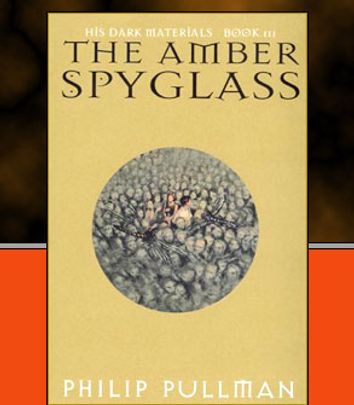
“The Amber Spyglass” is the final book in the most ambitious allegory being published today, Philip Pullman’s “His Dark Materials” trilogy. With epigraphs from William Blake, Rainer Rilke and John Ashbery, and tributes to John Milton and Henrich von Kleist in the acknowledgments, Pullman places himself in a tradition of serious symbol makers, which might be expected to intimidate the children to whom the series is directed (or, at least, to whom it was directed when he began it). But while Pullman may have become caught up in adult theology — and while he has won more grown-up readers with each “Dark Materials” book — he keeps the swooping plots and passionate characters that make his earlier books so appealing to young readers.
With fantasies, as with mysteries, the hardest part to get right is the end, where everything is revealed. The magical objects and unexplained forces that flourish in the genre easily lend themselves to anticlimax, disintegrating into mere mechanics or bluster once the author attempts to explain them or tie them together in the traditional apocalyptic battle at the end. Given the delicious promise of the first two “Dark Materials” books, some disappointment was almost inevitable. But “The Amber Spyglass” delivers surprisingly little of it; the latest novel is nearly as satisfying as the first two.
Each volume revolves around its title doohickey, while introducing child heroes, magical universes and mythic creatures. In “The Golden Compass,” the object is a mechanical device for seeking spiritual as well as physical direction. It belongs to young Lyra, an apparent orphan who lives among dons in an Oxford that somewhat resembles our own. In her world, though, people come in two parts. Everyone has a daemon — a talking animal companion that’s born with him and vanishes when he dies. It’s sort of like getting to keep your soul as a pet.
Children’s daemons can change shape at will, flitting from butterfly to dog to mouse, but once you hit adolescence your daemon settles into a fixed form that expresses your essence. Daemons are Pullman’s best invention. Everything about them seems exactly right, from their childhood mutability, to the fact that your daemon is always the opposite sex, to the way the daemon-person pairs echo and enhance each other. People and their daemons stick close to each other; the only folks who can spend more than a few moments apart from their daemons are witches. When Lyra discovers that someone’s kidnapping children — including her best friend — she sets off on a quest that carries her to the far north, home of witches and armor-clad bears.
“The Subtle Knife” introduces a new hero from our own world, Will, whose physicist father vanished mysteriously years ago. When sinister men come looking for his father, Will knows they’re threatening him, too. An urgent sense of danger propels him through a window into another world, where he finds Lyra and another of Pullman’s wonderful inventions: the title object, a knife so sharp it can cut through the substance that separates universes — and can kill daemons and angels.
Pullman certainly does good villains. There’s the seductive Mrs. Coulter and her daemon, a golden-furred monkey who likes to pull the wings off bats; the evil bureaucrats on the Oblation Board who calmly commit atrocities like cutting off children’s daemons in the name of scientific research; the Specters, wispy, floating horrors that feed on the souls of adults but are invisible and harmless to children. One fanatical priest, with a green, iridescent beetle for a daemon, demonstrates Pullman’s excellent grasp of institutional evil. He volunteers for a murder mission (with Lyra as the prospective victim), urging his practice of “preemptive penance” as a qualification:
Preemptive penance and absolution were doctrines researched and developed by the Consistorial Court, but not known to the wider Church. They involved doing penance for a sin not yet committed, intense and fervent penance accompanied by scourging and flagellation, so as to build up, as it were, a store of credit. When the penance had reached the appropriate level for a particular sin, the penitent was granted absolution in advance … It was sometimes necessary to kill people, for example; and it was so much less troubling for the assassin if he could do so in a state of grace. By the time Pullman reached “The Amber Spyglass,” he seems to have run out of steam on the doohickey front. The title object, a device for seeing Dust — the elementary particles of consciousness, golden specks that adhere to anything touched by a conscious being and are themselves conscious — plays only a very minor role in the plot. However, Pullman has mustered a spectacular array of forces in a three-sided battle for control over the universe of universes.
Authors of fantasy — children’s books in particular — frequently raid the religious myths of other cultures to supply their stories with depth and power: think of J.R.R. Tolkien and Norse myths, or Susan Cooper and religions of ancient Britain. Some borrow respectfully from their own sacred traditions — C.S. Lewis, for example, turned Jesus into a lion in the “Narnia” books. But Pullman takes a page from Blake, stealing characters out of the Judeo-Christian tradition, then switching the meaning of the roles. Like the gnostics, he raises hidden possibilities in the familiar story. Is God really the creator? Is the creator good or evil? Did the rebellious angels perhaps have a point, as America’s own Founding Fathers? Complex celestial politics, in which from time to time heroes betray their friends and villains save the day, add a frisson of heresy to the usual battle of dark and light.
In Pullman’s world, angels are long-lived and bodiless, but not necessarily immortal. As Lyra’s father, a powerful and ambiguous figure, explains it to a henchman, “Few as we are, and short-lived as we are, and weak-sighted as we are — in comparison with them, we’re still stronger. They envy us, Ogunwe! That’s what fuels their hatred, I’m sure of it. They long to have our precious bodies, so solid and powerful, so well-adapted to the good earth! And if we drive at them with force and determination, we can sweep aside those infinite numbers as you can sweep your hand through mist. They have no more power than that!” This weakness of angels can be comical, as when Will bosses around an enormously old and wise pair, or profoundly sad.
Lyra and Will’s adventures include a trip to the Underworld, complete with the ferryman of the dead and harpies guarding the gates. There Lyra meets her own personal death, and the children harrow hell, releasing the spirits. But ultimately, to save the world and establish the Republic of Heaven, they must make the ultimate sacrifice.
That’s where I felt a bit of disappointment sneak in. To make all the equations work out, Pullman has to introduce sexuality in characters that I felt were still too childlike for it to be convincing. He shuts doors and ties up loose ends in a way that feels, for the first time, slightly artificial. Still, that’s a very minor flaw in what stands with “The Lord of the Rings” as one of the most resonant fantasies of our time.
Continue Reading
Close
It has been many, many years since men — with their pollution, their demand for sons and their machinery of war — destroyed millions of people, changing the face of the planet we live on. Long ago, a few blond survivors waited out the worst of the Wasting in bunkers. Their descendants formed a new society called the Holdfast, based on domination: of women by men, of the young by the old, of the weak by the strong. But from time to time, a rare, brave woman escapes. Crossing the mountains, she exchanges slavery for life with the Riding Women, a race of people entirely independent of men.
Suzy McKee Charnas’ Holdfast Chronicles fall squarely in the tradition of feminist Utopias/dystopias that produced Joanna Russ’ “The Female Man” or Margaret Atwood’s “The Handmaid’s Tale,” nourishing writers like Ursula K. Le Guin and Sherri S. Tepper. The latest book in the series, “The Conqueror’s Child” (1999), recently won the James Tiptree Jr. Award, an annual literary prize for science fiction or fantasy that “explores and expands the roles of women and men.” Produced over the course of 30 years, the Holdfast tetralogy offers a fascinating look back at the permutations of the feminist imagination in recent years, and it underlines the ideals and challenges faced by feminists — sometimes on purpose and sometimes in spite of itself.
The first volume, “Walk to the End of the World” (1974), tells of underground rumblings among the slave women in the Holdfast as well as a rebellion among the young men, called Juniors, who scheme to wrest power from the ruling Seniors. Alldera, a “runner” or messenger, joins the rebel Juniors as a beast of burden, eventually winning her escape. In “Motherlines” (1978), she travels alone into what she imagines is empty land.
Starving, pregnant by one of the men who have raped her — Servan d Layo the DarkDreamer, a shamanlike leader of a warrior drug cult, or his lover, the executioner Eykar Bek — Alldera comes upon a cache of food near what look like the footprints of a monster. To Alldera, the Grasslands women and their horses are beings out of myth. To them, she’s a familiar problem — another runaway slave, a person to be viewed with pity and distrust.
Descended from a long-forgotten, pre-Wasting cloning experiment, the Riding Women reproduce parthenogenetically. Members of each Motherline, cousins with a single ancestress, look alike and share characteristic personality traits — quarrelsomeness, perhaps, or a solemn outlook, or a disturbing taste for novelty. Through them Alldera finds other Free Fems, Holdfast escapees like herself. In “The Furies” (1994), she leads the Free Fems in battle. With the help of horses, weapons and allies from the Grasslands, they conquer the Holdfast and enslave the men.
“The Conqueror’s Child,” the last and newest book in the Holdfast Chronicles, explores what sorts of societies are possible for the descendants of slaves. The narrator, Sorrel Alldersdaughter, has a problem with her blood mother. This passage from “Motherlines” should help explain why:
Alldera thought about her cub. It took many days’ thinking. Her mind, sluggish from starvation, turned slowly now. One night — in her fifth or sixth month, she could not tell, so starved and bloated was she — she dreamed of the cub: born plump and bloody, it was laid on a fire to cook. Then she ate it, ravenously taking back into her own body the substance of which the cub had been draining her all this time. Raised in the Grasslands according to the Riding Women’s system of shared motherhood, Sorrel feels abandoned by the woman who bore her. Alldera, who always resented her daughter, left her behind when she rode off to conquer the Holdfast, then never sent for her. When a pregnant Holdfast woman arrives in the Grasslands camp, gives birth to a son and dies, Sorrel identifies with the little boy. Everyone but Sorrel thinks that his maleness makes him a baby monster; no one else recognizes his essential humanity. Impulsively, she steals the child and rides with him to the Holdfast, where at least he won’t be the only boy. But she quickly realizes her mistake: In the new woman-dominated Holdfast, he has no future but slavery.
Rather than creating a straightforward, European-style patriarchy as a vehicle of male oppression or turning her feminine society into a lovey-dovey nurturefest, Charnas plays with social parameters, imagining the legacy of rage and fear. In the old Holdfast, for example, men don’t rule families; since sons are considered natural enemies of their fathers, the ruling Seniors make sure no man knows who his father is. Alliances form along generational lines, not familial ones. In the new Holdfast, women take much more interest in their children, nursing them until they’re old enough for the communal child-care center, then continuing a relationship with them into adulthood. But there’s no loving compassion for men. Called “stickies,” “cockies” or “muckies,” they’re kept in yokes and shackles for the most part, heavily guarded and treated with furious contempt.
In the newer books, Charnas introduces two more societies of survivors, inviting readers to draw comparisons. The Bayo-Born marsh women solve the problem of how to reap semen without keeping a lot of dangerous testosterone around by castrating the men after they’ve done their duty in bed. The dark-skinned people of the Pool Towns in the north live in more familiar family groups; men are leaders, but the sexes don’t consider each other enemies. In a way, this is the most equitable arrangement Charnas describes, but it’s also the most vulnerable. The Pool Towns fall prey to a roving band of old Holdfast Juniors led by d Layo. The men are slaughtered, the women enslaved.
Because Charnas began the series three decades ago, there’s something a little old-fashioned about even the new books. A feminist series begun today would surely address issues like AIDS and other physical consequences of sexuality, bioengineering and the theories of evolutionary psychologists. The Holdfast Chronicles are also oddly humorless, given how funny Charnas can be. In the late ’80s she wrote one of my favorite series of young-adult fantasies, the Sorcery Hall trilogy, about a Manhattan teenager who’s continually called upon to help her sorcerer grandmother save the world. The three generations of powerful women in that series, with their conflicts and alliances, cover ground that’s sometimes similar to that of the Holdfast Chronicles. Bringing some of the trilogy’s playfulness to the tetralogy need not have diluted the books’ impact, and it would have made them much more fun to read.
Continue Reading
Close
To ecologists and creators of drama alike, islands have much to recommend them. Isolated from the larger world, they conjure up their own societies and ecologies, filling the niches they create with characters or creatures evolved from the materials at hand. The same geography that bred “The Origin of Species,” “The Tempest” and “Lord of the Flies” is the hatching ground for “Galveston,” Sean Stewart’s beautifully written and muscular double coming-of-age fantasy.
When fantasists and science fiction writers want to create a self-contained world, they often pick a planet — an island surrounded by a vacuum. Stewart, however, stays Earth-bound off the Texas coast, rooting his story in our planet’s current history. In 1900 a flood changed the face of Galveston; 104 years later another flood — of magic, not water — disrupted the island utterly and sent the survivors into a state of siege.
Ever since Mardi Gras 2004, the island has been divided in two. Downtown, in Carnival, eternal night reigns. There, time stands still for a perpetual party hosted by the master of ceremonies, the hunchbacked god Momus. Meanwhile, beyond Carnival’s gates, Galveston’s leading citizens have been struggling for decades to hold their world together. The four Mardi Gras Krewes, clubs of townspeople who used to organize the Mardi Gras parade before the Flood, have grown in political power.
In the decades since, Grand Duchess Jane Gardner, Momus’ human consort, has ruled the island’s nonmagical society with an autocratic fist in a democratic glove, while Odessa the Recluse, nightclub owner and witch, uses her own magic to keep Momus’ magic confined within Carnival. When she detects any hint of magic in a Galveston resident, she makes a doll in his shape and uses it to “send him to the Krewes” — that is, trap him in Carnival.
As the book opens, the Grand Duchess is dying. Her daughter, Sloane, feels far from ready to assume the double mantle hanging over her head — Odessa, too, has chosen Sloane as her heir. Like someone in a Greek myth (Orpheus? Demeter and Persephone in reverse?), Sloane seeks out Momus in the hellish Carnival to bargain for her mother’s life. She’s desperate enough to ignore an age-old rule: Try to trick a trickster, and you’ll find yourself tricked.
“Are you glad to see me, Stepdaughter?” “Honored,” Sloane meant to say — but the word turned in her mouth and “Horrified” came out instead. She yelped and covered her mouth with her hand.“You are not in your mother’s house, Sloane. With me, you will speak only the truth.” Momus patted her fondly.
Unable to choose her own words, Sloane extracts an ambiguous promise from the god: “‘I just can’t stand to see her die,’ she cries. ‘Will you help me?’ The sea broke and hushed, broke and hushed like the slow beating of the world’s heart. ‘I will,’ said Momus.”
Sloane’s visit to Carnival brings her into contact with the book’s other young protagonist, Josh Cane. Josh has always carried a torch for aristocratic Sloane, his childhood playmate. The son of a gambler who vanished after his luck ran out and a diabetic pharmacist who died after she’d used up the last pre-Flood supplies of insulin, Josh has come down so far in the world that Sloane no longer recognizes him when he and his best buddy, Ham, rescue her from rapists after she stumbles out of Carnival.
The eternal Mardi Gras allows Stewart to create a wonderfully creepy carny atmosphere of ominous gaiety. It’s a bit like an Angela Carter novel. Things seem a little off at first, then escalate feverishly. Sloane arrives in Carnival (“‘Admission is always free.’ The ticket-taker chuckled. ‘You’ll do your paying inside’”), then notices the oddness:
No, wait — looking closer she realized that many in the crowd were not wholly human. A feathered woman stood on one leg like a heron, squinting hard as she tried to guess the Fat Lady’s weight. A man munching on a D-cell battery as if it were a pickle passed not three feet from where Sloan was lurking.Stewart’s gently twisted humor saturates his plot as well as his language and imagery. For example, in one grim but funny scene late in the novel, a cannibal inquires in a roundabout way about whether it will be safe to eat his beloved after she dies of tuberculosis. (The answer is yes, as long as he cooks her.)
Through Odessa’s magic, Stewart multiplies Sloane into a trio of doppelgdngers. There’s Sloane herself, obedient, insecure, unready; there’s confident, foxy Sly, the character she becomes when she dons the Mardi Gras mask Odessa makes for her; and there’s Scarlet, another creation of Odessa’s, a feisty doll-child who contains Sloane’s heart. To become fully adult, which she must do to save her community, Sloane has to integrate these three parts of herself.
Stewart spends equal attention on the subtly mapped friendship between arrogant Josh and warmhearted, gentle, foulmouthed, working-class Ham:
Once, when they were both thirteen, they had been out walking together when Josh said, “I don’t know why we stay friends, but I sure am glad of it.” “We stay friends because you think you’re better than me,” Ham had said, “and I let you.” That had shut Josh up in a hurry.When Sloane disappears into Carnival in the wake of a family disaster, Josh and Ham find themselves arrested for her murder. Can their friendship survive torture, exile to the cannibal-ridden shores of the mainland and sexual rivalry? Can Ham teach Josh that no man is an island? Will they and Sloane manage to find enough personal and political authority to keep Galveston from flying apart into magic and anarchy? In this tricky, twisty book, the answers are never quite what you’d expect, but they’re always illuminating.
Continue Reading
Close
“Truth, I have learned, differs for everybody,” opines Oelph, the slightly pompous narrator of Iain M. Banks’ new novel, “Inversions.” “Just as no two people ever see a rainbow in exactly the same place — and yet both most certainly see it, while the person seemingly standing right underneath it does not see it at all — so truth is a question of where one stands, and the direction one is looking in at the time.” If that’s not a warning against unreliable narrators, I don’t know what is. The Pontius Pilate-like statement seems reasonable yet treacherous, calling into question its utterer’s ethics. It’s typical of Banks: In book after book, he takes as his themes betrayal, deception and loyalty.
Banks began his career in 1984 with “The Wasp Factory,” a claustrophobic novel about a cruelly dysfunctional family. Variously confined — to a madhouse, to a small island off the coast of Scotland or by their own warped intentions — the family members struggle to express themselves by controlling one another’s fate. Their self-realization takes dangerous forms: murder, arson and worse. The narrator, a lonely adolescent who enjoys burning wasps and blowing up bunnies, claims to have murdered three children, two of his cousins and one of his brothers. The methods he used are ingenious if incredible: hiding an adder in a boy’s prosthetic leg, tying a girl to a huge kite and letting her blow away. He describes the murders matter-of-factly, though with a tinge of pride, as if any sensible person in similar circumstances would have done the same thing if he’d thought of it. Compared to his surviving brother, an asylum escapee who burns dogs alive, the narrator considers himself the sane one.
While it’s bone-chillingly weird, “The Wasp Factory,” one of more than a dozen novels by Banks, takes place on Earth and follows the familiar laws of physics. He also writes science fiction. These novels — the ones I’ve read, at least — share with the “literary” books their author’s twisted imagination and his fascination with deliberately inflicted pain. Yet because the conventions of science fiction are so much odder than those of straight fiction, Banks’ science fiction books seem more conventional. In them, he wraps his psychological concerns in crisp, imaginative prose, suspenseful plots and plausible — or at least enjoyable — technology.
Readers who like spaceships, worm holes and intrusions from other dimensions might want to start with “Excession,” a 500-page sprawl with the obsessive structure of a paranoid fantasy. The Culture, a loose hegemony of societies made up of biological and machine-based individuals, is alarmed to discover an excession — a small oval object that seems to have come from another dimension. Worried that the intruder intends to take over the universe, the Culture sends in its crack intelligence team, a club of Minds — immortal spaceships who wisecrack and conspire like a chatroom full of insomniacs. Word leaks out, war starts and the plot gyrates, showcasing Banks’ obvious delight in teasing his characters.
The new novel, “Inversions,” is a much more tightly structured story in the political-intrigue-on-a-foreign-planet subgenre. On a world that many inhabitants still believe to be flat, feudal leaders of regions formerly united under an emperor plot to gather power into their own hands. Their spies often find it wise to save their most nefarious acts for the rare nights when all six moons are dark.
“Master, it was in the evening of the third day of the southern planting season that the questioner’s assistant came for the Doctor to take her to the hidden chamber, where the chief torturer awaited.” So writes Oelph, the apprentice to King Quience’s personal physician. The “master” he addresses is an unnamed figure presumably in the king’s court, and part of “Inversions” takes the form of Oelph’s secret reports to this shadowy person. They alternate, chapter by chapter, with another account of palace intrigue, set half a planet away in Tassassen, another fragment of the former empire. The second story centers on a figure named DeWar, bodyguard to General UrLeyn, prime protector of Tassassen. It’s not clear until near the book’s end what the two strands have to do with each other.
Anyone might be a spy; we know Oelph is. Has he betrayed his mistress (already, on the first page of Chapter 1)? Is she about to be tortured? The doctor has many enemies. For one thing, she’s a foreigner, whose origins are never completely explained. As the king’s personal physician, she has his ear. It’s an unheard of position for a woman, one she won with her healing skill. Unlike all the other physicians in Quience’s kingdom, who believe in humors and bloodletting, she holds with what readers will recognize as the underpinnings of modern medicine: germ theory, scientific method, the importance of washing your hands before cutting into a patient.
Dr. Vosill’s medical rectitude stands for and reinforces our gradually building sense of her moral rectitude. Oelph, it becomes clear, is in love with her. She seems to trust him entirely, confiding in him and teaching him her medical secrets. So why does he file reports on her, and even steal one of her scalpels to hand over to his “Master”? Who is this master? What binds Oelph to him? Does the king deserve Vosill’s devotion?
Parallel to Vosill’s story, DeWar’s gradually reveals layers of scheming and disloyalty. Like Vosill, DeWar has come from a far land — the same one? — to serve a ruler in an intimate capacity. As UrLeyn’s bodyguard, he often risks his life for the general. Only Perrund, a favored concubine, shares as much of UrLeyn’s trust. She lost the use of one arm saving him from a dagger blow. Yet the general’s fortunes are falling, and someone close to him evidently wishes him ill. It’s a fascinating puzzle to sort out the goodies from the baddies, when Oelph’s creepy vision casts a shadow over everyone’s agendas.
For Banks, the question of betrayal ultimately comes down to motive. If you win your enemy’s trust, what do you owe him? What’s fair in love and war? By giving his characters a constellation of contradictory loyalties and requiring them to choose, Banks obscures the distinction between good guy and bad guy, allowing him to pack his endings with drama and unease.
Continue Reading
Close
In Graham Joyce’s 1996 novel “The Tooth Fairy,” a young boy develops a dysfunctional sexual relationship with the eponymous sprite. In 1999′s “Dark Sister,” a woman who uncovers a century-old diary kept by a witch finds herself compelled to cast the spells it contains. And in “Indigo,” published this month, a charismatic millionaire leads a group of young people on a deadly search for a color no one’s ever seen. These are fantasies, right?
Well, maybe. Joyce walks with the grace of a circus star, or a Henry James, on that narrow line between seeming and being. Can Maggie really transform herself into a bird, or is she just high on the herbs that go into her potions? Did Sam invent the tooth fairy, as his parents and his psychiatrist believe, or did the fairy invent Sam, as the creature insists? Do the indigo seekers see true visions or psychotic hallucinations? Joyce builds suspense by keeping his readers guessing up to the very end — and sometimes beyond.
Beyond, of course, is better. Readers of Lewis Carroll will remember that faint but persistent sense of betrayal when Wonderland turns out to be nothing but Alice’s dream. And imagine what a letdown “The Turn of the Screw” would be if men in white jackets carted off the governess for thinking she saw ghosts. Still, Joyce feels the need to settle the matter in two of these three novels (I haven’t read his other two). He answers the question “Magic?” with a definitely not, an almost certainly and a keep guessing; I won’t say which is which. Was he (or his publisher) hoping he could make the switch from fantasy to more mainstream thrillers? Having tested each option, perhaps he’ll realize that nightmares are most powerful if the dreamer never wakes.
Whether you call them fantasies or psychological thrillers, the novels share a dark vision of how people can hurt each other and lose themselves. Appropriately for both genres — after all, fantasies, like dreams, are classic shrink fodder — they dwell on the sorts of scenes and themes that make therapists sit up and take notes: incestuous desires, guilt and power, lost body parts, the causes and consequences of violence, the effect of battling parents on their offspring. Perhaps not surprisingly, psychologists play a prominent role in all three books.
In “The Tooth Fairy,” a horrific yet entrancing coming-of-age tale, trouble begins for Sam, more or less, when he loses a tooth at age 6. To test whether the tooth fairy really exists, he tucks it under his pillow without telling his parents. That night an intruder appears, a shadow with pointy, glowing blue teeth and a peculiar smell. “In addition to the scent of grass after rain was the odor of horse’s sweat, and birdshit, and chamomile.” Sam’s ability to see the fairy upsets the sprite as much as the boy, yet it keeps coming back for more. Sometimes, as in the memorable scene when it exposes itself in church and makes Sam do the same, it’s clearly male; at other times it’s just as clearly female. Its scent shifts around too: marsh gas and mushrooms dipped in honey when it’s a girl, a whiff of burning when it’s a boy and mad. “‘You want to know what pisses me off about you?’” it yells at Sam during one visit. “‘You’re always looking at things. Always looking at things you shouldn’t be looking at! You gonna stop? — Gonna stop seeing things, you google-eyed fuck?’”
Eventually Sam spills the beans about the terrifying visits. To help him stop seeing things, his parents send him to see Dr. Skelton, a hard-drinking Scotsman. The psychologist is given to exercises like advising Sam to snitch condoms from his parents or handing him an imaginary gun and telling him to shoot the tooth fairy. Sam’s first ejaculation follows fast on the heels of that particular bit of advice; when he next sees the tooth fairy, female now, it’s not imaginary bullets that he fires at her.
Parallel to his scary but pleasurable relationship with the tooth fairy, Sam leads a more conventional secret life. With Clive and Terry, his two best buddies, he likes to set fires and smash up public property. The tooth fairy ducks in and out of both sides of Sam’s double life, alternating between getting him in trouble and saving him disastrously. When Terry’s father shoots his family and himself, is it the tooth fairy’s fault? Or did the sprite save Terry’s life that night by insisting that Sam invite him over for a sleepover? Did the tooth fairy kill the Boy Scout who was about to rape Clive? Did Sam? Dr. Skelton, the ostensible voice of reason who should be sorting all this out, sinks deeper and deeper into alcoholic fuddle, even going so far as to see the tooth fairy himself.
With its genre-busting fairy and its sensitive rendering of childhood guilt, “The Tooth Fairy” should make readers see adolescence in a whole new way. “Dark Sister” and “Indigo,” however, while more tightly constructed, are also more conventional.
“Dark Sister” is a strangely old-fashioned feminist fable. Maggie, a suburban housewife and mother of two, longs to do something more with her life — take a course in psychology, perhaps. But Alex, her husband, won’t let her. He’s threatened by the possibility of her independence. Bored, Maggie becomes obsessed by a diary they turn up when renovating their fireplace. New entries and weird recipes appear in it daily, as if newly written. Her passion for the book’s revelations and its dead author carry her further from Alex’s control than any mere course could do, linking her with a sexy herbalist, an elderly wise woman and ultimately a whole genealogy of witches. But her new inheritance brings with it danger as well as power — witches, after all, tend to get burned, drowned, buried alive. It takes a daughter, a goddess and a line of elder sisters to rescue her from phallocentric violence and return her to her chastened husband.
Like “Dark Sister,” “Indigo” has a violent core and a ’70s aura — in this case, of druggie cults. Before he can receive any money from the estate of his manipulative father, Jack Chambers must find the missing heir, a mysterious young woman named Natalie, and publish a manuscript his father left behind. It’s a guide to a spiritual pilgrimage Tim Chambers had embarked on, gathering a crowd of susceptible young followers: the quest for the elusive color indigo, which can render the adept invisible. Here’s a sample of Tim’s writing: “Darkness, and its attendant properties of shade, shadow, silhouette, adumbration, and the like, are all the allies you need in your sorcery. Twilight, as you will see, is the crack between the worlds. Similarly the grey light of dawn.” As he attempts to carry out his father’s will, Jack finds himself falling in love with his half-sister and testing out his father’s brand of sorcery. It’s a well-built thriller, complete with a genuinely chilling revelation about the true meaning of indigo.
Joyce bundles redemption with horror, horror with redemption. For every character who loses her mind or his toes, there’s another who gains a voice or redeems the mistakes of her parents — and vice versa. Before he kills himself, Terry’s father in “The Tooth Fairy” invents a “Nightmare Interceptor” — an alarm clock with a sensor that clips to a sleeper’s nose, waking him when things get too bad. While it can’t save the life of its inventor, it does offer the younger generation the chance to take a reality check. But Joyce understands its danger: Once your life starts to feel like a dream, you better be careful with alarm clocks.
Continue Reading
Close