On Sept. 16, 2007, a convoy of Blackwater contractors guarding State Department employees entered a crowded square near the Mansour district in Baghdad, Iraq. But versions of what caused the ensuing bloodshed diverge. Employees from the firm claim they were attacked by gunmen and responded within the rules of engagement, fighting their way out of the square after one of their vehicles was disabled. Iraqi police and witnesses instead report that the contractors opened fire first, shooting at a small car driven by a couple with their child that did not get out of the convoy’s way as traffic slowed. At some point in the 20-minute gunfight, Iraqi police and army forces stationed in watchtowers above the square also began firing. Other Iraqi security forces and Blackwater quick-reaction forces soon reportedly joined the battle. There are also reports that one Blackwater employee may even have pointed his weapon at his fellow contractors, in an effort to get them to cease firing.
Since then, the Iraqi and U.S. governments have launched separate investigations, likely ensuring that the differing versions of the story will never meet. The only thing agreed upon is the consequences: After a reported 20 Iraqi civilians were killed, including the couple and their child, who was subsequently burned to the mother’s body after the car caught fire, the Iraqi government and populace exploded with anger.
Iraqi Prime Minister Nouri al-Maliki called the killings a crime, announcing that his government was pulling Blackwater’s license to operate in Iraq and would prosecute any foreign contractors found to have been involved in the killings. But there were two problems: Despite its mission of guarding U.S. officials in Iraq, Blackwater had no license with the Iraqi government. Secondly, the murky legal status of the contractors meant they might be considered exempt from Iraqi law because of a mandate left over from the Coalition Provisional Authority, the U.S. governing authority in Iraq that was dissolved more than two years prior.
The Blackwater mess has roiled Capitol Hill and shined light on the many questions surrounding the legal status, management, oversight and accountability of the private military force in Iraq, which numbers more than 160,000 — at least as many as the total number of uniformed American forces there. The debate will heat up again Tuesday with hearings by the House Oversight and Government Reform Committee led by Democratic Rep. Henry Waxman of California. The problem is, some of the most critical questions may yet go unasked.
I’ve done a decade’s worth of research and writing on the military’s use of private contractors, including hundreds of interviews and discussions with everyone from employees of private military firms to active and retired soldiers, ranging from four-star generals down to line infantry. I have reported my findings to audiences including the U.S. military, the CIA and the State Department. Although I’ve been approached with multiple offers (as well as varied threats) from those in the private military industry, I am not paid either to lobby for the industry or to attack it, and the findings in this report are my own.
When we evaluate the facts, the use of private military contractors appears to have harmed, rather than helped, the counterinsurgency efforts of the U.S. mission in Iraq, going against our best doctrine and undermining critical efforts of our troops. Even worse, the government can no longer carry out one of its most basic core missions: to fight and win the nation’s wars. Instead, the massive outsourcing of military operations has created a dependency on private firms like Blackwater that has given rise to dangerous vulnerabilities.
On Tuesday, among those testifying on Capitol Hill will be Erik Prince, the chairman and owner of Blackwater, as well as a series of State Department officials who were supposed to have overseen the firm’s activities. We can expect that Prince will wrap himself in the flag, discussing all the vital missions that Blackwater conducts in Iraq, while downplaying the recent killings. State Department officials are likely to say that they had no other option but to use the firm, given their lack of Diplomatic Security forces — conveniently ignoring that the department has chosen to hollow out its Diplomatic Security corps and instead hand over the task to a consortium of private firms led by Blackwater under a multibillion-dollar contract.
Waxman’s committee, which has already been focused on politically connected companies and contracting corruption in Iraq, has disclosed a series of documents in recent days that reveal some dark patterns with Blackwater. The documents appear to show that the firm cut corners that may have contributed to employee deaths, it may have tried to have documents classified in order to cover up corporate failures, and the State Department’s own inspector general may have tried to impede investigations into Blackwater, including threatening to fire any of his inspectors who cooperated with Congress.
Prince will take his shots, and State officials will point to new investigations they are now launching to try to mollify congressional anger. But regardless of whether the Blackwater contractors were justified in the shooting, whether there was proper jurisdiction to ensure accountability, or even whether using firms like Blackwater saves money (the data shows it does not), there is an underlying problem that everyone is ignoring.
Our dependency on military contractors shows all the signs of the last downward spirals of an addiction. If we judge by what has happened in Iraq, when it comes to counterinsurgency and the use of private military contractors, the U.S. has locked its national security into a vicious cycle. It can’t win with them, but can’t go to war without them.
When the U.S. military shifted to an all-volunteer professional force in the wake of the Vietnam War, military leaders set up a series of organization “trip wires” to preserve the tie between the nation’s foreign policy decisions and American communities. Led by then Army Chief of Staff Gen. Creighton Abrams (1972-74), they wanted to ensure that the military would not go to war without the sufficient backing and involvement of the nation. But much like a corporate call center moved to India, this “Abrams Doctrine” has since been outsourced.
The use of contractors in Iraq is unprecedented in both its size and scope. Estimates of the number of contract personnel in Iraq vary widely. In 2006, the United States Central Command estimated the number to be around 100,000. (That it turned out to be such a perfectly round figure indicated that the estimate was actually what researchers call a “WAG,” short for “wild ass guess.”) In 2007, an internal Department of Defense census on the industry found almost 160,000 private contractors were employed in Iraq (roughly equal to the total U.S. troops at the time, even after the troop “surge”). Yet even this figure was a conservative estimate, since a number of the biggest companies, as well as any firms employed by the State Department or other agencies or NGOs, were not included in the census.
What matters is not merely the numbers, but the roles that private military contractors play. In addition to war gaming and field training U.S. troops before the invasion, private military personnel handled logistics and support during the war’s buildup. The massive U.S. complex at Camp Doha in Kuwait, which served as the launch pad for the invasion, was not only built by a private military firm but also operated and guarded by one. During the invasion, contractors maintained and loaded many of the most sophisticated U.S. weapons systems, such as B-2 stealth bombers and Apache helicopters. They even helped operate combat systems such as the Army’s Patriot missile batteries and the Navy’s Aegis missile-defense system.
Private military firms — ranging from well-established companies, such as Vinnell and MPRI, to start-ups, such as the British Aegis — have played an even greater role in the post-invasion occupation. Halliburton’s Kellogg, Brown and Root division, recently spun off into its own firm, currently runs the logistics backbone of the force, doing everything from running military mess halls to moving fuel and ammunition. Other firms are helping to train local forces, including the new Iraqi army and national police.
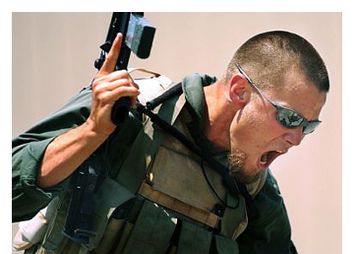
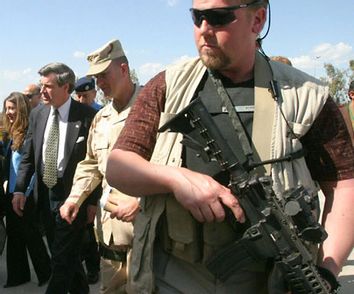
Then there are the firms such as Blackwater that have played armed roles within the battle space. These firms do everything from helping guard facilities and bases to escorting “high-value” individuals and convoys, arguably the most dangerous job in all of Iraq. Such firms are frequently described as “private security” or “bodyguards,” but they are a far cry from rent-a-cops at a local mall, or bodyguards for Hollywood celebrities. They use military training and weaponry to carry out mission-critical functions that would have been done by soldiers in the past, in the midst of a combat zone against fellow combatants. In 2006, the director of the Private Security Company Association of Iraq estimated that just over 48,000 employees from 181 of such “private security companies” were working in Iraq.
As it has been planned and conducted to date, the war in Iraq would not be possible without private military contractors. Contrary to conspiracy theories, the private military industry is not the so-called decider, plotting out wars behind the scenes like Manchurian Global. But it has become the ultimate enabler, allowing operations to happen that might otherwise be politically impossible. The private military industry has given a new option that allows the executive branch to decide, and the legislative branch to authorize and fund, military commitments that bypass the Abrams Doctrine.
It is sometimes easier to understand this concept by looking at the issue in reverse. If a core problem that U.S. forces faced in the operation in Iraq has been an insufficient number of troops, it is not that the U.S. had no other choices other than using contractors. Rather, it is that each of them was considered politically undesirable.
One answer to the problem of insufficient forces would have been for the executive branch to send more regular forces, beyond the original 135,000 planned. However, this would have involved publicly admitting that those involved in the planning — particularly then-Defense Secretary Donald Rumsfeld — were wrong in their slam of critics like Army Gen. Eric Shinseki, who warned that an occupation would require far more troops. Plus, such an expanded force would have been onerous on the overall force, creating even more tradeoffs with the war in Afghanistan, as well as broader global commitments.
Another option would have been a full-scale call-up of the National Guard and Reserves, as originally envisioned for such major wars in the Abrams Doctrine. However, to do so would have prompted massive outcry among the public (as now the war’s effect would have been felt deeper at home) — the last thing leaders in the executive branch or Congress wanted as they headed into what was a tight 2004 election season.
Some proposed persuading other allies to send their troops in to help spread the burden, much as NATO allies and other interested members of the U.N. had sent troops to Bosnia and Kosovo. However, this would have involved tough compromises, such as granting U.N. or NATO command of the forces in Iraq or delaying the invasion, options in which the administration simply had no interest. This was the war that “was going to pay for itself,” as leaders like then Deputy Secretary of Defense Paul Wolfowitz infamously described in the run-up to the invasion, and to share in the operation was to share in the spoils. Plus, much of the world was vehemently opposed to the war, so it was unlikely that NATO allies or the U.N. would agree to send the needed number of troops.
The private military industry was an answer to these political problems that had not existed in the past. It offered the potential backstop of additional forces, but with no one having to lose any political capital. Plus, the generals could avoid the career risk of asking for more troops.
That is, there was no outcry whenever contractors were called up and deployed, or even killed. If the gradual death toll among American troops threatened to slowly wear down public support, contractor casualties were not counted in official death tolls and had no impact on these ratings. By one count, as of July 2007, more than 1,000 contractors have been killed in Iraq, and another 13,000 wounded. (Again, the data is patchy here, with the only reliable source being insurance claims made by contractors’ employers and then reported to the U.S. Department of Labor.) Since the troop “surge” started in January 2007, these numbers have accelerated — contractors have been killed at a rate of nine per week. These figures mean that the private military industry has suffered more losses in Iraq than the rest of the coalition of allied nations combined. The losses are also far more than any single U.S. Army division has experienced.
Hence, while private losses were just the “cost of doing business” for a firm in Iraq, they actually had an undisguised advantage to policymakers. The public usually didn’t even hear about contractor losses, and when they did, they had far less blowback on our government. For all the discussion of contractors as a “private market solution,” the true costs that they hope to save are almost always political in nature.
And when we weigh the devastating consequences that the Iraq war has had on America’s broader security and standing in the world, this enabling effect of the private military industry may be its ultimate cost. The underlying premise of the Abrams Doctrine was that, if a military operation could not garner public support of the level needed to involve the full nation, then maybe it shouldn’t happen in the first place.
That debate over the ultimate costs of Iraq is one for historians to weigh now. What is clear, however, is that the enabling effect of the military contractor industry is not simply in allowing the operation to occur, but also in how it reinforces our worst tendencies in war.
Lobbyists for military contractors like to talk up how the U.S. war effort is the best supplied and supported military operation in history. Doug Brooks of the International Peace Operations Association, an industry trade group, says, “The fact that troops are going to Iraq right now and actually, in 120 degree weather, putting on weight, kind of shows we are doing too much to support.” Brooks is correct on many counts. The operation is one of the most lavishly supported ever, and most of that has been due to contractors to whom we have outsourced almost all the logistics, and the protection of that enormous supply chain.
But it has proven to be remarkably inefficient, all the while undermining our counterinsurgency efforts. According to testimony before the House Committee on Oversight and Government Reform, the Defense Contract Audit Agency has identified more than a staggering $10 billion in unsupported or questionable costs from battlefield contractors — and investigators have barely scratched the surface.
Such corruption doesn’t just represent lost funds; it represents lost opportunities for what those funds could have been used on to actually support the mission: everything from jobs programs to get would-be insurgents off the streets to flak vests and up-armored vehicles for our troops. The situation got so bad that in August the special inspector general for Iraq reconstruction (SIGIR) dubbed corruption as the “second insurgency” in Iraq.
While no one would argue that our uniformed soldiers do not deserve the utmost in support, contractors appear to have used this opening to drive a gold-plated train through (or, in the slang of KBR truckers, an opportunity to ship “sailboat fuel,” meaning charge for nothing). Halliburton’s contract has garnered the firm $20.1 billion in Iraq-related revenue and helped the firm report a $2.7 billion profit last year. To put this into context, the amount paid to Halliburton-KBR is roughly three times what the U.S. government paid to fight the entire 1991 Persian Gulf War. When putting other wars into current dollar amounts, the U.S. government paid just this one firm about $7 billion more than it cost the United States to fight the American Revolution, the War of 1812, the Mexican-American War and the Spanish American War combined. (More, the $2.2 billion that the U.S. Army has claimed Halliburton overcharged or failed to document is almost double the amount in current dollars that it cost the U.S. to fight the Mexican-American War, which gained the territories of Arizona, New Mexico and California.)
Turning logistics and operations into a for-profit endeavor helped feed the Green Zone mentality problem of sprawling bases, which runs counter to everything Gen. David Petraeus pointed to as necessary to winning a counterinsurgency in the new Army/USMC manual he helped write. As retired Marine Col. and expert on “4th generation” war T.X. Hammes described the effect of a profit-seeking approach in an interview with “Frontline”: “We get a little carried away, and then we gold-plate … They could do it, so they did, because it’s just money.”
Basically, the bigger the bases, the more fast-food franchises, the more salsa dance lessons — and the more money the firms make, while wrapping themselves in the flag. But while bigger bases may yield more money for stockholders, they disconnect a force from the local populace and send a message of a long-term occupation, both major negatives in a counterinsurgency. Moreover, it puts more convoys on the roads, angering the Iraqis and creating more potential targets for insurgents. “It’s misguided luxury … Somebody’s risking their life to deliver that luxury,” Hammes says, adding, “Fewer vehicles on the road creates less tension with the locals, because they get tired of these high-speed convoys running them off the road.”
For all the hubbub over the recent Blackwater incident, the American public remains largely unaware of the private military industry. While private forces make up more than 50 percent of the overall operation in Iraq, according to a study by the Project for Excellence in Journalism, they have been mentioned in only a quarter of 1 percent of all American media stories on Iraq.
Yet, at the same time, contractors are one of the most visible and hated aspects of the American presence in Iraq. “They seal off the roads and drive on the wrong side. They simply kill,” Um Omar, a Baghdad housewife, told Agence France Press about Blackwater in a report in mid-September. A traffic policeman at Al-Wathba square in central Baghdad concurred: “They are impolite and do not respect people, they bump other people’s cars to frighten them and shout at anyone who approaches them … Two weeks ago, guards of a convoy opened fire randomly that led to the killing of two policemen … I swear they are Mossad,” he said, referring to the Israeli spy service, which is a catch-all for anything perceived as evil in the Arab world.
It is also important to note that Iraqi civilians do not differentiate the acts of the private military contractors from the overall U.S. military effort, just because they are outside the chain of command.
The point here is not that all contractors are “cowboys,” “unprofessional” or “killers,” as Blackwater and other contractors are often described. Most are highly talented ex-soldiers. However, their private mission is different from the overall public operation. Those, for example, doing escort duty are going to be judged by their corporate bosses solely on whether they get their client from point A to B, not whether they win Iraqi hearts and minds along the way. Ann Exline Starr, a former Coalition Provisional Authority advisor, described the difference between when she traveled with a U.S. military escort and with guards from Blackwater and another State Department-contracted security firm, DynCorp. While the uniformed soldiers kept her safe, they also did such things as playing cards and drinking tea with local Iraqis. The private contractors had a different focus. “What they told me was, ‘Our mission is to protect the principal at all costs. If that means pissing off the Iraqis, too bad.’”
This “protection first and last” mentality has led to many common operating practices that clearly enrage locals. In an effort to keep potential threats away, contractors drive convoys up the wrong side of the road, ram civilian vehicles, toss smoke bombs, and fire weaponry as warnings, all as standard practices. After a month spent embedded with Blackwater contractors in Baghdad, journalist Robert Young Pelton said, “They’re famous for being very aggressive. They use their machine guns like car horns.”
As far back as 2005, U.S. officers in Iraq such as Col. Hammes were worried that while contractors may have been fulfilling their contract, they were also “making enemies each time they went out.” U.S. Army Col. Peter Mansoor, one of the leading experts on counterinsurgency, similarly noted in January 2007, that “if they push traffic off the roads or if they shoot up a car that looks suspicious, whatever it may be, they may be operating within their contract — to the detriment of the mission, which is to bring the people over to your side. I would much rather see basically all armed entities in a counter-insurgency operation fall under a military chain of command.”
The formula for failure isn’t hard to calculate. An Iraqi is driving in Baghdad, on his way to work. A convoy of black-tinted SUVs comes down the highway at him, driving in his lane, but in the wrong direction. They are honking their horns at the oncoming traffic and firing machine gun bursts into the road, in front of any vehicle that gets too close. The Iraqi veers to the side of the road. As the SUVs drive by, Western-looking men in sunglasses point machine guns at him. Over the course of the day, that Iraqi civilian might tell X people about how “the Americans almost killed me today, and all I was doing was trying to get to work.” Y is the number of other people that convoy ran off the road on its run that day. Z is the number of convoys in Iraq that day. Multiply X times Y times Z times 365, and you have the mathematical equation of how to lose a counterinsurgency within a year.
And these are standard occurrences that go on in the regular course of contractor operations, where no one is actually harmed. Unfortunately, however, contractors have also been involved in a pattern of abuses that go far beyond the recent Blackwater incident.
For example, a reported 100 percent of the translators and up to 50 percent of the interrogators at the Abu Ghraib prison were private contractors from the Titan and CACI firms, respectively. The U.S. Army found that contractors were involved in 36 percent of the proven abuse incidents from 2003-04 and identified six particular employees as being culpable in the abuses. However, while the enlisted U.S. Army soldiers involved in the Abu Ghraib abuse were properly court-martialed for their crimes, three years later not one of the private contractors named in the U.S. Army investigation reports has been charged, prosecuted or punished.
In another incident in 2005, armed contractors from the Zapata firm were detained by U.S. forces, who claimed they saw the private soldiers indiscriminately firing not only at Iraqi civilians, but also at U.S. Marines. Again, they were not charged, as the legal issues remained murky.
Other cases in 2006 included the Aegis company’s “trophy video,” in which contractors set video of them shooting at civilians to Elvis’ song “Runaway Train,” and put it on the Internet, and the alleged joyride shootings of Iraqi civilians by a Triple Canopy supervisor (which became the subject of a lawsuit after the two employees, who claim to have witnessed the shootings, lost their jobs).
Blackwater is thus not the only company to be accused of incidents that negatively impact the battle to win hearts and minds. But Blackwater has earned a special reputation among Iraqis. Much of this stems from the highly visible role it has played in escorting U.S. officials. Iraqi government officials claim that there have been at least seven incidents of civilian harm in which the company has been involved. The most notable that has been reported in the press was on Christmas Eve 2006, when a Blackwater employee allegedly got drunk while inside the Green Zone in Baghdad and got in an argument with a guard of the Iraqi vice president. He then shot the Iraqi dead. The employee was quickly flown out of the country. Nine months later, he has not been charged with any crime. Imagine the same thing happening in the U.S. — an Iraqi embassy guard, drunk at a Christmas party in D.C., shooting a Secret Service agent guarding Vice President Cheney — and you can see some potential for how Blackwater’s Christmas tidings were not happy ones for U.S. efforts at winning hearts and minds.
In May 2007, there were two more reported shootings of Iraqi civilians by Blackwater contractors, including an Interior Ministry employee, which led to an armed standoff between the firm and Iraqi police. Thus, many felt the great tension between the firm and the locals would soon erupt. In the weeks before the September killings, Matthew Degn, a senior American civilian advisor to the Interior Ministry’s intelligence directorate, described Blackwater as giving rise to “a powder keg” of anger.
U.S. military officers frequently express their frustrations with sharing the battlefield with such private forces operating under their own rules and agendas, and worry about the consequences for their own operations. As far back as 2005, for example, Brig. Gen. Karl Horst, deputy commander of the U.S. 3rd Infantry Division (responsible for security in the Baghdad area at the time), tried to keep track of contractor shootings in his sector. Over the course of two months, he found 12 shootings that resulted in at least six Iraqi civilian deaths and three more wounded. As Horst tellingly put it, “These guys run loose in this country and do stupid stuff. There’s no authority over them, so you can’t come down on them hard when they escalate force. They shoot people, and someone else has to deal with the aftermath.”
Several weeks before the most recent Blackwater incident, an Iraqi official explained how the contractors’ actions were reverberating against the wider U.S. effort in Iraq and beyond. “They are part of the reason for all the hatred that is directed at Americans, because people don’t know them as Blackwater, they know them only as Americans. They are planting hatred, because of these irresponsible acts.”
The Iraqi official’s view is echoed by many. Jack Holly is a retired Marine colonel who, as director of logistics for the U.S. Army Corps of Engineers, has worked with several firms in Iraq. As an example of the costs to key efforts, he described how Iraqi employees of the national rail system were so intimidated by Blackwater escorts that they refused to meet with State Department officials there to help them with the reconstruction effort. Of the Blackwater contractors he noted, “Their aggressive attitude is not what you would say is trying to mitigate disagreements between two societies.”
These perceptions of a contractor force run amok help to undermine the very justification for the U.S. effort in Iraq. As an Interior Ministry official said of the Blackwater contractors hired by the U.S., “They consider Iraqis like animals, although actually I think they may have more respect for animals. We have seen what they do in the streets. When they’re not shooting, they’re throwing water bottles at people and calling them names. If you are terrifying a child or an elderly woman, or you are killing an innocent civilian who is riding in his car, isn’t that terrorism?”
This statement is by an official ostensibly working with the U.S. Even worse is that incidents of contractor abuse have given America’s foes yet another weapon in the war of information so critical to winning in a counterinsurgency. Much like the Abu Ghraib affair, the episode in which the civilians were killed by Blackwater employees may have been an anomaly. But it proved to be a perfect fact around which adversaries could wrap their wider propaganda.
For example, the same week that the Blackwater shooting incident occurred, radical Shia leader Muqtada al-Sadr was planning the withdrawal of his coalition from the government. Instead of having to justify the act, which potentially could collapse the government and plunge the nation into civil war, he was able instead to focus his propaganda and recruiting efforts on the Blackwater episode, describing it as “a cowardly attack committed by the so-called security company against our people without any justification.” As with others, he was clear to blame not merely the firm, but the wider American policy, describing how the firm had been allowed to recruit “criminals and those who have left American jails.” That this part is not truthful misses the point; the episode gave the other side a factual point on which to leverage their wider propaganda operations.
The effort in Iraq is just one theater within a larger effort against extremist forces, in which the “war of ideas” is the critical battleground. The global war on terrorism is not a traditional military conflict made up of set-piece battles, but rather made up of a series of small wars and insurgencies in places ranging from Iraq and Afghanistan to Pakistan and Egypt, where the U.S. must sway a broader population from hostility to support if it ever wants to oust terror cells and shut down recruiting pipelines. As the newly revised foreword to the famous U.S. Marine Corps Small Wars manual notes, “Small wars are battles of ideas and battles for the perceptions and attitudes of target populations.” Within these wars, it is non-kinetic tools (as opposed to fielded weaponry) that make up “the fire and maneuvers of small wars. They frequently are the main effort simply because of the criticality of the functions they perform.”
Unfortunately, here again contractors have proven to be a drag on efforts to explain and justify the already highly unpopular U.S. effort in Iraq.
The Blackwater episode resonated negatively not merely inside Iraq, but throughout the Muslim world. Every single media source led with the episode in the days that followed, focusing on how the U.S. could hire such “arrogant trigger-happy guns for hire, mercenaries by any other name,” as UAE-based Gulf News put it. The Al-Jazeera satellite news channel reported on the U.S. hired contractors as “An army that seeks fame, fortune, and thrill, away from all considerations and ethics of military honour … The employees are known for their roughness. They are famous for shooting indiscriminately at vehicles or pedestrians who get close to their convoys.” In the leading newspaper Al-Sharq Al-Awsat, Fahmy Howeydi, one of the most influential commentators in the entire Arab world, compared Blackwater “mercenaries” to al-Qaida, coming to Iraq’s chaos to seek their fortunes. Even the Daily Star, which is a regional English-language newspaper considered the most moderate voice in the region, wrote how “At least irregular formations like the Mehdi Army [Sadr's militia] can plausibly claim to be defending their communities. No foreign mercenary can plead similar motivation, so all of them should go.”
What is telling about this episode is not merely the reaction in the press, but also how the contractor responded after the news broke. At a time when America’s image was getting pummeled because of its employees’ actions, Blackwater shut down its Web site and declined all interviews. Then a spokesperson in North Carolina issued a two-paragraph statement via e-mail, only targeted at a U.S. audience. It claimed that “The ‘civilians’ reportedly fired upon by Blackwater professionals were in fact armed enemies.” The firm then brought its Web site back online, without even this new statement posted, as if nothing had happened. It continued to not to take any press calls. You could, however, continue to buy Blackwater apparel on the Web site, ranging from baseball caps to baby clothes.
When the history books are written about the Iraq war, they will point to several critical turning points in U.S. efforts to beat back the insurgency that flourished after the 2003 invasion and “Mission Accomplished” victory speeches were the order of the day. Certain to make the list are the battle for Fallujah, the revelation of prisoner abuse at Abu Ghraib, and now the shootout in Baghdad that left as many as 20 civilians dead, the entire country seething and U.S. operations at a standstill. What will distinguish these accounts from histories of past wars is the new common denominator for each of these incidents: the private military industry.
In developing a counterinsurgency operation, the ideal is that a strategy is developed and then implemented. As Gen. von Moltke famously said, “No plan survives first contact with the enemy,” and it is expected that the enemy will react and the plan will have to be adjusted. What is not expected is for a third force to cause the strategy to be jettisoned, before it even has a chance to succeed.
The recent Blackwater incident is not the first time that decisions made by the firm have diverted American strategy and resources, taking the U.S. operation into unexpected and unfortunate directions. As retired Army officer and New York Post columnist Ralph Peters notes, “Time and again, contractor shoot-’em-ups have either turned back the clock on local progress or triggered greater problems. Blackwater also gave us the cowboys who got lynched in downtown Fallujah in early 2004 — prompting an ‘ordered-by-the-White-House’ response that defined the entire year.”
There are two notable aspects about the Fallujah episode as it relates to counterinsurgency. First, the town had been restive since the invasion, but as former Marine Bing West describes in his masterful book “No True Glory: A Front Line Account of the Battle of Fallujah,” the Marine unit that deployed into the area in 2004 had a classic counterinsurgency plan to simultaneously build up local trust in the community and weed out insurgents. As Maj. Gen. Mattis said, they would “demonstrate to the world there is ‘No Better Friend, No Worse Enemy’ than a U.S. Marine.” Unfortunately, on March 31, without any coordination with the local Marine unit, a Blackwater convoy drove through Fallujah, was ambushed, and the four contractors killed. The Marine unit based right outside of Fallujah didn’t even know that an attack had taken place until a reporter embedded at their base passed on the news from a wire-service report that he downloaded off the Web.
With images of the contractors’ bodies being mutilated making the press and eerily echoing the killing of U.S. soldiers in Somalia a decade before, the Marines were ordered to seize the entire city, despite their protests that it would worsen the situation rather than solve it. It was one ambush in a war full of them. But to the policymakers back in Washington, now feeling the pressure of the television news cameras, some sort of action had to be taken.
The Marines moved into the city in force and a major battle broke out. It proved a disaster for the effort to win hearts and minds. With international press reporting more than 1,600 civilians killed (an exaggeration) and his Iraqi and British allies pressuring him, President Bush ordered a halt to operations. The town was handed over to a makeshift Iraqi brigade led by a former Republican Guard officer. The city soon devolved into a base of operations for al-Qaida in Iraq, and the Marines were ordered back in November 2004. Ninety-five U.S. Marines and soldiers were killed and almost 500 wounded in the street-by-street fighting that followed. The Marines’ original strategy for winning at counterinsurgency never had a chance.
The second notable aspect of this incident is how the contractor convoy ended up there in the first place. A wrongful lawsuit against Blackwater, filed by the mothers of the four men killed, revealed that the employees had been sent on the mission without proper equipment, training or preparation. While the contract had called for at least six men in armored vehicles and time for a route risk assessment and pre-trip planning, the firm had rushed together a team of four men, who had never trained together, and sent them out without armored vehicles or even good directions. It later turned out that the critical mission the men were being rushed into was escorting some kitchen equipment. Blackwater had just won the contract and reportedly wanted to impress the client, a Kuwaiti holding company, that it could get the job done. The equipment was never delivered and Fallujah instead become a rallying point for the wider insurgency.
Another unanticipated setback for U.S. foreign policy occurred again in July of this year. One of the most critical aspects to Iraq’s short- and long-term stability is the behavior of its neighbors. While the Kurdish north is one of the most secure parts of Iraq, its quasi-independence has Turkey, which has its own large Kurdish minority, especially tense. In July, the Turkish government revealed that its forces had captured U.S. weapons in the hands of the Kurdistan Worker’s Party (PKK), a Turkish rebel group that often uses northern Iraq for a base of operations. The Turkish press exploded and the Turkish military discussed launching operations into Iraq, as well as using the episode to try to stifle civilian political rule inside Turkey.
The PKK is designated a “foreign terrorist organization” by the State Department, which bars U.S. citizens or those in U.S. jurisdictions from supporting the group in any way. The U.S. military and Justice Department launched an investigation into how U.S. weapons could get into the hands of the PKK, as the group has goals so contrary to U.S. strategy both within Iraq and beyond. Their investigations led them from Turkey and Iraq to North Carolina, home of Blackwater. Two Blackwater employees recently pled guilty of “possession of stolen firearms that had been shipped in interstate or foreign commerce, and aided and abetted another in doing so” and are now reportedly cooperating with federal authorities. However, the damage to U.S. strategy has already been done; as Steven Cook, an expert on U.S.-Turkey relations at the Council on Foreign Relations, put it, the “the Turks were very pissed.”
The same derailing of U.S. foreign policy has played out the last weeks in Iraq. Just days before the Blackwater shooting, Gen. David Petraeus and Ambassador Ryan Crocker delivered their assessment to Congress of the troop “surge” strategy and their plans for progress in the year ahead. There was intense debate over whether the military “benchmarks” were being met or not — a debate that missed the fact that, as reported by the McClatchy news service, 43 people were shot in Baghdad by Blackwater contractors that same week. But there was general agreement that progress had to be made in pressing the Iraqi government on the lagging, and arguably more important, political benchmarks.
Then the Blackwater shootings happened, and senior U.S. government officials went from figuring out how best to pressure the Maliki government to scrambling to repair relations. Within hours, Secretary of State Condoleezza Rice had called the Iraqi prime minister. She didn’t call to press him to take action on key political benchmarks like passing an Iraqi oil-sharing agreement or solving amnesty issues. Instead, she called to express her regrets about the Blackwater shootings. With the State Department so dependent on contractors that its personnel could not leave the Green Zone without them, Rice and Ambassador Crocker soon were reduced to begging the Iraqis to not kick out the firm, because the shutdown had paralyzed nearly all U.S. diplomatic and intelligence efforts inside the country. (Blackwater also has a contract to guard CIA offices in Iraq.)
Meanwhile, President Bush had been scheduled to meet with his Iraqi counterpart a mere eight days after the shootings. The top of the president’s agenda no longer included how to get the Iraqi government to act to stem sectarian violence so that U.S. military forces could return home. Instead, the focus was now the problems with Blackwater and the wider private military industry.
- – - – - – - – - – - -
Neither private military contractors in general nor Blackwater in particular are the only cause of U.S. troubles in Iraq. We can be sure that history will point to a laundry list of leaders and organizations to blame. But while contractors have performed the missions asked of them, it does not appear that the massive outsourcing of military efforts has been a great boon to the counterinsurgency in Iraq.
As the U.S. government now finally debates the private military contracting issue, it must move beyond the obvious focus on shoring up accounting, oversight and even legal accountability. We need to go back to the drawing board on the use of private military contractors, especially within counterinsurgency and contingency operations, where a so-called permissive environment is unlikely. That U.S. civilian diplomatic, reconstruction and intelligence operations in Iraq shut down after the Blackwater suspension illustrates both the inherently governmental importance of these missions and the massive vulnerability we have created.
The emperor has no clothes, but the answer isn’t simply to ask him to put on a scarf. A process must begin to roll inherently governmental functions back into government hands. These functions include armed assignments in the battle space, including security of U.S. government officials, convoys and other valuable assets; as well as critical but unarmed roles that affect the mission’s success or failure, such as military interrogations, intelligence tasks and the movement of critical supplies like fuel or ammunition. In turn, there are many, many others, such as the running of fast food restaurants, which need not be governmental and can be left to the private market.
The ultimate point is that counterinsurgencies and other contingency operations have no front lines and it is time to recognize this. The Defense Department’s function of “supporting” civilian agencies does not include merely stepping aside for a private contractor force. As CENTCOM commander Adm. Fallon notes, contractors shouldn’t be seen as a “surrogate army” of the State Department or any other agency whose workers they protect: “My instinct is that it’s easier and better if they were in uniform and were working for me.”
Our policy need not be inflexible. The return of inherently military and government functions to U.S. military and government personnel will take time, reassignment of personnel, and amendments to existing contracts. But if the Pentagon and State Department prove unwilling or unable to overhaul the process and restore our government’s capacity to carry out its constitutionally mandated mission, then the legislative branch must act for them. Congress has been funding an entire pattern of private military outsourcing that it never explicitly voted on, and it is well past time to act.
Many of those vested in the system, including those testifying on Tuesday, will try to convince us to ignore this cycle. They will describe an evident pattern of incidents as “mere anomalies,” portray private firms outside the chain of command as somehow part of the “total force,” or claim that “we have no other choice” but to rely on contractors, when it is rather about choices they’d rather avoid. These are the denials of pushers, enablers and addicts.
If our military outsourcing has become a dangerous addiction, only an open and honest intervention, a step back from the precipice of over-outsourcing, can break us out of the vicious cycle. Will our leaders have the will to just say no?
Unfortunately, we may already have our answer. On Sept. 21, 2007, five days after the latest shooting incident in Baghdad, Blackwater resumed operations in Iraq.
The killing of four American military contractors in Fallujah last week not only touched off a growing wave of violence but also raised concern about just how much of the mission has been outsourced to private firms. Private military contractors in Iraq are present in unprecedented numbers, more than 15,000, and they engage in a range of mission-critical activities — often armed combat — contrary to the U.S. military’s own doctrine of how civilians should be employed in the field. Everything from handling military logistics and training the local army, to protecting key installations and escorting convoys has been turned over to a literal small army’s worth of private troops.
This expansion arose not out of a well-planned strategy, but from a process that can at best be described as ad hoc. The public and Congress remain largely unaware, and the senior military leadership is in denial about the size and scope of such firms, but many in the military’s junior and field ranks have begun to ask questions about what such outsourcing will mean in the long term. Papers within the professional war college system have asked: How does such outsourcing so many of its core tasks affect the health of the military institution? Does dependence on the marketplace bring new vulnerabilities in war zones? What is the exact legal status of the contracting firms and their employees, not just within outdated international law, but also within U.S. military regulations that consider contractors to be “civilians accompanying the force,” not integral to its very operations? Is the military even equipped to be a business-savvy client and an efficient regulator?
Iraq is the largest private military market in modern history and also a testing ground for just how far the outsourcing trend will play out for the U.S. military. While vast areas within the operation have been turned over to private firms, helping to minimize the political costs of the war, the killings in Fallujah illustrate that outsourcing is never without cost. Indeed, the tragic deaths have raised two more key issues that continue to trouble the broader military-contractor relationship in Iraq: 1) private military firms, or PMFs, are integral to, but not within, the military operation, and 2) there are no universally established standards or even operating procedures, leaving too much to market discretion. In an era when “jointness” (the ability of the armed services to work with and depend on each other) is the dominant buzzword for transforming the Pentagon, the U.S. military is ignoring a critical disconnect.
Although PMFs take on the full range of military roles within Iraq, at the end of the day they are not part of the force. As Nigel Churton, chief executive officer of Control Risks, a firm that has about 500 personnel in Iraq, notes, “I think the key points one has to start from [are] we’re not now military. We cannot pretend that we have the ability to respond like a military force can.”
The consequence is that PMFs are independent entities, responsible for their own operations, safety and security. They do not receive full or timely access to the military and CIA’s complete intelligence picture, do not have full access to the military’s communications net, and, when out in the field on their own, do not have access to the same weapons, established systems of rapid reaction and response, or protection.
The lack of formally shared information on current threats and ongoing or planned operations is a crucial missing link. Military officers question why or how exactly the military should share confidential information with entities that not only lie outside their chain of command but also often hire local Iraqi and third-party nationals. But, according to one firm executive, the lack of information means that contractors are “flying blind, often guessing about places that they shouldn’t go.” For example, before the Fallujah killings, Marines were preparing their own operations in the vicinity as a follow-up to fighting in the city a week earlier, and the intelligence was that insurgents in the town were prepped for ambush.
These contradictions carry over to critical differences in the field. When contractor units are attacked, they must deal with the situation, in the words of one executive, “completely on their own.” The difficulty is compounded in Iraq. One of the very few restrictions that the CPA applies to the firms is an upper threshold on their armaments, limiting them to small arms. So, while contractors in other war zones wield heavy weaponry and call in air strikes from contractor-manned jet fighters and attack helicopters, in Iraq, where they face the greatest risks, they are often outgunned by local insurgents. For instance, while Fallujah was a city that U.S. military units were allowed to enter only if accompanied by an up-armored vehicle equipped with heavy machine guns or more, the contractors were limited to SUVs armed only with automatic rifles.
The United States has put civilians in a war zone, asked them to carry out key military tasks, but restricted their ability to accomplish those tasks, let alone protect themselves. However, loosening the rules and allowing contractors to bring in heavy weaponry would further call into question the lack of sufficient U.S. forces on the ground, besides raising all sorts of legal and political red flags. But not allowing contractors to do so, particularly when they are singled out for attack because of their greater vulnerability, is costing lives — and hostages.
Regardless of the policy, many contractors feel they have to respond. As Malcolm Nance, the head of one firm in Baghdad, notes, “We are going to have to get heavy now, although discreetly. Some people already carry grenades, although I wouldn’t do it because it’s not permitted by the coalition. But in markets in Baghdad, you can pick them for $1 apiece, and I suspect a lot of people will be shopping there soon … It’s not just the coalition armies who are fighting this war now.”
The rights and responsibilities between the military and its contractors also constitute an uncertain, gray zone. As opposed to what happens with a U.S. soldier, the military is under no compulsion to launch a full-scale search when a contractor goes missing. For instance, the U.S. military has spent 13 years searching for Navy Capt. Scott Speicher, whose plane crashed during the 1991 Gulf War. But when Kirk von Ackermann, a former Air Force captain working for Istanbul-based Ultra Services, disappeared outside Tikrit in November, the response was not a frantic mobilization or house-to-house hunt. Instead, von Ackerman’s photo was given to local Iraqi police, and little has been heard of the incident since. Indeed, the difference carries all the way to when PMFs employees are killed; the firms are responsible for notifying the families, deciding what level of grief counseling to provide, and shipping the bodies home. A PMF executive I spoke with grumbled that when one of his employees was killed in western Iraq, the only support he got from the U.S. military unit in his sector “was a free body bag.”
The obligations of the military when contractors are under attack is another area where the disconnect surfaces. One of the most disturbing aspects of the fighting in Kut was how all three outnumbered contractor contingents requested coalition military assistance, but received none. All were forced to “self-evacuate,” to the detriment of their safety, their missions, and the overall operation. The Hart Group unit, which had one contractor bleed to death while stranded on the rooftop, made so many fruitless calls for help that its mobile phone batteries ran out during the night.
Private contractors complain that in this area they give more than they get. Scott Custer, a principal with Custer Battles, comments, “We’ve responded to the military at least half a dozen times, but not once have they responded to our emergencies. We have our own quick-reaction force now.” For instance, when an Army helicopter crashed in Fallujah in November, nearby PMF forces rushed to defend the crash site. By contrast, many contractors ask whether the Marines would have intervened more rapidly in Fallujah if the corpses treated in such a barbaric manner had been those of Marines; instead, the Marines waited six hours only to send in Iraqi security to retrieve the bodies. (Marine officers respond that to have rushed in would only have inflamed the situation and that, because of they and the PMFs were not in communication, they only learned of the mutilations from the media.)
The problems of this PMF-military disconnect also deeply concern serving military officers. Clarified command and control is essential for commanders in the field. Military officers say that it is “so important it is one of the observed [that is, most fundamental] principles of war.” One officer notes, “Not to be overly dramatic, but the centrality of having clear command and control in our profession relates to the obvious and direct impact it has on lives when we engage in combat. Doctrinally, every written/formal order we produce has a section that deals with command and control.”
Unity of command may be a fundamental concept, but in Iraq, it is already lost. Officers must worry about armed forces operating within their sector of responsibility but outside the bounds of their authority. Many of these contractors work directly for the CPA, which coordinates and communicates only on a limited basis with the normal U.S. military chain of command. Others work for entities other than the CPA, such as construction firms and media companies. Thus, local military commanders are often unaware of the daily actions of firms in their zones of responsibility. This disconnect is not just a simple point of discomfort for officers: “Friendly fire” incidents have even broken out between contractor and coalition convoys.
Failures of command and control can have great consequences for the mission. Local populations are generally unable to distinguish between public and private forces, and as journalist David Wood of the Newhouse News Service writes, in Iraq, “a single misstep can ignite a spiral of political violence.” Retired Army Col. Robert Killebrew describes the predicament as follows: “You want very, very tight control. The issue is not so much their safety, although we worry about them. The question is: What does this [private contingents getting into firefights] do to American legitimacy in the country?”
Military jurists are equally concerned that by ignoring the well-thought-out doctrine on civilians’ role in warfare, contractors now operate in a legal no man’s land, beyond established boundaries of military or international law. If a U.S. soldier is suspected of committing a crime, there are the military criminal investigations, judge advocate, and court-martial system set up to investigate, prosecute and punish if appropriate. But contractors do not fall under this system and thus are generally self-policing entities. Rumors abound about PMF friendly-fire incidents, drunken firefights, and accidental discharges of weapons, but there is little that a firm can do other than fire its employees. Dismissal is even less likely when firm executives are implicated.
In turn, the worst that the combatant commander can do if a crime is presented to him is suspend the firm’s contract and expel the individual employee from the theater, again clearly insufficient punishment for felony offenses. The 2000 Military Extraterritorial Jurisdiction Act does not provide legal recourse, because it applies only to U.S. citizens working directly for the Defense Department on U.S. military installations, not to those working for other government agencies or private entities, or to other nationalities. Moreover, military jurists describe the “dearth of doctrine, policy and procedure” about when and how to apply the act, and no PMF employee in Iraq — American or foreign — has been held accountable under it.
Thus regulation is left to the local government, the irony being of course that the collapse of the local state is usually the very reason the firm is there in the first place. In Iraq, just as it was unlikely we would turn contractors suspected of crimes over to Saddam Hussein’s regime during the war, so it is equally unlikely we would turn them over to the Iraqi interim council. In turn, it is unlikely the council would have either the interest or capacity to deal with contractor issues.
The second key dilemma results from the fact that private military operations are carried out by competing firms operating in a fluctuating and sometimes unpredictable marketplace. Contractors thus have no common standard for recruitment, vetting, training, weapons, appearance, tactics. As one former Special Forces veteran said, “The military really can’t tell you how to do your job — they can advise you, but they really have no control over you.”
The result is that, as in any other industry, the companies diverge in the information they collect, the quality of their personnel and recruiting, their methods for evaluating risk, and their operational procedures. Knowledge of the battlefield means not just power but profits. Yet the firms not only do not have ready access to the military’s intelligence, getting only a delayed and “sanitized” version from the CPA, but also do not have any formal procedures or institutionalized incentives for sharing the local knowledge they have gathered. While there are certainly informal information transfers among clusters of firms, there is no central repository of intelligence or systemized threat analysis across the industry. Indeed, such a system would denude the leading firms of their very competitive advantage.
Many soldiers and analysts express admiration for the professionalism of and the difficult jobs carried out by firms such as Blackwater and others. But all realize that not every firm can be the best and that, at the lower end of the market space, some are barely competent, if that. This has become a particular concern in what executives term the Iraqi “gold rush.” The firms in Iraq range from well-established firms with thousands of years of collective experience in war zones, to start-ups that did not exist before the war. As Scott Custer of Custer Battles notes, “You’ve got a whole host of fly-by-night and disreputable companies. They’re terrible. They get people killed.”
Because of this loose and lethal environment, some of the best-respected firms in the industry have avoided Iraq altogether. For example, ICI is a firm with a strong operating history in some of the world’s worst war zones, including Sierra Leone and Liberia. In 1998, the State Department named it small contractor of the year. Its president, Brian Boquist, is a former Green Beret. “In Iraq it is the Wild West,” Boquist writes. “Almost none of them [the security firms in Iraq] have any real experience in war zones. We have stayed out of the place as it disintegrates from an insurgency to a civil war.”
One of the challenges of the booming PMF market in Iraq is that demand is now outpacing supply, and the once tight-knit community, where every employee knew and had worked with every other, has been cracked wide open. David Claridge, head of Janusian, said, “There is a shortage of quality labor. Hiring people takes time now, whereas before we had a database of people we could just call up. Now we have to wait for people to come off other jobs.” Claridge added, in an interview with NPR: “We are aware as an industry that perhaps some of the people being employed in Iraq — because of the massive demand for labor — some are perhaps not up to the task. As I say and I reiterate that this is not referring specifically to the individuals here [those killed in Fallujah], but we have seen a number of security operatives die during the last seven days, and we have to make sure that everyone providing services there is professionally trained and up to the task.”
Firm seek to meet this labor shortage in different ways. Some continue the practice of hiring only personnel that are personally vetted and known by the company leaders beforehand. But this comes at the cost of lower employee rolls and lost revenue opportunities. Others pull in a grab bag of skill sets and backgrounds as they multiplied their numbers. What it means to be “Ghurka,” “commando,” or even “Special Forces” has a looser standard. But now, as Paul Rees, the managing director of Centurion, noted to Knight Ridder News, the labor market is so tight that firms are hiring people who don’t know when to fire at attackers and when not to.
With no planning and a limited staff, as one senior Defense Department official comments, “the CPA has let all kinds of contracts to all kinds of people. It’s blindsided us.” At times, not only the lesser skilled but also some particularly disturbing characters have made it through the limited vetting, which can involve little more than sending in one’s résumé. For example, British forces were not pleased to learn that a former soldier convicted of working with Irish terrorists had been hired by the ArmorGroup firm (which has a reported 600 personnel in Iraq) and granted clearance to enter U.S. and British bases in Iraq. (After an Irish newspaper reported the story, the employee was suspended.) South African political activists have identified a number of the contractors in Iraq from appearances before the Truth and Reconciliation Commission, including one who admitted to firebombing more than 60 homes for the apartheid regime.
Where the billing is done by the day in a madly expanding market, the labor crunch also affects preparation. Experienced employees complain that pre-deployment briefing and training, important not only for honing sometimes rusty skills, but also for building small-unit cohesion in combat, have been shortened and in some cases even eliminated. It is important to note that some skills needed in the private military world, such as evasive-driving tactics, are not regularly taught in the military, so private contractors cannot exclusively rely on past training. As one PMF executive says, “Just because you used to be a SEAL doesn’t mean you’ll know how to handle every problem in a place like Iraq.”
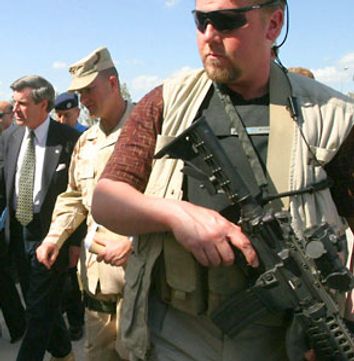
Each firm determines its own standards and procedures, and there is no formal regulation or even an industry self-regulatory mechanism to establish them or to police and punish those who fall below standards. While the best firms will blackball rogue or incapable employees, the industry has grown so huge and the clients remain so clueless that such tagging offers minimal recourse. For instance, industry insiders could only shake their heads when one firm invited CNN “Crossfire” talk-show host Tucker Carlson to ride along on a mission into Iraq. Not only did the firm’s personnel give the conservative pundit an AK-47 to wield in the middle of a volatile war zone, but when they needed gas, Carlson and crew took over an Iraqi gas station by holding local civilians waiting in line at gunpoint. (One hopes he wasn’t wearing his trademark bowtie, which would have only added to the local insult.) Carlson described the incident with proud delight in Esquire magazine, apparently not understanding the multiple industry sins that had been committed. Firms also greatly vary in their tactics and operations. For example, in the role of escort and protection, some firms opt to stay under the radar of potential adversaries. They purchase local vehicles, grow beards to blend in, and keep weapons hidden until needed. Others “cowboy up” and attempt to deter threats through posturing. They are recognizable by their web gear, Oakley sunglasses, cradled submachine guns, and brand-new black or white SUVs that can act as magnets for ambush: a mode of operation that is a huge point of contention in the industry.
Risk evaluation, likewise, differs by firm. In the PMF realm, risk incorporates battlefield threats as well as investment hazards. With differing intelligence collection and analysis capabilities (some create an in-house cell; others don’t), each firm weighs the risks using all sorts of metrics. The Monday morning quarterbacking of the Fallujah decisions has already begun, illustrating how various firms evaluate situations. Jonathan Garratt, the group managing director of Erinys, has publicly noted that he would have insisted his clients avoid Fallujah altogether. “It’s very dangerous. As a generalization, Fallujah is out of bounds on our map. We would only go through there in armored vehicles and a significant security force to defeat all threats.” Military officers have even suggested that if the decision to go into a “no go” area like Fallujah without the required up-armored vehicles and heavy weapons had been made within the military, the officer in charge “could expect a court-martial hearing.” In response, Blackwater officials have said that their units may have been tricked into entering the town by turncoat Iraqi security forces, leaving aside the point that they didn’t have access to such weapons in the first place.
The blame casting will likely continue, and may even result in civil suits, but the underlying point holds true that firms evaluate risks differently. This carries over to their life insurance packages — a complaint of the Chilean hired unit is that their contracting firm chose a poor one without their understanding — or the backup support they guarantee–some firms pay the cost of having a quick-reaction force in place, ready to rush to the rescue, while others save money by hoping for the best.
Another important difference between the PMFs and the military is that even individual members of firms can weigh the risks in deciding their own involvement. In the wake of last week’s killings, many employees decided it was best to change their job locales, regardless of the heady pay. As one Halliburton employee departing Iraq commented, after his truck blew up underneath him in a convoy attack, “It was time to come home.” Similarly, Michael Cherkasky, the president of Kroll, may have 100 employees on the ground in Iraq, but admits that he has chosen not to go. When asked why, he replied, “Are you kidding? I will fly into Kuwait. I will fly into Jordan. I will not fly into Iraq.”
In contrast to military standardization, there is a simple market reality at play in Iraq: Each firm has its own approach (which each thinks is the best), but not every firm’s recruiting, information and operating procedures can be the best, and some are not even optimal. Every industry has its winners and losers, but the price of establishing those in the private military world is different than in other marketplaces. This issue is compounded by the lack of formal weeding-out processes or the establishment of minimum capabilities, inherent needs in the military environment. One Special Forces veteran goes further: “How these contractors operate is determined by the individual companies. There’s no such thing as a ‘best practice.’ It’s a question of sheer economics — how much is the client willing to pay?”
Within the private military industry itself, the killings in Fallujah were shocking but not unexpected. As opposed to the first few months of the war, when contractor attrition was rumored to be as high as 30 percent (comparing quite poorly to the zero percent of U.S. soldiers that are able to decide to return home), those now going into Iraq know that it is an active war zone. Indeed, two contractors working for the Olive Security firm had been killed outside Mosul just days before the Fallujah incident, the main difference being that their deaths were not recorded on film. However, the Fallujah incident, followed so rapidly by the mass violence and the incidents in Najaf and Kut, caused most of the firms to reexamine their procedures, risk factors, and reliance on military support that may not be there. Christopher Bees, a director at ArmorGroup, says, “It’d be fair to say that anyone involved in the business in Iraq is bound to take a second look at what they do.”
Disturbed by the upswing in violence and the lack of military backing and coordination, at least four military contractors (Halliburton, Triple Canopy, AKE and Control Risks) were reported by journalists and CPA officials to be reconsidering the extent of their presence in Iraq, and they suspended key parts of their operations as they waited for the situation to settle. However, most indicators are that Fallujah killings won’t collapse the energetic PMF market in Iraq. The pay scale remains so high that those leaving will likely find ready replacements. In the days after the killings, I was contacted by two firms looking for advice on how they might crack the market, including one that had never operated in a war zone before.
So, while the boom for PMFs in Iraq certainly can’t last forever, it bodes to be lucrative while it does. Duncan Bullivant of Henderson Risk notes, “I wouldn’t give it more than another year at this level. The bubble will burst, but there’s an immense drive to cash in while it lasts.” U.S. plans for the transition to Iraqi sovereignty mean an even greater use of private contractors, such as a contract worth up to $1 billion to take over the responsibility for protecting the Green Zone, the four-square-mile area in central Baghdad where coalition officials live and work. Who knows, perhaps the PMF bubble may last longer than the dot.com one did.
The greater challenge looks to be how the broader business community responds to Fallujah and its aftermath. The cornerstone of the Bush administration’s plan to turn the corner in Iraq is the transfer to local Iraqi sovereignty on June 30 and the simultaneous dump of some $18 billion in reconstruction contracts over the summer. It was hoped that the massive infusion of aid would draw in outside business and create an upsurge of employment that would dry out the insurgency.
But, instead, the Fallujah killings and the ensuing outbreak of fighting in six cities might have sucked the wind out of the corporate participation necessary to making the plan a reality. Those already on-site have restricted their movement and activity (“no go” areas have ballooned), while a number of other firms set to enter the country have cancelled. The head of the firm Meyer and Associates, which provides protection for a number of contractors, reports that “right now everything is at a standstill.” Among the lesser-noticed victims of Fallujah was the Baghdad Expo, the largest conference planned by the Iraqi-American Chamber of Commerce. The meeting was to highlight business opportunities in postwar Iraq, with more than 200 companies scheduled to attend. The day after the killings, it was postponed.
So while the PMF industry has boomed, the accompanying investment needed to prop up the Iraqi economy has not (which could indirectly undercut the PMF industry in the long term). Companies know that the insurgents’ strategy is to weaken the coalition by targeting them, and thus many firms are waiting on the sidelines for the situation to stabilize and a real, functional Iraqi government somehow to come into being. As one potential investor commented after a U.S. Commerce Department briefing on investment in Iraq, “The carrot that’s being waved in front of everybody is that we should get involved on the ground floor. But this is below the ground floor. There are too many other markets now that are stable.”
This reluctance derives from more than a fear of going into a war zone; rather, it represents real financial calculations. As the situation has grown increasingly dangerous, insurance premiums have skyrocketed. Because the Defense Department had no policy on it beforehand, Bunny Greenhouse, chief contracting official for the Army Corps of Engineers, relates that for contractors in Iraq as much as 40 cents of every dollar is spent on insurance. “Why are we paying 40 percent? That’s unbelievable … Nobody foresaw that we were going to be in this kind of dilemma.” While Greenhouse is wrong –the experts on Iraq did predict the current turmoil, just as industry analysts pointed out the dangers of such poor planning — the insurance problem is yet another illustration of the costs of an ad hoc approach to doing business in the realm of war.
In turn, security costs have escalated, which is a boon for the PMF industry, but not for the broader effort. Many construction firms, such as Washington Group International, now have to employ two security personnel for every one worker carrying out the actual contracted task. Just before Fallujah, Stuart W. Bowen Jr., the inspector general for the CPA, estimated that at least 10 cents of every reconstruction dollar in Iraq was spent for security, up from 7 cents in the fall of 2003. If the present spate of violence continues, industry insiders think it might grow to as much as 20 cents per dollar. As a point of comparison, security costs for oil operations in war-torn Colombia average about 6 cents per dollar.
These added costs mean that the reconstruction package funded by taxpayers may not go as far as hoped (Bowen contended that as much as $4 billion could be spent on security), perhaps requiring even more funding on top of the previous budget supplementals. Already, the CPA has had to transfer $184 million meant for clean-water projects, the kind of aid package that seeks to bolster local popularity, to cover spiraling security costs for its own installations. Additionally, these added costs mean that within firms’ investment calculations, the threshold for turning a profit has been raised, further deterring outside investment. Bowen writes, “The inability to accurately predict the costs of security, including insurance, raises questions about the need for more funding — Iraqi, donor, or U.S. — to accomplish the reconstruction mission … We are in this big gray area about how security concerns will affect reconstruction timelines.”
In a recent campaign speech, President Bush proclaimed that “America must never outsource America’s national security.” Once again, the gap between rhetoric and reality is yawning.
While Bush was trying to make a point about U.S. relations with the international community, the fact is that the United States has indeed outsourced major portions of its effort in the war in Iraq. More important, it has done so in an ad hoc manner, without public awareness or discussion.
The private military industry is such a new phenomenon that most in Congress remain unaware of it. In turn, the issue is highly susceptible to partisan rancor, mainly because of the identity and political practices of some of the firms. For instance, simply mention the name Halliburton in a congressional hearing and the battle line is already drawn. Unfortunately, this ends rather than begins the inquiry, even though questions about the private military industry cut to the heart of national security and our soldiers’ welfare.
In the wake of the shock over Fallujah, this may change. A group of senators led by former West Pointer Jack Reed, D-R.I., has requested that the Pentagon begin the basic accounting task of tallying the number of armed non-Iraqi private military personnel on the ground. They have also requested that the Pentagon begin to adopt written guidelines, with legal justifications, for the rules of engagement the firms must follow, as well as how they will be coordinated with U.S. and sovereign Iraqi forces. Defense Secretary Donald Rumsfeld has not yet responded.
Those are good first steps, but they do not go far enough. To put it in economic terms, privatization always comes with both positive and negative externalities. The onus is not on the contracting firm, but on the client, in this case the U.S. government, to guard its own interests and make sure the job is done right. We must set up the processes needed to maximize the positives and minimize the negatives.
A clear examination is needed to bring higher standards and greater clarity into our current and future military outsourcing decisions. This need goes beyond tracking the armed personnel. It includes a basic accounting of the broader realm of contractor forces, public transparency of contractor casualties, and an examination of what is being spent. The U.S. budget on the service side of war has tripled in the last decade. We need far better financial scrutiny of contract competitions, awards and oversight to ensure that money is being saved through outsourcing (no formal study has yet proven this). Serious thinking must take account of such fundamental military questions as command and control, rights and responsibilities for both the good and the bad times, legal status, and the establishment of industry standards on recruiting, procedures and intelligence.
We should also take a step back and examine the overall trend, rather than continue to breathlessly outsource. Just because we can turn something over to the private market does not always mean we should. Two basic questions must always be asked before handing over any public function, most particularly to private military firms: Is the function being privatized in symmetry with national security and the public interest? If so, how will this privatization save money and promote efficiency? Unfortunately, our CEO-filled defense leadership has forgotten Economics 101 and brushed aside basic issues of public accountability. Instead, it has outsourced first and not even bothered to ask questions later.
Continue Reading
Close
Last Wednesday, the United States woke up to what seemed like a horrible replay of the images from 1993 Somalia. As crowds screamed their vicious delight, the bodies of four Americans were abused and dragged through the streets.
But Fallujah was not Mogadishu, and this was to be no repeat of “Black Hawk Down.” Instead of questioning the mission, the public struggled to figure out who was performing the mission in the first place. For most Americans, Fallujah introduced a realization of how our military operates today in the era of outsourcing. A growing industry of private military firms is filling a huge and often surprising array of roles in Iraq, roles that can even include combat.
The four men killed in Fallujah were not U.S. troops but rather employees of a little known company, Blackwater USA, that resides within an industry that until last week, few people even knew existed. Breaking out of the “guns for hire” mold of traditional mercenaries, corporations like Blackwater sell the sorts of services that soldiers used to provide. Known as “private military firms” (PMFs), they range from small companies that provide teams of commandos for hire to large corporations that run military supply chains. This new military industry encompasses hundreds of companies, thousands of employees, and billions of revenue dollars.
In Iraq, they’re also accounting for a growing share of the force and the casualties. There are 15,000 private personnel carrying out mission-critical military roles, and they have suffered at least 30 to 50 killed in action, including the four dead contract workers whose bodies were discovered on Tuesday. Scores more have been taken captive in just the last week.
The Bush administration was unwilling to enlist serious assistance from the United Nations or from most of our NATO allies, but thanks to the PMFs that employ private soldiers of more than 30 nationalities, it has been able to assemble an international coalition of sorts in Iraq. But it is more a “coalition of the billing” than of the “willing.” Indeed, there are more private military contractors on the ground in Iraq than troops from any one ally, including Britain. One single company, Global Risks, has a reported 1,100 employees in Iraq, including 500 Nepalese Gurkha troops and 500 Fijian soldiers, ranking it sixth among troop donors.
Working in over 50 conflict zones, the industry is emblematic of a broader globalization. PMFs and their clients are located worldwide, but their single largest client is the U.S. taxpayer; our government has signed over 3,000 contracts with private military firms in the last decade. The reliance on this industry was driven by changes in the market after the end of the Cold War. It boomed in an era of military downsizing (the U.S. military is about one-third smaller than it was during the 1991 Gulf War) and the increasing demands of new deployments, the more-technical requirements of modern warfare, and privatization as a new vogue of government.
While Congress and the senior leadership at the Pentagon do not have an exact handle on the numbers, an estimated 15,000 to 20,000 private military personnel are in Iraq. They are carrying out essential jobs that soldiers have done in the past — from handling logistics and maintenance to training the local army to fighting pitched battles — and they have taken more casualties than any ally. However, while performing tasks crucial to the operation, they are not formally part of the force, creating a critical disconnect in such areas as intelligence sharing, as well as confusion over rights and responsibilities in the midst of combat.
The size and scope of the private military contingent in Iraq also cut to the heart of the most troubling questions about the Bush administration’s handling of the war. They point up the administration’s inadequate planning and preparation, its lack of transparency about the war’s financial and human cost, and its sense of denial about whether it put enough American troops on the ground to accomplish the task handed to them. The hiring of such a large private force and the ensuing casualties that it has taken outside of public awareness and discussion have served as a novel means for displacing some of the political costs of the war. Even more troubling, the growth of such an ad hoc market arrangement, lying outside the chain of command, makes an already tough mission even more difficult, and risks lives on both the troop and contractor side.
Until Fallujah, the private military industry was largely hidden behind the headlines, present in the world’s hot spots but never fully acknowledged. When a CIA plane mistakenly coordinated the shootdown of a planeload of American missionaries over Peru in 2001, few realized that the plane was manned by contractors for Aviation Development Corp., based in Alabama. When suicide bombers attacked an American compound in Riyadh, Saudi Arabia, last spring, few understood what it meant that the targets worked for Vinnell Corp., a Fairfax, Va., defense contractor that trains Saudi Arabia’s and Iraq’s armies. When Palestinian militants killed three Americans in Gaza last fall, most didn’t realize that they were private military contractors working for DynCorp, a multifaceted government services firm, based just outside the Washington-Dulles airport. When a planeload of men was arrested in Zimbabwe last month, with the local regime claiming they were picking up weapons on their way to an alleged coup plot in Equatorial Guinea, few understood what it meant when they turned out to be employees of Logo Logistics, a PMF registered out of the British Virgin Islands. When the State Department spokesman noted that President Aristide of Haiti left office accompanied by his personal guards, he left out the part that Aristide had outsourced his protection to the Steele Foundation,, a San Francisco firm.
Though it’s little more than a decade old, the privatized military industry has an estimated $100 billion in annual global revenue. In fact, with the recent purchase of MPRI by a Fortune 500 firm, L-3, many Americans already unknowingly own slices of the PMF industry in their 401Ks.
The firms’ growth is also perhaps best evidenced in the way they have begun to play the age-old Washington game of lobbying. Employing mostly former senior government and military officers, the firms already enjoy broad familiarity with the government contracting process as well as informal connections with former colleagues and subordinates. But like any other mature industry, PMFs also feel they must employ lobbyists and make political campaign donations to stay ahead of each other. In 2001, 10 leading private military firms spent more than $32 million on lobbying, while they invested more than $12 million in political campaign donations.
Among the leading donors were Halliburton, which gave more than $700,000 from 1999 to 2002, 95 percent to Republicans, and DynCorp, which gave more than $500,000, 72 percent to Republicans. Interestingly, Halliburton’s spending to influence policy declined after its former CEO Dick Cheney became vice president. During the last two years of the Clinton administration, the firm spent $1.2 million lobbying the Senate, House of Representatives, and various executive branch departments. During the first two years of the Bush administration, Halliburton reported spending just $600,000 (getting a much better return on its investment, as its contracts roughly trebled).
But the large corporations are not the only ones that have begun to play the game. With a now public profile, and growing congressional scrutiny, Blackwater reportedly hired Alexander Strategy Group, one of the more influential lobbying firms, just days after the contractors’ deaths. Alexander is run by Tom DeLay’s former chief of staff, Ed Buckham, and also employed DeLay’s wife, Christine.
The private military industry had steadily expanded since its origins at the end of the Cold War, but it has hit new heights in the last three years of the war on terrorism. Indeed, if any operation should have been a purely military one, many thought it would be the response of the United States to Sept. 11, 2001. The military enjoyed broad support with the American people, and the concerns about casualties that had limited military operations in the 1980s and 1990s were set aside.
From the beginning, however, private contractors played key roles in the war in Afghanistan. Their employees deployed with U.S. military forces on the ground (including serving in the CIA paramilitary units that were the first to hit the ground), maintained combat equipment, provided logistical support, and routinely flew on joint surveillance and targeting aircraft. Even the noted Global Hawk unmanned surveillance planes were operated by private employees. The private firms’ role in the region continues today, with contractors now part of the CIA/military operation attempting to run down Osama bin Laden and his associates along the Pakistan-Afghanistan border.
In other anti-terrorism operations around the globe, PMFs have played similarly wide-ranging roles. The operations in the Philippines against Islamic guerrillas have DynCorp working on logistics, while other members of the firm are playing a more active role in anti-narcotics and counter-guerrilla operations in Colombia. When the United States deployed a military training contingent to the former Soviet republic of Georgia to help root out radical Muslim terrorists, the team was mostly made up of PMF employees. The Taliban and al-Qaida members unlucky enough to be caught can plan on spending their next years housed in a military prison at Guantánamo Bay, built not by U.S. soldiers but by the KBR division of Halliburton, and interrogated by private contractors from firms like Titan.
In fact, the PMF industry was one of the few whose economic outlook was improved rather than harmed by the 9/11 attacks. While the U.S. and global economy suffered from the shock, the prices of PMFs listed on stock exchanges jumped roughly 50 percent in value, with L-3′s even doubling. A number of firms were launched in the aftermath of the attacks, hoping to tap the boom market. One example is Janusian, a British venture that seeks to provide protection and intelligence against terrorist attacks. “The war on terrorism is the full employment act for these guys,” one Defense Department official commented. “A lot of people have said, Ding, ding, ding! Gravy train!”
But the Iraq War is where the history books will note that the industry took full flight. Iraq is not just the biggest U.S. military commitment in a generation but also the biggest marketplace in the short history of the privatized military industry. In Iraq, private actors play a pivotal role in great-power warfare to an extent not seen since the advent of the mass nation-state armies in the Napoleonic Age.
Before the war, private firms helped out with an array of tasks — operating supply lines, running training exercises, and even assisting with the war gaming and battle planning in the Kuwaiti desert that later proved so successful. The huge U.S. Army complex at Camp Doha, where the invasion was launched, was built, operated and guarded by a vast private operation led by a consortium called Combat Support Associates. (While CSA was operating in Kuwait, firms in the consortium were registered as “100 percent Native American-owned” and thus could use Minority Business Enterprise certifications as a way to gain preference in the government acquisition process.) These roles were not without their risks. Even before the battle started, several private military personnel were killed or wounded in live-fire exercises and, in a taste of what was to come, two civilian technicians were murdered by terrorists in a drive-by shooting in Kuwait.
During the major combat operations phase of the Iraq War last spring, private military employees handled everything from feeding and housing U.S. troops to maintaining sophisticated weapons systems like the B-2 stealth bomber, F-117 stealth fighter, Global Hawk UAV, U-2 reconnaissance aircraft, M-1 Tank, Apache helicopter, and air defense systems on numerous Navy ships. While civilians had always accompanied U.S. forces on deployments, all the way back to the sutlers who sold shoes and other consumer wares at Valley Forge, never had the U.S. military been so reliant on outsiders to accomplish its mission. Indeed, the pre-invasion ratio of private contractors to U.S. military personnel in the Gulf was roughly 1 to 10 (10 times the ratio during the 1991 war). Our allies, including the British and Australians, also depended heavily on contracted support.
During the occupation of Iraq, the demand for private assistance skyrocketed, particularly as the rosy scenarios made by political appointees in the Pentagon before the war proved false. Presently, an estimated 15,000 or more private military contractors are on the ground in Iraq, working for tens of companies and their subcontractors, providing tasks that only soldiers once performed. The CPA estimates that after sovereignty is granted to a largely nonexistent Iraqi government at the end of June, these figures may rise to as high 30,000. Jobs such as guarding the Green Zone in Baghdad will be privatized as well. We don’t know the exact figures, because the Bush administration maintains no formal tracking of the numbers. The very lack of any accounting illustrates the dire need for better oversight and accountability.
Outsourcing has provided a novel means to reduce some of the political costs of the war. Reserve call-ups are lessened and compromises with allies unnecessary. Any public dismay over casualties is also dampened. Unlike the formal reporting of U.S. military casualties, release of such information is at the discretion of each individual firm. Just as no one knows the exact number of private military contractor boots on the ground, so, too, does no one know the number of killed and wounded. From a survey of industry insiders as well as hometown press reports that sometimes announce the deaths, estimates are that between 30 and 50 private military contractors have been killed in the fighting in Iraq, with tens more killed in accidents. Assuming the rough ratio of killed versus wounded that has held among U.S. troop casualties (1 to 6), this means that upward of 200 to 300 private casualties have gone unreported on the public ledger. That is more than the entire 82nd Airborne Division lost in Iraq over the past year.
Private military firms carry out three crucial functions in Iraq: military support, military training and advice, and certain tactical military roles. It is important to note that official U.S. military doctrine has long held that “mission critical” roles must be kept inside the force. It has also held that civilians accompanying the force should not be put into roles where they must carry or use weapons, allowing the carry of sidearms (that is, pistols) only in the most extraordinary circumstances. But what used to be the exception is now the rule.
Military support firms help with logistics and engineering, as well as assisting with tasks such as tactical and non-tactical vehicle maintenance and repair. The major player in this sector has been Dick Cheney’s former firm, Halliburton. Operating under the LOGCAP contract (Logistics Civilian Augmentation Program), Halliburton has done about $6 billion worth of business on Iraq contracts.
Many consider such tasks secondary and in line with the broader military outsourcing of such ancillary jobs as lawn mowing at bases. But they could not be more wrong when it comes to logistics. As official U.S. military doctrine states, “Since the dawn of military history, logistical capabilities have controlled the size, scope, pace, and effectiveness of military operations … Logistical capabilities must be designed to survive and operate under attack; that is, they must be designed for combat effectiveness, not peacetime efficiency.” Or, as Gen. Omar Bradley succinctly put it, “Amateurs talk about strategy; professionals talk about logistics.”
Bradley’s view was proved right in the days after the Fallujah attacks. In an e-mail obtained by Knight Ridder News, a senior U. S. official in Iraq warned his superiors at the Pentagon’s program management office in Baghdad that Halliburton senior executives had said they were “considering withdrawing from the country” because of security concerns. The official noted that a cut in LOGCAP services by the firm would cause the “complete collapse of the support infrastructure” of the operation. Halliburton denied it was considering a withdrawal, while the CPA would not comment. Regardless, it underscored how vulnerable military officers felt the operation had become to outside corporate decision-makers.
As violence spread in the ensuing week, Halliburton and other military support firms put their employees on “lockdown,” and operations were suspended in several key areas. After another fuel convoy was ambushed and seven contractors went missing (one, Thomas Hamill, a dairy farmer turned military convoy truck driver, is presently held captive, while four of the civilians have since been found dead), movement by the firms effectively ceased in large portions of Iraq, including the Kuwait-to-Baghdad supply run. As they lie outside the military code of justice, constitutionally, the military simply can not order these firms to take the risks and truck on as it could have done with military units in the past. Officers have begun to worry about what this will mean for critical fuel and supply stocks they depend on to carry out their missions.
While its scope was debatable, the process behind LOGCAP used to be fairly noncontroversial, as the original contract to provide field logistics support to the U.S. Army was competitively bid out. However, eyebrows began to rise when in the months just before the war, nonmilitary tasks such as oil-well fire fighting and then oil field repair and operation were noncompetitively added to the purview of military logistics. Thus, through LOGCAP, Halliburton cornered the logistics and oil services market and has so far gained a 62 percent jump in revenue.
While the defense has been made that Halliburton is the only firm capable of such a job, it is important to note that Halliburton often acts as a middle man, meaning the U.S. military outsources tasks to a firm that outsources them further. Indeed, those who have seen the recent Halliburton commercials on TV, showing proud American employees serving happy soldiers, would be confused by who actually works at the firm’s kitchens, usually third-world nationals flown in from places like Bangladesh and the Philippines. The contractor-subcontractor relationship has not always been a smooth one, with U.S. forces at risk of the consequences. In February, several of the subcontractor firms publicly complained that they had not been paid by Halliburton, despite its huge revenue stream, and threatened to cut off food service to U.S. troops until they were.
Other concerns in the military-support arena are overbilling and quality assurance. As anyone familiar with construction or home repair will attest, it is essential to have competition to determine the most efficient contractor at the best price; it is also essential to maintain oversight to prevent being bilked and getting shoddy work. In the military effort in Iraq, this basic function has largely been AWOL, mainly as a result of poor planning and the lack of military, as opposed to contractor, oversight funding. The contract management office in Baghdad, for example, originally had five personnel in charge of managing some $18 billion in contracting. It later added nine more, leaving a still-daunting ratio of about $1.3 billion in oversight per person, in the middle of probably the most confusing contract zone in history.
The result has been a series of snafus and suspected swindling, best captured by the weekly drumbeat of financial scandals that Rep. Henry Waxman, D-Calif., has unearthed about Halliburton contracts in Iraq. The allegations circling the firm ranged from charging for tens of thousands of meals never served to soldiers, to billing for inappropriate extras such as adding the firm’s logo to hand towels. But Halliburton was far from the only firm about which these concerns were raised. An investigation by the Pentagon’s inspector general report found Pentagon procurement rules have not been followed in 22 of 24 deals awarded by the Defense Contracting Command for services in Iraq. One of the perhaps amusing examples was the U.S. taxpayer’s purchase of a Hummer H2 (the über-expensive SUV familiar from rap music videos) for a SAIC program manager, which included payment for the charter of a DC-10 cargo jet to fly it to Iraq.
Military consulting firms represent another market sector and carry out a number of military advisory and training services. The responsibility of creating the post-Saddam police, paramilitary forces and army has been outsourced to various firms. The importance of this work is without dispute. The U.S. plan for disengagement from Iraq is dependent on the formation of such local forces, and for decades they will be the operation’s institutional legacy.
DynCorp, a multibillion-dollar government services firm based in Reston, Va., is the major player in the police training program. The contract was originally awarded for $50 million but could be worth as much as $800 million. While the firm relies on the federal government for about 96 percent of its business (it spends more than a million dollars a year on lobbying and has written another dozen checks to the RNC in the last few years), it has a decided public relations problem stemming from the sex-trade scandal in the Balkans. Under two separate contracts in Bosnia and Kosovo, a number of its employees were implicated in sex crimes and the black-market arms trade, including its Bosnia site manager, who videotaped himself raping two young women. Because of a gap in the law, none were ever criminally prosecuted, and the whistleblowers in the incident (as opposed to the perpetrators) later sued the firm after they were fired. The firm has since set up an in-house screening program, which it hopes will avoid such incidents in the future.
Erinys is in charge of the program for setting up a paramilitary guard force for Iraq’s oil fields, obviously key to starting up the economy. Given that it did not exist before the war, Erinys surprised many established firms in the industry by winning the $39.2 million contract. Then, the firm raised eyebrows by importing many former South African soldiers and police who had worked for the old apartheid regime. However, the contract has gone well; since it took charge of operations, attacks on oil pipelines have declined. In little over four months Erinys trained, armed and deployed more than 9,000 Iraqi guards across the country. It plans to expand the force to nearly 15,000. Others credit not the raw numbers but the sensible payoff of local tribal leaders to protect the pipelines, much as what happened with the past regime.
Vinnell, MPRI and Nour USA have been engaged in training and equipping the new Iraq army, a task whose cost could reach as high as $2 billion. Vinnell, a subsidiary of Northrop Grumman, is notable for being the only firm targeted by al-Qaida twice, having offices bombed in Saudi Arabia in 1996 and 2003. MPRI is a firm of primarily former U.S. Army officers, all the way up to four-star generals. The company’s major client is training for the U.S. Army, but it has also worked on contracts in Croatia, Bosnia, Nigeria and Afghanistan. Nour’s contract became particularly controversial when allegations surfaced that the firm was linked with neoconservative darling Ahmed Chalabi, the Iraqi exile leader many blame for the faulty intelligence used to whip up war sentiment in the United States Despite having no operating history, the politically connected firm is alleged by its competitors to have beaten out more established firms by lowballing its contract by several hundred million dollars. The contract has since been suspended and is now being re-awarded, resulting in months of delay in the vital task of readying an Iraqi army. One U.S. Army contracting officer remarked to Jane’s Defense Weekly, ” I’ve been in Army contracting for 28 years and I’ve never heard of it happening like this.”
In the shifting battlefield of Iraq, military support and military consulting have become more dangerous. Unlike the firms in such places as Bosnia or Kosovo, in Iraq these contractors have taken an increasing number casualties. While these roles had originally been contemplated to lie outside the battlefield, the front lines have become all-encompassing, bringing everyone under fire. For example, Thomas Hamill, the struggling Mississippi dairy farmer turned convoy truck driver captured by insurgents last week, was doing a job quite similar to, and no less dangerous than, that carried out by Pvt. Jessica Lynch. The only difference is that he is a private contractor and she was regular Army. In response to the reality of these dangers, many of these support contractors and consultants have armed themselves. With the U.S. military unwilling to provide weapons, many are now turning to the black market.
But the most dramatic and controversial expansion of PMF involvement is in the combat realm. Before Iraq, PMFs had fought in several combat zones, the most notable being Executive Outcomes’ participation in the Sierra Leone and Angola wars. But Iraq is the first time that firms have played tactical roles alongside large numbers of U.S. troops in the field.
In Iraq, tactical PMFs, also known as military providers, play three key roles: They help defend key installations, protect key individuals such as Coalition Provisional Authority head Paul Bremer, and escort convoys. Each is obviously critical to the mission’s success. If bases, buildings and other key installations are captured or destroyed, if key leaders like Bremer get killed, or if the supplies don’t flow, then the operation collapses.
A listing of some 20 firms that offer such services is available from the State Department’s Iraq travel Web site, but curiously does not mention Blackwater. The same issues — the contractual process and the lack of oversight — suffuse this sector (in one study of $58 million in protection contracts let by the CPA, five of six contracts were no-bid). But the stakes are far higher than wasted taxpayer money.
Sometimes, these assignments are described euphemistically as “private security” to make them sound less military. But these are not private guards who stroll at the local shopping mall. They involve personnel with military skills and weapons who carry out military functions, within a war zone, against military-level threats. Custer Battles, for example, is a Virginia firm that has the airport security contract in Baghdad. Airport security in this context does not mean bored attendees standing by an X-ray machine, but rather former Green Berets and Ghurka fighters defending the airport from mortars, rockets and snipers.
In short, the roles performed by these firms entail the same risks or even greater ones than those faced by U.S. military forces. As fighting has spread, PMFs have been at the forefront. Blackwater, the firm that lost the four men in Fallujah, just days later defended the CPA headquarters in Najaf from being overrun by radical Shiite militia. The firefight lasted several hours, with thousands of rounds of ammunition fired, and Blackwater even sent in its own helicopters twice to resupply its commandos with ammunition and to ferry out a wounded U.S. Marine. The same night, Hart Group, Control Risks and Triple Canopy were all involved in pitched battles. Unfortunately, the Hart position was overrun. Abandoned by nearby Coalition forces, the firm’s employees had to leave one of their comrades dead on a rooftop on which he and four colleagues had been fighting after their house had been captured.
The extent of these firms’ combat role is largely off policymakers’ radar screen. Not only is Congress woefully ignorant of the contracts that its budgets have paid for, but senior Pentagon officials are, at best, in self-denial about the depth of the outsourcing. When pressed on the issue at a news briefing just days after the Fallujah deaths, Defense Secretary Donald Rumsfeld’s response was a prototypical nonsensical Rummyism.
Reporter: Why is the armed services privatizing armed security?
Rumsfeld: The armed services are not privatizing armed security.
Reporter: Those men were providing security for…
Rumsfeld: Society.
Reporter: A convoy.
Rumsfeld: The society is privatizing security.
Reporter: However you want to say it.
Likewise, discussions with high-ranking military officers reveal that many at the most senior levels have not factored what privatization means for operations on the ground. One high-ranking general involved in Iraq operations at the Pentagon had not even heard of the battles above, let alone the Blackwater firm, still contending that firms handled only secondary tasks like K.P. duty. Indeed, when the command staff of CENTCOM toured the Najaf battle site just hours after the heroic stand by the Blackwater employees, their briefing did not even mention the key role of the firm in saving the day.
In a field that often lacks transparency and sometimes includes shady characters, Blackwater is a firm with a reputation for professionalism; it has never had a major allegation of malfeasance leveled against it. Perhaps not coincidentally, it is also one of the few that has opened up its facilities to the press.
Blackwater was originally located in the military training sector and got its start in 1996. Founded by an ex-Navy SEAL, Gary Jackson, the firm has a 5,200-square-acre facility located in tiny Moyock, N.C. Moyock may be in the heart of North Carolina’s Great Dismal Swamp, but it is just 25 miles south of Norfolk Naval Base. Blackwater’s facility is the largest privately owned firearms training complex in the nation, and many consider it to have the best tactical shooting program. More than 50,000 personnel have gone through its training, and experts ranging from SEALs to SWAT teams (the World SWAT Challenge is held onsite) laud its facilities. In the current threat environment, the firm has focused on anti-terrorism programs, such as signing a $35 million contract to train more than 10,000 U.S. Navy sailors in force protection.
When the company was founded, Jackson described the business endeavor as like playing “roulette, a crapshoot.” But the firm soon thrived. It later added an overseas contingent and starting offering private military personnel for hire, primarily to the U.S. government. As Jackson discussed with the Guardian newspaper of London, “We have grown 300 percent over each of the past three years and we are small compared to the big ones. We have a very small niche market; we work towards putting out the cream of the crop, the best.”
Although the firm started out employing ex-American military, primarily from the Special Forces, growing demand has led it to look to other and often cheaper labor sources. The firm reports that 30 percent of its current personnel do not have military training, usually being former policemen. In February, it hired some 60 former Chilean soldiers from the Red Tactica firm, offering them contracts worth around $4,000 a month to guard oil facilities in Iraq from insurgent attack. Concerns were raised that many of them had a history with the Pinochet regime. Michelle Bachelet, Chile’s defense minister, questioned “whether paramilitary training by Blackwater violated Chilean laws on the use of weapons by private citizens” and ordered an investigation. Jackson responded, “We scour the ends of the earth to find professionals — the Chilean commandos are very, very professional.”
By the time of the lethal Fallujah incident, Blackwater had expanded significantly and reported that it had 450 personnel on the ground in Iraq (a far different number from the “five to six” one Pentagon general I spoke with thought the firm employed). Plans were in the works to create a training facility for Iraqi forces, parallel to the Moyock one, at a former Iraqi Air Force Base outside Baghdad. Its most visible operation was a $21 million, noncompetitively awarded contract to protect CPA head Paul Bremer. It provided for his security, as well as two helicopters for transport. So, while the U.S. president, U.S. senators, and U.S. generals have official security and transport, in the Iraq War zone, the top U.S. official does not.
The contingent outside Fallujah had some 20 armed personnel whose primary task was reportedly the protection of logistics convoys, manned by another contractor. This involved escorting trucks carrying food, kitchen equipment and personnel for Regency Hotel and Hospitality. Regency is a subcontractor of Eurest Support Services (ESS), which in turn is a division of the Compass Group, the world’s largest food service company. In Iraq, the firm feeds the troops at more than a dozen U.S. base camps.
There is no defining background or single reason why someone enters the private military job market. Typically, some mix of three motivating factors applies: mission, money and personal considerations.
Private military employees often see their jobs as an extension of their public service in the military. They usually have a great deal of pride and patriotism in what they do, and see themselves not just on a business outing but in an endeavor bigger than themselves. This is particularly so in Iraq, where many see themselves as playing a greater part in the war on terrorism (clearly, the patriotic impulse is not as strong for third-party nationals). Retired U.S. military personnel often describe this as their way to get back into the fight.
There is also the related sense of military community and camaraderie that continues into the private sector. It may be a business, but it is a realm where one’s former rank and experience still matter, as opposed to the regular corporate world. Loyalty to one’s colleagues also is important.
Few will deny that another key draw is the pay. “Doing this kind of work for a year means some people have enough to retire on. Iraq is something of a gold mine at present,” says Duncan Bullivant, the head of the British firm Henderson Risk. “The profit margin is incredibly high, way in excess of the risk factor.”
Soldiers within the private military field typically make between two to 10 times what they make with their home-state military. Much as in regular industry, those at the higher end have an elite background, except that in the PMF world, having been in a Green Beret, SEAL or Special Air Service unit supplants being an Harvard or Wharton MBA as a point of distinction. The industry also mirrors global business, in that pay scales back home still matter significantly. So, while a former Green Beret can make up to $1,000 a day in Iraq, a Nepalese Ghurka is paid in the range of $1,000 a month.
Such income opportunities are hard to turn down, particularly in comparison to the meager pay that soldiers often get within the military. It is also at the heart of a growing controversy: How does the industry’s growth affect retention within the military?
This challenge is different from the age-old problem of skilled professionals departing for better-paying civilian careers. Unlike a pilot who retires to go work for an airline, soldiers within the private military industry stay within the same sphere and, indeed, their firms often directly contract back with the military. The military not only prematurely loses the human capital investment it originally made in training soldiers, but then sees these exact skills billed back, at higher rates.
While it is too soon to tell how this all will shake out, it is known that special forces in Australia, Britain and the United States have all grown anxious at the increasing number of early retirements among its most skilled personnel, who depart for the PMF industry. As an illustration, there are reportedly more ex-SAS soldiers working for PMFs in Iraq now than currently serve in the entire elite British force. Indeed, the SAS has been forced to recruit for the very first time in its history, while U.S. Army Special Forces have been compelled to begin recruiting directly from the civilian population. Troubled by this development, the Pentagon recently convened a special working group of senior NCOs to examine how to stem the outflow from Special Forces.
The concern over labor poaching also might affect the National Guard and Reserves, already under incredible pressure to bolster retention. A number of reservists in California recently returned from Iraq were approached by private military firms dangling offers worth more than $120,000, most of it tax free, to return and carry out the same jobs. A particularly alluring selling point made by the firms was that the reservists’ finances were in shambles after being gone a year and many had lost their old civilian jobs in the interim.
Finally, individuals may be drawn into this industry for any number of personal reasons. The industry presents perhaps the easiest and simplest transition for ex-soldiers, and as many note, “It beats working at McDonald’s.” Others may be drawn to the career by comparative excitement and adventure. As one former Marine recon officer notes, “We’re adrenaline seekers, passionate about freedom and serving our country.” Even family issues can come into play. I have met contractors who confessed they simply wanted a year away from their wives’ nagging and others who were looking to escape the recent loss of loved ones.
The four men killed in Fallujah were professionals who had gained these jobs on the basis of their prior special forces expertise. Three had served in the U.S. Army and the fourth in U.S. Navy. Some had gone to work for the industry directly after their military service, while others had turned to the industry several years later. The L.A. Times described one of those killed, 38-year-old former SEAL Stephen “Scott” Helvenston, as “Hollywood’s image of a soldier, blond, bronzed and broad shouldered.” In fact, Helvenston had helped solidify that image, working as a trainer and stunt man for such movies as “Face/Off” and “G.I. Jane” and appearing on two reality series, “Man vs. Beast” and “Combat Missions,” produced by “Survivor” creator Mark Burnett. Helvenston ran his own fitness video business before going over to Iraq just two weeks ago before the attack.
Keith Woulard, a former SEAL who had worked with Helvenston as an instructor at the Navy’s Basic Underwater Demolition School in Coronado, Calif., commented, “A lot of people are saying, ‘Do you think he went over there for the money?’ Of course he did. But that wasn’t his main goal. It was to go over there and help out and put his knowledge to use.”
Tomorrow: Some skeptics begin to question outsourcing
This story has been corrected since it was originally published.
Continue Reading
Close