Randolph E. Schmid
Global warming pause linked to sulfur in China
Slowdown in rate of temperature change attributed to coal emissions, called "temporary"
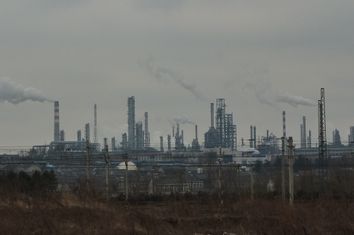
Industrial plants in the Qixia district of Nanjing, China. Scientists have come up with a possible explanation for why the rise in Earth’s temperature paused for a bit during the 2000s, one of the hottest decades on record.
The answer seems counterintuitive. It’s all that sulfur pollution in the air from China’s massive coal-burning, according to a new study.
Sulfur particles in the air deflect the sun’s rays and can temporarily cool things down a bit. That can happen even as coal-burning produces the carbon dioxide that contributes to global warming.
“People normally just focus on the warming effect of CO2 (carbon dioxide), but during the Chinese economic expansion there was a huge increase in sulfur emissions,” which have a cooling effect, explained Robert K. Kaufmann of Boston University. He’s the lead author of the study published Monday in Proceedings of the National Academy of Science.
But sulfur’s cooling effect is only temporary, while the carbon dioxide from coal burning stays in Earth’s atmosphere a long time.
Chinese coal consumption doubled between 2003 and 2007, and that caused a 26 percent increase in global coal consumption, Kaufmann said.
Now, Chinese leaders have recognized the effects of that pollution on their environment and their citizens’ health and are installing equipment to scrub out the sulfur particles, Kaufmann said.
Sulfur quickly drops out of the air if it is not replenished, while carbon dioxide remains for a long time, so its warming effects are beginning to be visible again, he noted. The plateau in temperature growth disappeared in 2009 and 2010, when temperatures lurched upward.
Indeed, NASA and the National Oceanic and Atmospheric Administration, have listed 2010 as tied for the warmest year on record, while the Hadley Center of the British Meteorological Office lists it as second warmest, after 1998.
Sulfur’s ability to cool things down has led some to suggest using it in a geoengineering feat to cool the planet. The idea is that injecting sulfur compounds very high into the atmosphere might help ease global warming by increasing clouds and haze that would reflect sunlight. Some research has concluded that’s a bad idea.
Using enough sulfur to reduce warming would wipe out the protective Arctic ozone layer and delay recovery of the Antarctic ozone hole by as much as 70 years, according to an analysis by Simone Tilmes of the National Center for Atmospheric Research in Boulder, Colo. This is the ozone layer that is high above Earth and protects against harmful UV rays, not the ground level ozone that is a harmful pollutant.
“While climate change is a major threat, more research is required before society attempts global geoengineering solutions,” said Tilmes.
Overall, global temperatures have been increasing for more than a century since the industrial revolution began adding gases like carbon dioxide to the air. But there have been similar plateaus, such as during the post-World War II era when industrial production boosted sulfur emissions in several parts of the world, Kaufmann explained.
Atmospheric scientists and environmentalists are concerned that continued rising temperatures could have serious impacts worldwide, ranging from drought in some areas, changes in storm patterns, spread of tropical diseases and rising sea levels.
Earliest human remains found in U.S. Arctic
Archaeologists uncover startling discovery that reveals behavioral habits of first human inhabitants
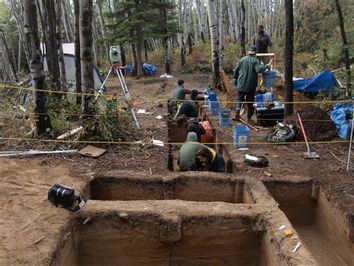
This undated handout photo provided by the journal Science shows a trench connecting both areas of the site in Alaska. Some 11,500 years ago one of America's earliest families laid the remains of a three-year-old child to rest in their home in what is now Alaska. Today archaeologists are learning about the life and times of the early settlers who crossed from Asia to the New World, researchers thank to that burial. (AP Photo/Ben A. Potter, Science)(Credit: AP) Some 11,500 years ago one of America’s earliest families laid the remains of a 3-year-old child to rest in their home in what is now Alaska. The discovery of that burial is shedding new light on the life and times of the early settlers who crossed from Asia to the New World, researchers report in Friday’s edition of the journal Science.
The bones represent the earliest human remains discovered in the Arctic of North America, a “pretty significant find,” said Ben A. Potter of the University of Alaska Fairbanks.
Continue Reading CloseScientists find unusual bacteria in California
Microbe in lake uses arsenic as a nutrient; not one of six major elements thought to be essential for life
Scientists have discovered a strange bacteria that can use arsenic as one of its nutrients.
The finding widens the possibilities for finding different forms of life here on Earth and possibly on other planets or moons. The unusual bacteria was found in a lake in California.
Six major elements have long been considered essential for life — carbon, hydrogen, nitrogen, oxygen, phosphorus and sulfur.
But the researchers found that the bacteria is able to continue to grow after substituting arsenic for phosphorous.
Ariel Anbar, a co-author of the report, said “it makes you wonder what else is possible.”
Post Office lost $8.5 billion last year
Earlier estimates put losses at $6-7 billion
The post office had an even larger loss than expected last year — $8.5 billion.
The agency said Friday it was in the red for 2010. Earlier estimates had put the loss at $6 billion to $7 billion.
It comes despite elimination of more than 100,000 jobs and other cutbacks over recent years.
The post office has seen a sharp decline in mail because of increased use of the Internet and the recession which cut advertising and other business mail.
For the year that ended Sept. 30, the post office had income of $67.1 billion, down $1 billion from the previous year. Expenses totaled $70 billion, a decline of about $400 million. It also was required to make a $5.5 billion payment for future retiree health benefits.
New microbe discovered eating Gulf oil spill
The emerging bacteria feeds on oil, won't deplete oxygen levels
A newly discovered type of oil-eating microbe is suddenly flourishing in the Gulf of Mexico.
Scientists discovered the new microbe while studying the underwater dispersion of millions of gallons of oil spilled into the Gulf following the explosion of BP’s Deepwater Horizon drilling rig.
And the microbe works without significantly depleting oxygen in the water, researchers led by Terry Hazen at Lawrence Berkeley National Laboratory in Berkeley, Calif., reported Tuesday in the online journal Sciencexpress.
Continue Reading CloseStamp prices going up again, to 46 cents
Postal service lost almost $4 billion last year, "faces a serious risk of ... insolvency," official says
Buy those Forever stamps now. The cost of mailing a letter is going up again.
Fighting to survive a deepening financial crisis, the Postal Service said Tuesday it wants to increase the price of first-class stamps by 2 cents — to 46 cents — starting in January. Other postage costs would rise as well.
The agency’s persisting problem: ever-declining mail volume as people and businesses shift to the Internet and the declining economy reduces advertising mail.
“The Postal Service faces a serious risk of financial insolvency,” postal vice president Stephen M. Kearney said, an indication that without significant changes a time could come when the agency would be unable to pay its bills.
Continue Reading ClosePage 1 of 2 in Randolph E. Schmid