Ray Sawhill

The gleeful contrarian

Not content with pushing buttons at Arts & Letters Daily, Denis Dutton now plans to shake up the publishing industry.

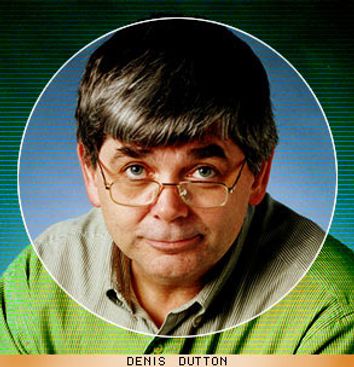
Denis Dutton, editor of the popular Web site Arts & Letters Daily, has the kind of damn-the-torpedoes, strapping intellectuality that figures like Camille Paglia, Robert Hughes and John Searle do. Over dinner with him, trying to keep up with his knowledge and ideas about wine, Glenn Gould, Kant and evolutionary psychology, you can feel like Boswell invigorated by the company of Dr. Johnson.

Dutton, 56, grew up in Los Angeles, got his Ph.D. from the University of California at Santa Barbara, spent time in India with the Peace Corps (he still twangs away at his sitar on occasion) and eventually accepted an appointment to the University of Canterbury in Christchurch, New Zealand. A gleeful contrarian, he edits the academic journal Philosophy and Literature, and in 1996 founded the Bad Writing Award. A thinker who prefers to measure his thoughts against what actually exists, he once took time out to live with the wood carvers of the Sepik River region of New Guinea to learn what art, craft and beauty mean to them.

Arts & Letters Daily has been one of the Web’s surprise hits, a text-heavy site that consists of little but one long scrolling page — technologically, it’s about as un-cutting-edge as can be. On it are found no animations or applets, just links to articles and essays published elsewhere, with teaser paragraphs describing the highlighted articles. The site caught on quickly as a kind of unofficial “best of the Web.” (Full disclosure: A few of my Salon pieces have been highlighted by ALD.) For readers interested in ideas and the arts, the site, which was purchased by the journal Lingua Franca in November 1999, is like a daily digest assembled by brainy, freewheeling grad students.

Now Dutton — the scholar as Internet impresario — has struck again, founding the online publishing house Cybereditions, dedicated to making available worthwhile scholarly books that had fallen out of print. Cybereditions offers them up as e-books, HTML downloads and print-on-demand paperbacks. Salon caught up with Dutton by phone, as he took a break between a meeting of the American Society for Aesthetics and an e-book conference in New York. As always, the conversation hit the ground running.

You just attended a conference of estheticians. How is the concept of beauty doing these days?

I think the idea of the social construction of beauty — this idea that beauty is simply whatever culture or society says it is — is on the run. Of course, beauty does arise in a cultural context. No one ever denies that. But there’s also a natural response people have to it.

But wouldn’t it be fair to say that an enjoyment of haute cuisine and Bach generally comes only with an education?

Sure. It’s clear on the one hand that an education enriches and informs a response to beauty, even makes it possible in esoteric cases. On the other hand, there’s no question that someone with no musical education whatsoever might wander into a concert hall and be overwhelmed by the Beethoven Pastoral Symphony. Any theory of esthetics that ignores these two sides of the appreciation of beauty is missing something important. I feel that as a young person in the Peace Corps I was too impressed by cultural differences and didn’t look closely enough at similarities. Evolutionary psychology is a terrific corrective to the idea that we’re all purely products of culture.

When did you start Arts & Letters Daily?

I designed it in July of 1998. It first went live on Sept. 28 of that year. The design of the page is based on an 18th century broadsheet.

Why?

The 18th century broadsheet tries to pack the maximum content on the minimum amount of paper. So I took that classically simple idea and turned it into a Web page.

I imagined it had something to do with your enjoyment of clashing points of view.

I do like the idea that there’s a range of views on the page, and all sorts of competing voices.

How quickly did people discover the page?

It took off very fast. These days, we’re often above 20,000 visitors per day. As with most Internet sites, weekends have smaller numbers, and Friday isn’t as big as Monday.

What do you know about your readers?

They’re the kinds of people who subscribe to the New York Review of Books, who read Salon and Slate and the New Republic — people interested in ideas. One of the things that pleases me about the Internet is that people have for a long time idealized the ’50s and 1960s as some kind of golden age of journalism. With three networks and every city having a monopoly morning daily — as if that were a golden age! For diverse points of view and open, robust criticism, things have never been better than they are today.

What has been the most controversial piece you’ve linked to?

A couple of times when we had some pieces that were excellent, sober, scholarly articles from the magazine Christianity Today, these seemed to get up some readers’ noses. People who wouldn’t think twice about something out of Commentary were objecting that we were publishing out of Christianity Today. They seemed to think we were somehow forcing religion down people’s throats.

What have you learned from your readers?

One thing that surprises me is that people are not necessarily looking for short pieces. Many of our most popular items have actually been quite long. This challenges the idea that everything on the Internet ought to be short and sharp. People are also looking for longer, meditative pieces that provide an occasion for thinking.

There is an audience out there for high-end material. You don’t hear much about them.

It’s all supposed to be shallow glitz.

In the media biz it’s taken for granted that magazines have to work a niche market. Yet if your site has a theme, it’s variety.

We’re very conscious of that. The site is intended to expand the reader’s sphere of interest. It’s a grave mistake in publishing, whether you’re talking about Internet or print publication, to try to play to a limited repertoire of established reader interests. A few years ago Bill Gates was boasting that we’ll soon have sensors which will turn on the music that we like or show on the walls the paintings we like when we walk into a room. How boring! The hell with our preexisting likes; let’s expand ourselves intellectually.

I know people who love your site but scratch their chins, because they can’t figure out your point of view. They want to know your agenda.

[laughs heartily] I heard recently about a British Marxist who finds that the site enrages him. But he can’t help but look at it every day. We’re reacting against cant and clichés wherever we find them. Whatever’s prevalent in the universities and among the chattering classes is sometimes something that needs exploding. And we’re willing to throw the dynamite. On the other hand, there are certainly many items on Arts & Letters Daily that present a fairly standard line that educated people take on many issues. A vegetarian gun-control advocate who opposes capital punishment is fine. But what pricks my interest more is the vegetarian anti-capital punishment cowboy who carries three shotguns displayed in the back window of the cab of his truck.

Let’s talk about Cybereditions. Book publishing is such a nutty field. Why would a professor of philosophy want to get involved?

My parents were in the book business, my brothers still run the Dutton bookstores in Los Angeles and I’ve been interested in editing books and journals all of my life.

When did Cybereditions go up?

It’s been selling books off its site since the middle of this year. We have about 30 titles in process right now, and we’re hoping to raise that number to over 100 in a couple of months. Books have been going out of print at the rate of 30-40,000 a year for the last 40 years. So Cybereditions takes high-quality, out-of-print books that the authors have the rights to and does a new edition where possible. Some of our books are unchanged from the original edition, but most are in some way updated.

What are your bestsellers?

Frederick Crews’ book “Skeptical Engagements” has been selling, Norman Holland’s book “Poems in Persons” has been selling. And Mark Turner’s “Death Is the Mother of Beauty” has been popular. We recently acquired Ihad Hassan’s “The Postmodern Turn,” and Brian Boyd’s first book on Nabokov’s “Ada.”

As successful computer people are beginning to kick back a little, are they becoming more interested in the cultural applications of the technology and the money?

A couple of years ago it was impossible to interest people in the computer world in anything that used the dreaded word “content.” If it wasn’t a switch that made something go faster or some kind of whizbang program, they weren’t interested. Cybereditions is an application of computer technologies to a very traditional business. Book publishing is and always was, as Jason Epstein has said, a cottage industry. It’s a matter of authors working with editors to produce books that are useful to readers. There’s no way to mass-produce good editorial work. And good books are no more going out of fashion than good stories or good food. We have found backing in Silicon Valley, though it’s very modest.

Authors tell me that, now that publishing houses are aware of electronic publishing, they won’t let rights revert to authors anymore. The publishers are refusing to admit that books have gone out of print.

That’s exactly right. This is going to enrich a lot of lawyers. Ask the publishers for the rights, and they’ll dawdle and claim a book is simply out of stock. At the same time, there are thousands of authors who, before all this, when they were told their books were out of print, simply took the rights back. So there’s a huge field that Cybereditions can work with even if the current publishing scene is not entirely friendly to a new entrant.

What rate do you pay?

We pay up to 40 percent of what we net, and with electronic downloads that can be done.

Does Cybereditions have a physical location somewhere?

The server’s in Santa Clara, Calif. The company doing the editing is in Christchurch, New Zealand. The technical people are there too. We’ll be using contract editors all over the world. Our authors will certainly come from everywhere. It is a New Zealand corporation, but with international investment. And the print-on-demand books will be done, mostly, in the U.S.

How do you react to the new Gemstar e-book readers?

The quality of the devices is excellent. But Gemstar is intent on controlling and licensing what the devices can actually be used for. Rather than using an open format, which allows you to use any file of your own, you can only read what you download either through their site, or what is licensed by them.

A lot of commercial publishers are high on Gemstar’s approach.

If this is the future of electronic publishing, I think you can count most readers out. Who would have bought a television set in 1955 if it turned out that the television-set manufacturer controlled what programs you could watch?

What kinds of opportunities does electronic publishing offer someone interested in scholarly publishing?

For one thing, it changes the concept of the book. Normally a book comes out in a final finished edition. Perhaps years later a second edition follows. But an electronic book can be continually revised, more like a computer program than a printed book. You can have an initial edition, then make some corrections — that’s edition 1.01. Some more and you have edition 1.02. Right up to a really new edition, and that’s version 2.0.

Everything becomes software.

We can continually update. Another thing: Traditionally, the book is published and sits out there alone and undefended while the critics pick it apart. With e-publishing, a scholar who’s worked for years on a book can now come out with a revised edition answering critics. We think that the idea that writers can now answer their critics is very important. That’s why we’ve registered the domain name booksthatbiteback.com.

So much of what gets said about electronic publishing is about how the floodgates will finally be opened and the native genius of the people will finally be released.

I sing the praises of the many contrary points of view that are available on the Web. The downside is that much of the material that’s available on the Web is unedited and self-indulgent. More than ever, the Web demands good editors who can knock writing into line and make it serve readers rather than the egos of writers.

Internet utopians tend to use the term “gatekeeper” as a synonym for “devil.” As a publisher, what’s your view of the role of gatekeepers in the Internet world?

The old libertarian paranoia about gatekeepers is passé. Gatekeeping is impossible on the Internet anyway. What we do need, as much today as ever in the past, are intelligent editors and publishers who can be relied on to select the best material.

We need guidance.

And guidance of that sort isn’t manipulation. It’s entirely rational, and an economic use of time.

In a way that’s what the canon is — guidance.

The classical canon is a great way to begin an open-ended reading list. It was never intended as a straitjacket, nor should it be.

You’re an egghead who has created an intriguing business. What have you learned about the business world?

Many of the people I’ve encountered, particularly in the computer industry in California, are some of the smartest and most imaginative people I’ve ever met. And one has to laugh a bit sadly at academics who look down their noses at people who happen to have done well in the computer industry.

I’ve always been amazed by the way some academics seem to think that they’re smarter than everyone else.

I once read that people with Ph.D.s in fact have slightly lower IQs than people with M.A.s. Apparently, a lot of really smart people feel, once they’ve got the M.A., enough of this, I’m out of here. And some people who go on to get the Ph.D. have a kind of stupid doggedness. As a Ph.D. myself, I suppose I might admit it takes one to know one! Even so, you also find some of the best minds in the world in academia.

Are there assumptions academics make about businesspeople you’d like to shake them out of?

The usual leftoid malarkey — that the business people are only interested in profit, really, while we academics worry about the good of the world, and whether our four-month vacations might be reduced to three and a half.

I left academia in the late ’70s. Bring me up to date.

There’s a very serious divide that’s developed in the academic community. The science departments have remained strong. And those departments such as psychology or economics that have tried to give an empirical base to their research and teachings have remained lively and productive. The sad story is over in the English department. English as a discipline has been reduced to a laughingstock by its adoption of cultural studies as its central focus. In a sense you can see how it happened. The students don’t want to read long, hard, old books. And many faculty members find it unrewarding to teach classic literature to recalcitrant students. But to rescue the situation by turning to politicized readings of comic books, soap operas and the media has been a big mistake. Of course, there are still holdouts for real quality — Bard College is a notable example. But increasingly they’re an embattled minority.

The radicalism of the cult-studies approach seems to go hand in hand with a complete caving-in to commercialism.

Yes. There’s an odd way in the which the left, by trying to remain avant-garde, has gleefully adopted commercialism as the only reality — playing perfectly into the hands of the philistine right. Realistically, we have to understand that there’s always a considerable percentage of students who are not given to independent thought, and who rather enjoy being told how to talk about their favorite soap operas in deconstuctionist jargon. In any society there are people who are easily led.

I’ve run into a syndrome among some younger people recently. At about the age of 30, they start to realize they were brainwashed instead of given an education. And only then do they start to wake up from it.

So long as you have contrarian sources of news and information, hope is not lost for intellectual independence. And we’d love Arts & Letters Daily to be the meeting place for critical thinkers from all over the map.

A novelist who has also taught at colleges told me that the people who are really interested in reading and writing are leaving English departments and going into creative-writing departments instead.

So the abiding classical interest in great prose and how it gets made will persist. It will just be reborn in another department.

You aren’t a pundit bemoaning the end of culture!

All of these interests can go only temporarily into eclipse, because they’re permanent human concerns. I’m a democratic optimist — I live in the belief that the more information people have, the more they can be trusted to make the right choices.

Art for politics’ sake

A critic of the NEA and Harvard talks about the narrow-minded, shock-obsessed contemporary art scene.

Lynne Munson’s “Exhibitionism: Art in an Era of Intolerance” is unusual in its use of the word “intolerance,” which refers not, as one might expect, to Rudy Giuliani and Jesse Helms, but to the atmosphere of political correctness that prevails in the art world itself. It’s unusual too in not being polemical, scholarly or comprehensive. Munson’s goal is clearly to avoid scattershot opinionating. She wants instead to focus on describing what has become of the art world — and to explain how it got that way.

To do this, Munson has put together a collection of journalistic portraits of some of the institutions — the National Endowment for the Arts, museum bureaucracies, art history at Harvard — that characterize the contemporary art world. The result is a small book of surprising weight and substance, provocative in the best sense. You might draw different conclusions than Munson does from her reporting, but you’d be hard-pressed to find a swifter, more fact-chunky short treatment of the framework within which the contemporary arts operate.

Munson herself is only 32, but she has deep-dyed conservative credentials. Bred in the Chicago suburbs, she spent a few teenage moments supporting Gary Hart, then found her path. At Northwestern, she majored first in political science, got bored with the lefty bent of the department’s faculty and switched to art history. (While at Northwestern, she met and became friendly with Joseph Epstein, then editing the American Scholar, whom she describes as an “informal mentor.”) She also edited the Northwestern Review, a conservative newspaper. That led to a stint in Washington doing research assistance for Lynne Cheney at the National Endowment for the Humanities. When the Bush years ended, she moved with Cheney over to the American Enterprise Institute, a conservative think tank.

The idea for “Exhibitionism” came to her when she looked into pursuing her art history studies at a graduate level — despite being a Washington policy wonk, she’d maintained friendships with artists and art scholars. She quickly realized that what she was looking for didn’t exist. “A connoisseurial, object-centered education in art history is not to be had anymore,” she says categorically. So she decided to write a book about how this came to be. (She says that when she’s bugged by something, her impulse is to “get on the horn, get into the primary sources and find out who the best sources are.”) She spent three years in New York researching and writing “Exhibitionism.” Salon spoke with Munson during her book tour.

How would you describe the story you’re telling?

My goal was to put forward hard evidence as to what may have sparked the art wars — and to chart very carefully the kinds of changes that have taken place during the postmodern era that fundamentally altered the focus and mission of our arts institutions.

Pretend you’re on “Crossfire.” What two or three points do you want to be sure to get across?

That shock art is the safest kind of art that an artist can go into the business of making today. That the real mavericks of our time have been working quietly and carefully for years in their studios producing wonderful work few people have seen. And that even though the NEA is not the cause of the various ills we’ve seen, it is to a great degree an embodiment of the problem.

What is the “new museology”?

It’s a set of theories postulated by a group of art historians that suggest that museums should no longer operate as objective storehouses for great objects, openly accessible to whomever would like to come see them. The museum should instead be an institution with more activist goals that looks at society, and looks at the objects in its collection, and says: How do we want to change society, and how do we want to use these things to create this change?

But doesn’t the traditional museum impose a political agenda of its own? That of the status quo, for example?

This is the core argument of the new museology. I find it funny. Traditionally, museums used to organize their collections according to the region in which they were made, and often according to the chronology in which they were made. It’s hard to see where politics could have entered into it. Museums and curators organized their objects that way in order to clearly and objectively present their collections, so that viewers who were not well-versed in art history could just come and browse the collection. New museologists have tried to make that approach seem political.

Chronology and geography — I wonder if the new museologists see politics infusing those categories, or the people and institutions that would make use of such categories.

Their primary argument really is that connoisseurship, or the methods through which art historians have assessed and compared works, is some kind of “dead white male,” mystical method, through which European painting always ended up on top. Today curators are spending an enormous amount of their time concocting theories and revising how their collections are presented.

Is this why, when I go to a museum these days, I’m so often more struck by themes and curatorial gambits than I am by the art?

Indeed. And you’re often overwhelmed by wall labels that are larger than the artworks themselves.

Aren’t the new museologists, though, just making the curatorial point of view explicit? And isn’t that a good thing?

But what can the curator’s point of view be when you’re putting all the paintings made in Italy during a certain century in a certain room? I don’t understand how the argument can be made that that’s a politicized approach. To me, so much of this is common sense — the idea that one painting can be better than another, for instance. You go to the Louvre, and there are so many people in front of the “Mona Lisa” you can barely see it. Some of that has to do with fame, of course. But ultimately that fame is the result of people over centuries of time finding something of value in that work. The new museologists and the new art historians like to make all sorts of complicated arguments about how Leonardo only came out on top because of some political strategy that’s been perpetuated. But you go to the Louvre and you see those people standing there, and you see the painting yourself, and you just say no.

No one’s holding a gun to the heads of the people looking at that painting. I’ve always found that people who make the argument that everything is at base political are people for whom that’s true. What I quarrel with is their insistence that that’s true for me, let alone in a cosmic sense. In your view, is that what these new approaches represent — people for whom politics is always paramount?

These are people for whom politics is an end in itself. They often seem to be people who just can’t enjoy a thing in itself.

Harold Bloom identifies himself as a lefty, but he makes a similar argument — that the deconstructionists who have taken over literary studies are people who really don’t like literature or art. What they really like is power and politics.

I would agree with Bloom. I think similar thoughts when I see collectors who spend tons of money on work that’s simply no fun to look at. There are people who fill their houses with work — some of which is little more than propaganda — work that’s meant simply to make a statement that you can understand almost instantly. It’s like filling your house with posters. It doesn’t have anything to do with the enjoyment of looking at something. It seems to have to do with the desire to feel as though you’re supporting the points of view embodied in the work. I have no trouble with people enjoying politics. I’m very engaged in politics myself. But politics and art are two very different things and to confuse them is very dangerous for both.

How many American museums have adopted the new museology?

Probably the majority. And many in places where people would be surprised to see such changes: in Baltimore, for instance, and at the Cleveland Museum of Art.

You point out that something so banal as museum entrances have been affected by this.

Museum entrances used to force you to walk up a lengthy staircase under, say, a grand colonnade, or under a portico. It was a grandiose experience that took a minute or two to proceed through. It helped you focus your attention on transitioning from day-to-day things — cars going by — and focus instead on an experience of high seriousness. It helped you experience the museum as a place for contemplation.

It set a mood.

Today’s entrances make no attempt to set that kind of mood. Now, it’s a more continuous experience. The experience you’re involved in before you enter continues on the inside. You often see a gift shop, a cafe. You don’t have a sense of preparing for a higher experience than you were having before.

What does this reflect?

The argument that art is just another object in one’s regular experience. The new museology says, Listen, don’t hold this object up in any higher esteem than anything else — which makes it easier to make art objects part of everyday debates.

It demystifies the object, which can help you see it more directly. But it can also make you wonder why you’re bothering to look at it at all.

Is it so bad to be ever so slightly intimidated as you approach a wonderful Botticelli at the National Gallery? And to be quiet, and to look at it carefully and really take it in?

When you were thinking about pursuing grad studies in art history, you couldn’t find what you were looking for. What was missing? And what did you finally learn has happened?

Art history graduate programs used to be centered on helping students actively engage art objects and understand them, and to cultivate a level of fluency in approaching and understanding art objects. Art history is more focused now on theorizing. Many students, especially at Harvard, spend years studying art history without really being forced into an encounter with art objects. I’m afraid of the effects this is going to have on museums. Harvard, particularly, is a place that trained decades and decades of wonderful museum directors.

Is Harvard especially bad?

It’s one of the worst. But any program that used to have connoisseurship as a hallmark of its curriculum is either fully gone or considerably on the wane. When you trade away important values that have guided artistic creation and scholarship for centuries, you trade away your ability to pass any reasonable judgment on the quality of things, and to trust scholars and scholarship. It cedes to politics. It cedes to power, really, to use a word that’s particularly treasured by the left. For example: If you no longer teach connoisseurship in school, who fills the void? Galleries. Dealers.

So the administrators are taking over, and the emphasis on social critique is getting greater. How are these facts related?

To a certain extent, in the late 1960s and early 1970s, what art should be came to be redefined as: Art needs to have a social message; artists need to be social advocates; artists need to be using their work as a vehicle for something else. It became a very lucrative track for many artists to pursue, and it came to overshadow many other ways of working.

How much blame does the NEA deserve for the current state of the arts?

A lot of people blame the NEA for a lot of things, because it has lent credibility to trends that don’t deserve to have it. I don’t think the NEA is at the heart of the problem. But I do think it epitomizes the problem.

The “art wars” that you refer to seem to replay the same argument over and over. What is it?

We have one side that lines up along the battle line of censorship and the other side that lines up along the battle line of blasphemy. And they face each other and blast away. The rest of us get bored silly, learn nothing and get confused about what the state of things really is. The artists who provoke the battles become famous, and the people who participate in the battles send out a lot of direct mail and start new organizations.

I suspect that most lefties are convinced that the real reason for conservative attacks on outfits like the NEA is that conservatives just don’t like culture, and never have. Do conservatives in fact care about art?

I don’t really like talking about the arts in these terms. To me the arts are apolitical. I don’t think that someone with conservative eyes would see art any differently than anyone else. The arts deserve to be depoliticized. That’s the wonderful thing about the arts that so many people are trying to rob them of. The arts really do float above those kinds of debates.

Your history of the NEA is especially fascinating. I was surprised to learn that it was under Richard Nixon that its budget expanded dramatically.

That’s right. The agency essentially started in 1967. In 1969 the budget was $8.5 million. By 1974 it was more than $64 million.

I take it that the agency hasn’t grown more efficient over time in its use of its money.

In 1967, they were giving away $16 in grant money for every administrative dollar they spent. By 1996, they were giving away $4 in grants for every administrative dollar. You plant a bureaucracy, you water it, it’s well fed and it blooms. But it doesn’t bloom in a way that serves your mission; it blooms in a way that serves itself.

How much favoritism is there at the NEA?

There is a lot of garden-variety favoritism. But the more pernicious form of favoritism is a stylistic bias. Philip Pearlstein, a figurative painter, tells a terrific story. He was on a panel, and he sat there watching slides with his fellow panelists. At lunch, he was thinking over what he’d seen, and he realized that he hadn’t seen one representational work. In fact, he hadn’t even seen one work that was a four-sided canvas with paint on it. He remarked on this to some NEA staffers, and they explained that the NEA had asked a few of the panelists to come in the previous day and cull out all of the applicants they felt were not competitive. So he spent some hours going through the works that had been culled out. And he found among the rejects far and away the best artists in the whole lot. Many were painters, and not all of them were representational.

Meaning that, despite all the progressive talk, the kind of art the endowment supports has become more and more restricted?

The NEA when it first started was funding work in every stylistic category one can imagine. And then, even as the budget was getting larger and the number of grants was mushrooming, the kind of art that was being funded became of a narrower and narrower variety. When I looked at what was funded in 1995, almost every single artist was making art that was primarily geared toward social critique. If you’re a painter and you go about your task, and your work is about paint, or space, or process, or whatever, but it isn’t also driven by a desire to critique society in some manner, don’t bother applying to the NEA.

To what extent is the NEA guiding and dictating this? And to what extent is it simply responding to what artists are doing?

There are excellent artists out there who don’t do this kind of work and who have not received any of these grants. Perceptual painting, for example, has persisted through the postmodern period, and none of those artists have received any NEA grants. And many of them have applied for many years.

Americans can get terribly worked up about arts funding even though many of them don’t interact with the fine arts at all. How to explain this, especially when it’s a matter of mere pennies and when there are so many other flagrant examples of government waste and stupidity?

I think in part it’s the fact that the formula for being a successful artist today has come to include learning how to critique the American public itself. When you have a whole generation of artists who have cultivated careers bent on this task, on critiquing the public — in making fun of religion or patriotism, or of the expectation that the arts will be beautiful — shockingly, the public reacts. Well, if you poke an animal with a sharp stick long enough, it’s going to turn around and bite your hand. The fact that censorship is always the first argument raised in the art wars strikes me as amazingly hypocritical. It’s not only artists in this country who have free speech, it’s everybody else too.

What’s wrong with a little government welfare for the arts?

We have no proof, except for the very beginning of the endowment’s existence, that the government has actually helped the arts. I think the best situation is where well-run private foundations give grants that do not discriminate on a stylistic basis but on the basis of quality.

England, France and Germany have enormous cultural programs.

The Netherlands does too. It has warehouses full of the work artists have produced that it can’t do anything with.

Doesn’t it seem a little barbaric that a major country shouldn’t have a sizable cultural program?

I never assume the European example is a great one to follow.

Is there any reason to think that the NEA might one day be terminated?

Realistically, abolishing the NEA is a nonissue. If the Gingrich Congress couldn’t do it, it’s not going to be done. No one running for office is even talking about it.

What’s likely to happen to it?

I think until someone can determine whether we can achieve a considerable shift in the way the NEA goes about its fundamental business, and until we’ve determined whether many of the corrupting influences that have undermined the NEA can be reversed, it’s best to keep the NEA small, run it well and hope for the best.

Continue Reading Close

A movie called “Nashville”

Twenty-five years ago, it looked like Robert Altman's freewheeling cinematic tapestry would change movies forever. What happened?

1. 1975

Robert Altman’s “Nashville” was released in 1975. We’d only recently pulled out of Vietnam; the energy crisis was upon us; Nixon had just resigned; and hardly anyone had heard of an oddly ambitious Southern governor named Jimmy Carter.

The world of filmmaking and filmgoing circa 1975 seems just as remote. The idea of studying movies in college was new and exciting; the filmmakers of the French New Wave still had some vitality; screenplays and collections of movie reviews were regularly published — indeed, a film critic, Pauline Kael, was one of the country’s most argued-over intellectuals; the annual summer onslaught of action-adventure extravaganzas was as yet unanticipated. Repertory houses showing older and foreign films could be found in many cities, and colleges were the homes of competing film series.

Most of the big hits of the 1970s were as square as they’ve always been, but there was always something for movie buffs to quarrel about. Had Godard blown it by embracing Maoism and video? Were Bertolucci and Bellochio really the equal of Antonioni and Fellini? Why were so few people aware of Ichikawa?

In America, the World War II/Korean War generation of filmmakers — Sidney Lumet, Sam Peckinpah, Altman, Arthur Penn — was in full bloom at the same time the “film generation” baby boomers (Francis Ford Coppola, Brian De Palma, Martin Scorsese) were introducing a new cosmopolitan art consciousness into American movies. There were heroes to root for and bad guys to hiss; the model was “the artist” vs. “the businessman.”

With the release of “Nashville” and “Jaws,” the summer of ’75 delivered both the culmination — and the beginning of the end — of that period. “Nashville” seemed to incarnate a film buff’s hopes for American movies. Here was an artist putting the machinery of popular culture to work for the sake of art, yet entering into the spirit of popular culture and partaking of its energy too. That was the dream: the power of popular art combined with the complexity of fine art, high and low not at war, and not blurred indistinguishably into each other, but embracing.

“Nashville” was debated in the mainstream press in a way that seems inconceivable now: The New York Times ran at least eight pieces about the movie, and editorial writers and critics weighed in with opinions and interpretations for months after the film opened. (The movie’s 25th anniversary isn’t going unnoted. The Times and Premiere have already run major pieces about Altman; Fox Television will broadcast a documentary about him, “Altman: On His Own Terms,” on August 13; the Academy of Motion Picture Arts and Sciences screened the film on June 22 in Los Angeles, with Altman and various cast and crew members in attendance; and, in November, Simon & Schuster will publish “The ‘Nashville’ Chronicles,” by the Newsday film critic Jan Stuart. Paramount will release the DVD version, offering its proper Panavision screen-aspect ratio, on August 15.)

But it was “Jaws” that captured the mass audience and really changed movies. It wasn’t the first big success of the boomer generation, but it was a hit on a scale no one had ever seen before. (Within a month of its release, the stock of MCI, the conglomerate that owned the film company that released “Jaws,” went up 22 points.) The aftereffects of “Jaws” rattled the world of film from top to bottom: Soon the artists were coming a cropper — Altman spent the rest of the decade creating ever-more-perverse head-scratchers; Coppola spent years on the debilitating “Apocalypse Now,” and seems never to have recovered his energy or concentration; Scorsese tripped himself up making the over-ambitious, epic musical, “New York, New York.” In 1977, George Lucas’ “Star Wars” was released, and the intellectual and art side of filmmaking and filmgoing has been scattered to the four winds ever since. Despite the occasional good movie, the news since has all been about technology, effects, gender, race and business.

Through most of the ’70s, Robert Altman ran a kind of medicine ball caravan of an operation, and, following his work, you could feel like a participant in an ongoing party. He was a hip impresario, moving from detective movie to western to gangster movie, tweaking and twisting them, demanding more of these genres than they were used to providing. If Peckinpah was the barbaric, bitter celebrator of boozy grandeur, staking it all on the one great certain-to-lose gesture, Altman played the margins with a slipstream elegance, keeping a variety of bets in play at once. Tall and charismatic, with a goatee and long fine hands, he looked like something out of a Mark Twain story — a frontier campaign manager, perhaps, or a riverboat gambler turned grandee.

He enjoyed shooting his mouth off about the cowardice of studio executives — he always seemed to need an enemy — and about his own preferences in drugs, booze and actresses. He brought to the movies a no-big-deal elegance; a taste for risk, humor and the unhinged; a hatred of rigidity and the overbearing; and an intransigent take-it-or-leave-it spirit. He also had — and still does have — an intoxicating line of California-zen “It’s the art, man” baloney, and a hipster/psychic’s ability to find (and touch) you where, as we used to say, you really live. I once had lunch with him for a magazine interview, and by the end of it was ready to follow him anywhere. It took me a day to come to my senses and realize I’d been snowed.

As an essayist about popular culture, Altman was our Godard; in his view of life as a sad/funny circus, he was our Fellini; in the way he looked for truth in the souls of actresses, he was our Bergman; in the way he always saw people as part of a larger context, he was our Renoir. He’s also a natural joker, a satirist at heart (even as he dreams of tragedy and art), a profane and lowdown American who can’t put on fancy European airs without looking foolish — not that that stops him from trying. (Altman’s an orchestrater and conductor of genius, but as a composer he’s a dry well.) But when he messed with pop and film archetypes — western heroes, frontier hookers, country-bumpkin thieves — he could deliver a many-layered experience.

The jokey babble of “MASH,” the vanishing-before-you melancholy of “McCabe & Mrs. Miller,” the offhand goof “The Long Goodbye,” the from-the-peripheries tone poem “Thieves Like Us” — different as they were — all seemed spun off the same reel. On the surface were familiar, linear story landmarks; beneath and around them burbled impressions and half-formed thoughts, feelings, and perceptions organized according to modernist art principles. Altman often works with what you’re not used to noticing or admitting to consciousness, what you normally tune out: objects and actions at the edges of your vision, overheard sounds, half-formed thoughts, hazy memories. He draws you away from what you usually focus on, and into less-familiar areas. What can’t be transcribed is often the point. A quality of revelation runs parallel to (and intermingles with) the surface throughout; part of the beauty of his movies is the way your attention flickers back and forth between these two levels, often unsure which is which. Some years back, a maker of CD-ROMs told me how eager he was to see Altman’s then-new “Short Cuts”: “Altman was making nonlinear multimedia before the form existed,” he said.

2. America, after the breakdown

There was a third kind of film Altman has made over and over again — films whipped up out of nothing but how he makes movies. Over and over, from “Brewster McCloud” to “H.E.A.L.T.H.” to “Ready to Wear,” they’ve been duds. “Nashville” is the great exception. There’s an exultant quality to it, as though the artist is glorying in his prowess, that can remind you of Picasso once he learned to cut loose with his own language. It’s a satirical musical comedy worked up around the idea that an independent/outsider presidential candidate — calling his new organization the Replacement Party — is coming to town to throw a fundraising (and publicity-garnering) concert.

The film has often been described as a tapestry, and that’s about right. The city of Nashville is used as a nexus or hub; even the people who live there seem like they might be tourists. (The exception is Keenan Wynn, playing a geezer with a small boardinghouse and a wife in the hospital. “What are you doing in Nashville?” a guy asks Wynn genially at a coffee shop. “I live here,” says Wynn. “Oh,” says the guy. It’s a real conversation killer.)

A dozen or so characters are moving through town. A dozen or so others are based in town. Keith Carradine is the sexily self-absorbed star of a hit folk-rock trio; Lily Tomlin is a suburban wife and gospel singer — she has something of the angelic and something of the shellshocked about her — with two deaf children. Henry Gibson plays the oily Haven Hamilton, a specialist in sanctimonious spoken-sung inspirational weepers, and the city’s unofficial greeter.

Geraldine Chaplin is the hopelessly pretentious flibbertigibbet “Opal, of the BBC.” “Un, deux, trois, quatre. Testing, testing,” she murmurs into her mike as she warms up her tape recorder. She’s there as a stand-in for Altman, and for anyone who would breeze into town to make overblown metaphorical points. The central figures — although they get no more screen time than many other characters — are Michael Murphy, as the candidate’s smooth advance man, and Ronee Blakley, playing an emotionally fragile star who’s returning to town after being away, recovering from burns she got from a “fire baton.” (“Nashville” probably took its self-mocking tone, as well as its subject matter, from William Price Fox’s Nashville novel “Ruby Red” and his script “The Great Southern Amusement Company,” both of which Altman had read.)

The film is like a series of overlapping variety shows set in parking lots, airport lobbies, hotel rooms, commercial strips and hospitals, and seen through plate glass and past billboards. It’s a jerry-built world of the disposable and the efficient. Altman gets the look of small-city mid-America: the knee-high socks, the businessmen in their tan suits — a Chamber of Commerce, high-school-athletic-team look.

People who wanted a tribute to the city of Nashville, or to country music, took the film very hard, as though the music and the city needed defending. “Cheap shot,” “patronizing,” “rip-off” — these were some of the accusations thrown at the film. I was willing to believe Altman had been a little rough on his subject until I visited Nashville for the first time, years after seeing the film. I was thunderstruck by how little the film had exaggerated; it had been more of a documentary and less of a satire than I’d thought. There was no escaping the bad middle-range singers, the bored backup musicians, the terrifying big hair, the Goo-Goo candy bars, the homey sentiments, the cranky retirees in cheery T-shirts.

The film comes across as a piece of New Journalism; it’s like Norman Mailer’s reports from conventions and rallies. Altman is using Nashville metaphorically — he’s really talking about politics. I wish he didn’t make that quite so explicit. There’s a reference to Dallas and a few to the Kennedys, as well as some red-white-and-blue visual cues, that the film could have done without. Still, the result is an X-ray of the era’s uneasy political soul.

What it reveals is a country trying to pull itself together from a nervous breakdown. As a young man, Altman had been taken by the Method, and in many of his films he has shown a love of watching women go to pieces. Here we watch not a blond in a slip but the entire country going through a crackup. It’s a country that’s wired up tight with tension masquerading as happiness. In this film about country music, the marketplace has leveled the ground, and there’s only one shot of the countryside. It’s of a funeral — the arc of a life returning to its sources.

Recording and communication devices — wires, phones, intercoms, cameras, mikes, speakers — seem to be everywhere; so does the machinery of publicity and fame. We watch the city recording itself, playing itself back to itself and marketing that image to itself. We eavesdrop on the culture’s conversation with itself. We’re watching people decide how they want to see themselves and how they want to sell themselves. Altman treats Nashville as a provincial New York or Hollywood, as one of the places where the culture manufactures its image of itself (this is Nashville in the early stages of getting slick and L.A.-ified). Altman shows us the image, and what goes into creating and sustaining it. He cuts between public functions and private domestic scenes; he shoots in studios and theaters, from onstage and from behind control booths. We gather that this is a culture that believes that its self-image accounts, or ought to account, for everything. And its image of itself is cheerful, upbeat, carefree: “It don’t worry me,” people sing.

Altman brings us into the space between the culture and its image of itself. We see the determination that goes into containing oneself in the pop image of just-folks. We see the jumpy creature within, and we see how Nashville’s self-image becomes a straitjacket. The songs that the characters sing, sell and buy are about roots and homesickness, and make a great show of being about “real” people and “real” problems. But they’re completely formulaic. The real energy goes into the marketing. There’s a consensus reality that has been created of simple shapes, bright colors and sweetened sentiments. A lot of the humor in “Nashville” comes from seeing how much heightening and industry go into producing this music that has such claims to relaxed authenticity.

The film is also a picture of a populist culture driving itself mad with celebrity. People want in to stardom, as they want in to heaven. And if they can’t get at least a piece of stardom, they’re furious. Altman shows us how we use stars. They give us focus. We tell ourselves their stories, and we organize our mental pictures around them. We want them to be real yet conform to our desires. But as populists, we’re picky about whether our stars are putting on airs (as though that were the greatest sin). We’re even picky about whether they’re just too dang professional. They have to be one of us, yet special, because we want to feel we’re a little special too.

The stages and studios of “Nashville” are full of professionals, but the stars themselves are near-amateurs, or very skilled at playing near-amateurs. Someone who really connects (like the Ronee Blakley character) can be a lightning rod for our frustrations. If there’s a revelation “Nashville” drives toward, it has to do with how attached we are to our fictions and how inescapable we have made them. “How do you get outside?” we overhear a frazzled soul ask at a hospital nurses station. Comes the polite answer: “You dial 9.” We feel starved for contact with the spiritual and the mythic, yet we live in a popularity-game world full of gods and superstitions. Altman uses the kids playing Lily Tomlin’s deaf children symbolically. In this film with the most complicated of all movie soundtracks, they’re the only characters untouched by the clamor and hubbub.

Yet the film is jubilant and festive; a freeway pileup turns into an impromptu picnic. The people are grotesques and caricatures of themselves, but they’re also — even the most flagrant losers among them — wily self-starters. (This seems truer and more accurate — to this Middle American, at least — than does the Raymond Carver view of ordinary Americans as stunted dead-enders.) The film feels like both a piece of drama and a painting with a time element.

In one scene, Lily Tomlin and Keith Carradine have just had sex. (A tape of him singing plays on his tape recorder: This seems to be a seduction technique of his — he’s purveying his self-regard.) In bed, relaxing, he has her show him how to say “I love you” in American Sign Language. She smiles happily, then realizes it’s getting late. She straightens her hair and pulls on her clothes, sizing up the damage in a bathroom mirror. Carradine is stung — we’ve seen him with a number of other women, but he’s opened up only with her. You can see him thinking: “People don’t leave me. I leave them.”

He retaliates by dialing up an old girlfriend, working his charm on her and offering to bring her to Nashville in full hearing of Lily. Almost imperceptibly, Lily — a straitlaced mother and wife who has probably never before cheated on her husband — registers how childish and selfish the man she’s just had sex with is; she also registers how badly she must have needed this tumble. She waves goodbye briskly and leaves wearing a different smile than the one she wore in bed; Carradine ends his phone conversation abruptly. He can make any woman in a club think he’s singing a song for her alone, but here, now, he’s frustrated and disconsolate.

With its profusion of wires, recording and communication devices, its mirrors and reflections and its concern with language, playacting, time and revelation, this brief scene is more complex than anything I can think of in the work of intellectual gameplayer-directors like Peter Greenaway. Yet the complicatedness isn’t made much of. We just take in the environment and the characters and what they’re going through. For Altman, this kind of thing happens to all of us, all the time. Signals get crossed, unwanted frequencies come wafting in, reflections we’d rather avoid bounce back at us, ghosts from the past sweep us up and then drop us, and when one thing comes into focus another falls out.

“I’m looking for surprises,” Altman said to a reporter at the time of “Nashville.” “If we had just taken what was in my head and put that vision on film, it would have been a pretty lousy movie. Or at least very, very ordinary. One head, no matter how good — well, it just can’t be the same as everyone bringing something to it.” Over his career, Altman developed a variety of techniques to allow for inclusiveness. The sound systems he developed with the sound engineers Jim Webb and Chris McLaughlin let him record and present more ambient and minor-character noise than we’d been used to. With his cinematographers — during this period, usually Vilmos Zsigmond and, here, Paul Lohmann — Altman used multiple cameras and lighted entire environments, not just individual shots. This gave his actors an unusual freedom of movement; it also meant that, since they often didn’t know from which direction they were being filmed, or which angle was likely to be used in the final cut, they couldn’t play to a camera.

Altman often has his actors fill out their characters with their own substance. Blakley, for instance, actually was once burned by a fire baton. An actress might choose her own wardrobe and write her own dialogue; the structure that Altman’s screenwriter, Joan Tewkesbury, worked out allowed for a great deal of improvisation. The actor’s rapport with his role becomes what we recognize as the character. Here, many of the performers playing singers wrote or co-wrote their own songs. (That’s how Keith Carradine got his Oscar.) There’s always a mixture of real and not-real in what we watch in a fiction movie. Some filmmakers take this to be a problem, and put all their energy into strong-arming you to believe in the fiction they’re presenting. For Altman, a desire to believe is basic to human nature. It doesn’t need goosing, just inviting. And, yes, what we’re watching is both real and not-real. Why not invite both to the party?

He works by crosscutting and parallel action, by implication and suggestion. One of his distinctive camera techniques is to move the cameras and have them zoom at the same time. Cameras in motion add depth to an image. They’re generally used to heighten involvement; they invite us into roundedness and mass. Zooms flatten the image out. They’re usually used to heighten tension: The bomb is in the trunk, the microfilm was left in this drawer. The way Altman combines the two cuts us loose from our lock on the conventional subject, and frees us to rove through the entire image at our own rate. The camera work (like the soundtrack) seems elastic, submarine. It has a Japanese-screen effect; we move back and forth between losing ourselves in abstraction and pattern, and seizing on the concrete and specific.

When he does zoom to pick something out, it’s usually a character trying to decide what response is appropriate. He’s drawn to moments when you can’t figure out how to take things. Altman has his actors reacting to more than they can keep track of. Part of the fun is in watching them try to puzzle their way through a moment. “Truth” for Altman, as for many people in the performing arts, often seems to be what happens when a performance is working. (The one bad performance in “Nashville” is Allen Garfield’s; he overdoes the sleazy pushiness. While everyone else is fitting in, he’s doing his best to stand out.) Perhaps the film’s funniest moment comes when Blakley is singing on an outdoor stage that’s a mockup of a paddle wheeler. She sings beautifully to a relaxed, rapt crowd. Scott Glenn plays a soldier who’s infatuated with Blakley, and he’s staring at her and listening to her, agog. Geraldine Chaplin pushes her microphone in front of him and asks if he’s been to Vietnam. He doesn’t respond; he’s too caught up in Blakley’s singing. “Oh,” says Chaplin, empathizing wildly, “I can see that you have been.” She’s incapable of realizing that there’s magic happening on the stage before her.

Henry Gibson is spectacular as the viciously competitive Haven Hamilton. He’s an imperious cornpone cynic, a virtuoso of sanctimonious boilerplate constantly making appreciative reference to “this business that’s been so kind to me.” He makes his toupee and girdle seem major statements. But it’s with the actresses that Altman shows his best stuff. Watching some movies, you get the feeling that the director is having a sexual exchange with his actresses, and that the film captures a pulsing, we’re-breathing-each-other’s-breath quality. You sometimes see this when D.W. Griffith directs Lillian Gish, Bergman directs Bibi Andersson or when Frangois Truffaut directs Jeanne Moreau.

Altman’s work with actresses is often in that league; in fact, there may never have been another director who has given us such a rich panorama of female performances, or who has delighted in such a wide range of physical and emotional female types. They range from the hard-bitten yet vulnerable examples of Julie Christie (in “McCabe”) and Susannah York (in “Images”) to the high-strung, self-dramatizingly serious women (Blakley in “Nashville” and Sally Kellerman in “MASH”), all forehead and cheekbones, for whom Faye Dunaway might have been a template, to the long-faced, down-to-earth women like Louise Fletcher (in “Thieves Like Us”) and Lily Tomlin to the one-of-a-kind Shelley Duvall (in “McCabe,” “Three Women” and “Popeye”).

From Sandy Dennis in “That Cold Day in the Park” (1969) to Embeth Davidtz in “The Gingerbread Man” (1998), Altman is fascinated by the beauty and power women are capable of, as well as by the potential for destructiveness that coexists with their sense of themselves as vulnerable. In “Nashville,” Geraldine Chaplin is a wizard at archness, missing the main point repeatedly with great wit. In her first film, Blakley gives a performance that’s ridged with emotion. When she isn’t performing, her Barbara Jean, a reigning country queen, is just psychic flotsam and jetsam. When she does perform, all the bits and pieces come into sync. There may not be a real personality in Barbara Jean, but at least it all sometimes moves to the same rhythm. Barbara Harris, a jazzy stylist of instability, never registered in another film as memorably as she does here. Playing a daffy, miniskirted, bleached-blond hillbilly with fantasies of stardom, she’s like a kitten on Quaaludes. When she does get her chance to sing, and she strews leftover flowers to the crowd, it’s as though she’s distributing bits of her ragamuffin heart.

It’s eerie how accurately “Nashville” pointed the way to the future. Here is our coming attachment to the “outsider” candidate, and our tireless hunger for authenticity and sincerity; here’s how feeling good about ourselves and griping about taxes came in the ’80s to take precedence over everything else political. In the film, once the crisis has been reached, every relationship snaps back to its previous state; we’re watching the country try to reaffirm its innocence. It rejects what it has seen of itself; the surface closes over again, like ice over a pond. This could almost be an anticipation of how, during the Reagan years, we acted out a manufactured version of normality and cheerfulness for ourselves.

Altman’s 1970-1975 streak can be seen as an extension of American painting from the mid-’50s on, and of American writing of the ’60s — as an example of pop art. For a couple of decades after World War II, pop — the teen-centered, Imperial America version of consumer culture — seemed young, irreverent and disrespectful of tradition and stuffiness, as well as garish and horrifying. To many artists, it seemed a great subject, source and vehicle for art. Robert Rauschenberg, James Rosenquist, Norman Mailer, Tom Wolfe and Terry Southern, among many others, took on pop subjects and worked in pop forms, bringing sophistication and perspective to pop while borrowing back its pizazz and accessibility. In a movie such as “Major Dundee,” Peckinpah dramatized his antagonistic relationship to pop with an abstract-expressionist fury. Altman was cooler, looser and more flexible — Robert Frank as a happy cartoonist.

The outdoor concert occurs at the Parthenon, a giant replica of the Greek temple erected for Nashville’s 1897 Centennial Exposition. (Originally constructed of wood and plaster, it was rebuilt in its present form in 1922.) The reporter Howard K. Smith does an essay on television about the candidate; the Goodyear blimp passes overhead flashing the candidate’s slogan. It’s a cloudy, milky day, but the colors are thick, broad and flat. We watch the stage being built, the traffic jam up and a line of black limos snake through town.

This getting-ready sequence seems straightforward, but it has a fated quality. (Even if you don’t respond to it as I do, it’s still a model of bringing strands together while keeping them all distinct.) I ran it over and over on my VCR, and I still can’t explain why it has the poised yet deranging, hallucinogenic effect it does. When the black limos pull onto the green grass behind the Parthenon, we watch them circle from above, between massive lemon-cream pillars. As Blakley and Gibson swing into a song, we’re above and behind them too. Then Blakley starts to sing about her parents, and we’re watching her from close up and underneath. There’s an immense flag fixed to the pillars behind her. When it billows out with the wind, you’re reminded of a scene earlier in the film. It’s at the airport; Blakley is returning from her convalescence to a city-sponsored welcome that’s like a parade. There are bands, reporters, crowds and marching girls. For a few seconds the sound of the entire scene is drowned out by a taxiing jet with a big “American” sign on its side. The colossal scale of the joke is part of the humor — it’s one of the biggest damn jokes since Buster Keaton tumbled a train into a river in “The General.”

Watching the earlier scene, you giggle. Here, when that flag billows out, you feel like you’re going insane. Blakley’s emotions surge, rise and crest. And amazingly, at that moment the sun — the sun! — comes out. The moment is so intense you don’t know whether you’re in ecstasy or whether you shouldn’t don an aluminum-foil hat to shield yourself from so many vibrations. All that’s on screen is a singer singing, yet — if you respond to Altman as I do — the inside of your skull feels as though it’s being painted on by such “artists of the insane” as Christian Wolfi. The feeling is sinister and beautiful; you feel there’s no turning back. Altman creates disordered, media-overload effects of the sort Thomas Pynchon is often said to create, and he does it without sacrificing aesthetic distance. (Pynchon always seems to me more interested in creating a nervous breakdown than in writing about one.) The center comes apart, and we’ve never felt freer. And we love our affliction.

3. The cinema of information

In the summer of 1975, I was a film student at NYU, and the day “Nashville” opened, I was among the first people in line at the Baronet. (Altman’s 1971 “McCabe & Mrs. Miller” was the film that made me fall in love with movies.) Altman walked by with a few people, checking out the business. I ran after him and asked for an autograph. Feeling foolish, dizzy and thrilled, I gave him the only thing I had with me he could sign — a copy, as it turned out, of Karel Reisz’s book on film editing.

It was a cuckoo time. There was an intoxication about filmmaking and filmgoing — a euphoria and a fever. For many people, an interest in movies and movie history provided a way into the arts and a framework for exploring them. Films like “Nashville,” “The Conformist” and “The Godfather” were peak experiences that seemed to bring together all your interests in the arts — high and low, visual, auditory and literary. A figure like Godard or Altman or Coppola opened up new directions and led you into discoveries not just in art but also in your life, in terms of sex, philosophy, love, fantasy and friendship. So these figures meant something to you personally. They transformed you; they made a difference in your sense of what was possible.

By 1980, Altman was unable to find financing for his projects in Hollywood. He directed plays in New York, then moved to Paris and directed opera, TV and small films. He returned to Hollywood moviemaking in 1992 with “The Player.” By then, the baby boomers were running the joint. By now, they have set the tone in the media for 20 years. It’s striking how on-the-money Altman is in “Nashville” about the dark side of the baby boomers. Even when they’re successes, and even when they view themselves ironically as such, they always see themselves as outlaws. The character Keith Carradine plays — in his leather vest, his sun-kissed tresses, his contempt and his sensitivity — rings true in his vanity, his sense of entitlement and his selfishness. A character played by Cristina Raines is so wrapped up in her narcissism and masochism that she can barely bring herself to make baby talk. In the film, the older characters make an effort to keep up appearances. The hip, solipsistic younger people generally just act out.

In American movies, what the 25 years since the release of “Nashville” have brought is an evolution in the direction of selling the story and the hook — the movie equivalent of pop music’s three chords in 4/4 time. It’s as though the goal of filmmakers has become to make the package and the product one — to make the movie live up to its ad campaign. Given this, it isn’t surprising that Altman’s influence has been greater on TV than on movies. A few kinds of new-Hollywood film genres reflect his work: the ensemble film organized around a lifestyle or occupation theme (“Parenthood,” “Pushing Tin”), and the Mad-magazine style movie spoof (“Airplane,” the various “National Lampoon” movies). On TV, his influence can seem to be everywhere. “Hill Street Blues” and its mixed-mode, ensemble-cast descendants (“ER,” for instance) are straight out of “MASH.” The projects that combine story and documentary material in new ways, from the dramatic reenactments on shows like “A Current Affair” to attempts like Court TV and “Cops,” come out of Altman’s experiments in mixing fact and fiction.

In the years the baby boomers have been in charge, I’ve fallen out of love with moviegoing. What American movies deliver now are, on the one hand, Hollywood marketing extravaganzas and, on the other, what’s somewhat optimistically called the “independent cinema.” The extravaganzas are essentially big-budget versions of what were once known as exploitation pictures. The ’50s and ’60s exploitation films were often happy-go-lucky time-wasters and pocket-pickers. You could feel fond of a Roger Corman or a William Castle for aiming so low, and for taking the money and running. You didn’t resent them any more than you did the people who ran a carnival.

It’s hard to feel any fondness for the people behind films like “Dinosaur” or “Gone in 60 Seconds.” These films do the same kind of button-pushing as the old B pictures, and they often give the same impression of being made out of recycled stock footage. But there’s an immense commercial anxiety behind them, and you can sense that they’re basically respectable. (You can feel the careers hanging in the balance.) The people involved don’t seem to be entertaining vulgarians or small-time opportunists — they feel like yuppies taking advantage of our reflexes. Tony Scott, the director of such aggressive marketing machines as “Top Gun” and “Crimson Tide,” has had his tasteful, serene house written up in interior-design magazines. And the independent films aren’t any more motivated by aesthetic concerns than the smasheroo studio films. They’re either illustrating a p.c. point or projecting a flip “alternative” attitude. The independent directors and producers often seem to think that the best response to database-driven commercial moviemaking is no technique at all. The result is anorexic filmmaking.

The language developed over a hundred years by such people as Griffith, Sergei Eisenstein, Orson Welles, Fritz Lang, William Wyler and Marcel Carne can sometimes seem to be a vanishing thing. I long ago became used to the fact that the movies I love don’t often succeed financially. What’s recently come as a surprise is how many of the films I’ve enjoyed most — from “Devil in a Blue Dress” to “The Last Bolshevik” to “Breakdown” to “Romance” — aren’t even talked about. They’re just ignored. I can’t help noticing that something these low-key films share is that they speak the language of movies. They draw on movie history and respond to it. I suspect that that’s what makes them irrelevant to most people.

In 1975, film was potentially the greatest of all the arts; in 2000, it’s one data stream among many. The hierarchical, centralized culture the baby boomers reacted against could be exclusionary, and its emphasis on ego and on greatness could be annoying. But it offered the possibility of something called “depth,” and it also provided a shared culture and language. The atomized, decentered culture we have now allows for horizontal ranging about; the new digital tools (and media) are irresistible; and the openness to cultural mixing is certainly a relief. But this mix-and-match culture can also seem shallow. If everything’s always available, why bother trying to unearth anything? (If it isn’t on a database, it doesn’t exist.)

A young Ivy League graduate I know made a success in arts journalism without ever having seen a Bergman picture. When she finally caught up with one, she was stunned to realize that there’d once been a time when people went to a movie theater to watch characters agonize and philosophize at each other. She hasn’t seen another Bergman since, and she hasn’t gone on to read any Scandinavian literature, or to search out further examples of Swedish films either. In Altman’s “The Player,” a comedy about what has become of Hollywood, a young studio executive is watching his career dissolve, and recovers his momentum only when he learns to stop worrying about integrity and depth. During my lunch with him, Altman observed wryly that one thing he could say for the executives he’d battled in the ’70s was that they cared enough about the work being done to get angry at you, and to hate your movies. Nowadays, when someone takes an idea upstairs for a decision, there’s nothing there but a computer.

Watched on videotape today, “Nashville” seems in its element in a way many movies don’t. It’s alive, and it doesn’t suffer from the fragmenting effects of stop-and-start, at-home viewing. This may be because Altman is instinctively drawn to multiple points of view and unresolved resolutions. It doesn’t exactly cohere, but it seems to bring our channel-surfing minds and experiences into some kind of loose relationship. It gives the impression of being a video installation rather than a routine feature; you can get the feeling that it’s playing on several monitors at once. Watching it made me think that one way of conceiving of TV is as movies gone to pieces and turned into wallpaper.

It also made me think that an upbeat way of looking at where we’ve arrived is this: We have been freed — perhaps against our will — of our attachment to the idea of art as a rebel activity, a gesture toward freedom made for the sake of the unconscious and revolution. Now it has become simply an activity some people pursue, and perhaps get something out of — as legitimate as (but no more vanguard than) business, cleaning, sports, science and child-rearing. “Nashville,” seen at this distance, looks like a snapshot of the moment when substance began to vaporize into information.

Continue Reading Close

The tantric moviegoer

New media has hurt sex on film, but there are ways to watch movies in an erotic frame of mind. Second of two parts.

Perhaps one explanation for the current near-absence of what we might call traditional movie eroticism is the preeminence of TV, video and the Web as media forms. TV used to aspire to be like the movies. Now the effort is going in the opposite direction, into making movies more like TV, ads, rock videos and Web sites. There’s a big difference between new-media sexiness and movie eroticism.

Video tends to make everything literal and raucous. Tasty bits aren’t just brought to the surface, they’re made ultrabrite, and actively go after your nerve endings. This is sex as special effects and packaging, all tweaked and Photoshopped. It’s sex for kids, the kind of sex you run out of energy for at about the age of 30 — around the same time, perhaps not coincidentally, many people lose interest in new pop music. (Has anyone yet made a movie that has intriguing sensual qualities using this new pumped-up, one-blast-after-another, nonlinear language? Some would say “Fight Club,” others have made a case for “Run Lola Run.” I’d argue for “The Matrix.” Whatever the case, there haven’t been many.)

As it’s generally used and encountered, video is either in “sell” mode (snazziness and production values = you’re being sold) or “reality” mode (no professionalism = truth), interrupted by the occasional blast of ESPN2-style nutcase edginess: ahh, “excitement!” Your nerves get a jangling, but you may wind up feeling like a figure from one of those out-of-focus, dysfunctional-life-in-the-’burbs literary book jackets: a flattened, wispy creature romping wanly in a backyard somewhere, recalling — too late! — the bliss of not growing up.

No wonder younger people sometimes say they feel like oversated, over-focus-grouped consumers before they feel like anything else. During a water-cooler conversation with a lively young co-worker the other day, I made a passing reference to “adult pleasures.” “Such as what?” she said challengingly.

If media sexiness tends to be like a Big Gulp, movie eroticism can sometimes be like wine; it can have layers and depth. At its best, it’s about seduction and invitation, and it coaxes responses out of you, even if (occasionally) brutally. It’s almost embarrassing how basic some of the reasons for this are — so basic we often forget what they are.

For instance: Movies have beginnings and ends, while the many channels of video just go on and on. Within delimited movie space and time, structured experiences can be created that are comprehensible and discussable — you don’t need to banter with friends to get oriented, or to hold what you’re watching at a distance. Languorousness, so important to mood, takes on meaning in movies; in video it seems like an absence of pace. Just as basic is the fact that the movie image is far more detailed and denser than the video image. There’s simply more to take in — and because there is, you’re more likely to enter into its world.

The ritual of moviegoing contributes to the qualities we think of as cinematic. You go to a theater at a specific time. You haven’t just sat down with the remote. You’re in the movie’s home, not your own, and when a movie works, you rise up into it. You submit in order to discover, and the experience can be like exploring both the world and your own imagination. You’re doing this in the dark, of course, half in private and half among other people: Who needs Plato’s Retreat? The limitations movies impose — the schedules, the frames around the image, the beginnings and endings, everything that stands between them and virtual reality — can contribute to experiences that may reach you on a deep level even when a movie isn’t very good. Exceptions do abound, but video sexiness is generally about effects (and suggests masturbation), while movie eroticism suggests a way of experiencing, and interacting with, all of life. (Is it only me or do other people sometimes feel as though they’re surrounded by only two classes of Americans these days: happy masturbators and unhappy masturbators?)

Perhaps we shouldn’t be surprised that sex conceived of as excitement that aims for nothing but to become faster and noisier always lets us down.

Had I been less startled, what I might have said to that young co-worker is that some adults discover a larger world of sensation when they view eroticism not as a restless search for arousal, but as a matter of sinking into the moment, whatever that happens to be, and exploring what’s there. Moviegoing can be approached in that spirit, and when it is, it can become an occasion for reverie and poetry, for lust, sadness and discovery — and for probably much else.

Let’s first clear our palates of a few common assumptions, the main one being that sex must always have to do with feeling bright, energized and cheerful — with feeling good. That’s an assumption best left to sugar addicts, Jolt fanatics, the crude and the very young.

The other is that pretension, absurdity and silliness are anti-erotic. A strength of Americans may be their lack of pretension. But rote anti-pretentiousness can cut you off from experiences you might enjoy — almost the entire French film tradition, for instance.

It may be that Americans would be better off if they were able to find pretension erotically amusing. Those French actors up there carrying on about anguish, sex and philosophy? It’s all make-believe, just light on a screen. French characters on the movie screen become what they always should have been, our playthings. What’s more absurd than what turns us on and our pursuit of that? We need to see the humor in our pursuit of erotic experience, and to learn that giddiness and sexiness can enhance each other.

Think of the Fred Astaire/Cyd Charisse “Girl Hunt” dance sequence in “The Band Wagon”; it’s nothing but a stylish, swingin’ parody of Mickey Spillane novels, yet my mind has returned to it regularly and with intense erotic pleasure ever since I first saw it several decades ago. Charisse wears an impassive expression, a black Louise Brooks hairdo, and a huge, fluffy coat, which she sheds as though whisking the cover off the signature dish at Lutece. She stands forth in a bright-green mini-dress, its skirt made of fabric slats. Each one is a frame for her life-of-their-own legs, and Astaire’s reaction to her is a witty piece of calligraphy. Then the comic tango of lust and seduction begins. The sequence might have been conceived of by the writers at Mad magazine, yet, as choreographed by Michael Kidd and shot in MGM’s best rubies-and-emeralds colors, it has its own straight-faced heat.

There are many things about movies that almost force us to take them erotically. The detail and size of the image, the proximity we feel to the performers, the intensification of the situations through dramatic means, the kinesthetics of movement and scene changes, for instance. I’ll use a couple of familiar movies for illustration, “Basic Instinct” and “Chasing Amy.” Each features a blond, lesbianism and lots of dirty talk, yet they have strikingly different feels. A sommelier might ask you to focus on a wine’s color, its nose, its palate and finish. I suggest that if you ask yourself the following questions the next time you watch a movie, there’s a good chance you’ll find yourself experiencing that movie more erotically. No money-back guarantee, but you can flame me if you’re disappointed.

What is the movie’s mood or tone?

Not because there’s any right or wrong answer, but because making the effort at putting some answer, any answer, into words is a way of opening your mind to the movie — you’ll begin to mix your thoughts and responses with the matter of the movie.

“Chasing Amy” is known for its raunchy dialogue and humor, but the film’s tone is full of regret — about losing friends, about realizing that hopes and possibilities have passed you by, about what can’t be unmade and how, like it or not, you finally have to live with that. It’s an unusual mix of the touchingly melancholy and the explosively rude.

“Basic Instinct” is flamboyantly melodramatic, hard-charging and intense, “adult” in an almost comically determined way. Its world is one of fantasy, antagonism and danger. It brings together the coarse and the glamorous; it’s the movie equivalent of a leather-faced old roué who comes on too hard, yet still has a few good tricks left to peddle. It’s like supercharged porn, square yet evil.

How does the movie engage your imagination?

“Chasing Amy” relies on its offbeat setting, and on unusual types — comic book artists and Jersey semi-hipsters. Its blond embodies a flaw in the script; you never really know what she’s up to. Yet that works because you keep hoping to find out. And with her big Martina Hingis smile, her downtown jewelry, her broad, flat Slavic-style face, she’s a whore/madonna who seems to exist only to fascinate Catholic boys, then make them feel inadequate. She’s a phantom, yet enticing.

“Basic Instinct,” on the other hand, uses voyeurism. We’re always trying to get a peek — we’re like the sweaty, overawed guys in the interrogation room who watch Sharon Stone uncross her legs. If the movie works for you, you may find that it hammers its way crudely into some of your dirtiest desires; it puts you in the position of peeping on your own fantasies. The sex shocks keep us off balance. We don’t know from moment to moment how far the movie’s going to go.

The icy, willful blond who’s probably up to no good is an image of mystery and eroticism from far back in movie history, and it was canny of writer Joe Eszterhas and director Paul Verhoeven to use this image in a sexed-up thriller. As Verhoeven uses her, and as Stone portrays her, the Catherine Trammell character never loses her luster despite all the nudity. She’s seen with near-pornographic explicitness; we see the Stone beaver, yet she and her character remain mysterious.

This is a rare accomplishment, and it raises a question: Once everything you could ever want is not only made available but is pushed at you, how does erotic reverie flourish? It’s not just that nudity and explicit language can overwhelm reserve. It’s also a matter of what surrounds the movies today — the reports on movie grosses, the regular behind-the-scenes and how-they-did-it articles in Premiere, Entertainment Weekly and the Sunday supplements, and the confessional interviews. It’s too much. What remains to be found out?

How does the movie engage your senses?

Movies are, empirically speaking, made up only of image and sound — how absurd to talk about them engaging the other senses. Yet when, say, you eat a Moroccan dinner, it isn’t just your senses of taste, smell and touch that are tickled. In your mind, you see things (the Casbah!) and you hear things (belly-dancing music!). A note to the politically anxious: Fantasies seem to operate in terms of stereotypes and archetypes, and if they’re to be explored and enjoyed we mustn’t be too censorious.

“Chasing Amy” is full of cigarettes, beer bottles, old sofas, Army-surplus slacker clothes, Jersey parks and nothing-special chilly days. The first big emotional scene is set — movie convention! — during a rainstorm, but the argument takes place on a random industrial block, in front of a heap of stray cardboard cartons. In the midst of the film is the image of Joey Lauren Adams, her eyes and teeth wet, her face glossy with makeup and a little sweat, wearing a net shirt and smooching with a girl. She and the environment set each other off. The film’s writer/director, Kevin Smith, has sub-rudimentary camera skills, yet that works here — you fill in the camerawork yourself.

“Basic Instinct” is shot in Douglas Sirk-goes-insane colors that make you feel a prickle — hot sun on your skin, perhaps, or cocaine in your nose. The fast cars, the ice picks, the tanned flesh of Stone — it’s all luxurious to the point of repulsiveness, yet delicious, too.

What is your relationship with the performers?

Performers are nearly always the focus of our fantasies and speculations. Watching “Chasing Amy,” I find myself wondering and musing about Adams. That gesture she makes with her hands indicating fist-fucking — how did she feel doing that? Mischievous? Shy? Did the director have to overcome any resistance on her part?

Watching “Basic Instinct,” I remember that I’d been following Stone for years. I’d noticed that she’d learned something about acting since her performances in “King Solomon’s Mines” and “Irreconcilable Differences,” and that she’d developed some emotional daring. I remember too that shortly before doing “Basic Instinct” she’d done a photo spread in Playboy. Did an agent persuade her that it was now or never? Did a boyfriend? Did she decide on her own? Did she need drugs and champagne to get her through some of these scenes?

One could go on and on. And, watching a movie, one generally does. For men, speculation about actresses almost always boils down to two questions: What would she be like to fuck? And, what’s she like when she comes? But why stop there? Why not also wonder: What’s it like for her to know that so many people watching are having imaginary relationships with her? If I were her boyfriend and saw this movie, how would I feel about her performance? How would I feel about the way she has revealed herself? What kind of sex would we have after the screening?

Women’s erotic conjectures may tend to go off in other directions. I once overheard some female colleagues raving about the sexiness of the movie “Ethan Frome.” When I expressed surprise about their enthusiasm, they laughed and said, “You wouldn’t understand. It’s all about buildup.”

Such private and semiprivate speculations and fantasies are unavoidable parts of moviegoing. My feeling is that, since we’re going to have them anyway, we might as well indulge and relish them. Some filmmakers have been able to weave our thoughts and fantasies about performers into their films. The results have been such glories as “Trouble in Paradise” and “Tales of Ordinary Madness.” And “The Band Wagon,” come to think of it.

- – - – - – - – - – - – - – - – - – - – - – -

If you’ve seen “Chasing Amy” and/or “Basic Instinct,” I’m hoping that you were comparing your impressions and memories to mine. Perhaps you had a moment when you were annoyed, or pleased. Perhaps you pulled back and gave your own memories and sensations a little musing attention.

It’s a pity these moments aren’t recognized and discussed more widely, because they can mean so much. When you’re in that state, it can seem as if space is being made available inside you for savoring; it can feel as if you’ve let go the day-to-day and dropped into something more essential and succulent; it can seem as if your mental focus has melted into the object or sensation of its attention. Everything stands in high relief, and seems available in a way it doesn’t in our usual lives. These falling-into-sensation-and-feeling moments can be terribly elusive. We don’t know how or why we get there. Often when we notice them, they vanish. But you can find your way back, over and over again. You can linger, extend, explore. You can — hint, hint — have sex while in this state. You can also watch and discuss movies while in it. Movies themselves can help us find and grow familiar with these states.

I’m as annoyed by the idea that movie-watching can be an art form as by the M.F.K. Fisher argument that eating can be an art form — moviemaking and cooking, yes, but not watching or eating. Still, movie-watching can certainly become a more adventurous, mysterious thing than it usually is. If you’re so inclined, the whole world of art, movies and literature can become an erotic playground.

If you do watch most movies on videotape, may I suggest one final trick? Imagine while you’re watching a movie on TV that you’re at the movies. The screen is so tiny not because it’s in your living room or at the foot of your bed, but because you’re in the last row of a crowded theater. It’s dark, you’re beside your sweetie, and otherwise among strangers. You aren’t talking and there’s no need to wiseacre — you’ll compare impressions, crack jokes and swap confessions later, over coffee or cognac. For now, the moment is all about steeping in the mood, and about observing, now and then, the stirrings of your senses and your imagination. Not to worry: The observing won’t kill the sensations, at least not if you view sampling them as part of the moment. You’re a divided soul, you might wail. How true — yet perhaps there are better things to do with such feelings than to fight them.

As Jennifer Grey’s Baby learned in “Dirty Dancing,” it’s a lot more rewarding to enter the game than it is to stand outside and giggle helplessly.

Continue Reading Close

Movies in heat

Films used to erotically seduce us; now they tend to sedate instead. First of two parts.

In a long, charged sequence in “Dirty Dancing,” the working-class hunk Johnny (Patrick Swayze) is teaching the pampered teenager Baby (Jennifer Grey) how to dance.

At one point he’s behind her and, with one hand on her bare belly, he uses the other to raise her arm up behind his head in a passionately nuzzling posture. Then he releases her arm and lets his free hand trail down her side, tracing her underarm and the outside curve of her breast. Baby bursts into laughter. And every time he attempts the move, the squirmy, eager girl gets the giggles. She just can’t contain herself.

Finally, after a few stern, almost disgusted looks from Johnny, Baby manages to keep a straight face. Her eyes twinkle softly, and her movements and breathing slow down — Baby has found her groove. Only now can the dance lesson proceed.

“Dirty Dancing” is the movie equivalent of a dopey juvenile novel, but it has a number of such primal scenes, and when it opened in 1987 it quickly became a surprise hit. Theaters were jammed with beaming, liquefying women of all ages, many of whom saw the movie over and over. What excited and pleased them wasn’t just images of great pecs, fab butts and poppin’ energy. It was the movie’s portrayal of a young woman opening up to her deep sensations of lust and desire (and perhaps also the fantasy that she could come into her own, sexually, in a matter of weeks).

These days I think the culture of moviegoing has developed an incurable case of Baby’s giggles. Too often when at the movies, I feel the way I feel when I look at the local magazine stand — blinded by overbrightness, as though the whole world had gone on Prozac.

All this sexiness and so little eroticism. What happened? Eroticism has always been a wonderful motor force for moviegoers and moviemakers. Older readers will remember the sultriness in movies from the teens through the ’80s. Silent-era stars such as Theda Bara and Clara Bow had it — Bow’s most famous movie was called “It,” and erotic allure and vivacity was what “it” referred to.

Clark Gable radiated a gloating dangerousness; Cary Grant embodied, in Pauline Kael’s words, “the perfect date.” And Marlene Dietrich made her very first appearance in an American movie, the 1930 Josef Von Sternberg film “Morocco,” dressed in a man’s suit, showing off exotic cheekbones and singing a slow, insinuating song. She kissed a female customer on the mouth, tipped her hat rakishly and disappeared into the shadows, leaving audiences to look forward to what ambiguous delights she might purvey next. It was a moment of Mayan/deco splendor the equal of the ornate movie theaters of that era.

Even jungle fantasies did their best to give eroticism form. In 1932′s “Tarzan, the Ape Man,” Johnny Weismuller’s build and swimming prowess are still impressive. In his loincloth, and with his hairless chest, this Tarzan is a genuine hunk. He has a heavy-lidded, sexily coiffed beauty, and his command of the animal kingdom has its allure.

Maureen O’Sullivan’s Jane is ladylike and practical. When she’s kidnapped, she’s pawed, poked and hauled around by the ape man and his animal friends; her dishevelment and wet-eyed looks of distress are very suggestive. She and Tarzan grow comfortable with each other when they horse around together in a river. She’s never felt so physically at ease as she does with this man-beast; for a moment, she bobs there in his arms, amused and aroused that he can’t understand a word she says.

There’s a dissolve, and the next time we see Jane, she’s lying on a branch above a stream. Her hair is askew, her hands weave the air and water idly, and she’s comfortable in her hips in a new kind of way. The image has a comic dreaminess — it’s one of the best movie images of post-coital satisfaction. Everything about Jane is smiley and relaxed; everything about her says, “So that’s what it’s all about.”

The way black-and-white photography stylizes movie action may help explain why so many movies of the ’30s have the quality of erotic reverie. But even in the 1950s, when color grew commonplace, directors and cinematographers knew how to use magazine layout-like compositions and designer-kitchen colors to stamp the eyeball in ravishing ways.

Hitchcock’s 1954 “Rear Window” is full of images worthy of being isolated and turned into movie posters. Grace Kelly, with perfect blond hair and red lips, wears black and white chiffon and, later, a memorable mint-colored suit; she spends the whole movie trying to seduce James Stewart.

Skeptical at first that anything’s amiss across the courtyard, she’s resourceful and twinkly once her imagination is touched, and almost impossible to shock. She’s like an enchanting child whose sweetness leads you to believe that she’s an innocent — yet, moments later, you stumble in on her playing sex games with a neighbor boy. The boundary between the innocent and the dirty simply doesn’t exist for her. She’s socially proper and privately amoral at the same time, as though that were perfectly natural; she’s as open to the pleasure of illicit thoughts as the biggest lecher, and has a secret pride in that fact.

At one point she brings over to Stewart’s apartment a tiny suitcase and announces that she’s going to spend the weekend. When she pops the suitcase open, revealing a fluffy pile of silky and satiny nothings — you can almost smell the gentle perfume she’s sprinkled on them — she gives Stewart a softly quizzical look. It’s the slyest, most charming image of a woman (boldly and demurely, proudly yet shyly) revealing her pussy to a man that I know of.
European stars such as Jean Gabin, Jeanne Moreau and Marcello Mastroianni introduced several generations of Americans to the seductiveness of the downbeat and the fatalistic. The 1960s can also boast Anna Karina and Angie Dickinson, Federico Fellini and Claude Chabrol.

And then there’s 1967 and the moment near the end of “Bonnie and Clyde” when Warren Beatty and Faye Dunaway realize they’re surrounded by the law; they manage to give each other a “you’ve been the world to me, baby” look the instant before the bullets begin to tear them apart. The 1970s were almost dementedly full of movie sex: 1971′s “McCabe and Mrs. Miller’s sultry, opiate-filled mood; the obvious and classic “Deep Throat” (1972) and the buttery “Last Tango in Paris” (1973) are a few examples. And in 1978, “Saturday Night Fever” showed how sexy dancing could be and how frustrated young men could get in the back seats of their cars.

Even the bad old Reagan/Bush 1980s and early 1990s yielded a generous, potent crop of erotic movies: David Lynch’s “Blue Velvet,” for instance, as well as Mike Figgis’ “Internal Affairs,” and Stephen Frears’ “Dangerous Liaisons.”

In the Clinton years, for whatever reasons, movie eroticism has become scarce. This is a peculiar moviegoing time. There have been a few pictures that have made a point of capturing and purveying eroticism — Taylor Hackford’s “Devil’s Advocate,” for example, had a reckless, overheated extravagance (and also helped introduce two promising young blonds, Charlize Theron and Connie Nielsen). The French have come through with some movies that have a shimmer: examples include “Mon Homme,” “Un Coeur en Hiver” and “Romance.” The straight-to-video underground still delivers the occasional treat. The Italian vampire movie “Cemetery Man,” for example, is worth digging up for its trash poeticism and zanily morbid fervor.

But what’s sold to us now and praised as sophisticated often couldn’t be more anti-erotic. “American Beauty”? I appreciated the voyeurism and teen nudity, but could have done without the anti-suburbia scolding. “Boys Don’t Cry” did deliver Chloe Sevigny bare breasted and trembling for a minute or two, but made you pay a high price — you spend the entire movie dreading the final rape/beating/murder. “Exotica” was “Showgirls” for high-minded depressives. Neil LaBute’s specialty seems to be taking the joy out of everything, in a corrosive, NC-17 kind of way.

Has there been a recent movie you’ve wanted to attend primarily in the hope of encountering some intriguing eroticism? Examples such as “Eyes Wide Shut” and “How Stella Got Her Groove Back” — effective or not — haven’t been numerous.

Another puzzle of recent years is: Why have the movie critics been treating movie sex and eroticism so flippantly? Can eroticism really be of so little importance to them? What, for heaven’s sake, do they go to the movies for? But perhaps they really aren’t all that interested or their editors don’t want them to go on about the subject. Or perhaps I’m an exception. If it weren’t for movie eroticism, I might well be an average suburbanite, and an occasional moviegoer.

Because of movie eroticism, I’ve been a dedicated moviegoer for 30 years. I can enjoy an action/adventure pic, or an indie, or a comedy. OK, seldom an indie. (And, God knows, never a Chinese film.) But I’m always, always hoping to stumble across some resonant sexiness. I’m fascinated by the way certain shots and situations work, whether for me or for other people.

I’m amazed and tickled at how much mental energy I can spend wondering about such questions as, What happened to Debra Winger’s special lustiness? And what became of the inkily perverse Jenny (“Near Dark”) Wright? Ever since seeing last year’s surprise Ashley Judd hit, “Double Jeopardy,” I’ve been thinking more than anyone ought to about that movie’s couple of moments of female nudity. The picture is a suspense number for McCall’s subscribers, the equivalent of a Mary Higgins Clark novel. (And women generally are turned off by nudity — as a movie executive once said to me, “Men will drive 10 miles out of their way to watch a woman take her clothes off. Women are more interested in how a man wears his clothes than in how he looks without them.”)

So how did “Double Jeopardy” deliver some nudity without alienating the middle-class women in its audience? Does nudity become acceptable when the rest of the movie caters expertly to their preferences? Did they take it as a bit of enjoyable spiciness? I don’t know.

I do know that heterosexual men and boys, given a camera, will within minutes start to plot ways of shooting women getting undressed. For all the propaganda encouraging us to believe that women can look at men in the same way men eye women — of course they can, but do they in practice? — I know of only a couple of movies where a female filmmaker looks at men with this kind of insistent gusto: Leni Riefenstahl in “Olympiad” and Kathryn Bigelow in “Point Break.” My theory is that most women tend to enjoy imagining themselves as the star who reveals herself to the camera, while most men tend to enjoy imagining pointing the lens.

Is there a better way to explain why the covers of both men’s magazines and women’s magazines so often feature beautiful women? An underseen movie that takes some of this into account is Karen Arthur’s 1987 (those ’80s!) “Lady Beware,” starring Diane Lane. A reworking of Hitchcock from a woman’s point of view, it isn’t a triumph as a thriller — have you noticed that women generally don’t show the same passion for the mechanical and the suspenseful that men often do? But it’s full of unusual moments of feminine bodily self-awareneness. The beauty, vulnerability and sensuality that Arthur and Lane put onscreen is a convincing display of female power. Why haven’t feminist movie critics made more of this film?

If I remain an eager moviegoer after all these years, it’s largely because of my pleasure in watching female performers. I sometimes fall in love with them a little; I develop imaginary relationships with them, and wonder about their careers and their acting choices. I’m exasperated by, yet fond of, the way some actresses will protect themselves in big commercial movies, yet will give their all for art. At the moment, I’m taken by (among others) Judd. I enjoy her talent, her beauty and her several personas — she’s part down-to-earth regular gal, part I’ll-do-anything starlet, part serious-artist wannabe.

In “Normal Life,” Judd played a crazy working-class woman — a frigid cock-tease — and spent a good part of the movie naked. Has her “Double Jeopardy” audience seen “Normal Life”? Unlikely. And how would they react?

I adore Joely Richardson above all current actresses, and pray for the day when the version of “Lady Chatterley’s Lover” that she filmed under Ken Russell’s direction becomes available in the States. Until then, memories of her angular eccentricity, her wit and her flesh from “Drowning by Numbers” will have to do.

Patricia Arquette, another current favorite, didn’t get naked onscreen until Lynch’s truly awful 1997 “Lost Highway.” Was it the Lynch mystique that persuaded her? In the film’s one scene of loony genius, a thug holds a gun to Arquette’s head as she stands before a repulsive Mafia chief. Without a word, she understands what’s expected, and slowly disrobes; at first she’s fearful and resentful, then she starts liking it. The scene is like a creepy embodiment of what the director-actress or audience-actress relationship, can sometimes seem to be all about, and a touching reminder of how actresses sometimes triumph over the prying eyes of the men around them, and over their own self-consciousness, too.

Arquette wore her hair blond in “Lost Highway” — do actresses feel more comfortable doing nude scenes as blonds? Do directors prefer to put blond hair on their naked actresses? Mulling over such questions, my head spins; I’m happy.

Continue Reading Close

Shark stories

Bios of David Geffen and Michael Eisner: Stroke books for the power-and-glamour-hungry.

In the world of Tom King’s “The Operator,” a biography of the music and movie mogul David Geffen, and of Kim Masters’ “The Keys to the Kingdom” an account of Michael Eisner’s reign at Disney, the media biz comes across as a pixilated moosh. The artists function like businesspeople, the businesspeople are creative, everyone lives in terror of where public taste will go next, and what comes into being around and because of the movies (publicity, gossip, spinoffs, documentaries) is more entertaining than the movies themselves.

“I’m not Sammy Glick,” Geffen protests, referring to the unprincipled subject of Budd Schulberg’s 1941 Hollywood novel “What Makes Sammy Run?” Yet of course Geffen is Sammy Glick to a T, although a contemporary, gay variation on the standard grasping, vindictive theme.

Born in Brooklyn to an unambitious father who died early and a bossy, enterprising immigrant mother, Geffen was a flop at school, but fell in love with musicals and movies. Hustling a job in the mailroom at the William Morris Agency (he claimed that he was related to Phil Spector and had a degree from UCLA), he found his niche. Within just a few years he’d won the trust of up-and-coming artists (Laura Nyro, Jackson Browne, Joni Mitchell), and made himself the indulged protigi of powerful men (Clive Davis, Ahmet Ertegun). Soon he had a record label of his own. Asylum Records was, Geffen explained to the talent he wooed, meant to be an asylum for its artists. He’d care for his musicians personally; he’d look after them. Weren’t they surprised when he sold Asylum and moved on. Some years and a few attempts at moviemaking later, he was head of another new label. At Geffen Records, he explained, the artists came first. And weren’t those artists surprised when he sold Geffen Records, too.

Today Geffen is worth around $2 billion. He has produced a variety of movies, from “Risky Business” and “Personal Best” to “Interview With the Vampire,” and has cultivated a wide circle of high-powered friends and enemies. According to King, during his clawing-to-the-top days, Geffen was dismayed by his homosexuality; he formed intense friendships with Cher, Mitchell and a few other women while making compulsive use of male prostitutes. These days he’s open about being gay and is a big contributor to AIDS charities. A shrieker, a liar and a bully for most of his working life, he’s now entered a statesmanlike phase. He’s a partner in DreamWorks and has become a friend of Hillary and Bill’s, advising them on how to spin the press.

Geffen is small, slim and hyper. Michael Eisner, who was once described by the late producer Don Simpson as “a big Gummi Bear,” is a more modern, self-satisfied kind of fat cat. He grew up wealthy on Park Avenue, wearing a jacket and tie to family dinners. Where Geffen is hysterical and pushy, Eisner is self-deprecating and entitled. According to Masters, he has some charm and smarts, and much self-possession; running things suits his sense of himself. He got started doing grunt jobs at NBC and CBS, made his mark at ABC, and together with Barry Diller, Dawn Steel, Don Simpson and Jeffrey Katzenberg, he was part of a famously aggressive executive team at Paramount. When that group fell apart, he got himself (and Katzenberg) hired by the moribund Walt Disney Productions. Together with the lawyer/executive Frank Wells, they worked the Disney brand. Out of their first 17 films, 15 made money, and within eight years, Disney was worth over 10 times what it was when Eisner, Wells and Katzenberg arrived.

Along the way, Eisner has also had some less well-known defeats. EuroDisney got off to a spectacularly bad start, losing over $1 billion in its first two years. A feud with Katzenberg led to a humiliating court battle, and Eisner’s choice of super-agent Mike Ovitz to be his No. 2 was an immediate disaster; after little more than a year on the job, Ovitz was given around $100 million to leave. Masters contends that, since the death of Wells in a helicopter crash and the departure of Katzenberg, who was largely responsible for the rebirth of Disney’s animation unit (and who wound up co-founding DreamWorks with Geffen and Steven Spielberg), Eisner has been floundering.

But along the way he has cashed some awfully big checks. In 1992, his salary and cashed-out stock options totaled more than $200 million, the largest sum the head of an American corporation had ever received. Where Geffen, in his new old-mogul way, actually has some dreams and some taste (he bought and refurnished a mansion that once belonged to Jack L. Warner, he owns art and he tries to make classy movies), Eisner, for all his affability and “warmth,” is professionally interested only in winning — Masters claims that Eisner doesn’t even enjoy dealing with “the talent.” Geffen appears to be more infuriating than Eisner, yet he’s also more appealing — he’s more mixed-up, a tiny part of him may actually love the arts and he has a streak of generosity.

There are some small practical lessons to be learned from these books, the most obvious being that if you can’t stand manic highs and suicidal lows, screaming, back-stabbing and 24/7 work weeks, you’d probably do well to consider going into another field. It’s remarkable how few people with middle-class (as opposed to lower-working, or upper-middle/upper-class) backgrounds seem to find any success in the movie world. And sometimes it seems that being blessed with an adoring and ambitious Jewish mother is a prerequisite for success in Hollywood. Eisner’s mother was an “iron-willed” woman who regarded Michael as her “young prince” and “helped him cheat at his schoolwork.” Geffen’s mom considered David “a miracle child,” and called him “King David” right into young adulthood.

Both of these books encountered trouble on the way to the bookstore. King began his biography with Geffen’s cooperation — like Geffen, King is gay, and Geffen hoped a gay journalist’s view would result in a portrait of himself as a dignified, empowering role model. (He hoped to come across as a kind of showbiz Warren Buffett.) Partway through King’s research, though, Geffen shut King off without much explanation.

Still, the resulting book is anything but an attack. As a writer, King, a Wall Street Journal reporter, shows calm and intelligence, and he manages the occasional low-key insight. But most readers will probably wish that he’d taken the time to polish his many not-yet-there sentences, and made the effort to move his story along with more zip. Respectful and plodding, the book might have been written by a gentleman’s-butler robot.

Masters’ book has a very different tone — it has the fake urgency and portentousness of a New York magazine cover story. She promises to explain much of significance; “the Hollywood power structure would never be the same” is a phrase that seems to recur every few pages. Yet she never gets around to telling us what the change is. Her book was commissioned by Broadway Books, which dumped it as “unacceptable,” before being purchased and released by Morrow. In fact, it’s competent, pointless and rather deranged.

Masters seems like a classic example of a frantic media broad: “Stop me before I report again” is the subtext of her every paragraph. The same desperation also damaged “Hit and Run,” an account of the Jon Peters/Peter Guber reign at Columbia that she co-wrote with Nancy Griffin a few years ago. Eisner often comes across as a hazy figure; he refused the author’s requests for interviews, so Masters relies heavily on Katzenberg.

Although Masters is a contributing editor at Time and Vanity Fair, and an adequate writer of overheated magazine prose, she seems to have no sense of perspective, and a compulsion to gather and write down facts. A typical sentence: “DreamWorks lost out on the chance to have a Burger King tie-in by moving up the film, because such efforts must be planned many months in advance.” What is it that leaves her so clueless about what readers might actually care to know? Perhaps she just has little to say about the human content of her material, and so relies on facts, facts and more facts to carry her through. But page after page of descriptions of contract negotiations do not make for riveting reading. Geffen pops up on occasion, yet you’d hardly suspect from Masters’ descriptions of him how high-strung and abusive he can be. (King, in his index under “Geffen, David Lawrence, screaming of,” has 22 entries.)

As books, both are juiceless and pitilessly overdetailed. They do, however, leave you wondering: Why do so many articles and books about life behind the scenes in show business get published? My hunch is that it’s because editors of magazines and books see themselves reflected in the movie moguls and businesspeople. But perhaps readers actually like and demand these books and articles. After all, it’s still show business — bigger, sexier and more glamorous than our usual lives. These are stroke books for the power-and-glamour-hungry.

There is such a thing as a movie-business book that provides some illumination. Although garish and slapdash, such in-the-midst-of-it works as Jane Hamsher’s “Killer Instinct” (about the making of “Natural Born Killers”), Charles Fleming’s “High Concept” (a down and dirty biography of Don Simpson), Robert Evans’ breathtakingly shameless autobiography “The Kid Stays in the Picture,” and Julia Phillips’ notorious “You’ll Never Eat Lunch in this Town Again” do give a reader a sense of what life in the movie business is like. You feel that you’ve encountered something authentic.

There are also a handful of civilized books that tell you directly about the business: Steven Bach’s “Final Cut,” for example, about United Artists and the “Heaven’s Gate” disaster, and Julie Salamon’s account of the “Bonfire of the Vanities” fiasco, “The Devil’s Candy.” The screenwriter William Goldman recently published “Which Lie Did I Tell,” a sequel to his “Adventures in the Screen Trade” — as a writer, he’s tough and self-satisfied, but he does a good job of spelling out what it is the movie business exists to do, and how it generally goes about doing it.

“The Operator” and “The Keys to the Kingdom,” though, are predicated entirely on our (supposedly) pre-existing interest in all things behind-the-scenes. King manages a few passages about Geffen’s taste, Masters almost none about Eisner’s or Katzenberg’s. As character studies, these flattened-out artifacts are just raw material. And as for the impact these men have had on the products their businesses make, or the culture at large? Next to nada. Too long, too sober and too well-vetted to qualify as guilty-pleasure wallows in show-biz outrageousness and misbehavior, these books are likely to please only those readers whose player-within demands constant feeding.

Continue Reading Close

Page 1 of 3 in Ray Sawhill

www.salon.com/writer/ray_sawhill/index.html