Rebecca Tuhus-Dubrow

“Look Both Ways”

No need to choose sides, says author Jennifer Baumgardner in her new book extolling bisexuality. Speaking from experience, she says the sex is good, the politics even better.

  • more
    • All Share Services

When Jennifer Baumgardner came out as bisexual, her mother wasn’t quite sure what to make of it. “The only bisexual I can think of is … Elton John,” she said. The year was 1994 — before Anne Heche pronounced Ellen DeGeneres her “wife,” before girl-on-girl dabbling became a prime-time cliché. Today, whopping numbers of young women check “either” on their Nerve.com profiles. And if they choose to tell their moms about it, even the suburban soap fans among them will likely have a vivid frame of reference.

Baumgardner is pleased by this mainstream visibility but still troubled by the popular image of bisexuality. She resents the tired assumptions: “Bi’s” are really straight — and experimenting for attention or leftist cred — or else gay with only one foot out of the closet. These stereotypes, it must be said, are not entirely without basis: The Madonna/Britney kiss, for example, was unabashedly for show, and even Elton John concluded that he was, on second thought, just gay. But Baumgardner is right that many of us are genuinely attracted to both sexes — and that the pressure in both the gay and straight worlds to identify as either/or is a hazard to psychosexual health.

In “Look Both Ways: Bisexual Politics,” Baumgardner sets out to rehabilitate her beleaguered sexual orientation. Extolling the benefits of bisexuality for women (the book focuses exclusively on females), she argues that an ecumenical approach to love is not only personally, but also politically, rewarding. She credits her experiences of loving both genders with teaching her how sexism infects relationships, and how to begin to purge it. This feminist case for bisexuality is provocative, but ultimately poses as many problems as it solves.

Previously co-author (with Amy Richards) of two feminist books, “Manifesta” and “Grassroots,” Baumgardner grew up straight and unsuspecting in the Midwest. Post-college, she worked at Ms. magazine, had an affair with her colleague Anastasia, and has since alternated between male and female lovers. Her love life constitutes much of the research for this book.

With Anastasia, Baumgardner enjoyed an intimacy and egalitarianism that had previously eluded her — not to mention better sex, which she chalks up to increased comfort. “I experienced things I’d never associated with relationships before,” she writes. “Things like baking Syrian bread together … Things like orgasms.” The relationship wasn’t perfect: She sometimes felt competitive with Anastasia and contemptuous of her borderline-doormat ways. But she attributed their problems in part to her own misogyny and homophobia, and believed that persisting in Sapphism could help her quash those insidious forces.

Given the satisfaction she found with a female lover, it’s a wonder Baumgardner didn’t complete the transition to a full-blown Kinsey 6. But she sees no need to limit her options. Men are still alluring, in part because of their power in our society, Baumgardner admits, and she likes the frisson that comes from difference. What’s more, she believes that the main obstacle to satisfaction in heterosexual relationships is, again, sexism. Instead of retreating from men, which she thinks would be a cop-out, she hopes to apply the lessons learned in same-sex love — how to achieve autonomy and intimacy — to the heterosexual variety.

After Anastasia, Baumgardner dated Steven, a Scottish journalist who was sporadically perfect but moody and commitment-averse. Indeed, it sounds as if at that point her theory was pretty much a bust in practice: For most of their relationship, she felt powerless and frustrated. Eventually, she left him for a woman, Amy Ray, half of the Indigo Girls, whom Baumgardner met on assignment for Ms. A butch lesbian, Ray had the attractions of male privilege: “lots of money and respect, plus she could play guitar.” But she also offered the cozy assurances that Baumgardner associates with women; they ended every phone conversation with “I love you.”

Next came another man, Gordon, the father of Baumgardner’s baby son. We don’t hear much about Gordon, although she does report some small victories: At least she was able to drag him to the Seneca Falls Museum, a feminist landmark. But they were destined not to cohabit, essentially because he was a slob, a flaw she seems to consider endemic to the male sex.

Reading her history, what’s striking is that she seems to have sought out — only to be disappointed by — males who were in certain ways rather stereotypical. After all, some straight men are emotionally literate, willing to commit, and more neurotic about cleanliness than their girlfriends are. It seems likely that what attracts Baumgardner to typically masculine men — their otherness and mystery — at once precludes the intimacy she craves. But the relevant distinction is not necessarily male vs. female. It’s enigmatic and different (more appropriate for crush or fling material) vs. emotionally accessible and simpatico (more conducive to serious relationships, and despite her past experience, not always gender-dependent). In terms of her frustrations, Baumgardner’s taste in men may be to blame as much as the patriarchy.

Apart from this curious blind spot, Baumgardner is generally thoughtful and honest, with a refreshing sense of humor about herself and her politics. Some of her disclosures are bravely taboo: She admits that she, well, likes heterosexual privilege. In fact, she has a high opinion of entitlement in general. Bisexuals, she argues, have been crucial conduits in advancing the lesbian-bisexual-gay-transgender agenda, largely because their taste of straight experience leads them to demand the same privilege when in same-sex relationships. (Without Anne Heche’s cluelessness about homophobia, she points out, Ellen might not have come out so extravagantly.)

Baumgardner’s prose, at its best, is warm, unpretentious and funny, although it’s occasionally breezy to the point of sloppiness. And as a memoirist, she is impressively willing to make herself vulnerable. Far from an exhibitionistic tell-all, the book includes disarmingly unsexy confessions. For example, she describes herself as “highly repressed,” attributing her orgasm difficulties with men to a fear of embarrassment.

In addition to mining her own experiences, Baumgardner interviewed many other women, including some older feminists. A certain contingent of the Second Wave generation, she reminds us, promoted lesbianism for political reasons: The “woman-identified woman” put women first in every area of her life. Ideological purity was paramount; “sleeping with the enemy” was scorned. Baumgardner recognizes the dramatically different context of the era, but criticizes a movement ostensibly devoted to the full development of women for trying to legislate sexuality.

Now, Baumgardner argues, thanks to feminism’s successes, we can afford complexity. She encourages women to follow their fluid erotic instincts. Like the Second Wavers, she believes in the transformational possibilities of lesbian love, but also in the importance of engaging men, as many younger feminists do. She wants to take “gay expectations” — demands for lesbian-style rolelessness and equity — and apply them to relationships with men.

Her arguments for sexual complexity and openness are compelling, as are her claims that bisexual experiences can supply a kind of stereoscopic vision. But I’m skeptical that bisexuality, as a broader feminist prescription, is either as necessary or as sufficient as she claims. After all, lots of straight women have “gay expectations” from relationships, which some men fulfill, while ovaries are no guarantee of a capacity for intimacy. Ironically, the trouble with her feminist argument is that it relies too heavily on gender stereotypes. Certainly, gender is an important factor in the dynamics of relationships, but so are education, class, attractiveness, number of years spent in therapy, how much your mother loved you, and countless idiosyncrasies.

Baumgardner observed in Second Wave feminism the pitfalls of politicizing sex, but at times she runs the risk of repeating that mistake. To be fair, her counsel is not to force any relationship or sexual orientation. Rather, she’s urging a receptivity, a rejection of limits. Still, there’s a fine line between praising the incidental fruits of certain kinds of relationships and advancing a utilitarian approach to sexuality. In her manifesto, Baumgardner sometimes seems to be promoting relationships as learning experiences, as means rather than ends. Or, looked at a different way, she may be committing almost the opposite error: devising a feminist brief to endorse her natural desires.

Baumgardner’s enthusiasm for bisexuality occasionally leads her to see it where it doesn’t exist. For example, she refers to a “blithely actualized bisexuality” in Denise Lambert, a character in Jonathan Franzen’s “The Corrections,” asserting that Denise’s female lover and her lover’s husband (with whom Denise also has a flirtation) were both key to her sexual awakening. But it’s the unprecedentedly lusty affair with Robin that really changes Denise’s life. By the end of the book, she exclusively pursues women and pointedly tells her mother she will never marry again. Her past heterosexual life resulted from a misunderstanding, and it seems safe to say that even the reasons enumerated in “Look Both Ways” wouldn’t persuade her to look back.

Jealous much?

Leanne Shapton plumbs the anxiety provoked by seeing lovers' ex-lovers in her quirky meditation on the ugly green monster inside us.

  • more
    • All Share Services

Last summer, at a street fair near my neighborhood in Brooklyn, N.Y., I glimpsed my boyfriend’s ex-girlfriend. She was absorbed in conversation with two friends and didn’t see me. Half an hour later, I saw her again, walking in the opposite direction. Each time she passed, I felt queasy. I bought a samosa from a vendor and went home. Later that night, I was doubled over with symptoms I won’t go into.

That evening came to mind as I read “Was She Pretty?” Leanne Shapton’s dreamy exploration of relationships and jealousy. For the project, Shapton, a Canadian-born artist and writer, plumbed her own ex-induced anxieties and interviewed friends about theirs. The result is an illustrated sequence of vignettes about couples and the exes who haunt them. In the book’s final anecdote, “Louise” goes to the emergency room with stomach cramps after seeing “Greg’s ex-girlfriend Lucy” at a party.

I had been inclined, unromantically, to blame my intestinal woes on the greasy street fare. But if Louise ate any suspect hors d’oeuvres at the party, they go unmentioned. Shapton has created a world isolated from such mundane factors, in recognition — almost in honor — of jealousy’s power. That said, Louise’s story is uncharacteristically dramatic. Most of the vignettes, accompanied by impressionistic ink drawings, are pithy and deadpan, hinting at vague threats and insecurities. A typical page reads, “Kelly and her boyfriend Len kept running into women he ‘used to know.’” Or, “Sheldon’s ex-girlfriend was Dianna. She was uninhibited.”

Nearly all of the drawings depict single individuals, as if to underscore the loneliness caused by jealousy. Dianna, for example, is sketched alone, in a clingy dress, hip jutting to one side and arms raised, hands behind her head. Maybe the image is an accurate recording — or does it come from Sheldon’s memory, or from Sheldon’s current girlfriend’s imagination? This ambiguity applies to the verbal sketches as well. “She was uninhibited” sounds like a quote, something said and repeated about Dianna. (It also seems to imply that someone has a few more inhibitions.) The exes — primarily, but not exclusively, female — are legends, distilled into one characteristic or habit. Perhaps another reason for the choice to present them alone, against blank backgrounds: They are decontextualized, not real.

“Was She Pretty?” resists classification, sending mixed signals about how seriously to take it. Shapton clearly has artistic ambitions, and the book is elegant and well designed. The publisher — Farrar, Straus and Giroux — is selling it as a “brilliant gem” and a “work of unsurpassed originality,” in the words of the book jacket. But it feels a tad “merchy,” as they say in publishing. It would not look out of place on the books table at Urban Outfitters. An efficient read takes 15 minutes tops — you could peruse it cover to cover while waiting for a friend to try on T-shirts with ironic slogans. And the same book jacket suggests filing it under “Relationships,” undermining its own lofty copy with self-help implications.

Adding to the lightweight vibe is the fabulousness of the characters. As well as a study of jealousy, the book is a portrait of a social milieu. The answer to the title’s question seems to be yes, she was pretty — and she had a cool job and probably a great Pilates instructor, too. The exes’ occupations include supermodel, novelist, filmmaker, fashion designer, fashion designer “muse” and actress. With the exception of a female bisexual, the characters are all straight. There is some ethnic diversity, but of the exotic, cosmopolitan variety. (Sample names: Carwai, Makeda, Estefania. No Latishas.) The relative homogeny is understandable, since the book is based on the author and her circle. Shapton is a young, artistic and, if her author photo is any indication, beautiful New Yorker, and like most of us, she probably associates with people who are not terribly different from herself. To be sure, some of the glamour can be chalked up to the mythologizing of the exes. Still, it detracts from the depth and universality that Shapton at times seems to be aiming for.

Indeed, some of the pages reminded me of American Apparel ads, which supply a bit of information about the model to further pique curiosity or to justify lust. “Ben’s ex-girlfriend Lara was a physiotherapist for the Canadian men’s and women’s Olympic swim teams,” we are informed. “She wore small white shorts year-round.” On the opposite page, a leggy woman and her promised shorts are on display.

Other passages recall comic strips. One refers to the multiple girlfriends of “Graham.” “He made them all the same mixed CD — a compilation of romantic and meaningful songs.” The next three pages each show a woman listening to music in a different setting: One is in full lotus, wearing headphones; another sits before a typewriter with a CD player behind her; the last stares into a mirror as musical notes waft by.

Anchoring the playful aspects, though, are more serious undertones. For announcing highbrow intentions, nothing does the trick like quoting Kierkegaard; Shapton enlists the Danish philosopher for her epigraph, which describes a “chain formed of gloomy fancies, of alarming dreams, of troubled thoughts, of fearful presentiments,” a chain that “yields to the most powerful strain, and cannot be torn apart.” She wants to probe the anxieties that come with the risky endeavor of feeling attached to another person. And her book is a modest achievement. The drawings, while not virtuosic, are expressive; the language is correspondingly plain yet evocative. Permeated with fears and desires, “Was She Pretty?” effectively creates a dreamlike experience. Plus, you have to give Shapton credit for taking on a subject that many of us would prefer not to dwell on.

“Jealous” is often used to mean “envious,” but there is, for purists at least, a difference. As Joseph Epstein observed in his 2003 book “Envy,” “One is jealous of what one has, envious of what other people have.” In other words, jealousy is more like possessiveness, envy more like covetousness. Envy is never sympathetic. Epstein quotes Dorothy Sayers: “Envy is the great leveler: if it cannot level things up, it will level them down … rather than have anyone happier than itself, it will see us all miserable together.” Of course, jealousy, too, can be a toxic, even violent, force. But in its milder forms, there’s more pathos to it. It’s the recognition that what’s yours is tenuously so, if at all. In secure relationships, Shapton suggests, jealousy is just a primal, occasional response to the idea of your lover with someone else. The notion simply doesn’t agree with you.

Paranoid possessiveness makes for good material — just look at Proust, the ultimate jealousy specialist, or Noah Baumbach’s 1997 film “Mr. Jealousy.” For the audience, exposure to such absurd extremes can, I think, be strangely therapeutic. It’s like seeing the raw, bloody cuticles of a compulsive nail-biter, and feeling inspired to quit — or, alternatively, feeling reassured that at least your bad habit is under control.

But pathological jealousy is not Shapton’s main interest. “Was She Pretty?” chronicles the moments and details that bring on entirely natural, probably passing responses. Some of the featured couples, in fact, seem remarkably mature. Toward the end, “Margaret” finds some old journals belonging to her boyfriend “Scott” and can’t resist taking a peek. (As the book progresses, the vignettes get longer and more involved, some spanning several pages, although these are still interspersed with one-liners.) Nauseated, Margaret reads about women from Scott’s past, including an adventurous lover (a woman is sketched on all fours, naked but for high heels). Scott recorded a funny observation of his own jealousy, which underlines the emotion’s irrationality: Seeing an ex on the subway with another man, he felt “jealous, but sorry for the man.” Of Margaret’s vying reactions, the one that emerges strongest is love, as she recognizes endearing qualities in her man. “This did not go far to alleviate her nausea, or slow the spool of images rushing through her head. But Scott’s past, before she met him, was blameless, and real.” Instead of exposing excessive jealousy for all its pointless destructiveness, Shapton’s work explores a sane feeling that is possibly ineradicable but unpleasant nonetheless. “Was She Pretty?” might remind you of your own insecurities, and stoke jealousy; it’s no self-help book.

But — to hazard my own positive-thinking spin — exes are not without their benefits. Ideally, after all, people learn from the past and arrive at new relationships wiser, better prepared to meet their partners’ needs. Although Shapton doesn’t address this utility directly, one story seems to encapsulate the conflicting roles exes play. During a romantic dinner at her new boyfriend’s place, “Claudine” has “a small emergency.” In the bathroom, she finds, to “her relief and equally her dismay,” a half-empty (or, you might say, half-full) box of tampons.

Continue Reading Close

“The Emperor’s Children”

With her dazzling new novel about young literary elite in New York, Claire Messud secures her star status.

  • more
    • All Share Services

An early chapter in Claire Messud’s new novel, “The Emperor’s Children,” finds Murray Thwaite, an acclaimed journalist, pondering a manuscript in his study. He has removed his work-in-progress — a series of reflective essays called “How to Live” — from its locked drawer, only to be interrupted by his beautiful, 30-year-old daughter, Marina. An aspiring writer, she has come to seek guidance about her stalled life. Murray, struggling to conceal his annoyance, humors her with a perfunctory stab at playing mentor. Before summarily adjourning the conversation with a hug, he asks her that clichéd question: “What do you want to do with your life?”

The scene is rich in irony, and tells us a lot about Murray Thwaite. Composing a manifesto of unsolicited advice to unknown readers, he can’t spare the time to counsel his own daughter in need. But there’s another revealing juxtaposition: On paper, Murray meditates on “how to live,” but reflexively, he phrases the question differently, in terms of what to “do with” a life. And if “How to Live” is surely, as Murray worries, a grandiose book title, then conceiving of life as something to be shaped and manipulated is, if not grandiose, then at least a luxury confined to a small segment of humanity. The notion is quintessentially American, and the highly educated New Yorkers in “The Emperor’s Children” confront it with a special brand of anguished expectation. Messud, training her extraordinarily perceptive vision on this social world, has expanded her range and ratified her own status as a literary star.

The cast of characters is a constellation of family and friends linked to the Thwaites. Danielle Minkoff, Marina’s sensible best friend from their undergraduate days at Brown, works as a producer of television documentaries. Julius, another college friend, won some early success as a freelance critic, but distractions — money troubles, a sybaritic gay lifestyle — have derailed his progress. Ludovic Seeley is a suave Australian who recently arrived in Manhattan to launch a cultural magazine. Just before his relocation, he met — and intrigued — Danielle at a party in Sydney, Australia, where she was on a business trip to research a project about Aborigines; through her, Ludovic becomes entangled with this group. Finally, there’s Frederick, nicknamed Bootie, Murray’s 18-year-old nephew. Overweight and awkward, Bootie was admitted to Harvard but went to state school for financial reasons and promptly dropped out to become an autodidact. Now, Emerson and Tolstoy in tow, he makes a pilgrimage from his hometown upstate to the city, hoping to get to know his admired uncle.

The novel is largely about the meaning of success, and Messud’s characters define it in various ways. Julius and Marina are, in a sense, similar: They crave literary achievement but balk at the necessary labor. Julius barely scrapes by on freelancing; Marina, floundering on a long overdue book project about the semiotics of children’s clothing, relies on the largesse of her parents. Narcissistically, unhappily, they prefer these indignities to what they see as bourgeois or ordinary: jobs, regularity, schedules. But they have arrived at their dogma from opposite origins: Marina needs to live up to her background, while Julius, from a humble family outside Detroit, needs to escape his. “It all came down to entitlement,” Julius observes. “Marina, feeling entitled, never really asked herself if she was good enough. Whereas he, Julius, asked himself repeatedly, answered always in the affirmative, and marveled at the wider world’s apparent inability to see the light. He would have to show them.”

Julius’ aspirations, however, are hindered by a new affair (having secretly resorted to temping, he seduces his boss) — a weakness to which the truly ambitious would never fall prey. The single-minded Ludovic Seeley, for one, appears more likely to subordinate his love life to his professional goals than vice versa — indeed, when he becomes romantically involved with Marina, his motives are suspect. Bootie, by contrast, is not a careerist. He would probably scoff at Ludovic’s efforts to assemble a star-studded launch party for his magazine. (Susan Sontag hasn’t replied, Ludovic complains to Marina. “But at least Renee Zellweger is a yes.”) With the fierce purism of youth, Bootie’s ambitions are perhaps the grandest of all. For him, the pursuit of knowledge and wisdom is everything. And he is sure that his Uncle Murray is of like mind, indifferent to accolades — a conviction that sets him up for inevitable disenchantment.

This novel is a departure, in certain ways, from Messud’s past work, two novels and two novellas. An American setting is a first for the cosmopolitan author. (Although she was born in the States and lives here now, she spent much of her life elsewhere. Her mother is Canadian, her father French-Algerian, her husband British, and her characters have been correspondingly far-flung.) While the prose remains exquisitely precise, patiently unfurling in comma-rich sentences, it is less lyrical and embroidered here. And where previous fiction favored character studies and atmosphere over plot, “The Emperors Children” is more story-driven than ruminative.

It is also more concerned with the superficial, as Messud acknowledged in a recent profile in the Guardian. (There was “a conscious effort to fit the form and the substance,” she is quoted as saying. “In a world of lots of surfaces, to try to make the surfaces tell.”) She nails the habits of her demographic: Marina, passing Bootie in Central Park, is on the way not merely to yoga, but to “my favorite outdoor yoga class.” Danielle and Ludovic, at a fashionable restaurant, are served “wispy constructions adrift on oceans of white porcelain.” This deployment of cultural markers can seem at once satirical and fetishistic, perhaps unavoidably for an examination of the lifestyle details of a kind of aristocracy. Yet Messud’s astute perceptions extend beyond the social realm. She is equally adept at evoking a self-conscious hand gesture, excruciating awkwardness, and the small betrayals that take place even between ostensibly loyal friends.

Messud’s characters, while less intimately known than in previous fiction, are nonetheless sharply drawn and alive. Danielle, the most sympathetic, is especially vivid, with a plausible interior life that receives disproportionate authorial attention. Although not immune to envy or the lure of New York literary society, she is grounded and content with her moderately prestigious job producing documentaries, and with her spare West Village studio (content, at least, until the plot takes off). And nearly all the characters are gratifyingly complex. The only exception is Ludovic, a one-dimensionally unlikable operator.

Although not much of a flesh-and-blood character, Ludovic is a mouthpiece for some interesting ideas, the engine of most of the substantive debate among the characters. He’s a proponent of seeing things clearly, of debunking (his magazine’s name is “The Monitor”). “What could be rarer, more precious, more compelling than unmasking these hacks for what they are?” he asks, referring to New York media royalty. “Than an instrument to trumpet that the emperor has no clothes, and the grand vizier has no clothes, and the empress is starkers, too — do you get my point?” He is the one who suggests the title for Marina’s book about children’s clothing — “The Emperor’s Children Have No Clothes” — from which Messud takes her own.

The title’s “emperor” also refers to Murray, whose relationships with most of the younger characters — his “children” — are at least loosely paternal in fraught ways: The female characters relate to him like Electra, the male ones like Oedipus. These relationships drive the plot, which is a feat of irresistibly readable storytelling, at times agonizing in its tension. A treacherous affair begins; Bootie, now a gravely disappointed acolyte, plots a spectacular betrayal. Explosive results feel inevitable.

These developments aside, there’s another source of foreboding in the narrative. As readers will quickly realize, this is a Sept. 11 novel — or really, a Sept. 10 novel, exploring the last days of an era. It opens in March of 2001. The characters are, of course, oblivious to the approaching disaster — conspicuously so. Danielle refers to the dearth of news (“The biggest thing is Nicole Kidman in Moulin Rouge!”); Julius calls the times “almost criminally uninteresting.” But our own awareness invests the narrative with a sense of dread.

When 9/11 comes, the day’s consequences are not about politics or tragedy. Instead, we see the more mundane ways New Yorkers were affected in the immediate wake of the attacks. Messud captures that moment, summoning the disorientation, the reordering of priorities, as well as the images: “dust-covered, bewildered people, some crying, drifting up the avenue, lots of them, like refugees” The day also plays a pivotal role in the narrative, defusing the other story lines; the effects of this literal explosion avert their feared outcomes. And the economy’s recoil and the changed national mood result in some lost jobs and reassessed career dreams. For the novel’s privileged bunch, it’s a wakeup call. This time, life does what it will with them.

Continue Reading Close

Reformed school girl

Christine Rosen attended a fundamentalist Christian school, but the doctrinaire teachings -- and the scary sex-ed classes -- couldn't stem the tide of her questions.

  • more
    • All Share Services

Reformed school girl

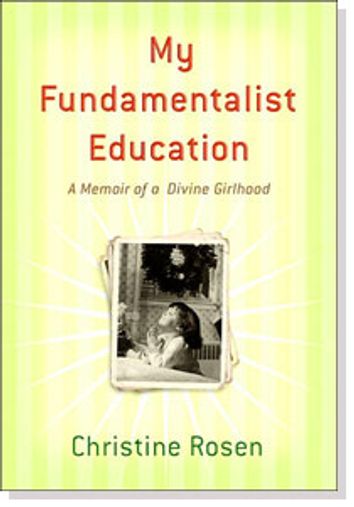
With all the hubbub about intelligent design these days, we don’t seem to hear much about creationism. The word sounds musty. But while intelligent design is the theory that believers take out in public, you can’t help suspecting it’s creationism that many of them really love. So there’s something refreshing in Christine Rosen’s account of her fourth-grade science class at Keswick Christian School in the early ’80s. In “My Fundamentalist Education: A Memoir of a Divine Girlhood,”Rosen recalls that the students had no need to lug around a science textbook. For geology lessons, they turned to Genesis 1:1. The way her teacher presented natural selection, it sounded more like an insult than a theory: “Evolution says we all come from apes and monkeys!” she exclaimed. “Who do you think is right, Darwin or God?”

In that face-off, the competitive edge enjoyed by omniscient beings was further enhanced by home team advantage. At Keswick, and in the surrounding town of St. Petersburg, Fla., religious faith was as pervasive as the heat. This entertaining memoir re-creates Rosen’s childhood in St. Petersburg, a land of malls, old people and Jesus. Few sociological indicators are more straightforward than bumper stickers, and Rosen repeatedly invokes them to convey Floridian culture. In parking lots, bumper stickers on white Buicks bragged, “I’m spending my children’s inheritance!” For Keswick parents’ vehicles, popular choices included “Jesus Saves!” and “God Is My Copilot!”

Rosen has strayed far from those origins. Now a resident of Washington, D.C., she has married a Jew (the legal scholar Jeffrey Rosen), earned a Ph.D. in history, and authored a previous book, “Preaching Eugenics: Religious Leaders and the American Eugenics Movement.” As a contributor to the Weekly Standard and the Wall Street Journal, she is not a total apostate to her conservative upbringing, but she has gone “entirely secular.” In the streets on which she now drives, a good number of cars probably sport disintegrating Kerry-Edwards ’04 bumper stickers.

This crowd also appears to be her memoir’s target audience. “My Fundamentalist Education” promises a glimpse into a world we soy latte addicts don’t understand but can no longer dismiss. Controversy about evolution, Christian blockbusters in Hollywood, a president who speaks in biblical code: Christianity is hot, and Rosen’s background is, suddenly, marketable. With her intelligence and tongue-in-cheek tone, she comes across as the ideal liaison: a former insider who will explain fundamentalism while allowing us to chuckle at it.

Rosen was born in 1973 to perfunctorily Methodist parents. Her father and stepmother sent her to Keswick without quite registering the degree of its zealotry. (The school was affiliated with the Moody Bible Institute, a Chicago-based fundamentalist Protestant institution committed to “separation from the world” and “winning souls to Christ.”) But as a kindergartner, Rosen latched on to the teachings, developing a love for the Bible and a “spiritual crush” on Moses. To a Floridian, she muses rather cutely, the Bible came in handy for making sense of the landscape she inhabited. “The Bible stories I heard every day — stories about burning bushes, plagues, and other freakish expressions of God’s power over nature — seemed sensible in a place where we shared our world with sharks, scorpions, sting rays, snakes, fire ants” and other exotic organisms.

With a sharp eye, keen wit and agile prose, Rosen looks back in amusement at Keswick’s rituals. In a “Walk Thru the Bible” seminar, second-grade students learned to illustrate biblical events with hand gestures: “We drew squiggly lines in the air to represent major rivers in the Middle East, and vast expanses of Numbers and Deuteronomy were dispatched with a grand sweep of the arm.” As for sex education, there were naturally no demonstrations involving condoms on bananas. The preferred pedagogical prop was a brick. During junior year at Keswick, boys and girls would be paired off with joint responsibility for a “Brick Baby,” symbolizing the inevitable consequence of succumbing to the lust of the flesh. In addition to “harlotry,” Keswick educators sounded the alarm against rock music, dancing, communists and the local 7-Eleven, whose insistence on stocking Playboy sparked a faculty-mandated boycott.

Christine, dutiful and devout, heeded her teachers. But as she was also smart and inquisitive, subversive questions were bound to pop into her head. In science class, she wasn’t about to ditch God for Darwin, but, having learned about fossils over the summer, she groped for a way to reconcile the two. Sounding just a few mental acrobatics away from inventing intelligent design herself, she wondered, “Perhaps the Grand Canyon had been created by the Great Flood, as my teacher said, but the Great Flood actually happened much, much longer ago? Perhaps the dinosaurs lived long before the Bible happened…”

As for sex, she had no intention of performing the act, not least because she had no notion of what it involved. In the eighth grade, when her teachers launched their initial campaign against fornication, her fantasy life was restricted to imagining alternative endings to “Choose Your Own Adventure” stories. Under Keswick’s tutelage, she developed a terror of premarital sex. But the warnings did awaken her curiosity, leading her to mine a friend’s father’s medical books and the “Sweet Valley High” series for clues about the forbidden subject. Rosen documents her nascent skepticism as she started to chafe against all the no-nos, although in the narrative it never grows beyond the budding stages.

School occupies the foreground of this memoir; in the background is a portrait of a split family. Rosen lived with her father, stepmother Pam, older sister Cathy and younger half-sister Cindy in a loving, relaxed household. On weekends, she visited her biological mother, who left the family not long after Rosen’s baptism. Through the light-hearted humor, an unsettling fact emerges: Rosen is deeply estranged from her mother, also known as Biomom. Typically, the fraught mother-daughter relationship would be the anguished focus of a memoir. Here, its subplot status feels disorienting, like the memoirist’s equivalent of burying the lead of a news story. The novelty is ultimately welcome; we have no need for another saga of family dysfunction. But those stories are compelling for a reason, and in this case, the book’s emotional energy definitely lies in Rosen’s feelings about her mother. Discussing them, her tone sobers up, grows careful. Her mother “was different from the other adults I knew — and not necessarily in a good way.” She compares her mother’s affection to the cape in a bullfight. “Seeing it before me — bright, alluring, as riveting as crimson — I charged headlong toward it. Just as I came close to reaching it, however, it would elude me.”

Despite those somber sentiments, some of the book’s funniest passages are those starring her mother. She found religion after Christine did, yet embraced it with equal fervor. But her Christianity was evangelical rather than fundamentalist. (That the two branches differ dramatically might come as news to some readers. Indeed, the more ignorant among us would have appreciated further elaboration on their contrasts.) “At school we praised the Lord through soothing organ music and the recitation of the Lord’s Prayer,” Rosen writes. “In Mom’s churches, they praised the Lord with a Pearl Forum Fusion five-piece drum set and electric guitar with wa-wa pedal.” Miracle cures and speaking in tongues, encouraged in evangelism, were frowned upon in fundamentalist circles. Christine and her mother alike, however, anticipated imminent end times, or “the rapture,” which proved a useful disciplinary technique. Faced with misbehavior, her mother would sigh, “There’s nothing I can do if you don’t get raptured with me.”

Rosen’s mother, like many of the Christians in the book, comes across as something of a parody. That is one reason “My Fundamentalist Education,” for all its humor and vivid prose, disappoints. Readers might have expected alarming revelations of extremist beliefs and behavior; or we might have hoped for soothing assurances that we’re all not so different from each other, no matter our beliefs. We get neither. Instead, Rosen colors in the details of our vague stereotypes.

Also disappointing is the epilogue, a chapter called “The Hereafter,” in which Rosen provides a series of updates. (Here we learn that her mother turned out to be mentally ill with what sounds like bipolar disorder. But she is alive, if not well, making her public christening as Biomom a little shocking.) In an elegiac mood, Rosen concludes that her teachers at Keswick fostered a “respectful yet questioning tone,” and a “combination of engagement with the text and the first glimmerings of skepticism.” But this generous assessment finds little support in the earlier portraits of hectoring schoolmarms. That Rosen did begin to question their teachings was a tribute to her, not to them.

At the end of her account, when Rosen is 12 and finishing the eighth grade, her parents belatedly recognize Keswick’s extremism — thanks to the 7-Eleven boycott — and decide to transfer Rosen and her sister to another school. At this point, she’s begun to itch with curiosity: “The longer I spent inside this closed world, the more eager I was to see what was on the other side of that wall.” But when she finally scales the wall, the action takes place offstage. Fast-forward to the epilogue: “In the end, I found I could not do the many things I wanted to do in the world if I continued in a faith whose first principle is separation from it.” Instead of telling a story, this memoir sets a scene. Just as momentum starts to build, the author vaults over its culmination. The chronicle of Rosen’s fundamentalist education shares a shortcoming with its curriculum: too little evolution.

Continue Reading Close