Reem Abdellatif

Egypt’s women rise up

As the country chooses a president, female rights advocates target the ruling military and the rise of Islamism

  • more
    • All Share Services

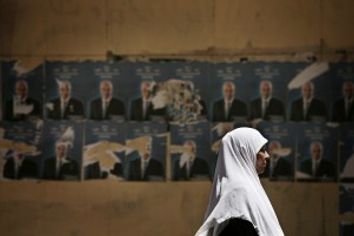
Egypt's women rise up An Egyptian woman walks past defaced posters of Egyptian presidential candidate Ahmed Shafiq in Cairo, Egypt, Wednesday, May 16, 2012. (Credit: AP Photo/Manu Brabo)
This article originally appeared on GlobalPost.
CAIRO — It was the middle of the night in Cairo when Ragia Omran, one of the country’s most prominent human rights lawyers, rushed to C-28, Egypt’s notorious military court, where almost 300 civilian detainees were being held without lawyers.

Omran, a self-described feminist and human rights activist, was there attempting to legally represent the protesters, including 26 female detainees — one as young as 14-years old — all accused by the military prosecution of attacking military personnel.

Global PostBut she was barred from entry, an insult added to injury by the military, a powerful and patriarchal institution that has been accused of many violations, including the sexual assault of its own female prisoners and aggressive indifference to the rights of women on a wide scale.

“They were denying me entry because it was 2 a.m., with the excuse that I am a female so it is ‘too late’ for me to enter the premises,” she told GlobalPost. “I stood there regardless and continued to demand to enter because each detainee has the right to a lawyer.”

Fifteen months after the fall of Hosni Mubarak, Egyptians head to the polls Wednesday and Thursday to choose the country’s first-ever civilian president. This election and the constitution to be framed in its aftermath will set a course for Egypt’s fledgling democracy, and there is almost no one who has more at stake than the country’s women.

As the debate continues about how much power the new president will have relative to the Supreme Council of the Armed Forces (SCAF) and how much influence the majority Islamist parliament will exert on society, women like Omran who were on the forefront of the revolution say they’re now being pushed out of public and political life, at best an afterthought to two rival and very male camps — Mubarak’s “old guard” and the Islamists.

None of the presidential candidates — all men after former television presenter Bothaina Kamel failed to qualify for the ballot — have demonstrated significant interest in women’s issues, advocates say, while many women have been targeted for violence and intimidation by the ruling military. But many women are pushing back against this campaign of marginalization, fighting to secure a role in Egyptian society at a pivotal time in the country’s history.

“Not a single candidate made efforts to sit down with the female coalition’s movement during his campaign, except for Amr Moussa,” said Fatma Emam, who is currently a researcher at Nazra for Feminist Studies and an activist blogger.

Emam, an outspoken 29-year-old woman from Nubia in Southern Egypt, said she is disappointed by the current front-runners, which include Moussa, the Muslim Brotherhood’s Mohamed Morsi, Abdel Moniem Aboul Fotouh and the Nasserite candidate Hamdeen Sabahy.

“What’s happening now in the elections shows that women’s rights are not a concern,” she said.

Emam believes economic and security concerns have trumped social issues — including women’s rights, fair laws and education reform — in voters’ minds. Recent Pew Research Center polling confirms that 81 percent of Egyptians consider economic improvement to be “very important” in the election — more than any other issue.

However, according to Egypt’s National Council for Women, 33 percent of Egyptian households are headed by women.

“Up until recently, five years or so ago, women were not given tax cuts by the tax authority because they were not considered heads of households, even though now at least 33 percent of women are breadwinners,” Emam said.

Though women are currently a crucial part of the Egyptian economy, the society still lacks a fair legal system that would guarantee the rights of all citizens, according to Mozn Hassan, a self-described women rights defender and head of Nazra for Feminist Studies.

From “virginity tests” allegedly administered by the army upon Samira Ibrahim and dozens of other women, to excessive violence strategically targeting female protesters like the “girl in the blue bra,” the women’s struggle has been closely tied to a larger movement against military rule in Egypt.

“A huge part of the idea of militarization in society involves targeting women,” said Hassan. “All of these events, including the virginity tests, are a part of it all, [and] this won’t end with presidential elections.”

The Women’s Vote

While many Egyptians hope that significant change will come with a newly elected president, Egyptian women say they must retrieve their rights themselves.

Dalia Ziada, one of the country’s most active women’s rights advocates, is currently leading a study at the Ibn Khaldun Center for Democratic Studies that focuses on the situation of women after the Arab Spring.

Ziada, director for the Ibn Khaldun in Egypt, will be working closely with the center’s researchers to monitor this week’s elections in 22 governorates across the country, including Cairo, Alexandria and Upper Egypt.

As an Egyptian woman, Ziada believes that many of today’s candidates have failed to address female voters, which make up 52 percent of society.

“Although he is associated with remnants of the old regime and he may easily prolong military rule behind the scenes, [Amr] Moussa, as a liberal, is the only candidate who has reasserted that women’s rights would be a priority,” she said.

But Ziada believes even Moussa exhibits a chauvinism that is pervasive in Egyptian politics.

“When asked about the role of the first lady, all of the candidates said they do not want their wives to be involved in politics,” said Ziada.

“If a president does not respect his wife and does not see that she can play a role in politics, then how will he respect the average Egyptian woman?”

Women Taking Action

Shortly after Hosni Mubarak’s ouster in February 2011, a few hundred women marched on International Women’s Day hoping to protest against sexual harassment, which has been a social epidemic in the Arab world’s most populous country for years.

But the women were attacked and harassed by small groups of men in Tahrir Square, the epicenter of the country’s uprising. The men yelled “now is not the time” for trivial demands.

Later in December 2011, images of soldiers slapping elderly women on the face, stripping young female protesters, and dragging women by their hair quickly circulated.

Despite evidence of violence, many people brought blame on the women, criticizing their presence in the streets and, in some cases, their “provocative” clothing.

This time, thousands of determined women of all ages and social backgrounds marched in unprecedented numbers to protest the Egyptian army’s excessive use of force and sexual harassment against pro-democracy protesters. As the women marched, male protesters made a human cordon around them, fearing that the women might be attacked again.

Meanwhile, the SCAF defended the soldiers’ actions, stating that they were acting “according to the circumstances.”

In March 2012, a court ruled against Samira Ibrahim, who accused a military doctor of forcefully administering a virginity test after she was detained by the military while protesting against the SCAF’s prolonged rule on March 9, 2011.

Although military generals had publicly admitted that the military conducts virginity tests as a safeguard against allegations of sexual assault or rape in military confinement, the court stopped short of assigning specific blame.

Many advocates see it as their role to denounce the autocratic regime, which is still “very much in place” and without much female representation.

Just 10 women won seats in Egypt’s parliamentary elections earlier this year. Women’s representation in the constituent assembly, which will be tasked with drafting Egypt’s new constitution, remains a contested issue.

“We have drafted a list of amendments in the constitution that need to be adjusted immediately, said Emam.

“The Egyptian Young Feminist Movement has also provided the speaker of parliament with a list of women who are eligible to serve on the constituent assembly who can help draft a constitution, but all of these efforts have been overlooked,” she added.

The Struggle with Legal Reform

With Islamists making up as much as 70 percent of the people’s assembly, Hassan fears that women’s voices will continue to be stifled.

“Till this day, the parliament has not passed a single progressive decision regarding the past incidents of violence,” she said. “There is also no law till now that would protect women from domestic violence.”

As the country’s ruling powers fail to hold accountable those responsible for such violence, society follows suit.

“The Nadim Center [for Rehabilitation of Victims of Violence] recently drafted a petition hoping to include a law that would support victims of domestic violence, but only 2,000 citizens actually signed the petition,” Emam said.

Parallel to legal reform, Emam strongly believes there must be societal and governmental restructuring so that women can successfully work to achieve their rights.

“I hoped they would discuss these issues in parliament, but instead they discuss our age of marriage,” Hassan said, referring to parliament’s controversial debates regarding a bill that would lower a woman’s legal age of marriage from 16 to 14.

However, Hassan believes that while the current people’s assembly ignores women’s concerns, the military institution does not even hear them.

“Even if Islamists are aggressive in their decisions regarding women’s rights, the military does not even see us,” she said.

Despite these obstacles, however, Egyptian women are proving that they are doers, not victims.

“I’m against the idea of victimizing women,” Hassan stressed. “You are in a patriarchal society, they already see you as victims. But if we are subjected to violence, we are not looking to be consoled. We are aiming to empower ourselves and to to be in positions that would allow us to put an end to these problems.”

Although they both work independently, Ziada from Ibn Khaldun shares Hassan’s sentiment when it comes to the threat of rising extremism.

“The rising Islamism gave a justification for the patriarchal mentality,” said Ziada. “Everything in the past was inappropriate for women to do; now it is not only inappropriate, it is haram, or a sin. Before, it was not right to challenge society; but now you can’t challenge God, according to Islamists.”

Taking matters into her own hands, Ziada is currently working with Ibn Khaldun on a program that aims to empower women from Egypt, Yemen, Tunisia and Saudi Arabia.

Still in the works, the program will choose women activists from the region and provide them with the tools that would allow them to compete for positions of power.

“We are going to start this initiative in two or three months. It will take about a year, and we hope to recruit women who have potential to lead in legal, religious, economic or political fields,” said Ziada.

By starting from the grassroots level and equipping Arab women with the skills of communication and international relations, the project aims to give them the opportunity to be part of the decision-making process.

“Our aim is to empower young women. This is what will achieve real change,” she added.

Egyptian press still not free

Media outlets play cat-and-mouse game with government censors as they remain forbidden to scrutinize the military

  • more
    • All Share Services

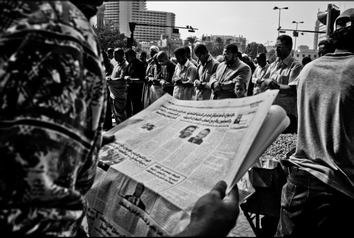
Egyptian press still not free (Credit: Ben Brody/GlobalPost)
This article originally appeared on GlobalPost.

CAIRO — On the streets of post-revolution Cairo, opinions are expressed freely and loudly. They come in the angry voices of protesters marching through traffic, and the graffiti scrawled across buildings and bridges. The days when criticism of the country’s leaders was confined to hushed whispers in smoke-filled cafes are gone.

Global PostBut while many Cairenes on the street have broken free of the fear that silenced them before, journalists and analysts say fear — or at least a sense of caution — still pervades many of the newsrooms trying to document a chaotic city in transition.

Ziad Akl, an analyst with the government-financed think tank Al-Ahram Center for Political & Strategic Studies, said that although the country’s military rulers allow a slightly “higher ceiling” than ousted President Hosni Mubarak, media outlets and researchers like himself are still “very much bound and constrained by the state.”

“We’re still in the very same cage,” he said. “It’s a just bigger cage.”

Under the iron-fisted rule of the Mubarak regime, open criticism of the presidential institution was not tolerated. Today, scathing editorials targeting Mubarak’s loathed and now-dissolved National Democratic Party regularly appear in papers.

But media experts and local reporters say the aura of impenetrability that once surrounded the presidential institution has simply shifted to the country’s military rulers, who replaced Mubarak when he was forced out in February.

There are signs that the military intends to maintain that status quo.

For example, it recently expanded the country’s long-hated “emergency law” to include broad language under which news organizations could be prosecuted for “spreading false news.”

Days before security forces raided Al Jazeera’s Cairo affiliate, saying the station lacked a license and neighbors were complaining of noise, Minister of Information Osama Heikal publicly threatened to “take legal measures against satellite TV stations that jeopardize stability and security,” according to Reporters Without Borders.

The organization says many of the 12,000 civilians being tried in military courts as part of a post-uprising crackdown are journalists and bloggers.

And in March, Major General Ismail Mohammed Etman sent out a letter advising media outlets to consult with the military’s “moral affairs” or intelligence departments on any matters involving the military.

“These are the authorities specialized in reviewing such matters, and that is to ensure the safety and security of the homeland,” the letter read.

The Ministry of Information declined repeated interview requests from GlobalPost. Housed in a fortress-like building on the Nile surrounded by barbed wire and dozens of soldiers in armored vehicles, the ministry has been in a state of turmoil since the uprising and reluctant to talk publicly.

Youssef Sidhom, editor of the small Christian weekly Al-Watani, said he simply avoids all stories about the military to “keep out of harm’s way.”

“Everything military is considered highly sensitive, a matter of national security,” he said. “We don’t question the military. We don’t joke with the military.”

While there is disagreement among journalists on how far reporters can or should go in scrutinizing the military, there is a consensus that it is an area where one must tread lightly.

Fathy Abou Hatab, online managing editor for Al-Masry Al-Youm, a popular daily owned by a wealthy businessman, said the website often publishes pieces critical of the army’s new political role in Egyptian government. Stories on the military budget or inner workings of the institution, however, remain strictly off limits.

While the state largely controls printing presses and circulation, online media like Al-Masry Al-Youm’s website are generally subject to less scrutiny. It’s more difficult for the state to regulate the free flow of online content, and it’s considered less of a priority in a country where only about a quarter of Egypt’s 80 million residents has Internet access.

Still, there are limits to that freedom. For content deemed too sensitive for regular publication, Hatab said he sometimes features it online just long enough to be picked up by Egypt’s social network-savvy youth.

From her desk in the publication’s bright, modern newsroom, Aya Abdullah monitors the nonstop cycle of tweets and Facebook posts. The shy 21-year-old in a shockingly pink headscarf passes along news tips culled from the social networks to reporters who can then head out to cover a protest or other spot news.

Abdullah said the army is paying more attention to social media after the Tahrir Square uprisings but it is still largely an unrestricted space for sharing and gathering information in real time.

“When there are clashes on the street, somebody is tweeting it,” she said.

Revolutionary activist Gigi Ibrahim agreed that social networks like Twitter and Facebook, through which a video or photo can go viral in minutes, are too fluid for the military to effectively censor.

“Now you have a reporter everywhere, on every corner,” she said in an October panel discussion hosted by GlobalPost and the non-profit Open Hands Initiative. “Nothing can be hidden anymore.”

For Safwat El-Alem, a Cairo University political media professor, journalists and social-networking activists have gone too far in their criticism of the military.

“There is chaos in media after the revolution,” he said, sitting in the living room of his spacious home near the Giza pyramids. “There is an uncontrollable flow of information happening now during these sensitive times. Media and citizen journalists are not following the rules of society.”

Egypt’s media scene is complicated by the presence of a powerful state media apparatus used to distribute the official state version of events. The print publications and TV broadcasts have a wide reach and maintain massive influence over the Egyptian public.

Hala Fahmy is a 20-year veteran of state TV. These days, though, the well-known TV personality spends little time inside the government building where she built her career. More often, she can be found protesting from the street below, pushing for reforms to make government-owned news more accountable to the public.

Although still technically an employee of state TV, Fahmy said she has not been allowed to work since the Tahrir Square uprisings, during which she slammed the ministry in scathing on-air interviews with satellite channels.

“They think I’ll plot to overthrow the regime,” she joked on a recent afternoon as she stood outside the state TV building with a small group of protesters.

Dressed casually in jeans and a rainbow-colored top, Fahmy seemed unfazed by the dozens of soldiers and policemen keeping close watch on the demonstration. At one point, she turned to chastise an officer reading off the phrase on her sign to someone on the other end of a cell phone call.

The bright yellow sign said in Arabic: “Why are you confused? Why are you even thinking about it? A revolution ends military rule.”

Akl, the analyst for the state-funded Al-Ahram Center, said he believes government media, including the paper housed in the building where he works, is slowly losing influence to independent publications that strive to print the truth at a critical moment in Egypt’s history.

“I know a lot of people who actually changed their historical cultural habit of reading Al-Ahram every day, and people are starting to read Al-Masry Al-Youm” or other independent papers, he said.

“I for one never read Al-Ahram anymore,” Akl said at one point, laughing. “Yeah, I work for it but I don’t like it, I really don’t.”

Continue Reading Close