Riddhi Shah

How to fix the culturally ignorant “Outsourced”

One frustrated Indian offers suggestions for an NBC show that's too often wrong, embarrassing or stuck in the past

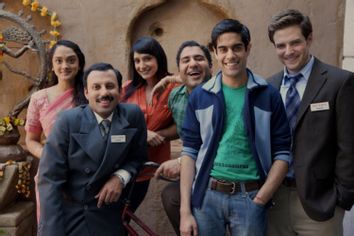
OUTSOURCED -- "Pilot" Episode 101 -- Pictured (l-r): Anisha Nagarajan as Madhuri, Rizwan Manji as Rajiv, Rebecca Hazelwood as Asha, Parvesh Cheena as Gupta, Sacha Dhawan as Manmeet, Ben Rappaport as Todd -- Photo by: Harper Smith/NBC(Credit: Harper Smith)

“Outsourced” creator Ken Kwapis is a brave man. A comedy about an outsourced American call center in the middle of a recession? That’s bold. Not that cross-cultural differences can’t be a goldmine for laughs, but after two episodes, NBC’s Thursday night show looks more like a budget-version of “The Office,” filled with simplistic clichés, iffy writing and ignorance.

Since its premiere last Thursday, writers have questioned whether “Outsourced” is xenophobic and racist. But “racism” suggests a level of malice on the part of the producers, a concerted desire to denigrate a community or a culture. I may have felt nauseated watching the show, but I can’t say the creators of “Outsourced” (which is based on a 2006 movie) are anything but well-intentioned. Of course, they’re also insular and ill-informed. (Kwapis has pointed out in interviews that his writing staff includes three Indians. I assume he means “Indian-Americans,” but regardless I can only say: For shame.) The India on “Outsourced” is an antiquated, pre-globalization, pre-capitalist India. The Indians are ancient caricatures of themselves. It bears little resemblance to the country where I grew up.

It didn’t have to be like this. Case in point, the British comedy “Mumbai Calling.” Shot on location in its namesake city, “Mumbai Calling” sparkles with an irreverent script that equally mocks the stuffy British executives and the call center’s quirky Indian staff. It doesn’t pull punches, but it knows enough about its subject matter to understand where to aim its jabs.

With that in mind, I thought I’d offer a few suggestions to Kwapis and his staff to help them remedy their schticky situation.

1. Do get our accents right. Rajiv sounds like he’s more from Boston than Bombay. Asha’s accent is a curry of the entire Commonwealth of Nations. And when you want us to talk about our myths so that your show sounds authentic, at least make sure you get us to pronounce them right. It’s Raah-maah-yun. Not Ruh-maah-yaah-naah. Oh, and the “Toad” joke? It gets old after about the second time.

2. Don’t assume that all of India looks like a cheap Indian restaurant or a market from the Arabian nights. Mumbai is India’s financial capital. It has tall buildings, residential towers and wide roads like any other big city. Promise.

3. Buy a map of India. Take a long look at it before you decide to pepper your script with geographical references. Pondicherry, which Gupta alludes to in the second episode, is not some mythical forest town out of “The Jungle Book.” It has no deer or tigers. It’s a former French seaside colony filled with beaches, palm trees and a charming artist’s colony.

4. Buy an Indian cookbook. Count the number of recipes that list a non-vegetarian ingredient. Surprised? I thought you would be. No, Indians are not all vegetarians. Yes, we do eat a lot of meat. And we’re pretty darn good at cooking it. If you still want to make silly sacred cow jokes, at least make sure the cow isn’t from California.

5. Talk to an actual young call center worker in India. I think you’ll find that 20-somethings in a big Indian city are quite similar to their counterparts elsewhere in the world. They date, and sometimes, they even have sex before marriage (gasp!). They’re unlikely to think that America is “wonderful” because they can relationship-hop endlessly without having to get married.

6. In the spirit of number 5, you should also talk to a young Indian woman. If she lives in a city, chances are that she can shake hands with a man and isn’t a terrified, repressed mess who can’t assert herself.

7. Ask the above men and women for their views on India’s ancient caste system. They will probably tell you that a person’s caste doesn’t affect his romantic dealings or workplace politics. If you followed Indian newspapers (which I strongly recommend you do), you’d find that caste is a problem in India’s rural hinterland. Most of urban India has gotten past it. Why, then, are you determined to insert ugly jokes about caste in a show that really has no place for it?

8. Finally, try and rise above juvenile jokes about headgear and food that makes you run to the toilet. It would also be nice if you didn’t think of as modern-day versions of Peter Seller’s brownface idiot in “The Party. “


Our national love affair with food on sticks

A retrospective of this year's state-fair portable-snack arms race, and theories on why we can't get enough of it

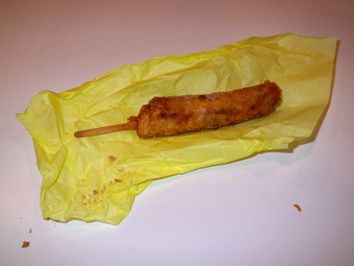
Fried Peach Cobbler on a Stick

Now that state fair season, aka summer, is drawing to a close, let us look back at the months-long joust between fairs from Minnesota to Texas, and the rough rivalries therein, vying every year for the title of Craziest Things on Sticks Meant for Human Consumption.

Texas — whose specialty is fried anything — put on a spectacular showing this year of pure greasy audacity. The Texans took an innocuous salad, added cheese, ham and bacon, deep fried it and impaled it on a skewer. If there were a prize for impudence, Texas would be an obvious shoo-in.

But this year’s overall winner would have to be Wisconsin. What it lacked in cheek, it made up for in creativity. Ponder, if you will, the gravity-defying genius of the Irish-stew-on-a-stick. Not to be flummoxed by the unstickworthiness of the myriad vegetable and meat components of a stew, vendor Slim McGinn’s created a pastry shell, stuffed it with braised lamb (and we’re guessing veggies), and presented it to us on a stick. Sheer brilliance! Other vendors offered frozen grapes on a stick, spaghetti and meatballs on a stick, and deep-fried cream cheese and bacon on a stick. How’s that for good old Midwestern gumption?

Further north in Minnesota, things went a little international. Jamal Hashmi, who operates a food stand in Minneapolis, decided to offer fair-goers a taste of what it’s like to be royalty in his native Somalia, via a piece of skewered camel meat. “It’s the food of the kings,” he told Minnesota Public Radio. Hashmi’s menu makes the fair’s other offerings – rainbow trout on a stick and deep-fried bologna – look downright pedestrian.

At the Iowa State Fair, visitors were treated to the unfortunately named chicken-lips-on-a-stick — breaded chicken breast smothered with hot sauce and served with blue cheese dressing. For those looking for something a little less edgy, there was the hard-boiled egg on a stick. There’s something to be said for the wholesome, but you have to think someone was just phoning that one in.

On the West Coast, ever the sophisticates in Sonoma County, Calif., the fair menu included impaled deep fried artichoke sandwiches. And at the San Diego County Fair, there was the zucchini weenie, perhaps the most disturbing food-thing ever to go on or off a stick. A hollowed-out zucchini that’s been stuffed with a hot dog and — naturally — deep fried, the zucchini weenie honestly seems like a perversion of nature. We can only say that God did not intend for the zucchini to be used in this way. And yet, you have to imagine that is exactly why it exists.

So what is it about edible things perched upon long sharp things that make us want to eat them? What is their magical and mysterious allure?

Andrew Smith, a food historian at the New School, believes that stick foods are perhaps the last remaining examples of a world where food used to be fun. “We take food so seriously these days. Stick foods are novel and they make us smile,” he says. Brian Wansink, author of “Mindless Eating” and director of Cornell’s Food and Brand Lab, agrees. “It’s a sense of adventure. It takes something familiar and makes it exotic,” he says. Because, as we can see with the Irish stew, the defiance of gravity is nothing if not exotic.

There’s a primal appeal to eating food on sticks, too, that’s not unlike eating a chicken leg. The skewer is a proxy bone; and you are victorious over your prey. For a more civilized — and social — explanation, there’s also an appeal to the portability of food that you hold but not exactly in your hand: It’s easier to share. Without your hands touching it, like a sandwich, the sense of individual ownership over the food isn’t so intimate. And, unlike plated food, you can easily walk around with it, presumably running into some friends who, why yes, would love a bite of fried salad because they hadn’t gotten in their vegetables for the day.

Besides, says Smith, you might be more willing to eat something that’s unhealthy because it’s on a stick. For one thing, you don’t really have to look at it — or think about it — once it’s in your hand. Unlike food lying before you on a plate, the angle of the skewer is usually poised so that you really only see the next bite. There’s an instant ridding of the guilt that may otherwise come with ordering a plate of deep-fried cream cheese stuffed with bacon at a restaurant. And it’s notable that these monstrous offerings come out at state fairs, which don’t come around very often. So there’s a sense of occasion that surrounds its arrival, automatically making you more willing to indulge yourself.

But all of this is speculation, and with the fairs all finished for the year, we’ll have 10 more months to theorize … until the vendors break out their masterpieces next year.

Continue Reading Close

The psychological jujitsu of “Xtreme baby carrots”

A massive new marketing campaign for America's favorite healthy snack recasts them as ... junk food?

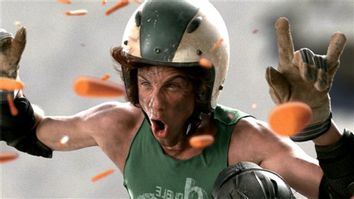
This undated image released by Crispin Porter + Bogusky on Wednesday, Sept. 1, 2010, shows "Extreme Baby Carrot Dude" catches air in his rocket-powered grocery kart as baby carrots are fired at him with a baby carrot launcher. (AP Photo/Crispin Porter + Bogusky) MANDATORY CREDIT. NO SALES.(Credit: AP)

Some things, you have to imagine, don’t need massive advertising campaigns. Milk, for instance. But then there you are, staring at life-size posters of all your favorite celebrities with those weird-looking milk mustaches. Up next: carrots! As reported by the AP, some 50 carrot growers from around the country recently joined forces to boost baby carrot sales, which set the bagged-vegetable world on fire in the ’90s but have fizzled of late. The result? A $25 million campaign created by advertising agency Crispin Porter + Bogusky that focuses on the untapped hipness of the baby carrot.

Over the next year, it’ll roll out a series of television commercials, Cheetos and Doritos-style packaging, seasonal tie-ins (Scarrots for Halloween! Boo!), commercials featuring sexxxy ladies lusting for xxxtreme carrots, and billboards with slogans like “Our crunch can beat up your crunch.” The campaign’s website features a staccato chant of “Baby! Carrots! Extreme!” set to heavy drumming.

I have to admit that I first thought the campaign was totally serious, and utterly ridiculous; another tone-deaf attempt at kids-cool by suited dorks. (Even if it is based on the slightly bizarre premise of convincing people that carrots are junk food.)

But then I went to the campaign website and looked at the Twitter feed. “Eatem like the bars are closing,” said one tweet. “Tell you’re kids [sic] that carrots are the new candy. Kids are dumb,” said another. The website’s impossibly cheesy, chanting biker-baritone was the next sign that things weren’t as goofy as they seemed. Or, rather, intentionally even more goofy than they seem.

By the third time I heard the metalhead grunt that Baby! Carrots! are EXTREME!, I finally got how brilliantly self-referential it all was. Ironically ironic, the campaign isn’t just deemphasizing the nutritional benefits of eating carrots over potato chips, it’s actively (and winkingly) trying to call baby carrots junk food. Mastering the dark art of reverse-reverse psychology, the ad-masters obviously understand that people aren’t going to eat something based on nutritional brownie points alone. It might be easier, instead, to convince teens and 20-somethings to eat carrots because it’d be ironic and funny and they’d be in on the joke. Kids, on the other hand, might actually be drawn to the bright packaging and stick-on tattoos, the old Cracker Jack ploy.

The entire campaign is kind of genius. It’s certain to attract attention and become a talking point. But will it cause a stampede in the veggie aisle? I doubt it. Ultimately, a child’s eating habits are more a product of the home environment than of a clever marketing campaign. And if you’re not the kind of mother who believes in the goodness of vegetables (baby, extreme or otherwise), an ironic billboard or two won’t do much to change that. As for the 20-somethings, who “get” the humor: Tweeting about this hilarious new ad is one thing, switching your Doritos out for a bag of Xtreme carrots quite another. 

Continue Reading Close

The secret to the immortality of McDonald’s food

The chain's burgers can resist rot for years. Scientists explain why they have the shelf life of the undead

Salon/iStockphoto/xxxnake

Ever since Morgan Spurlock held up that jar of mysteriously well-preserved fries in “Super Size Me,” the list of exhibits in the McDonald’s museum of food-that-refuses-go-bad has grown exponentially. The latest entrant is the Happy Meal Project, a burger and a packet of fries that have soldiered on undecayed for 143 days.

Started by New York photographer Sally Davies, as a part-art, part-food science experiment, the Happy Meal Project involves Davies documenting a Happy Meal every few days until it spoils. At day 137, the meal still looks pretty great.

And then there are other, more shocking examples of McDonald’s food’s weird indestructibility: like this poor burger that’s been around for 12 years. This one managed to stave off mold for a year and this one’s been around the country in this lady’s purse for more than four years. Each experiment, of course, brings with it a new wave of fear and outrage over the chemicals and preservatives that are making our fast food almost inorganic.

For its part, McDonald’s has remained largely silent. The fast food giant’s Chinese arm released a statement this May to counter the hysteria over Joann Bruso’s year-long experiment. It announced that all its patties are made of 100 percent USDA-approved beef and are completely preservative-free. Sneakily, though, it made no mention of its fries, bread, cheese or sauce.

But preservatives alone may not be responsible for the fungus-resisting powers of a Happy Meal. Marion Nestle, chairwoman of New York University’s food studies program, told us over e-mail that McDonald’s would have to use “really a lot of” sodium propionate to prevent bacterial or mold growth.

McDonald’s French fries, for example, which have repeatedly proven their hardiness to spoilage, contain citric acid as a preservative. But a bigger factor might be the fat content of the fries. About 50 percent of the total 250 calories contained in a small order of fries come from fat. “Anything that is high in fat will be low in moisture,” says Barry Swanson, a professor at the Washington State University department of food science. And low moisture means less room for mold to grow. They’re crisper and thinner than regular fries, which means that they’re exposed to greater heat per surface area, killing pathogens and reducing water content. McDonald’s fries are also coated in a nice, thick layer of salt, something we’ve been using as a natural preservative for the last 2,500 years.

The beef patty is also high in fat — varying between 37 and 54 percent of the total caloric content — and has been cooked at a high temperature. “It’s also very thin, which once again means high heat per surface area,” says Sean O’Keefe, a professor of food science at Virginia Tech. Davies noted that over time, her patty just shrank and hardened, losing whatever moisture it once contained.

A regular McDonald’s sesame-seed bun contains calcium propionate and sodium propionate — both preservatives. But the list of ingredients — down to the preservatives — is actually no different from what you’d find on the packaging of your average loaf of supermarket white bread. Wonder Light Enriched Buns, for example, are also loaded with calcium propionate. While neither list mentions quantities, it’s reasonable to assume that both are under the FDA-approved limit.

Ultimately, says O’Keefe, the McDonald’s haters have gotten their science wrong. “The ingredients are similar to anything you’d see in processed fast food,” he says. For better or for worse, McDonald’s is no more a chemical laboratory of secret compounds designed to embalm us from the inside than any other processed food maker. A Happy Meal manages to stay unspoiled because it is fatty, salty and practically empty of nutrients — which, really, are all good reasons to avoid it anyway. 

Continue Reading Close

Why our agricultural empire will fall

An expert tells us how our food system is repeating the history of doomed civilizations

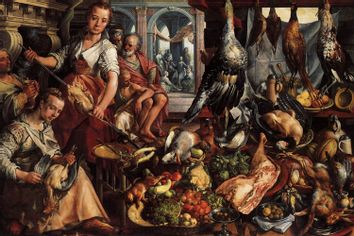
"The Well-Stocked Kitchen" by Joachim Beuckelaer

In an age of super-sized meals and obesity epidemics, food-shortage doomsday scenarios always seem a little surreal. Backed by half a century of agricultural abundance, it’s easy to imagine that cheap food will permanently abound. But in a new book, “Empires of Food,” academic Evan Fraser and journalist Andrew Rimas show us that we are not the first advanced civilization to have a hubristic, misplaced confidence that we’ll always be fed.

By tracing the rise and fall of a number of preindustrial empires, the authors show us just how much trouble we’re in. The Romans, the Mesopotamians and the medieval Europeans, for example, all had agricultural systems that, much like ours, were yoked to complex technology and highly specialized trade networks. And each of those societies eventually failed because they hadn’t accounted for soil erosion, growing overpopulation and weather changes. Climate change, anyone?

Fraser and Rimas propose no easy solutions, advocating instead that we learn to store surplus food, live locally, farm organically and diversify our crops.

Salon spoke to Evan Fraser over the phone about agricultural patterns through history, the instability of our food system, and whether the solutions he proposes are ultimately unaffordable for the world’s poor.

Your book focuses on how food can cause empires to rise and fall, and specifically, how this is an almost cyclical process that has been repeated through history.

A society has to go through the same steps to grow. For example, all complex societies have people living in cities who rely on country folk to produce their food. They have to transport the food over large distances, and they begin to use food as a tradable commodity. But usually this happens during a time of good weather. So the Romans, for example, grew because they specialized in wheat, but things got colder around 300 A.D., and the empire collapsed. The same thing happened with medieval Europe. In the 14th century, the medieval warm period ended, and there were huge famines.

In our case, we won’t face a cooling, but either end of the thermometer is problematic for a farmer. As a global society, we’ve come to depend on food production that is largely reliant on good weather conditions and good soil. But with climate change, good weather will be a thing of the past and production failures will become common. This is my biggest concern.

You mentioned Europe in the medieval period. What else do we have in common with their food system at the time?

Structurally, our system looks a lot like the European system in 1300, just before the crises of the 14th century. In medieval Europe, monasteries were the centers of food production. As the population increased, the monks tried to increase the amount of grain produced by cutting down forests and expanding into the hills. This was a short-term solution because cutting down trees only loosens the topsoil. The medieval warm period ended around 1300 A.D. In 1315, Europe was faced with a bunch of bad late-summer storms. The wind and the rain caused the topsoil to wash away, and crops failed. There were widespread famines, and Europe lost some 20 percent of its population. Years of bad harvests and poor productivity followed, which in turn led to political upheavals, riots, anti-Semitism and hunger. They were also probably very weak. So when a new disease called the Black Death appeared in 1347, it wiped out another 30 percent of the population.

Interestingly, one of the first signs that things were about to go wrong in the medieval period was that food prices started rising. It happened with the Romans too. Demand began going up, and yields stagnated. We have a strong parallel with that today. Between 2006 and 2008, we had a threefold rise in the price of food. The price of wheat has risen faster in the last six months than at any time in the last 32 years. From 1950 to 2000, the price of food decreased every year, but since 2000, it’s been increasing. Our system looks a lot like Rome in the year 250.

There are obviously several factors that can cause a food system to fail. You mentioned climate change earlier, but what else worries you?

All the safeguards against crop failures we’ve come up with in the last 50 years are fossil-fuel-intensive — chemical fertilizers, irrigation systems and dams all take energy to produce. With oil prices set to rise in the future, these solutions will become increasingly more expensive.

Further, in order to maximize yields, we’ve started specializing our crops. So we grow the same crop over and over again on the same piece of land. This strips the soil really quickly of nutrients. It’s a very efficient system, but history shows us that these crops are very water- and nitrogen-intensive.

What this means is that our system is already very brittle and fragile. Climate change, which we know will happen, will only weaken an already weak system.

In your book you also talk about the Mesopotamians and Sumerians who lived in the Fertile Crescent more than 2,500 years ago. It’s amazing to think that our food system is as vulnerable as theirs once was.

Much like the Romans, the Mesopotamians grew into an extremely developed culture because their farmers produced excess food, stored it, transported it and exchanged it in the urban marketplace. They developed cities by creating irrigation canals, which allowed them to have high yields. But they made the same mistakes that we are making today: They relied heavily on food produced during good weather and they overspecialized their farms. One of the problems with irrigation is that it leaves behind a deposit of salt when the water evaporates. Over the years, the soil becomes salinized. The Mesopotamians had a sudden hot, dry spell that they countered with irrigating the soil even more heavily. This created a short-term yield boost, but in the long term, it was unsustainable. So eventually, yields dropped, the economy faltered, tax revenues dropped, and the military weakened. When other powers came up in the region, they weren’t able to defend themselves.

The modern parallel with this, of course, is in our usage of chemical fertilizers. It has allowed us to boost our yield temporarily, but the underlying problem of soil erosion hasn’t been fixed.

Some people argue that our ability to use fertilizers and pesticides has actually helped the environment, because we use less land to produce the same amount of crop. But you are suggesting that we wean ourselves off fertilizers and produce food locally.

Well, I think too much of anything is a bad thing. For instance, northern England is excellent as a grazing pasture, but it can’t really sustain crops. So if its residents were to survive only on locally grown produce grown without fertilizers, they would manage to do it for exactly three years before the soil would start to erode. So it’s obviously not practical. Yet, we’ve taken the idea of specialization and gone too far with it. We’ve become greedy.

What about the possibility that technology might get us out of this mess? What do you think about the cloned cows in England that produce more milk than regular cows? Won’t they actually be beneficial for the environment because we will need fewer cows to produce the same amount of milk?

The high-productivity cow may produce more milk, but it will need more water, protein and energy than a regular cow. That energy has to come from somewhere. So these highly productive strains of animals and plants are actually a bit of an illusion.

It’s the same reason that droughts have become increasingly difficult to manage. We now plant these highly productive varieties of wheat everywhere, but they actually require a lot more water. So now even a small drought creates extreme food shortage.

But we could be in a more tenable situation if we used technology differently. So for example, if, instead of creating high-yielding varieties of crops, we created drought-resistant varieties, we’d be better prepared for the future.

One of the things you suggested we needed to change to live more sustainably is the way we price our foods. You say we need to price our foods so that they reflect the real price of producing them, free of government subsidies. But isn’t that eventually unaffordable for the poor?

One of the problems with the way we produce food right now is there are all sorts of hidden social and environmental costs. If pork chops included the price of water pollution and the cost of pollution caused by pig manure, we’d be paying a lot more for them and wouldn’t eat as many. Hothouse vegetables, for instance, have a huge energy subsidy, while chocolates, coffee and tea have a social subsidy in the form of poor wages paid to producers, and livestock production has a huge environmental subsidy in the form of waste management.

But as you pointed out, this hurts the poor consumer.

Often, though, a poor consumer in the developing world is also a food producer. So if we began paying fair wages, they would earn more and as a result be able to pay more for their food. The real problem, then, is how this would affect the urban poor. So what we need to do — if we decide to change our pricing policy — is to focus on poverty reduction in urban areas.

But this doesn’t mean that we shouldn’t let affluent consumers in the Western world pay the real price for what they consume.

In the U.S., we’ve seen a huge shift in the way people see food. The foodie movement means that food has become a sensory pleasure — a luxury instead of a necessity. But the solutions you suggest indirectly involve our going back to seeing food as mainly a means of sustenance.

There is a really interesting tension at play here. In order for us to produce food locally or use fewer fertilizers or pay better wages, we need people to be more interested in what they’re eating and where it’s coming from. But in the West, this has turned food into a fashion item. Instead, we need them to be invested in food without trivializing it or turning it into a trend. We need to think about unsexy but ultimately more practical solutions, like food storage and maintaining food capacity, if we want to protect ourselves for the future.

Continue Reading Close

Heirloom vegetables: $1,000

Sotheby's auctions high-priced vegetables to benefit local farms. But is that really an answer to agribusiness?

(Credit: Unknown)

For some of us, shopping at Whole Foods, despite its inherent promise of establishing you as an esteemed member of the socially conscious, politically correct, seriously foodie upper middle class, can be a wholly unwholesome experience. You have to battle the snaking lines, the overly cutesy labels, and the overwhelming mass of organic-heirloom-tomato-toting liberals. Entirely too plebeian.

So, come Sept. 23, you can trade your brown-and-green paper bag for a designer gown and head over to Sotheby’s for a vegetable auction. You can also trade your rather ordinary orange pumpkin for one that almost sounds like a strip club — the pink banana pumpkin. Also on the auctioning block will be the Turkish orange eggplant, the Black Sea man tomato and the ridiculously diva-like Lady Godiva squash. The price of a crateful of these charmingly named veggies? A thousand bucks.

Yes. 1-0-0-0.

The benefit, called “The Art of Farming,” promises to provide a platform for “local farmers” and “high-profile New Yorkers” alike over the “shared interest in the vitality of the Greenmarket.” The event, for which tickets are priced at $250, will feature a silent auction of heirloom vegetables, along with a request for a donation of $1,000 so that a crate of the vegetables can be given to a local food bank. The money earned through the event will go to GrowNYC, a charity that helps immigrants become farmers, and to the Sylvia Center, which teaches children to eat better. The idea, of course, is to promote non-mass-produced vegetables and local farming.

To be sure, it’s an event that has its heart in the right place. The proceeds will go to charities, and local farmers will be recognized for the hard work that goes into growing even a single plump, full-bodied tomato.

Unfortunately, it’s also the kind of event (it was conceived by Dr. Brent Ridge, one-half of Discovery’s “The Fabulous Beekman Boys”) that furthers the notion that eating well is an exclusive preserve of the rich. Putting an astronomical price tag on a box of vegetables only exacerbates the ever-widening cultural gulf between the Whole Foods-ers and those who have to make do.

But the problem may be about more than just bad publicity. The event purportedly holds up heirloom vegetables as a symbol of everything that is wrong with agribusiness today. But some of these vegetables became heirlooms precisely because they didn’t grow as well, or perhaps because they were harder to tend to, regardless of whether they tasted better. The simple economic principle is that anything that is rare or harder to grow will inherently be more expensive, and as a result, out of reach for millions of shoppers.

“People are drawn to these seeds more as a result of ideological disposition than actual agricultural knowledge,” says James McWilliams, an environmental historian at Texas State University. So what’s at stake here is the idea that we like these vegetables because we see them as a way to thumb our noses at big business. But will they help bring sustainable agriculture to the poor or address larger questions about food security?

McWilliams doesn’t think so. “If we were to actually bring these vegetables back in a big way, we’d need a lot more land to grow them because they’re so low-yielding. So we’d have to clear out more forests, which is actually a lot less sustainable,” says McWilliams. In fact, he says, we’re already seeing this play out in Brazil and Argentina where farmers are clearing rain forest to create grazing areas for grass-fed beef.

The Sotheby’s event will certainly do what it set out to: create awareness about the “art form” that is heirloom farming.  But along the way, it may also end up furthering the misconceptions that plague the food world today.

Continue Reading Close

Page 1 of 4 in Riddhi Shah

www.salon.com/writer/riddhi_shah/index.html