Rob Waters

AIDS: Why Africa suffers for the West’s sins

Craig Timberg talks about the colonial origins of AIDS and the legacy of distrust between Africa and the West

  • more
    • All Share Services

AIDS: Why Africa suffers for the West’s sins

As a lens to explore the complex and deeply fraught relationship between Africa and the West, the AIDS epidemic is as revealing and disturbing as it gets. Born in colonial Africa and discovered in gay America, the devastating rise of AIDS has been fueled in no small part by the clash of cultures that played out over the past 130 years or so between Africa, Europe and the U.S. — and the rivers of resentment those conflicts have sown.

“Tinderbox,” an insightful new book from a journalist and an AIDS researcher, tells the story of the epidemic from its birth in colonial Congo — where it lingered undetected for decades — to its sudden spread around the globe in the 1980s, to its status today as the object of a global public health war directed from Washington and Geneva and targeting Africa, home to some 70 percent of all AIDS cases today.

Narrating this disturbing tale are Craig Timberg, former South Africa bureau chief for the Washington Post, and Daniel Halperin, an epidemiologist, AIDS researcher and former advisor to the U.S. government’s anti-AIDS program. Timberg met Halperin in the middle of his five-year stint as the Post’s Johannesburg bureau chief and the two began exploring questions that had bothered Timberg since his arrival in South Africa.

Timberg, now back in Washington as the Post’s deputy national security editor, spoke with Salon about the book.

Perceptions about the origins and spread of AIDS have changed over time in fascinating ways. First, it was seen as a gay disease. When it was detected in Africa, people assumed it came from the West. Over time, scientists showed it originated in Africa, a notion rejected by many Africans but in keeping with Western notions about third-world diseases. You show in the book that AIDS arose as a result of sweeping changes in social structure brought to Africa by European colonialism. Describe its origins.

Scientists have known for more than a decade that the version of HIV that has caused almost all cases of AIDS is virtually identical to a virus common in central African chimpanzees. That’s not controversial. The location of the transmission was determined by a group of scientists who narrowed it down to chimpanzees living in southeastern Cameroon by collecting their feces, detecting the virus and comparing it to other strains collected elsewhere. Michael Worobey from the University of Arizona and his team mapped the genetic structure of pieces of HIV from all over the world, looking at the extent of mutations between them. They were able to make assumptions about how many years it would have taken to produce these changes. The time frame puts you close to the turn of the 20th century for the original virus, the ancestor to all modern HIV.

How was the spread of AIDS to humans linked to colonialism?

In southeastern Cameroon, at the exact moment scientists now believe HIV entered the human population, you had steamships going up rivers that never had steamships before. You have porters who are virtually human pack animals carrying ivory or gear for colonial companies through dense forests. One of those porters would have been the first human to contract HIV. It looks like HIV goes from the chimp population into a hunter who cuts himself while butchering a chimpanzee for food. It then spreads in a localized way along these porter paths and colonial trading posts and eventually comes down river on a steamship into Kinshasa, then called Leopoldville, the first major city in that part of the world.

And that leads to what you call the Big Bang – when HIV explodes and moves out of the Congo.

That’s right. A single spark emanating from southeastern Cameroon works its way to colonial Leopoldville. But HIV doesn’t spread fast on its own. It needs particular conditions to race through a population and Leopoldville had them. It was big and growing fast. It had a high concentration of men working in factories, separated from their wives and girlfriends. It had an emerging population of sex workers and transport to get people back and forth. Gonorrhea, syphilis, chlamydia spread like wildfire; HIV doesn’t but starts to spread along railroad lines, porter paths and rivers during the early and middle part of the 20th century. When scientists look at the genetic structures of different types of HIV they all seem to have come from a single piece of ancestral HIV that existed in Leopoldville at the beginning of the 20th century.

So HIV lingered in small numbers of people but doesn’t exit this area. When researchers go back to blood samples collected during the 1976 outbreak of Ebola virus, they find HIV.

Yes, so in the middle part of the 20th century about 1 percent of adults in major population centers of the Congo had HIV. Before they died, they developed symptoms of other familiar maladies—pneumonia, tuberculosis, wasting. It wasn’t obvious there was a new epidemic loose in the land until gay men in the United States started getting sick in the early 1980s. Before that, it didn’t spread far and it didn’t spread fast. The reason seems to be that in colonial Congo, the majority of adult men would have been circumcised and circumcised men are much less likely to contract HIV and pass it on. It’s only when HIV makes its way out of the Congo River basin to other places more hospitable to its spread that we get a true explosion.

Many people assume AIDS must be a disease of poverty. But you argue that wealth, modern transportation and economic development were key factors that allowed AIDS to break out.

When I first went to Africa as a correspondent in 2004, I carried this question with me: Why is HIV so severe in some places and not in others? Logic said: Africa, poverty, poor medical systems — there had to be a connection. But when I started traveling to different countries I discovered that most truly outrageous hellholes — places with warfare and incredible poverty — didn’t have much HIV. Other places with modern transport and sophisticated economies had a lot. When I met my co-author, Daniel Halperin, it began to come together. I saw that while being poor and having HIV is certainly a very bad thing because you’re more likely to die when you can’t afford medicine, some degree of economic activity actually makes you more vulnerable. When the epidemic starts spreading widely in some African societies it’s in the cities. Wealthier people — doctors, teachers, politicians, singers — get HIV in completely disastrous numbers. Some of that has to do with access to resources and multiple sexual partners.

You begin with a chapter on the city of Francistown, Botswana, an affluent place with a horrendous HIV rate. What struck you about Francistown?

I drove to Francistown for the first time in 2006 and it felt like driving into anywhere, USA. I could buy a hamburger at Wimpy’s, order a shot of espresso. There were cafes and ATMs. Yet it had this horrendous HIV rate. Among women in their 30s, two-thirds were infected. The picture of poverty before HIV didn’t add up. When you scratch the surface you begin to realize that other factors — human movement, transport, sexual behavior, circumcision or lack of it — are decisive in how the virus spread.

You describe the AIDS belt, an area in southern Africa at the very heart of the African epidemic. What are the characteristics that made it, as you call it, a tinderbox?

There’s a giant swath of the continent that starts at the southern end of Sudan, goes down through east Africa to South Africa and out to the sea where you have this combination of sexual networks and low rates of male circumcision. Together they produce the tinderbox. Two centuries ago most of Africa had polygamous societies in which the richest, most powerful men had multiple wives. In contemporary Africa, in part because of that tradition and in part because of the ravages of colonialism and migratory labor, many men and women have more than one sexual partner over the course of a week or month. But to be part of the AIDS belt, you need one more thing: low rates of male circumcision. The people who migrated down the Nile River basin from Sudan never had circumcision as part of their tradition. In the southern part of the continent, it was a tradition pretty much everywhere until about 200 years ago when some ethnic groups began to give it up. In those places you see HIV rates of 10, 15, even 25 percent.

Why is circumcision effective and why was early evidence of its power missed?

A man’s foreskin is unusually vulnerable to HIV; the skin is thinner, softer and more easily penetrated by HIV and other pathogens. When it’s removed, the remaining skin is rougher and more resistant to infection. That makes no difference if you’re a gay man who is the receptive partner in anal sex. But the African epidemic is spread predominantly through heterosexual sex, particularly vaginal sex, and circumcision is crucial. Circumcised men are at least 70 percent less likely to get HIV. This science first began to appear in the mid-1980s.

That’s three decades ago!

That’s right. That data seemed to offer this miraculous new insight. But the global public health community was deeply uncomfortable with the subject. It took another 20 years to come up with evidence so definitive they accepted it. Peter Piot, one of the central characters in the AIDS response, was part of that research team. Yet during all the years he was head of UNAIDS he was not enthusiastic about this science. To be fair, establishing correlation is not the same as establishing causality. And it’s a pretty serious thing to contemplate altering men’s penises if you’re the global health community.

One area of culture clash between global health agencies and Africa is over condoms. What happened?

People who had watched AIDS in the U.S. were mindful of the way condoms seemed to slow the spread of HIV there and especially in Thailand, where the epidemic was transmitted mainly in brothels. It was hard for those officials to understand how different the African epidemics were. In several places, Africans were saying, “Hey, our best chance for surviving is for people to have fewer sex partners at a time.” But Westerners had condoms on their minds. The U.S. government and other organizations made a huge bet on condoms and reasoned that if you could just get enough of them to people in vulnerable places you could reverse the epidemic. Instead, reported usage of condoms in some African societies went to rates far higher than anywhere else but HIV also went up. That puzzled people until it became clear that people were using condoms with prostitutes or one-night stands but not in long-term relationships with their husbands, wives, boyfriends or girlfriends. And that’s how HIV is most likely to spread.

Uganda emerged in the early days of the epidemic as a place that took effective action, changed people’s behavior and lowered HIV transmission. 

In 1986 a new government took over and confronted the facts of AIDS. They knew it was fatal, they knew it was incurable, they knew it was spread by sex, and they knew a lot of people already had it. So political, religious and cultural leaders focused on changing the sexual behavior that was at the core of HIV’s spread. The most famous terms for this was zero grazing, a metaphor that worked well in an overwhelmingly agrarian society. When leaders said zero grazing, Ugandans understood at an intuitive level that having sex with your primary partner is much safer than having sex with a primary partner and others. If a large number of people make a relatively small change in their number of sex partners it can make a massive difference in the spread of HIV. That’s what happened in Uganda and hundreds of thousands of lives were saved.

Why were the powers that be in global health so reluctant to focus on behavior change?

The global health infrastructure was uncomfortable talking about differences in sexual behavior. That’s a shame because a sexually transmitted epidemic is by definition spread by sex. To understand why it’s worse in some places than others you have to dive into some inherently uncomfortable questions about a very private matter.

Yet there was historical evidence here that changing behavior made a difference. San Francisco closed the bathhouses and it helped. In New York, behavior changes led to lower rates of anal gonorrhea in the early days of the epidemic.

Those changes were instituted within coherent communities. Gay men advocated the closing of bathhouses and made the choice to have fewer partners or use condoms. In Africa that process was hampered by the slowness to accept that AIDS was real and the fact that people are understandably resistant to being told what to do by a large and powerful outside force. Many of these societies need our financial aid, our technical assistance to do things that matter to them, including improving public health. The tension over how much to listen to outsiders while not wanting to be told what to do has troubling consequences that have infused the world’s response to AIDS in all sorts of ways.

What lessons do you draw from the way the epidemic has been addressed in Africa?

The overriding lesson is that sex matters. Those of us who care about people getting this terrible disease can’t be squeamish in discussing sexual behavior because we’re afraid of how it makes us look. The research has to be good, the messaging has to be forceful and clear. It’s not enough to tell people to use condoms all the time because the evidence after more than 30 years is that people don’t, not often enough to be truly decisive. We also have to be willing to engage in questions about how many partners people are having, we need to tell people that from the viewpoint of sexually transmitted infections, anal sex is more dangerous than vaginal or oral sex. These things are uncomfortable to talk about. At the same time, if we take seriously the moral question of trying to prevent as many infections as we can, we can’t be frightened of these subjects.

The depressing toll of the Great Recession

Mental health problems mount nationwide while budgets for treatment and care are shrinking

  • more
    • All Share Services

The depressing toll of the Great RecessionDown and out (Credit: AP/Rick Bowmer)

In late 2009, as the unemployment rate in San Joaquin County, California, reached 18 percent and one in twelve homes were being foreclosed, two high school students in the town of Ripon, population 15,000, committed suicide within two months of each other. Over the next eighteen months, sixteen more teenagers around the county took their own lives, a not-uncommon occurrence that public health researchers refer to as “suicide contagion.”

Years of declining budgets had cut the number of counselors, nurses and psychologists in county schools, impairing the ability of individual districts to handle the needs of grieving students, parents and communities on their own. So school officials in cities like Ripon, Stockton, Lodi and Linden turned to each other for help.

The districts made use of a mutual aid pact they’d set up, like those employed by firefighters and police from the same region. On the morning after each death, school nurses and counselors trained in suicide response, along with a team of therapists from Valley Community Counseling, a local mental health agency, descended on the school the student had attended. They spent days, sometimes weeks, meeting with pupils and parents, focusing on kids who knew the victims or seemed at particular risk.

The spirit of cooperation helped the team fashion an effective crisis response and ease the pain of some survivors, said David Love, executive director of Valley Community Counseling. But, by definition, it came too late, he said. “We’re doing everything we can to partner and develop these mutual aid plans,’’ Love said. “But we’re still band-aiding. When you’re doing crisis work, you’re at the back end. The tragedy is that we don’t have the resources early in the process.”

As the U.S. economy struggles to pull out of the worst funk since the 1930s, public services for the country’s most vulnerable populations—children, the elderly, the mentally ill—are being cut or disappearing at a time when the need for them is greater than ever. Faced with gaping deficits, states have slashed $1.6 billion from mental health programs over the past four years, according to a report by the National Alliance on Mental Illness.  The pain is being felt everywhere.

• Illinois has slashed $187 million from its mental health budget and plans to close three of nine psychiatric hospitals. A budget passed in November by the Chicago City Council will close half the city’s 12 mental health clinics.

• In Detroit, the county mental health program has lost $30 million in state funding over the past three years, forcing numerous cuts to the agencies it supports. Detroit Central City Community Mental Health, which provides outpatient treatment and reentry programs for people leaving jails and psychiatric hospitals, lost a quarter of its funding and cut its staff by a third. Charlotte House, a transitional housing program for people with psychiatric disorders discharged from the county hospital, closed its doors.

• California has cut mental health funding by $765 million, or 21 percent, since 2009. In Oakland, the number of children waiting to see a counselor at West Coast Children’s Center, a community mental health clinic, has swollen to 50.  “It’s not a good feeling that there are kids on a waiting list and you can’t hire more clinicians,” said Stacey Katz, the center’s director. “It stresses everybody out. How do we triage? How do we decide who needs services the most without violating our mission that kids should have mental health services when they need it?”

Meanwhile, homelessness, domestic violence, and child abuse are rising. Nationally, nearly 1 million schoolchildren were homeless in the 2009-2010 school year, a 38 percent increase in four years, according to the U.S. Department of Education.

University of Pittsburgh researchers reviewing hospital records from parts of Washington, Pennsylvania, Ohio, and Kentucky found that the rate of children younger than five brought to emergency rooms with abusive head trauma—brain injuries from being shaken or struck— was 65 percent higher during the 19 months of official economic recession that began in December 2007 than in the previous four years. Sixteen percent of the children died.

“Families are losing their jobs, they’re losing their housing, they’re on the street,’’ said Amy Weiss, director of Parents Place, a San Francisco program that offers counseling and support services to children and families. “We’re seeing more domestic violence, more complicated cases, more poverty. Our caseloads are bigger because there are fewer people and resources. We’re trying to do more with less.”

The economic misery that has swept the nation has savaged places like San Joaquin County, a place of long-standing poverty, large numbers of children and large tracts of homes purchased for little money down by people with scant savings and insecure jobs. To that mix, add years of declining investment in schools and social services.

The 900 students at Ripon High, where the suicide cluster started, have just two guidance counselors to help them. There was a third but the district laid her off before the start of the 2009-2010 school year after losing $6 million in state funding over three years. The cutback hinders the remaining counselors’ ability to address both mental health and academic needs, said Superintendent Louise Johnson.

Ripon High’s student-counselor ratio is better than the California average of one counselor for every 810 students—the second worst of any state. Neighboring Manteca Unified School District has no counselors in its elementary schools and has gone from four counselors at each of its seven high schools to two, said Caroline Thibodeau, the district’s director of health services. The number of school administrators and nurses has also declined, Thibodeau said.

While the number of adults attending to students has been falling, students needs keep rising. The number of homeless children in Manteca has more than doubled in the past five years to 700, Thibodeau said. Rates of alcoholism, drug abuse and child abuse are up, putting families under enormous stress, said Love. And over the past three years, he and his colleagues at Valley Community Counseling treated 60 percent more children who’d been exposed to domestic violence and 50 percent more whose parents were substance abusers.

“It’s a big circle,” he said.  “Family stress, community stress, student stress equals higher levels of depression and related issues among caretakers and children. With school cuts, counselor cuts and classroom sizes going up, the schools are seeing more mental health issues and have fewer resources. We’re getting more kids sent to us with clinical depression, PTSD or behavioral acting-out issues. And all this increases the possibility of suicide.”


Cities across the country are grappling with the same issues. In St. Louis, the number of homeless children in the city’s public schools has almost doubled in the past three years to 3,000. Until a few months ago, Elizabeth Snowden, 17, was one of them.

Elizabeth (her middle name) spent her high school years coping with headaches, fear and anxiety as she slept on streets and in overcrowded shelters, searching for quiet places to do homework and escape the stress that has engulfed her family of six since her mother Audrey lost her customer-service job at a St. Louis department four years ago.

“The stress affected me at school emotionally and physically,” she says. “I had a headache every day. I’d argue with my sisters and brothers and take everything out on them. It was tough keeping my grades up. I’d get them up, then fall back down and then I’d get stressed out. I got to the point I couldn’t take it any more.”

Audrey (who asked that her last name be withheld) moved the family to Mississippi, where a promised job evaporated in a region reeling from two hurricanes. When the family returned to St. Louis, they couldn’t regain their housing subsidy and had no money to rent a home. They ended up on the street.

Elizabeth and Audrey have been helped enormously by a social worker whose know their pain firsthand. Deidra Thomas-Murray, now director of homeless services for the St. Louis schools, spent years in her native New Orleans working in schools and with juvenile offenders, then became a refugee after Hurricane Katrina destroyed her home. She and her five daughters and foster daughters spent two weeks sleeping on the floor of a friend’s house in Baton Rouge, then went to Missouri, drawn by a relative’s offer of help. For a while, she said, five families crowded into a two-bedroom apartment while Thomas-Murray collected food stamps and hunted for work.

She found a job as a drug counselor, then a family therapist, and in 2006 was hired as a school social worker. Since 2009 she has coordinated the program for homeless students, networking constantly to solicit donations of clothing and sleeping bags for families. Her main focus: getting teachers and principals to know their kids so they can identify those who are homeless and make sure they get the services they’re entitled to by law.

“A lot of times we’ll see stuff happening with kids, but never ask what’s going on,” she says. “We just assume they’re some BAKs (bad-ass kids), which in many instances, isn’t the case. We, the educators, play a major role in how we embrace this population.”

Her advocacy has helped the district identify more homeless children, one reason their numbers have grown. The other reason is obvious. “More and more families are becoming unemployed and losing their homes,” she says.

Thompson-Murray is painfully aware of the damage being homeless inflicts on kids. “They worry about where they’re going to sleep at night,” she says. “They have difficulty separating from parents. If there’s been violence in the family, they’re preoccupied with whether the parent is safe. They have difficulty focusing. They stare off into space. They can be invisible in a crowd of kids. Or they can be the most disruptive in the class.”

The stress of economic uncertainty isn’t confined to the jobless, or people who have lost homes or services. Therapists working in government-funded agencies are under intense pressure as they absorb the distress of their clients, handle heavier caseloads and fret about their own flat salaries and job security.

Places for People, a St. Louis agency serving the city’s mentally ill, opened a drop-in center in April that offers assistance to anyone in need. The number of help-seekers climbed from 248 in May to 509 in August. “It’s off the charts,’’ admits executive director Joe Yancey.  The spike in demand has been so intense that the agency is grappling with whether it has the capacity to continue helping all comers.

The ability to meet the needs of the poor and distressed depends increasingly on extraordinary efforts. Megan Heeney, 26, is an outreach specialist with Places for People by day, helping people being released from psychiatric hospitals. At night, she’s part of a Catholic Worker community that provides housing for homeless women and children. She helped organize volunteers to bring homeless people off the streets when the temperature dips below 20 degrees and recruited local churches to provide shelter.

“We try as hard as we can to help people manage their crises,” she said. “We want to aid people in moving toward recovery yet because of economic conditions, we’re constantly doing crisis management.”

In a time of austerity, superhuman social workers can only do so much.

Continue Reading Close

Therapists revolt against psychiatry’s bible

Mental health professionals say new diagnoses will lead to overmedication

  • more
    • All Share Services

Therapists revolt against psychiatry's bibleYour mental illness defined here

Anyone who’s ever tried to get reimbursed by a health insurance company after seeing a psychiatrist or psychotherapist, or taking a child or teenager to one, has no doubt noticed the incomprehensible numbers that appear on the clinician’s statement, perhaps preceding some slightly less imponderable phrase.

Maybe you are a 296.22 (major depressive disorder, single episode, mild) or a 300.00 (anxiety disorder NOS–not otherwise specified). Hopefully, you are not a 301.83 (borderline personality disorder). Your kid might be a 313.81 (oppositional defiant disorder) or, more likely, a 314.01 (attention deficit hyperactivity disorder, predominantly hyperactive-impulsive type).

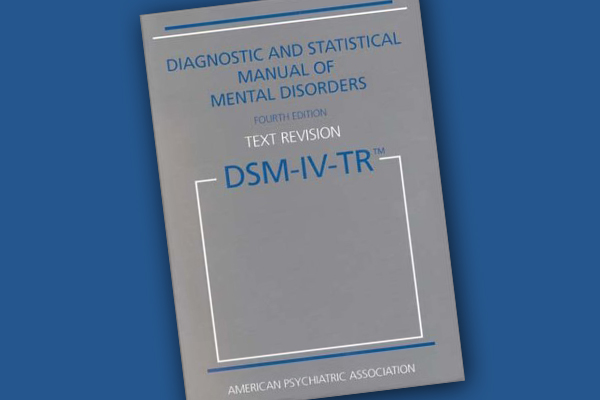
Since 1952, a tome called the Diagnostic and Statistical Manual of Mental Disorders, better known as the DSM, has been reducing to a few digits the psychological malady said to afflict a patient. This bible of mental health treatment, published by the American Psychiatric Association (APA), provides a list and description of every mental health condition known to—or invented by—psychiatry, from histrionic personality disorder (301.50) to transvestic fetishism (302.3).

Over the decades, the manual, adapted from a guide for mental diseases developed by Army and Navy psychiatrists, has ballooned. The number of listed disorders tripled to nearly 300. A few have been discredited and dumped along the way. Most famous were battles over the inclusion of homosexuality. Successive iterations of the manual listed homosexuality as a “sociopathic personality disturbance,” then modified that to describe a more limited “sexual orientation disturbance” among people who were “in conflict with” their attraction to people of the same sex. That was later replaced by a disorder called “ego-dystonic homosexuality,” applied to those whose homosexual arousal was a source of distress. That item was dropped in the DSM-III-R, published in 1987.

The great book’s coming edition, the DSM-5, is slated for publication in May 2013. As the task force producing it has posted drafts on its website, an undercurrent of dissatisfaction has exploded into a full-scale revolt by members of U.S. and British psychological and counseling organizations. The chief complaint is that the newest version will lower the criteria needed to diagnose some conditions, creating “subthreshold” disorders, and generally making it easier for healthcare professionals to label a person with a psychiatric disorder and medicate him or her.

The latest rebellion against the DSM-5 began with a salvo from across the Atlantic. In June, a special committee of the British Psychological Society complained in a letter to the APA that “clients and the general public are negatively affected by the continued and continuous medicalisation of their natural and normal responses to their experiences.” The committee criticized the proposed creation of an “attenuated psychosis syndrome”—a sort of poor-man’s psychosis with less severe symptoms—“as an opportunity to stigmatize eccentric people.” They also objected to a proposed reduction in the number of symptoms needed to diagnose adolescents with attention deficit disorder (ADD) because it might increase diagnoses and the use of meds.

Then David Elkins, professor emeritus at Pepperdine University and president of the Society for Humanistic Psychology, a division of the American Psychological Association, formed a committee to discuss similar objections and draft a petition enumerating them. In October, he posted the petition online. “I figured we’d get a couple hundred signatures,’’ Elkins said.

The response stunned him and his colleagues. The petition attracted more than 6,000 signatures in three weeks; as of mid-December it had topped 9,300 signatories and garnered the endorsement of 35 organizations. On Nov. 8, American Counseling Association president Don Locke jumped in with a letter to the APA objecting to the “incomplete or insufficient empirical evidence” underlying the proposed revisions and expressing “uncertainty about the quality and credibility” of the DSM-5.

“This has become a grassroots movement among mental health professionals, who are saying we already have a national problem with overmedication of children and the elderly, and we don’t want to exacerbate that,” says Elkins.

For many critics, Exhibit A is childhood ADD. As the disorder describing fidgety, easily distracted kids morphed from “hyperkinetic reaction of childhood” to the current “attention deficit hyperactivity disorder,” the number of children given the diagnosis exploded, fueling, by one account, a 700 percent increase in the use of Ritalin and other stimulants in the 1990s. Diagnosis requires checking six of nine boxes from a list of symptoms that include “often does not seem to listen when spoken to directly” and “often fidgets with hands or feet or squirms in seat.” Sound familiar, parents?

Two other newly proposed disorders singled out as problematic in the petition are “mild neurocognitive disorder” in the elderly and “disruptive mood dysregulation disorder” in children and adolescents. Both lack a solid basis in research and may fuel the use of powerful antipsychotic medications, which cause weight gain, diabetes and a host of other metabolic problems, the petition says.

“We are gravely concerned that if this is published as is in 2013, it will create false epidemics where hundreds of thousands of children and the elderly who really are normal will be diagnosed with a mental disorder and given powerful psychiatric medications that have dangerous side effects,” Elkins says. “That is not tolerable.”

David Kupfer, the University of Pittsburgh psychiatrist who chairs the task force overseeing the manual’s preparation, says he expects the final number of disorders included in the DSM-5 to be about the same as in the current book. He says he welcomes the criticism and that nothing is final. The task force has been testing proposed new diagnoses in 2,300 patients at seven adult treatment centers and four adolescent centers that are acting as field-test sites, he says.

“There’s a myth that all the decisions have been made, when in fact, all the decisions haven’t been made,” he says. “Just because [things have] been proposed doesn’t necessarily mean they’ll end up in the DSM-5. If they don’t achieve a level of reliability, clinician acceptability, and utility, it’s unlikely they’ll go forward.”

The most surprising critic of the DSM is a one-time pillar of the psychiatric establishment. Allen Frances, professor emeritus at Duke University, chaired the task force that created the DSM-4. Now he’s railing against both the process and proposed content of the new DSM in blogs on the website for Psychology Today that blast the new revision as “untested” and “unscientific.”

Psychiatric diagnoses are loose enough already, Frances  told me, and that laxity has led to “epidemics of over-diagnosis in child psychiatry” causing huge numbers of children to be unnecessarily labeled with attention deficit disorder and bipolar disorder and treated with medications.

“DSM has to be a safe, reliable and credible guide to current clinical practice,” he says. “It can’t be an untested program for future research.’’

The user revolt against the DSM-5 has emerged as a major challenge to the document, Frances says, and its future is looking unclear. He and Elkins are proposing that an independent committee of experts review the proposed draft and make recommendations.

The fight over the DSM-5 pits some of the greatest minds and biggest egos in the world of psychiatry, but it’s more than a battle among 301.81s (narcissistic personality disorder). For people seeking help for life’s problems who don’t want to be labeled mentally ill or have their treatment limited to medication, and for clinicians who want to help people without reducing them to a category, the stakes are high.

Continue Reading Close

My antidepressant made me do it!

The Hartman estate says Zoloft was to blame for a murder-suicide.

  • more
    • All Share Services

It was May 1998, and comedian Phil Hartman and his wife, Brynn, were planning a party. Their son, Sean, was soon turning 10 and they wanted to make it special with a bash at Planet Hollywood. Brynn was inviting her son’s friends, including some of his classmates from his school in Encino.

In mid-May she called Kathryn Alice, the mother of one of Sean’s friends, to get her address. Sean and Calvin, Kathryn’s son, played together and had visited each other’s homes. Through their sons, the moms had gotten to know each other, too. They chatted on the phone, and Brynn confided that things were tough. “She said she was barely hanging on by a thread,” Alice recalls. “I told her things will get better, but she said ‘I don’t know.’”

The invitation soon arrived in the mail, but the birthday party never happened. On May 28, at about 2:30 a.m., Brynn Hartman returned home from a night out with a female friend. As Sean and his sister, Birgen, slept in their rooms, Brynn entered the master bedroom and shot her sleeping husband three times. Four hours later, with police in the house and friends listening outside, Brynn lay down on the bed next to Phil’s body and pulled the trigger once more, killing herself.

How could this happen? Why did a woman who was, by all accounts, a devoted and protective mother, deprive her children of their parents? In the days after the killings, the tabloids and mainstream press ruminated over the problems in the couple’s often stormy relationship, speculating that Phil was preparing to leave her, or that she had relapsed into an old cocaine addiction. People magazine reported that she had recently started drinking again after 10 years of near-sobriety and had checked into an Arizona rehab clinic earlier in the year. Indeed, toxicology reports cited in press accounts indicate that at the time she died, Brynn Hartman had both cocaine and alcohol in her system.

But the couple’s family and their lawyers have another answer: Zoloft made her do it.

In late May 1999, one year after the deaths, attorneys for the Hartmans’ estate and children filed a lawsuit against Pfizer, the pharmaceutical giant that makes Zoloft, a new-generation antidepressant similar to Prozac. The suit contends that Brynn Hartman’s violent outburst was caused by a rare but previously documented side effect of the medication that left her agitated, jittery and “out of touch with reality.” It is one of more than 170 wrongful death lawsuits filed against the makers of these new antidepressants since Prozac first hit the market 12 years ago.

The Hartman suit also charges that Arthur Sorosky, the psychiatrist that supplied Brynn Hartman with Zoloft, was not really her doctor and never conducted an evaluation. Sorosky, the complaint alleges, was actually her son Sean’s doctor and gave Brynn medication samples — the kind doled out to physicians by drug company salesmen — “without the benefit of a history and physical examination [or] diagnosis.”

Sorosky’s attorney, Joel Douglas, told Salon Health that his client and Brynn Hartman had “a doctor-patient relationship” and that Sorosky had prescribed the Zoloft in a proper and appropriate way. “From what I understand,” he added, “with cocaine and alcohol in her system, you don’t need to look for Zoloft to understand what happened.”

But Zoloft and Prozac — along with other similar antidepressants — are being blamed for hundreds of violent deaths, including these:

  • July 1997: Thirteen-year-old Matthew Miller of Overland Park, Kan., kills himself in his closet one week after he begins taking Zoloft. According to his father, Mark Miller, Matthew had been moody and withdrawn for about nine months — the result, Miller believes, of the family moving to a new neighborhood and Matthew starting at a new school. In June, his parents took him to a psychiatrist. The doctor, accompanied by two medical students in training, talked with Matthew and his parents, but Matthew had little to say. When they met again three weeks later, one thing Matthew did tell him — in response to a question — was that he would never consider suicide. The doctor ruled out attention deficit disorder, but offered no other diagnosis to the Millers. But he did give them a three-week supply of Zoloft to try, and told them to check back in a week. Seven days later, members of Matthew’s family noticed that he seemed agitated. That night, he took his own life.
  • Feb. 19, 1997: Patricia Williamson, 60, of Beaumont, Texas, stabs and slashes herself more than 100 times in the bathtub while her husband eats breakfast in their kitchen. On the advice of a psychiatrist, she had begun taking Prozac six days earlier to help her through a depression that had arisen just a few months before. Her husband, hearing strange noises in the bathroom, pried open the door and found his wife of 20 years semi-conscious in a pool of her own blood. She died the next day in the hospital. Lawyers for Eli Lilly, the pharmaceutical giant that makes Prozac, recently reached an out-of-court settlement in the case.

  • March 1996: Daryl Dempsay, 35, stabs his wife and two children at their home in Burlington, Kan., then shoots and kills himself with a .22-caliber rifle. His wife and children survive, and have charged in a recently filed suit against Pfizer that Dempsay’s violent outburst was caused by an adverse reaction to Zoloft, which he had been taking for several weeks.

What would cause these people to become so violent or suicidal? The surviving family members and their lawyers — along with some experts and anti-psychiatry activists — contend that this volatile behavior is an extreme manifestation of a rare side effect of the new antidepressants.

The side effect, called akathisia, creates a feeling of distress, agitation and restlessness that leaves people jittery and unable to sit still or to stop shaking their legs. “In its milder form,” wrote Pfizer scientist Roger Lane in a journal article published last year, “it is experienced as a vague feeling of apprehension, irritability, dysphoria, impatience or general unease.”

“Akathisia is like being tortured from within,” says Peter Breggin, a Maryland psychiatrist and prominent critic of Prozac and other psychiatric medications. “It’s like the screeching of chalk down a board, only it’s going down your spinal column.

“This agitation or akathisia drives a person into extreme states of irritability, anger, and frustration,” Breggin continues. “People can become more depressed and more despairing; their impulse control loosens and they do stupid things. So the violent impulses that an ordinary person would control come pouring out or even appear for the first time.”

In his article, Pfizer’s researcher Lane described the suicide risk of SSRIs — selective serotonin reuptake inhibitors, the class of drug to which Prozac and Zoloft belong — in this way: “It may be less of a question of patients experiencing … suicidal ideation, than patients feeling that ‘death is a welcome result’ when the acutely discomforting symptoms of akathisia are experienced on top of already distressing disorders.”

Lane’s article focused specifically on akathisia and other similar side effects caused by SSRIs. Yet the word “akathisia” never appears in the package insert for Zoloft that is supposed to inform doctors about the risks and side effects of medication. And while akathisia is mentioned as a rare side-effect in the Prozac insert, both companies continue to publicly underplay the risks.

“This is an old story, it’s gone around and around,” says Jeff Newton, a spokesman for Eli Lilly. “But there’s ample evidence that Prozac is in no way linked to these kinds of violent behavior.” In fact, he added, Prozac reduces aggressive behavior and may lower the risk of suicide.

Pfizer representative Celeste Torello rejected the notion that Zoloft had any role in causing suicides or violence. “There’s no scientific or medical evidence that Zoloft causes violent or suicidal behavior,” she told Salon Health. “At this point, there have been over 90 million prescriptions written and there hasn’t been any evidence that it causes anything close to what Brynn Hartman did.” (When asked why Roger Lane, her own company’s scientist, discussed akathisia in his journal article but the company included no similar information in their package inserts, she declined to comment due to the pending lawsuit.)

To Andy Vickery, the lead attorney in the Hartman case and the other cases mentioned above, the failure of Pfizer and Eli Lilly to adequately warn doctors and patients about the possible risks constitutes gross negligence. “They withhold critical information from prescribing physicians, the public and the patients,” he says — information that would help doctors and patients recognize the symptoms of akathisia in time to do something about them.

Eli Lilly’s contention that Prozac is safe is bolstered by two jury verdicts in the company’s favor — one several years ago in a Louisville, Ky., case and the other earlier this year in Hawaii. In the Hawaii case, a jury cleared the drug maker in the death of a Hawaii man who killed himself and his wife 10 days after he began taking Prozac. (However, a motion for a new trial was heard on July 1, due to complaints by two jurors that they did not actually concur with the supposedly unanimous verdict. A ruling is expected shortly.)

“Litigation [against Lilly] has never worked,” Newton claims, though he acknowledges that Lilly has settled some lawsuits out of court. Newton claims the number is “very small” and they were made strictly as a business decision to avoid tying up company scientists and lawyers. Vickery says he settled nine Lilly cases last year alone, and has several more pending or waiting to be filed.

The idea that SSRIs can trigger suicidal or homicidal behavior is far from new. Indeed, the issue first exploded into public consciousness 10 years ago, when a former employee of a Louisville printing plant, Joseph Wesbecker, strolled into the plant with an AK-47 and started shooting. He killed eight people, wounded 12 and then turned the gun on himself.

Wesbecker had been taking Prozac for about a month, a fact seized upon by attorneys for the shooting victims and trumpeted on TV talk shows. Wesbecker’s sons did Larry King Live; one of the surviving victims went on the Donahue show for a program called “Prozac: the medication that makes you kill.” They claimed that Wesbecker had never been violent prior to taking Prozac.

But that claim was disputed by accounts in the local newspapers, which portrayed Wesbecker as a man with a deeply troubled past who had been hospitalized for mental disorders on three occasions, had made numerous suicide attempts and had reportedly told his wife a year before his rampage that he’d like to go to the plant “and shoot a bunch of people.”

About the time of the Louisville shooting, Harvard psychiatrists were finishing up an article for the American Journal of Psychiatry about six patients who “developed intense violent suicidal preoccupation” after taking Prozac for two to seven weeks. While three of the patients had attempted suicide in the past as a result of their depression, none were suicidal at the time they started on Prozac, the authors reported, and none had experienced suicidal urges on other psychiatric drugs. For all of them, their fixation with dying abated after they stopped taking the drug.

The article, coauthored by a leading expert on psychiatric drugs, sparked great interest and controversy within the psychiatric and pharmaceutical world. Other clinicians soon weighed in. A series of journal articles reported on cases in which patients on Prozac developed akathisia. When they stopped taking the medications, the researchers reported, the violent or suicidal urges abated.

Eli Lilly itself disputed the validity of case reports involving individual patients, criticizing them as inferior to the randomized clinical trials the firm had sponsored involving thousands of patients. Those studies, the company claimed, showed no evidence of suicidal impulses emerging among patients taking Prozac. Other researchers agreed with Eli Lilly, and submitted their own studies that found no increased suicide risk from Prozac.

In 1991, the FDA joined the fray, assembling a panel of experts to study the issue of Prozac and suicide and report back. The panel’s conclusion: There was no credible evidence linking the drug to acts of suicide or violence.

Though critics complained that the panel had been stacked with paid consultants to Eli Lilly, its opinion — coupled with Eli Lilly’s success in dismissing or settling out of court scores of lawsuits — seemed to settle the issue and remove it from the public spotlight. Until now.

Now the Hartman case and two violent school shootings committed by teenagers on antidepressants have pushed the issue back into the headlines. Eric Harris, one of the teenage gunmen at Columbine High in Littleton, Colo., was taking the antidepressant Luvox to treat obsessive-compulsive disorder. Kip Kinkle, the 15-year-old Illinois boy who killed his parents and two classmates last year before trying to take his own life, was reportedly on Prozac.

These two sensational cases, trotted out by critics of psychiatry like Breggin and columnist Arianna Huffington may, in fact, be poor examples. Kip Kinkle was reportedly obsessed with guns long before he started taking Prozac nearly two years before his rampage. And Eric Harris’ carnage, far from an act of drug-addled rage, had been meticulously planned for months.

And then there was Brynn Hartman. Given the cocaine and alcohol in her system, could any jury be made to believe that Zoloft was responsible, rather than the booze or the drugs? Perhaps there was a terrible interacion between all three substances — the Zoloft package label does warn that the drug should not be taken in conjunction with alcohol. It does not specifically mention cocaine, though common sense suggests that combining the drugs would not be the smartest idea.

The lawyers for the Hartman family will try to make the case that Brynn’s behavior changed during the two weeks or so during which she took the Zoloft, immediately prior to the killings. They argue in the complaint that her symptoms started several days before the shootings. She was having trouble sleeping, the suit claims, and complained that she felt “weird,” telling her nanny that she was having adverse effects from the drug. She told one friend that she was “going to jump out of her skin” and the friend advised her to talk to Sorosky. The lawsuit claims that on May 24, four days before her death, she called him and told him about her reaction the drug. His advice, according to the complaint: Cut the dosage in half.

When Kathryn Alice turned on her TV and learned of the Hartman deaths, she was stunned. “I never saw a sign of her being that off-balance,” she says. “She had a real strong instinct to protect her children. She was very involved with her kids and very concerned — constantly setting up play dates and picking them up and dropping them off. She was a really good mother.”

Continue Reading Close

Johnny get your pills

Are we overmedicating our kids?

  • more
    • All Share Services

Jimmy Spence was in fourth grade when his strange new behavior started: He
began jerking his head and limbs uncontrollably and making strange blowing
sounds with his mouth. During lunch at his school in Milford, Conn., his arm would suddenly jump and smack into someone next to him. Jimmy would hang his head in embarrassment as the kids around him laughed.

Partly to control these tics, a psychiatrist prescribed an antidepressant,
Wellbutrin, which Jimmy began taking twice a day. Ironically, the tics were
most likely a side effect of another medication Jimmy had started taking
three years earlier, when he was 6: Ritalin, the stimulant taken by
millions of American kids who are considered hyperactive.

Looking back, it’s hard to say exactly when Jimmy’s problems began. When he was 3, his mother and father separated. He felt suddenly lonely, and
thought he didn’t fit in with his parents’ new partners. Entering school
didn’t help; in class he was restless, unable to concentrate or stay in his
seat. His teacher urged Jimmy’s mother to seek professional help and when
she did, the psychologist diagnosed Jimmy with attention deficit hyperactivity disorder (ADHD) and suggested Ritalin. Within a week, Jimmy was taking two pills a day.

Jimmy disliked the medications. The Ritalin left him with wild mood swings when it wore off in the afternoon. And he dreaded the sense that everyone
at school knew about his problems. “The kids were always making fun of me,” he remembers. “It would be like, ‘That kid’s stupid, he’s on Ritalin.’”
Jimmy begged his mother to stop the Ritalin, and at one point, she agreed.
But school officials told her that if she didn’t keep Jimmy on medication
he would not be allowed to attend school for more than half a day. Nancy, a single mother, gave in.

Later, when the Wellbutrin was added to Jimmy’s daily regimen, it had little effect. The twitching continued, one time jerking his head so
forcefully that the school nurse feared he would snap his neck. Jimmy went
to therapists, psychiatrists, even a neurologist, but never saw anyone long
enough to form a connection. He was variously diagnosed with ADHD, bipolar disorder and a mood disorder. Another doctor took him off Ritalin and put him on a different stimulant, Cylert, while continuing the antidepressant. Still the tics continued.

By the fall of 1996 Jimmy, then 11, was in a funk. He hated going to
school in the morning, and came home nearly every day to hide in his
bedroom and cry. “I felt like nobody liked me, everything was just like –
like downpours,” he says. One afternoon, his mother went into his room and
found a note scrawled on the wall. “Somebody help me, I want to die,” it
said. She called the psychiatrist Jimmy saw occasionally, who switched him
from Wellbutrin to Zoloft, an antidepressant similar to Prozac. But within
a week, Jimmy degenerated. He ran in the street, ignoring traffic, threw lit matches around the house and imagined conversations that never occurred.

Alarmed, his mother grappled with questions she’d been asking herself for years. Were these medications really helping her son? Should
she continue to make him take them, or challenge the school and medical authorities who seemed so confident of their course?

A decade after it vaulted into our consciousness, America’s love affair with Prozac (and other new antidepressants) has worked its way down the age ladder. Last year, more than 2.5 million prescriptions for antidepressants were written for children and adolescents, according to IMS Health, a research firm that tracks prescription drug sales. That’s a jump of nearly 60 percent since 1993 — despite the fact that most of these drugs have not been approved by the Food and Drug Administration for use with children, and that no one knows what the long-term effects might be on developing brains. Prozac and its chemical cousins, the so-called serotonin selective re-uptake inhibitors (or SSRIs), have led the charge: SSRI prescriptions for kids nearly tripled in the last five years.

Many children have no doubt been helped by these drugs. But it also seems clear that powerful medications are being given far too easily to some
children, fueled by a variety of forces, from managed care to overworked parents. In a culture addicted to drugs, but reluctant to address
children’s pain unless they start shooting up schools, it’s become easier
and cheaper to deal with troubled kids by medicating them than by providing the personal attention of a sympathetic professional.

These days, antidepressants are being prescribed not just by psychiatrists but by pediatricians and family doctors. In a survey released last month by
researchers at the University of North Carolina, nearly three of four pediatricians and family practitioners in North Carolina said they had
prescribed antidepressants to children or adolescents; nearly a third
had recently (within the past six months) prescribed the medications to kids between 6 and 12. And, more alarming, only 8 percent of the doctors said they were adequately trained in the management of childhood depression; just 16 percent said they were comfortable treating depressed kids.

In an unpublished study from 1996-97, researchers with Kaiser Permanente, the nation’s largest HMO, found that more than 65 percent of children under 15 who were seen for depression in Kaiser clinics in Portland, Ore., were prescribed antidepressants by their pediatrician or family doctor. But perhaps the most shocking research finding is this: In Michigan, in 1996, investigators looking through records of state Medicaid patients found 157 children aged 3 or younger who had been given any of 22 different psychotropic medications for attention deficit disorder.

To Peter Jensen, the associate director of child and adolescent research with the National Institute of Mental Health, the idea of
pediatricians dispensing antidepressants is troubling. “The average pediatric visit is now 13 minutes,” Jensen says. “The kind of evaluation
that’s necessary to tell whether a child is clinically depressed goes beyond what a pediatrician in an office practice has the time or training to do.”

For years, research on the safety and effectiveness of these medications for children has lagged behind their use. In recent years, that’s changed
somewhat and most experts now believe that SSRIs are safe for kids — in the short run. Psychiatrists like them because they see them as “clean” drugs that regulate mood by adjusting levels of the brain chemical
serotonin, while leaving other systems of the brain untouched. They’re difficult to overdose on, and they cause relatively few immediate side effects — most commonly anxiety, nausea, and insomnia.

Some parents like the drugs because of their alluring promise to “fix” kids, while perhaps sparing a family in turmoil the emotional rigors of
counseling. And managed-care companies may like medications most of all, for one simple reason: They appear to be cheaper than therapy.

Indeed, many psychiatrists, pediatricians, and therapists say they feel
pushed to use medications both by managed care and by the difficulty of
getting a child into therapy. “The pressure to use medication has increased
enormously,” says Joe Woolston, medical director of the children’s
inpatient psychiatric unit at Yale/New Haven Hospital in Connecticut.
“Every single day, we have at least one case where the managed-care
reviewer says to us, ‘If you don’t start the child on medications within 24
hours after admission, we will not fund another day of hospital.’”

“For some of these children these medications may be lifesaving,” says
Peter Jensen. “For other children, the psychological treatments may be more
appropriate. But if there are constraints — financial considerations or
managed care saying you have to use a drug — well that’s really unethical.
That’s wrong.”

Phoebe Cirio, a child psychologist in St. Louis, says most managed-care
companies initially authorize a therapist to spend four to six sessions
with a child; the therapist must then convince case managers to authorize
more treatment. “If you can’t say clearly that such-and-such symptom is
better, they’ll say, ‘Well, maybe we need to refer to a psychiatrist for
assessment of underlying depression.’ Managed care sees this as a cheap way
to get rid of the problem. They think of antidepressants as equivalent to
antibiotics–let’s get in there and kill the germs.” Psychologists can’t do
effective therapy that quickly, Cirio adds. “You have to talk to the
parents, to establish rapport with the child,” she says. “Four or six
sessions is a totally inappropriate time frame.”

Mary Lou Sharrar, an Oakland, Calif., therapist who works extensively
with children, says she’s gotten so much pressure to limit the number of
sessions with young patients, and to refer them for medication, that she
now avoids working with children on managed-care plans.

Managed-care executives see things differently. Saul Feldman, a
psychiatrist and chief executive officer of United Behavioral Health, which
manages mental health and substance abuse benefits for 15 million people around the country, credits managed care with putting a stop to a widespread abuse in the 1980s, when thousands of children were inappropriately hospitalized in for-profit psychiatric hospitals. He acknowledges that some managed-care firms may try to rush kids out of therapy. “But,” he adds, “I think it’s absolutely inappropriate to push kids onto meds if the sole objective for doing so is economic. That’s unethical and it’s not done here.”

Jerry Rushton, the pediatrician who led the North Carolina survey, says he
and his colleagues in primary care often feel trapped when they try to plan
treatment for children. When they see a child in pain, they want to provide
immediate help. But they know if they refer the child for therapy, it can
take months to get approval and to set up an appointment; insurance
benefits can be denied; the child and parents may not follow up.

“It’s a dilemma,” Rushton says. “You don’t want to harm kids by giving them
medications when we’re unsure about the effects. But you also don’t want
them to go untreated and put them at risk for suicide or failure in school.
So sometimes you start them on the meds and you wait and you hope.”

So far, three drugs — the SSRIs Luvox and Zoloft, and an older
antidepressant, Anafranil — have been approved by the FDA for children and adolescents suffering from obsessive-compulsive disorder. Typically, fewer than half of the children on these drugs improve. A study of Zoloft reported in the Journal of the American Medical Association last year found that 42 percent of the children taking the drug improved, compared to 26 percent on placebos. No medications have been approved for children diagnosed as depressed.

But drugs don’t have to be approved for children to be used by them; any
drug that has cleared the FDA for one group of patients can be prescribed to anyone for any reason at a doctor’s discretion. This so-called “off-label” prescribing of antidepressants to children is based on research that is quite limited. So far, the best study of depressed children was led by Graham Emslie of the University of Texas Southwestern Medical Center. His 1997 report found that when Prozac was given for eight weeks to 96 depressed
children between 7 and 17 years old, 56 percent showed improvement,
compared to 33 percent taking placebos. But even with the improvement,
two-thirds of the kids on Prozac still had significant symptoms of
depression at the end of the eight weeks. And, says Emslie, “The children
who got medication seem as likely to have a recurrence as those who
didn’t.” Hardly a ringing endorsement.

But how applicable are these studies to real-world conditions? Clinical
trials in research settings include extensive visits between children and
clinicians. Such visits, Emslie says, are an important part of the
therapeutic process. But in the busy world of managed care, doctors
frequently dispense medication without providing therapy or meeting
regularly with the patient — because they don’t have the time or the
training. Jimmy Spence, for example, was taking stimulants and
antidepressants, but would often go months at a time without being seen for
an evaluation, much less for psychotherapy.

More studies are under way, funded by drug companies and the NIMH. They will seek to show that the drugs are safe in the short term and are at least moderately effective. The studies should provide greater insight into how the drugs work in the short term. But they could also be a double-edged sword: If the testing leads the FDA to approve antidepressants for children, doctors will prescribe them more often. And that could further erode support for counseling in favor of a pharmaceutical fix.

Government approval would also free drug companies to direct their
marketing efforts at children. Some would argue that they already are. Eli
Lilly, the maker of Prozac, has waged a peppy — and controversial –
advertising campaign, placing simple, high-contrast advertisements in
women’s and children’s magazines across the country. One featured a
child-like drawing of a dark cloud with the slogan “Depression hurts” next
to a bright sun and the slogan “Prozac can help.”

Some families view the new antidepressants as godsends. When Robert Schwartz, a
Long Island dentist, walked into the office of child psychiatrist Harold
Koplewicz five years ago with son Alex in tow, Schwartz was a desperate man. Then
4 years old, Alex was a dark-eyed boy with a winning smile and an
affectionate manner. But he could hardly speak, had not yet mastered toilet
training and often would get so agitated he’d clench and unclench his fists for
minutes at a time. He fixated on switches and buttons, turning them on and off
repeatedly, but couldn’t focus on building blocks or other children’s toys long
enough to play with them.

Alex’s problems first came to his parents’ attention when he was an infant. His pediatrician noticed that Alex’s growth had slowed substantially
starting at the age of 5 months. He ordered a blood test, which revealed a
thyroid deficiency. Alex began taking synthetic thyroid medication, but his
growth and development were already delayed. At 6 months, he couldn’t roll
over; at 10 months, he couldn’t crawl. Not until he was 18 months old was he
able to walk on his own.

Alex continued to miss developmental milestones, and his parents grew
increasingly concerned. They took him to numerous clinicians, including a speech
pathologist, psychologists and a neurologist. He was diagnosed with a pervasive
developmental disorder, a condition that can severely retard a child’s social
and communication skills. He started attending a special education preschool,
but was making little progress. Then his father took him to see Koplewicz.

Koplewicz read Alex’s file and reports, and within five minutes of meeting him,
was recommending a treatment plan centered around the use of Ritalin to help
Alex focus his attention. The next morning, just before dressing him for school,
Schwartz gave his son the first half-pill. The impact was almost immediate. “It
was like a metamorphosis occurred before my eyes,” his father recalled. “I gave
him the first pill at 8 a.m. and within 20 minutes, he wanted to pull up his
pants by himself, which is something he’d never done before.”

But the Ritalin also intensified Alex’s anxiety: He began to urinate in his
pants, and to jump at the sounds of traffic. To moderate the anxiety, Koplewicz
added a low dose of liquid Prozac to Alex’s growing drug regimen.

Since then, Alex’s progress has been slow but steady, held back for a while by
his parent’s divorce three years ago. Today, Alex, now 9, goes to a special
education program in his local school district and, twice a week, attends an
after-school social and recreation program. He also sees a psychologist two or
three times a month, who works with him on ways to modify his behavior and
assists his teacher with classroom strategies. But the central component of his
treatment continues to be medication: He’s now up to four drugs a day, a
combination of antidepressants and stimulants.

“Without the medication,” says his father, “he’d still be where he was at 4,
or we might have to be considering an institution.” He continues to see
Koplewicz every two or three months so the doctor can adjust his medication.
“It’s like a recipe,” says Schwartz, “and you’re constantly tweaking it to try
to get the perfect combination.” Alex, his father says, will probably need
medication for the rest of his life.

What if he stops taking them? Koplewicz is blunt in his warnings of what can
eventually befall children who need medications but don’t take them. “Bad things
can occur. You will drop out of school 10 times more frequently if you have ADHD
[that goes untreated]. You are at higher risk of killing yourself if you’re
depressed without an antidepressant. You will more likely do substances –
medicate yourself — if you’re depressed and don’t get treatment. There is an
adverse effect to not taking medicine which I don’t think parents recognize.”

Koplewicz makes these pronouncements from his perch as director of New York
University’s Child Study Center, where he has emerged as one of the leading advocates of psychiatric medications for
children. He argues that medication is the best way to help many children who
have what he calls biologically based brain disorders. “There are 5 or 6
million kids who could potentially benefit from SSRIs,” Koplewicz says. “I
actually think we’re not medicating kids enough.”

Koplewicz and his staff see thousands of families each year, many of whom (like the Schwartzes) have spent years trying to navigate the
disjointed services offered by school districts and public mental health
programs. By the time they get to the NYU center, many parents are mired in guilt
and despair. The charismatic doctor, who has written a book called “It’s
Nobody’s Fault,” has a message they find appealing: “I say that psychiatric
illness is not caused by bad parenting. It is not that your mother got divorced,
or that your father didn’t wipe you the right way. It really is DNA roulette:
You got blue eyes, blond hair, sometimes a musical ear, but sometimes you get
the predisposition for depression.”

But some psychiatrists and many psychologists — even those who believe in the
judicious use of medications for children — worry that the drugs are being overused.
“Many people feel the pressure to make a change and have a result quickly,” says
Mark DeAntonio, a psychiatrist who directs the adolescent inpatient unit at UCLA
Neuropsychiatric Institute. “It’s faster to write a prescription than to sit
down and talk to people and find out what’s really going on.”

Morris Johnson, a child therapist and former intake director of the Philadelphia
Guidance Center, sees a place for medications in extreme circumstances — “if a
kid is acting out, or trying to kill people in the family. But if you don’t get
to what’s causing those symptoms in the first place; the kid just ends up coming
back once the medication runs out. Medication is being used as a replacement for
therapy and I think that’s a major mistake.”

And then there’s the question of long-term effects: Will these drugs cause
problems down the line? Joan Moreau, a child psychiatrist in Williamsport,
Pa., has prescribed the new SSRIs to children as young as 6, but not
without some real worries. “What if 20 years after people start taking them,
they get senile or lose the capacity to reproduce?” she asks. “We just don’t
know because the medications aren’t older than 10 years.”

Because of these concerns, Moreau tries to wean children from medications as
soon as she can, and encourages parents to use psychotherapy as well. “If you can
help someone change the way they think and feel, that will serve them well in
the long term,” she says.

As she watched her son Jimmy falling apart, Nancy Spence wrestled with how best
to help him. In the end, she made the decision Jimmy had been requesting for
years: “I said, ‘I want him off all these medications. I want to know who Jimmy
really is.’ It had been six years and I’d had enough.”

It took three weeks to wean Jimmy from the medications. Within a week, he began
to feel better, and to feel his depression lift. Today, two and a half years
later, Jimmy is still off antidepressants, but takes a blood pressure medication
to control his tics.

In the kitchen of his small, tidy home, Jimmy sits, listening to the rap group
Wu-Tang Clan on a headset. He answers some questions, haltingly at first, but
after a while, the stocky adolescent opens up, raising his head from beneath his
baseball cap to make occasional eye contact. Pushing the headphones off his
ears, he walks over to the kitchen cupboard and pulls three old pill bottles off
the shelf. “These medications,” he says, setting them down on the kitchen table,
“they made me uncomfortable to where I just didn’t like me.”

Today, Jimmy said, he feels happier and more in control, though he still copes
with bouts of depression that tend to strike near the winter holidays. “I’m
popular, I like school better and I like my life better,” he says. Then he
pulls the headphones back down and moves his head slightly to the music.

Continue Reading Close

Precarious prescriptions

Can your doctor's poor penmanship hurt you?

  • more
    • All Share Services

To Teresa Vasquez, the news story that surfaced earlier last month about errors in the dispensing of a popular new arthritis drug, Celebrex, must have seemed chillingly familiar. On its way to becoming one of the bestselling new drugs in history, Celebrex has also earned another distinction: In 56 cases reported to the FDA, pharmacists have confused prescriptions for Celebrex with two other, similarly named drugs.

So far, apparently, the Celebrex mix-ups have caused no serious injuries. But Teresa Vasquez’s husband, Ramon — a heart patient from rural west Texas — was not so lucky. In 1995, according to court documents, Vasquez saw cardiologist Ramachandra Kolluru, who wrote out a prescription for the angina drug, Isordil, to be taken four times a day in doses of 20 milligrams. But to the pharmacist on duty at Albertson’s pharmacy in Odessa, Texas, the doctor’s scrawl looked like Plendil, a blood pressure medication with a maximum daily dose of 10 milligrams a day.

The pharmacist filled the prescription with Plendil but attached directions with the dosage for Isordil. As a result, Vasquez not only got the wrong drug, but he was directed to take it at eight times the maximum daily dosage. He took it several times, each time complaining to his wife about how poor it made him feel. The day after he began taking it, Vasquez suffered a massive heart attack. He died several days later, leaving his wife and three teenage children.

Experts say such mistakes are frighteningly common, though no accurate numbers are available. An estimated 1.3 million Americans are injured each year due to medication errors, such as getting the wrong dose or the wrong drug, according to the FDA. A study published last year in the medical journal Lancet estimated that between 1983 and 1993, the number of deaths caused by drug errors jumped 250 percent to more than 7,000 a year. How many of these deaths and injuries are due to name confusion? That’s not clear — though the U.S. Pharmacopeia, an industry trade group, estimates that about one-quarter of the 1,500 errors reported to its hot line each year involve mix-ups due to drug names that look or sound alike.

Among the fatal mix-ups reported to the FDA:

  • Narcan, used to reverse an overdose of narcotics, and Norcuron, a muscle relaxant used to intubate patients.
  • Pitressin, a synthetic hormone sometimes used to control bleeding in the esophagus, and Pitocin, used to induce labor in pregnant women.
  • Amiodarane, an anti-arrythmic, and Amrinone, used in congestive heart failure.
  • Demerol and Roxanol — both are narcotic analgesics, but Roxanol is more potent than Demerol.

Richard Chacon of Albuquerque, N.M., was one of the near misses. Chacon had been taking medication for chronic heartburn for many years, but in the summer of 1996, he noticed that the Prilosec pills he usually got looked different. He shrugged it off, figuring he’d been switched to a generic. In fact, he’d been given a prescription for Prozac. Without the protection of the right medication, his heartburn symptoms came roaring back. When he woke up one night with severe chest pain, and felt lightheaded and nauseous, he was rushed to the hospital. Since Chacon had a history of heart problems, including a double bypass procedure several years earlier, doctors were concerned that he was having a new round of cardiac trouble. After several days in the hospital, doctors discovered the error and Chacon was released in good condition.

One reason for the increase in medication mix-ups is the sheer number of drugs on the market. Bruce Lambert, an assistant professor of pharmacy administration at the University of Illinois at Chicago says there are 100,000 potential pairings of drug names that could be confused. And with around 100 new drugs coming onto the market each year, the potential for mistakes keeps growing.

“It’s a significant problem and it’s vastly underreported,” says Jerry Phillips, the FDA’s associate director for medication error prevention.

Pharmaceutical companies spend a lot of money selecting and test-marketing drug names. But critics of the industry say the companies pay far less attention to making sure names won’t be confused. “When a new name is being considered, it should be tested systematically for error prevention,” says Michael Cohen, a pharmacist who directs the nonprofit Institute for Safe Medication Practices. Potential names could be screened by a panel of pharmacists, doctors and nurses. The names could be run through a computer program, such as the one developed by Lambert, to identify look-alike or sound-alike names. “Unfortunately,” Cohen says, “the vast majority of companies don’t do that. So the FDA should require it.”

Celebrex, the new arthritis drug, was originally to be called Celebra. But drug maker Searle changed the name at the urging of the FDA, to avoid confusion with the antidepressant, Celexa. In Cohen’s view, though, the new name was not much safer. In fact, he predicted exactly what happened: that Celebrex would still be confused with Celexa, and would also be mistaken with Cerebyx, an anti-seizure medication. He pushed unsuccessfully for another change. To him, the errors that have occurred were both predictable and preventable; he continues to feel the name should be changed. “I hope we don’t have to wait until someone dies,” he says.

Searle spokesman Mark Gleason says there are no current plans to change the name, though a change is “one of a whole range of potential actions being considered.” In the meantime, he said, the company has sent out a “Dear Colleague” letter to pharmacists warning them of the potential problem. Gleason defends the company’s decision to go with the name Celebrex despite the warnings of problems. “This was mutually agreed to with the FDA,” he says. “There are 15,000 prescription drugs on the market, so it’s challenging getting brand names that aren’t like other brand names. You do your best shot. But there’s a lot of potential for human error.”

This potential for error has shot up along with the workloads of both doctors and pharmacists. “Doctors are seeing more patients than ever and pharmacists are under the gun too,” says Cohen.

Jim O’Donnell, an associate professor of pharmacy at Rush Medical College in Chicago, points out that changes in the pharmacy industry — the decline of mom-and-pop drug stores, the increasing volume of prescriptions handled by pharmacy chains and the growing use of poorly trained pharmacy technicians — have also set the stage for more errors. “The policy of some chains is that you must fill a prescription within 20 minutes,” he says.

Technology may provide some solutions: Dispensing software used by pharmacies could be loaded with special alerts that flash on the screen whenever a drug with the potential to be confused is being filled. On the other end of the prescribing chain, doctors could use computers to write prescriptions; when this approach has been tried in hospitals, it’s led to substantial reductions in errors. A simpler solution would be for doctors to type or print prescriptions, and to note on prescription forms the reason for drugs being ordered. That way when a pharmacist sees a diagnosis of heartburn, he or she will know the prescription isn’t for Prozac.

In the end, it may be the threat of litigation that makes drug companies, pharmacies and doctors pay more attention to the problem. In the Vasquez case, both Albertson’s and the pharmacist have settled a lawsuit filed by Vasquez’s widow, Teresa, and her children. But a case against Dr. Kolluru — alleging that his writing of the prescription was so bad as to be negligent — is scheduled for trial in August. “I laughingly say I’m representing the only doctor who’s ever been sued for bad handwriting,” says Kolluru’s attorney, Max Wright.

Until the FDA, along with the pharmaceutical and medical industries, makes the kind of reforms that will help protect the public, patients will need to learn to pay closer attention to the use of prescription drugs. Jimmie Anderson, of Berkeley, Calif., learned that lesson the hard way.

To control his high blood pressure, Anderson has been taking Norvasc for many years. But two summers ago, when he filled his prescription, he fell victim to one of the most common and serious mix-ups: He got the anti-psychotic Navane instead of Norvasc.

For four weeks, Anderson took the wrong medication, failing to connect his deteriorating health to the pills he thought should be helping. The first thing he noticed was his fatigue, then he felt his jaw lock up. Soon he started feeling restless. “I was walking the walls, pacing around my house,” he remembers. “I couldn’t sleep at all. It got so bad I thought I was dying.”

What may have saved his life was a visit from a friend who also took Norvasc and told Anderson he had the wrong drug. The experience changed Anderson’s approach to taking medicine and dealing with pharmacists. “Now I make sure I look at all my medications,” he says. “And I read them to make sure they’re right.”

Continue Reading Close