Rush Limbaugh’s resignation from ESPN’s “NFL Countdown” should bring the immediate controversy over his comments about Philadelphia Eagles quarterback Donovan McNabb to a mercifully quick end. However, his remarks have damaged his reputation and once again delivered another body blow to the conservative movement in the area in which it can least afford it: race.
And this time it’s not a creation of the liberal media; this was a self-inflicted wound.
If conservatives seriously wonder why it is so difficult for either the movement or its political manifestation — the Republican Party — to attract African-Americans, this incident should be Exhibit No. 1.
Sure, there are specific political issues on which many African-Americans disagree with the GOP. But the most important step in building political coalitions is convincing your target group that you are trustworthy when it comes to their central issues — that they’ll have a basic comfort zone in the coalition.
And the crude lesson many African-Americans will likely take from Limbaugh’s comments is that even if a conservative isn’t personally a racist, he may not be above turning a black person into a political football for ideological or entertainment value.
On Sunday, Donovan McNabb became Limbaugh’s football:
“I don’t think he’s been that good from the get-go. I think what we’ve had here is a little social concern in the NFL,” Limbaugh opined. “I think the media has been very desirous that a black quarterback do well. They’re interested in black coaches and black quarterbacks doing well. I think there’s a little hope invested in McNabb and he got a lot of credit for the performance of his team that he really didn’t deserve. The defense carried this team.”
Now, on the face of it, this could be seen as a harmless if politically incorrect statement for which Limbaugh should have been given a pass. (Although it’s worth noting that Limbaugh wanted to crucify Chicago Cubs manager Dusty Baker, who is black, for his seat-of-the-pants theorizing that blacks and Latinos suffer heat better than whites.) But Limbaugh’s statement wasn’t just provocative — it was just plain ignorant on the recent history of the NFL. He was acting as if McNabb was one of two or three black quarterbacks in the game.
Three years ago today, I wrote about the progress of black quarterbacks in the National Review, noting that “In addition to [Tennessee Titan Steve] McNair, the league today features starters Daunte Culpepper (Minnesota), Tony Banks (Baltimore), Akili Smith (Cincinnati), Jeff Blake (New Orleans), Donovan McNabb (Philadelphia), Charlie Batch (Detroit) and Shaun King (Tampa Bay) plus back-ups/part-time starters [Randall] Cunningham (Dallas), [Warren] Moon (Kansas City Chiefs), Kordell Stewart — and Tee Martin! (Pittsburgh), Ray Lucas (New York Jets). That comes to eleven NFL teams either starting a black quarterback or who have one in a featured role — a full third of the league.”
What was refreshing, I observed, was that the media hadn’t erupted in orgiastic frenzy at this development, as opposed to a decade before when sports analysts seemed obsessed by the fact there were only two starting black quarterbacks in the entire league (Cunningham — then with the Eagles — and one-time Houston Oiler Warren Moon).
And since that piece was written, the above mentioned have all been treated much the same as other players, regardless of race — until Limbaugh’s unfortunate comments Sunday. McNair, Culpepper and McNabb are still with the same teams (a combined 8-3 record). Some others now start for new teams (Blake, Stewart), others are backups with different clubs. Moon and Cunningham have retired. Quincy Carter leads “America’s Team,” the Dallas Cowboys. Byron Leftwich is a rookie starting for the Jacksonville Jaguars. Perhaps the most exciting player in the league is the now-injured Michael Vick of the Atlanta Falcons.
The point is that black quarterbacks aren’t novel enough for the media to engage in some sort of social cheering to single one out. Thus, Limbaugh’s basic argument was ludicrously antiquated.
Besides, hardly anything annoys conservatives more than when liberals introduce race into an issue when it has no place. And that’s exactly what Limbaugh did.
Is McNabb “overrated”? Different people can come to different conclusions. But the same thing can be said about Denver Broncos signal-caller Jake Plummer. Initially hyped by San Francisco’s Hall of Fame coach-turned-exec Bill Walsh as the second coming of Joe Montana, Plummer showed flashes of brilliance with the Arizona Cardinals. Six years later, his flashes of brilliance were overshadowed by a hail of interceptions and sacks. Yet, as his contract ended with Arizona last year, he signed a fat new one with Denver. The Broncos are 4-0 this year, with Plummer playing atrociously in the first two games and very well in the second two.
Given his statistics over the last several seasons, one could charge that he was “overrated.” Similarly, one could argue either way that McNabb is “overrated.” But with Plummer, the debate just centers on statistics — as most good sports arguments should. Yet Rush did what he hates in liberals. Instead of the typical liberal argument — “The man would get his real due if he were white” — we got Rush’s view, “He’s barely criticized because he’s black.”
And so, Limbaugh’s analysis failed factually and ideologically. Unfortunately, in the one area where it succeeded — injecting controversy on ESPN’s pre-game set — it introduced a particularly corrosive line of thought.
It articulated the double standard that blacks fear underlies much of American society: The successes and failures of white individuals belong to the individual (“Plummer’s a bum!” “Plummer’s great!”), whereas the success and failure of a black person belongs to the race. One week ago, after a poor start to the season, McNabb was being analyzed on his football skills. Today, he is analyzed on his race.
So Limbaugh managed to do in one moment what the media has actually refrained from doing in recent years. Removing their individuality, he has effectively “adjectivized” McNabb, McNair, et al. After succeeding on their own merits, they are once again black quarterbacks for however long the media chooses to continue with this story.
Rush didn’t help by initially dismissing the criticism as more p.c. blather: “All this has become the tempest that it is because I must have been right about something,” he said. “If I wasn’t right there wouldn’t be this cacophony of outrage that has sprung up in the sportswriter community.”
Such a self-serving statement suggests that Rush has never heard the adage that a stopped clock is right at least once a day.
Yet, ironically, Rush’s fall may provide another lesson. It actually underscores the similarities in the way that blacks and conservatives have, as subcultures, often been misrepresented in the dominant culture: Blacks are stereotypically portrayed as less intelligent, buffoonish and often criminal. Conservatives are stereotypically portrayed as selfish, mean and venal.
The black person and the conservative person feel like outsiders, both distrusting and envying the mainstream.
Each group needs to see its reality reflected in the dominant culture.
Each group creates its own media and ancillary organizations to support and amplify its unique experience and point of view.
Each group cheers when one of its own appears to become accepted by the mainstream and excels. It’s never enough to be successful just within the context of one’s own community.
Then, as the individual representative appears to fail in the mainstream culture, a sense of shame and disgrace envelops the entire group.
Rush Limbaugh, meet Jayson Blair.
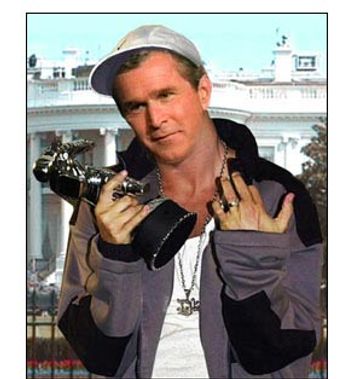
As Eminem finds himself at the top of many a music critic’s end of the year “best-of” lists, perhaps George W. Bush’s remarkable courting of black America makes a bizarre kind of sense.
Think about it. Before the campaign got underway, there was the dust-up over a Talk magazine profile where Bush mocked death row inmate Karla Faye Tucker’s last words, “Please don’t kill me!” Hmm. Dismissive of women: Check. The Talk profile was salted with more than a handful of “F-words.” Profanity: Check. There was the off-the-cuff reference to New York Times reporter Adam Clymer as a “major league asshole.” Verbally retaliating against someone he believes had “dissed” him in print? Check. For the purposes of this article, ignore the rumored drug use, but the DUI story fits the profile. Run-ins with the law: Check. Add in his continuing war with the English language and the Eminem comparisons only grow.
Aside from his various legal battles, what else is Eminem’s major claim? He has taken a black art form and, using initially underestimated skills, managed to move a major-league number of CDs, primarily to whites — yet is respected by blacks for his flow.
Wouldn’t it make a perfect kind of sense for the first “black” president — Bill Clinton — to be succeeded by the first “white rapper” president — George “Dubya” Bush?
Of course, the biggest problem with this analogy is that Bush hasn’t gotten anywhere near the love from the black community that Eminem has. Heck, Bush hasn’t even gotten the props briefly enjoyed by Vanilla Ice. With barely 8 percent of the vote, Bush has received a smaller share of support from black Americans than any Republican candidate since Barry Goldwater in 1964. It is particularly perplexing considering Bush actually sought that support far more than any other recent GOP standard-bearer.
Yet, since the “ratification” of his win, Bush appears to be committed to carving out a Cabinet that “looks like America” — even more than Clinton did. His first two selections were African-American — Colin Powell and Condoleezza Rice. Of his first nine appointees, only two (Don Evans and Paul O’Neil) are white men. The diversity is not merely genetic, it’s also ideological. Powell and Rice both support affirmative action and some form of abortion rights. And New Jersey Gov. Christine Todd Whitman, who has accepted Bush’s offer to head the Environmental Protection Agency, is anathema to the GOP’s conservative base because of her strong pro-abortion views (Quick: Name one vocally pro-life member of Clinton’s Cabinet in the last eight years. For that matter, think of one pro-life member, period.)
Still, Bush is being criticized by black Democrats and civil rights activists as making only “token” appointments that won’t win him many black votes down the road. Then, what are we to make of Bush’s sitting down with a group of black ministers Wednesday back in Austin, Texas?
Let’s be clear: Considering the non-support Bush received, he didn’t have to take valuable time out of his already-shrunken transition period to meet with the ministers. For that matter, was it necessary to have a black secretary of state and national security advisor? During the campaign, there was a quiet whisper among some Republicans that, contrary to conventional wisdom, there was no way the top foreign policy positions in a Republican administration would both go to minorities. Yet it’s turned out to be true.
Without waiting for his Cabinet to fill out, Bush proceeds to talk about his faith-based anti-poverty programs with a group of African-American clergy. One of them, the Rev. Floyd Flake, a Democratic former member of Congress, is also being seriously mentioned as a Bush education secretary. During the campaign, these overtures to minorities were dismissed as public-relations measures to cross over to suburban, white, baby-boomer moderates craving a friendlier GOP.
But the campaign is over. Why would Bush continue if he was really just pandering? Especially after such abject failure with blacks at the polls? Perhaps, shockingly, it’s because this is the real George W. Bush? Maybe it’s important enough to him that he will continue to try and succeed with a reverse crossover — a home-invasion of black America.
Well, if he does, the next important question becomes: If Bush is Eminem, who is his “super-producer,” his Dr. Dre? Is it Powell, who helps “sell” Bush to blacks (Powell spoke at Washington’s Howard University on Tuesday, underscoring the need for more minorities joining the Foreign Service), or is it Vice President-elect Dick Cheney, who does the job for conservatives (another minority group whose concerns must be addressed)?
George W. Bush knows that he is not going to get to black America by giving in to Jesse Jackson’s political agenda (whatever it might be). Jackson is an ideological Democrat, whereas most blacks are cultural and historical Democrats. Just as in the days of old when Southern whites would rather vote for a yellow dog than a Republican, blacks have become culturally accustomed to being suspicious of the GOP, accepting Democrat as the default choice. This makes the community — as a group — easily swayed by, say, an NAACP ad that reminds blacks of James Byrd’s death, and Bush’s failure to sign a hate crime bill in Texas (even if there already was one in Texas that covered racial hatred).
Thus Bush realizes that if he is ever going to have any hope of ingratiating himself to the black community, he will need to take an alternative route. To continue the music-industry analogy, Bush needs to go the “indie” route to circumvent the “major” black distribution network. His alternative distribution line depends on the “three Ps”: personality, personnel and policies.
1) Personality: He is never going to equal Clinton’s adoration among blacks, but if Bush makes reaching out to blacks a regular part of his message and not just an afterthought, it will be difficult for even a Jesse Jackson to attack him in 2004 the way he is now;
2) Personnel: Powell, Rice and (should he make the cut) Flake would not merely be in Bush’s Cabinet, but because of who and what they are, they can elevate those offices to a level not seen before — especially within the black community. How many people — of any race — would recognize Clinton Education Secretary Richard Riley if they tripped over him? Another appointment that may well be of note: Powell’s son Michael is the likely next chairman of the Federal Communications Commission.
3) Policies: Bush now has the opportunity to put into practice what conservatives have been pushing for years: school vouchers. While education is primarily a local issue, Bush has the bully pulpit and his meeting with black ministers may have opened up a valuable pipeline for him. Even if Flake doesn’t come on board as education secretary, he is someone who has shown how charter schools and other non-teachers’ union alternatives can work effectively in inner-city environments. If this message can be sold to Flake, it can be sold to others.
While Bush is held in very low regard by the vast majority of black America right now, four years is an eternity in politics. The seeds that he is planting even before he has been sworn in may very well bear fruit. By 2004, if the crossover is successful, black Americans might be less likely to assume that everything black leaders say about Bush is true, and instead be left asking, “Won’t the real George Dubya please stand up, please stand up?”
Continue Reading
Close
Just a few days after a New York undercover police officer shot Patrick Dorismond during a drug sting, I was chatting with a good Brooklyn buddy — a successful African-American record producer who involves himself in a variety of community interests. Nominally a Democrat, he’s clear-headed and broad-minded enough to advise both the Urban League and the national Republican Party. In many ways, his political outlook is not very different from that of the Rev. Floyd Flake, the black former congressman from Queens, who endorsed New York Mayor Rudy Giuiliani in his 1997 reelection bid, but broke with him in the wake of the Amadou Diallo shooting.
As we headed to a New York comedy club, we discussed Giuliani’s controversial reaction to the Dorismond shooting. As he usually does in such situations, Giuliani responded by offering strong support for the cops, while asking that everyone refrain from making judgments. He promptly raised the stakes by violating his own advice and releasing Dorismond’s arrest record — including his sealed juvenile offenses. It was a situation made for Al Sharpton and one which the good reverend has seized.
My buddy blurted out, “I think he’s nuts. There’s no other explanation. It’s just crazy that he would behave this way.” The conversation continued and I noted that, ironically enough, Giuliani has brought together three groups that traditionally interacted only warily — African-Americans, West Indians and African immigrants — albeit in hostility toward him.
The more recent immigrants don’t always buy into the politics of grievance that appear to animate native-born blacks, but the three killings of unarmed men from these communities by the NYPD in 13 months has mobilized these communities. “And Palestinians, too,” our driver volunteered, unsolicited.
Later, my friend amended his view of the mayor, but was still harshly critical: “He may not be nuts, but his personality may breed crime itself. Consider the law-abiding young, 20-something black male who has seen too many of his brothers incarcerated and wants to make something of himself. After being stopped and frisked three times in one night on the way home from his job, at what point does that young man just say to hell with it? People end up acting the way society expects them to. Crazy or not, Rudy Giuliani is not being a good public servant.”
But is he, as Jesse Jackson ventured after the shooting, “mental”? It’s an unfair accusation that can’t be easily defended. But that’s exactly the question that is being uttered by New Yorkers about their mayor these days.
It was clear from the beginning that Rudy Giuliani’s temperament would be an issue in his Senate campaign against Hillary Clinton. Liberals feel it’s a legitimate issue given that the mayor has never been perceived as Mr. Warmth and will never be confused with a “compassionate conservative.”
Clinton said as much in the current New York magazine: “There’s a real contrast in leadership styles. Willingness to listen to people and actually learn from people … I would look for every possible way to work with my colleagues to try to get things done for New York. And I wouldn’t expect if I disagreed with them, I could sue them or fire them.” Clinton didn’t say that Giuliani’s temperament does not lend itself to “playing well with others.” She doesn’t have to.
Riding the No. 1 train this past weekend, I found myself listening to a pair of fellow strap-hangers. They were a typical white couple in their early 20s, Downtown types, maybe just out of college. Probably one of the few couples on the New York subway John Rocker would find normal. No purple hair here, though the guy’s was uncombed and shoulder-length. Rudy just naturally flowed into their conversation.
Young woman: “I can’t believe Mom likes Giuliani. She’d never voted for a Republican before. Doesn’t she realize that he’s a lunatic?”
Young man: “Well, just hope that he keeps spouting off. Maybe everyone will start thinking the same.”
Jackson, Clinton, my buddy, random subway riders. I was detecting a pattern of here. But surely not everyone thinks the mayor’s nuts.
Both Salon and the New York Post recently noted Giuliani’s use of “projection” and other psychological terms to describe Hillary Clinton’s reaction to his reaction. The Post also reported that Rudy’s original skit at the annual “Inner Circle” charity event was to have featured Lorraine Bracco (psychiatrist Jennifer Melfi of “The Sopranos”), and would have placed Rudy on the couch. The punch line had him leaving and running into Tony Soprano (James Gandolfini). The two would have said simultaneously: “Don’t tell anyone you saw me here today.” Unfortunately, Bracco and Gandolfini had scheduling conflicts.
But, still, isn’t it a stretch to go from saying that someone has a temperament ill-suited to working with others to suggesting that they are “mental” as Jesse Jackson remarked last week?
It’s unprecedented, but not completely unheard of. It reminds me of what happened to John McCain just five months ago, when a similar sotto voce campaign was waged against the then presidential candidate by various unnamed senators, who insinuated that his stay at the Hanoi Hilton may have left him permanently unhinged. It was dark and anonymous.
Fortunately, McCain had a secret weapon to fend off the comments: Records from the psychologists he regularly met with for nine years following his 1973 release from Vietnam. Rudy doesn’t have that luxury. The early whisper campaign came back to haunt McCain as his campaign began to unravel before Super Tuesday. Under normal circumstances, when a campaign starts to slip, the talk is of various strategies that are no longer working or the other candidate’s superior message. Instead, columnist Robert Novak chimed in with this: “The fabled temper of John McCain, admirably kept under control in his rise from obscurity to Republican presidential contention, finally may have done him in.”
All the previous associations, valid or not, came rushing back. Bill Bennett, who just a few weeks before had been touting McCain as having the best shot of beating Al Gore, broke ranks. He wrote in the Wall Street Journal that McCain’s attacks on Pat Robertson and Jerry Falwell were “highly irresponsible and intemperate.” He then rattled off to the Washington Post that McCain’s derision of the two religious right figures as “evil” was a “very odd thing … I don’t know what’s going on. I’m not a psychiatrist.”
The McCain comparison is especially poignant now that the two tempestuous maverick Republicans have bonded. Though Giuliani endorsed Bush, he pointedly refused to join in the state GOP’s all-out assault on McCain. The Arizona senator returned the favor by citing Giuliani as someone he would definitely be campaigning for this year.
The similar accusations leveled at the two men makes one wonder if they might not be reaping the downside of being “Mars” politicians — testosterone-filled, uncompromising and bombastic — in a “Venus” political environment whose watchwords are “compassion” and “doing it for the children.” That is, Giuliani and McCain, regardless of their actual personalities, seem like “warriors” — unflinching in the battle for their beliefs in a society at peace.
Bill Clinton may be a gut-level street fighter, but he smiles and talks about “feeling your pain.” The McCain-Giuliani response is to inflict pain of their own by going for the jugular. And both men seem to face their harshest criticism coming to the defense of allies. Ex-Navy flyer McCain started to go off message when Robertson attacked his close friend Warren Rudman; Giuliani’s present stumble comes from a preemptive strike in support of the police.
But in today’s political calculus, an in-your-face, aggressive public posture opens candidates like Giuliani and McCain up to the charge of being out-of-step or “crazy.”
A John Zogby poll released last Sunday demonstrated that Giuliani’s handling of the Dorismond shooting has taken its toll. Clinton has moved ahead of him by 3 percentage points statewide and Giuliani is bleeding support from almost every demographic group, even the upstate voters he is counting on to carry him to victory. Of course, the day before the poll was released, a riot broke out at Dorismond’s funeral and several cops were injured. So, sympathy and support may swing back to Giuliani.
The difficulty Giuliani now faces may be seen in Carol and John, a couple typical of the young white professionals who have flocked to New York during its late-’90s renaissance. Carol works for a wire service; John attends business school and dabbles in dot-com ventures. They met while working on George Bush’s 1992 reelection campaign and have been married for three years. John even worked for a Republican congressman in the mid-’90s. These should be the ideal Rudy voters. But Giuliani can only count on John to vote for him.
Carol is concerned about Republican policies on education and the environment: “I’m a disgruntled customer, so I’m registering my disgust by shopping elsewhere,” she says. Carol reserves her toughest words for the mayor: “Yes, the city is safer. But Giuliani is unstable. This is not an ideological decision. When I vote it will be more strongly against him than for her.”
These sentiments were uttered in November, months before the Dorismond shooting.
Continue Reading
Close
Despite his outrage at Sen. John McCain for comparing him to President Clinton, George W. Bush employed classic Clintonian tactics to lead himself to victory in South Carolina. He stole his opponent’s rhetoric, inflated his record to match his opponent’s, marginalized his opponent to make him appear like an extremist and carpet bombed his opponent with attack ads. But the big irony for the Texas governor, and this will haunt him down the road, is that he failed to adopt one of Clinton’s key tactics from the 1992 campaign when the opportunity arose.
In one particular area, Bush failed spectacularly in South Carolina. As GOP pollster Tony Fabrizio recently told the Wall Street Journal: “The person who comes up with [his own] version of ‘Sister Souljah’ … will do a great deal for the Republican Party.” Bush could have had his Sister Souljah moment when he spoke at Bob Jones University, but he shamefully let it go.
Bob Jones University, as everyone now knows, is a very conservative Christian South Carolina institution: It bans interracial dating and its founder, Bob Jones, was a virulent anti-Catholic.
On “Meet The Press,” moderator Tim Russert asked Bush if he wasn’t giving affirmation to the views of Bob Jones University by agreeing to speak at the school and not criticizing its policies when given the opportunity. Bush responded, “I stood up there and said, ‘Let’s march together toward a better tomorrow.’ How can I go into a university like that and subscribe to those views when my little brother, the great governor of Florida, married a girl from Mexico in my own family?”
Observers with a keen ear might ask, “Good point, Governor. Why didn’t you make it at Bob Jones?” Sharing the experience of your brother and sister-in-law’s marriage would have given flesh to a philosophical disagreement.
In marked contrast to Bush, that’s what Alan Keyes did when he spoke at Bob Jones: “There are folks who told me I shouldn’t come here because I am a black man and, I say it with pride, a Roman Catholic Christian, and I would not be received in that place on that account … I have, thankfully, put the lie to that by coming.”
The argument could be made that Keyes had nothing to lose, since he’s not going to win anyway. But, in the long run, Bush risks far more. Keyes, the black, conservative Catholic, did something that an evangelical Christian like Bush is supposed to do — he testified to his faith, verbalized his Christianity as much as his Catholicism and still criticized the institution’s policies. Meanwhile, Bush simply told students what they wished to hear and demonstrated no leadership.
But the impact is not the same coming from Keyes, who has no chance of winning the nomination. Worse, it does not help the image of the GOP when the only candidate who dares critique Bob Jones University on racial matters to its face happens to be the only black one. McCain at least had an excuse: Bob Jones III pointedly did not invite him.
Bush could have done it all: He could have critiqued Bob Jones’ policy. He could have professed his faith. He could have spoken from the heart about the special place his brother and sister-in-law occupy in the family, noting also that they are Catholic. He could have distanced his party from the shadow of bigotry that haunts it. And he could have had his own proud Sister Souljah moment.
Souljah, as you may recall, was a rapper affiliated with the group Public Enemy. She had said in a Washington Post interview following the Los Angeles riots that, considering how blacks have been killing each other every day, “Why not have a week and kill white people?” On the 1992 campaign trail, Bill Clinton was invited to Jesse Jackson’s Rainbow Coalition conference. Noting that Souljah had addressed the crowd the day before, Clinton took the Rainbow Coalition to task for inviting Souljah and her “message of hate.” He did so right in front of Jackson.
This was an intentional tactic on Clinton’s part. Democrats believed Jackson had damaged Michael Dukakis’ 1988 presidential bid by demanding all sorts of platform concessions for his various liberal constituencies. Clinton decided to use the forum Jackson gave him to send a different signal. Stiff-arming the reverend was a clear message to the suburban voters in the primary that, down the road, Clinton would not be beholden to Jackson, radical blacks or the extreme wing of his Democratic Party. Dissing the president of black America was a high-risk move. As it turned out, Clinton won the nomination, conquered the suburbs in the fall and is today viewed, in Toni Morrison’s famous words, as “America’s first black president.”
But Bush still has a long way to go before earning any similar title. To underscore Bush’s tactical defeat, the same week he appeared at Bob Jones University, Colin Powell became one of the few national Republican figures to explicitly call for the Confederate flag to come down from the South Carolina Statehouse. Remember, this is the same Republican Party that was outraged only a few weeks ago when Gore’s black campaign manager, Donna Brazile, suggested that the GOP only used African-Americans such as Powell and J.C. Watts because they “have no program, no policy,” that would appeal directly to black voters. “They’d rather take pictures with black children than feed them.”
If Bush wishes to be leader of that party, he must find ways to help dispel the notion that the GOP is insensitive — at best — on racial issues and completely beholden to the party’s most extreme elements. Instead, Bush has given the Democrats two clubs with which to bash the GOP should he be the nominee — the flag and Bob Jones University.
As Bush continues to metamorphose into a “tactical Clinton,” will he recognize the next Republican “Sister Souljah” — whomever he or she might be — the next time? Or is it already too late?
Continue Reading
Close