Robert Bryce

Bush fire Rove? Fat chance

The six reasons it will take an indictment to get Karl Rove out of the Bush White House.

  • more
    • All Share Services

For all of you out there waiting for George W. Bush to fire Karl Rove: Don’t hold your breath.

Yes, Rove is the perfect target for the Democrats. Yes, the Democrats would like nothing better than to sully the reputation of the man who has been kicking their butts for years. And yes, there are questions about exactly what Rove told Matthew Cooper and possibly other reporters about CIA operative Valerie Plame. But for many reasons, Bush cannot dump Rove.

Reason No. 1: Firing Rove would be perceived as an admission by George W. that things are amiss in his administration. The hallmark of Bush’s presidency has been its ability — when faced with adversity or controversy about a war, a policy or an individual — to simply ignore the matter and stick to its talking points.

Look at Defense Secretary Donald Rumsfeld: A man whose many miscues should long ago have consigned him to retirement is now halfway through his fifth year in the top job at the Pentagon. Need another example of the Bush White House’s method of turning failures into press events? Then recall that it was just seven months ago that Bush bestowed the Presidential Medal of Freedom on three characters who had leading roles in the Iraq debacle: Gen. Tommy Franks, George Tenet and Paul Bremer.

Franks directed the invasion of Iraq and resisted the advice of his commanders, including Gen. Eric Shinseki of the Army, who told congressional leaders that America’s invasion force of 100,000 troops was far too small. In February 2003, Shinseki told Congress that “something on the order of several hundred thousand soldiers” would be needed to keep the peace in postwar Iraq. That didn’t happen. Instead, Shinseki was forced into retirement. Franks got a medal. And a book contract.

Another medal winner was former CIA director Tenet, who, in early 2003, assured the world that Saddam Hussein had weapons of mass destruction and must therefore be removed. Of course, no such weapons were ever found. But Tenet got a medal and a fat book contract, too. Finally, Bush strapped a medal on Bremer, the former lieutenant to Henry Kissinger who became America’s chief administrator in Iraq. Bremer left Iraq an even bigger mess than it was when he arrived. Nevertheless, Bush honored all three men, saying that they had “played pivotal roles in great events” and that their “efforts have made our country more secure.”

Reason No. 2: Firing Rove would mean being disloyal to the man who has done more to advance the Bushes’ agenda than any other single person. As has been reported many times, loyalty is the Bush family’s holy grail. Once you’re in the circle, you’re in for life. Rove has been a central player in the Bushes’ political dynasty for more than three decades. In the Bush ledger, Rove is nearly on a par with the family’s consigliere, James A. Baker III, as one of the family’s most trusted advisors. They aren’t going to dump him now.

Indeed, the Bush-Rove histories are so completely intertwined that it’s impossible to separate them. In 1973, when Rove was in a messy dispute as to who would be the chairman of the College Republicans, it was George H.W. Bush, then chairman of the Republican National Committee, who intervened and declared Rove the winner. From his office in the basement of the RNC’s headquarters in Washington, Rove began making himself indispensable. It was Rove who introduced the late Lee Atwater to the elder Bush. Atwater went on to become renowned both for his hardball politics and for being one of Bush I’s closest political advisors.

In 1977, when the elder Bush decided to run for president, Rove moved to Houston to manage his political action committee, the Fund for Limited Government. Although Bush didn’t win the nomination, he did become the vice president under Ronald Reagan. And Rove began changing Texas, which was totally dominated by Democrats, into a state dominated by the GOP. Starting with Bill Clements, who in 1978 became the first Republican governor in Texas in more than a century, Rove became the key operative for a fleet of Texas politicos, including former Sen. Phil Gramm, Sens. Kay Bailey Hutchison and John Cornyn, and the current governor, Rick Perry. In 1988, Rove advised Tom Phillips, who became the first Republican ever elected to the Texas Supreme Court. (Within a decade, the GOP would hold all nine seats.) Every one of those Republicans was to become an ally of George W. Bush’s.

It was Rove who stage-managed the younger Bush’s very first campaign stops for governor in November 1993. It was Rove — who by that time had already helped run GOP races in 31 states — who coached the still-unsteady Bush on how to recognize reporters by name, how to give answers in solid sound bites, and how to position himself against Ann Richards, the popular incumbent governor.

Once Bush moved into the governor’s mansion in Austin, it was Rove who began prepping George W. for the White House, inviting key GOP politicos from around the country to stop by the mansion for coffee and get-to-know-you sessions. It was Rove, the direct-mail genius, who kept Bush’s gubernatorial and presidential campaigns flush with cash. By May 1999, Bush’s presidential campaign had already raised $13 million — without holding a single fundraiser. That early money effectively scared off other GOP challengers and made Bush the prohibitive favorite to win the Republican nomination.

Reason No. 3: Bush needs Rove for the upcoming fights, including the midterm elections, the certain battle over his Supreme Court nominees, and the ongoing battles on Capitol Hill. In short, the entire Republican National Committee is a reflection of Karl Rove. Over the past decade, Rove has remade the RNC into an organization where virtually all of the top players owe their allegiance to him.

“What looms as a possibility is that Bush may be forced to move Rove out of the White House to keep access to the brain without the body being nearby,” says Jim Moore, the coauthor of the definitive Rove biography “Bush’s Brain,” published in 2003. “There’s no way for Bush to have any legacy without Karl around to push tort reform and judicial issues. Without Rove, Bush’s legislative agenda goes nowhere. They can’t blow him up. It would be complete surrender. It would be like throwing down their guns and walking into the stockade.”

Reason No. 4: The conservatives are behind Rove. Wednesday’s editorial in the Wall Street Journal about Rove lays out the GOP’s defense plan: 1) Call Joe Wilson a liar. 2) Repeat. 3) Repeat again. 4) Point out that the e-mail from Rove to Matthew Cooper can be parsed many different ways. 5) Insist that Rove was doing journalists like Cooper a favor by warning them to be careful when discussing Wilson and Niger. 6) Insist that no laws were broken.

Reason No. 5: The Democrats aren’t strong enough to keep this issue alive. Look, the Democrats in the House and the Senate can’t even force hearings on the Downing Street memos — the documents that appear to show that the Bush administration decided to invade Iraq in the summer of 2002. The memos also show that the United States began bombing Iraq not in 2003, but in 2002, before Bush got authorization from Congress. Those memos were the blueprint for a war that has become a quagmire, a war that has cost taxpayers $200 billion and led to the deaths of thousands of Iraqis and nearly 2,000 American soldiers. Why do the Democrats now think that they are strong enough to get rid of the man who sets the agenda for the RNC, Congress and the Bush White House?

Reason No. 6: Rove has been through all of this dirty-tricks stuff before. He has been made the bad guy by the Democrats through several investigations, and he has always come out stronger than he was before the kerfuffle started. For instance, in October 1986, Rove was working for Republican Clements in his race against then Gov. Mark White. A few days before the two candidates were to debate, Rove discovered a listening device that had been planted behind a needlepoint hanging of an elephant on his wall. The FBI investigated. Accusations and counteraccusations were made. But the common wisdom held that Rove had planted the bug himself. No charges were ever brought, and the matter slowly dissipated.

A few years later, Rove was implicated in a federal investigation into three men who worked for Jim Hightower, the Democratic Texas agriculture commissioner. Rove allegedly directed an FBI agent who investigated Hightower’s fundraising efforts. The agent also launched noisy investigations into other top Texas Democrats. Eventually, three of Hightower’s employees were convicted on charges of bribery, conspiracy and misapplication of funds. All three served time in federal prison. Again, despite the finger-pointing, Rove thrived.

Despite all these reasons for keeping Rove in the White House, there is a big wild card in all of this: special prosecutor Patrick Fitzgerald, who has virtually unlimited power to go after anybody and everybody involved in the Plame game. Fitzgerald’s grand jury is getting testimony from Cooper. And it has Cooper’s notes. It may also be getting information from the execrable detonator of this entire affair: columnist Robert Novak.

If Rove gets indicted by Fitzgerald, then all bets are off. But short of that, get used to Rove. He’s going to be around for a good long while.

The gushing truth

Contrary to Bush, enviros and Thomas Friedman, America will never be energy independent. The sooner we accept this, the sooner we'll be able to change our gas-guzzling ways.

  • more
    • All Share Services

The gushing truth

It would be easy to blame it on Richard Nixon. He started blathering about “energy independence” shortly after the Arab oil producers raised prices and launched an embargo against the U.S. in October of 1973. Within weeks, oil prices quintupled and the American economy went into seizures.

The crusade for energy independence reached another crescendo last week, when the House voted to approve some $8.1 billion in tax breaks for the mightily struggling energy industry. Let’s see, during the first quarter of this year, Exxon Mobil’s profits jumped 44 percent. Royal Dutch/Shell’s profits were up 42 percent while Marathon Oil’s profits were up a measly 26 percent. And there’s this news: According to John S. Herold Inc., a research-only firm, five of the country’s biggest oil and gas companies had a total of some $51.4 billion in cash on hand at the end of 2004.

Never mind the absurdity of tax breaks for a sector that’s printing money. The main problem with the energy bill is that it’s being sold as a magic potion that will help America wean itself from foreign sources of energy. When that “energy independence” moment occurs, goes the reasoning, America will be a self-sufficient Valhalla with lots of good-paying manufacturing jobs. Farmers will make big profits by growing acre upon acre of corn and other plants that will be turned into oil-replacing, clean-burning ethanol. And American GIs will never again need to visit the Persian Gulf, except, perhaps, on vacation.

If you believe in that vision, stop reading here. That vision will not happen. America will never — repeat, never — be energy independent. America is such a major energy user and the energy market is so complex that we can never be independent. America simply sucks up too much oil (25 percent of world production), too much natural gas, and too much coal to ever cut itself off from the global market. The price for these commodities is set by global market forces like booming economies in China and India, and by the ever-increasing energy needs of citizens everywhere to power their cars, fax machines, computers and air conditioners.

In short, there’s no silver bullet when it comes to energy. Pretending that there is only obscures the magnitude of the problem. And that problem is enormous. Hydrocarbons of all types are becoming harder to find and more expensive to produce. And more people are vying for the resources that remain. Domestic oil production has been falling since the early 1970s and no matter how large the subsidy or tax break to domestic drillers, that trend cannot be reversed. Given our current energy consumption, the idea that we can mine enough domestic crude to meet our demand is simply fallacious. You’d be hard-pressed to find any diner at the Houston Petroleum Club to say otherwise.

If we continue pretending that we can somehow be independent of these hard truths, it will be that much harder to make the difficult changes that must be made: a strong embrace of efficiency and conservation (particularly in the transportation sector) and a bolder, more comprehensive program to develop renewable and alternative sources of energy.

I’ll explain more in a moment why we can’t be independent. But first, a short review of recent comments from the right, the left and the center that use the “I” word:

  • On April 19, White House spokesman Scott McClellan endorsed the energy bill, saying, “It is time to act to make America more energy independent … We are dependent on foreign sources of energy. It is a threat to our economic security and our national security.”
  • On April 20, U.S. Sen. Maria Cantwell, D-Wash., during a press conference with fellow Democrat New York Sen. Charles Schumer, said that the U.S. needs to increase its research and development spending in order to “focus on technologies that can lead us to energy independence.”
  • On April 21, the National Environmental Trust denounced the House version of the energy bill, saying President George W. Bush and his cronies should “get serious about American energy independence.”
  • On April 27, during his press conference, President Bush used the oxymoronic phrase “greater energy independence” seven times. (Never mind that the very idea of independence is absolute. “Greater” has nothing to do with it.) Nevertheless, Bush insisted that “By harnessing the power of technology, we’re going to be able to grow our economy, protect our environment, and achieve greater energy independence.”

    Then there’s New York Times columnist Thomas Friedman, who has begun calling himself a “geo-green.” Last December, he called for a Manhattan Projectlike “initiative for alternative energy and conservation to make America energy-independent in 10 years.” On Jan. 30, Friedman repeated his battle cry, proclaiming that if only Americans were more energy efficient, the Arab OPEC members’ oil revenues will shrink and “they will have to open up their economies and their schools and liberate their women … It is that simple.”

    Oh, Tom, if only it were.

    Numerous factors keep America from ever becoming energy independent. First is our enormous auto fleet. Amory Lovins and the other energy efficiency gurus keep saying that we can quit buying foreign crude oil if only we all drove more fuel-efficient cars. Their argument goes like this: Two-thirds of the oil the U.S. consumes is used for transportation. In fact, our transportation consumption nearly equals our oil imports. Thus, if we make transportation more efficient, then the need for that imported oil goes away.

    Alas, even dramatic increases in America’s automobile fuel efficiency will only slow the growth rate of our oil imports. According to the National Commission on Energy Policy, if automakers increased the efficiency of their fleets from the current 24 miles per gallon to 44 mpg, America’s motor fuel consumption will still increase by 3.7 million barrels per day by 2025. That trend reflects two facts: Americans are driving more miles each year, and Americans own more than 200 million vehicles, each of which has a life span of about 15 years. Converting that gigantic fleet to one that is more fuel efficient will take decades and cost tens of billions, perhaps even hundreds of billion of dollars. In the meantime, people still need to commute to work. And they are not going to spend $25,000 on a Prius just to save $25 every time they fill up their gas tanks.

    Second, even if the U.S. did manage to reduce its overall oil consumption, it is unlikely to have a major effect on oil prices or oil supply. Oil is so fungible and demand so high that crude being loaded at Yanbu, Saudia Arabia, that isn’t bought by a refiner in Texas, will be shipped instead to Singapore or Shanghai.

    The booming economies of China and India are creating enormous demand for petroleum. The Chinese economy grew by almost 10 percent during the first quarter of 2005. Decreasing consumption in America “won’t have a global impact on major oil exporters,” says Scott Tinker, the director of the University of Texas Bureau of Economic Geology. “In fact, quite the opposite. The big oil-exporting countries are recognizing that the future market for them is in the mid- and Far East, in countries like India and China. Increased demand in those regions will overshadow decreased consumption in the U.S., keeping global demand above global supply.” That’s bad news for all those Hummer drivers who will be paying yet higher prices at the pump.

    Tinker raises a key point: Global demand is reaching parity with global supply. The Organization of the Petroleum Exporting Countries has, for three decades, controlled global oil prices. But OPEC has no spare capacity. Thus, the price of oil has become more volatile, and every barrel that comes onto the market is quickly sold. That means that oil buyers cannot deny their currency to one supplier in favor of another. In short, oil prices are determined on a global market in which every player is subject to fluctuations in price and supply. This point was summarized in a 2002 report by the Congressional Research Service. It determined that “energy independence will not free the United States from oil price shocks.”

    Oil is only part of the imported energy question. Over the next five years, America is going to become a major natural gas importer. By 2010, according to the Federal Energy Regulatory Commission, the U.S. will be importing about 10 percent of its daily gas needs in the form of liquefied natural gas (LNG). That gas will come from places like Qatar, Trinidad and Nigeria. By 2025, the FERC expects LNG to account for 20 percent of America’s daily gas consumption. And there is no alternative. The U.S. — which has built dozens of new gas-fired electric power plants over the past few years — cannot meet its gas demand any other way. No amount of tax subsidies or drilling programs will allow the U.S. to escape the ongoing decline in domestic gas production.

    Furthermore, over the next decade or so, the natural gas market will increasingly mimic the oil market — with price being determined on a global basis. That trend will accelerate in the coming decades as natural gas grabs a larger percentage of overall global energy consumption. Gas is an excellent fuel source. It contains no sulphur. It burns cleanly, is easily shipped via pipeline and there is a lot of it. But there’s a problem. According to the Energy Information Administration, nearly half of all proven global gas reserves are in the Persian Gulf. So even if the U.S. does everything right and in the coming two or three decades we all start driving efficient cars that use less oil, and using waffle irons that use less electricity (and less imported natural gas), we are still going to be tied to the Persian Gulf.

    One final factor to keep in mind when thinking about energy independence is peak oil, the concept that the world is reaching, or has already reached, its capacity to produce ever-increasing amounts of petroleum. Peak oil is fundamentally changing the global balance of power. It is giving the big oil-exporting nations a lot more power and we had better get used to it.

    If oil producers cannot meet surging global demand, energy prices, and gasoline prices in particular, will likely continue upward. Which means that the Arab OPEC countries — which are already swimming in cash — will become even richer. According to a recent report from the World Bank, the Arab oil-producing countries will take in nearly $300 billion from their oil exports this year. That’s nearly double the amount they garnered in 2002. By the end of this year, the World Bank predicts that Iran will have $18.5 billion in cash on hand — more than four times the surplus the country had in 2002. Kuwait will have $13.9 billion, more than three times its 2002 surplus. The Saudis will have a staggering $60.6 billion surplus, five times the amount they had in 2002.

    These countries are using that cash to strengthen their own economies. And well they should. Saudi Arabia, Iran, Iraq and Nigeria all have rapidly growing populations. According to the U.N., Saudi Arabia’s population will increase by more than 41 percent over the next 15 years. All of those new citizens will need education, housing and medical care. These population surges could cause major instability in all of these countries. And as we are seeing in Iraq, insurrections are bad for exports. The Bush administration originally claimed that Iraq’s oil revenues would pay for all of the rebuilding efforts. But the country is struggling to maintain export rates of 1.5 million barrels per day due to the constant attacks on the country’s oil infrastructure.

    More important, these countries may view the idea of energy independence as an opportunity to move out of America’s orbit. So even though the U.S. is a popular market for the OPEC countries, George W. Bush and his policies are not. A year ago, the Pew Center for People and the Press found that in predominantly Muslim countries, “anger toward the United States remains pervasive.” It remains to be seen if the major oil-producing countries will refuse to do business with the U.S.

    Bush has sought to isolate the Venezuelan and Iranian oil markets but his efforts aren’t working. Venezuelan President Hugo Chavez has already struck major oil contracts with Cuba and China. Over the last few months, the Iranians have signed a $40 billion energy deal with India and a $70 billion deal with the Chinese. The Iranians are also negotiating a huge deal with Pakistan and India that would carry natural gas to India. Dubbed the “peace pipeline,” the Bush administration is actively trying to stop the project. But in March, India’s oil minister, Mani Shankar Aiyar, told reporters that the project “can’t be compromised for any third-party concern.” Then, speaking more directly to the Bush administration, he said that “friendly countries in the world must recognize that even if they have national concerns, we have a very important requirement of energy without which we cannot hope to sustain priorities.”

    As for the Saudis, they remain one of America’s closest allies. But two weeks before Saudi Crown Prince Abdullah went to Crawford, Texas, to hold hands with George W. Bush, he was in Paris, signing a $26 billion defense deal with Jacques Chirac. The deal calls for the Saudis to buy 96 Rafale fighters from France. Meanwhile, our dear friends, the Kuwaitis, are demanding that the U.S. pay them $500 million for the fuel they have been supplying (at no cost) to American troops involved in the second Iraq war.

    The point is this: Globalization is a fact of life in the energy business. It has been for a long time. And the global interconnectedness of the energy trade is accelerating. That trend is accelerating even as oil-rich countries like Russia, Venezuela, Kuwait and others are taking more control over their domestic energy resources. That means that the major oil companies, long accustomed to getting major concessions in these countries, may not have as much access to big oil fields as they once did — another reason why the major oil companies (Exxon Mobil, BP, Shell) will soon reach peak production.

    All of these factors should be forcing the U.S. toward more energy efficiency and huge investments in renewable energy. Instead, President Bush is talking about building refineries on old military bases. But he is not telling us exactly where he’s going to get the crude oil to feed those refineries. He wants to drill in the Arctic National Wildlife Refuge. But the U.S. Geological Survey estimates that only about 6 billion barrels of oil could be recovered from the refuge, a billion less than Americans consume a year. What’s more, there’s no guarantee that oil companies that set up shop on the Alaskan refuge will hawk their oil only to the United States.

    Although America will always be part of the global oil market, we must still aggressively pursue conservation, efficiency and renewable energy at home. Conservation in the automotive sector can help us reduce oil consumption. That’s good for America because it reduces air pollution and cuts greenhouse emissions. It may also reduce the amount of oil we need to import. The U.S. now spends about $12 billion per month on imported oil. Cutting those energy imports will be good for our balance of trade. Biofuels, like ethanol made from domestically grown plants, can make a significant contribution toward offsetting imported oil. Rethinking our transportation system, and diverting some of our transportation dollars away from cars and roads and toward mass transit, will help reduce urban sprawl and conserve open space.

    We need renewable sources of energy like wind and solar for many reasons. First, they are environmentally friendly: no greenhouse gases or pollutants. Second, the cost of these technologies is falling, and they may soon become competitive with fossil fuels (coal and natural gas). Third, they can reduce the amount of fossil fuels needed to produce electricity and reduce the need for building expensive new power plants.

    Unfortunately, George W. Bush has shown no leadership on energy issues, even as big strides are being made in developing alternative sources. One new technology turns infrared light into electricity, dramatically improving the efficiency of existing photovoltaic cells. Wind power continues to grow rapidly, while getting only minor federal subsidies. Other more capital-intensive processes like coal gasification and gas-to-liquids are showing promise. If environmentalists are going to be realistic about America’s energy future, they are going to have to get over their long-standing aversion to nuclear power. The Japanese conglomerate, Toshiba, has just introduced a prototype of a micro-nuclear power plant that produces 25 megawatts of power and does so at fairly low cost.

    All of these technologies could have roles in America’s energy future. But reducing America’s energy consumption — or at the very least, slowing the rate of growth of our fossil fuel consumption — will take years, barrels of cash, and more than a little bravery in Congress and the White House.

    It’s time to get started.

  • Continue Reading Close

    Running on empty

    The leading energy analysts who foretold Enron's demise have an alarming new claim: The world's major oil companies are almost tapped out.

    • more
      • All Share Services

    Running on empty

    Four years ago, the analysts at John S. Herold Inc. were the first to call bullshit on Enron. On Feb. 21, 2001, three Herold analysts issued a report that said Enron’s profit margins were shriveling, the company had too few hard assets, and its stock price was way too high. Less than ten months later, Enron filed for bankruptcy.

    Today, the analysts at Herold — a research-only firm that issues valuations on several hundred publicly traded energy companies — are making predictions even bolder than their call on Enron. They have begun estimating when each of the world’s biggest energy companies will peak in its ability to produce oil and gas. Herold’s work shows that the best minds in the energy industry are accepting the reality that the globe is reaching (or has already reached) the limit of its own ability to produce ever increasing amounts of oil.

    Many analysts have estimated when the earth will reach its peak oil production. Others have done estimates on when individual countries will hit their peaks. Herold is the first Wall Street firm to predict when specific energy companies will hit their peaks.

    Since last fall, Herold has done peak estimates on about two dozen oil companies. Herold believes that the French oil company, Total S.A., will reach its peak production in 2007. Herold expects 2008 to be critical, with Exxon Mobil Corp., ConocoPhillips Co., BP, Royal Dutch/Shell Group, and the Italian producer, Eni S.p.A., all hitting their peaks. In 2009, Herold expects ChevronTexaco Corp. to peak. In Herold’s view, each of the world’s seven largest publicly traded oil companies will begin seeing production declines within the next 48 months or so.

    Executive vice president Richard Gordon, who heads Herold’s global strategies team, says the firm’s goal in doing peak-production estimates for individual oil companies is simple: “If the dinosaurs are going extinct, we are trying to figure out which ones are going to go extinct the soonest.”

    Herold’s projections have enormous ramifications both for stockholders in the major oil companies and for every energy consumer on the globe. If Herold is correct, and the world’s biggest oil companies cannot increase their production in the coming years, then several things appear certain:

  • Oil prices — which are already at record levels — will continue rising as demand outstrips supply. In a few years, gasoline prices of $2 per gallon could seem like a bargain.
  • State-owned oil companies like Mexico’s Pemex, Venezuela’s PDVSA (Petroléos de Venezuela) and Saudi Arabia’s Saudi Aramco may be unable to increase their production enough to meet burgeoning global demand.
  • The producers who belong to the Organization of the Petroleum Exporting Countries, and Saudi Arabia in particular, may have even more leverage over the global oil market in the coming years.
  • The United States will be ever more reliant on oil imported from countries filled with people who don’t like George W. Bush or his policies.
  • While Herold’s projections provide ammunition to the growing chorus of analysts who believe peak oil is imminent, they are not being welcomed by the oil companies. Last month, when I asked ChevronTexaco’s chairman and CEO, David J. O’Reilly, to respond to Herold’s projection that his company would reach its peak production in 2009, he replied snappishly, “I’m not going to comment on that.”

    A spokesman for Royal Dutch/Shell in London was similarly coy, saying in an e-mail that the company had “no comment” on Herold’s projection. However, the company’s spokesman, Simon Buerk, pointed to a September 2004 report published by Shell that predicts the company will be producing the equivalent of 4.5 million barrels of oil per day by 2014, not the 4 million barrels per day that Herold foresees for that time frame.

    Charley Maxwell, an analyst at Weeden & Co., a Connecticut brokerage, says oil industry officials are loath to discuss Herold’s projections because doing so would “circumscribe their future prospects and the future growth of their stock, and executives have no interest in doing that since so much of their compensation is tied to their stock options.” Maxwell, one of the most respected stock pickers in the energy business, believes the non-OPEC oil producers will hit their peak oil production in the next five years. And he applauds Herold’s research, saying that no other reputable firm “has been willing to make this type of prediction.”

    Another energy industry veteran, John Olson, co-manager of Houston Energy Partners, an energy hedge fund, agrees. Olson believes that Herold’s predictions about peak production are “very significant. It is perhaps the first cannon ball over the bow of a big tanker.”

    But Herold has its critics. Brian J. Jennings, the chief financial officer of Oklahoma City’s Devon Energy Corp., which Herold believes will hit its peak in 2009, says that Herold’s analysis is “a truncated look at the company. It assumes that nothing we are going to do over the next five years will increase our production.” Jennings says Devon expects to increase its oil production by 25 percent over the next five years — and that figure does not include fields that the company is developing in the Gulf of Mexico.

    Of course, scientists, pundits and oil men have been predicting that the world will run out of oil ever since the gusher blew at Spindletop in Texas in 1901. Despite those predictions, the last century has been one of unbroken increases in supply. Each year, the oil industry has produced more oil than it did the year before. Today, the industry is producing about 83 million barrels of oil per day. New oil fields in the deep-water Gulf of Mexico, in the Caspian Sea and in Saudi Arabia will soon begin pumping oil onto the global market. Plus, huge deposits of oil are available in the Canadian tar sands and American oil shale.

    But turning tar sands and shale into motor fuel is a very expensive proposition. And those new, unconventional oil sources may be insufficient to replace the decline in production from existing fields, which deplete by about 6 percent per year. Further, they may be too small to quench the demand from the developing world — China in particular. Last month, at a conference in Houston, Zhu Yu, the president of China’s Sinopec Economics and Development Research Institute, said that between January and September of 2004, motor fuel use in his country soared by 20 percent. Yu also predicted that China’s oil consumption will double over the next 15 years to more than 10 million barrels of oil per day. Meanwhile, the Energy Information Administration expects India’s oil consumption to increase by nearly 30 percent over the next five years.

    The oil industry has plenty of other reasons to be nervous. The royal rulers of Saudi Arabia, the world’s biggest producer, appear vulnerable to terrorist attacks and civil unrest. The Saudi government’s biggest enemy, Osama bin Laden, has focused his ire on both the Saudi royals and the oil infrastructure in the Persian Gulf. And his loyalists are eager to attack both of those targets.

    In Iraq, insurgents are continually attacking that country’s oil infrastructure — thereby crippling the war-torn nation’s economy and its future prospects. In Venezuela, which has the biggest oil deposits in the Western hemisphere, president Hugo Chavez has threatened to cut off the flow of oil to the United States if the Bush administration continues its efforts to undermine his government. In Russia, president Vladimir Putin’s brazen, state-sponsored theft of Yukos, one of that country’s biggest oil companies — and his jailing of the company’s CEO, Mikhail Khordokovsky — is likely to slow investment in Russian oil fields for years.

    Furthermore, spare oil-production capacity has largely disappeared. Oil producers are running their wells at maximum capacity. Indonesia, a member of OPEC, cannot meet its OPEC quota of 1.4 million barrels per day. In February, Indonesia was able to produce only 942,000 barrels per day, its lowest level of production in 34 years. And last week, Algeria’s energy minister, Chakib Khelil, said that OPEC “does not have the production capacity to increase its quotas.”

    All of these factors are sending oil prices to record highs. Monday’s NYMEX closing price for light sweet crude was $54.95 per barrel. Last week, the Department of Energy issued a report saying that it expects prices to stay near or above $50 per barrel for the rest of this year. That’s a big change for an agency that has always been conservative in its price projects. At about this same time last year, the agency was predicting that oil would cost about $29 per barrel throughout 2005.

    Whatever price projections are used, it’s increasingly clear that the era of cheap oil is over and that oil companies are having a harder time finding new oil to replace the oil they’re pumping. In short, it appears that the late M. King Hubbert, a geophysicist who worked for Shell in Houston, is being proved right. In the 1950s, Hubbert used mathematical models to predict that American oil production would peak in the early 1970s. That’s exactly what happened. Now, Hubbert’s theories are being tested on a global scale.

    Herold’s owner and CEO, Art Smith, is a believer in Hubbert’s work. Smith and his fellow analysts at Herold have been building their peak production databases since 1996. About 10 months ago, Herold began publishing what it calls “strategic evaluations” of specific companies, which include graphics showing when that company will reach its peak production. Herold does not do geologic analysis. Instead, its analysts mine the company’s filings with the Securities and Exchange Commission. It also looks at the oil properties that the company has acquired or sold, along with new projects being drilled, and older oil fields in the company’s portfolio. “We look at this data, put it into a financial model, and start asking questions,” says Herold analyst Gordon.

    Herold isn’t the only Wall Street firm considering the issue of peak oil. In early December, Deutsche Bank issued a report that predicted global oil production will peak in 2014. The Deutsche Bank report also stresses political instability and China’s surging demand. Those factors, Deutsche Bank believes, “could trigger a shortage shock leading to a price crisis.”

    And while many analysts in Houston are convinced a peak in global production is in the offing, there are others who believe that today’s high prices will trigger a surge in new oil production. David Pursell, a partner at Pickering Energy Partners, a Houston brokerage, says with oil at $50 per barrel, “a whole lot of oil fields that used to be woefully uneconomic suddenly become profitable and that means that any peak projections get delayed.” Although Pursell is not ready to agree with Herold’s projections about individual energy companies, he — along with virtually everyone else in the oil industry — agrees that the era of cheap energy is over and that America must begin adapting to the new geopolitical realities that come with that fact. Alas, it appears the Bush administration hasn’t made that same transition.

    Last week, President Bush gave a speech on energy policy in Columbus, Ohio, in which he encouraged Congress to pass an energy bill. Once again, he touted his plan to drill for oil in the Arctic National Wildlife Refuge, a move he said would “eventually reduce our dependence on foreign oil by up to a million barrels of oil a day.” The key word here is “eventually.” Even if approvals for drilling ANWR were granted immediately, the first oil from the refuge would not reach the continental United States for years. Furthermore, as the New York Times reported last month, it appears that the major oil companies may have cooled in their desire to drill in the refuge. During his speech, Bush also talked about efficiency measures that could save homeowners electricity. But during his 4,600-word, 35-minute-long speech, Bush uttered the words “hybrid vehicle” exactly one time.

    It’s astonishing that Bush, the former Texas oil man, still doesn’t understand the fundamental problem of America’s imported oil addiction. Nor does he appear to grasp the threat that is posed by the possibility of peak oil.

    The majority of the oil that the United States imports from places like Saudi Arabia and Venezuela is used as motor fuel in automobiles. Yet the president conflated the idea that burning more coal and building more nuclear power plants will somehow allow America to reduce its oil imports. In his speech, Bush refused to discuss the obvious: We cannot cut our oil imports (read: gasoline addiction) without dramatic changes to our auto fleet. At some point, the United States will have to force the automakers to build more efficient automobiles. And a key part of that efficiency changeover will mean replacing increasing numbers of America’s 200 million cars and trucks with hybrid vehicles.

    Even some of Washington’s most hawkish neoconservatives are embracing the idea of high-mileage hybrid vehicles. Former CIA director James Woolsey, a key backer of the war in Iraq, is driving a Toyota Prius. Woolsey, along with neocons like Frank Gaffney have begun preaching the Greens’ gospel of energy efficiency. The neocons haven’t joined the Sierra Club. Instead, they’re arguing that energy conservation is simply smart strategy when dealing with the Muslim extremists who reside in the oil-rich countries of the Persian Gulf. But so far, the neocons haven’t been able to get Bush’s ear.

    Remarkably, when it comes to thinking about peak oil and what it means for the future of America, Wall Street analysts and neocons are taking the lead, while the former oil man from Midland keeps his head up his tailpipe.

    Continue Reading Close

    The Texas chainsaw massacre

    With Bush's victory, the Lone Star State's right-wing ethos reigns supreme.

    • more
      • All Share Services

    The Texas chainsaw massacre

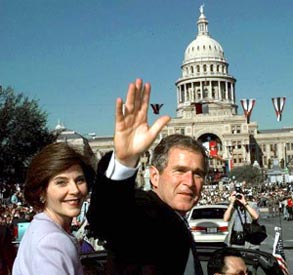
    With the reelection of George W. Bush, the Texanization of American politics is virtually complete. Ever since 1845, when the state was annexed by the United States, the Lone Star State and what it represents have been controversial. At that time, Ralph Waldo Emerson said the push to add Texas to the Union was an event that would “retard or retrograde the civilization.”

    Retrograde or not, Bush’s convincing win over John Kerry means that America’s identity has now been subsumed by the Texas worldview. American voters have chosen a government that is militarist, self-absorbed, piously Christian, dominated by big business, generally unconcerned about social inequality, and perfectly happy with regressive taxation. Those characteristics have defined Texas for generations. And now that Bush has regained the White House, the state will accelerate its export of these attitudes to rest of the United States, if not to the rest of the world.

    This election had many facets. But a recurring theme — and criticism — of Bush was his image as a cowboy. For his critics, Bush the cowboy was a hayseed, a country bumpkin with too much pride and too much power who was always ready to reach for his revolver. For Bush’s backers, Bush the cowboy was the modern version of “Gunsmoke” marshal Matt Dillon, a quick-on-the-draw gunslinger who would, as Bush put it, get the bad guys “dead or alive.”

    Bush’s entire campaign strategy was based on that image: Bush, the tough hombre who never makes a mistake, will protect America from those varmint terrorists. The sissy senator from Massachusetts won’t. End of speech. Repeat. Then repeat again. And again.

    It worked. And thanks to Bush’s roots in the Lone Star State, the tough-guy image was, of course, the cowboy. The European press in particular seized on this theme. In April, the Guardian called Bush an “inept cowboy” who can’t “keep the herd settled in at night.” Yet Bush reveled in the cowboy image. During the Republican Convention, Bush told his faithful: “Some people say that I have a swagger. In Texas, we call it ‘walking.’” The crowd roared its approval.

    Like Texan Lyndon Johnson, Bush has a rural hacienda that allows him to play the role of gentleman rancher. He wears cowboy boots. When dressed in casual clothes, he often wears a big belt buckle. Like Johnson, Bush wears a cowboy hat while on the ranch. Bush’s straw hat is finished in a style known as a “cattleman’s crease” — even though the cattle being run on his Prairie Chapel ranch do not belong to the cowpuncher in chief. (In fact, neither does the ranch itself; it’s owned by a Midland, Texas, outfit known as the Lone Star Trust.) Bush has even played the cowboy in Washington by wearing a pearl-gray Stetson on occasion. And of course, Bush adjusts his drawl up or down depending on just how Texan he wants to be.

    Texas was an essential part of Bush’s path to power. Born in New Haven, Conn., and a product of Andover, Yale and Harvard, Bush acts the Texan in a way that would never have occurred to Johnson. For Johnson, who grew up on a hardscrabble ranch in Blanco County, the Texas attitude, the Texas accent, was inbred. He couldn’t turn it on or off in the way that Bush does so skillfully. Johnson was an arrogant but charming, undereducated, overachieving, rough-hewn politico who got his degree from Southwest Texas State Teachers College in San Marcos and never felt comfortable around the fancy-pants intellectuals who went to the power schools in the East.

    George W. Bush embraced Texas myths and style in a way that his father never could or would. And Texans see Bush II as one of their own. Last year, Houston oilman George Strake Jr., a veteran of Texas GOP politics for several decades, told me that the elder Bush “had to learn the Texas mentality from a book. But 43 [George W. Bush] has the Texas mentality in his heart. He was raised out there in west Texas.”

    For historian H.W. Brands, a professor at Texas A&M University whose most recent book is “Lone Star Nation: How a Ragged Army of Volunteers Won the Battle for Texas Independence — and Changed America,” having Texas “in his heart” goes a long way toward explaining Bush’s foreign policy. The president is “quite willing to tell the world to ‘go to hell — this is the way we are going to do it,’” says Brands. “The first George Bush was a New Englander and was by nature much more attuned to the sensibilities of other countries.”

    The tough-guy attitude is as much a part of Texas as the Alamo or the Dallas Cowboy cheerleaders. It’s an attitude — and a self-obsession — that stems from the nine years the state was an independent country. It also comes from the Alamo, the losing battle in San Antonio that went on to become the battle cry for the Texas soldiers fighting the Mexican army. The defeat at the Alamo is a perfect example of Texas’ insular attitude. “Texas celebrates a military disaster,” says Brands. “I don’t know of any other military defeat that is so celebrated.” Stir in several billion barrels of light, sweet crude oil; pour in a steady stream of immigrants (mainly from points south) who happily accept cheap wages; and you have the formula for an inward-looking state that continually reinforces its creation myths.

    These elements — along with its music, its movies and several other ingredients — endow Texas with a swagger, a halo of self-congratulatory pomposity unmatched by any other state. In 2003, the Texas Legislature passed a law requiring schoolchildren to recite the Pledge of Allegiance every morning — to the Texas flag. Texans have internalized this maniacal self-obsession with their state. It’s a concept best summarized by singer-songwriter Ray Wylie Hubbard (a native of Oklahoma), who, in 2003, released the instantaneous classic “Screw You, We’re From Texas.”

    That “screw you” attitude is key to understanding the Texas approach. Perhaps it’s a coincidence that two of the last three presidents — and three of the last eight — have been Texans. But it’s hard to dismiss as coincidence that all three of those men fought major wars. Johnson hurled the United States into Vietnam, and was racked by doubts about his decision to escalate the conflict. Both Bushes waged wars against Iraq.

    Texans had fought in two wars before the state was annexed — after a lengthy and acrimonious debate in Congress — by the United States. The militarization of the state began during the Mexican-American War. After that war ended, the U.S. Army built a string of forts in the southern and western parts of the state to keep the Mexicans and the Comanches at bay.

    The forts built after Texas statehood had a clear result: Texas became the most militarized state in America. More enlisted personnel are stationed in Texas than in any other state. Policy decisions about the Persian Gulf may be set in Washington, but they are enforced by soldiers stationed at Fort Hood, America’s biggest military base, which sits less than 20 miles south of Bush’s ranch in Crawford. Fully 10 percent of the personnel in the U.S. military are Texans, even though Texas accounts for 7 percent of the nation’s population.

    When the second Iraq war started, two of the six members of the Joint Chiefs of Staff were Texans. The commander of all U.S. forces was U.S. Army Gen. Tommy Franks, who hails from Bush’s old stomping grounds, Midland. The commandant of the Marine Corps, Gen. Michael Hagee, is from Fredericksburg. Another leader of the war in Iraq, Lt. Gen. Ricardo Sanchez, is from south Texas.

    What’s more, many of America’s biggest companies are located in Texas. More Fortune 500 companies are based in Houston (18) than in any other city except New York. Big Business loves Texas because of its regressive tax policy; it is one of just seven states that does not charge any form of personal income tax. In fact, Texas has a constitutional amendment that prohibits an income tax without the consent of voters. Low tax rates allow corporations to pay their workers less and make bigger profits.

    The paucity of tax revenue also means that Texas lags behind other states in virtually every health and human services category. It has maintained a permanent underclass for decades. In 1980, it ranked 39th in the percentage of citizens living in poverty. Last year, Texas tied for 47th in that category. Among the 50 states, Texas ranks dead last in the percentage of poor children with adequate health insurance and last in the percentage of citizens who have high school degrees. It’s first in the number of people killed by handguns, first in the number of people executed, and first in the number of people in prison.

    While it’s not yet clear what effect Texas’ social maladies will have on the country as a whole, demographic trends are making Texas an ever more influential state. By 2025, the U.S. Census Bureau expects Texas to have 27 million residents, a 30 percent increase over the 2000 figure. Over the same time period, the populations of Illinois, Michigan, New York, Ohio and Pennsylvania will remain essentially flat. That shift in population — and the political power that accompanies it — will concentrate even more clout in Texas. It will get more seats in the House of Representatives, and the Electoral College votes that come with them. Those votes will decide the presidency. Since 1924, only two men have won the White House without winning Texas: Richard Nixon did it in 1968, and Bill Clinton did it twice, but only because billionaire Texas maverick Ross Perot was on the ballot both times.

    Bush’s Texas cronies will continue to influence the nation’s politics for many years after he leaves the White House in January 2009. Although Karl Rove had a lower profile in this election than he did in the 2000 campaign, his influence will remain enormous. Rove was the key factor in turning Texas into a solidly Republican state. (Not a single Democrat today holds statewide office in Texas.) And now, armed with Bush’s 3-million-vote mandate, he will continue pushing for a nationwide Republican majority that could endure for generations.

    Bush’s inner circle of advisors — Karen Hughes, Mark McKinnon and Matthew Dowd — may be major players in 2006, 2008 and beyond. Hughes, Bush’s former press chief, has become one of his main operatives, doing TV work, carrying his message and advising him on strategy. Hughes is also making big money as a speechmaker. Rumors continue to fly around Austin that she might be interested in running for political office in Texas. McKinnon, Bush’s image-maker, will continue making TV commercials and messages. Dowd, a Texan who worked in state government before joining Bush’s campaign, has been the GOP’s chief pollster. He too is rumored to be planning a run for statewide office in Texas.

    (There’s also Tom DeLay, the embattled House majority leader from Sugar Land, Texas, who will continue selling Capitol Hill to the highest bidder — unless, of course, he’s indicted.)

    Bush will continue using the spoils system to appoint Texans to plum jobs. White House general counsel Alberto Gonzales is frequently mentioned as a possible appointee to the Supreme Court. James Oberwetter, a Dallas oilman and Bush family insider, is now serving as the U.S. ambassador to Saudi Arabia and, thanks to Bush’s reelection, will continue his stint in Riyadh for the foreseeable future. Halliburton, the company that continues to send deferred compensation paychecks to Vice President Cheney, remains one of the federal government’s biggest contractors. Baker Botts, the Houston law firm that has gained more from the Bush presidencies than any other law firm in America, will continue to get plum appointments. That firm’s superstar, James Baker, will continue using his positions with Baker Botts, with the Carlyle Group and as Bush’s Iraqi debt envoy to further blur the already fuzzy line between business and government.

    It’s all part of the Texas takeover. In 1962, John Steinbeck wrote that Texas “is a nation in every sense of the word.” Four decades later, it appears that Steinbeck was right. It is a nation: the United States of Texas.

    Continue Reading Close

    America’s Achilles’ heel

    The insurgents in Iraq know that keeping its oil flowing is crucial to U.S. success in the war -- and they're doing all they can to muck things up.

    • more
      • All Share Services

    America's Achilles' heel

    Last month, Defense Secretary Donald Rumsfeld assured Americans that Iraq “continues to calm down.” But the bitter reality is that America is losing the war in Iraq. And it’s not just because the interim Iraqi government can’t stop the suicide bombers or prevail over the soldiers loyal to Shiite rebel leaders like Muqtada al-Sadr. It’s also because neither the U.S. nor the interim Iraqi government can control the flow of Iraq’s oil.

    The bad news from the oil fields continued last week when men loyal to Sadr surrounded several Iraqi government buildings and threatened to attack pipelines and other oil facilities unless the government stopped pumping oil through the pipes that feed Iraq’s oil export terminals in the Persian Gulf, Mina al-Bakr and Khor al-Amaya. (Mina al-Bakr was built by Halliburton for the new Baathist government in the mid-1970s, when the United States did not have diplomatic relations with Iraq.) The Iraqi government reportedly stopped pumping oil in an effort to stem unrest in Basra, a city that for months has been viewed as more pro-Western than other areas.

    Saboteurs also bombed one of the two main pipelines that feed the terminals. Repair crews had the 48-inch line fixed by Aug. 11, but it was unclear when — or if — the pipeline would be put back into service. Every day that the Persian Gulf terminals are shut, it costs the Iraqi government at least $50 million in lost oil revenue.

    The situation in the northern oil fields is even worse. The easiest way to move oil from the oil-rich fields near Kirkuk to market is through a pipeline that runs to the Turkish port at Ceyhan. But ever since U.S. forces invaded Iraq, that pipeline has suffered more hits than Mike Tyson. The pipeline has been bombed so frequently that Iraqi officials are openly talking about shutting it down.

    Indeed, most of the news from Iraq’s oil sector, despite some $2.3 billion in investment by the United States in the months since Saddam Hussein was deposed, has been bad. Recent figures show that oil production now approaches 2.3 million barrels of oil per day. Exports have reached about 1.9 million barrels per day — a fraction of the amount Iraq was exporting in the days before the first Iraq war in 1991. Although the exports are far less than the Pentagon had hoped for, they are helping Iraq’s nascent government stay afloat. And the new regime has been bolstered by record-high oil prices, which show no sign of abating anytime soon. On Aug. 13, prices for September delivery of light sweet crude hit a record high of $45.93 a barrel on the New York Mercantile Exchange.

    But along with the rising prices and an increase in production has come a dramatic increase in the number of insurgents. According to the New York Times, the number of insurgents in Iraq has grown from 2,500 in April 2003 to some 20,000 today. And those men understand that America’s Achilles’ heel in Iraq is oil.

    “Whoever controls Iraqi oil controls Iraq’s destiny,” says A.F. Alhajji, an oil industry analyst at Ohio Northern University who closely follows the Persian Gulf. And now, says Alhajji, the insurgents are ensuring that Iraq’s destiny is to continue in chaos. By strangling the country’s oil exports, they are cutting off the lifeblood of Iraq’s new government. Without reliable flows of cash from its oil industry, Iraq will not be able to rebuild. And the U.S. Congress is unlikely to fund the Iraqi rebuilding effort unless it shows some results quickly.

    Since last June, insurgents have attacked various parts of Iraq’s oil infrastructure at least 90 times. That figure is probably a fraction of the real number. Gal Luft, executive director of the Institute for the Analysis of Global Security, a Washington think tank that tracks energy issues, says the real figure may be twice as high. But the Pentagon is reluctant to talk about the attacks on oil targets. “Nobody really wants to provide information because it’s a political hot potato,” says Luft. According to IAGS’s pipeline watch Web site, there were 90 attacks on oil targets between June 2003 and early August of this year. On Aug. 5 alone, there were three attacks, including an additional bombing of the Kirkuk-to-Ceyhan line. That same day, a bomb hit a gas pipeline that feeds an electricity plant in Bayji, north of Tikrit.

    For the insurgents, pipelines are attractive targets. Some 4,400 miles of pipelines crisscross Iraq. The Kirkuk-to-Ceyhan line — which, according to IAGS, has been bombed 11 times in the past 15 months — has become the insurgents’ favorite target. (Other sources say that pipeline is being bombed much more frequently — at least once a week, sometimes more.) The ongoing cost of repairing the Kirkuk-to-Ceyhan line and the nearly impossible task of protecting it from further attacks are two reasons Iraqi officials have considered shutting it down, a move that makes sense to Alhajji. “It’s not worth it anymore,” he says, adding that the expense of patrolling the line, combined with the lost oil and repair costs, has made the pipeline expendable.

    But shutting down the Kirkuk-to-Ceyhan line would have negative repercussions for both the Turks and the Kurds. The Kurds, who have been the most reliable supporters of the American invasion, are very concerned about losing the revenue that comes from the oil fields in northern Iraq. If that revenue stops flowing, the Kurds will lose a powerful voice at the bargaining table. The Turkish government, which is nominally pro-American, will be angered if the pipeline is shut down because the Turks are paid transit fees on oil shipped through the line. And there’s another danger: Closing the northern export route would enable insurgents to concentrate all their disruptive efforts on the pipelines and pumping stations in the central and southern parts of the country, which feed the Persian Gulf oil terminals.

    Furthermore, if the line is shut down, there is a real possibility that it could be looted, just as other parts of the Iraqi oil industry were looted in the weeks after American troops got to Baghdad. If pumps and other parts are stolen, the Iraqi government will be limited to exporting its oil through the Persian Gulf for months, if not years, after order returns to the country.

    President Bush and his administration don’t like to talk about Iraq’s oil — at least not in the context of a justification for the war. In November 2002, in an interview with Steve Croft on “60 Minutes,” Rumsfeld asserted that the then-looming Iraq war had “nothing to do with oil, literally nothing to do with oil.”

    Despite Rumsfeld’s pronouncement, it’s clear that oil has always been the key factor in America’s relationship with Iraq. During the Gulf War, George H.W. Bush kept to his script that the war was “not about oil.” Yet his own secretary of state, James Baker, a Texan with deep ties to the oil industry, didn’t get the memo advising him to stick with the script. On Nov. 13, 1990, Baker held a press conference during which he said that the “economic lifeline of the industrial world runs from the [Persian] Gulf, and we cannot permit a dictator such as this to sit astride that economic lifeline. And to bring it down to the level of the average American citizen, let me say that means jobs. If you want to sum it up in one word, it’s jobs. Because an economic recession worldwide, caused by the control of one nation, one dictator if you will, of the West’s economic lifeline will result in the loss of jobs on the part of American citizens.”

    On Jan. 15, 1991, just before the United States began attacking Saddam’s forces in Kuwait, Bush signed a national security directive.

    The very first line of the recently declassified directive declared, “Access to Persian Gulf oil and the security of key friendly states in the area are vital to U.S. national security.” It goes on to say that America “remains committed to defending its vital interest in the region, if necessary through the use of military force, against any power with interests inimical to our own.”

    Oil was a key factor in the second Iraq war from the get-go. The first combat took place on March 20, 2003, when several groups of Navy SEALs stormed the Mina al-Bakr and Khor al-Amaya oil terminals. By controlling the oil terminals, the Pentagon was able to ensure that it would eventually control Iraq’s oil exports.

    A week later, on March 27, Deputy Defense Secretary Paul Wolfowitz told Congress that the war wouldn’t be overly expensive. “We’re dealing with a country that can really finance its own reconstruction, and relatively soon.” He continued, saying “the oil revenues of that country could bring between $50 and $100 billion over the course of the next two or three years.”

    A few weeks later, Wolfowitz compared America’s reaction to the threat of nuclear weapons being developed by North Korea with the situation in Iraq. “Let’s look at it simply,” he said. “The most important difference between North Korea and Iraq is that economically, we just had no choice in Iraq. The country swims on a sea of oil.”

    Leaders of al-Qaida have been talking about the oil issue for years. In interviews with Western reporters a few years ago, Osama bin Laden repeatedly referred to what he called the “rape” and “plunder” of Saudi Arabia’s oil by the United States. In 2002, after al-Qaida operatives bombed the French oil tanker Limburg off the coast of Yemen, the terror group released a statement that said, “The Mujahadeen hit the secret line — the provision line — and the feeding to the artery of the life of the crusader nation.”

    On April 24 of this year, three bomb-laden boats piloted by suicide bombers attacked both of Iraq’s oil terminals in the Persian Gulf. None of the boats hit their targets, but the attacks killed two U.S. Navy sailors and injured four others. Two days after the attacks, al-Qaida leader Abu Musab al-Zarqawi issued a statement that said, “We tell you enemies of God, robbers of oil and riches and drug traders … O snakes of evil, we will exterminate and debilitate you by land, sea and air until God makes us victorious or until we die.”

    The attempted bombings of the oil terminals were the first waterborne suicide attacks on American forces since 2000, when al-Qaida engineered the attack on the USS Cole in Yemen, which killed 17 American sailors. Al-Zarqawi reminded the world of the attack on the USS Cole, saying that his loyalists “have repeated this attack in a new garb and with stubborn determination by striking vital economic links of the infidel and atheist states.”

    One week after the attack on the terminals, Saudi gunmen killed two Americans, two Brits and an Australian who were working for ABB Lummus in the oil town of Yanbu, Saudi Arabia’s most important port on the Red Sea. On May 29, al-Qaida assassins attacked an oil industry complex in Khobar, Saudi Arabia. That attack left 22 people dead. After the Khobar attack, al-Qaida leader Abdul Aziz al-Moqrin (now believed to be dead) said the attack was carried out because Saudi leaders have been providing “America with oil at the cheapest prices according to their masters’ wish, so that their economy does not collapse.”

    The Iraqi government and the Pentagon are doing all they can to protect Iraq’s oil infrastructure. More than 14,000 security personnel are now working for Erinys, a South African private security firm that has a $39 million contract to guard Iraq’s pipelines, pumping stations, refineries and oil wells. But given the results so far, Erinys may need an additional estimated 14,000 guards.

    Mike Ameen, a Houston-based oil executive, is not optimistic about the future of Iraq’s oil economy. Ameen has spent decades working in the Middle East. He speaks, reads and writes Arabic and has recently worked as a consultant for the U.S. government on the Iraqi oil business. Ameen says that by targeting the oil infrastructure, the insurgents are making it far more expensive for oil field contractors to do business in Iraq. They are also preventing any major oil companies from even considering new investments in Iraq. “It’s a gloomy picture — it really is,” says Ameen.

    Unfortunately, that gloomy picture shows no sign of improving anytime soon.

    Continue Reading Close

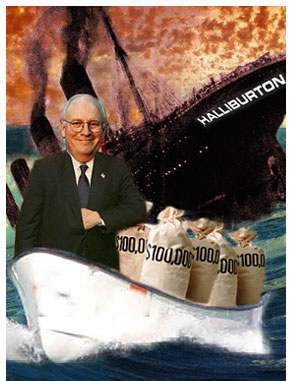
    Halliburton’s boss from hell

    Dick Cheney campaigned on a platform of business know-how. But his tenure as Halliburton CEO left the company mired in bad deals, investigations and lawsuits.

    • more
      • All Share Services

    Halliburton's boss from hell

    In early September, during the Republican National Convention, the GOP is almost certain to name Dick Cheney as its nominee for vice president of the United States. In the meantime, it’s clear that Cheney deserves another nomination: as one of the worst CEOs in recent American history.

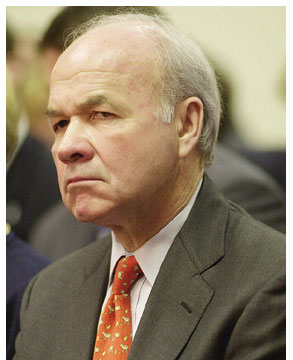
    Of course, there are plenty of CEOs that should to be on that list, including Enron’s Kenneth Lay, Tyco’s Dennis Kozlowski and Adelphia’s John Rigas. While those bosses certainly are being pilloried, Cheney’s disastrous five-year-long tenure at Halliburton deserves far more scrutiny than the mainstream business press has bothered to provide.

    Cheney’s job at Halliburton is particularly newsworthy now that John Kerry has chosen John Edwards as his running mate. The Republicans have already begun hammering Edwards for his work as a trial lawyer; Democrats have an opportunity to bash Cheney’s performance at Halliburton. Given the wreckage that Cheney left behind, that record offers a target-rich environment.

    Since Cheney’s departure, the company’s net worth has gone into free-fall, debt has soared, and it is now facing embarrassing legal entanglements that could hamper its profitability for years to come. Furthermore, despite being the largest oil-field services company on earth (last year, its revenues surpassed those of French giant Schlumberger), Halliburton hasn’t been able to make any money. Instead, it’s losing money — lots of money. In 2002, the company lost $1 billion. In 2003, despite revenues of $16.2 billion, it lost another $800 million. In the first quarter of this year, losses totaled $65 million. More bad news is expected when the company reports its second quarter results on Friday.

    The latest dose of Cheney-related bad news came on Monday, when Halliburton announced that the Justice Department has begun a criminal investigation of the company in connection with the operations of one of its subsidiaries in Iran. Halliburton also said that it has received a subpoena from a federal grand jury that is seeking documents from its Iranian dealings. In early 2000, while Cheney was CEO, a Halliburton subsidiary located in the Cayman Islands opened an office in Tehran. U.S. regulations prohibit American companies from trading with Iran and Libya because of their links to terrorist organizations. While at Halliburton, Cheney lobbied against the sanctions, saying that they were “ineffective.”

    A Halliburton spokesperson downplayed the investigation and the subpoena, telling the Wall Street Journal that it is “important to understand, especially in the current political environment, that this is not a condemnation of the company, but a method of further studying the facts.”

    The news of the criminal investigation follows close on the heels of other bad news: In late June, Halliburton said that it will take an $815 million charge against earnings for the second quarter. Of that amount, $200 million stems from cost overruns on the Barracuda-Caratinga offshore project in Brazil, a $2.5 billion undertaking that was announced in January of 2000 — seven months before Cheney left Halliburton to become George W. Bush’s running mate. The rest of the charge against earnings — $615 million — will cover the asbestos-related legal claims that stem from Cheney’s decision to take over Dresser Industries in 1998.

    Meanwhile, both the Securities and Exchange Commission and French investigators are investigating Halliburton for its alleged involvement in bribing Nigerian officials over a giant liquefied natural gas project. Much of the alleged bribery occurred on Cheney’s watch.

    Add in a recent $106 million legal judgment against the company for its involvement in a Kazakh oil deal done during Cheney’s stint as CEO, along with the Pentagon’s ongoing investigations into Halliburton’s overbilling (investigators have recently found that Halliburton spent $11 million to house personnel at the five-star Kuwait Hilton), and it becomes clear that Halliburton may have trouble surviving Dick Cheney.

    Indeed, nearly every malady now facing Halliburton follows from deals done during Cheney’s reign. Those deals are ultimately the responsibility of the Halliburton board of directors — who, rather than choose an experienced CEO who knew the oil-field services and construction business, picked a charter member of the Bush family’s crony network.

    Halliburton’s board members have been candid in discussing the reasons for hiring Cheney — and his business acumen is never mentioned. Cheney, whose degrees are in political science, had virtually no business experience when he became CEO of Halliburton in 1995. Thomas H. Cruikshank, the former chairman of Halliburton, told one reporter that Cheney got the job because “he would be able to open doors around the world and to have access practically anywhere … There was a lot that he could bring in the way of customer relationships.”

    But there’s little evidence to show that those relationships did Halliburton any good. Instead, Cheney’s ability to forge relationships got Halliburton into the worst acquisition in its history. In January of 1998, Cheney went quail hunting with Bill Bradford, the chairman of Dresser Industries, another big oil-field services company. During their shooting expedition on a ranch in South Texas, Cheney proposed a merger with Dresser. After a series of meetings, Bradford agreed.

    But Cheney didn’t grasp the scope of Dresser’s legal liabilities. Dresser owned a subsidiary that was facing a mountain of legal bills stemming from its old asbestos business. That asbestos problem began catching up to Halliburton almost immediately. The year of the merger, Halliburton had about 70,000 outstanding claims on asbestos. By 2002, it was facing more than 300,000 lawsuits. In late 2001 alone, the company was hit by jury verdicts totaling $122 million. The company’s stock price fell like a rock — going from a high of more than $60 in the days after Cheney was named as Bush’s running mate to as low as $9. Credit rating agencies downgraded Halliburton’s debt, and there was open talk of bankruptcy.

    Since then, Halliburton has been able to strike a deal with its insurers to cover much of the asbestos-related costs. But Halliburton is likely to suffer from its asbestos hangover for several years to come, as it works to pay down increased debt it took on to resolve the matter.

    “The Dresser deal will go down as one of the worst deals in the modern energy business,” says a Houston-based energy analyst who has been following Halliburton for several years. The analyst asked that his name not be used — which is not surprising given Halliburton’s size and the staunch Republican leanings of most energy business personnel. Asked if Cheney was a good CEO for Halliburton, the analyst replied, “The answer is clearly no. He knows how to make decisions. But he wasn’t an energy guy. You can’t find anything good that comes out of his tenure.”

    Another Cheney-era deal, the Brazilian offshore oil project known as Barracuda-Caratinga, is also draining the company’s cash. During Cheney’s time at the helm, Halliburton agreed to a fixed-price contract with the Brazilian oil company, Petrobras, to build the infrastructure needed for the two offshore oil fields — Barracuda and Caratinga, which are located in about 3,000 feet of water. But the project has spun out of control. In a June 29 research note, Merrill Lynch analyst Mark S. Urness wrote that the cost overruns and charges taken by Halliburton on the project have already totaled $675 million, and the company may still have to cough up another $272 million to resolve the mess.

    Despite the problems, Urness still rates Halliburton a “buy,” saying that the company has a “solid fundamental outlook” that is based on its “leading oil services franchise, as we anticipate increased worldwide upstream capital spending by producers through 2004-05.”

    Halliburton recently lost a $106 million legal judgment to a pair of Houston oil companies that had claimed the services giant violated confidentiality agreements in an oil deal in western Kazakhstan, near the Caspian Sea. Again, Cheney was involved.

    Last month, the Financial Times reported that Cheney and his second in command, David Lesar (who succeeded Cheney as Halliburton’s CEO), were both aware of negotiations between Halliburton and the Houston companies — Anglo-Dutch Petroleum International and an affiliate — for the rights to develop a rich oil field in Kazakhstan. In 1997, Anglo-Dutch went to Halliburton and the two began negotiating. Anglo-Dutch later sued Halliburton because Halliburton kept confidential information about the oil field and then tried to buy out Anglo-Dutch’s interest in the project. Last October, a jury sided with Anglo-Dutch. Halliburton and a British company, Ramco Energy, were ordered to pay Anglo-Dutch. Halliburton was ordered to pay the majority of the judgment.

    After the judgment was finalized, Scott Van Dyke, president and chief executive of Anglo-Dutch, told the Financial Times, “I think Halliburton thought I was just a little guy that they could walk all over.”

    Perhaps the most serious legal problems now facing Halliburton — and Cheney — involve the alleged bribery in Nigeria. Halliburton got into the Nigerian construction project in 1999. French authorities are investigating a $180 million slush fund that may have been used to bribe Nigerian officials. Cheney is one of several former Halliburton officials who may face indictment by French courts thanks to his role in the $4 billion project, which was built by Halliburton and Technip, one of France’s largest engineering firms.

    On June 18, Halliburton announced that it was “severing all ties” to Jack Stanley, the former president of Halliburton’s construction and services subsidiary, Kellogg, Brown & Root. Halliburton took action against Stanley and another Halliburton official because it said they had received “improper personal benefits.” Stanley allegedly received some $5 million in payments from the Nigerian project.

    Halliburton has launched its own investigation into the Nigerian mess. The probe is being handled by the Houston law firm of Baker Botts, which has close ties to the Bush administration. The lawyer investigating the matter is James Doty, who represented George W. Bush when he was purchasing the Texas Rangers baseball team in the late 1980s. The Securities and Exchange Commission has launched its own investigation into the Nigerian bribery scandal, and it appears that Baker Botts is representing Halliburton in that inquiry as well. A spokesperson for the law firm referred questions to Halliburton’s spokeswoman, Wendy Hall. Hall did not respond to e-mails.

    If the SEC finds that Halliburton did bribe Nigerian officials, the company and its officials could be charged under the Foreign Corrupt Practices Act. If it is convicted under FCPA, Halliburton will be barred from bidding on federal contracts. That would mean the company would lose all future contracts with the Pentagon — an area that is now one of its primary businesses.

    Cheney had served as secretary of defense in the first Bush administration, and during his time as Halliburton’s CEO, he pushed the company to increase its contracting deals with the Pentagon. He hired a number of former high-ranking military officials, who then began aggressively pursuing deals with the U.S. Army and other branches of the military. In Iraq, Halliburton was awarded logistics and oil-field repair contracts worth some $8 billion.

    But it’s not clear that all of that work has been good for the company’s bottom line. In fact, the opposite may be true. According to the company, in 2003 its Iraq-related work resulted in $3.6 billion in revenues. But those contracts accounted for just $85 million in operating profits.

    Those profits may turn out to be very expensive. It appears that Halliburton has overcharged the Pentagon for everything from fuel and food to overnight stays for its personnel at the Kuwait Hilton. The Pentagon has launched wide-ranging audits of the company’s activities. The Department of Justice has launched its own inquiry into Halliburton, and the company could face fraud charges. In March, the company announced that the government audits of its contracts could “materially and adversely affect our liquidity” — that is, the ability of the company to meet its ongoing cash obligations.

    A CEO of an energy research firm, who also asked not to be named, said that Halliburton’s lack of profits, given today’s high oil prices, is stunning. “How can they not be making money in a business that is minting money?” he asked. He also questioned Cheney’s push to get into the military contracting business. “The entitlements and all the attention on Halliburton’s connections with the Pentagon and the Iraq contracts hasn’t resulted in them getting anywhere. It’s not repeat business. It’s arguable whether they should even be in the business at all.”

    Given all of Cheney’s blunders, it’s no surprise that Halliburton’s balance sheet is a disaster zone. Since the end of 2000, shareholder equity (the company’s net worth) has fallen from almost $4 billion to less than $2.5 billion. Long-term debt during that time period has increased nearly fourfold, going from $1 billion to more than $3.9 billion. Between the end of 2000 and the first quarter of 2004, Halliburton’s total liabilities went from $6.1 billion to $13.9 billion.

    In short, Cheney’s mistakes have cost Halliburton billions of dollars. But Cheney himself did just fine. During his 58-month stint at Halliburton, Cheney was paid a total of $45 million. He continues to receive deferred compensation from the company. This year’s payout to Cheney is likely to exceed $100,000.

    Continue Reading Close

    Page 2 of 7 in Robert Bryce