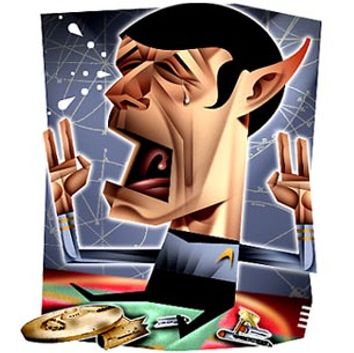
Robert Wilonsky

The trouble with “Trek”

Plagued by falling ratings, rampant merchandising and a boss who hates the franchise legacy, the noble "Star Trek" faces the indignities of age.

  • more
    • All Share Services

The trouble with

Mr. Spock is laughing. It sounds as though he will never stop. His is a deep, long chuckle — “Haw haw haw haw!” Then, Spock — OK, Leonard Nimoy — suddenly stops long enough to read a small excerpt from a letter I sent to him, requesting an interview for this story about the future, or not, of “Star Trek.” The italics are his.

“The piece will deal with the fact that there is currently only one ‘Star Trek’ show on the air …”

Nimoy stops, offers a very theatrical, “Oh, no!” and continues.

“And, at present, only rumors about a second show, which may or may not debut in 2001.” Again, he pauses, laughs, and says, very dramatically, “What are we going to do?!”

He begins again: “Even Bill Shatner says it’s over: ‘The window of “Star Trek’s” phenomenon status is closing rapidly!’ Oh … my … God! The sky is falling.” Spock laughs. “Your letter was so dour, so negative. I figured I had to talk to this guy.” Again, a chuckle.

Suddenly, he turns very serious. “To say there’s only one ‘Star Trek’ show on the air, as though that were a problem, is curious to me. It’s as though we’re losing. It’s all perception, isn’t it?”

Nimoy is, to say the least, amused by the notion that “Star Trek” is on its death bed. After all, this is a man whose character died in one film (“Star Trek II: The Wrath of Khan”), was resurrected in the next (“Star Trek III: The Search for Spock”) and then lived long enough to appear on a series set 85 years after “The Original Series.” (He starred in two “Star Trek: The Next Generation” episodes, playing Ambassador Spock.) He has heard stories of “Star Trek’s” demise for 30 years — ever since NBC canceled the old show due to low ratings.

“Star Trek” is dead. Does not compute.

But the inarguable facts stare Spock straight in the face; to argue against them would seem, well, illogical. After all, this season marks the first since 1993 that there’s only one “Trek” series (“Voyager”) on the air — and it’s doing poorly in the ratings, surely the opposite effect executive producer Rick Berman hoped the cancellation of “Deep Space Nine” would have.

And last year’s “Star Trek” film, “Insurrection” (the series’ ninth feature), tanked at the box office, raking in a disappointing $73 million — just $6 million more than it cost to make the movie. By comparison, “Star Trek: First Contact” (1996) grossed $95 million in the United States, and another $58 million overseas, after the movie’s $45 million cost. And the Nimoy-directed “Star Trek IV: The Voyage Home” made $108 million — in 1986 dollars. All said, “Insurrection’s” weak box-office receipts were hardly surprising: The movie played like a banal “Next Generation” episode, and there were already plenty of those available on videotape.

Paramount Pictures boss Sherry Lansing was so unhappy with the film’s poor showing that she has suggested that “Star Trek’s” keepers — namely Berman, who took over the franchise in 1991 when “Star Trek” creator Gene Roddenberry died — rethink the franchise before blandly going where everyone’s gone before.

Of course, for some, “Star Trek” died in 1991, when the cast of the first series said farewell in the sixth film, “The Undiscovered Country.” There are also those, me included, who would insist “The Original Series” (as fans refer to it, with caps) was “Star Trek’s” high point, even during its worst, giggle-ridden moments (“The Way to Eden,” anyone?).

And there are those who would insist that “DS9″ was the best “Trek” series (and it wasn’t bad, though it was a little too “Love Boat”-in-space for my tastes). Anyone who would insist that the best of the lot was “Next Generation” (once called “a talk show in space” by Spin) or “Voyager” (the “Gilligan’s Island” of “Trek”) has been sipping too much Romulan ale.

Then again, “Star Trek” fans are like Van Halen fans: It’s either Dave or Sammy, Kirk or Picard. Never both.

It’s likely those of us weaned on Roddenberry’s first series view its successors through the blinding haze of a nostalgia that grows brighter the longer the original characters remain off the screen. It’s damned difficult to watch Captain Janeway try to get her “Voyager” crew home week after inexorable week when all we want to see is Shatner dust off his toupee for one last hurrah as Captain James Tiberius Kirk. Nostalgia has a way of skewing perceptions, of making us all a little giddy and unreasonable.

“But this isn’t nostalgia,” says Mark Altman, who penned the indie comedy “Free Enterprise,” which stars Shatner and comes out on DVD Tuesday, after writing nearly a dozen “Trek”-related books. “They got all the ingredients right with the original. It was impeccably cast. Look at how brilliant Shatner and Nimoy were; look at the caliber of the scripts. This was a show written by people who fought in World War II, who had been cops, who were among the top science-fiction writers — these were people who lived life. The new shows are written by people whose only experience is writing television.”

If anything, Paramount Pictures is nostalgic for the days when “Star Trek” was, quite simply, a sure bet. Money in the bank.

According to a Dec. 11, 1998, story in the Los Angeles Times, the franchise — as “Trek” is referred to by Paramount execs — remains a billion-dollar industry. The films have taken in more than $1 billion worldwide; the same goes for the videotape sales. The four series are said to have made $2.3 billion, while, according to the Times, “Trek” merchandise has raked in nearly $4 billion, a small percentage of which goes back into Paramount’s pockets. (In his 1999 book “Get a Life!” — which dealt with “Star Trek” and its rabid fans — William Shatner claims “Trek” merchandise has raked in $50 billion “throughout the lifespan of the franchise,” which prompts him to wonder, “What the hell are all of you people buying, anyway?”)

But there are signs that the cash cow is on feeble legs. As Shatner pointed out, box office for the movies is undeniably dropping, ratings are down and convention attendance is on the decline. Some of the licensees are even dropping off. One source says that Playmates, the company that has manufactured “Star Trek” dolls since 1992, will let its licensing agreement with Paramount expire in December. (A publicist at Playmates won’t confirm or deny this.)

Perhaps the answer to “Star Trek’s” decline in popularity is a simple one: It’s simply too ubiquitous to remain special. There have been three TV series since 1987, nine films, hundreds of novels, several awful comic-book series and dozens of computer games (many featuring the voices of “Trek” regulars); and it’s the subject of its own Paramount-distributed, monthly glossy magazine, Star Trek: The Magazine. Too much of a mediocre thing will kill off any franchise, even one as golden as “Trek.”

“When ‘Deep Space Nine’ and ‘Next Generation’ were on the air simultaneously, that was the beginning of what some would say was the overkill — beating it into submission, exploiting the crown jewel,” says Altman. “Plus, ‘Star Trek’ was being merchandised to death — from coffee mugs to condoms, anything they could put the insignia on.”

The death, or at least the slowing, of the franchise was perhaps inevitable all these years later — especially since “Next Generation” and “DS9″ still appear in daily syndication alongside now-daily “Voyager” reruns. (It’s hard to tell the old episodes from the new, since they all look so much alike.) And the Sci-Fi Network, home to several Trek-alikes that have begun to diminish the franchise’s impact, reruns “The Original Series” every afternoon.

“Star Trek,” quite simply, breeds like Tribbles.

“When ‘Star Trek’ was like an island unto itself, during those years when it was in reruns, there was a specialness to it,” says Tracy Torme, a writer on “Next Generation” during its first two seasons and a friend of Roddenberry’s during the “Star Trek” creator’s final days. “It ran a couple of years, there had been a couple of movies, but there was still a uniqueness to it. The danger you run into when you have as many spinoffs and so many episodes to come down the pike, it loses its special quality. You can’t help it. There’s so much more to watch. That could be part of the problem — it’s the over-saturation.”

Even Captain Kirk says the end is near. In “Get a Life!” Shatner writes that “Star Trek” is no longer special. “Star Trek,” he notes, has become just another television show among so many other choices. “‘Star Trek,’ it would seem has become the worn-out stuffed animal in the bottom of the toy box,” he writes. “Still beloved, but old, fraying around the edges, and often neglected in favor of this year’s brand new distractions.”

And Paramount has squeezed everything out of the franchise, licensing “Star Trek” to anyone with two nickels to rub together. The studio has allowed “Trek’s” name to be put on everything from coffee to Beanie Babies to denim shirts to baby clothes; there was even an “X-Men”/”Star Trek” crossover comic book and paperback novel in 1996. And tourists to Las Vegas can visit Star Trek: Experience — which is either proof that “Trek” is more mainstream than oxygen or evidence of the studio’s desperation to wring every cent it can from “Star Trek” before it vanishes into the desert air.

In August, a company called Starbase-1.com sent out a press release announcing something called Altair Water — “the ‘Star Trek’ thirst quencher” named after “Dr. Bones McCoy’s drink of choice.” Even the buoyant press release couldn’t ignore the obvious, noting that the franchise has been “beset of late by death … box-office doldrums … and an all-but-empty TV nest.” Still, the company insists, “the advent of Altair H20 is a sure sign that the fandom is not lost.”

Sure. Drink up.

The obvious question at this point is, Who killed “Star Trek”?

The obvious answer is Rick Berman.

And maybe it’s as simple as that. After all, before signing on with “Trek” at the beginning of the decade, Berman was in charge of Paramount’s miniseries division, and he had been responsible for the Emmy-winning children’s TV series “The Big Blue Marble.” When he first met with Roddenberry in 1986, during his initial talks with Paramount about a new “Trek” series, Berman told the so-called Great Bird of the Galaxy he didn’t know one thing about “Star Trek,” aside from the one or two episodes he had seen as a kid. If nothing else, Berman was honest.

Five years later, Berman found himself in charge of the franchise. Within two years he had alienated Spock and had become one of the men responsible for killing off Captain Kirk in the film “Star Trek: Generations.” For longtime fans like me, it’s been downhill from there.

“The dirty little secret is Berman and the people running ‘Star Trek’ right now hate ‘The Original Series’ and hate being compared to it,” says Altman, referred to by the Los Angeles Times as the “world’s foremost Trekspert.” Altman, during his days as a sci-fi magazine journalist, actually used to have a good relationship with Berman until he became critical of “Next Generation” and “Voyager.”

“They are not people who have any affection for the old show. When [producer] Harve Bennett and [director] Nick Meyer took over the franchise for ‘Star Trek II,’ they went back and looked at every episode of ‘The Original Series’ and learned everything they could about what worked and what didn’t. When these guys [Berman and writer Brannon Braga] took over, they hated the original and resented being in the shadow and avoided watching it. They’d be happy if people forgot the original, and that’s unfortunate.”

Rick Berman is the anti-Gene.

It’s so very easy to condemn a man for what he’s not, so very convenient to blame a man for the death of a childhood memory. Berman’s “Trek” is not Roddenberry’s “Trek.” It’s not as charming, not as intriguing, not as much fun. At its best, it’s just a bland, monochromatic revision of Roddenberry’s original show; at its worst, it’s just a good-looking TV show … and about as empty as space itself.

But Berman, who declined to be interviewed for this story, never came into “Star Trek” claiming to be the franchise’s savior — though, paradoxically, it was Berman who saved the show. If nothing else, he has managed to both bring back and keep alive a show, or some variation, all those years after NBC first killed it off. As Nimoy reminds us, “The Original Series” lasted 79 episodes; between the three subsequent series, there have been hundreds and hundreds of hours of “Trek.” That, in itself, is an accomplishment. Without Berman to keep the show alive, there’d be no Berman to blame for the show’s death.

One former colleague, who did not want to be identified in this story, says that Berman didn’t even want to do “Voyager,” insisting it was time to give the series a rest. The story goes that Paramount insisted on a third series to follow “Next Generation” and “Deep Space Nine,” and that Berman reluctantly agreed.

“Rick is not a wide-eyed visionary,” says Torme, who is now creating the animated series “Doomsday” with Howard Stern for UPN. “He is more of a professional producer. He always approached the show from a practical level. When I first met him, he was a straight-ahead producer who was Paramount’s guy, and he adapted. He became more of a ‘Star Trek’ guy. But he wasn’t dying to be on ‘Star Trek.’ This was just his next job, and fans resent it because he wasn’t a dyed-in-the-wool fan. It’s fair criticism, but you have to keep in mind where he is coming from. And in his defense, the amount of work he’s put into the show is unbelievable.”

To lay the blame at Berman’s feet alone is certainly not fair. Paramount Pictures, from top to bottom, has done a lousy job of tending to “The Original Series.” Yes, a handful of episodes are available on DVD — looking and sounding quite remarkable, actually — but the first four films have yet to make it on disc. A publicist in Paramount’s video department says that this is all according to a “logical plan”: The films are simply being released in reverse order, she says, noting that the Nimoy-directed “Star Trek IV: The Voyage Home” will be out Nov. 9, as will the documentary “Trekkies.”

“Star Trek IV,” like all of its predecessors and successors, will be released without any frills: no director’s commentary, no outtakes, no extras except for a tiny featurette on the making of the movie. (The DVDs containing old episodes also contain no outtakes — which is a shame, since “Star Trek” blooper reels used to be the highlights at conventions.) There also will not be a director’s commentary with “Star Trek III: The Search for Spock,” since Nimoy has not had any talks with Paramount about “Star Trek”-related matters since 1993.

Paramount’s screwy release plan means that the year will end without the release of “Star Trek: The Motion Picture” on DVD — even though 1999 marks the 20th anniversary of that film’s release. “I would love to hear Shatner do commentary on ‘Star Trek V.’ I asked him if he wanted to, and he said he did — only, he told me, nobody asked him,” Altman says, his voice rising. “I mean, this is the 20th anniversary of ‘Star Trek: The Motion Picture,’ and why isn’t there a special edition of that film? There’s so much archival material. It’s absurd, especially because Robert Wise wasn’t happy with the cut because it was rushed. They’re doing anniversary editions of ‘Young Frankenstein,’ why not ‘Star Trek: The Motion Picture’?”

“Star Trek,” at least as it existed among the fans who forever hold “The Original Series” as the best “Trek,” died on Nov. 25, 1994. That’s when “Star Trek: Generations,” the first film starring the cast of “Next Generation,” debuted — just weeks after Paramount decided to pull the plug on the sophomore series.

“Star Trek VI: The Undiscovered Country,” released Dec. 6, 1991, and setting the record for biggest box-office take on an opening day, was supposed to mark the final appearance of the original crew — their dramatic sendoff, one last chance to save the world. It was a film full of poignant, emotionally resonant moments, none more powerful than a scene in which Spock tells Kirk that perhaps the two warriors have simply “outlived” their usefulness. For fans of “The Original Series,” it was a noble, dignified farewell.

Three years later, under Rick Berman, Captain Kirk would come out of retirement one last time in “Generations.” This time, his would be a tragic and humiliating farewell. Quite simply, Captain Kirk — the man who cheated death a million times, who saved the universe a thousand more — fell off a bridge and landed on some rocks. So much for going out with honor. Outraged fans would refer to the death, engineered by writers Brannon Braga (who is now in charge of “Voyager”) and Ron Moore (who left the “Trek” camp after “DS9″ was deep-sixed), as nothing more than a cheap gimmick.

In interviews leading up to the movie’s release, Berman often said, in justifying the death of Kirk, that it was beginning to be a “cheat” not to explain what had happened to the Enterprise’s most famed commanding officer after “Generations.” At some point, he and his colleagues reasoned, they would need to forever exorcise the ghost of Kirk if the new series of “Trek” films, based on “Next Generation,” was going to succeed on its own merits. Berman often referred to Shatner’s appearance, as well of those as Walter Koenig (Chekov) and James Doohan (Scotty), as a way to pass the baton to the “Next Generation” cast.

And yet the anticlimactic death of the franchise player only underlined the filmmakers’ worst fears. Without Shatner (not to mention Nimoy and DeForest Kelley, both of whom begged out of the film because their parts were so small), the Enterprise became nothing more than a rudderless ship.

What made “The Original Series” and the first six films so entertaining wasn’t the mere mention of the name “Star Trek,” but the characters who inhabited the ship. Without Spock or McCoy and the interplay between them and Kirk — a relationship built over decades, and one dissected throughout the films — the new cinematic Enterprise was left to fly on the shoulders of bland, two-dimensional characters.

What Berman and his staff seem never to have realized is that “The Original Series” was so endearing because of its stars — because Shatner, Nimoy and Kelley seemed at once larger than life and so very vulnerable, so very human. The subsequent casts have been, at best, knockoffs of the original characters (Data=Spock) or, at worst, anonymous faces wearing drab Starfleet uniforms. Patrick Stewart’s Captain Picard forever seemed like a good actor stuck in a thankless part: the captain of a hotel lobby, which the bridge of the Enterprise-D always resembled. And “Voyager’s” Kate Mulgrew exudes remarkably little charisma and barely opens her mouth to deliver her lines.

Berman’s decision to kill Kirk wasn’t merely a pragmatic solution to a nonexistent quandary. After all, why couldn’t Paramount make films using both casts, at least until the original crew of the Enterprise started dying off in real life? No, his execution of Kirk symbolized a lack of understanding of what made the show so endearing for so long. You can put any group of people in Starfleet uniforms, but if there is no sense of humor, no sense of purpose, no sense of compassion, then it sure as hell ain’t “Star Trek.”

“There has definitely been a difference in vision than what we were doing, and that’s either for better or worse,” says Nimoy, who says he does not watch the new shows because he hasn’t the time. “You have to give them credit, because, on the one hand, we only lasted three seasons and were canceled. They lasted 12 years with three different shows. If you put the aggregate years together, that’s like 30 years of ‘Star Trek.’ And they have a right to call it ‘Star Trek,’ but it has evolved into something different. What it is, I don’t know — I don’t watch enough of it to pass judgment.

“I can tell you on a very general level I think we had a certain kind of charm and a currency. I felt we were in touch with the time. Now, times have changed, and maybe it’s not as easy to grab hold of a Zeitgeist as it was for us. We were dealing with very strong social movements of the time. By that, I mean the civil rights movement, the Vietnam War, overpopulation concerns, the growing awareness of concerns for the planet. We had very rich, fertile territory to plow, and I think we did it very well. I don’t know that these people have the same kind of territory to plow, except, ‘How are we going to get home this week?’ It’s not the same, is it?”

Nimoy has never forgiven Berman for the poor handling of Kirk’s death — and for the fact that Braga and Moore, in their original “The Undiscovered Territory” script, had reduced the Spock and McCoy characters to nothing but walk-on parts, another sign of how little these men cared about the original show. Nimoy says he wouldn’t have minded so much had he been asked to direct the film before the script was written. Even if the Spock role was to be small, at least as director Nimoy could find some way to give him an identity.

But that wasn’t to be.

“I had directed two very successful ‘Star Trek’ movies, and ‘IV,’ it’s safe to say, is to this day the most successful,” Nimoy says. “But the point is, when I was asked to do them, I was brought in first, as the director to make a movie for Paramount Pictures. When Rick Berman announced to me he had been hired as producer to make the next ‘Star Trek’ movie, I said to him, ‘Who’s going to direct it?’ And he said, ‘Well, it would be very exciting to work with you as a director someday,’ which I thought was very evasive. Then several months later, after he and his people had done the script, they called me and said, ‘We would love to have you direct this movie.’

“Well, this is an entirely different construct than making a movie for Paramount. Now, I’m making a movie for Rick Berman, you see. Well, the script was lousy. I said so: ‘This needs major, major work.’ They said, ‘Well, we don’t have time for the kind of changes you’re talking about.’ So I said goodbye. And then to end it with a fight scene between Kirk and Malcolm McDowell! What’s the point?”

Since then, Nimoy has not talked to Paramount about anything related to “Star Trek” — with one exception: He and business partner John de Lancie (better known as “Next Generation’s” Q) have shipped to stores this week an hour-long audio version of their “Spock vs. Q” two-man show, which they’ve performed at a half-dozen “Star Trek” conventions. Nimoy licenses the character from Paramount; that’s the extent of his relationship with the studio.

“Which is a shame,” Nimoy says, “since Rick Berman and I used to be friends.”

Where does the “Star Trek” franchise go from here? There has long been speculation about a series set at Starfleet Academy, perhaps even as a prequel to the first series. Cynics have long dismissed the notion, brushing it aside as “Dawson’s Trek.” And Rick Berman, in the October issue of the sci-fi fetishist Starlog magazine, all but quashes any further discussion of a Starfleet Academy series.

“The fact is that I have never been involved in a single discussion about a Starfleet Academy film with anybody at the studio,” Berman said. “A Starfleet Academy show would have to be earthbound, to some degree, which I see little value in. And putting young people in jeopardy and having young people dealing with conflict with aliens on a regular basis is not the idea that Gene [Roddenberry] would have been interested in doing. Nor is it a direction I’m interested in going in.”

Mark Altman actually sees nothing wrong with a Starfleet Academy series. If nothing else, it would revive the franchise without carbon-copying it. For once, there would be no more starships cruising through space seeking out new life and new civilizations one more ho-hum time. Thirty-three years later, he says, it’s time someone realizes that space is no longer the final frontier. “To go on another starship,” Altman says, “and deal one more time with anomalies and things that attach themselves to the ship — who cares?”

But one source close to Braga says the studio likely will want yet another show set on a Federation starship, again featuring all the recognizable aliens from shows past.

“They’re taking what they think is a safe choice,” says one former “Trek” writer, “when they need a bold choice.”

Better yet, suggest some former “Star Trek” writers, how about calling it a day, at least for a while?

“I think it’s time to give it a rest,” says Rene Echevarria, a former writer for “DS9″ now working on Glenn Gordon Caron’s series “Now & Again.” “We will never see two “Star Trek” series on the air at the same time — I hope.”

There also will be another film, though Berman, in an August interview with the official “Star Trek” magazine, said talks about future films have been “very abstract.”

Altman, of course, would like to see the original cast return — though the recent death of DeForest Kelley (McCoy) would seem to make it unlikely that the surviving cast members would want to reunite. Nimoy says that “De’s death is a nail in the coffin” of his ever doing any more “Trek” films.

But Kelley’s death doesn’t faze Altman, who envisions one final “Trek” film — a “Wild Bunch” sort of affair, with cold-warriors Kirk and Spock trying to reconcile their violent 23rd century with a more peaceful 24th century. Altman — who would, of course, like to pen such a film — says Shatner loves the idea and is eager to reprise Kirk yet again. (Death never stopped “Trek” characters before, and Kirk does appear in dozens of the “Trek” novels, some of which have been written by Shatner.) Nimoy says Altman’s idea is something he and Kelley were bandying around during the filming of “Star Trek VI: The Undiscovered Country.”

“I think with the right script, these guys would be real interesting,” Altman says. “You hear people say they’re too old. That’s bullshit. For God’s sake, Clint Eastwood is making a movie called ‘Space Cowboys.’ Look at William Holden. These guys have a life to them that Stallone and Schwarzenegger don’t have. I mean, this is such a good idea, and it will not be given flower in the Berman administration.”

So maybe “Star Trek” has lived long enough, prospered enough. Maybe it will die a quiet death, be buried out in space like Captain Kirk. After the next couple of years, depending on what happens with the next series and the 10th film, Paramount and millions of fans could end up writhing as the franchise withers away. That means the next two years are pivotal for the studio, perhaps the most important in the franchise’s history. Berman has saved “Trek” in the past, and Paramount, at least, can’t even kill just one character. Could it assassinate the franchise in one shot? There aren’t enough phasers in Rick Berman’s closet to do the job.

Sharps & flats

"Saturday Night Live" has 24 years of the best acts in rock 'n' roll on tape. Too bad none of that made it onto a new two-CD compilation.

  • more
    • All Share Services

Talk about your easy targets. This collection of musical performances from “Saturday Night Live” just begs to be picked apart, just … asks for it, its chin thrust forward for a quick sucker punch. Twenty-four years of access to some of the greatest live acts in the history of rock and the best DreamWorks can come up with is a watery selection that features Jewel? The Dave Matthews Band? Counting Crows, for Christ’s sake? And why, dear Lord, does the world need another album that features Sting’s “If I Ever Lose My Faith in You?” Bring me the head of Lorne Michaels. He ain’t using it anyway, at least not those ears.

Actually, the double-disc “Saturday Night Live: The Musical Performances” is credited to DreamWorks’ co-honcho Michael Ostin and “SNL” music talent coordinator Ryan Shiraki, the same man who felt it necessary to book the Corrs, Barenaked Ladies and the Backstreet Boys last season, resulting in channel-clicks that could be heard across the country at around 11:02 p.m. It’s surprising that none of those acts made the short list here, since 24 of the 30 songs date from the ’90s. That makes this a representative collection for those who’ve only seen “Saturday Night Live” on Comedy Central and who think Dennis Miller is an original cast member.

Ostin refers to this dreary, obvious collection as the first volume in a series of releases — “the launch of a franchise,” he has said, featuring “some of the most familiar performances.” He promises future collections will feature more sublime artists (perhaps Sun Ra, Ornette Coleman and Tom Waits, who have all performed) and musical sketches (no doubt Steve Martin’s “King Tut,” Bill Murray’s lounge-lizard “Star Wars” theme and performances from the Blues Brothers, the latter being less a promise than a threat). “We decided to go for the throat,” Ostin says of the first installation. No doubt with a razor blade in one hand and a bucket of salt in the other.

The show certainly has had its share of transcendent musical moments: the night Elvis Costello and the Attractions stopped short during “Less than Zero” and launched into “Radio, Radio,” against Columbia Records’ objections. Or the time the Replacements self-destructed while performing “Bastards of Young.” Or the time Paul Simon performed “Still Crazy After All These Years” dressed in a chicken suit. Or Nirvana’s 1992 appearance, the closest our generation has come to experiencing what it must have been like to witness the Beatles on Ed Sullivan’s show. That’s not to mention tantalizing, revelatory performances by the likes of Waits, Gil-Scott Heron, Jimmy Cliff, the Band, the Kinks, the Rolling Stones, Bob Dylan, Willie Nelson, Talking Heads, Devo, the B-52′s, Captain Beefheart and a very young and very unknown Prince. Only Costello’s infamous appearance (which seems, in retrospect, quite quaint, considering that it was one of the moments he was invited to recreate with the Beastie Boys on last weekend’s 25-year anniversary special), ranked high enough to wind up on “The Musical Performances”; the rest have been relegated to later releases, if they show up at all. Instead, Ostin and Shiraki offer us the turgid and obvious: one disc full of old farts and their offspring, and another loaded with alterna-heroes and very, very little hip-hop and R&B.

The first disc begins with Paul Simon’s “Diamonds on the Soles of Her Shoes” from a 1986 appearance — even though Simon and George Harrison sang “Here Comes the Sun” together during the first season. Simon’s cut is as safe and benign as they come, white-washed Afropop fabricated for an audience that searches for its exotica by tuning into public radio. From there, it turns into a playlist only a mother, a frat boy or a VH1 programmer could love: Eric Clapton, James Taylor, Lenny Kravitz, Tom Petty, the Grateful Dead, Billy Joel and Sting. Costello’s “Radio, Radio” and David Bowie’s 1997 rendition of “Scary Monsters” (alas, no “TVC-15″ from 1979) are as out of place on that disc as a hooker in a monastery — sneers and smirks on a CD full of blank stares. Befitting a collection as ill-advised as this, Disc 1 ends with Randy Newman’s tired wink-wink anthem “I Love L.A.,” even though the compilers had myriad better Newman cuts from which to pick (say, 1975′s “Sail Away” or “Dixie Flyer” from 1988).

Disc 2 was custom-made for play at what’s left of alternative radio, beginning with Nirvana’s by-the-numbers rendition of “Rape Me” (and not the aforementioned “Smells Like Teen Spirit,” which was simply too enormous for the small screen). The Beastie Boys’ “Sabotage” and Oasis’ “Acquiesce” come close to capturing a bit of that roar, but it’s too little of not enough; same goes for Dr. Dre’s “Been There Done That” and TLC’s “Creep,” studio products that now sound as though they were recorded inside a tin can. Only Beck’s haunting, perfect “Nobody’s Fault But My Own” — from January of this year! — stands up to repeated listens, if only to stop you from getting to Alanis Morissette’s “Hand in My Pocket,” which follows two songs later. Then again, it could have been worse. At least there’s no Anne Murray, Billy Squier, John Waite or Loverboy — though listen to this thing once, and you’ll wonder why the hell not.

Continue Reading Close

Basketball diary

Showtime's sorry drama "The Hoop Life" and its young writer want to dramatize the sporting life, but on the court or off, reality is always far more interesting than fiction.

  • more
    • All Share Services

There is no more dysfunctional basketball team. The coach-general manager has the owner by the Spaldings. He wrote his own contract, traded away the team’s superstars and filled the roster with, among others, an 18-year-old ward of the state, a 20-year-old German and a member of the Chinese army.

The star forward/center, supposedly the next Michael Jordan, was suspended several times for drug infractions and received a rare lifetime ban from the league. The team president, who came from Nike, was investigated for sexually harassing several female employees, most of whom have since left the front office. (He was, of course, cleared of any wrongdoing.) The team is a laughingstock among laughingstocks already, and that was before it announced that its games will be broadcast on a TV channel whose only other programming consists of Home Shopping Network loops.

You can’t make up this shit. It’s all true, the sordid details of the Dallas Mavericks, one of the worst — and most comical — teams in the history of the sport. By comparison, the New England Knights, the team at the center of Showtime’s new series “The Hoop Life,” are a boring set of undergrown centers who play the game with Pop-a-Shot skills. And no wonder. The series (airing Sunday at 10 p.m. EST on Showtime) was created by 29-year-old Sean Jablonkski, a Barry Levinson protigi, who told Salon Arts & Entertainment that he’s never even visited a locker room. Too busy.

Unlike the current crop of ultra-gritty reality shows that popped up after “ER,” “The Hoop Life” ignores the most important thing about basketball: winning and losing. Most of the show’s action takes place off the court — and usually in a hot tub, a swimming pool or a satin-sheeted bed. Or on what appears to be an old “21 Jumpstreet” backlot.

The series stars Mykelti Williamson, best known as Forrest Gump’s shrimp-loving pal Bubba Blue. He plays Marvin Buxton, a player haunted by his fear of winning. He missed a shot and instigated a bench-clearing brawl during the Big Game in the series’ initial moments. He’s convinced himself that he blew the shot on purpose, which has prompted a half-season’s worth of Marvin playing one-on-one with his demons. (Williamson’s an old pro at these behind-the-scenes sports dramas: He was a cast member on “Bay City Blues,” the 1983 now-ya-see-it-now-ya-don’t minor-league series that starred Sharon Stone, Bernie Casey and Dennis Franz — and made “Bull Durham” look like a D.A. Pennebaker documentary.)

Also on the team is Curtis Thorpe (played by Cirroc Lofton, Jake Sisko on “Star Trek” spinoff “Deep Space Nine”), the Knights’ straight-outta-high school rookie sensation, who wears the most realistic blank stare this side of Kirstie Alley on “Veronica’s Closet.” Completing the team’s Holy Tortured Trinity is Greg Marr (Rick Peters), who also lost the Big Game — and his wife. (He’s got a penchant for illicit poontang.) Trying to hold down the moral fort is head coach Leonard Fero (“The Wonder Years’” Dan Lauria), who hates the general manager (Dorian Harewood), hates the team’s new corporate owners and seems to hate most of his players (or, vigorously, at least the Russian one). The man is, quite simply, tired of playing nanny to a bunch of spoiled millionaire children.

When these guys do play ball — in a Canadian minor-league arena, no less, which only underscores the show’s rinky-dink brand of fiction — you wonder how they ever reached that fabled Big Game. The New England Knights play so far below the rim that they might as well be a WNBA team. (And by the way, why is it that all fiction writers name their teams the Knights? Apparently it’s the 555 of sports.) But again, the show isn’t really about basketball. Ostensibly, the plot is building toward the next Big Game — toward Marvin’s redemption, toward Curtis’ coming of age, toward Coach Fero’s firing by the Big and Evil Media Corporation that now owns the Knights. But the show cares less about fleshing out characters and more about plopping them in the middle of overblown soap-opera plots, none more ridiculous than the episode in which Curtis’ uncle is threatened by Eurotrash gangsters when the kid gets drafted to play in the show’s fictional American league, the UBA, thus reneging on his promise to play … in Europe.

Jablonski insists this is the point: Basketball is just a backdrop for the Bigger Human Drama. “The team is a foundation for the show to explore the players’ lives,” he told Salon Arts & Entertainment. “What the team does is separate from what the characters do. It’s like the doctors on ‘ER.’ They have personal lives, and all of the sudden, a body gets thrown in front of them while they’re talking about a mother-in-law. It starts with the characters; team arc is secondary to the nature of the show. You can even take a show like ‘Homicide.’ A lot of what cops do on a day-to-day basis is boring: It’s paperwork, phone calls. That stuff is not interesting. The obligation you have is to dramatize that and show people the moments they want to see.”

The premise of “The Hoop Life” — that sport is rich with narratives of human drama and contemporary culture hot buttons — obviously isn’t entirely invalid or unnecessary. It’s just that sport itself usually does it better than any dramatized account. “When a world of clichis runs into reality, somebody gets hurt,” columnist Thomas Boswell wrote in June 1986 when real-life basketball phenom Len Bias really died from a real cocaine overdose. “Too often, athletes are given an adult’s body, an adult’s desires and a child’s morals.” “SportsCenter,” Sports Illustrated, the dailies and even the chorus of talking heads tell stories like Bias’ every day, and they’re full of intoxicating detail, real tragedy and honest ethical questions. In these tales, children win millions before they ever suit up and celebrities are made before they ever touch the ball.

“Shit, when I was 17, I didn’t know which end was up,” Jablonski said, “and these guys are millionaires just coming out of high school, behaving like rock stars.” But the director, and the series itself, only pretends to touch on these issues, using them as an excuse instead of a reason. The plot thrust seems much more reductionist: You can show titty on cable. It’s a bad “Dream On” set in a gym, or any other made-for-cable series you can think of dressed in a jock strap and a T-back.

Showtime knows it. The show’s Web site features a logo of three luscious babes (well, their arms) surrounding a virile stud ball player. Earlier this season, there were hooker girlfriends and sports groupies (strippers) everywhere. And last Sunday, high-school phenom Curtis went to see one of his teachers about getting a better grade. She offered him three choices: Take the exam and hope you don’t flunk, retake the class — or do me. Cue softcore porn soundtrack, cut to teacher and student double-dribbling on the desk, wan-wan-WANH. He shoots, he scores.

The hype surrounding “The Hoop Life” (OK, so there isn’t much) comes from the fact it’s produced by Barry Levinson and Tom Fontana’s production company — the same folks responsible for the canceled “Homicide: Life on the Street” and HBO’s prison-rape drama “Oz,” the most overrated television show this side of ABC’s fetishistic and benign “Sports Night.” (Face it: “Oz” is little more than ass-fucking for the curious straight male.) Fontana apparently looks over the young writer’s show, but none of the veteran’s sense of hyper-realism seems to have rubbed off. Jablonski began his career answering Fontana’s phones, typing his scripts and doing his fact-checking. While developing “The Hoop Life,” he interviewed former NBA player John Salley and two other pro ballers. But for a guy who spent his “early” career fact-checking, Jablonski sure gets a lot wrong.

His blessedly awful show reflects that ignorance: It’s an hour-long unintentional comedy of fouls and bricks and double-dribbles, and just about every other basketball pun that comes to mind. Maybe it wouldn’t be so bad if it were written by someone who actually cared about the game; but right now, the stiff characters and vague dialogue give the show an effect you would imagine “ER” possessing if the writers never opened a medical dictionary. Imagine, George Clooney in blue scrubs, yelling at anyone who will hear him: “Uh, give me some more … whachyacallit? … blood.”

Continue Reading Close