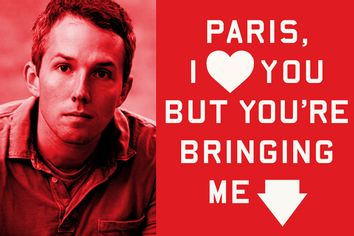
Rosecrans Baldwin

Why did we move to Paris?

Leaving New York seemed ideal. Until the crazy landlord, topless exams, the French flu, the lack of credit cards...

  • more
    • All Share Services

Why did we move to Paris?Rosecrans Baldwin
Excerpted from "Paris, I Love You but You're Bringing Me Down," by Rosecrans Baldwin, published in May 2012 by Farrar, Straus and Giroux. Copyright © 2012 by Rosecrans Baldwin. All rights reserved.

Paris’s neighborhoods, the arrondissements, are organized like a twist. They spiral from the river like toilet water flushing in reverse and erupting out of the bowl — a corkscrew or what have you, a flattened pig’s tail, a whorling braid notched one to 20. But if you walk from one neighborhood to the next, there is little to suggest the numbers changing. So it was confusing. Anyway, if you began in the middle of the Seine and snaked around, we lived on the Right Bank in the top of the third arrondissement, called the haut Marais, the upper Marais, on Rue Béranger, a quiet little street curling down from Place de la République.

We’d chosen the apartment so we could be within walking distance of nearly everything. I’d overlooked its darkness and short ceilings for location’s sake: 15 minutes to Notre Dame; 25 to the Louvre.

Earlier generations of Americans wanted to live on the other side of the Seine, in the Latin Quarter, where artists and students rambled, but the Left Bank had long ago priced out the artists and students. Now it was home to the rich of Paris, the wealthy of the retired-expat class, and Russian moguls, while the youthful and creative tended to live on the Right Bank, especially in the higher, cheaper numbers, the 19th or the 20th — if not the Right Bank of Berlin, or Toronto.

But we were very happy about our neighborhood, if not our quarters. Our apartment, located above a costume jewelry shop, was dismal and dark. The apartment above us was being renovated — I hadn’t heard the noises during my initial visit. So during our first days — we had a solid week before I was required at work — we tried to get out as much as possible.

Behind our street was a village of elbow streets, sunny walls and filthy corners, and many tucked-away shops. A ten-minute walk south was the proper Marais, the former Jewish quarter that had become a trendy shopping zone, but our northern district was still untrafficked. There were tailors and art galleries. Cafés and butchers. A store that sold athletic trophies and one that sold model trains. A blood-samples lab, a computer-repair agency, a video rental. On a leafy corner was a brightly lit lingerie-and-sex-toy boutique.

And where roads didn’t cross was an old covered market, the Marché du Temple, blue with a dirty glass roof. Some weekends, men trucked in what appeared to be stolen leather goods, but otherwise the market stood empty — Thursdays, maybe it was Tuesdays, a tennis league strung up nets inside — and the surrounding quadrant would be filled with people dawdling over café tables that they’d occupy for hours, chatting with friends. Then behind the market was Rue Bretagne, a picturesque street that wasn’t trendy yet. It would be soon, but not yet. Rue Bretagne had a park with a playground, two bookstores, a boutique that sold vintage radios, a booth that sold found photographs—it was the Left Bank I’d seen in picture books, preserved in time. At the center stood the oldest Paris farmer’s market still operating, Le Marché des Enfants Rouges, built in the 1600s, now ringed by food stalls that sold Moroccan tagines, huge piles of Turkish desserts, West African stews, even sushi.

It was fantastic.

Rachel and I tramped from dawn to late at night, and collapsed each evening. We also spent a lot of time having our pictures taken. Every service we signed up for in Paris — cell phones, Internet, electricity — required passport photos, with strict rules about their composure. On two separate occasions, we were asked to resubmit our photos; too much smiling. No visible happiness was allowed in official pictures — pas de sourire, visage dégagé.

To become Parisian was business très serieux.

Anyway, we set up home: Bought dishes, stocked the larder, purchased a mop and broom. We ate cheaply so we could afford a few good meals, including an expensive lunch one day inside the Musée d’Orsay, under rows of dazzling chandeliers, where we drank too much wine. Later we got caught in a rainstorm, running for shelter alongside the Seine. That week we must have seen … we saw a lot. But there were also errands to do.

For example, we visited a bank to open a checking account and apply for a credit card. Well, France didn’t have credit cards. Perhaps didn’t grasp them, conceptually — it wasn’t clear. The bank representative, who did not speak English, said I shouldn’t be bothered, that yes, our accounts included debit cards.

“No,” I said in French, “I apply for a card of credit.”

“This is what you have, a debit card,” she said.

“No. The debit card, it takes money, when I have money,” I said, going slowly to find the words. “I want a card that does not have a need for money.”

The banker rumbled it for a second. “Well,” she said, “we have an option where the card does not remove the money until the end of the month. Is that what you want?”

“No,” I said. “Something different.” I smiled cheerfully and tried again. “I want the card when I do not have money.”

“Maybe I do not understand,” she said. “What type of bank has cards like these?”

“American banks,” I said. “For example, if I want a computer for 2,000 euros, but I do not have 2,000 euros? I have a card. The card buys the computer. I give money to the card. Each month, a little money. Then: 2,000 euros.”

“Ah,” the banker said, pleased now, “you would like to arrange a loan!”

“Yes, but no,” I said. “I want a card. A card that gives a loan.”

“I’m sorry, I don’t understand, what kind of card again?” the clerk said.

“Its name is ‘credit card,’ ” I said.

The clerk looked at me closely to make sure this wasn’t all one big joke.

“I’m sorry,” she said, “I do not think we have this in France.”

- – - – - – - – - – - – -

Toward the end of our first week, Rachel and I were sneezing, dizzy, exhausted, light-headed, almost fainting, lacking jet fuel, and coughing up sea-green mucus.

“The Paris Flu,” expats said. A persistent chest cold caused by French germs. “Everyone gets it,” I was told over a drink in Beaubourg, by an editor at the Herald Tribune, a friend of a friend. “Trick is,” he said, “you gotta eat the local honey. Go to that farmer’s market near you, Enfants Rouges. Introduce antibodies to your system from the Paris bees. Make sure you look for the sticker that says the bees are from Paris, that’s important.”

The next day, after a morning rain, there was a huff of good weather, and Rachel and I went out and purchased the honey of local bees. Then our stove broke. I was eating honey off a Kit Kat when the repairman rang the buzzer.

The repairman looked at our stove and drew squiggles on a ticket. He made to leave, so I handed the ticket back to him and attempted to explain that I couldn’t read his handwriting.

He wrote in block letters, CRÈME POUR LA PLAQUE.

So for lack of a creamy topping . . .

“The stove has plaque?” Rachel said from the doorway. She sniffled and went back into our living room, a cavern with dark beams.

I said quietly to the repairman, “Where do I find the cream for the plaque?”

But he’d already walked out. He was kind of a bastard.

In the hallway, he stopped in front of our neighbor’s door. There were buzz-saw sounds, and sawdust pouring in through an open window from the apartment upstairs. The repairman snatched the paper back from me and scrawled in carpenter pencil, “BHV,” then stomped downstairs, just avoiding a pregnant girl and her boyfriend.

“BHV,” I announced, closing the door. “What’s that?”

“Oh, the hardware store,” Rachel said, “near Hôtel de Ville. Bay-ash-vay. It’s the one with the lingerie section. I heard about it, I’ll take you later.”

- – - – - – - – - – -

Several letters arrived that week from the government. One said Rachel and I needed to be weighed, measured, and scanned for tuberculosis, immediately. Also, I’d be asked to pass a language test, since I’d be the one taking a job that could have gone to a French person.

Our appointment was the same day as the repairman’s visit. The health clinic was located near Place de la Bastille, not far away. We were in that paunch of Paris summer when the heat ballooned at one p.m., and the weather was lovely in a vehement way, glares everywhere.

At the clinic, Rachel and I were assigned to different waiting areas. After X-rays and measurements, I was directed to a language examiner’s office, for my French quiz.

“What do you do for a living?”

“I work in advertising.”

“What do you do in advertising?”

“I write.”

“What do you write?”

“I write for babies. Milk for babies.”

“Where are you from?”

“New York City.”

The examiner sat forward and said in English, “Wow, you are?” For five minutes she described to me how she was planning to visit Manhattan soon, it was a long-standing dream. “But isn’t it very dangerous?” she asked in English, her consonants sharp as thorns. “Do blacks and whites really get along?”

We stopped for a bite to eat on the way home, in a café on the Boulevard Richard-Lenoir. We ordered some white wine and frites, which came served with awful ketchup — and here I’d thought Heinz was universal.

“So,” Rachel said, “a lot of scientists have now seen me topless.”

“Oh, I know the feeling,” I said. I was holding my tuberculosis X-ray up to the window.

“Trust me, no, you don’t,” Rachel said.

She cinched her jacket, a green coat she’d bought especially for our move to France, and explained that things for women in Paris were quite different. “So the doctor is asking me questions. I have no idea what she’s saying. I think she tells me to remove my top. I’m pointing — This, my bra, she wants off? Yes, she wants off. Then I’m instructed to leave. Now that you’re topless, please go out that door. Only it’s a door for a closet with a yellow bulb inside, and at the other end there’s another door. I’m to go into the closet and wait for the other door to open.”

Rachel drank some wine. “So I’m asking myself, do I cover up, or go out full-frontal? Because I want to do it right. Do it the French way. What would Chloe do? I figured, probably a Frenchwoman would just walk out, you know, breasts on parade.”

“And?” I said.

“I went out French. The door opened, I checked my posture. It’s a big room, like an operating theater, with three male technicians. But they barely notice me. I’m like, You’re not even going to look? What does that say? Then I’m instructed to smoosh my chest against an upright X-ray machine, which was freezing, and they’re saying, Do it again, it’s not quite right. I mean, they’re wearing lab coats, but they’re also wearing jeans. How was I to know it wasn’t some crazy French reality TV show?”

- – - – - – - – - – - – - -

Friday evening of the weekend before my first day at work, Pierre and Chloe invited us over for dinner. In the same room where I’d slept during my interview weekend, we drank tequila and listened to Charles Trenet and Wu-Tang Clan until about three a.m., when Pierre and Chloe’s downstairs neighbor complained about the noise.

Outside, the black sky combined Paris, summer, and the oncoming morning. Noises floated over our heads, but on Pierre and Chloe’s street it was quiet enough to hear the traffic signals buzzing. To get home, we rented Vélibs. These were the new bicycles that Paris had installed in a bikes-for-rent program. They’d become the latest badge of chic. Misty mornings, columns of riders pedaled beside the river, and pictures were everywhere of bare-legged women cycling around town in Chanel. Columnists filed reports on Vélib trends, Vélib crime especially — how the city’s bright young things rode Vélibs home after partying and crashed them into the Seine.

On the map, one street, the Boulevard de Magenta, appeared to run straight to our apartment. We looked down the hill, and there it was: four empty lanes plunging into blackness, flanked by gracefully decaying Haussmann slabs brambly with iron balconies. Rachel went first, her dress flapping in the wind. There was neon in her hair, then she was eaten up by the dark. I took off after her, 20 feet behind. Fifty feet behind. Soon she was gone. The boulevard flattened out, but for all my pedaling I was slowing down.

Rachel reappeared and found me gliding, kicking with my toes. The chain had come off my bicycle and was grinding on the road. There was no one around.

“We shouldn’t have had the tequila,” Rachel said, pedaling a circle around me.

“No, no,” I said, stopping, “not the tequila.”

We stood next to a bus stop and stared around. A Vélib stand was nearby. We parked the bikes and walked home. It was one of those moments when nothing could go wrong.

- – - – - – - – - – - – - -

The next morning I tried to take out the garbage, but the shed door wouldn’t budge. I yanked it, banged on it, was about to quit when Asif, the gardien, our building manager, whose rooms abutted the shed, rattled his shutters and yelled at me to shut up.

Asif came out, smoking. He wore an unbuttoned paisley shirt and blue jeans with embroidery on the seat. Asif appraised me and said something in French. I didn’t understand and attempted a retreat. That just pissed him off more. He whipped back his hair and snatched my trash, unlocked the shed, and tossed the bag inside.

His hair had the slow-motion buoyancy of a mermaid’s.

“I’m sorry,” I said. “But I do not have a key.”

“Give me your keys,” Asif snapped in French, with a destabilizing Pakistani accent. I could barely understand him. He was tall and lank, posing like a model. He pinched the neck of a four-inch key on my key ring and handed it back to me with two fingers, like a silver snake.

“You’re American?”

“From New York,” I said. “My wife,” I said, pointing at our bedroom window, just above his head.

“I love New York,” Asif said. “I’m going soon. You’ll tell me where your family lives?”

He pulled me inside his rooms. They smelled of sex. A cute brunette in a bathrobe was sautéeing peppers and chicken. She smiled at me. Asif downed some whiskey from a glass on top of a trash can, and poured us shots. We did a toast to New York City. He gripped my arms, beaming. When I explained I needed to go run errands (faire les courses), Asif went slack. “Fine, then leave!” he shouted, frowning, and disappeared into the bedroom.

Over time, I’d learn that Asif gained and lost euphoria faster than anyone I’d ever met.

That same morning, Rachel and I walked down to BHV, the home-and-hardware store with a lingerie section — it also had a jewelry section, and cabinets of designer handbags, and a lumberyard in the basement, and a kitchen-items section with space for cooking classes — where we bought cream for our stove. Turns out the cream worked. Our coils didn’t conduct electricity when they lacked moisturizer; apparently they’d gone dairy-free too long. And the same day, just when we couldn’t face one more spoonful of honey, our flu vanished.

We lived in Paris, Paris being not only the city of milk and honey, but also the city where milk and honey were solutions.

No one wonders, because who needs to ask?

That afternoon, we walked halfway across the city and rode a bus home, and collapsed in bed. Lying there on top of the comforter, staring at the dark beams crossing the white plaster ceiling, suddenly I was anxious and out of breath, overpowered by homesickness.

I wanted out of that apartment, out of Paris, as fast as possible.

Rachel said something into her pillow about being hungry. Ice cream, I said, I’ll go get ice cream.

I don’t even like ice cream that much.

I ran outside, le monde à mes pieds, to Place de la République, the large traffic circle behind our apartment. République was a racetrack with four lanes of vehicles whipping around two parks. No square in America looked so majestic, yet in Paris République was considered a retail zone — hardly special except for being where protesters gathered whenever the government threatened to raise the retirement age. In the center was a statue of a robed woman. She was Marianne, symbol of the French Republic, proud and tall, perhaps unaware that her robe was slipping. In several ways, she reminded me of Mireille. I stood on an island in the middle of the Boulevard Saint-Martin, which flowed into République, and waited through several traffic lights, just watching. New, new, new, I was thinking. Our previous life would be reversed within 24 hours: Me working in an office, in a language I barely spoke, and Rachel at home writing when she wasn’t attending French lessons. Was this a good idea? Was it the right thing to do?

It seemed like a colossal mistake.

But would I really prefer to be anywhere else? Hadn’t Rachel’s breasts passed inspection by Parisian experts? As long as no one talked to me about topics other than New York, wouldn’t I be fine?

I was scared. Well, so what?

I got the ice cream. We ate it in bed. Through the windows came fragrances from the trees outside and Asif ’s vegetable garden. We heard only birdsong. I remembered a letter Edith Wharton wrote about Paris in 1907 that I’d seen excerpted in a magazine back in the States: “The tranquil majesty of the architectural lines, the wonderful blurred winter lights, the long lines of lamps garlanding the avenues & the quays — je l’ai dans mon sang!” (“I have it in my blood!”)

At the time, I’d thought I knew what she meant. But now I knew.

Excerpted from “Paris, I Love You but You’re Bringing Me Down,” by Rosecrans Baldwin, published in May 2012 by Farrar, Straus and Giroux. Copyright © 2012 by Rosecrans Baldwin. All rights reserved.

How adults ruined Halloween

Today's kids have a coddled holiday. What happened to the real terror of BB guns and raw eggs?

  • more
    • All Share Services

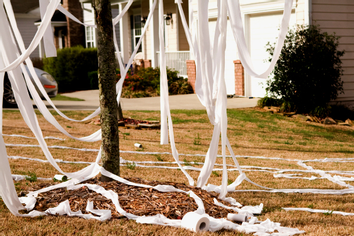
How adults ruined Halloween (Credit: iStockphoto/HeatherPhotographer)
This piece originally appeared on Gilt Taste.

Here is a Halloween tradition, circa 1892, as described by an article in the New York Times: You hang a stick by a string from the ceiling. At one end of the stick is an apple; at the other end, a lit candle. You spin the stick around, and try to snag the apple with your teeth without getting your face burned off.

GiltTasteBy the time I was a kid, in the 1980s, not much had changed.

In our town, Halloween was terrifying and thrilling, and there was a whiff of homicide. We’d travel by foot in the dark for miles, collecting candy, watching out for adults who seemed too eager to give us treats. At that time, rumors on the evening news said maniacs were injecting Almond Joys with rat poison, tucking razor blades inside candy apples before handing them out to children.

Granted, no one in my gang would touch a candy apple in the first place—caramel on a piece of fruit being so much lipstick on a pig. But we knew death was possible. If it wasn’t the psychopaths, some high school kid might shoot you in the mouth with a BB gun, or make you drink raw eggs. There were seven of us who lived a short walk from each other’s houses; perhaps by the first morning of November we’d be six. Halloween, all told, was fantastic.

Today, though, it’s tough to conceal a Gillette Mach 4 Vibrating Razor inside a Mars bar. I’ve become an adult, and having seen how adults mostly ruin Halloween, I’ve also become a Halloween Scrooge.

In our semi-rural neighborhood, children are chauffeured around on Halloween in minivans, before dusk. They trick-or-treat in broad daylight, shuffling to and from houses like refugees, between colonnades of guardians, as if Halloween was now monitored by UN peacekeepers. Our nation’s one night dedicated to horror has become a soccer-practice carpool. And sure enough, the costumes are feeble, store-bought. I’d make a joke about wishing kids these days would dress like tramps, as in hobos, rather than tramps, as in Katy Perry, but Andy Rooney would probably sue me for copyright infringement.

However, my Scrooge-ness does not extend to candy.

If I see a roll of Bubble Tape, a bag of Haribo Gold-Bears or a pouch of green-apple Big League Chew, I’m eleven again. The great thing about candy is that it can’t be spoiled by the adult world. Candy is innocent. And all Halloween candy pales next to candy corn, if only because candy corn used to appear, like the Great Pumpkin, solely on Halloween.

My mother still has a three-step system to eating candy corn. First she eats the white tip, then the orange middle, then the yellow end. She swears each segment tastes different. While writing this article, I emailed three friends versed in statistics and asked them how many ways you can eat a piece of candy corn. Assuming that no bite’s smaller than a single segment, they worked out an answer: nine. The formula they devised, which I don’t understand even slightly, is this:

W = 9 + Sum over t, t = 1 to 2 [ (Z_t | Z_t-1)*(D_t | D_t-1) ]

W= Ways to eat a candy corn

Z = Size of bite

D = Side of bite

t = bite occasion

My wife saw this and told me the statisticians had missed one option: you can also bite a piece of candy corn in half lengthwise, “so you get a little piece of each segment in each bite.”

I told her that was ludicrous.

“I have very firm opinions about candy corn,” she said, and went on to trash my preferred brand, Brach’s, saying their candy was waxy compared to her favorite, Farley’s.

If candy corn is where I still find my Halloween innocence, it was my father who set me on the road to becoming a Scrooge. In seventh grade, news spread around our town that all the kids, all the town’s children from sixth to ninth grades, were gathering on Halloween night at one of the elementary schools for an egg and shaving-cream war. Pharmacies were quickly depleted of Barbasol. I bought six cans with my allowance, and modified their aerosol tops with a hot needle in order to shoot farther.

My mother somehow heard the rumor. She came outside, where I was testing my assault range, and forbade me from even going. She went the extra mile: “No one in our family has ever gone to jail,” she said. “If you get caught by the police, we aren’t bailing you out. You’ll sit in that jail for weeks.”

I was stunned. I hadn’t even realized “jail” was a possibility. Now I’d be left there to rot? Instead, my friend John and I roamed our neighborhood that Halloween, John being likewise banned. All our friends were gone; they were having the best night of their lives. We ate candy corn and shaving-creamed a few mailboxes without much joy. When we got home at ten, we must’ve looked pitiful, because my dad came out and told us we could go ahead and shaving-cream the garage if we were going to act so pathetic about it.

The next morning, my mom found the side of her garage etched with John’s and my initials, three feet high like graffiti tags. Apparently menthol shaving cream burned through paint. Well, we hadn’t known. My mother was furious. She even called John’s mom. “But dad said we could,” I insisted.

She consulted my father, who was raking leaves. He said he didn’t know what I was talking about.

That November, John and I repainted the garage. I never trick-or-treated again. It wouldn’t be until I graduated from high school that my father copped to his betrayal, and by that time I’d crashed his car, so we were even, probably.

But this Halloween, I’ve decided to set my Scrooge aside—there’s no fun in it, only humbug. Instead, I’m carving a pumpkin with a big exclamation point, and any children brave enough to visit will receive full-size candy bars. Afterward we’ll all play spin the candle. And if a parent calls the police, my wife has promised to bail me out. It’s going to be great.

Continue Reading Close

How I ended up living with my in-laws

In a rotten economy, more adults are showing up on their parents' doorstep. I just never thought my wife and I would be among them.

  • more
    • All Share Services

My father-in-law has ear hair like a wolverine. It fans out from the auricles, wafting from the ridge lines like cilia, like gray feathered plumage. Most men who grow hair along their ears get it clipped by the barber, but my father-in-law, a pulmonologist at the University of North Carolina, has let his ear hair grow free since the 1980s. When there’s wind, it waves. It’s his freak flag flying an inch and a half long. He’ll never cut it. “I’m like Samson,” he says, chuckling. “It’s the source of my power.” People who know him say they don’t notice it anymore, and after months of sitting next to him at the dinner table, I don’t either, except as a symbol of achievement: He’s so accomplished, even his ear hair is mythic.

I, on the other hand, had to move in with my in-laws.

My wife and I never planned to live with her parents for very long. We thought of it as a temporary stay, a camping trip. We were returning to the States after working abroad for the past 18 months, and we needed a place to crash until we got settled. Apparently, though, our flight from Paris to Raleigh-Durham killed the global economy. Jobs in our area, as in many other parts of the country, have disappeared. What we’d originally envisioned as maybe a three-week visit is approaching a six-month occupation.

Stories in the media have nicknamed people like us “boomerang children” — adults forced by the downturn to show up on their parents’ doorsteps. But we don’t think of ourselves as occupying forces. I picture us like two performers on a USO Tour. We dress to impress. We smile wide no matter what’s on CNBC. We’re here to support the troops. I’ve recently taken on the Bob Hope role at dinner. I’ll spoon out rations and ask, “So how are we all doing tonight? How was your day, Mike? How was yours, Marilyn?”

The guilt, though, and the awkward awareness of living on your in-laws’ largesse, is tough. It’s an ego-belittling situation; I’ve signed my own leases since I was 20. One morning I found myself changing loads in the laundry room, thinking: You’re an adult married man and you’re folding your mother-in-law’s brassiere.

We’re happy, of course, to do our part. To cook and clean and chip in for groceries. And it turns out I’m handier at programming universal remotes than I realized, and my wife is helping her mother redo the bedroom closets. I think we’re good guests, and on most topics we’re pretty tolerant. We recognize that they have their way of doing things and we have ours, and if ours are more sensible and modern, like putting empty glasses directly into the dishwasher rather than leaving them around the house, then we don’t always need to point this out.

For example, my father-in-law wakes up each morning by retching into the sink. Loud enough so it penetrates walls. It’s woken me up on a couple of Saturdays. Apparently some dentist 30 years ago told him to brush the back of his tongue until he dry heaves.

“You’re telling me you don’t do that?” he says. “It’s not the way it’s supposed to be done?”

“What,” says my wife, “to the point of vomiting?”

“Not that there’ s anything wrong with that,” I add.

In Europe, it’s common to hear about young professionals living with their parents. With the continent’s high rents and taxes and its population density, it makes sense. Over in Japan, grown children not only live with their parents, some of them never even leave the bedroom. But in the U.S., with 50 states and wide open spaces, there’s almost a compulsion to go out and break ground, to build a cabin. Expand and claim one’s territory. Put up fencing and breed a brood. So returning to the nest feels less like going in reverse than stopping, which is the equivalent of defeat.

According to an AARP study done in January, only 5 percent of Americans over 18 live with their in-laws. But more than 40 percent of the respondents said they would be comfortable with such an arrangement, moving in with family, if it became necessary. The truth is, we’ve got a pretty good deal, particularly because my in-laws enjoy having us around.

Did I mention my mother-in-law specializes in Mediterranean cuisine? That my father-in-law has season tickets to UNC basketball games?

I found recently that Harper’s keeps indexes of its old articles and stories organized by topic, including “adult children living with parents.” It’s one of those discoveries you wish you could take back. It’s grim material. One story, “Farmer Finch” from 1885, relates a family’s fortunes after the local bank collapses. You see the context. Their savings are depleted, the farmer’s daughter has to give up on her dreams. Trees in the landscape are “a most unbending and heartless family, which meant to give neither shade in summer nor shelter in winter.” And the opening line is a tickler: “It was as bleak and sad a day as one could well imagine.”

Frankly, it’s depressing, each night sleeping in someone else’s home. I miss having a roof to my name. Our situation isn’t an “All in the Family” cliché, but it’s still easy to see reality in plain terms: I live with my in-laws, and I can’t say when that will change.

My wife and I both use exercise to cut down on the strain. Which means that these days, my running odometer has clicked to new peaks. In November, I ran 49 miles up and down the nearby hills, past cow farms and abandoned barns. My mileage in December was a bit higher. Then in January, I ran 76 miles, including a 10-mile day, which left me ecstatic. It was the farthest I’d ever run. Then I developed shin splints.

The mornings, truthfully, are when it’s worst. That’s when job-listings Web sites show the same openings as the day before (none), when the news headlines are refreshed (doom and its synonyms). And since the Web is both television broadcast station and newspaper printer, never mind a place where, thanks to Facebook and Twitter, every person I’ve ever met since high school regularly updates me on their mood, it’s hard to escape the hive mind’s anxiety.

No panic’s ever been reported by so many in so few characters.

Then there are the intimacy-concealment tactics. I can’t say too much, but it’s communication by discreet signals. When my wife and I close the door to the back den, my in-laws know not to come a-knocking — because inside we will be balancing our expenses.

For the most part, though, my wife and I feel lucky. Loving relatives and home-cooked meals are solid levees against a recession. We’ll leave when we can, but for now, we’re grateful.

Before moving in with my in-laws, I never had cable television. A typical evening was re-watching a “Poirot” DVD. But recently I’ve been introduced to, and become an enthralled fan of, the Home Shopping Network. My in-laws watch it late at night to unwind. They don’t buy, they graze. The point is to watch and enjoy the mad banter, the salesmanship, the chatter of people selling gems for $24.99.

“It’s a terrific bargain for what’s essentially priceless,” the hostess will say, and the four of us smile because it’s true.

Continue Reading Close