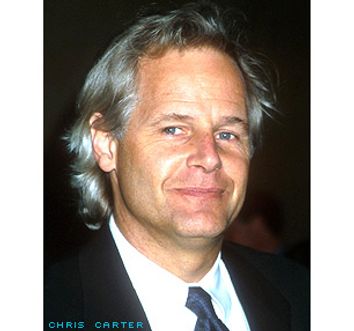
Chris Carter, the world leader of the sci-fi geeks, is also the definitive anti-geek. You
might expect the brain behind “The X-Files” to look like one of those guys you see at
the “Star Trek” conventions sporting a mullet haircut and glasses held together with
duct tape, but Carter doesn’t even wear glasses. He’s tall, tanned and handsome,
well-scrubbed and well put together.
He made a rare public appearance recently in Santa Barbara, Calif., which is where he
lives part-time. It’s also the place he most likes to surf. That’s what they say about
him in the online chat rooms, anyway. They also say his nickname is “Carver” from his
days as a writer for Surfing, and that he surfs goofy-foot, which means he keeps his
right foot forward. He chose the character name Mulder because it’s his mom’s maiden
name and named Scully after famed baseball announcer Vin Scully. But if you’re an
“X-Files” fan worth your salt, you already knew that. There’s little they don’t know about
him, those fans. In the chat rooms, Carter is commonly referred to as “God.”
After Carter was introduced to a packed auditorium of 800 at Santa
Barbara’s gorgeous seaside University of California campus, the
audience erupted into sustained, possessive applause. Carter strode
onstage in tan pants and a blue, button-down oxford
shirt. God was in the house, and he was wearing Banana Republic.
Before Carter arrived, the middle-aged woman in front of me had been wringing her
hands in anticipation. When he was 10 minutes late, I feared a nervous breakdown.
Now that he was here, she breathed easier but looked like she might cry.
Carter carried himself as though he were meeting up with some dudes for a beer.
Despite being the ’90s’ most intense purveyor of paranoia, his entire demeanor in
person seemed to say, “What, me worry?” After the applause died down, he initiated a
penchant for deflective self-deprecation that would last all night — “I have a lot of
family and friends who are probably wondering why you are clapping.”
Carter was introduced by Constance Penley, a professor and chairwoman of the University of California at Santa Barbara Film Studies
Department, who has herself written extensively on science fiction. “The creation of
‘The X-Files’ was arguably the most important event of the decade, except for possibly
the discovery of the Mars rock, or the impeachment of the president,” Penley said. “Of
course, in the ‘X-Files’ universe, the two would be connected.”
Penley continued to gush: “The show was so sophisticated in its presentation of the
ethical and social dimensions of science that you would have thought that Chris Carter
had been trained as a philosopher, rather than a journalist.”
A philosopher? A blue-collar guy from Bellflower, Calif., a crummy Los Angeles suburb?
His dad was a construction worker; his mom, a housewife. He earned a journalism
degree from cheap California State University in Long Beach in 1979, paying his way through
school as a potter. For a while, he did construction. He started working as a reporter for
Surfing magazine but, after seeing “Raiders of the Lost Ark” six times in six days,
began to entertain the idea of becoming a scriptwriter. He was encouraged by his
screenwriter girlfriend, Dori Pierson.
That’s when things began to get weird.
In 1985, Jeffrey Katzenberg, while still head of Disney, saw a script Carter had written
and gave him a development gig for $40,000 a year — chump change in Hollywood,
but twice as much as Carter had ever made in his life. He worked on such forgettable
product as “Meet the Munceys” and “B.R.A.T. Patrol.” But his work impressed an
up-and-coming suit named Peter Roth, and when Roth became president of 20th
Century Fox in 1992, he stole Carter away to develop new shows. Carter’s “X-Files”
pitch didn’t fly at first. Too out there. But Carter did some research, showing in part
that 3 percent of all Americans believed they had been abducted by aliens, and Fox
took a chance.
Carter’s story, obviously, is too whacked to have been scripted on any show besides,
perhaps, his own. “It only proves he’s an alien,” Penley said. “He has been placed
here by creatures who did not know how to construct a believable narrative about how
one becomes a television producer and creator of a mass cultural phenomenon.”
Carter’s appearance in Santa Barbara came just a day after he began work on the final
episode of the show’s seventh season, which he revealed will be called “Requiem.” It
could be the last “X-Files” show. Carter and Duchovny’s contracts come up this season.
And even though Gillian Anderson is still under contract, she’s said to be unsure about
returning. Meanwhile, Duchovny has filed a lawsuit against Fox protesting what he sees
as sweetheart rerun licensing deals.
“Elian Gonzalez’ future is more certain,” Carter remarked.
But even after 160 episodes, Carter said, he still has more stories to tell, and would
like to keep going: this, despite the incredible weirdness that the job has brought into
his life. As he told the crowd in Santa Barbara, the weirdness began before the series
even made it on the air.
From the start, Carter envisioned the dichotomy of an inquisitive, credulous male lead
working with a female lead who combined elements of rationalism and skepticism with
a deep spiritual yearning. The studio accepted Duchovny immediately for the role of
Fox Mulder, but didn’t warm to Gillian Anderson as Dana Scully.
“Gillian was unknown and when she came in she was disheveled,” Carter said. “She
wasn’t a very good salesperson for herself. But she had an intensity and an
intelligence — and she cleaned up well. I couldn’t get the executives to see what I saw,
no matter how much I tried, and it really came down to the idea of how she would look
in a bathing suit. And I kept saying to them, she’s not going to be in a bathing suit.
She wasn’t the bombshell they envisioned. They thought it was going to be a show
much more like ‘Hunter.’”
The only thing more difficult than dealing with the suits was dealing with the FBI. “Early
on, I was calling the FBI for some research. And they were very kind. They talked to
me about procedure and protocol, and then one day they just cut us off. They wouldn’t
accept our calls and then about two weeks before the first show aired, a call came in
from the FBI and they said, ‘Who are you and what are you doing?’ And I swear to
God, it was like J. Edgar Hoover reaching up from the grave. I was that nervous about
it, as you can imagine.”
The FBI’s tune changed, though, when the show became a hit that glorified its work.
“All of a sudden we started getting calls from agents, individual agents, saying that
they loved the show,” Carter said. “And by the end of the first year they took us on
what they call the ‘Jodie Foster tour’ of the FBI. They rolled out the red carpet as they
had done for her in ‘The Silence of the Lambs.’”
Of course, the show hit just about the same time as the Internet started to take off, which added a whole new
dimension to fandom, and to Carter’s job as producer of the first television show to
ever attract such a huge online following. “The Internet and ‘The X-Files’ grew up
together and it was great,” Carter said. “The show originally aired at 9 o’clock on Friday
night and at 10 o’clock, I could get on the Internet and see what people thought of it.
It was great in the beginning.”
But even that got weird. “It became overwhelming; it was too much,” Carter said. “I
used to see every single piece of Internet mail. And now I see the reams of stuff after
every episode and I ask them not to put it on my desk. It’s not because I don’t care
anymore — it’s because I think there are lots of voices out there trying to be heard,
and a lot of it ends up being shouting. A lot of people do it just to get attention.”
The intense fan passion for the show meant his personal appearances could also take
on an element of otherworldliness. “The autograph sessions at events like this are
always really odd,” Carter said. “People try to slide you things, tapes of their
abduction. My wife and I have gone to bed at night listening to tapes of people’s
abductions. It’s better than counting sheep.”
The obsessive-fan phenomenon played itself out in living color in Santa Barbara. The
event opened with Carter showing clips from the series. Then questions came from
Penley and another film studies professor, Lisa Parks. Then the night was turned over
to audience questions.
That’s when things began to get weird.
Carter was asked if he had ever been dropped on his head as a child. He was asked
about his surfing. He was asked about specific episode elements too arcane for
anyone but the most hardcore fan to understand. He answered every question, no
matter how bizarre, with the same low key sense of humor, as if he knew better than
anyone how absurd it all was.
Had he ever been abducted?
“I have never had an experience with an alien, and I think they owe me a visit
because I’ve been their best P.R. man ever.”
“What are you horrified by?”
“I would say an IRS audit.”
“What about Mulder’s fascination with pornography?”
“He’s a lonely man.”
“Explain the apparent homoeroticism between Mulder and Skinner.”
“We’re saving that for the cable series. The ‘Triple X-Files.’”
In the end, Carter left the impression that he doesn’t take the fandom and his own
place in it especially seriously, but that he does take his role as a popular storyteller
with the deepest sense of personal gravity and responsibility. “The X-Files” gets raves
in part because it addresses so many of the central themes of life in the United States
at the turn of the millennium — a wariness about technology, a wondering about the
deeper questions of life and a distrust of big government.
It is his ability to bring these issues forth in story form that makes Carter want to
continue, despite the weirdness, and makes him so valuable to a culture that needs an
intelligent mirror of itself. And he revealed in Santa Barbara that what all the wondering
and yearning really come down to is not paranoia, but society’s increased need for a
spiritual touchstone.
In his last statement of the night he talked about Scully’s personality traits. “The most
difficult thing to reconcile is science and religion,” he said. “And so we created a
dilemma for her character that plays right into Mulder’s hands. So that cross she wears,
which was there from the pilot episode, is all-important for a character who is torn
between her rational character and her spiritual side. That is, I think, a very smart
thing to do. The show is basically a religious show. It’s about the search for God. You
know, ‘The truth is out there.’ That’s what it’s about.”
Then he sat down to sign autographs, and listen to people’s abduction stories.
That’s when things began to get weird.
You might be surprised to hear this, but one of the masterminds behind the Web’s nastiest and most notorious new interactive game — Sissyfight 2000 — is a card-carrying academic brainiac. Eric Zimmerman, a freelance game designer out of Manhattan, is also an adjunct professor at the Parsons School of Design and New York University. The 30-year-old intellectual/geek has lectured at more than 30 universities about the aesthetics of video games, writes scholarly papers on the social theories of play and discusses his chosen field with a hybrid lyricism, mixing words like “transgressive” and “butt-ugly” in the same sentence. Which, at first, belies the fact that Zimmerman, along with the staff of Word.com, helped create the meanest, most popular little back-stabbing game on the Net.
Six little cartoon girls enter a pastel playground where playful music sets a nursery school tone. That’s where the niceties end. The goal of the game is to reduce the other little schoolgirls, in their little schoolgirl outfits, to whimpering sissies. Through a barrage of scratching, teasing, tattling and grabbing, players knock each other out of the game by chipping away at their opponents’ self-esteem. There are various defensive moves — cowering or licking your lollipop, for example — but mostly this is a game of pure childish cruelty and aggression. Entertainment Weekly, which gave the game an “A” grade, says, “Sissyfight brings forth a player’s nasty, repressed child like no other game — except maybe fifth-grade dodgeball and corporate retreats.”
To take the playground metaphor even further, the girls who go on to claim victory are the ones who succeed in creating a mob mentality by ganging up on their weaker or less clever sisters. As the game progresses, girls can talk to each other in little comic strip bubbles and, using various catty strategies, plot and connive to create powerful, esteem-destroying cliques that leave some poor girls on the outs.
And when things get real nasty, those bubbles often become filled not with offers to team up, but with astoundingly creative bursts of expletives and sexual and racial epithets. At times, in fact, the talk degenerates into a series of gross-outs worthy of, well, a group of kids who have gathered after class behind the portables. The smartest little schoolgirls are careful, though, not to go too far. In the game’s strategy hints, designers warn players not to do anything that might turn the others against them. “Try making a girl with the name Jar Jar Binks and see how quickly you get snuffed out,” they warn.
The game was developed in a yearlong process with the staff of one of the Web’s most ancient (er, it’s five years old) and most respected online magazines, New York’s Word.com. The site is known for its ironic and smart essays and stories, but its savvy editor, Marisa Bowe, says that she had had a hankering to develop new ways to marry high and low art forms in an interactive setting, to make the most of the Web’s potential for transdisciplinary opportunities.
“I thought that if we could take the geekiest corner of entertainment — role-playing games — and make a crossover hit that would appeal to people who aren’t hardcore gamer geeks, then we would be onto something,” Bowe says. “It seemed like a good business idea that might turn out to be popular.”
That it has. It has been mentioned in EW, Wired and the Village Voice and become a selected link on the influential Shift. It has also attracted more than 25,000 registered users. At last count, it was bringing in a new registered user every minute. Its maddeningly addictive qualities account for much of the popularity — the world record so far for continuously playing Sissyfight is 16 hours, 58 minutes and 20 seconds.
The key to the game’s success, Zimmerman says, is that despite its retro-1980s Atari-style graphics, it succeeds in emotionally affecting players more deeply than games that realistically portray horrible acts of graphic dismemberment. “People have very emotional experiences playing Sissyfight,” Zimmerman said, talking from a cellular phone in San Francisco, where he was speaking at a gaming conference. “People have said to me, ‘I have never been so traumatized online. I entered a game and everybody realized I was the newbie. They jumped me — grabbing, scratching and teasing me out of the game in a couple of turns.’”
Not surprisingly, Word.com gets a lot of regular e-mail feedback from its new flock of grabbing and scratching virtual schoolgirls: “This game is awesome. It is the meanest game ever. It is so much meaner than Quake or any of the games where you actually try and kill each other.”
Another player effused, “It’s great therapy and helps me get revenge on all my childhood torturers. I’ve never laughed sooo much while being sooo mean!”
Zimmerman could not be more pleased. “For me that’s a real accomplishment,” he says. To the Brooklyn resident, who gets paid for lecturing at universities like the Massachusetts Institute of Technology about the intricacies of gaming, “Every Sissyfight game is a miniature society with dramatic struggles for power. An aggressive player might emerge as a leader and direct the other players, but might later be branded as a bully and be destroyed by the mob. It’s emergent complexity in action.” And even though the graphics are low-fi, he says, the emotions the game spurs are high impact. “There are a lot of debates about so-called immersion in gaming,” Zimmerman says. “I take the stance that immersion is not about the richness of the graphics, but about the total relationship a player has with a game. Play engagement occurs not just visually, but on strategic, social and cultural levels as well.
“Sissyfight 2000 proves you don’t need technological extravaganzas of real-time 3-D graphics, reflection maps and shadowing to get completely emotionally engaged with a game.”
The game has, of course, also attracted
a certain amount of killjoy
finger wagging from the
protect-the-children contingent.
Zimmerman suffered a few sticks and
stones during an NPR interview, slung by
a listener who suggested that the
schoolgirls should be encouraged to
support each other’s self-esteem
instead of tearing it down. And Word.com
has received a smattering of e-mail
attacks like this one: “This is the
biggest waste of time and bandwidth ever
to have been devised to run on the
Internet. Why can’t you use your time
and ingenuity for a more productive
idea, losers.”
Aside from the hostility that this user
expresses (which might be better vented
if he played more Sissyfight), he brings
up a point all video game designers have
heard before — that their work
encourages violent behavior. Not
surprisingly, Zimmerman disagrees.
“The human psyche does not work on a
monkey-see, monkey-do basis,” Zimmerman
says. “Sissyfight is radically
metaphorical, voluntarily entered into
and satisfyingly transgressive. The
idea that play should be ‘good for you’
and turn you into a better citizen of
the state is something that I want to
question.”
The game’s addictiveness has made it a
hot topic of discussion on other places
besides Word.com. On the popular
punkrock.net bulletin boards, for
example, there are endless entries about
Sissyfight from users who use such game
names as Anna Bortion, Pussyhoney,
Bjgirl69 (who has been outed as a guy),
BullDyke and Vaginosis. A team of
players who enter games and summarily
destroy their competition has taken to
calling themselves “The Pigtail Squad.”
One player had this to say: “I am
supposed to study all night for my
midterm this afternoon; instead all I
did was play Sissyfight 2000 till 3
a.m.” And then, in another entry: “I
decided to get up early to cram. What am
I doing now? Playing Sissyfight 2000.”
To Zimmerman, success has come to
Sissyfight because of a carefully
designed gaming recipe that blends the
worst kind of humiliating hostility with
a lighthearted childhood innocence.
“Sissyfight kind of encourages cruelty
and that’s why it makes the social space
so highly charged,” Zimmerman says. “At
the same time I would say that it’s
aggressively playful too, in the music
played and the very stylized nature of
the girl characters. Those elements cut
across the cruelty of the game in
interesting ways.”
Of course, Sissyfight, more than any
other fantasy video game, is not really
a fantasy at all but based squarely on
the very real brutality and unfairness
of childhood. As such, for many, it taps
into wounds that haven’t been opened
since the days of “Gilligan’s Island”
reruns. And in the same way children are
cruelly honest and uncensored in their
playing and fighting, Sissyfight comes
to computers across the world without
having gone through any PTA scrutiny or
having been taken away by the recess
monitor.
And that’s the way Zimmerman wants it.
“Children’s play fascinates me because I
think it is sort of utterly violent and
perverse and Sissyfight is too,” he
says. “And I think that pop culture and
art in general should challenge and be
provocative, and so there certainly is
nothing wrong in creating a game that is
too.”
Continue Reading
Close
A crummy old plastic bag floating in the wind above a dirty sidewalk. It’s not an image that one might immediately think of as beautiful, or moving, or important. But it is perhaps the most beautiful moment in this year’s most beautiful film — “American Beauty” — a moment that sums up the lyrical grace of the film, and embodies the idea that fate does what it wants with us, and even if we are going around in circles on a dirty street, ultimately, if seen from the outside, there is a beauty in our little dance.
I went to a script-writing seminar a few weeks back that was attended by six of the year’s best screenwriters, three of them Oscar contenders — Charlie Kaufman, who wrote “Being John Malkovich,” Eric Roth, who co-wrote “The Insider” and Alan Ball, who wrote “American Beauty.” Much of the attention in the seminar, both from the audience and from the other members of the panel, focused on Ball, for obvious reasons. Not only is he the front-runner for the Oscar, and not only will “American Beauty” most likely win best picture, but there is a kind of newness to the tone of “American Beauty” that makes it almost seem like a landmark film, a kind of paradigm shift in the portrayal of the pain and despair of everyday life in ways that recognize both its comedic and tragic aspects and make it seem, ultimately, all worth it.
Ball was asked about the plastic bag scene, but not by one of the audience members. It was illuminating, actually, that the question came from another writer, David O. Russell, who wrote another of 1999′s most innovative films, “Three Kings.” Russell leaned forward into the mike, looked Ball right in the eye, and asked, as if he were asking a telepath how he had managed to bend a spoon, “How did you come up with the plastic bag scene?”
For those who have not seen the film, the scene is simple — a white plastic bag is caught in the wind in front of the kind of graffittied metal doors that come down at night in front of liquor stores in tough neighborhoods. The scene is shot in slow motion. The bag goes up and down and left and right and around and around. It could be a bird, or a butterfly, or a cloud. But it’s not. It’s a piece of litter on a dirty street. And as such it’s a metaphor that even in the toughest place, and perhaps most often in tough places, beauty happens.
Ball answered the question directly, with no emotion. He said that he wanted a scene of grace to balance out the heaviness of the other scenes, to provide a quiet moment. “I tried to think of the most beautiful thing I had ever seen,” he said. For him, it wasn’t some schmaltzy sunset in Hawaii. He remembered walking past the World Trade Center at a time in his life when he was working as the art director at a magazine, and writing plays at night for a theater company that was disintegrating. Most of the people in the theater company were hitting their mid-30s and moving on. He felt a little stuck. A plastic bag was caught on the wind and it seemed to float around him, as if it were a specter, as if it were alive and talking to him. There was something so profound in the simple beauty of the moment, he said, that it brought him to tears.
I called Ball after the script seminar to talk to him in more detail about the plastic bag moment. “It was in the early ’90s, towards the end of winter, the beginning of spring,” he said. “It was kind of cold and overcast but it wasn’t raining. It was a Sunday. So the whole financial district was deserted. But it was kind of one of those days that after months of it being freezing, it was warm enough to walk. And so I just decided to walk from midtown down to the World Trade Center to catch the train back to Brooklyn. I was in front of the World Trade Center, and I noticed this plastic bag in the wind, this white plastic bag. And it circled me, and it literally circled me, like, 10 or 15 times. And after about the third or fourth time I felt very, um, I started to feel weird. And then, I don’t know, there was something striking about the experience, and I really did feel like I was in the presence of something.”
Ball used to be a television writer, a job he loathed. Just like Lester, the “American Beauty” character played by Kevin Spacey, he yearned to change his life, to escape from the trap he had found himself in. And the way he changed his life was by writing “American Beauty.” “That script was fueled by anger,” he said — anger at having to write television characters over and over who did nothing more than “trade insults.” Just as Lester was essentially freed, in a way, in the movie, Ball freed himself by writing it. In what could be considered a minor miracle in today’s bloated Hollywood script development world, his script sold eight days after he put it on the market, and it was in the theaters 18 months after that. Along the way, director Sam Mendes allowed him to be on the set every day, and to help shepherd his script through the filming process, which is another impossible dream for a writer. Although Ball is still fulfilling some television contracts, when that is completed, he will most likely never again have to write dialogue about people trading insults.
Ball is a lanky guy who still wears beat-up old Dr. Martens and has a classic writer’s face — somewhat withdrawn, world-weary, bags under the eyes. You can see that he’s been through it. He’s no slick, amped-up script machine like Ron Bass. The character of Lester, he said, had been “floating around in the back of my mind for years.” Of course, so had that plastic bag. When you watch “American Beauty,” the plastic bag scene comes when Lester’s daughter asks to see her boyfriend’s video footage. The boyfriend lives in an emotionally dangerous world inhabited by his psychologically incapacitated mother and his violent, repressed father. The boyfriend shows the girl his footage of the plastic bag going round and round. Mendes lets the audience watch it for a long time. The longer you watch, the more mesmerized you become until the bag begins to speak to you the same way it did to Ball. A friend of mine in New York, a hardened entertainment journalist, cried at this scene, and so did I.
“As children we come into the world with eyes that are wide open and we can see beauty in the most surprising places and the miraculous in the mundane, and that gets sort of conditioned out of us as we are socialized,” Ball said. “But there was something about the poetry of that bag in the wind. The lyricalness of it was incredibly overwhelming to me on that particular day. I think there is a part of us that longs for that way of seeing the world. I think that’s what people talk about really when they talk about the loss of innocence. So just to be reminded of that, and that it still exists within all of us is very moving to people. Because it’s so easy to be so cynical.”
And so, on Sunday, when Ball walks up to receive his best screenplay Oscar, you can know he will be doing so in part because he told the truth about the most beautiful moment in his life. The plastic bag scene works, as does the entire movie, because Ball was so pushed to the edge by the circumstances of his life that he found the courage to make a little pearl and to share it with the world. And in a world of contrived scripts and cobbled together Hollywood schlock, it is refreshing and encouraging that Ball’s “American Beauty” will be the big winner. It’s real. It’s about time.
Continue Reading
Close
Until last week, there weren’t too many places a bashful novice could go for professional striptease instruction. And what a shame that was. Because these days, a professional “house dancer” or “feature entertainer” working in a “gentleman’s club” can earn upwards of $100,000 a year, sometimes a lot more. And good coin isn’t the only perk. She has her days free, the work keeps her in good shape and she gets to claim her Victoria’s Secret bills as a tax deduction.
The Pure Talent School of Dance recently opened its doors — or rather, the doors belonging to Scarlett’s, an “upscale gentleman’s club” in Clearwater, Fla. — to help aspiring strippers make the most of their God-given talent. Twelve young women, from Kentucky, California, New Jersey and other far-flung locations, showed up for the first day of classes.
The school is run by the Pure Talent Agency, which represents 250 adult dancers, booking them at more than 2,500 gentleman’s clubs nationwide. Pure Talent plans to host its weeklong course once a month, and the owners say there is already a waiting list of aspiring entertainers.
The first 12 students showed up for their first day of class, said owner Jim Hayek, “bright-eyed and ready to learn.” Hayek runs the school with his wife, Ann Marie, a former “feature entertainer” who started Pure Talent after retiring from stripping. At the Hayeks’ “school of dance,” the bright-eyed ones don’t find ballet slippers, barres or leotards. Instead, they train with brass fire poles, colored lights, high heels and, once in a while, a fog machine. The students, ranging in age from 20 to one in her mid-30s (she declined to provide an exact age), will learn to bump and grind, work the pole, make lingering eye contact with members of the audience, choose the right music and wardrobe, get the appropriate cosmetic surgery, land magazine spreads, eat the right foods, make appearances in adult films, choose their clubs with discretion and listen quietly and attentively to clients while providing them with lap dances.
The emphasis of this specialized academy is not placed on the art of stripping, however, but on sound financial planning and carefully orchestrated career development. Because anyone can get naked, right? Well, maybe not everyone. And once naked, maybe not everyone has what it takes to get down on all fours in front of a room full of strange men.
For those willing and able, though, the greater challenge lies in parlaying that ability into a career that could very well afford them a home, freedom from the 9-to-5 grind and perhaps a brand new Lincoln Navigator each fall.
As Jim Hayek says, “A lot of these ladies have families, or are single mothers, and without this career they would maybe be on food stamps. This gives them the flexibility to spend time raising their children, something they couldn’t do if they had a 9-to-5 job, making $300 a week minimum wage.”
Hayek, a savvy and articulate 33-year-old with a marketing degree from the University of South Florida, is delicate and respectful when describing his milieu. The word “stripper,” for instance, is never uttered. For that matter, the word “woman” is never uttered either. His clients are either “girls” or “ladies” or “dancers” or “entertainers.” Mostly he calls them “ladies.” Strip club? Topless bar? Definitely not. It’s a “gentlemen’s club.” And of course, what his ladies do onstage is definitely not “stripping.” It’s dancing or entertaining albeit naked.
At the Hayeks’ dance academy, the day is divided between striptease instruction at Scarlett’s and classroom instruction on financial and career planning. It’s this information that will help students turn taking off their clothes for a living into a sustainable career that could net them — after just one week of training — as much money per annum as is earned by a woman who has graduated from college, made it through three years of law school and spent five years building a practice.
Classroom training begins with investment counseling. Jim Hayek brings in a special guest speaker (whom he won’t name, but describes as “one of the top financial planners in the country”). The expert advises “the ladies” on creating a custom investment portfolio, setting aside money in an IRA, understanding tax laws and being aware of the differences in financial responsibility for those dancers who succeed in earning more than $150,000 a year. This type of planning is crucial, Hayek says, because most strip careers last only five or 10 years. If dancers manage their careers and their earnings carefully during those years, they can set themselves up for life.
Next, a First Amendment attorney comes in to talk about how to deal with United States pornography laws, which differ from town to town. Then comes the “career development” counseling, concentrated on two distinct areas: careers for “house dancers,” who choose to perform only in one club, and careers for “feature entertainers,” who hope to earn higher pay by traveling from club to club as featured attractions. These dancers spend about a week at each club and perform as many as 24 consecutive shows.
Dancers who prefer not to go on the road hear advice about how to pick the best hometown club, and then how to succeed in making themselves popular over the long haul within that hermetic environment. For the feature entertainers, the formula for creating a vibrant career is not unlike that of a movie star — it’s all about name recognition and creating a marketable image.
First of all, the dancers are advised to enter as many beauty pageants as possible, especially those whose names begin with the words “Miss Nude.” Then they are to secure as many photo layouts in adult magazines as possible, with the understanding that there is definitely a magazine hierarchy. “Penthouse is the No. 1 credit for a print magazine,” Hayek says. “It’s the crhme de la crhme. But Cheri and Gent and Score are very valuable to them as well.”
After that comes the issue that separates the, er, “ladies” from the “girls” — appearances in adult films. “Traditionally, adult films stars get paid more money than magazine models,” Hayek says. “They are a draw for the clubs.” A woman who becomes known for her starring performances in adult films can often double her live appearances fee. And the amount a dancer can charge often comes down to such minutia as whether she has appeared as a “box girl” — the girl whose photograph appears on the video packaging.
Porn star Annamalle, for example, commands top fees as a club entertainer precisely because she, in just a few short years, succeeded in appearing in more than 300 adult films. It’s a simple matter of supply and demand — dudes who have spent six months fast-forwarding to Annamalle’s good parts will pay top dollar for the luxury of seeing their favorite sex industry professional in the flesh.
Visibility can be especially important, Hayek said, for “novelty acts” — women whose appeal stems primarily from the staggering size of their breasts. Still, Hayek admits, adult films are not absolutely necessary to a feature entertainer’s career.
Hayek’s wife, Ann Marie, for example, parlayed one Playboy spread into a five-year stint leading a traveling burlesque review called Dream Girl Centerfolds and another few years as a solo dancer. She then formed Pure Talent, now one of the most respected agencies in the business. Hayek started her business in a small apartment just three years ago, and today the Hayeks own their own home, new cars and a freestanding 2,000-square-foot office building.
If all that career development talk doesn’t sound very sexy, well, there’s plenty of sex in the rest of the school’s curriculum including a lot of talk about the opposite sex. The stripping portion of the training is led by a big-name feature entertainer, Jade Simone St. Clair, who travels 42 weeks a year with a two-man stage crew and a trailer brimming with $50,000 in costumes and another $50,000 in fog machines, pyrotechnics and a state-of-the-art stage lighting rig. “I’m like my own little Kiss concert,” St. Clair says.
St. Clair, like Jim Hayek, employs her own idiosyncratic vocabulary, sprinkling her conversation with words like “sweetie” and “baby doll.” She developed this persona out of professional necessity. It is a way of turning reality into fantasy, which she says is at the very heart of the service she provides. “We tell the girls, when they walk in the front door of the club at 7, the fantasy begins. And at 2 o’clock, it’s over,” St. Clair says. “Because in between the walls of that club, it’s fantasy time. The guys who come in to finish a business deal, or because they had a fight with their girlfriends, or because they just want to see a pretty girl dance, they want a break from their everyday life.”
To help ensure that the guys’ bubbles are never burst, St. Clair says, her curriculum’s most important lessons is for the dancers “to keep a good attitude.” This includes looking deeply into men’s eyes and conducting themselves in a “classy” manner. As Jim Hayek puts it, “Walking across the club with a cigarette in your mouth, a cocktail in your hand and chewing gum in your mouth is not alluding to the fantasy that the customer came in with.” And when the dancers sit with a man in hopes that he will pay for a lap dance, St. Clair encourages them to be good listeners. “Don’t talk a lot, or be negative. Don’t talk about bad boyfriends or say, ‘I don’t have enough money to pay my rent.’ Make it funny, make it a party atmosphere.”
Onstage technique in the new millennium, St. Clair says, is a lot more about performance and tease than it was in the ’80s and early ’90s. “It used to be they would be sexy for one or two songs and they got down and did table dances. Now, it’s more of a tease again, back more to the burlesque days.” As a result, St. Clair teaches them the full history of burlesque, starting with Gypsy Rose Lee and moving forward.
Last, but not least, comes the inevitable question: cosmetic surgery — yes or no? St. Clair, who has had breast implant surgery, admits that “as a ‘feature,’ it’s almost a necessity to have bigger type cleavage.” She goes on, a hint of apology in her voice. “Due to the fact that over the last couple of years every ‘feature’ has had it [breast surgery], it is almost as if the gentlemen expect to see it.”
St. Clair began her stage career in the musical theater, attending a performance high school in her home state of Texas and going on to study dance in New York with such notable instructors as Gregory Hines and the Martha Graham Dance Troupe. She gradually made her way into stripping after entering a nude beauty pageant on a dare and winning.
As earnestly as St. Clair and the Hayeks work to legitimize their profession, both stress that for many of the entertainers, moving into a more mainstream form of entertainment is often the ultimate goal. “One of our girls was used in an ad in Cosmo in December, and that’s what we are looking to do more of,” Jim Hayek says. “A lot of our girls are very beautiful.”
St. Clair herself says her “goal for the year 2000″ is to move out of working “gentlemen’s clubs” and into mainstream television acting work. She says she would like to either become a host on the E! channel or a VJ on MTV. “I love to talk to people,” she says.
But for now, as the primary instructor at the Pure Talent School of Dance, St. Clair finds a great deal of satisfaction in teaching “bright-eyed” young women how to overcome their natural inhibitions. “I have this little girl in here who is bashful as can be, and I want to make her into a feature,” St. Clair says. “She came to class saying she wanted to learn how to be an extrovert. And today, she had to strip in front of all of us. I was so proud of her. I’m starting to feel like a mother.”
Continue Reading
Close