Sam Kim

SKorea asks China about NKorean missile carrier

A North Korean vehicle carrying what appears to be a new missile passes by during a mass military parade in the Kim Il Sung Square in Pyongyang, to celebrate 100 years since the birth of the late North Korean founder Kim Il Sung on Sunday, April 15, 2012. North Korea's new leader gave his first public speech Sunday since taking power, portraying himself as a strong military chief unafraid of foreign powers as the army showed off what appeared to be a new long-range missile. (AP Photo/Ng Han Guan) (Credit: Ng Han Guan)

SEOUL, South Korea (AP) — South Korea has asked China whether it is the source of a sophisticated missile carrier displayed by North Korea during a military parade last weekend, a Seoul official said Friday.

Military experts have pointed to China as the probable supplier of the 16-wheel truck, but China has denied it. U.N. Security Council resolutions ban countries from supplying arms-related materials to North Korea.

North Korea used the vehicle to unveil a new long-range missile during Sunday’s celebrations marking the centennial of the birth of its late founder, Kim Il Sung. Two days earlier, North Korea launched a long-range rocket but said it failed to put a satellite in orbit.

Seoul was checking whether China, North Korea’s only major ally, was the missile carrier provider, a South Korean Foreign Ministry official said, speaking on condition of anonymity, citing the diplomatic sensitivity of the issue.

On Thursday, China denied any wrongdoing in connection with the vehicle’s appearance at the North Korean parade. Foreign Ministry spokesman Liu Weimin told a regular news conference that China is against the spread of weapons of mass destruction and carriers for such weapons.

U.S. State Department spokesman Mark Toner said in a briefing that China has repeatedly said it’s complying fully with U.N. Security Council resolutions sanctioning North Korea. But Toner said he wasn’t aware whether China had given assurances on the missile carrier.

The carrier, also believed capable of launching missiles, was the biggest yet displayed by North Korea and gives the country the ability to transport long-range missiles around its territory, making them harder to locate and destroy.

Analyst Ted Parsons of IHS Jane’s Defence Weekly first raised the possibility that the missile-carrying vehicle came from China, citing similarities to Chinese design patterns.

North Korean space officials, meanwhile, said in a statement Thursday that they will keep pushing forward with their space development program. Washington says the North’s rocket launch was a cover for a missile test.

SKorea to work with US to reduce Iran oil imports

SEOUL, South Korea (AP) — South Korean officials say they will continue working with the U.S. to reduce oil imports from Iran after President Barack Obama greenlighted potential sanctions against countries that continue to buy Iranian oil.

South Korea is one of several major importers of Iranian oil that have not received exemptions from the U.S. sanctions.

Foreign Ministry officials in Seoul said Saturday that they expect to reach an agreement with Washington by late June on reducing oil imports from Iran. The officials declined to be named because discussions were still under way.

South Korea has already restricted financial dealings with more than 200 groups and individuals with suspected links to Iran’s nuclear program. Seoul relies on Iran for up to 10 percent of its oil.

Official: NKorea Test-fired Short-range Missiles

SEOUL, South Korea (AP) — North Korea fired three short-range missiles this week in an apparent routine test of its technology, a South Korean official said Friday.

The North fired the KN-02 missiles, which are usually deployed against ground targets and have a range of about 75 miles (120 kilometers), into its eastern waters on Wednesday, a Defense Ministry official said, speaking on condition of anonymity because of ministry policy.

Japan’s Sankei Shimbun newspaper first reported the tests.

North Korea regularly conducts short-range missile tests, but the latest came as it tries to consolidate new leader Kim Jong Un’s grip on power after his father Kim Jong Il’s death on Dec. 17.

North Korea has made it clear that it will continue Kim Jong Il’s “songun,” or military-first, policy under the leadership of Kim Jong Un, and a steady stream of propaganda has sought to portray the young leader as a confident military commander. There has been uneasiness about his rise among the North’s neighbors and in Washington.

North Korea conducted a short-range missile test hours after it announced Kim’s death on Dec. 19.

Wednesday’s tests were seen as part of the North’s attempts in recent years to improve the range and accuracy of its short-range missiles.

“If the North wanted to send a message, it would have fired a greater number of longer-range missiles,” said Kim Jin-moo, a North Korea expert at the Korea Institute for Defense Analyses in South Korea.

Continue Reading Close

South Korea landslides lead to land mine fears

Dozens dead after massive rainfall in and around Seoul

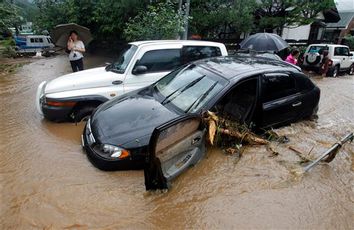
A resident uses her mobile phone near wrecked vehicles after a landslide caused by heavy rains in in Seoul, South Korea, Wednesday, July 27, 2011. A quick blast of heavy rain sent landslides barreling through South Korea's capital and a northern town Wednesday. (AP Photo/ Lee Jin-man)(Credit: AP)

Thousands of rescuers dug through thick mud for survivors of deadly landslides and flooding as South Korea’s military warned Thursday that buried land mines may have slid down mountains weakened by rain.

Massive rainfall in Seoul and surrounding areas since Tuesday has killed at least 47 people, and another four were missing. The rain stopped or decreased Thursday, but more was forecast until Friday morning.

At a mountain where a deadly slide hit Wednesday, digging for missing people was halted Thursday until the rain stopped because the Defense Ministry said mines placed there in the 1960s could have shifted. Soldiers with metal detectors were waiting to search for the mines, said Yoon Yong-sam, a spokesman for the air force, which planted the land mines around an air defense base on the mountain.

A defense ministry official said earlier that 10 mines could have been pushed down Wumyeon Mountain. The official declined to be named because of policy. Another ministry official, spokesman Kim Min-seok, played down the immediate risk because a concrete wall on the hillside could be stopping the mines from reaching rescue workers.

South Korea’s military dug up many land mines on the mountain between 1999 and 2006, but about 10 couldn’t be accounted for, officials said. Fences around the base have warnings about unaccounted land mines.

There were also fears of land mines in northern provinces also hit by flooding and slides, prompting the Joint Chiefs of Staff to order mine-search operations where needed.

The landslide Wednesday in southern Seoul killed at least 16 people. About 5,000 firefighters, soldiers, police officers and others mobilized Thursday to try to find any survivors and clean walls of mud piled in residential areas near the base of the mountain, emergency official Kim Wu-min said.

Bae Jin-sun, a 27-year-old who works in southern Seoul, said she was worried about the safety of rescue workers near the mountain.

“There is still the possibility of a land mine falling through the cracks,” she said.

Footage by YTN television network showed excavators removing a mass of mud and fallen tree parts and rescuers in raincoats shoveling up the dirt piled up near an apartment. Uniformed soldiers and firefighters wearing cotton gloves used their hands to pull out rocks and tree branches from the mud.

Another landslide early Wednesday killed 10 college students sleeping in a resort cabin in Chuncheon, north of Seoul. The students from Inha University in Incheon, just west of Seoul, were volunteering at a local elementary school.

The National Emergency Management Agency reported 18 more deaths because of a stream flooding and landslides elsewhere in towns near Seoul. No deaths of foreigners have been reported.

The rainfall left almost 5,000 people homeless, flooded about 1,380 houses and caused power outages at more than 125,000 homes throughout the country, the National Emergency Management Agency said in a statement Thursday.

The 17 inches (440 millimeters) of rain that fell on Seoul on Tuesday and Wednesday was about 15 times more than the average two-day rainfall at this time of year, according to the state-run Korea Meteorological Administration.

Associated Press writer So Yeon Kwon contributed to this report from Seoul.

Continue Reading Close
www.salon.com/writer/sam_kim/index.html