Sandeep Kaushik

The other guy Democrats love to hate

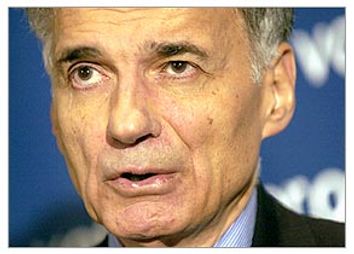
In an interview with Salon, Ralph Nader rejects the spoiler label and says Democrats "need to stop their whining and go to work."

  • more
    • All Share Services

The other guy Democrats love to hate

Though he failed last Monday to draw enough supporters to make the Oregon ballot, Ralph Nader is determined to run a full-bore independent campaign in swing states, whatever the consequences. And if his comments to Salon are any indication, he intends to bash the Democrats along the way.

With his February announcement that he would mount a third bid for the presidency, this time as an independent, consumer advocate Ralph Nader cemented his status as the other guy the Democrats love to hate. But it’s not just Democrats that question his motives. With the 2004 presidential election shaping up as an apocalyptic, scorched-earth showdown between two major parties vying for the allegiance of an evenly (and deeply) divided country, Nader’s decision elicited an explosion of anger in many of the liberal and progressive circles from which Nader drew his past support.

It is not that Nader’s message has lost its relevance to progressives. His thundering denunciations of creeping corporatism, his characterization of the Iraq invasion as an imperialist war of choice sold to an unsuspecting public on a platform of outright mendacity, and his calls for major reforms of healthcare, labor and trade policies all ring true. It is his proposed solution to those problems, and his contention that there is not much substantive difference between Democrats and Republicans, that has caused so much consternation among “anybody but Bush” liberals. Perversely, he seems angrier at the Democrats than he does at the Republicans. For those who don’t share Nader’s scorn for the Democratic Party, the very palpable fear after three years of Bush-style “compassionate conservatism” is that this election could turn out to be a reprise of 2000, where in at least two states, Nader, running under the Green Party banner, siphoned off enough votes from Al Gore to throw the election to George Bush.

To all outward appearances, Nader remains unperturbed by the negative reaction. In making his announcement, he called on “the liberal intelligentsia” to “relax and rejoice” over his decision, claiming that he would aid the Democrats by opening a second front against Bush. He has said, counterintuitively, that he intends to draw more votes from disaffected Republicans and Independents than from Democrats. He has claimed he will keep the Democrats honest, pushing them to embrace badly needed reforms they might otherwise ignore.

Still, the conundrum for Nader is that the only way he can avoid irrelevance is by at least threatening to play the spoiler’s role, thus forcing Democrats to take him and his message seriously. To this end, he categorically rejects entreaties not to run in swing states. Oregon, for example, where Nader garnered 5 percent of the vote in 2000, was a state Gore carried by less than 6,800 votes. That Nader can actually reprise his 2000 results, however, is unlikely. In his first high-profile campaign swing, a visit to Seattle and a ballot-access nominating convention in Portland last week, Nader suffered a significant setback, falling well short of the 1,000 supporters he needed to attain the Oregon ballot immediately. Only 741 registered voters came out in Portland — a city where he drew 10,000 to a rally in 2000 — a telling indication of the diminished enthusiasm for Nader’s run.

But despite that tepid turnout, early polling shows that Nader once again holds the potential to undercut John Kerry in key toss-up states that the Democrats must win to have any chance of unseating Bush. He is clearly determined to make the ballot in at least the 43 states he contested in 2000, and ballot access experts believe he is likely to succeed. That this is a real problem for Democrats has not been lost on Republicans — at least some of the money coming into Nader’s coffers are donations from prominent Bush supporters.

Salon sat down with Nader last Monday in Seattle to ask him about his seemingly quixotic campaign. He defended his decision to run and blasted the Democratic Party as a decaying institution unwilling to champion progressive reforms. He called on his critics to “stop whining,” flatly rejected the contention that he is a spoiler, and said that liberals are “so freaked out” by Bush that they have failed to ask anything of Democratic nominee John Kerry.

In the wake of the 2000 election, a lot of people blamed you for Al Gore’s defeat. Why do you reject that contention, particularly in light of the fact that Florida and New Hampshire, for example, were two states where your presence on the ballot shifted the outcome from Gore to Bush?

First of all, I think Gore did win Florida. So blundering is the Democratic Party that they didn’t catch the shenanigans of Katherine Harris before the election, like falsely designating tens of thousands of Floridians ineligible to vote. Then during the voting itself they lost 250,000 registered [Florida] Democrats to Bush. You’d think they’d be concerned about that. Plus, they were abandoned by the Democratic mayor of Miami who had a tiff with the Democratic Party and sat out the election. And then afterward they didn’t ask for a full state recount. It’s one thing to blame the Greens, but now they’re blaming the Greens for not having retrospective clairvoyance to know that the election was stolen from them by the Republicans.

What about the Democratic claim that you’re playing the spoiler again this year?

The Democrats should stop their whining and go to work. Stop whining. If we all have an equal right to run, no one would use the word “spoiler.” If we all have the right to run, everyone’s a spoiler. Everyone’s trying to get more votes than everyone else. So the use of the word “spoiler” to a third-party candidate is a scarcely veiled designation of second-class citizenship to the candidate. Which of course is what the two parties have always legislated. They want third-party and independent candidates out. They have all kinds of barriers state after state. But that doesn’t mean the rest of us should adopt that classification. Especially since in our history some of the greatest reforms were led by third parties: abolition of slavery, women’s right to vote, the trade union movement.

Say we agree with your critique of the Democratic Party. They’re whiners, they misplayed their hand, Al Gore was an execrable candidate but should have won handily. Nevertheless he would still be president if you hadn’t been running. Isn’t that a valid claim?

Well, look, I would have got more votes if [Gore] didn’t run either, if the Democrats didn’t run. So you come back to the equality issue. You constantly come back to the equality issue. If you want to talk substance, neither of the parties is responding to so many of the needs of the American people as they are responding to the greed of big corporations whose executives are funding their election campaigns. Let’s step into the area of substance for a moment. When the Democrats say, “Don’t you think there’s a difference between the Democrats and the Republicans?” And I say, “Well, tell me.”

The Democrats are entirely defined by how bad the Republicans are, not by how good the Democrats are. Not that they’re breaking new, pioneering areas in representing the public interest and the nation’s interest and the consumer and the worker’s interest. No! They stay static, just static enough to keep raising money from all these commercial interests. And then the Republicans can always be relied upon to become worse. So they define themselves by how bad the Republicans are instead of how good they should be, in an ever-evolving fashion. So here’s what happens: Today the Democratic Party is far worse than it was 40 years ago, far worse than it was 30 years ago. Worse than it was 20 years ago. It’s all been decaying ever since.

But when you look at the surprising success of, say, Howard Dean’s candidacy — and admittedly, it flamed out — doesn’t that indicate that the Democratic Party has come to its senses in a way that wasn’t apparent in 2000 or even 2002? Do you see that at all? Do you see any kind of substantive change in the Democratic Party in the last three years?

Rhetorically it was very promising in the primaries among some candidates. But you see that it has now turned into a temporary flurry as the corporate Democrats and the DLC and the Washington Democrats take over the party from the insurgents — Howard Dean and the smaller candidates, most prominently Dennis Kucinich. They had their little flirtation with progressive rhetoric. Some of it was very good. There were times when I thought Howard Dean was plagiarizing my statements of 2000 about corporate power.

But ultimately you believe that the end result is that the Democrats are back at the same place they were a couple of years ago.

Yes, there doesn’t seem to be that much difference.

There’s been talk that you will sit down with John Kerry in the next month. Is that meeting going to happen, and what would you like to see come of that? What would you like to say to John Kerry?

I’ve already met with Howard Dean. Yes, I’m going to meet with John Kerry. We’re going to talk about how we can collaborate to beat George W. Bush while we remain competitors of sorts.

You do hope to push John Kerry in a progressive and leftward direction. What specific things would you like to see him do or say?

Well, I’d like to see him become very specific on national health insurance. I would like to see him adopt a single-payer plan as proposed by the Physicians for National Health Insurance, a group of 10,000 physicians — it’s all in the New England Journal of Medicine. Second, we’re going to push him more on energy, to be specific on solar and renewable energy with objective targets that should be maintained. Third, I think he’s got to go up on his minimum wage. And fourth, he’s got to deal with the globalization issue, which he voted for, NAFTA and the WTO. Those are some of the things.

When you announced you were running in February, there was a paroxysm of anger, even rage, from progressives who felt you were making the wrong decision. Noam Chomsky, Bernie Sanders, Jim Hightower, the Nation, Jimmy Carter, Howard Dean — all of them questioned why you were running. How do you respond to their criticisms?

Yeah, well, there’s an epidemic of low expectations by Democrats toward the Democratic Party. Except for Noam Chomsky. He has a different reason. His reason is that this is such a fanatic, messianic, militaristic regime that, in his words, it could take us over the cliff globally. So he has a different scale of operating. The problem with the Democratic Party is expressed exactly in the comments that you just referred to from the Nation, from Jim Hightower. I mean if you read Jim Hightower’s latest book, you’d run out and run against the Democrats. That’s how devastating his critique is. So why is he saying that he doesn’t think I should have run? Because his expectation levels are much different than mine. I have a higher estimate of the voters in this country. [That they are] willing to be appealed to, and willing to respond, and willing to demand more of their party. The tip-off on low expectations is that none of these groups that are supporting the Democratic Party are asking anything in return. That’s important: They’re not asking anything of Kerry in return. They’re so freaked out, you see.

Liberal Democrats are fixated this year on one thing: beating Bush. Do you consider that narrow and shortsighted?

Yes. I don’t think they can beat Bush by themselves. I think they need a demonstration effect represented in part by this candidacy. We’ll show them ways and modes to beat Bush that they can pick up and run with. Just like Michael Moore did in endorsing Wesley Clark when he raised the deserter issue. The two major factors that have been pushing Bush on the defensive have not come from Democrats. It’s been Richard Clarke and Michael Moore.

There was an article in the Dallas Morning News a couple of weeks ago that claimed that a substantial amount of the money coming into your campaign is from Republican donors to President Bush …

[interrupting] No, you have to read that article very carefully. It’s not true at all. As a matter of fact, read the New York Times yesterday. John Tierney, he goes through that [recounting an analysis by the Center for Public Integrity shows that only about 3 percent of Nader's fundraising is coming from donors with ties to the Republican Party, and that some of those donors have personal ties to Nader].

In 2000, you were on the ballot in 43 states with the backing of the Green Party. Running as an independent, will you be able to get on the ballot in a similar number of states?

Yes, we will get on the ballot in at least 43 states. We just missed last time in several states: Oklahoma, Idaho, South Dakota. We’re going to get on the ballot in those states.

Will this be a volunteer signature-gathering effort?

As much as possible, yeah.

You’ve said you’re not interested in the Green Party’s nomination this time around, or that of the Reform Party, which has offered you its nomination, or the Natural Law Party as well. Why have you decided to reject those, and does that mean a blanket rejection, given that these parties could give you ballot access in at least half the states?

First of all, the Green Party is not going to make up its mind till June. So that’s their problem, not mine. They’re split three ways. A small number don’t want a candidate for the presidential election. The second category of magnitude want restrictions on the candidates — stay out of the close states like Oregon and Washington state. And the third want an all-out run. But you can’t wait till June because the ballot deadlines are closed in some states or closing.

The other point is, this is an independent [campaign]. I’m appealing to independent voters. It’s OK to get supported by other parties, but if you take their nomination then you’re not [independent]. At least in those states, you’re not an independent candidate. One out of every three people in this country call themselves independent.

You reject the position of those in the Green Party who say that you should only run in “safe” states, either Democratic or Republican. You intend to run even in states that are considered swing states. Why?

Because if they’re trying to build a party, they’ve got to go all out in 50 states. It feeds a lot of cynicism to say to people in Wisconsin, “Well, you’re a close state so we’re not going to campaign all out.” That is the first step toward being indentured to the Democratic Party. That’s the only reason they would not campaign in close states.

Howard Dean strikes back

In a candid interview, the former front-runner goes after his two main adversaries -- George W. Bush and John Kerry -- and says they're a lot alike.

  • more
    • All Share Services

In 2003 Howard Dean burst on the scene as the pugnacious Democratic partisan itching to take on George W. Bush, undeterred by the president’s inflated post-9/11 popularity. He was the stand-alone guy who stood up against the Iraq invasion. It was his message of tough-minded liberal empowerment that resonated among rank-and-file Democrats despairing of their elected leadership’s halting and impotent efforts to battle the Bush conservative agenda. Growing legions of Deaniacs, compelled by his straight talk and fearless defense of core Democratic principles, self-organized over the Internet, flooded his campaign coffers with record donations and transformed him from small beer to big wheel in the race to take on the corporatist from Crawford.

And so it was that only one short month ago, Dean was seemingly on a roll. The former Vermont governor began this election year as the undisputed front-runner in the race for the Democratic presidential nomination. But the past month has not been as kind. The other leading candidates effectively co-opted Dean’s populist, anti-Bush message — while sheathing it in ostensibly more electable packages. With astonishing rapidity, his support collapsed in the Jan. 19 Iowa caucuses. He finished a distant third, 20 points behind Sen. John Kerry, his arch-rival from Massachusetts, even after a hugely expensive advertising blitz and a massive, if ineffectual, organizing effort.

Last week he lost New Hampshire, where he once enjoyed a 30-point lead in the polls, by a double-digit margin to the surging Kerry. Then his campaign manager, Web guru Joe Trippi, quit the campaign rather than face demotion. Dean’s once bulging campaign coffers are now drained, his staffers working without pay, and the latest tracking polls predict he will go down in flames in all seven of Tuesday’s primaries as well.

The conventional wisdom says he is finished, a political dead man walking. But someone forgot to tell Howard Dean. He is reputedly not the sort to go down without a fight, and he appears determined to live up to his combative reputation. In consultation with top aides, Dean has come up with a new strategy for a much leaner, and perhaps a bit meaner, guerrilla campaign, targeting a handful of February states — Washington, Michigan, Maine and Wisconsin — in the run-up to the big California and New York primaries on March 2. And with the bull’s-eye now on Kerry’s back, Dean is once again happily throwing darts with abandon. In a Saturday afternoon interview, Dean said he was “incensed” and “sputtering” mad over Kerry’s heavy reliance on special-interest donations during his career in the U.S. Senate. “It’s one thing to say you’re against special interests, but he isn’t,” Dean riffed. “He’s taken more money than any other senator in the last 15 years. I mean, that’s pretty blatant. George Bush does the same thing. It seems to me there’s a little of George Bush in John Kerry.”

By any ordinary political calculus the nomination now seems like a pipe dream, but Dean has defied expectations before. After a loud and loving rally before an overflow crowd of more than 1,500 in anti-Bush, anti-war Seattle — arguably ground zero of the once-mighty Dean Nation — the candidate, appearing relaxed and confident, held forth on recent developments, his new underdog status and his rivalry with John Kerry.

Not so long ago you were on top of the campaign heap. Even at the beginning of January, you were the front-runner, leading in Iowa, well ahead in New Hampshire. Now, having lost the first two contests, you’re the underdog. What happened?

We just got absolutely pummeled by everyone who was interested in pummeling the front-runner. Others will now have the delightful experience of being the front-runner. In some ways it’s easier to run from behind. There are a lot of advantages to being the front-runner, you have a lot of momentum, but you also get a lot of media scrutiny and a lot of attention from everybody else in the race.

That aside, have you had a chance to reflect over the events of the past month, and do you see personal mistakes you may have made that played into your defeats?

I’m sure there are dozens and dozens of them. But it’s pretty hard to reflect when you’re right in the middle of a series of primaries every single week. I’m sure there’ll be time for reflection later on.

Do you think you do better, given your personality, as the underdog rather than the front-runner?

Yeah, probably. It’s a hell of a lot more fun than being the pin cushion for every media organization in the country and all the other opponents in the Democratic Party and the Democratic Leadership Council.

Your campaign began to surge on the basis of your opposition to the Iraq war. But has the war lost its potency as an issue?

I think the American public has moved their attention. I think the war is an important issue because people feel like they were deceived, which they were. But people are really tuned into social justice issues more so than they were and I think that’s a good thing.

So did Americans lose their antiwar fervor after the capture of Saddam Hussein?

I think Americans did, but I don’t think Democrats did. [But] it’s not as important an issue. Look at what people are facing: They’re losing their jobs, they’re losing their health insurance by enormous numbers, people are kind of losing hope in the country. They see this Medicare bill pass, which really is much more oriented to the pharmaceutical companies and the HMOs than it is to seniors. I mean they’ve just sort of flung up their hands and said, “My God, what’s happening here?” Folks [think] Iraq is still important — we’re still losing lives every day — but that’s not where their focus is. They’re really worried about what’s going to happen to their own families now and that always takes precedence.

What’s driving all this anxiety?

I think the social justice problem has been a problem as long as this president has been in office. He’s made it very clear that his philosophy appears to be that if you’re rich you deserve it, if you’re poor you deserve it, and that’s that. I’d like to think we can do better than that in this country and I think most folks agree with me.

You campaign manager Joe Trippi, credited with pioneering the innovative Internet-based strategy that helped make you the front-runner in the first place, abruptly quit the campaign last week when you decided to bring in a new campaign CEO. Why did you make the move?

We needed organization in the office. Joe was really overworked and was trying to do it all. I needed somebody to come in and be the last word on all issues and Joe didn’t want to give up that authority so he left. I’m hoping at some point he’ll come back because he’s a brilliant strategist. I don’t think it’s going to have an effect on the message.

Did Trippi tell you to basically let it rip before you walked out onto the stage in Iowa for the so-called I Have a Scream speech?

Sure, but I’m not going to blame Joe Trippi. One thing about this campaign stuff and Joe Trippi and all that: I do not blame him for one thing that went wrong in the campaign. The reason is, actually what drove Joe crazy, is I want to know everything, and I want everything explained to me, and I sign off on all the final decisions. I have not one piece of ill will about spending too much money. I OK’d every major strategic decision and you can put the blame at my feet for anything going wrong.

You say you hope he comes back. Have you had a real conversation with him?

Yeah, we had a real conversation. He was pretty upset the last time I talked to him so I think I’m just going to give him a week or so to relax at his Maryland farm. Here was a guy who did everything. We would have never been where we are if it hadn’t been for Joe Trippi.

Has Trippi’s departure caused any wavering among your supporters?

No, they’ve been really supportive. They’ve been really terrific. They’ve just been great.

You mentioned money. You raised a record amount of money last year — $41 million. Where did it all go?

A lot of it was spent in Iowa and New Hampshire. Our idea was to do what Senator Kerry is now trying to do, which is to knock everybody out early. We still raised $3.2 million since Iowa, so we’re not in bad shape. But we’ve got to conserve and we’ve got to retool. We’ve got to redo the whole operation.

So with all the changes, how do you turn things around?

Well, we have somebody who really knows how to run a tight ship, the CEO of the campaign, Roy Neel, who ran Al Gore’s operation in the White House and then was a deputy chief of staff to Bill Clinton. We’re going to make a lot of adjustments; we’re obviously not going to run a front-runner campaign at this point. We had it well set up to run against George Bush, which we knew was going to be very tough. We had field organizations everywhere. But we obviously can’t run that kind of campaign now. We have to run a come-from-behind campaign.

You’ve been attacking the culture of Washington and special interests for some time. Now other candidates, in particular John Kerry, are doing so as well.

I was really incensed today when I read in the Washington Post [Jan. 31] that Kerry took the most special interests’ and lobbyists’ money in the Senate in the last 15 years. These guys all adopted my message, so I’ve got a certain amount of pride that I’ve set the agenda for the party, which is one of the things I intended to do. But it’s one thing to adopt a message. It’s another thing to just plain ignore your own past. [Kerry] has no right to ever talk about taking on the special interests because that’s who’s keeping him in business. The way our campaign is run, 89 percent of our money comes from people who are ordinary Americans, who aren’t special-interests people. We are the quintessential campaign finance reform of this campaign. I was really outraged when I read that [Post article]. I was sputtering I was so mad.

But Kerry refuses to take even a dollar of PAC money.

Yeah, he doesn’t take the PAC money but he takes money from the lobbyists. He takes the money from other special interests. Read the article — in 1999 he intervened in a rules case with the Coast Guard on behalf of a foreign company, which is very unusual. After he got the rules changed he apparently got $7,200 in contributions. That’s exactly what we don’t want in Washington. Harry Truman used to say if you nominate a Republican to run against the Republicans a Republican is going to win every time. We don’t need any more of that in Washington. The whole point of my campaign is to clean house so that ordinary people get their voice back in the nation’s capital.

You’ve criticized John Kerry as too much of an insider, too much of a compromiser. But on healthcare, for instance, you told a Seattle audience today that you’d sign any halfway decent bill that improves the healthcare system. Aren’t you being unfair to Kerry?

Here’s what I object to about what Senator Kerry has done. It’s one thing to say you’re against special interests, but he isn’t. He’s taken more money than any other senator in the last 15 years. I mean, that’s pretty blatant. George Bush does the same thing. It seems to me there’s a little of George Bush in John Kerry. George Bush says the most blatant things that are just plain false. No Child Left Behind leaves every child left behind — something that Senator Kerry also voted for. How many rationales has George Bush given us for the Iraq war? Well, how many rationales has John Kerry given us for the Iraq war (which he also supported)? So I’m beginning to see a pattern. Maybe they shared a little more than just brotherhood at Skull and Bones, I don’t know. I think that is not the kind of person the Democratic Party is going to win with. If you have a choice between Bush and Bush Lite why not go for Bush? Of course I never would.

That makes you a better potential nominee than John Kerry? A more electable nominee?

First of all, I say what I think and I stand up for what I believe in even when it’s not popular. No Child Left Behind and the war are two examples of that. It’s easy to stand up when the polls are in your favor. The president I admire most in the last 60 years is Harry Truman because he did exactly that and he’s one of the great presidents of the last century. Secondly, I can get things done. Senator Kerry sponsored 350 bills. Three of consequence passed. We have health insurance for everybody under 18 with prescription benefits for a third of all our seniors in my state. I’ve balanced budgets. So I have a record of actually doing something. Washington, D.C., is the only place in the country where sitting on a committee makes people think you have experience. I have executive experience and that’s a big difference. The other thing is that I don’t owe anybody except the voters, and so I don’t have any fears about saying what I believe. The voters are the only ones I’m responsible to, not the special interests.

Will the contest vs. John Kerry, or George Bush for that matter, turn on your record?

I hope so, because mine’s a lot better than both of theirs.

Has the media been fair to you? Did they come after you because you were the front-runner or because of the themes on which you were running?

No, only because I was the front-runner. I don’t believe there’s a conspiracy, except for maybe Fox News and people like that. Fox has a clear ideological agenda, but I don’t think most media organizations have a clear ideological agenda. I’m not upset about it. My attitude is that if you can’t take the heat you shouldn’t be running for president. I actually viewed that as a positive thing even though it wasn’t any fun. That stuff’s going to come out sooner or later so you might as well get the hell kicked out of you earlier than later.

When you were the front-runner there were a series of stories about your record. For instance, that you gave tax breaks to Enron …

[interrupting] Oh that was all nonsense. Ridiculous! That was just perfect crap, the most ridiculous thing I ever heard of. First of all, what we did was set up captive insurance companies. There were no special tax breaks. Enron had a subsidiary that moved a captive insurance company to our state a year later. These things were so small — that’s the thing that was so frustrating. The New York Times actually put a story on the front page that had been rehashed from 10 years ago. It was the most ridiculous thing. [voice dripping with sarcasm] Enron tax breaks!

What about the temperament issue? Particularly after the speech in Iowa, you’ve been portrayed as a dangerously angry guy, someone whose finger you don’t want near the red button. Your reaction?

That was all mostly nonsense put forward by the other guys — and [Karl] Rove. You know my test for how well I do in speeches? I turn off the sound and watch. I get about a D- for my first debate in South Carolina [last May]. I was crabby, and boy did I ever look cranky on that television. I give myself an A for the speech in Iowa. I was smiling, I was pumped up, I was having a great time. I’m the first to confess it wasn’t very presidential, but ABC News sort of did an apologia the other night. If the clips had shown the audience it would have been great. There were thousands of kids waving the American flag and screaming at the top of their lungs in there. It was an extraordinary scene. People say this campaign is fueled on anger, which is mostly nonsense. It’s really fueled by hope. People want to hope again that they really can have the kind of country that they thought this was. That’s what really drives the campaign.

Legions of Deaniacs do seem passionately committed to your campaign. But what if you’re not the nominee? Do you think they’ll come out for whoever gets the nomination?

I think it depends on who the nominee is. Look, I’m going to go out and vote for the nominee of the Democratic Party no matter what, because anybody is better than what we’ve got now. But the degree of enthusiasm depends on who the nominee is. Obviously, I hope it’s me.

But have you brought people into the party who will only participate as long as you’re the candidate?

I don’t know the answer to that, but I think we’ve brought hundreds of thousands of people back to this party who were not in it before — all over the country.

But in Iowa and New Hampshire, you didn’t get the promised outpouring of support from new voters.

Well don’t forget, we just took a terrible hammering. We just got absolutely hammered in those places. Everybody was saying I was against Medicare, I was against Social Security, there were midnight phone calls being made by other campaigns saying I’m from the Dean campaign I want you to go out and vote, and on and on it goes. So we were certainly getting a lot of attention there, and that certainly wasn’t particularly helpful.

You’ve talked about running a guerrilla campaign at least between now and March 2. Is there a danger that in doing that you’ll weaken the Democratic Party and the effort to unseat President Bush?

I don’t think so. [Shakes his head] I don’t think so.

There were clearly a lot of people in Iowa and New Hampshire who flirted with your campaign, but for whatever reason turned to either Kerry or John Edwards. Will you change your message in any way to bring those folks back into the fold?

I don’t know what to do about that. I don’t bend my message by polls. I basically say what I think is right and not everybody’s going to agree with me. Again, at that time all the other campaigns were engaged in enormous full-scale attacks and it was really hard to fend them all off. The one that was going on right before [the caucuses] was the electability attack. Supposedly I made a gaffe a day. Well, if you look at the gaffes, they were things like saying, “We’re not any safer since Saddam Hussein was caught,” which is perfectly true. I mean it was really a tough, tough caucus. In New Hampshire I thought we did well. We came back from a pretty devastating loss. We got knocked off our front-runner pedestal, and I was pleased to come back and do as well as we did in New Hampshire.

How have you been changed by two years of campaigning?

I’m sure there are [changes], but I’m not by nature a reflective person, especially when I’m in the middle of combat. I may sort that all out after this is all going on. The way I work is I basically think things through on a subconscious level and all of a sudden it pops up. I know that process is going on, but I’m really focused on the day-to-day stuff we have to do to become president.

After avoiding the spotlight for so long, your wife campaigned at your side in Iowa and New Hampshire. What reaction did she have to all the public and media attention?

Don’t forget that she’s been mostly exposed to my supporters, so she thought it was great. In fact, today is our anniversary, and I called her and she said, “You know, I’ll come out anytime you want.” Now, for a woman who spent 12 years avoiding the public life I just couldn’t believe it. She is a doctor and we have a son at home, but she’ll come back out on the campaign trail, which is great. It’s great for me to have her on the campaign trail, because it’s great to have her around, not just because people really like her. You know we had all these plans; we were going to let her be interviewed by a local media person who’s very nice for her first television interview and we were gradually going to work up. All of a sudden, ka-boom, Diane Sawyer. I thought she did really great.

Will you win any of the Feb. 3 states?

I don’t know. We have a shot at New Mexico. What we’re trying to do is get 15 percent in every state so we can get delegates out of every state. We’ll do reasonably well in Arizona, I think. We have a shot in South Carolina — that’s really being contested heavily. New Mexico is our best chance to win one. North Dakota, I think we’ll probably finish in the top three, but I can’t be positive.

Won’t your campaign be crippled if you don’t win at least one of those states?

No, because as I’ve said we’ve raised $3.2 million, which I suspect is more than anybody else since Iowa. We’re just trying to get the ship righted so we can keep going.

What is your goal at this point? A brokered convention?

My aim is to win, and to change this country. I have no idea what’s going to happen. I just try to do things one state at a time, and try to do as well as we can in every state.

Continue Reading Close