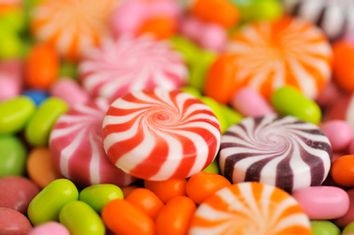
Last week, Washington state joined more than a dozen state governments that have passed or proposed a tax on sweets: Starting on June 1, the state will begin adding sales tax to the price of candy. The hard part, it turns out, is figuring out exactly what “candy” is. Does a chocolate-covered pretzel qualify? What about a yogurt-covered raisin? Where does “candy” end and “food” begin?
Washington, apparently, draws the line at flour. It defines candy as “a preparation of sugar, honey, or other natural or artificial sweeteners combined with chocolate, fruits, nuts, or other ingredients or flavorings and formed into bars, drops, or pieces.” But any sweet that contains flour is considered food, and thus not taxable — which sounds logical enough until you start looking at what is exempt. A Nestle Crunch bar is not candy, but a Hershey Bar is. Gummy Bears are candy, licorice is not. Milky Way Midnight? Candy. Milky Way? Not candy.
Clearly, the flour rule is not an effective way to distinguish what is and isn’t candy, but is there a better way? To find out, Salon spoke with Samira Kawash, also known as the “Candy Professor,” a professor emerita at Rutgers University who is writing a book about the cultural history of candy in America.
Why is candy so hard to define?
There isn’t any substance that’s purely candy. “Candy” is really more a feeling about the product, and in fact, it’s a distinction that runs along moral lines.
What do you mean by that ?
Candy is the essential substance of pleasure, but at the same time it is always tainted with the association of sin. And that sin, that “dark side” of candy, has historically taken lots of different forms. In the 1880s through the early 1900s, there were these fears about adulteration, that the candy was somehow being tainted by impure ingredients like artificial coloring, or clay dust in place of sugar. But the level of alarm over adulteration was far in excess of any problems with the candy itself, which was actually pretty good quality at that time.
There was a series of accusations of candy poisoning during this period — when kids got sick, people claimed it was because of tainted candy, and it was reported in all the newspapers. Each time, the National Confectioners Association investigated and showed, over and over again, that there was no poison in the candy, and there was some other medical explanation for why the child got sick.
The idea that there’s something dangerous about candy is repeated throughout history. That was 100 years ago, but when you look at this century, the ideas about danger are still there — sugar is harmful, candy causes cavities, it causes your teeth to rot, it causes diabetes. Certainly, candy plays a role in those things, but it’s not the only thing that does. There’s a real moralism involved.
Is this why we’re willing to accept a candy tax?
There is this idea of the candy tax being a “sin tax”– we should tax candy because it’s bad and people shouldn’t eat it — whereas if we look at other foods, there isn’t the same type of judgment.
What makes the current attempt to define candy different from those in the past?
Culturally, one of the things that candy does is provide a line between “food” and “not food.” As long as we can say, “that over there is candy,” then we can feel better about all the other junk in the grocery store that we call food. Michael Pollan has that really useful idea of “food-like edible substances,” all the stuff on those middle aisles of the grocery store that is as processed, sweet and fatty as any candy, but we call that “food.” If you take a more “real foods” approach, it’s clear that none of it is food.
I think if we looked at it reasonably, we’d either group all of that stuff together and say a Snickers bar is just as much food as one of those Quaker chewy granola bars, or we have to say that none of it is food, but you have powerful commercial interests [in the processed food industry] to ensure that that doesn’t happen.
Isn’t soda considered as bad as candy?
Not inherently. The arguments for a soda tax, like the one proposed in New York, are really similar to those for the candy tax, but to build momentum for a tax, the Center for Science in the Public Interest has been working for 10 or 15 years to redefine soda as “liquid candy.” It’s interesting that soda seems OK to people until they start calling it candy — it’s really been changing the name that has gotten traction on the idea that we should be limiting soda and taxing it.
The distinguishing feature in the Washington state candy tax law is flour. What’s so wholesome about flour?
Of course there is the notion of the wholesomeness of cookies and pies and cakes, and the association of baked goods with the home. I think one of the reasons that candy was historically viewed with so much suspicion is that it was one of the first processed products produced on a commercial scale. There is a real distance between the kind of candy you would make at home and the kind of candy you would buy at the store, whereas commercially produced baked goods were much more similar to homemade food. There’s a closer association of a bakery with something that’s pure and domestic, and with candy, it’s, “Where is it coming from? Who is making it, and what are they making it out of?”
Is there any truth to that?
In the early part of the century, when [the food industry] started debating the merits of processed food, and when white flour bakery goods were only recently available, they discovered that white bread really didn’t have any nutritional value unless you fortified it with vitamins. There’s not really that much of a difference between white flour and white sugar. But the baking industry and the agriculture interests were much more successful at associating flour with wholesomeness and nutrition.
How do you think this debate is going to change candy?
I think everybody’s going to put flour in their candy now. It’s so surprising to find out which candies actually have flour in them. I mean, Milky Way? Really? When they made the rule, I’m sure they didn’t realize how many types of candy would actually qualify as food.
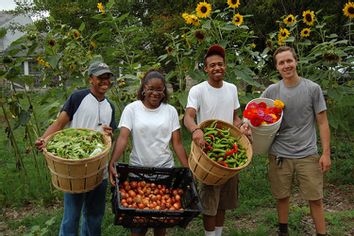
Urban farmers are coming to the rescue in dozens of city neighborhoods where you’re about as likely to find a fresh tomato as you are to find a unicorn on the sidewalk. But if “urban farmer” calls up visions of an old hippie hoeing a quaint little patch of sunflowers in the shadow of high-rises, think again. Modern urban farming is about block parties with DJs and cooking lessons. It’s raising fish in indoor tanks and getting outdoor education in city schools. It creates meaningful jobs for inner city youth who learn to plan food systems and cultivate crops. But most of all, it’s about ingenuity. Urban agriculturists see potential where others sees blight, seeking out vacant lots and neglected open spaces, looking at what they have within arm’s reach rather than thinking about what’s missing.
This slide show is a tour of some of the country’s most innovative approaches to urban agriculture. These are farms and gardens created in the service of education and activism. Whether they’re training entrepreneurs, teaching kids to grow organic kale, or producing food from plots no bigger than your living room, the urban approach to farming is about feeding, not being fed.
View the slide show
Every now and then, a trend takes a mysterious turn. Here we are, in the midst of an era in which portion sizes have been growing steadily for decades, and suddenly, small plates are making a comeback. As USA Today writer Bruce Horovitz pointed out last week, bite-size menu options are a hot new thing at casual chain restaurants like California Pizza Kitchen and Houlihan’s. Of course, small plates are a concession to budget-conscious eaters and possibly an attempt at a more upscale feel, but in a surprising twist, Bob Hartnett, CEO of Houlihan’s, claims that the change is specially targeted at younger, Web-savvy customers. Small plates, he explains, are for diners who are “just as comfortable sharing a plate of food as they are sharing social media.”
And there is even some scientific proof to back up his theory. A study of Internet use and eating habits in Korean teenagers showed that the people who used the Web most tended to eat smaller meals. Out of the entire study, which compared light, moderate and heavy levels of “Internet addiction,” the heavy users were the only group in which reduced meal size was a more prevalent trend than unchanged or increased meal size — all of which raises an intriguing question. We’ve spent plenty of time discussing how the Internet is changing the way we read, the way we communicate, and the way we fall in love and break up, but how is the Internet changing the way we eat?
For better or worse, social media-style sharing is now part of our cultural zeitgeist — “liking,” tweeting, describing and evaluating all our tedious comings and goings — and, undoubtedly, this has also changed the way we experience and react to food. For the Web-obsessed, eating is no longer just about privately savoring a meal. It’s about Yelping and blogging, and, as the New York Times recently explored, taking pictures of our food and posting them online. Increasingly, our meals are plugged in to the broader social experience of eating, an ongoing conversation about millions of meals like ours.
In that context, it makes sense that younger diners might be forgoing individual meals in favor of passing around a slew of small plates. Consider it the dining equivalent of updating your Facebook status: Sara Breselor is having Houlihan’s Disco Fries and they’re not quite what she had hoped for. A trail of comments follows (but the pickle fries ROCK!!! Ah yes, Sara Breselor and three others like this). And so on.
“I think it mimics the fragmentation of information,” says Dan Zarrella, Web marketing specialist and author of “The Social Media Marketing Handbook.” Whereas many people used to rely on one or two good sources of news and information, they now check 20 different websites. “People have grown up with this idea that it’s not just about one key thing, it’s about a lot of different things together,” Zarrella says. “I could see how eating behavior could mirror that preference.”
Much has been made of the idea that the Internet has ruined our ability to focus on large, sustained ideas, books and long articles, and perhaps a trend toward little servings reflects our anxiety about decision-making in an information-saturated world. Committing to a single choice is much more difficult when your consciousness is so crowded by possible options. Even in a restaurant, where there are a finite number of choices, the same anxiety kicks in. The pear and arugula salad looks great, but what if the roasted beets are better?
Perhaps this is why the new “small plates” menus are full of “combo” options that let diners cover a lot more ground than they could with a single full-size serving. Houlihan’s, for example, has a new menu of mini desserts, and they offer the option of ordering “any five” desserts for $12.99. But there are only five options on the mini menu, so opting for the combo means ordering all of them, and thus getting to enjoy dessert without the anxiety of having to choose just one of them. (Then again, maybe it’s just an attempt to make more money by upsizing the order.)
Of course, the Web is already having a huge effect on restaurant trends. Sites like Yelp can tangibly impact a restaurant’s success, and the people who are influential on Yelp are outgoing, entertaining and highly connected. Which means that restaurant trends are being guided less by lovers of food and more by lovers of interaction. “I have a bunch of followers on Twitter, because I like people and I like making friends on Twitter,” Zarrella says. “So if I talk about a restaurant, there’s a very good chance that I like it because it feeds into the social need that I have.” He says that the person who is most influential on social media “is not necessarily going to be judging restaurants by their culinary merits, but they’ll be judging restaurants based on a social experience.”
And one thing is clear: In the future, the online world will be far more closely integrated into our everyday experience of eating. “One big technology shift that’s happening, and that I think is going to be very important to restaurants, is the blending of offline and online,” Zarrella says. We’re already seeing this in what Zarrella calls “augmented reality,” things like the Yelp application for smart phones, which allows users strolling city streets to take a picture of a restaurant and instantly call up hundreds of its reviews.
This is the kind of Internet-mediated interaction that is likely to define restaurant culture in the near future. Zarrella himself recently experienced a dramatic example of how social media can change the interaction between restaurants and customers. A self-professed “beer nerd,” Zarrella went to a bar in Boston, where, he says, “There are these two really rare beers on the menu. One of them was sold out, so I got the other one. I was so excited about it that I took a picture of the beer and I posted it to Twitter, saying, ‘this is my new favorite place!’” he says.
Then, the hand of the virtual reached out and brushed against the real. “The bartender saw the tweet,” Zarrella says. “He had just finished his shift. And it turns out, the other beer that I had wanted to try — the one that was sold out — he had bought it, and was splitting it with his friend at the next table over. So he was like, ‘I liked your tweet, thanks a lot for that,’ and he gave me a glass of the really rare beer.”
Continue Reading
Close
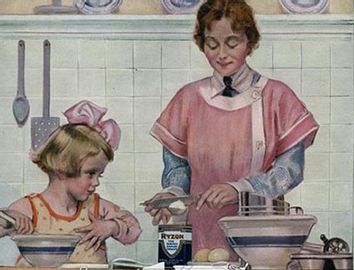
My mother is a great cook, and an adventurous one. Throughout my childhood, she made flan and soufflé and once, memorably, a dish called “pungent fish balls.” But she was also busy and often didn’t have time to cook from scratch, and I wonder sometimes about my longing for small memories of her culinary non-grandeur. Mac and cheese from a box, for instance, or “cheese toast” for lunch: wheat bread in the toaster oven with cheddar cheese and paprika. I can find all the necessary ingredients for this particular snack within 50 feet of my apartment, but I have never once made it for myself. I never really want cheese toast, it turns out. Cheese and bread tastes like cheese and bread. So why is it that I’ll still eat it in a heartbeat if my mom makes it?
To investigate, I talked to Dr. Alan Hirsch, founder and neurological director of the Smell & Taste Treatment and Research Foundation in Chicago, about the ways mom’s cooking shapes our memories of childhood and our preferences as adults.
Why is our mothers’ cooking so special to us?
It’s a matter of olfactory evoked nostalgia. We looked at 989 people from 45 states and 39 countries, and we found the number-one odor that made people nostalgic for their childhood was baked goods; the smell of mom’s baking.
But what if your mom never baked?
The memories we have are not true memories. When we have a memory, it’s really a compilation. In our culture, we perceive the maternal influence as being the comforter, the one who bakes apple pie, and we come to associate that with our mother, even if it’s through false or perceived memories. My best guess would be that we do it because that’s the memory that we want to have.
So our memories of our childhood could have nothing to do with the things we actually experienced as children?
That’s right. It could be things that we learned to associate with childhood. There is often a very wide variation between what you recall and what actually happened. We think of memories as being a stable thing, but memory fluctuates, depending upon our immediate past experience, our emotional affect at the time, and our expectation. Even if our mothers weren’t cooking, we somehow as a culture have developed that association, and it affects the way we remember childhood. Your memories change along with your experience.
Ok, so getting back to your study, why do baked goods in particular remind us of childhood?
I think it’s because you associate baked goods with a more positive eating experience than you do with, say, Brussels sprouts. I think most kids at one time or another ate Brussels sprouts, but they don’t say that they make them recall their childhood. Baked goods were given as a reward, at dessert. Or when you were coming home, and you were particularly hungry, you got cookies or baked goods for a snack, so that’s why people have this nostalgia for them. Nostalgia is really a sanitized memory of the past. We remember the good and forget the bad.
And what’s the relationship between nostalgia and smell?
The quickest way to a change of mood or behavior, quicker than any of the other sensory modalities, is smell. When you smell something you immediately decide whether you like it or you don’t like it, and then you figure out what it is, whether it’s rose or lilac–which is totally different than all the other sensory spheres. When you see a picture of a cow or a horse, you identify it, and then you decide if you like it or not. With smells it’s the exact opposite. It’s a pure affective or emotional sense.
Anatomically, it’s hardwired. The part of the brain that processes smells is actually right there where the emotions are, and that’s because odors were important for the survival of the species — to be able to detect if there were any particular pheromones present, or if a lion was about to attack you. It was important for an infant’s survival to be able to smell the mother. All these things were evolutionarily important, so it makes sense why smell would continue to be so emotional.
To what degree does the food we eat as children define our preferences as adults?
What we’ve found is that the foods that you like in ages 0-7 tend to be foods that you like throughout adulthood. The part of the brain that’s oriented towards food preferences seems to develop then; it’s almost imprinted. Now, the reality is, there can be negative experiences that change this — you develop an aversion, you get sick from something and then you avoid eating it again. But that’s the exception rather than the rule.
And how do we learn to like what we like?
Part of it has to do with past experience. If your mother eats Chinese food when she’s pregnant, you’re more likely to like Chinese food later on. If your mother eats carrots when she’s nursing you, you’re more likely to like carrots. There’s this phenomenon of “neophobia,” when you’re fearful of new foods. The more you’re exposed to a food, the more you like it, and if you’re exposed at a very early age, you like it that much more.
So part of it is this exposure, and part of it has to do with your genetics. We all taste differently. Some people can’t taste the bitter taste that’s found in green leafy vegetables, and they tend to like vegetables more. All of these things will impact your preferences. And superimposed on that are cultural expectations– seeing commercials for “Trix are for kids”– that make you more oriented towards one food over another.
We’ve also looked at geographic distributions of olfactory evoked nostalgia. While baked goods are number one, people from the East coast describe the smell of flowers as making them nostalgic for childhood. In the South it was the smell of fresh air, and in the Midwest it was the smell of farm animals. On the West coast it was the smell of meat cooking or meat barbequing. It also depends on when you were born. For people born from 1900 to 1930, natural smells made them nostalgic for their childhood—trees, horses, hay, pine, that sort of thing. People born from 1930 to 1980 were more likely to describe artificial smells that make them nostalgic for childhood—Playdoh, Pez, Sweet Tarts, Vapo rub, jet fuel.
But we’re able to like things that we didn’t like in early childhood, right?
We are culturally inclined to do so. For instance, coffee– kids don’t like coffee, because it is very bitter. But it’s part of the maturing experience in our society to drink coffee, so you can learn to drink this bitter drink that normally people would be averse towards. There are certain things you can acquire. Like alcohol, people don’t normally like the taste of beer, because it’s bitter, but you can learn to acquire that taste.
Continue Reading
Close
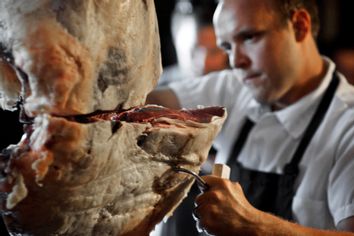
That wailing you hear in the distance is the sound of small meat processors begging the USDA for mercy. The U.S. Department of Agriculture’s Food Safety Inspection Service recently proposed a set of new regulations that will require all meat processors to submit their products to a new series of tests, a procedure that can cost hundreds of thousands of dollars for even a modestly scaled operation, enough to cripple many small processors.
What worries fans of small farms and locally produced food is that the closing of small processors will mean the closing of small farms. Slaughter and processing is the biggest challenge for small-scale meat; they’re operations simply too costly and complex for farms to handle themselves. As it is, farmers have few options for meat processing without selling their animals to massive feedlot-meat operations, and without that piece of the puzzle, many farmers may quit. Why is the USDA considering the new testing regime? Some producers wonder if the machinations of Big Food are in play.
“The new testing would just ensure that the current processes, which are based on scientific consensus, are working,” according to Dustin VandeHoer of the Iowa Department of Agriculture and Land Stewardship. But, he adds that it’s not clear why they’re being mandated: “It doesn’t appear that it’s in response to any specific situation. They’re just kind of reinterpreting the existing rules.’” And he’s unsure that the new tests are necessary. “We haven’t had problems with food safety, especially with the smaller plants,” he says. “We should never become complacent, but I think we can reach a point where [small meat processors] can still be allowed to operate and food can be safe. I don’t know that we need to be taking this path that’s going to put small plants out of business.” (Repeated attempts by Salon to solicit comments from the USDA were unsuccessful.)
Greg Higgins, chef/owner of Higgins Restaurant in Portland, Ore., and a founding member of the sustainability and local-food-focused Chefs Collaborative, has darker suspicions. “What’s always in the back of my mind is the industrial food lobby,” he says. He suspects that the change in the USDA regulations, and the way they will affect small meat producers, was probably “fairly well thought out by the lobbyists.” The popularity of small farms, grass-fed meats, and artisan products like salumi and prosciutto is expanding rapidly, and Higgins suspects that the industrial food lobby is trying to squeeze producers out so as not to lose a share of the market.”They don’t want any competition,” Higgins says. “They’re very powerful and I think they would relish the opportunity to keep the market closed.”
Mario Fantasma of Paradise Meats in Trimble, Mo., wants to trust the USDA. “I’m sure their intentions are good,” he says, “but I don’t think that they see far enough into what it can do to small companies — and even large companies for that matter.”
Higgins says that it’s unfair for small plants to suffer when health safety risks are disproportionately linked to large-scale processing. “Think about all the big health scares we’ve had,” he says. “They’re all related to large-scale food production, whether it’s spinach from a massive grower in California or ground beef out of the Midwest, they’re all gigantic, they’re never these little tiny plants.”
And Fantasma argues that small plants are, by necessity, already more conscious about food safety. “At small facilities, we’ve always had food safety in our top priorities. We can’t afford not to. If one of our customers came here and got sick, what do you think would happen to my business? That alone would kill us. It’s common sense that we want to do everything in our power to make sure that our product is safe.”
“The thing that’s going to affect us is the cost of the testing,” Fantasma says. Regulations for small plants like Fantasma’s will require 13 samples of every product to be tested before processing, and another 13 samples after processing. “When you add all those products and tests, it racks up a super amount of money,” he says. “Right now we’re sitting at about $500,000 for the initial validation tests, just for the first year. We wouldn’t be able to do it. It would just really devastate our business.”
Fantasma recognizes the trickle-down effect of the new regulations. “It’s not just about us, the processors. Look at what would happen to the farmers who are trying to offer their farm-raised products to their customers. [The USDA is] taking away their ability to market their own products. Their farms would wither up. They would have to go back to selling to commodity markets, whether they want to or not. And what’s bad about it is that these guys raise some nice animals, hormone- and antibiotic-free. They work real hard for their living, trying to keep a sustainable farm running, and when you take their market away from them, it shuts them down.”
The American Association of Meat Producers and the Iowa Department of Agriculture have both made public statements against the new regulations and have started a letter-writing campaign. VandeHoer is hopeful that the USDA will heed their concerns about the fate of small plants, and Fantasma says the letter writing is his only hope. “All we can do is go to them and say, ‘Look, this is going to kill us.’”
Continue Reading
Close
Virginia farmer John Boyd describes a scene from a painful past: a white U.S. Department of Agriculture loan officer only allows black farmers to apply for loans one day a week. “Black Wednesday,” the farmers call it, and they line up outside the USDA office in Richmond, Va. The loan officer, James Garnett, leaves the door to his office open so that all the farmers in the hallway can hear the loan requests of their colleagues be summarily, and vehemently, denied.
But Black Wednesday was not an artifact of the ’50s. This was the America of the ’80s and ’90s, and in 1994, the USDA itself commissioned a review of the treatment of minorities in its Farm Service Agency programs. The commission’s study found that “minorities received less than their fair share of USDA money for crop payments, disaster payments, and loans.”
The result was a massive class-action lawsuit, Pigford v. Glickman, which the USDA settled out of court in 1999, admitting to widespread racial discrimination against black farmers in its loan programs between 1981 and 1996. About 15,000 farmers were paid a total of more than $900 million in the settlement. But tens of thousands of farmers filed claims after the deadline, and many charged that the government’s outreach had been insufficient, causing them to miss their opportunity.
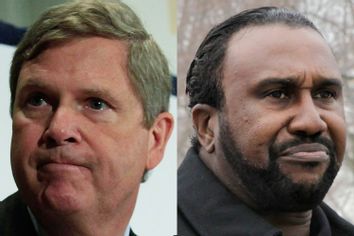
In February 2010, President Obama and Secretary of Agriculture Tom Vilsack promised an additional $1.15 billion to cover the remaining claims, but the story doesn’t end there. The settlement agreement mandated that Congress appropriate the funds by March 31 of this year. The deadline came and went with no action by Congress, and so the future of the settlement remains in limbo.
After years of Black Wednesdays, John Boyd founded the National Black Farmers Association, spearheading both the original lawsuit and the effort to reopen the Pigford case in order to allow the claims of the farmers who missed the deadline. Salon spoke with Boyd about the history of the lawsuit and what the missed deadline means for farmers.
What happened between you and the USDA loan officer in Richmond?
Mr. Garnett had made 147 farm loans in Mecklenburg County, Va. Only one of those loans was to a black farmer, and he was the minority advisor to the USDA county committee. When they investigated Mr. Garnett, they asked him, “Do you have a problem making black farm loans?” Guess what he said? He said yes. He said yes, I think that they’re lazy, and they’re just looking for a paycheck every Friday.
Mr. Garnett took my loan application and tore it up and threw it in the trash can while I was sitting there in front of him. And he said he wasn’t going to lend me any of his money. When I asked him why he wasn’t going to make the loan, he said, “Well, I don’t have any money now. If you want to come back again next year, that’s up to you, but I think you need to go ahead and just sell your farm. I’ve got a farmer, Mr. Blaylock, and you can milk cows on his farm. I think that would be the best opportunity for you and your family.”
I was mad. I was looking for a $10,000 operating loan to plant my crop. After nine years in a row I’d only gotten one loan from the USDA farm services, and I would apply every year.
I said, “Mr. Garnett, I don’t think I can go back and tell my wife that I’m not going to get an operating loan again.” And he said he didn’t care. And when he said he didn’t care, I told him to go to hell in a handbasket, and he began to use profanity, and he spit tobacco on my shirt.
When the investigator asked him, “Did you spit chewing tobacco on John Boyd’s shirt?” He said, “Well, yeah.” He claimed he accidentally missed his spit can.
When was this?
This was in 1994.
What was the result of the investigation?
In my case, they found Mr. Garnett guilty of discrimination. But they didn’t terminate him. They allowed him to move to the sister county, which is Greensville County, Va., and they let him retire after two months in Greensville. He didn’t see anything wrong with that.
This is a federal agency, admitting to racial discrimination in the very recent past. Why do you think more people aren’t getting angry about this?
I think many people don’t realize it. The problem that I have is that the USDA is the last plantation. I’m not using the past tense. It is the last plantation.
Hispanics have had problems, Native Americans, women — they all have problems with the USDA and its lending programs.
[Native American farmers filed a lawsuit, known as Keepseagle, alleging discrimination against the USDA in 1999. The case is currently unresolved. -- Ed.]
The USDA was the last federal arm of this country to integrate. It filed lawsuits in federal court to prevent it from integrating. And to me that [influence] exists today. The average subsidy to the top 10 percent of farms is over $1 million per farmer. The average subsidy to a black farmer is $200.
How can the disparity be so extreme?
Very few black farmers take part in U.S. farm subsidy programs. We have these programs that we should be participating in, and we’re not. I think it has to do with outreach, and a lot of it has to do with the “good old boys” system that remains in place. This is a system that needs to be revamped. That’s part of what our original lawsuit was about.
What is the history of the current claim and the $1.15 billion settlement?
Eighty thousand farmers filed claims after the deadline. You know, they didn’t know about it.
It took from 2000 to 2009 to get the case reopened. I spent eight years on [Capitol] Hill, getting the measure in place.
But Congress missed the March 31 deadline to appropriate funds. What does this mean for the farmers?
We’re going to miss another planting season, so that means more black farmers out of business.
The government announced the settlement like it was all over. They didn’t announce the settlement like there was another step that still had to be done. The farmers that read these articles around the country were thinking that they had money on the way. We’ve hired an additional phone bank to take all of these calls that are coming in about the cases.
I’m just hoping that the administration is going to help us get this done. The president is going to have to get involved. [Vilsack] released a statement saying that he was still committed, but the question is, committed at what level?
A billion dollars is not going to happen by itself. Let’s be real here. The administration is going to have to push it. The same way [Obama] was out there fighting for healthcare, he’s going to have to stand up with me and help us get this done. You can’t just go out there and say, “Hey, I did my part. It’s in the budget, it’s done.” The budget is like the president’s wish list. If you want to turn that into a reality, you’ve got to put a little elbow grease in there.
I’m so tired of going to funerals and saying, “He died before he saw his settlement.” I look at these families and say, “I’m sorry that your daddy didn’t see the justice while he was living, but maybe you will.”
Continue Reading
Close