Scott McLemee

“Punching Out”: The last days of a Detroit auto plant

A new book chronicles the dismantling of a hulking factory -- and the workers it leaves behind

  • more
    • All Share Services

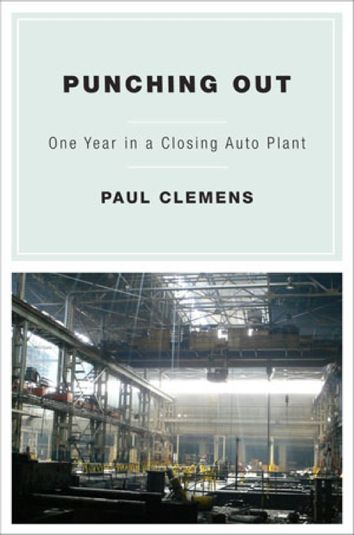
"Punching Out" by Paul Clemens

In the early 1950s, my friend Marty Glaberman wrote a pamphlet called “Punching Out,” reflecting on his experience of working in the auto factories of Detroit. Marty later became a professor of labor history at Wayne State University. But when you talked to him or read his writings, it was always clear that he’d gotten the better part of his education from his decades “on the line” — participating in the constant struggle of workers to retain their humanity as they coped with the unrelenting pace of the assembly line. That was what he tried to convey in “Punching Out”: the vitality of the working-class community that emerged on the shop floor. In Detroit’s factories, people were creating not just cars, but a way of life.

When Marty died, 10 years ago, the city of Detroit was already in bad shape — factories closing, people leaving, abandoned buildings going up in flames each Halloween in a grim festival of urban self-destruction. As it happens, Paul Clemens has given his new book “Punching Out” — which follows the dismantling of a Detroit auto factory — the same title as Marty’s essay from six decades ago. Evidently this is a coincidence; there are no references in the text to suggest otherwise. But either way, the echo is meaningful, for Clemens is writing about the destruction of both a workplace and a social world.

The workplace in question was the Liberty Motors plant of the Budd Co. , one of the oldest factories serving Detroit’s auto industry, opened in 1919. It stamped out the roofs, doors, tailgates and so forth that were then assembled into cars elsewhere. It changed hands in the 1970s and ended up as part of the German steel concern ThyssenKrupp. At its peak, 10,000 people were employed at the plant; by 2006, when it shut down, there were about 350 workers. A typical product of three decades of deindustrialization, then. As Clemens writes, the United States now has “more people dealing cards in casinos than running lathes, and almost three times as many security guards as machinists.” 

But “Punching Out” is not a retelling of the story of that decline. Instead, it is an account of what comes afterward — when the workers have been let go, the security guards posted to keep property from being stolen or destroyed, and crews brought in to dismantle the machinery and send it elsewhere (in this case, to Mexico, where a new factory is opening). The author gained access to the inside of the plant — wandering around its “eighty-six empty acres in the center of the city of Detroit” — during the long months it took to break it down. The executives of the ThyssenKrupp corporation weren’t helpful, but he became friendly with the guys doing the work, and his narrative is a blend of impressions from talking to them and what he could learn about the place from poking around in the ruins.

At times, “Punching Out” feels like a book in search of a thesis to pull it together, and Clemens admits as much. He is keen to avoid indulging in melancholy prose-poetry or cheap philosophizing about the “creative destruction” of postindustrial society. The real vigor of the book comes from its character sketches of the men who shrug off the label “vultures” as they go about their jobs.

In my friend Marty’s day, the factories ran constantly. You’d “punch out” at the end of a shift, but somebody else was walking in. Clemens calls his book the story of “the American working class mopping up after itself.” And then the lights go out. Nowadays what’s open all the time is the casino, where nothing is made, and scarcely anyone leaves as a winner.

Editor’s note: Marty Glaberman’s essay “Punching Out” is collected in this volume.

How Abraham Lincoln really viewed slavery

A new history explores the complex relationship between the president and the institution he abolished

  • more
    • All Share Services

How Abraham Lincoln really viewed slavery

Just after publishing “The Black Jacobins” (1938), his great history of the Haitian slave revolt, the Trinidadian man of letters C.L.R. James settled in the United States, where, in due course, he began to think of writing about Abraham Lincoln. The project that took shape in his mind was unusual. For one thing, James thought historians should look at history from below, with an eye to how the slaves had fought back against their oppression. He wanted to treat Lincoln as part of their story, not vice versa. But James also wanted the book he had in mind to discuss both Shakespeare’s play “King Lear” and the Russian revolutionary V.I. Lenin.

Barnes & Noble ReviewPeculiar as this may sound, it made a kind of sense. For James, Lear is the definitive picture of an old social order in the process of disintegration, while Lenin was the visionary architect of a new way of life (though James, as a fierce anti-Stalinist, had nothing good to say about what had been done with the blueprints meanwhile). In effect, Lincoln would appear in the middle panel of a triptych: the most Shakespearean of presidents, and one whose enemies saw him as a dictator.

Only fragments of the project were left behind when James died in 1989 — and I doubt very much that Eric Foner had any of it in mind while writing “The Fiery Trial: Abraham Lincoln and American Slavery,” which is as painstaking and straightforward a book as James’s would have been imaginative and idiosyncratic. But there is an affinity between them, even so. “The Fiery Trial” is not, strictly speaking, a biography of Lincoln; the attention is always focused on his relationship to slavery, with other aspects of his life and personality refracted through that question. And because slavery was the fault line running through the very depths of American society, each nuance or shift in Lincoln’s attitude is charged with enormous implication. Foner shares James’ feel for how a leader’s outlook is shaped by (and then responds to) tensions unfolding on the world’s political stage.

Foner is one of the great contemporary U.S. historians, and one doesn’t want to go too far with comparing this book — in some ways a prequel to his 1988 book “Reconstruction: America’s Unfinished Revolution, 1863-1877″ — to a work of drama. But his method throughout “The Fiery Trial” takes advantage of the fact that we, the audience, know something the main character cannot: that the attitudes towards slavery expressed in his early life (when he hated it while also keeping his distance from abolitionism) are so many steps along the way to the enormous cataclysm of the Civil War. Foner takes care to emphasize Lincoln’s own words as they were recorded at the time — not the later recollections of them by people who knew, as we do, what was coming.

He registers each little shift of attitude and widening of perspective along the way, while continuously situating Lincoln’s opinions (and his occasionally maddening silences) in the context of the debates of the time. While there is no reason to doubt the statement, near the end of his life, that he had always hated slavery, that revulsion reflected a sense that it was morally damaging to white people — much like alcoholism. Like other reformers of the day, he saw “genuine freedom as arising from self-discipline rather than self-indulgence,” writes Foner, “something violated by both drinkers and slaveholders, who allegedly lived according to their passions.” This Calvinist streak was accompanied by a policy wonk’s sense of how the problem could best be solved — through compensating slaveholders for emancipation while relocating freed slaves to Africa.

So much for trying to patch over a crack in the foundation. In time, Lincoln shared the conviction that the country faced “an irrepressible conflict between opposed and enduring forces” that would make it “either entirely a slaveholding nation, or entirely a free-labor nation,” to quote a famous speech from 1858 by William H. Seward, his future secretary of state. But Lincoln remained persistent in trying to pursue gradualist efforts to eradicate slavery, well into the Civil War — with no regard, most of the time, for any notion that black people might have a say in the matter.

Foner is too serious a historian to editorialize about how Lincoln was a racist. Sure he was; the point is cheaply made. But as ex-slaves throw themselves into combat against the Confederacy — and the need to destroy the old system, root and branch, becomes inescapable — Lincoln begins to develop a conception of African-American citizenship with implications that can only be called radical. This is a powerful book, confirming the point that C.L.R. James often made: A leader, however farsighted, may unleash forces that then push him further than he ever imagined going.

Continue Reading Close

The Best Of Crank!

Scott McLemee reviews 'The Best of Crank!' by Bryan Cholfin.

  • more
    • All Share Services

| At the end of the millennium, prosperous urban hipsters have discovered the retro-futurist look. (So the papers report; I don’t know anyone that cool.) Their apartments are decorated ` la the Jetsons — except, of course, for the robot maid, though inexpensive flesh-based units are still on the market. There is something quaint and charming about reviving old-fashioned visions of the push-button future. And as Bryan Cholfin writes in the introduction to “The Best of Crank!” that cozy spirit also prevails in science fiction writing nowadays. “Much of the new SF, in particular the short story markets, looks backwards into the literary past,” he complains. “The writers and editors increasingly turn to the ‘Golden Age’ of SF (generally meaning the ’40s and ’50s), viewed through the filters of nostalgia, for the models to emulate.”

The stories in Cholfin’s zine Crank! defy this trend. The editor waxes manifestolike about “the creative hybridization process already under way” between science fiction and the rest of imaginative writing. In a way, this is fighting an old battle. In the ’60s, the New Wave writers made similar complaints and commitments — and wanted SF to stand for “speculative fiction” (which pissed off a lot of people). Many stories from Crank! could have appeared decades ago in Harlan Ellison’s “Dangerous Visions” anthologies. A high compliment indeed; but that such work is still marginal suggests how conservative things have gotten.

Two pieces here are set in historical realities just alternative enough to cast an odd light on the one we live in. “Receding Horizon” by Jonathan Lethem and Carter Scholz has Franz Kafka escaping to America, where he gets a job writing screenplays for Frank Capra. Somewhat less subtle is Rob McCleary’s “Nixon in Space,” which recalls the ex-president’s pathetic efforts to go to the moon: “Nixon left, embittered, and ended up selling his garbage to souvenir hunters to pay the bills. The real reason NASA didn’t want him was that they were afraid his known tendency to sweat like a pig would short circuit the electrical system in the space capsule.”

A number of stories are fractured fairy tales — with kings and wizards and spirits often pulling double duty as elements in feminist allegory. Lisa Tuttle’s “Food Man” is a memorably nauseating treatment of eating disorders and sex. And Gwyneth Jones’ “The Thief, the Princess, and the Cartesian Circle” is about dysfunctional families and the pleasures of self-mutilation. Other work drifts off into the theological and/or the surreal.

About half the work here is simply OK — no better, if also no worse, than some story where Professor Frink explains his Oscillating Gizmotron. But the best of “The Best of Crank!” is excellent. No one who knows SF will be surprised that Ursula K. LeGuin’s contribution is a gem. “The Matter of Seggri” is set on a world where some ancient trick of genetic engineering rendered human males a rarity. The culture has evolved so that “the men have all the privileges and the women have all the power.” This sounds like the prelude to a terribly obvious satire. But LeGuin works out the social structure and the emotional nuances with a fine touch — including a piece of Seggrian romantic fiction (a form considered mildly dangerous by conservative women).

And “I, Iscariot” by Michael Bishop is a tour de force. An electronically simulated trial of Judas leads to a subtle probing of the biases of the Gospel writers. Meanwhile, in online chat rooms, the public quarrels over evidence and defense strategy, just like with O.J. The story is bound to seem like heresy to any Christian fundamentalist — or science-fiction traditionalist — and a dangerous vision of what SF can be.

Continue Reading Close

I Married A Communist

Scott McLemee reviews 'I Married a Communist' by Philip Roth

  • more
    • All Share Services

Only Philip Roth could have written “I Married a Communist”; the man’s fingerprints are everywhere. You may think of Roth as a novelist of great comic extravagance, his satirical imagination controlled by a realist’s sense of detail. Or you may scramble for the exit at the thought of one more book revisiting his core obsessions, namely: 1) the libido and its discontents; and 2) anti-Semitism, particularly its most convoluted form, Jewish self-hatred. These form two sides of a coin that has become a prop for Roth’s narrative tricks, in which mirrors have become crucial to the magic act. Even Roth’s literary alter ego, Nathan Zuckerman, writes novels in which he creates alter egos. No American writer has put himself in greater danger of disappearing up his own keister.

With his most recent work, though, Roth has been climbing back out. As in “American Pastoral” (1997), Nathan Zuckerman’s attention returns to radical politics, and the new book takes place between the fateful election season of 1948, during the last gasp of Communist influence in American political life, and the era of McCarthyism. Chronicling that important transition is part of Nathan’s ongoing inventory of his own psyche, but it also anchors the book in public history.

As a teenager longing to write radio plays, Nathan is thrilled to discover that his high school English teacher’s brother is Iron Rinn, star of a popular serial about the struggles of the common folk. For a time, Nathan and the actor (born Ira Ringold) become close friends. The novel unfolds as Ira’s brother Murray fills in the gaps of Nathan’s recollection, decades later. Nathan found in Iron Rinn a surrogate father: more serious and less politically compromising than his biological parent. Only with the passing of time can Nathan grasp the complexities of his hero’s marriage to Eve Frame, a legendary silent-screen actress.

As intense as the anger that fuels his political seriousness is Ira’s conviction that, should push come to shove, he could return to the masses. Bourgeois life has not made him yield his ideals, at least on anything important. And push does come to shove. Not only is he blacklisted, but when his marriage falls apart, Eve rushes into print with the exposi that gives the novel its title.

This novel’s intricate development makes it considerably more engaging than a bald plot-synopsis might suggest. With luck, a reader might even forget that it is a reply to Roth’s ex-wife, actress Claire Bloom, whose tell-all memoir might as well have been titled “I Married a Clinically Depressed Narcissist.” As Ira’s brother muses, “Nothing so big in people and nothing so small, nothing so audaciously creative in even the most ordinary as the working of revenge.”

Beyond the glint of the knife in its passages of psychological dissection, the novel does a fine job conveying the feel of late 1940s-style American communism, at least in its pop-culture manifestations. The effort to infuse the language of the common people with epic grandeur, the populist sentimentality, the weird combination of Norman Rockwell and Stalin’s “Problems of Leninism” — the whole corny sensibility is rendered here in both its most appealing and its most self-deluded forms.

The picture of McCarthyism is less ambivalent. “When before had betrayal ever been so destigmatized and rewarded in this country?” asks Murray. As Roth licks the wounds to his ego, the novel invokes the birth of media as cultural terrorism. It was an era in which the public discovered “An interesting, manipulative, underground type of pleasure in which there is much that a human being finds appealing.” If not appealing, hard to avoid. Now more than ever.

Continue Reading Close

Master of allusion

When a philosopher creates a video game about Vegas, the payoff is fascinating but elusive.

  • more
    • All Share Services

Mark C. Taylor, a professor at Williams College best known for his work combining Derrida and radical theology, may be the first American philosopher to embed his thought in a computer game.

Last year, in conjunction with Taylor’s “Hiding” — a collection of essays on the surfaces, mysteries and depth(lessness) of postmodernity — the University of Chicago Press released a CD-ROM titled “The Real.” A fusion of post-apocalyptic sci-fi with Las Vegas kitsch, “The Real” is set in 2033, with the gambler’s paradise completely buried in sand — except for a dilapidated motel, presided over by a melancholy figure known as the Janitor. While installing the game on your C drive, you learn from the packaging that the Janitor is Professor Taylor, who created “The Real” in collaboration with designer Jose Marquez (identified therein as “Cabin Boy”).

So how do you play a philosophical computer game? Patiently. The skills acquired from Donkey Kong avail you nothing in “The Real.” Once signed into the motel “guest book,” the player is presented with a slot machine. A handwritten message appears on screen: “Pick up the token below and deal it or tip it and pass the time away. If you get tired, give it up.” Dropping a blue chip into the slot and pressing “tip” causes a pensie or koan to scroll by on the Times Square-like message board at the top of the screen — one apothegm per chip: “How to build a void without avoiding building?” “If image is the materialization of desire, desire is immaterial.” “The real has become our illusion.”

A red chip gets you something more visual, if no less cryptic. The face of the slot machine fills up with material from the Janitor’s scrapbook. Music (ranging from country to rock to the faintly Giorgio Moroder-ish) and occasional voice-overs pour from the computer speakers. The 52 sections of the scrapbook contain an anecdotal history of everyday life before the desert took its revenge on the casinos: There are articles from newspapers (“Liberace Impersonator Eats Baby Piano”) and narratives (an Algerian grad student at Brown gives up on writing a dissertation and becomes a clown in Vegas) and gloomy, murky collagelike images aplenty.

At the end of each segment, you get two more chips, one red, one blue. Sometimes they dematerialize as you go to pick them up. Even so, you get another “page” and another Jenny Holzer-like “tip” to contemplate — for example, “Vegas is the culture of death brought to life.” There are no points to score, no reflexes to test — and messages scrolling past sometimes make fun of the player. “Staring at the screen is less productive than staring at a mirror,” the screen says. Or, “The time has come for you to go outside.”

If winning is not the name of this game, losing certainly is. The Janitor’s scrapbook is a documentary record of loss: death, disappointment, shady real estate speculation. And in notes for the project (available, with much other documentation, at its Web site), Taylor quotes Edmond Jabes: “You do not go into the desert to find yourself but to lose yourself.”

“The Real” did leave me musing solemnly over Being and Time (as in, “Well, that’s two hours of my life I’m never getting back”). Nor was it quite clear how the CD-ROM interfaced with Taylor’s book, “Hiding,” which ends with a manifestolike chapter on how networks serve to deconstruct the metaphysical oppositions between system and subject, chance and design, stability and volatility. How did that relate to the book’s discussion of Vegas as the locus classicus of postmodernity?

This confusion was, perhaps, an effect of how I had read “Hiding”: in none too linear a fashion, absorbed (yet distracted) by its abundance of fashion advertisements, sidebars and reproductions from 19th century treatises on phrenology.

And so, perplexed, I contacted Taylor — via e-mail and telephone, naturally. “‘Hiding’ was designed to be as close to the experience of multimedia and hypertext as possible, while still being a book,” he explained. (Logging in to the text at random suddenly seemed perfectly justified.)

Given this fusion of medium and message, it was surprising to hear Taylor deny any particular interest in the work of Marshall McLuhan. “He was never formative for my own thinking,” he stated, “though I did reread him after starting this work. No, everything I do evolves out of an interest in Hegel and Kierkegaard and Nietzsche, and later, Derrida. That’s where I came from, and what I keep going back to.”

That applies to “The Real,” as well — and at least partly explains its relation with his most recent writing. “My argument in ‘Hiding’ includes the idea that Las Vegas is the logical culmination of what began in the late 18th century, at the University of Jena, where Hegel taught, and where Schiller wrote ‘On the Aesthetic Education of Man,’” he explained. “The Romantic thinkers shifted the axis of the world from theological transcendence to the creative activity of man, especially in the artwork.”

Continuing this trend, one current in the 20th century avant-garde (from the Russian Constructionists through Andy Warhol’s Factory) sought to efface the distinction between the work of art and its mechanical reproduction. The apotheosis of this trend appeared in the deserts of Nevada: a neon oasis, filled with great big signs. “Las Vegas is where reality and image have converged,” Taylor says. “It’s virtual culture on display in its most spectacular form.” Hence the postapocalyptic setting of “The Real”: one step beyond the collapse of reality into image, an adventure among the ruins of the virtual.

Taylor’s impromptu lecture (with me on the other end of the phone as his sole audience) was vigorous, engaging, a bit dazzling. I got a feel for why the Carnegie Foundation for the Advancement of Teaching named him Professor of the Year for 1995.

His CD-ROM is, Taylor notes, dense with allusions: “Hegel, Lacan, Baudrillard — it’s all there, but invisible, or at least transformed. The humanities are going to have to confront and embrace the possibilities of multimedia and hypertext. This project is carrying the notion of writing as performative to the next level.”

A provocative thought! Somehow it makes me want to go reread “Hiding” — maybe even from start to finish.

Continue Reading Close

New JFK death film

The digitized Zapruder film cannot dispel lingering questions about JFK's assassination.

  • more
    • All Share Services

When “JFK” was released in 1991, Oliver Stone talked excitedly about the great speed of the film — the enormous number of cuts, yanking the viewer back and forth between Technicolor and grainy black-and-white, between clips of actual news footage and purely imaginary scenes (with only the most fragile roots in reality).

“It is like splinters to the brain,” the director enthused. “We were assaulting the senses in a kind of new-wave technology. We wanted to get to the subconscious.” Stone’s vision of himself as tribal shaman (blowing the public mind with stroboscopelike editing, rewriting history with lightning flashes of imagery) sounds quite a bit like the poems Jim Morrison wrote while in film school, before joining the Doors:

Cinema is the most totalitarian of the arts. All
energy and sensation are sucked up into the skull,
a cerebral erection, skull bloated with blood …

– and so forth. These very ’60s-ish notions found their ideal expression in Stone’s telling of the assassination of John F. Kennedy. For if you assume that film reaches down into primitive and concealed layers of the psyche, you can’t find a better subject than the most archetypal of rituals, the killing of the king.

That event is shown repeatedly (minus the trippy overtones) in a newly released videotape, “Image of an Assassination.” Of all the evidence concerning the Kennedy assassination — running to more than 17,000 printed pages of the Warren Commission hearings — the Zapruder film exerts the greatest fascination. With a hand-held camera, Abraham Zapruder recorded the presidential motorcade during the crucial moments before, during and after the sniper fire. Those 26 seconds of film have been searched endlessly for clues. They offer the promise of almost direct access to the moment of truth. In an analysis of the film published by the American Journal of Physics in 1976, Nobel Prize-winning scientist Luis Alvarez gave the most concise statement of what researchers have always believed about the testimony of Zapruder’s camera: “It doesn’t have the normal human failings.”

The images themselves — the waving president and first lady, Kennedy’s grab at his throat, the cloud of blood hanging in the air, Jackie’s lunge across the back of the limousine just before it speeds away — have burned the film into the collective memory in a way no auteur could imagine. And Stone, for one, acknowledged that fact, indirectly. The Zapruder footage, as he told an interviewer, formed the “core” of his docudrama. He interrupted the movie’s speed-freak pacing long enough to show the Zapruder record “frame by frame, detail by detail, again and again. To see the president’s head blown off in this way hits you in the gut, at the subconscious level. It is the moment in every movie theater where there is a collective gasp by the audience.”

The new video presents a digitally processed edition of the original, now held at the National Archives. Most of the scratches and dust have been cleaned up using computer techniques. And the transfer incorporates a strip of film (now filling the left quarter of the screen) never visible during previous showings of the footage. A documentary, running a little more than a half hour, traces the history of the Zapruder footage and the details of the digitization process. Then follows six showings of the film itself, at various speeds, with different kinds of focus.

The cover box is tasteless (“Includes a never-before-seen version
of President Kennedy’s assassination! A collector’s item for all
Americans!”). But it’s no overstatement to say that
watching the digitized version is like seeing the Zapruder film anew.
The color, resolution and additional detail are unlike anything
available before. And thereby hangs a tale. For if the Zapruder film left
its mark on the national memory over the past 35 years, it got there most
often through bootleg copies, circulated mainly by conspiracy theorists.

When Life magazine reproduced a number of stills from the Zapruder footage just
after the assassination, the publisher decided that Americans should be
spared the trauma of viewing its most grisly images. He purchased all
rights to the film and withdrew it from public circulation for the next
several years. (In 1975 the rights were returned to the Zapruder estate,
which then deposited it at the Archives.) But while sequestered, the film
began its underground existence. Volume 18 of the unabridged Warren
Commission Report included frames from the crucial sequence, and some
enterprising soul managed to put together a crude re-animation of the
black-and-white reproductions. Another researcher, allowed to watch the
Zapruder film in the Life archives, surreptitiously filmed the images off
the screen using a hand-held camera of his own. (These details are
omitted from the new video.)

In the late 1960s, the Zapruder film was subpoenaed during the trial of
Clay Shaw — a Louisiana businessman accused by Jim Garrison (the hero
of Stone’s docudrama) of organizing the Kennedy assassination. Garrison
never proved much of anything, except, perhaps, that New Orleans is a
very strange place; but his legacy to the world of assassinology was
enormous. While the Zapruder film was in his possession, Garrison tended
to mention its whereabouts to others involved in studying the events in
Dallas. If someone decided to run off a copy when he stepped out of his
office, what could he do about it? Not much! More than 100
“Garrison bootlegs” thereby got into circulation. And from them, other
boots were made.

The turning point came in 1975, when the footage was shown to a national
television audience for the first time. The occasion was a late-night
talk show hosted by Geraldo Rivera. An excerpt from the program is
included on the new video, which is in its own way a slice of broadcasting
history.

The youthful Geraldo, wearing lapels as big as his head, gives off an
almost electric charge of countercultural fervor. His guests include a
JFK assassination researcher, who narrates as his own Zapruder bootleg
runs, filling the television screen. It is not as muddy as some copies in
circulation at the time, but should give today’s viewer a sense of the
improvements in visibility with the digitized version.

The crucial moment is what conspiracy theorists know, with a certain
morbidly affectionate familiarity, as “Z-313″ — that is, frame 313, in
which the president’s brains get blown out, and his head snaps backwards.
Thus proving (as Geraldo’s guest says, and many have repeated) that there
must have been a marksman firing from somewhere in front of the
motorcade, probably at the “grassy knoll” in Dealey Plaza; otherwise, if
the fatal bullet had come from the School Book Depository, behind
Kennedy, his head would have fallen forward. That interpretation is in
fact very much open to dispute. The nerves and muscles in the human body
make it respond to force in ways somewhat more complex than a sack of
potatoes.

But the television audience is not concerned with nuances. Everyone in
the studio gasps. Geraldo says, “That was heavy.” And cut to a commercial
break.

In the intervening decades, the images have grown more familiar, if not
less powerful. After watching those 26 seconds more times than I can
count, the impact of Z-313 is still visceral. And within the milieu of
JFK assassination investigators, a shift in attitude is evident. For
years, the
Zapruder footage was a fabled object, rare and virtually unobtainable.
Studying the film closely might reveal the truth about what happened in
Dallas. It was the closest thing to being there.

But now the aura has worn away. The theory has lately been argued — at
great length and in microscopic detail — that the Zapruder film has been
tampered with, somehow, during all those years in the custody of Life
magazine or the National Archives. Suspicion feeds on suspicion.

As noted, the images on the new video have been passed through high-tech
enhancement processes. Which is not the sort of detail to be overlooked
by someone who wonders if, perhaps, “They” didn’t instruct Zapruder to
take his camera, that morning. (Such has been speculated by residents at
alt.conspiracy.jfk.) In the early 1960s, director Jean-Luc
Godard defined film as “Truth, at 24 frames per second.” That, for a long
time, was the implicit faith of the small audience devoted to the
Zapruder film. Technically, however, it runs at about 18.5 frames per second.
And even in a restored and stomach-turningly vivid edition, Truth
disappears, somewhere between the sprocket holes.

Continue Reading Close

Page 1 of 3 in Scott McLemee