Shana Ting Lipton

Just say Yes

Gold bodysuits, giant inflatable phalluses and an orangutan mascot for gay divorce. With a new book and movie, the Yes Men prepare to take their activist performance art to a whole new level.

  • more
    • All Share Services

Just say Yes

The four male figures standing in the moonlit yard of a Los Angeles hillside house are plotting strategy. And central to it is the 6-foot-tall tree, with bug eyes and a black ministerial hat, standing in front of them.

“That’s Smokey the Log, our mascot,” explains Mike Bonanno. He and his partner, Andy Bichlbaum, together known as the political prank team the Yes Men, plan to use Smokey the Log in their latest act of activism/performance art. Smokey, it seems, will be deployed during the group’s bus tour of presidential swing states to persuade voters to sign petitions stating that they are supporting President Bush’s forestry policies and are “promoting global warming,” Bichlbaum says.

The Yes Men are sort of like “Jackass” for the MoveOn set, except they set the artistic bar a bit higher. “‘Theater’ is basically the closest word we could use to describe what we do,” Bonanno says, adding emphatically: “It’s protest, it’s theater, it’s performance art. It’s identity correction.”

Their pranks are reaching a broader audience this week with the release of their book and documentary film (opening Friday in New York and Los Angeles), both called “The Yes Men.” Impersonating Republicans and members of the World Trade Organization, they have attended conferences and spoken on television, expressing what they believe to be the unfiltered and uncensored agendas of their nemeses. And — to further aggravate their NEA-bashing foes — they’ve received grants to pursue their passion: a Guggenheim new-media grant, a California Institute of the Arts Alpert grant for film and video, and an experimental/new genres grant from Creative Capital Foundation in New York.

“When it comes down to it, we like to think that we’re telling the truth,” Bonanno says. “If anyone took us to court they would be doing their own identity a disservice.”

“The Yes Men” chronicles Bichlbaum and Bonnano’s prankish “Identity Correction” projects as they impersonate their initial target, the World Trade Organization, online, on television and at business conferences around the world. In the film’s climax they make it all the way to Tempere, Finland, for a business conference on textiles where Bichlbaum transforms himself into “Hank Hardy Unruh, WTO representative.”

Amid a roomful of a dozen or so unassuming attendees, he gives a lecture explaining that the problem with slavery in the United States was not an ethical one, but its lack of cost-efficiency. The stunned audience is speechless until Unruh’s assistant (Bonanno) helps him further the presentation by yanking off his breakaway business attire to reveal a skintight gold lamé jumpsuit. The conference-goers gasp.

“This is the management leisure suit,” Unruh proudly proclaims. With another tug at his groin, a large phallus with a mock television screen at its tip inflates from his waist. This schoolboy’s accidental nightmare is the intentional climax to the Yes Men’s political theater of the absurd. Unruh paces around, gold protrusion bouncing with each step as an instructional video shows how the businesses of the future will monitor workers through the strange TV penis he’s demonstrating. The baffled audience applauds, and as seems to usually be the case, “nobody gets it,” Bichlbaum says, resigned.

New York natives Bichlbaum, 40, and Bonanno, 36, met eight years ago and immediately hit it off. The two had both taught university courses in new media, and “we were both politically active in our different ways,” Bichlbaum says. “People we knew introduced us to each other because we had done similar projects.”

Their first Yes Men foray was conceived serendipitously in 1999 while they were working at the anti-corporate Web site ®™ark. They received an e-mail from someone who had registered the domain name www.gwbush.com asking them to create a site spoofing Bush’s election platform. Bichlbaum and Bonanno got to work. They graphically fashioned it after the real Bush campaign site (www.georgewbush.com), sans flowery political rhetoric. Instead, they unabashedly offered the platform: “To help the rich at the expense of the poor and the environment.”

At a press conference shortly after the mock site went live, a reporter asked the then-presidential hopeful to comment on it. An outraged Bush exclaimed, “There ought to be limits to freedom.”

After that, Bichlbaum and Bonanno obtained the domain www.gatt.org (“GATT” being the abbreviation for General Agreement on Tariffs and Trade). They set it up to look like a World Trade Organization site, complete with a contact e-mail. When they started receiving invitations to appear at global business conferences and on television by people who wished to reach the WTO, they decided to launch their breed of live-action political theater.

“We kept upping the ante,” says Bichlbaum. And so WTO characters like Hank Hardy Unruh and Granwyth Hulatberi were born.

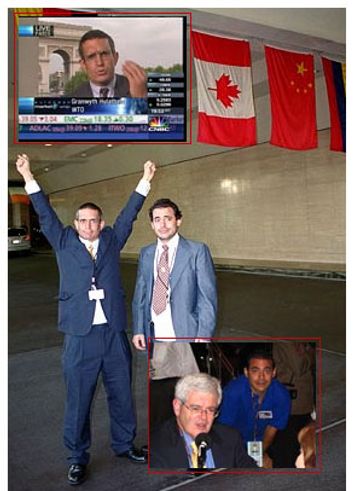
During a July 2001 appearance on CNBC’s “European Market Wrap,” Hulatberi appeared to discuss the upcoming protests against the G8 meeting in Genoa, Italy. Among his suggestions: a market for human rights violations, so that countries that want to abuse their citizens can buy “justice vouchers” from those who don’t. The show’s host took it in stride, but fellow guest Barry Coates, from the activist World Development Movement, was livid.

More people were introduced to the Yes Men via their recent high-profile escapades at the Republican National Convention in New York City, which earned them the title of “prankster invaders” in the New York Times. Doesn’t this mainstream media coverage put them in danger of being recognized? “Our target audience, swing voters, doesn’t read the New York Times,” Bichlbaum says.

He and Bonanno crashed the convention in Madison Square Garden disguised as Republicans. “People gave us their press credentials,” Bonanno admits. Once inside, they passed out more than 1,000 fliers asking folks to “Take the U.S. Patriot Pledge” and volunteer to have a permanent nuclear waste storage facility in their communities. And they made friends. Bichlbaum ingratiated himself to Energy Secretary Spencer Abraham, getting his photo taken with him. “He was probably the only rabid fan that Spencer Abraham had ever seen,” Bonanno jokes. Bichlbaum pipes in: “Mike got a photo of himself crouching behind Newt Gingrich!”

If the unique photographs weren’t enough to earn them a red shooting star on eBay, the Yes Men snagged another invaluable souvenir that would certainly be sought after: the 210-page script from that day’s RNC speeches. Found on the floor next to a garbage can, the teleplay included Arnold Schwarzenegger’s prime-time speech. “It had scripted pauses, as well as spontaneous eruptions from the audience,” Bichlbaum notes. “We also saved a list of delegates’ names and addresses. We can use it as a mailing list for something,” Bonanno adds impishly.

The Yes Men don’t have specific plans on how they will use this material, but they know that other opportunities for more political pranks will come up (all of which will be chronicled on the Yes Men’s Web site).

What sets the Yes Men apart from other political pranksters is the elaborateness of their disguises. They conduct interviews and online research and can create a mean PowerPoint presentation on short notice. An experienced special effects designer, Sal Salamone (who recently contributed his work to the hit musical “The Producers”), creates the elaborate costumes, like the Studio 54 homage to indentured servitude that Bichlbaum wore in Finland and the majestic Smokey the Log suit — two weeks in the making.

Salamone is also debuting another Yes Men “character,” a sort of party gorilla for the James Brown fan who votes — an orange orangutan sporting funky sunglasses and a suit made of (you guessed it) gold lamé. The satirical simian and the lovable log are part of the traveling “Yes, Bush Can” tour.

As they make their way through the swing states in a large white van, campaigning heavily through Nov. 2, the Yes Men will ask potential voters such loaded questions as: “Will you sign a petition supporting Bush’s tax cuts for the elite?” “Orren,” their orange orangutan, will serve as the Bush administration’s environmental policies mascot. Orren made a test run just last week in San Francisco’s Castro District as the Diversity Compassion Orangutan, there to support gay divorce on behalf of the Bush-Cheney campaign. (Specifically, he was promoting a preemptive annulment program for potential gay marriages, fully explained in this leaflet.)

Of course, this derision toward the president, his party and their politics is par for the course in this epoch of rebellious pop-culture politics. Controversial filmmaker Michael Moore — who makes a cameo appearance in “The Yes Men” — is chief among its patrons. Bichlbaum and Bonanno are slowly gaining a following from the underground up for their unique brand of highly organized but absurd comedic protest.

The Yes Men are in good (albeit odd) company among anti-administration groups like Guerrilla News Network (online uncensored hard news from the underground) and “F**k the Vote” (a satirical campaign to trade sex for votes against Bush). “Bush has been a real good leader of the activist community,” Bichlbaum says.

Yet, despite all the Bush-bashing, Bichlbaum says that not much will change for the Yes Men if the Oval Office occupant changes. “If Kerry wins, it’s not going to be over,” he says. “This momentum is going to have to carry us past November.” He believes that when people see the type of political protest that the Yes Men and others do, they will become “addicted to it, because it’s so fun.”

“Six Feet’s” muse

The eerie photos at the center of a "Six Feet Under" plot turn get an L.A. artist the audience he always wanted. But is Claire Fisher getting all the credit?

  • more
    • All Share Services

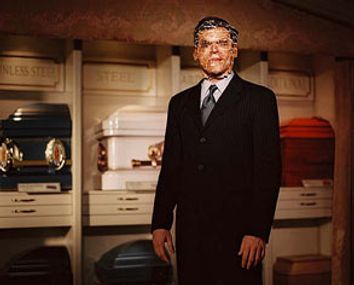
The denouement of this season’s “Six Feet Under” (season finale Sunday, 9 p.m., on HBO) focuses on creativity itself. Claire (Lauren Ambrose) and her ex-boyfriend Russell (Ben Foster), both art students, are lounging around her apartment stoned. Russell rips out the eyes from a photo of Claire and places them on her lids. She asks him to take a picture, and a photographic concept is born — one that gives Claire status and a gallery show, but leaves Russell unrecognized.

David Meanix, the Los Angeles artist responsible for the haunting and disturbing photo-collage portraits used in the show, is a real-life Russell. In a bizarre postmodern media twist of life imitating art imitating life, he has been glued to the television each week watching Claire get the credit for his brainchild. He admits to having the same fear as Russell: “I don’t want to be unrecognized and have it be ‘Claire’s work.’”

But mostly, he’s thrilled to have an outlet for his work. “I was a huge “Six Feet Under” fan,” says the previously unknown Downingtown, Penn., native who pushed hard for his artwork to be on the hit program. “The minute they hinted that Claire was going to art school, fireworks went off telling me that my work should be Claire’s work.” For two years he hounded Emmy-nominated art director Suzuki Ingerslev.

She finally caved. He was commissioned to do portraits of David (Michael C. Hall), Nate (Peter Krause), Ruth (Frances Conroy) and Anita (Sprague Grayden) to be used on the show. The four-hour process began with Meanix photographing the actors with a 35-mm camera with a macro lens, shooting minute swatches of each part of the face, “focusing on the pores.” He printed the photos in actual size, color-copied them, ripped them, and then plastered each paper shard back onto the face, creating the puzzlelike “mask.” Each actor donned the dry mask to pose for a final portrait photograph. Krause was lucky that the props department already had a model of his face on hand (from another season’s ‘death fantasy montage’ sequence), so he didn’t have to suffer through the plaster facial.

Meanix hopes to do more, “that people will be daring enough to sit through the process to get their portraits done.” Despite the hours of stillness involved, the artist says that his work is about motion and dimension. “I’m inspired by anything that captures the grace of movement, that brings photography into three-dimensional space,” he continues, “Like dance and sports photography, and the work of Herb Ritts.”

Meanix also cites British artist David Hockney as an influence. Ironically (or not?), on the show, Claire’s teacher compares the artwork to Hockney’s collage photography, yet back here in the school of hard knocks, Meanix admits, “No one’s pounding down my door [to buy the work].”

But he has managed to create a cultish buzz around his work in L.A.’s hip inter-media circles. West Hollywood artist Jena Cardwell first encountered his art in a little gallery in the San Fernando Valley. As an avid “Six Feet Under” fan she was pleasantly shocked to revisit it in the show. “I was totally blown away. It’s different than anything I’ve seen,” she enthuses.

Meanix’s process has also evolved from the rudimentary black-and-white versions of his collage portraits to the show’s rich contextual color images (Ruth Fisher, for example, sits at the dinner table for her portrait). Beyond this, Meanix is trying to delve further into the realm of 3-D by creating photo-collage portrait busts. He explains: “My next thing is to focus on a new body of work,” literally and figuratively. His latest piece, a 3-D body sculpture of a nude man, lies in the middle of the floor of his atelier, like a “human” pet.

Nevertheless, the “Six Feet Under” series of works is creatively raw, which is what makes it interesting as well as believable as the fabrication of a rookie artist. “I like the amateur feel of my work,” Meanix says. He recalls coming up with his “photo-sculpture” technique in the early ’90s, when he was “a big stoner too.” Like Claire, he had started out doing a lot of more traditional self-portraits while studying interdisciplinary art at San Francisco State University. As he explored the collage concept, it developed into his senior project. But because he was late turning it in, he never got his official classroom critique.

Things have a way of coming full circle. Almost a decade later, Meanix sat in front of a TV set surrounded by friends, transfixed as a classroom of wide-eyed art students and a teacher investigate his creative work. “It was so weird. It was amazing,” he recalls. “I feel like I finally got the great crit that I never had.”

Continue Reading Close

The ‘stache is back

It's fuzzy! It's scuzzy! And it's adorning upper lips all over L.A.

  • more
    • All Share Services

Last month, a 34-year-old Los Angeles photographer named Dan Monick was invited to a mustache birthday party that a buddy of his was throwing for two girlfriends. The invite showed a picture of the two women, altered in Photoshop to make them look like Frida Kahlo and Salvador Dali. Monick, who has a real ‘stache, went to the gathering and found himself in mustache heaven: fake fuzz, real fuzz, on men and women alike.

It’s not a party until the cops show up, and this turned out to be a real blowout. “The police were chasing some dude who ran into the party and ran out the back door,” explains Monick. “It’s like 3 in the morning on Sunset Boulevard and the cops, all of whom have mustaches, come running into a mustache party.”

The police promptly ticketed some of the partygoers who were drinking in front of the house. So much for hirsute solidarity.

It’ s “Magnum P.I.” all over again. Just flip on MTV: The Foo Fighters’ frontman, Dave Grohl, has a goatee mustache hybrid, drummer Taylor Hawkins has the real deal (upper lip only). Doctor Matt Destruction of the Hives sports a ‘stache, and so does funky rapper Har Mar Superstar. But Angelenos aren’t growing facial hair just to mimic their favorite rock stars. No, L.A. is host to the mustache revival because everyone here likes to play a role: daddy, cop, stud, lounge singer, dictator and, lest we forget, porn star.

Flash-forward: It’s Tuesday night at the Three of Clubs, an amber-lit dive bar on Santa Monica Boulevard and Vine. It’s unusually crowded for a weeknight. The main draw: Tattooed Hollywood scenester Cali Dewitt is tending bar. Not only is he serving drinks, he’s serving them while wearing an oversize baseball cap and sporting a new, floppy mustache. He might blend in just fine over at the Hooters in Fayetteville, Ark., but in Hollywood, he’s getting all sorts of attention. And not just because he’s Hollywood gorgeous. Roars can be heard from regulars, apparently seeing his new look for the first time. “Why? Why?” asks one brunette incredulously. Dewitt explains that he’s grooming himself in preparation to accompany his brother’s band on tour. His plan, he says, is to be the “belle of the bus.” This isn’t a retro trend for him. And he’s not doing it to pick up guys. Dewitt is straight — he just thinks ‘staches are “cool.”

Traditionally, it’s been gay men who appropriate (and usually improve) hetero fashion. But in L.A., it’s always been hard to tell gay from straight; now mustaches are blurring the lines even more. Now that the “sensitive New Age guy” period is over, straight men are rediscovering their “masculinity” through the mustache. When viewed as part of a costume, it’s just over-the-top enough to offer a couched and disassociated peek into all aspects of manhood.

Just hours away from L.A., at the Imperial Palace in Las Vegas, nine mustached men in their late 20s meet up for an annual event they call Mustacho Basho. Once a year, it’s déjà Village People. The styles range from “Fu Manchu” and “softball player” to, yes, “Hitler.” (The Saddam look does not seem to have taken off.) The accompanying outfits are equally diverse. One guy, working a ’70s hustler look, wears tight denim shorts and a green vest sans shirt. Another brings class to his ‘stache with dress pants, shirt and ascot.

“Some of my friends go over the top with their outfits to make sure everyone knows that the mustache is not serious,” says 29-year-old political consultant Gordon Hintz. He’s the guy in the white suit with the eye patch whose mustache credo is: “Blending in while looking ridiculous is a real art.”

And real art takes time and patience. Every year since the summer of 1994, Hintz, a Wisconsin native who lives in L.A., and a bunch of his friends spend eight weeks growing out their 5 o’clock shadow in preparation for the weekend when they will artistically prune their facial hair into mustaches.

“I wish I had the guts to go with a mustache for longer,” sighs Hintz, who shaves his facial hair as soon as the weekend is over.

Hintz would have likely been horrified by the party at which Monick’s friends were allowed to wear fake facial hair. For Hintz and his buddies, the thrill of the ‘stache is partly about solidarity, and partly about commitment to real growth. But Jeff Hartline, the 34-year-old contractor and host of that party, was just trying to be inclusive. He takes his own mustache very seriously. “I wanted to be a fireman when I was growing up,” he explains. “Firemen, policemen — guys in the ’70s who were male role models to my generation — all had mustaches.” Sadly, Hartline, a brunet, was unable to properly grow his own ‘stache. “It didn’t work,” he says sadly. “It grew out blond.”

Homegrown or store-bought, sporting a ‘stache often means that men like Hartline, Monick and Hintz are mistaken for gay — which they don’t mind, because it turns out chicks dig mustaches. Hintz swears that at the last Mustacho Basho, women were swarming all over him on the dance floor, even though he was dressed as a scoutmaster. (The costume also gave Hintz a chance to explore a more burning social question: As he puts it, “Why does a group that excludes homosexuals choose to dress in such unmanly uniforms?”)

Dan Monick’s girlfriend, 32-year-old freelance art buyer Hillary Bartos, thinks her man’s mustache is at once “gross” and oddly attractive. She wasn’t crazy about Monick’s new look at first, but she got used to it.

“It grew on me,” she says — with irony, one hopes. “I totally found it sexy after a while. He reminded me of a porn director — in a good way.”

“It’s awesome because you just don’t give a fuck,” says Monick. “I looked and felt totally sleazy. It made people uncomfortable for some reason.” But he managed to get past people’s intense scrutiny and says that the whole experience empowered him.

Monick was wearing a mustache before this new wave really swept L.A. Part of the fun was that, back then, he was one of the few guys in town working the look. All of that came crashing to a halt when one day he found himself on the Chung King Road (Chinatown’s famous gallery strip) confronted by dozens of young mustached men. Apparently they were part of a March of Dimes benefit: grow a moustache, collect a donation.

That’s when Monick finally decided it was time to shave.

Continue Reading Close

Weapons of mass instruction

"Koyaanisqatsi" director Godfrey Reggio invented a film genre, prefiguring the campus classic "Baraka." There are no words in his latest -- just one cutting image after another.

  • more
    • All Share Services

Weapons of mass instruction

The camera focuses on an engraved brown rock surface — a primitive relief that depicts human figures congregated around a monolithic object. This first image from the 1983 documentary film “Koyaanisqatsi” launched a trilogy that has taken director Godfrey Reggio more than 20 years to complete.

“Naqoyqatsi,” the final film in his series of wordless movies, recently opened in New York and Los Angeles. It ends with a human figure floating through a computer-simulated background. As with the other films in the series, there is no narrative and no dialogue in “Naqoyqatsi” — just a painstakingly edited assemblage of images set to the haunting and hypnotic original score of composer Philip Glass.

The juxtaposition of how “Koyaanisqatsi” begins and how “Naqoyqatsi” ends gets to the core message of Reggio’s work. For him, nature and our self-created world (call it human nature) are so irreconcilable that we live our daily lives in a perpetual state of imbalance.

The trilogy, “Koyaanisqatsi” (1983), “Powaqqatsi” (1988) and “Naqoyqatsi” (2002), is an opus about life on this planet. Reggio spent his adolescent years sequestered in a monastery of the Christian Brothers order, and this film project has almost monastic clarity and discipline. It’s a documentary project of mammoth proportions, one that Reggio hopes will have even broader sociological implications.

“Koyaanisqatsi” means “life out of balance” in the Hopi language. In shifting montages, the film places nature side by side with urban life — desert landscapes and scenes from fast-paced metropolises. (It was shot and edited by Ron Fricke, who went on to create other documentaries of the genre, notably “Baraka” in 1992.) “Powaqqatsi,” or “life in transformation,” focuses predominantly on developing countries and the way nature’s resources are pillaged to sustain human life. The latest film, “Naqoyqatsi,” “life as war,” suggests that our daily lives — competition in the workplace, sports, our relationship to technology, a frantic consumer culture — simulate, if not stimulate, war. It took Reggio over a decade to finance this swan song, but the timing could not have been more appropriate. War, after all, looms.

But how do you get people to see a feature film without words? Reggio’s first film still has a loyal cult following. “‘Koyaanisqatsi’ was tremendously successful, especially in art houses and on college campuses — probably one of the most successful films of the ’80s,” says film historian and Bard College professor Scott Macdonald. The films have played as far as Russia and South Africa in international festivals; the series is as universal as it gets — there’s no language barrier.

The films are, however, extremely unusual. In order to market the newest feature, the film’s producers have turned to a homespun, anti-tech strategy. In New York and Los Angeles, raw, hand-photocopied fliers are being posted on the streets. One flier makes a list of goals for happiness, in effect, asking us if all there is to life is a flashy car and a well-paying job. Another looks distinctly like a band flier, but announces, “This is not a band, it’s a movie.” With this kind of low-key, viral marketing, a massive audience for “Naqoyqatsi” would be a miracle.

But the Qatsi trilogy has seen its share of miracles. Each of the three films might not have made it to the big screen if not for the support of three different well-known movie directors. Back in the early ’80s, Reggio and his colleagues were in post-production on “Koyaanisqatsi” at the Goldwyn Studios in Hollywood. Director Francis Ford Coppola was at the studios as well. One day, he happened to catch sight of the film and requested a private screening. Coppola loved the film. “He said he would do anything he could to make this available to the public,” recalls Reggio.

In 1988, George Lucas presented “Powaqqatsi” with Coppola. Neither one took production credits — they merely lent their names to help cultivate a bigger audience. And more recently, in March 2000, director Steven Soderbergh came across an article in the New York Times that mentioned Reggio’s ongoing dilemma in finding backing for “Naqoyqatsi.” It wasn’t long before Soderbergh approached the humble Louisiana-born documentary filmmaker and offered his support for the third act. This is the end of the trilogy, says Reggio: “For 27 years I’ve had this commitment to make these films. Now I’m free of that necessity.”

“Naqoyqatsi” represents a noticeable departure from the style of the first two films. Eighty percent of the film is made up of stock footage — commercials, newsreels, computer animations and such. That footage has in turn been fed into computers and digitally manipulated. A platoon of paratroopers, for example, jumps out of a transport plane over and over again. But in “Naqoyqatsi,” for the most part, the enemy does not wield a gun. The enemy is technology itself — and, in a bit of easy irony, the medium through which the documentary was made.

The dizzying visuals consist of numbers, words, genetic sequences, theorems and bar codes in motion, as well as moving collages of consumerist ephemera (commercials, products, logos). As these images carry the viewer through the film and into a state of queasy confusion, they make a not-so-subtle exaltation: Technology is not outside of us — it’s who we are. In the end, the means of conveying the message — the fast-paced and disfiguring computer-tweaked visuals — is the message. In other words, social commentaries on technology can only be properly explained through that very technology.

If the focal point seems abstract that’s because it is. Reggio has undertaken a colossal task in both his subject matter and its unorthodox presentation. The theme of technology is present in all the films but is portrayed on slightly different levels. In “Koyaanisqatsi,” the inner workings of a metropolis — seen in one case through aerial footage of a freeway in fast motion — set up the analogy that urban life is really nothing more than a giant set of circuits. The potent opening scene for “Powaqqatsi” shows, in slow motion, a community of people in the developing world laboring through mud and earth. This introduction highlights the brilliantly machinelike discipline, force and organization that go into carving out a society.

“Naqoyqatsi,” especially through images of Dolly the cloned sheep and dancing DNA formulas, reminds us that our complex genetic makeup resembles the circuitry inside the computers that dominate our daily lives.

To get the full impact of what Reggio is trying to say, you’re best off starting with his first work, “Koyaanisqatsi,” and progressing, in order, through the films. Each work, as it proceeds to another stratum, furthers the agenda of the trilogy as a whole. On its own, “Naqoyqatsi” may fail to deliver its message. Tech-savvy viewers are, after all, used to seeing thousands of logos, commercials, computer icons, newsreels and digital images a day. It could be difficult for viewers to step back from the film with enough clarity to both experience and understand the message.

In the end, the barrage of visual information may have little impact on the image-saturated minds of those who view it. But anyone who watches the trilogy as a whole is likely to be moved not only by the cinematography and monumental score, but by his or her own ability to watch a movie in a completely different way. Instead of following the plot step by step, viewers of the Qatsi trilogy must learn to sit back and take in a viewing experience that does not follow conventional Hollywood formula. The films take place in the realm of the timeless.

In this realm, words get in the way. “Our language can’t even begin to express what’s happening [in our world],” says Reggio. That’s another way of saying that the written word has been supplanted by images. In the book “The Alphabet versus the Goddess,” author Leonard Shlain calls this shift the “iconic revolution.” He theorizes that the rise of literacy reconfigured our brains to function in the realm of the left hemisphere (a lobe that favors scientific analysis, reasoning, dualism, law and order and misogyny). Television, films and advertising, he argues, are reshaping how we process ideas, in favor of right-brain traits — aesthetic appreciation, universality, nurturing and equality.

According to Shlain, Reggio’s work is a prime example of that shift: “In listening to music and looking at graphics — primarily right-hemisphere experiences — it creates a different kind of unity experience.” Language, according to Shlain, detracts from this. “Whether you’re watching a regular film, an art film or a foreign film,” says the author, “there’s no way of getting away from language and the activation of your left hemisphere.”

Shlain sees this proliferation of images over words as a uniquely positive occurrence, while Reggio understands it differently. In “Naqoyqatsi,” images of all kinds overload the viewer to the extent that he or she is left wondering what is real and what is reel, so to speak. We are asked to ponder this question every day when we sit down in front of our TVs, especially when we watch the increasingly artificial devices of news coverage.

By appropriating familiar media images, Reggio almost demands an answer. Confronting viewers with military training videos, battle footage and news clips of killers — the director makes us consider how real these real-life events actually feel. In another sequence, a smiling woman bites into a hamburger in slow motion (the clip was obviously taken from a fast-food commercial). The director’s message about our present media existence appears dark, almost apocalyptic. He seems to view the cult of image as responsible for distorting our values. “In that sense we can talk about the Los Angelization of the planet,” he says somberly.

Reggio’s Qatsi series challenges viewers to escape from L.A. He asks us to change the world. At the same time, he arms us with bountiful images of our landscapes — the potential for so much unspoiled beauty. Speaking of “Koyaanisqatsi” and “Powaqqatsi,” film historian Macdonald raves: “Both films give us a sense of the world, in all its immensity.” But the trilogy’s most recent incarnation, “Naqoyqatsi,” ends on a zero point. A computer-generated image of man bobs around a boundless universe. It seems that this zero point is upon us now.

Historically speaking, the art produced during turns of centuries is often chaotic, stark or somewhat fear-based. Edvard Munch’s “The Scream” and Pablo Picasso’s blue period ushered in the 20th century. What immediately followed, the colorful and optimistic Fauves, is a sanguine historical indicator of what could await us. The point of “Naqoyqatsi,” for example, is not to follow the Schwarzenegger formula for inducing a fear-based rush or to eroticize violence. The message seems to be that we had the capacity to create this society and we have the capacity to change it.

Reggio’s advice: “Live your own creative life. Don’t make your college diploma a death certificate because it conjoins you to the great myth of making money, and the pursuit of technological happiness through ‘commodotization.’” He admits that the films are about tragedy, to a certain extent, but believes that the journey they invite us to take is a cathartic one. “The purpose of tragedy is not to depress; it’s to purge, to rebel against our destiny.”

Continue Reading Close