Shari Waxman

The twins thing

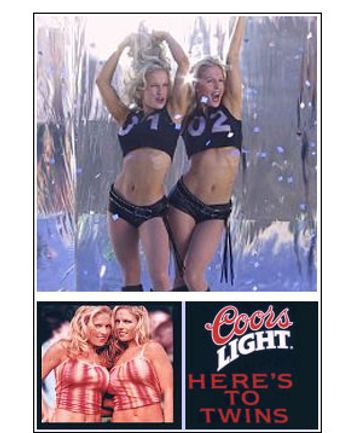
Coors beer ads have created a fantasy scenario with an incestuous twist that communicates brilliantly with the piglike male brain.

  • more
    • All Share Services

The twins thing

The sexual exploitation of women in beer ads supports the misperception that women exist for men’s pleasure alone; as well, it creates a standard of beauty that is impossible for the average woman to achieve, often resulting in feelings of inadequacy and blah, blah, blah, blah. Does anyone even care anymore?

That said, there is something uniquely off-color about Coors’ latest advertising campaign. The commercial spots, which first aired during the 2002-03 NFL season, are responsible for Coors’ highest-ever ad ratings, predicted increases in product sales, and a newfound relevance with 21- to 25-year-old male consumers. Though the musical odes to stuff guys love — “two-hand touch,” “short skirts,” “burritos at 4 a.m.” — played during the commercials are clever, credit for the campaign’s success goes to Diane and Elaine Klimaszewski. Besides being just plain hot, the aesthetically gifted 26-year-old blondes featured in the campaign are twin sisters. Twin sisters whose four blue eyes seem always to be saying, “Hey boys, anyone up for a three-way?” Sisters in a three-way? Gross.

With the Barbie twins busy working toward an eating disorders-free world and the Olsen twins still just this side of nubile, Diane and Elaine have secured the No. 1 spot in the twins category. Their Coors fame has since led the model/actor/singer sisters to appearances in “Star Trek: Enterprise,” a new Peter Gabriel video, J.Lo and Ben’s upcoming film “Jersey Girl,” and the November 2002 issue of Maxim; ventures in music (their self-titled debut pop album, “Klone,” is available online), fashion (their lingerie line is called “Zipper Girl”) and television (they are now developing the reality series “No Chicks Allowed”).

Diane and Elaine are knockouts, no question, relatively not super skanky, and entrepreneurially spirited. But is their combined T&A factor that much greater than that of two equally hot but unrelated models? And, if so, why?

Coors is not breaking any ground with the “two girls is better than one” concept. That bandwagon has been teeming for years with advertisers (Guess Jeans, Jose Cuervo, Skyy Vodka and Abercrombie & Fitch, to name only a few), many of whom beat around the bush far less than Coors. For instance, in a currently airing alcoholic-beverage commercial, a duo of gorgeous women, pressed together in the cleavage-to-cleavage confines of a phone booth, manage to squeeze in Joe That-Could-Totally-Be-Me when they notice he comes bearing alcohol.

Foote, Cone & Belding, the agency responsible for the “Here’s to Twins” ads, is not alone in knowing that every guy with blood in his veins has fantasized about being the roast beef in a hot woman sandwich. But they are alone in creating a ménage à trois fantasy scenario with an implicitly incestuous twist. Incest — even between sisters, and even if only by association — conjures images of drunk, portly uncles, birth defects, low I.Q.s, and missing teeth. This stuff usually doesn’t make people thirsty for an ice-cold Coors. And it’s stuff, you’d think, advertisers would want to stay away from.

Our instinct to avoid sexual relations with close relatives is less about producing messed-up offspring than people think. Prohibitions against such behavior, for blood and non-blood relations alike, were established prior to knowledge of genetics and continue despite effective and accessible birth control. A supplemental theory proposed by anthropologists and sociologists is that incestuous relationships lead to role conflicts within families, create ambiguous boundaries, and disturb normal psychological and social development. This is applicable to sexual relations in which procreation is not a possibility, for instance, sister-on-sister action.

The incest taboo has been a tough cookie to crack, but then, who’s trying? Hooking up (voluntarily) with one’s own parents, siblings, aunts, uncles, or cousins is not topping most people’s sexual wish lists. Sure, it happens on occasion, and that bastard Freud insists we think about it, but moderately well-adjusted people seem to maintain their distaste for such behavior. So why has Coors risked millions of dollars on ads hinting at the one taboo that makes even the most sexually liberal among us squirm?

I looked to my male friends for insight into the matter. Their lack of it spoke volumes.

Greg, a 30-year-old business school student, went dumb when I asked him how he felt about the incestuous connotations in the “Here’s to Twins” Coors ads. The look of incredulous annoyance on his face — it read, “What the hell is your problem?” — was one I would come to know well. I would also come to know that explaining I have no problem, but am simply wondering why it is that the implicit sexual relationship between twin sisters sits just fine with him, and in fact strikes him as fucking awesome, was not only futile but cruel. I had no idea that asking men to analyze the biological relationship between Diane and Elaine Klimaszewski would be like asking a 7-year-old to analyze the time frame for Santa’s worldwide toy delivery schedule.

Greg wasn’t going to let me ruin his fantasy. He delivered his sociological analysis of the phenomenon — “I have no idea” — with a heavy sigh before turning away. Bob, a 36-year-old reporter, only infuriated me further by saying what men always say when things get complicated: “You are thinking way too much about this.” Such a cop-out. Only in this case he may have been right.

“It’s not like they’re really twins.” Pause, eyes look to ceiling, mouth falls open. “Oh, you mean they’re really twins?”

It was astonishing how many times I heard this from men who had read and/or heard the word “twins” while looking at the two physically identical women and still hadn’t put 2 and 2 together. Even men who knew that Diane and Elaine are real twins were dumbfounded when I pointed out their blood relationship. They had never thought about it that way; they had never thought about it any way.

From my research I learned that men find real-life relationships are hard enough. All those post-coital responsibilities — holding, talking, breakfast, phone calls, talking, commitments, talking, anniversaries and valentines, plus all that talking — can really stress a guy out. So the less they have to act like decent human beings in their fantasies, the better. Even the most universal of male fantasies — having two women at once — turns nightmarish when interrupted by thoughts of emotional obligations. (Does this mean I have to call both of them the next day?) Their fantasies are about what could happen in a world free from the rules of wives and girlfriends (and, obviously, the rules of attraction) and from the reality that two identical women are biological twins. Even if they are really, really hot.

This is why Diane and Elaine are such a bargain. At least for fantasy purposes, men seem to perceive the pair as essentially one woman, with the bonus of two bodies. Two bodies servicing his body. Four boobs for the price of two.

Rest assured, most men still find incest gross. Oddly, some of the men I spoke with were offended by my mention of the issue in relation to Diane and Elaine. In their ironic innocence they had managed to enjoy the twins’ physical sameness without processing the reality of their monozygotic relationship. As Scott, a 32-year-old magazine editor, so eloquently put it: “There are two of them and they are the same and I can have sex with them at the same time and did I mention that they’re the same?” In other words, the twins are more than just two women — they are two of one woman.

Despite their claims, I’m not convinced men are even into three-ways, or lesbians, for that matter. What they are into is two women working together in a joint effort to bring them pleasure. It is a scenario that deems the sexual relationship between the two women irrelevant; hence, the acceptability of the sister-sister-guy fantasy. The three-way scenario is that much more heavenly when the two women are indistinguishable from one another, their lack of identity being the ultimate in low-maintenance.

Scott had warned me from the beginning: “Men really are pigs, stupid pigs. You should be thankful that you don’t understand this part of our psychology.” Now that I know, I kind of wish I could go back to being thankful.

Shooting crap

Alleged psychic John Edward actually gambles on hope and basic laws of statistics.

  • more
    • All Share Services

Shooting crap

John Edward, host of the television series “Crossing Over,” is just short of creating an empire of Oprah or Martha Stewart proportions. His show, a half-hour exhibition of his self-professed ability to communicate with the dead and predict the future, now airs on CBS and Sci-Fi at least 10 times a week. Author of three books (his second, “One Last Time,” was a New York Times bestseller), subject of an HBO documentary, guest of “Larry King Live” and “The Crier Report,” and celebrated counselor to a host of B-list celebrities (Jennifer Beals, Anne Rice, et al.), Edward has gained surprising credibility.

He has managed to sell his talents via audiotapes (“Developing Your Own Psychic Powers,” yours for $59.95), a quarterly newsletter, internationally touring seminars (sold out), private readings (the wait list is now three years) and personally endorsed products like the John Edward Pink Rose Appreciation Pin, “a symbol to express love.”

But Edward, a 32-year-old native of Long Island, has not fessed up to all of his talents. As it happens, he is more than a psychic medium; he is also a master statistician. The smoke and mirrors behind his self-professed ability to communicate with the dead is a simple application of the laws of probability. Basically, if you keep trying something whose results are independent, your odds of getting your desired result increase.

For example, the odds that you will roll a 3 on any one roll of a six-sided die are 1 in 6, about 17 percent. After six throws, the chance that you will have thrown at least one 3 has increased to about 67 percent. After 12 throws, it’s nearly 90 percent.

Lucky for Edward, most audience members on his television show are too hopeful and trusting to pull out a calculator and expose the charlatan behind the prophet.

The temptation to believe that Edward, a self-professed medium, can connect with the deceased and foretell future events is great, especially for those who are vulnerable and in need of comforting. Many members of the show’s audience, hoping to connect with deceased loved ones via Edward, are mourning recent losses. They come with the expectation, no doubt, that being “read” by Edward on national television will yield healing revelations from those who have “crossed over.” Inevitably he reports that the dead are at peace, happily and lovingly watching over those left behind on Earth.

Since Edward is playing a numbers game, there are, of course, rules to follow. “Crossing Over” audience members are coached even before they enter the television studio on how to behave during taping. The rules for being in the audience are stated on the show’s Web site and begin with the following:

“Have no expectations. You may REALLY want to connect with one specific relative … but there is a good chance they may not come through. Keep your mind open and welcome whoever comes through during the reading. We don’t want you to be disappointed or broken-hearted if your chosen loved one doesn’t come through. As John says, ‘Please do not put earthly expectations on a heavenly experience.’”

So each audience member becomes, in effect, a throw of the die, and each of Edward’s guesses is the number he’s trying to roll. Symbolically translated, where P = probability: P(Aunt Mary comes through) + P(Grandma’s first poodle comes through) + P(Jen’s ex-brother-in-law comes through) + P(a person who will eventually die comes through prematurely) + P(an unknown ancestor comes through) + P(Edward can talk himself out of anything) = Damn close to 100 percent.

Seems fair enough. But apparently still too risky for Edward. The rules on the Web site continue:

“Validation is important! Since John does not know your friends and relatives, it is very important you give feedback. A simple nod of the head, a yes or no answer goes a long way in a reading. Please don’t give more information than John asks for.”

Translation: John will throw out guesses until you indicate he has hit on something, and then he’ll run with it. Should his ramblings contradict your reality, do not correct him.

Even more precious is his allowance for any and all errors, which he disguises as a modest admission of mortality in his book “Crossing Over: The Stories Behind the Stories.” Edward writes, “I’m always saying that it is not the spirits who are getting it wrong; it’s more likely that I am misinterpreting their messages.” You have to trust a guy so willing to admit his own failings.

In his book, Edward offers an example of his powers that is so dubious I thought he was joking. As it goes, once he told a “sitter” (the person being read) that someone in her life was doing something with wallpaper; it was odd, Edward recalls, that it had no meaning for her that day. Until, lo and behold, a few months later, the sitter’s sister-in-law changed the border in her bathroom! Add up the probabilities of the hundreds of independent events involving wallpaper and the sitter’s friends and family over the course of months and the realization of his prophecy is nearly inevitable. The art of intelligence insulting has rarely known such mastery.

Adding to the speciousness of the whole operation is that the wallpaper example was handpicked for inclusion in the book; consider how many failed readings were excluded. The careful plucking of successes from a mass of attempts is a technique used in Edward’s television show as well. The creation of each half-hour episode requires six hours of taping. Do the math.

Yet it works. I prefer to believe Edward’s fans are not unintelligent, but simply in need of something to believe in, to feel good about, or to relieve the anxiety of what cannot be controlled. If he is fulfilling these needs, then in some ways, his gig is legit. Just like playing the lottery, if you really want to believe, you are better off not knowing the odds.

This story has been corrected since it was first published.

Continue Reading Close