Sidney Blumenthal

The GOP on the verge of imploding

A look at how radicalism has forced the Republican Party to retreat.

  • more
    • All Share Services

On May 3, 2007, ten Republican candidates aspiring to succeed George W. Bush as president debated at the Ronald W. Reagan Library, where they mentioned Reagan 21 times and Bush not once. By raising the icon of Reagan, they hoped to dispel the shadow of Bush. Reagan himself had often invoked magic — “the magic of the marketplace” was among his trademark phrases and he had been the TV host at the grand opening of Disneyland, “the Magic Kingdom,” in 1955. Evoking his name was an act of sympathetic magic in the vain hope that its mere mention would transfer his success to his pretenders and transport them back to the heyday of Republican rule.

Bush’s second term has witnessed the great unraveling of the Republican coalition. After nearly two generations of political dominance, the Republican coalition has rapidly disintegrated under the stress of Bush’s failures and the Republicans’ scandals and disgrace. The Democrats have the greatest possible opening in more than a generation — potentially. They should pay strict attention to how Bush has swiftly undone Republican strengths as an object lesson.

On September 10, 2001, Bush was at the lowest point in public approval of any president that early in his term. It was a sign that he seemed destined to join the list of previous presidents who had gained the office without popular majorities and served only one term. After the terrorist attacks of September 11, Bush’s fortunes were reversed, and he was no longer seen as drifting but masterful. Now he appeared to take his place in the long line of Republican presidents who had preceded him. He acted as though his astronomical popularity in the aftermath of September 11 ratified whatever radical course he might take in international affairs and vindicated whatever radical policies and politics he might follow at home.

Vice President Dick Cheney assumed control of concentrating unfettered executive power, a project to which he had been devoted since he had served as the assistant to presidential counselor Donald Rumsfeld in the Nixon White House. Karl Rove, the president’s chief political strategist, took charge of subordinating federal departments and agencies to the larger political goal of achieving a permanent Republican realignment through a one party state — another Nixonian objective, run by another Nixonian. Cheney and Rove’s complementary efforts gave the substance to the radical theory of the “unitary executive.”

In 2004, Bush swaggered through his reelection campaign, still swept along on the momentum from September 11. He and Rove did not consider the perverse and unprecedented illogic of Bush v. Gore as anything but a rightful decision. They did not see the means by which he became president as artificial, making his position inherently weak and unstable. Bush took occupying the office itself and September 11 as tantamount to a resounding mandate for his radicalism. Nor did Bush or Rove view Bush’s steady and precipitous decline in popularity as cause to reconsider their preconceptions. After the Afghanistan invasion, Bush’s numbers tumbled until he ramped up the campaign for the invasion of Iraq, after which his standing dived again, only to spike once more after the capture of Saddam Hussein, only to fall again. Nonetheless, Rove drew no lessons from these warnings, except that war and terror served as indispensable political weapons to sustain Bush. On this rock, Rove proposed to build a reigning party.

After the 2004 election victory, Rove’s former political deputy and Republican National Committee chairman Ken Mehlman said, “If there’s one empire I want built, it’s the George Bush empire.”

Perhaps the most considered, comprehensive and boldest analysis after the 2004 election came from two English journalists, writers for The Economist magazine, John Micklethwait and Adrian Wooldridge. In their book, The Right Nation, they conflated Bush’s unilateralism, the religious right, and the conservative counter-establishment of think tanks and foundations with American exceptionalism. “Today, thanks in large part to the strength of the Right Nation, American exceptionalism is reasserting itself with a vengeance.”

They categorically declared that the realignment Rove was seeking had at last appeared. Bush’s reelection was the crowning moment of the entire Republican era, setting it on a firm foundation for a generation to come. “Who would have imagined that the 2004 presidential election would represent something of a last chance for the Democrats?” they wrote. “But conservatism’s progress goes much deeper than the gains that the Republican Party has made over the past half century or the steady decline in Democratic registration. The Right clearly has ideology momentum on its side in much the same way that the Left had momentum in the 1960s.”

The Economist’s correspondents were Tories in search of a promised land after the Labour Party became the natural party of government in Britain with the post-Thatcher crackup of the Conservatives. The United States was a fantastic canvas for their thwarted dreams. They were delirious to discover that while conservatism had fallen from grace and favor in Britain it held every lever of national power in the New World. “Thatcher could never rely on a vibrant conservative movement to support her (unless you regard a couple of think tanks as a movement) while American conservatism has been going from strength to strength for decades,” they wrote with undisguised envy.

At least in one way the Republican triumph in 2004 echoed British political history, resembling that of the British Liberal Party in 1910. “From that victory they never recovered,” wrote George Dangerfield in The Strange Death of Liberal England. But the strange death of Republican America, the supposed “Right Nation,” cannot be attributed to the same reasons as the decline of Liberal England, a complacent faith of good intentions bypassed and trampled by events that it presumed to understand as it drifted into the dark passage of world war.

The guiding assumption of American politics was that Bush’s presidency was girded by a stable conservative consensus and that politics would operate on this consensus into the foreseeable future. In this view, Bush became not only the most recent expression of Republican supremacy but also its strongest. It was a curious refraction of the consensus school of the 1950s that envisioned American politics as an unbroken thread of liberalism.

According to the consensus school, the dissimilarities between American and European politics — ravaged in the 20th century by wars and totalitarian movements — suggested an essential consensus predating the creation of the nation rooted in the thought of John Locke. “The American community is a liberal community,” wrote the historian Louis Hartz in his highly influential The Liberal Tradition in America, published in 1955. That same year, William F. Buckley, Jr., launching the modern conservative movement in the first issue of National Review, wrote that conservatism “stands athwart history, yelling Stop.” By 2004, after Bush’s victory, conservatives were triumphalist. “The 2004 election was about as clear a vindication as we could have hoped for,” wrote Micklethwait and Wooldridge. And “that conservatism is the dominant force in American politics and that conservatism explains why America is different.” Turning the old consensus thesis on its head, they argued that the American community is a conservative community.

For long periods of time political alignments shift incrementally and slowly. But our politics also has a volatile history, not always placid, erupting suddenly and sharply through cataclysms, and often as a result of violence. The Civil War, the Great Depression, and the Vietnam War and the civil rights revolution were earthquakes that abruptly overturned long settled arrangements. When Herbert Hoover was elected in 1928, his landslide victory was universally seen as the peak of Republican Party consolidation, the culmination of the party’s progress since the Civil War. Similarly, when Lyndon Johnson was elected in 1964, his landslide was interpreted as the apotheosis of the New Deal. For two generations the Republicans have been running on the themes and infrastructure developed since the Democratic collapse in 1968.

The scale of the Bush disaster is larger than any cataclysm since then. Whether or not there is a powerful geopolitical analogy between Iraq and Vietnam wars, as Bush first insistently denied, then vehemently argued, there is a pertinent domestic political analogy. Vietnam ended a Democratic era as definitively as Iraq is closing a Republican one.

Republicanism at its pinnacle — during the Reagan years — had been an easy identity for adherents to wear. With the recession of 1982 a memory, tax rates especially for the wealthy drastically lowered, and the country at peace amid the Cold War, President Reagan demanded no sacrifice or pain. His carefree attitude disdained the Protestant ethic, with banker’s hours that conveyed there was no relationship between hard work and reward. His sunny disposition had removed the scowl of Richard Nixon and the stain of Watergate from the party. Yet Reagan’s landslide of 49 states in 1984 echoed Nixon’s landslide of 49 states in 1972. One famous victory was built on the other, one Californian paving the way for another. Nixon’s work of realignment as well as his self-destruction made possible the rise of Reagan, who had been his rival for the Republican nomination in 1968.

Conservatives prefer to date the origins of the Republican ascent to the candidacy of Barry Goldwater in 1964. But it was his defeat followed by the shattering of the Johnson presidency over Vietnam that cleared the path for the resurrection of Richard Nixon, who was the main progenitor of the Republican rise. Only on the ruins of the Goldwater debacle was Nixon able to capture the Republican nomination in 1968. He was the author of the project for an imperial presidency. Watergate, a concatenation of plots, was an emanation of that grand design, both to create an unaccountable executive and harness the federal government into a political machine for what Nixon first called a “New Majority.” The 1974 Final Report of the Select Committee on Presidential Campaign Activities documented the Senate Watergate Committee’s investigation into Nixon’s effort to use “the powers of incumbency” through programs such as “the Responsiveness Program,” created to “redirect Federal moneys to specific administration supporters and to target groups and geographic areas to benefit” his campaign.

If Nixon had succeeded in his plan, the U.S. government and politics would have taken very different forms. But his resignation shattered the center in the Republican Party, and Nixon made possible not only Jimmy Carter but also Ronald Reagan. The traditional Republican center attempted to hold under Gerald Ford, but it could not cohere, even within Ford’s own White House where it was undermined by the team of his successive chiefs of staff, Donald Rumsfeld and Dick Cheney.

The Republican fall parallels the previous decline of the Democrats. From 1968 through 1988, the story of the Democratic Party had been its internal disintegration and reduction to its base.

The Republican Party dominance was not illusory, mere smoke and mirrors, though it did have superior image-making too. After the enfranchisement of black voters in the South in the mid-1960s, whites deserted the Democratic Party and flocked to the Republican Party, eventually creating a GOP Solid South, as Lyndon Johnson had feared when he told his youthful press secretary Bill Moyers upon signing civil rights legislation, “We have lost the South for a generation.” The Republicans turned many urban and suburban ethnic Catholics, who had been at the core of the New Deal, into Republicans, by exploiting strategies of racial fear around issues of crime, education, taxation, and housing and by appealing to cultural traditionalism on issues such as abortion and women’s rights generally.

The Republicans also won over formerly progressive Western states, through an anti-government states rights Sagebrush rebellion on behalf of local extractive industries. Running for governor in 1966, Reagan tipped California, which had been balanced for decades between liberal Democrats and liberal Republicans, toward the conservative wing of his party. The movement of California into the Republican column signaled the shift of geopolitical equilibrium to the Sun Belt, a new alliance of West and South, and consolidated the Republican Party coalition.

Kevin Phillips, a strategist for the Nixon campaign in 1968, wrote in his seminal book, The Emerging Republican Majority (published the following year), that Nixon’s victory “bespoke the end of the New Deal Democratic hegemony and the beginning of a new era in American politics…. Today the interrelated Negro, suburban and Sun Belt migrations have all but destroyed the New Deal coalition.” Phillips described how the alignment of the Democratic Party with civil rights (“many Negro demands”) provoked a reaction. “The South, the West and the Catholic sidewalks of New York were the focal points of conservative opposition to the welfare liberalism of the federal government…”

Even as he planned to wind down the Vietnam War, Nixon painted antiwar critics and Democrats as unpatriotic and hostile to national security, and for decades the Democrats could not escape the stigma. In defense of his Vietnam policy, Nixon conjured up a “Silent Majority” in opposition to the antiwar movement. This constituency, transmuted a decade later into the so-called “Reagan Democrats,” included many of the same former Democrats that had defected to Nixon’s banner. A complex of domestic and foreign policy motives drove them: resentment against liberal elites and minorities over social welfare policy; antagonism to the youthful university-based counterculture undermining traditionalism; and liberal softness against Communism supposedly weakening the will to win in Vietnam.

None of these themes, including the anti-Communist one, lost their vitality even after the end of the Vietnam War. Nixon’s resignation over Watergate gave the Democrats an opening, but Jimmy Carter’s presidency proved a spectacle of Democratic infighting and provided the Republican right the chance to seize control of the party in 1980 by running on an agenda against economic mismanagement and Soviet adventurism. By now conservatism was transformed from a cranky backward looking isolationist fringe into a vigorous, politically skillful movement that had captured and held the commanding heights of the Republican Party.

In 1984, the Democrats nominated Carter’s vice president, who, unfairly or not, bore the burden of past ineptitude, to compete with Reagan at a time of peace and prosperity. By August 1984, Gallup found that on the question of “increasing respect for the U.S. overseas,” Reagan led Walter Mondale 48 to 33 percent. Reagan’s reelection affirmed the Republican era, its national coalition and lock on the presidency.

The Republicans were the dominant political party, even when the parties appeared momentarily and evenly matched in public opinion or when the Democrats controlled one or both houses of the Congress. Democrats invariably bore the burden of defending themselves from past errors, real or imagined, and on positions from gun control to abortion Republicans used “wedge issues” to splinter the Democratic coalition and fuse the Republican one.

The exposure of the Iran-contra scandal during Reagan’s second term brought his domestic programs to a grinding halt. This bizarre scandal involved a convoluted effort to create a parallel, secret and illegal U.S. foreign policy, offshore and underground, evading the Congress and the usual channels of the national security apparatus. In 1987, the congressional hearings into the scandal and the Senate’s rejection of Reagan’s far right nominee to the Supreme Court, Robert Bork, who as Nixon’s hatchet man in the “Saturday Night Massacre” had fired the Watergate special prosecutor, had a further radicalizing effect on the right. Meanwhile, Reagan revived his moribund presidency by reversing his course, negotiating an arms control treaty with Soviet leader Mikhail Gorbachev and proclaiming the end of the Cold War. Though Republicans from both the right and the center criticized him as a naive utopian, his demarche lifted his fallen popularity and that of his vice president, making possible his election.

The political career of George H.W. Bush illustrated the contradictions of Republicanism and the growing radicalism of the party that his son would later push to an extreme. His difficulties reflect the radicalization of the party going back to 1964 and his circuitous route in navigating its currents. As much as he was overwhelmed by events, the elder Bush was also undermined by his inability to sustain a viable Republican center post-Reagan. For every gesture he made toward fiscal prudence, a traditional Republican virtue, his party punished him. In 1992, former Nixon speechwriter and conservative firebrand Patrick Buchanan challenged Bush for the Republican nomination, capturing 38 percent of the vote in New Hampshire, a humiliation for the incumbent president. Buchanan’s insurgency and the right’s obstreperousness made it necessary for Bush to lend them the stage of the Republican National Convention in Houston, a disaster for him contributing to his loss in the general election.

The principal lesson the son absorbed from his father’s political failure was to avoid having enemies on the right. George W. Bush became what his father never could, a radical conservative, transcending the problems that had plagued the father throughout his career. The son systematically abandoned the father’s respect for fiscal responsibility, individual rights, the separation of church and state, the Congress, constitutional checks and balances, and a realistic and bipartisan foreign policy. George W. Bush saw Reagan more than his father as his model, but he was as little like Reagan as he was like his father. Bush’s radicalism has provided a vantage point for historical revisionism, causing his Republican predecessors, judged to be avatars of conservatism in their day, as more moderate in perspective. Reagan’s pragmatic willingness to negotiate with congressional Democrats on such matters as Social Security, for example, takes on another aspect. But the inexorable movement to the right is inarguable as a historical pattern.

Every time the conservative Republican period seemed to be exhausted it gained new impetus through openings created by Democratic fractiousness and incompetence in politics and governing. With each cycle conservatism reemerged more radicalized — a steady march further to the right. After Nixon’s disgrace in Watergate came Reagan; after the conservative crackup that engulfed George H.W. Bush came the radical Congress elected in 1994, led by Newt Gingrich and Tom DeLay; and then came George W. Bush. Bill Clinton’s presidency served as an interregnum that might have broken the Republican era for good had his vice president Al Gore been permitted to assume the office he won by a popular majority. But the conservative bloc on the Supreme Court ultimately thwarted him. When the court in Bush v. Gore handed the presidency to Bush it gave him an extraordinary and unnatural chance to extend Republican power.

Only through the will to power in the Florida contest, the deus ex machina of the Supreme Court, and the tragedy of September 11, was Bush able to gain and hold the presidency. But he and the Republicans have been living on borrowed if not stolen time.

Karl Rove believed he could engineer a political realignment by recreating his work in Texas where he marshaled money and focused campaign technology in order to destroy the Democrats. But the analogy of the nation as Texas writ large was faulty from the start. In Texas he had the wind at his back, regardless of how elaborate and clever his machinations. The transformation of Texas in the 1980s and 1990s into a Republican state was a delayed version of Southern realignment. Yet Rove came to Washington believing that the example of Texas could be transferred to the national level. With the attacks of September 11, this seasoned architect of realignment believed he possessed the impetus to enact his theory. It apparently never occurred to Rove or Bush that using Iraq to lock in the political impact of September 11 would ever backfire. In his First Inaugural, Bush spoke of an “angel in the whirlwind,” but the whirlwind was of his own making. For all intents and purposes Rove could not have done more damage to the Republican Party than if he had been the control agent for the Manchurian Candidate.

The cataclysm has consumed Rove’s theory, his president, his party, and prospects for a Republican majority. The Republicans may take years if not decades to recreate their party, but that project would have to be on a wholly different basis.

The radicalization of the Republican Party is not at an end, but may only be entering a new phase. Loss of the Congress in 2006 is not accepted as reproach. Quite the opposite, it is understood by the Republican right as the result of lack of will and nerve, failure of ideological purity, errant immorality by members of Congress, betrayal by the media, and by moderates within their own party. They may never recover from the election of 2004, when they believed their agenda received majority support and they ecstatically thought they were the “Right Nation.”

Herbert Hoover did not transform his party but became its avatar through failure. By contrast, Bush has remade the Republican Party, turning it into a minority party as a consequence of his radicalism. Bush’s discredited Republicanism has further provoked the radicalization of its base where religious right and nativist elements are increasingly dominant. The party is in the grip of an intolerant identity politics — white male semi-rural fundamentalist Protestant — that seems only to alienate women, suburbanites, Hispanics, and young people. By the end of his presidency, Bush had achieved the long conservative ambition of remaking the Republican Party without an Eastern moderate wing. Once a national coalition, embracing New York and California, Alabama and Illinois, the Republican Party has retreated into the Deep South and Rocky Mountains.

The emergence of Senator John McCain, whose career is notable for his breaks with party orthodoxy and the Right, as the Republican nominee has been made possible only because of the fracturing of the conservative coalition forged since 1968. His strategy would have to encompass states off limits to Republicans for more than a decade and to temper the radicalism of his party, even as he tries to reassure an anxious Right that views him with suspicion. In 1952, the originator of the notion of realignment, political scientist Samuel Lubell, wrote in his seminal work, The Future of American Politics, American politics is not a contest of “two equally competing suns, but a sun and a moon. It is within the majority party that the issues of the day are fought out; while the minority party shines in the reflected radiance of the heat thus generated.” When Lubell wrote, even as Dwight Eisenhower was about to win the presidency resoundingly, the Democrats were the sun and the Republicans the moon. Only after Nixon did the parties exchange place in the political solar system. Now after George W. Bush a new Copernican revolution is occurring.

But the Democrats have not yet solidified a new coalition. They may be on the eve of becoming a majority national party for the first time in their history without conservative Southerners at their core. But they may still snatch defeat from the jaws of victory, mesmerized by grandiose delusions as if the past were weightless. Just as the Republican collapse under Bush has given the Democrats an unprecedented opening, the Democrats may still find a way to reinvent the Republicans. Even if they win the presidency, the Democrats can only consolidate their future coalition through skillful and successful governing. Only then will they be the sun. In Bush’s final days, a new era has not yet dawned, but an old one is setting.

Dick Cheney was never a “grown-up”

A hard look at how one man changed the face of neoconservatism.

  • more
    • All Share Services

Dick Cheney was never a

After Dick Cheney shot a friend in the face on a Texas hunting trip in February 2006, the national press corps began to speculate about him as one of the great mysteries of Washington, the Sphinx of the Naval Observatory, his official residence. Cheney had been known in the capital for decades through a career that carried him from congressional intern to the most powerful vice president in American history, but now his supposedly changed character became a subject of intense speculation. Brent Scowcroft, who had been George H.W. Bush’s national security adviser, and had counseled against the invasion of Iraq, told The New Yorker magazine in 2005, “I consider Cheney a good friend — I’ve known him for thirty years. But Dick Cheney I don’t know anymore.” Scowcroft’s judgment was less about Cheney’s temperament than his policy positions. The press, however, sought to disclose the sources of his “darkening persona,” as a cover story in Newsweek described it. “Has Cheney changed? Has he been transformed, warped, perhaps corrupted — by stress, wealth, aging, illness, the real terrors of the world or possibly some inner goblins?” A cover story entitled “Heart of Darkness,” published in The New Republic, suggested that Cheney’s heart disease had produced vascular dementia. “So, the next time you see Cheney behaving oddly, don’t automatically assume that he’s a bad man.”

In 2000, when Cheney, as head of George W. Bush’s search committee for a running mate, selected himself, opinion makers in Washington greeted the choice as proof positive of the younger Bush’s deference to wisdom and therefore personifying prudence. Cheney’s “manner gives him immunity from the extremist label,” assured David Broder, the longtime leading political columnist of the Washington Post. “Voters who saw his televised briefings during the Persian Gulf War remember the calm voice and thoughtful expression that are his natural style … By choosing a grown-up, Bush gave evidence of his own sense of responsibility.”

Five years later, in 2005, Colonel Lawrence Wilkerson, by then the former chief of staff to the former Secretary of State Colin Powell, speaking publicly at a Washington think tank, the New America Foundation, was less concerned with the press corps’ obsession with Cheney’s shifting images than with exposing his unprecedented manipulations. “What I saw was a cabal between the vice-president of the United States, Richard Cheney, and the secretary of defense, Donald Rumsfeld, on critical issues that made decisions that the bureaucracy did not know were being made.” Though he had had extensive experience in government, Wilkerson had never before encountered such “secrecy,” “aberration” and “bastardization” in decision-making. “It is a dysfunctional process,” he said. “And to myself I said, okay, put on your academic hat. Who’s causing this?”

Previously fixed on the stereotype of the “grown-up,” pundits projected a new stereotype of dementia. But had Cheney, in fact, been fundamentally transformed, becoming unrecognizable to those professional observers of the press who believed they knew him well? Both Scowcroft and Wilkerson had encountered Cheney within councils of state. Had even Scowcroft misjudged Cheney as a team player when he was Secretary of Defense during the Gulf War? Was Cheney a regular, conservative minded Republican who had just gone mad? Or, if he were a member of a “cabal,” did it involve more than Rumsfeld?

George W. Bush jettisoned the tenets of traditional Republicanism — fiscal responsibility, limited government, separation of church and state, and realism in foreign policy. Instead the doctrines that had been nurtured in the hothouse of the Counter-Establishment since the Reagan period achieved their most radical expression. At every point, Cheney exercised his power.

The supply-side theory of tax cuts — that slashing tax rates especially on the upper brackets would produce a flood of new government revenues — was applied with a vengeance even after the Reagan experiment had disproved the notion, having fostered extraordinary deficits. On Nov. 15, 2002, after Bush’s tax cuts had passed, then Secretary of the Treasury Paul O’Neill spoke at a White House meeting of the senior economic team about an impending “fiscal crisis” because of “what rising deficits will mean to our economic and fiscal soundness.” Cheney quickly knocked down his argument. “Reagan proved deficits don’t matter,” he said. “We won the midterms. This is our due.” O’Neill was soon fired. He concluded that Cheney and “a praetorian guard” governed Bush’s presidency. “It’s not penetrable by facts,” he said. “It’s absolutism.”

Conservative lawyers were installed throughout the administration and appointed to federal judgeships while radical legal doctrines were imposed. As soon as he took office Bush ended the American Bar Association’s pre-screening of judicial nominees, a practice that had begun in 1948. The ABA was considered a hopelessly “liberal” organization. In its place de facto vetting was now performed by the Federalist Society, a group that “has created a conservative intellectual network that extends to all levels of the legal community,” according to its website. Founded in 1982 and infused with more than $15 million in grants from conservative foundations, the Federalist Society has become the principal network for lawyers on the right. Nearly every Bush judicial nominee, every Justice Department official, every general counsel in every federal department and agency, and dozens of senior cabinet and sub-cabinet secretaries was a member.

The congressional investigation into the political purge of U.S. Attorneys uncovered evaluation forms with a column to be checked about whether or not the applicant was a Federalist Society member. On every issue, from the gutting of the civil rights division of the Justice Department, where 60 percent of the professional staff was driven out and not a single discrimination case was filed, to the implementation of the so-called “war paradigm,” including abrogation of Article Three of the Geneva Convention against torture, (which then White House counsel Alberto Gonzales termed “quaint” in a memo to the president), Federalist Society cadres were at the center. David Addington, Cheney’s counsel and later chief of staff, directed the tight-knit group of “torture lawyers” within the administration.

Foreign policy was dominated by the neoconservatives whose agenda was galvanized after the terrorist attacks of September 11. The 2000 manifesto issued by the Project for a New American Century, a neoconservative group that advocated “regime change” in Iraq, contained a cautionary line that “the process of transformation, even if it brings revolutionary change, is likely to be a long one, absent some catastrophic and catalyzing event — like a new Pearl Harbor.” September 11 became that “new Pearl Harbor,” providing long hoped for political momentum the neoconservatives channeled for an invasion of Iraq.

The influence of the neoconservatives over the national security apparatus was heavy-handed and pervasive. More than 17 signatories of the Project for the New American Century statement held posts within the Bush administrations, including Cheney, Rumsfeld, Paul Wolfowitz (Deputy Secretary of Defense), Richard Perle (chairman of the Defense Policy Board), and John Bolton (Undersecretary of State for Policy and later Acting U.S. Ambassador to the United Nations). But these eminences were the tip of the iceberg. Neoconservatives also staffed the Office of the Vice President, comprising the largest national security team ever assembled by a vice president. Neoconservatives were strategically placed throughout the National Security Council—for example, Elliott Abrams, NSC director of Middle East affairs, a convicted felon in the Iran-contra scandal. And neoconservatives were packed into the Office of the Secretary of Defense and his Office of Special Plans, a new office created to “stovepipe” intelligence to the White House without having it vetted by the CIA or other intelligence agencies.

The Iraq war was largely a neoconservative production conducted under the guidance of Cheney and Rumsfeld. Cheney took command of the intelligence process, even arranging for Bush to sign Executive Order 13292, written by Addington, giving the vice president the same power over intelligence as the president. The disinformation campaign that Saddam Hussein possessed weapons of mass destruction was a joint enterprise of the Office of the Vice President and the Office of the Secretary of Defense, providing a steady stream of evidence that was later revealed to be false and fabricated.

The occupation of Iraq was undertaken as a grand experiment in conservative ideology. The experienced hands in nation building at the State Department, who had prepared for the complexities of Iraqi reconstruction, as well as senior professionals from the departments of Treasury, Energy and Commerce, were blackballed by Cheney, Rumsfeld and their neoconservative aides. The hiring for the Coalition Provisional Authority was run by Rumsfeld’s liaison to the White House (mainly OVP), who gathered resumes from the slush piles of conservative think tanks, and subjected prospective employees to rigorous tests of political loyalty, asking whether they had voted for George W. Bush and were opposed to abortion.

Cheney’s reliance on neoconservatives was essential in carrying out his long conceived project of creating an imperial presidency, an executive unfettered by Congress or the press, that under the banner of war could enact any policy and obey or ignore any law that it wished. Cheney’s use of the neoconservatives to attain his aims — the core goals of the Bush presidency — was hardly happenstance or an alliance of sudden convenience. “Has Cheney changed?” asked Newsweek. The answer to that question required delving deeply into the hidden history of neoconservatism.

Richard Nixon was the first Republican president to cultivate the neoconservatives. They were considered a potentially fresh source of ideas to deal with racial turmoil, student unrest over the Vietnam War, and the discontents of the working and middle classes. Nixon’s first encounter took place on March 12, 1970, when Irving Kristol was invited to dinner with the president. Kristol was a former Trotskyist who maintained a consistently cynical view of liberalism as he drifted to the right, acting as an editor at a succession of small journals. The diary of H.R. Haldeman, Nixon’s chief of staff, records: “Tonight P (President) stag dinner with key staff and Irving Kristol. Got off to slow start and through dinner P talked with (George) Shultz (Secretary of Labor) about labor matters, Kristol just listened. Sort of a waste of time and talent. In Oval Room [Office] after dinner the talk heated up, about whole subject of condition of the country, focused on radicalization of large number of college students, strength of nihilistic groups (in influence, not numbers), and how to deal with it all … Must say, Kristol didn’t add much.”

Nixon did not recall Kristol from that dinner. Kristol, after all, had been uncharacteristically quiet. Nonetheless, Nixon’s aides kept sending him articles Kristol wrote on such subjects as pornography and censorship. After Kristol endorsed Nixon for reelection in 1972, causing a stir among the New York intellectuals, Nixon’s most conservative aides, Patrick Buchanan and Charles Colson, recommended that Nixon hire Kristol as a domestic policy expert to replace the departing Daniel Patrick Moynihan. For whatever reason, whether Nixon’s or Kristol’s demurral, Kristol did not receive the appointment.

With Nixon’s resignation and Gerald Ford’s assumption of the presidency, a new aide arrived with the portfolio to gather ideas from conservative thinkers. Robert Goldwin was himself little known among intellectuals. He was a resident scholar at the American Enterprise Institute, the oldest conservative think tank in Washington; founded to combat the New Deal, it functioned as the brain trust for Barry Goldwater’s campaign in 1964. Goldwin had published no notable articles or books of his own and believed generally that intellectuals did not “even have much to say to the ordinary citizen.” His notion was less an idea than an impulse, a deeply seated resentment against liberalism that took the form of anti-intellectualism.

Goldwin’s gruff contempt expressed the common opinion of conservatives, even conservative thinkers, of the period. AEI was less a hive of activism than a small, stagnant world apart. Its scholars had not achieved distinction in peer-reviewed academia; nor were they known for interesting articles in major publications. Kristol was an experienced provocateur and organizer, whose neoconservatism was a Leninist strategy for the right: intellectual cadres would act as a vanguard to guide the masses of Nixon’s “Silent Majority” against the class enemy.

Goldwin’s first service to President Ford was to arrange an hour long private meeting with Kristol, who soon began recommending neoconservatives to positions on the National Endowment for the Humanities and Library of Congress.

Goldwin also called Kristol’s work to the attention of Ford’s chief of staff Donald Rumsfeld, who in turn handed it over to his deputy Dick Cheney. (Cheney had also been Rumsfeld’s assistant when Rumsfeld served as counselor to President Nixon.) Cheney had earned a master’s degree in political science at the University of Wyoming and pursued doctoral studies at the University of Wisconsin before dropping out to work as an intern for a Republican congressman from Wisconsin. According to documents in the archives of the Gerald R. Ford Presidential Library, Cheney wrote Goldwin on Jan. 25, 1975. “I greatly appreciate receiving the stuff you’ve been sending me… Anything like that that comes in from Kristol or others, I’d love to see.”

Five days later, Kristol wrote Goldwin a letter explaining the political necessity of fostering a conservative Counter-Establishment:

“I do think the White House ought to do something for a relatively small group of men who are, unbeknownst to it, being helpful to this Administration, to the Republican party, and to conservative and moderate enterprise in general. I am referring to the men who head small and sometimes obscure foundations which support useful research and activities of a kind that the Ford and Rockefeller Foundations take a dim view of. I have got to know an awful lot of them these past years, and they never have received the barest recognition which I think they are entitled to. I am thinking of people like R. Randolph Richardson of the Smith Richardson Foundation, Donald Regan from the Merrill Trust, someone from the Earhart Foundation, the head of the Scaife Family Trust, and the head of the Lilly Endowment, etc. I say ‘head’ because, in each case, one would have to determine whether it is the chairman of the board of the executive director who is the appropriate person to receive this recognition. But it would be nice if, say, the White House were to invite these gentlemen and their wives to a State dinner occasionally. If you think this can be done, I’d be happy to draw up a list for your guidance.”

On Feb. 14, 1975, Cheney wrote Goldwin, “Bob, why don’t you come see me on Irving Kristol. We need to come up with a specific proposal as to how he might be utilized full time.” Kristol was soon sending a flow of letters and articles containing his views on a wide range of subjects to Goldwin that were also shared with Cheney. One Goldwin memo, dated Nov. 18, 1975, appended to a Wall Street Journal op-ed written by Kristol on small business, “The New Forgotten Man”: “In case you missed it, this Kristol piece is excellent and addressed very directly to us in this Administration.” At Kristol’s suggestion, Goldwin also launched a series of seminars for senior officials within the administration that included a number of neoconservative luminaries. Cheney, who had become White House chief of staff, and Rumsfeld, who had been named Secretary of Defense, were regular attendees.

After Ford’s defeat in 1976, Kristol’s influence in directing the funding of right-wing foundations made him the widely acknowledged godfather of the neoconservative movement. During the Reagan years, he moved from New York to Washington, settling as a resident scholar at the American Enterprise Institute, which under his influence had shed its traditional Republican origins and become a neoconservative bastion. (In 2002, George W. Bush awarded Kristol the Presidential Medal of Freedom.) Kristol’s son, William, meanwhile, continued the family business, serving as chief of staff to Vice President Dan Quayle, an isolated outpost of neoconservatism during the elder Bush’s administration that its denizens called “Fort Reagan.” William became editor of a neoconservative journal of opinion, The Weekly Standard, part of press lord Rupert Murdoch’s media empire that included Fox News, where the younger Kristol holds forth as a regular commentator. Two years after establishing The Weekly Standard, Kristol co-founded and chaired the Project for a New American Century, whose office was housed at the American Enterprise Institute.

The abbreviated history of the Ford administration, reaping the whirlwind of Nixon’s failed presidency, besieged on all sides by the Congress, the press and an insurgent Republican right, scarred Cheney. His encouragement of Kristol and the neoconservatives reflected his efforts to move the Ford administration rightward. Along with Rumsfeld he pushed for the creation of a parallel commission dubbed the Team B to second-guess the CIA on Soviet military capability. The Team B’s report projecting a rapidly expanding Soviet threat turned out to contain faulty data. Then CIA director George H.W. Bush, who had acceded to Team B’s creation, later condemned it as having set “in motion a process that lends itself to manipulation for purposes other than estimative accuracy.” Nonetheless, Team B served as an important milestone in legitimating neoconservatism within the Republican Party.

Elected to the House of Representatives from Wyoming in 1978, Cheney quickly rose within the Republican leadership, becoming the party’s senior figure on intelligence matters. As the ranking Republican on the joint congressional committee investigating the Iran-contra scandal Cheney issued a report (written by his then counsel Addington) that attacked the Congress for encroaching on the president’s prerogatives in foreign policy, although the scandal involved secret offshore bank accounts, rogue sales of missiles to Iran and bribery of White House officials. This parallel and illegal foreign policy was constructed to avoid adherence to the congressional Boland amendments that prohibited covert military aid to the Nicaraguan contras. Cheney’s minority report was a brief for the imperial presidency. It stated: “Congressional actions to limit the president in this area therefore should be reviewed with a considerable degree of skepticism. If they interfere with the core presidential foreign policy functions, they should be struck down.” In 2005, he told reporters that the report best captured his views of a “robust” presidency.

When I published this book in 1986 it appeared just months before the Iran-contra scandal was revealed. I had set out to examine the ways that conservatives had created an infrastructure for institutionalizing and magnifying their influence in national politics and throughout the federal government. Then on the national staff of the Washington Post, I knew Dick Cheney as the House Republican Whip. But I didn’t imagine then that his crusade for unfettered presidential power and a unitary executive would culminate during a subsequent presidential administration.

As Secretary of Defense in the elder Bush’s administration, Cheney was always the most ideological member of the national security team. Colin Powell, then chairman of the Joint Chiefs of Staff, called Cheney’s Pentagon senior staff “a refuge for Reagan-era hardliners.” After the Gulf War, in 1992, the neoconservatives engaged in a new Team B-like operation under Cheney’s aegis. Paul Wolfowitz, Undersecretary of Defense for Policy, and his deputies, I. Lewis “Scooter” Libby (later VP Cheney’s chief of staff) and Zalmay Khalilzad (later U.S. ambassador to Iraq and the U.N.), after consulting with leading neoconservatives, produced a draft document for a post-Cold War U.S. foreign policy, simply called Defense Policy Guidance. The memo argued for unilateral use of U.S. force, preemptive strikes, preventing the emergence of powerful rivals including nations that were formally allied to the U.S., and pointedly did not refer to international order or multilateral organizations. Once the document was leaked to the New York Times, however, Bush administration officials killed it as contrary to their foreign policy. But Cheney was proud of the memo and issued a version of it under his name as a departing gesture in 1992 as the administration left office. “He took ownership of it,” said Khalilzad. The ideas contained within it resurfaced in the 2000 manifesto of the Project for a New American Century (Wolfowitz, Libby, Khalilzad, and Cheney were signatories) and in 2002 as the basis for President George W. Bush’s “National Security Strategy of the United States of America.”

After the first Bush administration, Cheney became the chief executive officer of Halliburton and a member of the board of trustees of the American Enterprise Institute. His wife, Lynne, who as chair of the National Endowment for the Humanities from 1986 to 1993 had been a fierce cultural warrior on the right, became a senior fellow at AEI. On January 23, 2003, two months before the invasion of Iraq, President Bush delivered a speech at the annual AEI dinner bestowing the Irving Kristol Award. “You do such good work that my administration has borrowed 20 such minds,” he declared. The following year, Cheney did the honors. “Being here brings to mind my own days affiliated with AEI, which stretch back some 30 years,” he recalled.

Cheney had not changed over the years; on the contrary, he could not have been more explicit and direct about his goals all along. There never was a real mystery about him. Early on, Cheney’s notions for an imperial presidency and his relationships with the neoconservatives merged on to a single track. Since the beleaguered Ford White House, he sought out people to develop and implement such ideas, which became the governing policy of George W. Bush’s administration. Only through Cheney was the rise of neoconservatism made possible. Now its next phase will revolve around finding a new sponsor to return them to power despite the catastrophic consequences of their ideas.

Continue Reading Close

Goodbye, Mr. Bush

The Republican will to power remains ferocious. It will take a dauntless Democratic leader to win back the White House and restore dignity to the Constitution.

  • more
    • All Share Services

Goodbye, Mr. Bush

Under crisis conditions of an extraordinary magnitude political leadership of the highest level will be required in the next presidency. The damage is broad, deep and spreading, apparent not only in international disorder and violence, the unprecedented decline of U.S. prestige, and the flouting of our security and economic interests but also in the hollowing out of the federal government’s departments and agencies, and their growing incapacity to fulfill their functions, from FEMA to the Department of Justice.

The more rigid the current president is in responding to the chaos he has fostered, the more the Republicans still supporting him rally around him as a pillar of strength. His flat learning curve, refusal to admit error and redoubling of mistakes are regarded as tests of his strong character. Whatever his low poll ratings of the moment, his stubborn adherence to failure is admired as evidence of his potency.

The patently perverse notion that weakness is strength is the basis of Bush’s remaining credibility within his party. His abuse of presidential power is seen as his great asset rather than understood as his enduring weakness. But when the president assumes all the responsibility, he also receives all the blame, which becomes unitary and unilateral. Supreme Court Justice Robert Jackson stated the constitutional principle in the 1952 Youngstown Steel case: “When the President takes measures incompatible with the expressed or implied will of Congress, his power is at its lowest ebb. Presidential claim to a power at once so conclusive and preclusive must be scrutinized with caution, for what is at stake is the equilibrium established by our constitutional system.”

In his waning year, Bush is pointedly indifferent to the predictable consequences of his collapse. According to those who have met with him recently, he envisions himself as a noble idealist having made moral decisions that will vindicate him generations from now.

Despite the obvious shortcomings of his policies, he has startlingly succeeded in reshaping the executive into an unaccountable imperial presidency. And Bush’s presidency is now accepted as the only acceptable version for major Republican candidates who aspire to succeed him. All of them have pledged to extend its arbitrary powers. Their embrace of the imperial presidency makes the 2008 election a turning point in constitutional government.

This campaign pits two parties running on diametrically opposite ideas of the presidency and the Constitution. There has not been such a sharp divergence on the foundation of the federal system since perhaps the election of 1860.

Two models of the presidency are at odds, one whose founding father was George Washington, the other whose founding father was Richard Nixon. Under the aegis of Dick Cheney, who considered the scandal in Watergate to be a political trick to topple Nixon, the original vision has been entrenched and extended. Cheney is the pluperfect staff man, beginning as Donald Rumsfeld’s assistant in the Nixon White House, and was aptly code-named “Backseat” by the Secret Service when he pulled the strings in the Ford White House as chief of staff. For Cheney and the president under his tutelage, eagerly acting as “The Decider” on decision memos carefully packaged by “Backseat,” the Constitution is a defective instrument remedied by unlimited executive power.

Like Nixon, Bush and Cheney act on the idea that the more they operate outside the constitutional system, the stronger they are. But, unlike Nixon, they are willfully contemptuous of facts and evidence, believing that unfettered power gives them the authority to create or impose their own. Bush and Cheney have refined and simplified Nixon’s concept, purging it of his realism and flexibility. There will be no opening to Iran as there was an opening to China. In Bush’s imperial presidency, neoconservatism meets Nixonianism, the ideology providing the high concept of low politics.

In ways that Nixon did not achieve, Bush has reduced the entire presidency and its functions to the commander in chief in wartime. And in order to sustain this role he has projected a never-ending war against a distant, faceless foe, ubiquitous and lethal. Fear and panic became the chief motifs substituting for democratic persuasion to engineer the consent of the governed, as Jack Goldsmith, Bush’s former director of the Office of Legal Counsel in the Justice Department, explains in “The Terror Presidency.” He writes, “Why did the administration so often assert presidential power in ways that seemed unnecessary and politically self-defeating? The answer, I believe, is that the administration’s conception of presidential power had a kind of theological significance that often trumped political consequences.”

The imperial president must by definition be an infallible leader. Only he can determine what is a mistake because he is infallible. Stephen Bradbury, the acting director of OLC in the Justice Department who wrote secret memos justifying the torture policy in 2005, defined this Bush doctrine in congressional testimony in 2006: “The president is always right.” Placing his statement in context, Bradbury explained that he was referring to “the war paradigm,” the neoconservative idea of the Bush presidency, “the law of war,” wherein the president is a law unto himself. This notion seems medieval, but it is central to the new radical Republican notion of the presidency. When Bradbury uttered his extraordinary remark, he did not think he was saying anything unusual. His statement, after all, was only a corollary of Nixon’s infamous one made in his post-resignation interview with David Frost, “When the president does it, that means it’s not illegal.” Bush exceeds Nixon in his claim of divine inspiration from the Higher Father.

Every executive policy does not exist on its own merit but as part of an overarching plan to establish an executive who rules by fiat. Enforcing these policies is intended to break down resistance to aggrandizing unaccountable power for the presidency. Warrantless domestic surveillance is a case in point.

Torture is the linchpin of the new Republican argument on presidential power. Abuse of detainees is the metaphor for beguiling the public into supporting abuse of the presidency. The sadomasochistic ecstasy of torture and the thrill of vengeance are the ultimate appeal of the party of torture. Projecting violence against accused terrorists in an endless war is a deep political strategy to forge and fortify a new regime. This novel form of government, never before installed in the U.S., despite precursors from Nixon’s planned seizure of powers, is being cemented into place so that its penetrability and removal will become extraordinarily difficult. Those who undertake the task of rebuilding the structure will be vulnerable to harsh political attacks as unpatriotic and subversive. Thus restoring American constitutional government after Bush demands the most strategic political and bureaucratic genius.

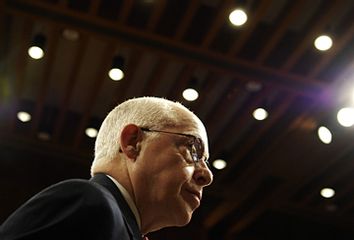
So vital is torture to the imperial presidency that Bush staked the nomination of his new attorney general, Michael Mukasey, on his refusal to oppose a ritual designed during the Spanish Inquisition to purge sinful heresy: waterboarding. Were Mukasey to have called waterboarding torture, as it surely is, he would have been obligated to prosecute those responsible for war crimes.

Mukasey’s testimony was symptomatic of the new constitutional order forged by Bush. Even more insidious, the secretive process to which the administration subjected Mukasey to get him to toe the line underlines that the radical changes Bush has made in the presidency are not merely for one administration, but intended for all that follow.

On Oct. 25, Sen. Dick Durbin of Illinois received written responses from Mukasey to questions he had submitted. In one question, Durbin asked about a report that Mukasey had met with unnamed conservative figures to discuss his legal views and allay any misgivings they might have.

The list of names extracted from Mukasey by Durbin passed by unnoticed in the controversy. Mukasey revealed that on order of “officials within the White House” he sat down with six prominent right-wing leaders, whose gathering constituted a de facto subcommittee of the “Inner Party” of the conservative movement. Those present were Reagan’s attorney general, Edwin Meese III; former Reagan and Bush I legal officials Lee Casey and David Rivkin; the executive vice president of the Federalist Society, Leonard Leo; the president of the Ethics and Public Policy Center, Edward Whelan; and the chief counsel for the American Center for Law and Justice (founded by Pat Robertson), Jay Sekulow.

Mukasey’s meeting with this group at the insistence of the White House amounted to a supra-official confirmation hearing. The incident demonstrates that the Bush imperial presidency is a central tenet of the permanent elite of the party extending beyond his administration. Politicizing paranoia, subsuming intelligence by ideology, purging and deputizing prosecutors, dismissing law by fiat (signing statements) and holding in contempt checks and balances are not temporary measures. It is no accident, as the Marxists (or neoconservatives) say, that President Bush will address the 25th anniversary gala of the Federalist Society on Thursday.

All major Republican candidates for president have embraced Bush’s imperial presidency, but none has surpassed in his fervor Rudy Giuliani. The possibility of holding unaccountable power and conducting a presidency on the footing of what one of his closest advisors, the literary critic as foreign policy expert manqué Norman Podhoretz, has called “World War IV” has wildly excited him. Giuliani time, indeed.

Whether Giuliani becomes the nominee or not, he has defined more clearly than the others the coming themes of the Republican campaign for 2008. His political premise in running for mayor of New York was that the city was under siege, overrun by crime and chaos. His answer to crime was his new police commissioner: Bernard Kerik, the lawless lawman.

Giuliani’s image of New York then is transformed now into an image of the country besieged from within and without. As mayor he stoked inflammatory racial confrontation and basked in demagogy. His heated and cynical paranoid style has gone international. (For cynicism, few episodes exceed his showdown in 2000 with the Brooklyn Museum over an African artist’s painting of a portrait of Jesus using elephant dung as a material when Giuliani was slipping in the polls against his prospective opponent for the U.S. Senate, Hillary Clinton. When the chips are down, Giuliani always looks for the elephant chip.) Whether he becomes the Republican candidate or not, he has helped consolidate Bush’s authoritarian model as the only acceptable one for Republicans.


Now, on a personal note, I have reached the end of my critique of the Bush administration, having elaborated it for years. (In fact, my book on “The Strange Death of Republican America” will be published in April 2008.) As events continue to unfold there will undoubtedly be many more things to say about Bush, Cheney, their administration and the Republican field. But given the momentous stakes, I have decided that nothing is more important than committing myself wholly to the outcome. Therefore, beginning here, the tone changes.

Readers know of my background in the Clinton White House. (See “The Clinton Wars.”) They are familiar with my long friendship with Sen. Hillary Clinton. When she recently asked me to join her campaign as senior advisor I felt I must accept, though not out of obligation but, rather, wholeheartedly. There will be other times and places for me to explain how I have seen her grow into the person I now feel is best qualified and suited to restore the presidency, an office I observed and participated in for four years and about whose nature, I know from working closely with her, she has a deep grasp.

I believe that the reason the Republicans have promoted the talking point that Hillary is unelectable is that they fear that more than any other candidate she can create a majority coalition, win and govern. They fear more than loss in one election; they fear the end of the Republican era beginning with Nixon. They know that she has the knowledge, skill and ability to govern. They know that she has already taken everything they can throw against her and is still standing.

Just as the disintegration of the Democrats brought about the rise of the Republicans, the collapse of the Republicans has created an opening for the Democrats. But the Democrats have been victims of their own false euphoria, sanctimony and illusions before. Now, only the Democrats can revive the Republicans. Nixon, Reagan and Bush were all beneficiaries of Democratic disarray and strategic incompetence. The Democrats have snatched defeat from the jaws of victory before and it can happen again, even under these circumstances, when history is turning the Democrats’ way.

The Democrats at key junctures have been seduced by the illusion of anti-politics to their own detriment. Anti-politics upholds a self-righteous ideal of purity that somehow political conflict can be transcended on angels’ wings. The consequences on the right of an assumption of moral superiority and hubris are apparent. Their plight stands as a cautionary tale, but not only as an object lesson for them. Still, the Republican will to power remains ferocious. The hard struggle will require the most capable political leadership, willing to undertake the most difficult tasks, and grace under pressure.

Continue Reading Close

Bush’s old world disorder

Gone are the days when stern words by a U.S. president could prevent rash action by an errant foreign leader like Musharraf.

  • more
    • All Share Services

Bush's old world disorder

Every aspect of Bush’s foreign policy has now collapsed. Every dream of neoconservatism has become a nightmare. Every doctrine has turned to dust. The influence of the United States has reached a nadir, its lowest point since before World War II, when the country was encased in isolationism.

Russian President Vladimir Putin, whose soul President Bush famously claimed to peer through, is scuttling arms control agreements and cutting his own deals with the Iranians. The Turkish army is poised to invade northern Iraq in pursuit of Kurdish militants that the Iraqi government and the U.S. allowed to roam freely. The resurgent Taliban, given a second life when Bush drained resources from Afghanistan for the invasion of Iraq, is besieging the countryside, straining the future of the Western alliance in the form of NATO. Pakistan, whose intelligence service and military contain elements that sponsor the Taliban and al-Qaida, remains an epicenter of terrorism. Gen. Pervez Musharraf‘s imposition of martial law in Pakistan on Nov. 3 was his second coup, reinforcing his 1999 military takeover. Facing elections in January 2008 that seemed likely to repudiate him and an independent judiciary that refused to grant him extraordinary powers, he suspended constitutional rule. Toothless U.S. admonitions were easily ignored.

Gone are the days when the stern words of a senior U.S. official prevented rash action by an errant foreign leader and when the power of the U.S. served as a restraining force and promoted peaceful resolution of conflict. In the vacuum of the Bush catastrophe, nation-states pursue what they perceive to be their own interests as global conflicts proliferate. The backlash of preemptive war in Iraq gathers momentum in undermining U.S. power and prestige. The resignation last week of Bush’s close advisor, Karen Hughes, as undersecretary of state for public diplomacy, whose mission was to restore the U.S. image in the world, signaled not only failure but also exhaustion. The administration’s ventriloquism act of casting words into the mouth of the president’s nominee for attorney general, former federal Judge Michael Mukasey, who would not declare waterboarding torture, demonstrated that Bush is less concerned with the crumbling of America’s reputation and moral authority than with preventing an attorney general from prosecuting members of his administration, including possibly him, for war crimes under U.S. law.

The neoconservative project is crashing. The “unipolar moment,” the post-Cold War unilateralist utopia imagined by neocon pundit Charles Krauthammer; “hegemony,” the ultimate goal projected by the September 2000 manifesto of the Project for the New American Century; an “empire” over lands that “today cry out for the sort of enlightened foreign administration once provided by self-confident Englishmen in jodhpurs and pith helmets,” fantasized by neocon Max Boot in the Weekly Standard a month after Sept. 11, have instead produced unintended consequences of chaos and decline. Dick Cheney’s and Donald Rumsfeld’s presumption that successful war would instill fear leading to absolute obedience and the suppression of potential rivalries and serious threats — the “dangerous nation” thesis of neocon theorist Robert Kagan — has proved to be the greatest foreign policy miscalculation in U.S. history.

The quest for absolute power has not forged an “empire” but provoked ever-widening chaos. The neocons have been present at the creation, all right. But this “creation” is not another American century, in emulation of the post-World War II order fashioned by the so-called wise men, such as Secretary of State Dean Acheson, a consummate realist, who Condoleezza Rice continues to insist is her model. Squandering the immense influence of the U.S. in such a short period has required monumental effort. Now the fog of war clears. On the ruin of the neocons’ new world order emerges the old world disorder on steroids.

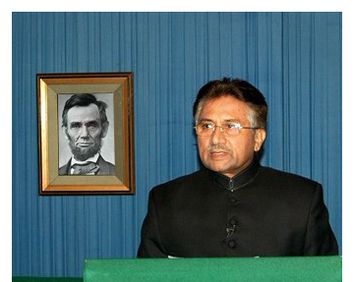
Musharraf’s coup spectacularly illustrates the Bush effect. His speech of Nov. 3, explaining his seizure of power, is among the most significant and revealing documents of this new era in its cynical exploitation of the American example. In his speech, Musharraf mocks and echoes Bush’s rhetoric. Tyranny, not freedom, is on the march. Musharraf appropriates the phrase “judicial activism,” the epithet hurled by American conservatives at liberal decisions of the courts since the Warren Court issued Brown v. Board of Education, which outlawed segregation in schools, and makes it his own. This term — “judicial activism” — has no other source. It is certainly not a phrase that originated in Pakistan. “The judiciary has interfered: That’s the basic issue,” Musharraf said.

Indeed, under Bush, the administration has equated international law, the system of justice, and lawyers with terrorism. In the March 2005 National Defense Strategy, this conflation of enemies became official doctrine: “Our strength as a nation state will continue to be challenged by those who employ a strategy of the weak using international fora, judicial processes, and terrorism.” Neoconservative lawyers, in and out of the administration, have strenuously argued that the efforts to restore the Geneva Conventions, place detainees within the judicial process and provide them with legal representation amount to what they denigrate as “lawfare” — a sneering reference to “welfare” and the idea that detainees are akin to the unworthy poor. Lawyers for detainees, meanwhile, are routinely insulted as “habeas lawyers,” as though they were agents of terrorists and that arguing for the restoration of habeas corpus proves complicity “objectively” with terrorists. Rather than cite these neoconservative talking points directly or invoke the authority of Bush, whose feeble protestations he brushed aside, Musharraf slyly quoted Abraham Lincoln, who suspended habeas corpus in Maryland and southern Indiana during the Civil War. (The U.S. Circuit Court of Maryland overturned his act. In 1866, the Supreme Court ruled in Ex parte Milligan that civilians could not be tried before military tribunals when civil courts were functioning.) In Musharraf’s version, Lincoln is his model, taking executive action in order to save the nation: “He broke laws, he violated the Constitution, he usurped arbitrary powers, he trampled individual liberties, his justification was necessity.” Musharraf, of course, as he suspends an election, leaves out the rest of Lincoln, not least the difficult election of 1864, which took place in the middle of the Civil War.

But where did Musharraf get his warped idea of Lincoln as dictator and America as an example of tyranny? Not quite from diligent study of American history. According to a 2002 interview with Ikram Sehgal, managing editor of the Defense Journal of Pakistan, Musharraf received this notion from his reading of Richard Nixon’s book “Leaders,” published in 1994, in which Nixon discusses Lincoln’s measures taken under extreme duress with ill-disguised admiration. Thus, for Musharraf, as for Cheney and Bush, Nixon’s vision of an imperial president lies at the root of their actions in creating an executive unbound by checks and balances, unaccountable to “judicial activism.” Since declaring a state of emergency, Musharraf has rounded up thousands of lawyers and shut down the courts, while halting offensive military action against terrorists. In the name of combating terrorism, even as parts of his government are in league with them, he launches an attack on those who profess democracy.

The Bush administration finds itself devoid of options. Neoconservatives are left, happily at least for some of them, to defend torture. They have no explanations for the implosion of Bush’s policies or suggestions for remedy. Self-examination is too painful and in any case unfamiliar. Bush regrets Musharraf’s martial law, yet tacitly accepts that the U.S. has no alternative but to support him in the war on terror that he is not fighting — and is using for his own political purposes. On the rubble of neoconservatism, the Bush administration has adopted “realism” by default, though not even as a gloss on its emptiness. Bush still clings to his high-flown rhetoric as if he’s warming up for his second inaugural address. But this is not rock-bottom; there is further to fall.

Continue Reading Close

The sad decline of Michael Mukasey

His reputation for integrity was meant to restore credibility to the Justice Department. Instead, his remarks on waterboarding show that he, like Alberto Gonzales, has let the White House call the shots.

  • more
    • All Share Services

The sad decline of Michael Mukasey

When President Bush nominated Michael Mukasey as attorney general his distinguished career was offered as guarantee of his integrity and independence. A former federal district judge, senior partner at a major law firm and former assistant U.S. attorney, well known and widely respected by the New York bar, he appeared to have the experience and balance needed to restore trust to the battered Justice Department. The previous attorney general, Alberto Gonzales, had been an eager plaything of the White House, a factotum from Texas who faithfully followed orders to politicize and purge for partisan purposes. While Mukasey espouses conservative views upholding an expansive interpretation of the executive, and argues that warrantless domestic surveillance is therefore justified, Democratic senators on the Judiciary Committee were still willing to give him the benefit of the doubt.

Then Mukasey was questioned about whether waterboarding — a technique of forced drowning first used in the Spanish Inquisition and by orders of the Bush administration applied to accused terrorist detainees — is torture. At great length, the nominee feigned lack of knowledge: “I think it would be irresponsible of me to discuss particular techniques with which I am not familiar when there are people who are using coercive techniques and who are being authorized to use coercive techniques. And for me to say something that is going to put their careers or freedom at risk simply because I want to be congenial, I don’t think it would be responsible of me to do that.” Questioned further, he said, “If it amounts to torture, it is not constitutional.” But he would not say whether it was torture.

All 10 Democratic senators on the committee sent Mukasey a letter asking him to clarify whether waterboarding is torture. On Oct. 30, the nominee replied in four convoluted pages. He called waterboarding “over the line” and “repugnant” on “a personal basis,” but adopted the lawyerly pose that it was merely an academic issue: “Hypotheticals are different from real life and in any legal opinion the actual facts and circumstances are critical.”

Mukasey’s retreat into abstraction, however, did not shield him from controversy. On the contrary, Democratic senators on the committee now declared that his nomination was in jeopardy. With his deliberately opaque replies, Mukasey had failed to protect himself, but instead in a stroke exposed himself to rejection. He did not suddenly find himself in trouble because he was an outsider to Washington. Nor had he committed a gaffe or a slip of the tongue, or displayed strange behavior. The nominee who was to be the break from Gonzales was acting remarkably like Gonzales.

Mukasey is not a free agent. He had been strictly briefed and in his testimony was following orders. He has avoided calling waterboarding torture because that is consistent with the administration’s position and past practice. Mukasey’s refusal to disavow waterboarding reveals his acceptance of his assignment to a secondary role as attorney general, an inferior agent, not a constitutional officer, to certain political appointees in the White House.

Those who are responsible for waterboarding have defined and dictated Mukasey’s evasions. His acquiescence demonstrates that no one in his position could take a contrary view to that of David Addington, Vice President Cheney’s former counsel and now chief of staff, who directed and coauthored the infamous memos by former deputy assistant director of the Office of Legal Counsel John Yoo justifying torture, and charged the current acting director of OLC, Stephen Bradbury, to issue new memos rationalizing it.

Addington is the reigning legal authority within the administration, presiding over the attorney general no matter who would fill the job. Addington rules by decree and tantrum, intolerant of any alternative opinion, which he suppresses with intimidation and threat. Gonzales, as White House counsel and then attorney general, was the marionette of Karl Rove and Addington. Rove is gone, but Addington remains.

In his confirmation hearings, Mukasey has proved he will dance as the strings are pulled. His positions on waterboarding express precisely the relationship between the Bush White House and its Justice Department. Mukasey’s testimony telegraphs that the White House will continue to call the shots. He has already ceded the essence of his power even before assuming it. His vaunted integrity and independence have been crushed, short work for Addington.

Addington’s dominion over the law — controlling the writing of the president’s executive orders and the memos from OLC, the office of the White House counsel and the carefully placed network of general counsels throughout the federal government’s departments and agencies — is a well-established and central aspect of Cheney’s power. Addington has been indispensable to the vice president since he served as his counsel on the joint congressional committee investigating the Iran-Contra scandal, when Cheney was the ranking minority member. In that capacity, Addington wrote, under Cheney’s signature, the notorious minority report that was an early clarion call for the imperial presidency.

Addington and Cheney’s report decried Congress for its “hysteria” over the Iran-Contra scandal, which involved the selling of missiles to Iran to finance arms for the Nicaraguan Contras against explicit congressional legislation. The Constitution, they argued, “leaves little, if any doubt that the president was expected to have the primary role of conducting the foreign policy of the United States.” They added: “Congressional actions to limit the president in this area therefore should be reviewed with a considerable degree of skepticism. If they interfere with the core presidential foreign policy functions, they should be struck down.”

The Cheney minority report was the doctrinal basis for the Bush presidency: the unitary executive, the commander in chief ruling in wartime by fiat and, ultimately, torture being defined as whatever the president, not the Geneva Conventions, said it was. Addington’s authorship of the Cheney Iran-Contra report was largely overlooked until fairly recently, but his deeper connection to that scandal and its resonance have received little attention.

In the 1980s, Addington, then in his 20s, served as deputy counsel to CIA director William Casey, the moving force behind the Iran-Contra affair and the most powerful figure in the Reagan administration after the president. Along with other hotshots in the counsel’s office, Addington was part of what became known within the agency as the “Lawless Group,” named after Richard Lawless, a CIA operative who was a close assistant to Casey, according to a former senior CIA official. After Casey’s death, Rep. Dick Cheney co-opted the “Lawless Group,” putting its members in key positions when he was secretary of defense during the first Bush administration and vice president in the second. (Lawless, for example, after working as Jeb Bush’s business partner, served as deputy undersecretary of defense, retiring this past April.)

“A lot of the decisions on Iran-Contra were signed off by the counsel’s office,” a longtime senior CIA official told me. “It was not a renegade operation. It had lawyers, just like now. Everything they were doing was run by the general counsel’s office and Addington was deputy. You may draw your own conclusions, as the Russians say.” In fact, the role of the counsel’s office surfaced in the trial of Alan Fiers, the CIA agent in charge of the Central American Task Force, who pleaded guilty to misleading Congress. But that role was never investigated or ever really reported.

“These guys don’t like the mainstream CIA. In fact, they hate it,” the CIA official explained. “They don’t like information unless it fits what they want to hear. They hate the CIA because the CIA tells them what they don’t want to hear. They want assessments that prove ideological points. They are looking for simplistic answers to complicated issues. They inhabit a make-believe world of moving up into perceived areas of expertise. It’s the same guys; they all resurface when Republicans are back in power. It’s the same group. It’s a system. The similarities are amazing in all these wars we’ve been dragged into.”

Casey is the half-forgotten forefather of the radical Bush presidency. A clandestine agent of the Office of Strategic Services during World War II, the intelligence group predating the CIA, Casey became a wealthy and politically influential lawyer. He was among the original godfathers of the conservative movement, serving on the board of the right-wing Regnery publishing house, operating as financier of William F. Buckley Jr.’s National Review and founding conservative think tank the Manhattan Institute.

An avid supporter of Richard Nixon‘s, Casey was appointed chairman of the Securities and Exchange Commission and president of the Import-Export Bank. Casey regarded the Watergate scandal as a mere political attack, “political shenanigans,” as he described it to Nixon in a private letter in May 1973. In 1980, Casey was director of Reagan’s campaign. After the election he wanted to be named secretary of state, but settled for CIA director.

“By God, we’ve got to get rid of the lawyers!” he told William Webster, Reagan’s FBI director. Tim Weiner, in his newly published history of the CIA, “Legacy of Ashes,” writes, “Like Nixon, he believed that if it’s secret, it’s legal.” “Casey was an inappropriate choice,” said former CIA director George H.W. Bush.

Casey conducted his own foreign policy, relying on secret methods and men of action. His rival, Reagan Secretary of State George Shultz, remarked, “The CIA’s intelligence was in many cases simply Bill Casey’s ideology.” “Casey had made of himself a clandestine secretary of State,” wrote his biographer Joseph Persico in “The Lives and Secrets of William J. Casey: From the OSS to the CIA.” “His involvements in Afghanistan, China, the Philippines, Iran, and Central America had not been simply those of a spy chief but those of a covert foreign minister.”

Casey chose Lt. Col. Oliver North to run the covert Contra operation and suggested to him plans for illegal supply in violation of the Boland Amendment and how to use a middleman for selling arms to Iran. The final report of the joint congressional committee on the Iran-Contra scandal concluded: “We believe that the late Director of Central Intelligence, William Casey, encouraged North, gave him direction and promoted the concept of an extra-legal covert organization.” “The person who managed this whole affair was Casey,” said Abraham Sofaer, then the State Department’s counsel.

Before congressional committees, Casey falsely testified that the CIA was unaware of the shipment of missiles to Iran. His perjury was exactly the same as that of then National Security Advisor John Poindexter, on the same question, and it is likely he would have been indicted, faced trial and been convicted, like Poindexter. Casey’s then deputy, Robert Gates, now secretary of defense, said, “Casey was guilty of contempt of Congress from the day he was sworn in.” Adm. Bobby Inman, who preceded Gates as deputy, had resigned because, he said, “I caught him lying to me in a number of cases.” Inman’s immediate successor as deputy, John McMahon, quit after opposing the Iranian arms deal. After a week of mumbling appearances before Congress, Casey collapsed from a cancerous brain tumor and died.

Casey’s closest aides — including the Lawless Group — scattered. Cheney promptly hired Addington. As his counsel, Addington attacked the investigation, defended the administration and covered up his own involvement in the Casey operation. One former prominent Democratic Senate staff member who had directed the probe told me that the Democrats were unaware of Addington’s link to Casey. If they had been they would have raised it as a dangerous conflict of interest and demanded that he be removed. “Addington never should have been permitted to work on the committee,” he said. “But no one paid attention to his background. It wasn’t important.”

Cheney’s defense of Casey’s actions as written by Addington in the minority report became the core of the Bush doctrine: The president as commander in chief can do whatever he wants regardless of Congress. There must be no checks and balances, no accountability. There must be no disclosure to other branches of government, whether legislative or judicial. Oral findings, or, if necessary, secret memos, make the illegal legal merely by saying they are legal in the name of presidential authority. The operational need to know determines who knows.

Now Mukasey, who was supposed to restore credibility to the Justice Department, has been transformed overnight into a cog in the machine, another servant to his masters, Addington’s apologist. His brief tragedy is just one small outcome of a long history. The almost instantaneous tainting of his reputation should have been understood from the start as inevitable.

Continue Reading Close

Journalism and its discontents

Ninety years after Walter Lippmann first railed against the complicity of the media in wartime propaganda, we're back at ground zero.

  • more
    • All Share Services

Journalism and its discontents

Walter Lippmann (1889-1974) was the most influential American journalist of the 20th century. Born into one of the German-Jewish “Our Crowd” families of New York City, he began his career as a cub reporter for Lincoln Steffens, the crusading investigative journalist, then became one of the original editors of the New Republic, and was recruited to write speeches for President Woodrow Wilson and help formulate his plan to make the world “safe for democracy,” the Fourteen Points. In the 1920s, Lippmann became editorial director of the New York World, then a major daily newspaper with a Democratic orientation. When it folded, the New York Herald Tribune offered him a column, which, with the Washington Post, served as his journalistic base for almost 50 years.

Lippmann wrote books on philosophy, politics, foreign policy and economics. In one of them, “The Cold War,” he early defined the struggle between the United States and the Soviet Union while offering penetrating criticism of U.S. policy as a “strategic monstrosity” that would lead to “recruiting, subsidizing and supporting a heterogeneous array of satellites, clients, dependents and puppets,” inevitably forcing poor choices of having to either “disown our puppets, which would be tantamount to appeasement and defeat and the loss of face,” or else back them “at an incalculable cost on an unintended, unforeseen and perhaps undesirable issue.” Lippmann’s prophetic warning was realized in the Vietnam War, which he opposed at considerable cost to his personal and political relationships. (Anyone interested in Lippmann, or American politics, should read Ronald Steel’s magisterial biography, “Walter Lippmann and the American Century.”)

Among his varied roles, Lippmann was the original and most prescient analyst of the modern media. His disillusioning experience in World War I prompted the first of three books on the subject, “Liberty and the News,” followed in rapid succession by “Public Opinion” and “The Phantom Public.” In them Lippmann deconstructed the distortions and lies of government propaganda eagerly transmitted by a jingoist press corps, the “manufacture of consent” and the creation of “stereotypes” projected as false reality.

“Liberty and the News,” first published in 1920, is being reissued by Princeton University Press, and its insights into the “error, illusion, and misinterpretation” in wartime of the “news-structure” remain as fresh as ever. For this volume, I have written an afterword, using Lippmann’s ideas as a prism to illuminate the current crisis of the press and its professional collapse.


From the moment he entered onto the public scene as a writer for the new journal of opinion, The New Republic, established in 1914, Walter Lippmann’s precocity was apparent. He made his way almost effortlessly into the highest levels of society and politics, his uninterrupted elevation almost proof in itself of the progressive view of history. Yet his thinking, particularly about the craft of journalism, derived chiefly from experience with the curdling of American Progressivism and the end of its innocence after World War I.

Lippmann sharpened his early disillusionment into a perfectly pitched tone of omniscience. He descended from his lofty peak as a wise man with an Olympian air of detachment, permitting mere mortals to benefit from his counsel. Oracle to the powers that be, he was also the father of modern objectivity. He never saw any contradiction between his deeds and words or felt any need to pause over any supposed conflict. Nor did any public figure suggest that there was anything untoward or unseemly in his alliances or aversions. Instead, they sought his approbation and cordiality. His immersion in politics while holding forth as a disinterested observer did not taint him as hypocritical or false. Everyone understood that he was Walter Lippmann. If there were a prevailing prejudice about him, it was a tendency to judge him by his cogency and influence.

The standards of objective journalism Lippmann painstakingly advocated in the early twentieth century, and which were adopted as ideal goals by major news organizations in midcentury, have long since been traduced, trampled, and trashed. The journalistic world before the Vietnam War was, to be sure, hardly a golden age. The pliability of much of the national press in the face of Senator Joseph McCarthy’s red-baiting smear campaigns occurred in the middle of those happy days. Golden ages glitter only in retrospect as viewed from the junkyard of the present. Nonetheless, there has been a steady degeneration of the press over the past few decades, involving both the willful self-destruction of hard-won credibility and the rationalization of dull incomprehension as invulnerable self-importance. The gap between Lippmann’s ideals and present realities is one of the major reasons why Liberty and the News remains so pertinent — and so troubling — nearly ninety years after its publication.

“For in an exact sense the present crisis of western democracy is a crisis of journalism,” Lippmann wrote. That sentence was distilled from years of hope turned to despair. Lippmann had ferried from the offices of The New Republic, located in New York, to the White House, where he helped work on speeches for Woodrow Wilson. After the entry of the United States in the world war in 1917, Lippmann enthusiastically accepted an appointment as the U.S. representative on the Inter-Allied Propaganda Board, with the rank of captain. But Captain Lippmann soon crossed swords with George Creel, chief of the Committee on Public Information, an official federal government agency that whipped up war support through jingoism. When Lippmann submitted a blistering report in 1918 on how the committee manipulated news to foster national hysteria, Creel sought his dismissal — and Lippmann quit his post to assist the U.S. delegation at the Versailles peace conference. The year following the war, 1919, began with Wilson greeted as a messiah and ended with him politically broken and physically paralyzed. His collapse personified the wreckage of Progressive idealism. Lippmann focused his attention on the part played by the press.

“Everywhere today,” Lippmann wrote in Liberty and the News, “men are conscious that somehow they must deal with questions more intricate than any that church or school had prepared them to understand. Increasingly they know that they cannot understand them if the facts are not quickly and steadily available. Increasingly they are baffled because the facts are not available; and they are wondering whether government by consent can survive in a time when the manufacture of consent is an unregulated private enterprise.”

Lippmann had witnessed firsthand how the “manufacture of consent” had deranged democracy. But he did not hold those in government solely responsible. He also described how the press corps was carried away on the wave of patriotism and became self-censors, enforcers, and sheer propagandists. Their careerism, cynicism, and error made them destroyers of “liberty of opinion” and agents of intolerance, who subverted the American constitutional system of self-government. Even the great newspaper owners, he wrote, “believe that edification is more important than veracity. They believe it profoundly, violently, relentlessly. They preen themselves upon it. To patriotism, as they define it from day to day, all other considerations must yield. That is their pride. And yet what is this but one more among myriad examples of the doctrine that the end justifies the means? A more insidiously misleading rule of conduct was, I believe, never devised among men.”

Public opinion was not a free marketplace of ideas, but was channeled and polluted by the managers of news. They concentrated their power at the expense of accurately informing the public, whose fears and hatreds they exploited. Reason was impossible to sustain in the whirlwind. Lippmann wrote:

Just as the most poisonous form of disorder is the mob incited from high places, the most immoral act the immorality of a government, so the most destructive form of untruth is sophistry and propaganda by those whose profession it is to report the news. The news columns are common carriers. When those who control them arrogate to themselves the right to determine by their own consciences what shall be reported and for what purpose, democracy is unworkable. Public opinion is blockaded. For when a people can no longer confidently repair “to the best foundations for their information,” then anyone’s guess and anyone’s rumor, each man’s hope and each man’s whim becomes the basis of government. All that the sharpest critics of democracy have alleged is true, if there is no steady supply of trustworthy and relevant news. Incompetence and aimlessness, corruption and disloyalty, panic and ultimate disaster, must come to any people which is denied an assured access to the facts. No one can manage anything on pap. Neither can a people.

A year before Liberty and the News appeared, the famous muckraking journalist and novelist Upton Sinclair, author of The Jungle, published The Brass Check, the first contemporary exposé of the press as a corrupt special interest. Sinclair asserted that the press simply reflected its big business ownership and did its bidding. Lippmann’s analysis, though, was at once more subtle and more penetrating, elucidating a form of corruption that ran to the foundations of the nation’s politics.

By substituting propaganda for truth, brandishing jingoism to enforce conformity, and asserting arrogance and certainty over skepticism and humility, Lippmann contended, the manufacturers of consent confounded democracy. “In so far as those who purvey the news make of their own beliefs a higher law than truth, they are attacking the foundations of our constitutional system. There can be no higher law in journalism than to tell the truth and shame the devil.”

Woodrow Wilson waged war to make the world “safe for democracy” and to establish an international order based on collective security. Nearly a century later, President George W. Bush appropriated Wilson’s rhetoric as a gloss on preemptive war and unilateralism. Neoconservatism stood Wilsonianism on its head, and, had he lived to see the day, Lippmann might have rubbed his eyes like Rip van Winkle at how much had changed. Yet Lippmann also would have discovered a depressingly familiar press corps on a bandwagon of jingoism, disseminating falsehoods leaked by government officials, engaging in ruthless self-censorship, and preening in careerist triumphalism.

The behavior of the press corps under Bush revealed a corruption more in line with Lippmann’s analysis than Sinclair’s, although Sinclair’s stress on the primacy of vulgar economics had its play, too. Indeed, Bush administration officials, including Vice President Dick Cheney, complained to the chief executive officers of major media corporations about reports and reporters, and the pressure fell down the chain of command like an anvil. Nearly every correspondent, producer, and commentator on every broadcast and cable network outlet was keenly aware of such interventions and adjusted accordingly. The cable network MSNBC’s dismissal in February 2003, one month before the invasion of Iraq, of the popular Phil Donahue as host of a public affairs program that had raised skeptical questions about the rationale for the war was cautionary and symptomatic. An internal memo claimed that Donahue presented “a difficult public face for NBC in a time of war” while “at the same time our competitors are waving the flag at every opportunity.” For crass reasons, jingoism became a criterion for presentation of news.

But economics did not explain everything. In 2002, the conservative Fox News anchor Brit Hume, well aware of the scent of fear in the air, declared ABC News unpatriotic: “Over at ABC News, where the wearing of American flag lapel pins is banned, Peter Jennings [the news anchor] and his team have devoted far more time to the coverage of civilian casualties in Afghanistan than either of their broadcast network competitors.”

Hume’s attack reflected the general conservative argument that the press was a bastion of “liberal bias,” and was thus untrustworthy and even potentially perfidious in the war on terror. A conservative columnist, Andrew Sullivan, who later became a disillusioned administration critic, articulated most clearly the right-wing dichotomy of domestic good-and-evil in the immediate aftermath of September 11. “The middle part of the country — the great red zone that voted for Bush — is clearly ready for war,” he wrote. “The decadent Left in its enclaves on the coasts is not dead — and may well mount what amounts to a fifth column.”

In an atmosphere rife with intimidation, key reporters and editorial writers for major newspapers, including the New York Times and the Washington Post, also became cheerleaders for the neoconservative project. In the case of the Times, the editors’ avid desire for scoops initially overwhelmed all else — and put the newspaper in the forefront in publishing falsehoods, on its front page, about Iraq’s supposed stockpiles of weapons of mass destruction. In May 2004, the Times, its false reports now exposed, issued an extraordinary “Editors’ Note”: “Information that was controversial then, and seems questionable now, was insufficiently qualified or allowed to stand unchallenged. Looking back, we wish we had been more aggressive in re-examining the claims as new evidence emerged — or failed to emerge.” Thereafter, though, the Times’ reckless search for scoops gave way to the suppression of news that might damage the Bush White House. For more than a year after its apology over its WMD coverage — and throughout the 2004 election campaign — the paper refused to publish its reporters’ accounts of how the Bush administration was engaged in domestic spying by evading the legal court established by the Foreign Intelligence Surveillance Act.

In the rush to war, from September 2002 through February 2003, the Washington Post editorialized in favor of an invasion twenty-six times. Every single editorial contained disinformation, some of it directly leaked by administration officials. On February 6, 2003, the day after Secretary of State Colin Powell‘s speech to the United Nations Security Council presenting supposed evidence of WMD, the Post ran an editorial headline, “Irrefutable,” and said “it is hard to imagine how anyone could doubt that Iraq possesses weapons of mass destruction.” (Two years later, Powell described his speech, which had been revealed as a string of disinformation, as a “blot” on his record, “terrible,” and “painful.”) Afterward, the Post‘s editorial board issued no “Editors’ Note” or clarification like the one that had appeared in the New York Times. Factual reporting that suggested doubt about the existence of Saddam Hussein’s weapons of mass destruction had been either buried or suppressed by the Post‘s editors. And, with the notable exception of the Knight Ridder news service, the Post‘s coverage was typical of the supposedly “liberal” press corps.

In the heady days before, during, and long after the press embedded with military units invading Iraq, making them feel close to the action, Bush was presented as decisive, commanding, and knowledgeable; National Security Advisor Condoleezza Rice was brilliant; Vice President Cheney wise; Secretary of Defense Donald Rumsfeld savvy; and Karl Rove a genius. In the fall of 2002, as the administration ratcheted up its propaganda offensive before the Iraq war, Bob Woodward, the renowned investigative reporter of Watergate, published a book, Bush at War — based on leaks of select national security documents and interviews with officials up to and including President Bush. Senior officials, in fact, were ordered to grant Woodward his access. George Tenet, then the CIA director, later wrote in his memoir: “[W]e kept getting calls from the White House saying, ‘We’re cooperating fully with Woodward, and we would like CIA to do so, too.’” Through administration packaging of high-level contacts and carefully chosen classified material, the imprimatur of the famous and trusted journalist was stamped on stereotypes favorable to the administration.

In early 2004, after receiving a call from the chairman of the Joint Chiefs of Staff, General Richard Myers, CBS News withheld its own reporting on torture at the Abu Ghraib prison in Baghdad. (Only when CBS news executives learned that The New Yorker was about to break the story did they permit 60 Minutes II to report it, but without any publicity or rebroadcast.) In May of that year, Senator Mark Dayton, Democrat of Minnesota, questioned Secretary of Defense Rumsfeld and General Myers about the incident. The transcript of the Senate Armed Services Committee hearing reads:

Dayton: Mr. Secretary, were you aware or did you authorize General Myers to call CBS to suppress their news report?
Rumsfeld: I don’t have any idea if he discussed it with me. I was — I don’t know. I don’t think he did.
Dayton: So over the last two weeks, calling CBS to suppress the news report. You don’t —
Rumsfeld: “Suppress” is not the right word at all.
Dayton: I’m sorry, sir, but I —
Rumsfeld: And it’s an inaccurate word, I should say.
Dayton: General Myers, did you discuss it with the secretary?
Myers: This had been worked at lower levels with the secretary’s staff and my staff for some time, and —
Dayton: That you would call CBS to suppress their news report?
Myers: I called CBS to ask them to delay the pictures showing on CBS’ “60 Minutes” because I thought it would result in direct harm to our troops.
Dayton: … Mr. Secretary, is that standard procedure for the military command of this country to try to suppress a news report at the highest level?
Myers: It didn’t — let me just — Senator Dayton, this is a serious allegation —
Dayton: It sure is.
Myers: — and it’s absolutely — the context of your question I believe is wrong.

In March 2004, more than 1,500 members and guests of the Radio and Television Correspondents Association attended its annual black-tie dinner, where President Bush entertained the throng with White House photographs showing him searching the nooks and crannies of the Oval Office for WMD and saying, “Nope, no weapons over there! Maybe under here?” The crowd roared with riotous laughter.

In the months before the 2004 election, CBS News’ 60 Minutes produced but declined to air its investigation into the Niger forgeries claiming Saddam was seeking yellow uranium for nuclear weapons, a fabrication used as a central justification for war. Two years later, on the revamped CBS Evening News, the vituperative right-wing talk show host Rush Limbaugh, who had been fired from ESPN for inflammatory racial remarks, was invited to inaugurate its regular commentary on “civil discourse” (a segment the network soon canceled). And during the run-up to the 2006 midterm elections, ABC aired a two-part dramatization, supplied by right-wing partisans, of the terrorist attacks of September 11, 2001. The shows fabricated events and dialogue in order to cast blame on the Clinton administration and exonerate President Bush. Even though ABC executives were alerted beforehand to the falsified history, they chose to broadcast it anyway.

Meanwhile, the chairman of the Corporation for Public Broadcasting, overseeing the Public Broadcasting System, Kenneth Tomlinson, contracted a right-wing activist to investigate “liberal bias” at PBS. The CPB inspector general, however, reported that Tomlinson had imposed a “political test” on employees and hired favored consultants without properly informing the board. Tomlinson’s crusade ended with his resignation in 2005.

The transactional nature of the Bush-era press corps surfaced in the 2007 trial of the vice president’s chief of staff, United States v. I. Lewis Libby, when evidence of the administration’s extensive manipulation of journalists was adjudicated under oath. The scandal began with a campaign ordered by Vice President Cheney to attempt to discredit former ambassador Joseph Wilson. After undertaking a mission for the CIA to ascertain whether Saddam Hussein was seeking yellowcake uranium in Niger, Wilson had found an utter absence of proof. In an op-ed article published in the New York Times in July 2003, he exposed as false President Bush’s claim to that effect made in his 2003 State of the Union address — the president’s most urgent reason for going to war. The White House tried to besmirch Wilson by prodding journalists to publish that his wife, Valerie Plame Wilson, an undercover CIA operative working on WMD, was responsible for sending him to Niger (a falsehood debunked in the trial).

Libby sought out Judith Miller, the New York Times reporter who the administration had used to plant the original disinformation about WMD, but, unbeknownst to Libby, Miller’s editors had taken her off the beat. Karl Rove, the president’s chief political adviser, spreading the smear, told a TV talk show host, “Wilson’s wife is fair game.” Finally, conservative columnist Robert Novak exposed Plame’s identity, despite having been warned against doing so by the CIA’s public affairs officer. Novak sent a copy of his prepublication column to Rove through a Republican lobbyist to let him know the hit was made.

More than a few members of the press had been recipients of the Plame leak from various White House aides, but they refused to disclose their sources, citing journalistic privilege. Miller went to jail for eighty-five days until she said her source, “Scooter” Libby, had released her from confidentiality. The court ruled against those journalists refusing to offer their testimony as witnesses to a crime, demolishing the customary journalistic privilege that actually had no standing in law but had received deference from government authorities until then. Libby claimed he had not been the source of the leak and repeatedly lied to the grand jury, saying that he had learned about Plame from journalists. After a trial featuring testimony from White House officials describing their techniques for exploiting the press, Libby was convicted on four counts of perjury and obstruction of justice.

As Lippmann observed almost ninety years ago, the crisis of journalism cannot be disentangled from the crisis of national government. Government and journalism now share a crisis of credibility, trust, and competence. At the least, the crisis of journalism reveals a changing standard for and definition of “objectivity.” Journalism, or more precisely, freedom of expression and freedom of the press, has been plunged, as a result of casual, callow, craven, or simply career-minded attitudes, into complicity, tacit and active, with a harsh and secretive administration that seeks to concentrate unaccountable power in the executive and sees itself as above the law and above reproach.

Only incidentally does the crisis of journalism involve the conflict between impartiality of judgment on the one hand and advocacy on the other. This might be a salient question under other circumstances, but it is peripheral here. Neither is the problem caused by slight inattentiveness; nor can it be solved by minor adjustments. The failure of most of the press for most of the Bush era to cover most of the basic reality was because to do so was too radical and threatening, not only to the administration but also to the news organizations themselves. Their dismal behavior goes to the root of a professional collapse. The press fiasco under Bush marks the culminating contradiction, if not repudiation, of Lippmann’s original ideas about shaping journalistic standards for a modern age. It is not sheer happenstance, but the outcome of a long history that was by no means inevitable.

Two years after writing Liberty and the News, Lippmann published Public Opinion, perhaps the most important book on American journalism in the twentieth century. It opened with an invocation, a long quotation from Plato’s Republic, of the famous scene of cave dwellers who discern reality only as shadows dancing on the walls. Americans, Lippmann wrote, inhabited a cave of media misrepresentations of “the world outside,” stereotypes, distortions of distortions — “not a mirror of social conditions, but the report of an aspect that has obtruded itself.” Journalism became a media phantasmagoria, he wrote: “There are no objective standards here. There are conventions.” He argued that a professional “intelligence bureau” of “expert reporters” that would present “a valid picture” of “the relevant environment” should be created, “interposing some form of expertness between the private citizen and the vast environment in which he is entangled.” Disillusioned with politics, Lippmann turned to experts to act as arbiters of reality. He hoped that these antipolitical engineers would “disintegrate partisanship,” establishing “footholds of reason.” With that, Lippmann composed a Magna Carta for professional journalistic objectivity.

Gradually and imperceptibly, after taking decades to establish, the standard of objectivity shifted to become the opposite of what it had once been. Rather than serving as a method of describing the object, objectivity became an artificial balancing act of presenting competing claims about it. Objectivity turned into finding one hand and then the other hand, “fair and balanced,” as the mocking slogan of Fox News put it. Editors, publishers, and other news executives often came to consider establishing the facts as untoward activism and advocacy. Fear of being accused of lacking “objectivity” drove them to bend over backward to demonstrate lack of bias by refusing to declare the facts themselves. Fairness was equated with lack of controversy. Objectivity became transformed from reporting into rationalizing the act of avoiding reporting. Professionalism, or expertise, as Lippmann understood it, was caricatured as a “liberal” ideological point of view — on the one hand — that must be balanced by another “conservative” ideological point of view — on the other hand. To the degree that this polarization became the standard, it successfully altered and neutered journalism. Professionalism receded in the name of professionalism.

Just as Lippmann’s sense of objectivity took hold within the major news organizations by midcentury, the conservative movement began a counter trend. Objectivity was assailed as subjective, facts treated as opinion, reality as wholly ideological. Of course, during the New Deal and through the 1950s, most newspaper publishers were Republican, as they are today. But conservatives believed, nevertheless, that the new encroaching standards of objectivity in the major metropolitan press and national broadcast media reflected the power of a monolithic liberal establishment.

Richard Nixon turned his simmering resentment against “the establishment” into a focused strategy against the press. In November 1969, Vice President Spiro Agnew delivered a speech denouncing it as a “small [and] unelected elite.” He warned, “The views of the majority of this fraternity do not — and I repeat, not — represent the views of America.” And he even cited Walter Lippmann as an authority against “monopoly” over public opinion.

After his landslide victory in 1972, Nixon urged the eccentric right-wing billionaire Richard Mellon Scaife to buy the Washington Post. Nixon’s ploy launched Scaife on his subsequent crusade against “liberal media.” In 1985, Scaife spent millions subsidizing a failed lawsuit by former general William Westmoreland against CBS News, trying to prove it had defamed him. (The same Scaife agents involved in that foray turned up later at the center of the $2.4 million Scaife-funded Arkansas Project of dirty tricks against President Clinton.)

As the Watergate scandal proved, Nixon’s effort to demonize and isolate the press was part of his larger plan to formalize and institutionalize an imperial presidency. He sought an inherent power for the president to make war, declare national emergencies, nullify checks and balances by impounding funds at the president’s discretion, create a system of secrecy, all rationalized by claims of national security. Checks and balances, oversight and accountability, exemplified by a rigorous press, were cast, following Agnew, as a fundamental threat to the country. From Nixon to George W. Bush, the impulse to build an unfettered executive has driven the essential struggle between the press and the presidency. The conservative movement’s relentless campaign against “liberal bias” has been a lever to remove this check and balance.

The growth of a countervailing conservative media machine has also been a decisive political factor in mobilizing public opinion and insulating a part of it from contamination of “liberal bias.” In October 2004, the University of Maryland Program on International Policy Attitudes conducted a study, “The Separate Realities of Bush and Kerry Supporters,” revealing that 72 percent of Bush supporters believed that Saddam Hussein had WMD and that it had been proven, even though there had been extensive news reports from the Iraq Survey Group that it had found no WMD. Furthermore, 75 percent of Bush supporters believed that Saddam was substantially helping al Qaeda, 63 percent believed that that evidence had been found, 60 percent believed that experts agreed with that conclusion, and 55 percent believed that the 9/11 Commission had proven the point, even though it proved exactly the opposite. Bush supporters did not hold these misperceptions because of inattention to the news. Another University of Maryland study, “Misperceptions, the Media and the Iraq War,” revealed that misperceptions varied significantly according to news sources and that higher levels of exposure to Fox News in particular compounded factual misperceptions and approval of Bush. Eighty percent of those who cited Fox News as a major source of their information suffered serious misperceptions, according to the study, compared to 23 percent citing National Public Radio and the Public Broadcasting System.

“Without protection against propaganda, without standards of evidence, without criteria of emphasis, the living substance of all popular decision is exposed to every prejudice and to infinite exploitation,” Lippmann wrote in Liberty and the News. “The quack, the charlatan, the jingo, and the terrorist, can flourish only where the audience is deprived of independent access to information.” Yet Lippmann assumed that the people were passive, acted upon by politically motivated elites. Today, about one-third of the public actively chooses sources of information that play to their prejudices. The readers, listeners, and viewers of the Drudge Report, the Rush Limbaugh show, and Fox News have consciously selected “the quack, the charlatan, the jingo” to seal themselves from objective information. The “breakdown of the means of public knowledge,” as Lippmann called it, rests on a carefully cultivated preference for crank opinion over unsettling fact. The more reality defies this public’s understanding, the more fervently it redoubles its resistance to it, embracing the distorted stereotype as the only true account.

The entrenchment and exploitation of this segment of public opinion has become big business and political necessity on the right. In May 2003, Matt Labash, a writer for the neoconservative journal The Weekly Standard (published by Rupert Murdoch, owner of Fox News), explained how the conservative attack on “liberal bias” operated as a profitable game. “While all these hand-wringing Freedom Forum types talk about objectivity, the conservative media likes to rap the liberal media on the knuckles for not being objective,” he said. “We’ve created this cottage industry in which it pays to be un-objective. It pays to be subjective as much as possible. It’s a great way to have your cake and eat it too. Criticize other people for not being objective. Be as subjective as you want. It’s a great little racket. I’m glad we found it actually.”

The degree to which this “great little racket” has been accepted and assimilated by members of the press was expressed by Mark Halperin, then political editor of ABC News, in an appearance on a right-wing radio talk show in October 2006:

Many people I work with in ABC, and other old media organizations, are liberal on a range of issues. And I think the ability of that, the reality of how that affects media coverage, is outrageous, and that conservatives in this country for forty years have felt that, and that it’s something that must change … And news organizations putting their heads in the sand for forty years, and not caring that half the country thought we were too liberal and biased against them, was an insane business decision. But it was also insane to do from the point of view of what we’re supposed to do as our core mission … I don’t know if it’s 95 percent [the percentage of people with whom he works who are liberals], and unfortunately, they’re not all old. There are a lot of young liberals here, too. But certainly, there are enough in the old media, not just in ABC, but in old media generally, that it tilts the coverage quite frequently, in many issues, in a liberal direction, which is completely improper.

“From our recent experience,” wrote Lippmann, “it is clear that the traditional liberties of speech and opinion rest on no solid foundation.” Journalism must reconstruct itself for a new age, at least as urgently as in Lippmann’s time. So far it has failed the tests of the new century. Nearly ninety years after Lippmann first assayed the crisis of journalism, it finds itself back at ground zero — or in Lippmann’s cave. Even some of the impassioned amateurs of the Internet have been more factually reliable on central issues than the most august news organizations. Their fear — as readers, viewers, and influence seep away in the face of new technology — has provoked more anxiety than self-examination. But journalism may yet be revitalized, as part of a general reawakening of American democracy that discovers new forms of expression and forces new debate to achieve its ends.

The filigree of wire, cathode-ray tubes, woofers and tweeters, satellite dishes, and printing presses are the same everywhere in a flat world. But Americans are wired differently. The freedom of the press is part of our Constitution, the first right, the First Amendment; and our democracy — public policy, politics, commerce, and nation — has been shaped by its exercise, its use, and its abuse.

In 1822, in a placid time, an “Era of Good Feelings,” as it was called, James Madison was nonetheless eternally vigilant about liberty and the news. “A popular Government without popular information, or the means of acquiring it, is but a Prologue to a Farce or a Tragedy, or perhaps both,” he wrote. “Knowledge will forever govern ignorance, and a people who mean to be their own Governors, must arm themselves with the power which knowledge gives.”

Continue Reading Close

Page 1 of 38 in Sidney Blumenthal