Sloane Crosley

My proud little Siamese freak show

Out from the shadow of a family of artists -- and Martha -- I forged one reliable trick that never fails me

My sister once told me that no one good was born on her birthday. She said this as casually as you and I might recite the last four digits of our Social Security numbers, as if it were an indisputable and long-standing fact. By “good” she meant “famous” because that was the nature of our conversation.

“That can’t be true,” I protested, in a mock effort to find fault with an argument that didn’t matter either way.

“I think one of the guys from Chicago has my same birthday.”

“Oh. That is desperate.”

“Well,” she sighed dramatically, “not all of us can have Martha.”

Oh yes, that’s right. The Queen of Crafts herself, Martha Stewart, and I have the same birthday. I prefer to think it’s the glue-gun wielding, perfect-tart-producing Martha and not the copper pan-throwing, jail-going Martha. But I suppose if I am going to share a calendar square with some of Martha, I have to share it with all of Martha. Our immediate neighbors to the past and future are crafty as well (see also: Yves Saint Laurent, Andy Warhol). I’m not sure when God set aside those seven days to create the world, but from a decoration standpoint, it was probably the first week of August. But despite all this general creativity floating about, it is Martha and Martha alone in whose perfectly stenciled shadow I live my life. And my tributes to her have been, in a word, poor.

For a long time I wanted to draw, but I could never get the proportions right. My still life sketches were the artistic equivalent of someone who has misjudged the space constraints of a postcard, the handwriting shrinking uncomfortably at the bottom. So I tried to make vases and bowls instead but I mushed the clay. Or spun it so fast on the pottery wheel, it flung itself onto the wall in protest. I tried my hand at painting but still don’t understand the concept of acrylic paint. And yet, despite all evidence of my artistic stunting, I thought it would be a good idea to create a series of large Plexiglas dioramas based on the essays in my first book. Then, for my second, I crafted paper dolls, spending hours hand-painting and folding, trimming and gluing. The results are not terrible. But, alas, there’s a difference between psychosis and talent, between perspiration and inspiration. Sometimes the line can be invisible to both the artist and the viewer … but usually the artist knows when he or she is full of it.

Don’t get me wrong, both the dioramas and dolls are my creations and I love them. But I am a sober parent with her eyes open. I know the difference between my brood and truly gifted children. In addition to the Martha Factor, I’m also contending with the more immediate influence of my sister, the jewelry designer; my mother, the painter; my grandfather, the marble sculptor; my great grandmother, the painter; and so forth.

There is but one thing I can do and do very well. One little slice of concrete creation that’s really mine. If we’ve spent more than a few hours together and you’re reading this, you can vouch for me. This talent is totally under the table. Literally. But if you give me a plastic straw in a paper wrapper and two minutes, I’ll give you the world.

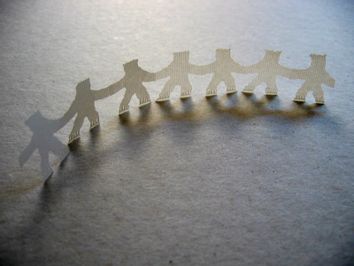
As is common among addicts, I started early. I was the youngest and thus the most paradoxically disenfranchised and suffocated of my family. I sat bored and fidgeting at many restaurant tables. I don’t remember the first time I created my wrapper art, but I feel certain it was during one of these social torture hours masquerading as college graduation dinners. I don’t remember reaching for the straw or breaking the seam apart with my thumbnail. Nor do I remember folding it into an accordion of half-inch panels and ripping off the excess. And what I really don’t remember is how or why it occurred to me to make tiny tears into the soft paper, creating negative space that left the shape of a person. But after about 20 years of practice, I will say: I’m pretty damn good at it.

All my feelings of artistic inadequacy melt away. The big reveal is always definite, the results always the same. The certainty of the process is just as addictive as the artistry. It works like math the way nothing else in my life works like math, including math. I unfold the paper to reveal a chain of five to eight tiny people, holding hands. Or, if your mind is sick in persuasion, five to eight mutated babies attached at the arms. It’s more habit than craft at this point. Perhaps it is not art art but it is certainly an art.

There is also an entertainment value in the creative process itself (so much unlike writing where the journey to the finished product is profoundly unfun to watch). My hands move quickly around the fragile paper, like a smaller-scale and less impressive Edward Scissorhands. If you and I are at a bar, you can then stick these thinly membraned bodies around a cool glass. You can dunk them in whiskey or iced tea if you wish to add some racial diversity. If you have a pen on you, well — I don’t need to tell you all the things you can do with ink. The doll chain makes a nice gift as well. A gift presented without fanfare in the middle of a conversation or created while someone is in the bathroom. Often I make them while no one is looking. People assume I am just fidgeting with a paper straw wrapper and then, out of the blue I get to say: Here, this is for you. Then, assuming this Siamese textile freak show survives the whiskey-dunking, people discover it in wallets or pockets days later. The dolls are the gift that keeps on giving. Until they disintegrate.

Their dimensions remain the same. The technology of the source material has not advanced much in the past couple of decades — a straw wrapper is a straw wrapper is a straw wrapper. And yet their impact is malleable. Sometimes their creation comes with apologies to a waitress or bartender for littering her immediate surfaces with strips of paper afterbirth. It’s also something I can do again on command.

This predictability is completely absent from my more regular creative endeavors, just as it was absent from my pottery throwing and fruit-bowl sketching. Even my desserts, those plucked directly from Martha’s cookbooks, never come out quite the same way twice. But in the methodical creation of straw wrapper paper doll chains? I have a go-to activity where I can find assurance in my ability to form and to amuse. Consistency is not the heart of art so much as it is, say, the gall bladder of art. It does not inspire or captivate. It does not win awards or get its own daytime talk show. But having a creative default is an excellent palate cleanser for the artist as well as the viewer. I masticate straw wrappers with my nails so that whatever comes out next might be just a little more worthwhile. Indeed, if I’m lucky enough to see another 60 Augusts, I fully expect to find myself in a soft chair somewhere, drooling on my muumuu, entertaining the night nurses by gesturing at the wrapped straw next to the pudding cup on my food tray and saying: Here, watch this.

The best-laid plans

I had all these romantic notions about one-night stands. Who knew it would be so difficult to actually have one?

The second I was old enough to know what sex was, I knew I wanted to have a one-night stand. To me, it seemed the most deviant, cool, subversive and flat-out dirty thing there was. I wanted to do it immediately. Largely because I had no idea what it entailed. I figured a one-night stand happened when two people, one of whom was a woman, went to a man’s apartment for martinis and stood on the bed the entire time, trying not to spill them. Sometimes they bounced on the bed until they hit their heads on the ceiling, and that’s how the girl (a) passed out or (b) knew it was time to go home. This accounted for the sound of mattress springs creaking as well as any exhaustion the next morning. It was how hair became tousled. It also accounted for a very specific image I had, one of a woman in a silk teddy seen from behind. She’s facing a window and it’s probably nighttime. We zoom in on her hip, where she is resting her expensively manicured hand, with a pair of red sling-back stilettos hooked on her pinkie. Like a few notes of a song stuck in my head, that’s all I got. I don’t know who or where this woman is, only that between all the drinking and the bed bouncing and the near-concussion getting, the heels had come off. That explained why there was a lot of morning-after tiptoeing in movies and why no one ever had sex with their shoes on — it would puncture the mattress and twist the ankle.

It’s remarkable, the logic we’ll build around a misapprehension. Our brains are like bonsai trees, growing around our private versions of reality. For example, I never asked my mother where babies came from but I remember clearly the day she volunteered the information. My sister was taking a nap, my father was out back developing an elaborate pulley system for firewood using a laundry basket, and my mother called me to set the table for dinner. She sat me down in the kitchen and, under the classic caveat of “loving each other very, very much,” explained that when a man and a woman hug tightly, the man plants a seed in the woman. The seed grows into a baby. Then she sent me to the pantry to get place mats.

As a direct result of this conversation, I wouldn’t hug my father for two months.

Eventually, I realized that bouncing on hotel beds was only “sexual” in teenybopper movies and short stories. I now saw one-night stands for what they were: a strange penis and a strange vagina getting to know each other fairly well, very quickly. But my original fascination with the one-night stand remained intact, even if the logistics had changed. And why not? Here was one last thing I could single-handily save from being muddied by adulthood. Here was one small innocent dream from my childhood brain. A dream there was no harm in believing (provided one kept their wits and prophylactics about them). It is so rare that we get to realize as adults what we imagined ourselves doing as children. Granted, this rule is generally applied to more wholesome activities like, say, intergalactic space travel or a career in the ballet. Nevertheless, I suspect this is why I hung on to my one-night stand dreams.

But by now, time was running out. Another decade and my invitation to the reckless sex-and-drug-abuse club would get revoked. Then people would be compelled to spit words like “floozy” into my face and they would have every right. It was suggested that perhaps I was not trying hard enough. That’s probably true. It’s not as if I had chronic bad breath or a neck goiter or other blatant physical obstacles to overcome. A couple of guy friends generously offered to help me remedy the situation, but their candidacy was null by virtue of the fact that they’d met me. And I wasn’t about to walk into a crowded sports bar and scream, “I’ve got twenty minutes and one expired condom. Who’s in?” Adventure within reason was key. Still, it seemed that it shouldn’t be this hard. Who do you have to sleep with to get laid in this town?

My first legitimate attempt came during the spring of my freshman year of college. Armed with the knowledge that oral sex had nothing to do with talking, I met a prep school-issued member of the sailing team at a keg party. It was such a small college that the simple fact that we had never seen each other before was enough to get the conversation going. After eliminating all the telltale TV signs that he was a potential rapist, I went back to his dorm room. It was below freezing that night, and I had decided to wear taupe-colored stockings beneath my jeans and flannel socks over that. This is not a look that lends itself to a sexy undraping. It’s also supermodel-proof, meaning that even a supermodel would look unappetizing in taupe-colored stockings and jeans. I tried to keep my new friend busy by kissing him while he began unzipping, but nothing gets past the human hand these days. He put a massive callused paw on my synthetically silky thigh, stopped, said “huh,” and excused himself to the bathroom where he vomited (presumably from alcohol). Then we both crawled into bed and he passed out, drooling on my arm as it went numb from the weight of his head.

I felt relieved that he had gotten sick. Now the social scales of mortification were even. I watched him until six a.m. at which point I felt I had put in my time. I got up and wrote him a Post-it Note, apologizing for leaving. When I realized I had crammed in all I could on one yellow square, I grabbed another and filled that one with more witty remarks about seeing him around for some delectable cafeteria cuisine. Though one consisted of just my signature, in the end I filled six Post-it Notes, which I stuck on his computer monitor over a screen saver of rotating catamarans.

Three months later, he graduated and I purchased my first pair of candy red high heels.

I realized that I had to be a little bolder if I was going to have a suitable one-night stand and that it wasn’t going to be handed to me on a silver keg. My second attempt came during a semester I spent at Columbia University. Columbia seemed like a hotbed of people and options compared to my small and cloistered New England college. For one thing, it had grad schools. We didn’t have grad schools. We didn’t even have a football team. There were certain similarities, however, including the way the floors of the library became progressively less social as you worked your way up. The first floor was a meat market. The top was monkish. This architectural layering of academic intent seems widespread. But at Columbia, if I really wanted to get some studying done, I had to bust out of the building altogether and study in the law library.

This was a place where silence was platinum. One was glared at if one sneezed or shifted in one’s seat. I could have come in naked with nothing but a grand piano strapped to my back and my only chance of eye contact would have been if I had leaned on the keys. The law library became my sanctuary, my home away from a home that included a roommate who hung full-color posters of Audrey Hepburn on her wall, recited Shakespeare, and regularly flopped down naked and soaking on my bed and said things like: “Tell me, is there anything more glorious or decadent than a shower in the middle of the day?”

I wasn’t sure that there was. This was before I took up smoking, before I tried heavy drugs in any effective amount. This was a time before I bought myself flowers or clothing I didn’t need. This was also a time before regular sex. Somewhere in my head a new image of the one-night stand had formed. It had all the good clean fun of bed bouncing but was now informed by the fact that I had seen a couple of penises and got the gist of what would go down on such an evening.

The Columbia law library looked like one of those very expensive stores that you can tell are expensive by the amount of space between the clothing on the racks. Just replace the shirts with people. It was also open late. I spotted a guy in one of the modern-looking chairs. I was burned out from studying but I didn’t want to go home. God knows what show tune-heavy naked prancing was going on in my room. She also used to binge on Twix bars and pin the wrappers to her bulletin board. I packed up my things in case my encounter went poorly, marched over, and leaned in.

“Would you like to get out of here?”

“Why?” he asked with genuine confusion, and stared at me.

Unable to squeeze any more mileage out of my bravery, I said, “I’m sorry, I thought you were someone else,” masking my shame by pretending I was a spy. The right answer to my question would have been given in code, like, “I would like to get out of here but it’s raining on the plains.” And then one of us would slip the other one some microfiche. I ran out of the library and never went back.

The following year it looked like my time had finally come. I was traveling around Europe with my friend Justine and I decided to give it another go. We boarded a train bound for Venice and thought it would be a good idea to sneak into one of the first-class cabins. It was an overnight train and in first class the seats slid down on both sides of the cabin, making the room a solid block of cushions. We found what we thought was an empty cabin, but opened the door to discover a nineteen-year-old Italian rap artist, sans entourage, or however you say “sans entourage” in Italian. He had a wide forehead and spiky black hair and two tongue rings. He wore a black button-down T-shirt, black jeans, and shock-white sneakers. He was also foreign and his very existence jibed nicely with my fantasies of raising my children abroad and learning how to make good coffee. Justine wrote in her journal while I chatted it up with our companion. In perfect English, he apologized profusely for his poor English. He said he wished he spoke better but “that’s the way it goes.” I was trying to imagine how I would say “that’s the way it goes” in Italian when a train cop knocked on the door with a couple of inexplicable German shepherds, checked our tickets, and booted my friend and me back to coach.

Hours upon hours later, unable to sleep from back pain, I remembered that the aisles of the first-class cabins were lined with a kind of nubby carpeting. I grabbed my book and lay on my back in the middle of the hall with my knees up. The lights flickered overhead as the train sped through the south of France. A hip-looking couple rolled cigarettes and smoked them with their arms out the window. People passing through stepped over me. Suddenly I saw the light in the rapper’s car turn on. The couple in the hall was immersed in some debate in a language I couldn’t understand. I knocked on the door and went in.

“Me again,” I said, sliding the door shut behind me.

We talked, he handed me headphones, and I listened to some of his rap. And then he kissed me. Which is pretty narcissistic, kissing someone while they’re listening to your music. The only thing that would have made it worse was if the song was about him kissing a girl on a train. Which it very well could have been.

The doors didn’t have locks on them.

“We can do everything but,” he said, and again, I marveled at his grasp of American phrases.

“Don’t worry about me,” I replied. And then, not wanting to look like a slut but still gunning for my one-night stand, I said, “We can do whatever comes naturally.”

I felt like a guy.

“No, not naturally.” He ran the metal tip of his tongue around the inside edge of his teeth. “I’m Catholic.”

“Really? A Catholic rapper? I’ve never heard of such a thing.”

“That’s because you’re American and all Americans do is violence.”

And the Catholics are such pacifists? But I knew arguing would only lead to more chatter so I accepted his Euro-slap and we did everything but. He threw out his back, I threw out my neck. It was romantic. I kept thinking: How is it that I got the one moral rapper on the planet? And: I wish the doors on this train locked. I had to keep dislodging my ankles, which persisted in slipping into the crack between the pulled-out seats. Afterward he gave me a mix tape, which I wound up leaving in a Danish hostel two weeks later.

A few years ago, after I had long since given up the one-night stand ghost, I accompanied a girlfriend to an AA party. I had a cranberry juice and seltzer and I met James. Granted, he was vouched for, meaning that if he hacked me up to pieces and stored me in Ziploc bags, we had mutual friends and somehow that meant he would never get away with it. Still, he was new to me. He suggested going to my apartment but I knew I had (a) a roommate and (b) my childhood blankey in plain sight. Plus, bringing him back to my bed made me feel like a prostitute whereas going to his place made me feel like a call girl. The next morning I woke to realize that not only had he put an extra blanket over me while I slept, and he’d ordered in breakfast, but he lived two apartment buildings down from me. In fact, our apartments faced out to the same courtyard and if we wanted to communicate through tin cans and string, we could have. Not only were we going to see each other again, the whole scenario stank of frequency. He was nice and clever and a generally pleasant human being who hadn’t done a single reckless thing since the day he thought he could will objects to disappear and wrapped his brother’s car around a tree.

I hadn’t factored that into the equation, James being a good person. I slouched in his kitchen chair and sighed. He poured the orange juice and coffee. There was nothing to do but eat my home fries and ask him what he did for a living. And that was the beginning of a legitimately beautiful friendship. The other day we were in SoHo, shopping for sneakers for him.

“You’ve ruined me, you know?”

“How so?”

“You were supposed to be my one-night stand. Everyone should have one and now look what you’ve done. I’m going to have to go out into the world and sleep with someone else. You’ve turned me into a strumpet.”

“Who said everyone should have a one-night stand?”

I stopped walking. Were all my attempts at achieving sexual normalcy for naught? It was as if he had casually mentioned the nonexistence of the tooth fairy to a kid who’s all gums. For most of the forthcoming/drunk women I’ve ever encountered, one-night stands happen in between relationships, an attempt at recharging any romantic energy or just reassuring yourself that you’re hot enough for strangers to want to touch their genitalia to yours.

But I respected them. They were never filler for me. I treated them like a complete experience and what had they done but elude me? A one-night stand that plays hard to get. Fascinating.

“Maybe you’re just not a one-night kind of girl,” added James. “Don’t look at me like that — in some cultures that’s a compliment.’

How was it possible that despite twenty-odd years of evidence to the contrary, they still struck me as sleek and glamorous and sometimes more worthwhile than a full-blown relationship? Then I remembered something I had seen when I started this ridiculous journey. I realized that if I could pan out from that picture I have — the one of the woman with the negligee and the red heels — I’d probably find her at a boyfriend’s house. Maybe she’s about to break up with him. Maybe he’s about to tell her about the affair. Maybe this is her wedding night. Maybe this is what she wears to remove hair balls from the shower drain. As long as I stayed zoomed in, I’d never know. I bent down and took my shoes off. I wanted to walk barefoot in the dewy grass with them swinging in my hand. Except we weren’t on grass. We were on Prince Street. I made it half a block before James stopped me.

“Enough,” he said, “you’re going to give yourself tetanus.”

“Alright.” I leaned on his shoulder with one hand while I put my shoes back on with the other. “But you should try it sometime. It’s not as bad as you’d think.”

Continue Reading Close

Lost in space

You may not be able to read a map but I get lost in the supermarket, due to my severe spatial disability.

Things were better during my genius years. I was about 18 months old when my mother found me in the living room with a pile of building blocks — counting and spelling as I stacked them. She called a medical professional. My mother told the doctor of my wunderkind rate of development and he suggested she bring me in immediately. Tests were done. Psychologists were consulted. Special schools were researched. Should I be put in genius kid school? Should I skip a grade? Two? Better wait six months and see if she “evens out,” said the doctor.

He was right. While my parents continued to overzealously ply me with brain food and flash cards, a healthy case of the stupids kicked in, offsetting my projected brilliance. By age 6 I was just like every other kid. Maybe a little bright, but nothing to necessitate a lampshade. I also wet my bed and habitually banged my head so hard against the wall while I slept that my parents installed padding. I was out of the woods.

Then, for reasons unknown to me, all the kids in my grade were told we’d have to take a test on Iowa. I tried to piece together everything I knew on this subject, but I was 7 years old and my brain was like a slot machine: I put in “Iowa,” pulled the lever, and it came up all corn. When at last the test landed on my desk, I was relieved to find it was the standardized kind, blessedly devoid of crop rotation analogies. In my head, I thought I did OK. In reality, I bombed, landing in a breathtakingly high percentile (high in this case meaning “of the masses”).

The school called, expressing concern. Should I be held back a grade? Two? In one section of the test, we had to look at a series of everyday objects, match them with their proper names, and fill in the bubbles on a Scantron sheet. I got 19 out of 30 wrong.

“Sloane doesn’t even know what a spatula is,” the school psychologist said, driving home her point.

“Please,” said my mother. She marched me to the kitchen, flung open a drawer and held a rubber paddle in front of my face.

“This,” she said loud enough for the school psychologist to hear, “is a spatula. OK?”

“OK,” I nodded.

My mother went on to explain my brush with brilliance, my aptitude for geniusness, my general awesomeness, but the school was having none of it. They made me take an IQ test, after which the test administrator announced he had never seen such a right-left brain discrepancy. I was diagnosed with a severe temporal spatial deficit, a learning disability that means I have zero spatial relations skills.

It was official: I was a genius trapped in an idiot’s body. The reason I did so poorly on the Iowas was that the questions were multiple choice and presented vertically. Once I had decided on an answer (say, “spatula”) I had to remove my eyes from the paper and shade in the corresponding choice in a horizontal line of bubbles. This, much like reading a map and telling time on an analog clock, was an impossibility for me.

Armed with parental skepticism and a master’s in special education, my mother began testing me at home. Just to be sure. She’d tell me to retrieve something that was to the right or to the left of something else. She discovered that I had already found ways to compensate — claiming I was distracted while I was actually desperately trying to figure out the answer. At school, if someone asked me what time it was, I’d say my watch was broken or rudely hold out my arm. By age 10, I started wearing a thin gold chain on my left wrist so I could look down and associate it with that direction. To counterbalance my deficiency, my visual memory became stronger. I could sketch the contents of my locker in accurate detail. I just couldnb

I was living in Alice’s Wonderland — if Alice was a little kid lost in a suburban shopping mall, petrified by the knowledge that she will never be able to find her way back home. I never outgrew that feeling of constant disorientation. Rather, it never outgrew me. Coming home from college freshman year, my father and I stopped off at a sprawling Connecticut market with curving aisles, outdoor spaces and multiple entrances. We split up. When I had collected the items on my half of the list, I tried to find him. For 15 minutes, I circled back and forth and through shortcuts that landed me in places I had just left. Should I ask someone to lead me to the manager’s office where I could call him over the P.A. system? I once heard that you can find your way out of any maze by keeping your hand on the left side of the wall. Great, but which side was left? I gave up under a sign for fresh corn, thinking it was best to stay put until my father found me. I was 18 and on the verge of tears in the grocery store.

Though they’re not as dramatic as they once were, I still have my fair share of Alice moments. Luckily, I have grown more adept at handling them over the past decade. I now know my right from my left and my up from my down. Unluckily, my terrible sense of direction remains. For me, to live in New York City is to never be able to meet someone on the northeast corner. It is to never ever make a smooth entrance, always to get caught looking lost on the street. The only subway I can exit and begin striding forth with confidence is the one by my home, as there is a gigantic park on the right-hand side and I know I don’t live in the trees. I am dating someone who lives near the 7th Avenue stop in Brooklyn and an odd phenomenon occurs every time I visit. When I leave his apartment, I go into the subway through the same entrance. The next time I arrive, I find the entrance, go up the familiar staircase, and it spits me out across the street from where I need to be. I have no idea why. We’re all mad here, said the Cheshire Cat. I’m mad, you’re mad. Of course, I keep this recurring befuddlement to myself because a) no harm done, it’s just across the street, and b) part of me still wonders if I’m making this whole thing up.

The biggest problem with my problem is that other people think they have my problem. People get lost going to the airport. They make plans for Tuesday the 16th when the 16th is a Wednesday. It’s not their disability, it’s their life. Most people will claim they are “terrible with” something. Names, faces, tipping in restaurants. They expect no special concessions. Should I confess to the encumbered nature of my thinking, they’re only too pleased to offer an “I know, Ib

For a long time, I agreed with them. I grew up watching TV with my mother while she faux-diagnosed sitcom characters as having ADHD or Asperger’s. I rolled my eyes and wondered where all the plain-dumb kids had gone. Why did there have to be a diagnosis for everyone? Were the cave people on Ritalin? I didn’t think so. I was my own worst sympathizer and took an entire adolescence to realize something really was different with me and I couldn’t outsmart it.

When I told a friend I was writing this, she said she knew someone who had facial blindness, a kind of recognition dysphasia that makes it impossible for her to recall faces of casual acquaintances and old friends. To compensate, she goes through life taking photographs and being dangerously friendly to strangers. I found this woman’s existence extremely comforting. Here was someone else who hid her problems in plain sight, compensating for her disability with no end of odd behaviors, working double-time just to keep up with everyone else’s standard of “normal.” I wondered how many of us there were out there with severe learning disabilities, walking among the mortals like anti-X-Men with useless or detrimental powers.

Recently my sister hosted a barbecue at her home in New Jersey and the best means of getting to her house is to take the bus. I had the opportunity to leave the country for the weekend, so I took that instead.

“We were making fun of you,” my mother recounted, “saying, oh, she’s going to South America because she’s too cool to take the bus.” Fine, I thought, let them think I’m a snob. Let them think I’m lazy. Anything is better than admitting the effort it takes to do what the rest of your percentile does with ease. Anything is better than the feeling of loneliness that comes of falling down the rabbit hole and realizing the Cheshire Cat has a better sense of direction than you do and the White Rabbit has facial dysphasia and doesn’t recognize you and it’s not as if you can read his pocket watch anyway…

But then my mother, still the parent of a genius toddler, continued: “And I thought, that’s not it. She won’t get on a bus because it’ll take her too long to translate the schedule. And then she won’t know which direction to go when she gets off. But it’s no problem — I’ll just stand at the corner. And when she walks down the stairs I’ll be there to meet her.”

Continue Reading Close
www.salon.com/writer/sloane_crosley/index.html