Technically speaking, my nest has been empty for four years. Both my son and daughter are, as I write this, completing their last semesters as undergraduates. Yet I realized recently that while the children have gone, they left their pets behind and each year as the kids move closer to adulthood and financial independence their pets are tying my husband and me to home more than they ever did. Our nest isn’t empty. It’s filled with expensive, aging animals.
“Barf, poop, pee”: That was the subject line of an e-mail I wrote to my husband last week while he was in Washington, D.C., for a conference. We both wanted to go but one of us needed to stay home with the animals. Two dogs, two cats, three backyard chickens, and some fish in a small outdoor pond. The chickens are mine and don’t require much care, plus they’re an asset since they lay eggs. The fish are pretty much self-supporting.
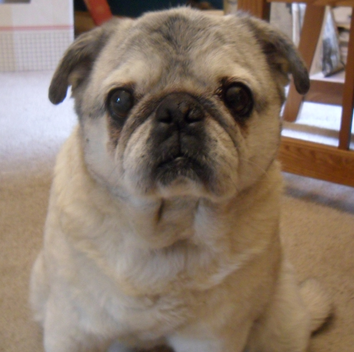
The dogs each belong to the children. Belle is a 15-year-old pug who can barely walk. Even as a youngster she pretended to be hard of hearing, and I’ve never trusted her eyesight. Now, however, I have to tap her on the shoulder to get her attention. Sometimes when I wake her she doesn’t seem to know who I am or where she is. She has to be carried outside. My husband says it’s like lifting a cinder block but harder. There’s no place to get a good hold and when you put her down you never know whether she’ll stay standing.
When my daughter was in second grade Santa brought Belle to her for Christmas. She calls Belle “her heart,” and I dread the day I have to make the call saying Belle is gone. How I’ll feel about Belle’s passing, however, I’ll keep to myself.
Molli belongs to my son. She’s a 12-year-old golden retriever who suffers from severe arthritis and bad skin. She’s always been a bit nervous and fearful of new situations. Now, however, she only goes outside with much cajoling and coaxing. She spends her days in my husband’s study pressed between the bookcase and his heavy chair. If she hears someone unfamiliar in the house she growls but doesn’t move. Take that, robbers!
My son got Molli when he was just entering adolescence and their vulnerability and mischievousness seemed perfectly matched. They were both cute but, at times, so bad. My son often spent time with Molli in her crate. I’m not sure who was sent there first.
The cats, brothers whom we rescued from the shelter, belong to my daughter. One year for her birthday she asked only for a really big fat cat. As if by fate, a really big fat cat and his skinny brother had just days before been surrendered to the local shelter. My husband said we couldn’t take one without the other and so my daughter got a double birthday present that year. She and my husband renamed them Minnesota Fats and Fast Eddy.
Their age has never been determined. The only thing that’s clear is that they’re getting on in years, cat and human. Fats, the older of the two, has taken to gorging, then moving through the house like a drunkard until he heaves and heaves and heaves, leaving a trail of half digested kibbles and permanent brown spots on the carpet behind. He moves more slowly each year, his hindquarters swaying and dipping, as much from his girth as from his unfortunate encounter with the back wheels of our car. After the accident, his hips were reconstructed but never functioned quite the same. His brother finds his constant neediness tiresome and often puts up a paw and whacks him as he walks by.
I know that Belle and Molli and Fats and Eddie are family pets, too, and I love them. But from the beginning, it was the children who asked for them and who, to a certain degree, cared for them. Nevertheless, we might be called indulgent parents when it comes to pets. Our kids have had everything from turtles and baby chicks to hamsters and rabbits. I’m sure there were other pets too but I’ve blocked them from my mind.
The four that are with us now have been a part of the family for many years and according to the vet, will be with us for many more. They each take more pills than my husband and I combined.
So we don’t feel comfortable leaving these pets, in various stages of decline, even for a weekend. The son of a friend does a good job looking after them when we do manage a day away but the cleanup afterward makes it almost not worth it. No matter how good your caretaker, they often miss, or overlook, some of the nastier messes. And the whole time we’re gone my mind reels with worst-case scenarios.
I’ve resolved not to worry any more about the carpet or the wooden floors. There’s not much I can do about it anyway. The carpet will be replaced someday and the wooden floors can be refinished. But I was sad about missing the trip to Washington and we’ve decided to decline the offer of a house swap with a friend who lives in the mountains. Our friend, like us, has the occasional creaky knee and bad back and we just couldn’t see her physically being able to take care of the menagerie.
There are those who would say our children should take responsibility for their pets, and maybe they should. But there’s a part of me, too, that might be holding on to my not-so-empty nest, unwilling to completely let go of that time when children and pets filled the house with a cacophony of noise and activity. Caring for our children’s aging pets may be a way of letting go a little at a time, accepting change, and then moving on.
Or maybe we’re just suckers, home-bound with aging animals. Our friends with adult children are off rekindling relationships or discovering new hobbies or traveling, even saving for retirement while we sit in our little nest surrounded by our pets’ pill bottles and our cleaning rags, sending each other our own kind of love notes, subject heading: “barf, poop, pee.”
In our minds, it was an act of defiance: I’d put a joint in my purse. When my sister gave me the signal, we’d each say we had to go to the bathroom where we’d meet, light up and take a few quick hits off the joint, then go back out to the party.
It was 1971. I was a senior in high school; my sister, several years older, was a secretary and still lived at home. She hadn’t gone to college. Actually, it hadn’t been an option. My father, who himself was forced to drop out of high school to help support his family, didn’t think girls should go to college. Or at least not his girls. I always thought it would have made more sense for him to insist on a good education. He saw what an education could do. He worked as the photo bureau chief for the New York Times in Washington, D.C., where he called among his personal friends some of the country’s most highly educated individuals within the nation’s government and media. That meant U.S. presidents, too.
I would love an invitation to the White House today. But at 17, it wasn’t cool. It was so bourgeois. My sister and I were placard-carrying antiwar demonstrators, and my waist-length hair, long skirts and beads were an expression of my distaste for everything my parents stood for. That their daughters were part of a counterculture opposing the policies of the U.S. government didn’t seem to register on my parents. So when the invitation came for the annual White House Christmas party, my mother issued the order: You’re going to the White House, you’re going to look good, and you’re going to behave. My mother was a former Marine sergeant. You didn’t argue.
My sister and I weren’t the big statement kind of people; ours was a more subtle form of protest. Lighting a joint seemed innocent enough. We also thought it would be pretty cool to smoke a joint before going, too. So, while my mother sat on a stool in the kitchen having a scotch and soda while she waited for my father to change upstairs, my sister and I got high in my third-floor bedroom, blowing the smoke out a dormer window cracked against the December cold.
It’s pretty strange being stoned around your parents, even stranger when you’re stoned around police, security guards, officials of every sort, and a huge crowd of children and adults giddy with excitement and anticipation. And you’re in the White House.
Was I smiling too broadly? Were my eyes glazed? And where was my sister? I found myself wandering through the rooms alone, overwhelmed by the opulence. Actually, my parents and younger brother were nearby, sampling cookies and punch. I was sure I was being followed. Were there drug-sniffing dogs then?
I had to go the bathroom. When I came out of the stall I saw my sister across the bathroom standing by the sink. She put her thumb and forefinger together as if holding a joint and brought it to her lips. Between us were a half-dozen women and children. She smiled. As I pushed past her I told her I didn’t want to, that it was too dangerous, and left before she could pull me back into a stall with her.
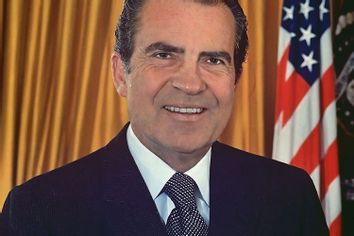
But something was happening in the hall. There were quiet murmurs. There he is, I overheard people saying. And when I followed their gaze I saw the president among the crowd. He was making his way through the party, laughing and talking, greeting people by their first names. He seemed comfortable. And happy. We must have been standing near the band because all of a sudden Nixon was sitting at a piano playing and singing Christmas carols. Somehow, not by my own volition, I was in the group nearest him. There I was, stoned, singing with the president. I remember thinking he seemed just like a regular person, that he was just a man. In many ways he reminded me of my father.
I don’t remember anything else about that night. At home, my sister and I probably went directly up to my room on the third floor, spent a couple of hours watching television, and pulled out that joint in my purse. We probably laughed at how messed-up we had been and how it would have been impossible to actually carry out our plan. It didn’t take me long to understand that the act of defiance my sister and I planned had more to do with youthful ignorance than political activism. It took me much longer to grasp that my sister’s interest in all things mind- and mood-altering was an addiction. And finally there is this: As much as I hated the Vietnam war and Watergate and came to revile Richard Nixon, I have to admit I cried when he died. I hated him, but still, I cried. In some ways I felt sorry for him, for whatever had happened in his life that created the demons he carried with him, for surely that must explain — at least in part — who he became. Of all the images of Richard Nixon that flash through my mind — those pictures of him defiant, angry, even crazed-looking — I always come back to him at that Christmas party, sitting at a piano singing Christmas carols.

I can’t find any documentation for a press corps Christmas party in 1971! I found the invitation for 1972, and a reference to the 1970 party in a press briefing in early December. In 1970 and 1972, families were invited to the White House. We would have gone to those events, too. Unfortunately, I can’t remember. It could be that all those events have merged into this one Christmas party that I remember as 1971.

This is the only photo I have of me with Richard Nixon. The sister in the essay is the one looking at Nixon. I’m also giving him a good stare: I’m in my mother’s arms, thumb in mouth.
Continue Reading
Close
Thursday, Aug 19, 2010 6:45 PM UTC
Dad always said he "made" his famous photographs for the New York Times. I think I finally understand what he meant
By Stephanie Tames
My father was a news photographer. When he talked about his work he would say he didn’t take photographs, he made them. There’s a difference, he’d say.
I never asked him what he meant, but the distinction seemed important to him. I remember thinking when he said it that the word “made” sounded conspiratorial. I thought he was admitting that he somehow manipulated a scene he photographed, that he violated what seems a contract with the viewer. As Susan Sontag says in “On Photography,” “The picture may distort; but there is always a presumption that something exists, or did exist, which is like what’s in the picture.”
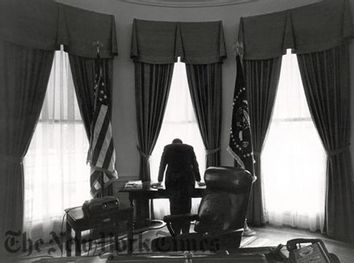
Sometimes people ask me how my father got a photograph, particularly “The Loneliest Job in the World,” a photograph of President John F. Kennedy silhouetted by a window in the Oval Office. They want to know if my father composed the photograph in his mind first, and then asked the president to lean on the table. This is what my father said: He watched the president and saw that, because of the president’s injured back, the president often went to the table at the window to read. My father waited, and when Kennedy moved toward the window and the table, he positioned himself with several cameras set at different exposures. He said he had seen an image in his mind and knew that underexposing the film would create more than a picture of the president. He took several frames from slightly different angles.
The photograph was part of a series that accompanied an article in the New York Times Magazine, where my father was chief photographer for the Washington bureau. When my father showed the president a mock-up of the magazine before it came out in the Sunday paper, the president looked at the photographs, pointed to the silhouette, and said, “That’s the picture that should have been on the cover.” Both the photographer and subject sensed its importance. They both knew the picture wasn’t of a particular man leaning on a table. It’s a picture of the president, standing in silhouette, seemingly deep in thought and carrying the weight of the world on his shoulders. The picture holds within it something more than what is seen.
When my father said he made photographs rather than took them, maybe that’s what he meant. Anyone can squeeze the button on a shutter, as he liked to say. Back in 1961 when my father made that photograph, the image moved through a lens onto a piece of paper embedded with chemicals. That’s it.
Maybe my father was prescient. Maybe JFK was, too. After the assassination, the photograph became famous. It was a symbol of the Kennedy presidency, the lost hope of a generation, Camelot. In some ways the photograph gave us solace, as if we saw in the president’s posture an acceptance of his destiny.
Later, the picture seemed to hold within it the cumulative losses of the Kennedy family.
Now the image has been appropriated by anyone who wants to be seen struggling alone against uncertain odds, even if they aren’t real. There was a three-second shot of Martin Sheen silhouetted against a window at the opening to the “West Wing” television show.
I remember my father once being angry when a photograph was disqualified from a competition because the judges thought it had been manipulated. It was a picture of a NASA rocket ready for launch. The photograph was taken at night, a full moon burned iridescent. The judges thought the moon looked too perfect, too round, too much the size of a quarter that could have been placed on the photograph during developing. My father shrugged off the criticism; to him the allegation said more about the judges than it did about his photography. That wasn’t how he made pictures.
Yet my father wasn’t above creating, or re-creating, a scene. Everyone in the family was called upon at some time to act as a model. My younger brother and I often went on assignment with him and were photographed walking through the National Zoo for a shot of the new bird exhibit and looking through a wall-size window at the Smithsonian. On a cold, icy morning, my father saw two schoolchildren on hands and knees pushing their books up the steep hill in front of our house. Within an hour my brother and I were doing the same. It made the next day’s paper.
My oldest sister is the widow in “Widow’s Walk,” a winter snow scene at Arlington Cemetery, although she was neither a widow nor the wife of a soldier. She was a high-schooler, called on by our father to walk among the white gravestones at a prescribed angle after a deep winter snow. I have a memory of sitting in the car waiting for her to walk, then walk again, until my father was satisfied he had captured on film the image he sought. I was bored. She was cold.
The photograph was made in 1968. “Widow’s Walk” had nothing to do with the Vietnam War, but it evoked the nation’s growing discomfort with the war and the daily death count. Today, the photograph transcends any specific reference to a time, or even a place. It speaks to all loss.
My father wasn’t on assignment when he made “Widow’s Walk.” He loved photographing Washington, particularly in the snow when the city’s granite and marble buildings took on an ethereal quality. Washington, to my father, was as close to an earthly approximation of Mount Olympus as there was. Draped in fresh snow, it was as if the city sat atop pure white clouds. Every winter he tried to photograph what he felt in his heart.
When my father started work as a photographer in the early 1940s, photojournalism was in its infancy. In fact, photographers’ work was seen more as craft and certainly not on the same level as the writers in the newsroom. But my father helped create a different aesthetic. Photojournalism became as important to the story as the story itself. Even today when video of an event shows up on the Internet in real time, it is the photograph we look to for meaning, that we search for some hint of the truth as if we are holding in our hands the actual moment in miniature.
Did he take photographs or make photographs? I’m still not sure what my father meant, if he was simply saying, for those who still didn’t believe, that photography was more than craft? Or was he making a joke, something for which he was very well known? Was he confirming or contradicting Sontag?
Maybe I do understand. For my father, whether he changed the lighting, moved a piece of furniture, or stood in the shadows and waited for a scene to unfold in front of him, when he took a photograph he become a part of it and in that instant it changed from something he took to something he made.
By the way, the morning my father made the picture of JFK at the window, the president was reading the Times. He had gotten to the editorial page. My father said, “He looked over and he saw me. He hadn’t been aware that I took that picture from the back, but he saw me when I moved to the side there. He glanced over at me, and he said:’‘I wonder where Mr. Krock gets all the crap he puts in this horseshit column of his.’ Apparently he was much upset about Mr. Krock’s column that day.”
Continue Reading
Close