Steve Burgess

Why the U.S. must invade Canada — now

It didn't support the war, it's soft on pot and gays, its economy is rolling and U.S. troops are bored. Anyway, reasons to invade countries are no longer needed!

There’s nothing like the deep, satisfying belch that follows a good meal. But hey America, what about dessert? Iran and Syria have both been offered up as succulent dishes to follow the Iraqi main course. May I suggest a simpler alternative, right next door? Invade Canada. Hell, we’re asking for it.

Canada — a ripe plum ready for the taking. And the plum was probably imported from Florida, which will make it all the easier. It’s not like it hasn’t been considered before — Michael Moore’s one stab at a fictional film (unless you count his documentaries) — was “Canadian Bacon,” in which President Alan Alda takes on Canada. The mere convenience of it is enough to justify it — a regiment in Detroit could blitz Toronto from 9 to 5 and still go home to watch the CNN highlights with the kids every night.

There are plenty of reasons to invade your passive-aggressive northern neighbor. (Or “neighbour,” as we spitefully choose to spell it. Doesn’t that just piss you off?) But never mind — thanks to the lessons learned in Iraq, reasons are no longer necessary. The Bush administration’s labored justifications for the Iraq invasion, served up as convincingly as a chocolate-smeared 6-year-old’s explanation of where the cookies went, proved to be utterly irrelevant. Most Americans, it turned out, were only too happy to kick some non-American ass and didn’t really require an explanation. As a prelude to the invasion of Canada, Bush could merely produce satellite photos proving conclusively that American troops are bored. Good enough for most.

So why bother? An excellent question. The United States owns most of Canada already and, unless you’re unusually fond of thick socks and earnest magazines, there’s not much worth plundering. But the invasion of Afghanistan proves that when sufficiently provoked America will invade and conquer the most God-forsaken acreage imaginable. You might live in an Oklahoma trailer park in tornado season but if you flip America the bird, the troops will come.

Lately, Canada has been flipping America the bird with suicidal abandon. For those who haven’t noticed (roughly everyone except Vegas bookies during hockey season), Canada has been acting rather snotty of late. After failing to support the invasion of Iraq, the Canadian government has been embarking on policies that threaten to turn our shared continent into a giant cesspool of sin.

Canadian Prime Minister Alex Trebek (trust me, it’s easier this way — at least you’ll be able to picture somebody) has also been profligate in his criticism of America, and President Bush in particular. On his way to the recent G8 summit, with Canada-U.S. relations already severely strained, the prime minister treated reporters to hearty criticisms of Bush’s economic and social policies. This after his director of communications had referred to Bush as “a moron” last fall and one of his party members was caught by a reporter’s microphone saying: “Damn Americans — I hate the bastards.” Bush’s planned visit to Canada, already postponed once in a fit of pique, has now been delayed again until after a new prime minister takes office. (Shania Twain, perhaps?)

Canceled visits are small beer of course, unless they presage a full-scale attack. Justifications are plentiful, if you want to be gentlemanly about it. Consider the moral issues.

Following a recent court decision, the Canadian province of Ontario has begun performing gay marriages. The Canadian government has indicated it will not fight the ruling, but will instead prepare legislation legalizing gay marriage nationally. The resulting influx of gay couples into Toronto is almost certain to spill over into Buffalo, N.Y. This could doom President Bush’s chances of carrying the state of New York in 2004. Or, even worse, that giant sucking sound of gay Americans pouring over the northern border could lead to economic catastrophe. Broadway will go dark.

Drug laws sound another alarm for American policymakers. Just last week, local authorities announced that they would open a legal “safe-injection” site for drug users in Vancouver, the first shooting gallery of its kind in North America. The U.S. response? “A lie,” said Bush drug czar John Walters. “Immoral.”

Recent moves to decriminalize pot in Canada may have disappointed Canadians who had been promised more drastic action (under pending Canadian legislation, possession of over 15 grams will still be criminal, less than that a misdemeanor), but they are still worrisome enough to have drawn dire warnings from Washington. During a Canadian speaking tour, Walters said Ottawa’s push toward decriminalizing marijuana could “complicate” border security. “Frankly, I’m worried about Canada beginning to look like Mexico as a major supplier of drugs into the United States,” he told one Canadian news program. Indeed, there are tremendous dangers here for the U.S. — a potential Cheech & Chong revival is only the beginning. But never mind the smuggling issue — that’s merely a smokescreen.

Bush’s real concern will be the state of the Canadian economy. It’s currently outpacing the U.S. quite nicely. Canada’s budget deficits are under control while America’s soar; the once-pathetic Canadian dollar is climbing steadily against the U.S. buck. Once Americans realize that even a dope-addled nation enveloped in a giggling fog can do a better job of running its economy than the Republicans are doing, it will be curtains for Bush. America’s next president will be Dr. Dre. An invasion must begin now.

Or how about a protective invasion for health reasons? A prophylactic invasion, a complete Canadian quarantine to prevent the spread of SARS and mad cow disease. Currently Canada is a festering cauldron of plague, our streets strewn with bloated dead. That’s pretty much an accepted fact. Summer tourist traffic is down in Vancouver, B.C., due to fear of SARS. That the only reported SARS deaths (about 30 so far, none recently) have been recorded in Toronto, Ontario — roughly as close to Vancouver as Los Angeles is to Panama City — is apparently not important to the American traveler. (Nor does it seem to matter that even in Toronto, SARS poses less risk to visitors than the flying spittle of Mayor Mel Lastman.) The fear of SARS is real, as real as was Saddam’s threat to the American way of life. Americans will cheer decisive action.

Mad cow disease could provide another pretext for invasion. So far, mad cow has been a singular Canadian experience — it has been found in a single cow. (Even that cow may only have been disgruntled.) Still, one dangerous cow is something - tough to sneak old Bessie past Hans Blix.

It’s not as if the fever for war would be entirely manufactured, either - certainly not for Canadians. Northerners express a litany of grievances against the U.S. — for example, the annoying tendency of Bushites to make pious pronouncements about the sanctity of free trade while slapping specious duties on Canadian lumber and grain.

Mostly though, Canadians are galled by the fact that we can get as angry as we want and nobody cares. Our refusal to participate in Iraq drew a few of the usual protests. A Chicago competition for school choirs refused to accept a Canadian group on account of our nation’s treachery. (Thank God you can always count on a few dedicated wingnuts.) But for the most part, no one noticed. Why would they? France was snubbing America too, and they have the bomb. Canada’s ancient helicopters are more dangerous to their pilots than to enemy combatants; Canada’s underpaid soldiers are mostly a threat to default on loans. Hold the “freedom bacon” — nobody missed our help anyway.

It is this sense of our irrelevance that drives Canada’s incessant whining about the States. We’re better than you, goes the Canadian refrain — nobler, more caring, more tolerant, given to smiles and hugs where Americans opt for assault weapons. And yet no one notices. What’s the point of being good if Mom’s not even watching? So we sit in a passive-aggressive funk and vote for leaders who exact our revenge by pissing in the Rose Garden and running away.

Damn it, we’re obnoxious little pests. Squash us like bugs, America! We’ll probably apologize afterwards.

Georgy Do-Right

A top Canadian official calls Bush a "moron" -- and her countrymen cheer. Why do our northern neighbors think the president is a chimp?

It takes a lot for Canada to make the papers, but this was a good one. Last week at a NATO conference Francoise Ducros, a top aide to Canadian Prime Minister Jean Chretien, was overheard calling President George W. Bush “a moron.” Out loud.

It was, to say the least, a bit of a diplomatic faux pas. In the Canadian Parliament, opposition politicians screamed for the head of Ducros, Chretien’s director of communications. Ducros paid the price for her indiscreet comment Tuesday when Chretien accepted her resignation. (She had offered to resign last week, but the prime minister initially refused to accept her resignation.) Before Ducros departed, a Canadian news organization ran a poll, asking the public what Ducros’ fate should be.

The winning suggestion: Give the woman a promotion.

No, these are not good days for the president’s international image. Bush may bask in warm approval ratings back home, but Canadians seem to view him with a mixture of fear and contempt, a German government official compared his foreign policy to Hitler’s, while European political cartoonists almost uniformly portray him as various species of monkey. And those are his allies.

Prime Minister Chretien, a man who often seems to speak both English and French as second languages, promptly offered a helpful clarification. “He’s not a moron at all,” Chretien said of Bush. “He’s my friend.”

That ought to show up in future Bush campaign literature. Pretty much lays the issue to rest (although Chretien left open the question of whether the president might be a chucklehead or possibly a putz).

Canadian antipathy to the States is neither new nor secret. A recent cover story in the National Review pilloried Canadians as “Wimps!” decrying our mewling, hypocritical complaints about U.S. behavior and facetiously suggesting that a good, sound bombing would do wonders for our attitude.

The Review story had a point. There is indeed a facile strain of Yankee-hating on the Canadian left, a relentless demonizing of the American ogre combined with an utter lack of gratitude for the military and economic benefits of having such a kick-ass next door neighbor. While 9/11 prompted an overwhelming grass-roots outpouring of Canadian solidarity with America, it also gradually uncovered an appallingly deep and intellectually lazy anti-Americanism among many educated Canadians. There was a widespread tendency to seek justifications for the terrorist attacks; a sort of “Yes, it was awful, but so is U.S. foreign policy” approach. The long habit of criticizing America proved so durable that many Canadians began to cast Osama bin Laden as a legitimate grievant.

That’s inexcusable. But in many other ways, northern anti-Americanism is not only understandable but inevitable. And for that, President George W. Bush must carry the can.

Try to walk a mile in fur-lined Canadian galoshes while you consider the following.

As the U.S. prepared to attack the Taliban, Bush called for allied support. Canada responded by sending troops to Afghanistan.

And how did the president say thank you? By imposing a massive tariff on Canadian softwood lumber, a tariff that threatened doom for the West Coast lumber industry and made a mockery of our vaunted North American Free Trade Agreement (not to mention the supposedly fundamental Republican commitment to free trade). The World Trade Organization criticized the U.S. tariff as pure politics. The Canadian government howled. No matter.

Meanwhile, four Canadian troops were killed in Afghanistan when an overzealous American pilot bombed them during a training exercise. The military investigation was secretive and grudging, while Michigan politicians began raising money to protect the U.S. pilots from a “witch hunt.”

And Canadians asked: Is this how America rewards its friends?

More irritants have been piling up of late. Recently Canada’s Foreign Affairs Office took the previously unthinkable step of issuing a travel advisory after the Americans threatened to single out Canadian citizens of Middle Eastern descent.

Lately, Canadian newspapers have been full of the tale of Michel Jalbert, a Quebec duck hunter who recently spent a month in a Maine jail. His crime: filling up at an American gas station in his hometown of Pohenegamook, which sits on the Canada/U.S. border. It’s a daily routine the villagers have engaged in for years (the gas station’s driveway is in Canada, but its pumps are in the United States). American authorities imprisoned him for crossing the border with a gun, not allowing him to contact his family for over a week.

The Jalbert story has been huge in Canada, ignored in the States. Which only adds to Canadian irritation — such affronts sting all the more since the Americans are no more aware of our outrage than a baboon who walks through a spider web. (Pat Buchanan recently caused a top-of-the-newscast Canadian furor when he referred to us as “Soviet Canuckistan.” Buchanan really ought to consider moving to Canada — up here, people pay attention to him.)

Recently, PBS ran a two-part biography of the great Benjamin Franklin. It detailed his subtle and brilliant diplomatic work in Paris during the American Revolutionary War, tirelessly ingratiating himself with the French to gain their support against Britain.

Not many Ben Franklins around these days. Then again, there is virtually no one in the Bush administration who feels the lack. Apparently, the new America does not need friends.

This American attitude was detailed with sobering clarity last September when the administration released its “National Security Strategy.” In it, the U.S. frankly proclaimed its intention to dominate the globe and, as the world’s only superpower, to play by its own rules. All justifiable, the manifesto claimed, because unlike the imperialist titans of the past, America always acts for the common good.

The honesty was almost refreshing. And the reality of the global situation is undeniable. What’s annoying is that America is not content to be the world’s über-bully. It also wants to be loved. It’s like Bogart and Peter Lorre in The Maltese Falcon. “When you’re slapped,” the U.S. sneers, “you’ll take it and like it.”

Few outside the U.S. accept the country’s automatic claim to the high moral ground. On the contrary, postwar history suggests that the U.S. tearily celebrates its own democracy while coldbloodedly subverting any other governments — including democratic governments — deemed to be hostile. Bush’s “You’re either with us or against us” rhetoric might have been all right when the villain was bin Laden. But now that this noble battle has been replaced by what is widely considered an irrelevant vendetta against Iraq, the attitude doesn’t wash internationally.

President Bush appears to have the instincts of a congressman. Congressional representatives do not generally care about foreign policy (unless it leads to local defense contracts). If some trade issue gives a congressman the opportunity to bash foreigners while championing local voters, he’ll snap it up like a whorehouse gift certificate. Likewise, the Bush administration often seems unconcerned with how American actions are perceived abroad.

Most of the media attention accorded Bush’s National Strategy focused on military matters. But grass-roots anti-Americanism often centers on an issue that American commentators rarely deign to notice — trade. The National Strategy revealed an interesting attitude toward free trade, a policy usually considered intrinsically American. Free trade, it announced, would be pursued as a sacred good. With one caveat: American workers must never suffer.

Hello? America will sign free trade agreements with you but if they ever start working in your favor, it’s tariff time? What sane nation would sign a deal like that?

A nation with no other choice. A nation like Canada.

The favorite Canadian quote on cross-border relations came from the late Pierre Trudeau. Living next door to the U.S., the former prime minister said, is like sleeping with an elephant; you feel every twitch and grunt.

He was perhaps too diplomatic to point out that Canada is actually more like a flea on an elephant’s ass — invisible unless we prove too annoying, and then easily crushed. That’s a fact Canadians are forced to accept. But it doesn’t lead to fond feelings.

Recently I was talking to some friends about that Ben Franklin documentary and happened to mention the inspiration French revolutionaries took from the Americans. My friends were skeptical — surely, they insisted, the American Revolution must have followed the French. The idea that those heroic peasants from “Les Misérables” lit their torches from an American flame seemed impossible to my Canadian peers. Today’s America is viewed as Republican — not bravely-manning-the-barricades republican, not teaching-the-world-the-ways-of-liberty republican. George W. Bush Republican.

And we know what Canadians call him.

Continue Reading Close

Please note: You’re in the Britney Generation

Is it our memory that's going or Pepsi's?

How about that. For once the football game was as interesting as the commercials. Which meant that for almost four solid hours on Sunday, millions of viewers could not safely dash to the bathroom. The drawdown at approximately 10:10 p.m. EST must have made city reservoirs swirl like toilet bowls.

You can’t ignore the ads anymore. They have their own Web site. Ever since director Ridley Scott’s 1984 Macintosh spot, the commercials have been a major part of the annual Super Bowl show — a telecast that draws approximately 800 million viewers worldwide. (One survey claims that 16 percent of viewers tune in only for the commercials, and 58 percent pay more attention to the ads than to the game.) Even as endless player interviews and game prognosticators droned on through the week, particular ads were generating their own pre-telecast hype. This year’s advertisers included surprise newcomers — the White House — and surprising dropouts, like EDS, whose “Herding Cats” and “Running With the Squirrels” ads were previous Super Bowl standouts.

Receiving the most pre-game publicity was Pepsi’s Britney Spears extravaganza — actually a series of commercials featuring Spears in mock Pepsi ads from decades gone by. There is Spears as a 1958 soda fountain patron in suitably grainy black-and-white, Spears as a white Supreme circa ’63, 1966 beach party Britney, 1970 hippie chick Britney and Britney as Robert Palmer in the 1989 “Simply Irresistible” video/Pepsi ad; the only “contemporary” one, a new millennium commercial. A commercial featuring snippets from all of the above was also aired during the game.

The period Pepsi jingles are real, but the ads themselves are modern reinterpretations of old TV commercials, and that may be the only interesting thing about them. Retro efforts like these always underline a certain truth: Eras are defined largely in hindsight. After all, who has the self-awareness (or clairvoyance) to understand exactly how a decade will be recalled?

Here, campy references to “American Bandstand” and “Beach Blanket Bingo” epitomize their times in a way that consumers of that day may not have appreciated. But the telling pop cultural touches are easily done in hindsight, and it has always been thus. Think of Ringo Starr’s retro revival of the Johnny Burnette song “You’re 16″: “You walked out of my dreams,” Ringo warbled in 1973, “and into my car.” Very ’50s. But the original version contained the more prosaic “out of my dreams and into my arms.” The composers did not have the benefit of first attending a matinee of “Grease.”

Periods are often remembered for extremes. Trends like punk rarely crack the media mainstream while still creating fresh outrage. Spears’ Pepsi epics are at least anchored in their times by authentic jingles, but must pump up the period references to properly cue the audience — the late ’60s version shows her in full Woodstock mode. But did late ’60s TV advertisers ever really play up the hippie ethos? It was also the Nixon era, and the Silent Majority were the ones with the bucks. (Coke’s ’70-71 “I’d Like to Teach the World to Sing” was more “Up With People” than hippie. And by that time we were post-Altamont anyway).

Most straightforward is the revival of 1989′s Robert Palmer commercial, based on the “Simply Irresistible” video with Spears cast as Palmer. In this case the original ad did capture the era rather well — besides, the pop cultural differences get subtler as time goes on. Unfortunately, 1989 is probably closer in style to 2002 than 1962 was to 1968.

It’s always telling that, when retro-to-modern transitions like this are attempted, the “modern” segment is usually generic and not representative of any era at all. The millennium Pepsi ad would not have looked particularly futuristic 15 years ago. In another 10 years, perhaps some defining characteristic will have been added, something to tell audiences: “This was the decade.”

However, the new ad may well have captured the current moment anyway, for one reason — Britney herself. What other figure on the current pop horizon has a better shot at becoming the emblem of the age? You don’t have to like it, of course. We can make our own history, but we don’t get to write it.

Continue Reading Close

Why does my Yankee loathing run so deep?

Is it possible to love New York yet pause a moment to curse the Bronx Bombers and all their works? You bet.

Today, everybody loves New York. Mayor Rudy, New York’s Finest, the firefighters — all part of the corny Big Apple bumper sticker plastered on our collective heart. As we watch the city get off the mat and start swinging again, people everywhere salute the plucky citizens of America’s mightiest metropolis. And then some of us turn toward Yankee Stadium and offer salutes of a different kind. To hell with solidarity — we still hate the Yankees.

Now, in the fall of 2001, is that OK? Is it cool to lie awake wishing painful strains on every pinstriped groin? At this dark moment when we stand shoulder to shoulder with all the residents of Gotham, can we pause a moment to curse the Bronx Bombers and all their works? Hell yes. I hate those Bronx bastards.

I know — sports don’t matter anymore. Sept. 11 put everything in perspective. Empty athletic contests mean nothing in the big scheme of yada yada. Why then do my teeth grind like tectonic plates as I watch Paul expletive O’Neill circle the bases like a prize spaniel prancing around a dog ring? Why does my Yankee loathing run so deep?

It’s the inevitability — the numbing predictability of Yankee success when the pumpkin wears frost. They say baseball is like life, and it’s true insofar as this: No matter what you do, what deals you make, what successes you enjoy, you cannot forestall the inexorable end. There are only two certainties in this life: death and the Yankees.

Taxes? You can cheat on your taxes. Taxes are random compared to the Yanks. In the 2001 playoffs they first faced an Oakland Athletics team that won 102 games and compiled the best record in the majors after the All-Star break. The Yanks lost the first two games of the best-of-five series on their own home turf. That left them in need of three straight victories, two of them in Oakland where the A’s had a 17-game winning streak going.

But the sun continued to rise and set as usual and the Earth failed to wing crazily off into space like a runaway truck tire. So a week later the victorious Yanks were heading into Seattle for the American League championship. The Mariners, you may know, tied the major league record for most wins in a season with 116. One hundred and sixteen victories, piled up steadily from April to September like sawdust from a Washington wood chipper.

And what are the victories of spring and summer? They are the youthful Hollywood dreams of a future chartered accountant. They are the salad days of a high school quarterback, destined someday to land steady work as the overnight security officer at a parsnip warehouse. They are a 10-course banquet of nachos and cream soda. They leave you as fat and gassy as the other half of a Mike Tyson fight. When the Yankees hit town, Seattle had as much chance as a crippled pigeon on a LaGuardia runway.

But why? Why do the Yankees wait like a terminal disease at the end of every tedious campaign? Money, of course; for all baseball’s trumpeting of midbudget successes like the A’s, the poor are no more likely to prosper in the major leagues than they are in the America’s Cup.

Nonetheless, winning is not just about cash. The Texas Rangers proved that with spectacular flair this year by vomiting a quarter-billion bucks onto shortstop Alex Rodriguez. Evidently Rangers’ management hoped their pitching staff, like Anna Nicole Smith, would perform better in front of a rich guy. Instead they finished with the worst earned run average in the major leagues and the Rangers missed the division title by 43 games. A-Rod played well, but to match expectations he would have needed the kind of season not seen since Moses went 10-for-10 against Pharaoh. The fact that ownership of the Texas Rangers now appears to be a springboard to the White House should have American taxpayers clutching reflexively at their wallets.

Money doesn’t help if you’re stupid. But Seattle spent wisely. So did Oakland. Baseball fans grown tired of the annual October pinstripe parade had every reason to believe that deliverance had come at last. And when baseball’s reliable rat fink Roger Clemens stumbled out of the playoff gate, losing Game 1 to Oakland and looking shaky in his second start, tyranny finally seemed on its last legs.

The Yanks didn’t need their ace. The Yanks, it seems, don’t need anything but that famous two-letter pileup stitched onto their hats. Logic becomes futile. Throw away the racing form. Yankee mystique trumps all.

The World Series begins this weekend. National League champion Arizona owns the deadliest one-two pitching combination in recent history with starters Curt Schilling and Randy Johnson. Yankee hurlers seem vulnerable. Finally, the stage may be set for new October heroes.

And maybe George Steinbrenner will be president. Sorry, Rudy, but I hate the goddamn Yankees.

Continue Reading Close

Janet Jackson

Her best singles represent the kind of quality craftsmanship that made us listen to the radio in the first place.

These are dark days for pop radio. Calculation rules. TV shows like “Making the Band” and “Popstars” celebrate the corporate Meccano set that is current pop culture; the deluge of boy bands and Britney leaves us grateful even for a bloated and self-indulgent remake of “Lady Marmalade” if it can at least remind us of an inspired original. Pop fans wait for the dawn to break — and in the meantime, thank the radio gods for Janet Jackson.

For 15 years, spanning the eras from Journey to Destiny’s Child, Janet Jackson has frequently provided the best reason to turn on the radio — although, admittedly, the case for opening a good book is usually a lot stronger. Top 40 has always been more or less a sausage factory. Between the occasional bursts of true genius that change the prevailing flavor of pop, journeyman producers and performers rush in to fill the gaps with sawdust imitations of the real joy. Much of pop history has consisted of marking time until the next big thing.

Janet Jackson is not, and never has been, the next big thing. Working with producers/songwriters Jimmy Jam and Terry Lewis, Jackson could be fairly described as yet another sausage merchant. But Janet’s gourmet links are so fine. Since her 1986 breakthrough album “Control,” whatever Janet Jackson song happened to be on the radio at any given time was usually the song you wanted to hear. At their best, her singles represent the kind of quality craftsmanship that made us listen to the radio in the first place — the kind of songs that make you swallow a stream of crap from O-Town and 112 because the next song might just be “Someone to Call My Lover.”

That hit from Jackson’s latest album, “All for You,” demonstrates much of what makes her records stand out from the radio dross. Opening with a guitar sample from America’s “Ventura Highway,” the producers demonstrate how such samples ought to be used — as filigree on an original work, rather than the basis for a Puff Daddy-style karaoke record.

As for the singer, she is dreaming aloud about the lover she seeks: “Maybe we’ll meet in a bar/He’ll drive a funky car/Maybe we’ll meet in a club … ” A bar? A club? Hardly a Cinderella scenario. And yet there is a quality in Jackson’s voice — the kind of sweet yearning Diana Ross brought to the Supremes — that culminates at the end of each verse as she sings a wistful “Maybe!” Somehow, Jackson makes a tale of club-hopping sound as innocent as “Someday My Prince Will Come.”

“Innocent” is not a word that has been attached to Janet Jackson’s music of late — ever since 1993′s “Janet” album, her lyrics have displayed startling sexual frankness. And yet while her songs have often been raunchier than Madonna’s, Jackson’s image retains a certain wholesome quality. Perhaps it’s because of the inherent sweetness of her voice, or perhaps it’s the power of first impressions. Aside from some early performances with her famous siblings, Janet’s first real introduction to the public came via roles on the sitcom “Good Times,” in the late ’70s, and then “Diff’rent Strokes,” in the early ’80s. That initial clean-cut image has subsequently allowed her to explore the subject of sexual pleasure as the natural province of a mature young woman.

Then too, the public may cut Janet some slack because, as she has admitted in interviews: “People see me as the ‘normal one.’” A relatively uncomplicated pop career is not what people have come to expect from the offspring of the most famous showbiz clan ever to come out of Gary, Ind.

Born May 16, 1966, Janet is the youngest of Joe and Katherine Jackson’s nine wunderkinds. The Jackson 5 were already stars when she was just a child, and Janet was spared the poverty of the family’s early years. After beginning her acting career, Jackson released her self-titled debut LP in 1982. She was only 16. The record drew little attention, and 1984′s “Dream Street” didn’t do much better. Meanwhile, brother Michael was dominating the charts in a way that few artists have ever accomplished.

Janet’s first real attempt to break away from the tight strictures of the Jackson clan was personal, not professional. At 18, she eloped with singer James Debarge for a quickie marriage that was just as quickly annulled, sending her back to the family home in Los Angeles. Her next breakaway would be more successful; it took her not to the altar, but to Minneapolis.

In 1985 A&M Records executive John McClain suggested that Janet work with Jimmy Jam and Terry Lewis, two aspiring producers who had until recently been members of the raucous funk outfit the Time. When Janet’s father, still her manager then, heard that the duo was based in Prince’s hometown, he bristled. According to writer David Ritz, father Joe warned the two men: “I don’t want my daughter sounding like Prince.”

And that, more or less, was the end of Joe Jackson’s professional hold over his daughter. Because sounding like Prince was something eager young Janet could definitely get behind. The resulting LP, “Control,” was a statement of independence packed with insolent hits like “What Have You Done for Me Lately” and “Nasty.” In the fall of ’86, “When I Think of You” not only gave Janet her first No. 1 single, it provided a blueprint for subsequent explosions of pop ecstasy like 1989′s “Escapade” and 1998′s “Together Again.” Sausages don’t get much tastier than those.

Reworking a successful formula need not lead to tedium. Motown was perhaps the greatest sausage factory of all, with songwriters like the Holland-Dozier-Holland team recycling every hit into one or more rhythmic clones. With her own team of Jam and Lewis, Janet Jackson would continue to hone her craft through the ’90s, experiencing increasing levels of success. But listen again to “When I Think of You,” and the essential elements of Janet Jackson’s style are already there, fully formed.

Many of Jackson’s records feature a postmodern “in-studio” theme, with Janet simultaneously performing the song and commenting on the playback. (“Didn’t quite hit the note,” she mutters in 1995′s “Runaway”; “That’s the end?” she squawks at the abrupt finish of “Miss You Much.”) A more important element is the reliable presence of actual melody. These tunes have hooks. Take away the melodic edge, the lilting style her team lends to these songs, and what would you have? A famous name and a state-of-the-art studio sound wrapped around an empty, aimless groove. You’d have Jennifer Lopez. J-Lo’s records deserve their very own adjective: per-funk-tory. Listen to a few of them back to back and see if you don’t start scanning the dial for a little dose of the Janet antidote.

Between 1986 and 1997, Jackson’s four albums of original material — “Control,” “Rhythm Nation 1814,” “Janet” and “The Velvet Rope” — all hit No. 1 on the Billboard album chart. The 1995 hits package “Design of a Decade,” featuring two new tracks, hit the Top 5. “All for You,” Jackson’s latest opus (by now credited only to “Janet”), proved to be her fastest seller yet, moving more than 605,000 copies in its first week last spring. The title track set a new standard at Radio & Records magazine by being added to every applicable radio station playlist in its first week, loping easily to No. 1 shortly thereafter. Jackson has also maintained a screen career with performances in John Singleton’s “Poetic Justice” and the Eddie Murphy vehicle “The Nutty Professor II.” Meanwhile her concert tours, beginning with her first in 1990, have been renowned for lavish production values and meticulous choreography. When you ponder the magnitude of her brother Michael’s ’80s and early ’90s success, it’s almost incredible to think that, as of now, Janet is the biggest star in the Jackson family. Few performers have ever had to emerge from such a formidable shadow — a shadow that includes the strong taint of family eccentricity.

When a Jackson pops up on the radio today it’s generally either Janet as a singer or Michael as a punch line. Years after his last chart appearance, Michael is still the butt of morning DJs’ jokes about plastic surgery, hyperbaric chambers, questionable pajama parties, etc. His solo career has charted a very different course from Janet’s (or almost anyone’s for that matter) — hers characteristically sure and steady, his wild and erratic. You can’t become the King of Pop without also making yourself a target for regicides, and the backlash against Michaelmania has threatened to make him a ghost of pop past. His carefully staged reemergence begins this fall with his 30th anniversary concerts at Madison Square Garden Sept. 7 and 10, featuring all-star guests and a handful of brothers. But never before has Michael faced the real possibility of eclipse by a sibling.

In interviews, Janet has confessed to a sense of family guilt about her relative success at a time when other Jacksons are consigned to oldies stations (and in LaToya’s case, back issues of Playboy). Likewise, reports have hinted at tension within the family — Janet will not be among those appearing at Michael’s big comeback show, a fact that she attributes to her undeniably busy touring schedule.

But regardless of whether Janet has put distance between herself and her tabloid-happy clan, she has at least tried diligently to stay out of the same supermarket publications. In that she has been largely successful, although at this level of success, it seems, no one escapes unscathed. It was only when she filed for divorce last year that Janet’s secret 1991 marriage to Rene Elizondo Jr. was revealed — a notably successful act of espionage for a woman so in the public spotlight (note to secretive celebs: Marry a key grip). Elizondo has since filed suit against his former wife for a portion of her royalties, allegedly owed to him for production work.

Aside from this marital unpleasantness, though, the only risqué thing about Jackson is her lyrics and her cheerful admission that they do reflect a healthy sexual appetite. (There is also the matter of her eye-popping promotional campaigns. In 1998, one sensual Jackson billboard was removed from a British motorway when drivers began plowing into hedgerows and each other as they gawked.)

There has rarely been a time when pop radio listeners could not legitimately complain about the dreck being dumped upon them in 3- and 4-minute piles. But the great ones stand out all the more in creatively fallow times. Janet Jackson may well be the beneficiary of contemporary pop’s Lilliputian landscape. Her singles are admittedly a hit-and-miss affair — she can sometimes descend too far into pop convention and turn out the same kind of mediocrity as her less-talented peers. More often, though, a Janet Jackson song on the radio is a deluxe buffet set up on a compost heap. Pass the sauerkraut.

Continue Reading Close

The powder puff girls

My $5,000 night at the most exclusive geisha house in Japan.

My girlfriend Kaori and I are riding the Thunderbird 26 train from Kanazawa to Kyoto when her cellphone begins playing “Waltz of the Flowers.” Mr. Nagata is on the line. The conversation is all Japanese to me, but amid the unintelligible torrent I hear the one word that tells me everything I need to know — “Ichiriki.” Kaori gives me the thumbs-up. Tomorrow night, Mr. Nagata will guide us into the inner sanctum of a disappearing order — Ichiriki, the most famous geisha house in all Japan.

Anyone familiar with Arthur Golden’s “Memoirs of a Geisha” will know the Ichiriki, a place few Japanese and even fewer foreigners have ever seen. (The Ichiriki’s mistress contends that Golden has never stepped through its doorway.) Much of the action in his pre- and postwar tale of Japan takes place at this doyenne of Kyoto geisha establishments, located in the ancient city’s Gion district.

Readers of Golden’s beautifully detailed account will be aware that the Ichiriki is no samurai Studio 54. Greasing the bouncer’s palm or being Gisele Bundchen will not get you past the lineup. There is no lineup. The right to patronize the 400-year-old Ichiriki is, like the right to Japanese citizenship, a very tough nut to crack, sometimes involving generations of history. It’s also jaw-droppingly expensive, but that’s just an afterthought — the real trick is to establish a relationship. Mr. Nagata is president of a company that has patronized the Ichiriki for more than a half-century. That gives him the right to invite guests for an evening’s frolic. That and about 5 grand U.S.

Mr. Nagata is a very successful businessman. That he is also a believer in tradition shows not only in his enthusiastic support of Japan’s vanishing geisha tradition, but also in his relationship with Kaori — Mr. Nagata is her go master. Teaching the intricacies of Japanese chess to a select few students is both a hobby and a calling for Mr. Nagata, himself a champion-level go player. Hearing that his student’s gai-jin (foreigner) friend was accompanying her to Kyoto, Mr. Nagata felt honor-bound to showcase for us the ultimate in Japanese culture.

Before embarking upon this adventure, Kaori insists, it will be necessary for me to adjust my “Memoirs”-derived terminology. Apparently, no one in Kyoto uses the word “geisha” at all. Here, full-fledged members of this honored sorority are referred to as “geiko” (gay-ko), while apprentices are known as “maiko” (mike-o).

Confusion about the geiko world is not limited to foreigners — Japanese citizens, too, are more likely to be familiar with baseball’s Ichiro than Gion’s Ichiriki. Guidebooks such as Lonely Planet and even the official Japan Travel Bureau publication contain misinformation or frequently no information at all. Since the Ichiriki and other ochaya are so difficult to access, it would seem there is little point in educating tourists about them.

One misunderstanding in particular raises Kaori’s ire. Throughout “Memoirs of a Geisha” and in books such as “Lonely Planet Japan,” places like the Ichiriki are referred to as teahouses. Kaori shakes her head emphatically at this. The Ichiriki, she says, is an ochaya — a place where geiko entertain. The word “ochaya,” it’s true, can also be translated as teahouse. But the Japanese language has many words that carry double meanings. “Kumo” can mean spider or cloud; “hashi” can mean bridge or chopsticks. And, Kaori tells me, the Ichiriki is no more a teahouse than the Rainbow Bridge can pluck sashimi out of Tokyo Bay.

The Ichiriki’s Japanese renown has nothing to do with “Memoirs of a Geisha,” which is largely unknown here. Nor does its reputation come merely from age. In Japan, where thousand-year-old shrines can be found wedged between sweet shops and hunkered down in the modern shopping centers that have grown up around them, 400 years is no big whoop. No, the Ichiriki’s prominence comes largely from its role in one of Japan’s favorite historical tales — “The Legend of the 47 Ronin.”

According to the story, in 1701 there was a headstrong young regional warlord named Asano-Takuminokami. His samurai, numbering more than 300, were led by the roguish Oishi Kuranosuke, a warrior fiercely loyal to his boss.

One day at the Edo palace of Japan’s supreme leader, the Shogun Tsunayoshi, disaster struck young Asano. Goaded into anger by a treacherous old don named Kira Kouzukenosuke, Lord Asano lashed out with his sword, wounding his enemy slightly. The shogun was outraged — Asano had tarnished the dignity of the palace with his attack. The disgraced young master was forced to commit seppuku, or ritual suicide. Kira had outmaneuvered his naive young adversary in a fatal game of court politics.

Instantly, Oishi Kuranosuke and Asano’s other samurai were adrift. They had become ronin — in effect, freelance samurai. Everyone waited for Oishi Kuranosuke’s inevitable revenge on the hated Kira.

And Oishi Kuranosuke said — don’t hold your breath. Telling anyone who’d listen that he had no interest in anything but the good life, Oishi holed up at the Ichiriki, partying like it was 1799. While the Ichiriki’s exclusivity kept Oishi safely out of sight from any of Kira’s mercenaries, the unemployed warrior proceeded to play Hef with a string of Gion’s loveliest.

When almost two years had passed and his enemies had long since relaxed, Oishi Kuranosuke put down the sake bottle and gathered his 46 remaining warriors around him. On a winter morning in December 1702, the 47 ronin attacked the castle of Kira Kouzukenosuke and overwhelmed the defenders without losing a man. They found their hated rival hiding in an outhouse. Soon Kira’s severed head adorned the grave of Lord Asano.

Impressed at their loyalty, the shogun granted a reward. Rather than ignominious execution, he allowed the ronin to commit seppuku as honored warriors (only the youngest was spared). A truly Japanese happy ending. The 47 ronin passed into legend — and with them, the Ichiriki.

On this early May evening in Kyoto, Kaori and I are to meet Mr. Nagata at the Ichiriki. Our cab pulls up in front of the hotel and, as with all Japanese taxis, the back door swings open unaided. It’s one of those freakish little pieces of everyday Japanese technology, like umbrella laminators. More clues that you’re not in Manhattan anymore: The cab is as spotless as Grandma’s living room; the driver wears white gloves and a peaked cap; there is no tipping.

We drive away, turn off the main thoroughfare and crawl through the narrow streets of Gion. The sight of two women in kimonos excites me, but I am a raw rookie — they are just bar hostesses. The shops look modern and the street like any Japanese nightclub district, until we cross Shijo-Dori and suddenly the architectural styles recede centuries in an instant. Immediately we stop in front of a large wooden building with red walls and a sloping tile roof. A man in traditional dress greets us and leads the way through the gate into an outer courtyard. There is scarcely time to pause for a moment’s disbelief at the ease with which we have penetrated an invisible barrier — the one separating modern Japan and its companion, guidebook Japan, from an ancient world that still carries on alongside, like Brigadoon made visible.

Smiling and bowing in the entrance, an older woman in a kimono bids us trade our shoes for sandals and, eyeing my 6-foot-2 frame, points to the archway by way of warning. Chips in the wood indicate the long history of tall people who forgot to duck. Down red-paneled halls we go until we are shown into a spare Japanese room lined with tatami and furnished only by a low central table with a red lacquer surface. Mr. Nagata stands to greet us.

He is a small, balding figure in a well-tailored blue suit, a fit-looking man in his 60s with an ever-present smile and an intent gaze that suggests your every reaction will be instructive for him. (Kaori believes he looks like a Japanese Danny DeVito. It’s a bit of a stretch, but OK.) We sit with our legs in the well beneath the skirted table, and Kaori translates my profuse thanks to Mr. Nagata for the opportunity he has given us. We have brought omiyage, the gifts of greeting and/or gratitude that Japanese friends exchange at every opportunity. We have brought chocolates from Vancouver, British Columbia, and a large bottle of Kanazawa-style sake. But before we can present them the door opens. Our first geiko has arrived.

No matter how many photos and documentaries I’ve seen, it’s impossible to be prepared for this moment. Or perhaps it is precisely the many photos, books and documentaries I have absorbed that increase the sense of wonder and import, yet still leave me unready for the magnificent presence that joins me now. She backs into the room, turns and smiles, a red lipstick slash on a shocking white background topped by an elaborate coif of jet-black hair. Finally she kneels to bow and says “okoshiyasu,” a welcome peculiar to Kyoto.

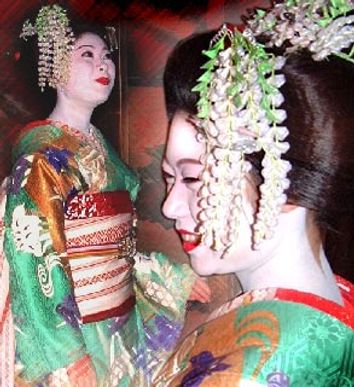
Her name is Yuiko. Just 20 years old, she graduated from the ranks of the young maiko only a year ago — her white collar indicates that she is now a geiko. Green and pink flowers decorate her kimono of bright yellow silk, secured by an obi of burgundy with a white bamboo design. When she turns, pink flesh is visible at the back of her neck where the white makeup suddenly stops. I had heard of this sly technique, intended as an alluring hint of the naked skin beneath the careful makeup. Having spent some time on the Web examining enough female anatomy to pass a gynecological exam, I had been skeptical. And yet the effect of that pink patch is exactly as advertised — a powerful reminder that beneath this awesome finery is the body of a young woman.

Yuiko is followed shortly by two new arrivals. Like a tiger and its keeper, they present a striking contrast — Komomo, a modest-looking young geiko without makeup or elaborate hair, dressed in a subtle pink kimono and black obi; and Teruhina, as brilliant as her companion is discreet, clad in shimmering green with white, purple and gold flowers, her red and white obi trailing behind, an elaborate hairpiece of long white flowers and dangling silver bars swaying as she turns and laughs.

Teruhina is a maiko. Like all geiko and maiko, she belongs to an okiya. An okiya is more or less a geiko stable, run by a “mother” who trains and outfits her charges and manages their affairs (and of course takes the money they earn). The Ichiriki has no exclusive claim on Yuiko, Teruhina or any of Gion’s star performers — they might turn up at any ochaya, so long as the guests ask for them and agree to pay their rates. More popular geiko and maiko can charge higher fees. That may seem only natural but, Kaori points out to me, it represents a contrast with traditional Japanese corporate culture. Too often Japanese companies are gerontocracies where seniority, regardless of ability, inevitably means prominence. By contrast, Gion is a ruthless meritocracy. Charm or die.

Teruhina’s gorgeous plumage is not a case of the bridesmaid upstaging the bride — young novices traditionally dress with more flash and color than older, established geiko. Teruhina is just 18 and joined her okiya two years ago, fulfilling a dream first inspired when a maiko visited her classroom at school. As an apprentice, she spends her days studying dance, flower arranging, Japanese drums and shamisen, the three-stringed lute that all geiko are expected to master. “It’s more fun than I thought it would be,” she insists to me in unsteady English.

The presence of a maiko represents no bargain for Mr. Nagata. In fact, one Japanese friend suggests to me later that ochaya guests must pay more for a maiko, despite her comparative lack of training and experience. I could hardly pose such rude questions to my hosts but based on what I have seen, even in modern Japan, the claim rings true. Girlish sexuality is prized here in a way that can make visitors squeamish. Cartoon posters of barely pubescent nymphs are publicly displayed without shame, and pachinko parlor patrons may be welcomed by sweet junior high students in short skirts and go-go boots.

Teruhina’s dazzling costume, so soon to be put away forever, may well be intended to mimic the first, passing blush of virginal beauty. And while a refined ochaya patron might prefer the company of a mature geiko, it would not surprise me to discover that the company of the less experienced Teruhina brings a higher price.

Just what price I will never know, since Mr. Nagata refuses to say. But Japanese acquaintances suggest that $5,000 would be a very conservative estimate. Mr. Nagata would have been offered a variety of options for our evening’s entertainment, including traditional games that geiko sometimes play with their guests. He selected for our benefit a sort of introductory primer — some dance, some conversation; some geiko, some maiko. He will be billed accordingly. You might recognize the figures if you’ve ever made a down payment on a house.

I don’t know exactly what was on that menu, but I’m pretty sure what was missing. If you’re looking for sex, the Ichiriki is not the place. Other parts of Kyoto can help you out with that and, incidentally, save you a whole lot of money. Although many geiko are kept as mistresses by wealthy patrons, the Western image of geiko as prostitutes has now largely faded. Still, when one hears of the fantastic sums paid for an evening’s entertainment at an ochaya it seems that anything must be permitted. On the other hand, considering that the going market rates for sexual services are a fraction of what Mr. Nagata will pay tonight, it also seems clear that the Ichiriki must be trading in another line entirely. At any rate, my own experience here would prove entirely chaste. Not without sexual tension, but chaste.

Now comes an unexpected honor — the mistress of the Ichiriki arrives to pay her respects in person. Kyoko Sugiura is a lovely woman, perhaps mid-40s, in a trim hairdo and white and gray kimono. She joined the Ichiriki 19 years ago via marriage to the owner’s son. As Kaori translates for me, Ms. Sugiura reminds us that the Ichiriki is no drop-in center. Wads of money are sometimes offered by casual would-be visitors, but to no avail. We are here solely by the grace of Mr. Nagata — his wads will be gratefully accepted on our behalf. Ms. Sugiura explains these things with a pleasant smile; her manner indicates that we are nonetheless honored guests. For now, at least.

Mr. Nagata nods in acknowledgment of his honored position. He knows Gion well and proclaims the Ichiriki to be the best ochaya of all. Which is a lucky thing, he adds with a roar of laughter, because even if the Ichiriki were the lowliest of geiko houses he would have no choice — he must spend his money here or stay home. For ochaya are not merely hard to enter — once entered, they are difficult to leave. The anonymous barfly is free to flit from speakeasy to roadhouse, but those whose custom is accepted by an ochaya are locked into a relationship that tradition expects to be monogamous. Mr. Nagata’s company patronized the Ichiriki long before his time. When he joined the firm he joined the Ichiriki, for life.

I’ve brought along my copy of “Memoirs of a Geisha,” wondering what the habituis of modern Gion will think. The mistress of the Ichiriki is familiar with the book and also with author Golden’s chief source, former geiko Mineko Iwasaki. Iwasaki recently brought suit against Golden, alleging breach of privacy. Ms. Sugiura thinks the suit is misguided. “Mineko’s career came after the war,” Ms. Sugiura says, “and most of the book takes place before the war. No one would think the book is about Mineko.”

As filtered through Kaori, Ms. Sugiura’s attitude toward “Memoirs” seems dismissive. She points out that to the best of her knowledge the author has never been inside the Ichiriki. Nobody in Gion cares about the book, she claims. Maybe not, but Komomo has certainly read it. “I’m Komomo, not Hatsumomo,” she laughs, making reference to “Memoirs’” nasty geiko villain. “She’s cruel!”

Komomo, visually the least prepossessing of the trio, makes up for her relatively plain appearance with skill and accomplishment. Her presence tonight probably has something to do with her English, which though limited is by far the best of the three girls’. More talents soon become evident.

Komomo, Yuiko and Teruhina leave the room briefly. Komomo soon returns with a shamisen. Taking it to the far side of the room, she kneels and waits. Now Yuiko and Teruhina reenter, each carrying a cone-shaped platter covered with pink flowers. As Komomo begins to pluck the shamisen and sing a quavering melody, they dance. Their song is called “Flower Umbrella,” and they perform without expression. Emotion is conveyed through movement, not mugging.

The next song causes Kaori to sigh — her mother sang it to her long ago. As Yuiko and Teruhina glide through a wistful pas de deux, Komomo sings of life in Gion — pain and grief unseen beneath white makeup. “Gion, kanashiiya darari-no-obi-yo”; Gion, like a sad, drooping obi, trailing behind a maiko as she walks.

After loud applause from our small group, the performers return to their social roles at the table. Mr. Nagata is well past his first sake and looking quite at home. I am striving to converse with my exotic table-mates but frequently require translation by Kaori and Komomo, and in the general hubbub the system often breaks down — I ask a question about go and get an answer about golf. Most of what is being discussed flows past me like water over a drowned corpse. (In fact, I later learn that entire parallel evenings are going on without my knowledge; for example, Kaori’s valiant efforts to parry constant paternal questioning from Mr. Nagata about the exact nature of our relationship.)

Sake and conversation are central to the geiko’s art. It has been said that a superb geiko will entertain through wit and charm while a lesser talent, if she’s wise, will pour sake down a customer’s throat until wit and charm become irrelevant. All of which makes me sorry for my new friends, since I represent a geiko’s worst nightmare — I speak no Japanese and don’t drink. This could prove to be the Japanese equivalent of a sober St. Patrick’s.

Still, we all struggle for common ground. I speak of my wonder at the breathtaking speed and energy of Tokyo, pointing out that the Japanese capital has a population equal to that of my entire nation. And since that nation is Canada, my geiko companions assure me of their sincere intention to visit Niagara Falls someday.

“I like the music of Alanis Morissette,” Komomo informs me, displaying her ready knowledge of Canadian pop stars. “I once neglected my studies for an important exam so that I could see Bryan Adams in concert.”

Yuiko and Teruhina also express their admiration for the Vancouver-raised rocker. And to my horrified amazement, I find myself talking about the night he sat at the table beside mine in an all-night restaurant. Well, damn it, I’m not faced with a lot of conversational options here.

But this nattering about celebrities is oddly fitting. In a way, the world of the Ichiriki is like the world of “Entertainment Tonight.” The modern worship of fame has created an entire population that would swoon over the merest brush with Brad Pitt. And the aura and spectacle of this geiko world has left me eager to make any contact, forge any bond, with these women. Their job is to entertain and yet, conditioned by decades of desperate party chatter, I am incongruously worried that they’ll get bored with me.

The conversation hiccups along carefully, through a combination of simple, direct statements and relayed translations. But so focused am I on bridging the linguistic divide, I soon realize I’ve failed to consider another gulf, wide as the Pacific — these young women and I were born five U.S. presidents apart (Eisenhower for me; Reagan for them). Beneath its mesmerizing exterior, this encounter with living embodiments of Japanese history is basically a flirtation with near-teenage girls. One underscored by centuries of tradition and the weight of a nation’s disappearing heritage, but nonetheless …

Teruhina has moved to sit beside me now, poking through my reporter’s notebook. Flipping to a back page, she draws a little heart. Then, touching her finger to her bright red lips, she transfers the scarlet smudge to redden the little ink heart on the page. “Secret,” she tells me.

I impress Teruhina with the special Bruce Lee watch I bought in Tokyo — his nunchucks move in time with the second hand. She responds by laying out her own personal treasures. Teruhina is bedecked with an emperor’s ransom of finery — the collar of her kimono alone probably cost $5,000, and she wears a jeweled belt with a diamond and ruby buckle that is among the most valuable possessions of her okiya, worth perhaps $50,000. But these are not the things she shows me — my Bruce Lee timepiece requires a different response. Proudly she produces her own Hello Kitty watch, and a Tintin key chain. Soon she’s admiring my new Astro Boy wallet, purchased in Tokyo’s Ginza district. We’re thick as thieves.

Five or 10 G’s to trade pleasantries about Bryan Adams and Niagara Falls? It has a surreal quality best appreciated when the cash is coming out of someone else’s shoe. But at last, God help me, I am beginning to get a glimpse of what really pays the bills in Gion. And it’s not sex — that’s not even on the table, though it may be lurking under it, down in that foot well somewhere or peeking out of that little pink gap in the makeup. No, it’s the chance to be flirted with by a sort of costumed superhero whose powers are of fascination — Captain Coquette, Sultaness of Spark, has eyes only for me tonight.

But it’s a sign of Teruhina’s bright career prospects that she keeps an eye on Kaori, too. Unaware of our relationship when she entered the room (Kaori and I have been seated at opposite ends of the table all evening), Teruhina clearly figures it out pretty quickly and takes pains to put Kaori at ease. When Kaori innocently asks what Teruhina wrote in my notebook, the maiko happily displays her artwork with a friendly laugh. So much for our little secret.

Across the table Kaori is listening to Mr. Nagata, her face devoid of expression. I wonder what this evening at the Ichiriki means for her. If my experience is shaped and confined by language, how different must Kaori’s experience be, untouched by the flirtation that gives these encounters so much of their flavor for men? It seems to me that her presence in this place where geiko and their male clientele have drunk and laughed for centuries must be a modern innovation as shocking to the Ichiriki as would be a television in the corner, blaring out “Larry King Live.”

The Ichiriki’s mistress, Ms. Sugiura, does not find Kaori’s presence unusual. Women, she explains, have been guests at the Ichiriki for over a century. And as Kaori assures me later, the evening held considerable interest for her. Women love to watch other women — all the more so when arrayed as artfully as these. “I enjoyed watching you, too,” she tells me, with a look that mixes equal parts amusement and threat. Apparently I was not the only one taking notes.

By now Yuiko has excused herself to attend another engagement. Ms. Sugiura offers to show us around the Ichiriki. Down the hall we enter a large central room, used for hosting the largest parties. Traditional Japanese paintings on the wall date back centuries. Ms. Sugiura leads me over to a shelf where sits a model, a tiny theater holding rows of miniature samurai. These are the 47 ronin. Their shrine has been here for 150 years.

I am curious about the story’s ending — why did the ronin not seek vengeance against the shogun, who forced their master’s suicide? And was their mass suicide really a happy ending? But Mr. Nagata and Ms. Sugiura agree that the shogun found the proper solution. The loyalty of the ronin had to be rewarded, and yet their defiance could not go unanswered.

Teruhina takes me over to the glass patio doors to show me the garden. Above us, the moon is nearly full. Teruhina howls. I join in and we burst into giggles. With Komomo translating, I tell her of the coyotes that howl at the moon near the town where I grew up. What is the word for wolf, I ask? “Oukami,” Komomo replies. Suddenly Teruhina begins to sing to me, dancing lyrics that end with a repeated word –”oukami, oukami, oukami.” Then I recognize the melody. Teruhina is serenading me, in Japanese, with “Who’s Afraid of the Big, Bad Wolf?”

Pictures are posed for and small gifts of Canada left behind — chocolates for Ms. Sugiura, maple syrup for our geiko and maiko entertainers. I promise to return tomorrow to drop off personal cards for Yuiko, Komomo and Teruhina. As we stand at the front archway waiting for our shoes, Teruhina stands close and looks up at me. “I hope to see you again,” she says, pronouncing the English words carefully. Her serious tone may reflect the caution of someone repeating a memorized foreign phrase, or perhaps the formal presentation of a ritual farewell. Or perhaps her unlikely wish is sincere. Maybe she actually likes me.

Kyoto women suffer from a stigma among Japanese — they are legendary for their supposed insincerity. There are humorous advertisements playing on the idea that a Kyoto woman’s smile cannot be trusted — and naturally a geiko, as a professional courtesan, must be the most insincere of all. Even Mr. Nagata confides to Kaori that he considers the pleasant companionship of his Ichiriki evenings to reflect nothing more than the painted-on gaiety of Gion ‘s social mercenaries.

And Kyoto is insular. In Japan they say that unless you can trace your Kyoto roots back at least three generations you will not truly belong, and in this too Gion is the wellspring from which the harsh reputation flows. The geiko world is like a permanent carnival. Years ago in a dingy pub, a couple of midway mechanics passing through my hometown bluntly explained to me the carnival philosophy. “There’s only two kinds of people in the world,” one said. “There’s carneys — that’s us — and there’s marks. That’s everybody else.”

But so what? Yuiko and Teruhina told Kaori privately that they liked me. Who am I to doubt it? They’re just 20 and 18, surely too young to be jaded, and probably don’t see a lot of goofy foreigners in funky glasses sporting Bruce Lee watches and holographic Astro Boy wallets. I am choosing to believe.

Back on the street again, Mr. Nagata decides that our night should not yet end. He leads us around a corner and into a narrow alley lined by solid wooden fences, stopping at a small door cut into the high wooden wall. We step through, and it’s a rabbit hole into Wonderland — in a beautiful floodlit garden, a path leads past the long, tall windows of a secluded bar. This is the Fukushima ochaya. Like many of its competitors, Fukushima has been forced to find new revenue streams, and a drop-in bar (albeit an exclusive and hidden one) helps augment the more traditional geiko party business.

We enter and take a small table. Once again we are joined by the proprietor — Mr. Nagata is a treasured customer wherever he goes. A maiko sitting at the bar is drawn to our table and poses for pictures. Kaori notes details that escape me — this maiko’s bright yellow kimono, she tells me, is not in the same league as Teruhina’s. (Later, as we examine the photographs from Kaori’s digital camera, she notes disapprovingly that this maiko leans against me provocatively. In my photos with Komomo and Teruhina, Kaori points out to me their sweet discretion — they sit upright beside me, and yet their sleeves are gently touching mine.)

The young bartender drops by our table to chat, and I show her the digital photos we took at the Ichiriki. Kaori taps my arm urgently and gives me a warning look — if I’m not careful I will get Mr. Nagata into trouble. The proprietor of the Fukushima, sitting close by, must not know where we’ve come from. Likewise, the mistress of the Ichiriki would not be pleased to discover our presence at the Fukushima. Mr. Nagata is, in effect, cheating on her.

Later, we walk out to the quiet streets of Gion and pile into another impeccable cab for the return home. Japanese taxis are a little pricey, but what the hell. The advantage of spending the cost of a used Honda on an evening’s entertainment is that you stop sweating the small stuff. Offering heartfelt thanks, we part company with Mr. Nagata at our hotel, and he waves the driver on.

Kaori and I spend the next day exploring Kyoto. Late in the afternoon we arrive back at the Ichiriki on foot. I am carrying in my backpack the promised cards for Yuiko, Komomo and Teruhina. As I breeze into the courtyard to look for last evening’s maitre d’, I fail to notice that Kaori is hanging back reluctantly. Puzzled staff eye me as they hurry past with trays and laundry. Soon the man who guided us through the gate last night emerges. I proffer the cards and begin my explanation, but he merely shakes his head. “Geiko house,” he says, motioning for me to leave. “Members only.”

Can he have forgotten so soon? I offer my explanation once more in a stuttering English torrent. He is implacable, insistent that I leave at once. I turn to look for Kaori, but she has moved a little way down the street. “Help me,” I call, but Kaori remains rooted on the pavement. “I can’t go in,” she says.

I stand on the sidewalk as bicycles and pedestrians amble past. The little Gion street is bright and clear in the sun. Inside the open gateway, the courtyard of the Ichiriki is shadowed beneath the trees.

Continue Reading Close

Page 1 of 7 in Steve Burgess

www.salon.com/writer/steve_burgess/index.html