Steven Hart

No direction here

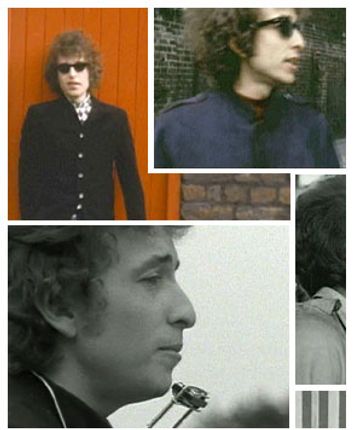
The Bob Dylan-controlled documentary of himself, "No Direction Home," has some odd moments -- Scorsese playing Dylan? -- but offers little new insight into his Bobness.

  • more
    • All Share Services

No direction here

“No Direction Home: Bob Dylan” (which airs on PBS Monday and Tuesday) is, like the work of its subject, part fraud, part tease and part revelation, shot through with flashes of genius.

A great deal of time, care and talent went into its making, and yet it seems as sloppily made as the tossed-off albums that all but buried Dylan’s reputation in the 1980s. Over the course of two installments and three and a half hours — relentlessly focused on the first five or so years of Dylan’s career — “No Direction Home” offers little that is new and much that is already grindingly familiar to fans of His Bobness. And yet it is tremendously watchable and occasionally rewarding, even if it’s apt to leave most viewers with the feeling that they have been served appetizers and dessert without getting so much as a glimpse of the main course.

Is it necessary, in the four decades since Dylan released his first album, to explain why a rock musician deserves a slot in the “American Masters” pantheon? A friend of mine recently spent a frustrating evening with a young woman who said, “Look, I know Dylan’s a legend and all, but what’s the big deal? Why’s he important?”

The only response to such doubters is: If you value popular music as a venue for serious artistic purpose, thank Bob Dylan, who infused rock and folk music with blazing intellectual energy and visionary poetry. If you look back on the late ’60s and early ’70s as a lost era of pop music ambition and innovation, then thank Bob Dylan, whose 1960s albums were the benchmark that motivated artists across the pop spectrum, from the Beatles and the Rolling Stones to Stevie Wonder and Marvin Gaye, to stake claims for themselves as something more than purveyors of disposable junk music. And if you despair of the legions of puling singer-songwriters who followed in his wake … well, don’t blame Bob Dylan. The man can’t help it if his imitators lack his outsize talent.

Recognize also that this talent came along at a fleeting, never-to-be-repeated moment when the record industry, baffled by rock music but eager to exploit its commercial potential, was still loose enough to give somebody like Dylan the space to grow, and when radio was still capable of making Dylan’s 1965 breakthrough “Like a Rolling Stone” into a cultural watershed as well as a pop music landmark. Combine that with a manager, Albert Grossman, who shrewdly gave Dylan mass-market credibility by encouraging mainstream performers to release sweetened versions of his songs while preserving Dylan’s own albums as pillars of harsh integrity. By the time mass-market listeners were ready to answer the challenge posed by the promoters at Columbia Records — “Nobody sings Dylan like Dylan” — their ears had been made ready by the likes of the Byrds and Peter, Paul and Mary. In the fragmented, highly corporatized music industry of today, there may be other artists who could match Dylan’s talent, but none will ever equal his impact.

Dylan parted ways with Grossman decades ago, but the emphasis he placed on image manipulation and mystique maintenance was a constant throughout Dylan’s career, and “No Direction Home” is best viewed as another addition to Dylan’s hall of mirrors. Even the credits are deceptive. This is not “A Martin Scorsese Picture,” except in the loosest sort of auteurist terms. As last week’s Wall Street Journal made clear, “No Direction Home” is an in-house project from Bob Dylan’s management team, conceived as a way to frame Dylan’s legacy while the man himself is still around to supervise the work.

The rather desultory interviews with a glowing Joan Baez, a haggard Allen Ginsberg and other figures from Dylan’s career were conducted not by Scorsese but by Dylan’s manager and staff — probably just as well, in light of Scorsese’s fumbling attempts to interview members of the Band in “The Last Waltz” (a direct inspiration for the earnestly fatuous Marty DiBergi in “This Is Spinal Tap”). The fact that Ginsberg died in April 1997 gives an idea of how long this project has been in the works. The interviews with Dylan himself show the maestro in a disarmingly straightforward mood, offering flashes of the quiet wit and wordplay that make his recent “Chronicles” such an engrossing read.

Scorsese was brought into the project late and allowed to assemble the film only from archival materials vetted by Jeff Rosen, Dylan’s manager. Scorsese’s presence is most clearly felt in a moment of almost sublime goofiness — a re-creation of Dylan’s notoriously obtuse 1963 speech to the National Emergency Civil Liberties Committee, with Scorsese doing a Dylan impersonation that wouldn’t pass muster at a high school talent show. He even drops the punch line, when Dylan baffled and offended the audience by claiming to feel kinship with Lee Harvey Oswald.

Scorsese follows a skeletal chronology of Dylan’s progress from the iron hills of northern Minnesota to the folk clubs of Greenwich Village, but frequently leaps ahead to the clamorous performances of 1965 and 1966, when Dylan enraged the folkie faithful by dropping the Woody Guthrie poses and reinventing himself as a frizzy-haired rock hipster, culminating in the creation of “Like a Rolling Stone.” After years of watching grainy bootlegs of “Eat the Document,” the aborted documentary of Dylan’s 1966 swing through England, it’s great to have this footage in a clean, well-mastered form. I’m sorry to report that Scorsese doesn’t include the gruesome limousine ride with John Lennon, which shows Dylan deathly ill from a combination of exhaustion and drugs while the Smart Beatle sits frozen behind his shades, clearly terrified that he might say something unhip.

It’s all very watchable, but this is such familiar stuff. Heavy-breathing rock critics like Greil Marcus and Paul Williams have devised a veritable Stations of the Cross story line for this period, ending with the motorcycle accident that Dylan used to take himself off the celebrity treadmill and try his hand at something approaching a normal life. (Scorsese, curiously, omits the accident, which would at least have given “No Direction Home” a more shapely narrative.) Personally, I find the post-accident Dylan far more interesting as an artist and a human being — given a choice between the icy hipster glaring from the cover of “Highway 61 Revisited” and the regretful, passionate husband of “Blood on the Tracks” and “Desire,” I’ll go for the more mature version. The magnesium-flare brilliance of “Highway 61″ and its mid-1960s companions is undeniable, but it doesn’t shed much warmth.

“No Direction Home” tells us nothing about Dylan we didn’t already know, or thought we knew, but it could hardly have turned out otherwise, given the circumstances of its creation. “I don’t know what he thought about,” Baez says at one point. “I only know what he gave us.” In “No Direction Home,” Dylan gives us something to while away a few hours of viewing time, nothing more.

The moderate who wasn’t there

Christine Todd Whitman can cry all she wants, but today's GOP is not her party. And she has no one but herself to blame for that.

  • more
    • All Share Services

You wouldn’t know it from the rather whiny title of her new book — “It’s My Party, Too: The Battle for the Heart of the GOP and the Future of America” — but there was a time not so long ago when Christine Todd Whitman was being called the future of the Republican Party.

The GOP, groggy from the loss of the presidency after 12 years of dominance, certainly needed a face-lift. The ravening beast that had always coiled within the dapper bosom of the Reagan presidency had burst forth during the 1992 Republican National Convention in Houston. The Reagan-era slogan “It’s Morning in America” had given way to “It’s Payback Time, Liberal Scum.” When she became New Jersey’s first woman governor in 1993, Whitman looked like a bellwether back to the sensible middle way — a moderate Republican who was pro-choice, talked a good game about fiscal discipline, and seemed accepting of gays. Her direct, plain-spoken manner was immensely appealing in person. Pundits talked of “Whitman Republicans” rescuing the GOP from its extreme right contingent; Whitman herself seemed destined for bigger things than the governor’s mansion.

That was then, this is now. Bush’s narrow victory in November completed the Republican Party’s transformation from a vehicle for principled conservatives into a debt-fueled pimpmobile for crony capitalists and religious hucksters. Rockefeller Republicans — a tag Whitman has proudly embraced — are second only to the Clintons in the party demonology. The tax code is about to be revamped to allow further looting of the public coffers, and culture-war commandos are drawing a bead on everything from Social Security to SpongeBob Squarepants. And even as Bush and his backers are doing doughnuts on the National Mall, Whitman steps up to ask, with a cluelessness that borders on the sublime: “Will the GOP interpret the president’s reelection victory as a mandate, even a requirement, to continue to cater to the demands of the far right on a series of key wedge issues?”

If Whitman really thinks this was ever an open question, voters are entitled to wonder why she should ever be taken seriously again as a political candidate. For that matter, we should all ask if Whitman even believes her own words. She was, after all, co-chair of Bush’s reelection campaign in New Jersey, so none of what’s happened in the past two months could have been much of a surprise. Nor could she have feigned shock when “It’s My Party, Too” drew advance ridicule from right-wingers on the Internet. “Earth to Christie: We won,” was all one New Jersey Republican had to say to the Star-Ledger, the state’s largest newspaper, when asked about the book. The GOP has become comfortable with its inner troglodyte — in fact, it embraces the lil’ fanged bugger. This rather thuggish organization that loves to rule but refuses to govern is not Whitman’s party anymore. To the extent that she helped make this transformation possible by putting a pleasant face on the party’s ugly excesses in the 1990s, Whitman has earned her irrelevance.

Christie Whitman has long been a puzzle to New Jersey residents, and “It’s My Party, Too” will give them plenty of company. Whether as a rallying cry for moderates of both parties, or as an argument for Whitman’s continuing value to Republicans (or Democrats), the book is almost comically unconvincing. The hard-liners who now control the GOP are laughing off Whitman’s warning that they are alienating the majority of voters. Campaign 2004 showed their mastery of the undemocratic art of fracturing the opposition, pumping up the base and confusing the issues with a blizzard of lies — see the Swift Boat Veterans for Truth. The fact that “moderate” Republicans like Whitman were willing to play loyal soldiers in this fight leaves us with the question of what good they are to anyone.

Middle-of-the-road Democrats (and anyone with a memory of recent history) will be offended by the gross distortions and errors of omission swaddled within the book’s somnolent Chamber of Commerce banalities about compromise and negotiation. “I joined the administration cautiously optimistic that the extreme bitterness of the Florida recount — in which actual fights had broken out at one polling place — and the Supreme Court decision on the election could be put behind us,” Whitman writes in her opening chapter. But, alas, “the Democrats showed only a limited interest in working cooperatively.” How much dissembling can be packed into one sentence? I don’t recall anything about fistfights, but I do know the Republicans sent a handpicked mob of party operatives to shut down a legal recount. Whitman’s schoolmarm tone tries to turn the theft of the presidency, aided and abetted by the Supreme Court, into a playground shoving match, with Democrats painted as the sulking losers. And by no stretch of the imagination can the shellshocked lassitude of the Democrats following that debacle be considered resistance.

Every page of “It’s My Party, Too” is drenched in speechwriter chloroform — many readers will feel their eyelids fluttering from the very first sentence: “We stand at a historic juncture in American politics . . .” But it’s when her writing is at its dullest that Whitman is prone to try to slip a whopper past the reader. She endorses the idea of reducing greenhouse gases, then calls it “a goal President Bush also supports.” She talks of making government accountable to the citizenry, yet as governor she eliminated the Office of the Public Advocate, a highly effective tool for keeping politicians honest. Looking back on the infamous 1996 photo of her patting down a randomly chosen man during a police-led tour of Camden, Whitman writes: “As soon as I touched the young man, who was African American, I realized I’d made a mistake. I had no business ‘fake frisking’ him.” After looking at that photo and Whitman’s gee-this-is-such-fun grin as she humiliates the man, I find it hard to believe Whitman regretted anything except the fact that the photo came to light.

How, at this late date, shall we identify the elusive, yeti-like creature known as the moderate Republican? Whitman herself invites horselaughs whenever she cites fellow travelers on the great middle way. On the Republican side, she brightly offers Tom Ridge, whose blatant pimping of terror alerts whenever Bush’s poll numbers looked too shaky helped turn the Department of Homeland Security into a reliable source of material for Jay Leno and David Letterman. On the Democratic side, even more astonishingly, Whitman tosses her bouquet to Georgia Sen. Zell Miller, whose foam-flecked rant before last year’s GOP national convention had even case-hardened culture warriors calling for a tranquilizer rifle and a net.

In Whitman’s case, success has been chiefly a matter of personal style and good timing. She caught incumbent Democratic Sen. Bill Bradley loafing through his 1990 reelection campaign and used her narrower-than-expected defeat to leverage influence. She won the keys to the governor’s mansion in 1993 by playing (moderately) to a statewide anti-tax tantrum. When the GOP won control of the House in 1994, House Speaker Newt Gingrich picked her to deliver the response to President Clinton’s State of the Union address. Even at a time when Gingrich and his minions were bellowing like puffed-up Genghis Khans, Gingrich was shrewd enough to know that Whitman’s lower-key approach would play better on television. For the same reason, the party leadership picked Whitman to co-chair the 1996 national convention.

Whitman’s appeal proved to have a rather short shelf life. In July 1997, National Review dubbed her the “Nowhere Girl” because of her wobbly record on the GOP’s red-meat social and economic issues. She only narrowly staved off a reelection challenge from a blandly likable Democrat named Jim McGreevey. She infuriated New Jersey Republicans by retracting a Senate bid in late 1999. When Whitman accepted Bush’s offer to come to Washington and handle smoke and mirrors for him at the Environmental Protection Agency, the air quickly became thick with the smell of burned bridges.

The truth of the matter is that Whitman is hardly a standard-bearer for any kind of moderation. Her much-touted tax cuts were largely achieved by slashing state aid to municipalities, pushing costs downward and local property taxes upward, and by shorting the pension fund for state workers to the tune of $2.5 billion in contributions, eventually floating bonds to cover the shortfall. Her penchant for outdoor recreation belied her open-for-business attitude toward environmental regulation, leaving the state Department of Environmental Protection understaffed and demoralized (which would also be the case at the EPA). Her pro-choice orientation is hardly a badge of courage in New Jersey; in fact, it’s pretty much a prerequisite for anyone seeking the governorship. It has also proved negotiable at crucial points. When two pro-choice Republican governors, William Weld of Massachusetts and Pete Wilson of California, demanded a chance to present their views at the national convention, Whitman let the party freeze them out. George W. Bush has famously credited his political success to being “misunderestimated” by his opponents; Whitman has spent her career being misoverestimated by her supporters.

Part of what makes “It’s My Party, Too” so tedious is that what should have been Whitman’s best stuff — the near-miss gubernatorial campaign that briefly made her a Republican star, and how Bush sawed her off at the knees at the EPA over global warming — has already been told (with extra-large helpings of insider dirt) by GOP consultant Ed Rollins in his 1996 memoir, “Bare Knuckles and Back Rooms,” and by journalist Ron Suskind in last year’s “The Price of Loyalty.” Whitman takes a decorous jab at Rollins and offers a weak gloss of the EPA fiasco, in which she announced Bush’s support for the Kyoto Protocol on global warming, only to have Bush reject the protocol and leave her twisting in the wind. But for the most part she is proud to announce that “It’s My Party, Too” is not a tell-all book.

A “tell-all” book is one thing; a “tell nothing” book is quite another, though in Whitman’s case it’s understandable that she would want to gloss over a few things. A great many people would like to know why Whitman, heading the EPA in the days and weeks following 9/11, repeatedly assured New Yorkers that the toxin-laden air of Lower Manhattan was safe to breathe. Whitman, understandably, doesn’t go near that one in “It’s My Party, Too,” though she does describe in great detail how she came to present the Bush family with Scottie pups. The story of how she helped present the rescue workers of ground zero with lasting health problems will have to be told, I suspect, with the help of subpoenas and lawsuits rather than ghostwriters.

We will also have to wait for another book, I suppose, to get the inside story of how Whitman did her part to beautify the New Jersey approach to Philadelphia during preparations for the Republican National Convention in 2000. The main avenue to the Benjamin Franklin Bridge was Admiral Wilson Boulevard, a Brechtian hell’s highway of go-go bars, liquor stores and hot-sheets hotels. Whitman spent some $45 million to bulldoze everything along the boulevard and replace it with a “park” that succeeded in making Camden look even more desolate. She also eliminated, along with the sleaze merchants, a good number of Camden’s few remaining legitimate businesses. It does make one smile while reading her chapter on “Reclaiming Lincoln’s Legacy” through minority outreach.

Since flunking out of the Bush League, Whitman has been relegated to the bush leagues, and she’s clearly impatient to become a player again. Ultimately, the most pressing question in “It’s My Party, Too” is: Does Christie Whitman still have a place in the Republican Party? The answer: Sure, as long as she’s ready to keep playing the role of a front. And if she is, we can already guess the title of her next book: “Thank You, Sir, May I Have Another?” And the subtitle: “I Spent Years Sucking Up to Fundies and Ideological Con Men and All I Got Was This Stupid Book Deal.” Who knows — if Whitman releases some of the pent-up patrician rage coiled beneath the Oldwick tweed, that book might actually be worth reading. Which would put it miles ahead of this one.

Continue Reading Close

Nothing was revealed

A new book about Bob Dylan's masterpiece, "Blood on the Tracks," fusses over the details while missing the story.

  • more
    • All Share Services

Nothing was revealed

As every Bob Dylan fan knows, “Blood on the Tracks” remains the album by which the man’s music will be judged. The holy trinity of mid-1960s albums — “Bringing It All Back Home,” “Highway 61 Revisited,” “Blonde on Blonde” — may hold an unassailable place in history, but their magnesium-flare brilliance offers more light than warmth. “Blood on the Tracks,” by contrast, frequently boils over with love, regret and longing. It is often tagged Dylan’s “breakup album,” and some of the songs do seem to reflect the slow dissolution of his marriage. But it also sports sexy country blues (“Meet Me in the Morning”), a blast of raw vitriol that turns back on itself (“Idiot Wind”), a surrealistic western (“Lily, Rosemary and the Jack of Hearts”), and “Tangled Up in Blue,” a landmark song that opened up possibilities that Dylan is still exploring onstage.

As almost every Bob Dylan fan knows, “Blood on the Tracks” exists in two versions. The original, recorded in September 1974 in New York City, sported backup from Eric Weissberg (he of “Dueling Banjos” fame) and sundry supporting players. The album was almost ready for release when Dylan pulled it back to substitute radically different versions of the five key songs, recorded in December with a group of Minneapolis musicians whose names are still too little-known because of screw-ups on the album cover credits. Though legend has it that luminaries like Robbie Robertson all but begged Dylan to release the original, the revamped edition served as the official 1975 release. Dylan would later become notorious for second-guessing himself in the studio, but in this case his instincts were correct — the Minneapolis players raised “Blood on the Tracks” to a higher level. But even the upgraded SACD version of “Blood on the Tracks” released last year continues to credit only Weissberg and company, ignoring their contributions.

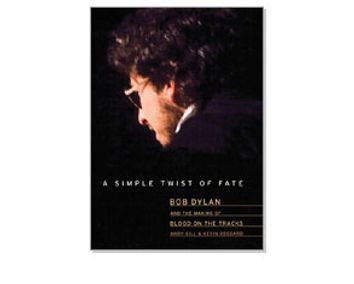
It is the chief accomplishment of the new book “A Simple Twist of Fate: Bob Dylan and the Making of Blood on the Tracks,” and no small accomplishment at that, to bring those second-line Minneapolis musicians into the spotlight and even give credit to David Zimmerman, Dylan’s long-suffering brother, for what turns out to have been his crucial role in the project. Not only did Zimmerman supervise the Minneapolis recordings, but he also had the savvy to recruit a pair of jazzbos for the rhythm section, possibly reasoning that experienced improvisers wouldn’t be fazed by Dylan’s off-the-cuff approach in the studio. The shrewdness of his thinking is clear right from the opening notes of “Tangled Up in Blue,” in which drummer Bill Berg avoids a heavy backbeat in favor of a light weave of high-hat cymbals and fluttering snares. Where the original “Tangled Up in Blue” is resolutely earthbound, the Minneapolis version shimmers like a dream in motion — the perfect setting for a deceptively simple narrative in which points of view constantly shift according to some mysterious, half-understood plan. Berg ought to be a household name for this performance alone, so kudos to the authors for doing what needed to be done.

Sad to say, the kudos ends there. To frame the story of “Blood on the Tracks” without Dylan’s cooperation, Andy Gill, a U.K. music writer, and Kevin Odegard, one of the Minneapolis crew, have trawled through back issues of various magazines, dipped heavily and frequently into the two most up-to-date Dylan bios — Clinton Heylin’s “Behind the Shades” (the one Dylan book to read if you’re reading only one) and Howard Sounes’ “Down the Highway” — and added interviews with the few supporting players left to be heard from. The result is a hash of trivia, common knowledge and old news, written in a breathlessly hyped-up style often hilariously at odds with its mundane content. Have you been lying awake at night, wondering what sort of microphone was used on the bass drum during “Tangled Up in Blue”? Neither have I, but Gill and Odegard devote long stretches of their book to such technical arcana. In the journalism trade, this is called “dumping your notebook” — using a blizzard of factoids, fussy details and irrelevant asides to obscure the fact that the real story has gotten away.

What is the real story of “Blood on the Tracks”? It lies within the lines of the album’s 10 songs, in the sound that Dylan pursued and finally captured, in the landscape of regret, memory and hope that opens up whenever the album is played. To delve into these songs is to study some of the finest work found in American song. The job requires someone with the boldness and the breadth of knowledge shown by Michael Gray, whose hefty study “Song and Dance Man” puts the bulk of rock-crit writing about Dylan to shame. Unsuited for this task, Gill and Odegard opt to skim the surface of Dylan’s songwriting, then trot out samples from the reviews that greeted “Blood on the Tracks” in 1975. Among the too-familiar names are Paul Williams, whose fanboy gushing has produced some of rock criticism’s most embarrassing moments, and former big cheese Jon Landau, whose grudging respect for the album serves as a reminder that his abandonment of criticism to manage the career of Bruce Springsteen was, as they say, a win-win situation.

The official version of “Blood on the Tracks” had been in the stores barely a month when copies of the original version, taken from one of the many acetate copies floating around, became available as a vinyl bootleg called “Joaquin Antique.” The CD incarnation is widely available as “Blood on the Tracks — NY Sessions.” The revamped songs may be superior — though “You’re a Big Girl Now” loses some of its raw hurt — but that doesn’t mean the original versions were bad songs. A listening session with the two versions side by side is a rewarding experience for any Dylan fan. It will certainly put anyone closer to the beating heart of Dylan’s artistry than “A Simple Twist of Fate.”

Continue Reading Close

Who’s Sauron — bin Laden or Bush?

The success of "The Lord of the Rings" has launched a war over Tolkien's politics, pitting pundit against pundit, and Viggo Mortensen against John Rhys-Davies.

  • more
    • All Share Services

Who's Sauron -- bin Laden or Bush?

In the years following the mid-1950s publication of “The Lord of the Rings,” author J.R.R. Tolkien was often plagued by interpreters who wanted to read his three-volume epic as an allegory of World War II or the Cold War, with the disembodied villain Sauron standing in for Hitler or Stalin, and the fiendishly powerful One Ring representing nuclear weapons or space-age technology or whatever.

Though he detested these interpretations, Tolkien offered a truce by drawing a line between “allegory,” which placed responsibility on the author, and “applicability,” which left readers free to find parallels of their own without pretending to read the author’s mind. However, the worldwide success of Peter Jackson’s film version of “The Lord of the Rings” has produced a whole new generation of mind readers claiming to understand Tolkien’s motives, and opened up another front in the culture war that has long simmered around Middle-earth’s frontiers.

When the book’s original paperback editions became campus bestsellers in the 1960s, conservatives wrote it off as hippie-dippie pablum, an incense-scented ur-text of the New Age movement. Religious conservatives were suspicious of the book’s popularity with rock groups like Led Zeppelin, and its connection to the seminal role-playing game Dungeons and Dragons. But what a difference a generation makes! With “The Lord of the Rings” firmly ensconced in popular culture, Catholic theologians and evangelical activists alike are trumpeting the book’s hidden Christian messages. As for the pundits, their successors are happy to claim a story in which good has blue eyes and resides in the West, while evil lives due east and has a really bad complexion. How’s that for moral clarity?

It’s true that Tolkien’s personal politics placed him closer to the conservative line than anything else. The counterculture’s early embrace of Tolkien was always comically inapt, though the sight of Bilbo Baggins and Gandalf the Gray enjoying “the finest weed in the valley” can still draw sniggers in the theater. But right-wingers may want to undergo a long-overdue round of soul searching before they lay claim to Middle-earth. In fact, they might be better off giving Tolkien back to the hippies. Unlike, say, “Atlas Shrugged,” “The Lord of the Rings” makes for a double-edged weapon in today’s culture wars.

The first skirmish in the newest battle flared last year when Jonah Goldberg of National Review Online defended “The Two Towers” against some leftist writers who charged the film with racism because the chief monsters — burly orcs called Uruk-hai, bred by the turncoat wizard Saruman — have dreadlocks, dark skin and flat noses. The dispute was a nonstarter because, like their counterparts in the book, the film’s orcs also speak with broad Cockney accents and trade insults right out of “Tom Brown’s Schooldays.” (Fortunately, Jackson didn’t follow Tolkien’s own description of the orcs: “Swarthy … like the less attractive type of Mongolian.”) But that’s nothing compared to the most recent clash, given an acid political edge by the ongoing fiasco in Iraq, and involving members of Jackson’s cast: Viggo Mortensen, who plays king-in-waiting Aragorn, and John Rhys-Davies, who plays the stouthearted dwarf Gimli.

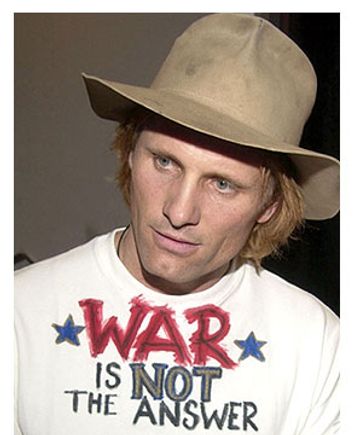
When the first installment, “The Fellowship of the Ring,” opened only two months after the Sept. 11 terrorist attacks, pundits and feature writers were quick to make the War of the Ring an adjunct to the war on terror. During press appearances for the second installment, “The Two Towers,” an exasperated Mortensen wore a T-shirt bearing the message “No more blood for oil” and let interviewers know he considered George W. Bush a good buddy of Sauron. Last fall, as the hype machine went into overdrive for “The Return of the King,” Mortensen spoke at an antiwar rally in Washington sponsored by International ANSWER, an odious Stalinoid fringe group. Like most of the people who attended the rally, Mortensen seems to have gone in spite of rather than because of the group’s involvement — it’s not as though antiwar comment has had so many platforms. Nevertheless, Mortensen has become the piñata of choice for pundits like gay conservative Andrew Sullivan who remain determined to ignore the accretion of lies that fueled the Iraq invasion. (Sullivan, saucy thing, even called Mortensen “cute, but dumb as a post” in his blog.)

Rhys-Davies emerged as a hero to the pro-war faction during a recent press junket, when he offered remarks apparently aimed at Mortensen: “I think that Tolkien says that some generations will be challenged, and if they do not rise to meet that challenge, they will lose their civilization. That does have a real resonance with me … What is unconscionable is that too many of your fellow journalists do not understand how precarious Western civilization is, and what a jewel it is.” Rhys-Davies linked all of it to the rise of militant Islam, and conservative pundits swooned.

Since the interview, Rhys-Davies has been making the rounds of right-wing bottom feeders. On Feb. 19 he spent what looked like the longest hour of his life trapped in Dennis Miller’s no-laugh zone on CNBC, doing his best to stay awake while the host and Gloria Allred debated Michael Jackson’s fitness as a parent. When his moment came, Rhys-Davies warned that Western Europe was on the verge of being overrun by unassimilated Muslims representing homophobia and other forms of religious intolerance. Since then, of course, George W. Bush — putative defender of the tolerant values of the West — has announced he will fight for a constitutional amendment barring same-sex marriages. Sorry, Gimli — the barbarians are already inside the gates, and they don’t pray to Allah. Before we can preach Western values to the Muslims, we have to get the word out to Pat Robertson and his ilk.

But is that really news to Rhys-Davies? A month before his Dennis Miller ordeal, on Jan. 17, the actor consented to share a podium with Michael Medved, the bush-league Bill Bennett who counts up cuss words in movies and types out screeds like his book “Hollywood vs. America.” The venue was the Discovery Institute, the Seattle home base of “intelligent design,” the slicked-up version of creationism heavily underwritten by conservative moneybags Howard Ahmanson Jr. If the mere presence of some cranks at a political rally disqualifies Viggo Mortensen from serious consideration, then why would John Rhys-Davies — by all appearances a worldly and cultivated man — let his name be linked with a group dedicated to injecting theology into science curricula across the country?

The religious angle on Middle-earth, like the political one, was late in developing. Though Tolkien himself considered “The Lord of the Rings” a Christian (and specifically Catholic) work, he took pains to keep overt religious elements well below the surface. Only by digging through the voluminous appendices at the back of “The Return of the King” does one learn that the Fellowship of the Ring’s departure from Rivendell — the beginning of the mission to save all of creation from unredeemed evil — comes on Dec. 25, while the timing of other plot developments roughly corresponds to the Annunciation, the Crucifixion and the harrowing of Hell. Meanwhile, the pre-Christian ingredients of Middle-earth — the Elder Edda, “Beowulf,” the Icelandic sagas, the Finnish “Kalevala” — are fairly obvious, as is the affection with which the author uses them. Tolkien’s soul was in the Lord’s keeping, but his heart — like that of his friend, C.S. Lewis — quickened to a pagan drumbeat.

The sound of that drumbeat, along with the scent of New Age patchouli oil, held many Christians at bay when “The Lord of the Rings” enjoyed its first flush of success. The rise of scholarship into Tolkien’s Christian leanings began to gather steam in the late 1970s and 1980s, helped considerably by the publication of Tolkien’s letters, the 12-volume compilation of working papers called “The History of Middle-earth” and, above all, the posthumous 1977 publication of “The Silmarillion,” the endlessly fussed-over private mythology that formed the backdrop to Middle-earth.

As Tom Shippey points out in “The Road to Middle-earth” and “J.R.R. Tolkien: Author of the Century,” “The Silmarillion” was designed as a “sub-creation” complementing Scripture — Tolkien even includes a subtle link between the first appearance of men and the banishment from Eden. The lovely creation story in “The Silmarillion” has the universe sung into existence by the Ainur, a celestial choir formed by the supreme being Illuvatar. (C.S. Lewis, who read Tolkien’s work in manuscript, liked this idea so much that he appropriated it for his “Chronicles of Narnia” series.) Just as Lucifer was the brightest of the archangels, so is Melkor — the satanic figure of Tolkien’s universe — the most beautiful of the singers, and he incurs his fall by trying to make his voice the dominant one. Tolkien has Melkor’s discordant notes incorporated by the other singers to form a more beautiful whole. Even the works of evil play a part in the creator’s overall design — a key doctrinal point for Tolkien’s Christian advocates, who also point to the depiction of evil as a non-creative force. Throughout “The Lord of the Rings,” we are reminded that the orcs and trolls rampaging around Middle-earth are distortions of other creatures, not separate creations in their own right.

Christian analysis now appears to be the dominant mode of writing about “The Lord of the Rings,” and enthusiasts are ready to argue everything from the Eucharistic nature of lembas bread to the influence of Catholic liturgy on Tolkien’s style. (Joseph Pearce’s “Tolkien: A Celebration,” offers a good sampling.) Last summer, Christianity Today devoted an entire issue to Tolkien, and a scan of scholarly literature shows plenty of academics arguing for Tolkien’s place alongside overtly religious writers like Hillaire Belloc and G.K. Chesterton. Actually, Tolkien’s clearest literary antecedents are William Morris, the Victorian socialist and author of medieval romances like “The Well at the End of the World,” and Lord Dunsany, the Irish fantast whose 1905 debut, a private mythology called “The Gods of Pegana,” could have served as a model for “The Silmarillion.” But that’s another doctoral thesis.

Nevertheless, “The Lord of the Rings” is viewed with suspicion by many evangelical and fundamentalist Christians, even those who don’t necessarily view the pope as the devil’s doorman. The alert evangelicals at the ChildCare Action Project cite “The Two Towers” for no fewer than 17 “offenses to God,” including “gaiaism” (walking, talking trees — oh dear), “mockery of the Transformation” (Gandalf’s second coming is a bit close to, well, the Second Coming) and “miraculous reverse aging” (presumably the spontaneous makeover Theoden undergoes once Saruman’s possession is thrown off). There is also the sticky issue of showing a good wizard (Gandalf) pitted against a bad one (Saruman), when any good fundamentalist knows all sorcerers are bad news. For this reason the Harry Potter books also meet with fundamentalist disapproval, compounded by the fact that they show magical beings mingling with the quotidian world. “Though not as overtly and sympathetically occultic as the Harry Potter series,” David W. Cloud warns on the Logos Resource Pages, “Tolkien’s fantasies are unscriptural and present a very dangerous message.”

Help for evangelicals and fundamentalists alike comes from Focus on the Family, James Dobson’s Colorado-based activist group. “Finding God in the Lord of the Rings,” written by Dobson associates Kurt Bruner and Jim Ware, offers homilies like “It is never so dark that we cannot sing,” lifted from passages in Tolkien and linked (sometimes rather tenuously) to biblical scripture. The film version of “The Return of the King” gets unexpected bonus points from Plugged In, the group’s entertainment Web site, because Arwen’s decision to have a child with Aragorn at the cost of her own well-being carries an appropriately pro-life message. Part of this accommodation may stem from the ceaseless rear-guard action any strict religious sect must wage against the relentless advance of pop culture. But it doesn’t raise Focus on the Family’s standing with some of the sterner fundamentalists, who are already suspicious of the group’s ecumenical approach to social issues. Reaching out to Catholics, Jews and even Muslims is not going to win favor with these folks, even if it’s to deny civil rights to gay people.

Here is where the conservative drive to annex Middle-earth bogs down. Posterity has not preserved Tolkien’s views on homosexuality, good, bad or indifferent. But it has given us enough of his other opinions to show that his conservatism was very much an old-fashioned, mind-one’s-own-business sort. Even if he disliked gays, Tolkien would not have felt the need to burden others with his opinion. Nor would he have expected the government to go out of its way to deny them the right to marry. With his distaste for industrial society and views on stewardship of the land, Tolkien probably would have been dismissed as a tree-hugger by such deep thinkers as Rush Limbaugh. His preferred mode of government was the gentle anarchy of the Shire, where hobbits tended to their own affairs. Failing that, he told his son in a letter, he would settle for an ineffectual monarch whose interests were model trains or stamp collecting. The neoconservatives and their dreams of remaking the Middle East would surely have met with a great deal of skepticism from the bard of Middle-earth.

For that matter, the invasion of Iraq makes a poor match with the War of the Ring. It only works if we can imagine Gandalf as having cut business deals with Sauron back in the Second Age, even providing him with the seed cultures for breeding his legions of orcs. There is no question of imminent threat in “The Lord of the Rings” — the armies of Mordor come looking for trouble. Had Gondor marshaled its troops only to find Mordor bare of weapons, and Barad-dur ready to crumble at a touch, then we might find parallels with George W. Bush’s grand venture.

Looking back on Tolkien’s life, we find his conservatism was rooted in a proper suspicion of power and the motives of those who seek to wield it. This suspicion infuses every line of “The Lord of the Rings,” in which the good characters are defined by their wariness of power, while the bad are invariably eager to seize it. One of the many ways Jackson amplifies Tolkien’s original comes in the portrayal of Aragorn, fated to become the king of reunited humanity, who spends much of the story resisting his destiny because he doesn’t trust himself with such power. Saruman seems to think he can use the power of the Ring to work toward the greater good (a point made clearer in the book), but Gandalf is reluctant even to touch the ring, lest he fall prey to his own version of Saruman’s delusions.

Contemporary conservatives, by contrast, are very much enamored of power — indeed, it is hard to imagine any other way to define them. Certainly none of the qualities that used to typify conservatives — fiscal prudence, limits on spending and checks against the spread of government power — can be found in the Republican-run halls of power. All of which should make Gollum, the river-dwelling hobbit who becomes entranced by the Ring of Power and pays for it with his soul, an ominous metaphor. He never hesitates to exploit a wedge issue, be it Frodo’s trust of Sam or the distribution of lembas bread, and is savage in combat until defeated, at which point he whines endlessly about how unfair it all is.

Will a similar fate await those who hold the Ring of Power in November? Call it allegory or call it applicability — either way, many Ring devotees who predate the right’s latter-day Tolkien fans would surely find that result more than satisfactory.

Continue Reading Close

The real fellowship of the ring

How J.R.R. Tolkien and C.S. Lewis' all-night argument about God paved the way for both "The Lord of the Rings" and "The Chronicles of Narnia."

  • more
    • All Share Services

The real fellowship of the ring

On a warm September night in 1931, three men went for an after-dinner walk on the grounds of Magdalen College, part of Oxford University. They took a stroll on Addison’s Walk, a beautiful tree-shaded path along the River Cherwell, and got into an argument that lasted into the wee hours of the morning — and left a lasting mark on world literature.

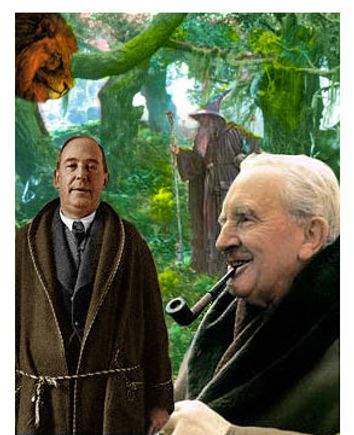
At the time, only one of the men had any kind of reputation: Henry Victor Dyson, a bon vivant scholar who had shared tables and bandied words with the likes of T.E. Lawrence, Virginia Woolf and Bertrand Russell. His two companions were little-known Oxford academics with a shared taste for Icelandic sagas, Anglo-Saxon verse and the austere cultural mystique of “the North.” Few people remember Dyson now, while millions celebrate the names of his companions: C.S. Lewis and J.R.R. Tolkien.

Yet the works that made their reputations — “The Hobbit” and “The Lord of the Rings” for Tolkien, “The Chronicles of Narnia” for Lewis — were profoundly shaped by that night-long argument and the bond it cemented. It’s possible that Tolkien’s Middle-earth would have remained entirely a private obsession, and quite likely that Lewis would never have found the gateway to Narnia.

“Lovers seek for privacy,” Lewis wrote in “The Four Loves” (1960). “Friends find this solitude about them, this barrier between them and the herd, whether they want it or not.” Lewis and Tolkien quickly found this cozy solitude after they met in 1926, during a gathering of the English faculty at Merton College. Both men had fought in World War I, and come back scarred by its industrial savagery. They had seen the worst the 20th century had to offer — up to that point, anyway — and took paradoxical comfort in studying blood-soaked Viking Age stories of ambiguous heroes and gods battling monsters and the outer darkness, tales short on the milk of human kindness but long on sardonic humor. (“Broad spears are becoming fashionable nowadays,” a character remarks in “Grettir’s Saga,” just after being pierced with one.)

In the pitiless Old Norse universe, gods and their human allies face inevitable defeat, but there is no thought of surrender or negotiation with the monsters besieging them. The brave and the cowardly all come to the same end — what then must we do? “It is the strength of the northern mythological imagination,” Tolkien explained in his famous 1936 lecture on “Beowulf,” “that it faced this problem, put the monsters in the center, gave them victory but no honor, and found a potent but terrible solution in naked will and courage.” In the struggle against evil, there is no shame in defeat — only in not fighting.

The solution seems to have made a bigger impact on Tolkien’s writing than on Lewis’. There is an unmistakable Icelandic chill in the air when Aragorn, faced with a catastrophic loss in “The Lord of the Rings,” asks what hope is left, then answers his own question: “We must do without hope. At least we may yet be avenged.”

Lewis approached “the North” from the literary side, while Tolkien was a philologist immersed in the sound and history of languages. He could be spiky and opinionated: After their initial meeting, Lewis called him “a smooth, pale fluent little chap — no harm in him: only needs a smack or so.” But by the next year, Tolkien had invited him to join a group known as the Coalbiters, who were devoted to reading the Icelandic sagas in the original Old Norse. (The name was a play on “kolbitars,” an old Icelandic term for tale-swappers who sat so close to the communal fire that they were almost literally biting the coals.)

Every Thursday evening the friends would gather by the fireplace, slippers on their feet and drinks at their elbows, to hear “The Saga of King Hrolf Kraki” or “The Saga of the Volsungs” or whatever epic was under study. The Coalbiters faded in the early 1930s, to be replaced by the Inklings, an informal group that lasted over the next three decades, with Tolkien and Lewis as its key members. (Much more about them can be found in such books as Humphrey Carpenter’s “J.R.R. Tolkien: A Biography” and Colin Duriez’s new “Tolkien and C.S. Lewis: The Story of a Friendship.”)

At the time of their meeting, both men were uneasy about their literary prospects. Tolkien’s curriculum vitae consisted of a 1925 translation of the important Middle English poem “Sir Gawain and the Green Knight,” along with a 1929 essay on “Ancrene Wisse,” a 13th century manuscript offering advice for “anchoresses,” or female monks, and “Hali Meidhad,” a medieval tract praising virginity. His mind was awash in anxiety over half-completed and languishing projects; “Leaf by Niggle,” his 1939 tale of a painter who can never find time to complete an ambitious work, is accepted by Tolkien scholars as a byproduct of these worries.

Lewis, for his part, had published two books of the type automatically described as “slim volumes of verse” — no further explanation necessary. He had yet to find his voice as a writer, let alone anything worthwhile to say with it. “From the age of 16 onwards,” he wrote in a letter to his boyhood friend Arthur Greeves, “I had one single ambition, in which I never wavered, in the prosecution of which I spent every ounce I could, on which I really and deliberately staked my whole contentment; and I recognise myself as having unmistakeably failed in it.”

When he got his first look at Tolkien’s fiction — an early run at the love story of Beren and Luthien, a cornerstone of Middle-earth’s invented mythology and and a tale with tremendous personal associations for Tolkien — Lewis recognized a man who could spend long years grinding away at a single story, but who also had his own voice and used many of the pagan source materials Lewis loved. To his lasting credit, Lewis reacted to this discovery not with envy or jealousy, but with spontaneous and generous delight.

On that fateful night in 1931, Lewis was in the midst of a fretful return to religious faith. Raised as an Irish Protestant, he had become an agnostic as a teenager. Though he came back to accepting the idea of a divine presence in 1929, he continued to resist Christianity. It remained for Dyson, a High Anglican, and Tolkien, a devout Roman Catholic, to push him over the threshold — though it literally took them all night. As they marched back and forth along Addison’s Walk, Tolkien argued for the literal and mythological truth of the Resurrection of Christ.

By all accounts, the key moment came when Lewis declared that myths are lies, albeit “lies breathed through silver.” Tolkien replied, “No, they are not,” and demanded to know why Lewis could accept Icelandic sagas as vehicles of truth while demanding that the Gospels meet some higher standard. Hours past midnight, Tolkien finally went home to bed, leaving Dyson to carry on the campaign. Tolkien’s argument — that the Resurrection was the truest of all stories, with God as its poet — may not sound particularly convincing to nonbelievers (nor indeed to some Christians), but to a man committed to the idea of myth as the only way to express higher truths, it was irresistible. Two weeks later, Lewis told a friend he had once again fully embraced Christianity: “My long night talk with Dyson and Tolkien had a good deal to do with it.”

The effect on Lewis was explosive. Beginning in 1933 with “The Pilgrim’s Regress,” Lewis produced a torrent of books, essays, novels and radio talks, all works of Christian apologetics or stories with obvious spiritual preoccupations. Even as he churned out these works, Lewis prodded Tolkien to pull together and complete his stories of Middle-earth — the private universe that had preoccupied him for most of his life. Thanks to that ceaseless, friendly prodding, Tolkien published “The Hobbit” to great acclaim in 1937. The prodding continued during the long, fitful gestation of its outsized sequel, “The Lord of the Rings,” which finally saw the light of print in the mid-1950s. “The unpayable debt that I owe to [Lewis] was not ‘influence’ as it is ordinarily understood but sheer encouragement,” Tolkien recalled. “He was for long my only audience. Only from him did I ever get the idea that my ‘stuff’ could be more than a private hobby.”

But the debt did not end there. Lewis quickly built a reputation as an explainer of Christianity, but he would hardly be remembered today if his fame rested solely on books like “The Problem of Pain” (1940), with their bullying style and legalistic method of argument. The man who had returned to faith through myth and poetry seemed to think he could lawyer his readers through the gates of heaven. This point was not lost on Lewis’ critics, particularly those within the faith. “The problem of pain is bad enough,” one clergyman groused, “without Mr. Lewis making it worse.”

Lewis is at his most charming and approachable in his stories, and his journey into fiction — like his return to faith — was in large part guided by Tolkien. In 1937, on the eve of publication for “The Hobbit,” the friends found themselves deploring the state of contemporary writing. “Tollers,” Lewis said, “there is too little of that we really like in stories. I am afraid we shall have to try and write some ourselves.”

Tolkien’s response, a time-travel story called “The Lost Road,” was never finished. But Lewis completed his story, an H.G. Wells-style science fiction adventure called “Out of the Silent Planet.” It was published the next year, thanks to the support of Tolkien, who was enjoying commercial success with “The Hobbit” and had a bit of clout with publishers.

“Out of the Silent Planet” was widely praised, but it was Lewis’ second foray into fiction that made him a household name. “The Screwtape Letters,” in which a senior demon advises his infernal student on how to achieve a human’s downfall, was published in 1942 (with a dedication to Tolkien) and has apparently never been out of print since. This is all to the good, since “Screwtape” contains some of Lewis’ most waspishly elegant writing. (Some years ago there was an audiobook version, narrated by John Cleese, that needs to be reissued immediately.) Less persuasive, but still successful, were the second and third volumes of the Space Trilogy: “Perelandra” (1943) and “That Hideous Strength” (1945). Tolkien approved of all but “That Hideous Strength,” about which he wrote, “A bit tripish, I’m afraid.” But he actively detested what was to come next.

If many of Lewis’ books remain in print, it is largely as a byproduct of the continued success of “The Chronicles of Narnia,” the seven-volume cycle that began in 1950 with “The Lion, the Witch and the Wardrobe” and continued at more or less yearly intervals until “The Last Battle” appeared in 1956. Though the Christian themes are out in the open, the sheer charm of the books seems to disarm all readers — all except Tolkien, who saw them as heavy-handed and inconsistent.

Some of Tolkien’s attitude may have been grounded in chagrin. The Narnia books marched out of Lewis’ brain and into bookstores with assembly-line efficiency; “The Lord of the Rings,” meanwhile, wallowed for over a decade in dithering and endless rewrites. Lewis was unswervingly supportive of Tolkien during the long gestation, but the other Inklings could be brutal: Dyson, for one, was known to snarl, “Oh fuck, not another elf!” as Tolkien read another section of the epic in his usual rapid-fire mumble.

Tolkien’s chief objections, however, were those of a craftsman. He considered “The Lord of the Rings” a Christian work, but its religious themes were carefully buried in the story. (Even die-hard Lewis fans may be tempted to groan when, in the first Narnia book, Aslan sacrifices himself to redeem the human children.) Tolkien presented Middle-earth as a sort of prehistoric Europe, employing elements from the Icelandic sagas, “Beowulf” and the Finnish “Kalevala” as though they were half-understood memories of the events described in “The Lord of the Rings.” But Tolkien’s systematic approach used folklore from northern Europe. The Narnia book, in which the Germanic figure of Santa Claus rubbed elbows with Greco-Roman divinities, struck him as simply lazy and undisciplined.

This drove something of a wedge into Tolkien and Lewis’ friendship, and they were not nearly as close in their later years. But when “The Lord of the Rings” was finally ready for publication in three hefty volumes, Lewis understood that it was a major work. He put any sense of personal injury aside and placed his considerable reputation on the line to sing its praises. The mutual support that began with that argument on Addison’s Walk was still going strong (at least on one side of the equation).

It was only natural that literary gamesmanship would crop up in each man’s work. Lewis made the first move by using Tolkien as the model for John Ransom, the philologist hero of the Space Trilogy. Tolkien steadfastly denied any connection with Ransom beyond choice of profession and “some of my opinions and ideas Lewisified.” In this he has backup from Lewis biographer A.N. Wilson, who calls the hero “fairly unlike” Tolkien. Readers may want to take these denials with a few grains of salt.

In “Out of the Silent Planet,” Ransom finds himself confronted by terrifying monsters on the red planet Malacandra (aka Mars), but immediately lays plans for a grammar as soon as he discovers the creatures use language. “If you are not yourself a philologist,” Lewis explains, “I’m afraid you must take on trust the prodigious emotional consequences of this realization on Ransom’s mind … The love of knowledge is a kind of madness.” In “That Hideous Strength,” the final book of the Space Trilogy, Lewis gives Ransom a speech that might have been lifted whole from one of Tolkien’s letters:

“However far you went you would find the machines, the crowded cities, the empty thrones, the false writings, the barren books: men maddened with false promises and soured with true miseries, worshipping the iron works of their own hands, cut off from Earth their mother and the Father in Heaven. You might go East so far that East became West and returned to Britain across the great ocean, but even so you would not have come out anywhere into the light. The shadow of one dark wing is over all.”

Tolkien repaid the favor in “The Lord of the Rings” by giving some of Lewis’ mannerisms to Treebeard, the ligneous leader of the tree-like Ents — chiefly his booming voice and constant throat-clearing. And it’s not too far a stretch to find a faint dig at Lewis’ nonstop literary productivity when Tolkien has Treebeard describe Entish as “a lovely language, but it takes a very long time to say anything in it, because we do not say anything in it unless it is worth taking a long time to say.”

Shortly after Lewis died, in November 1963, Tolkien wrote to his daughter: “So far I have felt the normal feelings of a man my age — like an old tree that is losing all its leaves one by one: this feels like an axe-blow near the roots.” By then, both men had definitively answered any self-doubts about their ability to succeed as writers. Tolkien, in fact, was about to become an international celebrity as the paperback edition of “The Lord of the Rings” caught on with college students. When he died in 1973, the Oxford don was a campus favorite alongside Hermann Hesse and Carlos Castaneda. It hardly needs to be pointed out that his epic has only grown in popularity over the decades, withstanding the sneers of critics, the songwriting of Led Zeppelin, the kitsch-sodden calendar art of the Brothers Hildebrandt, the rise of legions of subpar imitators, and animated films from Ralph Bakshi and Rankin-Bass that can still astonish viewers with their sheer awfulness.

The long-overdue arrival of a proper film adaptation of “The Lord of the Rings,” courtesy of Peter Jackson, gives this story a fitting coda. A film version of the first of the Narnia books, “The Lion, the Witch and the Wardrobe,” will soon go into production in New Zealand. The enterprise was finally able to go forward because of the huge success of Jackson’s “Lord of the Rings,” and will use some of the same production and design people, including the Weta special-effects shop that helped bring Middle-earth to earth.

The repercussions of that 1931 conversation along the River Cherwell are still being felt. Even now, it seems, Tolkien and Lewis are helping each other out.

Continue Reading Close

“Some of these bootleggers, they make pretty good stuff”

Bob Dylan's debt to the hidden industry that he (unwittingly) helped create.

  • more
    • All Share Services

Bob Dylan must be the first musician in history whose unreleased songs are as well known, and in many cases better, than his officially issued work. Certainly no other artist has been so bedeviled by underground recordings. The 40 or so albums that make up the official Dylan canon are all but lost in a sea of bootlegs so vast that collectors have organized them into subcategories, any one of which contains enough entries for months, even years of study.

After decades of failing to stop the bootleggers with complaints and litigation, Dylan and his record company decided to beat them at their own game by launching “The Bootleg Series” in 1991. The most recent installment, “Live 1975: The Rolling Thunder Revue” (Columbia/Legacy), contains superb music, but it illustrates two uncomfortable facts. First, that for well over half his career, Dylan’s art has been better served by the bootleggers than by his own label — or, indeed, by Dylan himself. And second, that underground releases must get a good share of credit for sustaining interest in Dylan as a continuing creative force. The official Columbia releases are fine for charting the first incandescent phase of Dylan’s career. But from the mid-1970s onward — decades marked by long silences, artistic fumbling and a parade of bungled albums — the real story of Dylan’s artistry comes not from Columbia, but from bootleg labels with names like TMOQ, Swingin’ Pig, Dandelion, Q, Crystal Cat, Rattlesnake, Wild Wolf and Scorpio.

Considering the twists and turns that have marked Dylan’s career, it’s only fitting that the man himself can be credited with sparking the subindustry that so irritates and benefits him. It all started when word got out that Dylan was refusing to release a batch of songs recorded in 1967 with the musicians who would become the Band. And so, in the summer of 1969, some enterprising souls issued a vinyl album of several Basement recordings, mingled with Dylan performances from the early folkie period, under the title “Great White Wonder.” (Clinton Heylin’s “Bootleg: The Secret History of the Other Recording Industry,” is the indispensable record of how this happened.)

And yea verily, “Great White Wonder” did beget “Troubled Troubador,” which did beget “Waters of Oblivion,” which begat “Little White Wonder,” after which Columbia stepped in with the much-doctored and woefully incomplete 1975 release of “The Basement Tapes.” (When the album became a hit, Dylan is supposed to have said, “I don’t believe it! I thought everybody had ‘em already.”) Fresh batches of Basement recordings — mostly covers of folk and traditional songs, the bulk of them of interest only to cultists — leaked out in 1986 and 1990, begetting the five-CD “Genuine Basement Tapes” set, which in 2001 begat a four-CD upgrade called “A Tree With Roots.” These officially unreleased recordings are so popular that Greil Marcus could write about them in his 1997 book “Invisible Republic” (since retitled “The Old Weird America”) with the expectation that anyone who didn’t already have the source material could track it down without much difficulty.

And that’s only the beginning. The Dylan bootleg catalog is wide and deep. Its best entries include “New York Sessions,” the original version of “Blood on the Tracks,” which Dylan pulled back at the last minute so he could drastically revise the five key songs, and “Rough Cuts,” which proves that Dylan had enough quality material to make “Infidels” a masterpiece, rather than a precursor to such career-killers as “Empire Burlesque,” “Knocked Out Loaded” and “Down in the Groove.” A popular set of outtakes from “The Freewheelin’ Bob Dylan” shows the young folkie experimenting with electric backup years before he stood the Newport Folk Festival on its ear. Every phase of his concert career, from the blowhard 1974 comeback shows to the Never-Ending Tour that continues to this date, has generated a slew of bootlegs, most of them superior to Dylan’s official live releases.

Some underground labels even use their releases to mock the Columbia/Legacy offerings. “Biograph,” a 1985 54-song retrospective of greatest hits and unreleased songs, sparked “Ten of Swords,” a 10-album vinyl set that earned an approving mention in Rolling Stone. The initial three-CD issue of Columbia’s “Bootleg Series” was savagely criticized by many fans, and prompted Scorpio to issue “The Genuine Bootleg Series,” a trio of three-disc sets that are consistently more enjoyable and comprehensive than their legit cousin. The next official “Bootleg Series” installment, released in 1998, documented the Manchester Free Trade Hall show from 1966 (often mislabeled the “Royal Albert Hall Concert”), the show where some meatball called Dylan a Judas for playing rock ‘n’ roll. Two years later, Scorpio one-upped Columbia with “Genuine Live 1966,” a 10-CD set that gathers several concerts into one opulent package. To show just how far the completist impulse can go, a competing label called Vigotone has issued a 26-disc box set that collates every known bootleg from the chaotic 1966 tour.

Sometimes the mockery extends to Dylan himself. By general agreement, the rock bottom of Dylan’s concert career took place at a 1991 show in Stuttgart, Germany. Dylan opened with a train-wreck version of “New Morning,” then staggered through a series of barely coherent performances that left fans uncertain as to which songs they’d actually heard. Some wag took a recording, chose the dorkiest possible photo of Dylan for the cover, and issued it as a bootleg under the title “Name That Tune.”

If there is no underground rejoinder to this latest “Bootleg Series” release, that’s only because the Rolling Thunder Revue has already been extensively documented by such gold-standard bootlegs as “Cowboy Angel Blues” (Q), “Mapleleaf Gardens 1975″ (Heartbreakers), “A Dark Night on the Spanish Stairs” (Rattlesnake) and “Knight of the Hurricane” (Razor’s Edge). The attention is completely warranted. The 40-or-so shows on this autumn swing through New England generated some of the finest performances of Dylan’s career, and the Revue itself — an unlikely blend that included comrades like Joan Baez and Ramblin’ Jack Elliott, glitter rocker Mick Ronson, ex-Byrd Roger McGuinn and rockabilly bassist Rob Stoner — was probably the most sympathetic and listenable backup band Dylan ever assembled. Dylan tried to revive the Rolling Thunder spirit in 1976, but the tour quickly turned rancorous as his tottering marriage finally collapsed. The only official record until now has been “Hard Rain,” captured at the bitter end of the 1976 jaunt. It is little short of scandalous that the magical 1975 shows have gone unreleased for over a quarter-century.

Give credit where due: While the 22 performances on the Columbia/Legacy release have all been in the hands of collectors for years, never before have they sounded as good. The set cherry-picks songs from four venues where Dylan brought in a professional crew to film performances for “Renaldo and Clara,” the unwatchable art-house epic filmed with members of the Revue pressed into service as actors. New details emerge from the songs: We finally get to hear Stoner’s muscular bass playing, and notice fresh nuances in Dylan’s singing, which was raspy but full-bodied and at times even powerful. Scarlet Rivera, a violinist Dylan spotted in Greenwich Village, here confirms her place with Bruce Langhorne, Mike Bloomfield, Al Kooper and Robbie Robertson as one of Dylan’s most distinctive collaborators.

“The Rolling Thunder Revue” shows Dylan infusing new life and anger into a warhorse like “The Lonesome Death of Hattie Carroll,” and bringing “Isis” into its definitive form. The full-band numbers are superb, but the quieter moments are the ones that stand out. “Sara,” for example, sounds like a bit of special pleading on “Desire” — that line about “Stayin’ up for days in the Chelsea Hotel/ Writing ‘Sad-Eyed Lady of the Lowlands’ for you” has never rung true. The version offered here has some lyrics not found on the “Desire” version: “Sleepin’ in the woods near a fire in the night/ Where you fought for my soul and went up against the odds/ I was too young to know you were doin’ it right/ You did it with strengths that belong to the gods.” Those verses are some of Dylan’s most nakedly expressive writing — a glimpse into the unspoken debts and loyalties that underpin any marriage.

Yet collectors have been rather lukewarm about this release. Rather than try to capture the flavor of a typical Revue show — for all the looseness of the performances, the set lists were pretty rigid — “The Rolling Thunder Revue” offers a random assortment of gems. It’s no surprise that the solo turns from Roger McGuinn and Joni Mitchell didn’t make the cut, but Columbia/Legacy needn’t have skimped on the duets with Joan Baez that were a highlight of Revue shows. Each disc offers only about 50 minutes of music, hardly more than vinyl — a bit of corporate stinginess that extends to the bonus DVD, which features only two of the excellent concert sequences from “Renaldo and Clara.” The bootleggers, with their penchant for complete warts-and-all concert recordings, are still the source for a true representation of the Rolling Thunder Revue.

That this should be the case goes to the heart of why underground recordings exist, despite the best efforts of the recording industry. Most of the arguments against bootlegging have a way of self-destructing. The recording industry says bootlegs are bad because they cheat the artist and his label of revenue, then says it cannot release the material because it wouldn’t sell in sufficient quantity. Columbia has no problem using unreleased tracks as collector bait; witness “Love and Theft,” which was originally issued with a two-track “bonus disc” in order to goose sales. If there is no market for this stuff, how can the bootleggers be endangering the industry?

The argument is even weaker with the concert recordings that make up the bulk of underground recordings. The artist was paid for his performance; the audience members paid for their tickets. If no official concert recording was to be released, then how could a bootleg recording be cheating anyone of revenue? The industry’s crocodile tears over fans’ being sold a “substandard” performance aren’t very convincing; if the performance was that bad, perhaps the artist should consider reimbursing everyone who attended the show.

The strongest line of attack remains that of respecting the artist’s wishes. If Dylan doesn’t want this stuff released, shouldn’t his wishes be honored? The argument would carry more force coming from another source. Columbia itself had no qualms about dissing Dylan in 1973, when it punished his brief flirtation with another label by issuing “Dylan,” a collection of gangly outtakes from “New Morning” and “Self Portrait,” assembled with an eye to causing the maximum amount of embarrassment for the errant artist. And when the man himself shuffles off this mortal coil, does anyone doubt that the formerly solicitous company will waste any time in launching a series of posthumous expensive box sets along the lines of its Miles Davis reissues?

A lot of fans don’t want to wait that long, and more power to them. It would be the height of arrogance to suggest that an artist is not the best judge of his own work. Yet to compare the bootleggers’ output with the authorized releases put out during the same period, it’s hard not to conclude that the shadow labels have done a better job of reminding everyone of what made Bob Dylan’s work worth following in the first place. And to conclude that without their efforts, Dylan himself might not loom as high on the landscape of popular music. The official record gives us the listless gospel of “Saved,” the empty stadium rock of “Real Live” and the nasal bleating of “Good As I Been to You.” The bootleggers show us that beneath the rubble, buried by Dylan’s own caprices and occasional bouts of corporate foolishness, there is evidence that Dylan is not just a 1960s-vintage antique. For a man to have helped create his own nemesis is ironic enough. For that man to owe thanks to his self-created nemesis is, well, Dylanesque.

Dylan, characteristically, seems a little conflicted about all this.

During the recording of “Planet Waves” in 1973, Dylan was so afraid of getting bootlegged that he kept the tapes in his van while he went out carousing in Greenwich Village. In the booklet accompanying “Biograph,” he offers this amusing rant:

“I mean, they have stuff you do in a phone booth. Like, nobody’s around. If you’re just sitting and strumming in a motel, you don’t think anybody’s there, you know … it’s like the phone is tapped … and then it appears on a bootleg record. With a cover that’s got a picture of you that was taken from underneath your bed and it’s got a strip-tease type title and it costs $30. Amazing. Then you wonder why most artists feel so paranoid.”

Even so, that paranoia didn’t keep him from providing an approving blurb for “Invisible Republic” — a book that might as well have been commissioned to boost sales for the shadow labels. “Sugar Baby,” the closing song on “Love and Theft,” offers the now-famous couplet: “Some of these bootleggers, they make pretty good stuff/ Plenty of places to hide things here if you wanna hide ‘em bad enough.”

Continue Reading Close

Page 1 of 2 in Steven Hart