Sumana Harihareswara
Dub masters

In an obscure corner of the cable TV universe, "Uncle Morty's Dub Shack" is giving Asian B movies a hilarious new life.

  • more
    • All Share Services

Dub masters

“Uncle Morty’s Dub Shack,” which just finished its first season on the ImaginAsian cable network, is the “Mystery Science Theater 3000″ of bad Asian films, and like its predecessor with the then-unknown Comedy Central, it could help put the obscure iaTV on the map. The conceit of the show is that four loser friends — Trevor, Aladdin, Jimbo and John — earn a little extra cash dubbing martial arts, action and Bollywood films into English at the Dub Shack, run by an old crank named Morty. Uncle Morty doesn’t have the translated scripts, so the friends turn the movie scenes into sketch comedy. For those of us who didn’t warm to MST3K, “Uncle Morty’s” is easier to love, because it’s only half an hour long (the films are significantly, and mercifully, edited down), and the writers create believable alternate narratives for the flicks instead of merely smirking at them.

For example, in “Blowback 2,” a 1991 Japanese action film, a wannabe vigilante completely botches his revenge fantasy. The dubbers play the scene for laughs but keep the story going:

“So your plan didn’t go so well, huh?” the vigilante’s girlfriend says.

“No, it didn’t.”

“Well, maybe you should think of a different strategy, or something like –”

“No, I think I just need a bigger gun. A bigger gun, a partner, and really cool-looking dress suits. Yeah, that should do it.”

And then the film cuts to the protagonist with a new partner, both of them wearing white suits. (The bigger gun makes its appearance in the last scene.)

But what surprised me was the consistent hilariousness of the between-dubbing skits, where Trevor, Aladdin, Jimbo and John step away from their roles as behind-the-scenes voices and become silly, B-movie-worthy characters themselves. The friends stave off global financial collapse by accidentally inventing a hug-based currency, join a cult with ties to the oil industry, and, one time, accidentally turn into women (it’s a long story). In the cliffhanger first-season finale, the four losers try to get jobs at a rival recording studio, but the required drug test poses an obstacle — because of Trevor’s addiction to Reddi-wip.

ImaginAsian starts rerunning shows from the first season on Friday, Oct. 14, at 11 p.m., and on Halloween, iaTV will feature a marathon of four favorite first-season episodes starting at 9 p.m. The second season will start in February. (Watch the clips on the iaTV Web site, and you’ll see why it’s worth the space on your TiVo.) Salon spoke by e-mail with the Dub Shack’s Jimbo Matison, who does double duty as the creative director at iaTV, and Trevor Moore, who also writes and produces for the show, both of whom live in New York.

How did you two get to do “Uncle Morty’s Dub Shack”?

Jimbo: We don’t have a lot of money to produce original content; it’s not that we’re cheap, we just don’t have it. I noticed we had a great deal of B kung fu and Bollywood movies, some we just couldn’t air. I had made a pilot for a show a couple years earlier, when I lived in San Francisco, that was similar to the “Shack,” where I stripped the sound out and added my own stuff. I showed it to the other guys at the network and we decided we could make a funny show for cheap. Trevor and I came up with the whole Dub Shack scenario and we ran with it. Really, the great thing about ImaginAsian is that we are small, and an idea like this gets the “OK” much quicker than at regular networks.

Why couldn’t you air those old kung fu and Bollywood movies? Were there copyright issues?

Jimbo: No copyright issues, they just lacked quality. They stank on the shelf. There were a couple that were so bad, we couldn’t even goof on them. We have some Japanese B action films that are just wrong. Truly painful to watch.

What differentiates a film that you can’t even goof on from a film that you can chop down to a goofable 20 minutes?

Jimbo: I think it’s the actors. In some of the movies the writing might not be the best but the actors are great character actors, so their performances are really big and exaggerated. They’re like cartoons without the proper voices. We give them the servicing they’ve been needing. [Laughs] But some movies, oh, the acting is so bad and the plots are so thin, there’s just not much to work with. In “Blow Back 2,” we really didn’t change the plot much. The big running scheme was, the main guy just wanted a bigger gun to beat the bad guy. “Blow Back 2″ was pretty hard to goof on, but we like that one for what it is.

Trevor: I like the films that have a lot of scenes with just two or three characters having a conversation, because then you can just throw whatever words you want into their mouths and completely twist the story’s plotline. The films that are tricky are the ones with a lot of action and not a lot of dialogue. There’s a difference between “bad/funny movies” and “bad/bad movies.” We’ve had to scrap movies a week before our deadline because we didn’t realize it was a “bad/bad movie” until we were halfway done writing it.

Is it easier to write funny commentary for Chinese kung fu/action movies or Bollywood musicals?

Trevor: I think they each have their advantages. The kung fu films tend to have these great, expressive, comic-relief characters that are just so easy to write jokes and come up with voices for. And the Bollywood films have all of those musical numbers that you can write songs for.

Jimbo: I love writing new songs for the Bollywood musicals. It’s great to watch with the sound off and think, “What are they just not singing about?” and then have them sing about it. With the kung fu films it’s fun to figure out the most absurd reasons for them to fight each other. It’s also dang fun to throw on the goofiest sound effects when they hit each other. Usually it starts with lots of fart sound effects, just to get it out of our system, and then on to better sound effects like foghorns that sound like really big farts. We’ve really been aching to get our teeth into some bad anime. I think we’re getting some for the next season. Oh, it’s gonna be so nice.

In addition to rewriting Bollywood songs, you’ll even put songs in martial arts movies where there originally weren’t any. And the original conceit for the show has the four friends as members of some sort of band. Have you written or performed music before?

Jimbo: Oh yeah, I’ve been in a ton of punk bands since way back when. I’ve also been a director for a long time — commercials, animation, etc. — and I’ve always written my own music for whatever I’m doing. It’s a lot more fun that way. We love the music aspects. It lets us jump up and down in the office. We have guitars and basses and amps and drums and when we get the disco ball rollin’ it gets bananas.

Trevor: I used to do a sketch comedy show on a couple of PAX TV stations and we would write and perform little songs every show for that, but I’ve never been able to really play anything. I rap some but that’s it. Jimbo does all the instrumental stuff.

Jimbo: I will say Trevor is not so much a musician but is great at writing rhymes. Dude’s got hella flow.

Why do you think your sketch comedy works when so much other television sketch comedy sucks?

Jimbo: I think our sketch comedy works because we dare to be dumb. I love writing the stupidest thing I can think of. It’s like a contest I have with myself. That’s not to say I try to write something unintelligent, though. I don’t enjoy unintelligence. The cast is easy to write for, too. I can write jokes and scenarios for Aladdin, John, Trev and Morty with my eyes closed. Everybody is funny in their own right, too. Just Aladdin standing next to Trevor is funny. They are so opposite — we really are all so different it’s kooky. I think Trevor and me writing together is a good combination. I tend to write the absurd stuff while Trev writes the darker side. But when we’re done with a script there are scenes where we honestly don’t know who wrote what joke.

You say other TV sketch comedy sucks. That makes me think, “There’s got to be something good out there.” I can’t think of any, though. I think the best writing on TV now is in animation. “South Park,” “The Simpsons.”

Trevor: I think we sort of bask in stupidity. We are sort of proud when we’ve written something incredibly stupid and juvenile, but then every now and then we’ll throw in a point or social comment and that just gives the show a very weird feel. It’s intentionally stupid and I think that just appeals to some people.

Jimbo: We do think very hard about the writing. We’re ruthless with each other, too. If I’ve written something bad, Trev will hand it back with the words “useless waste of time” on it. Equally, I will write “bag of shit” on his work.

Oh! I know what works for us: dares. We dare each other to do the most stupid stuff on TV. Aladdin dared me to put him in a dress for an episode and that’s why I made him not turn into a girl. [In an episode where an animated fairy turns the other main characters into women, the spell simply turns Aladdin into a cross-dresser.] He loved the idea of it. That was until we actually had to go buy him a dress. That’s when reality set in. The saleswoman at the dress shop was very pretty and Aladdin wanted to make a move. I picked out dresses I knew Aladdin would look just outrageous in. I had to yell at Aladdin to get him to come out of the dressing room to show the nice lady, who just giggled into her hand. She asked if Aladdin was my boyfriend. I knew he was listening inside the dressing room. I immediately shook my head no and told her “Yes!” Aladdin howled. Needless to say he didn’t get a date.

You said that, in your pilot, the show was just you dubbing over the movies. Why did you and Trevor add the other characters and the whole back story with the Shack?

Jimbo: We added the characters because I didn’t think just watching the shows dubbed would hold an audience. MST3K had Joel, Mike and the robots to break it all up. I also thought it would be better to have a face connected to the voice that’s goofing on the film. I think it helps the senses to make it funnier. Whoa, deep. Also, I just wanted to be on the show. [Laughs] It’s true! What a dork. Yeah, I’m a big-ass hambone.

Trevor: We wanted to set up a little more of these characters’ world so that we’d have more stuff to play with. And we’ve changed a lot of it from the beginning of the season! Originally we were going to the same bar in every show and checking in with the goons who torment Morty at the end of each episode, but as we got a couple episodes in, we decided not to limit ourselves with “segments” that we had to do each show. So now the characters leave the studio more, they turn into girls, the world blows up — it’s become kind of like a live-action cartoon show. And I’m sure the show will change and evolve in the next season, we’re just doing whatever interests us at the time and seeing where it takes us.

I really wanted to do an episode about Aladdin being stuck in a bathroom stall next to Katie Couric while she is having really painful diarrhea and she’s crying and making deals with God and telling Aladdin all of her secrets, like it’s her deathbed or something — then later she tries to hunt Aladdin down and kill him so that her secrets will be safe. So, who knows what the next batch of shows will be like.

Do you think it’s odd that two white guys are the ones writing it, when you’re making fun of Asian movies on the ImaginAsian channel?

Jimbo: I actually don’t think it’s odd that we’re making fun of Asian movies. To me, that’s America. One second generation Latvian [Jimbo], a Taiwanese Canadian [John was born and raised in Ontario], a third-generation Irish guy [Trevor] and one Bengali [Aladdin] goof on bad movies from Asia. What a great mix! That’s America.

I actually don’t like the term “white guys.” I’m proud of my Latvian blood. Latvians are nuts! If you go to France and then Ireland you won’t come back thinking they have the same culture. Same as if you went to Japan and India. Big difference. Maybe that viewpoint is also from my growing up in San Francisco in the ’60s and ’70s. I love everybody, baby. Don’t get me wrong, though; I do use the term “white guys,” but I use it for predictable consumers who lack culture. [Laughs]

I think we respect the films, too. We would never want to goof on a film that was a classic and endeared by the country of origin. We also don’t come from the viewpoint of, “Hey, let’s make fun of Asian people!” That would be screwed. For instance, we never use outrageous Asian accents on our characters. That would just be lame, predictable and insulting. We do, however, use outrageous French accents and such, because it’s just absurd and silly. The French have a right to be offended at our show! We consciously don’t use stereotypes as humor, because to us it’s just not funny. Our viewpoint is, “Hey! Let’s have some fun with these old B films!”

I’m not that good at talking about my own writing. I don’t have much of an ego with all of this. I just want to make some funny TV that no one has ever seen before. I don’t really like TV, and I want to make it a better place.

This story has been corrected since it was originally published.

Jump on the veggie express!

I used to hate schlepping around the city for groceries. But now I have a bounty of beautiful, organic produce brought right to my door.

  • more
    • All Share Services

Jump on the veggie express!

I hate to drive. My boyfriend does, too. But he loves to cook, so for years we schlepped to Trader Joe’s, Whole Foods and farmers markets to get locally grown, seasonal, organic produce. Then, two years ago, I heard about Planet Organics, a San Francisco-based service that delivers fresh, organic produce to your door. Now we’re never out of veggies and we spend much less time in endless checkout lines.

Home delivery has made cooking with organic vegetables fun and convenient. We can leave it up to the produce pickers at Planet Organics to choose what we will eat each week — they’ve surprised us with delicious beets, plums and green beans, all things we never would have ordered on our own — or we can handpick our own bounty. The Web site allows us to preemptively refuse things we hate, so we’re never stuck with persimmons or green peppers. And we can customize our deliveries to include all-natural meats, prepared meals and even some sundries like shampoo and deodorant. But the best part? Planet Organics is bonded to handle house keys, so it can deliver to our house even when we’re not there!

Sad because you don’t live in the Bay Area but you want fresh groceries delivered to your door? Don’t fret. In New York City, try FreshDirect. Most urban areas in the United States have some grocery delivery services, most often in association with a CSA (community-supported agriculture) co-op farms. (CSA prices vary from about $20 to $50 per week or approximately $300 for a “season” of groceries.)

When choosing a service, you may have to be flexible about price, selection and degree of environmental friendliness. Planet Organics groceries do cost substantially more than megamart veggies, but in exchange you save some money on gas. And if you don’t have a car, just knowing you won’t have to wrangle groceries home on the bus is nearly priceless. Another thing to remember: CSAs are local and almost always seasonal, so you might get stuck with whatever crops your farmer chooses to plant.

As for the health benefits, well, the more produce you buy, the more you’ll feel compelled to eat it, so you can always count on getting your five daily servings. Of course, that can backfire. I have spent many a week staring a browning bunch of bananas in the face — well, stem — wishing the Planet Organics produce mavens had sent us underripe fruit instead of fruit at its peak. But veggie guilt aside, regular home deliveries of produce have been a convenient way to slip into a good habit. And you’ll save gas. Well, gasoline, anyway.

Continue Reading Close

TV chefs that don’t bite

If you really want to learn how to cook -- as opposed to learning how to "entertain" -- stick with these two shows.

  • more
    • All Share Services

TV chefs that don't bite

My mom served up boiled sweet potatoes, seasoned only with salt and pepper, this Thanksgiving. My boyfriend might have done the same, last year. But for our own intimate Thanksgiving dinner for two this year, Leonard expertly braised his sweet potatoes in butter, cream and sugar, yielding yams so perfect I gobbled them down with embarrassing zeal.

As Leonard gets to be a better and better cook, I find myself inviting people over to his house for dinner, and last month I finally stopped trying to convince myself that my jeans had just shrunk in the wash.

How did my engineer boyfriend learn to cook so well? Certainly not from watching the food shows the cable TV channels dish up in abundance. The personality-driven recipe files of Emeril Lagasse, Nigella Lawson, Rachael Ray, Jamie Oliver, even Jacques Pepin entertain us, but they don’t teach us much cooking. And “Iron Chef”? That’s just a neo-feudalistic game show that happens to involve food.

Nope, Leonard and I aren’t much for food shows. It’s the geeky cooking shows we devour in search of explanations, technique, equipment tests and, yes, entertainment: Food Network’s gimmicky-in-a-good-way “Good Eats” (which sometimes runs as often as three times in one day) and PBS’s consumer-reports show “America’s Test Kitchen” (check local listings), which explain the science and engineering behind good food. Leonard got his awesome sweet potato recipe from “ATK’s” “Thanksgiving III” episode, and I’m looking forward to finding out what menu items from its holiday dinner show — as well as from “Good Eats” episodes on cookies, fudge, cake and cheesecake — will end up on his table later this month.

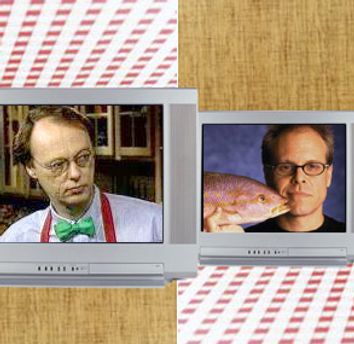
Christopher Kimball, a wry, bow tie-bedecked New Englander, hosts “America’s Test Kitchen,” which brings to TV some of the findings of his Cook’s Illustrated magazine. Like Consumer Reports, Cook’s Illustrated takes no advertising, and the heart of this show is a no-nonsense quest for the best techniques and recipes. Cooks conduct experiments to get to the tastiest version of a dish, and you’re treated to descriptions of those experiments and their results instead of the standard self-indulgent cooking-show patter. “ATK” also features taste tests of store-bought products, equipment and utensil tests, and (in some episodes) a science segment where ridiculous props explain, say, browning or the effects of capsaicin.

It’s worth it to read a Cook’s Illustrated, even if, like me, you seldom cook. The articles read as very accessible lab reports, with hypotheses, trials and errors, and conclusions (recipes). I find them much more useful than yet another three-recipe column that begins, “While staying in a small hotel in Tuscany …” and extols the virtues of fresh, seasonal ingredients but doesn’t teach any skills or methodology.

Each episode of “America’s Test Kitchen” demonstrates how to achieve a Platonic form for two or three dishes and, for contrast, offers examples of bad food (tasteless, watery soups and Jello-like custards) to avoid. But Americans as a whole don’t even know the difference, according to Kimball.

“There’s not a tradition here of people saying, ‘You know, I just bought that chicken and it wasn’t very good,’” Kimball says. “There’s no tradition of that because there’s no taste memory of saying, ‘I grew up with a certain food and I know what it’s supposed to taste like.’”

Leonard had his own “Test Kitchen” revelation last year, watching the hosts explain how to avoid something that he had never before realized was avoidable: soggy biscuits on fruit cobbler. (Don’t just plop the dough atop the fruit and bake it all at once! Bake the biscuits separately.) “ATK” shines at such moments of epiphany, offering the viewer a sense that a better culinary world is possible.

“The best e-mails or notes are when people say, ‘I could never cook, and I’ve always been a failure at cooking, and I started reading Cook’s or I watch your show, and now, I actually cook and I like to cook, and the stuff’s coming out,’” says Kimball. “It does give them something, confidence that they can actually do this, and they start doing more of it. That’s my goal, of course. I’m insidiously trying to get everybody to go back in the kitchen.”

On the other hand, “Good Eats” host Alton Brown is out to entertain more than to edify. In each episode of his show, using a variety of conceits (from morning talk show to detective story), Brown focuses on a type of food (from yellow cake to egg to barbecued pig) and explores ways to turn it into “good eats.” Jokes, from subtle to slapstick, complement his focused and hyperarticulate commentary.

“My first and foremost goal is to make a half-hour of entertaining television,” Brown explains. “That is the No. 1, all-time, best kind of compliment, which is that I’m making a family television show that’s not boring or pablum.”

But he’s still teaching. Using more science than his “Test Kitchen” counterparts, Brown moves smoothly between theory and practice in every scene. Both shows throw out conventional wisdom when a cheaper, better or faster option seems obvious. Brown goes further, improvising ingredients and even equipment more often. Why buy a grill when you can make one from hardware-store parts? And at every step, we learn the chemistry and physics of the process, and thus how to vary the instructions to produce a different result. The “Test Kitchen” is a dedicated committee, but Brown is a crabby and brilliant tinker.

Brown does create unconventional dishes using the principles he’s induced, inspiring his followers to do the same. (Leonard’s inventions include date-fudge baklava and ice cream with strawberries and balsalmic vinegar — both of which are much tastier than you might think.) But Brown, like the “Test Kitchen” cooks, focuses on improving familiar dishes. He says he’s a “hacker, not an inventor.”

“I don’t have a great creative mind. I am not the guy that’s going to say, ‘I am going to create monkfish liver tureen with kumquat compote truffled with …’ I just don’t think that way,” he says. “I’m not hungry for new things. I’m hungry for good versions of things I’ve already had! I’m about, ‘Man, let’s get a better hamburger. Let’s have a better slice of pizza. Let’s have better bread. Better coffee.’”

Brown and Kimball seek neither novelty nor authenticity but rather aim for good food via a non-onerous recipe. If “Iron Chef” is fantasy and the pretty-chef shows are food porn, “America’s Test Kitchen” and “Good Eats” are science nonfiction. Instead of an elite arena for high priests, the kitchen, as they see it, is another lab. And they make for excellent lab partners.

Continue Reading Close

I am Indian. I am American. I do customer support.

My cousins and I do the same kind of work. But their parents stayed in India, while mine moved to the United States.

  • more
    • All Share Services

I am Indian. I am American. I do customer support.

“Are you in India now?”

I silently held the phone for a moment, not knowing what to say. I am Salon’s customer support representative. The customer had put my name and my title together and asked the logical, if awkward, question.

“No, I’m in San Francisco,” I answered tentatively.

“Same difference,” he blustered.

My gig at Salon entails much e-mailing and a bit of phoning, helping people subscribe and renew and retrieve lost passwords, and copying and pasting paragraphs from the FAQ. In other words, I work from a cubicle in San Francisco, but I could easily telecommute from Omaha — or Bombay. A few subscribers have tentatively mentioned that I have a beautiful name, or that they loved “Bend It Like Beckham,” but this was the first caller to call me out on the absurdity of my position. An American-born Indian doing call-center work in California?

After that, I heard a story from my equally brown sister. Nandini related that, upon hearing her loud American voice in a Bangalore pub, a call-center representative had complimented her accent and offered her a job. Even better: The headhunter didn’t give up until my cousin spoke up, informing the interloper that he himself answered phones for Dell and could get Nandini a far better gig than one at some no-name Indian firm.

Given that the universe already believes that I belong in an Indian call center, I had to take the chance to visit the real thing when I visited my parents in south India this year. My parents’ cousin’s cousin arranged an evening visit to her call center in Bangalore.

As I entered the lobby at sunset, the polite crowd of young male jobseekers made finding a seat nearly impossible. Their gazes traveled to the rent-a-cop security desk, to the lobby’s generic ATM, and to the doorway between them.

The men in that lobby yearned for that ATM. Extravagantly, ahistorically decadent salaries flow from that ATM. For its employees, who make more than teachers, more than CPAs, the firm pumps out thousand-rupee notes — fast money, faster and more meritocratic than California gold-rush riches ever were.

The building’s cubicle walls were sea green and light blue, anonymous and modern. The clip art on the walls reminded people to keep customer information confidential — “What is said here stays here!” — while Dennis the Menace posters encouraged productivity and teamwork. A mostly patient fellow of about 24 led Oscar from New Jersey through a DSL diagnostic procedure. My subject idly refreshed his desktop over and over. Most workers wore well-made Western clothes and laughed together between calls.

I observed their work, similar to my own. But their friendships, in this after-dark cocoon of intimacy, reminded me of nothing so much as college dorm life.

Indian colleges often don’t provide the revolutionary independence of American campuses — dorms are single-sex, and many students live at home or with relatives. But college life in the U.S. is all about late nights with your peers. Aside from diplomas, the profound benefits of college in the United States are tacit lessons: how to make mature friendships, how to think rationally, how to affect a businesslike demeanor, how to break free from your family and your past. And that’s what these call-center workers are learning. In that room, they make fast friends, flirt, try out new clothes and identities, earn easy cash, and learn how to be cosmopolitan consumers.

Moreover, these workers are my cousins. They are basically me in the alternate universe where my parents stayed in India instead of moving to the United States. My Indian cousins go to three-week institutes to consciously learn my birthright. They and I are two sides of the same devalued coin. I am an Indian in America, trying to relearn my heritage: Kannada, subtle and nutritious vegetarian cuisine, the Mahabharata, and a meditative frame of mind. They are Indians finding America, servicing it, learning to coddle its temperaments, learning that we value results over process.

Does mystical Eastern stoicism make us good at this job? The empathy for the conqueror that all colonial people have to learn? For me it is a job, and for them it is liberation.

At this call center, I listened to Indians who “neutralize” the Indianness in their accents, and I discovered that Indian English minus Indian eccentricities equals British. The old English joke remains: For all the oppression Britain levied on India, “at least we gave them the railroads.” Fifty years after independence, the linguistic infrastructure that Britain left behind counts for something too.

I help First Worlders dispose of their income. And my cousins, riding out of the Indian rice paddies on a train that history accidentally left behind, are learning to replace me. I wince and I worry, but how can I begrudge them their good luck?

Continue Reading Close

“Star Trek’s” new moral frontier

UPN's "Enterprise," back for its third season, has saved the Trek franchise with messy, moving and ambiguous story lines torn from the 21st century.

  • more
    • All Share Services

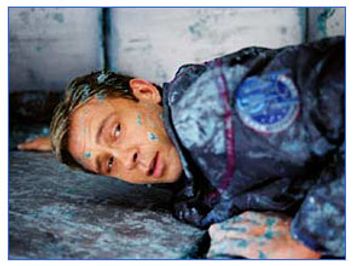
“Star Trek” fans will have a new reason to sigh in relief on Wednesday night as “Enterprise” returns for its third season, ready to prove all over again that it is not “Star Trek: Voyager.” The fourth Trek series, which ended in 2001, was a tired debacle in my eyes, and those of most “Star Trek” fans. Its creators seemed to think they could re-create the magic of “Next Generation” or the mood of “Deep Space Nine” by reusing their stories and adding gimmickry and Big Bangs.

“Enterprise” doesn’t have a gimmick. It has a premise, an interesting question to answer: How did humanity go from the bottom to the top of the galactic totem pole? What happened between the era of “Enterprise,” in the 22nd century, and the time of the original 1960s “Star Trek” series, featuring Kirk and Spock, some 115 years later? Why and how did humans rise to equal status with other spacefaring species?

“Enterprise” follows the best Trek tradition in making the era seem fresh and undetermined and arresting, even though we know how things will turn out. Or do we? The uncertainty of these eager and fragile characters matches the uncertainty of our times here on 21st-century Earth, and the writers play with time to enhance that uncertainty. “Enterprise’s” setting both in the “Star Trek” chronology and in our real time forces it to meditate on what might be, and on the dirty tricks people of all species will play to affect that future.

To recap: The Vulcans, a frowning and logical race (think Spock, only more tight-assed), made the first alien contact with Earth in 2063. Ever since, they’ve been holding Earth’s hand and keeping the training wheels on humanity’s ventures into deep space. Capt. Jonathan Archer (Scott Bakula) and his crew explore, are nearly destroyed by forces they don’t understand, meet new races, and generally try to prove the Vulcans wrong. As in other “Star Trek” series, the ideas are the meat of the thing, with a salad of special effects … and a dessert of cheesecake.

Yes, I would be remiss in not mentioning the babe factor in “Enterprise.” The creators seem to believe that the flesh of Jolene Blalock (who plays Vulcan science officer T’Pol) is as hot as the stars that the Enterprise passes, and should show up as often. In every other episode she bares various parts of her body in plot twists that would hardly please the logical Vulcan mind. In the T&A tradition of modern Trek, she is the skin equivalent of Jeri Ryan from “Voyager” and Marina Sirtis on “Next Generation.” The season premiere goes so far as to show her in a cleavage-revealing uniform. Linguist Hoshi Sato (Linda Park) has only removed her shirt once that I can recall, and that was by accident. Yes, they are the only females on the bridge of the Enterprise. To be fair, we see some of the males partially disrobed as well, but they don’t make it into the trailers.

The other structural flaw: the theme music. Against all Trek tradition, the theme music to “Enterprise” contains lyrics. Lyrics about the unbreakability of the singer’s soul, and about faith of the heart. I would prefer “I’ll Be There for You” from “Friends” to this. Welcome rumors are afloat that the third season will see a change in the opening score, and my screener copy of the season premiere strengthened those rumors by omitting audio over the lovely opening montage of naval and aeronautical history.

My other complaints are of the “This episode wasn’t as great as it could have been” variety. The first two seasons of “Enterprise” have seen fewer ghastly missteps than we saw in the first two seasons of “Next Generation” or “Deep Space Nine.” Sure, the captain and doctor withheld a cure from a disease-ravaged race and committed passive genocide for wholly spurious reasons, and T’Pol embarrassed herself and us while in pon farr, the Vulcan mating cycle. But these isolated low points can’t mar this show’s accomplishment: After hundreds of hours of Trek movies and TV episodes, “Enterprise” is making the franchise new again, creating fresh stories and possibilities.

The young crew of “Enterprise” is trying to make sense of when and how to intervene in other societies. There is no pat-and-easy Prime Directive of noninterference yet; these episodes will form the basis cases for later policies. Like a relatively young United States, the human race sticks its collective nose into forces and peoples it doesn’t understand, while the Vulcans are the cautioning mentors who have been around the block a few times, calling to mind Old Europe. Several episodes have developed this theme in different directions, and only some episodes feature direct references to the present day. But almost all of them tacitly reference 21st-century political problems.

The Cabal, a faction of the Suliban race, is attacking humans (among others) because its future-seeing master tells them to. Among other ramifications, we see peaceful Suliban citizens rounded up and placed in internment camps, oppressing and radicalizing them, yet perhaps protecting them from the bigoted populace. The Enterprise liberates one such camp, but it can’t liberate them all, and we end the episode musing over the escapees’ fate.

The Xindi, another mysterious alien race, has sent a weapon to Earth and massacred millions of humans, because they have heard (from the same future-seeing master, or someone like him) that humans will destroy the Xindi home world in 400 years. We are shocked, we are heartbroken, we want revenge. But we don’t even know where the Xindi live, much less how powerful they are.

This latter episode, the second season finale, strongly referred to the terrorist attacks of Sept. 11, 2001. “Enterprise” premiered just a few weeks after those attacks, and the story acknowledged, and responded to, that involuntary setting. The Trek framework is well adapted to telling this story of an allegorical war on terror; one episode can cover a day or many months, as developments hasten and slow.

Like “Deep Space Nine,” “Enterprise” entices us into caring about its characters, then forces you to watch them doing the dirty work of the state-security apparatus. In the season premiere, we see Archer bribing a sleazy mining official for an interview with his Xindi employee. Far from home and out of its depth, the crew is bound to experience some blowback, as it indeed does here. I want to see more of this. I want to see “Enterprise” compensate for drawing the analogy between 9/11 and this ahistorical, unpreventable alien massacre. “Enterprise” can redeem itself by emphasizing that our incidents and relationships with other races have ramifications, that there are other fish in the pond.

When chief engineer Tucker finds out that his sister has been killed in the Xindi attack, he refuses to hold a special service for her, arguing that the size of the slaughter takes precedence over one person’s memory. And then he begs the captain for the chance to take revenge on the mass murderers: “And tell me we won’t be tiptoeing around — none of that noninterference crap T’Pol’s always shoving down our throats.”

This is why the moral dilemmas of “Enterprise,” from now forward, will feel real and messy and moving: Earth has an interest. Capt. Picard of “Next Generation” sometimes struggled over playing God, sure, but usually human lives weren’t at stake. Are torture scenarios next, as in Fox’s contemporary terrorism drama “24″? How far will Archer go to avenge and protect human lives? “Enterprise’s” new, darker and denser story arc holds a promise even more alluring than Jolene Blalock’s bum.

Continue Reading Close