Susan Crabtree

Surging with Steve

Forget John McCain and Bill Bradley. On the heels of his strong showing in Iowa, Steve Forbes is the fast-rising insurgent.

Since Steve Forbes‘ second-place finish at the Iowa caucus, he has displayed a far more gregarious side — he’s flaunted an irrepressible smile as he tromped through New Hampshire — with his standing in polls for the state’s primary running between 10 and 16 percent and the ringing endorsement of the Manchester Union Leader newspaper.

After Iowa, Forbes quickly shot a television ad trumpeting his campaign’s new momentum. The spot, called “Surging,” shows an ebullient Forbes standing before a crowd of Iowa supporters after the better than expected results were announced. “This is not a good night for the powerbrokers in Washington, D.C.,” he tells viewers. “We broke the political rules.”

Forbes may be feeling a little smug these days, but he’s earned it. In one night, the longshot candidate for president managed to debunk nearly a year of inside-the-Beltway conventional wisdom that had all but declared his candidacy dead on arrival. Washington insiders thought there was no way someone so stiff and awkward on the stump could give the photogenic, good-ol’-boy-establishment-Republican candidate from Texas a run for his money. But in Iowa, Forbes did just that.

His show of strength — 30 percent to Bush’s 41 percent — clearly agitated the Texas governor’s supporters on Capitol Hill, who were quick to mobilize their defenses. The day after the caucus, Senate Majority Leader Trent Lott took aim at Forbes, saying that even far-right radio host Alan Keyes had a better resume for the presidency.

However brief Forbes’ Iowa surge may be, his second place finish gave his campaign a much-needed boost and forced many of his detractors to stand up and take notice. Regardless of his performance in New Hampshire, Forbes could slow the Bush juggernaut in the months to come, not as a chief rival for the nomination, but possibly as chief distraction. With his personal war chest, Forbes will be able to sling arrows long after any other candidates have given up and gone home.

For a while, it didn’t look like Forbes could build any momentum at all. Since announcing he would run last year last year, reporters have scrutinized Forbes’ looks, his wealth and his stilted personality as much as his policy positions. They’ve obsessed about Forbes’ face peels, straightened hair, nervous tics and even how often he blinks his eyes (once every 15 seconds, according to the Washington Post).

But for the considerable number of conservatives who seethe at the mere mention of Bill Clinton‘s affability and slick spin control, Forbes’ clumsiness, made-for-radio looks and laconic style are his biggest assets.

The closest Forbes comes to sharing his life story on the stump is when he evokes the name of his grandfather, B.C. Forbes. Life for the Forbes family, according to the tale, wasn’t always full of yacht parties, executive suites and trips to a family-owned island in Fiji. Before the Great Depression, his Scottish immigrant grandfather almost had to sell the fabled, but then-struggling business magazine he had built from the ground up to the predatory hands of William Randolph Hearst. But B.C. managed to corral his resources and save the family magazine for future generations.

It’s your classic bootstrap story, but it still provides some insight into the family’s self-made riches and Forbes’ capitalist philosophy on life. As a child, Malcolm “Steve” Forbes Jr. had to contend with a flamboyant father and his exaggerated lifestyle. High-flying Malcolm Sr. had a jet he dubbed the Capitalist Tool and was known for his lavish parties and frequent jet-setting trips to his French chateau and Moroccan castle. Malcolm waded into New Jersey politics with the same bravado, running unsuccessfully for governor of New Jersey twice.

If Steve Forbes disagreed with his father’s lifestyle, he’s never said so publicly. His brother once famously noted that “Steve didn’t experience adolescent rebellion.” But in many ways, the relatively modest way Forbes leads his life reads like a complete rejection of his father’s excesses. He still, for example, drives a Ford station wagon; he’s been known to frequent the fast food chain, Friendly’s, and the home he shares with his wife Sabina and teenage daughters is worth a paltry $3 million — about the same amount Forbes paid for the famous television spot last May that showed him looking presidential in regal surroundings modeled after the Oval Office.

Forbes attended Princeton University during the late 1960s and he served in the National Guard during the Vietnam War. While others joined Princeton’s Vietnam protest movement, Forbes found an alternative outlet for his political sensibilities: Business Today, a conservative magazine he created. He later went on to take over the reigns of Forbes magazine, the family’s crown jewel. Forbes magazine is said to have a market value of $1 billion, and Forbes himself is said to be valued at as much as $440 million.

During the ’90s, the candidate sought to parlay his family fortune and position as editor in chief of Forbes into a political launch pad — and he has had considerable success doing so. During his first White House run in 1996, he entered the race late and spent $37 million promoting his single-issue flat tax campaign, with as much as $400 a vote poured into Iowa alone.

“It didn’t matter what the question was, the answer was the flat tax,” says a former top administrator of the Christian Coalition. Understandably, Christian conservatives were leery of a candidate who had once called Pat Robertson a “toothy flake” and the Christian Coalition a myopic organization that “didn’t speak for most Christians.” In 1996, the then-economic conservative decried a total ban on abortion as “a waste of time.”

“I am white, a Protestant, an Ivy Leaguer, rich, business-oriented, without practical political experience,” he flatly acknowledged in 1996. “It couldn’t be worse, but at least I’d like to be free to fall down on my own arse without any help from conservatives.”

Four years later, in the 2000 election, Forbes is reaching out to social conservatives with a vengeance — at times, he even sounds downright Pentecostal. “The first order of compassion is protecting the unborn,” he regularly states, and in the last two years he has hired away several Christian Coalition field directors to work on his campaign.

Forbes started courting conservatives of all stripes early. In 1997, he created a nonprofit organization, Americans for Hope, Growth and Opportunity and a matching political action committee which became one of the most prolific issues advertisers in the country. The group produced and aired radio and television ads advocating for a flat tax, arguing to downsize the federal government, criticizing the Chemical Weapons Convention, offering support for a missile defense system, calling for the establishment of medical savings accounts, decrying medicinal marijuana legalization and calling for a ban on “partial-birth abortions.”

The ads have hit the airwaves in 20 states, including the crucial primary and caucus states of Iowa, New Hampshire, South Carolina and Arizona. AHGO has also sent out a flurry of e-mails and faxes to conservative activists and legislators around the country. After Clinton’s 1998 State of the Union, it funded a one-minute response ad starring Forbes.

Setting up a PAC as a prelude to a run for president is a time-honored tradition. Many candidates create PACs in order to jump start their presidential runs as early as possible. But Forbes’ move was controversial because he circumvented federal disclosure and fund-raising laws by registering AHGO with the New Jersey Secretary of State instead of the FEC. Estimates of the dollars the group has raked in since 1997 vary widely — with some reporting amounts between $4 and $10 million.

But Forbes hasn’t just whipped out his wallet every time he wanted to score points with conservatives. He has also toured the country and met with the top leaders of conservative organizations. “Consequently, what conservatives may have called pandering if someone else did it, they haven’t called pandering,” states David Keene, president of the American Conservative Union. “It’s [Forbes'] ability really in a retail sense to meet and convince them that he’s sincere that’s allowed him to make so many inroads.”

So far, Forbes has lined up the support of the more notable conservative leaders and solid majority of the rank and file too. Most recently his continuous pro-life message has earned him the endorsement of Phyllis Schlafly, the grand dame of the anti-abortion movement who also well known for her late-1970s efforts to kill the Equal Rights Amendment.

But until now, the conservative support shared by Alan Keyes and, to a lesser extent, Gary Bauer, has prevented Forbes from posing a more serious threat to Bush.

“I think if there was one conservative campaign this could be a real race,” says Morton Blackwell, a president of the conservative Leadership Institute and life-long GOP activist. “But because so many conservatives are split for a variety of reasons, it’s going to be tough.”

But with his deep reserves, Forbes is the only social conservative who can stay in the race as long as he’d like to. And for now, he shows no signs of giving up.

The long shot

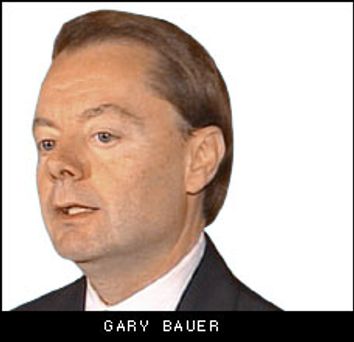
Gary Bauer talks about why he's running for president.

In late January Gary Bauer was riding high. The anti-abortion headmaster of the Republican Party had just won the first major GOP straw poll of Republican presidential candidates.

The poll was held at the Conservative Political Action Committee conference, the annual mecca for what there is of a vast right-wing conspiracy. (The buttons that said as much were a hot item at the conference, as were those suggesting “Lorena Bobbit for White House Intern.”)

It was apparent even then that the world would soon be seeing a kinder, gentler Gary Bauer. The former head of the socially conservative Family Research Council wanted to use the C-PAC venue to transform his activist credentials into Republican primary votes and knew he that to do so he would need to attract more than just angry white males.

Bauer shocked many Washington Republicans when he decided to support competitor Sen. John McCain’s campaign finance reform proposal. And in October he shocked everyone when he held a press conference to dispel a rumor that he was having an affair with a young campaign aide. This bizarre event attracted national media attention to what otherwise would have been nothing more than standard political insider gossip.

But no. Suddenly, Bauer was spewing lines straight out of Ms. magazine, saying he couldn’t “imagine that anybody on the campaign would object to me having meetings behind closed doors with professional women.” Now every chance he gets he repeats his favorite new phrase: he now has a glass door to connect his office to the outside world because “there are no glass ceilings in my campaign.”

Yet despite a fourth-place showing at the Iowa straw poll in August that suggested he was the emerging Christian conservative candidate to beat, Bauer now trails George W. Bush by 45 percentage points in most national polls and is still struggling to redefine himself as a mainstream candidate.

When asked if he’s the true Christian conservative candidate, he immediately takes exception. “I’m running as a conservative. It’s puzzling to me why observers want to mention my faith in describing me,” he says. “I believe everybody I’m running against in the Republican Party goes to church on Sunday and says they’re Christian.”

“There is no religious test [to run for] for office in America. The Constitution specifically prohibits it,” he continues. “I think voters will vote for me or against me depending on whether or not they agree with my China policy, my tax policy, what I think on abortion and so forth. How I worship is really none of their business.”

That’s quite a contrast to the speech he gave last April announcing his candidacy, in which he directly linked the bloodshed at Columbine High School to the crumbling of religious values in America.

“When you have a society where you’re no longer telling many of your kids that they’re created by God,” he said, “that their liberty comes from him, that virtue matters and death is never an option, whether it’s an unborn baby or settling a fight. I don’t think we can be surprised when we get the kind of horrible pictures and scenes that we increasingly see.”

Distancing yourself from your core group of supporters is quite a dangerous campaign strategy for primaries season. This early on, candidates usually work hard to keep their supporter base happy. Elizabeth Dole is exhibit A as to what happens if you don’t have a base of support beyond couch-loving Rosie O’Donnell fans. The money dries up and then you crash.

In fact, Bauer owes his staying power to a core group of evangelical activists who have donated time and money to his campaign. They’re just as passionate about their politics as they are about their sermons. To those core supporters, Bauer is a true hero for his anti-abortion work.

So why does he seem to be publicly backing away from them?

It’s obvious he’s trying to do everything he can to broaden his supporter base, which makes sense. But what he really needs to do is light a fire under die-hard Christian conservative voters, early on, in New Hampshire and Iowa, where, to everyone’s surprise, Pat Robertson finished second behind Bob Dole in the 1988 caucus. Bauer’s political franchise is built on Christian conservatism, and that’s where he’s most likely to succeed.

In many respects, Bauer seems like the logical successor to Robertson. Christian activism features prominently in a risumi that has included domestic policy positions in the Reagan administration and a 10-year gig working with religious radio broadcaster James Dobson.

Bauer capitalizes on the Reagan connection whenever he can, sprinkling speeches and fund-raising material with references to the Gipper and his view of America as the “shining city on the hill.” Like Reagan, Bauer supports decreasing taxes and increasing defense spending. He advocates a flat tax rate of 16 percent, with tax credits for families with children. He’s also already talking about trying to appeal to Reagan Democrats, playing up his blue-collar upbringing in Newport, Ky., and opposition to most favored nation status for China, even though Reagan never supported protectionist positions.

Bauer recalls sitting in his living room as a teenager watching the Gipper deliver his nominating speech for Barry Goldwater at the 1964 Republican National Convention. “I said to my father at the time that I thought Reagan would be president some day and I wanted to work with him in the White House,” he states proudly. “Twenty-one years later, I ended up being in the White House with a west wing office.”

It was an ambitious goal for any young person, let alone one who had grown up amid poverty and alcoholism in a shabby suburb, just across the river from Cincinnati. Newport was so deeply corrupted by Cleveland mobsters and riddled with bars, brothels and casinos that in 1957 Esquire magazine dubbed it “Sin City.”

Bauer’s father, Stanley, better known as “Spike,” worked various blue-collar jobs at the steel mill. The younger Bauer and his mother would often spend nights waiting for him to come home, knowing full well he was at the bar drinking his paycheck away. “I was usually at loggerheads with my father,” Bauer says matter-of-factly. “He wrestled with alcoholism his entire life, so things were always kind of dicey at home.”

Bauer’s grandmother had already lost one son to the mob, and she was intent on providing some structure and solace in her grandson’s chaotic childhood. She took him to the local Baptist church on Sundays, and eventually Bauer coaxed his parents to join him there. After his grandmother died, Bauer and his father were baptized together.

By age 17, Bauer’s already deepening moral convictions prompted him to join a group of ministers and local Republican businessmen who were organizing a crusade to push the mob out of town. He passed out leaflets and attended meetings. “It was a combination of being involved in the reform effort in town and also this exposure to Reagan that led me to be involved in politics,” he says.

The experience helped Bauer form his political views and would pay dividends down the road. When it came time to go to law school at Georgetown University and find a job in D.C., those Kentucky reform contacts came through in spades. The local Republican businessmen involved gave him a scholarship and even called the Republican National Committee and found him a part-time job in the research department. He went from the RNC to a position as a deputy director of the Direct Mail Marketing Association.

In 1980, Bauer left to take an unglamorous job as a policy analyst on the Reagan campaign. When Reagan won, he was rewarded with another low-level job in the office of domestic policy headed by Martin Anderson. For the first few months, Bauer didn’t have much of an assignment and found himself bored and frustrated. He complained at a policy development meeting that the administration was paying too little attention to values issues like school prayer and abortion. “Almost as a throw-away, Anderson said, “Fine, Bauer,” he recalls, “those issues are yours.”

Bauer soon leap-frogged his way up in the administration bureaucracy, taking top positions near the end of Reagan’s second term after other people left for private-sector work. He became deputy undersecretary of education, then undersecretary and later worked as head of the domestic policy office.

“[Bauer] became our go-to guy,” says conservative consultant Craig Shirley. “He always returned our phone calls and was more than happy to take our message and take it as far as he could inside the administration.”

While in the Reagan administration, Bauer doggedly pushed for issues like school prayer and a reversal of Roe vs. Wade — so much so that, he admits, that chief of staff Donald Regan and first lady Nancy Reagan often told him to back off. But Bauer took solace knowing he was taking orders directly from the president, who supported his work and told him to stay focused, regardless of his west wing detractors.

Dobson, head of the socially conservative Focus on the Family, began inviting Bauer onto his popular radio talk show. In 1987, he joined Dobson’s Colorado-based public policy group and spun off a Washington branch called the Family Research Council. Bauer built the Family Research Council into a $14 million dollar grassroots organization. Bauer’s political action committee, the Campaign for Working Families is the sixth largest PAC in the country, pulling in $6 million in the 1997-98 election cycle alone.

By any standards, these are solid conservative credentials. Too bad, then, that 20 years after the Rev. Jerry Falwell’s Moral Majority organized and rallied religious conservatives to become a powerful force in American politics, the movement is now losing steam, its leaders becoming increasingly disillusioned.

After Clinton’s impeachment acquittal, Paul Weyrich, president of the conservative Free Congress Foundation wrote that attempts to restore morality “through the political process have failed.” He suggested that conservatives channel their energy towards “parallel institutions” such as home schools and religious radio.

Now, as the 2000 campaign shifts into full gear, religious conservatives can’t even decide which candidate to support.

Bauer would be a credible coalition candidate, but he’s inherited some bad blood. Robertson and Dobson never got along too well, and that could ultimately hurt Bauer. Even last year, when Bauer was mulling a decision whether to run, Robertson not so casually told him to go take a cold shower. Then, nearly a month ago, Robertson told reporters the Bauer campaign was a “lost cause” and all but officially threw his support to Bush, who has done precious little to court religious conservatives.

Another recent event further underscored how difficult it’s been for Bauer to drum up support. The competition was out in force at a private February Christian Coalition meeting of various politically conservative family values groups. The Eagle Forum’s Phyllis Schlafly was there, as was the Free Congress Foundation’s Weyrich and various other moral conviction operatives. They met with most of the GOP presidential candidates and afterward went around the room disclosing who they were going to support.

Only one, Donald Wildmon from the American Family Association, backed Bauer. Weyrich decided to support Steve Forbes and Schlafly is waiting to see who emerges from the pack of candidates this year. In years past, she was burned when she supported Phil Gramm and Pat Buchanan too early on and then stood by helplessly as they dropped out of the race.

“Conservatives are individualists,” says Schlafly. “[Bauer's] certainly become a very fine spokesman for conservatives. Everybody likes Gary — but not being elected to office before is a difficulty for him as it is for Forbes and Buchanan.”

The candidate of choice for conservative leaders boils down to power and who has the best chance of occupying the White House. Even those who share Bauer’s beliefs and uncompromising stands just don’t believe he has what it takes to win.

“People in the movement say, ‘Gary Bauer? You’ve got to be kidding!’” a Bauer campaign aide relays. “‘I remember when he was running the Xerox machine.’”

A lot of the derision may have to do with Bauer’s diminutive size and baby-faced appearance. Tough-talking conservative men have a hard time looking up to a 5-foot-4 man. Even those who compliment Bauer occasionally throw in the short man joke. It’s a harsh reality Bauer has been dealing with his entire life, but he has usually managed to compensate in other areas.

Bauer can out-debate and out-speak even the most seasoned pol. “I’ve seen people who are really in awe of Gary,” says Tom Edmonds, Bauer’s media consultant. “It’s amazing how he can field questions. He can give a speech as good as anybody I’ve ever met.”

Still even the best orator would have a hard time competing with the bundles of money both Bush and Forbes are throwing around. Early on, Steve Forbes picked off several key Christian Coalition worker bees and has been well-received among several Christian conservative organizations. Bush, himself a vocal Christian, has broad appeal among those who truly believe faith and forgiveness can erase a checkered past.

Even James Dobson, a longtime friend, refuses to throw an endorsement Bauer’s way — mainly because he’s holding out to support Bush if he should become the nominee. One religious conservative reports that Bauer’s been hectoring Dobson for an endorsement so much that it’s beginning to strain their friendship. The marital fidelity flap didn’t help things — Dobson was reportedly fuming about the way Bauer handled it.

Focus on the Family spokesman Paul Hetrick says Dobson hasn’t endorsed anyone for president this year or ever before, although he did give $1,000 to Bauer’s campaign, the maximum allowable contribution by an individual. “He is thinking about endorsing someone next year,” says Hetrick, “After a few debates and a further shaking out of the candidates.”

Bauer’s confident he’ll be one of the last few candidates standing and would welcome Dobson’s seal of approval. Bauer spokesman Tim Goeglein says he doesn’t know if his boss has been lobbying Dobson for an endorsement and he couldn’t say what has taken place in “private conversations.”

Since he first decided to run, Bauer’s been walking a thin line. He can’t afford to abandon his Christians brethren, but he doesn’t want to be constrained by them either.

But Bauer still has a long way to go to reconciliate his Christian conservatism with his desire to run as a mainstream candidate.

That conflict is evident in a campaign fund-raising video that stresses his economic and foreign policy positions, but also emphasizes what he calls the “values deficit ” — the decline of moral values in America and his belief that Roe vs. Wade made it possible for “unborn children to be treated like they were Styrofoam cups.” Bauer also defends his opposition to the gay rights movement. “I am against the political agenda of the homosexual rights movement,” he says in the video. “And so are the majority of the American people.”

Bauer’s own campaign staff is a direct reflection of his straddling efforts and how they can backfire. He has a number of non-religious Washington hired hands working for him: Edmonds, political director Jeff Bell, campaign manager Frank Cannon. Others he handpicked either from FRC, the Campaign for Working Families or various Christian groups he’s worked with over the years.

The tensions between the religious and non-religious camps have simmered under the surface since the campaign began, but erupted into the open when he refused to stop meeting behind closed doors with his young, attractive deputy campaign manager — what many in the religious faction considered a violation of Christian policy. Deeply spiritual men like Charles Jarvis, his national campaign chair, and Tim McDonald, his main advance man, as well as his long-time personal secretary, decided to walk away over the controversy.

Bauer may have viewed the situation as an opportunity to prove he’s in touch with mainstream Republicans, but if so, it has also proved to be costly with his Christian base. Some Christian activists freely admit they’re disillusioned with him and believe his campaign hit its high mark back in Iowa. “My view is that this has become a big ego trip, and I like Gary,” says one activist. “I think he peaked early and fourth place is the best he’s going to do.”

Those who have followed him on the campaign trail or watched him work a room say they would never underestimate the fire in his belly. He’s a force, they say, who won’t go away easily.

“I’m sure that Gary, in his own mind, thinks that lightning is going to strike and he’s going to be the nominee,” says longtime GOP strategist Lyn Nofziger.

Continue Reading Close

Bauer is reborn — as a feminist!

The Christian rightist's presidential candidacy was going nowhere fast until he discovered that everyone likes a little sex thrown into the mix -- everyone, that is, except his uptight top aides.

It was strange enough that presidential aspirant Gary Bauer held a press conference Wednesday to denounce the little-reported rumors that he was having an affair with an attractive young aide — thus granting the rumors national play they never would have achieved on their own.

Now, in an even weirder twist, Bauer is emerging from the controversy as an out-and-out women’s libber.

Gary Bauer, über-feminist? Until Wednesday, that would have seemed an oxymoron, but the worldview the deeply conservative Christian activist articulated when he appeared at his press conference was straight out of the Mia Hammish millennial zeitgeist:

Women can be anything they want to be.

When Bauer said that he couldn’t “imagine that anybody on the campaign would object to me having meetings behind closed doors with professional women,” he emerged as nothing less than a sensitive New Age man.

Despite the fact that his homemaker wife of 27 years was by his side, standing by her man, Bauer came off as every bit the modern male, indignantly insisting that he is completely at ease with women in the workforce, where they have every right to be.

“Such meetings take place all over Washington, D.C., every day with congressmen, senators, other presidential candidates,” Bauer said. “Both of my daughters intend to be professional women” — perhaps not unlike the attractive female 26-year-old aide whose company he has been keeping.

After all, as Bauer pointed out, “this isn’t 1899.”

In response to a question about whether aides told him that the fact that he was seen too often with the aide was causing an “appearance” problem, Bauer made like Alan Alda.

“How are you ‘seen’ with somebody on your campaign ‘too frequently’?!” he sneered. “I am seen with 25 people on my campaign every day. It’s a relatively small campaign headquarters. My daughter sits a couple doors down from me. Every day I’m with all the people on that campaign. We’re walking through the halls, we have meetings.”

There were several questions about the nature of these meetings. Were they closed-door sessions? Bauer’s response: “I think that there are standards in American politics that I have followed in 25 years in Washington, D.C. … At the previous organization I worked at, there were professional women that I met with, that I asked for advice, that were part of my senior staff. I have done nothing different than I’ve done in 25 years …”

Sounds awfully progressive for a man who has spent his public life trying to overturn Roe vs. Wade — especially when you consider the views of his one-time colleagues.

Charles Jarvis, Bauer’s former national campaign chairman, and Tim McDonald, his former chief of advance operations — both of whom jumped ship recently and joined Steve Forbes’ campaign — went public after Bauer’s press conference with the real reasons behind their recent exodus.

They said they just couldn’t stomach all the time Bauer was spending with this woman. It violated their Christian sensibility — as well as several other evangelical leaders’ personal policies toward woman staffers.

Never mind that so far no one has come forward with any evidence that an affair took place. (That is why Salon.com is not reporting the woman’s name.)

One female conservative Christian activist says that Jarvis has a reputation for being “one of these guys who has a real problem with women in the workforce.”

Unlike Bauer.

But Jarvis’ extreme reaction isn’t just a 1950s throwback to the mentality that a woman’s place is in the kitchen. It reflects the idea held by many that these guys can’t trust themselves to control their own sexual desires. For 40 years, the Rev. Billy Graham has abstained from meeting with women alone, for example.

Apparently, Graham has lots of company in Washington. The Washington Post reported Thursday that Rep. Steve Largent, R-Okla., won’t meet alone with a woman, and that Senate candidate John Ensign won’t even ride alone in a car with one. Largent’s spokesman Brad Keena clarified that policy to say that it’s not a hard-and-fast rule, but that the congressman uses “common sense.”

All of this temperance may seem benign on the surface. “Don’t let there be an appearance of evil — that’s our guiding principle,” says Wendy Wright, spokesperson for the conservative women’s group Concerned Women of America. “We have to acknowledge that temptation is real and available to all people, even the strongest among us. There are what I would call prudent measures that can be taken.”

For example, Wright says a pastor friend of hers had a window built into the door of his office to avoid both an appearance and a temptation problem.

Still, for plenty of female Christian conservatives, it’s a bit disheartening to know that women are still viewed as bewitching apple-bearing Eves and men as easy-prey Adams who crumble at the slightest provocation.

Even more dangerous are the other obvious yet unspoken personnel implications. Will politicians not hire a woman — not to mention an attractive woman — just to avoid the mess it may cause down the road?

This would amount to a particularly insidious kind of discrimination, one that often goes undetected. Lately, nerves are so raw about workplace relations, who knows how many qualified women have been turned down for jobs just because men are afraid they can’t trust themselves around them?

If this keeps up, attractive young women may eventually need quotas!

It’s easy to blame Neanderthal men for the belief system that created this climate of paranoia, but as the Lewinsky scandal proved, feminists have played a role as well. Danielle Crittenden, author of “What Our Mothers Didn’t Tell Us: Why Happiness Eludes the Modern Woman,” and an advisory board member of the conservative Washington-based Independent Women’s Forum, blames feminists for the current climate of hysteria.

“This [type of discrimination] is not just happening among Christian conservatives. This is taking place all over corporate America,” she says. “Corporate men don’t meet behind closed doors with women, they don’t go on business trips alone with them. And we can thank feminists, the sexual harassment law, and the climate of fear it created for that.”

In the post-Anita Hill world, it seems, there’s plenty of blame to go around. Bauer is only the latest man to stand behind the microphones and defend his family and his reputation. And the foundation of his indignation is built from the complete and utter acceptance of attractive young women in the workplace, working side by side with men, as equals.

Bauer, in fact, complained that his two daughters were having to divert from their own paths toward professional womanhood by attending his press conference Wednesday. Bauer said that he “would prefer my [younger] daughter to be back at college” and “my oldest daughter to be with me at a meeting right now at campaign headquarters.”

Clearly, Bauer “gets” it. Sisters are doing it for themselves. Even the Bauer sisters.

Continue Reading Close

Cry for me, Puerto Rico

The next big issue after the clemency controversy is the growing pressure to throw the U.S. Navy off its test bombing range.

Hispanic Heritage Month hasn’t been kind to Hillary Rodham Clinton this year. September is normally the month when Democrats celebrate their ties to the Latino community — the Gores, for example, danced salsa at an event this time last year — but no one around the first lady is in a partying mood these days.

Ever since Clinton infuriated leaders of New York’s Puerto Rican community
with her surprise statement opposing her husband’s clemency offer for
radical pro-independence prisoners, her Latino allies have mutinied against her. As a result, she’s spent much of the last two weeks in damage-control mode.

She’s tried everything — shmoozing at the Congressional Hispanic Caucus gala; standing shoulder to shoulder with Bronx Borough President Fernando Ferrer, one of the city’s top Puerto Rican officials, to denounce the GOP’s tax bill; and working into her speeches her long-ago efforts to help register Hispanic voters in the Rio Grande Valley.

Even as she’s tried to repair the damage from the clemency debacle, Clinton has faced another Puerto Rican political issue that is set to explode on the national stage this week: the status of the U.S. Navy’s bombing range on a tiny island called Vieques.

At a New York press conference last week, the crowd burst into laughter
when Hillary tried to avoid answering a question concerning Vieques.
“One thing I want to do is consult with a number of people,” she said
with a nervous titter, referring to the lack of time she spent talking
to Latino leaders before coming out against the clemency offer. “I am
heavy into consultations right now.”

She better be. On Wednesday, the House and Senate Armed Forces
Committees will hold the first of a number of hearings that will no doubt
keep the questions coming. Already, a number of U.S. politicians of various stripes are on the record as wanting to force the Navy from the island.

“What is unfortunate, I find, is that while we are focused on whether
or not [the prisoners] should be released, the real issue here is
Vieques,” the Rev. Jesse Jackson recently said in a television appearance. “Should the U.S. own Vieques? If Indonesia should not own East Timor and if the U.S. should not own the Panama Canal, we should not own Vieques … The real issue today is our Navy should leave Vieques as an occupying force. We should not be a colonial power in Puerto Rico in 1999.”

In August, Jackson visited the island and held a press conference about the issue with Puerto Rican Gov. Pedro Rosello. Jackson pledged to rally Hispanic voters across the country and make Vieques a major campaign 2000 issue.

Why now?

The pearl-white sands and turquoise waters of Vieques, a tiny inhabited strip
just off the coast of Puerto Rico, may seem a bizarre place for campaign
2000 electioneering. From a distance the island looks like just another
bucolic Caribbean getaway.

But for five decades, the U.S. military has occupied more than two-thirds of
the 22-mile island, bombing and shelling the western tip around 190 days a
year. It’s the only place where the Navy, Army, Air Force and Marines all
conduct live-fire training exercises within close range of a significant
civilian population.

In April, the Navy stopped all bombing after a pilot mistakenly dropped two 500-pound bombs on an observation tower, killing civilian security guard David Sanes. It is the only reported civilian death linked to the exercises in the history of the Navy’s presence here, but it was enough for the vast majority of Puerto Ricans — those for statehood and those for independence alike — to unite in their efforts to push the Navy out.

Demands that the Navy leave have resonated all the way to Washington. The White House has appointed a Pentagon panel to evaluate the controversy and a decision is expected any day now. If the panel finds for the Navy, the Puerto Rican attorney general has threatened to sue the federal government.

As Democrats court the influential Hispanic vote this election cycle,
Vieques is poised to become a cause célèbre.

“I can assure you that once we leave this place and take our case to
the people of New York in great numbers, and Illinois and Texas and
California and Florida, this issue will be a critical matter on the
agenda for 2000,” Jackson said during the press conference he held with
Gov. Rosello.

Although Republicans in Washington generally support the Navy remaining
on the island, the issue has attracted a whole host of strange
bedfellows. Democratic Sen. Chuck Shumer and Republican Sen. Frank
Murkowski, as well as Democratic Reps. Luis Gutierrez, Robert Menendez
and Nydia Velasquez and GOP Reps. Don Young and Dan Burton, have all
called for the Navy to leave.

Last week Murkowski, R-Alaska, introduced a bill that would give the Puerto Rican government control of the Navy-owned land used for bombing exercises on the island. “It’s time to return this tiny island to its people,” Murkowski said in a speech on the Senate floor.

But fellow Republican James Inhofe, chairman of the Senate Armed
Forces Committee’s panel on military readiness, threatened to shut down
a major Navy base in Puerto Rico unless political leaders back off and
allow resumption of target practice on Vieques. The base, Roosevelt
Roads, pumps $300 million a year into the local economy, and the loss
would be a painful one for Puerto Rico.

The chairman of the Republican National Committee links Clinton’s
clemency offer to threats of violence over the Vieques issue, noting
that a self-proclaimed leader of the Puerto Rican group Boricua Popular
Army came out of hiding recently to threaten that if the U.S. Navy
resumes exercises in Vieques, it will “face the consequences.”

“Bill Clinton’s misguided act of ethnic pandering on behalf of his
wife’s New York political ambitions is having precisely the effect that
every law enforcement agency said it would,” charged RNC Chairman Jim
Nicholson. “It’s reawakening a tiny, but violent terrorist movement.”

In standard form, presidential contenders have yet to trudge into the
debate in any real way. In late August the Associated Press reported
that Vice President Al Gore pledged to support the efforts to force the Navy to leave
in a telephone call with Gov. Rosello. But when
asked about it, Gore’s spokesman said the vice president does not
discuss personal telephone conversations.

Some members of the George W. Bush camp have also met with Puerto Rican officials about the matter, but he hasn’t ventured an opinion yet.

Although Hillary Clinton has desperately tried to avoid coming down one
way or the other on the matter, her would-be opponent, New York Mayor Rudy Giuliani waded cautiously into the turbulent waters last week. He urged New York Democrats to stop pressuring President Clinton for a quick decision on whether the Navy should leave Vieques after nearly six decades there.

“I think the president of the United States should come to a decision
on it after he gets his report back,” Giuliani urged, referring to
recommendations expected from the Pentagon task force. The
panels is expected to recommend keeping Vieques open for only five more
years.

As the mayor urged patience, a New York City Council committee began pushing for a resolution demanding that the Navy leave. Fifteen New York politicians of
Puerto Rican descent, including U.S. Reps. Jose Serrano and Velasquez,
were busy drumming up support for the House and Senate hearings.

“We believe your present hearings on the president’s clemency toward
the Puerto Rican political prisoners focuses on the symptom rather than
the fundamental problem that this Senate has failed to address: the
ultimate status of Puerto Rico,” the legislators wrote to Senate
Majority Leader Trent Lott.

The Vieques issue, they argue, is directly linked to the unresolved
nature of Puerto Rico’s status after nearly 100 years as a U.S.
territory. For the past 47 years it’s been a commonwealth. Puerto Ricans
are U.S. citizens and subject to military service, but they pay no
federal taxes, cannot vote in presidential elections and are represented
in Congress by a delegate with no floor-voting powers.

If they composed a state with real congressional representation, they’d have more power to protect their citizens and force the Navy to behave more responsibly or leave.

For years, Puerto Ricans’ anger over the Navy’s occupation of Vieques
and their status as a commonwealth in general has simmered under the
surface. But since Sanes’ accidental death, Puerto Ricans of every political stripe
have united to demand that the Navy either leave or stop their target
practice altogether.

Since days after the death, hundreds of protesters have illegally camped out on the western tip of the island designated for dropping live fire, precluding the Navy from resuming bombing. Elaborate murals and spray-painted signs proclaiming “Fuera Marina Vieques” — Navy out of Vieques — now dot the island.

One protester, Puerto Rican Sen. Ruben Berrios, leader of the Puerto
Rican Independence Party, has camped out on the ordnance-strewn beaches
of the live-fire zone for more that to 100 days now. He vows to remain
until the Navy decides to withdraw.

“Mr. Clinton can go into the next millennium as a protector of the
ecology or he can be one of the dictators of his age,” says Berrios, who
like Clinton graduated from Georgetown University and Yale Law School.
“The president cannot extricate himself from this situation — the
pressure is too great in all of Puerto Rico.”

Since the early ’40s, Vieques has served as a training center for U.S. forces based in the North Atlantic. Troops trained here have been
deployed in every conflict since World War II, including Vietnam, the
Persian Gulf War and Kosovo.

Navy spokesman Roberto Nelson worries that unless the Navy can resume
practice, the troops scheduled to train here will not be prepared to
face combat.

“It’s not a game,” warns Nelson, who works at the Roosevelt Roads Naval
Station on Puerto Rico. “In the military the penalty you pay for
improper training is people die.”

But there is another reason that the Navy doesn’t want to close
down operations on Vieques: the money it generates from other countries
who also use it for training their militaries. Up until early August, the Navy advertised the “Atlantic Weapons Training Facility”
on a Navy Web site, promoting the “one-stop shopping” and “scheduled as
requested” advantages of the area and that the “ideal moderate tropical
climate permits year round ops with practically no cancellations.”

When the Puerto Rican government discovered the Web site and raised questions
about it, the Navy shut it down.

Anti-Navy sentiment continues to reverberate throughout Puerto Rico.
Walk down any street in Vieques and you will overhear impassioned
discussions about the latest developments in the ongoing controversy.
Citizens are constantly wondering what the Navy’s next move will be, and
allegations fly about a rumored epidemic of cancer many islanders
believe the constant bombing has caused.

Talk of cancer is nothing new. A study conducted by the government of
Puerto Rico in 1997 found 482 cases of cancer between 1960 and 1989, a
rate that is 27 percent higher than any other municipality in Puerto Rico.

To make matters worse, the Navy has recently admitted to using napalm and uranium-tipped bombs on the island after years of denying it. Investigators from a federal cancer-monitoring agency, the Agency for Toxic Substances and Disease Registry, are now investigating. The inquiry could take six months and
delay any kind of White House action or involvement, which means the
issue could still be playing itself out in the middle of campaign 2000.

In the long run, Vieques may well make the clemency controversy seem like a footnote, but it doesn’t necessarily have to become another political pitfall in the first lady’s quest for the Senate. If Hillary plays her cards right, Vieques and all the thorny issues that go along with it could provide a wonderful opportunity to win back the good graces of her Hispanic brethren in New York.

Of course, that depends on her husband’s next move and the political fallout it causes. Will he or won’t he side with Puerto Rico this time? And what will be her response? Only their pollsters know for sure. Either way, you can bet
Hillary will do a little more consulting this time around.

Continue Reading Close

Who harassed whom?

The former chief of staff to Sen. Max Baucus claims he sexually harassed her, then fired her, but the senator tells an entirely different story -- that she was relentlessly abusing his staff.

Just when you thought that the year of “that woman” could finally be relegated to the history books, the corridors of the Capitol are once again buzzing with the torrid details of yet another embarrassing sex scandal.

OK, so maybe they’re not quite so torrid this time. There’s no thong underwear or wet kiss elevator assaults; no pubic hair on Coke cans or stained navy blue dresses. Heck, there aren’t even any allegations of inappropriate touching!

So even that dirtiest of dirty old men, Ken Starr, would be hard-pressed to come up with a steamy narrative for this one; nevertheless, the story isn’t without its intriguing details. What it may lack in sex, the latest story makes up for with mystery. The Capitol Police have a cameo role, there are some allegedly revealing e-mails, as well as a rendezvous at the Four Seasons hotel and some weird stalking allegations.

And it wouldn’t be a Washington sex scandal without an elaborate smear campaign to discredit the accuser, bizarre legal contortions on all sides and an ample helping of partisan politics. This one delivers on all those counts, too.

Last week, the Capitol Hill newspaper Roll Call broke the news that mild-mannered Montana Sen. Max Baucus, a Democrat, had fired his chief of staff, Christine Niedermeier, for what he described as management differences and she described as direct retaliation for refusing months of sexual advances.

At its core, it seemed like a classic “he said, she said” kind of tale.

Baucus, 57, married to his second wife, says he fired Niedermeier because her tyrannical behavior toward staff was causing an office-wide revolt. Niedermeier, 47 and single, says she was terminated because she rejected his advances and because he feared she was going to file a sexual harassment suit.

Baucus flatly denies the charges. “Let me state unequivocally that I have never, under any circumstances, sexually harassed Christine Niedermeier,” Baucus said in a written statement. (He later repeated his denial to the Associated Press.)

In his statement, the senator added that 36 of his staff members had signed a grievance petition against Niedermeier. He said his aides started circulating the petition because they found her abusive management style intolerable. He further claimed that a number of his long-term aides went so far as to tender their resignations due to her abusive ways.

One of those former staffers, Jim Messina, now a chief of staff in another congressional office, supported Baucus’ version. Messina told Salon News that he left the Baucus operation in May because of Niedermeier’s abuse.

“Working for Neidermeier was a nightmare,” Messina said. It was just constant abuse, constant yelling … she wouldn’t let you [do your job] … It was tough because we all love Max so much because he’s such a good guy.”

Niedermeier came forward with her version three weeks after her firing when Roll Call called to ask her what had happened. She says the 36-signature petition was thrown together as a cover story only after she had confronted Buacus about his behavior. Furthermore, she says she has been prevented from reclaiming the evidence that could prove her case.

Niedermeier claims the abuse started a month after she took the chief of staff position with Baucus in May 1998. She put up with it, she says, because she liked her job and was afraid she’d be fired if she told him to knock it off.

Nevertheless, on May 3, 1999, she accompanied Baucus to an official White House dinner for Japanese Prime Minister Keizo Obuchi. By late July, however, Niedermeier says, she had tired of Buacus’ ongoing harassment.

Niedermeier is quick to acknowledge, though, that none of Baucus’ alleged come-ons were Clintonesque in nature. He never, for instance, dropped trou and “asked her to kiss it.” His style, she attests, was much more subtle, but annoying nonetheless.

According to Niedermeier, Baucus asked her questions about her personal life and her relationships with boyfriends, commented on what she was wearing, compared her to his wife and, at times, implored her to go away with him for the weekend. One time he suggested they go to Disney World together.

Former staffer Messina ridicules this characterization of Baucus’ behavior. “I don’t believe one of the allegations,” Messina told Salon. “At no time in my four years with Sen. Baucus did I ever see or hear anything. In an operation as tight knit as that, rumors spread about everything.

“Neither myself nor any of the women who worked for the organization, nor my girlfriend, who worked for him for three years, ever saw, witnessed or heard anyone talk about that,” Messina continued. “Max is like, in many ways, geeky — in a good way. He just is kind of oblivious to all that. He wouldn’t know how to do it.

“He complimented everyone,” Messina continues. “He complimented me on my tie, that doesn’t mean he wanted to sleep with me … He’d ask how my relationship was … just normal things. Things that if you or I were friends, you’d ask me about. That doesn’t mean that he’d want to sleep with me.

“He’s kind of the exemplary boss in that way — one of those guys who really is truly human.”

None of Niedermeier’s allegations are exactly titillating stuff, let alone persuasive evidence of sexual harassment. It is only when you consider her version of the events leading up to her dismissal that the story gets more complicated.

On July 31, Niedermeier says, she met Baucus in the lobby of the Four Seasons Hotel in Georgetown, where they talked for two hours about the growing tensions in the office.

Then, Niedermeier says, she decided to bring up as a major source of personal strain between the two of them the issue of sexual harassment. Niedermeier’s attorney, Elaine Charlson Bredehoft, says that at first Baucus denied it, then he apologized.

That’s where the e-mails come into the picture. Last week, Niedermeier provided several media outlets with a series of e-mails from Baucus that were written after the meeting at the Four Seasons - letters of goodwill that lauded her abilities and expressed the senator’s deep confidence in her. (On Aug. 1, from Baucus to Niedermeier: “I feel good about Saturday session. Quite good … you’re my person; I’m going with you.” Aug. 2 from Baucus to Niedermeier. “I do have full confidence in you. Full.”

A week later, however, things apparently turned ugly. Neidermeier says she accompanied Baucus and one of his friends in a private plane on a short flight between two small towns in Montana for a golf tournament. According to Bredehoft, Baucus starting screaming at Niedermeier right when they got on the plane, demanding to know if she was planning on suing him for sexual harassment.

Niedermeier says she assured him she wasn’t, but that he remained belligerent throughout the flight. She also says that the friend then got in on the act, warning her that things would get messy if she didn’t work everything out amicably. Attorney Bredehoft says that the friend continued to “virtually stalk [Niedermeier]” after the plane ride and throughout the weekend, following her to different receptions, yelling at her in front of other people and calling her room repeatedly.

Niedermeier was still in Montana the following week, when on Aug. 15 an aide called to say it was time to discuss her “exit strategy.” She quickly flew back to Washington; during a layover she talked on the phone with Baucus, who told her then and there that she was fired.

When Niedermeier got back to Washington that night, she went to the office to try to retrieve the personal e-mails she believed would back up her claims of harassment, but she was detained by two Capitol police officers who threatened her with arrest unless she agreed to leave the premises.

“I never would have imagined myself in a situation like this in my life,” Niedermeier told Roll Call. “I never wanted to come forward, but I worked tirelessly for Max Baucus … I loved my job. I often told [Baucus] I worked longer hours for him than when I ran for Congress, because I was at a stage in my life that I loved being on the Hill again. And if someone would do this to me and be so mean when I have worked so hard and effective for him is just very hard.”

So what changed between the Four Seasons meeting, the e-mails and the plane trip? “What we suppose happened, he must have talked to somebody — maybe his counsel, maybe his cronies, maybe some staff members,” attorney Bredehoft says. “He became afraid that she was going to file some sexual harassment claims. That’s clearly what was on his mind.”

Baucus flatly rejects Niedermeier’s version of events. His spokesman, Mike Siegel, says that in fact Baucus changed his mind about keeping his chief of staff after seeing her yell at an aide on Aug. 5. (Bredehoft counters that this incident has been “fabricated” by Baucus.)

And why then won’t Baucus release the personal e-mails that Niedermeier claims will help bolster her case?

Spokesman Siegel says he can’t comment on the e-mails or even acknowledge their existence because of the “implied litigation.” He also won’t confirm or deny the meeting at the Four Seasons or the plane ride. Baucus says he wants Niedermeier to present her case in court under oath, not in the press.

Now Niedermeier must decide what to do next: file an ethics committee complaint, file a lawsuit or let the whole thing drop. On Thursday, Niedermeier suddenly canceled a press conference at which she was supposed to announce whether she would file suit. No explanation was given.

Meanwhile, as the accusations and counterclaims took on an increasingly nasty, desperate tone this past week, the rest of Capitol Hill got involved in its inimitable way.

Aides and fellow Democrats jumped in to defend the beleaguered senator. Sharon Peterson, Baucus’ state director, issued a written statement: “How Chris Niedermeier could make these reckless allegations is completely beyond me. I am personally outraged by these charges. I’ve known Max Baucus and his family for more than 20 years and I have found him to be a man of highest integrity … It was the staff that came to Max, because Ms. Niedermeier was consistently demeaning and abusive to us.”

Of course, dismissing Neidermeier’s charges isn’t as easy as trashing Paula Jones or Monica Lewinsky. Niedermeier is a well-educated, middle-aged professional, who has worked in Democratic Party politics for years and even ran for Congress twice from Connecticut in the 1980s.

This is where the alleged abusiveness toward staff becomes relevant. Effective chiefs of staff on the Hill are usually widely feared precisely because they play bad cop to the senator’s good cop. In essence, that’s their job.

It appears that Niedermeier was, in fact, brought in originally to ruffle the staff’s feathers a bit. Baucus is facing a tough election bid, and despite his 20 years in the Senate and his position as ranking minority member on the Senate Finance Committee (behind retiring Sen. Pat Moynihan), Baucus really hasn’t made much of a name for himself here.

Messina confirmed that Baucus hired Niedermeier because “he wanted someone who was tough and who could go in and make some changes.”

On the Hill, the common view among Democrats seems to be that Baucus is shy and retiring and just incapable of this type of behavior. By contrast, the senator’s friends aren’t shy about attacking Niedermeier’s credibility.

Sen. Kent Conrad, D-N.D., stated: “When you’ve got virtually all of his staff indicating that she was unacceptable as a boss, then that has really damaged the credibility of her claim.”

Months ago, Conrad volunteered, “His staff told my staff” that Niedermeier was facing an office revolt. “In fact, I had somebody who was interviewing in [Baucus'] office and other senior staffers there told him not to come there,” Conrad said.

Senate Majority Leader Tom Daschle was less combative, but equally reverential. “All I’ll tell you is that Max Baucus is one of the most respected members of the Senate and I’ve known him for a long time and admire him greatly.”

Should there be a Senate Ethics Committee investigation?

“I can’t comment on that,” Daschle replied. “That’s not for me to decide.”

This all sounds rather like selective amnesia on the Democrats’ part. After all, weren’t they the ones who, in 1991, rushed to the microphones to say we “must” believe Anita Hill, “because women do not lie about these things”?

“Sexual harassment is about the abuse of power. Do not make an exception in one case,” California Sen. Barbara Boxer famously declared when Hill accused Supreme Court nominee Clarence Thomas of verbal sexual harassment.

“That is a very perilous path, because the message that it could send is: The more embarrassing the transgression, the more protected you will be,” Boxer said. “And if it is sexual misconduct, you can count on it being behind closed doors. And that is wrong not only to the women of this country, but to their husbands, to their sons, to their fathers … we are all in this together.”

So what does Boxer have to say about the latest case? “I’m not going to talk about that,” she told me when I approached her about the charges leveled against Baucus. “David [her press secretary] has a statement if you call the office.”

Her prepared remarks were terse: “I have known and respected Max Baucus for years, he is regarded by his colleagues as an honest and honorable senator. That’s why so many of us are surprised by the allegations against him. I hope this matter will be resolved fairly and expeditiously.”

When I asked her spokesman if Boxer thought the Ethics Committee should investigate the matter, he begged off. “I’m not going to go beyond her statement.”

Boxer has plenty of company. The National Organization for Women did not return repeated phone calls for this article. Washington’s junior senator, Patty Murray, defended Baucus.

Murray is the one who memorably stood before the male-dominated U.S. Senate during the Bob Packwood investigation and declared indignantly, “You still don’t get it!” She was one of five female senators led by Boxer who pressured the Ethics Committee to hold public hearings on sexual misconduct and other charges against Packwood. Yet, Murray is hardly ready to give Niedermeier the benefit of the doubt in this case. “She has not filed any formal charges,” Murray told Roll Call. “She has done this in the press. All I know is Max is a man of integrity … somebody I really respect.”

“Every woman senator loves him,” Messina explains, “because he always helps them get committee assignments and he’s one of the only nine or 10 senators in the entire Senate who’s had a 100 percent pro-choice voting record his entire life. He’s just a great, pro-choice woman’s activist and now he’s going to be scarred with this. It’s just horrible.”

The whole case is probably a sad commentary on Capitol Hill, circa 1999. It would be nicer to think that after the sex trial of the century, Washington would taking a page from Newt Gingrich’s pre-resignation comeback book, “Lessons Learned the Hard Way.”

Alas, Gingrich himself never learned his lesson and neither did his colleagues. The Baucus brouhaha, as well as Gingrich’s own acrimonious divorce and affair with a 33-year-old staffer, clearly illuminate the sexual tension built into the Washington workplace that too often explodes onto the public stage.

Sadly, after three major sexual harassment cases in the nation’s capital, we don’t seem to have made much progress in our understanding of sexual harassment law. The line between office space and personal space remains as fuzzy as ever.

Politics only makes matters worse. Democrats and Republicans alike have shown time and again they are all too willing go to the mat to defend their man even if it means destroying a senator’s or a woman’s reputation in the process.

So far in the latest scandal, the Washington media has responded to the allegations with one long snore. Another sex scandal? Yawn. President Clinton has perhaps forever raised the outrage bar for sexual misdeeds, and from now on it’s going to take a lot more than suggestive e-mails and a Disney World invite to cause much of a stir in this town.

Continue Reading Close

The blame game

Bush's people are putting the Steve Forbes campaign on the defensive in the drug-use controversy.

Leaking nasty rumors about the other guy is a time-honored campaign tradition, of course, but what’s a candidate to do if he’s innocent as charged? How can he prove that he didn’t do it, honest? That’s Steve Forbes’ dilemma.

Next to George W. Bush himself, Forbes is the GOP candidate who has been most hurt to date by the drug-use controversy swirling around the Republican front-runner. That’s because of the open speculation, fueled by the Bush organization itself, that it is the Forbes camp that has helped spread the rumors of “W’s” cocaine use.

Forbes might have anticipated the heat. In 1996, he was roundly criticized for running an extremely negative campaign against Bob Dole, and there is some evidence that he has been test-polling a similar approach this time around against Bush.

It was hardly surprising, then, that over the past week two prominent Bush supporters — Mary Matalin and Ralph Reed — and media critic Larry Sabato appeared on various network talk shows blaming Forbes and, to a lesser extent, conservative Gary Bauer for spreading the story.

The accusations started flying when Sabato appeared on CNN’s “Inside Politics.” “Everyone knows that this is coming from certain other Republican campaigns that are trying mightily to get the press to push George Bush on this particular question,” Sabato spouted.

“Wait a minute,” host Bernard Shaw interrupted. “Larry, I did not know that. Which campaigns? Which campaigns in the Republican Party are pushing this on reporters to make G.W. Bush look bad?”

“I’ve been told by reporters — I haven’t talked to the campaigns myself because that’s not my job,” Sabato asserted. “I’ve been told by the reporters that some people within the Forbes campaign and the Bauer campaign, among others, have been asking these questions or encouraging the press to investigate this pattern.”

Out at Forbes headquarters, aides watching the program scrambled into damage-control mode. Their response was swift and direct. Campaign manager Bill Dal Col and spokesman Greg Mueller quickly issued a statement and faxed it to Shaw, who then read it on the air before the last segment of his show:

This reaction from Steve Forbes’ campaign and spokesman Greg Mueller and we quote, “We emphatically deny that anyone on the Forbes campaign has initiated a conversation with any reporter about the issue of Bush’s drug use. We are in no way engaged in pushing this drug story.”

A day later on CNN’s “Crossfire,” Forbes added his personal vehement denial of any role in fomenting the rumors and furthermore pledged to fire anyone on his staff who trashes an opponent — on or off the record.

Watching all this, I believed the Forbes camp, and here’s why. Like just about every other journalist in Washington, I have been floating a few of these “cocaine questions” to sources in all the various political camps, Republican and Democratic alike. Most are quite willing to entertain the questions, to offer up additional rumors they’ve heard about Bush’s “youthful indiscretions” and even to provide tips on how to pin them down.

Everyone, that is, except those in the Forbes campaign.

It’s not that the Forbes staffers are unhappy to see the cocaine question play itself out, mind you. But whenever I have broached the subject with them, their response has always been the same: “We’re under strict orders not to talk about it in the office, not to talk about it outside of the office, not to talk about it with reporters, not to look for anything.”

Nevertheless, folks inside Bush’s embattled camp continued to suspect the worst of their well-funded opponent. “Have you surveyed national reporters?” Bush spokeswoman Mindy Tucker asked me. “They’re all telling us this is coming from the Forbes campaign. Where else can it be coming from? It’s certainly not coming from the governor’s friends.”

Tucker did not seem concerned that she now was the one trashing Forbes.

“They’re doing exactly what they’re accusing us of doing,” fumed Forbes spokesman Mueller in response. “These are typical actions of a candidate who’s in the kitchen and feeling the heat.”

At this point, the sniping back and forth was getting absurd. But I went back and asked Tucker exactly what the Forbes camp was allegedly telling reporters, since they weren’t telling me anything at all. “To continue questioning us on this,” was all she could reply.

The silliness of this bickering aside, the real question, of course, remains not who is spreading these rumors about Bush, but whether they are true.

And for the Forbes camp, even though it seems they are not the source this time around, you can’t help noting that what goes around, comes around — even if it is four years later.

Continue Reading Close
www.salon.com/writer/susan_crabtree/index.html