Susan Montoya Bryan

Wildfire destroys 12 homes in southwestern NM

  • more
    • All Share Services

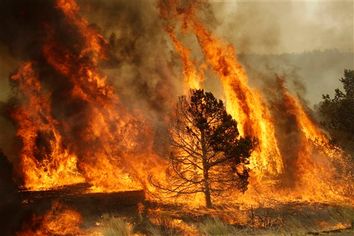
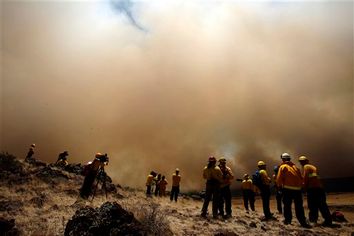
ALBUQUERQUE, N.M. (AP) — Winds and erratic flames forced firefighters to sit on the sidelines Thursday as a massive fire that destroyed a dozen homes and several other structures in small New Mexico community grew larger and put more buildings at risk.

Tripling in size over the last day, the lightning-sparked Whitewater and Baldy fires merged to burn across more than 110 square miles of the Gila National Forest by Thursday.

“At this point it’s just a monitoring situation to see whether (crews) can find some place where they can build lines or do something to slow it down,” said fire information officer Iris Estes.

The wind-whipped fire burned Wednesday afternoon through the Willow Creek subdivision, a small summer community in southwestern New Mexico. Officials confirmed 12 cabins along with seven small outbuildings were destroyed, and the damage assessment continued Thursday.

Fire managers said employees with the State Forestry Division and the U.S. Forest Service would be contacting property owners.

While some residents questioned whether fire managers could have done more early on to contain the blaze, others acknowledged that fighting flames in the area’s steep canyons was near impossible now.

“The fire had been around about 10 days, lurking and creeping and then kaboom, it exploded,” said Tabitha Sims, secretary of the Willow Creek Landowners Association. “They made a heroic effort at trying to build a break, but I think it was unfortunate that this wind event happened to come right at the worst time.”

Sims, an Arizona resident who owns a cabin at Willow Creek, said parts of the area were vulnerable due to a lack of fire over decades. She described Willow Creek as “an incredibly special spot” where generations of families have spent their summers.

“The people who have lifelong memories of going there, I just feel for them,” she said.

Seven Willow Creek residents evacuated earlier this week, and the community of Mogollon was under voluntary evacuation. Authorities said many structures were still at risk.

Firefighters were anticipating winds of up to 35 mph late Thursday afternoon.

In northern Nevada, high winds also were expected in an area where a fire broke out Tuesday, burned 7,500 acres and damaged two homes. Crews near the Nevada-California line raced to secure a line above a second rural community Thursday before the winds kicked up.

Meanwhile, firefighters in a rural part of California’s San Diego County fought a 1,200-acre wildfire that led to evacuation orders for 100 homes. Gusts of up to 45 mph were forecast in the area Thursday night.

In the Gila National Forest, the flames have raced across more than 70,500 acres of rugged terrain. The Baldy fire was first spotted May 9 and the Whitewater blaze was sparked May 16, but nearly all of the growth has come in recent days thanks to relentless winds.

There is no containment.

The blaze is about half the size of last summer’s historic Las Conchas fire, the largest in the state’s recorded history. That blaze burned 156,593 acres and destroyed dozens of homes in northern New Mexico’s Jemez Mountains.

With drought conditions persisting, New Mexico forestry officials have been urging residents to take precautions to help avoid another record fire season.

Many trails in the Gila region were off-limits due to the Whitewater-Baldy fire and more could be closed as the blaze continues to burn.

About 10 miles to the southeast, volunteers and staff at the Gila Cliff Dwellings National Monument have been watching the column of smoke develop each afternoon.

“The plume above us yesterday was truly awesome. It was scary awesome,” said volunteer Dave Young.

The monument was not in any immediate danger, but Young described conditions in the area as “bone dry.”

“We’re talking single-digit humidity in the afternoon. We’ve been down to 1 percent, and you can’t get below 1 percent,” he said.

Aside from low humidity and high temperatures, Estes said crews were expecting the red flag conditions to last through Saturday.

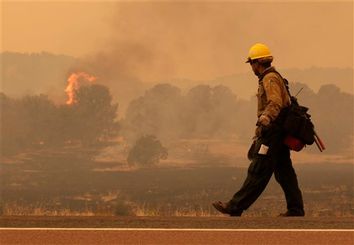
More than 400 personnel were assigned to the fire.

___

Follow Susan Montoya Bryan on Twitter: http://www.twitter.com/susanmbryanNM

Wildfire destroys 12 homes in southwestern NM

  • more
    • All Share Services

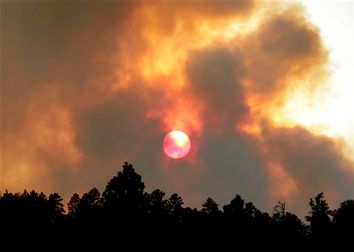
Wildfire destroys 12 homes in southwestern NMThis Tuesday, May 22, 2012, photo, provided by David Thornburg shows a plume of smoke rising from the Whitewater fire burning in the Gila Wilderness east of Glenwood, N.M. Fire managers said the blaze had charred more than 10,000 acres before merging Wednesday afternoon with the nearby 11,500-acre Baldy fire. Both fires were sparked by lightning. (AP Photo/David Thornburg)(Credit: AP)

ALBUQUERQUE, N.M. (AP) — Winds and erratic flames forced firefighters to sit on the sidelines Thursday as a massive fire that destroyed a dozen homes and several other structures in small New Mexico community grew larger and put more buildings at risk.

Tripling in size over the last day, the lightning-sparked Whitewater and Baldy fires merged to burn across more than 110 square miles of the Gila National Forest by Thursday.

“At this point it’s just a monitoring situation to see whether (crews) can find some place where they can build lines or do something to slow it down,” said fire information officer Iris Estes.

The wind-whipped fire burned Wednesday afternoon through the Willow Creek subdivision, a small summer community in southwestern New Mexico. Officials confirmed 12 cabins along with seven small outbuildings were destroyed, and the damage assessment continued Thursday.

Fire managers said employees with the State Forestry Division and the U.S. Forest Service would be contacting property owners.

While some residents questioned whether fire managers could have done more early on to contain the blaze, others acknowledged that fighting flames in the area’s steep canyons was near impossible now.

“The fire had been around about 10 days, lurking and creeping and then kaboom, it exploded,” said Tabitha Sims, secretary of the Willow Creek Landowners Association. “They made a heroic effort at trying to build a break, but I think it was unfortunate that this wind event happened to come right at the worst time.”

Sims, an Arizona resident who owns a cabin at Willow Creek, said parts of the area were vulnerable due to a lack of fire over decades. She described Willow Creek as “an incredibly special spot” where generations of families have spent their summers.

“The people who have lifelong memories of going there, I just feel for them,” she said.

Seven Willow Creek residents evacuated earlier this week, and the community of Mogollon was under voluntary evacuation. Authorities said many structures were still at risk.

Firefighters were anticipating winds of up to 35 mph late Thursday afternoon.

In northern Nevada, high winds also were expected in an area where a fire broke out Tuesday, burned 7,500 acres and damaged two homes. Crews near the Nevada-California line raced to secure a line above a second rural community Thursday before the winds kicked up.

In the Gila National Forest, the flames have raced across more than 70,500 acres of rugged terrain. The Baldy fire was first spotted May 9 and the Whitewater blaze was sparked May 16, but nearly all of the growth has come in recent days thanks to relentless winds.

There is no containment.

The blaze is about half the size of last summer’s historic Las Conchas fire, the largest in the state’s recorded history. That blaze burned 156,593 acres and destroyed dozens of homes in northern New Mexico’s Jemez Mountains.

With drought conditions persisting, New Mexico forestry officials have been urging residents to take precautions to help avoid another record fire season.

Many trails in the Gila region were off-limits due to the Whitewater-Baldy fire and more could be closed as the blaze continues to burn.

About 10 miles to the southeast, volunteers and staff at the Gila Cliff Dwellings National Monument have been watching the column of smoke develop each afternoon.

“The plume above us yesterday was truly awesome. It was scary awesome,” said volunteer Dave Young.

The monument was not in any immediate danger, but Young described conditions in the area as “bone dry.”

“We’re talking single-digit humidity in the afternoon. We’ve been down to 1 percent, and you can’t get below 1 percent,” he said.

Aside from low humidity and high temperatures, Estes said crews were expecting the red flag conditions to last through Saturday.

More than 400 personnel were assigned to the fire.

___

Follow Susan Montoya Bryan on Twitter: http://www.twitter.com/susanmbryanNM

Continue Reading Close

Webcasts push solar eclipse to the masses

  • more
    • All Share Services

Webcasts push solar eclipse to the massesThe moon slides across the sun, showing a blazing halo of light, during an annular eclipse at a waterfront park in Yokohama, near Tokyo, Monday, May 21, 2012. Millions of Asians watched as a rare "ring of fire" eclipse crossed their skies early Monday. The annular eclipse, in which the moon passes in front of the sun leaving only a golden ring around its edges, was visible to wide areas across the continent. (AP Photo/Shuji Kajiyama)(Credit: AP)

ALBUQUERQUE, N.M. (AP) — It was one of the best places in the western United States to watch the annular solar eclipse, and people drove for days just to get to this dusty stretch west of Albuquerque.

Did it matter?

Some say no. The game of chasing celestial spectacles like Sunday’s eclipse has changed thanks to live webcasting by observatories around the world and social network sites that are being fueled by grainy smartphone photographs and video clips.

The National Park Service streamed the eclipse live on its website from Petroglyph National Monument, a remote expanse of prairie and long dormant basalt volcanoes that was situated directly in the path of the eclipse.

It was a first for the agency, proving that sharing such an event with the world from such a location was technically possible.

“This was a big step for us,” Jeff Olson, an agency spokesman who was on his way back to Washington, D.C., on Monday after watching the event at the monument.

Across town, the University of New Mexico did the same thing. In Japan, Panasonic went live from Mount Fuji.

Millions of people across a narrow strip of eastern Asia and the Western U.S. turned their sights skyward for the annular eclipse, in which the moon passes in front of the sun leaving only a golden ring around its edges.

The rare lunar-solar alignment was visible in Asia early Monday before it moved across the Pacific — and the international dateline — where it was seen in parts of the western United States late Sunday afternoon.

“I always tell people it’s like going to a sporting event. It’s always better to be at the game but watching it on TV is not so bad,” said Patrick Taolucci of Slooh SpaceCamera, which can tap into observatory feeds around the world and stream them online while experts discuss what’s happening.

With the location and equipment barrier removed, UNM astronomy professor Richard Rand said this new way of experiencing eclipses and other celestial events can only add to their understanding and result in more interest in science.

Rand received an email from a mother Monday who said she and her daughter were able to watch the university’s streaming of the eclipse on their smartphone while driving to a viewing site in New Mexico.

Emails have also been pouring into the National Park Service. More than 17,000 people logged on Sunday, including people who missed out on seeing the ring due to clouds in Colorado and a person who was wheelchair bound and unable to get to any of the viewing parties.

But for some, especially the globe-trotting eclipse groupies, there was nothing like being in Albuquerque.

Alan Macklem made the three-day trip from Manitoba, Canada, with his wife.

“I’ve started,” he said. “It’s going to turn into a compulsion and then into a habit and then I won’t be able to break it. I’ll have to see every eclipse from now on.”

So what’s the fascination?

Watchers agree there’s simply nothing like it and it doesn’t really matter whether people are behind a pair of solar glasses or watching it on a smartphone.

“I think it’s something that really goes to the inner soul, the guts, the real inside of who we are as human beings,” Olson said. “We’re drawn to the sun. We’re drawn to the stars at night.”

___

Follow Susan Montoya Bryan on Twitter: http://www.twitter.com/susanmbryanNM

Continue Reading Close

Powwow draws tens of thousands to NM

  • more
    • All Share Services

Powwow draws tens of thousands to NMHundreds of Native American and indigenous dancers pour onto the floor at University of New Mexico Arena for the grand entry during the 29th Annual Gathering of Nations in Albuquerque, N.M., on Friday, April 27, 2012. The event draws more than 3,000 dancers and singers and tens of thousands of spectators for three days of competitions and the crowning of Miss Indian World. (AP Photo/Susan Montoya Bryan)(Credit: AP)

ALBUQUERQUE, N.M. (AP) — They come from Canada, both coasts of the United States and everywhere in between.

More than 3,000 Native American and indigenous dancers and singers are gathering in Albuquerque as tens of thousands of spectators join in for the 29th Annual Gathering of Nations.

Organizers bill it as one of the world’s largest powwows. It features three days of dancing, native foods, crafts, jewelry and the crowing of Miss Indian World.

For Caleen Sisk, tribal chief of Northern California’s Winnemem Wintu Tribe, it’s also about celebrating the differences among native people. More than 500 tribes are represented at this year’s event.

Sisk says the gathering reminds the rest of the nation that tribal people are still around and still practicing their traditional ways of life.

The event wraps up late Saturday with the winning dancers receiving awards.

Feds prepare for another busy US fire season

  • more
    • All Share Services

Feds prepare for another busy US fire seasonBernalillo County Commissioner Wayne Johnson, right, talks to U.S. Forest Service Chief Tom Tidwell, left, and Regional Forester Corbin Newman, center, about wildfire response after a news conference at the Sandia Ranger Station in Tijeras, N.M on Thursday, April 26, 2012. Federal officials expect the 2012 season to be just as active as last year, when historic fires charred hundreds of square miles across parts of Arizona, New Mexico and Texas. (AP Photo/Susan Montoya Bryan)(Credit: AP)

TIJERAS, N.M. (AP) — The chief of the U.S. Forest Service says he expects this year’s fire season to be as active as last year, when historic fires charred hundreds of square miles in Arizona, New Mexico, Texas and elsewhere.

Forest Service Chief Tom Tidwell says the Southwest remains dry and the middle part of the country could have a more severe season this year.

Tidwell says federal scientists are monitoring weather patterns and trying to make accurate predictions so resources can be placed in the areas where they’ll be needed most.

Tidwell joined U.S. Agriculture Secretary Tom Vilsack, Interior Secretary Ken Salazar and other officials for a conference call Thursday to address the nation’s preparedness.

Vilsack says the agencies are taking their responsibility seriously given that lives and property are at stake.

Official: US needs more young farmers, ranchers

  • more
    • All Share Services

ALBUQUERQUE, N.M. (AP) — U.S. Deputy Secretary of Agriculture Kathleen Merrigan sees an epidemic of sorts sweeping across America’s farmland.

The country’s farmers and ranchers are getting older and there are fewer people standing in line to take their place.

New Mexico has the highest average age of farmers and ranchers of any state at nearly 60 years old, and neighboring Arizona and Texas aren’t far behind. Nationally, the latest agricultural census figures show the fastest growing group of farmers and ranchers are those over age 65.

Merrigan is making stops at universities around the country in hopes of encouraging more students to think about agricultural careers.

She was in New Mexico and Arizona last week. This week, she has stops planned at the University of Colorado in Denver and Michigan State University.

Page 1 of 4 in Susan Montoya Bryan