Susanne Koelbl

“There has to be peace now”

In an interview, Afghan President Hamid Karzai says he's ready to talk with the Taliban

  • more
    • All Share Services

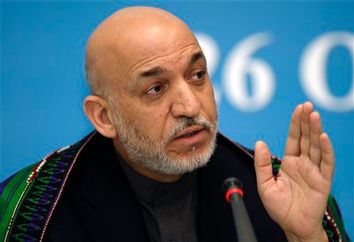
Afghanistan President Hamid Karzai speaks during a news conference with his Turkish counterpart Abdullah Gul, unseen, in Istanbul, Turkey, Tuesday, Jan. 26, 2010. Turkish, Afghan and Pakistani presidents meet in Istanbul for Turkish-sponsored talks aimed at reducing tensions between Afghanistan and Pakistan. (AP Photo/Ibrahim Usta)(Credit: AP)

At the Afghanistan conference in London, you — as well as other participants — spoke of reconciliation with the Taliban. Could you envision receiving Mullah Omar on the red carpet at the presidential palace in Kabul?

Mullah Omar is first and foremost an Afghan, and we want all Afghans to return. Afghanistan is a democratic country, but it is also an Islamic country and the Taliban know that. If they accept our constitution, it will be their constitution, too. We welcome all Afghans back to their country with this little bracket of not being part of al-Qaida or the terrorist networks.

Is the renunciation of al-Qaida a prerequisite for reconciliation or is that something that can come as a result of talks?

The rejection of al-Qaida and terrorist networks is an absolute prerequisite.

You have suggested that Taliban leaders should be removed from United Nations terrorist lists in order to allow the initiation of talks with them. But why should the international community allow the same people back into Afghanistan who they sent soldiers into the country to get rid of?

Because they didn’t get rid of them. There has to be peace now! It’s a process that the UN must see through. And we will see as to how to involve the UN. We have requested that the UN take some people off the list. They have done that and we are grateful. We will also request that they remove more, and we feel that is good for the peace process.

What is needed for a successful reconciliation program?

It must have two main components: Reintegration and reconciliation. The reintegration is for the thousands of Taliban soldiers and village boys in our country who have been driven out of their homes — either by fair means or by intimidation, by bad behavior on the part of NATO forces or by bad behavior from Afghan forces — and who do not stand ideologically against the Afghan people or the international community. They must be persuaded by all means to return.

And who does the second group comprise of?

Then there is the political structure of the Taliban, which has its own environment of relations with the rest of the world and the question of al-Qaida and the terrorist networks. Our neighbors and the international community will be involved in this. That’s going to take a lot more effort.

How can you trust a Talib who agrees to abandon his alliance with al-Qaida?

I think it is a small fraction of the Taliban who are actually in contact with al-Qaida. But within the mainstream, the whole of the movement — and even at the higher levels of their command structure — there are people who don’t know al-Qaida, there are people who have never seen Osama bin Laden and who don’t even understand what al-Qaida is up to.

The reconciliation program has already existed for years, but it has failed so far. Why do you suddenly expect it to be successful now?

The new thing is that the international community now understands how important (the reconciliation program is). New is that the United States, Europe and Japan are willing to contribute to it, and we have the support of our brothers in Saudi Arabia. We hope that King Abdullah will personally assume a prominent role in leading and supporting the peace process.

The international community, especially your most powerful protectors, the Americans, have lodged serious allegations against you. At issue are bad governance, corruption and nepotism. Have these persistent allegations changed your relationship to the West?

Some political and media circles in America and Britain were clearly very keen to have me replaced by mostly unfair means, but the Afghan people decided differently. This didn’t change our relationship, but it did make me wiser.

Do you still even have control over your country?

There are regions that are under the control of the Taliban. But where we are, we are strong. We deliver services and issue instructions. And I can dismiss or appoint anybody I want. The same Western press that called me the “Mayor of Kabul” without reach in the country, overnight began calling me an all-powerful president who caused fraud in the votes, had cheated in the votes and had people in government working for him all across Afghanistan to rig an election.

Which image did you prefer — that of Mayor of Kabul or election-rigger?

None of it was true — neither the Mayor of Kabul, nor the fraudulent elections. We are a legitimate government. We are a Third World country. We have poverty, war and poor education opportunities. We have a lack of capacity and a lack of money. So how we function is in accordance with the environment which we have. And that’s the better description.

The U.S. has since acknowledged your re-election, and even your best-known American critic, Special Envoy to Afghanistan and Pakistan Richard Holbrooke, now says he is looking forward to working with the new government. Do you still trust him?

When the war began in 2001, the Afghan people had tremendous expectations. Back then, they really believed the arrival of America and its allies would bring peace to Afghanistan. And they cooperated with them, and the Taliban were driven away in only two months. That is the perspective from which we must view the situation today. What has happened to cause the Afghan people in the south to allow the Taliban to return to their villages? Something must have gone wrong. But who allowed things to go wrong? Was this entirely the fault of the Afghan government and the Afghan leadership? Or was this also the fault of our partners?

What has changed since Barack Obama took office?

With President (George W.) Bush it was a very engaging relationship. We had regular contact, we spoke about the problems, we had frank conversations and discussed civilian casualties and all other issues. My ministers participated with me in the video conferences we held together with the Bush administration.

It sounds as if you miss President Bush.

President Obama is the new American president, and he has announced a new strategy. We backed the strategy to the extent that it would bring security to Afghanistan. Now, the American people have given Afghanistan a lot of resources, for which we are grateful. But there are issues that we have that we hope will be resolved as we move forward.

In his speech at West Point two months ago, President Obama announced that he wants to start pulling American troops out of Afghanistan beginning next year. Is this one of the issues you are concerned about?

We must be realistic. We know that we will not be entirely ready for that date and that we will require help for some more years to come — and that realism is something that we have conveyed to our partners. But we are also happy about the announcement by the US president because it creates pressure for us to work hard to sustain ourselves with our own resources and abilities.

Is the new strategy the right one?

General McChrystal is a good soldier, his strategy focus is on protecting Afghan civilians, and this is the key factor here. If we adhere to that and respect it, we will succeed. If we don’t, failure is certain. Terror does not originate in the Afghan villages. That’s why the war on terror is directed at the sanctuaries, the training grounds and the financial support. Had our allies recognized that eight years ago, we would have a lot better story to tell in Afghanistan today.

You appear to be referring to Pakistan, which is believed to be the operating ground of the Taliban leadership. You speak frequently with Pakistan’s president, Asif Ali Zardari, and his top security people. Will the day ever come when Pakistan is prepared to expel top Taliban leaders from its soil?

I hope that, in the peace process, we will begin to cooperate on all these questions and that reconciliation will become reality at the highest level of the Taliban movement and others. And we will do that with the help of Pakistan.

“People in Afghanistan want change”

In an interview, Abdullah Abdullah, challenger to Afghan President Hamid Karzai, discusses election fraud

  • more
    • All Share Services

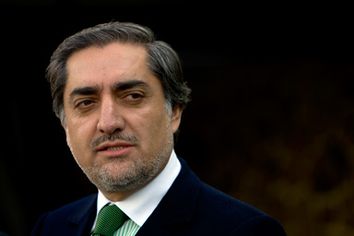
Abdullah Abdullah, former Afghan foreign minister who run against President Hamid Karzai in last August's vote, speaks during a press conference in Kabul, Afghanistan, on Monday, Oct. 26, 2009.

Three years ago, Afghan President Hamid Karzai dismissed you as foreign minister. Now you are his rival in the runoff. Do you feel a sense of gratification?

In 2004 I decided not to vote for him. We have different ideas, different visions. He believes in a strong, centralized system; I believe in a parliamentary system, which is more decentralized. He believes in individuals; I think parties should become more influential in a democracy. I believe in a truly independent Independent Electoral Commission, in an independent Constitutional Commission and in the judiciary. He doesn’t. There are, as you can see, a number of differences. About the only thing we have in common is that we are both candidates in the presidential elections.

Still, in a recent phone call you congratulated President Karzai for accepting the election results — after he announced he would submit to the runoff. Was this intended as a subtle provocation?

I thanked him for accepting the results, even if his acceptance was delayed. I said that one chapter is now behind us and that another chapter is now in front of us. During the campaign, I spoke to the public about Karzai’s and his government’s failures. So there might have been quite a few things between us. But as a candidate, and with him as an incumbent, at the end of the day the lines of communication should remain open.

In the first weeks after the election, you both ruled out the possibility of a national unity government. Last week, there were rumors in Kabul that, under certain circumstances, you would be prepared to work together with Karzai. Is there any truth to this?

I can promise you, these are rumors. I want change, not just a power-sharing arrangement.

There is a good possibility that Karzai will win easily in the second round of voting. Should that happen, you would once again find yourself with little influence in the opposition. Can you afford this?

According to the Electoral Complaints Commission, the difference between his and my result is about 17 percent. It should be mentioned that the method used by the Commission only identified a part of the fraud, but not all of it. The real results would have been quite, quite different. I saw that the people want change in this country. The runoff will strengthen the people’s belief in the electoral process. It is a necessity for the political environment and it will create new momentum.

It wasn’t just Karzai’s camp that committed fraud. Some of your supporters were also at fault, even if it wasn’t as widespread. Would you deny this?

There were irregularities on our side as well, I don’t deny it. But fraud would be too strong a word to describe what took place.

The runoff, like the first round of voting, will once again cost almost $200 million of international donors’ money and will require a Herculean effort in organization and security. How can one be sure that the second round of voting will be accurate and will lead to a legitimate government?

This is a very serious question. I will propose certain recommendations for the transparency of the elections, because massive fraud could of course happen once again. That’s not acceptable. People in the Independent Electoral Commission [IEC], who have shown bias, who have violated the law and who worked in favor of one candidate, should be removed. Those who have been a part of the corruption in the IEC need to be replaced. The IEC needs to be truly independent. That is a must.

The atmosphere between the Americans and President Karzai has been tense for quite some time. Are you America’s favored candidate?

Luckily, they didn’t really have a favorite candidate. Five years ago, it was different. At that time the U.S. clearly supported Karzai. This time they stood by the process. I appreciated that. After the press conference, when the final results were announced, President Barack Obama called me, and he called Karzai. It was a courtesy call and he praised me for my stand, for my responsible attitude. But it was a short conversation.

Obama’s decision on General McChrystal’s new strategy for Afghanistan is on hold, pending a legitimate government. Can the Taliban still be stopped and if so, how?

For years I have been saying that you need a credible partner in Afghanistan. One who can deliver, otherwise it can’t succeed. General McChrystal’s strategy is the right one. But it takes two to tango. The other part is the Afghans — if they fail, it can’t work. The legitimacy should come through the electoral process, through free, fair and transparent elections. Hopefully as a result, the people of Afghanistan have a chance for change.

Karzai wants to negotiate with the top leadership of the Taliban, saying that they would participate in the government if they stop fighting. Will that work?

To believe that negotiations with the so-called Quetta Shura [the Taliban ruling council] will bring peace to Afghanistan is an illusion. These people are destroying the country; how can we make peace with them? What needs to happen is that we have to reach out to the people of Afghanistan, because the government is losing their support. That’s one of its major failures. Essentially it needs good governance, which serves the people and which is accountable. We need elected governors, not appointed ones. We need to fight corruption. It’s a whole package of measures that would go a long way toward winning the people’s trust.

People in Kabul say your budget was tens of millions of dollars with much of it donated by Iran. Is that correct?

[Laughs] I wouldn’t say that I wished it was true. No, I can surely confirm that a foreign country was not involved. Contributions from the people were overwhelming, well higher than my expectations. They invested in a different political agenda. They want change.

Continue Reading Close

Afghanistan may already be lost

President Obama wants to try a new approach to beat back the Taliban, but some analysts think the war can't be won

  • more
    • All Share Services

Afghanistan may already be lostA U.S. soldier attached to Marines from Delta Company of 2nd Light Armored Reconnaissance Battalion patrols through dust along with other U.S. Marines near the town of Khan Neshin in Rig district of Helmand province, southern Afghanistan September 9, 2009

The images are shaky, but you can see things well enough to recognize that something is not right. And then it happens: An armored car belonging to Western forces races through the streets of an Afghan city. Panicked civilians scramble to get out of the way. A civilian car moves into the lane ahead of the military vehicle. The machine gunner aims, fires and scores a hit.

The military vehicle then races away while a number of Afghans run over to the attacked car, which is now in flames. They can be seen yelling and waving their arms frantically. Some of them try to help injured passengers out of the car.

“How many new insurgents is this patrol likely to have produced today?” a quiet voice asks in the darkened screening room. It belongs to Stanley McChrystal, 55, the new commander of U.S. and NATO forces in Afghanistan. They call him “McThree,” as his predecessors’ names were McNeill and McKiernan.

The four-star general is tall and lean. He is said to need only a few hours of sleep and to skip breakfast and lunch, eating only once a day, always in the evening. He does this in order to be wide awake at all times during the day.

Born into a military family, McChrystal chose to serve with the U.S. Special Forces and commanded its secret operations in Iraq and Afghanistan for several years. It was his men who found Saddam Hussein and killed Abu Musab al-Zarqawi, a key al-Qaida operative in Iraq. His track record lends him authority.

Unsparing self-criticism
McChrystal is seated in a conference room at the headquarters of the International Security Assistance Force with the force commanders responsible for the western, eastern, southern, and northern sectors, as well as for Kabul province. He shows them half a dozen film clips like the one in which a patrol vehicle machine-gunned a civilian car. Some of the videos were downloaded from YouTube. They are embarrassing, painful scenes documenting the fact that Western soldiers actually do insult, wound and kill Afghan civilians. This is why the West is not having any success in Afghanistan, McChrystal says. “We need to change.”

Slightly less than eight years after the beginning of the war in Afghanistan, the time has come for unsparing self-criticism. America has gone the furthest in this. No wonder: This war has now become Barack Obama’s war. He has put additional troops on the ground. The military has changed its strategy and is attempting to be more careful about calling in air strikes when there is a chance that civilians could be affected as well.

Tragically, information came in from Afghanistan last Friday indicating that, once again, civilians had been killed in a NATO air strike. As it turned out, a German army officer called in a U.S. air strike after finding out that two fuel tankers had been stolen by the Taliban near Kunduz. The reasoning given for ordering an aerial attack was that the Taliban could potentially use the fuel trucks to attack the German camp in Kunduz. However, German Chancellor Angela Merkel hit back on Tuesday at NATO allies that have criticized the air strike, saying Germany would not tolerate accusations before a full investigation had been conducted.

Because of incidents like this, among other factors, public support for the mission — which received broad international backing when it began — is gradually being undermined. According to recent polls, more than half of all Americans are now against the war in Afghanistan, and only 25 percent support President Obama’s plan to send more soldiers into the area.

Increasing doubts
In Western countries, doubts about the point of the mission have been increasing. Promoting democracy? The results of the recent presidential election aren’t scheduled to be announced until Sept. 17, but it is already clear that they are going to be distorted by the ballot-box stuffing, false vote counts and vote buying that went on, on a massive scale. The incumbent, Hamid Karzai, is in the lead. He was the candidate favored by the West, a hope for progress in the country, a man who had a good relationship with America and a support base in Afghanistan. This is pretty much gone now. Karzai has lost much of the confidence the West had in him.

More than 100,000 foreign troops are currently stationed in Afghanistan, nearly 62,000 from the United States and the remaining 40,000 from the other NATO countries. The German contingent numbers around 4,000. The U.S. forces have shouldered a large part of the burden with regard to combat operations.

In a secret strategy paper, McChrystal has laid out for Obama and NATO some of the things that, in his view, need to be changed so that Afghanistan, like Iraq, can become at least a partial success for the West. Secretary of Defense Robert Gates told him he can ask for anything he feels is necessary to get the job done, even including more soldiers if necessary. McChrystal apparently only wants to modify force structures for the time being, sending some noncombatant personnel home and replacing them with combat troops.

A controversy has broken out in the Obama administration over priorities in the region. Hillary Clinton has pleaded in favor of sending in more soldiers and strengthening the focus on Afghanistan, while Vice President Joe Biden has warned against losing sight of the importance of Pakistan, an unstable nuclear power that serves as a safe haven for the Taliban and al-Qaida.

The last chance
McChrystal is responsible for turning the tide in Afghanistan. His new strategy may be the last chance to turn things around militarily in the Hindu Kush. The Dutch and Canadian governments have announced that they intend to withdraw their contingents by the year 2011. Canadian forces stationed in Kandahar have lost 128 of their soldiers. British troops stationed in Helmand province, a Taliban stronghold and the center of opium poppy production, have had 212 of their men killed. The death toll appears to have brought about a significant change in the way the British view the military effort in Afghanistan. In an editorial published in July, in which it predicted the British public would soon decide the war is not worth the casualties, the Observer newspaper wrote: “Lives saved by bringing soldiers home will seem a surer benefit than the unproven hypothesis of preventing terrorism with a war thousands of miles away.”

The Obama administration seems determined to expand the military effort and then to make an assessment as to whether or not progress can be made that way. NATO was informed by diplomatic sources that the United States wants to move a combat force of about 45,000 men from Iraq to Afghanistan — in part as replacements for troops rotated out and in part as reinforcements. The same sources indicated that the Europeans would be expected to help by providing additional forces, more reconstruction assistance and increased funding. The Obama administration wants to wait until after the general election in Germany on Sept. 27 before officially announcing its wishes.

The magic word “surge” is making the rounds in Kabul, just as it did in Iraq. However, this will involve civilian personnel for the most part. McChrystal wants to send advisors and reconstruction specialists not just to Kabul and the provincial capitals but also to remote districts and villages. They are to develop relationships with the clans and village elders and to build confidence. They are also to find out if there are any Taliban willing to engage in talks and determine whether it is possible to distinguish between fundamentalists and moderates who would be willing to negotiate.

The United States was able to make progress in Iraq by taking this more patient approach. But will this be possible in Afghanistan?

There are some who say it’s as good as over in Afghanistan. The confidence of the general population has been lost; too many civilians have been killed. This is the way Thomas Ruttig, a member of a group of experts known as the Afghanistan Analysts Network, sees the situation. Having served as an election observer in Paktia province, he now says that, in his view, the Afghans don’t need agricultural experts from Kentucky. They need to have their fields cleared of mines; they need loans so that they can pay for irrigation systems, fertilizer, and seeds; they need functioning markets — and more than anything else they need peace.

Missed objectives
There are numerous things that have gone right in Afghanistan since the fall of 2001. But many major objectives have not been achieved. Osama bin Laden got away. Al-Qaida simply moved a few hundred kilometers away and set up new training camps in the lawless tribal areas of Pakistan. The political system in Afghanistan continues to be largely a farce. Court decisions can be bought. Most of the women who live in rural areas continue to have no rights. The Afghan police don’t protect their citizens. More often than not they use their powers as law enforcement officers to squeeze money out of the populace. Administrative officials won’t do anything unless they are paid bribes and often use their positions of power to make life hard for people.

The fraud perpetrated during Afghanistan’s second presidential election was systematically organized in some parts of the country. This was seen to by the candidates’ regional networks. An investigative commission is examining around 700 complaints that have been judged to be relevant.

There is the case of Delaga Bariz, district chief of Shorabak in Kandahar province, who maintains that ballot boxes were stuffed with 23,900 votes for Karzai. Allegedly the Bariz tribesmen in Shorabak had decided to vote for Abdullah Abdullah, Karzai’s strongest rival. But then some of Karzai’s people showed up and took the ballot boxes to Kabul, Delaga Bariz says.

The independent Afghanistan Analysts Network documented a case from the area around the town of Spin Boldak in the south. There the head of the border police had promised to monitor the election personally in six districts. The night before Aug. 20, a large number of ballot boxes were brought to his home and members of the independent election commission are said to have been urged to fill them with votes for the incumbent president. On Election Day, the police chief took the filled ballot boxes to official polling stations for counting.

President Karzai’s younger brother, Ahmed Wali Karzai, lives in Kandahar. As head of the provincial council, he is one of the most powerful figures in the region and organizes political support for his brother. But he claims not to have had anything to do with the election fraud.

Insubordination and criticism
The relationship between President Karzai and Washington had cooled considerably by the end of the Bush era, as a result of weariness and disappointment on both sides. Karzai repeatedly expressed scathing public criticism of reckless bombardments by U.S. planes in which Afghan civilians regularly died. But the Americans had expected gratitude and loyalty from him, not what they saw as insubordination and criticism.

The Obama administration immediately put even more distance between itself and the West’s former favorite. Karzai had sought and formed sordid alliances with war criminals and drug barons for the purpose of preserving his power. He had also taken steps to distance himself from the West. Few people today would consider him a true democrat — anyone who thought so was mistaken right from the start.

Now the State Department has announced that, if Karzai is declared the winner of the presidential election, his future vice president, Mohammed Fahim, will be banned from entering the United States — because of his alleged links to the drug trade.

A difficult question
Just how badly the relationship between the Afghan and American governments has broken down was shown the day after the election at a luncheon given in the presidential palace for Obama’s special envoy, Richard Holbrooke, an experienced diplomat with a reputation for bluntness. He and Karzai, the proud Pashtun, are like fire and water. Karzai doesn’t like Holbrooke’s arrogance, and for his part Holbrooke is irritated by Karzai’s recalcitrance.

Karzai was in a good mood when he received his guest in a paneled room on the ground floor of the palace. “May I ask you a difficult question?” Holbrooke asked. He felt that a runoff election between Karzai and Abdullah could increase the democratic credibility of the resultant government and reduce criticism in the West of the military operation in Afghanistan.

Karzai sensed a trap. He thought Holbrooke was looking for a last chance to force him out of office and help the preferred rival candidate, Abdullah, to take over the presidency. His tone became sharp as he said this constituted an interference in Afghan affairs, adding that it was the role of the independent election commission — not the Americans — to decide on the need for a runoff election.

There are two versions as to how the luncheon continued from that point on. According to one version, they sat there silently and ate dessert. According to the other version, Karzai immediate stood up and asked his guest to leave — whereby things got very heated.


This article has been provided by Der Spiegel through a special arrangement with Salon. For more from Europe’s most read newsmagazine, visit Spiegel Online or subscribe to the daily newsletter.

Continue Reading Close

Iraq: Afghanistan’s model for success

The U.S. Army is trying out a radical change of course in Afghanistan -- but will it work?

  • more
    • All Share Services

Iraq: Afghanistan's model for successGeneral Stanley McChrystal is the new head of US and NATO forces in Afghanistan. He is taking a new approach to fighting the war.

For Mohammed Nader Ashraf, the most important thing is to make sure they don’t find him. That would be dangerous, because he is crouched behind a wall on the edge of a cornfield, talking to strangers.

Ashraf, who has a dark, wrinkled face and is wearing a light-colored turban, spits on his right index finger and scrubs it with a small stone. The finger is still bluish-black with ink, the method used in Afghanistan’s Aug. 20 presidential election to prevent multiple voting.

But in Ashraf’s native village, near Khalaj in Afghanistan’s Helmand province, the mark is also a curse. Helmand is Taliban country, the province where the insurgents are strongest in Afghanistan. They view participating in the presidential election as an act of treason. The Taliban have denounced voting as un-Islamic and threatened to cut off the inked fingers of anyone who votes.

But Ashraf is smiling. Despite the threats, he rode for four hours to the provincial capital Lashkar Gah early on the morning of the election, taking secret routes along irrigation canals and dusty paths. Then the 42-year-old placed a cross next to the name of President Hamid Karzai, not out of a desire for democracy, but out of a lust for revenge. In the spring, a Taliban court ruled against him in a land dispute, and he lost two of his fields. “If President Karzai stays in office, even more American soldiers will come to Helmand, and I’ll get my property back,” says Ashraf, licking his finger.

Test case
The second presidential election since the ouster of the Taliban from Kabul was not without incident, but it was also not a failure. An estimated 17 million Afghans were officially eligible to vote, although most village elders and clan leaders had decided in advance who their followers were to support or whether they should vote in the first place.

Dirty deals were made, votes were bought, and voting permits were distributed in good faith. There were 135 incidents last Thursday alone, including more than a dozen Taliban attacks on polling places and one police station. About 50 people were killed, most of them attackers. The relatively high voter turnout, given the circumstances, was partly attributable to the fact that provincial councils were also being elected. These councils are often more relevant to the daily lives of Afghans than the relatively weak president in faraway Kabul.

Nevertheless, incumbent Karzai is likely to have won the vote, and Ashraf’s hopes of having his farmland returned to him could in fact come true.

The American soldiers he is pinning his hopes on are already there. Four thousand troops arrived in Helmand last month in an attempt to drive out the Taliban, who are stronger in the region today than at any time since the American invasion eight years ago. Operation Khanjar (“dagger”) is the test case for President Barack Obama’s new strategy for achieving a turnaround in Afghanistan.

“We’re the world’s most feared military unit”
The U.S. Marines include men like Capt. Robert Tart, a wiry, 33-year-old New Yorker whose angular face, under his sand-colored helmet, makes him look at least 10 years older. Wearing a flak vest and outfitted with an assault rifle, night-vision goggles and a radio, he is standing in a forward operating base, a U.S. camp with protective walls, on the border with Helmand province.

It is a region of seemingly endless desert, where the air is filled with yellow sand, and jagged mountains form the horizon. The air temperature is 113 degrees Fahrenheit.

Tart is ready to go. His company is waiting for him, 24 men standing in front of their Humvees. They received a tip that drugs are being hidden at a remote farm south of Delaram.

From the moment Tart leaves the camp, the enemy is observing him. Tart knows it, and he feels it. The Taliban have laid roadside bombs, and they fire antitank grenades at the soldiers from the surrounding farms. Anyone here could be a potential attacker: the goatherd on a hill, or the motorcyclist standing on the side of the road.

Before coming to Afghanistan, Tart served three tours of duty in Iraq’s Anbar province, at a time when the situation there seemed hopeless. His unit took part in the siege of Fallujah when it was a terrorist stronghold. Eventually, a former general under Saddam Hussein was installed to keep order on behalf of the Americans, and the situation stabilized. “We’re the shock troops, we’re the world’s most feared military unit,” says Tart, who apparently believes that this will make his unit just as effective in Helmand.

“This will not be easy”
Helmand is Afghanistan’s Anbar, the heart of the insurgency. It is the world’s largest opium-growing region, responsible for 42 percent of total production. Helmand, Afghanistan’s largest province, is almost one and a half times the size of Switzerland. It is also the Taliban’s main moneymaker in Afghanistan, providing the extremists with up to $210 million in annual revenue from the drug trade.

Although President Obama in faraway Washington merely inherited this war with the Taliban, he has now tied the outcome of the conflict to his own political fate. Afghanistan, he says, is a “war of necessity,” not a “war of choice” like the Iraq war, entered into for the wrong reasons.

In a speech to war veterans in Arizona last week, Obama said: “If left unchecked, the Taliban insurgency will mean an even larger safe haven from which al-Qaida would plot to kill more Americans.” Difficult times are ahead for his fellow Americans, he said, adding: “This will not be quick. This will not be easy.”

Obama wants to win the war at all costs, and he is prepared to spend even more money on the conflict in this difficult country, despite the massive U.S. budget deficit and the healthcare-reform debate. Almost 800 U.S. soldiers have died in Afghanistan since 2001, and the war effort costs American taxpayers $4 billion a month.

Defeating the Taliban and al-Qaida will take “a few years,” said Defense Secretary Robert Gates, adding that it is still “completely unclear” when American forces will be able to withdraw. He also noted that rebuilding the country’s economy and government will take even longer — at least “10 years.”

The new man in Kabul
In May, Gates dismissed David McKiernan, the commander of U.S. forces and of international troops in Afghanistan. McKiernan’s removal demonstrated how serious Washington is about its radical change of course. The last time a commanding four-star general was replaced was in 1951, when President Harry Truman removed Gen. Douglas MacArthur for having opposed his plans during the Korean War.

The new man in Kabul is Gen. Stanley McChrystal, a lanky, 55-year-old ascetic who prides himself on eating only one meal a day to avoid drowsiness and who gets by with only a few hours of sleep every night. Until now, McChrystal tended to be involved with the darker side of the military business. He commanded covert U.S. Special Forces operations in Iraq and Afghanistan for five years. His men were the ones who hunted down former Iraqi President Saddam Hussein before capturing him in a hole in the ground. McChrystal also gave the order to kill Iraqi al-Qaida leader Abu Musab al-Zarqawi.

According to insiders with the International Security Assistance Force in Kabul, the general has been given one year to achieve initial successes in Afghanistan, and two years to produce a turnaround. Political support cannot be maintained for longer than that. That’s why McChrystal now plans to revise the logic of the war, changing the U.S. forces’ objective from fighting the enemy to providing security for Afghans.

Deep partners
“Why did this happen?” the general asks in his morning meeting in Kabul after learning that civilians were injured or killed the night before. His soldiers have orders to withdraw rather than risk killing innocent people in a gun battle. McChrystal wants them to rethink the approach, and in fact to adopt a new way of thinking.

That will be difficult, says McChrystal, because the Taliban “are gaining ground.” His favorite concept these days is “deep partnering.” He wants his soldiers to stop isolating themselves behind barbed wire and walls, and the international troops to get out of the cities and go into the villages. And he wants his GIs, from generals to privates, to train, fight, eat and live next to Afghan security forces. “Where we go, we will stay,” he says.

This roughly reflects the language of the U.S. military’s new field manual, “Tactics in Counterinsurgency,” written for company, battalion and brigade commanders. The volume sums up the bitter lessons from the Iraq war.

Since McChrystal has taken over, the number of enemy fighters killed in battle is no longer released. “We will not win based on the number of Taliban we kill, but instead on our ability to separate insurgence from the center of gravity — the people,” McChrystal wrote in one of his first commands. Naturally the general continues to send special units to hunt down and eliminate senior Taliban leaders.

Dirty money
After driving 7 miles, Capt. Tart and his unit have reached a mud farmhouse in the desert. There are several outbuildings, the sand-colored roofs are shaped like domes, and red hollyhocks are blooming in the garden. Two men are sitting in front of the house, and everything seems peaceful.

The informant who led Tart to the farm, a Pashtun with a gaunt face and thin beard, quickly disappears. The farm is supposed to be a hiding place for opium, and the Marines find packets of drugs in holes in the cellar and hidden between double walls. The two men in front of the house, a young man and an older man, claim that they just happen to be here to do work in the garden.

It is already dark, and yet the thermometer still indicates 86 degrees. Tart has already collected some 1,300 pounds of opium, with a market value of more than $100,000 in Afghanistan. The identity of the owner of the drugs remains unclear.

Tart has the older of the two men handcuffed and then takes him along to the police station in Delaram. The captain is pleased with his success. “The drugs bring in dirty money, which is used to kill our people,” he says. “We took it off the street.”

The police station in Delaram is between the bazaar and the cemetery, where green-and-white flags fly over the graves. The Marines have set up camp in a derelict building, and the police officers live in the adjacent house. This is where the U.S. troops are testing McChrystal’s new strategy of living with local security forces.

The American soldiers look a bit like pirates, with bandanas and tattoos, chewing tobacco between their teeth. The food is better with the Afghans, they say. They received the tip-off about the opium only because they have set up camp here instead of withdrawing several weeks ago, when suicide bombers attacked the police station several times.

The Afghan police have set up a building for visitors behind the Americans’ quarters. The first of the villagers eventually came to the police — and talked. Others followed, a sign that the new strategy appears to be paying off.

Looking for combat
Cpl. Jacey Marks, on the other hand, looks like someone who would have trouble rethinking the strategy. The powerfully built soldier has close-cropped red hair, high cheekbones and tattoos. Marks served in Haditha, the embattled Iraqi city that acquired a tragic notoriety when a small number of GIs mowed down 24 Iraqi civilians there in 2005. He gained combat experience in Haditha, and combat is what the 24-year-old soldier has learned so far. “That’s what you look for,” he says, reflecting the mentality of the Marines.

Now Marks is driving with a patrol in the border region near the western edge of Helmand. He drives his Humvee over bumpy fields to avoid the omnipresent roadside bombs, expecting enemy fire or an ambush at any moment. But nothing happens. Nothing has happened in weeks. The enemy is merely watching him from afar, and all the energy the corporal has directed against the enemy comes to nothing. Marks is learning that Afghanistan is not Haditha. The Taliban know that they can only lose in direct combat with the Marines, and they avoid them.

“The Taliban aren’t challenging us, the Marines, but they are exhausting the American public, which will eventually come to believe that there are no successes and there is no purpose to our effort here,” says a first sergeant at the Marines’ camp in Delaram. He is sitting under a camouflage tent, fanning himself with a paper plate.

Only 4.5 percent of the Afghan population lives in Helmand, but many Afghans stand to lose a lot if peace were to suddenly break out there. Opium and the war are economically significant for Afghanistan. The drugs fuel the war, and the war protects the drugs. Those who profit from opium want to see the status quo maintained for a while longer.

Gen. McChrystal’s goal must now be to take support away from the insurgents and win the backing of as many clans and tribes as possible, so that the Taliban are eventually forced to negotiate — under the West’s terms. But is this even achievable anymore?

A broader approach
There is much talk about reconciliation in Kabul these days. The U.N. special representative for Afghanistan, Kai Eide, wonders out loud whether talks with the enemy ought to be organized at the district or provincial level, or whether, as he believes, “we should take a broader approach.”

Thomas Ruttig, of the independent consulting group Afghanistan Analysts Network, recommends an intensive process of talks between the government and all the groups that have disassociated themselves from it. He supports nationwide hearings to heal the wounds of 30 years of war.

Anything is still possible in Afghanistan, writes Anthony Cordesman of the Washington-based Center for Strategic and International Studies in his recent study, “The Afghanistan Campaign: Can We Win?” Cordesman, a respected security analyst, spent an entire month working in McChrystal’s team to assess how much additional strength an accelerated buildup of Afghan security forces would provide. He analyzed cooperation within the international community and speculated on a new Afghan government’s chances of launching a peace process. His conclusion is that the jury is still out when it comes to victory or failure.

On Election Day, Mohammed Nader Ashraf, the farmer from Helmand province, waits until it is completely dark before returning to his village near Khalaj. He is not interested in judging the outcome of his election adventure on the question of whether democracy has been advanced, or even whether Afghanistan will finally find peace. There is only one thing that counts for Ashraf: When will he get his land back?

Translated from the German by Christopher Sultan.


This article has been provided by Der Spiegel through a special arrangement with Salon. For more from Europe’s most-read newsmagazine, visit Spiegel Online or subscribe to the daily newsletter.

Continue Reading Close

“Nuclear weapons are not Kalashnikovs”

Prior to his meeting with Obama, Pakistani President Asif Ali Zardari discusses his country's nuclear arsenal, failed peace talks with the Taliban and the whereabouts of Osama bin Laden.

  • more
    • All Share Services

Mr. President, the Taliban is advancing deeper and deeper into the heart of Pakistan. Does your army lack the will or the capability to effectively combat the extremists?

Neither the one nor the other. Swat itself has a particular nature — its physical boundaries limit our action and capabilities. We had a similar situation in Bajaur along the border to Afghanistan. There, too, we went in with F-16s, tanks, heavy artillery and our forces. At the time, 800,000 people lived in the region, and 500,000 were displaced by the fighting. What we really wanted, though, was for the local population to stay and help resist the Taliban on their land. In the case of Swat, the Taliban used the population as human shields. A more aggressive offensive would have caused greater civilian casualties. For us, the concept of a policy of dialogue has always applied. War is not the solution to every kind of problem.

The peace agreement you supported with militant Islamists in Swat Valley just failed like others before it. The Taliban didn’t give up their arms as agreed to in the deal. Are deals with extremists a realistic strategy for peace?

During negotiations, we try to differentiate between copycats or criminals and the hardcore. It is an ongoing insurgency, which takes time to finish. We go in with our troops, we talk, we retreat, we pull back, and then the Taliban goes on a new offensive. It is a drawn-out issue and there is no encyclopedia one can turn to for answers. I would advise you to read about the Afghan wars. It’s the way the Taliban, who are Pashtuns, fight: They take you on and then they melt into the mountains. And you often can’t tell who is who or what they are up to. These men are like old Indian chiefs in the U.S. who didn’t want to recognize the fact that, by then, they were ruled by American laws.

The chief Taliban negotiator in Swat, Sufi Mohammed, claims that democracy is opposed to Islam. So what are the foundations for a treaty?

When he refuses to recognize Pakistan’s constitution, he is breaking the terms of the peace deal. That gives our negotiators and the populace the support they need to take him on. If the deal doesn’t work, then parliament will have to decide on it again. That’s democracy and, as you can see, it works.

In the meantime, the army has entered into battle against the Taliban. Is it not just a bogus operation in order to quiet a concerned West?

It is a large-scale operation. Altogether, more than 100,000 Pakistani troops are operating in the region. Of course we also have a comprehensive strategy and a plan for reconstruction.

The Taliban is increasingly calling on the poor to follow them and to chase away the landlords and feudal lords. Are the Islamists in the process of transforming themselves into a social movement that pits Pakistan’s underprivileged against the rich elite, who have opposed land reform?

I don’t see that. In regions of the northwest border provinces, there is no feudalism because there is no land available that would be sufficient for agriculture — it is all mountainous terrain. There are old families and there is a tribal chief system that relies on tribal laws that has been indigenous for centuries. The Taliban have superiority of numbers and arms and are more aggressive, so they sometimes overpower the local authority.

Why don’t you move some of the troop divisions you have stationed on the eastern border with India to the northwest border, where there is clearly a greater need?

Both borders are of equal importance. The fact that the Indians recently increased their troop presence on the border creates a little concern. We react appropriately and we understand our country better than outsiders. This year we have already killed many foreign fighters and even more local attackers. Our opponents have incurred heavy losses — this is a serious battle.

The Taliban in Swat Valley have invited Osama bin Laden to live with them and they have offered to protect him from the Pakistani army and the Americans. What will you do if he accepts their offer?

It would be a great gesture if Osama bin Laden were to come out into the open in order to give us a chance of catching him. The question right now is whether he is alive or dead. The Americans have told me they don’t know. They are much better informed and they have been looking for him for a much longer time. They have got more equipment, more intelligence, more satellite eavesdropping equipment and more resources on the ground in Afghanistan, and they say they have no trace of him. Our own intelligence is of the same opinion. Presumably, he does not exist anymore, but that has not been confirmed.

The relationship between the democratic government in Islamabad and the traditionally dominant army has never been an easy one. Do you trust your army chief, Gen. Ashfaq Kayani, and the notorious ISI secret service?

It is a trustful working relationship and I am well enough informed. My party, the Pakistan People’s Party, and its allies have the majority and we will see things through. At the moment I see no danger of a military coup.

Why do you leave the elimination of top terrorists in the Pakistani tribal areas to the Americans, whose drone attacks are extremely unpopular among the populace? Why don’t you handle this yourselves?

If we had the drone technology, then we would. It would be a plus. We have always said that we don’t appreciate the way the Americans are handling it. We think it is counterproductive. But it is mostly happening in the border areas between Pakistan and Afghanistan — for all intents and purposes no man’s land.

What are you hoping will happen during your visit with President Barack Obama?

That is a million-dollar question. And I am hoping the answer will be billions of dollars, because that is the kind of money I need to fix Pakistan’s economy. The idea is to request that the world appreciate the sensitivity of Pakistan and the challenges it faces and to treat us on par with General Motors, Chrysler and Citibank.

The Americans currently view a nuclear-armed Pakistan as the world’s most dangerous country. Your wife, Benazir Bhutto, who was assassinated by terrorists, feared that your country’s nuclear weapons could fall into the hands of Islamist extremists. Do you share this fear?

If democracy in this country fails, if the world doesn’t help democracy, then any eventuality is a possibility. But as long as democracy is there, there is no question of that situation arising. All your important installations and weaponry are always under extra security. Nuclear weapons are not Kalashnikovs — the technology is complicated, so it is not as if one little Taliban could come down and press a button. There is no little button. I want to assure the world that the nuclear capability of Pakistan is in safe hands.


This article has been provided by Der Spiegel through a special arrangement with Salon. For more from Europe’s most-read newsmagazine, visit Spiegel Online or subscribe to the daily newsletter.

Continue Reading Close

The leader of the Pakistani Taliban vows to strike America

Rival Islamic militant groups are joining forces to make Pakistan into a stronghold -- and are receiving support from Pakistan's ISI intelligence agency.

  • more
    • All Share Services

The leader of the Pakistani Taliban vows to strike America

Last Thursday, at 7 a.m., Baitullah Mehsud dialed the telephone number of Alamgir Bhittani, a radio correspondent in the Tank region of Pakistan’s North-West Frontier Province. The voice of “Bait,” as the Pashtuns call the feared leader of the Pakistani Taliban, was soft and flattering.

He had called the journalist to boast about his exploits, telling him that his fighters were the ones who had created a blood bath the previous day at a police academy near the northeastern Pakistani city of Lahore. He told Bhittani that he had ordered his men to “eliminate” as many supporters of what he called the traitorous Pakistani regime as possible.

Wearing stolen uniforms, the group of 10 terrorists had gained access to the training camp to kill recruits. The attackers took hostages and hid in one of the buildings. Helicopters and elite army and police units appeared on the scene. In the end, three of the terrorists blew themselves up, and the rest were arrested. When the blood bath was over, eight police recruits were lying dead in the barrack’s yard.

The attack, Mehsud said, was in retaliation for President Asif Ali Zardari allowing the Americans to pursue him and his allies in the border region between Afghanistan and Pakistan. “I am not afraid of death,” Mehsud boasted, before adding a threat. Soon, he said, the Americans would also be made to suffer. “We will take the battle to Washington with an attack that will astound the whole world.”

Washington takes this threat seriously. Since his election in November, President Barack Obama has been urging his allies to stop treating the drama of the Afghanistan war as an isolated problem but, rather, as a regional conflict that also has to be conducted in Pakistan.

When Obama explained his plans for an intensified Afghanistan campaign at the NATO summit in Strasbourg and the southwestern German city of Baden-Baden last weekend, there was almost as much mention of Pakistan as neighboring Afghanistan. The president has also redefined the goals of the war. His aim is no longer to bring democracy to poverty-stricken Afghanistan, but to hunt down and defeat the Taliban and al-Qaida, both in Afghanistan and Pakistan. Obama wants stability in the region.

The new strategy has even yielded a new abbreviation in military jargon: AfPak. And its goal is to save AfPak, which is in danger.

Iraq veteran Gen. David Petraeus, the head of U.S. Central Command, hopes to interrupt what he calls a “downward spiral” in the war by increasing the number of U.S. troops in Afghanistan to 68,000 and, later, to 78,000. In addition to their current operations along Afghanistan’s eastern frontier with Pakistan, U.S. troops will also assume responsibility for fighting the Taliban in the southern part of the country next year. When that happens, combat operations along almost the entire border with Pakistan will be under U.S. military command.

Instead of an “Afghanization” of the conflict through the training of Afghan soldiers and police, the new strategy will result in an Americanization of the war.

The Americans are also redefining the war as a struggle against three enemies who, from their bases in Pakistan, threaten Afghanistan, their own country and the entire Western world. The first are the Afghan Taliban fighters, led by Mullah Omar, who have left Afghanistan for their new stronghold in Quetta, the capital of Pakistan’s Baluchistan province. Their allies are the Pakistani Taliban in the tribal regions along the border with Afghanistan under the command of the notorious Baitullah Mehsud. Finally, Osama bin Laden’s al-Qaida, which continues to operate in Pakistan, provides ideological and material support for both groups. Bin Laden and the hardcore of his network are also believed to be based in the mountainous border region between Afghanistan and Pakistan, where they have apparently been operating for some time.

Obama has described the regions on both sides of the border as the “world’s most dangerous place.” The biggest threat there, for Obama, is not just the possibility of the West suffering a defeat in Afghanistan, but the potential collapse of Pakistan, a nuclear power. The effect on the power structure in this part of the world and the consequences for the West would be incalculable.

David Kilcullen, a top advisor to Gen. Petraeus, recently told the Washington Post that “within one to six months we could see the collapse of the Pakistani state,” adding that such a scenario “would dwarf everything we’ve seen in the war on terror today.” The U.S. government now plans to spend up to $500 million a year to better equip and train the Pakistani military as part of an “emergency war budget.”

The fighting has already spread to both sides of the border. More than half a year ago, the Americans tried to strike the Islamist militants in their hideouts on Pakistani territory with precision guided missiles, a campaign that began under the Bush administration and that Obama is now continuing, only with greater force.

U.S. military commanders no longer ask the government in Islamabad to sanction the airstrikes, which are conducted with unmanned Predator drones. According to a Pakistani intelligence report from February, there have already been 80 such attacks this year alone, claiming 375 lives, including those of both civilians and militants.

In January, Usama al-Kini, the head of al-Qaida in Pakistan, was one of about a dozen senior al-Qaida leaders killed in the attacks so far. Al-Kini, who was on the FBI’s “most wanted” list, is believed to have been responsible for the first major al-Qaida attacks on U.S. embassies in East Africa in 1998. The Americans celebrated his death as an important blow against the terrorist network in Pakistan.

CIA director Leon Panetta praises the drones as the “most effective weapon” in the struggle against militant groups in Pakistan. Last week, the Americans attacked one of Mehsud’s camps in northwestern Pakistan, killing 12 militants.

Mehsud, 35, is seen as the prototype of the ruthlessly ambitious new generation of Taliban fighters. During the U.S. invasion in November 2001, he was in command of only a small group of fighters. Later on, he helped hide fleeing al-Qaida leaders in the mountain villages of South Waziristan. The “Arabs,” the derisive term the local population uses for foreign militants, showed their appreciation by providing Mehsud with financial support and training for his fighters.

Mehsud was once a physical education teacher at a Quran school. He is relatively uneducated and carries no religious title. Nevertheless, he has installed, and is systematically expanding, a reign of terror in the tribal regions. Traitors are labeled “spies” and “enemies of Islam” and are publicly beheaded. When the family members of one such “traitor” were carrying the body of their relative to his grave, a suicide bomber blew up the mourners.

Mehsud is like a magnet, attracting extremists from around the world. They include former Kashmiri militants seeking a new challenge now that their organization has been banned as well as retired trainers for the Pakistani intelligence agency, Inter-Services Intelligence (ISI). Hundreds of young jihadists from the Gulf states, Central Asia, Uzbekistan, Turkmenistan and Chechnya have also joined Mehsud’s group.

This has led to the development of the world’s most important training center for international terrorism in Waziristan. Even rival groups have joined forces there.

The credit for this reconciliation of former adversaries goes to Islamic fundamentalist Mullah Omar, the leader of the Taliban until the fall of 2001 and Afghanistan’s quasi head of state at the time. One of the founders of the Taliban, Omar lost an eye in battle. He is believed to have married one of bin Laden’s daughters and given safe haven to al-Qaida in Afghanistan.

Mullah Omar’s Taliban is not only regaining strength in Afghanistan, but is also becoming a force to be reckoned with elsewhere. At the beginning of the year, as the New York Times reported, Omar sent a six-member team to Waziristan to warn the Pakistani militant groups about the Americans’ new Afghanistan strategy and appeal to them to put aside old rivalries. The goal, they said, must be to join forces to liberate Afghanistan from the American occupiers. In a letter accompanying the envoys, the spiritual leader of the Taliban wrote: “If anybody really wants to wage jihad, he must fight the occupation forces inside Afghanistan.”

Nuclear nightmares

Surprisingly, Baitullah Mehsud was receptive to the appeal for unity and aligned himself with other Taliban leaders. In late February, fliers written in Urdu turned up in the Pakistani-Afghan border region announcing the formation of a new platform for jihad. The Shura Ittihad-ul Mujahideen (SIM), or Council of United Holy Warriors, declared that the alliance of all militants had been formed at the request of Mullah Omar and bin Laden. The group made it clear that, from now on, its enemies would include not only Afghan President Hamid Karzai and Pakistani President Asif Ali Zardari, but also U.S. President Barack Obama.

“There is a new quality to this,” says Imtiaz Gul in his office at the Center for Research and Security Studies in Islamabad. “These groups are now the Pakistani face of al-Qaida.” Gul, who has just written a book about terror in the tribal areas, is convinced that all Taliban leaders are in close contact with al-Qaida. According to Gul, their training camps for suicide bombers are run by foreign al-Qaida commanders. “Even the materials and style of the explosive vests the Taliban are now using are identical with those of al-Qaida suicide bombers,” says Gul.

The expansion of the combat zone is driving Pakistan toward the abyss. The militant attacks pose a threat to the state, but so do the military operations against the Taliban, which may be doing as much damage as good. The drone attacks in the border region drive the extremists into Pakistan’s interior and its cities. Besides, the attacks, which almost always claim the lives of Pakistani women and children in addition to militants, serve as a recruiting tool for new jihadists.

“I am strongly opposed to the drones,” says Petraeus advisor Kilcullen. “What good does it do us if we have eliminated half of all al-Qaida leaders but have antagonized the entire Pakistani population?” Kilcullen, an Australian, masterminded the most recent U.S. strategy in Iraq, which went hand-in-hand with the troop buildup. He now believes that “we can negotiate with 90 percent of those with whom we are fighting — but from a position of strength.” He also helped develop Obama’s new AfPak strategy.

The Pakistani military is hardly capable of stopping the Taliban’s victory march. A few weeks ago, the extremists gained control over the idyllic Swat Valley in the heart of Pakistan, where they have introduced Islamic Sharia law and have taken over an emerald mine to help finance their movement. The government in Islamabad is so weak that it agreed to a cease-fire with one of the most ruthless militants in the valley, Maulana Fazlullah. Fazlullah and his thugs have terrorized the residents of the Malakand region for more than two years.

The terror has since penetrated into the country’s interior, including the state of Punjab and its capital, Lahore. The city, Pakistan’s liberal cultural center, is near the border with India. Evidence of the city’s mounting Talibanization includes signs in show windows announcing that female children will no longer be served. In October, Islamic militants blew up beverage shops near Lahore’s main train station because unmarried couples were allegedly using the shops for their romantic trysts. Three bombs were detonated at a local art festival a short time later. Nowadays, terrorist acts claim more lives in Pakistan than in neighboring Afghanistan. Last year, such attacks claimed 2,267 lives.

The military avoids serious confrontation with the extremists. Many officers still do not see the Taliban as their enemy. Pakistan’s true enemy, in their view, is India, the country from which Pakistan once seceded and with which it has since waged three wars. Quite a few officers say that the fight against terrorism in the northwestern part of the country is being forced upon them by the Americans and that they are fighting the wrong war.

For decades, the military leadership has granted the ISI substantial freedom in its treatment of terrorist groups. This laissez-faire attitude gives them room to maneuver.

Gen. Ahmed Shuja Pasha, a pleasant man with carefully parted hair, sits in his elegant office at ISI headquarters in Islamabad. “The ISI is a security agency and is on the front lines of defending the country,” he says.

In truth, however, the intelligence agency pursues its own covert foreign policy. Pasha points out that in the 1980s, Pakistan — together with the Americans — supported the Afghan mujahedin in their war against the Soviets. This type of assistance was considered desirable at the time, he explains, and adds: “You must understand that both Afghan and Indian intelligence are working against us. It would certainly be strange if we were the only ones who were doing nothing.”

The Americans have long suspected the ISI of playing a double game. After Sept. 11, 2001, former President Pervez Musharraf willingly pursued the al-Qaida terrorists who had sought refuge in the border region and received billions in military aid in return. At the same time, however, he spared the Taliban leaders, allowing them to go into hiding.

In a recent article in the New York Times, Obama administration officials were unusually candid in accusing the ISI of supporting the Taliban in its struggle against the Western alliance and the Karzai government in Kabul. That support, they said, includes ammunition and fuel, as well as the recruitment of fighters. The officials claimed that wiretapped telephone conversations prove that members of Pakistani intelligence have even given the Taliban advance warning of planned raids.

These conclusions are consistent with the impression that Mike McConnell, the former director of the National Security Agency (NSA), a U.S. intelligence service, gained on a visit to Islamabad last year. A Pakistani two-star general candidly explained the mind-set of his fellow military commanders to McConnell, noting that although the army is fighting the Taliban at the instruction of politicians, it also supports the militants. The Americans, the general reasoned, will eventually leave Afghanistan, at which point it will be up to the Pakistani military to prevent India from advancing into the power vacuum. “That is why we must support the Taliban,” the general said.

According to Bruce Riedel, an advisor to Obama, Pakistan has “created a Frankenstein that threatens the Pakistani state itself.” Former Secretary of State Madeleine Albright has described Pakistan as an “international migraine,” noting that it has nuclear weapons that could fall into the hands of terrorists — a nightmare scenario, in the wake of 9/11.

ISI director Pasha is familiar with these fears in the capitals of the West. He pours tea into cups made of fine English porcelain. He says that he is saddened by the notion that the world believes his country could fall into the hands of terrorists. “That is unimaginable,” he says. “It will never happen.”

But the general has been known to make mistakes. Only recently, he referred to brutal Taliban leader Baitullah Mehsud as a good “patriot.” Good for Pakistan or the ISI, or for whom?

The American government has now placed a $5 million bounty on Mehsud’s head.

Translated from the German by Christopher Sultan.


This article has been provided by Der Spiegel through a special arrangement with Salon. For more from Europe’s most-read newsmagazine, visit Spiegel Online or subscribe to the daily newsletter.

Continue Reading Close

Page 1 of 2 in Susanne Koelbl