Taras Grescoe
Ra
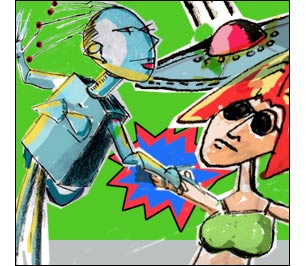
A gorgeous group of alien spawn hones a hedonistic hankering for sex.
MONTREAL — It’s an unusually balmy Canadian evening, and the lateral light of a late sunset is pinkening the glowing faces of a group of French speakers gathered outside the Salle du Gesy, a venerable pile of cut stone in downtown Montreal.
It’s an unusually convivial and touchy-feely crowd, even for Quebec, a province renowned for its bonhomie: There are lots of shouts of recognition, lingering hugs and an affectionate rubbing of shoulders and biceps. Most of them are beautiful, too — buff, tanned men in ribbed white T-shirts who’d look at home in Chippendale’s bow ties and striking women, apparently from every continent, staring newcomers like me directly in the eye.
This is a gathering of the Raklians, an organization whose members believe that the fact that the human race was created by extraterrestrials shouldn’t interfere with our hedonistic enjoyment of sex. The skinny guy in front of me in the ticket line, who looks like a bit of a “Star Trek” fan, does magic tricks for the ticket seller, pulling coins from her ears. She smiles sweetly: “Peux-tu me sortir un bisou aussi?” — how ’bout pulling out a kiss for me, too? — and he obligingly pecks her on the cheeks.
In the lobby, women dressed in white are passing out pamphlets for UFOland, a kind of alien amusement park in the countryside outside Montreal (“Exact replica of a UFO! World’s biggest building made of bales of straw! World’s tallest replica of DNA!”). The Raklian movement isn’t, I’ve been assured, a millennial death cult. Which is a good thing because, judging from all the beatific smiles and unconditional love around me, I get the feeling I’m one of the few non-Raklians in the building tonight.
I enter the auditorium and sit down next to a tall blond woman, who is outfitted with a white halter top, a furry white purse and tight white pants. She turns to me, fixes me with baby blue eyes as round as saucers and asks, in heavily accented French, where I first heard the message. “Boulevard Saint-Laurent,” I deadpan, the Montreal street where I was handed a pamphlet for tonight’s conference on human cloning by a Raklian on roller blades a few weeks ago. Ivana, as she’s called, tells me she heard the message from her brother, and that she left her native Warsaw, Poland, to be near other Raklians in northern France. I ask her if she lives in a community, but she shakes her head: “We’re free to come and go as we please, you know.”
Ivana tells me she moved to Quebec about five months ago to be near Rakl himself and is making her living as a dancer. This being Montreal, one of the world’s leading dance capitals, I reflexively ask her what troupe she’s with. “No,” she says, looking at me as though I was a bit of a dunce. “I dance in the clubs.” Riiight: I’d heard that a disproportionate number of Raklians come from the exotic-dance community. Every few minutes, Ivana interrupts our conversation to hiss ineffectually at a toddler in a print dress running rampant in the aisles: “Isis!”
The Raklians claim about 35,000 members worldwide, and though only 4,000 are French Canadian, the fact that Rakl himself now lives here has made Quebec the organization’s de facto headquarters. He has found fertile material for recruiting in this predominantly French-speaking province. Though 85 percent of Quebecois still identify themselves as Roman Catholic, church attendance here is the lowest on the continent, with only 15 percent of the provincial population actually showing up for services with any kind of frequency (vs. 21 percent of Canadians overall and 40 percent of Americans). That doesn’t mean spirituality has vanished from Quebec, however. It has just veered toward the flaky and esoteric, so that there are now 800 sects and religions to choose from in the Montreal area alone.
Quebec’s more notorious New Age religions include the cult of Roch “Moses” Thiriault, a Seventh-Day Adventist who one day saw the light, declared himself “Oint the Eternal” and took his brood to the remote Gaspi Peninsula, where he oversaw amputations, castrations, disinterments of rotting corpses and brawls among the survivors. (Thiriault comes up for parole this year.) Then there’s the infamous Order of the Solar Temple, a cult founded by a Belgian homeopath whose local branch boasted the former mayor of the town of Richelieu, several journalists and a vice president of the local hydropower utility — before they committed mass suicide, embarking on that long voyage to Sirius.
The Raklian movement, thankfully, has a reputation for being a little less demanding of its followers. Rakl is actually Frenchman Claude Vorilhon, a former automobile journalist, who explains in his book, “The True Face of God,” that he was taken to the planet of the Elohim in a flying saucer in 1975, where he was introduced to noted earthlings such as Jesus, Buddha, Joseph Smith and Confucius. The Elohim, small human-shaped beings with pale green skin and almond eyes, were apparently the original inspiration for the Judeo-Christian God. They informed Vorilhon that he was the final prophet — sent to relay a message of peace and sensual meditation to humankind under his new name of Rakl — before the Elohim would return to Jerusalem in 2025.
They didn’t oblige him to give up race-car driving, however, and Rakl spent much of the ’80s and ’90s whipping around the world’s racetracks in his beloved Mazda Rx-7 Turbo. (Now in his early 50s, he’s in semiretirement from the stock-car tracks, though he has been known to enliven his speeches to the converted with videos of past racing exploits.) The theme of tonight’s lecture, cloning, seems to be linked to Rakl’s conviction that the human race was created in the laboratory 25,000 years ago from the DNA of aliens.
A friend of mine who spent a week at a Raklian sensual meditation camp in the Quebec countryside came back with a mixed report of the experience, which sounded like a cross between a nudist camp and a New Age retreat on the California coast. The rules were simple: Everybody was free to say no to a sexual invitation, nobody had the right to feel jealous or possessive if his or her lover desired another and the wearing of condoms was mandatory. The place was filled with gay men, girls fresh off the plane from Japan, Swiss women walking around naked and far too many Quebecois studs for my friend’s taste.
He’d been expecting some kind of smorgasbord of free love, and was disappointed to find that the disproportion of men to women meant that couples paired up early on and stayed together for the whole week. Suffice it to say that he came back to Montreal a frustrated lad. But not a bitter one: “It would have been paradise,” he told me, “if I hadn’t had to listen to Rakl natter for six hours every day.” In fact, some of the Raklian men confided to him that they accepted the religion’s basic message — namely, that there is no God or soul and our creators’ greatest gifts to us are the beauty and sensuality of the human body. They just stopped listening when Rakl started talking about UFOs.
As extraterrestrial religions go, the Raklian Movement International, as it’s sometimes called, seems to be a fairly benign one. The organization stirred up controversy in 1992 when it responded to Quebec’s Catholic school board ruling on birth-control dispensers by handing out condoms outside schools. And litigants in Switzerland have accused some Raklians of being pedophiles, citing Vorilhon’s entreaties to “awaken the spirit of your child, but also his body.” But Rakl subsequently distanced himself from such practices. Most of the criticism has come from the families of new acolytes, some of whom dislike the fact that they are required to kick back a 10th of their income to Rakl as a tithe.
In the 1995 book “The Gods Have Landed,” Susan Jean Palmer, an expert at Montreal’s Dawson College on what sociologists call “new religious movements,” has found little evidence of nefarious activity among the Raklians. Recounting one of the monthly Sunday meetings at Quebec’s Holiday Inns, Palmer described the style of feminine dress as ranging “from elegant Paris Match, to punk, to (apparently unconscious) parodies of Brigitte Bardot in her St. Tropez heyday.” Certainly enough to keep the stray bodybuilders of the Me generation coming back for more. Like the followers of Bhagwan Shree Rajneesh before them, the Raklians are essentially members of a lifestyle cult. In increasingly irreligious Catholic societies, Rakl’s success seems to derive from providing a structured environment for decadent behavior: He offers a no-guilt playground for hedonism and sexual experimentation.
As the auditorium continues to fill, I notice that Ivana’s interest in me has waned since she learned that I don’t really have the fundamentals of the “message” down, and her gaze wanders to the elaborately muscled men milling in the aisles. But then the lights dim and the evening begins: Brigitte Boisselier, dressed in a wide-brimmed hat and elegant high heels, strides onto the stage and explains that she is a biochemist who was fired from the French firm Air Liquide, as well as declared a “dangerous mother” by the French state because of her advocacy of human cloning. But now, she says happily, she is a bishop in the Raklian movement, and cryptically warns us “not to expect a politically correct evening!” Next onstage is Richard Seed, a Boston-based lecturer famous for declaring that he wants to be the first human to be cloned (“after, of course, my wife, Gloria”). He welcomes cloning as the first step toward rejuvenation — a balding fellow with bad posture, he repeatedly mentions how nice it would be to be 22 again — but besides that, he says, “clones will be fun.” Seed is at pains to inform us that he’s a Christian and a Methodist. (That’s a relief, because if there’s one thing I can’t stand, it’s a Muslim Methodist.) I can’t help wondering what this guy with a suit and tie and a doctorate in physics from Harvard is doing in this roomful of French-speaking UFO enthusiasts.
Finally, after being introduced as “the prophet of the third millennium,” Rakl himself strides onto the stage. Short, with an utterly receded forehead and the remains of curly black hair drawn up into a topknot, he looks a bit like a samurai warrior crossed with the Man From Glad. He’s wearing an all-white shirt with huge shoulders, baggy white pants and white slippers, and he sports the heavy silver medallion I’ve seen around many necks here: a Star of David filled with swirls. (The swirls used to form a swastika, but apparently a fair number of Jews were offended by this attempt at reconciling such a terminally opposed yin and yang.) Somehow, I have trouble convincing myself I’m in the presence of a divine messenger. Rakl has an accent that makes it sound as if he’s trying to dislodge a wad of phlegm, or perhaps a mussel, caught in the back of his throat. Which makes me suspect that I’m actually in the presence of a Belgian.
Rakl paces around like a seasoned stand-up comedian, working the crowd. He announces that he has just gained his Quebecois citizenship, and half the audience is on its feet to clap in congratulation. “Unfortunately, I have to be Canadian too!” News flash: Rakl is a separatist! “I’ve written a book called ‘Vive le Quibec Libre,’” he adds darkly. After taking a couple of shots at the pope (“The difference between me and Jean Paul II is that, every year, everything that he says is proved to be false, and everything I say proves to be true!”), he turns to the main theme of the evening. He doesn’t want to encourage human cloning in order to create lots of little replicas of himself. He wants to clone himself so he can live forever. “Do you want to die at the age of 35?” he asks. “No!” is the resounding reply from the audience. Actually, judging from the youthful beauty of most of the people in this room, I’m beginning to suspect that I’ve stumbled onto a sect inspired by the ’70s science fiction film “Logan’s Run,” in which those over age 30 are not only distrusted but also vaporized. And as an English-speaking writer in a roomful of French-Canadian hedonists, I feel like I’m 32 going on 50.
What’s more, I’m blatantly scribbling on a notepad just as Rakl is having a go at the journalists in the room. Distancing his religion from the Solar Temple and the Branch Davidians, he confesses his disgust with lazy reporters. “I used to be one myself, you know,” Rakl continues. “But why do the journalists always call me for comment when there’s a collective suicide? I don’t want to die! I want to be around to piss them off for a long time!” The crowd responds with roars of delight.
Ivana, I’ve noticed, is eyeing my dancing pencil with a look of resentment. Against my will, an image straight out of the remake of “Invasion of the Body Snatchers” springs to mind: Ivana leaps to her feet, points to me in a rage and shouts the word “journalist” from her inhumanly twisted mouth. A circle of toned and tanned bodies inexorably closes in on me, and the scene fades to black as I disappear beneath a pile of writhing lap dancers.
The Raklians have a very nice little religion, I say to myself, gathering up my journalistic impedimenta and making a quick exit. They might even be fun to hang out with for a summer, practicing a little sensual meditation with a United Nations panel of strippers — if only it weren’t for all that UFO stuff. The problem is, I can tell my pleasure would be ruined by the knee-jerk curiosity inculcated by my own sect, the Newsman cult. Too many questions are already springing to mind: What happens if you neglect to pay Rakl his 10 percent tithe? If the Elohim created humans from their own DNA, who created the Elohim? Most important, what happens to Raklians when they get old?
Since I ask questions as obsessively as most true believers avoid them, it’s a foregone conclusion: I don’t have the requisite faith to make it as a Raklian. In fact, I say to myself, emerging dazed into the comforting Montreal twilight, I probably need a little deprogramming myself.
Absinthe makes the heart grow
Taras Grescoe explores the dangerous and alluring effects of absinthe on a pilgrimage through Barcelona's Barrio Chino
It drove Baudelaire to Belgium, then to an early grave; it left Paul Verlaine a hollow-eyed wreck, wandering from bar to bar in Paris’ Latin Quarter accompanied by a misshapen shoeshine boy named Bibi-la-Purie. The deaths of Vincent Van Gogh, Oscar Wilde and poet Alfred de Musset were hastened by their inordinate love for this poison, long-since banned by the thinking men of all civilized nations. Except, of course, in death-defying, devil-may-care Spain, where 136-proof absinthe is about as common as orange Fanta. I’d come to Europe determined to uncork the liquid muse of the avant garde, the licorice-flavored, high-octane herbal alcohol popularized by a French doctor in 1792. I’d discovered that in the nation of his birth, absinthe’s sale had been strictly prohibited since World War I, but that in Spain, absinthe is considered just another aperitif, as familiar as vermouth and Campari. I’d found what the Spanish call Absenta in liquor stores in Madrid and in just about every bar in Catalonia; hell, I’d even found liter bottles of the stuff in the window of Can Canesa, the great grilled sandwich shop in Barcelona’s Plaga Sant Jaume. And now I was in Barcelona’s Barrio Chino — the infamous warren of narrow streets where Jean Genet set “A Thief’s Journal” and the Divine Dalm went slumming — finally face to face with my own glass of La Fie Verte, the 19th century hallucinogen that, in its time, had ruined more lives than cocaine. To tell the truth, I had been a little worried about my date with the Green Fairy. Before my trip, the only two people I’d met who’d actually tried absinthe — both mild-mannered Canadians — had gotten into fistfights after only a couple of glasses of the stuff. With this in mind, I’d chosen my drinking companions carefully: Mary, a Scottish painter who’d fallen in love with Barcelona in the ’80s and stayed on through the booming ’90s, and Henri, a gaunt Belgian pastrymaker with the sideburns of a rockabilly singer from Memphis. He’d left Ghent only two days before, using a Renault truck to transport 55-pound blocks of chocolate across France at a top speed of about 45 miles per hour, to fulfill his longtime dream of becoming the first trufflemaker for the sugar-loving citizens of Barcelona. As drinking partners, Mary and Henri may not have been Sarah Bernhardt and Arthur Rimbaud, but they had forged their friendship over countless glasses of absinthe, and knew its rituals. What’s more, under their tutelage, I was pretty sure that I wouldn’t finish the night in jail. We had started the evening at midnight (this being Spain, after all) in the Bar Marsella, which, though recently purchased by two hefty Anglo-Saxons, has been preserved intact as a kind of monument to the fast-fading bohemia of the Barrio Chino. In the Marsella, yellowing posters for long-forgotten aperitifs curl on the walls, the paint peels suggestively and half-a-dozen different tile patterns jockey for space on the undulating floor. A young waiter had brought us small brandy glasses full of clear, oily-looking absinthe, along with all the attendant paraphernalia: a bottle of water, paper-wrapped lumps of sugar and a three-tined trowel. In the classic version, one sets the trowel on the rim of the glass and slowly strains the water through the sugar cube into the absinthe until it dissolves. (Water wasn’t the only mixer for absinthe, however: Singer Aristide Bruant drank it with red wine, and Edgar Allen Poe took his with brandy. And died, incidentally, at the age of 40 of a heart attack after a prolonged drinking binge.) Mary introduces me to a local variation: I allow a sugar cube, squeezed between forefinger and thumb, to soak up the absinthe, which is 68 percent alcohol. Then, placing the cube on the trowel, I light it on fire until the alcohol burns off. After stirring the dissolving cube into the absinthe, I fill the glass three-quarters full with water, provoking a remarkable transformation. The liquid turns milky green — a color Oscar Wilde described as opaline, though to my eyes it looks more like a happy marriage of crhme de menthe and whipped cream. In the murky half-light of the Bar Marsella, my glass of absinthe appears to be glowing from within.
Continue Reading Close