Theresa Pinto Sherer

A lost soul

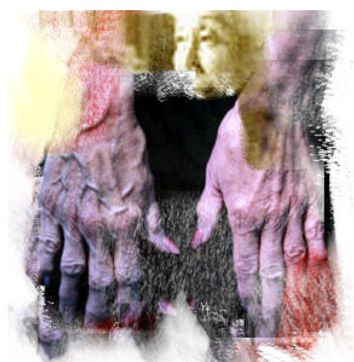
After her strokes, my grandmother is still here. But what is left is base behavior and compulsion, unleavened by charity, kindness or faith.

  • more
    • All Share Services

A lost soul

The Estates of Ft. Lauderdale aren’t really estates, nor are they in Ft. Lauderdale. They are a neatly plotted collection of well-maintained mobile homes that were recently annexed into the city of Dania Beach, Fla. It is where I grew up, with my mother, my two sisters and, just one block away, my maternal grandparents.

My son and I enter the only home I have ever known, the one I remember clearly from my childhood, and my grandmother is walking down the hallway in two shirts and no pants. She looks slightly disoriented, but you can tell she is in a good mood today. Her legs look boneless and all wrinkled skin, hanging loosely from the skin at her hips which hangs loosely from the skin above that. We tell her to go put some pants on, and she reemerges 15 minutes later, with a different shirt on over the ones she was already wearing, but still no pants. Eventually, she will get them on and we will go for our daily breakfast.

When we return, my grandmother drifts slowly down to her bedroom, where she does mysterious things that I can only guess at, moving objects from here to there, folding and refolding her sweaters, moving her money from one hiding spot to another. Today, she comes back holding a full bottle of small white prescription pills, a rubber band and her toothbrush.

In the two years since her stroke, I have grown accustomed to this erratic and odd behavior, which turns out to be not so unusual for stroke victims. But it is odd to me, since she was the domestic anchor of our family for so long, the stereotypical Italian grandmother. As with most immigrant Italian families who can still find their names on the Ellis Island wall, our family was headed by a matriarch who cleaned, cooked and took care of the children. When my father left us, and my mother had to work to support us, my grandmother watched my younger sister and me day after day.

Now it is hard for me to visualize the grandmother who helped raise me, who taught me how to cook and clean; I can’t remember how she used to be. I see “before” pictures and just as she does not recognize her new, poststroke face, pointing at herself in recent photographs and saying, “Elsie” (her name is Nicolena), I do not recognize her old one. I moved to California for four years, and her strokes occurred during this period, so there was a disjunction. When I left she was my Italian grandmother, apron securely fastened. When I returned, she was a shrunken remnant of her former self.

Though I am not blood-related — my kinship comes through adoption — all the women in my family have some part of my grandmother running through our veins. She is imbedded in our systems, and my mind is rampant with memories. I cherish my recollections of her getting her hair styled and set each week. She was of the old school, with a high bouffant that she picked each day and wrapped each night before bed. As the week progressed, she’d get a slight bare spot near the back of her head, and I would stare fixedly at it each day as I watched it get bigger and bigger.

One of my most vivid memories, documented by an old Polaroid snap, is of my grandmother getting tipsy from rosé table wine, a mainstay at our dinners. I caught her singing in her high soprano, dancing with her arms above her head, a goofy and endearing grin on her face. She taught me all the card games that I know. I was content, all through my teenage years, to stay at home and play Continental, Michigan Rummy or Gin with her, rather than go out.

The history of my grandmother’s disease goes something like this: She suffered a few transient ischemic attacks, or TIAs, before her big one, the hemorrhagic attack that killed part of her brain and forced doctors to remove a section of it. Diagrams in an American Heart Association (AHA) pamphlet, which I suppose are given out to comfort and inform family members, show a brain overlaid with labels for the various control zones. Sight here, hearing there. But it leaves out something that I’ve come to identify over the past two years since I’ve been back, that part of her we most miss: her soul.

The doctors removed only a portion of her brain, along the frontal lobe, which had been damaged already by the hemorrhaging and, according to the AHA diagrams, controls speech. They might attribute certain changes in behavior to strokes, a form of vascular dementia, but the real truth is, her soul has been blighted and all that is left is behavior and compulsion. I have become convinced that our physical brain, and the sentience it allows, is much more than a sensory organ. It has evolved beyond that. It directs and guides our chaos of emotions and passions into productive, empathetic, creative avenues. For lack of a better word, it is soul.

The removal of that part of her brain also took away her most beneficent attributes, her charity and kindness and faith, and left them as transient ghosts that appear every once in a while, and less and less over the years. What became more prominent is what I consider to be her base behavior, what she most likely was born with and exhibited as a child, only flavored now with years of experience. She is an amalgam of obsessive operations, like a series of slow-going ticks, collected over a lifetime. She hoards money, she habitually cleans up and throws away perfectly good items, she continually applies lipstick. If we start to argue, which is common in our family, she will begin to yell right along with us without knowing what we are talking about.

On good days, she’ll talk animatedly so that you think she discerns the world again, even if we only half understand her. She basks in the warmth of center stage. But on bad days, when the world seems a little less friendly, she wanders off, a frown of depression spoiling her aged face, or hides in her bedroom with the door shut. All passion and emotion remain, without a cognitive spirit to guide her.

Clinically, she might be considered an obsessive-compulsive. But all the stroke-related information that I can find on the Internet mentions things like depression, physical therapy and paralysis. I read testimonials about families having to adapt to wheelchair disabilities or victims becoming independent once again after an attack. Nothing seemed similar to my grandmother’s case. I find out that it could be vascular dementia related to the stroke, but, as my mother reminds me, these behaviors always existed in my grandmother — left with nothing else, they now make up the hugest proportion of her personality. She is a shallow pool. Still, I find her new personality to be endearing and quirky. I consider it a variation on her style, based on Oliver Sacks’ notion that “‘Style,’ neurologically, is the deepest part of one’s being, and may be preserved, almost to the last, in a dementia.”

The next time I visit my mother, she tells me to look out the front door at the fading pink clothesline that hangs on her porch, the round kind with a dozen or more clips used to hold wet and dripping clothes. Today, in each clip, there is neatly placed a single puzzle piece from a puzzle my younger sister had been working on two weeks ago. For days, we had wondered about the 29 missing pieces of that puzzle.

I asked, not that it was really necessary, “Who did that?” “Who do you think?” was the response.

According to the American Academy of Neurology, nearly three-quarters of a million people in the United States suffer a stroke each year and 190,000 of those die. It is the third leading cause of death in this country. As an evolutionary biologist, I wonder about the role of strokes in our biological trajectory. I can’t help but contemplate the fact that recent studies show an increase in strokes, just like we see the numbers for cancer go up each year, resulting in more research and treatment, all coincident with the prolonged life that humans in developed countries enjoy. I am one of those who sometimes takes a reductionist viewpoint, that when we tamper too much with nature, we get all sorts of unnatural results. In other words, my grandmother would have died without medical intervention and surgery, and could have forgone two years of depression, chaos and dependence.

Then something will make me realize, maybe one of those rare good days, that she still loves to laugh. On a recent Sunday afternoon, my mother — who has taken up the role of matriarch — filled the table with the ravioli and meatballs she’d prepared. My grandmother was talkative, inquiring, asking pertinent questions, even making a little sense. Some event would set her off, and she would take a few moments to laugh raucously, uncontrolled and out loud for several minutes. It was infectious. And as her granddaughter, I was suddenly glad that she did not die from her strokes and continues on life’s journey. I enjoy her new self as much as I did her old — the afternoon tea we take together, how easy it is to make her laugh and her unintentionally modern short gray haircut.

When I get a rare moment to myself, I think about my grandmother. I see the cycle of compulsion and control and cleaning winding itself around to my mother and my sisters and me. I worry that I might someday end up in the same situation. I wonder if right now, today, she is using a No. 2 pencil to line her eyes or writing a note with her lipstick. And my only wish for her is to leave this world, when it is her time to go, peaceful and happy — at last.

Identity crisis

Decades after becoming an Italian-American Korean, I learn the truth and wonder: Why was I abandoned on the street, a note pinned to my shirt, at the age of 3?

  • more
    • All Share Services

Identity crisis

Memory is so indelibly bound up in words, the symbols that stand for the objects that make up remembrance. Twenty-five years ago, I spoke a different language in a different country and lived a different life. Yet I have no memory of it. I was just 3 and by the time I was 4, I had been adopted by an Italian-American family living in South Florida, I spoke flawless English and I had neatly forgotten my past. I began rebuilding my identity from scratch.

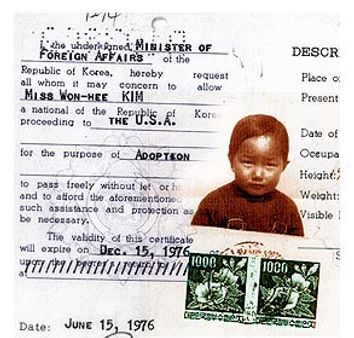
Twenty-two years later, my mother revealed to me that just before I was adopted, I had been found on the streets, wandering alone with a note pinned to my shirt that read, “Kim, Won-Hee. August 20, 1972.” It was handwritten, not in the letters of the English alphabet, but in the calligraphy of Korea, the country where I was born.

Upon hearing this news, the writer in me immediately snatched it up as something to develop and spread around like so much confessional compost. But the little girl in me was scared and a bit sad. Up until the age of 3, I lived with someone — a guardian? a parent? — who cared for me. Then, for some reason, I was abandoned.

I could refashion the story to my liking, giving it elements of adventurousness and tragedy, claiming ownership of an exotic past that would never settle into a neat little pile of events and facts. But in reality, my past became an even bigger black box than it had been, for I had always been told that my parents were dead, and now that story was a symbol of mendacity.

One of my adoptive mother’s habits is to spring news like this on me, but in a guileless manner, as if she assumed I already knew what she was about to tell me, her mind forgetting that she once colluded to keep certain things a secret. On this occasion, she responded with astonishment when I appeared shocked at her admission. Perhaps as a gesture of consolation, she proceeded to give me a box of official papers, aging documents with seals, stamps and signatures on them. They are all I have to tie me to my Korean past.

All my life I have fought against what I perceive to be normal and conventional, because I have feared that if I did not struggle, my true self, which would undoubtedly be average and nothing special, would begin to show. I was afraid that I would be what novelist Frederick Exley was afraid of being and what drove him to alcoholic insanity — a fan, someone to sit on the sidelines and cheer for those who take the center stage in life. After my mother told me about my inauspicious beginnings, I clung to the scant details and added them to my ever-changing identity; it was a way of knowing that I, too, had an extraordinary story to tell.

Then I learned, after some journalistic digging, that my situation was not peculiar for the time or place; most children who were orphaned in Korea were orphaned in much the same way I was, since it was essentially illegal to give away children who had existing relatives. The thousands of children who were eventually adopted usually had been left covertly on street corners and in alleyways.

Korean intercountry adoption by Americans and Europeans came into existence because of the Korean war, which also is nothing unusual. In numerous and obvious ways, war makes orphans of many. But Korean adoption was the second and largest wave of intercountry adoption since German and Greek children came after World War II. It was also the most noticeable wave (which I experienced through the racist taunting of my primary school years); the European kids, for apparent reasons, were less conspicuous.

It was almost fashionable to adopt Koreans after the war, much the way adopting young girls from China or children from Eastern Europe is in vogue today, and more than 100,000 kids — the majority of them female — are estimated to have made the trek from Korea to the United States or Europe since 1954.

If you visit one of the many Web sites devoted to tracking down and reuniting Korean families with the children they once gave up, you see the emotional damage laid bare. Women who do not remember the exact year they gave birth plead for help in locating their child who may be 26 or 27 and may or may not be living in the Netherlands. Young adults seek out details of their heritage in desperate hope of enlightening themselves about themselves.

Strangely, I have never felt the urge to find my own biological family. I admit that I am a little afraid of such a search, but mostly I am just apathetic. While growing up, I often mentally perceived myself as “white.” What surprised me is that in this, I was not alone: A recent survey of Korean-Americans adopted between 1955 and 1986 shows that more than half saw themselves in the same skewed way, describing themselves as Caucasian. Many times I too forgot that my origins lay halfway around the world. But I am not ashamed of my heritage. Over time I have become very proud of my slanted eyes and flattened face, but these traits are not central to my existence or my common bond with society as a human.

When it was my turn to be given up, I was one of the “lucky ones.” My note very specifically spelled out my name and my birth date; I spoke full and flawless Korean so that I could communicate my needs; I had been found not long after I was abandoned. My younger, adopted sister, who came into the family two years after me, was one of the unlucky ones. Her note was lost, and no one knows exactly how long she was left to survive on her own, but it was long enough to bow her legs and weaken her bones from malnutrition, to put disease into her gums and to essentially break a young child’s spirit.

The lone picture of me taken right before I left Korea for the first and last time, snapped outside of what I assume are the walls of the orphanage, shows me to be a petite girl with remnants of baby fat still clinging to my cheeks, ostensibly healthy and striking an almost military pose, arms stiffly at my sides. My hair has that slicked-down, Louise Brooks “Diary of a Lost Girl” look that is probably common to all such places, and my face has a shine to it. It’s as if the photographer asked me to smile for my new parents, and maybe relayed to me that I was going away to America. But, sad and perplexed, I could only give him a mild look of defiant confusion. My picture, so different from my sister’s, at least shows that I was not defeated; hers limns out a bleak existence, with her standing forlornly against a white wall. She just looks lost.

In 1976, I came to New York, literally with the clothes on my back and a single, official “travel certificate,” which permitted me “to pass freely without let or hindrance … for the purpose of adoption.” I was approximately 3 feet tall and weighed 28 pounds, only three pounds more than my 10-month-old son weighs now. I am told that I adjusted very quickly, that Korean Social Services, the government agent responsible for my adoption, must have taken good care of me, though I arrived carrying scabies and with a bandage on my forehead. Two years later, almost to the day, my younger sister arrived and I was there to greet her. I felt part of a family once again, and I strove to ensure that she would shortly feel the same.

What I ask now is, why at the age of 3? If I had been left as a newborn, my Korean family would have been abandoning an infant, an almost blank slate, unable to express who she was at this nascent stage. And I can understand the circumstances that may lead a person to do that, such as the financial inability to feed and clothe and take care of a new baby.

But by leaving me at 3, they were abandoning all I had become in those years; they were forsaking me as a young person, a girl named Won-Hee Kim. They were not saying, “We cannot take care of you,” but, “We no longer want to take care of you.” And I wonder what I was like, what it was about me that caused this action, since in our solipsistic society, I know in the end it must have been my fault. Like a child of divorce, I fear the blame rests on my shoulders, even if, rationally, I know it’s likely they just wanted a better life for me, and saw America as a shining beacon.

On this side of the world, I had a ready-made family waiting: a 12-year-old sister, two parents, two sets of grandparents, one aunt and her son. When you meet me, you meet all of them, imbedded within my personality. Most noticeably, I talk with my hands and stuff food down people’s throats. Yet I believe in the theory of evolution, having studied it for nearly seven years, so I know that the nuances of my personality were predisposed before I was walking and talking, before any environmental influences had time to take hold. But we all know that a person develops as a confluence of nature and nurture, so I wonder: What behaviors do I have that are a remnant of my first three years of life? What still connects me to that far and distant country?

One thing I know is that I don’t have a solid foundation in myself. I never quite know where I belong, and this I definitely attribute to my chaotic beginnings. Like many people, I have always felt isolated and apart, trying a bit too hard to find my rightful place in the group. But my new knowledge of my initial start in life has helped me to reconcile this aspect of myself, putting a cause before the effect, showing me that my rootlessness does not come out of nowhere.

I occasionally wonder why my mother adopted two Korean girls to begin with. When I ask her, she will respond, “Because I love children and would’ve adopted dozens more if I could have.” Yet I look around and see her slightly improper infatuation with all things Asian and the picture on the wall of a birth daughter that she lost at the age of 3. If I ask her about the Asian fetish, she swears up and down that she is not obsessing, but that she was one of us in a past life. She just knows it. By this I am to understand that she has an unspoken kinship with Asians, even though she won’t eat bean curd or shrimp heads.

When we talk about the death of her second biological daughter, Diane, she claims the loss had nothing to do with our adoption and the coincidental age of 3. She would have adopted anyway, she says, because she wanted a houseful of children and planned on sending for two boys after Diane was born — before she found out that Diane suffered from the rare genetic disorder that would kill her. Though I can’t help wondering what subconscious motives lay about, when I see her loving and familiar face, the one that has been with me for 25 years, the one that has never abandoned me, I neatly forget all that.

Unquestionably, I am happy to be here, and I am happy to have become the person that I am. The recent turn of events, the attacks on the World Trade Center and the newfound insecurity that has befallen us as a nation, have only cemented my identity as an American and in an ironic emotional twist, left me more secure than ever as to who I am and where I belong. Since I am an Italian-American Korean from New York, I have an immigrant’s appreciation of America, but also now an American’s appreciation of America.

I have never doubted who my “real” mother is. (Ironically, four years after I came to America, my adoptive father left, so he is a somewhat nonentity in my life.) But now I have a son of my own, and my mind more and more wanders over territory littered with terms that purvey a sense of a knowing past, like “family medical history” and “genealogical tree.” My curiosity about my roots has increased a thousandfold so that I am compelled to seek out more knowledge of my other short past, but from a safe and objective distance. I am not yet to the point of looking for my birth parents, and I may never be.

I consider myself a survivor of all that has been heaped upon me through no volition of my own, no different from the rest of society, moving from one event to the next, whether good or bad. I mean, I don’t carry around many emotional bruises from these humble beginnings. I adapt quickly. My sister slept with a bag of bread, among other things, for years, while my only visible scar, if it can even be attributed to the healing of a wound, was my use of a night light throughout my teenage years. Really just a carry-on, not true baggage.

But I still like to sleep with the lights on, perhaps to make sure that I won’t be left alone in the dark once again.

Continue Reading Close

Baby loves me, baby loves me not

Is there a biological guarantee that your child will love you? Not yet.

  • more
    • All Share Services

Baby loves me, baby loves me not

Get ready for battle. That’s what friends and family, and all those concerned strangers, should have told me. Not about the sleep deprivation or the Moro reflex or the funny breathing. The first few months of caring for a baby are like being under attack: Pitched fevers of hyperactivity require your constant attention; then sudden moments of edgy silence ensue as the baby sleeps and you gather your strength for the next onslaught.

Most of us will admit, however, that it is worth it. A great passion overwhelms us and grows for our children as they grow up. We simply take the emotional steps necessary to do this and never turn back. We begin to utter those words and we wait for the moment when they will say them back to us. The smiles and coos work for a while, but eventually we need a bigger return on our investment. We need to hear those words. I love you.

But this is a dubious event, with no prescript guiding our children to it, no law stating that a child must declare love for his or her mother or father or anyone else — with or without conditions. What if Murphy’s law ruled, and all the diapering, bathing, feeding and playing led to just a sort of mild appreciation?

We are all familiar with what happens when a child is deprived of maternal love (or love of any kind) during those crucial developmental years — the possibility of physical debilitation, mental illness and even psychosis. But what of a mother who is deprived of a child’s love? The bleak possibility leaves me feeling inept and afraid. Each day my son and I visit tiny traumatic experiences, unavoidable really, but I wonder if they make a lasting impression, deep enough to wipe away any growing feelings of affection.

Love is obviously a dominant trait among human beings. As a biologist, I have wondered if there might not be a gene that controlled it, spread it throughout the human population and made it subservient to the principles of heredity. But this was wishful thinking on my part, less the hypothesis of a scientist than the optimism of an insecure mom.

Actually, the idea is not so far-fetched. The Human Genome Project is making great strides in helping to uncover genes for numerous social behaviors or, rather, aspects of human behavior that were once relegated to the realm of sociology. For example, we have laid claim to the discovery of genes for shyness, aggression, depression and homosexuality. (As an aside, I should mention that, as with most things, how genes are expressed is a far more complex process than a term such as “the gene for shyness” implies. But there is no space here for a lesson in genetics.)

Some 25 years ago, in his book “Sociobiology: The New Synthesis,” Edward O. Wilson combined evolutionary biology and animal behavior to posit the historical reasons for the existence of various social behaviors in all organisms exhibiting them — slime molds as well as humans. He used the tenets of population biology, ordered by natural selection and biological fitness, to look at societal comportment. As for love, he interpreted it as a part of self-sacrificing behaviors like altruism and prolonged child care, and, of course, as a component of sex. (He continued developing his unifying theory in “On Human Nature,” published three years later, in 1978).

The Human Genome Project, in many regards, is the molecular equivalent of sociobiology and even, to some extent, social Darwinism. But because of its pop science flavor and purported medical benefits, it does not have the same negative buzz as either of its predecessors. Sociobiology and social Darwinism both were contentious issues and afflicted in their time. (Maybe because of statements such as this: “The pattern of parental care, being a biological trait like any other, is genetically programmed and varies from one species to the next,” taken from Wilson’s text.)

But both sought to find biological reasons steeped in evolutionary theory for our social characteristics and the conduct that they entailed. While social Darwinists might postulate that the most fit members of a population are more likely to be shown the general behaviors attributed to love, and therefore have the highest probability of surviving the brutal design of nature, sociobiologists would say that the capacity to love is simply inherited.

Even though sociobiology never became vogue exactly, many biologists eventually warmed up to the ideas, albeit tweaking and interpreting them in a new and modern way. For Wilson, love was bound up in sex and altruistic behavior. For his scientific siblings, it may be bound up in histones and DNA.

And then there are those who believe love to be spiritual, mysterious and bound up in something not nearly as concrete as genes. For the deeply religious, like my mother, love is a ruling aspect of our lives, meant to guide us on the path of righteousness. For them it is a unifying thread for all humanity, binding us all in its sticky web. My mother believes that children are born with love like they are born with God. She could be right or she could be in what I call a state of biological denial. My mother, like most people, may not want to accept the idea that what she feels so strongly for her children and what her children feel for her are caused by proteins, synaptic firings and bodily fluids.

A friend of mine is of the opinion that a child’s love does not exist at all. (Nor does it blossom between two unrelated persons, according to her.) She thinks a child’s love is an emotional attachment, and there is some truth to this. Parents act as anchor and stability in a world that must seem very large and very chaotic to a newborn child. Caregivers are the first to give security and comfort — and they are loved for it. Later on, many of us will find new “love” attachments, with religion, work, a family of our own or even a bowl of soup. For my friend, maternal affection is the only true expression of love. But if you combine her opinion with Wilson’s theory, then no love remains at all, and this is a disheartening thought.

Perhaps novelist Haruki Murakami has found the key. In his short fiction “Man-Eating Cats,” he describes an adulterous affair not in terms of mere love but as total and complete empathy. Murakami implies that when we say “I love you,” we mean “I empathize.”

And this makes sense. The child who is with his or her mother day and night for months and months would eventually have to identify emotionally with that mother. It is entirely possible that, as humans, we may empathize more than we love, truly understanding what others are going through in this life, the unbearable weightiness of mere existence.

If this is true, then love need not prevail in evolution or religion or nonexistence. Perfect understanding is, well, more understandable and intuitively grasped than the idea of love. We can “get” someone much easier than we can love them. We can define “my understanding” better than we can define “my love.” So love need not exist at all.

Still, I want to hear my son say it, whether or not he can define it or clarify its origins. They haven’t found a gene for love or even begun looking for one as far as I can tell, but part of me hopes that they will. This is the only thing that gives me solace on those long, fussy days, when I question the why and what of this new journey I have undertaken. Rather than delve into the chapter on “Parental Care” or “Group Selection and Altruism” in Wilson’s text, I’d rather rest my mind on this thought: He has to love me; it’s in his genes.

Continue Reading Close

Can two men make a baby?

Researchers say it's possible, but lawmakers must pave the way.

  • more
    • All Share Services

Can two men make a baby?

It has been close to four years since the replication of Dolly the sheep — not a very long time considering the lumbering progress of science. Still, cloning now seems like an old, tired subject that pops up periodically in the media, a run-of-the-mill hot-button topic that has become a part of the American glossary of debatable issues, like gay rights or abortion.

Not coincidentally, each of these issues is inherently tied to the other: All involve life choices that revolve around sex, our national obsession. Of course, humanity’s preoccupation with sex is just a cloak for its true obsession with reproduction or, more precisely, immortality.

Most evolutionary biologists will tell you that all organisms are obsessed with reproduction and passing on DNA; yet I doubt the road to procreation for other sentient beings that may exist in the universe, regardless of their sophistication or culture, is as littered with condoms, sex toys, birth control pills, test tubes, child support payments and abortion clinics as our own.

For humans today, the rites of reproduction, not to mention the rights to reproduction, are more complex and more contentious than ever. But for the most part, creating a child still requires a woman and a man or, to be more specific, the DNA of an egg and the DNA of a sperm.

Yet when Dolly was cloned a link emerged between cloning and reproduction, and predictably, a controversy ensued. On the edges of it were people like Richard Seed, a physicist who wanted to establish a cloning clinic to provide babies for infertile couples. And then there were the Raelians, a cultish religious group in Canada dedicated to the belief that extraterrestrial scientists seeded this planet by way of cloning. (They have recently announced plans to clone a deceased child.)

Meanwhile, Randolfe Wicker, an unofficial spokesman for human cloning who founded the Clone Rights United Front, mixes science and gay rights activism. Currently the director of the Human Cloning Foundation, Wicker argues for human cloning as a means to copy himself in the name of reproduction and feels strongly that cloning should be used by any and all persons who wish to do the same. Clearly, with Dolly, the path to immortality has forked, creating options in reproduction that go beyond or around the “man and wife” route and focus on mixing DNA.

A plausible reproductive option that involves the manipulation of DNA is a laboratory technique called egg nuclear transfer. It has been suggested that this method of manipulating the DNA of human eggs now be applied to infertility cases in which the mitochondria (essential structures found in every human cell) of a woman’s eggs are damaged. Egg nuclear transfer, when used for infertility, would entail removing the DNA of the impaired egg and placing it into an enucleated egg — an egg that has been cleaned of its own DNA and contains healthy mitochondria.

Because it involves human cloning, egg nuclear transfer, and any further research that encompasses it, are illegal under the current laws of many countries. But legislation that would allow nuclear transfer research for infertility treatment was voted into law by the British Parliament late last month, igniting a debate about how use of the technique might be expanded to include controversial applications.

Dr. Calum MacKellar, a bioethicist associated with the University of Edinburgh, has been outspoken about egg nuclear transfer, expressing a concern that it could be used to “mate” the genetic material from two sperm cells to create a biological child from two men. Theoretically, the technique could be used to introduce sperm DNA into an enucleated egg, fertilize this “male egg” with another sperm and gestate the resulting embryo in a surrogate mother. (Of course, this could be done with the DNA of two female eggs as well.)

As simple as it might sound, this scenario is still somewhat remote, since the creation and fertilization of a male egg would require researchers to overcome certain biological obstacles, not just legislative and psychological ones. One such impediment would be the automatic response that mammalian gametic DNA seems to exhibit in which it recognizes the DNA of the opposite sex, otherwise known as imprinting. Nevertheless, MacKellar is concerned that loopholes in the British legislation allow research that could bring about the male egg. In the draft of a recent article, he asks rhetorically: “Would society accept such motherless children?”

Biologically speaking, egg nuclear transfer used for homosexual reproduction would closely mimic heterosexual reproduction, so, in essence, the resulting children would not be without the idealized two-parent home. The method does not replicate exact copies of humans, but instead allows all the necessary chance and mixing up of DNA that is standard in heterosexual reproduction, although the DNA doing the mixing would be sperm originated or egg originated only.

“That’s creepy” was the response of a gay friend of mine when I told him of the idea for male eggs. But he went on to say that he’s not against it, since he supports any and all varieties of reproductive freedom. Would he use it himself? “Perhaps, if it weren’t prohibitively costly.” Nevertheless, he’s not overly enthusiastic about the concept, as in, “I don’t feel liberated by it.” Probably because he’s not determined to have children of his own genetic makeup and views adoption or surrogacy as perfectly suitable alternatives.

Felicia Park-Rogers, director of Children of Lesbians and Gays Everywhere in San Francisco, agrees with my gay friend. She acknowledges the human desire for a child of one’s own flesh and blood and advocates “as many ethical options as possible” to create a family. Though she is resolutely opposed to human cloning for reproduction — which she views as an act of pure narcissism — the bearing of children by way of egg nuclear transfer, she says, is “a perfectly ethical option” for gay and straight parents.

Since most humans react with knee-jerk revulsion to the words “cloning” and “reproduction” when used in close proximity, egg nuclear transfer for purposes of reproduction will be a hard sell. A gut-level aversion to cloning for reproduction may be somewhat instinctive, at least as far as evolution is concerned: Human cloning technology in the name of medical research is expected to remain outside the process of procreation; cloning as a mode of reproduction muscles into the natural order of the species.

Nevertheless, it is clear that much of the queasiness about human cloning for purposes of reproduction will be motivated by homophobia. Protests against male eggs will not just be about the issue of cloning but about homosexuality and the rights of gay men and women to have biological children.

It is hard to imagine many people being inimical to the newly mandated purpose of egg nuclear transfer, which is to give infertile couples a chance to start a family. But are we ready to view homosexual couples as clinically infertile? Will we define basic human reproductive rights as being available to everyone, regardless of sexual orientation?

During our correspondence, it became very clear that MacKellar is against the use of egg nuclear transfer by homosexual couples to create genetic offspring — for “theological reasons.” Park-Rogers, on the other hand, asserts that “any time we’re looking at new ways to reproduce, we need to look at what’s [ethically] best for families and children. So I would hate to see homophobic discrimination take part in blocking this in any way.”

The scientific community spends millions of dollars on infertility research; couples spend millions on infertility treatment. Infertile couples everywhere have moral, ethical and legislative support as they struggle to have offspring. How would we justify the limitation of this expense and support to heterosexuals? Who deserves to have genetic offspring?

Those who have challenged the prerogative of infertile couples to have children often allude to concerns about overpopulation, the unnaturalness of reproduction via a laboratory setting or the great numbers of orphaned children available for adoption. But as MacKellar points out, most of us are driven to have offspring who look and act like us. Whether this is due to our quest for immortality or the hypothetical selfish genes (the idea that DNA has devised ways to perpetuate itself regardless of the organisms housing it), it is a drive that exists and cannot be denied.

Some may argue that a government — any government — does not have jurisdiction over a person’s right to bear children and should not pass laws to govern a person’s DNA. But like it or not, legislation will dictate which direction we end up taking in this matter. (Even as I write this, MacKellar notifies me that scientists have proposed another way in which men could make babies of their own — by reprogramming cells from cloned embryos to change what was to become sperm to become an egg.)

Eventually, lawmakers will have to give in to the pressures of scientific progress, if not progressive thinking. Yet even if researchers are permitted to bring these technologies into reality, it could be four more years — maybe fewer but most likely more — until anyone, even heterosexual couples, would benefit from them. One hopes that, in that time, a principle of fairness will prevail and the law will be clear, so that use of reproductive technologies will center not on discriminatory doctrines but on the fundamental rights of freedom and choice.

Continue Reading Close