Thomas Goltz

Morning in Montana

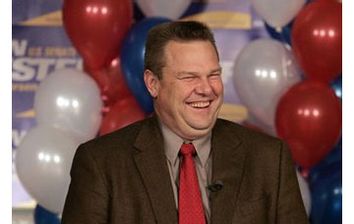
After a long night, big Jon Tester claims victory and delivers the U.S. Senate to the Democrats.

  • more
    • All Share Services

Morning in Montana

“Settle in, and get yourself a stiff drink,” suggested Montana Gov. Brian Schweitzer to a ballroom filled with worried Democratic Party faithful just before the bars closed on Election Night. The state — and the nation — were waiting to see if the razor-edge lead of Democratic senatorial challenger Jon Tester over incumbent Republican Sen. Conrad Burns would hold. “Tomorrow, we are going to have a new senator, and his name is going to be Jon Tester.”

Not long after, shirttails flapping and oozing confidence, the candidate himself bounded to the podium to reassure his cheering supporters. Tester, a 50-year-old farmer from Big Sandy with a flattop haircut, said he knew he would win. “A campaign is like a field of wheat,” he said, urging patience. “You gotta let it dry out a bit.”

Later, in a tour of the bar next to his campaign party palace, Tester pressed flesh and announced that he was going to bed, but waking up a winner.

Gov. Schweitzer, however, was speaking from experience about long nights and close races. In his first run for any office in 2000, he narrowly lost a contest for the same Senate seat to Conrad Burns. He knew which counties and districts to watch for through the agonizingly long night.

And while Tester slept, the Democrat’s margin dwindled from some 14 points around midnight to less than 1 percent by dawn. A five a.m. hiccup allegedly had the vote turning in Burns’ favor.

But by 10 a.m. Wednesday, Mountain Standard Time, the haggard, unshaven and still garrulous Gov. Schweitzer, who never met a crowd he didn’t like, was once again in front of one, declaring Tester’s victory.

“It’s over,” he told Salon, citing figures from three problematic districts that he claimed cinched Tester a seat in the U.S. Senate. “The only thing the Republican Party establishment can do at this point is send in a pack of Philadelphia lawyers in their $2,000 suits.”

Fat chance in a state with a real aversion to outside meddling, and where the new senator-presumptive is a man who actually looks natural in his cowboy boots, denim shirts and bulging waistline.

Oh, and don’t forget Tester’s trademark “hook em horns” left hand, which is missing the three digits between the pinkie and the thumb, lost in a meat grinder as a kid.

That is the sort of working-class accident that a lot of ranch hands, tractor drivers, smoke jumpers, firefighters, policemen, mechanics, carpenters (many now serving in the Montana National Guard in Iraq) and just plain folk can relate to out in Big Sky country, and certainly helped turn the corner for Tester in his almost Cinderella campaign to unseat Burns. The “what-you-see-is-what-you-get” profile of a fourth-generation dryland wheat farmer (organic, nowadays), coupled with Tester’s straight talk about everything from the Patriot Act (get rid of it) to the war in Iraq (bring the troops home now) to the undue influence of lobbyists in Washington (Abramoff) and the general sense that his opponent had become a walking embarrassment across the political spectrum in the Treasure State, all conspired to bring an end to the long and storied career of Conrad Burns.

Burns, famous for his punchy speech (including the occasional ethnic slur), cowboy hat and good ol’ boy, glad-handing ways, strode the stage of Montana politics for the past 18 years, during which tenure he gained the reputation of bringing home the bacon to this beautiful but subsidy-dependent state. A sample of voters who admitted voting for the former senator — often against their conscience — revealed that the one issue that tipped them back into the Burns camp was the prospect of losing federal pork. Along with that claim, his campaign was essentially based on calling Tester a “Brokeback Democrat” who was just “too liberal for Montana.”

The irony is that Burns may have sabotaged his campaign less by his association with the Bush administration’s security policies, the war in Iraq or even the Abramoff scandal than by one single remark in his hometown and deep base of Billings, the largest city in Montana and one that runs on oil, cows and conservative sentiment. There, bumping into a knot of elite “hotshot” firefighters battling blazes at the height of “smoke season” in this tinderbox state, he was captured publicly berating them for doing a “piss-poor job” risking their lives to save multimillion-dollar spreads nestled in near-wilderness areas. The remark galvanized the generally conservative 1,000 or so rural and municipal firemen into a political action group who called themselves Fire Fighters for Tester, and they turned on Burns with a fury, dogging the beleaguered senator down every stop on the campaign trail dressed in yellow shirts emblazoned with the words “Fire Burns.”

“I would describe myself as an open-minded independent who tends to lean to the political right,” said Chris Bruha of the Livingston and Park County fire department. “But those words made me snap.”

That attitude was soon mirrored across the blue-collar bedrock of the state, underlining the personal, independent nature of politics around here. Usually viewed by outsiders as red, Montana is actually better viewed as deep purple. The iconic Jeanette Rankin, the only member of Congress to vote against both World War I and II on pacifist grounds, was elected to the House before women’s suffrage. Ross Perot scored something like a quarter of the state’s vote on his first bid for the White House, and in the 2004 elections, voters overwhelmingly threw out the Republicans from virtually all posts of significance, but also voted for George W. Bush — mainly because he was not John Kerry.

In a last sign of desperation, Burns had President Bush show up to stump for him in Billings. But even W. could not save Burns from the flames.

At 11 a.m. local time on Wednesday, Jon Tester was finally able to claim victory. “It is time to put politics aside and work together on important domestic and foreign policy issues,” he said in brief remarks before a bank of cameras.

The Burns campaign has announced that it will be “making a statement” by early afternoon.

Montana cops for Tester

Inside Tester HQ in Great Falls, popular Democratic Governor Brian Schweitzer explains why it's not just the firefighters backing Tester.

  • more
    • All Share Services

A siren whine and flashing blue lights — the only other car on a lonely stretch of Highway 89, just outside Monarch, Montana, pulls up behind me. “You were clipping along there pretty good, and this is when the deer are crossing the road,” said the highway patrol officer, after asking for my license, registration and proof of insurance. Eighty-two in a 70 mile-per-hour zone. I tried to explain that I had my foot to the floor in order to make the Joy or Despair soiree Tuesday night at Democratic senatorial challenger Jon Tester’s HQ in Great Falls. “I am going to have to write you a ticket,” said the officer. The price of reporting on Election ’06 from the heartland had just gone up.

Five minutes later, after a herd of about a dozen deer had crossed the road heading down to Belt Creek at the canyon bottom, the officer was back at the window. “I could have written you for 82 but I’m dropping it to 80 so it won’t go on your record,” he said with a smile. “Thanks,” I said. “Well, have a good time at the Tester party,” he said.

“Did you vote today?” I asked, as he started to walk away. “Voted this morning.” He smiled at my next question. “Jon Tester,” he answered. “And I am a registered Republican … Jon Tester just seems to represent my interests better than [incumbent Republican Sen. Conrad] Burns. In fact, most guys like me, cops, have got the same feeling and voted the same way.”

An hour later, inside the confines of “Tester-istan” — in the Heritage Hotel in Great Falls — the crowd was monitoring the first national returns on CNN, with talking heads trying to explain how Montana is fundamentally a ‘red’ state and would likely remain Burns’ turf. I tracked down Montana’s hugely popular Democratic Governor, Brian Schweitzer, and told him about the highway incident — and the word of Tester-voting cops, Republicans to a man.

“HB 35,” said Schweitzer, grinning, not missing a beat. “That is legislation that we passed in 2005 that raises the ceiling on salaries and benefits for our highway patrolmen and cops,” he said. “We have this in the bag.”

Continue Reading Close

“Burns is the devil we know”

Taking the pulse of small-town Montana at the polls.

  • more
    • All Share Services

Winds howled and voters flocked to the county fairgrounds today here in Livingston, Mont., an edgy little city of 7,000 souls along the banks of the Yellowstone River. The central question for them: Vote for three-term incumbent Republican Sen. Conrad Burns or his rival, the president of the Montana state Senate, Jon Tester?

There has been talk today of a near-record turnout; a random buttonholing of how folks voted cut in both directions.

“None of your damn business,” snorted a man of around 60 years of age, when asked whether he had voted Republican, Democratic or Libertarian, although he qualified that by describing himself as a “traditional conservative.” What that means in “deep purple” Montana is anybody’s guess.

“We don’t need no junior senator,” said Joe Colvin, who used to manage Martin’s Cafe next to the Great Northern railway depot, alluding to the Burns’ campaign strategy of convincing folks that his long tenure in Washington makes him uniquely capable of bringing home vast amounts of federal pork — and that that money will evaporate if Tester wins. Colvin had been planning to vote for Tester, but apparently had changed his mind at the last minute after having a talk with some friends.

Down Main Street, at Chadz’s Coffee House, a mixture of Burns and Tester supporters jostled for free gourmet java by furnishing a sticker proving they had voted at the fairgrounds.

“I voted for Burns because he is the devil we know,” said 60-something Jean Sandberg, who expressed worry that the country was headed into World War III.

“I voted for him last time but couldn’t do it again,” said her daughter, Beverly, whose husband, Rudy, was former in the Army. “I got on the same plane with Burns a couple of years ago, and he was slapping the girls on the back and generally making himself into a walking embarrassment for Montana.”

Continue Reading Close

NATO's Achilles' heel

History, geography and suspicion underlie popular anti-NATO sentiment in Greece.

  • more
    • All Share Services

Demonstrators spray the most graphic, anti-NATO
graffiti on the most prominent buildings, and no one bothers to whitewash
it away. “Nazi American Troop Organization” is one of the milder slogans.

Under the indifferent gaze of more than a dozen police, the U.S.
consulate narrowly escapes a “suicide” fire-bombing — the perpetrator is
never arrested because she comes from “a good family.” The U.S. consul
himself is shunned by former friends and associates. Conservative
church-connected parties and the local communists, formerly the bitterest
of rivals, parade around together raising funds to aid victims of NATO bombing.

This is not downtown Belgrade, but the port of Thessaloniki, capital of
the Greek province of Macedonia (which abuts the Balkan nation bearing the same name). This was to be NATO’s military jump-off point
but has now, like all of Greece, turned into the Achilles’ heel of the
U.S.-led NATO campaign.

The pro-Serbian, anti-NATO sentiment is not just the province of a radical
few. Talk in the streets, kiosks, coffee shops and tavernas in Greece’s
second largest city suggests that virtually everyone regards the NATO
campaign as a dark plot ultimately aimed at adjusting borders in the
Balkans — including those of Greece.

“It’s all about the uranium mines in Kosovo,” said Thomas Tsitsis, the
manager of a family taverna and restaurant chain, echoing an idea shared
by many. The plight of the Kosovo Albanians — usually called simply “the
Muslims” — is dismissed as propaganda and lies.

“I cannot believe what is published or broadcast in the Western media
about the so-called refugees until I see it with my own eyes,” said
Costas, a carpenter who spent a decade in New York. He saw no such need
with respect to NATO bombing of Serbian cities.

Dr. Basil Gouranis, a leading scholar on the ethnic politics of northern
Greece, finds this puzzling. “Yesterday, the Serbs were the people who
supported the communist takeover of Greece, eradicated Greek culture and
communities north of the border and foisted the problem of Macedonian
Slavs on us. Today, they are our ancient Orthodox brethren who can do no
wrong.”

Private television broadcasts of a distinct pro-Serbian flavor are one
thing, anti-NATO activities on the part of the government are something
else. While Prime Minister Costas Simitis has stated Greece will not
participate militarily in the NATO coalition, his government has quietly participated in all NATO
strategy meetings and signed all relevant agreements.

The contradiction between these two positions has produced public
outrage. Demonstrators gather daily at the port to protest the
off-loading of military equipment.

There is absolutely no prospect of troops from Greek’s age-old rival and
NATO ally Turkey crossing Greece to bases in Albania, however. The two
countries are at odds over the island of Cyprus, and counterclaims to
Aegean airspace and seabed almost led to war last year. They also face
ethnic problems uncomfortably close to those bedeviling the former
Yugoslavia: Ankara supports special status for “Muslims” (Turks) in
Greece, Athens supports separatist Kurds in Greece — as dramatically
underlined by its harboring the leader of the terrorist Kurdish Workers
Party (PKK) at the Greek embassy until he was captured in February.

Then there is the complex question of Macedonia — not just the former
Yugoslav republic but also the “Macedonia of the mind,” a place of
grandeur dating back to the days of Alexander the Great — who is himself
claimed by both Slavic-speaking residents of Macedonia as well as the
would-be descendants of Pericles in Greece. Athens was so adamant about
this that it blocked Macedonia’s application to the European Union and
the United Nations until it accepted as its official name the unpalatable
acronym “FYROM,” literally, the Former Yugoslav Republic of Macedonia.

Now, however, FYROM and Greece are almost in an alliance — if not with
Serbia/Yugoslavia, then certainly not against it.

For those with a historical bent, all this calls to mind the first and
second Balkan Wars of 1912 and then 1913.

The first pitted the Christian states of Serbia, Greece and Bulgaria
against Ottoman Turkey (and Ottoman Albania) over control of Macedonia
and its primary city, Thessaloniki.

In the second Balkan War, Serbia and Greece fought Bulgaria for the
spoils of the first — meaning Macedonia — pushing Sofia into the arms
of the Central Powers of Germany, Austria and its old enemy, Ottoman
Turkey, during World War I. Britain and France then came to Serbia’s defense by
sending a force to Thessaloniki that eventually pushed into Bulgaria,
leaving the rolling hills of Macedonia littered with obscure war
memorials and the graves of more than 20,000 allied soldiers.

A replay of that scenario, which ultimately led Europe into the Great War
of 1914, may seem a little too rich for now. But it pays to walk among
the graves, read the graffiti on the walls and listen to the voices.

Continue Reading Close

Getting into Chechnya

Journalist Thomas Goltz relates a heart-stopping adventure surreptitiously slipping by Russian border guards across a forbidden frontier on his way to Chechnya.

  • more
    • All Share Services

The border post emerged from the bank of night fog like a metal dinosaur straddling the road, bathed in cheesy incandescent light. Invisible dogs barked at night odors. A searchlight swung across an adjacent field, freezing momentarily on a small flock of sheep framed against coils of barbed wire. A knot of Russian soldiers stood near the metal barrier across the road, smoking cigarettes, killing time, while another small group clambered over a truck like ants, inspecting it for contraband. Ours would be the next vehicle searched.

“Dr. Teymur,” Isa asked in a loud voice as we got out of the car. “Do you have a smoke?”

“Da,” I replied, giving him one and yanking out another for myself.

“Remember what I told you,” hissed Isa, bending close as I ignited the lighter and touched the flame to his cigarette. “Just answer yes to everything that sounds like a question. Do you understand?”

“Da,” I said.

“Are you scared?” he asked.

“Da,” I replied.

“Do you have to say da all the time?”

“Da — but I am only following your instructions.”

My guide and companion for the last two hours looked at me and tried to suppress a laugh. His jowly cheeks jiggled and his large belly heaved, but he managed to keep the noise to a squeak. “Heeheehee!” he tittered, holding his breath. “You say da to everything, don’t you?”

“Da,” I replied. “You told me to.”

It was actually not such a good joke, and hardly the opportune moment to enjoy it. It was February 1995, and we were walking the last few feet toward the main Russian border post on the Dagestan-Azerbaijan frontier, which we were going to cross illegally on our way to war-torn Chechnya. The route was not only the main artery for illicit men and munitions being secretly imported into the North Caucasus killing fields, but also the most obvious place for the authorities to interdict the same.

I was traveling quasi-incognito, wearing shabby-yet-respectable clothes and a Chechen papakh, or lambskin hat, on my head. A long blue trench coat, missing a few buttons in front, concealed my 30-pound Kevlar body armor. Although I had trained to get used to the extra weight by working out on Stairmasters in Montana and then just walking around in the flak jacket in Istanbul, it was feeling very heavy right now. I was drenched in a cold sweat that was creeping inward from my skin to the marrow of my bones. Yes, I was scared and freezing cold. It was all I could do to stop shivering from the mixture of deep chill and adrenalin-stoked anxiety. I was sneaking into Russia at war …

. . . . . . . . . . . . . . . . .–>

“Don’t worry,” Isa had told me an hour before, as our communal taxi
from Baku stopped at the shrine to the Khidhir Eleys, the Islamic equivalent
of Elijah, patron saint of sailors, travelers and lost causes. “We have it
wired. Wired! We are only crossing a bridge — although a very special one.
The name says it all — Zalota Most, the ‘Golden Bridge.’”

“Why is that?”

“Because everyone who works there gets rich on bribes.”

“Great.”

“Now give me some cash so that I can buy us through.”

I did not know Isa well, but the circumstances dictated that I had to
trust him completely. We
had met in Baku, the capital of Azerbaijan, the day before, introduced to
each other as two men joined together by mutual need. I was a journalist
who had run out of other options of getting into Chechnya, and I was desperate
to find a guide. He was a quasi-refugee, desperate for some dough, although
he framed his interest in my mission in more altruistic terms: He was doing
something for his country.

I wanted to believe that — because I had entrusted him with
not only my money but my life. Just in case he had a mind to threaten me
with the loss of the latter in order to acquire the former, however, I was
carrying a dummy wallet to give him (or anyone else who might put a gun in
my gut) on demand. It contained an old passport, several out-of-date credit
cards and enough dollars, pounds, marks, rubles, liras and even Azerbaijani
manats to temporarily satisfy a thief. At least I hoped so. My real
documents and cash stash were hidden elsewhere on my person.

It was into the dummy that I now reached to pluck out a couple
hundred dollars in $20 bills, slipping the roll to Isa. He
took the wad of bills and stuffed it in his coat pocket, thought better,
plucked one note from the roll and slipped it into the donation box for the
upkeep of St. Khidhir’s shrine.

“Now we have Khidhir on our side,” he said and lifted his hands to
recite the Muslim Fatiha, or creed of faith. I did the same in case any of
our companions were watching.

“By the way, I think the driver wonders who you are,” said Isa as we
walked back to our communal taxi. “Be careful not to say a word.”

For security reasons, we had maintained radio silence in the car all
the way from Baku. Isa had muttered something to the other passengers about
my being one “Dr. Teymur,” one of his distant relatives from the Chechen
diaspora in Jordan. The problem with this cover was that while I
looked like a Chechen, or at least might pass for one, I spoke
virtually no Chechen at all. Happily, with the exception of Isa, no one else
in the communal taxi did, either.

To reduce potentially embarrassing contact,
I sat in the front passenger seat and feigned sleep, eavesdropping
on Isa’s conversations in Russian with the two strangers who shared our
taxi. One was a Lezgin merchant, returning from Istanbul, and the other an
Avar or a local Russian; it was not clear. Either might have been an agent
or informer for three or four different governments that would be interested
in my identity and the purpose of my trip. The driver, I gathered, was an
Azeri from Dagestan. I had a host of questions I could have asked about the
security situation, the morale of the Chechen fighters and other things,
too, but I thought it best to keep my lips locked and just suffer through the
trip in silence.

We passed the Azerbaijani frontier post around 11 o’clock; a guard
stepped out of the fog and hailed us to stop. I was about to get out and
somehow deal with the demand to see my passport when Isa wedged his way
between the soldier and the car door and created enough confusion that
the guard checked Isa’s travel documents twice — once for him and once for
me. Perhaps some money was exchanged; I do not know.

Then, as we entered the no man’s land between Azerbaijan and Russian
Dagestan, Isa began speaking to me in Russian from the back seat.

“Dr. Teymur,” said Isa, “we have just crossed the Samur River! Is
it good to be home?”

“Da,” I said, according to our code, wondering why he was talking
to me at all.

Suddenly, a white Djiguli sedan darted out of the foggy darkness and
blocked our path — and things moved very quickly.

“Wha–?” cried our driver, and hit the brakes. Mutterings of
concern from the two other passengers ricocheted around the car.

“Don’t worry, friends, it’s for us,” hissed Isa, trying to reassure the
others. Then he turned to me. “Get out, now!”

“But my bags …”

“Get out!” hissed Isa. “Your stuff will rejoin us on the other side!
Go!”

Things were going too fast — and I didn’t like this new twist at all.
Isa had not bothered to mention the fact that we were to change cars inside
the frontier area. More to the point, I had several thousand dollars in
lightweight camera gear tucked in the trunk of the first car and did not
feel like kissing it goodbye before my mission had properly begun. But once
again, I was in Isa’s hands and there seemed only one thing to do — go with
the flow. I got out of the front seat of one car and into the back seat of
the other, praying that I was not part of some wicked kidnapping or killing
set-up, such as my own.

Dobri vecher, gentlemen!” said the driver of the new car, leaning
back to wish us a good evening with a smile — and revealing twin rows of
gold-capped teeth. It rapidly became clear how he paid his
dentist.

“Here,” said Isa, forking over a small wad of my $20 bills.

“It is not enough!” said the man after making a quick count.

“What do you mean?” said Isa. “It’s 100 bucks each.”

“The price of transportation has risen,” said the man in the passenger
seat. “It is now 150 bucks.”

“Look, guys,” Isa implored the pair. “We are really low on
dough — let’s say an extra 50 for both and call it even.”

The driver and man in the passenger seat exchanged glances.

“For the Muslim cause,” entreated Isa, handing over some more money.

The driver growled, took the cash and then hit the accelerator,
roaring down the fog-shrouded road for less than a kilometer before
screeching to a halt once the security gate came in view.

“See you on the far side,” said the driver — and then the sedan was gone
and Isa and I were standing alone in the middle of the road, facing the
barrier and the Russian guards. It was all too confusing, and there was no
time to ask any questions.

“Really, my dear!” chortled Isa as we walked up to the zero-point
barricade, manned by two young Russian soldiers and a very large German
shepherd dog. “The very idea of Dima and Igor … No — can it be true?”

“Da,” I said.

“It can’t be so!” chortled Isa, clapping me on the shoulder.
“Atlichna!” bellowed Isa. “Splendid! Hahaha!”

“Hahaha,” I joined him.

“… and do you remember Igor and that other broad, Larisa?”

“Da,” I said.

The pair of guards were now less than three feet away, and Isa tossed
them a casual hello.

“Rabonik, kak dyela?” he said, while flashing his passport.

“Khorosho,” said one of the pair.

“Grrrr,” growled the German shepherd the other was holding by a
leash.

“Papers,” said one, sticking out his hand to demand our documents.

“God, I never thought he would do a thing like that — his wife,
family, his kids …” cackled Isa, nonchalantly passing his
passport to the youth with a flick of the wrist. “Can you imagine? Hahaha!”

“Da,” I said and laughed a little.

The border guards stared at us, feeling sorry for having missed a very
good and no doubt very sordid joke. Then, while the guard turned Isa’s
passport over in his hands, a $50 bill fell out and slowly
fluttered to the ground. One of the guards leaned forward, squatted as if to
tie his boot laces and than quickly palmed the money on the ground.

“Payyekheli,” he muttered, avoiding my eyes that were also avoiding
his. “Move it.”

“Paka,” said Isa to the other guard. “See you.” Then he put a hand on
my shoulder and squeezed hard to let me know that it was time to move, now.

We were through, and my heartbeat was starting to become somewhat
more regular with each step beyond the barrier.

“Russians!” hissed Isa as we strolled away. “They sell their sisters,
their mothers, as well as their country to the highest bidder. You
understand me?”

“Da.”

This time Isa could not hold back a laugh. He positively cackled.

“Da,” chortled Isa. “Da, da, da …”

Myself, I was obsessed with two thoughts: The first was that I, an
illegal alien, traveling incognito, had just walked through what should have
been the most tightly controlled road in Russia, and maybe the world. I was
in, which was good. I flattered myself by thinking that I had
accomplished a trick that was regarded by most others as virtually
impossible, or at least sufficiently insane a venture to rank with, say,
bungee jumping from the Golden Gate Bridge. Sneaking into Russia! What a
prank!

The second thought mitigated the first one to some degree: My success
was predicated on a level of corruption in Russia that was so far beyond
anything I might have imagined it to be that logically I could not trust
anyone, ever, anywhere, to do right out of general principle or even a vague
sense of what “the law” required. Not the border guards, not the taxi
drivers, not even Isa. In a word, I was in way over my head and, no matter
which way you pitched the equation, utterly dependent on rank strangers,
most of whom seemed to be smugglers and thieves. And someday, I would have
to rely on them to get back out the way I had come.

Continue Reading Close

Chechnya rebuilds  from Turkey

Russia's rebels find that, to reestablish government, telephone service is a must

  • more
    • All Share Services

ISTANBUL —

A handful of Chechen and “Chechenized” bureaucrats are working
against the clock to cement commercial and political ties between the
breakaway Russian republic and the rest of the world. What’s unusual is that they’re doing so here — from a three-story Turkish villa in the wooded heights above the
Bosporus.

Istanbul has become the de facto, if not de jure, seat of
government of Chechnya. Now that the guns are silent, Checnya’s leaders hope to move as quickly as possible from being a guerrilla movement to becoming a
functioning government — and to do that, working telephones are needed.
Istanbul has got them; Grozny, the official Chechnyan capital, does not.

“Qatar is on the phone,” shouts a secretary, and Mansour Jachimczyk
interrupts a conversation with an American woman in New York who
specializes in “negotiation deadlock” to take the call from the Gulf,
slipping from English into Russian and then into his native Polish before
going back to English again.

Krakow-born but Muslim-convert Jachimczyk is a man of many languages and
many titles. His business card reads “Secretary General of the
International Roundtable for the Reconstruction of Chechnya, Peace in the
Caucasus and Democracy in Russia and Chief Advisor to the Government of
the Chechen Republic of Ichkeria on Foreign Affairs and International
Relations.”

“One of our major projects right now is to create sister-city
relationships between Grozny and other Chechen towns with major cities in
Europe, the Middle East, Japan and America,” Mansour explains. “Thus, if
war resumes, there will be a ready network in place to protest to a
number of different governments.”

A renewal of war appears, for the moment at least, unlikely. Up to 20,000 Russian troops have left the battle-scarred republic while the pro-independence rebels are slowly establishing complete control of Grozny, the capital. Still, Grozny, and much of the rest of Chechnya, has been devastated. Communications from Grozny have been completely destroyed.

Meanwhile, “consulates” have been established in a score of foreign capitals, with
most of the “ambassadorships” having been appointed from the Istanbul
office to devoted supporters of the Chechen cause like Mansour. A series
of conferences bringing together scholars, human-rights activists and
politicians are also in the works. One was already held in Istanbul; the
next is planned for Warsaw in December, then Tokyo, London and Washington
in the spring of 1997.

The minister of foreign affairs, Rouslan Chimaev, and the minister of health, Dr. Umar Hambiev, make Istanbul the main seat of their
activities, while other high-ranking officials in the Chechen government
come and go with frequency. The equivalent of the head office of the
Chechen information and news service is now based in Istanbul as well.

The mansion overlooking the Bosporus is also the occasional domicile of
Alla Dudayev, the Russian-born widow of the late president of Chechnya,
Djokhar Dudayev, who still remains the most resonant symbol of Chechen
resistance to Russian rule in the breakaway republic. “My husband was only one of many, many martyrs who died for Chechen independence,” says Mrs. Dudayev. “Our task now is to make sure their deaths were not in vain.”

Another reason for the Chechnya-Istanbul connection is that Istanbul
is a friendly venue for a government not recognized by anyone else in the
world. Not only is public opinion
in mainly Muslim Turkey squarely on the side of the Chechens, but the
city is home to a large and very active diaspora community who emigrated
from Chechnya to the Ottoman Empire during the 19th century.

“I think we can be proud of our contribution to the Chechen struggle over
the past few years,” says Fazil Ozen, chairman of the Chechen Solidarity
Committee in Istanbul, which has funneled millions of dollars (and not a
few fighting men) into Chechnya since 1994.

Communication between Istanbul and Grozny, however, remain problematic. While
satellite telephone links are possible (the Soviet-era
telephone system was bombed to bits during the war), physically getting
in and out of Chechnya still requires sneaking in and out, often over the
mountains. “It is pretty tough going sometimes, especially if you are carrying a lot
of luggage,” says minister of health Dr. Hambiev, dressed in a black suit
and looking more like a banker than a front-line surgeon, which he was
during the war.

Meanwhile, multi-lingual Mansour Jachimczyk is back on the mobile
telephone, making last minute arrangements for Foreign Minister Chimaev’s
trip to France, which, he hopes, will be the first country to officially
recognize Chechnya as an independent state. Israel and Poland are the
other chief candidates for that honor.

“Someday, I will slow down and be able to go home and build my house, as
planned,” he says, reaching for his attaché case and heading for the
Mercedes waiting outside the door.

Where is that?

“Chechnya.”


Thomas Goltz, a long-time foreign correspondent, was a finalist
for the Rory Peck Prize for his documentary
on the town of Samashki in Chechnya, which was broadcast on PBS in 1996.
His book on Azerbaijan, “Requiem for a Would-Be Republic,” will be
re-issued by ME Sharpe (USA) early next year.

© Pacific News Service


Quote of the day

Love’s Labor Lost

“Don’t tell me to improve my time-management skills. I’ve done that, and I’m scheduled to the teeth.
Teen-age boys don’t need you on schedule. A spouse doesn’t share intimacies on command. Work
doesn’t always present new opportunities or crises just when you block out time for them. Throw in a
boss who has a good idea every two minutes and you can forget the schedule for good.
In the end, you simply can’t do more of both. There’s no room for better ‘balance.’ The metaphor is all wrong. You have to make a painful choice.”

— Robert Reich, on why he is quitting as Secretary of Labor. (From “My Family Leave Act,” in Friday’s New York Times)

Continue Reading Close