Thomas Watkins

Wall of Shame: Police chief may post DUI mug shots on Facebook

Huntington Beach is home to more alcohol-related fatalities than anywhere else in California. Will this help?

  • more
    • All Share Services

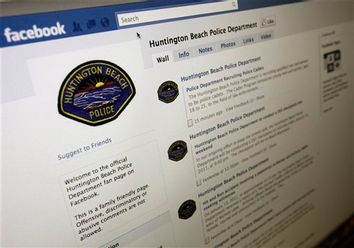
Wall of Shame: Police chief may post DUI mug shots on FacebookA Facebook page for the Huntington Beach, Calif., Police Department is shown Friday Jan. 14, 2011. The Huntington Beach Police could soon be trying electronic shaming as a way of keeping drunken drivers off the road. A councilman in Huntington Beach wants police to begin posting on Facebook the mug shots of everyone who is arrested more than once for driving while under the influence. (AP Photo/Richard Vogel)(Credit: AP)

Police in a city ranked top in the state for alcohol-related traffic fatalities might soon be trying a new tactic to keep drunken drivers off the road: Electronic shaming on Facebook.

In a contentious move that has raised the hackles of privacy advocates and been met with resistance from a police department fearful of alienating residents, a councilman in Huntington Beach wants police to begin posting the mug shots of everyone who is arrested more than once for driving while under the influence.

“If it takes shaming people to save lives, I am willing to do it,” said Devin Dwyer, the councilman behind the proposal. “I’m hoping it prevents others from getting behind the wheel and getting inebriated.”

Dwyer initially wanted the police department to post on Facebook photographs of everyone arrested for DUI in the bar-laden beach town just south of Los Angeles. He has watered down his proposal — now only repeat offenders would be featured on the virtual wall of shame — in hopes of winning support from the rest of the seven-member council, which is set to vote on the issue Tuesday.

Huntington Beach, a city of about 200,000 famed for its Surf City alias, an off-leash dog beach and a downtown packed with bars, is ranked top out of 56 California cities of similar size for the number of alcohol-related traffic fatalities. In 2009, 195 people were killed or injured.

Drunken driving laws are aggressively enforced, and in 2009, there were 1,687 DUI arrests.

“There is a saying: Come to Huntington Beach on vacation, leave on probation,” said attorney Randall Bertz, who specializes in DUI cases.

Bertz, a former police officer who has been defending such cases for 23 years, said uploading DUI suspects’ photos onto Facebook violates their right to privacy and would likely not be a deterrent to habitual drunken drivers.

“It will have a negative impact on relations with the community, the police department and city officials,” he said. “What’s next, will they have drunk drivers walk around with sandwich boards? Will it be public flogging?”

For its part, the Huntington Beach police department is pushing back against Dwyer’s proposal. Police spokesman Lt. Russell Reinhart said that since launching its Facebook page in November, officers have found it to be a valuable way of getting information to the public and soliciting tips on tough cases.

A couple of DUI suspect mug shots have been posted, but they were from egregious cases where police thought the public could be at immediate risk from the suspect. Reinhart fears Facebook fans could be turned off by the routine public shaming of all repeat DUI offenders.

“We see no value in doing that,” he said. “Law enforcement is not about public shaming.”

Dwyer said he has received wide support from residents for his proposal, including from a woman whose husband and three children were killed in an alcohol-related crash. He decided to push his plan forward after the local newspaper had a change in editorial policy and ceased publishing arrest logs.

Connie Boardman, a Huntington Beach councilwoman who opposes Dwyer’s idea, said posting the photos would have little effect on behavior.

“People who habitually drink and drive are alcoholics and are not going to be shamed by this,” she said. “But their parents and their spouses would be mortified.”

She added that children might be bullied if peers see their parents on a Facebook wall of shame.

“That is going to result in tremendous humiliation for a kid who has no hope of controlling his parent’s behavior,” she said.

Other police departments have already tried putting up a rogue’s gallery of DUI arrestees, though some of these attempts have been short lived.

In Evesham Township, N.J., the 75-officer police force maintains an active Facebook page and initially posted every DUI arrest mug shot. Within four months, the county prosecutor told police to stop the practice because it was unclear whether it was allowed under rules about what information police can release.

“It wasn’t our intention to shame people,” police Chief Mike Barth said. “But it did cause a stir.”

In March, the Honolulu police department abruptly stopped posting DUI mug shots on its website under a pilot project. The site had developed a significant following and spawned a Facebook fan page, but no reason was given why the project was cut short.

Many police agencies have set up Facebook accounts where they routinely disseminate suspect photographs, often for individuals wanted for serious crimes.

The Oconee County sheriff’s office in Georgia maintains a Facebook page that includes a photograph of a suspected child molester.

Chief Deputy Lee Weems said typically, only photos of people who are convicted are posted on Facebook. A tabloid newspaper called “Bad and Busted” prints photos of all arrestees.

In California, nothing can prevent a police department from releasing photographs of people who’ve been arrested, and state law compels police agencies to make certain information available, including the full name and occupation of everyone arrested, along with a physical description.

Clare Pastore, a civil rights and poverty law professor at the University of Southern California, said she was troubled by the idea of publicizing photos of a suspect before they have been convicted.

“There’s a little bit of a presumption of innocence problem,” she said. “It’s not really appropriate to shame someone before they are found guilty.”

——

Online:

http://www.facebook.com/HuntingtonBeachPolice

L.A. school district confirms 2 wounded in accidental shooting

Principal Rudy Mendoza says the 10th-grader who brought the gun to school has been apprehended by police

  • more
    • All Share Services

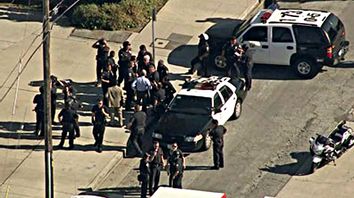
L.A. school district confirms 2 wounded in accidental shootingA wounded student is taken to an ambulance in Los Angeles.

A gun in a 10th-grader’s backpack accidentally discharged when he dropped the bag, wounding two students at a Los Angeles high school, the campus principal said.

Gardena High School Principal Rudy Mendoza said the student dropped the bag as he walked between classes at midmorning. The boy who brought the gun was apprehended, Mendoza told The Associated Press.

Los Angeles Fire Department Capt. Jamie Moore said two victims were transported to a hospital, one in serious and one in critical condition.

Police initially reported that three people were shot and the shooter was at large.

Numerous law enforcement agencies responded to the shooting at the 2,400-student campus located in the city of Los Angeles adjacent to the city of Gardena.

Gardena police Lt. Steve Prendergast said a teacher called 911 at 10:41 a.m. and Gardena officers initially responded. The investigation was being turned over to Los Angeles city and school district police.

A handful of frantic parents rushed to the school after hearing about the shooting on the news. They paced nervously as they waited behind police tapes for word from their children.

“I’ve never heard of anything like this before,” said Thomas Hill, whose 16-year-old and 18-year-old children attend the school. “You’re going to have confrontations between kids but never this.”

A mother who was waiting to hear from her 14-year-old son, Michael, said the school has a reputation for gang violence. Lupe Contreras said she has been trying to get her son out of the school.

Cynthia Cano, 15, said she was in a Mexican-American social studies class when an announcement was made that the school was in lockdown.

“We heard someone got shot. Everyone was freaking out a little,” she said in a telephone interview from inside the campus.

——

Associated Press writer Christina Hoag, Greg Risling, Daisy Nguyen and Sue Manning contributed to this report.

Continue Reading Close

Video shows sexual assaults on disabled women

L.A. Sheriff's department seeks help in identifying suspects in hours of footage on DVDs left anonymously

  • more
    • All Share Services

Los Angeles sheriff’s investigators have uncovered shocking video showing a group of men sexually assaulting at least 10 severely handicapped women.

The Los Angeles County Sheriff’s Department said Thursday that an anonymous individual dropped off DVDs copied from a computer hard drive containing over 100 hours of video depicting a sequence of sexual assaults on women, all of whom appear to be disabled.

Authorities say the footage was shot at several locations, including one that appears to be a residential care facility.

Investigators are seeking the public’s help in identifying where and when the video was shot, as well as the identity of the suspects who were captured on tape.

The video is not being released, but composite drawings of four of the suspects have been created based on the video footage.

Police: Ex-con acted alone in Ronni Chasen slaying

"This was a random act of violence. We believe that it was most likely a robbery gone bad"

  • more
    • All Share Services

Hollywood’s whodunit about the wealthy publicist gunned down driving home from a movie premiere now appears to be more of a garden-variety crime gone wrong.

Police on Wednesday said preliminary ballistics tests showed the gun a man used to kill himself as officers went to talk to him about Ronni Chasen’s killing was the same weapon that was used to kill her.

Harold Martin Smith, 43, a down-on-his-luck ex-convict with a rap sheet spanning at least 25 years, had apparently ridden his bicycle to a dark intersection on Sunset Boulevard then attempted to rob Chasen.

“This was a random act of violence. With Mr. Smith’s background, we believe that it was most likely a robbery gone bad,” Beverly Hills police Sgt. Mike Publicker said. “Through the interviews and the information we received, that leads us to believe that he was at a desperate point in his life, and was reaching out and doing desperate measures.”

Smith committed suicide Dec. 1 as police, acting on an anonymous tip left with the TV show “America’s Most Wanted,” went to speak with him at a seedy Hollywood apartment building from which he had recently been evicted. Before police could talk to him, he pulled out a revolver and shot himself in the head.

It’s another surprising turn in the investigation; just this week, law enforcement sources questioned whether Smith’s gun was even the same kind that was used to shoot Chasen. Neighbors speculated Smith’s boasting about the crime was the ramblings of a man with mental issues who could not have carried out the homicide.

Though police said that gun appeared to be the same one used to kill Chasen, they cautioned that ballistics tests were preliminary and a final analysis could take two weeks.

Smith and Chasen’s lives could hardly have been more different. She left at least a $6 million estate; he had a long criminal record that included two felony strikes — a third conviction could have landed him a lengthy prison sentence. She drove a luxury car; he rode a bicycle. Chasen was well known among Hollywood’s power players and helped actors, directors and composers win Oscars; Smith’s former neighbors recalled him as being mentally unstable.

Police provided no information about who had phoned in the tip that cracked the case but, according to at least one of his former neighbors, Smith had bragged about the killing.

Terri Gilpin, who lived along the hall from Smith on the third floor of the apartment building, said Smith had also boasted that he was going to get paid $10,000 for carrying out the killing.

Police Chief David Snowden disputed that, saying there appeared to be no broader plot.

“We believe that Mr. Smith acted alone. We don’t believe it was a professional hit,” Snowden said, though he added that the investigation was ongoing.

Chasen, 64, was an influential behind-the-scenes player in Hollywood with a long track record in promoting films such as “Driving Miss Daisy,” “On Golden Pond” and the sequel to “Wall Street” and their stars for Oscars.

Police said it didn’t appear that Chasen knew Smith or that any of her property had been taken. No shell casings were found at the scene, and investigators did not reveal if there was any video evidence of the attack.

The tipster who led detectives to Smith might be eligible for a $125,000 reward. Steve Katz, a co-executive producer of “America’s Most Wanted,” said staff notified the tipster about the latest developments.

“When he heard that his tip helped resolve this case, he was very emotional,” Katz said. “This is really a perfect example of how an average person can make a difference.”

Documents obtained by The Associated Press revealed Smith was a two-strike felon who had been convicted of burglary twice and most recently had been released from prison in 2007 after serving time for robbery.

Smith told neighbors at the apartment building where he shot himself that he would never return to prison. Police armed with a search warrant approached him, told him to take his hands out of his pockets and said they were there to talk to him about Chasen’s killing.

That’s when Smith pulled a gun from one of those pockets and shot himself in the head.

Without Smith to talk to, police looked to the gun for evidence that would tie him to Chasen’s killing.

Continue Reading Close

L.A. police move to quell more shooting protests

Officers defend killing, but outraged residents counter that the force is out of touch

  • more
    • All Share Services

Police mobilized Wednesday to avoid more mayhem on the streets after being taken by surprise at consecutive nights of violent protests sparked by the fatal shooting of a knife-wielding man.

The police chief, city officials and consuls general from three Latin American countries scheduled a community meeting as senior officers tried to reach out to residents of the central Los Angeles neighborhood where the man was shot.

Sunday’s killing of Manuel Jamines, 37, has turned into a rallying point as community members, aided by outsiders, have taken to the streets for two nights running and used the death to highlight past injustices and vent ongoing frustrations.

Police have defended the killing and said they’ve been taken aback by the level of protest for a case that seemed like a clear-cut case of justifiable use of force. Each year, the LAPD is involved in up to about 40 shootings — those that typically cause controversy involve unarmed or surrendered suspects.

Residents outraged over the killing have said police should have handled the situation differently and say the surprise by department brass shows that the force is out of touch with the people.

Three bicycle officers were flagged down Sunday by people concerned about a man wielding a knife. The officers approached the suspect and told him in Spanish and English to put down the weapon.

Instead, Jamines raised the knife above his head and lunged at Officer Frank Hernandez, a 13-year veteran of the department, said Capt. Kris Pitcher, who heads the Los Angeles Police Department’s force investigation division.

Hernandez shot Jamines twice in the head. He died at the scene. Several witnesses later told police Jamines had been drinking.

“They could have used pepper spray or a Taser gun,” said Salvador Sanabria, executive director of nonprofit community group El Rescate. “The community … reacted this way because they thought there was another way to deal with a drunk guy.”

Pitcher said Jamines was an undocumented immigrant from Guatemala. DNA tests were being carried out to determine whose blood was on the knife. Officers received unconfirmed reports he may have attacked someone before police arrived.

The officers involved were placed on administrative leave, a standard move after shootings.

An estimated 300 protesters who gathered outside the local police station pelted officers Tuesday night with eggs, rocks and bottles and set a trash bin on fire. Others dropped household items from apartment buildings.

Officers fired at least two rounds of foam projectiles at demonstrators and 22 people were arrested, mainly for failure to disperse and unlawful assembly.

A night earlier, three officers were slightly injured by thrown objects and four people were arrested on suspicion of misdemeanor inciting a riot.

Police Chief Charlie Beck said he was surprised by the extent of the protests. Though he was withholding judgment on the case pending an investigation, he said the shooting seemed relatively non-controversial.

“This was a tragic thing, I wish it would have worked out different,” Beck said. “But the facts are very straightforward.”

Beck said the protests were the culmination of a variety of frustrations, including a terrible economy and a feeling of victimization among immigrants who say the U.S. population likes to blame them for many of society’s shortcomings.

“As you polarize society, this is the kind of thing that can push forward,” the chief said.

He also blamed activist groups, including the Revolutionary Communist Party, for co-opting peaceful vigils and inciting violent protests.

Beck patrolled the area as a captain in the aftermath of the Rampart corruption scandal, in which an LAPD anti-gang unit was the focus of allegations that officers framed and beat innocent people. He said community outreach had improved considerably since then but acknowledged his department could do more.

Sanabria said residents were already angry with the police over strict enforcement of public drinking laws and clampdowns on street vendors. The police department doesn’t go after immigrants based on their legal immigration status, but Sanabria said officers still could be more sensitive.

“They don’t understand the complexity of the ethnic demographic population they have here,” Sanabria said.

He added that Jamines’ first language apparently was a Mayan dialect, not Spanish, and said some police need to be trained in it.

The LAPD is vastly different today from the organization it was 20 years ago, with much greater racial and gender diversity. All three officers involved in Sunday’s incident were Latino and spoke Spanish, former police chief William Bratton noted.

Continue Reading Close

L.A. authorities plan to use heat-beam ray in jail

The "Assault Intervention Device" draws fire from civil rights groups, who compare it to torture

  • more
    • All Share Services

A device designed to control unruly inmates by blasting them with a beam of intense energy that causes a burning sensation is drawing heat from civil rights groups who fear it could cause serious injury and is “tantamount to torture.”

The mechanism, known as an “Assault Intervention Device,” is a stripped-down version of a military gadget that sends highly focused beams of energy at people and makes them feel as though they are burning. The Los Angeles County sheriff’s department plans to install the device by Labor Day, making it the first time in the world the technology has been deployed in such a capacity.

The American Civil Liberties Union of Southern California criticized Sheriff Lee Baca’s decision in a letter sent Thursday, saying that the technology amounts to a ray gun at a county jail. The 4-feet-tall weapon, which looks like a cross between a robot and a satellite radar, will be mounted on the ceiling and can swivel.

It is remotely controlled by an operator in a separate room who lines up targets with a joystick.

The ACLU said the weapon was “tantamount to torture,” noting that early military versions resulted in five airmen suffering lasting burns. It requested a meeting with Baca, who declined the invitation.

The sheriff unveiled the device last week and said it would be installed in the dorm of a jail in north Los Angeles County. It is far less powerful than the military version and has various safeguards in place, including a three-second limit to each beam of heat.

The natural response when blasted — to leap out the way — would be helpful in bringing difficult inmates under control and quelling riots, the sheriff said.

But the sheriff was creating a dangerous environment with “a weapon that can cause serious injury that is being put into a place where there is a long history of abuse of prisoners,” ACLU attorney Peter Eliasberg said. “That is a toxic combination.”

Cmdr. Bob Osborne, who oversees technology for the sheriff’s department, said the concerns were unfounded. He said he stood in front of the beam more than 50 times and that it never caused any sort of lasting damage.

“The neat thing with this device is you experience pain but you are not injured by it,” Osborne said. “It doesn’t injure your skin, the beam doesn’t have the power to do that.”

He said the device would be a more humane way of dealing with jail disturbances. Unlike hitting inmates with batons or deploying tear gas, a shot from the beam has no aftereffects, he said.

The device was made specifically for the sheriff’s department by Raytheon Missile Systems. Spokesman Steve Whitmore said its $750,000 cost was paid for by a Department of Justice technology grant.

After a six-month trial, the sheriff will determine if the device is effective and if it should be deployed in other jails.

“When this pilot program is done, the realistic hope is it will accomplish not only what the sheriff’s department wants but what the ACLU wants, which is to save lives harmlessly,” Whitmore said.

A Raytheon spokesman on Thursday referred questions to the sheriff’s department, but provided a fact sheet describing how the device only penetrates skin to a depth 1/64 of an inch. The military’s version of the device can shoot a beam more than 800 feet but the sheriff’s department model has a maximum range of 85 feet.

Continue Reading Close

Page 1 of 2 in Thomas Watkins