Tim Bella

Glenn Beck, Republican strategist

When the Fox News host pushes a crackpot theory, it doesn't take long for the GOP to run with it. A timeline

  • more
    • All Share Services

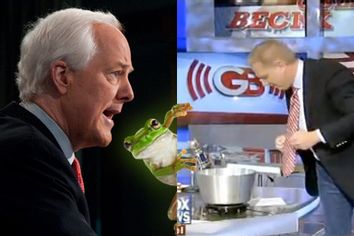
Glenn Beck, Republican strategistSen. John Cornyn (R-TX), left, and Glenn Beck "boiling" a frog, right

Something strange has happened to rank-and-file Republicans since President Obama took office. These past few months, standard-issue gray lawmakers have sounded like fire-and-brimstone demagogues. Conspiracy theories and over-the-top legislation to fix imaginary wrongs are flying wildly around formerly mainstream GOP circles.

It turns out that like so much of what ails the world today, this can be traced back to Glenn Beck. Some fifth-term Iowa senator might be railing against death panels, but it’s really Beck’s voice you’re hearing. With his show on Fox News, Beck has successfully positioned himself as the weirdo right’s ambassador-at-large to the rest of the world. When the patron saint of the Tea Parties lets his freak flag fly, seemingly normal right-wing functionaries have been known to line up and salute. Republicans parrot Beck’s crackpot notions and pet issues routinely — sometimes running with his manias the morning after he first airs them.

Take Sen. John Cornyn, R-Texas. In the middle of the Senate Finance Committee’s debate over healthcare reform legislation last month, he broke out with an analogy about frogs failing to jump out of boiling water, one that seemed to have little to do with what he was discussing. “Sounds to me like it’s the old story about the frog in the pot of water on the stove that pretty soon the heat’s turned up so slowly that the frog doesn’t know it’s cooked,” Cornyn said. Where might he have gotten the idea? Perhaps from Beck — who the night before had pretended to boil a frog on TV. “You know the old saying, if you put a frog into boiling water, he’s going to jump right out, because he’s scalding hot, but if you place the frog in lukewarm water and gradually raise the temperature, it won’t realize what’s happening and die?” he asked viewers (who, apparently, included the junior senator from Texas). “We have been tossed quickly into boiling water!”

Democrats watch this all with some bemusement. “In the absence of any new leadership and an unwillingness to put forward any new ideas, the Republican Party has become the party of cranks and conspiracy theorists,” Democratic National Committee spokesman Hari Sevugan says. “And that’s exactly why their popularity rivals that of swine flu. And they will remain marginalized so long as they continue to talk to the tinfoil hat crowd.” But Beck is more than a harmless — if deranged — entertainer. His ability to push the GOP from rhetoric to action means he can inject toxic ideas and fears directly into the body politic. It was Beck who raised the most alarm over Obama’s czars and his allegedly totalitarian instincts, after all. Here’s a guide to some of Beck’s greatest hits, and how they wormed their way into the real world.

Overthrowing the czars

Beck’s central theme is that our country is being taken away from us by shadowy, menacing figures (though in the end, the most menacing figure of all seems to be tall, skinny and wearing a Nobel peace medallion). He usually focuses his general panic on specific, shifty-seeming characters. Often, because he wants to invoke Russia — and is apparently ignorant of both the history of Russia and the thoroughly ironic origins of the term’s use in the states — he calls these people czars.

March 17: Talking to guest Kevin Williamson of the National Review, Beck has his first discussion of the supposed proliferation of czars in the administration. But the only explicit complaint comes from Williamson, who says, “We have way too many people named czar in their job title.”

May 29: Beck makes his own first comment. “And, I’m so excited. We’re getting a new czar, everybody! Yes. Can we stop with the czars, please?” He continues to refer to the phenomenon almost daily over the summer. Obviously influenced by Jonah Goldberg’s book “Liberal Fascism,” Beck links the czars to early American progressives like Woodrow Wilson, and through him, naturally, to Hitler, Mussolini and Lenin.

July 15: Rep. Jack Kingston, R-Ga., introduces the “Czar Accountability and Reform (CZAR) Act of 2009.” By September 16, the bill has 99 co-sponsors, including one Democrat.

July 30: House Minority Whip Eric Cantor writes an op-ed in the Washington Post accusing the Obama administration of making an “end run around the legislative branch of historic proportions.” Notes Cantor, sagely, “At last count, there were at least 32 active czars that we knew of, meaning the current administration has more czars than Imperial Russia.”

Sept. 12: Conservative protesters inspired by Beck head to Washington, D.C., where the czarist (and also, somehow, communist) power grab is a common theme of signs and chants.

Sept. 13: Senator Kay Bailey Hutchison — locked in a bitter Republican gubernatorial primary — writes essentially the same czar-fighting op-ed as Cantor, also in the Washington Post.

Sept. 16: On the floor of the House of Representatives, Rep. John Shadegg, R-Ariz., holds up a chart showing 34 “czars,” saying rather darkly, “I don’t think you know who these people are.” A number of the people on the chart were, in fact, confirmed by the Senate.

Sept. 29: Sen. Russ Feingold, D-Wis., announces plans to hold a hearing of his Judiciary subcommittee on the “czar” issue, which — by going bipartisan — officially jumps the shark.

Attacking Cass Sunstein

Though Beck’s diatribes against Obama’s czars have mainly hinged on the word’s association with Russia — and by tortured implication, communism — he’s also singled out specific enemies for periodic close-ups. A curious favorite this summer was Cass Sunstein, a legendary legal scholar, and Obama’s nominee to run a regulatory office in the White House. Before Beck was on the case, it was mainly progressives who disliked Sunstein, a well-known centrist.

July 22: Shortly after one conservative senator lifts his procedural hold on Sunstein, Cornyn, of Texas, places his own hold on the nomination. A spokesperson tells Fox News, “Sen. Cornyn finds numerous aspects of Mr. Sunstein’s record troubling, specifically the fact that he wants to establish legal ‘rights’ for livestock, wildlife and pets, which would enable animals to file lawsuits in American courts.” That very day, Beck mentions Sunstein for the first time, saying:

The latest nominee for the regulatory czar, a Harvard law professor, oh, and a guy Barack Obama knew in Chicago, is Cass Sunstein. He’s a friend of Obama’s. Wait until you meet this guy. He embraces the ever so popular senior death discount. That’s the idea that will calculate the lives of younger people as having greater value than those of the elderly. He also believes in giving legal rights to livestock, wildlife and pets. So, your pet can have an attorney file a lawsuit against you.

Aug. 7: Another senator anonymously places a hold on Sunstein’s nomination, slowing down the move toward a vote.

Aug. 31: Beck increases the frequency of his Sunstein attacks all month, eventually asking, “Is he just a control freak? What is this?”

Sept. 3: Beck writes on Twitter, “FIND EVERYTHING YOU CAN ON CASS SUNSTEIN, MARK LLOYD AND CAROL BROWNER”.

Sept. 10: By a 57-40 vote, the Senate confirms Sunstein. Several Democrats vote against him.

Van Jones: Beck’s great triumph

The anti-czar crusade is also, of course, where Beck met his Nicholas II: so-called “green jobs czar” Van Jones.

July 23: Picking up on commentary at right-wing website WorldNetDaily, Beck mentions Jones for the first time on-air. “This is a guy who is a self-avowed Communist,” said Beck. “And he is in the Obama administration — this guy wasn’t a radical, and then was arrested. He spent six months in jail, came out a Communist.” It was the first of dozens of instances this summer in which Beck went after Jones.

Aug. 24: Beck suggests that the Apollo Alliance — an environmental group on whose board Jones sat — had rigged the stimulus so they could “raid the U.S. Treasury.”

Aug. 25: At a town-hall meeting held by Rep. Steve Buyer, R-Ind., a constituent asks, “Who wrote all of these thousand-pages bills? And did the far-left Apollo Alliance have any influence on any of them?” Buyer has no idea what she’s talking about, but people in the crowd begin shouting audibly about Jones. It’s the first in a series of such confrontations between furious constituents and understandably befuddled representatives. But Beck’s show would wind up enlightening them all.

Sept. 4: The day after it emerges that Jones had signed a so-called “9/11 truth” petition, Rep. Mike Pence, R-Ind., calls for his resignation. Sen. Kit Bond, R-Mo., calls for hearings on his fitness for office. Says Pence, “His extremist views and coarse rhetoric have no place in this administration or the public debate.”

Sept. 5: Jones resigns.

Obama the totalitarian

Beck’s notion that the president is some kind of czarist fits in neatly with a larger effort to brand the decisively elected president as a dictator. Every Democrat gets called a socialist, but Beck has given the charge an especially dark twist, with repeated references to 1984, communism and fascism. His frequent, Goldberg-influenced musings on the Progressive Era give a surreal veneer of historical basis to the incoherent hysteria. Beck got going on this topic early.

Feb. 4: Beck does a segment on the stimulus bill and children’s healthcare legislation that he calls a “Comrade Update.” Fox News obligingly covers the screen in Soviet symbolism.

April 1: In a now-famous segment, Beck declares with horror, “They’re marching us to a non-violent fascism. Or to put it another way, they’re marching us to 1984. Big Brother. Like it or not, fascism is on the rise.” In the background, Fox plays video of goose-stepping Germans.

June 23: A Republican women’s group in Maryland issues a statement saying, “The president and Hitler have a great deal in common.”

Sept. 12: The 9/12 protest produces an outpouring of comparisons between the president and the Third Reich. Says one attendee, “I’m afraid he’s going to do what Hitler could never do.” The event, of course, is heavily promoted by Fox News and addressed by a number of prominent Republican figures.

Sept. 22: Beck’s new book, “Arguing With Idiots: How to Stop Small Minds and Big Government,” comes out — featuring an oh-so-subtle cover image.

School indoctrination?

Beck was one of the first commentators to attack Obama’s plan to give a back-to-school speech to students. The event was almost tailor-made for Beck’s road-to-tyranny hysterics.

Sept. 2: Beck gives the story of the president’s back-to-school speech some of its first national media attention. Says Beck, “Isn’t that great? The teachers have a little plan on what they can talk about. How much do you love the president? How can you help the president accomplish his goals? This is fantastic. It doesn’t sound like propaganda to me at all.” On the radio, Beck called the speech “indoctrination,” and said, “you have a system that is capturing your kids.”

Sept. 3: In an opinion piece for Fox News, former Reagan official Peggy Venable writes, “When recruits are children, doesn’t that constitute indoctrination, even brainwashing?”

Sept. 4: Just two days after Beck raises it, aspiring Republican presidential candidate Tim Pawlenty says of the president’s speech, “I don’t think he needs to force it upon the nation’s schoolchildren.”

Art as propaganda

In Beck’s world, Obama isn’t content just to use the school system for indoctrination. He’s also getting artists — presumably, decadent and perverted ones — in on the action.

Sept. 1: On his show, Beck raises the bizarre idea that the National Endowment for the Arts has been instructed to tilt the politics of funded projects leftward. Says Beck, “There is a propaganda arm now, engaging artists and the art community using your tax dollars in propaganda.” He would keep at it all month.

Sept. 24: Commenting on a different brainwashing-related story, he throws in this aside: “Maybe we could have had a giant statue of Barack Obama made with your taxpayer dollars from the National Endowment for the Arts. Wouldn’t that be grand?”

Sept. 26: Again, just two days after Beck discusses an issue, the GOP responds. Rep. Darrell Issa, R-Calif., accuses the administration of trying to turn the NEA into the White House’s “strategic communications firm.” Says Issa, “Activating artists and art groups reliant on NEA funds under the implied threat of withholding future grants is a Chicago-style tactic that should have been left on the campaign trail.”

Money, money, money

March 24: Talking to former ambassador to the United Nations John Bolton, Beck asks, “Ambassador, everybody is calling for global currency. I think part of this is a game, but I think, also, part of it is — I mean, now the U.N. is saying, you know what? We should have a global currency. It’s also a movement to tie the entire globe together into one big government. Am I wrong or right?”

March 25: The very next day, Rep. Michelle Bachmann, R-Minn., asks Treasury Secretary Tim Geithner and Fed chief Ben Bernanke, “I’m wondering, would you categorically renounce the United States moving away from the dollar and going to a global currency?”

With additional reporting by Mike Madden.

Liberal groups unveil anti-Grassley ad

A new spot targets the Iowa Republican, who's been a pivotal force on healthcare in the Senate

  • more
    • All Share Services

Sen. Chuck Grassley, R-Iowa, has become a pretty prominent part of the debate over healthcare reform as the chief Republican negotiator in the Senate Finance Committee. And with his stance against the public option — indeed, against any bill right now — he’s become a target for liberal groups. Now, two of them are joining to air an ad against him in his home state and in Washington D.C.

The two groups behind the spot are Democracy for America, which was founded by Howard Dean and is now run by his brother Jim, and the Progressive Change Campaign Committee. For now, it’s slated to run 200 times in Iowa and another 100 in D.C. The groups had previously implemented a similar strategy against senators like Nebraska Democrat Ben Nelson.

The ad features an Iowa farmer named Kevin Shilling who says he’s voted for Republicans including Presidents Reagan, Nixon and George W. Bush and for Grassley himself.

“I voted for Sen. Grassley in the past,” Shilling says in the ad. “But when Grassley takes over $2 million from the big health and insurance industries that oppose reform and then says he won’t give Iowans the choice of a public option, I have to ask: Senator, whose side are you on?”

Using one Republican to go after another in an ad is always a good strategy, but it may not get this particular ad all that far. Shilling may have voted Republican in the past, he may even still do so, but he’s also a county chair of the Iowa Democratic Party.

Continue Reading Close

Strange bedfellows: GOP uses big business to slam Dems

Republicans are attacking Democrats for their ties to a pharmaceutical industry group

  • more
    • All Share Services

House Republican Leader John Boehner hasn’t forgotten about the deal that the pharmaceutical industry group PhRMA made with the Obama administration on healthcare reform. And now, he’s reminding PhRMA.

Boehner laid out his case in a letter to the organization’s CEO, Billy Tauzin, in which he urges PhRMA to renege its support of President Obama’s healthcare reform legislation, according to Politico. In exchange for supporting the legislation, PhRMA received profit protection under rules established in a 2003 prescription-drug bill.

The tone Boehner took in the letter — sharp and even condescending at times — is somewhat odd considering Boehner is attempting to persuade PhRMA to overturn what he describes as a bad deal that Obama and Co. will not ultimately honor.

“Appeasement rarely works as a conflict resolution strategy,” Boehner wrote. “This is as true in the arena of policymaking as it is in schoolyards across America. When a bully asks for your lunch money, you may have no choice but to fork it over. But cutting a deal with the bully is a different story, particularly if the ‘deal’ means helping him steal others’ money as the price of protecting your own.”

He added: “The simple truth is, two wrongs don’t make a right. And the short-sighted health care deal PhRMA struck with the Obama Administration at your urging provides confirmation of this time-tested maxim on an epic and tragic scale.”

Of course, one reason for Boehner’s tone may be that Republicans generally are looking to use PhRMA as a club with which to beat the Democrats on healthcare reform. Helping matters is that PhRMA has hired AKPD Message and Media, the Chicago-based run firm that was started by Obama senior advisor David Axelrod, to run a portion of its advertising business. The House Republican Conference is already all over that angle.

Continue Reading Close

Poll: Fox News still polarizing

What you think of the conservative news network depends on whether you agree with them

  • more
    • All Share Services

Maybe Fox News Channel’s “We Report, You Decide” tag line is accurate, after all. Unfortunately for the network, though, it seems anyone who doesn’t already agree with the Fox worldview is deciding against it.

The network has seen its ratings increase during the course of the last year, but a new poll shows the cable news station, much like its brethren, remains a polarizing news outlet to many viewers.

According to the Daily Kos/Research 2000 poll, only 34 percent of respondents said Fox News was a reliable source, compared to the 41 percent who called it unreliable. Its competitors, CNN and MSNBC, didn’t fare much better in the poll. CNN matched its 44 percent reliability rating with a 44 percent unreliability rating, and MSNBC raked in a 23 percent reliability rating compared to a 17 percent unreliability rating. The poll was conducted earlier this month and surveyed 2,400 people with a 2 percent margin of error.

But broken down by party identification, the poll shows impressions of the networks are even more split. More than two-thirds of Democrats — 68 percent — rated Fox News as unreliable, compared to just 11 percent of Republicans. Sixty-one percent of Republican respondents called CNN unreliable, compared to 20 percent of Democrats. MSNBC tallied 31 percent unreliable marks from Republicans and just 7 percent from Democrats.

Continue Reading Close

Can healthcare reform pass without a public option?

Dropping the idea might help in the Senate, but House liberals could kill the bill

  • more
    • All Share Services

The Obama administration seems like it’s getting ready to drop the idea of a public option from healthcare reform legislation if it means getting a bill passed. Ironically, though, such a move could actually make passage more difficult — sure, it would probably smooth the way through the Senate, but the House is a different story altogether.

The real obstacle for President Obama and for Democratic congressional leadership may be the large contingent of liberals in Congress’ lower chamber; if they band together — and they’ve started to do that — they could pose a serious threat.

With a hat-tip to Jane Hamsher, here’s how the math works in the House: There are 435 members altogether, meaning 218 votes are necessary for passage. Kiss 178 Republican votes goodbye — it’d take a minor miracle to get even one of them to support the Democratic plan. That leaves 256 Democratic votes (there’s one vacancy) and means that Speaker Nancy Pelosi and Majority Leader Steny Hoyer can afford for 38 of their members to jump ship, at most.

Problem is that without a public option, Pelosi and Hoyer have already lost more votes than that. Last month, 57 Democratic representatives signed a letter proclaiming their opposition to an agreement negotiated with the more conservative Blue Dog Democrats. In it, they wrote, “Any bill that does not provide, at a minimum, for a public option with reimbursement rates based on Medicare rates — not negotiated rates — is unacceptable.”

The number of Democrats who’ll vote against the bill if they believe it’s too conservative could go as high as 100, Rep. Anthony Weiner, D-N.Y., told CNBC during an interview Monday morning.

“If the president thinks he’s cutting a deal to get Senate votes, he’s probably losing House votes,” Weiner said. He also suggested that healthcare reform would be essentially meaningless without a public option, echoing a similar sentiment expressed by progressive Dems such as Howard Dean.

“If he says, ‘Well, we’re not going to have that,’ then I’m not really quite sure what we’re doing here anymore,” Weiner said.

Continue Reading Close

CIA officials lie sometimes? You don’t say

A judge reprimands several Agency officials for not being fully honest with him

  • more
    • All Share Services

Nancy Pelosi may be on to something after all.

The House speaker has alleged that the CIA lied to her, and Republicans have reacted angrily to the suggestion. But a Monday ruling from a prominent federal judge is a reminder that the Agency and its employees aren’t always perfectly honest. has ruled that as many as six CIA officials committed fraud in order to protect a covert agent from a 1994 eavesdropping lawsuit.

U.S. District Judge Royce Lamberth has ruled that as many as six CIA officials committed fraud in order to protect a covert agent from a 1994 eavesdropping lawsuit. Lamberth also referred Jeffrey Yeates, a CIA attorney, for disciplinary action stemming from the suit, which was brought by a former agent at the Drug Enforcement Agency.

Lamberth has delayed action until he determines if any of five others – including former CIA Director George Tenet – should face contempt charges or sanctions for failing to notify the court that an agent was no longer covert.

The DEA agent, Richard Horn, said his home in Burma was illegally wiretapped by the CIA in 1993 and that two former high-ranking CIA officials, Arthur Brown and Franklin Huddle, Jr., attempted to have Horn relocated because of their discontent with Horn’s work with Burmese officials on the country’s drug trade.

In 2000, Tenet filed court papers asking that Brown’s involvement in the case be dismissed due to his status as a covert agent. Lamberth threw out the case against Brown in 2004, and he was seemingly off the hook up — until last year when Lamberth discovered Brown’s cover was lifted in 2002, though the CIA continued to file documents saying Brown was still covert.

Lamberth also blasted CIA Director Leon Panetta, saying Panetta has given conflicting viewpoints about what should be revealed in the Horn case.

Of course, there’s also the inevitable “He said, He said” game between Brown and John Rizzo, former acting CIA general counsel. Rizzo said the office of general counsel didn’t know about Brown’s change in status until 2005, but that one attorney — Yeates — knew about the change and withheld the information from the court and his supervisors. Brown has disputed Rizzo’s account.

Continue Reading Close

Page 1 of 2 in Tim Bella