Tom DiEgidio

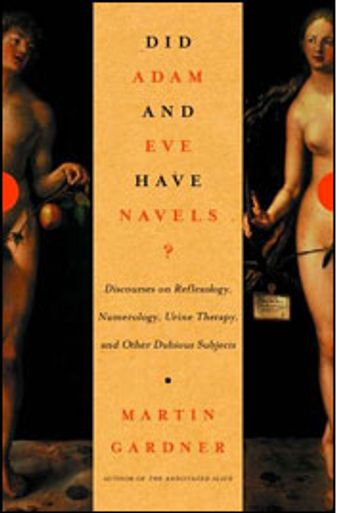
“Did Adam and Eve Have Navels?” by Martin Gardner

A witty, world-class debunker cuts through centuries of pseudoscience crap, from earthbound asteroids to balancing eggs.

  • more
    • All Share Services

Before cracking open Martin Gardner’s latest book, “Did Adam and Eve Have Navels?” I was prepared to be, at best, mildly amused. You know, ho-hum, yet another tome poking fun at religious fundamentalists unable to comprehend the basics of science — the Scopes monkey trial revisited for the 1,000th time.

How interesting could the topic of Adam and Eve’s navels be, anyway? I thought how much more amusing it would be to examine that hot old question — much discussed at the Council of Trent — of Adam’s penis. (It was decided, given the absence of desire in the Garden of Eden, that Adam’s erections were voluntary, that appendage functioning more like his arm.)

Yet it turns out, as Gardner explains in the title chapter, that there have been full-fledged political implications to the question of biblical bellybuttons. In 1944, an acrimonious congressional debate was occasioned by an armed services manual on “The Races of Mankind,” which depicted Adam and Eve with those cute remnants of our umbilical cords. Gardner views with amused distaste the idea that some of our lawmakers were worried that the U.S. government might offend that portion of the electorate who take their Bibles literally and hold sacred the unborn status of our original ancestors.

Gardner has his vision trained on all instances of blatant disregard for the scientific method that has been the cornerstone of technical and theoretical progress since Galileo. This colorful collection was culled from the column that Gardner contributes to Skeptical Inquirer, the official organ of the Committee for the Scientific Investigation of Claims of the Paranormal. Perhaps the best-known representative of that organization is magician James Randi, who has often appeared on TV in his role as debunker. Gardner, however, might be considered the ideological father of the CSICOP, since its foundation was partly inspired by his pioneering bestseller, “In the Name of Science.”

So Gardner, born in 1914, is no Johnny-come-lately to the debunking game. And with his elegant arguments and fine eye for telling detail, it’s no surprise that he has also penned novels and short stories. Add to these qualities the delicious sense of sophisticated fun that one would expect from the author of “The Annotated Alice,” who also happened to write the “Mathematical Games” column of Scientific American for 25 years.

He brings those talents to bear in such genially engaging chapters as “Near-Earth Objects.” Inspired by the mistaken 1998 news story that a meteor would swoop perilously close to the Earth, Gardner wears an impressive succession of hats — literary historian, memoirist, film critic — as he muses (no other term will do) on the theme of cataclysmic destruction. He chillingly concludes by speculating that to fundamentalists “a sudden extinction of humanity would be acceptable. The Biblical Jehovah, remember, is said to have drowned every man, woman, baby, and their pets, except for Noah and his family.”

In other chapters he makes clear that some great scientific minds such as Isaac Newton — who pursued the pseudoscience of alchemy when he wasn’t busy inventing the concept of gravity — have been inconsistent characters who did not always toe the line of pure science. Sketching a fuller picture of Thomas Edison than the usual sanitized version, Gardner sums up his appraisal of the national hero by stating that his “beliefs and habits were those of a crackpot and a bum. Rats lived happy and undisturbed in his laboratory; he often slept in his clothes, because he believed that changing or taking them off induced insomnia; he thought that Richard Wagner was Jewish; he was a disastrous husband and father; he all but starved himself to death because he believed that food poisons the intestines; his own company in Europe coined the cable name ‘Dungyard’ for him.”

Indeed, what sets Gardner apart from the rest of the debunking crowd is that he doesn’t just take potshots at the sitting ducks of fundamentalist thought or kooky cults; the sacred cows of science appear equally — and hilariously — in his deadly cross hairs. Gardner is always marvelously panoramic and ruminative, whether reporting the spread of the mistaken belief that eggs balance more easily on the first day of spring, pointing out that Newton was a fundamentalist, or discussing the conceptual origins of the Internet in the work of H.G. Wells. And he stimulates these same mental qualities, often useful gateways to creative thought, in the reader.

Schools could do well to interest children in science through Gardner’s entertaining volume — if they don’t ban it first. After all, there are plenty of adults out there who don’t want their kids exposed to the notion that Adam and Eve had the same bellybuttons we all love to contemplate. And not even a well-reasoned and engrossing book like Gardner’s is likely to change their minds at this late date.

Leo Castelli

A widely influential figure in the American art world, the legendary gallery owner was always in the right place at the right time.

  • more
    • All Share Services

Legendary art dealer Leo Castelli died Aug. 21 at his home in New York City at the age of 91. He was best known to the public for having been the first to sell Andy Warhol’s Campbell Soup can paintings. But his reputation wasn’t the result of New York hype. He profoundly affected the very nature of the American art world and its influence around the globe.

When I was summering in East Hampton back in 1980, there was still an old grocer who claimed to be proud of having refused to trade a sack of potatoes to Jackson Pollock in exchange for a painting. That was not an unusual fate for a major American artist in the ’50s. But in a few short years things would be vastly different. Despite Gore Vidal’s continuing assertion that America is “not yet a civilization,” artists would finally be celebrated and financially rewarded in the world’s richest nation. I had met Leo Castelli by then, but I was unaware of the historic role he had played in bringing about that cultural revolution.

I arrived in New York City in the late 1970s. I was as aware of Castelli as anyone else who was interested in contemporary art would be. There seemed nothing special about a dapper man with European manners owning a major art gallery. That he should be gregarious and eager to talk about Jane Austen in flawless English with a young literary oaf from Philadelphia seemed perhaps a bit out of the ordinary in a scene noted for mercenary concerns and social exclusion. A Yugoslav friend assured me that Castelli had happily discussed mountaineering with him in fluent Serbo-Croatian. The one thing Castelli never seemed to chat about in any language was himself. Over the years, from the few things I could pry from this man, and from what others said and wrote about him, I pieced together his remarkable story.

Leo Castelli was born in 1907 in the Austro-Hungarian city of Trieste. As the empire’s main port, Trieste was a rich admixture of the Italian, Slavic, Germanic and Hungarian cultures. No wonder polyglot wordsmith James Joyce was drawn to live there during the years of Leo’s childhood.

The son of Jewish Hungarian banker Ernesto Krauss, Leo was part of the cultured Triestine bourgeoisie in which fine manners and aesthetic concerns were de rigueur and the arts took precedence in conversation over matters of trade. Despite a predilection for literature, which was quite natural in his social sphere, Leo would eventually follow his father into banking. His first professional position, though, after schooling in Trieste and Vienna and taking a law degree at the University of Milan, was with an international insurance firm. He was posted to the company’s Bucharest office and wound up marrying the Romanian heiress Ileana Shapira, better known today as Ileana Sonnabend, a notable art dealer in her own right.

The mid-1930s saw Castelli at the Paris branch of the Banca d’Italia. While in France, he came to know the surrealists and, in 1939, opened his first gallery in partnership with a furniture designer. Up to that point Castelli had led a charmed life: a privileged upbringing in a cosmopolitan city; a happy marriage to the daughter of a wealthy industrialist; the opportunity, as a lover of contemporary art, to befriend the surrealists and work with them in the undisputed capital of the art world. But the gallery had barely been open when war forced a retreat with his wife and daughter Nina to New York where his father-in-law had invested in real estate.

This, in fact, was one of the most striking examples of Castelli’s always being in the right place at the right time. During the war Castelli served with the Office of Strategic Services. His war work in Europe gained him his U.S. citizenship and made him an alumnus of an organization that was sometimes referred to as “Oh So Secret.” It was also called “Oh So Social” since it was the private stomping ground of an elite East Coast Ivy League Wall Street clique.

After the war some members of the OSS entered its successor agency, the CIA. Still others took their predestined places in corporate boardrooms, on Wall Street and in various branches of government. Castelli, on the other hand, entered his father-in-law’s knitwear business, while dealing a number of Kandinskys he’d rolled up before leaving Paris.

He slowly felt his way around the New York art world, becoming representative for the Kandinsky estate and helping to curate shows by his new friends the abstract expressionists.

It wasn’t until 1957, when he was almost 50, that Castelli opened his first gallery on New York’s Upper East Side. But by 1958 he’d already shown Jasper Johns and Robert Rauschenberg and was playing a key role in fostering new directions in American art. Significantly, he gave his artists monthly stipends so that they would never have to worry about affording paints, or potatoes, again. The year after that saw the work of Cy Twombly and Frank Stella in the gallery, while the early ’60s brought Roy Lichtenstein and Andy Warhol and the blooming of pop art.

This was Castelli’s greatest moment. He had identified the artists, Americans whom he believed had as much validity as any Europeans. The economy was booming and JFK had set the tone of the ’60s by actively promoting American culture at home and abroad. America was about to assert itself in the last arena in which Europe could still feel some sort of superiority. The East Coast Ivy League Wall Street elite got into the swing of things and U.S. artists no longer had to contemplate slow starvation. Castelli worked hard and successfully to give the new American art respectability at home and a presence in Europe, both radical notions at the time. Thirty years earlier, President Hoover had replied to a letter from the president of France inviting American participation in the Salon d’Autome, blithely stating that there were no artists in the United States. Now, finally, living American artists were being supported by museums, corporations and businessmen on two continents. New York became the new center of the international art world.

True to form, Castelli did not merely defend his position as the purveyor of pop, but continued to follow the new. He championed minimalism, conceptualism, neo-expressionism and more. Among his artists were Rosenquist, Judd, Oldenburg, Kosuth, Nauman, Flavin, Salle and Schnabel. He followed his own instincts. This was brought forcefully home to me during a conversation in which I, a young and green critic, asked what he thought of art criticism. Castelli replied with debonair affability that he always marveled at the descriptive talents of good critics. But, I insisted, had he ever, even once, actually been influenced by what a critic had to say? Giving me an icy stare that told me I’d made, and was forcing him to make, an ungentlemanly breach, he replied with a single word, “No.” It was that resounding “no” that convinced me to open my own gallery.

Following his divorce from Ileana in 1959, Castelli married Antoinette Fraissex du Bost, who founded Castelli Graphics. They had a son, Jean Christophe. After the death of “Toiny” in 1987, Castelli married for a third time, to the young Italian art critic Barbara Bertozzi, with whom he opened a new gallery.

While he did not single-handedly transform the American art world, Leo Castelli did more than any other individual to see to it that American art was appreciated both here and abroad. It seems perhaps improbable that this should have been accomplished by a suave, reticent European ladies’ man who often downplayed his own importance. But perhaps it was a job that could only be pulled off by a literary, mercantile, polyglot, Jewish, Italian, Austro-Hungarian, banking, lawyering, art-dealing veteran of the OSS.

Continue Reading Close