Tom LeClair

The magical thinking of America

A new novel uses the story of one couple's loss to explore the nation's complex religious underpinnings

  • more
    • All Share Services

The magical thinking of America
This article appears courtesy of The Barnes & Noble Review.

When Hari Kunzru, the British son of an Indian and an English parent, was asked about his literary influences, two of the first three he mentioned were American: Thomas Pynchon and Don DeLillo. After three earlier novels and a book of stories, Kunzru has, in “Gods Without Men,” written a distinctly American novel worthy of comparison with the best work of these two forefathers. In its almost 400 pages of disparate but connected narratives, “Gods Without Men” resembles a compact “Mason & Dixon” or a condensed “Underworld,” both of which deal in part with the mythic American West. Like Pynchon and DeLillo, and like Kunzru’s accomplished British contemporaries David Mitchell and Tom McCarthy, Kunzru is an anthropological novelist, a writer who presents individual psychology and current society through the long and wide lenses of cultural systems — religious, historical, political, technological — as they are affected by a particular physical environment. In “Gods Without Men,” it is the Mojave Desert and its Trona Pinnacles, unusual stone pillars that attract, in Kunzru’s telling, contemporary tourists, 20th-century UFOlogists and hippies, earlier historical characters and ancient Native Americans.

Barnes & Noble ReviewAt the end of Kunzru’s first novel, the widely praised “The Impressionist,” early-20th-century British anthropologists disappear while studying a remote African tribe. In “Gods Without Men,” a Harvard-educated anthropologist named Deighton travels in 1920 to the Mojave to record the languishing language of a local tribe, eventually goes mad, and disappears. The failures of Kunzru’s scientists don’t deter the author from his anthropological approach. Each disappearance is just one more unknown — perhaps a meta-unknown — to which the ethnovelist applies Clifford Geertz’s “thick description”: Kunzru’s field knowledge, theoretical imagination and linguistic expertise.

Besides, Kunzru seems obsessed with disappearance. Two major characters in his second novel, “The Transmission,” vanish at its end. The protagonist/narrator of his third book, “My Revolutions,” is a political activist who reappears after 20 years underground. The plot of “Gods Without Men” revolves around the disappearance of a severely autistic four-year-old boy, Raj, while his parents — Lisa and Jaz Matharu — are visiting the Pinnacles in 2008. Perhaps Raj has escaped from his stroller and wandered into the desert; maybe he has been abducted.

Raj is missing for weeks, then months. While deftly keeping readers in suspense, Kunzru traces the parents’ fear, guilt, anger and mutual conflicts, all exacerbated by the media frenzy that surrounds them. Television reporters desperate for a solution within their expiring news cycle waylay the Matharus. Know-nothing bloggers accuse them of killing Raj or connect his disappearance with hateful conspiracies. One of the most active literary users of social media, Kunzru has the fantasies and styles of the blogosphere down cold. Insulted and even assaulted, the Matharus try to disappear from public sight, but they can’t hide because public appeals may help return their son. In desperation, Lisa, formerly a book editor, turns back to her Jewish upbringing and to mystical texts for solace. Jaz, a former student of quantum physics who applies his knowledge to stock trading, resists the superstitions of his Sikh parents but forgets about quantum uncertainty and wonders if Raj may have been abducted by the space aliens that earlier groups who gathered at the Pinnacles attempted to reach.

Both parents engage in what Kunzru several times refers to as “magical thinking.” Although his presentation of the Matharus is psychologically acute, Kunzru’s achievement in “Gods Without Men” — what places him with Pynchon and DeLillo — is moving beyond a personal, emotion-bending story that might be told on a daytime talk show to collect and invent earlier narratives of magical thinking involving the Pinnacles, narratives that create a selective but unique and fascinating history of god-struck America. These narratives are in dated chapters that regularly alternate with the Matharu story, which proceeds chronologically. The “alternate” chapters do not, but I’ll describe them in chronological order because, like anthropologists unearthing disturbed levels of a site, readers are meant, I think, to eventually reconstruct a timeline that connects all the novel’s shards into a chronicle of spiritual need.

Kunzru strokes into several chapters Native American myths about the Pinnacles as a borderland between the living and the dead, along with legends about preternatural characters. Two chapters purport to be an eighteenth-century report on the explorations of a Catholic priest to whom an angel appeared at the Pinnacles. One Nephi Parr, a hyper-religious but rogue Mormon who kills heretics near the Pinnacles, believes in 1871 that angelic airships are waiting for the saved. After the anthropologist Deighton loses his young wife to a Native American in 1920, he dreams or hallucinates an otherworldly child’s kidnap, an illusion that precipitates a murder on the rocks. An airplane mechanic named Schmidt, who watched the “Enola Gay” take off, goes in 1947 to the Pinnacles to expiate his sin and to found a cult based on communication with extraterrestrials, a cult that an emotionally deprived Washington housewife named Joanie joins in a 1958 chapter. In the high sixties, the Pinnacles morphs into a sex, drugs, and rock and roll commune that hopes to reach the spirit realm through technologically amplified music.

All of these chapters about believers or would-be believers share the appeal of Pynchon’s crank characters and his scrupulosity about details of milieu, dialect, technology, and time-stamped paranoia. Kunzru even tips his hat to the master of invented history when Schmidt, attempting to transcend the earth, burns to death in a structure that resembles a gravity-defying rocket.

In the present of 2008, a British rocker fleeing his failing band in Los Angeles stays at the same motel as the Matharus and is, because of the coincidence, briefly suspected of abducting Raj. A local Iraqi teenager named Laila also has her own chapter that describes her work “simulating” an Iraqi in a Potemkin village built to train Marines on a nearby base. A man called Coyote, a refugee from the hippie commune and an avatar of the Native American trickster, now finds the desert a good place to cook and use crystal meth. In these chapters Kunzru channels DeLillo’s ability to throw the voices of pop culture, marginal politics, and the criminal underground, as if the family trauma of “White Noise” alternated with chapters from “Great Jones Street,” “Libra,” and “Running Dog.”

Raj is only one of several characters who disappear in or from the Mojave. But what has most significantly disappeared from the desert in “Gods Without Men” is connection with transcendence. In the contemporary chapters, the desert is a tourist attraction for the Matharus, a getaway for the musician, a job for Laila, and a hideaway for Coyote. When Raj disappears, Kunzru shows how the magical thinking of Lisa and Jaz resembles and may be influenced by the myths, manias, and delusions of the American past, as well as the “Homo sapiens” past. But the Matharus’ responses lack the fanatic passion and the transcendental ambition displayed, sometimes destructively, by earlier desert denizens. The Matharus’ “moderation” may allow them to survive while other characters disappear. But the novel is still haunted by the Satan problem of “Paradise Lost,” the Ahab problem of “Moby-Dick”: the self-destructive obsessives are more interesting fictional creations than the survivors.

A colleague of Jaz’s named Cy Bachman (a cybernetic composer of sorts) has created a computer program called Walter into which Jaz feeds incredibly heterogeneous data sets to predict the stock market and, according to Bachman, to discover “the face of God.” The program eventually ruins the trading firm, and the face of God refuses to magically appear. An up-to-the-nanosecond delusion, the program implies that Kunzru’s title, taken from Balzac, is a fiction: there are no gods without men to create them. But, in a witty turn, the program also provides a model for this fiction into which Kunzru pulls together disparate characters and various eras to represent the actions of men (and women) without gods.

Obeying the principle of recursion in the Walter program, Kunzru has Laila buy an old record album that has the same cover as the novel and, careful readers will note, includes references to details in “Gods Without Men:”

Cocooned inside her headphones, her eyes tight shut, she felt as if was inside a capsule, heading out into space.
There was a howling sound, like a dog. There was a child’s voice, calling out a word, perhaps a name. There were horse’s hooves, an engine, a man coughing, bare feet running across sand. There was gunfire.
A whole world.

Not really a “whole” world, of course, any more than “Gods Without Men” is a “whole” world. By planting the invented album within his fabricated book, Kunzru wryly admits the irony of using fiction to examine humans’ desire for a supreme fiction.

The world without God, according to Bachman’s Kabbala, is broken, scattered. “Gods Without Men” is appropriately fractured, multiple lives from different times in the same approximate space. Two more explicitly anthropological novels that feature Native American belief systems in the West — Leslie Silko’s “Ceremony” and Ursula Le Guin’s “Always Coming Home” — are even more fragmented in form and style but also more hopeful about the recovery of transcendence. Although Kunzru is as large-hearted as these writers of magic realism, as sympathetic to humans’ need to fill the absence symbolized by the desert, he is skeptical of magic in any form.

The Pinnacles appeared when the Mojave’s lakes disappeared. Three of the formations may look to some like fingers, but the stones are only stones, possible signposts for humans in an empty land but not signs pointing to the divine. Perhaps even the Matharus realize this, for the last words of their final chapter are “There was nothing out there at all.” Even at the end of “Gods Without Men” there is no end of profound questions as Kunzru, like Joyce’s famous fingernail-paring artist-God, disappears.

Who will win the National Book Award for fiction?

With the prize set to be announced Wednesday, we take a closer look at the finalists

  • more
    • All Share Services

Who will win the National Book Award for fiction?

When the five finalists for the National Book Award in fiction were announced last month, the lead in news stories was Jonathan Franzen’s “Freedom,” the Novel Betrayed. Its absence occasioned the usual attack on awards, judges, critics and literary evaluation in general. But consider the numbers. When I was a judge several years ago, about 300 books were nominated by publishers. If judges ignore authorial reputation and chatter about the books, what are the chances that a book will make it into the final five? Say a hundred works are meretricious and nominated merely to please their authors. Now the possibles are down to 200 books, but if each judge gets to choose a nominee it’s still only one chance in 40 that a book will make the cut. You might find distasteful this probabilistic analysis of the process — “All books are not created equal,” you say — but I hope the numbers will diminish the consternation over Franzen’s absence and will encourage readers to give the novels that are finalists a chance. Think of them this way: “Wow, these books beat 40 to 1 odds.”

Barnes & Noble ReviewThere is a downside to citing these numbers. “Wait just a minute,” you say. “Nobody can read 300 books in the few months the judges have.” And you’re right. Judges have to sample in the early stages. So in the spirit of putting you in a judge’s seat, below are samples from each of the novels, along with some context and description. The passages are short — bite-size pieces of prose like the chocolates in a Whitman’s Sampler — but should provide a taste of each writer’s style, sensibility and, indirectly, his or her approach to fiction. Perhaps the excerpts will take you to the books themselves, and then you can imagine yourself in the hot seat, a chair at the table where the judges have to argue their criteria and decide on the winner.

In Lionel Shriver’s “So Much for That,” the irascible middle-aged metalsmith Glynis is married to the usually placid Shepherd Knacker, who observes his wife’s combative relation with an old schoolmate:

Glynis disparaged Petra’s work as safe and cookie-cutter. Unlike Glynis, Petra did not press against the limits of “craft” and yearn to join the art world proper. She made jewelry, period, for people to wear. Another tactless observation? Shep liked that. He liked functionality. He was a handyman. He had always cherished the fact that his wife made objects not only attractive but utile, which should have made them more valuable, not less. Thus he’d no patience for the loopy distinctions between art and craft that put the latter at a commercial disadvantage. If you made a clay pitcher that held water, it was virtually worthless. Bang a hole in the bottom and it was “art”: you could charge an arm and a leg. How fucked up was that?

Living in expensive Westchester, Shepherd used to complain about Glynis’ unprofitable artistic bent. Now that she is dying from Mesothelioma, he praises her aesthetic dedication. Although he can’t say so, he still resents it because their one-income family is being bankrupted by the healthcare industry — co-payments, out-of-network doctors, incredibly expensive experimental drugs. His ambivalence seems to surface in the range of diction: the arty “utile,” the cliché “arm and a leg,” the vulgar rhetorical question. As Glynis’ condition worsens, the good Shepherd finds larger issues than art or craft to resolve: When should one calculate the costs of extending a life of suffering? When might suicide be a plausible decision? For perspective and commentary, Shriver includes Shepherd’s best friend Jackson, who is raising a child doomed by Familial Dysautonomia and who supplies amusing libertarian rants. Dictated by incurable disease, the plot is inexorable but surprises with the ways that death can twist the living. As a novelist, Shriver is similar to her expert handyman protagonist: She knows her material, the novel’s illnesses; she believes in the utility of fiction, the value of showing ordinary people in extreme situations; and she employs a functional and plain-spoken style occasionally punctuated with rage.

Jaimy Gordon’s “Lord of Misrule” is a horse-and-human story set at a small-town West Virginia track in 1970. The following passage describes Maggie, the young protagonist, as she rubs down her gelding:

She had to slow down time, go into a kind of trance state where sweet electricity pooled at her nerve endings like nectar on the pistil of a honeysuckle. And then by running her fingers over the animal she could find his hidden landing places. Not that there were jungle airstrips, few and hard to find. They were all over the place. But you had to approach the body boundary reduced to this one brooding spark. You dangled from a headland, black empty space rushing by, and suddenly you were across. The key was being tuned down so fine that you felt the crossing. Without that your fingers were just dead prongs on a rake and nothing happened.

Gordon “rubs” her characters the same way, using “nerve ending” observation, linguistic fine tuning, extended metaphor, and shifting point of view (third to second) to bring out the “brooding spark” of the sometimes masochistic Maggie, the hidden mania of her boyfriend Tommy, the family sentiment of Maggie’s loan shark relative Two-Tie, and the suspicious generosity of Medicine Ed, an aged groom who, no doubt, will be played by Morgan Freeman in the movie. Even horses are massaged into characters with emotional lives: the goofy Little Spinoza, the gutsy Lord of Misrule. The plot is somewhat conventional — the rookie couple gets entangled in the cynical dishonesty of low-end racing and finally has to confront a violent gangster–but Gordon handles with aplomb the required final Big Race, when the major characters have different stakes. Plot, like a race, is less important to her than the slow time of the “backside” world of stalls and grooms and walkers that prepares horses (and readers) for a few minutes of intense action. Ultimately, it is this now lost world that Gordon “rubs” back into being.

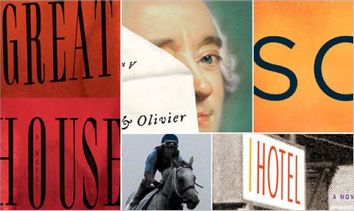
In Peter Carey’s “Parrot and Olivier in America,” the time is the early 19th century, the young aristocratic Olivier resembles Alexis de Tocqueville, and the low-born, middle-aged Parrot is Olivier’s British secretary. During their travels, they argue about almost everything. In the following passage, Parrot narrates and Olivier speaks first about art in America:

“Art is produced to suit the tastes of the market, which is filled with its own doubt and self-importance and ignorance, its own ability to be tricked and titillated by every bauble. If you are to make a business from catering to those people, the whole of your life will be spent in corrupting whatever public taste might struggle toward the light.”

“America is new.”

“Indeed,” he said, and I frankly loathed the certainty of his judgment. He might go away and write a book about this, but what could he know from so short a visit? The time it would take to make this nation would be put in centuries and it did not do to come prancing around in your embroidered vests and buckled shoes and even if the “New York Sentinel” reported what you said, it did not mean you knew.

Like the excerpt, the novel’s chapters alternate point of view, Olivier’s formal, structured and often pompous manner, Parrot’s more colloquial, loosely organized and mocking speech, both probably modernized a bit by the author. Their subject is personally crucial because Olivier believes himself a connoisseur of beauty, and Parrot, an amateur sketcher, has a painter wife and a business associate whose works resemble Audubon’s. For Carey, art represents cultural invention and reinvention as his protagonists struggle to create themselves as Americans: Olivier to marry, Parrot to survive. The novel’s first third describes Parrot’s outlaw youth in England and Australia and Olivier’s royalist upbringing in France. The companions’ episodic and mostly comic adventures in the New York City of the 1830s include contact with crooks and officials, resurrected acquaintances and recalcitrant Americans. As an artist, Carey would probably elicit scorn from Olivier, for the novel is a democratic “bauble,” designed to satisfy “the tastes of the market” for historical entertainments.

One of the five narrators in Nicole Krauss’ “Great House” visits a castle in Belgium where she sees a hall full of stored furniture, which reminds her of a photograph of Jews awaiting deportation to Treblinka:

The photo had struck me at the time because of the thoughtful composition which the photographer had clearly taken pains over, taking note of the way the pale faces topped with dark hats and scarves were mirrored by the seemingly infinite pattern of light and dark bricks of the wall behind them that trapped them in. Behind that wall was a rectangular building with rows of square windows. The whole gave the sense of a geometric order so powerful that it became inevitable, where each common material — Jews, bricks, and windows — had its proper and irrevocable place. As my eyes now adjusted and I began to see, rather than just vaguely feel with some unnameable sense, the tables, chairs, bureaus, trunks, lamps, and desks [were] all standing at attention in the hall as if waiting for a summons.

A piece of furniture confiscated by the Nazis connects Krauss’s narrators and other characters, most of whom are Jewish. The Israeli antiques dealer Weisz wants to find, five decades after World War II, his father’s desk, which has passed from a German novelist in London to a young Chilean poet, who reminds the novelist of her abandoned son, to an American novelist in New York City, who journeys to Jerusalem to find Weisz. This is the basic story that eventually emerges from Krauss’s “thoughtful composition,” her almost perfectly “mirrored” two-part “geometric order” that begins four narrations in part one and finishes three in part two. The American confesses hidden suffering, a British professor discovers secret suffering, an Israeli lawyer attempts to assuage past suffering, and Weisz causes current suffering, as if the desk that unites them were a curse of the Holocaust. Like the grad student narrator of the sample, the other speakers are monologist interpreters of experience who struggle to overcome self-indulgence. With its 19 drawers, the desk separates and conceals things. Krauss makes her house of fiction a similar construct of deceptions and evasions. The novel is saturated with emotional “common material” and is painstaking in structure but perhaps not, like the photograph, “inevitable” in its resolution and revelations.

Karen Tei Yamashita’s “I Hotel” is a 613-page novel in the form of 10 free-standing novellas linked by setting, a residence hotel in San Francisco during a decade beginning in 1968. Because the novellas are in wildly different styles — cinematic and dramatic scripts, collages of literary and political documents, narrative voices inflected by African-American dialect and Chinese and Japanese culture, cartoons and drawings — only the following sample represents them all:

Authors sometimes take strange liberties.

Charlie Chan

The “passage” in a section titled “Analects” is a bald statement set off by itself without any obvious context. Much of Yamashita’s prose is active, telegraphic and assertive, yet qualified — the “sometimes” — by other direct statements. Her constant subject is liberation — political, economic, racial and artistic. Perhaps a tenth of the book is composed of quotations from political theorists, poets, popular singers, jazz musicians, revolutionaries and others. The quotes, like the sample, may be authentic or invented by the author. Many of them are concerned with perceptions by or about Asians. Since one of the primary liberties that Yamashita takes is rendering novelistic action in the form of cinematic directions, Charlie Chan is an appropriate “authority.” As a detective, he is an ironic model for the Asian-American author’s investigations of the criminalized political activists of the period (one of the fictions takes the form of a police “dossier”). And just as a detective explains his reasoning at the end of a case, the novelist articulates her rationale in her final novella, an epilogue that could have been a prologue to welcome readers into her book.

Each novella has two or three conflicting characters; several of the most memorable are a Chinese historian and a Chinese saxophonist, a Japanese professor, a member of the Black Panthers, a Filipino activist, an early feminist. Characters from the first novellas sometimes appear briefly in later stories, but Yamashita’s most daring liberty is reversing the usual proportion between foreground (continuity of character and action) and background (setting and cultural information). To readers who were conscious adults in the early 1970s, her information about strikes, occupations and riots may seem over-familiar, but to younger readers “I Hotel” offers a thick description of the period in a cut-and-paste structure that resembles contemporary hypertext. The only novel like it that I know is Robert Coover’s similarly obsessive and excessive “The Public Burning”, which did for politics of the 1950s what Yamashita does for her decade. Since her West Coast novel published by a Midwestern small press went largely unreviewed in East Coast media, “I Hotel” is a true odds-beater as a finalist.

And now the hard part.

“So Much for That” is a very good mainstream novel with important topical concerns and engaging realistic characters but is rather pedestrian in its handyman style. “Lord of Misrule” is a very good indie press novel with no topical concerns and somewhat stereotyped characters but contains award-worthy sentences. Although a comic novel recently broke through to win the Booker Prize, “Parrot and Olivier in America” is not as amusing as other Carey novels, and it doesn’t penetrate America as perceptively as a European buddy book it resembles, Pynchon’s “Mason and Dixon.” The extensively voiced sufferings of the graduate student, lawyer, novelists and professor in “Great House” actively solicit one’s sympathies but are given only an oblique connection to the Holocaust. Although Krauss is possibly more profound than the first three, “Great House” seems “needy” to me, artfully contrived to elicit the admiration of other writers. Of the five, “I Hotel” is the most ambitious in its cultural range, the most diverse in character, the most ingenious in form, and the most idiosyncratic in style. It also has by far the most longueurs. I still think “I Hotel” should win — as a similar book by a West Coast writer, William Vollmann’s “Europe Central,” did the year I was a judge. But Yamashita may be too anarchic or too declamatory or too alien — too off-putting in one way or another — to get the votes she needs. Krauss and “Great House” will probably receive the award. In this space last year, I picked the winner, Colum McCann’s “Let the Great World Spin.” But don’t bet on “Great House” — unless you get great odds.

Continue Reading Close

Why do novelists hate being interviewed?

Under pressure from the publicity machine, writers are told to talk to journalists. Now they're hitting back

  • more
    • All Share Services

Why do novelists hate being interviewed?

“I Don’t Want to Talk About It.” That was on the card Don DeLillo handed me in Athens after I crossed seven time zones to interview him back in 1979. Fortunately the card was half a joke. I remembered the occasion when reading his new novel, “Point Omega”, in which a filmmaker from New York travels to the California desert to talk a writer into doing a filmed interview. In “Mao II,” about another writer that people want to talk with, DeLillo has a character say, “The interviewers are writing novels.” What I’ve noticed recently is that the novelists are writing novels about interviewers, and I’m wondering what this trend says about novelists and their readers.

Barnes & Noble ReviewI no longer do interviews. Too many problems. The tape broke when Stanley Elkin was talking. I got lost trying to find Joseph McElroy’s house in rural New Hampshire. DeLillo gave a thoughtful and mysterious interview, but the Paris Review decided that, after only six novels, he wasn’t sufficiently famous. William Gass took a year to rewrite the transcript. William Gaddis refused to edit the transcript. After I’d flown from Ohio to New York, Toni Morrison’s secretary said I was not on her schedule and let me in only after I produced a letter promising the interview on that date at that time. I loved the novelists’ unreliable narrators, but not the novelists who proved unreliable.

Given those experiences, I was surprised to find in recent novels that it’s the interviewer, not the artist, who’s usually portrayed as irresponsible or unworthy of respect. In “Me and Kaminski,” the German novelist Daniel Kehlmann depicts his marginally employed young interviewer as an opportunist who pursues an elderly blind painter to squeeze salable personal secrets out of him, but all he will talk about are form and style. Then, after the interviewer buys the old guy time with a prostitute and drives him to a meeting with his long-lost lover, the painter reveals he’s not really blind and takes the key to the car. While it’s true that the interviewer essentially abducted the painter from his home, in the end the tricked interviewer gets little credit for liberating the artist and is left with a handful of credit card slips. It’s a win for the artist (and novelist) because the interviewer throws away his notes and deletes his photos.

J. M. Coetzee is more subtle and clever in “Summertime,” which is almost completely composed of interviews that an invented biographer does with five presumably invented early acquaintances of a writer named John Coetzee. The interviewees resist and criticize the interviewer’s project, and three ask him why he’s not concentrating on the writer’s work rather than “gossip.” This former interviewer noticed, though, that most of the interviewees, unlike the interviewer, show no signs of having read the work. Coetzee has the interviewees accuse the interviewer of putting his own words in their mouths and “just making things up,” but the author still sees fit to use the interviewer’s “raw” Q&A form to construct a fictional memoir more stylistically interesting than his two nonfictional memoirs.

Roberto Bolaño’s “2666″ is the height of disrespect: The author disappears the novel’s would-be interviewers. The book opens with a 159-page section about four well-read and nicely individualized European literature professors trying to track down a novelist who vanished decades ago. But just as three get close, the novel veers away to treat a Chilean academic, an American sportswriter, and, in a much longer section, the disappearance of women from a city that resembles Ciudad Juarez. It doesn’t take an interviewer to see that Bolaño exploits the professors to solicit readers into a detective story that he turns into a larger, but very unpleasant, crime story. The further indignity: In the final section Bolaño himself composes the novelist’s biography that the professors might have written had the author not killed them off. Ironically, only real professors have the time to read Bolaño’s 893 pages which, because of repetitions and digressions, seem like 2,666.

DeLillo, the man who didn’t want to talk about it, somewhat improbably understands things an interviewer can do for a writer. In “Point Omega” the interviewer listens without objection to the blowsy, self-serving monologues of the aging writer, and when his daughter disappears in the desert, it’s the young interviewer who helps organize the search and cares for the despairing father. Yes, it’s possible the interviewer’s sexual interest in the young woman drove her into the desert, but I don’t think that was the interviewer’s intention. In the end DeLillo’s filmmaker, like Kehlmann’s journalist and Bolaño’s professors, loses the interview. I’m not suggesting this is equivalent to losing one’s daughter, just noting that the interviewer’s good works go unrewarded.

Philip Roth’s “Exit Ghost” is the most vitriolic about interviewers. Roth includes two characters’ rants against journalists’ interest in writers’ lives and describes the young interviewer, Richard Kliman, as having the “insane rapaciousness of the biographical drive.” Roth’s narrator, the now-elderly novelist Zuckerman, does recognize that Kliman’s recklessness and passion double his own traits as a young man, and that novelists are always biographizing. But in this work, arguing the near-sanctity of the work itself, Zuckerman refuses to read an unpublished manuscript that Kliman gives him, a manuscript by E.I. Lonoff, Zuckerman’s dead mentor who has fallen into obscurity.

Although counter to most readers’ expectations, possibly even those of the author who voices his hatred of interviews in interviews, Kliman, the “literary lunatic,” is to me the literary hero for his devotion to Lonoff’s work, even if it does encode a biographical secret about incest. And who is the most positively presented figure in the novel? George Plimpton, whose Paris Review institutionalized author interviews.

I understand novelists mourning a time when doing interviews was not a publisher’s requirement, and I can imagine that uninformed interviewers must be an irritant, but some novelists seem unaware of their inconsistency. They pillory interviewers for trying to make money off their work, but don’t novelists make money from their works about interviewers? It’s barely worth mentioning that writers also profit from the publicity that interviews give them.

If money isn’t the real issue, I began to wonder if the novelists’ animus against interviewers might be displaced animus against passionately curious readers, those who want to learn about authors to better comprehend their books. It appears that some novelists want to be understood, but not too thoroughly understood. Roth’s Zuckerman suggests a darker, Oedipal motive for the animus: “Old men hate young men.” All of the interviewers here are younger and more sexually charged than the artists they pursue, and younger than the authors who create them. Come to think of it, I was younger than the novelists who caused me the most problems.

Given the prejudice against interviewers reflected in these novels, I suppose this essay might be taken as special pleading by a former interviewer or even as publicity for my collection of interviews, “Anything Can Happen” (with Larry McCaffery), but it’s long out of print. No, there are two wholly objective reasons why novelists should consider treating their interviewer characters more sympathetically. Interviewers can be obtuse in their responses and selective in their interpretations. They may be privacy invaders or economic parasites, hero hustlers or celebrity scavengers, but in the future literary interviewers may also be the only people who still read literary fiction. Interviewers and interviewers who become biographers also have the final edit, the last word.

Continue Reading Close

Mosquito

Tom LeClair reviews 'Mosquito' by Gayl Jones.

  • more
    • All Share Services

“Say what?”

So says again and again Nadine “Mosquito” Johnson — truck driver, Bud
Light drinker, TV documentary watcher and narrator of Gayl Jones’ novel
“Mosquito” — as she listens to the diatribes of Delgadina, an intellectual
Chicana bartender in Texas City; to the polemics of Ray, a polymath black
activist; to the advice of childhood friend Monkey Bread, now a bookish
assistant to a Hollywood star; and to the conversations of other
African-Americans whose ideas the high school-educated Mosquito doesn’t
understand. She also doesn’t fully understand these characters’ actions.
Her eventual lover Ray may or may not be a priest. He and Delgadina may
have manipulated Mosquito into assisting a new Underground Railroad that
smuggles refugees from Latin America.

“Mosquito” is a midlife Bildungsroman that Mosquito’s tutors try to
make into a Künstlerroman — a novel of the artist’s development — as they tell her what kind of book to
narrate. Maybe it’s “Don Quixote” from Sancho’s point of view or a
border-town “Tristram Shandy”; perhaps it’s an improvisational jazz
autobiography or trickster satire; probably it’s an archive of the
Daughters of Nzingha (the African woman warrior), because “Mosquito”
includes the group’s newsletters, poems, letters — and, the author
helpfully notes, a play by her mother, Lucille Jones.

These models discourage plot and welcome everything else. Jones refers to
the history of blacks in Mexico and to her own family; alludes to real and
invented African-American novelists from Ralph Ellison to her own creation,
Amanda Wordlaw; discusses languages that Mosquito doesn’t speak but seems
to understand; reports reminiscences from Mosquito’s childhood in Kentucky;
retells dreams and throws in Delgadina’s cantina sink while she’s at it.

At first Jones’ main character has the appeal of Huck Finn, fresh talk from
a naive, good-hearted outsider. But after 50 pages and with little
narrative momentum, her “confabulatory” charm wears off and “Mosquito”
reads like 2,000 pages of Gertrude Stein’s “Melanctha,” aggressively
digressive, frequently vapid and stupefyingly repetitive.

Mosquito says, “You can’t trust everybody with every story. You can’t trust
people with every story. You don’t tell everybody every story. Even them
stories that is satires ain’t to be told to just everybody. You don’t even
tell everybody everything in the same story.”

Say what?

Jones — famously reclusive, particularly since witnessing the death of her
mentally unstable husband in a February 1998 href="http://www.salonmagazine.com/media/1998/02/26media.html">confrontation
with police
— has Mosquito explain this kind of discourse while
commenting on a minor character who “recontextualizes the subject matter of
Elvis to create a new storytelling form whose express purpose it seems is
to insult the intelligence.” In her academic study of oral narration,
“Liberating Voices,” Jones advocates replacing “intelligence” with affect
and wisdom. She used similar yarning methods in “The Healing.” I thought
that book should have won the National Book Award last year, but “Mosquito”
is twice as long, Mosquito is half as articulate as Jones’ earlier
narrator and the simulation of orality is now constricting rather than
liberating.

I’m not arguing with the multiethnic, multiracial, multiclass and
gender perspectives of “Mosquito.” They deserve more affecting, wiser, less
self-promoting treatment. Jones creates interesting characters and pressing
situations in a charged landscape, then maddeningly occludes them all with
the hyper-realism of Mosquito’s meandering and maundering voice. We hear
little from the refugees. Instead, we get pages and pages of second-hand
opinions about colonialism. Then paragraphs of implausible literary
commentary explaining why these opinions should be in this book. Ostensibly
the oral history of Mosquito’s inquisitive “I,” “Mosquito” turns out to be
an echo chamber where Gayl Jones can say “me, me, me.”

Continue Reading Close