Tristram Korten

A healthcare reform foe’s alleged history of discrimination

Plaintiffs claim conservative activist Rick Scott had strange criteria about who could work in his clinics

  • more
    • All Share Services

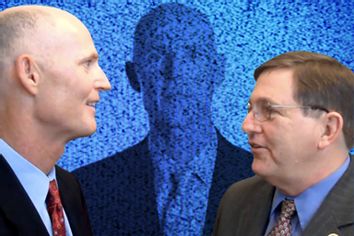
A healthcare reform foe's alleged history of discriminationRick Scott talks about Solantic to Texas Congressman Michael Burgess, chair of the Congressional Health Care Caucus

This summer, St. Petersburg, Fla., neurosurgeon David McKalip caught heat for sending an e-mail depicting President Obama as a witch doctor with a bone through his nose. McKalip, a neurosurgeon and founder of the anti-healthcare reform group Doctors for Patient Freedom, sent the photo to a conservative listserv with a note saying “Funny stuff” and the caption “Obamacare – Coming soon to a clinic near you.” The C in Obamacare was a hammer and sickle.

Given that racial unease has bubbled under much of the right-wing opposition to Obama’s political agenda, it’s not surprising that it should surface in the online joshings of a healthcare reform foe, even one as respectable as Dr. McKalip, a member of the American Medical Association’s House of Delegates and president of the Pinellas County Medical Association. (McKalip resigned from the local post, took a leave of absence from his AMA position in the wake of the e-mail, apologized profusely and withdrew from a public role in the anti-reform movement.) But a Salon investigation of a far more prominent healthcare foe has found allegations of discrimination that go beyond a tasteless e-mail. Plaintiffs have charged that the healthcare company owned by Rick Scott, who continues his multimillion-dollar, self-funded campaign against reform, practiced hiring discrimination based on ethnicity and appearance.

After six months and lots of money, Scott, founder of Conservatives for Patients’ Rights (and an ally of McKalip), has finally seen the fruits of his multimillion-dollar campaign against reform. Scott, a millionaire healthcare entrepreneur, predicted that when Congress reconvened this September the public option would be dead. “While Victory is near, we must not rest,” Scott crowed on CPR’s Web site. Scott himself never rested. He met with lawmakers, coordinated conference calls with conservative activists, wrote opinion pieces and spoke to the faithful about the evils of socialized medicine. Conservatives for Patients’ Rights targeted elected officials in 11 states with TV ads hoping constituents would pressure the lawmakers to oppose proposed changes. Sure enough, when the public option failed in the Senate Finance Committee Tuesday, Scott took credit in this video.

Scott came to the fight with a background in the business of healthcare; in the 1990s he was the CEO of the country’s largest chain of hospitals, until that company, Columbia/HCA, pleaded guilty to defrauding the government in 1997 and Scott was ousted (he was never charged in the fraud). Determined to reclaim some of his lost clout in the healthcare field and rehabilitate his image, in 2001 he started a chain of walk-in clinics in Florida called Solantic.

Scott proudly talks about Solantic during his anti-reform campaign, holding it out as an example of the kind of free-market ingenuity that can fix our ailing healthcare infrastructure, as opposed to big government. “Solantic has continued to prove over the past eight years that it is possible to lower healthcare costs through the free market and still deliver quality care to patients,” he wrote in an e-mail statement to Salon.

Yet even before it was fully operational Solantic executives were accused of a pattern of serial discrimination in hiring, a pattern supposedly initiated by Scott himself. The suits alleged a standing policy not to hire overweight women, Hispanics with strong accents, older women and black women.

The company settled the suits, and never admitted any wrongdoing. Today, the company’s CEO, Karen Bowling, adamantly denies there was ever such a policy. But as Scott exerts influence on the national healthcare debate, and holds up his own company as a model of the virtues of the for-profit system, the chronology of the accusations is compelling. It starts with one of the very first people Solantic hired.

- – - – - – - – - – - – - – - – -

David Yarian’s office is located south of Jacksonville, Fla., in a brand-new medical complex carved out of some nearby woods. Yarian, a 56-year-old doctor with a genial, round face and neatly parted graying hair, who favors crisply starched shirts with the cuffs folded inside the shirtsleeves, is currently the associate director of a community hospice there. “A nonprofit,” he proudly points out. His emphasis is noted; the last for-profit medical venture Yarian was involved in was Scott’s Solantic.

In 2001, tired of the commute from Jacksonville to his job running an occupational medical center two counties away, Yarian responded to a newspaper ad for a doctor to help the start-up Solantic. In June of that year, Bowling met Yarian inside a rented conference room at a Jacksonville office park.

“After she interviewed me, Rick Scott flew down and interviewed me,” Yarian recalls. At the end of the interview, Yarian says, Scott explained he was doing this because he was passionate about healthcare. “He told me he didn’t need the money,” Yarian recalls. (Scott was paid $10 million to walk away as CEO of Columbia/HCA along with $300 million in stock.) Later, when Yarian learned about Scott’s past, he surmised that part of what motivated Scott was the need to prove that his success at Columbia/HCA was not a fluke, or the product of fraud. “He really wanted to be able to say, ‘Look at me, I did it again in healthcare!’” Yarian says.

On June 12, 2001, Solantic offered Yarian $200,000 to be its regional medical director. It was exciting, he says, to be on the ground floor of a company whose founders were ambitious. “The goal all along was to make this a brand that could go national,” Yarian says. “My role was to put together the clinical design for all the urgent care centers.” He was in charge, nominally, of everything from selecting medical equipment to purchasing malpractice insurance. From the very start, though, Scott became very hands on. “I’d receive a dozen e-mails a day from him, and at least six phone calls. I didn’t think he did anything else,” Yarian recounts. In fact, Scott ran the investment firm Richard L. Scott Investments. “Scott ran everything, no decision could be made without his approval,” Yarian says.

And that became an obstacle.

“One of the first things we needed was an R.N. [registered nurse] to help oversee the clinical part with me,” Yarian recalls. “There was this great young individual who had a lot of experience with clinic start-ups. She interviewed with me, and then with Karen. We both loved her. When I got on the phone with Rick, the first thing he says is, ‘What does she look like?’”

Yarian says he began describing her to Scott, at one point mentioning that “She’s a little bit overweight.”

“Immediately Rick says to me, ‘Fat people can’t work at our centers.’ And that sort of set the trend,” Yarian says. “I’d be interviewing someone and his first concern was what they looked like. He was always sending e-mails that people had to be fit and attractive. And no one was hired without his approval.”

(Rick Scott declined to return several messages seeking comment at both his Naples investment firm, and at Conservatives for Patients’ Rights. Salon then sent a detailed list of Dr. Yarian’s statements to CPR. Through a CPR spokesman, Scott sent the following e-mail: “This current story, focusing on the unsubstantiated claims of one disgruntled former employee who left the company after only four months, is but the latest example of Salon’s despicable tactics. The company I founded, Solantic … has a vibrant and diverse workforce that is representative of the communities in which they are located, and our employees are dedicated to delivering quick, responsive and high-quality care to all of our patients. Other than calling Yarian’s comments “unsubstantiated,” Scott neither denied nor confirmed these events.)

“He was so hung up on this idea of trim, fit people we [Solantic employees] would joke about how nuts he was,” Yarian says. “Initially I laughed too. But then I saw the depth of it. And I began feeling that this wasn’t right.” He decided to approach Bowling. “But when I brought up my concerns that this might be discrimination with her, she said, ‘I’m not going to give up this opportunity he has given me.’”

Discriminating against someone because they are overweight is not against the law, because the merely overweight are not a protected class of people under the law. Those who are considered “morbidly obese,” however, might qualify under the Americans With Disabilities Act. “One would hope an employer would hire based on merit,” explains Justine Lisser, a senior attorney-adviser at the federal government’s Equal Employment Opportunity Commission (EEOC), speaking in general. “But it’s not against the law for an employer to be a jerk.”

Soon enough, Yarian claims, Scott became still more specific about who should not be hired.

After the attacks on Sept. 11, Yarian says that Scott phoned him and stated that he should be careful not to hire anyone of Middle Eastern descent because they might scare off customers. At the time, Yarian was willing to excuse the directive as part of the collective shock the country was going through.

In November, though, Yarian interviewed a Hispanic man for a supervisory nurse position. “He was great. He had all the qualities and experience I was after,” Yarian says. “But he had a slight accent. When Rick found out, he said, ‘Nope. All our employees have to be mainstream.’”

Yarian, who is married to an African-American woman, felt that Scott’s odd obsession with weight and appearance might have just crossed a legal boundary. “Mainstream? What did that even mean?” he says he remembers thinking. “It was just a very, very uncomfortable feeling to realize this after you got to know him.”

(The EEOC’s Lisser zeroed in on that word when I mentioned it. “We at the EEOC would want to carefully check out a company that expressly stated a hiring guideline specifying ‘mainstream’ people,” she says. “We’ve seen ‘mainstream’ and ‘clean-cut’ used as code words to discriminate based on race and national origin before.”)

Yarian had the same instinctual response. “When they started talking ‘mainstream,’ to me that meant discrimination,” he says. “The next day I sent him an e-mail, and told him I didn’t feel comfortable with our conversation. I asked him, ‘What do you mean by mainstream?’ I never got an answer.”

Instead, the following day Bowling called him in for a meeting. “She told me, ‘If you can’t change your attitude about this then you have no future with the company.’ And she told me not to communicate with Rick anymore,” he recalls. “She said they put together a severance package of about $30,000 for me.” Yarian says he refused the package because his employment contract specified that if he was terminated without cause he was entitled to six months’ salary — or about $100,000.

Yarian took the next two business days, a Monday and Tuesday, off. When he went in on Wednesday Bowling instructed him to take his personal effects and leave. He had been fired. His computer access had been terminated and a Jacksonville City police officer was summoned to escort him out. Yarian sued for breach of contract, asserting that he had been fired for opposing the company’s discriminatory hiring practices.

In December of 2002 the two sides settled, with Solantic paying Yarian about $80,000, of which more than half went to lawyers.

In addition to apparent discrimination, Yarian says Scott’s hiring prohibitions also meant that he couldn’t hire the best people for the job, a crucial matter when it comes to administering healthcare. When Yarian told Scott that quality was being impacted, Scott, he says, responded, “Quality is assumed.” Yarian still marvels at the comment. “Well, I couldn’t hire the most qualified people, so I didn’t know what he meant.”

In a 2002 deposition in the case, Bowling conceded that Yarian had come to her with concerns about the company’s hiring practices. “He did express concerns that we — that he didn’t believe in the hiring practices, and how do you interpret what’s presentable,” she said. “And alluded to overweight people.” Bowling rebuffed the idea that her company was discriminatory in any sense. “I challenged him by saying, ‘Can you tell me one time in Solantic’s employment history that we have not hired a candidate because they were Hispanic, overweight, whatever?’” she asserted. “And the answer was ‘No.’”

Bowling also sent Yarian a letter at the time enumerating several violations of company policy warranting his dismissal — allowing a pharmaceutical representative to leave samples in his office; telling a doctor candidate that he did not get the job when the company was still evaluating him, and repeatedly complaining that Bowling “interfered with your responsibility to recruit medical staff by refusing to consider well-qualified applicants because they spoke with a Hispanic accent or because they were overweight.” Bowling says when she pressed him for specifics, “You could not name any.” (Yarian, of course, says he gave her several specifics).

On a broiling summer afternoon, Bowling, pleasant and upbeat, met me at Solantic’s Tamarac clinic outside Fort Lauderdale to respond further to Yarian’s assertions. She disputed most of Yarian’s version of events; Scott was not involved in hiring, she said; she never heard Scott say the company would not hire overweight people or people with accents; and she never heard him mention that all the company’s hires had to be “mainstream” Americans. “What does that even mean?” she asked aloud. And, she said, Yarian’s account of his attempts to hire a registered nurse was not accurate. “I don’t think we even had a position for a nurse in 2001,” she asserted. “We never hired anyone in that position.” (“What a joke!” Yarian blurted when I told him this. “It was a key position; the hire we needed the most after the CFO, the human resources director, the IT guy and me.”)

“If you look at my background, the way I’ve lived my life, the people I’ve hired to previous positions, you would know I don’t discriminate,” Bowling offers.

Perhaps, but within a year after Yarian left, a pattern emerged as Solantic went on a hiring binge to staff its five pilot clinics.

Solantic would hold what employees called “casting calls,” group job interviews for its front office and clerical help. Many ex-employees have alleged these group sessions allowed management to eyeball prospective hires and make sure only the ones fitting the company’s aesthetic guidelines were selected.

From 2003 to 2005, five Solantic supervisors, all working in different clinics, have claimed they were explicitly prevented from hiring people they deemed the most qualified because the candidates were either overweight, too old, Hispanic or black. The supervisors all prepared lawsuits with the same lawyer, claiming they were fired or forced to quit “because they did not want to enforce Solantic’s discriminatory practices,” as their complaints state. Two employees corroborated specific incidents in their own lawsuits against the company.

  • Jacquelyn Lee, a manager at Solantic’s Arlington and Neptune Beach offices, claimed in court papers that she offered a job to a Hispanic woman who was slightly overweight, and was told by her supervisors to rescind the offer. Lee says she objected and was fired on Dec. 30, 2003.
  • Holly Waldrop, a manager at Solantic’s Westside operation, claimed supervisors told her she could not hire a woman Waldrop wanted to because the woman was “too old” and women at that age don’t learn well. Waldrop complained to her superiors that this was discrimination, and was fired a short time later, in May 2004.
  • In July 2004 Lucinda Hietbrink, a manager at Solantic’s Jacksonville Beach location, interviewed Kolandra Abraham, a black woman, for a clerical job. Hietbrink “extended the job offer, which was accepted by the applicant, and she was scheduled for orientation. After members of higher management saw the applicant/new hire, the employment offer was rescinded,” Hietbrink states in court papers. Hietbrink stated that she had already objected once before when management wanted to fire a woman because she was overweight. She claimed she strenuously objected to rescinding Abraham’s offer as well, and was fired a short time later, on July 22, 2004.
  • Abraham also filed a lawsuit, saying she was offered the job, but, according to court papers, “after the human resources manager saw her, she told Ms. Abraham that she was not in the budget.”
  • In the summer of 2004, Carrie Fernandez, a manager at Solantic’s Orange Park clinic, hired Sarah Carter as a registrar. Carter, who is white, had just had a baby. But after meeting a market leader in her office named James Bennett, Carter was sent to talk to a human resources manager. During that meeting Carter states in court papers that the manager stepped out for a minute, allowing Carter to see an e-mail printout Bennett had written stating that Carter was “too hefty” and, according to the complaint, “therefore did not meet the company’s appearance standards.”
  • Fernandez filed her own complaint against the company, stating that her supervisors instructed her to rescind the offer to Carter because she was “too hefty.” Fernandez, who had objected once before when she was told not to hire a qualified black woman “due to her race and age,” complained to her superiors that this amounted to discrimination and quit. In the aftermath, Carter was hired, but quit in June 2004 after she was assigned to work under Bennett.
  • Stephanie Davis, a manager in Solantic’s Northside clinic, is white but has family members who are black. She claimed that she was so intimidated by the company’s discrimination practices that she took down personal photos in her office “fearing she would be terminated if higher management saw them during an inspection of her center.” Eventually Davis filed a hostile work environment complaint with the EEOC, and then claims she was retaliated against until she quit on March 3, 2005.

Rick Scott was not mentioned in any of the complaints.

A combined suit on behalf of all seven plaintiffs was filed on July 14, 2006. On May 23, 2007, less than a year later, Solantic settled with all the women for an undisclosed sum. Because the settlement terms are confidential, with penalties for speaking publicly, all the plaintiffs contacted declined to be interviewed. Bowling, too, smiled tersely when asked about the cases, saying only; “Do we make hiring decisions based on a protected class of people? Absolutely not. And we have diversity training for our employees.”

Florida is one of a handful of states governed by the “At Will” employment doctrine — which gives employers broad latitude to fire employees.

“You can’t fire or fail to hire someone based on sex, race, national origin, religion or age,” said Howard “Skip” Pita, a Miami trial attorney who handles discrimination litigation. “Otherwise you can fire someone for almost anything. An employer fires you because he thinks you’re too fat or doesn’t like the way you dress? Too bad.”

In the Solantic case, the number of complaints from both supervisors and employees, some of which corroborate each other, and the swiftness of the settlement, leads Pita, who has no connection to this case, to believe the company felt it was vulnerable. “Usually cases like this don’t settle early on, unless the evidence is strong,” he said.

None of this was reported in the media, local or otherwise. Until I brought it up to Dr. Yarian he had never heard of the women and their lawsuits. He was surprised he hadn’t been contacted by the women’s lawyers. “Obviously, it doesn’t surprise me,” he noted. “Rick Scott is a savvy businessman, but he has a lot of hangups.”

I visited three Solantic clinics, and their staffing seemed to be a melting pot. There was a black man and black woman at the Tamarac center, an Asian woman at the Perimeter Road facility in Jacksonville, and a white woman at the Orange Park clinic. All of them were young and fit. Scott made sure to send an e-mail asserting that currently 53 percent of Solantic’s employees are white, 20 percent black and 17 percent Hispanic.

Scott was also contemptuous of Salon for pursuing this story. “It is no surprise that Salon Magazine is once again dutifully playing the role of attack dog on behalf of liberals in Washington just as their top agenda item — government-run healthcare — has run into trouble on Capitol Hill. Salon, true to form, is launching another personal attack designed to distract their readers from the substantive issues of the healthcare debate.”

Rick Scott profits off the uninsured

A leading foe of healthcare reform owns a chain of clinics aimed at people who would benefit from a public option

  • more
    • All Share Services

Rick Scott profits off the uninsuredRick Scott, foreground.

For months now multimillionaire healthcare entrepreneur Rick Scott has been at the center of the aggressive campaign to derail healthcare reform in Washington, D.C. Reprising the role he played nearly 20 years ago, when as the head of a national hospital chain he helped kill Clintoncare, the former hospital-chain executive founded the group Conservatives for Patients’ Rights, raising $20 million to fight Obamacare, including $5 million of his own money. The tall, lean Scott, whose shiny bald head swivels in exasperation at the idea of government involvement in healthcare, even stars in its nationwide ad campaign comparing Democratic proposals to socialized medicine. Through this group, he has fomented the conservative strategy to disrupt town hall-style healthcare meetings around the country by shouting down elected officials. (CPR sent schedules of the meetings to so-called Tea Party activists.) He can justifiably claim some of the credit for the Senate Finance Committee’s two votes Tuesday against a public option. But in Rick Scott the right has found a frontman whose baggage threatens to overwhelm his message.

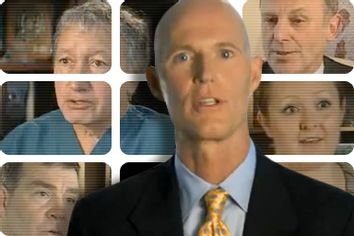
A linchpin of Scott’s 2009 campaign has been the use of anecdotes from abroad — horror stories from Britain and Canada meant to illustrate how government-controlled healthcare systems “clearly kill people” by controlling their access to care, as he told Fox’s Sean Hannity in June. He even funded a documentary titled “Faces of Government Healthcare” cataloging the horror stories of British and Canadian patients who were purportedly denied medical attention for life-threatening illnesses until it was too late.

Yet even as Scott makes the rounds of Congress and talk-show green rooms, a wrongful death lawsuit has been working its way through the Florida courts against a doctor employed by the chain of walk-in clinics Scott founded. Scott has repeatedly bragged that the 27-clinic, Florida-based company, Solantic, is an example of the free-market ingenuity needed to fix our ailing medical infrastructure. The lawsuit, however, alleges a Solantic doctor misdiagnosed a patient’s deep-vein thrombosis as a sprained ankle, leading to a pulmonary embolism and death. That same doctor was reprimanded by the state for misdiagnosing deep-vein thrombosis in a patient who died two years earlier. It’s the kind of anecdote you’d expect to hear in Scott’s documentary — except that it condemns a free-market system where profit and patient volume may take precedence over care.

And this isn’t the first time that Scott’s warnings about the ills of socialist medicine have found an ironic echo in his own healthcare business. Scott argues that socialized medicine rations care and strangles competition, yet just after his first stint as anti-reform spokesman in the 1990s, while he was running the world’s largest healthcare company, he was accused of monopolizing markets and choking out the competition while slashing the chain’s costs to the point that it affected patient care. And while he asserts that two of the core principles of healthcare reform are “accountability” and “personal responsibility,” Scott ran a company that ultimately pleaded guilty to defrauding the government in one of the nation’s largest Medicare frauds ever. Two executives went to prison, the company paid almost $2 billion in fines, and Scott was pushed out of the company. Before he could retake the political stage, he had to build his healthcare business all over again.

In the end, Scott’s virulent opposition to Democratic healthcare proposals may simply be a business decision. The post-millennial incarnation of Rick Scott has plunged into several new healthcare businesses that could be adversely affected by reform. Among other healthcare businesses, Richard L. Scott Investments has invested in a pharmacy company, Pharmaca, where one of his employees sits on the board of directors. Drug manufacturers are opposed to a Medicare-type entity that could negotiate bulk purchases of drugs and drive down the cost of their products. More important, Scott’s Solantic bills itself as a low-cost alternative to people who would otherwise go to emergency rooms for their immediate care needs — i.e., the uninsured and people paying out-of-pocket expenses as a result of diminished insurance plans — the very people reforms are intended to cover.

Solantic’s very existence is an implicit acknowledgment that healthcare costs have not been reined in by free-market forces. Scott himself boasts that a person paying out of pocket will spend at least 10 times less at a Solantic clinic than in a hospital emergency room. That’s because hospitals have to charge insured patients a premium to help cover the costs of the uninsured, who often can’t pay the full price for medical care, and may skip out on paying altogether. (The Center for American Progress, a liberal think tank that supports a public option in healthcare reform, estimates there is an $1,100 cost shift to family premiums in order to cover the uninsured.) As insurance premiums rise as a result, businesses are turning to higher-deductible plans for their employees, which forces Americans who do have health insurance to pay more in out-of-pocket expenses.

Solantic makes its profit on the spread in this system. “He’s there to catch everyone who doesn’t have access to regular healthcare,” says the Center for American Progress’s Igor Volsky. “It’s just a business opportunity.”

- – - – - – - – - – - -

Richard Lynn Scott was raised in Kansas City, Mo. His father was a truck driver, his mother a department store clerk who sold encyclopedias door-to-door to augment their income. After high school he joined the Navy, then attended the University of Missouri, while working full-time at a grocery store. It was also during college that he exhibited his entrepreneurial drive, buying two doughnut shops for his mother to manage. Ultimately, he decided to become a lawyer, and attended the law school at Southern Methodist University in Dallas, staying in town afterward to practice at a large firm, Johnson & Swanson, where he represented hospitals in mergers and acquisitions. It’s there that he began to see healthcare in terms of its business components and profit potential.

He had no medical background and never operated a hospital or ran a clinic, but at some point decided he wanted to own hospitals. In 1987 Scott made a failed bid on behalf of some investors to buy the Hospital Corporation of America, a hospital chain founded by members of the Frist family, including Dr. Thomas Frist Sr., the father of then-U.S. Sen. Bill Frist. But the Frists rejected the offer. The move, however, brought him to the attention of Richard Rainwater, a politically connected investor with ties to the Bush family. Rainwater had made a fortune investing for the wealthy, including George W. Bush. At one point Rainwater, who owned a big chunk of the Texas Rangers and brought Bush in as the team’s managing partner, brought in Scott as an investor in the team as well. 

In 1987 Rainwater and Scott partnered, and with the initial purchase of two hospitals in El Paso, Texas, formed the Columbia Healthcare Corp. They took their company public and used the money to buy hospitals at a fast clip, focusing on dominating specific markets by buying several hospitals in a region and closing the poor-performing ones. They slashed costs, cutting jobs and hours, and bought bulk supplies at discount. Wall Street rewarded them. By 1994 they had enough capital to buy Scott’s original target, HCA. The combined company, rechristened Columbia/HCA, would grow to more than 340 hospitals, 135 surgery centers, 550 home health locations in 37 states and two foreign countries, making it the largest healthcare company in the world. Scott moved to HCA’s corporate headquarters in Nashville, Tenn., as CEO.

Although Scott, through Rainwater, hobnobbed with politicos, he was not known as a political animal. He was a workaholic. His political contributions in those days were to trade groups like the Federation of American Health Systems, and to people associated with his business, like Bill Frist’s Senate campaign. “I do not recall that he was a major political player back in either the ’80s or early ’90s, even though he had these connections to Bush through Rainwater,” says R.G. Ratcliffe, a veteran political reporter for the Houston Chronicle, who has covered Texas politics, and Rainwater, for 30 years. 

Scott himself was an unassuming man, even as his company made financial news across the country. Maggie Mahar, a journalist for the business magazine Barron’s in those days, flew down to meet Scott in order to write a profile, but found a man so undynamic she had to change the focus of her story. “He was supposed to be a new up-and-comer, and I just didn’t get it,” she recalls. “Usually someone who runs a large corporation has a large personality, if not intelligence. With Scott there just wasn’t enough there, so I wrote about whether tax breaks for nonprofit hospitals were unfair to for-profit hospitals.”

Yet when the Clinton White House began aggressively pushing healthcare reforms, it was Scott who took up the role as frontman for his company, voicing opposition to industry groups and the media. “What’s happening in Washington is not healthcare reform,” he was quoted in the New York Times as saying to a group of Tampa hospital executives in 1994. “Healthcare reform is happening in the market place.” Many suspect he was urged to do this by the Frists, who still retained much control of the company.

The Center for American Progress put together a video montage showing that Scott’s talking points today are almost exactly the same as they were in 1993 and 1994. He was at the top of his game then, a man Time magazine praised in 1996 as one of the 25 most influential Americans, alongside Jerry Seinfeld and Sandra Day O’Connor. “In an industry notorious for waste and inefficiency, Scott aggressively consolidates operations and imposes cost controls,” Time lauded in its article. One of the examples Time cited was Scott and Rainwater’s investment in the two El Paso hospitals, followed by the purchase of a third nearby, which they promptly closed to drive up revenue at the other two.

Others were not so smitten. Journalist Mahar studied Columbia/HCA’s business model for her book “Money-Driven Medicine: The Real Reason Healthcare Costs So Much.” Hospitals were traditionally seen as a nonprofit business because they provide an essential service to society, Mahar explains. “Hospitals are a necessity like gas and electricity,” she says. “We regulate those industries. We don’t allow prices to skyrocket. The same thing in healthcare. We don’t want hospitals gouging sick people.” But in the 1980s, she says, ambitious investors began to see healthcare as a way to make money. Chief among them was Scott.

“What Rick Scott wanted, and his shareholders wanted, was for healthcare to be a growth industry where revenues go up every year,” says Mahar, now a fellow at the public-policy think tank the Century Foundation. “I think it’s basically impossible to achieve the level of profitability they wanted in the hospital business. You can’t expect double-digit profits from a hospital. It’s a very tough business. You need a lot of people. You need a good nurse-to-patient ratio to keep patients comfortable and respond to emergencies. And it’s unpredictable; you don’t know how many patients on a night shift are going to get sick. So you can’t trim down to the bone. When you do, people die.”

Columbia/HCA regularly posted double-digit growth that paid big dividends to shareholders. BusinessWeek recognized it as one of the 50 best-performing companies on the S&P 500. But in her book Mahar cites examples of how the cost cutting at Columbia/HCA impacted care. One technician complained of having to watch 72 heart monitors at one time. Nurses at an Indianapolis hospital complained to state authorities that babies in the neonatal unit were left unattended for up to three hours. In one case a nurse caring for seven infants was so busy she failed to hear an alarm when a baby stopped breathing; the child was saved when a parent rushed in. The state fined the hospital.

Other, bigger problems were looming. In the mid-1990s, aided by a former accountant who became a whistle-blower, the feds opened an investigation into suspicions that Columbia/HCA hospitals were routinely defrauding the government by inflating the expenses of procedures billed to Medicare, and paying illegal kickbacks to doctors who steered patients to Columbia/HCA hospitals. In July 1997, a year after Time’s coronation, federal agents raided Columbia/HCA hospitals in more than half a dozen states, and carted away reams of paperwork. Some hospitals were discovered to have two sets of books, one reflecting the true costs for procedures and another with inflated expenses charged to Medicare. Four executives were indicted; two were found guilty and sent to prison. Rather than continue to fight the government, company executives decided to have Columbia/HCA plead guilty to 14 felonies. The hospital giant ended up paying $1.7 billion in fines and settlements. 

Scott was not indicted in the scandal and has protested that he never condoned any illegal activity. He has asserted that federal agents never even interviewed him. But Columbia/HCA’s board found him an unpleasant symbol of the problem and voted to oust Scott almost immediately after the scandal erupted in 1997, paying him a $9.88 million severance package, along with 10 million shares of stock worth up to $300 million at the time, to walk away.

Mahar lays much of the blame for Columbia/HCA’s illegal acts at Scott’s feet. He cultivated a corporate culture where profit was the most important thing, and, as she put it in her book, “executive salaries hinged not on such criteria as reducing infections or lowering death rates, but on meeting financial targets like ‘growth in admissions and surgery cases.’”

- – - – - – - – - – - -

Scott was stung by his fall. He retreated into finance, starting the investment firm Richard L. Scott Investments in Connecticut, that bought stakes in a variety of industries, including a TV network devoted to health news (later acquired by Fox) and a computer security firm. But he clearly wanted to reestablish himself as a healthcare player.

A few years after his HCA ouster he got his chance when he and a former Columbia/HCA marketing executive named Karen Bowling conceived of a chain of urgent-care clinics. They collaborated on a business plan for a company that would provide a retail experience not unlike Starbucks or McDonald’s — convenient, affordable, with a focus on “customer satisfaction.” In 2001 Scott funded it. The company, based in Jacksonville, Fla., was formed as a service to people who would otherwise visit overburdened emergency rooms with relatively routine problems, such as broken bones, sprains and minor infections, to patients who need to see their primary care doctor for matters such as immunizations and physicals but would have to wait days or even weeks for an appointment. The clinics were designed to be open 12 hours a day, seven days a week. Today, there are 27 Solantic clinics, all in Florida.

Karen Bowling is a cheery former Jacksonville TV reporter. She began working for Scott in the late 1980s when Columbia/HCA gobbled up the Jacksonville hospital where she was the marketing director. She has been a faithful Scott ally ever since, even leaving her job with Columbia/HCA when Scott was ousted. She worked for various of his companies before starting Solantic. “We both really believed healthcare should be more convenient for patients,” Bowling says.

Bowling insists the majority of clients are insured, and just want the no-wait convenience of a Solantic clinic. But Scott’s repeated emphasis on the cost savings for those paying cash implies the company sees the uninsured as a market to be tapped. “We’re probably one-tenth to one-fifteenth the cost if you’re just writing a check and going to the E.R.,” he boasted to Texas Rep. Michael Burgess in a made-for-YouTube interview the congressman shot. And most press reports identify Solantic as targeting the uninsured. The New York Times described Solantic as a “chain of urgent care clinics which Mr. Scott promotes as inexpensive alternatives to emergency rooms, especially for the uninsured.” And why not? With an estimated 45 million to 47 million Americans without health insurance right now, it would seem a smart business move. But just as happened with his first healthcare empire, Scott’s newest business raises questions about the compatibility of a corporate bottom line with quality patient care.

- – - – - – - – - – - -

One of Scott and Bowling’s initial hires at Solantic was Dr. David Yarian, the company’s first regional medical director. His job was to create the clinical design for the urgent-care centers. Yarian lasted roughly five months. He clashed repeatedly with Scott over hiring practices. They also had philosophical differences about how to set up the clinics. Solantic initially designed them so that there would be one doctor and one physician’s assistant on staff for 12-hour shifts to meet a steady stream of patients, Yarian says.

“The whole design was for people to get in and out quickly,” Yarian says. “I believe the target was 50 patients a day based on a 12-hour day. But no clinic works that way, especially urgent-care clinics where people don’t make appointments.” The business is too unpredictable. “But Rick and Karen had never run a clinic. He wanted to turn it into a McDonald’s. His whole point was volume and speed.”

Yarian knew about Scott’s past, and he worried that Scott was emphasizing profits over patients again.

“It was made very clear to me this was a numbers game,” Yarian says. “The doctors were going to be evaluated on the number of patients they saw. This is exactly what happened at his hospitals.”

After one clash too many, Scott and Bowling fired Yarian in November of 2001. Yarian sued for breach of contract and ended up settling with the company.

Scott, in a statement to Salon, declined to address Yarian’s criticisms and dismissed him as a “disgruntled employee.”

In 2004, three years after Yarian’s brief tenure, Solantic hired Dr. Nadeem Maalouli as one of the doctors for its Orange Park clinic just outside Jacksonville. It’s not clear if the company knew it at the time of his hire, but Maalouli was being investigated by state health officials for a botched diagnosis. In September 2002 Maalouli was working in a hospital emergency room when he treated a 32-year-old woman complaining of shortness of breath, chest pain and possibly blood-tinged sputum, according to a complaint by the Florida Department of Health. But after Maalouli examined her, the complaint states, he found her “normal.” In fact, Maalouli had failed to detect the woman’s deep vein thrombosis (DVT). Four days later the woman suffered a pulmonary embolism and died. In 2007 the state’s Board of Medicine ultimately ruled that Maalouli’s failure to detect the DVT had violated medical standards and reprimanded him. Maalouli agreed to pay a $15,000 fine and to take a continuing education course in detecting pulmonary embolisms.

That case was winding its way through the state’s bureaucracy when Maalouli started at Solantic. (Maalouli through his lawyers declined to comment for this article). Then, on March 16, 2005, Tanieta Ogden Shuler, a 31-year-old Jacksonville woman, limped into his clinic, according to information taken from court and medical records. It was around 8 p.m., right before closing, and Shuler complained of a pain shooting from her right heel up the back of her leg. Dr. Maalouli, who was finishing a 12-hour shift, examined Shuler and diagnosed a sprained ankle. He recommended she keep her foot elevated, treat it with ice, and use crutches for the time being. Then he prescribed Motrin 800 and Darvocet for the pain. 

Six days later Shuler followed up with a podiatrist who recommended an MRI to see why the pain was persisting, a task Shuler put off. The next day, at about 7 p.m. on March 29, Shuler was rushed to the emergency room at Memorial Medical Center, where she died. An autopsy revealed that Shuler suffered from DVT in her leg, which caused a pulmonary embolism.

In their lawsuit, Shuler’s family asserts that Maalouli’s examination fell below the accepted standard of care because he didn’t send her off to get a sonogram or other tests to double-check his assessment (the clinics don’t have sonograms). Maalouli’s and Solantic’s lawyers dispute that, saying all indications pointed to a sprained ankle, and that it’s likely Shuler didn’t even have the DVT when she came in to be examined.

Questions likely to come up at trial include whether the company’s supposed emphasis on numbers pushed Dr. Maalouli to see Shuler as the clinic was closing, after he had worked a 12-hour shift, and whether Maalouli did not send her off for further tests because he might have lost a client to another facility.

Bowling declined to comment on this case because it is still in the court system. “It’s important to say it hasn’t gone to trial and it’s outcome hasn’t been determined yet,” she says.

And of course, one wrongful death case, amid the 1.7 million visits to Solantic’s 27 clinics, according to company statistics (counting multiple visits by the same patient), is not a condemnation of the entire business model. But it is an uncomfortable fact for Scott to deal with as he travels the world cherry-picking horror stories from countries that use government run systems.

After all, a doctor at a for-profit clinic that relies on high patient turnover, who is called to account for two alleged misdiagnoses ending in two deaths, is right up there with the examples from Scott’s documentary — the English woman denied routine pap smears for two years until she was diagnosed with fatal cervical cancer, or the Canadian man who had to wait 20 months for an appointment regarding his heart arrhythmia, and finally came to the U.S. for treatment.

Aside from the paradox the wrongful death suit puts Scott’s example-rich campaign against socialized medicine in, it also counters his boast that Solantic is the kind of free-market exemplar that can fix our healthcare industry. Urgent care clinics provide a service, but only for the most uncomplicated procedures. Doctors don’t review a patient’s past medical history. There is no ongoing primary care offered. They have limited testing abilities. Other than X-ray machines the facilities don’t have any advanced equipment. This is not the solution for the nation’s uninsured.

“For very limited things it could work,” says author Mahar. “But one problem with this transparent pricing is that if I go in with a terrible stomach pain, no one knows where this is in the price plan until they start examining me. How can they possibly tell me when I stagger in how much it will cost to treat me? Even something as simple as a headache, well I could have a tumor. Basically healthcare is not a commodity that can be neatly priced.”

Even Bowling concedes it is no replacement for ongoing care from a physician. “I think people should rely on us for episodic care,” Bowling explains. “As a policy we refuse patient requests to be the primary care physicians.”

And Rick Scott has never proposed his own full-length healthcare plan, though he has ventured a few specific proposals — transparent pricing by insurance companies and standardized forms for insurance submissions. Mostly, Scott knows what he’s against.

Solantic’s target customers — not only the uninsured, but the self-employed, and small businesses seeking to provide insurance to employees — are the ones advocates say would benefit most from some kind of affordable healthcare option, even if it was provided by the government. Reforms that would make sure every American had access to affordable health insurance might put Solantic’s business plan in jeopardy, giving Scott incentive to gum up the works. “I think those kinds of clinics will become less popular as everyone becomes insured,” notes the Center for American Progress’s Volsky.

It was only after founding Solantic that Scott began to invest heavily in politics again. He moved from Connecticut to Naples, Fla., along with the bulk of his investment company, and became increasingly active in Republican activities. From 2004 through 2009, he has given $67,000 to Republican candidates and organizations, according to the Federal Election Commission, including $25,000 to the Republican National Committee in 2004, and another $28,000 in 2008.

Then, in February 2009, after the Obama administration announced that reforming healthcare was a priority, but before any concrete plans were announced, Scott reclaimed his mid-’90s soapbox. He charged in with his money and organizational support and helped the diminished GOP galvanize the anti-reform cause, quickly emerging as perhaps the most vocal and prominent conservative voice on the issue. He launched Conservatives for Patients’ Rights, which promotes what it sees as the four pillars of healthcare reform — choice, competition, accountability and personal responsibility. He chose to become its spokesman, appearing in a series of ads put together by Creative Response Concepts, the P.R. firm involved in the Swift Boat Veterans for Truth campaign to discredit Sen. John Kerry’s presidential bid. The healthcare ads have aired on CNN and Fox, as well as the Web site Politico.com, and he has penned opinion pieces on RealClearPolitics.com.

In mid-July Scott’s group organized a conference call with 104 conservative leaders, plotting a strategy to drag out the healthcare debate in Congress until they have enough popular momentum against reform. Participants in the meeting came out energized. “This healthcare issue is D-Day for freedom in America,” South Carolina Sen. Jim DeMint was quoted in Politico.com as saying. “If we’re able to stop Obama on this it will be his Waterloo. It will break him.”

For Scott that would no doubt be good for business. 

Continue Reading Close

A bellwether race in South Florida

Incumbent Republican Rep. Mario Diaz-Balart was below 50 percent in the polls before the voting started.

  • more
    • All Share Services

One local race in Florida that says a lot about how things might change is the battle in Congressional District 25, which runs through three counties in South Florida.

Republican Rep. Mario Diaz-Balart is polling at less than 50 percent against Joe Garcia. That means trouble for the six-year incumbent, especially since the race is a statistical dead heat.

What’s got everyone watching this contest is that Diaz-Balart, 47, is a Cuban in the hard-line-exile mold. That he might lose to a Democrat — with a slightly softer stance toward the communist island — shows how topsy-turvy this election season is. (Forty-five-year-old Garcia, also Cuban, is the former executive director of the Cuban American National Foundation and also well known to his constituents.)

With 30 minutes until polls closed Garcia was in the outer Miami suburb of West Kendall at a polling station where the wait was three hours. People brought chairs and food and were patiently waiting it out. Something like 7,000 voters had passed through the station, which serves two precincts. “As of last night over 5,000 registered voters here had not voted yet,” Garcia aide Melissa Agudelo said. “This is going to be a long haul.”

This small race is a harbinger for how the tide may have shifted in the Democrats’ favor within a reliable Republican constituency.

And coupled with record turnout in black neighborhoods throughout Florida during 14 days of early voting, Democrats are praying they have a one-two punch to counter a well-oiled Republican machine that has turned the state red the last two elections.

Continue Reading Close

Socialism or death in Miami

Spanish-speaking Democrats appear in South Florida as the Cuban Republican juggernaut begins to stumble.

  • more
    • All Share Services

MIAMI — The most loaded word in Miami’s Hispanic community today is “change.” To Julio, a 66-year-old from Cuba who declined to give his last name, this election was about “whether you were willing to take a chance on change. I’m not.” He waited in line nearly four hours in Miami’s financial district to vote. “I think it means the country will move to the left. I’ve seen it before.”

The most loaded word used to be “socialism.” The McCain campaign pushed the association that Obama’s policies equaled socialism in the last days of the campaign here in Florida, the biggest swing state of them all with 27 electoral votes. Any whiff of Marx or Castro is a, yes, red flag to the Miami area’s million-strong Cuban community, long crucial to Republican victories statewide, and the reason there are three Cuban-American Republicans in the U.S. House from South Florida. Those people who chased Obama supporters down the street after a McCain rally last week started screaming “Socialist! Communist!” at the mere sight of an Obama poster. The police had to escort the Obama supporters to safety. But the Cuban community is not necessarily the cakewalk it once was for the Republicans. The older generation of hard-line exiles is dying off, and the younger ones may have other things, like job security in a shaky economy, on their minds. Cries of socialism may not be enough to counter heavy early voting and heavy turnout by reliably Democratic demographics. That and the fact that Cubans are no longer the majority among Hispanics here anymore. No one group dominates like that now in a crucial demographic. Based on current polling and turnout trends, today may end with fewer than three Cuban-American Republicans reelected to Congress.

Basilio Serrano, a 23-year-old unemployed construction worker, whose parents are Cuban, didn’t have to wait at his polling place in the inner city, but without a car and having just moved to a cheaper apartment farther away, he did have to cobble together transportation. I gave him a ride to his polling place. To him Obama’s slogan was all good. “Well, something needs to change now,” he said.

“I find her offensive”

John McCain was making a bid for South Florida's Jewish voters, a crucial demographic in a purple state. But then he chose Sarah Palin as a running mate.

  • more
    • All Share Services

The local retirement community known as Century Village is just one outpost in a statewide network of Century Villages, Florida’s largest chain of retirement complexes. It is also a time capsule of the New York Jewish gestalt, circa 1965, transplanted intact to the golf greens of Palm Beach County. If a small, unscientific sampling of the shoppers in the Hamptons Plaza mall, directly across from the complex, is any indication, John McCain’s choice of running mates may have pushed the residents of this heavily Democratic enclave back in Barack Obama’s direction.

“I was leaning towards McCain,” growled Marvin Weinstein, 74, as he strode to an appointment in a doctor’s office. “But I think his choice of her has turned me off.”

“What I hear is she’s an awful anti-Semite,” George Friedberg said as he sat curbside in his Escalade. “She won’t be getting my vote.” Friedberg’s wife, Florence, appeared at the passenger-side door, shopping bags in hand. “I was leaning towards McCain, but after he selected her I’ve ruled him out completely. I find her offensive.”

Just a month ago, Florida was not considered top of the list among likely electoral vote pickups for Barack Obama. Since the spring McCain had held a consistent lead in the state, which dovetailed with rumors that many of South Florida’s Jews, a major building block of the state’s Democratic coalition, were wary of a black candidate with a Muslim middle name.

But that was before Wall Street’s meltdown — and before the full import of the Palin pick began to sink in. A poll from Quinnipiac University put Obama ahead of McCain in Florida by a substantive 51 to 43 percent as of Sept. 29, and cited “Gov. Sarah Palin’s sagging favorability,” among other things, as an influence.

Only about 5 percent of Florida’s voters are Jewish, according to exit polls from the 2004 election. But this is a swing state with 27 electoral votes and elections here are often decided by slim margins. “You never, ever take a vote for granted in Florida,” notes Democratic pollster Thomas Eldon, of Schroth & Eldon Associates. “All the votes here count, even if we don’t count all the votes.” George Bush owed his victory in Florida in 2000, and the presidency, in large part to the difficulty that the elderly Jewish voters of Palm Beach County had with a butterfly ballot.

In 2000, one of Democratic presidential nominee Al Gore’s prime electoral-vote targets was Florida, and his running mate was an Orthodox Jew. Would-be veep Joe Lieberman made repeated trips throughout the campaign to South Florida to deliver the base. It worked: George Bush received only 12 percent of Florida’s Jewish vote. Four years later, Bush improved his total, taking 20 percent, and winning the state by 5 points.

In 2008, Joe Lieberman is back, but this time to make his case for the Republican candidate. Lieberman, now an independent, was reportedly McCain’s personal choice for vice president, before party pressure forced him to look elsewhere. Lieberman cut a swath through South Florida this summer on behalf of McCain, an old friend and fellow Iraq hawk. Lieberman toured a synagogue, a cafe and a Jewish community center, in Broward and Miami-Dade counties in late July, then returned in early August, a trip notable because his campaign bus hit another vehicle. He is scheduled to return to Boca Raton Monday to conduct a town hall at the local Chabad center.

This year the Republicans thought they had an opening to exploit, a poor fit between the Democrats of South Florida and their party’s presidential nominee. Much of the party leadership had been aligned with Hillary Clinton; Clinton also beat Obama by 17 points in the state’s controversial Jan. 29 Democratic primary. Then there was Obama’s race, his middle name, rumors about his religion, and doubts about his support for Israel.

Polls seemed to confirm Obama’s relative weakness. Clinton outperformed him by 5 points relative to McCain among Jewish voters nationally, according to Gallup. Obama was still winning a majority of the Jewish vote, but at around 60 percent he was lagging behind John Kerry’s 2004 numbers.

The numbers weren’t as bad as they seemed, but word that older Jewish voters were resisting Obama persisted through the primaries and into the fall. There were the disaffected Hillary supporters, and some who, in common with other older white voters across the country, couldn’t get past Obama’s race. “I play mah-jongg with someone who said, ‘I would never vote for a black man.’ And that just made me so angry,” Obama supporter Bertha Griffith huffed outside the Hampton Plaza.

Others focused on Obama’s supposed ties to Islam. “I think it has affected some people, unfortunately,” says Marcy Selko, a committed Democrat and 69-year-old retired librarian who lives in Palm Beach County. “I’ve heard some people say, ‘How could we have a president whose name is Hussein?’ They said this even though they were Democrats!”

The Florida GOP jumped to exploit Obama’s name and his light legislative record on Israel. “When you look at the whole picture, you realize Obama is not a friend of Israel,” says Sid Dinerstein, chairman of Palm Beach County’s Republican Party, who is Jewish. “It is very important for the Jewish community of Palm Beach County to make an informed decision.”

Dinerstein is happy to provide information. Within a day of talking with Salon, Dinerstein forwarded nearly a dozen articles and opinion pieces from the Jerusalem Post, the Washington Times and a wide variety of other publications critical of Obama’s commitment to a safe and secure Israel. One of the broadsides was an anonymously authored document titled “Obama and the Jews: Truth Checklist,” and pointed out Obama’s association with the Rev. Wright, and by extension Louis Farrakhan.

Then there are the anti-Obama Internet smear campaigns, not officially affiliated with any campaign, which have also reached South Florida. These accuse Obama of being a closet Muslim whose campaign is funded by Hamas. One of the most insidious is a fake Maureen Dowd article titled “Obama’s Troubling Internet Fundraising.” Dated June 29, 2008, the Times columnist purports to assert that a series of big money donations were made to Obama from Saudi Arabia, Iran and China. In fact Dowd wrote no such piece (she didn’t even publish on June 29). “Ms. Dowd did not write the column,” a Times spokeswoman states flatly. A copy of the e-mail was supplied to Salon by state Rep. Dan Gelber of Miami Beach, Democratic leader of the state house and a Florida superdelegate, who had received it from an alarmed friend.

“It’s just made-up stuff, it’s so silly,” says Gelber, who is Jewish. “But it’s like getting an e-mail about your child, even though you know it’s not true or from a source you don’t believe, you feel obligated to read it. And that’s how these people feel about Israel, it’s like their child.”

In this environment, the Obama campaign made its bid for the Jewish voters of South Florida by selecting one of the region’s most prominent Jewish Democrats, Rep. Robert Wexler, to co-chair the state campaign. (Rep. Kathy Castor from Tampa is the other chair.) Six-term incumbent Wexler’s seat in Florida’s 19th Congressional District, centered in Palm Beach County, is so safe that he has run unopposed three times. An Orthodox Jew and self-described “Fire Breathing Liberal,” Wexler counterintuitively endorsed Obama right out of the gate, against the grain of the state Democratic leadership.

Wexler thinks the GOP has underestimated South Florida’s Jews. “There’s this misnomer among some in the press that the Jewish community is a one-issue community. It isn’t,” he says one summer afternoon following a talk at a Democratic Club in West Palm Beach. When his constituents learn “that John McCain supports privatizing Social Security” and “wants to appoint justices who will overturn Roe v. Wade,” he says, “I assure you they will have nothing to do with John McCain.” But Wexler also says his support for Obama is based on the fact that he’s such a strong supporter of Israel, and because Obama recognizes that Iran is the greatest threat to Israeli and American security.

And that was all before Palin hit the stage. Her selection was a calculated risk by the Republicans, who badly needed to shore up support among the Christian right in battleground states like Florida. But it carried a special risk in Florida, one of the swing states with a significant Jewish population. “Kissing the Jewish vote goodbye,” headlined England’s Guardian newspaper after McCain announced his running mate. “Small Town Palin Big Problem for Jews,” New York Jewish Week warned.

Wexler, known for his bombast, immediately declared the Alaska governor “a direct affront to the Jewish community.”

“She was obviously selected to galvanize the conservative base, and she’s done that,” Gelber notes. “But for people with other issues, well, elderly Jewish voters are really not comfortable with that level of religious conservatism. They’re generally pro-choice, don’t believe creationism should be taught in schools, and they support stem cell research.”

Among those Salon spoke to at the Hamptons Plaza mall — outside the Bagel Tree Diner, the Boca Kosher market, and the Beltone Hearing Center — “she stinks” was a common refrain. Palin’s anti-choice stance chafed the retirees, as did her fundamentalist Christianity. No one mentioned having seen a videotape of the blessing she received in the Wasilla Assembly of God church prior to her run for governor, in which the pastor who blessed her against “witchcraft” also noted in passing that “the Israelites” run the nation’s economy.

Now it’s the Democrats who see an opportunity in South Florida. The Jewish Council for Education and Research, which endorsed Obama, is trying to capitalize on McCain’s stalled momentum by sponsoring “the Great Schlep,” which “focuses on encouraging young Jews to visit their grandparents in Florida during the Columbus Day Weekend” and convince them to vote for Obama. As an added incentive to Bubbe and Zayde, the JCER provides pledges for the grandkids to sign promising to call more often during an Obama administration.

Continue Reading Close

The coddled “terrorists” of South Florida

Anti-Castro Cuban exiles who have been linked to bombings and assassinations are living free in Miami. Does the U.S. government have a double standard when it comes to terror?

  • more
    • All Share Services

The coddled

On a hot subtropical Sunday, deep in the humid brush bordering the Everglades west of Miami, Osiel Gonzalez squints down the worn barrel of an AK-47 rifle and squeezes the trigger. With a crack and kick the bullet whizzes over a field of neatly trimmed grass and hits a human silhouette on a paper target 40 yards away.

Gonzalez wipes the sweat off his brow and smiles. Perspiration stains the neck and armpits of his camouflage jacket. All around him are men in fatigues, some flat-bellied on the grass shooting rounds, others cleaning their weapons or picking through ammunition boxes. The air is thick with cigar smoke. At age 71, Gonzalez is still one of the best marksmen at this training camp for Alpha 66, the paramilitary Cuban exile group formed in 1961 “with the intention of making commando type attacks on Cuba,” as the organization’s Web site baldly puts it. Gonzalez hopes to put his skills to use when the second revolution comes, the one that will tear his homeland free from the grip of communist dictator Fidel Castro. At that point Gonzalez hopes to have a Cuban soldier in his sights, not a paper silhouette.

Plans to attack Cuba are constantly being hatched in South Florida. Over the years militant exiles have been linked to everything from downing airliners to hit-and-run commando raids on the Cuban coast to hotel bombings in Havana. They’ve killed Cuban diplomats and made numerous attempts on Castro’s life.

But, other than an occasional federal gun charge, nothing much seems to happen to most of these would-be revolutionaries. They are allowed to train nearly unimpeded despite making explicit plans to violate the 70-year-old U.S. Neutrality Act and overthrow a sovereign country’s government. Though separate anti-terror laws passed in 1994 and 1996 would seem to apply directly to their activities, no one has ever been charged for anti-Cuban terrorism under those laws. And 9/11 seems to have changed nothing. In the past few years in South Florida, a newly created local terrorism task force has investigated Jose Padilla and the hapless Seas of David cult, and juries have delivered mixed reviews, but no terrorism charges have been brought against anti-Castro militants. The federal government has even failed to extradite to other countries militants who are credibly accused of acts of murder. Among the most notorious is Luis Posada Carriles, wanted for bombing a Cuban jet in 1976 and Havana hotels in 1997. It is, perhaps, a testament to the power of South Florida’s crucial Cuban-American voting bloc — and the political allegiances of the current president.

In Greater Miami, home to the majority of the nation’s 1.5 million Cuban-Americans, the presence of what could credibly be described as a terrorist training camp has become an accepted norm during the half-century of the anti-Castro Cuban diaspora. Alpha 66 and numerous other paramilitary groups — Comandos F4, Brigade 2506, Accion Cubana — are so common they’ve taken on the benign patina of Rotary Clubs with weapons.

But Alpha 66 members are eager to remind you that even if they are graying and prosperous they are not toothless old tigers. Their Web site boasts that “in recent years” they’ve sabotaged Cuba’s tourist economy by attacking hotels in the beach resort of Caya Coco. At the group’s headquarters in the Little Havana neighborhood of Miami, the walls are hung with the portraits of dozens of men who have died on Alpha 66 missions.

To reach Alpha 66′s South Florida camp you have to drive to the farmlands west of Miami’s sprawl, then wait for a guide. You follow the guide down a winding, pitted dirt road for a few miles until you get to a gate and a yellow watchtower hung with an old-fashioned school bell. Behind a wall of trees and shrubs is a compound that looks like a hunting lodge. A low-slung wood-plank bunker with a deck and awning provides refuge from the sun.

Before hitting the range, the men — there are no women here today — had done maneuvers, marching in double file around the field, while a short, barrel-chested former Cuban army officer named Ivan Ayala barked directions: “Columna izquierda!” Many of the aging, uniformed men laboring to make it around the field are veterans of the failed CIA-backed Bay of Pigs invasion of 1961 and alumni of Castro’s jails. Some, like Osiel Gonzalez, even fought alongside Castro against Cuban dictator Fulgencio Batista, before Castro’s turn toward communism. Most, if you believe them, have a “commando” mission or two with Alpha under their belts — landing on a remote beach and burning sugar cane fields, or strafing a shoreline with machine-gun fire. In other words, they’ve walked the walk of counterrevolutionary violence, even if it’s now reduced to a shuffle.

They deny they have anything in common with the militants hiding in the caves of Afghanistan and Pakistan. “No, we are not terrorists,” says Gonzalez, the second-in-command and a co-founder of the group who, when he is not donning fatigues and shouldering a rifle, is a financial consultant. “We don’t want to kill civilians.”

“Our goal is to free our country for our children and grandchildren,” drawls Al Bacallao, who has already retreated to the porch’s shade behind Gonzalez and the shooting range. The 61-year-old Bacallao was raised in Georgia after arriving from Cuba at age 8, and is the rare Cuban exile with a Southern twang. “The United States fought for its liberty, why can’t we?”

But Alpha members may have a fluid definition of what a civilian is. Raking the coast with .50-caliber machine-gun fire certainly does not exclude civilian casualties, nor does attacking tourist spots. By his own admission, Bacallao, who joined Alpha 66 23 years ago, has gone on several missions to Cuba. In 1993 U.S. authorities arrested him and a boatload of other men setting out for the island.

“Our plan was to land and make a hit and run — those are the best actions, you know,” recounts Bacallao, as rifle shots punctuate the air. “And we had everything on board; a .50 caliber gun, hand grenades, AK-47s, plastic explosives. We had enough to blow up Florida, Georgia and Alabama!” He lands hard on the “bam” in Alabama. Then he laughs. “But we broke down. The motor started failing and the currents were strong. Eventually we were picked up.”

“Let me tell you, we were treated like animals,” he says. “And all we were trying to do was liberate our country.”

But if he was treated like an animal, he is not in a cage. Federal prosecutors charged him and his companions with illegal weapons possession but a judge dismissed the case against most of the men, and a jury found the rest not guilty. Like other anti-Castro exiles before him, despite violent acts he is free to continue reporting to the training camp, and free to continue preparing for counter-revolution.

Video: Photos and audio from Alpha 66′s training camp

When it comes to South Florida and terror, the official line from current and former federal law enforcement officials is that the law is enforced without fear or favor. The U.S. attorney for the Southern District of Florida, R. Alexander Acosta, declined comment for this story, but several of his predecessors insisted to Salon that the law is applied objectively and without regard to local or national politics.

“I don’t think there has ever been or is presently a refusal to consider more aggressive charges if the evidence truly sustains them,” asserts Kendall Coffey, who was the Southern District’s U.S. attorney from 1993 to 1996 and is now a prominent defense lawyer. Coffey adds that he never experienced pressure from his bosses in Washington regarding Cuban militants. “Not at all,” he says.

“The politics of a case simply do not come into play,” states Guy Lewis, U.S. attorney in South Florida from 2000 to 2002.

Judy Orihuela, spokeswoman for the FBI’s Miami office, insists the agency will investigate any group that intends to violate U.S. law and poses a violent threat. At the Department of Justice in Washington, Dean Boyd, a spokesman for the national security division, rejects the notion that federal law enforcement shows leniency toward exile militants. Boyd maintains the DOJ would never attempt to influence a local case for political reasons and is blind to community or political pressure. “We pursue charges based on the evidence, not on other considerations,” he says.

“That’s sheer bullshit,” counters Wayne Smith, who was chief of mission at the U.S. Interests Section in Cuba under Presidents Carter and Reagan from 1979 to 1982, making him the de facto U.S. ambassador to Havana. Smith, who now runs the Cuba Program at the D.C.-based Center for International Policy, invokes the names of two of the most notorious Cuban exiles to argue that the U.S. does, in fact, play favorites. “We are certainly not applying these laws objectively in the case of Luis Posada Carriles, Orlando Bosch and a whole lot of others who have been involved in terrorist activities. We say that countries must take action against terrorists, but we’re clearly not. And I think it’s because we’re sympathetic to their actions.”

At the beginning of Castro’s reign, the U.S. was more than sympathetic to the militant exiles. In the 1960s, the U.S. government actively encouraged and supported anti-Castro violence, including the ill-fated Bay of Pigs invasion. “Throughout most of the 1960s, rolling back the Cuban revolution through violent exile surrogates remained a top U.S. priority,” says Peter Kornbluh, director of the Cuba Documentation Project at the National Security Archive and a specialist on U.S. policy toward Cuba. With exile involvement, the U.S. government made numerous attempts to assassinate Fidel Castro between 1961 and 1975, though the number cited in the title of the British documentary “638 Ways to Kill Castro” may be an exaggeration. Many anti-Castro Cubans went to work for U.S. intelligence and compiled long résumés of covert activity. In the 1980s, some assisted with the Reagan administration’s covert effort to arm the Contra rebels in Nicaragua.

Cuban-American entanglement with the CIA eventually bled into U.S. politics; two of the five “plumbers” who broke into the Democratic Party’s national headquarters at the Watergate in 1972 were Cuban-American. Tolerance for anti-Castro militancy, meanwhile, also had domestic consequences. Throughout the ’60s and ’70s and into the ’80s, exiles carried out dozens of bombings and assassinations in Miami and other American cities, targeting people they deemed too accommodating to the Castro government.

Over time, as Kornbluh notes, the exiles seemed to change their approach somewhat as they aged and as they prospered economically — and as the CIA backed away. By the 1980s, says Kornbluh, support for militancy “shifted from official funding to private backing from wealthy Cuban-Americans.” Much of the anti-Castro activism among Cuban-Americans was directed by a Miami businessman named Jorge Mas Canosa, head of the Cuban American National Foundation. Cuban intelligence, and even anti-Castro militants, have linked CANF to violent plots targeting Cuba.

Still, however, the militants continued to train within the borders of the U.S., and to amass weaponry. Retired Army Col. Larry Wilkerson remembers attending briefings during Caribbean war game exercises from 1992 to 1997 where he learned of the exiles’ capabilities. “We would always be fed this intelligence and I was astounded at how many suspected caches of arms they had access to not just in Florida, but in California, New Jersey and other places; light machine guns, grenades, C4, dynamite, all manner of side arms and long arms,” recalls Wilkerson, who was former Secretary of State Colin Powell’s chief of staff from 2002 to 2005. “It was a veritable terrorist haven. This is Hezbollah in Florida, if you’re looking at it through Havana’s eyes.”

In general, it would be hard to deny that the U.S. government has at least created the appearance that it is willing to tolerate a great deal of legally questionable behavior. But to be fair, even if federal prosecutors want to be objective, they are part of a political culture where such decorous sentiments aren’t always honored. Juries, judges — even the prosecutor’s families — are liable to feel the tug of local anti-Castro feeling. “I welcome the opportunity of having anyone assassinate Castro,” Republican Rep. Ileana Ros-Lehtinen of Miami recently told a British documentary crew. Ros-Lehtinen, who has also publicly expressed support for famed militant Orlando Bosch, is married to Dexter Lehtinen, former U.S. attorney for the Southern District of Florida.

Even outside South Florida, juries can balk at convicting anti-Castro exiles. In 1997, the U.S. Attorney in Puerto Rico charged seven Cuban exiles with attempted murder of a foreign official after authorities searched a boat in Puerto Rico and found sniper rifles and night vision goggles, and interviewed a defendant who revealed a plan to whack Castro in Venezuela. The defendants tried to get a change of venue to South Florida and failed, but still succeeded in finding a sympathetic panel. A Puerto Rican jury acquitted the men of the attempted murder charges.

In perhaps the highest-profile criminal case involving Cuban exiles, federal prosecutors in Washington, D.C., were unable to keep suspects in the assassination of former Chilean diplomat Orlando Letelier behind bars. Five Cuban-Americans were alleged to have played roles in the murder of Letelier and his American aide by car-bomb in D.C. in 1976. Three years later, Alvin Ross Diaz and Guillermo Novo Sampoll were convicted of murder and conspiracy to murder a foreign official and sentenced to life. Novo Sampoll’s brother Ignacio was convicted on lesser charges.

Ross Diaz and Guillermo Novo Sampoll ended up serving less than five years, however, after winning a new trial and then acquittals. Ignacio Novo Sampoll, whose initial sentence was only three years, also had his conviction overturned on appeal. The last two defendants, Virgilio Paz Romero and Jose Dionisio Suarez Esquivel, eluded capture for 15 years, and then cut deals allowing them to serve less than a dozen years apiece. After his release, Guillermo Novo Sampoll would be arrested in Panama for plotting to murder Fidel Castro.

Today, federal law enforcement’s de facto approach toward militant exiles seems to be to infiltrate and monitor them and attempt to disrupt their “missions” as they’re launched. The Cuban government would maintain that the U.S. does not show sufficient interest in this limited task.

In 1997, Cuban intelligence agents discovered an exile plot to blow up airplanes carrying tourists to and from Cuba, according to a report released by the Cuban Interests Section in Washington, Havana’s diplomatic post in the U.S. Castro himself wrote a letter to then-President Clinton asking for help investigating the plot, given the potential impact on both countries.

On June 15, 1998, a delegation of FBI agents went to Havana. The Cubans say they gave the agents documents, surveillance videos and samples from a defused bomb found in one of the hotels. The Cubans alleged the evidence led back to individuals in Miami. But when the FBI left, the Cubans claim they never heard anything more about the matter. Instead, three months after returning stateside, FBI agents arrested a network of 10 Cuban intelligence agents — the source of much of the shared bombing information. Five of them pleaded guilty and received minimal sentences. Five others are serving terms ranging from 15 years to life. Havana has waged a prolonged propaganda campaign to free them.

One former law enforcement official dismisses the Cuban government’s version of events. “They gave the FBI manila folders with a bunch of newspaper articles in them,” the official scoffs, pointing out that the spy network had been under investigation for more than a year before the arrests.

When the feds do disrupt a mission and federal prosecutors do follow up criminally, they often charge the exiles with illegal weapons possession, a crime that carries a five-year prison sentence, rather than more serious offenses. Prosecutors have proven willing to accept lenient plea bargains and ask for lenient sentences. They have done so despite the fact that in 1994 and 1996, Congress passed laws that would give them far greater latitude to crack down on violent anti-Castro militants.

The 1994 Violent Crime and Control and Law Enforcement Act, an anti-terrorism measure passed after the first attack on New York’s World Trade Center, made it illegal to knowingly provide material assistance for terrorist activity. The Antiterrorism and Effective Death Penalty Act of 1996 was also intended to deter terrorism. The section titled “Conspiracy to Harm People and Property Overseas” states that anyone within the jurisdiction of the U.S. who conspires to commit “an act that would constitute the offense of murder, kidnapping, or maiming” abroad faces punishment up to life in prison.

During the Clinton administration, no anti-Castro militants were prosecuted under those laws. And then came the Bush administration, and 9/11.

In 2001, George Bush was inaugurated as president on the strength of Florida’s 25 electoral votes. One reason he got close enough in the state’s popular vote for the U.S. Supreme Court to hand him the victory was because Florida’s Cuban voters supported him by a lopsided ratio of 4 to 1. His brother, Florida Gov. Jeb Bush, had already established ties to the state’s Cuban community, which had supported him by a similar margin in the gubernatorial election two years earlier. Jeb had also served as a campaign manager for Cuban-American Rep. Ileana Ros-Lehtinen in 1988, and during that campaign had called his father, George, then the vice president and a candidate for president, to enlist his help in blocking the deportation of militant Orlando Bosch.

All three Bushes have relied on Cuban-American money and support to carry Florida. In 2004, President George W. Bush placed new restrictions on U.S. citizens and Cuban residents in the U.S. who want to visit relatives on the island, and increased enforcement of the embargo against Cuba. To date, his administration has not invoked the 1994 and 1996 anti-terror laws against any anti-Castro militants.

The support of unsavory characters simply because they were fighting our fight was more understandable when we were engaged in a global war on communism. But given the Bush administration’s “war on terror,” some experts think our government’s approach to Cuban militants within our own borders harms our credibility. “There’s always some discretion allowed prosecutors, but generally the goal is to apply the laws equitably,” explains Peter Margulies, a law professor at Roger Williams University School of Law, who has written about anti-terrorist laws and formerly taught at St. Thomas University in Miami. “If you don’t, you undermine the legitimacy not only of U.S. law, but our standing in the world. Governments in Latin America now profoundly distrust us because we don’t apply the same rules when dealing with Cuba that we do to the Middle East.”

Under Bush, the FBI continues to monitor Cuban groups, but Miami spokeswoman Judy Orihuela says the agency considers the militants to be of “diminished capacity.” The administration has its own ideas about who is and isn’t a terrorist.

In August 2007, less than 30 miles from the Alpha 66 training camp, a federal jury in downtown Miami convicted a Brooklyn-born Muslim convert named Jose Padilla of conspiracy to kidnap, maim or kill people abroad. His sentencing hearing began last Wednesday; he faces up to life in prison. Although the military originally alleged he planned to detonate a dirty bomb in the U.S., the criminal case finally brought against him charged he plotted overseas attacks and plotted to provide support to terrorists as part of a U.S.-based terrorist cell. Prosecutors used the 1996 terrorism law in this case.

In December 2007, a federal jury failed to convict any of seven adherents of the Seas of David group of terror-related charges. The members of the tiny religious sect, who were also charged under the 1996 law, had allegedly conspired to purchase weapons from an informant they believed to be a representative of al-Qaida, and were supposedly plotting to bomb the Sears Tower in Chicago and a federal building in Florida. When the FBI raided the group’s headquarters, the most serious weapons agents found were three machetes and some handgun bullets. They never found any plans for a terrorist plot. The jury acquitted one man on all charges and could not agree on verdicts for the other six defendants. The judge declared a mistrial; the U.S. Attorney’s office plans to retry the men in 2008.

The 1994 and 1996 anti-terror laws have been invoked more than 40 times since 9/11, but never against anti-Castro militants. If authorities in South Florida wanted to apply the same scrutiny to Cuban-Americans that they applied to Padilla, who is Puerto Rican, and the Seas of David group, which was largely Haitian-American, they could surely find some suspects who have both a training camp and more weaponry than machetes. Among the South Florida residents who might bear some scrutiny:

Santiago Alvarez and Osvaldo Mitat — Cuban authorities allege that Alvarez, a founder of Alpha 66 who is now a Miami developer, was on board a motorboat that strafed the shoreline of a Cuban fishing village in 1971 killing two men and wounding four others, including two young girls.

Alvarez is known to have provided financial and other material support to Luis Posada Carriles and other militants. In April of 2001 Cuban authorities reported capturing three Miami area residents after they clambered ashore with AK-47 assault rifles, an M-3 carbine fitted with a silencer and three semi-automatic Makarov pistols. While in custody, one of the men phoned Alvarez, while Cuban agents recorded the call. “The other day, when you told me about the Tropicana, do you want me to do something there?” Ihosvani Suris de la Torre asked, referring to a popular nightclub. Alvarez responded: “If you want to do that there, so much the better. Makes no difference to me.” Cuba asked the FBI to do a voice analysis to prove it was Alvarez. The FBI has never acknowledged opening an investigation. The Cuban government released a transcript of the call to foreign journalists and broadcast audio of it on national television.

Through his lawyer, former U.S. attorney for the Southern District of Florida Kendall Coffey, Alvarez told Salon he was not involved in the operation and was only trying to help Suris; he knew the call was being recorded, and that Suris faced the firing squad, so he wanted to say something that would make Suris appear to be providing valuable assistance to his captors.

But Alvarez sounded supportive in a 2001 interview with the Miami New Times. “My first connection with them is that we all believe that in order to fight Castro we have to fight in Cuba,” he said in a previously unpublished portion of the interview, adding, “We’re not terrorists.”

In 2005 federal agents searched an apartment Alvarez kept north of Miami in Broward County and found a store of military hardware including an M-11 A1 machine gun, two Colt AR-15 assault rifles, a silencer, and a Heckler & Koch grenade launcher. Agents arrested Alvarez and his assistant, Osvaldo Mitat.

According to Peter Margulies, prosecutors could have considered charging Alvarez with providing material support for terrorist activity, which carries a sentence of 15 years to life. Instead, they charged Alvarez and Mitat with seven counts of illegal weapons possession.

Both pleaded guilty to one of the counts. The judge sentenced Mitat to about three years and Alvarez to just under four years. “While I have always been passionately interested in a free and democratic Cuba, I recognize that any conduct of mine must occur within the bounds of the law,” Alvarez stated at his sentencing. After the plea, Alvarez supporters, who were able to remain anonymous, brokered a deal with prosecutors through a lawyer. In exchange for even more weapons, including 200 pounds of dynamite, 14 pounds of C-4 explosives and 30 assault weapons, the judge further reduced Alvarez’s sentence to 30 months.

“Alvarez and Mitat are the paradigm of Miami justice,” Miguel Alvarez, chief advisor to Ricardo Alarcón, president of Cuba’s National Assembly of the People’s Power, says wryly. “They confiscate a cache of arms from them, they try them, and when they turn over another cache of arms, they reduce their sentences. It’s amazing.”

Wonders Peter Kornbluh of the National Security Archive: “What was all that hardware for? Why did they let him plea bargain without getting the story on what he planned to do with all those weapons?”

“You can bet your bottom dollar,” says Jose Pertierra, the Washington, D.C., attorney hired by the Venezuelan government to press for the extradition of militant Luis Posada, “if their names were Mohammed they wouldn’t be as lenient and they’d certainly be looking for the rest of the arms.”

Gaspar Jimenez — Jimenez was indicted in the 1976 car bombing of Cuban-American radio commentator and critic of exile violence Emilio Milian in Miami. The U.S. attorney dropped the charges. In 1977 Mexican authorities arrested Jimenez and two others for attempting to kidnap the Cuban consul and killing the consul’s bodyguard. Jimenez escaped and was rearrested in Miami in 1978. He was deported to Mexico and served less than three years. In 2000, he was jailed in Panama for attempting to assassinate Castro, as were Guillermo Novo, Pedro Remon and Luis Posada Carriles. All four were pardoned by the Panamanian president in 2004.

Pedro Remon — One of the four exiles arrested in Panama for the Castro assassination plot, Remon was also arrested in 1985 in the United States for a bombing at the Cuban mission to the United Nations in New York. He was indicted for the murder of Cuban diplomat Felix Garcia-Rodriguez in New York and the attempted murder of the Cuban ambassador. He was sentenced to 10 years on reduced charges.

And then there’s Luis Posada Carriles. With Orlando Bosch, he is a suspect in the 1976 bombing of a Cubana Airlines flight that killed 73 people. Posada is perhaps the most wanted of all of Miami’s militants. “Certainly what Posada is accused of fits [the] standard [of the terrorism acts],” says Margulies.

“The Santiago and Posada cases create some real questions about whether we are applying the law in this matter in an objective manner. The premise of the anti-terrorism laws, including providing material support, is that people who are in this country shouldn’t plan violence in another country, because 1) it is inherently wrong, particularly if it involves civilians, and 2) it can entangle the U.S. in complications, including war.”

But the idea of indicting Posada as a terrorist would prompt laughter in many Cuban exile circles, if not a few bomb threats.

It’s a warm night in Westchester, a largely Cuban suburb southwest of Miami. Shade trees sway outside the folksy Miami Havana restaurant; inside waiters pour sangria in the rear dining room, which is packed with heavily perfumed women draped in gold jewelry and men in starched guayaberas. Alpha 66 is hosting this fundraiser to repair storm damage at its training camp, but it is also a pep rally for “the struggle,” la lucha.

Shortly after the American and Cuban national anthems play over a scratchy sound system but before the chicken and rice is served, an old man with neatly combed white hair enters through the French doors. He is barely visible behind a scrum of men who quickly surround him. Diners crane to see. They begin to whisper. Then clap. Soon there is a standing ovation. Luis Posada Carriles, the hero of the counter-revolution, is making his way to the head table.

“Bambi” Posada, 79, is wearing a light gray suit, white shirt and dark tie. As he sits down, the crowd asks him to speak. Talking publicly is not his strong suit after an assassination attempt in 1990 took out a chunk of his tongue. Nonetheless he mumbles a thanks to the crowd for their support, then sits down. During dinner a 9 mm Beretta pistol is raffled. The winner is a young mother.

The Cuban government has implicated Posada in a series of 1997 Havana hotel bombings, which killed an Italian tourist and injured 11 people. In 1998 Posada, a former CIA and Venezuelan intelligence operative, told the New York Times that he was responsible for the bombings. The Venezuelan government wants Posada for the 1976 bombing of a Cuban jetliner, which killed 73 people. Although Havana-bound Cubana Flight 455 originated in Trinidad and Tobago, the plot was allegedly hatched by Posada in Caracas. Two men who worked for Posada admitted to the crime, but Posada has repeatedly denied any involvement in that attack.

Venezuelan authorities arrested Posada and Orlando Bosch in 1976 for planning the bombing. Posada escaped from a Venezuelan prison in 1985, in an operation allegedly funded by Jorge Mas Canosa, and fled to El Salvador. He then began working for a CIA-led gun-running operation. Posada was paid $3,000 per month by Oliver North deputy Maj. Gen. Richard Secord to funnel guns to the Nicaraguan Contras. After the Iran-Contra debacle, he remained in Central America as an advisor to the Guatemalan government.

In 2000 Panamanian authorities arrested Posada and three Miami Cubans for a plot to bomb a Panamanian auditorium where Castro was scheduled to give a speech. Posada was in possession of a gym bag full of C4 explosives. The four men were convicted on related charges in 2004; one was a CANF employee, another was Pedro Remon. Panamanian President Mireya Moscoso, a close U.S. ally, pardoned all four men that same year just before she left office. All of them returned to Miami except Posada.

In 2005 Posada entered the U.S illegally; he was later arrested with a false passport and jailed. He requested political asylum in April and the Venezuelan government requested his extradition in May. A U.S. immigration judge in Texas rejected Venezuela’s request when prosecutors did not challenge Posada’s assertion he’d be tortured if sent back. Assistant Secretary of State Roger Noriega said publicly in 2005 that the Cuban and Venezuelan charges against Posada “may be a completely manufactured issue.” Posada was held by U.S. immigration authorities from May 2005 to April 2007, when he was released on bail. In May 2007, a U.S. district judge tossed out all charges of immigration fraud against him.

Venezuelan President Hugo Chavez, a Castro ally, has vowed to do all he can to prosecute Posada. “They have wanted to stonewall the extradition by giving the appearance of criminal prosecution on lesser matters,” says Jose Pertierra, Venezuela’s Washington attorney. “They use that at diplomatic meetings. They tell government officials from Venezuela, ‘We’re taking care of the Posada matter. We have a criminal investigation going on.’”

Whatever authorities might be investigating, whether it is Posada’s role in the Havana bombings or his fake passport, “doesn’t even compare with an extradition involving 73 counts of first-degree murder,” Pertierra says. “Can you imagine Osama bin Laden [entering] Pakistan on a camel,” he adds, “and Pakistani immigration authorities telling the White House that they don’t want to extradite Osama bin Laden for murder because they’ve got him on an immigration charge?”

Eduardo Soto, Posada’s lawyer in the immigration case, asserts that the international convention against torture prohibits his client’s extradition to Venezuela. “You could be a convicted mass murderer, you could be Adolf Hitler, it matters not, if there is a possibility that he would be tortured in countries that would [otherwise] be entitled to take him,” Soto says. It helped Posada’s case that federal prosecutors didn’t contest this claim.

There is another option. “Either extradite him to the country that is demanding him, Venezuela, or try him as if the act, the bombing of the Cubana plane, had been committed in U.S. territory,” says Cuba’s Miguel Alvarez, citing agreements hammered out at the Montreal Convention of 1991 on explosives, one of a series of international conventions meant to spell out the obligations of national governments when terrorism occurs.

Back at the Miami Havana restaurant, Posada has been joined at the front table by an old comrade in arms. Sitting next to Posada is Pedro Remon, who shared a cell with Posada in Panama. Remon stands up to speak. “It’s an honor to have gathered here tonight for a just cause,” he tells the crowd. “To cooperate with an organization that has been the vanguard over so many years of struggle against communism in Cuba.”

Remon’s years behind bars give him, like Posada, a kind of elder statesman status among the exiles, and prison has hardly diminished his resolve. Athletic with a thick mustache, he still believes in groups like Alpha 66. “The organization has been strengthened,” he tells Salon in an interview at the restaurant. “They have very good new people who are dedicated to the cause of Cuba.” And he laments the absence at the fundraising dinner of comrade-in-arms Santiago Alvarez. “I’m very hopeful he’ll be with us soon,” he says.

Posada is less talkative with strangers. “I’m sorry, I still have a legal matter.” After dessert he politely waves goodbye to his supporters and heads for the door escorted by Alpha 66′s jefe militar Reinol Rodriguez.

Rodriguez, a towering man with white hair and mustache, returns to the dining room and stands with a group of men in a half-circle, including Al Bacallao, who back at the training camp talked about his 1993 arrest on a weapons-laden boat headed for Cuba. They’ve loosened their collars, rolled up their sleeves, and are talking hopefully about the hot summer in Havana and how the heat might fuel discontent. “We’re waiting for the spark,” Rodriguez says. “We’re ready to go when the moment comes.”

“We have what it takes,” Bacallao adds, extending his hands as if he were holding a couple of melons. “Cojones.”

Continue Reading Close

Page 1 of 2 in Tristram Korten