Pity the lapsed bohemian, wanted for so many crimes. Duplicity! Greed! Selling out!
In his new book, “Bobos in Paradise,” author David Brooks breaks out a coinage — Bobo, where “BOhemian” meets “BOurgeois” — to argue that America’s ruling class is now made up of defiant ’60s idealists grown older, richer and less radical. His book’s a scold: The Bobos, according to Brooks, have built their lives on opportunism, compromises and ideological legerdemain.
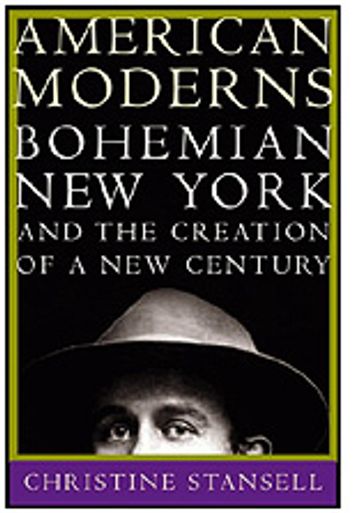
To parry this charge requires another big book about bygone bohemia, this one set 100 years ago: Christine Stansell’s “American Moderns: Bohemian New York and the Creation of a New Century.” Stansell rescues the notion of bohemia from its would-be debunkers, those skeptics who have, for half a century, found implausible the notion of a place whose residents live artfully and on principle. But she does so without seeming to be on a crusade: Stansell, a feminist historian at Princeton, writes narrative history, not polemic.
She acknowledges instances of hypocrisy among the footloose and the ragtag, but she also argues persuasively that bohemian life has always been a step toward the middle class. “Bohemia’s self-designated types always existed in symbiotic relation to bourgeois culture rather than in opposition to it,” as she puts it. “While bohemias signaled dissent from the profiteering of the cultural marketplace, they also provided their affiliates the means to parlay that dissent into successful careers.” Stansell’s comfort with this paradox of bohemian culture — a paradox that, year after year, makes both left- and right-wing pundits’ blood boil — might even incite readers to wonder why the bohemian fantasy regularly invites so much sadistic dissection.
Rolling out her subject in miniprofiles of picturesque artists and radicals (Emma Goldman, John Reed, Neith Boyce, Mabel Dodge, Floyd Dell), Stansell evokes the scene that sprang up in downtown New York when 19th century immigrants attempted to construct, episodically and haphazardly, a Paris-style cafe culture. At the time, alcohol was clubby, remote and expensive; coffee and tea were more democratic, and the displaced Europeans who initially gathered at the coffeehouses were eclectic, unaffiliated and largely down at heel.
Soon, students, journalists, organizers and socialites showed up — for politics or art, for reasons good and evil — to inspect the foreigners. These interlopers scoffed at 19th century squeamishness about class mixing. With their growing passion for urban “contact” (a shibboleth in Walt Whitman’s populist poetry, which they read avidly), they saw slumming as redemption rather than corruption.
Discussions of free love, feminism, abstract painting, naturalism in fiction, trade unionism and radical politics flourished among the caffeinated polyglots. The years between 1890 and 1919 thus saw the evolution of Greenwich Village. Its cafes, salons, private homes and clubs provided a social infrastructure for women looking to delay or renounce marriage and men looking to delay or renounce making a living.
Not every New Yorker got to savor the spiciness of life downtown. In spite of bohemia’s claims of inclusiveness, Stansell shows, women and African-Americans often couldn’t transcend mascot status. She’s less forthcoming, however, on bohemia’s other contradictions. The ad hoc alliance between collectivist politics and individualist art, between union organizers and free-loving art-world nudists, represents an unlikely coupling that some — Richard Rorty comes to mind — have blamed for leaving a schizo legacy for the American left. Can you lavishly express yourself and, at the same time, march in unison with a political movement? Stansell spends little time on this crucial question; art and politics are, to her, simply alternative modes of expression available to hearty souls.
In its many redemption fables, “American Moderns” occasionally strikes a note of jubilation, leaving no doubt that Stansell, whose last book, “City of Women,” was about antebellum New York, is an “I love NY” historian. If you love New York too, the satisfactions of this book may resemble self-satisfactions. Even if you don’t, vicariously snubbing the Victorians is always enjoyable. In Stansell’s telling, America’s first bohemia was a splendid and efficient racket: It kept its adherents hopeful in straitened circumstances, made their lives feel significant and ultimately made bourgeois citizens out of them.
Turning to a book of stories about ex-lovers, you might ask yourself what you want from stories about ex-lovers. A wailing country song or a Latin revenge scenario are good places to start, but it’s also understandable if you want an exorcism — what Frank Sinatra could have used when he moaned to his pack, “Ava! Why can’t I get this girl out of my plasma!?”
In “The Ex-Files,” editor Blake Ferris has assembled what must be history’s
first anthology of screeds and homilies to former boy and girlfriends. It’s a
book rich with tenacious, if fictional, Avas. These creatures have inspired no less than Dorothy Allison, David Foster Wallace and Junot Diaz. But strange to say, by the end of the collection it still may not be entirely clear who counts as an “ex.” Maybe that’s why they’re hard to forget; they’re hard to identify.
Wallace’s story “B.I. #20 12-96 New Haven CT” — from his 1999 book
“Brief Interviews with Hideous Men” — is a twisted monologue by a woman-hater, a
deposition thick with intelligence and contempt. But he ends his diatribe
softly, even stupidly. “Why did it matter if she was fluffy or not terribly
bright?” asks the hideous speaker. “She had all my attention. Happy now? All
borne out? I knew I loved. End of story.” The sense of an ending, an end point, that achieving romantic love represents — and the fierce struggle to resist getting there — gives several of the stories a thriller-like pacing.
In Jennifer Egan’s “Forty-Minute Lunch,” a
journalist assigned to profile a teenage starlet probes cravenly for revealing details
for his story. Getting none, he forces the girl to the ground, landing himself
behind bars. Similarly, in Derrick Jensen’s “Honeybees,” animal rights terrorism nearly overwhelms the love story. The mood is more suspenseful than wistful.
But there are sweeter stories, too. Most notably, Amy Sohn’s “I’ve Done This
Before.” Here, as elsewhere, Sohn creates a heroine who crashes into one body- and soul-busting sexual situation after another. But, though she tries, she can’t quite take this roughness in stride. She talks tough, generalizing about “every jerky guy
who’d ever fucked me over” and boasting: “I was bold and
aggressive and not afraid to come on to men I wanted.” But as the story winds
on it becomes clear that she’s missing something nameless, and it’s not just love — there’s something
inaccurate or under-thought about what she claims to find routine. When she finally tells her new boyfriend, “I’ve already had sex doggie-style in this skirt,” it’s not a
comic or even a crass line, but something like a war-time understatement; you get the sense that these two people don’t really know how they got into this skirt, this bed, this jam. It’s a strangely lovely story.
In the end, however, as good as some of these stories are, ex-lovers aren’t a great organizing principle for an anthology. As these writers represent them, exes make up a formless population, a shadowy, vaguely criminal set. What’s meant to unify the stories is their common cultural source: what Ferris identifies in the introduction as the relatively recent norm of serial monogamy.
This love ‘em and leave ‘em jungle spares no one. As Ferris puts it matter-of-factly, “If you don’t have at least a few notches in your lipstick case, you’re a loser.” It’s not so much unforgettable characters that generate tension for these authors, but a bind. Call it the need for notches, and the parallel dream of the Final Notch.
It’s clear from these stories that the rocky road back to the ex is, in a narrative, exhausting. Writing about a former lover may work better in lyric poetry, in which repetition and cycling back are intrinsic. In a recent poem, English poet laureate Craig Raine gave his reasons for memorializing a dead girlfriend. Why does he write of her, when she is troublesome, sick, gone? “To make you hear,” he writes. “To make you here.”
Continue Reading
Close
You can get a good overview of Emily Barton’s fictional universe from her characters’ names alone. First, there’s the narrator, Yves Gundron. And then there’s his brother, Mandrik le Chouchou. His wife, Adelaoda. Their daughter Elizaveta. The madwoman Vox Friedl. Andras Drck. Matthias Gansevvort. But of all the handles gleefully crashed together out of Nordic, Germanic, Russian and Latin odds and ends, the coolest name in “The Testament of Yves Gundron” may be that of Yves’ neighbor, Ydlbert von Iggislau.
Ydlbert von Iggislau?
Meet the Mandragorans. They couldn’t give you much help with spelling or pronunciation, since literacy is in short supply in Mandragora. As are electricity, paved roads and numbers over 20. Barton’s simple-minded Mandragorans are congenial, Tolkienesque farmers who have managed to keep ignorant of the rest of the world for centuries — lo-fi in the extreme. Only Mandrik has ever traveled outside the village; only he, the priest and the madwoman seem to suspect that life might comprise more than farm work.
|
|
But not for long. Yves, Ydlbert and their countrymen soon discover that their innocence is precarious — vulnerable to the corrupting influence of technology and, especially, American interlopers. One by one, the Mandragorans come across hints that somewhere out there is a faster, more dangerous and more specific world. First, Yves invents
a harness that ups the ante on efficient production and transportation. And
then the ax really falls — an anthropologist comes calling. Into
this Luddite paradise, with its self-sufficiency and its potage of phonemes, comes Ruth Blum of Cambridge, Mass.
Ruth, a single, sporty, hypereducated woman in her 20s, could almost be a refugee from a more conventional novel — as if she’s in this book poking around for a
new genre to call home. And for a while it seems she’s found one, quietly
scribbling notes on her anthropological windfall. But in the inevitable paradox
of the social sciences, Ruth can’t help becoming involved in her own experiment,
befriending Yves, seducing Mandrik, alienating Adelaoda. The Mandragorans, in
turn, study Ruth right back — gleaning, finally, an appetite-whetting idea of what her world must be like. As their curiosity grows, they develop a three-dimensional psychology, in all its glory and pain. The Mandragorans, once peaceable and unreflective, become moody, jealous, angry and sick. They begin like characters in Boccaccio, all action, and end like figures in Blake, all interior life.
In the outside world, Mandrik warns his sheltered countrymen, “They’ll want
it to be bright everywhere, all the time; wherever you go, there will be no
peace or darkness. You will be literally deluged with attention — not with help
or with friendship, but with the relentless pursuit of information. You will
have no time to farm, only to answer questions.”
He and Ruth stand nearly alone in their loyalty to the Mandragoran past. Ultimately, it seems a misplaced allegiance. “The Testament of Yves Gundron,” Barton’s first novel, is inventive and not short on pleasures (the simple fact of such eccentric scene-setting offers surprises on almost every page). But in the end, it’s a relief to leave weird Mandragora. Too often, the novel punishes its characters for not resisting modernity strenuously enough — not sticking with unpaved roads and unharnessed horses. But it shouldn’t be heartbreaking that the Mandragorans, with all the world before them, want complexity and consciousness and the chance to fall from grace like the rest of us. Who can blame them?
Continue Reading
Close
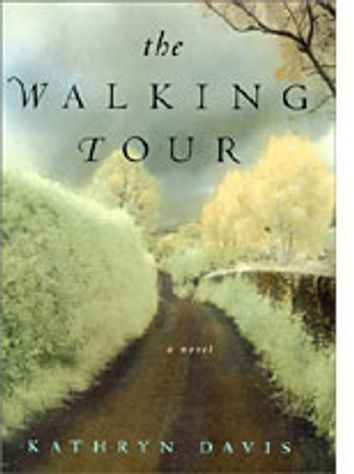
Making your way through Kathryn Davis’ enthralling and mystifying new novel, you might come to a place — several places, actually — where you lose sight of the clear narrative path. This reader did. “The Walking Tour” disorients: It sends you flipping pages back to see if you’ve missed major plot turns, like a violent crime or the introduction of a new character. But, like a hike through a rocky and vaguely menacing landscape, the novel, Davis’ fourth, is also pulse-quickening and, at times, sublime.
This much is clear: Sometime in the late 20th century, two cyber-entrepreneurs, Bobby Rose and Coleman Snow, together with their unstable and artistic wives, Carole Ridingham and Ruth Farr, join a tour group and set off to see the Welsh countryside.
As the group paces around the Gower peninsula, however, tensions among the members — sexual, professional and otherwise — escalate so fast that the atmosphere turns supernatural. Ruth has mythological hallucinations; Carole, a famous painter, battles schizophrenia and mad bees; and an enigmatic Asian businessman, possibly in concert with Coleman, may or may not be plotting among ghosts to take over Bobby’s business (a company responsible for a successful but insidious software called SnowWrite and RoseRead). In the eye of this storm is a tragedy — two deaths — that’s left obscure
until the novel’s end. Even leaving aside the prominent mischief wrought by the masque-like roster of supporting characters, this is an elaborate narrative matrix.
Davis compounds her novel’s complexity by having the tale of the tour narrated in fragments by the daughter of Bobby and Carole, Susan Rose. Susan sets out to construct her parents’ story from scant evidence, which she shuffles like cards: court transcripts, Ruth’s diary, Carole’s postcards and the testimony of Monkey, a soothsayer from her own time. As she pieces things together, Susan also contends with the dangers of her 21st century world, a weird property-free dystopia with a “Clockwork Orange” ambience, dominated by Monkey’s scary post-technology gang, the Strags.
The effect of the two intertwining narratives is an epistemological hide-and-seek in which the storytelling often conceals as much as it reveals. But it’s well worth embracing
the book’s intricacies: Though Davis takes obvious pleasure in playing out her
novel’s dense setup, there is nothing rarefied about her precise and often
epigrammatic prose. (Of Carole, she writes: “Really sad people never break your
heart.”) Davis makes frequent reference to Wordsworth, and, like the
Romantic poets, she is keenly attuned to those moments in which the natural world has psychological reverberations. When Susan reflects on girls who seem to transform themselves from “baby savage to smooth operator without missing a beat,” Davis elaborates: “They never know what it’s like to hear in the rustling noise of summer’s end the approach of a destiny so at odds with your parents’ that it seems like a betrayal.”
Here and throughout the novel, Davis expertly positions Susan between nostalgia
and ambition. In “The Walking Tour,” she has created a profound and demanding
narrative double-helix — one that requires its characters to forge a future with
an incomplete template from their pasts, just as the reader is required to
leave clear and orthodox paths to enter Davis’ heady wilderness.
Continue Reading
Close
“we have now become the first guests on this show without black mock turtlenecks,” Brian Williams announced on July 12 when he appeared with weatherman Al Roker on John Hockenberry’s “Edgewise,” the MSNBC show that was abruptly canceled a week later. It was a throwaway line: Williams, a student-council-type who sticks with jackets, is the star of MSNBC’s “The News with Brian Williams,” a standard news show that’s always had the network’s full support. His appearance with Hockenberry was meant to give a brotherly boost to the network’s offbeat, NPR-inspired magazine show, which had bewildered MSNBC brass since its launch last fall. Instead, Williams underscored the difference between the show and the network. Like an artsy kid in a high school full of jocks — or a black turtleneck in a closet full of suits — “Edgewise” just didn’t fit in at MSNBC.
It wasn’t for lack of trying. With a near-evangelical commitment to eclecticism, the producers of “Edgewise” created a show designed to leave no curiosity unpiqued. An hour-long magazine program that aired Saturday and Sunday nights at 8 and 11 p.m., the show combined interviews, short documentaries, performance and commentary; it also took on a dizzying range of topics.
“Our tone was curiosity and fascination rather than hysteria,” says producer R.J. Cutler, who came to television after having produced the high-profile documentaries “A Perfect Candidate” and “The War Room.” The show’s 40 episodes include unnarrated, high-concept segments on cockfighting, Zaire, a pro-life haunted house, Wallace Shawn, Jeff Buckley, assisted suicide and Tiger Woods’ caddy. In many ways it resembled “Heat,” a radio show, broadcast on public radio, that both Hockenberry and Cutler worked on in the early 1990s. “You can have artistic aspirations on a news show,” Cutler says. “We wanted to mix ways of looking at the world. We believed a person who is interested in seeing David Brinkley very well may be interested in seeing Michelle Shocked in the same show.”
Critics applauded, film festivals took notice and fans sent worshipful e-mail — but the network never “fell in love with the show,” says Hockenberry. Neither did an appreciable viewership. When the numbers came in — markedly lower than the fledgling network’s already low average — MSNBC was quick to pull the plug.
Some weeks the show’s ratings had been too small even to measure. According to Mark Harrington, MSNBC’s president, it is just a question of math. “A once-a-week program was too much of an investment to sustain at this point,” NBC News President Andrew Lack adds.
According to “Edgewise” producers, however, the show was perfectly viable; it just needed a little help from the top. “We had a new form, a new network and a new talent,” Hockenberry says, referring to himself, a former news correspondent at NPR and ABC and author of “Moving Violation,” a memoir, and “Spokeman,” a successful one-man show, both of which chronicle his life in a wheelchair. (Hockenberry was paralyzed from the waist down in 1976.)
“We didn’t get any cross-promotion” — on NBC or CNBC. “The show was seen as too out there,” says Hockenberry. Cutler agrees: “They were not shy about saying, ‘We have no idea what you’re doing.’” As a consequence, the producers argue, the management took a laissez-faire attitude toward the square-peg show, which they had given Hockenberry as part of his agreement to work as a correspondent on “Dateline NBC.” “The show was the secret they wanted kept secret,” says Cutler.
But maybe the turtlenecks could have tried harder with the suits, too. The show’s producers, according to Hockenberry, “needed to get into the game and become the darlings of the network.” It was especially important, in Hockenberry’s opinion, that the “Edgewise” people become TV people. Cutler “came from film, so he was viewed with suspicion … the burden to schmooze was his.”
Curiously, it didn’t help that the show became popular with the independent film community, leading to an invitation to show a “best of” tape at the 1996 Nantucket Film Festival. “That was not reassuring to higher-ups,” says producer and booker Brad Klein. “They saw it as frivolous and artsy.” The eerie subject matter of some of the shows might also have given programmers pause. The July 14 Watergate/Wes Craven show — a look into “contagion of all kinds,” Hockenberry promised — could not have offered much comfort to programmers looking to warm the hearts of the Microsoft generation.
The show’s efforts to combine art and news did indeed produce some weird effects. The title sequence, a jazzy black-and-white montage of parts from a manual typewriter, suggested maverick reporting and archival work; the warm, den-like set, on the other hand, seemed more like a place to watch TV than to broadcast it. After one show’s series of still photographs showing Cambodians facing execution under the Khmer Rouge, the return to the buttery colors of Hockenberry’s den, and to Hockenberry’s own curatorial egalitarianism — in which all manner of material is “interesting” — was a little jarring. In cases like this, “curiosity and fascination” may not be motivation enough to assimilate disturbing material, especially when it’s set against clips from “Contact” featuring Jodie Foster and Matthew McConaughey. When the juxtapositions were this stark, Hockenberry’s radio-trained avuncularity was not enough to make sense of them.
Finally, though, it could be that the problem with “Edgewise” comes down to the problem with “edge.” “People who really have an edge were like ‘pshaw,’” Hockenberry says, referring to responses to the show’s content. “The show was made by people who want edge but don’t know exactly what edge is.” When asked for his own working definition, Hockenberry did not miss a beat. “Nietzsche would say that ‘edge’ is that moment when the creature has reached the boundaries of its cage and is sniffing in places that might just be meaningless, hoping it’s going to reach a new world.” Ah … the kind of concept for which black turtlenecks were invented.
Continue Reading
Close