Wendell Potter
WellPoint’s heart-stopping rate increase
The health insurance company finds itself in congressional investigators' cross hairs
A congressional hearing next week into the proposed 39 percent rate increase in California by health insurance giant WellPoint could breathe new life into healthcare reform efforts on Capitol Hill, especially if lawmakers broaden their investigation into the outrageous rate increases other insurers are also demanding from coast to coast.
WellPoint found itself in congressional investigators’ cross hairs after the California Department of Insurance challenged the company’s planned increase in the rates it charges its customers who cannot get coverage through the workplace, but have to go it alone in what is called the individual market.
This week WellPoint announced that it was canceling its Investor Day, which had been scheduled the day before a hearing by the House Energy and Commerce subcommittee on oversight and investigations. An Investor Day is a big and usually very expensive affair that publicly traded companies hold, usually once a year, to tell investors and analysts how much money they expect to make in the coming year, and how they plan to make it. It is not at all unusual for a company to spend a quarter of a million dollars on these soirées, which, because the news media usually ignore them, give company executives a chance to speak with more candor than usual about their operations.
I know because I used to help plan these functions. They are often held in New York’s finest hotels — the ones that charge a minimum of $1,000 a night for their rooms.
Keith Olbermann invited me to talk about WellPoint’s rate increase on his “Countdown” show on MSNBC last night. When I got home, I saw that I had received several e-mails from people who has seen the show and wanted me to know about their own heart-stopping rate increase notices. Two were from former colleagues of mine at Cigna, both of whom had worked for the company for years and who were enrolled in a pre-retirement plan. One said Cigna planned to increase his rates by 46 percent this year. Another said his rate increase would be 47 percent. Yet another acquaintance, who works for a small business in Iowa, said he received a notice from his insurer that his rates would be going up by 38 percent.
I pointed out on “Countdown” that WellPoint’s planned increase in Maine was so high the state’s insurance commissioner cut the planned increase in half, prompting WellPoint to sue the state. That case is still pending. And I noted that Blue Cross and Blue Shield of Nebraska announced plans last year to increase rates on some of its plans by more than 35 percent. It won’t take a lot of investigating for members of Congress to see that these outrageous rate increases are common, and that the WellPoint increase in California is nothing more than business as usual for this industry, which values profits far more than the health and well-being of its customers. If everyone who has received a rate increase notice lets their members of Congress know about it, it just might give lawmakers the motivation they need to get reform passed.
Dear Sen. Baucus: Don’t sell out Americans
Without oversight, insurance companies will continue to exploit American consumers
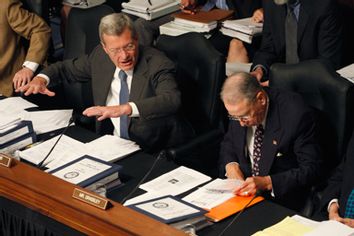
Senate Finance Committee Chairman Sen. Max Baucus, D-Mont. left, makes a point on Capitol Hill in Washington, Wednesday, Sept. 23,2009, and the committee continued working on health care legislation. The committee's ranking Republican Sen. Charles Grassley, R-Iowa is at right. There are so many problems with the healthcare reform bill proposed by Senator Max Baucus (D-MT), chair of the Senate Finance Committee, it is little wonder that members of his committee have proposed more than 500 amendments to fix it. Unfortunately, some of the worst amendments that would make the bill even more of a gift to the health insurance industry are being offered by Republicans. If there is a God in heaven, they will not be adopted. But many other amendments are vital, including those that will make this key bill more like the better bills that have been reported out of four other Congressional committees. All of those bills call for the creation of a public insurance option, which is an absolutely critical element of reform. Without it, all of us who are not eligible for an existing government-run program, like the Medicare and VA programs, will be forced to buy coverage from the private insurance industry, which is dominated by a cartel of huge for-profit companies.
Continue Reading CloseHow corporate P.R. works to kill healthcare reform
Health insurers have become expert at using P.R. to get what they want. I got out before the latest round
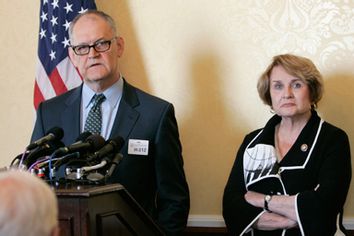
Former CIGNA Vice President Wendell Potter, left, who has become a whistleblower regarding the health care industry, accompanied by Rep. Louise Slaughter, D-N.Y, speaks during a news conference on Capitol Hill in Washington, Wednesday, Aug. 12, 2009. It is easy to think of efforts to influence lawmakers as the exclusive domain of K Street lobbyists. Much has been said and written about the millions of dollars the special interests are spending on lobbying activities and the hundreds of lobbyists who are at work as we speak trying to shape healthcare reform legislation. Very little by comparison has been written about the millions of dollars that special interests are spending on P.R. activities to accomplish the same goal and that are vital to successful lobbying efforts.
Continue Reading Close