Wieland Wagner

The Dalai Lama’s moment of truth

His Holiness struggles to defuse mounting violence between Tibet and China.

  • more
    • All Share Services

At this summer’s Olympic Games, Beijing’s Communist Party wanted to present China as a gleaming new superpower. But its brutal suppression of Tibet has jeopardized this image — and placed the Dalai Lama himself under pressure to keep angry Tibetans on a course of nonviolence.

He sits hunched over, as if the weight of the world rested on his shoulders, his famous and often so liberating smile frozen, his characteristic and consistently bubbling optimism dissipated. The 14th Dalai Lama seems depressed as he receives the world press in his Indian exile. He is a winner of the Nobel Peace Prize who has apparently lost the support of all partners in peace, a god-king without a country.

He’s at a loss over what to do about the bloody unrest in Tibet. He has called for an independent international investigation of the recent riots and military crackdown, knowing that Beijing will never agree. And he’s urged the Chinese leadership to exercise restraint and respect human rights. But the Dalai Lama also preaches nonviolence to his fellow Tibetans. “I lack the means to defuse the conflict,” says the world’s most famous asylum seeker, a man revered by people around the world — in Germany even more so than the pope.

“We would need a miracle for that,” says the Dalai Lama, 72, whose real name is Tenzin Gyatso. (His title means “Ocean of Wisdom.”) “But miracles are unrealistic.” The Dalai Lama has even broached the idea of stepping down as the political leader of Tibetans and returning to private life. Over and over he says: “I don’t understand the Chinese, I really don’t understand them. This sort of escalation cannot be in their best interest.”

Chinese Premier Wen Jiabao has called the Dalai Lama a “hypocrite” and holds him responsible for the recent violence in the streets of the Tibet’s capital, Lhasa. Other leading Chinese Communists have heaped derision on the Tibetan leader in exile, calling him everything from a “divider of the nation” to a “wolf in monks’ robes.”

His native Tibet has again moved into the international spotlight, but not in a way the apostle of nonviolence welcomes. China, which occupies Tibet, has declared a “people’s war” there and has largely cut off the region from the outside world. Tibetan Communist Party leader Zhang Qingli has called it a “fight for life and death.” After a period of silence about the incident, the Communist Party in Beijing announced that there were 16 dead on the streets of the Lhasa. But Tibetan exiles believe the death toll is closer to 100.

Since last weekend, tanks have rolled through the city’s streets, and soldiers have been stationed at all key points, sealing off the Jokhang Temple in downtown Lhasa and the nearby Sera, Drepung and Ganden monasteries. Distraught Tibetans who have managed to find a functioning telephone or Internet access report house-to-house searches, arrests, beatings and torture. The Chinese apparently set an ultimatum that expired on Monday evening. Those who were recognized as protesters by the government who failed to turn themselves in and denounce fellow protesters by the deadline — thereby accepting a supposedly “mild punishment” — faced “the full severity of the law,” as the Communist Party called it.

Eyewitnesses say that more than 1,000 people were arrested, with dozens of them paraded through Lhasa in open trucks, their heads bowed and their hands handcuffed behind their backs. More than 100 women and men had turned themselves in voluntarily, reported the region’s vice governor, who claimed: “Some were directly involved in looting and arson.” Qiangba Puncog, the region’s governor, offered an accountant’s assessment of the “serious crimes of the Dalai Lama clique,” saying that during the riots of the last few days 214 shops went up in flames, 56 cars were damaged, and 61 police officers were injured.

Nevertheless, the Chinese failed to quell the resistance. The clashes between rioters and security forces continued on the outskirts of Lhasa on Tuesday, and in the city residents placed toilet paper on the streets — a message calling on the Chinese to finally withdraw from Tibet.

But by midweek official TV broadcasts showed images of Chinese merchants clearing debris from their ruined shops, while others covered burned-out window openings with plastic tarps. The Communist Party leadership wanted to demonstrate that calm had returned to Lhasa. A reporter stood in front of a burned middle school to suggest that rioters had not even drawn the line at schools. And rumors, probably started by Communist Party officials, spread among the Chinese in Lhasa that the drinking water was contaminated. The Dalai Lama had ordered the water supply poisoned, a merchant told Norwegian tourists who were the last to leave the city, on Air China Flight 4111 to Beijing.

If Lhasa had become deathly quiet by midweek, though — because few residents dared leave their homes to challenge Chinese forces — protests spread like wildfire to other parts of the People’s Republic.

Demonstrators took to the streets in Sichuan, Gansu, Yunnan and Qinghai provinces, where there are more Tibetans than in the so-called Tibet Autonomous Region, an arbitrary entity created by Beijing. According to Tibetans in exile, 39 people died during protests in these areas by Wednesday. Many of the demonstrators were monks and devout Buddhists openly celebrating the Dalai Lama, defying the ban on displaying his likeness, and swearing eternal obedience to their revered god-king. But students also joined the demonstrators in several cities.

In Lanzhou, the capital of Gansu province, roads leading to Tibet were closed, and the town of Xiahe in the Ganan Tibetan Autonomous Prefecture was also sealed off. Xiahe is home to the Buddhist Labrang Monastery, where, according to eyewitness reports, 400 monks took to the streets and, joined by several thousand sympathizers, swung the Tibetan flag and sang songs praising the Dalai Lama.

In Aba, in Sichuan province, demonstrators set fire to a market with Molotov cocktails, and several of them were allegedly shot by police. “>

In Gansu province — as photographs taken by two Canadian television reporters show — demonstrators on horseback stormed down from the mountains and congregated in front of the Bora Monastery near the city of Hezuo. Together with monks and demonstrators on mopeds, the Tibetans surrounded a government building, took down the Chinese flag, and hoisted the Tibetan flag in its place before police and soldiers regained control over the area after hours of street skirmishes.

A few blocks away, monks from the Bora Monastery even broke into and ransacked Chinese shops. They deliberately spared the shopkeepers but didn’t end their attacks until a lama interceded. Meanwhile, Communist Party leaders used government-controlled television to announce that they had the situation “everywhere completely under control.”

The region, a popular tourist destination, is now deserted. Instead of the usual backpackers, hotels now house government security forces. Residents seeking to leave the Aba Tibetan Autonomous Prefecture in the direction of Chengdu must pass through road checkpoints, where Chinese soldiers wielding machine guns search cars and trunks with metal detectors. Meanwhile, military trucks filled with young soldiers — reinforcements — arrive from the opposite direction.

Even in Beijing, roughly 50 young academics from the Central University for Nationalities dared to challenge the authorities by staging a sit-in — and risking their freedom, or at the very least jeopardizing their careers. According to the state news agency Xinhua, professors convinced the protesters to return to their dormitories.

But the Chinese public was kept almost completely in the dark about most of the protests, as if a news blackout — including blockage of the domestic feeds for CNN and the BBC, a ban on international reporting, and the expulsion of Hong Kong journalists — could make the events go away.

And yet the news quickly circled the globe, mainly thanks to media-savvy young Tibetan politicians in exile. They spread their message throughout a worldwide network and triggered a massive outcry against Beijing. From Athens to Amsterdam, from Washington to Wellington, and from The Hague to Tokyo, demonstrators took to the streets to show solidarity for the repressed Tibetan minority. In Berlin, hundreds demonstrated in front of the embassy of the People’s Republic of China. The protests were especially strident in neighboring Nepal and India, where more than 80,000 Tibetan exiles live.

In Taiwan, where elections will be held on Sunday, events on the roof of the world have suddenly taken center stage. Beijing considers the island nation a renegade province and hopes that the Kuomintang Party (KMT), which is the Taiwanese party most closely aligned with the mainland Communist Party, will win the election — which would bring Taiwan closer to “reunification.” But now the widely favored presidential candidate, KMT’s Ma Ying-jeou, finds himself on the defensive. He has condemned what he calls “repression in Tibet,” and he’s considering a boycott of the Olympics, echoing the sentiments of some European politicians.

The events in Tibet and elsewhere have turned into a major public-relations disaster for China’s leaders. Suddenly the ugly face of Chinese communism is omnipresent again, as images of past injustices are conjured up. The 1989 massacre on Beijing’s Tiananmen Square, when the party’s tanks mowed down peaceful demonstrators and up to 3,000 people were killed, has been on people’s minds; so has the violence in Lhasa in 1959, when more than 80,000 Tibetans died in the wake of a failed uprising that led to the Dalai Lama’s forced exile. It’s all happening as Beijing hoped to bask in the glow of the Olympics. This preeminent celebration of sports is more than just a prestigious event for China’s leadership. Beijing associates the Olympics with its return to the stage as a world power.

The countdown to this new era has been running for seven years. The 1.3 billion citizens of the most populous nation on earth have been well primed. Beijing wants to suggest it has joined the United States as a superpower — backed up by certain economic facts. China already has the largest foreign currency reserves of any nation, and it will likely be the world’s leading exporter in 2008. The West looks up to us again, Beijing implies to its own people, with its imposing new towers and new Olympic sports facilities.

Last Tuesday, at his annual press conference to conclude the Beijing meeting of the National People’s Congress, Premier Wen — already playing jovial host — insisted that the “smiles of 1.3 billion Chinese ” will be returned by the smiles of all of the peoples of the world. But his performance also revealed that this time Beijing can no longer ignore global outrage over its repressive policies in Tibet. Speaking on live TV, the premier seemed genuinely anxious to respond to reporters’ questions.

But then Wen proceeded to rattle off the party’s hackneyed phrases, insisting that the Dalai Lama’s claims that he seeks a peaceful dialogue, not independence for Tibet, are nothing but lies. On the other hand, he was also forced to address a French reporter’s request to allow the foreign press to travel to Tibet, promising that Beijing would “look into” the matter.

But why is China jeopardizing its reputation in the world in such a dramatic way? What is it about Tibet and the Dalai Lama that has triggered the Communist Party leadership’s extreme reaction? And how much of the escalation can be attributed to young, radical Tibetans who no longer support the Dalai Lama’s peaceful “middle way,” instead seeking confrontation with their Chinese occupiers?

Even more important, what exactly happened in Lhasa? And what is happening there now, while the global public is kept in the dark?

Beijing sees the unrest in Tibet as an attack on the country’s territorial integrity and sovereignty, and a large majority of Chinese share its views. Ninety-two percent of Chinese belong to the Han ethnic group, and from their perspective Beijing is merely defending China’s best interests in its dealings with Tibet.

If the People’s Republic were made up entirely of Han Chinese, of course, the government could have saved itself the trouble of blocking reports about the Tibetan riots on the Internet. The popular Internet portal Sina listed up to 470 Web sites with tens of thousands of comments from enraged Chinese. One user wrote that the government should “not relent in the struggle against terrorists,” while another insisted that Beijing should “protect the fatherland and fight the separatists.”

This outpouring of anger cannot be dismissed as a consequence of nationalist indoctrination, a strategy China’s communists hope will keep them in power in their new age of capitalism. The fight against rebellious minorities along the outer edges of the massive country, in strategically important regions blessed with mineral resources, also touches on a deeply rooted Chinese fear of national disintegration. They call it “iuan,” or chaos.

This is why no Chinese government can afford to yield to Western pressure to make concessions to Tibet, even if the Olympics are jeopardized. The Chinese government finds itself in a Catch-22 situation. One goal was to use the games to plaster over a host of growing internal conflicts, including social tensions and ethnic uprisings. But now the Olympics themselves may have contributed to the widening of natural fissures in China’s social fabric.

After it was awarded the games, Beijing proved receptive to criticism, but only of its foreign policy. It endured scathing condemnation by Hollywood stars like Mia Farrow of Beijing’s backing of the Sudanese government and its role in the genocide in Darfur (in a 2007 Op-Ed piece in the Wall Street Journal, Farrow characterized the 2008 games as a “Genocide Olympics”). This outcry prompted the Communist Party rulers to consent to a U.N. peacekeeping force in Darfur and even consider participating in it.

But all hopes for an improvement of human rights within China have been in vain. Despite protests by organizations like Human Rights Watch, dissidents like Yang Chulin (“We want human rights, not the Olympics”) and AIDS activist Hu Jia have been put on trial for “subversion.” Although Li Baodong, the Chinese ambassador to the United Nations, is permitted to exercise self-criticism (“China still has a long way to go to promote and protect human rights”), the regime in Beijing already paints itself as a role model when it comes to human rights. Foreign Minister Yang Jieche insists: “The Chinese people enjoy the full extent of human rights and religious freedom.”

The Chinese Communist Party’s deep hatred of the Dalai Lama is rooted in his gentle but firm insistence, when speaking with politicians from around the world, that precisely the opposite is true. He accuses the Chinese government of waging “cultural genocide,” in the form of the deliberate mass settlement of his native Tibet with Han Chinese, a process that destroys Tibetan traditions. One reason Beijing has responded so vehemently to the attacks is that they are so difficult to deny.

Lhasa is a predominantly Chinese city today. As a result of Han Chinese settlement, promoted by tax subsidies, Tibetans are now a minority in their own capital. They make up only about one-third of its 400,000 residents. Bars and brothels have dramatically altered the character of this holy place, as have the soldiers patrolling its streets. The city’s tallest building, surrounded by colored plastic palm trees, houses the headquarters of the secret police. The most successful businesspeople are Chinese, who make no secret of their disdain for the “backward locals.”

Tibetans benefit the least from a rising standard of living, even though, from a material standpoint, they are better off than ever before. But they are spiritually starved, and the majority of Tibetans still cling to their spiritual and political father figure, perhaps even more so today. They know the 14th Dalai Lama has long been a democratically oriented reformer, and most Tibetans have at least enough contact with the government in exile in Dharamsala to know it has a freely elected Parliament. The Chinese Communist Party and its “People’s Liberation Army,” which in 1950 invaded Tibet — until then a de facto independent country — have yet to acquire a comparable level of respect among Tibetans.

The Tibetan people don’t enjoy true religious freedom. They are permitted to perform their Buddhist ceremonies in the private sphere, and a few monasteries have been restored to be inhabited by monks again. But the party has carefully severed Tibetans’ spiritual bond with their god-king. Anyone caught with a picture of the Dalai Lama is arrested and often tortured.

The Potala Palace, the traditional seat of the Dalai Lama, is being preserved, but merely as a tourist attraction, part of Beijing’s effort to reduce Tibet to a spiritual Disneyland. Late last week, when unarmed monks were intimidated during a peaceful demonstration and then arrested, the Tibetans finally vented their anger. It was this rage that probably contributed to violence against Chinese police officers and business owners — violence that Beijing’s governors met with even sharper repression. The official reaction, in turn, led to several monks attempting to commit suicide, setting off a spiral of unrest interrupted only by periods of calm that can be attributed, at best, to exhaustion.

The Dalai Lama opposes any form of violence. He reacted with extreme outrage, even bitterness, to Chinese Prime Minister Wen Jiabao’s charge that he “and his clique” had instigated the bloody riots in Lhasa. Wen even claimed that he had “a lot of evidence” to support his accusations. “Hey, Mr. Prime Minister, come here and show them to me and the world,” the Nobel laureate called out a press conference on Tuesday.

In truth, the world’s most famous exile has always sought to accommodate the Chinese, beginning with Mao (he was long blinded by Mao’s ideological powers of persuasion), followed by Deng Xiaoping and his successors at the head of the Communist Party.

The 14th Dalai Lama gave up his fight for a sovereign independent nation long ago, and now he calls “only” for true cultural autonomy for his Tibet. In several rounds of talks, most recently in 2006, his negotiators sought to shape compromises with Beijing’s negotiating team, but failed completely.

The Dalai Lama pinned his hopes on the Communist Party’s current harmonization campaign and its increasingly tolerant treatment of all religions. “I am the last Tibetan leader with whom there can be a peaceful transition,” the god-king said last year. “And if I am to be an obstacle, I am prepared to withdraw from politics and continue my life as a simple monk.”

He left many questions unanswered: whether he should have a successor, whether a woman could become a Dalai Lama, and whether the traditional search for a new reincarnation should be replaced with a sort of conclave in which the new Dalai Lama is elected by abbots. “Perhaps there will even be two Dalai Lamas after me,” he said. “One serving at Beijing’s pleasure, and one recognized by the Tibetans according to spiritual tradition.”

The Communist Party, as an atheist force, has presumed to be responsible for reincarnations. In 1995 it appointed the Panchen Lama, the second-highest-ranking Tibetan religious leader, and abducted the boy designated by the Dalai Lama, along with his parents. The whereabouts of the family remain unknown to this day. Beijing’s Panchen Lama has obediently condemned the “crimes of the Dalai clique.”

The young Tibetan Buddhists of Dharamsala insist that the 14th Dalai Lama has put up with too much, far too much. Taking the nonviolent Mahatma Gandhi as his role model, as the Dalai Lama does, is all very well and good, they say, but the approach should also yield comparable results.

“Gandhi brought independence to India, and where are we today?” Kelsang Phuntsok, then-president of the Tibetan Youth Congress in Dharamsala asked provocatively in 2007. “The word ‘violence’ is not a taboo for me. At this point we are getting nowhere with the position taken by our revered leader. We are like the panda bears of international politics. Everyone cuddles us, but no one does anything serious on our behalf. We must take fate into our own hands.”

When a member of the Youth Congress starved himself to death during a protest a few years ago, the Dalai Lama denounced his act. But young Tibetans celebrated him as a “martyr.” It cannot be ruled out that some have thought of transforming their pacifist struggle into a resistance movement akin to the Palestinian struggle. But there is no concrete evidence whatsoever that last week’s unrest in Lhasa was part of a deliberate military provocation.

In their campaign surrounding the Beijing Olympics, until now, young Tibetans have opted for creative rather than violent campaigns. They’ve unfurled “Free Tibet” banners at the Great Wall, used all legal means at their disposal and even presented the IOC with a list of athletes ready to compete as part of their own Tibetan “national team.” They have launched rallies converging at the Chinese borders and staged PR-conscious demonstrations in front of embassies.

Now that the young Tibetans are trying to achieve a boycott of the Beijing games, they agree with the Dalai Lama’s view that the event should be used to draw attention to the cause of their oppressed people.

Unlike the 14th Dalai Lama, however, the Tibetan Youth Congress will continue to fight for full independence. Young Tibetans think their god-king is simply not of this world when they hear him say: “In Buddhism, we are constantly concerned with how we handle our negative forces and emotions. I also pray for the Chinese. They, of all people, need our sympathy.”

Dharamsala’s wild young Tibetans have a sixth sense for understanding provocations by the Chinese — when Tibet’s Communist Party chairman Zhang says, for example, that the party is the “father and mother of the Tibetan people,” and claims to know exactly “what is good for the children — the Central Committee is the true Buddha of Tibetans.” The Dalai Lama, when he hears this sort of rhetoric, says that he has “great understanding for the impatience of the young people,” and that he must admit that his “middle way” has registered few victories so far.

Yet the Dalai Lama sees no alternative to his approach, no matter how fiercely Beijing’s politicians demonize him. “As neighbors, we must live together,” he says, “side by side.”

Translated from the German by Christopher Sultan


This article has been provided by Der Spiegel through a special arrangement with Salon. For more from Europe’s most-read newsmagazine, visit Spiegel Online at http://www.spiegel.de/international or subscribe to the daily newsletter.

China’s boom and doom

China now produces tons of cheap clothes, electronics and raw materials -- and dizzying amounts of pollution beginning to taint the globe.

  • more
    • All Share Services

China's boom and doom

The cloud of dirt was hard to make out from the ground, but from six miles up, the scientists could see the gigantic mass of ozone, dust and soot with the naked eye. In a specially outfitted aircraft taking off from Munich airport, they surveyed the brownish haze stretching from Germany all the way to the Mediterranean Sea.

These kinds of clouds float above Europe for most of the year, and they’ve traveled far to get there. By analyzing the makeup of particles in this cloud, European scientists were able to identify its origin. “There was a whole bunch from China in there,” says Andreas Stohl, 38, of the Norwegian Institute for Air Research.

Some 7,500 miles to the west, Steven Cliff is slowly winding his way up Mount Tamalpais near San Francisco in his RV. The 36-year-old researcher has installed a complex instrument to measure the air that crosses the Pacific from Asia and reaches the West Coast.

Days like this are ideal for taking these measurements. San Francisco is shrouded in cool fog, but on top of the mountain there’s warm sunshine. Indeed, these are ideal conditions for surveying air currents untainted by local influences. But Cliff is alarmed by his instrument’s readings — soot particles have colored the device’s filter “blacker than we’ve ever seen it,” he says.

Back in a lab at the University of California at Davis, Cliff and his colleagues analyze the origins of the air pollution with the help of x-rays. According to their chemical signature, most have come from coal-fired Chinese power plants, Chinese smelters and chemical factories, and from the tailpipes of countless Chinese diesel-powered cars and trucks.

On the other side of the Pacific, in Yokohama, Japan, climate change researcher Hajime Akimoto places three photos of the Earth next to each other. They show in red where concentrations of nitrogen dioxide are especially high. The picture from 1996 shows the area between Beijing and Shanghai as a loose group of reddish spots, but one from 2005 completely covers that part of China in bright red.

Winds are blowing ever-greater amounts of pollution from China into Japan, leading many Japanese to complain about irritated eyes and throats. Last year, for the first time, two cities issued official warnings about the health dangers caused by Japan’s neighbor across the sea.

China has become a global environmental problem. Initially, it was only the economists who were shocked by how the country was changing the world with its cheap clothes, televisions and washing machines. But now climate researchers are concerned about another Chinese export — the pollution it is spreading across the planet. The massive nation is already the world’s second-biggest producer of greenhouse gases after the United States.

And particularly in North America and Europe, awe over China’s booming economy and its ability to produce cheap goods for the entire world is now often giving way to a critical question: Can the planet handle China’s growing damage to the environment?

China’s economy is booming — with an annual growth rate of more than 10 percent. But the more the country’s population of 1.3 billion strives to raise itself out of poverty with a mostly antiquated industrial base — and the cheaper the Chinese goods the world’s consumers buy — the higher the price the world will pay for China’s economic miracle.

The Chinese are no longer simply destroying their own environment. Just as trade is global these days, so too is the threat against nature.

The connection isn’t always apparent at first glance. For example, what does the spreading desert of Inner Mongolia — a massive autonomous region in northern China — have to do with the comfy cashmere sweaters that shoppers are snapping up for next to nothing in cities from Berlin to Boston? For years, Chinese herders in the region let millions of goats graze until the grass was gone, roots and all. Then the soil simply blew away and the desert began to expand at an alarming rate. Since the early 1980s, China’s grasslands have shrunk each year by some 15,000 square kilometers — an area the size of Connecticut.

And now in the midst of a deadly drought, the sand dunes move ever closer to the small village Chaogetu Hure. Inch by inch, seemingly unstoppable, the dunes claim everything in their path, as if they want to bury the government’s costly efforts to plant trees, build fences, corral goats and resettle local inhabitants.

Abbot Lao Didarjie is being forced to watch the walls of the house opposite his Zhao Huasi temple slowly disappear under the sand. Out of fear for the house of worship, he’s raised an alarm with six different authorities. “The temple was built by the sixth Dalai Lama in the 17th century,” says the religious leader. “It should be saved for the coming generations.”

Only a few miles away, on the edge of Luanjingtan, the farmer Xu Changqin inspects a few meager green stalks of wheat. The local peasants worked hard to plant their fields, but last May a sandstorm covered them over. “The grassland is getting smaller. The fertile grounds are disappearing,” says Xu, explaining how growing numbers of people are moving away to seek more hospitable places to live.

The fine sand from the farmer’s homeland blows all the way to California and Europe. It’s mixed in with ash and other dangerous particles from industries in China’s Inner Mongolia region, which is home to countless factories, chemical works and power plants.

Along the Huang (Yellow) River in the city of Shizuishan, in the Ningxia region adjacent to Inner Mongolia, the extent of the pollution becomes obvious. Swaths of gray-black clouds blot out the sun to make the perfect setting for a Hollywood film about the end of the world. Two power plants belch ash into an artificial lake separated from the nearby river only by a thin dam. The wind blows the ash upward to start it on its journey around the globe.

But it’s not just sand, smog and ash that China is spewing into the atmosphere. The country’s factories and power plants already emit more sulfur dioxide (SO2) and carbon dioxide (CO2) than Europe, even though the booming Chinese economy manages only a fraction of the per capita gross domestic product that the old industrialized nations do. Between 2000 and 2005, China’s SO2 emissions grew to 26 million tons. In just a few years the country will surpass the United States to become the world’s biggest carbon dioxide producer. China already accounts for more than 15 percent of total global CO2 emissions.

Independent U.S. energy expert James Brock can see the smog-filled sky from his office in Beijing. “Currently each Chinese person uses just one-fifth of the energy that an American does,” he says. But when China reaches a Western standard of living, each person in the country will use three times what he or she does now. Even done efficiently, that will amount to five tons of coal each year. Presently, only very few Chinese can afford that standard of living. But what effect on the environment will there be if the Communist Party makes good on its promise to spread as much “modest prosperity” to as many citizens as possible by 2020? Can nature withstand the strain when the number of families with washing machines, driers, air conditioners and cars rises from 100 million to a half billion?

Chinese factories are already producing three times as many air conditioning units as they did five years ago. And although few people drive cars in China compared to industrialized countries, in Beijing alone the number of vehicles is growing by a thousand each day. In order to feed its appetite for energy, China is building coal-fired power plants as fast as it can. Every seven to 10 days a new plant begins spewing smoke into the sky. The amount by which China increased its power production last year alone is greater than Britain’s entire capacity.

Coal heavily pollutes the air, but China’s leaders see little alternative to a dirty resource that is available in ample quantities around the country. Some 69 percent of all Chinese power plants are run on coal. China used 2.1 billion tons of it in 2004 — more than the United States, the European Union and Japan combined. Even if the Chinese economy continues to grow only 7 percent annually, its coal usage would double to 4 million tons within 10 years.

Slowly, politicians and scientists are recognizing the path of destruction caused by China’s industrial revolution. Yet China has a long tradition of abusing nature. Revolutionary leader Mao Zedong spoke of “dominating nature” and during the Great Leap Forward (1958-59) ordered the construction of numerous factories. In an attempt to overtake Britain as an industrial power, the Chinese were instructed to build mini blast furnaces across the entire land. The absurd project failed, but the environmental destruction is still visible. To heat the steel furnaces, China chopped down an estimated 10 percent of its forests.

The country opened itself to the world in the late 1970s, and its bizarre mixture of communism and capitalism has since produced growth rates that Western politicians can only dream of. But China was simultaneously turned into one massive, poison-producing factory.

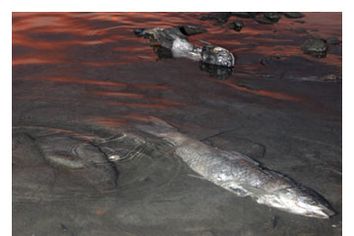
The country is home to 16 of the world’s 20 dirtiest cities. The inhabitants of every third metropolis are forced to breathe polluted air, causing the death of an estimated 400,000 Chinese each year. Half of China’s 696 cities and counties suffer from acid rain. Two-thirds of its major rivers and lakes are cesspools, and more than 340 million people do not have access to clean drinking water. The Yangtze River, once China’s proud artery of life, is biologically dead for long stretches. Many other rivers flow with blackened water, and along their banks are the notorious “cancer villages,” where many people die early.

It’s now begun to dawn on Beijing’s politicians what China’s economy is doing to China’s ecology. Experts like Pan Yue, the deputy minister of the State Environmental Protection Administration (SEPA), are already fearful that environmental pollution will destroy the impressive economic growth of recent years. SO2 emissions cause $65 billion worth of damage each year, and the World Bank estimates environmental pollution already shaves 8 to 12 percent off China’s gross national product.

“China has gone through an industrialization in the past 20 years that many developing countries needed 100 years to complete. That’s why the country now has to deal with environmental problems that would also take 100 years to solve in many Western nations,” Pan says.

Chinese Premier Wen Jiabao has also distanced himself from the country’s rape of the environment by promoting “sustainable growth,” which includes an ambitious nuclear program. At least 20 nuclear power plants are to be built by 2020 — but the communist leadership doesn’t say where the radioactive waste will end up. Beijing also wants at least 10 percent of the country’s energy needs to be covered by renewable sources such as solar, wind and hydro. Photovoltaic facilities have already been erected in thousands of villages, and giant wind parks dot China’s eastern coast.

Beijing also actively participates in the international emissions trade and provides foreign environmental polluters with opportunities to buy their way out of their obligations by financing somewhat clean chemical plants. The Chinese government plans to spend around $125 billion on sewage treatment facilities and new water pipes over the next five years.

But such impressive-sounding announcements, measured against the scope and speed of China’s environmental destruction, fall far short of what’s needed. And despite any good intentions, the Communist Party members make no secret that their most important goals remain those that will ensure their continuing power: raising the living standard of China’s citizens and eliminating the massive gap between rich and poor, as well as East and West.

China’s leaders are certainly pushing for tougher laws to allow for stricter punishments for criminal officials and unscrupulous factory managers. But the misery is partially caused by the country’s authoritarian system, which allows for neither an independent judiciary nor democratic supervision. SEPA’s 167,000 employees aren’t empowered enough to clamp down on polluters in every single province, especially if there’s an influential employer there. And often local officials simply consider impressive growth rates more important for their career than a clean environment.

Of 661 Chinese cities, 278 did not have a sewage treatment plant at the end of 2005. But wealthy polluters can often pay any fines with petty cash. Many recently built power plants shouldn’t even exist. Roughly half of them are illegal — many simply on technical grounds, but others because of corrupt or negligent officials who ignore environmental rules. Instead of falling as they should, emissions in 17 provinces have risen.

These grim facts aren’t kept secret, as some government officials apparently still believe that they have the situation under control. SEPA official Li Xinmin claims it remains unproven that pollution from Chinese power plants reaches other countries. “That’s a false, irresponsible argument,” Li says.

Climate expert Liu Deshun, from Beijing’s Tsinghua University, seemingly has a reassuring statistic or sensible Communist Party decree for almost any pressing environmental problem. But he avoids the key question: How much is China contributing to global warming, and what is the government doing to try to stop it?

Liu wears a small green cap and an oversize pair of sunglasses. “We are a developing country,” he says. “We aren’t yet in the position to take on international obligations.” Beijing has signed the Kyoto Protocol — which aims to reduce CO2 emissions worldwide by 2012 — but as a developing nation, China is not obligated to make cuts. Still, the professor claims Beijing’s leaders have made an important contribution to efforts to protect the environment: The country’s strict population control policies have ensured that 300 million fewer people live on the planet and use its limited resources.

When a chemical plant exploded in the northeastern Jilin province in November 2005, the industrial city Harbin had to cut water supplies for four days to prevent its 9 million inhabitants from being poisoned. But that didn’t keep the catastrophe from spreading, as a thick benzene film traveled from the Songhua River into the Amur River, where it slowly dissipated in Russia’s Far East.

Alexei Makinov, saw the disaster in the making. “It wasn’t just a problem since the accident,” says the 54-year-old Russian geologist and head of the hydrology lab of the Russian Academy of Sciences in the Far East in Khabarovsk. “The river has been stinking since 1997.” The scientist’s desk is covered with tables and statistics, and his glass-fronted cabinet is crammed full of papers. All of it is environmental data on the Amur.

But it’s easy to see with the naked eye just how much damage the river has suffered. The Sungari — as the Songhua River is known in Russia — carries tons of poisonous sludge hundreds of miles downstream to the Amur. When fishers cut a hole in the river ice during the winter, a horrible odor is released. Makinov thinks the smell is from dying plant life and tells of residents complaining of infections, rashes and diarrhea.

The ailing Amur River has become the most important patient of 65-year-old doctor Vladena Rybakova as the end of her career nears. “The river began to stink of phenol,” she says. “And at first we thought it was a natural phenomenon.” But soon Rybakova and her colleagues found the actual cause over the Chinese border. Whereas 65 million people live on the Chinese side of the Amur, there are only 4 million on the Russian side. Since the Chinese authorities offered the Russian scientists no information on what their factories were producing and what poisons they might be releasing into the waters, the Russians began investigating on their own in the early 1990s. After Rybakova fed lab rats fish from the river and then dissected them, she discovered that “their livers decomposed before you could start cutting.”

The road to Sikachi-Alyan leads past barracks and massive radar equipment. It is home to the ethnic Nanai minority, which has always lived from fishing. During Soviet times there was a fishing collective here, but now the village of wooden houses has fallen into bitter poverty. These days no one will buy what the locals catch.

“For the past 12 years, the fish have smelled like chemicals,” says village leader Nina Druzhinina, a thin woman with a towering hairdo. “At first we thought it was Russian plants letting untreated water into the river. But now we know most of the filth comes from China.”

In order to secure their future, the Chinese also intend to dominate the Mekong River, which is known as the Lancang in China. In Yunnan province there are two major dams holding back the waters of Southeast Asia’s longest river without regard for China’s neighbors. Six further dams are planned. At the construction site of the Xiaowan Dam, an army of workers is transforming the once green gorges into a barren Martian landscape. Xiaowan will be one of the world’s biggest hydroelectric plants — almost as huge as the controversial Three Gorges Dam on the Yangtze River.

Farther southward, the Mekong flows through fertile rice paddies and cornfields. Here and there, bamboo groves crowd the banks. But the lives of millions people who depend on the river’s natural rhythms have been disrupted. The Chinese now have a dam in place and they flood the Mekong as they please — when, for example, the water is too low and the Chinese need a big ship to enter the Thai river harbor of Chiang Saen.

In Cambodia, where river fish are one of the most important sources of food, the size of the catch is shrinking — especially in the important Tonle Sap lake and river system. But even down south in the Mekong Delta the river has become unpredictable, according to residents. Sometimes floods wash away houses, and at other times there’s not enough water for the rice paddies.

Suthep Teowtrakul, district head of the small Thai town Chiang Khong, observes the river every day. He wears a yellow polo shirt sporting the words “I Love the King” and has four Buddha figures in his office. But neither his monarch nor the bodhisattva can help him counter the Chinese effects on the Mekong. “My motto is: Leave the river alone,” he says, while admitting that’s unlikely to happen, “because the Chinese think the Mekong belongs to them.” Just like the fields they destroy or the air they pollute.

At a recent United Nations conference on climate change in Nairobi, the Chinese demanded that developing nations not be forced to make cuts in greenhouse gases. Only after pushing through this condition — from which China has the most to gain — did the Chinese delegates vote to work toward a follow-up agreement to the Kyoto Protocol.

China is a big country, a future superpower. Its leaders, accountable only to themselves, don’t care for economic or environmental advice. They set their own path.

But each year, each month, almost every week, China experiences some sort of major environmental catastrophe. The mess spreads across the land, in its waterways and the air. And far too often, the rest of the world gets sprinkled with some of it too.

Translated from the German by Christopher Sultan

- – - – - – - – - –

This article has been provided by Der Spiegel through a special arrangement with Salon. For more from Europe’s most-read newsmagazine, visit Spiegel Online at http://www.spiegel.de/international or subscribe to the daily Newsletter.

Continue Reading Close