Salon Home

William Astore

Tuesday, Jan 24, 2012 4:23 PM UTC2012-01-24T16:23:00Zl, M j, Y g:i A T

America, arms-dealer to the world

Munitions is the one U.S. industry that's booming -- with devastating global consequences

Assembly line workers work on a F-35 fighter aircraft at a production plant in Fort Worth, Texas

Assembly line workers work on a F-35 fighter aircraft at a production plant in Fort Worth, Texas  (Credit: Reuters/Jessica Rinaldi)

This originally appeared on TomDispatch.

Perhaps you’ve heard of “Makin’ Thunderbirds,” a hard-bitten rock & roll song by Bob Seger that I listened to 30 years ago while in college.  It’s about auto workers back in 1955 who were “young and proud” to be making Ford Thunderbirds. But in the early 1980s, Seger sings, “the plants have changed and you’re lucky if you work.” Seger caught the reality of an American manufacturing infrastructure that was seriously eroding as skilled and good-paying union jobs were cut or sent overseas, rarely to be seen again in these parts.

If the U.S. auto industry has recently shown sparks of new life (though we’re not making T-Birds or Mercuries or Oldsmobiles or Pontiacs or Saturns anymore), there is one form of manufacturing in which America is still dominant. When it comes to weaponry, to paraphrase Seger, we’re still young and proud and makin’ Predators and Reapers (as in unmanned aerial vehicles, or drones) and Eagles and Fighting Falcons (as in F-15 and F-16 combat jets), and outfitting them with the deadliest of weapons. In this market niche, we’re still the envy of the world.

Continue Reading
Tuesday, Jun 14, 2011 5:01 PM UTC2011-06-14T17:01:00Zl, M j, Y g:i A T

What line between civilian and military authority?

An increasingly powerful Pentagon is taking over the culture of Washington

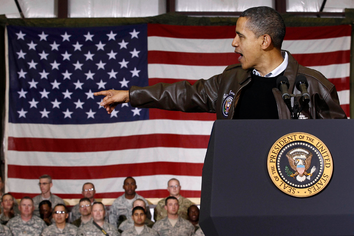
U.S. President Barack Obama meets with troops at Bagram Air Base, December 3, 2010.

U.S. President Barack Obama meets with troops at Bagram Air Base, December 3, 2010.

I have a fairy tale for you. Once upon a time, a representative democracy was established with a constitution that distilled the wisdom of the ages. Its foundational principles included civilian control of the military and a system of checks and balances that encouraged vigorous public debate as a basis for effective policy-making.

In this fabled land, the role of civilian leaders was, in part, to serve as a check on military ambition and endless wars. They were to prove cautious, too, in committing their citizen-soldiers to battle, and when they did, they would issue Congressional declarations of war so that everyone could grasp the nature of the national emergency at hand and the necessity of military action. In waging war, they would rely on shared sacrifice and even raise taxes. When necessary, it was their job to rein in or even remove military leaders who acted like Caesar (read: General Douglas MacArthur) rather than Cincinnatus (read: General George Washington).

Continue Reading
Thursday, May 12, 2011 4:45 PM UTC2011-05-12T16:45:00Zl, M j, Y g:i A T

America’s autocratic way of war

DC elites keep the masses in the dark about military decisions, the same way the French nobles did in Versailles

America's autocratic way of war

The killing of Osama bin Laden, “a testament to the greatness of our country” according to President Obama, should not be allowed to obscure a central reality of our post-9/11 world. Our conflicts in Iraq, Afghanistan, Pakistan, Yemen, and Libya remain instances of undeclared war, a fact that contributes to their remoteness from our American world. They are remote geographically, but also remote from our day-to-day interests and, unless you are in the military or have a loved one who serves, remote from our collective consciousness (not to speak of our consciences).

Continue Reading
Thursday, Jun 3, 2010 7:04 PM UTC2010-06-03T19:04:00Zl, M j, Y g:i A T

Doubling down in Afghanistan

Why the U.S. government stubbornly refuses to fold a losing hand

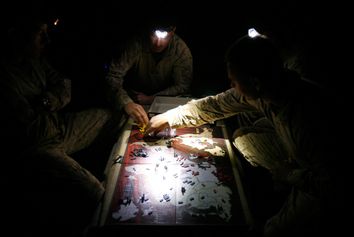
U.S. Marines from Kilo company, 3rd Battalion 6th Marines play the "Risk" boardgame by the light of their flashlights in COP Reilly base in Marjah district

U.S. Marines from Kilo company, 3rd Battalion 6th Marines play a round of the "Risk" boardgame by the light of their flashlights in COP Reilly base in Marjah district, Helmand province, March 24, 2010. REUTERS/Asmaa Waguih (AFGHANISTAN - Tags: MILITARY POLITICS IMAGES OF THE DAY) (Credit: © Asmaa Waguih / Reuters)

As Congress moves toward rubber-stamping yet another “emergency” supplemental bill that includes more than $33 billion for military operations, mainly to fund the latest surge in Afghanistan, maybe we should take a page from the new British government. Facing debilitating deficits, the conservative Tories and their Liberal Democrat partners are proposing painful cuts to governmental budgets, including military operations in Afghanistan. As the Independent put it, quoting a senior military source, “Essentially, the Americans know we are broke and we are getting blokes killed for no good reason. Whatever the [British Ministry of Defence] says, it absolutely isn’t business as usual.” In other words, an overstretched government, low on chips and recognizing a losing hand in Afghanistan, is finally moving to cut its losses, perhaps even to walk away from the table.

Continue Reading
Tuesday, Apr 20, 2010 9:21 PM UTC2010-04-20T21:21:00Zl, M j, Y g:i A T

The business of America is kleptocracy

It's not creeping socialism or fascism that we have to worry about. It's greed

This piece originally appeared on TomDispatch:

Kleptocracy — now, there’s a word I was taught to associate with corrupt and exploitative governments that steal ruthlessly and relentlessly from the people. It’s a word, in fact, that’s usually applied to flawed or failed governments in Africa, Latin America, or the nether regions of Asia. Such governments are typically led by autocratic strong men who shower themselves and their cronies with all the fruits of extracted wealth, whether stolen from the people or squeezed from their country’s natural resources. It’s not a word you’re likely to see associated with a mature republic like the United States led by disinterested public servants and regulated by more-or-less transparent principles and processes.

Continue Reading
Tuesday, Oct 13, 2009 7:07 AM UTC2009-10-13T07:07:00Zl, M j, Y g:i A T

Norman Mailer for secretary of defense

On Afghanistan, Obama needs the input of freethinking outsiders, not generals. What if LBJ had listened to Mailer?

Author Norman Mailer speaks at an anti-war rally at the bandshell in New York's Central Park, March 26, 1966.

Author Norman Mailer speaks at an anti-war rally at the bandshell in New York's Central Park, March 26, 1966.

It’s early in 1965, and President Lyndon B. Johnson faces a critical decision. Should he escalate in Vietnam? Should he say “yes” to the request from U.S. commanders for more troops? Or should he change strategy, downsize the American commitment, even withdraw completely, a decision that would help him focus on his top domestic priority, “The Great Society” he hopes to build?

We all know what happened. LBJ listened to the generals and foreign policy experts and escalated, with tragic consequences for the United States and calamitous results for the Vietnamese people on the receiving end of American firepower. Drawn deeper and deeper into Vietnam, LBJ would soon lose his way and eventually his will, refusing to run for reelection in 1968.

Continue Reading

Page 1 of 2 in William Astore

Other News