This originally appeared on William Hogeland's
blog.
Given some of my key subjects, I can’t help but be interested in the “occupy” movement that, at the moment, has hundreds of protesters more or less living in Zuccotti Park near the New York Stock Exchange in lower Manhattan for the past three weeks, and is apparently sparking similar protests in other cities. Until some 700 people were arrested over the weekend, you couldn’t find out much about this action via “mainstream media,” and much of the left media, such as it is, has been critical in some cases, and outright dismissive in others, regarding the movement’s evident formlessness and absence of specific goals.
That absence was pretty much undeniable. Still, in Salon, Glenn Greenwald has shrewdly criticized liberal-Democrat scorn for Occupy Wall Street. On the other hand, Mother Jones criticizes the movement on bases other than those that Greenwald attacks….
But I write about the deep, founding roots of rowdy, American populist protest and insurrection, often visionary and even utopian, yet informed and practical too, specifically over money, credit, and the purpose and nature of public and private finance. And despite my pop-narrative books on the subject, and despite my articles here, and in such place as Newdeal20.org (articles picked up by AlterNet, Huffington, Salon, Naked Capitalism and others), key indicators of my relative impact (like royalty statements!) give me a sneaking suspicion that most people still don’t connect the American founding period with a rugged drive on the part of ordinary people for equal access to the tools of economic development and against the hegemony of the high-finance, inside-government elites who signed the Declaration and framed the Constitution and made us a nation.
Sometimes people even ascribe democratic ideas to the famous upscale American Revolutionaries, who to a man actually hated democracy and popular finance. Thomas Paine, the exception, was ultimately rebuked and scorned by all of the others.
The difficulty in dealing with our founding battle for democratic economics arises in part because the movement was not against England but against the very American banking and trading elites who dominated the resistance to England. That complicates our founding myth, possibly unpleasantly. Also, it was a generally losing battle. With ratification of the Constitution, Hamiltonian finance triumphed, and people looking to Jefferson and Madison for finance and economic alternatives to Hamilton are barking up the wrong tree, since what those men knew, or even really cared, about finance could be written on a dime. (Anyway, in pushing for creating a nation, Madison supported Hamiltonian finance down the line. Their differences came later.) When Occupy Wall Street protesters say “It’s We the People!” they’re actually referring to a preamble, intending no hint of economic democracy, to a document that was framed specifically to push down democratic finance and concentrate American wealth for national purposes. Not very edifying, but there it is.
The Tea Party, meanwhile, has taken up founding economic issues from a right-wing point of view, associating itself with the upper-middle-class Boston patriots (often mistaken for populist democrats) who led a movement against overrreaching British trade acts in the 1760′s and were important to the impulse toward American independence. I’ve written fairly extensively about where and how I think the Tea Party goes wrong on the history of the founding period. But at least they’re framing their objections to current policy, and framing the historical roots of their ideas, not mainly in cultural but in economic terms.
Like it or not, though, it is Occupy Wall Street that has the most in common, ideologically, not with those Boston merchants and their supporters but with the less well-known, less comfortably acknowledged people who, throughout the founding period, cogently proposed and vigorously agitated for an entirely different approach to finance and monetary policy than that carried forward by the famous founders. Amid horrible depressions and foreclosure crises, from the 1750′s through the 1790′s, ordinary people closed debt courts, rescued debt prisoners, waylaid process servers, boycotted foreclosure actions, etc. (More on that here and here.) They were legally barred from voting and holding office, since they didn’t have enough property, so they used their power of intimidation to pressure their legislatures for debt relief and popular monetary policies. Their few leaders in legit politics included the visionary preacher Herman Husband, the weaver William Findley, and the farmer Robert Whitehill.
They had high hopes for American independence. In the 1770′s, their “out-of-doors” collaboration with the famous elites was critical to enabling the Declaration of Independence — even though none of their names appears there (well, Benjamin Rush’s does, but by then he’d become unradicalized). Their democratic, egalitarian hopes dashed, in the 1780′s, in western Massachusetts, they marched on the state’s armory in Springfield to reverse regressive finance policies that had again plunged ordinary people into debt peonage and foreclosure while bailing out rich creditors (elites called that populist action, reductively, Shays’s Rebellion). In the 1790′s, with the Constitution in force, and Hamilton’s economics the law of a powerful new nation (partly in direct reaction to the Shays action), populists took over the militia and debt-court system throughout western Pennsylvania and western counties of neighboring states, flew their own flag, and tried to secede from the United States and form an economically egalitarian country. Hamilton dubbed that action, again in a successful effort to reduce it, the Whiskey Rebellion, and he and President Washington responded, naturally enough, by occupying western Pennsylvania with federal troops.
It is my possibly vain hope that reading up on such historical matters might inspire efforts like Occupy Wall Street to greater cogency and a deeper, more solid foundation in longstanding (if embattled and problematic) American values than they now seem to possess. You don’t have to look as late as the 19th-century Populists and the 1930′s labor movement, for example, to find an American left deeply immersed in both economic issues and an ambitious vision of a better country. Those things were present at the creation.
Occupy Wall Street probably doesn’t, when you shake it down, want to secede from the union like the whiskey rebels — happily enough. But those rebels didn’t start out by wanting to secede, either; they’d fought in the awful front lines of the Revolution in hopes that those sacrifices might lead to something for them and their families; it didn’t. Occupy Wall Street does seem to want to secede, somehow, from the hopeless-feeling regurgitation, through the two political parties, of elite finance theories and policies that never seem sincerely dedicated to any fundamental improvement of opportunity for what they call, not wrongly, “the 99 percent.”
The problem for Occupy Wall Street is that their founding-period political ancestors, who were indeed good at “occupying,” almost always accompanied their efforts with, for one thing, published resolutions registering specific demands and objections (not “this situation sucks” — which of course it does — but “replace a regressive tax with a progressive one,” “give us access to the franchise,” ”issue paper money,” “take away Robert Morris’s bank charter,” etc.). On Twitter I’ve tried to collect some specific goals from Occupy people. Generally those who respond seem interested not in anarchist dismantling of government or sweeping stuff like ending capitalism but, say, real regulation. Which is cool if only because my early American democratic-finance activists called themselves “regulators”!
But a lot of efforts to state a goal for the protest itself devolve in sloganeering about the economic situation and self-admiring paeans to the virtues of protesting. Wouldn’t galvanizing this stuff require… leadership? Our founding democratic-finance activists weren’t such communitarians that they refused to have leaders and set achievable goals. They were used to being rank-and-file — even though as miltiamen, they elected their leaders.
And they knew where they’d succeeded and failed. This thing in Zuccotti Park is open-ended. It has no declared closing date. How can it ever declare victory, get the hell out, build its organization, and come back to fight another day?
This originally appeared at New Deal 2.0
In a critical and entertaining portrait of the anti-tax activist Grover Norquist, the New York Times columnist Frank Bruni presented Norquist as an absolutist obsessed with forcing modern political life to conform to ideas that Norquist associates with the American founders’ first principles.
Of course, Norquist is by no means alone in taking that position. That the Constitution came into existence to keep taxes low, the federal government small, and national debt at zero is an article of faith among many who, like Michele Bachmann, have taken to calling themselves “constitutional conservatives.” And faith is required to believe it, as the Norquist interview shows. To make his supposedly constitutional argument, Norquist cites the First Amendment on freedom of religion and the Second on the right to keep and bear arms, and then goes on to cite absolutely nothing, in either the articles or the amendments, that so much as hints at a constitutional requirement to balance the federal budget, avoid debt, tax no more than people like Norquist deem appropriate, and keep government small.
He can’t cite anything to that effect because while balancing budgets, restraining borrowing, and keeping taxes low and government small might be good goals, depending on what you mean by them, it is impossible to locate in the founding national law any requirement to accomplish them. Indeed, the reality of founding history leads to the reverse conclusion.
The Constitution came about precisely to enable a newly large government — a national one — to tax all Americans for the specific purpose of funding a large public debt. Neither Alexander Hamilton nor his mentor the financier Robert Morris made any bones about that purpose; James Madison was among their closest allies; and Edmund Randolph of Virginia opened the Constitutional Convention by charging the delegates to redress the country’s failure to fund — not pay off, fund — the public debt, by creating a national government.
Beginning during the War of Independence, and continuing throughout the 1780s, American nationalists committed themselves to a small class of upscale high financiers (largely identical with the American nationalists), who had bought bonds from the confederation Congress in hopes of earning regular, tax-free, 6 percent interest payments — not in the Congress’s crashing paper currency but in hard, cold metal or its equivalent, stable bills of exchange. Morris, Hamilton, Madison and others believed that swelling the debt to immense proportions would make a coherent nation out of 13 squabbling states and make that nation a player on the world economic stage. Their plan to do so depended partly on making military-officer pay a pension, thus turning the entire officer class into public bondholders — and giving Congress new power to tax all Americans to support that debt.
Hamilton is often reflexively presented as finding inventive ways to pay down the national debt. His real accomplishments were of course “funding and assumption” — absorbing the states’ war debts in the federal one and funding that huge obligation via nationally collected and nationally enforced taxes.
Hence the all-important provisions of the Constitution giving Congress very broad powers to tax and acquire debt. To 18th-century American nationalists across the political spectrum — to our founders and framers, that is, from Hamilton to Madison, from Morris to Randolph, from the financiers to the planters — national taxing and borrowing were ineluctably connected to the very purpose of national government.
Nobody has to like it. But the original intent of the Constitution involved sustaining and managing public debt via taxation.
Both the articles and the amendments do, of course, limit government and restrict its power. But no ratified amendment has ever qualified Congress’s power of the purse, which in the minds of the framers explicitly involved the power to take on debt and fund it. In their tweets and blogs, “constitutional conservatives” have been promoting a balanced-budget amendment with reference to the tired notion that since households and small businesses must balance their budgets (as if!), government must too. They link that economically useless prescription to the widespread fantasy that our Constitution was written, amended and ratified for just such a purpose. The framers saw it just the other way.
But really everybody, not just “constitutional conservatives,” buys into the fantasy now. History is rarely helpful politically. It’s hard to imagine liberals bringing to debt-ceiling and balanced-budget debates the painful realpolitik of our national origins, which show the Constitution existing, originally, to finance the investing class and yoke that class’s interest (in every sense) to national power. Thus the Times gives the Bruni piece a headline referring to Norquist’s “dangerous purity” — as if the danger in Norquist’s approach lies in a too-rigid insistence on basic principle. There’s nothing purist about Norquist. Whether his ideas may be proven right or proven wrong, they are anything but originalist. Like those of Bachmann and the rest of the anti-tax right, Norquist’s principles are novel, innovative and weirdly postmodern, extra-constitutional at best.
Stark realism about the actual founding purposes of the Constitution will always have limited use in political debate. But it would be nice, at least — though unlikely — if we would argue these issues on their merits, and leave the Constitution alone.
William Hogeland is the author of the narrative histories “Declaration” and “The Whiskey Rebellion” and a collection of essays, “Inventing American History.” He has spoken on unexpected connections between history and politics at the National Archives, the Kansas City Public Library, and various corporate and organization events. He blogs at http://www.williamhogeland.com.
Continue Reading
Close
This originally appeared at New Deal 2.0
Anything but a lost, halcyon epoch of unity and consensus, our founding era saw deep, harsh oppositions among Americans over what kind of society our independence from England was meant to bring about. Like today, the direst political oppositions devolved on the economy, and on proper uses of public and private finance. From the North Carolina Regulation of the 1760s to the Whiskey Rebellion of the 1790s, Americans struggled mightily with other Americans over economic issues.
Though little-known, those struggles had decisive impacts on all of the famous moments in founding history. The Continental Congress’s adopting the Declaration of Independence occurred in the summer of 1776 only because those among the financial and political elites who wanted American liberty made secret, common cause with radical populists who wanted American equality. The Constitutional Convention’s proposing a national government in 1787 came in direct opposition to progress made by the radical democrats who promoted ordinary, working Americans over the high-finance investing class.
So it’s hardly surprising that those same struggles have critically important echoes and resonances — if sometimes painfully dissonant ones — for our bitterly divided politics and disastrous financial crises today.
Yet despite constant appeals to founding values by politicians and pundits across the political spectrum, a perennial American eagerness to avoid framing our founding period in economic terms can make it strangely difficult to keep those all-important 18th-century finance issues in historical focus. The Tea Party movement, for example, has laid its claim on the founding period, and to a great extent that claim is indeed an economic and financial one. Casting the modern welfare state as a form of tyranny, in large part because of what they see as its excessive taxation, Tea Partiers invoke the famous American resistance to Parliament’s efforts to raise a revenue in the colonies without the consent traditionally given by representation. Seeing founding-generation American patriots as unified against British taxation (and frequently misrepresenting the politics even of the elites they invoke), the Tea Party defines its own anti-government, anti-tax values as essential to American identity.
The Tea Party thus edits out an alternative view of government that prevailed among the ordinary 18th-century Americans who were all-important to achieving independence. Those Americans opposed elites epitomized by the Boston merchant class, which the Tea Party, perhaps appropriately enough, so strongly identifies with. The internal struggle for American equality was as important to the founding as the high-Whig resistance to England, but the Tea Party can’t deal with the populist leaders and militia rank-and-file who wrote the socially radical 1776 Pennsylvania Constitution, or the Shaysites of Massachusetts who marched on the state armory, or the so-called whiskey rebels who inspired federal occupation of western Pennsylvania. American Revolutionary patriots all, those democratic-finance leaders had ideas about government’s role in ensuring economic equality that prefigured programs of the 19th-century Populists and the 20th-century New Dealers, the very programs the Tea Party wants to dismantle. Tea Party history therefore has to expunge the welfare state’s roots in America’s founding.
Liberals, too, can have a problem with the economic conflicts of the founding period. Alexander Hamilton’s national finance program, which Madison and Jefferson opposed with such intensity, was economically regressive. Under the influence of the founding financier Robert Morris, Hamilton made a stunningly successful effort to yoke American wealth to great national projects by beating down the popular-finance movement and promoting the interest (in both senses!) of the high-finance elites. Yet when some of today’s liberals look to Madison for support in critiquing Hamiltonian finance, they come up empty. Madison’s attacks on central banking represented anything but an argument for democracy and economic equality.
In fact, the activist governing philosophy of national power that Hamilton espoused and Madison opposed gave precedent to modern liberal ideas about an energetic federal role in achieving social ends. Hamilton, not Madison, was in that sense the modern liberal, and the Hamiltonian influence on today’s liberal establishment can be seen in the Brookings Institution’s “Hamilton Project” and Peter Orszag’s hanging of a National Gallery portrait of Hamilton in his office. That kind of liberalism makes Hamilton the author of using fervent support for Wall Street in hopes of benefiting Main Street.
There’s another kind of liberal history, leaning economically left, that prefers to trace a pretty straight line from Thomas Paine to Thomas Jefferson to Andrew Jackson to FDR, incorporating the labor movement along the way. It thus sees democratic, labor-oriented populism as essential to American founding values and coming to fruition throughout American history. In this view, the Declaration’s “all men are created equal” prophesied social progressivism (even if that’s not what the signers meant by it) and the Constitution’s “we the people” prophesied democracy (even if the document was specifically intended to prevent democracy). The Revolution is defined not by the split between, say, Hamilton and Madison but by the emergence of Jeffersonian and then, even more fully, Jacksonian democracy. The American people become in essence social radicals, and the development of social democracy, while embattled, becomes a natural project of America.
One problem with that view lies in its reliance on Jefferson and Jackson as socially progressive. The New Dealers did an amazing job of reinventing Jefferson as one of their own — they built him a monument and carved his face on the nickel and on a mountain; they put a statue of his Treasury Secretary Albert Gallatin at the front door of the Treasury (Hamilton, the department’s inventor, stands around out back). But it’s pretty funny to think of Jefferson as a patron saint of federal-government, welfare-state activism, and Jefferson’s attitudes about democracy are notoriously slippery and problematic. The sage of Monticello could wax romantic about small farmers, and he could get excited about radical uprisings (in Paris), but he wasn’t about to invite small farmers up his hill, and giving the proletariat of the American cities access to political power — what Paine actually helped bring about in 1776 — filled him with disgust and horror.
The Jackson era, too, by no means represented a triumph of the kind of economic equality espoused by Paine, Herman Husband, Thomas Young, James Cannon, and the democratic-finance populists of 1760s and 1770s. Modern forms of “consensus” history see Madison and Hamilton alike as being superseded by Jackson, who ushered in a rowdy, undeferential, dirty-boots, small-business capitalism, contrasted with the gentility shared by all of the famous founders, no matter their differences. That kind of capitalism was hardly what founding-era democratic-finance activists had in mind. The Jackson administration’s assaults on central banking may be read by social-democracy historians as a dismantling, at last, of the regressiveness of Hamiltonian finance — but what began flourishing in the Jackson era can just as easily be read as fulfilling the diverging fears of those bitter enemies Paine and John Adams. Paine, desiring to re-order the world around a economic equality ensured by strong national government, would have been terribly disappointed by the cutthroat society emerging in Jackson’s America. And Adams’s warnings that democracy could only lead to machines, demagoguery, and party wars over political fiefdoms might as well have been describing the American politics that began with 19th century democracy.
Just as in Tea Party history, which sees the American people as essentially anti-government, an act of faith is required to see the American people as essentially socially progressive (or essentially anything). Both liberals and conservatives remain riveted — hypnotized! — by the big-name founders, from Madison to Hamilton to Adams to Jefferson to Washington to Franklin (with Paine sometimes thrown in because of “Common Sense”); they therefore remain locked in a fight over what those founders would or would not have supported today. Widening the lens to include the more ordinary likes of Cannon, Young, Husband, Christopher Marshall, Timothy Matlack, Robert Whitehill, and William Findley, among others who opposed American financial elitism in the Revolutionary era, challenges all sides of today’s political debate. Bearing down on the painful fact that a struggle over money, not ideas, marked every significant moment during the American founding can help enable new thinking about our struggles today.
The founding leaves us with questions about, not answers to, the kind of American economy we want now. In this series I’ve tried to raise some of those questions. This post is my last in the “Founding Finance” series. Writing it, and reading commentary on it here and around the blogs, has been a great pleasure. Thanks to Lynn Parramore (and to Bryce Covert, New Deal 2.0, and the Roosevelt Institute)! I hope these posts help frame an ongoing conversation about the strangely little-known, yet perennially resonant drama of American founding finance.
William Hogeland is the author of the narrative histories “Declaration” and “The Whiskey Rebellion” and a collection of essays, “Inventing American History.” He has spoken on unexpected connections between history and politics at the National Archives, the Kansas City Public Library, and various corporate and organization events. He blogs at www.williamhogeland.com.
Continue Reading
Close
This piece originally appeared on New Deal 2.0.
The annual drop-dead moment when Americans must file tax returns or face unpleasant consequences has become an opportunity for the Tea Party, protesting what it sees as crippling taxation and overactive federal government, to rally its supporters. Extending this year’s filing deadline from April 15 to today, April 18, the IRS gave Tea Partiers a big weekend, and all over the country, tax-day events hymned unregulated markets, excoriated federal programs like the health-insurance reform bill, and defended anti-labor governors. Anti-Obama leaders from Sarah Palin to Donald Trump urged the faithful to oppose evils summed up for them in the annual requirement to file federal tax returns. For the Tea Party, “Tax Day” represents all that’s gone wrong with America since the founding.
So as we stand on long lines at the post office hoping to avoid the midnight axe, we might spare a moment to consider the father of federal taxes, Alexander Hamilton. Our first Secretary of the Treasury, Hamilton is celebrated by both establishment liberals and establishment conservatives: The Hamilton Project is an economic effort of the liberal Brookings Institution, and former Obama budget director Peter Orszag hung a Hamilton portrait in his office; on the right, the writer David Brooks and former Bush Treasury Secretary Henry Paulson are two of Hamilton’s biggest fans. It’s not surprising. Hamilton is rightly said to have put the new nation on sound financial footing and secured its creditworthiness. He gave us our first comprehensive national finance policy.
That policy depended on exercising certain economic powers that finance nationalists like Hamilton and his mentor the rich financier Robert Morris, as well as planter nationalists like James Madison, had been striving to achieve for the federal government throughout the 1780′s, and which came to fruition at the Constitutional convention in 1787. While Hamilton and Madison would arrive at dire odds over whether the Constitution gives the federal government the right to form a central bank (Hamilton yes, Madison no), all nationalists had long agreed that a national government, unlike a confederation of states, would have a right to tax its citizens directly, throughout the states. And unlike what they saw as state governments’ susceptibility to the American popular-finance movement’s riot and noncompliance, a national government, nationalists hoped, would have both the will and the police resources to enforce and collect taxes.
So whereas Tea Partiers sometimes associate their objections to federal taxes with a desire to “get back to the Constitution,” federal taxation is one of the Constitution’s central purposes. And we can thank the wunderkind Alexander Hamilton for proposing the legislation by which the first U.S. Congress imposed the first federal tax ever on an American product.
Hamilton wasn’t messing around. Empowered by the new government to do what he and Morris had long been frustrated in trying to do, the young, charismatic, brilliant, diligent Secretary worked up a full-blown plan for connecting national wealth, and even more importantly national credit, to ambitious national aims. Like Morris, though to a far more sophisticated degree, Hamilton wanted the United States to become an economic powerhouse and financial empire to compete with England. And he’d been tireless in figuring out how to do it.
The key, as Morris had always suggested, was to combine a big public debt with vigorously enforced taxes earmarked for funding that debt. That is: sell U.S. bonds to the small, rich merchant lending class and, as Morris had put it, “open the purses of the people,” collecting taxes from the American people, in metal, not paper, and earmarking revenues for paying the bondholders their 6% interest in hard, cold cash — 6% untaxed interest, that is. Federal power would thus shift national wealth upward and consolidate it. Yoking national credit to national interest, government would serve as an economic pivot between the creditors and the people and thus be in a position to finance roads, canals, wars, and other national projects.
Morris had fought hard during the confederation period for a simple federal tariff on imports, known as an “impost,” and opposition even to that measure had always been stiff: states wanted to retain their sovereign power to tax. But he’d also schooled his supporters in what a real federal tax slate would look like. Once people had become inured to paying a federal tariff, Morris had predicted, the federal government would be able to impose taxes on domestic products too, taxes known as “excises.” Continuing to expand tariffs alone would hit too hard the very people Morris and Hamilton wanted to encourage: the merchant financiers, who also engaged in international trade (that’s where they got the gold). Fully consolidating wealth, and fully connecting it to high national aims, meant collecting revenue for finding bonds from people who would never own a bond. Hence the importance, to Hamilton, of imposing domestic taxes.
And Hamilton pulled his whole plan off, pretty much on his own. He is often portrayed as having faced down and tamed a huge public debt that had been run up, somehow, to unfortunate proportions during the war and now needed to be paid off. Nothing could be farther from how Hamilton himself saw the situation. Swelling the public debt had been a project of his and Morris’s for many years — for all the cogent reasons of national credit described above — and now as Secretary, his plan was hardly to pay the debt down (many of his biographers to the contrary) but to fund it. Which as those of us with credit cards know, is another thing altogether.
In that context, Hamilton further persuaded Congress to assume all the states’ debts in the national one, swelling the public debt to the nth degree at last and placing it all in federal hands. That took a tough political fight. Hamilton won it in part because his Madisonian opponents were nowhere near as finance-savvy as he, and partly because empowering the federal government to enact a top-down national finance plan had all along been a chief purpose of the Constitution under which Hamilton acted.
So state debts were nationalized, and a law for funding the domestic public debt was passed. Hamilton couldn’t get his bondholders their full 6%, but they were happy enough. Investing in the U.S. looked safe and lucrative.
Funding and assumption: those were Hamilton’s great twin achievements, and they did secure the credit of the nation in just the way he and Morris had always wanted. But they depended on a third leg of the finance program, rarely discussed but utterly essential: federal taxation of the American people, with a full-fledged collection service, inexorably spreading federal power to collect, audit, and prosecute throughout the country, from state to state, town to town, and village to village. To Hamilton, taxes weren’t an unfortunate necessity. They created a nation, pulling the country together through a network of federal officers opening offices and banging on doors. Running every last detail of that widespread, growing, and powerful federal agency, Hamilton came into his own.
Next week: How Hamilton constructed and calibrated his first federal tax — the excise on American distilled spirits — to achieve his and Morris’s longstanding goal of quelling the popular finance movement. Also: How the finance populists fought back. In the meantime: Happy Tax Day!
William Hogeland is the author of the narrative histories Declaration and The Whiskey Rebellion and a collection of essays, Inventing American History. He has spoken on unexpected connections between history and politics at the National Archives, the Kansas City Public Library, and various corporate and organization events. He blogs at http://www.williamhogeland.com.
Continue Reading
Close
This originally appeared at New Deal 2.0
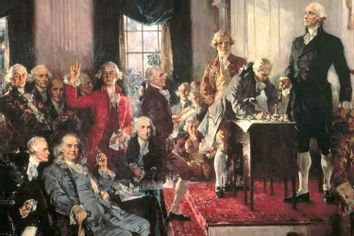
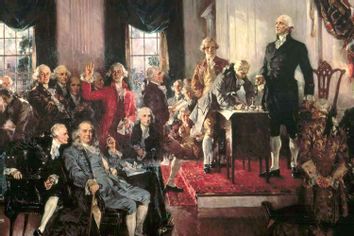
Edmund Randolph of Virginia kicked off the meeting we now know as the United States constitutional convention by offering his fellow delegates a key inducement to forming a new U.S. government. America lacked “sufficient checks against the democracy,” Randolph said. A new government would provide those checks.
Randolph’s listeners in Philadelphia in the spring of 1787 knew what he meant by “the democracy.” And readers of this series probably will, too. He was talking about the 18th-century American popular finance movement, whose supporters agitated for policies to obstruct concentrated wealth and to give regular folks access to political power and economic equality. Amid depressions and foreclosures, ordinary people had long been rioting — they called it “regulating” — to pressure assemblies to restrain the merchant creditors, whose command of scarce gold and silver let them acquire immense wealth by lending at high, even predatory rates to the needier.
Then, with revolution against England, the popular finance movement turned its attention to changing the economic terms of American society. The 1776 Pennsylvania constitution, based in large part on ideas expressed by Thomas Paine in “Common Sense,” smashed the ancient property qualification for voting and holding office. In Pennsylvania, new political leaders like the preacher Herman Husband, the weaver William Findley, and the farmer Robert Whitehill entered the assembly and began passing laws shutting down elite banking and requiring government to operate, for the first meaningful time anywhere, on behalf of ordinary people.
Democracy in Pennsylvania sent chills through elites of every kind throughout the newly independent country. Rioting for popular finance was bad enough, but rioting was temporary, spasmodic, and traditional. Debtors wielding legitimate political power to equalize economic life — that was tantamount to a new kind of tyranny of the mob, hardly what Whig revolutionaries had fought England to gain. Neither Edmund Randolph nor other delegates of the Philadelphia convention, meeting in secret sessions in the Pennsylvania State House, felt any need for subtlety in seeking to suppress the political and economic equality burgeoning everywhere in America among “the democracy.”
Present at the Philadelphia convention was the fabulously wealthy Pennsylvania financier and speculator Robert Morris, America’s first central banker, no doubt licking his ample chops over the fulfillment, at long last, of his plan to wed nationhood to high finance. Yet it was the planter Randolph, not the financer Morris, who referred to “the plague of paper money,” and he meant just what Morris meant. State legislatures’ currency emissions and legal-tender laws depreciated the merchants’ income from their loans; paper, the people’s medium, built debt relief into money itself. Randolph also rued the country’s difficulty in paying the investing class its interest on federal bonds. With those bonds, Morris had made private creditors into public creditors as well, swelling the domestic U.S. debt to vast proportions in an effort to connect national purpose to high finance.
Hence the need, Randolph said, for a national government with laws acting on all the people throughout the states. It’s no coincidence that he also charged the delegates with repairing the federal government’s military weakness. A debtor uprising in western Massachusetts known as Shays’ Rebellion had marched on the state armory. That wasn’t just a riot. It showed how far ordinary people might go in rejecting regressive taxes and policies giving investors huge paydays with public money. The United States, Randolph said, must be empowered to put down insurrections anywhere in the country.
So Randolph did indeed know what he meant by “the democracy,” and his fellow delegates knew too. Why are historians typically so coy about the constitutional convention’s financial purposes?
The fight over those purposes is almost 100 years old. In 1913, the historian Charles Beard published “An Economic Interpretation of the Constitution of the United States.” There Beard argued that because delegates of the convention came overwhelmingly from the bond-holding class, the government they put into effect represents less a glorious triumph of republican philosophy than a rearguard action of money elites to assure their own payoffs. Beard’s startling contention was that the framers acted at least as much on financial self-interest as on principle.
If that contention remains startling, we can thank an immense effort, carried out over generations, to throw out not only Beard’s particular economic interpretation of the convention, but along with it any suggestion that struggles between elites and ordinary Americans over public and private finance played a role in framing our Constitution. It’s not surprising that many of the popular founding father biographers routinely avoid the issue. But entire careers in academic history — major ones, like Edmund Morgan’s — have been largely dedicated to depicting a founding generation acting with perfect intellectual consistency almost entirely on principle. Wherever self-interest did arise, Morgan suggests (in his popular book “The Birth of the Republic” and elsewhere), the nature of the founding mission was such that it enabled even greed to inspire the founders to good. In that kind of history, everyday political struggles over money between ordinary Americans and American elites just don’t play.
Beard did err. A pro-Jefferson, anti-Hamilton bent led him to associate self-interest mainly with the high-finance elites; he saw the land-based, state-sovereign philosophy of many planters as tending more naturally toward democracy, and he miscast people like Jefferson and Samuel Adams as Paine-like democrats. Randolph’s opening speech at the convention shows a confluence between Virginia planters and Philadelphia financiers on ending democratic finance (men who would never again agree on anything agreed on that!). As the historian Staughton Lynd has wisely suggested, citing Robert Brown in an essay in the anthology “Towards a New Past”, had Beard referred less specifically to bondholding, and more generally to property-owning, he would have been standing on firm ground.
But many take Beard’s errors as ample cause for heaving big sighs of relief, writing off any mention of founding conflicts over money and finance as “economic determinism,” and resting easy in a certainty that, the founders’ own words to the contrary, economic struggles played no important role in making us who we are as a people. “No, that’s Beard,” runs the objection to mentioning founding economic struggles. “Haven’t you heard? Beard’s been debunked.”
Debunking Beard is full of bunk. Beard’s leading critic, the historian and right-wing activist Forrest McDonald (he served, for example, as chairman of the Goldwater for President Committee of Rhode Island), rejected Beard’s economic analysis in favor of uncritical adoration for the founders’ sheer greatness. In his 1958 book “We the People”, McDonald purported to dismantle Beard’s argument with his own supposedly more accurate economic studies, but in a 1986 article in “The Journal of Economic History,” Robert McGuire and Robert Ohsfeldt used what economists call “regression analysis” to show that McDonald set premises and drew conclusions far more tendentious than Beard’s. McGuire’s recent book “To Form a More Perfect Union” strengthens both the critique of McDonald and the adjustment and rehabilitation of Beard.
To men of the constitutional convention, some of our modern economic analyses might seem strangely redundant. If we know how to read them, the founders often tell us, unabashedly and in their own words, what they were trying to do. McDonald claimed that, Beard to the contrary, a multitude of interests prevailed at the convention, not just one. Well, that’s true. What’s striking is that despite their well-known mutual antipathies, on a well-known multitude of fateful issues those northerners and southerners, planters and moneymen, slaveholders and manumissionists, city dwellers and countrymen, nationalists and state sovereigntists meeting in Philadelphia in 1787 shared a desire even stronger than their antipathy for one another: stop the American democratic finance movement once and for all.
The fight wasn’t over. But the men of the constitutional convention were making no bones about trying to win it.
William Hogeland is the author of the narrative histories “Declaration” and “The Whiskey Rebellion” and a collection of essays, “Inventing American History.” He has spoken on unexpected connections between history and politics at the National Archives, the Kansas City Public Library, and various corporate and organization events. He blogs at http://www.williamhogeland.com.
Continue Reading
Close
This piece originally appeared in NewDeal 2.0.
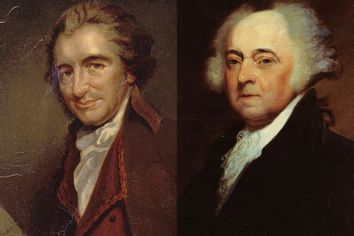
Here’s John Adams on Thomas Paine’s famous 1776 pamphlet “Common Sense”: “What a poor, ignorant, malicious, short-sighted, crapulous mass.” Then comes Paine on Adams: “John was not born for immortality.”
Paine and Adams may have been alone among the founders for having literary styles adequate to their mutual disregard. “The spissitude [sic!] of the black liquor which is spread in such quantities by this writer,” Adams wrote of Paine, “prevents its daubing.” Paine: “Some people talk of impeaching John Adams, but I am for softer measures. I would keep him to make fun of.”
They went on and on.
The Paine-Adams antipathy wasn’t just personal. Its sources lay in the founding generation’s deep political divisions over economic equality. Those who don’t know there was a founding political division over economic equality can thank the many historians — including even some biographers of finance-savvy founders like Superintendent of Finance Robert Morris — who feel more comfortable with philosophies of government, issues in constitutional law, and (if they get into economics at all) the legacies of Robert Walpole, Jacques Necker and David Hume than with day-to-day American economic realities, and with the full range of 18th-century thinking from elite to working-class, on monetary and finance policy.
Things John Adams hated about “Common Sense” are revealing. One was the pamphlet’s widespread reputation as the tipping point for America’s declaration of independence from England. Adams thought that was nonsense. The only novel thing in “Common Sense,” Adams believed — and he meant it in a bad way — wasn’t what he cast as its belated, derivative call for American independence. It was what he blasted as Paine’s “democratical” plan for a new kind of American government, which flew in the face of the balanced republicanism that Adams loved. That part of the pamphlet was its only important part to John Adams, but it is often ignored or glossed over in favor of celebrating what Adams thought the pamphlet never did: persuade Americans to support independence.
In proposing a new American government, Paine scoffed caustically at the whole idea of balance and the covalence among branches that we’re taught to revere as exceptionally American, but were really derived from the post-Settlement English constitution. Where Adams saw checks and balances as key to liberty, Paine wanted an executive branch subordinated to a hyper-representative legislature (a single house, with no check from any elite “upper” house) and a judiciary directly elected by the people.
Most horrifying to Adams, Paine wanted citizens to have the vote regardless of property ownership. While in “Common Sense” Paine dialed back his thoughts on equality, arguing only for easy access to the franchise, in other works he promoted smashing the ancient equation that liberty-loving Whigs had always made between property and representation. Paine wanted the less propertied and — horrors! — even the unpropertied not only to vote in a free America, but also to hold office.
Paine’s goal in giving the lower sort and the poor access to political power was economic equality. When ordinary Americans held power, they would pass laws promoting the interests of ordinary Americans — and obstructing, not coincidentally, the interests of finance elites. And that’s just what happened in Pennsylvania beginning in 1776, when Paine’s friends wrote a constitution for that state, based largely on Paine’s ideas, removing the property qualification for the first meaningful time anywhere. Assemblies elected under that constitution passed anti-monopoly laws, worked to bring about government debt relief, and took away the charter of the bank founded by the high financier Robert Morris for the purpose of enriching himself and his friends.
The ideas in “Common Sense” that John Adams feared and loathed became realities in Pennsylvania. Many historians celebrating Paine’s goals of liberty and independence fail to acknowledge that for Paine, those goals were inextricable from political equality for the people he spoke for: ordinary working Americans.
One of the most fascinating moments in Paine’s career therefore occurred when he went to work for the high financier Robert Morris himself, writing at Morris’s behest on behalf of federal taxation in the service of national unity. Paine’s democratic populist friends saw Morris’s taxes, and indeed Morris’s wish for national unity, as a means of shoring up American wealth and pushing back the economic gains ordinary people had made in the Revolutionary period. Paine excoriated Morris for chicanery during the Revolution and helped create the economically democratic government that took away Morris’s bank and made the fat cat investor accountable to public opinion. In the 1780s, sudden support for Morris’s nationalist finance made Paine look like a sellout. He lost friends among his 1776 allies for equality.
But unlike many of his populist friends, Paine wanted a strong national government for America. Many economic populists of the period made the mistake of placing hopes for popular finance in antifederalism and then in the emerging “states rights” thinking of the anti-Hamilton elites. Populists had reason to feel more sympathy for state governments than for a national one: legislatures from time to time had been susceptible to the will of the less enfranchised, expressed through rioting; states had issued paper currencies and established land banks. And nationalists like Morris and Hamilton were indeed out to end all that. They wanted to make finance and monetary policy national matters, empowering suppression of debtor riots and enforcement of taxes collected for the benefit of an interstate money elite.
Paine, however, was impatient with the anti-nationalism of his fellow democrats. Skeptical of knee-jerk populism, he had high hopes for national finance. The strangest of bedfellows, Paine and Morris were working together at weird cross purposes. Paine’s vision, diametrically opposed to Morris’s, was like Morris’s in being a national one. Along with “the madman of the Alleghenies” Herman Husband, who also saw through state-focused elites’ pandering to populism and thought an egalitarian national government might be better empowered to hold greed in check, Paine’s radical democracy made him an offbeat kind of Federalist. Gazing farther than most of the popular finance activists of his time, he looked for a strong national government that would amplify the democratic gains he’d helped achieve in Pennsylvania.
The United States government, in Paine’s vision, would justify its national power by regulating elite finance throughout the states, promoting the interests of ordinary Americans everywhere, and increasing social equality by law. For Thomas Paine, American finance policy must dedicate itself to economic equality.
William Hogeland is the author of the narrative histories “Declaration” and “The Whiskey Rebellion” and a collection of essays, “Inventing American History.” He has spoken on unexpected connections between history and politics at the National Archives, the Kansas City Public Library, and various corporate and organization events. He blogs at http://www.williamhogeland.com.
Continue Reading
Close