William Speed Weed

Nobel dude

Kary Mullis revolutionized genetic research but thumbs his nose at the scientific establishment. It thumbs its nose right back.

  • more
    • All Share Services

Take all the MVPs from professional baseball, basketball and football. Throw in a dozen favorite movie stars and a half-dozen rock stars for good measure, add all the television anchor people now on the air and collectively we have not affected the current good or the future welfare of mankind as much as Kary Mullis.” — Ted Koppel, on ABC’s “Nightline”

At the Inventors Hall of Fame, Kary Mullis’ work stands with that of Louis Pasteur and Guglielmo Marconi. Every research university in the country has tens, if not hundreds, of the machines that run on his ideas. Somewhere in Mullis’ home is a round medal with a bas-relief of Alfred Nobel, representing the highest honor in science, one shared by the likes of Albert Einstein, James Watson and Francis Crick.

That’s because Mullis invented the polymerase chain reaction, or PCR, a technique that makes a billion copies of one tiny gene, thereby allowing scientists to study that gene in great depth. As the historic Human Genome Project pulls into its home stretch, physics passes on to biology the mantle of most revolutionary science. In the last century we conquered the atom; now we will conquer the gene. And we will do it with PCR.

So Mullis must be an august man, writing his memoirs at the National Academy of Sciences, receiving policy makers and reverent fellow scientists in his book-lined study the way Papa Einstein did, right?

No way, dude! Mullis is like hangin’ 10 in La Jolla, surfin’ every day, brewskies in the fridge, LSD whenever. (Hey, he knows how to make the stuff.) Aliens occasionally visiting. A sexy new wife (since all the women at scientific conferences finally got sick of his lechery). And he just had a book published with his naked bod on the cover. Far out!

Actually, neither of these descriptions is accurate.

But the second one, Mullis as the surfer loon, is the most pervasive. I first heard about it two years ago at a bar during a conference in Southern California. Two geneticists were joking about how they should go find Mullis, do some drugs and score some chicks.

“Isn’t he the guy who invented PCR?” I asked, surprised. Usually scientists are more respectful of their best and brightest. They said, yeah, Mullis may have invented PCR, but all those drugs, and all that womanizing, and all those crazy ideas about mind expansion had essentially placed his reputation in the alleyway trash bin, but he was fun to joke about.

When Mullis won the 1993 Nobel Prize in chemistry, journalists reinforced this stark morality tale: Boy genius invents a great thing but then behaves so irresponsibly that everyone laughs him out of science’s good graces.

With his own book, “Dancing Naked in the Mind Field,” published in 1998, Mullis fumbles the chance to show the world he isn’t a fool. His writing is not thoughtful enough to justify his eccentricities, and the book makes him seem the jester people say he is. He writes, among other things: O.J. Simpson was innocent and Marcia Clark’s a hottie, humans don’t contribute to global warming and HIV is not the cause of AIDS. He purports to have found astral planes by scientific method, he relishes old tales of seducing women and taking drugs and he pooh-poohs current science.

“I’d put 90 percent of our present expenditure for physics and space technology on [finding asteroids that might hit Earth],” he writes. “The other 10 percent should go to looking for aliens.” All of this is too challenging to simply glide over; and the lack of deeper explanations makes the man seem facile.

When I tracked down Mullis for an interview (his first for a major magazine in almost two years), I was primed to get some of those juicy “No way, dude; let’s do some LSD!” quotations to jazz up my profile. Of course, character being different from caricature, I didn’t get any.

During our hour-long phone conversation, Mullis spoke nothing like the bar-stool imitations of him I have heard scientists do. He has a soft voice that retains the diphthongal calm of his native South Carolina. It is indeed a good voice for a successful womanizer, but I was struck more by his consideration in answering my questions. His speech had none of the silly jumpiness of his book. I asked him why so many scientists dislike him.

“I’m not driven by being understood,” he told me without raising his voice. “I don’t try to be contrary, either. If I say, ‘Hey, there’s no reason to think that human beings have any long-term control over the weather,’ I am telling you what I know. No one contradicts me honestly; they just shout because they dislike what I say.”

He means what he says; it’s important to him. He has ideas that belong on astral planes. But there is also passion — the energy of a wide-ranging mind that disregards barriers of inquiry most of us heed. And there is hurt for being laughed at by the same scientists who have built their careers on PCR, the invention he gave them.

Mullis grew up in Columbia, S.C., in the late ’40s and ’50s. He showed a prodigal ability to blow things up: He gassed his grandmother (not lethally), and he torched some trees. At the time, he told me, he considered explosions part of a normal boyhood, and he laments the fact that today, “You can’t ask your pharmacist to stock larger quantities of potassium nitrate because you want to make a bigger rocket.”

Through Georgia Tech and graduate work at the University of California at Berkeley in the late ’60s, Mullis mixed things well. He was creative and exacting in his work because he loved chemicals and catalysts. He was creative and expansive in his personal life because he loved sex and substances.

One of his thesis advisors at the time, Henry Rapaport, remembers that he was in love with learning; he took so many classes, both in and out of science, that his advisors had to be taskmasters in getting him to finish. Rapaport, who wonders if he might otherwise have stayed forever, also notes that Mullis was “attracted to the obscure and unusual.”

It was at Berkeley that he learned to make LSD, and though he wouldn’t talk with me about it, a clear theme across the anecdotes in his book is that he likes it still. To him it is indeed a mind-expanding substance.

It doesn’t help his image that Mullis looks like a cross between David Letterman and Gene Wilder. His eyes smirk at the world. It’s not hard to imagine him smirking his way through his first marriage, through at-home experiments in which he tried to turn off lights by wiring himself into an electrical circuit and then “willing” the lights off, through the seduction of nurses from his wife’s medical school with this trick, through suggesting to the queen of Sweden at the Nobel ceremony that his son marry her daughter (she declined) and through the writing of his book, which begins — in a preemptive strike against those who will laugh at the rest of what he has to say — with the invention of PCR.

- – - – - – - – - – - – - – - – - – - – -

He was smirking through the windshield of his Honda on a windy road in Northern California late on a Friday evening in May 1983. His girlfriend was in the seat next to him, and they were on their way to a romantic red-wine weekend for two. He held a job at the time in a small biotech company called Cetus, which had been founded by, among others, Carl Djerassi, the inventor of the birth control pill. As he drove, his mind was debriefing after a tough day in the lab. His work at Cetus involved DNA, and, like everyone who worked with DNA in the early ’80s, he wanted to be able to make more of it, to get it to copy itself in a lab so he could study and manipulate it. Watson and Crick had shown that DNA is the recipe for life; scientists were desperate for an easy way to read it.

Part of his work involved now archaic ways of getting genes to replicate — it took months and was heavily error prone. There must be a better way.

The muse descended, the idea came, Mullis pulled over. He searched the car for paper and pen and started writing, despite complaints from the girlfriend that they should go on to the house first. It was so easy, such an elegant idea, simple and effective. The polymerase chain reaction “was a chemical procedure,” Mullis later wrote, “that would make the structures of the molecules of our genes as easy to see as billboards in the desert and as easy to manipulate as Tinkertoys.”

Genes are double strands of chemicals, and the whole kit and caboodle of them, the entire recipe for life, is made of just four chemicals: adenine, thymine, cytosine and guanine. Think of each strand as a long string of these chemicals lined up in a row like beads. When two strands of DNA come together to make the familiar spiral-staircase helix (which graces the letterhead of so many biotech companies), these four chemicals get very picky: adenine (A for short) will only line up across from thymine (T) on the other strand. You never see two A’s or an A across from cytosine (C) or guanine (G). C and G likewise form an exclusive pair.

Here’s PCR in a nutshell: Put the gene you want to look at in a pipette with a little liquid. Heat it up and the double-stranded helix breaks apart. Each string of chemical beads drifts off by itself. Throw in a large and random assortment of loose A’s, T’s, C’s and G’s, and the individual chemical beads will seek out their pairs on the single strands. Once every chemical letter on each original strand has a new partner bead (the same-letter partner it always has because of chemical exclusivity), you cool down the mixture and the new rows of partner beads anneal into strands of their own, conveniently providing a new half to each original strand.

The helix reforms and — voil`! — you’ve made two exact copies of the one gene you started with. Heat these two up and you have four separate strands. Throw in more loose chemical letters, let them pair up and you have four identical genes. Repeat this process 30 times and you have more than a billion copies of that one piece of DNA you started with — cartloads of it in lab terms.

So begins the genetic revolution. Without PCR, genetics is like trying to do experiments on one droplet of milk sitting on a white plate. The milk is hard to find, and you only have enough of it to try one thing — such as add a droplet of orange juice and see what happens — and that’s it. You are limited in experimenting if you only have a tiny amount to play with. PCR makes genes by the milk pail, and scientists are thrilled.

Take Anne Blackwood, an oncologist at the University of Pennsylvania in Philadelphia who treats breast cancer patients and runs a lab looking for a cure. Cancer is caused by the slow accumulation of mutations in the genes of cells. To get any real sense of what’s going on in the earliest stages of cancer, when only a few cells are worth looking at, Blackwood needs PCR to multiply the mutated genes.

Blackwood is also developing a long-term database of breast cancer types. She has a library of microscope slides of tissue biopsies — tiny samples, some of them more than 10 years old. Using PCR, she can tease out the genetic profiles of each tissue sample and make a record of the mutations she sees. Such a large, statistical study of how cancer works is rapidly improving prognostic capabilities. It is also getting doctors much closer to a genetics-based cure.

Genetics-based cures are the Holy Grail of the Human Genome Project, the research that is mapping out all the genes in the human recipe book. Such mapping requires incredible amounts of gene replication; without PCR, it simply wouldn’t be feasible.

Since PCR is ubiquitous in all pursuits “genetic,” it is worth listing a few more: A hair left at a crime scene can find its owner through PCR. By the same token, DNA evidence, readable through PCR, has exonerated more than 60 innocent people on death row. (Mullis likes this one: “It always gives me a boost when some poor bastard that’s been in there for 10 years is set free.”)

President Clinton was discovered on a blue Gap dress, big boy writ large through PCR. Evolutionary biologists recently proved through genetics that hippos and dolphins are more closely related than hippos and pigs, despite fossil evidence to the contrary. Humans share just shy of 100 percent of our genes with chimpanzees — we are minimally different items. Lettuce and humans share 40 percent; lettuce and mushrooms share less.

Astrobiologists haven’t used PCR yet; but scientists at the National Aeronautics and Space Administration have launched a probe to bring dust from the tail of a comet back to Earth. If they find microbes in that stardust, they will run it through a PCR machine to see whether life on Earth was seeded by a comet.

Indeed, Ted Koppel and the rock stars cannot match PCR, and it is good of him to admit it. Neither can most living scientists, and yet they are not so generous. Why the sidelining, why the laughter? Why must Mullis wear the dunce cap? It depends, of course, on whom you ask.

Rapaport thinks it’s Mullis’ ego. Rapaport, who had close ties to Cetus, does not dispute that Mullis invented PCR on a roadside in Northern California — in a sense. But, he says, science hates the “Hollywood hero,” the notion that one person creates something complete at the moment of “Eureka!” What Mullis had, says Rapaport, was a theory, nothing more. From there, it took a handful of arguably equal intellects at Cetus months of hard work to take Mullis’ notion and create a real PCR, one workable enough for the Blackwoods of the world to do something with. “Reduction to practice distinguishes the brilliant idea from malarkey,” says Rapaport.

As for malarkey, says Dan Koshland, a famous Berkeley scientist who knew Mullis, look at everything else he’s done. It’s fine for a chemist to agitate about matters chemical, but when he sticks his nose into AIDS and global warming, he has crossed boundaries of professional knowledge that should be respected, Koshland says.

And the problem is his prize: He can’t be ignored. “He was a free spirit before he got the Nobel Prize,” Koshland says. “Now he’s a free spirit with a Nobel Prize.” And that’s just tiresome: “His views on social issues are irrelevant.”

“In the scientific community, there’s a great deal of mutual respect for everybody, the realization that every worthwhile invention is a series of small steps taken by many people,” says Rapaport.

Of course, the Nobel committee singles out scientists, and Mullis was very happy to be glorified all by himself, Rapaport says. Whereas most scientists do a less eloquent version of Isaac Newton’s “If I have seen further it is by standing on the shoulders of Giants,” Mullis’ book mentions only bitterness toward those at Cetus who tried to take some credit for PCR. Rapaport notes, “If he’d been on a desert island, he wouldn’t have come up with it.”

Rather than protect Mullis’ eccentricities, scientists mock them. But there is more to it than that: There are plenty of scientists, Nobel winners and others, who enjoy splendid suites on the top floor of the academy even though their kahuna-size egos prevent them from acknowledging that anyone might have helped them in that one great thing they invented once upon a time. So Mullis’ own explanation for his excommunication may have some merit.

To his mind, modern-day science is a sluggish beast that isn’t ready for the world-changing questions he’s asking about global warming and mind reading. “I am playing by what I consider to be the rules that have worked pretty well for science over the last four centuries,” Mullis says. “You make observations, write theories to fit them, try experiments to disprove the theories and, if you can’t, you’ve got something.”

When he applies these rules to certain topics he finds interesting, people don’t get it.

But come on, astral travel?

“Look at any notion that 19th century scientists held as unassailable truth about the universe,” Mullis retorts. “Anything: the nature of light, energy, matter, time, space. How silly those ideas, how wrong they are to us now.”

It is true: Einstein’s relativity shows that matter curves space and that time slows down when you speed up — concepts that Newton would have found more absurd than the existence of angels. One major reason we progressed past the absurdities to what we now call truth was the adherence to scientific equipoise — the concept that requires scientists, in the face of the unknown, to consider all possible explanations. So if astral planes and global warming are open questions (arguably they are), then the out-of-hand dismissal of Mullis demonstrates a lack of equipoise. Scientists therefore make a cultural decision, not a scientific one, when they marginalize Mullis as a fool.

Mullis identifies the cultural decision this way: “Science has not been successful by making up explanations of things that fit with the current social fabric.” But modern science, supported by taxpayer money and held accountable to a press and a public, is compelled to fit the social norm. It cannot afford to step out on limbs of revolutionary thought (though arguably it does — look at string theory). Mullis considers himself a revolutionary, laughed at by those who will only cling to the trunk of the tree.

No wonder they don’t like him, and they certainly won’t accept that reading of his ostracism. In part because of this ostracism, and in part because of his own love of other things — from surfing to LSD to writing to his new wife — Mullis has not done much new science since PCR.

But he told me he is involved in a new start-up that is using compact disc technology to read genes in blood. He could not tell me much about it for proprietary reasons, but the idea is that you could smear a little blood on a disc and read the genes there in a CD player. This technology will have to go head-to-head with the “gene chip” technologies already far into testing phases. The bedside genetic analysis of patients these technologies offer would bring about a revolution in medicine as large as PCR has already wrought.

Whether it will be Mullis who does it — a second time — remains to be seen.

Timothy Ferris

Disregarding our illusory firewalls of thought, he boldly goes where no science writer has gone before.

  • more
    • All Share Services

Timothy Ferris

Five hundred years ago, philosophers thought the universe was a few hundred
thousand kilometers across (with the Earth at the center). These days, scientists estimate the observable universe to be about 15 billion light-years across (with the Earth at the center of nothing because the universe has no
center). That’s a change of 14 billion trillion kilometers in 500 years.
Do the math and you discover that our conception of the cosmos has expanded
at a rate of about one light-year per second over the past half-millennium.

Science is fast.

It is also frighteningly accurate: Using equations provided by 16th
century astronomer Johannes Kepler, we sent a tiny hunk of metal called Voyager on a billion-mile journey to the outer planets and beyond. Our aim in sending Voyager is as accurate as that of a sharpshooter firing a bullet from
Earth and hitting a 1-foot target on the moon. It’s not easy to get one’s mind around science’s achievements, and most of us — who left science behind
when we lost our high school textbooks — regard science with a mixture of suspicion and the cold fear that it’s generally over our heads.


Watch a segment of “Life Beyond Earth”
56
| 100

RealMedia(Don’t have the
RealPlayer 7? Click here to download it free.)


Timothy Ferris has written eight books on science, three of them enduring
bestsellers: “Coming of Age in the Milky Way,” “The Mind’s Sky: Human
Intelligence in a Cosmic Context” and, his most recent, “The Whole Shebang: A State-of-the-Universe(s) Report.” Under Ferris’ pen, science is
never frigid or remote — even for the science-wary reader. Packed with the
colorful human beings that scientists actually are, his work gives us the
real juice: Science is a process, a crazy, dynamic struggle of quirky
turns, blind alleys, sleepless nights, absurdities and breakthroughs.

Here’s how he introduces Tycho Brahe, a contemporary of Kepler’s,
in “Coming of Age in the Milky Way”:

Tycho was an expansive giant of a man who sported a belly of Jovian
proportions and a gleaming metal alloy nose — the bridge of his original
nose had been cut off in a youthful duel. Heroically passionate and wildly
eccentric, he dressed like a prince and ruled his domain like a king,
tossing scraps to a dwarf named Jep who huddled beneath the dinner table.

Ferris goes on to tell how Tycho died of a burst bladder at a formal
dinner in his honor because it would have been impolite to excuse himself. Oh
yes, and another distinction: Of the billions of human beings who had lived on
Earth up until his time — all of them looking up at the same night sky –
Tycho was the first to document the positions and motions of the stars and
planets with scientific accuracy. Such precision allowed Kepler to write
the equations that the National Aeronautics and Space Administration used to send Voyager to the outer planets and beyond.

Ferris’ own nose sits on a handsome and rugged face beneath a wavy frame
of brown hair. Sixteenth century lordly airs are hard to come by in these times, and it would be wrong to call the 56-year-old Ferris haughty. But the man has a solid and confident look to him — the writer at the top of his game. He is given to
tweed jackets and khakis that always smell of cigar smoke (he says he has
never written a worthwhile sentence without a lighted cigar in hand), and he
works from a grand, book-lined office on the bottom floor of his house in
San Francisco. It’s a remarkable setting: His house is the highest-set
private property under Coit Tower, which crowns San Francisco’s Telegraph Hill. His view of the Bay Bridge is stunning, and the four floors he shares with his wife, Carolyn Zecca, and son, Patrick, are tastefully
rich — with colors chosen by design guru Don Kaufmann and paintings by his
talented wife. He is king of a castle in a sense, and his fellow royalty are such grand-vizier writers as Annie Dillard, Joyce Carol Oates, Hunter S. Thompson and Jim Harrison — all of whom he considers friends.

Like each of them, Ferris has carved out his own literary niche. But while reading a Ferris book may be as easy and
entertaining as reading a Dillard book, it’s important to remember that
the underlying subject matter is very different.

In some ways, science writing is tougher than science itself. At least, it
is tougher to do well. A scientist must be rigorous and accurate. A
science writer must be accurate, clear and also entertaining. Niels Bohr, a
grandfather of nuclear physics who believed in communicating science to
the masses, complained of what he called “complementarity,” by which he meant
the impossibility of being both accurate and clear at the same time — let
alone entertaining. As a scientist, Bohr could duck out of the clarity
requirement by saying, as he did famously, “I try not to speak more clearly
than I think.” Science writers don’t have the duck-out option, and
Ferris’ genius is his ability to meet all the criteria for good science writing. Critics acclaim him as “admirably lucid.” He “sets the standard
for clear-headed science writing today.” He achieves “a heroic synthesis
of cosmic knowledge” in “good, clean, poetic prose.”

The very warp and weft of Ferris’ texts are subtle storytelling threads
that bring the reader to understand in words what scientists think of in
math. Take supersymmetry. It’s a centerpiece of modern big-bang cosmology.
People win Nobel Prizes for achieving partial solutions to supersymmetry,
but it is very hard to explain to the nonphysicist. Most physicists you
ask get lost in jargon: gravitons, weak-gauge bosons and, uh, neutrinos –
yeah! Ferris just tells a story. Cosmologists believe, on the basis of some
evidence, that once upon a time all the forces of the universe (gravity,
electromagnetism and the strong and weak nuclear forces) were the same
force — in a state of supersymmetry. Something happened soon after the big
bang to break supersymmetry and make these forces the radically different
entities they are today (they pull on different things and at different
strengths). If we can only figure out how they were once the same and
discover what split them, we’ll have come a long way toward understanding the
origin of the universe.

Then comes a simple metaphor. In the beginning, the forces were a group of
pencils, held together and standing on their points. Looking down on them
from above, all you’d see was a neat group of identical erasers. But something
happened. The hand that held them let go, and the pencils fell out in
different directions. Now they look like separate items, like the
separate forces in the broken symmetry of today’s universe.

That Ferris can create simple metaphors and entertaining stories is probably not surprising. He was born to writing and fell in love with science early and
actively.

Ferris’ father had been a journalist and a public affairs officer, but
hard times hit the family. The senior Ferris took his wife and two boys to the
truck-farming community of Deerfield Beach, Fla., where, just after World War II, they rented a house for $45 a month. Though his father drove a truck
for a living, young Timothy saw his father’s passions emerge when he wrote
fiction on the weekends. His mother had once been a literary critic. These
parents encouraged their boys to enjoy literature, driving them once a month to
a bookstore in a neighboring town where each was allowed to buy one
hardcover book.

When he was 8, Ferris got a book called “The Child’s History of the World,”
which was a tour of the Earth from astronomical and geological
perspectives. He’s pretty sure he didn’t read it all the way through, but Ferris says
the book hit him hard. “I just found it astonishing to realize that all of
this stuff, the sort of loamy soils of the fields in which I was playing as a
boy — this is a small town in rural Florida — that all this stuff hadn’t
always been here. That it had had a history. And that if you wanted to
understand how it came to be part of the Earth, you had to understand
astronomical processes. So I started to study astronomy.”

But never to be an astronomer. The literary lineage was too strong for
that and, says Ferris, the scientific ability too weak: Once in a
college astronomy class, he tried to measure the width of Lake Michigan, using an
astronomical technique called parallax. He came up with 800 miles wide, an
answer that was 700 miles too large.

Instead, the young Ferris looked at
Mars through a backyard telescope and then wrote about it. When he was 16 he
acquired an agent for the science fiction novels and the astronomy
textbook he was writing, none of which was ever published.

Working-world realities pressed him after college into writing jobs with
steady incomes. Sitting on his top-of-the-world balcony
overlooking San Francisco Bay, he tells the story of growing
up dirt poor and pursuing writing because he loved it. He was warned, as
writers still are, that there is no money in this craft and only a select
few will make it. Why did Ferris become one of the select few? Like all
greats, because he created something new. He crossed a ’70s funky-cool
style with a passion for hard science and came up with a product people loved.

After stints with UPI and the New York Post, Ferris took a job as the New
York bureau chief for Rolling Stone in 1971, a heady time to be at that
magazine, when rock’s social revolution was in full force. Two years later, Ferris
wrote an article about cosmology called “How Do We Know Where We Are If
We’ve Never Been Anywhere Else?” It was an unusual piece for the magazine — no
musical figures, no social relevance — but there’s no doubt, the piece was Rolling Stone cool. “That humans know they live in a galaxy is astonishing,”
Ferris wrote. “It is as though a society of plankton confined to an inlet in the Philippines had managed to draw a rough but accurate chart of the entire
Pacific Ocean.” The article generated what Ferris calls surprising praise. People really liked it because it was simultaneously down to earth and
very far out. It was easy to read and they’d never read anything like it
before.

That was it. Time to write a book.

“The Red Limit: The Search for the Edge of the Universe” came out in 1977
and won the American Institute of Physics prize the next year, establishing
Ferris as an exacting reporter who knew his science. In 1978, his
popularity among scientists and his experience at Rolling Stone won him a unique opportunity. Along with scientists Frank Drake and Carl Sagan, Ferris
curated the audio recording “Murmurs of Earth” that the Voyager spacecraft — thanks to Kepler’s equations — is carrying out of our solar system as you read this.

After two more astronomy books and one on journalism, Ferris wrote the
book that made him truly famous. “Coming of Age in the Milky Way” was
nominated for a Pulitzer Prize in 1989, and it won a host of other honors.
If you read one book on popular astronomy, this should be
it. The science and storytelling are equally vigorous, and as a tale of human
thought that includes difficult ideas of present astronomy, it is a
comprehensive tome, albeit in simple language. What really sets it apart
is its ingenious premise: We, as a species, are a child just reaching
maturity. Millenniums ago, when we were young, we thought the sky was a canopy held up by the mountains — the heavens were as close to us as a mother’s face to a child. As we grew, we were able to focus farther. As we learned to
count and write, as we learned to travel the Earth and as we pursued
science, we grew up to understand how vast a cosmos it is — 15 billion light-years across at least.

Which leaves us with a very itchy question: Are we the Milky Way’s only
children? This question underpins Ferris’ second bestselling book, “The
Mind’s Sky.” Here he rambles (his word) through what is known about the
possibility of life on other worlds (billions of stars out there, probably
billions of planets, ergo lots of intelligent life) and what is known
about how the human mind thinks. Intelligence is a slippery concept, and, in us, it grew up in the specific evolutionary pressures of this little Earth,
which orbits a cookie-cutter star in a suburb of the Milky Way. So what we
know about our own selves says a lot about how we look at the cosmos — and
look for other intelligent beings. But it says nothing about the nature of
other intelligences out there.

“The Whole Shebang” is a return to cosmology, but it’s not a history. It’s a landscape, and its subject, as the title says,
is everything — everything physicists and cosmologists and astronomers
know and are trying to know about the universe, including whether this one is
the only one out there.

Right now, Ferris is working on a book called “Seeing in the Dark,” which
promises to be, like “The Mind’s Sky,” a more philosophical journey through cognitive science and astronomy — what happens as starlight comes into the human brain through the eye. Ferris recognizes these books as more interpretive and likes their sense of discovery and creativity. But he knows the power of
his reportorial work. “Coming of Age in the Milky Way” and “The Whole Shebang” are both on the New York Times’ list of the best books of the 20th century.
This is pleasing to him in and of itself, but a wry smile comes over
Ferris’ handsome cigar-smoking face when he points out that Thompson –
his old friend from Rolling Stone — has only one book on the list.

In all deference to the fear and loathing master, it’s not hard to see
why. Ferris is a polymath. His thinking is broad enough to strike us more than
once, and probably more than twice. He uses Reni Magritte’s “Ceci n’est pas
une pipe” to explain a theory of human cognition put forward by physicist
John Archibald Wheeler. Gertrude Stein and William Blake are heroes and he
quotes them — appropriately — in his work. The music of Alban Berg
serves as his metaphor for the complex subtleties of scientific thought.
Perhaps his range of thinking explains why musicians, poets and even dance
troupes have been inspired to create projects in their own
genres based on “Coming of Age.”

It’s probably also why Ferris is so good at explaining science to the
nonscientist. His range doesn’t represent cultural sophistication for its own sake, though if you’ve never heard of Berg, you might think it does. To Ferris, music, philosophy, art and science are simply facets of the one
human intelligence we all have (a physicist might call this intelligence
supersymmetric). Pencil metaphors and stories about dwarfs help, no doubt,
but it is more important that Ferris writes to the center of our brains
and disregards the firewalls of thought we falsely assume are there.

Of course, science is Ferris’ first among equals. With its restless
skepticism and insistence on evidence, it is the fastest-moving mode of
human thought (at one light-year per second!), and Ferris considers it the
most interesting subject for books. He contends in “The Whole Shebang” that
being a cosmologist is a smart, stable career these days because our
knowledge of the universe is expanding so rapidly. The same should be
said, for the same reasons, about being a cosmology writer — especially if
you’re good.

Continue Reading Close

Slaves to science

For post-docs, finding a supernova is easier than finding a job.

  • more
    • All Share Services

Slaves to science

Sally bounds up the stairs two at a time. She fumbles with the key, then bursts into the lab. With fingers still frozen from the morning air, she takes a tray of hockey-puck-size clear plastic cups out of an incubator. The cups contain fish embryos and water. She drops some of the fluid onto a slide and looks through the microscope. There they are, little spheres with dark paisley inlays.

These particular fish are growing without hearts because Sally knocked out a gene fish need to grow hearts. She can now study this missing gene by watching what doesn’t happen in its absence. She had to get the fish out of the incubator at exactly this stage of development — just as the organs are forming, but before these fishlings die when they discover they have no hearts. Having not left the lab until midnight, Sally overslept the 6 a.m. alarm.

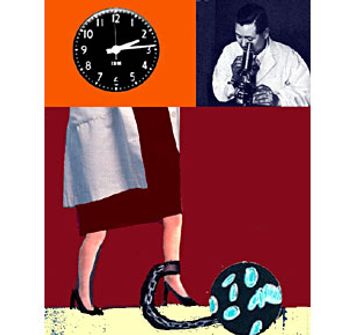
Poor Sally. With wan skin and greasy hair, she looks like a drowned mouse in bed-rumpled clothing. Sally repeatedly scratches her left underarm. Sally (not her real name) is a post-doctorate, one of 40,000 scientists in America caught between graduate school and professorship. They are science’s slaves, indentured to the promise of an academic job and whipped by the fear of not getting that job. So they toil like Sally: 80 hours a week for less than $30,000 a year, running her advising professor’s lab, doing his research and writing papers that redound to his greater glory as much as her own: It used to be that Ph.D. candidates and post-docs would do the work while the professor hogged the credit; these days they share the credit, though not the work.

Sally likes her advisor. He always acknowledges her efforts, and he is doing his best to get her a faculty position somewhere. But he also relies on her sweat. These fish-embryo trials have to be completed before he gives a presentation at a summer conference. He’s not the one getting up at 6 every morning, and he won’t really be writing the presentation. But Sally must “keep up the good work” until she herself becomes a professor.

According to Eleanor Babco of the Commission on Professionals in Science and Technology, no one tallies how many science faculty positions are vacated every year, but it is clearly not enough to hire each year’s group of science Ph.D.’s, because the pool of in-limbo post-docs keeps growing. Non-science Ph.D.’s don’t have such a formalized system. They can be lucky enough to get a professorship right away, they can jump to another line of work before returning to the academy or they can drive a taxi.

Science Ph.D.’s are not allowed to leave if they ever want a professorship. They are put into this bottleneck, this holding pattern called the post-doc where they must work as hard as they absolutely can in order to stand out and be chosen. Sally cannot afford to sleep in. She cannot afford to take time off. She cannot afford to give her real name to the press because complaining is looked down upon. All she can do is hope hope hope that some department somewhere will someday hire her on as an assistant professor of genetics at $42,000 a year.

Sally is single, lover-less and 32 years old.

Among a number of “Far Side” cartoons about eccentric scientists, she has posted a news clip over the lab table: “Law firm raises starting salaries to $150,000.” “Those kids are 24,” Sally says. “They did three years of grad school. Are they worth that much more than me?”

Academic science, especially in the biological fields, has grown healthily in the past decade. But the research and the lab work have become more complex, requiring more worker-hours to run a scientist’s lab. The overproduction of Ph.D.’s provides science professors a source of cheap, high-quality labor. Most post-docs find they have no alternative. What could they do? Drop out after eight years of education? Leave the august halls of Newton, Einstein, Pasteur and Gould?

“It’s unthinkable to most,” says Sally as she scribbles some numbers into a lab book. “Unthinkable for two reasons: One, you say to yourself: ‘Here I am, I have been growing fish embryos for eight years. I am very good at it. Who else in the world cares?’ You have dedicated your life to something so narrow, so inconsequential, that you have to see it through to consequence. You wait it out and publish with the hope that your work is someday cited by some researcher who discovers something else that a decade later leads to a new drug to cure cancer.”

Sally scratches her armpit and checks to see if I noticed. The second reason dropping out is so hard, she continues, “is the science-is-an-elite-club mentality. Maybe it’s that scientists were always geeks and so when we succeed, we say non-scientists are a second class of intellect. Whatever the reason, most career-track scientists think that people who go another direction are failures, pure and simple.”

Indeed. In mid-February, I attended a “Career Alternatives for Scientists” workshop at the annual conference of the American Association for the Advancement of Science (AAAS) in Washington, D.C. A room full of post-docs heard from a panel of former career-trackers who had jumped the rails. One is now a program officer for a philanthropic foundation. Another works at the U.S. Patent Office. One is a science writer. For all of them, life has improved: They are using their scientific training, working sane hours and making more money than most professors. Just as importantly, they joined the real working world — people at cocktail parties understood what they did.

Was this a battle cry of freedom? No. It was an I’m-OK-you’re-OK therapy session designed to exorcise the Goliath guilt they all felt over the very thought of leaving the traditional track: “Scientists stop talking to you — you cease to exist,” one panelist exclaimed, ” “How dare you squander your Ph.D.!’ And normal people say, ‘So why’d you do the Ph.D. in the first place?’”

“It’s OK, you guys!” another panelist reassured them. “You’ll always be scientists! You’ve done the training. And I promise, you’ll get over the feeling of failure — paychecks help!”

As I sat among these kvetching post-docs, I thought of natural selection, Darwin’s theory of evolution. To simplify (with apologies to Darwin): Nature produces more animals than the environment can support. These animals differ from one another over a wide range of attributes (in nature, we are talking about giraffes with long necks and giraffes with short necks). Nature then takes this overabundance and variability and wipes out those animals with the wrong attributes — it selects for the animals that fit the environment.

I wondered if academic scientists might view these tail-between-the-legs program officers and science writers as having died out — gone extinct from science because they weren’t the best scientists. The academy has room, the reasoning goes, for only the best scientists; the over-production of Ph.D.’s combined with the thinning out process of the post-doc bottleneck is very healthy — it’s Darwinian. It leads to the finest scientists.

I asked one of the panelists, a National Institutes of Health (NIH) official, if he had encountered this argument. “Definitely, there are many who think that,” he said, pointing vaguely to the rest of the AAAS conference. “But they’re wrong. There is a selection, but it’s not a selection for the best. It’s only weeding out the people who don’t want to destroy their lives for the sake of publishing papers on potassium ions in protein folding.”

Aha! A subtle and proper Darwinian distinction: Animals are not selected for the best attributes, they are selected for the fittest attributes, as defined by the environment. In a world with no trees the short-necked giraffes are better adapted. The slavish environment of post-doc-dom doesn’t reward ability as much as it does tenacity.

The program officer, Victoria, had a risumi packed with the right papers in the right publications. Her choice to go into a non-traditional career did not reflect poor promise in science. Rather, she wanted to work normal hours. She wanted a wage that reflected her abilities. There was more to life than studying oyster-hosted bacteria; as she put it, “Since I was planning to die sometime in the next 50 years, I thought I’d vary things a bit.

And if the overproduction of Ph.D.’s leads to intense competition and a hellish lifestyle, but does not end up selecting the best scientists — only the most fiercely competitive — then why run the system that way? The NIH official, who asked not to be named but whose position gives him a systemwide perspective, has an answer:

“Science has become addicted to cheap labor,” he explains. “The established scientists love having people who are going to bust their ass for them 14 hours a day, seven days a week. Post-docs are the life-blood of science: They are up on all the new technologies and techniques, the know the literature, they are good at writing papers and teaching grad students.” He strokes his beard and looks at the floor for a moment, and then adds, “Who wouldn’t want that? It’s a great system for the senior scientists to have all these slaves working for them. Of course, it can’t last. Abusing the middle folks, the post-docs, won’t help in the long run — because you’ll lose them.”

I tell him about my friend Bill, who is fleeing a neuroscience post-doc at Stanford for a Silicon Valley start-up at the end of the academic year. The job description involves computers and neural networks, so he’ll use his neuro background. He’s something of a new man since he made the choice. He talks about the next step with an excitement I have never seen in him. He says the people he’ll be working with are brilliant and the ideas necessary to their company are as complex and challenging as any of his academic work. He will triple his pay. The NIH official is not surprised. “Folks who should be moving up are finding other careers. And so they should. We all did.”

In today’s world, the academy has only indoctrination on its side — the notion that all Ph.D.’s seem to buy into that to be a scientist is to be a member of an elect priesthood. But listen now to that grand sucking sound; I.T. money, the biotech revolution. There’s science to be done and money to be made, regardless of what those who still wear medieval hoods say about selling out. The NIH official fears an over-correction — that too many will drop out of academic science. But if it happens, one could venture, it’s just nature’s way of finding the right balance.

Continue Reading Close

The right stuff for the Red Planet

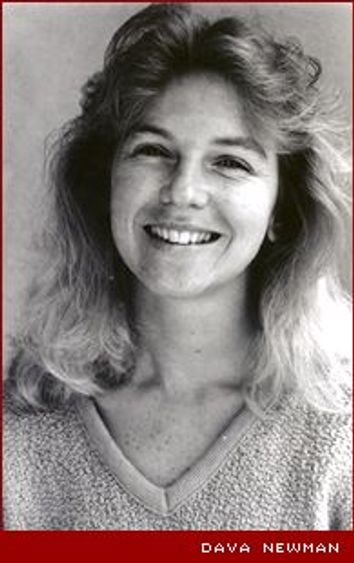
At 35, Dava Newman's an MIT engineer with a lab that would put James Bond's "Q" to shame and a passion for sending people to Mars.

  • more
    • All Share Services

The right stuff for the Red Planet

On a summer’s day 30 years ago in her parents’ Montana living room, a 5-year-old girl named Dava Newman sat before the television mesmerized by the image of a man bunny-hopping on the moon. Most people would agree: That mission was not just any old “giant leap for mankind,” but — all hyperbole aside — our greatest achievement in space. But what have we done since? Well, we went to the moon until we got bored, and now we send up the space shuttle, which is as practical as a repair elevator, and about as exciting.

Newman wants more. She’s grown up to be an MIT engineer, and she’s determined to get us where we really want to go: Mars! She’s got a good chance of succeeding: NASA funds a growing force of engineers like Newman who were children when the Eagle landed and who are now eager and capable enough to further our foray into the solar system.

Newman’s graduate students, her fellow professors and her NASA astronaut colleagues all praise her for a rare alignment of qualities: She is a bright and incisive thinker; she is a driven, “roll up your sleeves and solve it now” engineer; and she is a collaborator, a team player who disdains the usual competitive stance of top scientists.

Her partner in life, Guillermo Trotti, became one of the first architects to work with NASA on space-station design. NASA likes his designs so much that they have become reality in the International Space Station habitation module. Trotti and Newman met at an MIT summer session for people interested in human designs for space. For him, she embodies the much-touted American can-do attitude: chin up, team together, get it done.

Though space flight is a much bigger game, Newman is still the undersized, over-spirited basketball player she was as a teenager, the hard-playing, teammate-motivating point guard who leads her team from the great city of Helena, Mont., all the way to the Junior Olympics. If the future mission to Mars inspires a sequel to “The Right Stuff,” who should play Newman in the movie version? Trotti taps Jodie Foster: “She has the drive and the sensibility, the mental and physical beauty for the part.”

It’s not hard to imagine Foster playing the valedictorian wunderkind of Helena. Newman at first thought she wanted to be president (her father was a congressional campaign manager), but without female role models for either politics or athletics, she entered Notre Dame with dreams of becoming the world’s best sports lawyer. She wanted to represent Kareem Abdul-Jabbar. Her older brother, himself a lawyer, convinced her that engineering would give her a technical background that law schools would like.

But before she graduated, two things changed her course: She fell in love with flight, especially human space flight; and she despised Ronald Reagan’s Strategic Defense Initiative — Star Wars. Space was no place for war. So, law be damned, aerospace engineering it was — human aerospace engineering, because, as she once said to an audience of young students, that’s the key to ensuring “cooperative, global human space exploration rather than … militarization of space, to which I’m opposed” — what a great moment that would be in a Foster film.

Good engineers are incessant tinkerers, and now that graduate school and professorship have set her at the forefront of aerospace bioengineering, Newman runs a workshop full of toys. It’s like a messier version of Q’s lab in the James Bond films, without the weapons, of course. There are gadgets everywhere: computers, treadmills, whirling platforms, ceiling tracks, moving robots — all generating the engineering know-how to send people to Mars.

The first set of problems has to do with getting astronauts there and back without them turning to jelly. These are problems that scientists, including Newman, began studying on the Mir space station cosmonauts. After a few months in zero gravity, the cosmonauts’ bones and muscles began to deteriorate, especially in the legs, pelvis and back. The human body evolved in gravity. We’re meant to be bipeds that pound the Earth as we move about every day, and we have come to rely on that pounding. Our skeleton needs the repeated stress of our walking weight to break down old, brittle bone, release the trapped calcium and use it to grow sturdy new bone. Without daily pounding, bone doesn’t regenerate. It just gets brittle. Likewise, our muscles — even if we’re not athletic in the modern sense — require the daily motions of moving about and carrying our weight to stay healthy.

Newman’s rocket science colleagues claim they can send a manned spacecraft to Mars and back in two years (a solid achievement at over 6,000 mph). Given what we know about debilitation in zero gravity, here’s what would happen to the person on the ship: A 30-year-old astronaut would come back with the osteoporotic bones of an 80-year-old woman. Pull him out on the landing pad to congratulate him and he will collapse. It will take him months to build up enough muscle to walk again, and he could break his bones a number of times in the process. What’s needed are countermeasures, as the engineers call them.

One of Newman’s countermeasures is a rotating bed, a long, body-wide platform that whirls about quickly. You lie down on it with your head toward the center, and as it spins your feet press against a little endplate. To try it on Earth is sort of a sickening ride. But if you tried it in space (with your eyes closed), you would feel more or less as though you were standing still on Earth: The centrifugal force of the whirling mimics the force of gravity. If the Mars astronaut slept on this every “night,” his body would spend a third of the voyage in artificial gravity, though he would have to get used to the sensation of sleeping standing up.

Another Newman lab project is a specialized treadmill with bungee cords that pull the runner down to the track with a force close to that of gravity. Mir cosmonauts had an early version of this, and they were required to jog on it for four hours a day. Newman and her colleagues work on combinations of treadmill design and dietary supplements to see if they can shorten the amount of exercise time required and still curtail the bone and muscle loss. Newman’s greatest laboratory ever goes into operation next year: the International Space Station, which will be home to a continuous supply of bone-losing, muscle-atrophying astronauts to experiment on.

These are just the problems of getting to Mars and back with the healthy body you started with. What about once you’re there? The lander’s down, the dust has settled and you are required to open the hatch and step outside. This is the moment you’ve come for. What in the worlds do you wear?

“I’d like to put on my sweater and a skirt if I’ve got work to do on Mars,” Newman says. “The moon suit was over 100 pounds, and bunny hopping was fine for what they did. But we have to stop thinking big, white and clunky.” She has started designing her own suit, which will look nothing like anything we’ve seen before.

Newman’s tinker toy for this project is a robot she has on loan from NASA. It’s a 6-foot-2-inch black-and-silver humanoid that Newman calls “Tallchief” because she considers it as elegant as Maria Tallchief, the Native American prima ballerina who founded the New York City Ballet with her husband George Ballanchine. Tallchief (the robot) is wired to a computer and a sensor suit. The way to move Tallchief is to get in the sensor suit and move yourself around. Whatever you do, Tallchief does.

The robot is a human engineer’s dream because you can poke and prod it invasively. To design a suit for running around the surface of Mars — Newman insists: no bunny hopping — she needs to know, for instance, how much torque a human applies at the knee when he pulls his back leg forward while walking in Martian gravity (Martian gravity is three-eighths of Earth’s gravity: If you weigh 150 pounds here, you will feel like 56 pounds there). As Tallchief walks on the treadmill next to the graduate student who controls it, Newman can jab a torque measuring device into the robot’s knee joint. You can’t jab a graduate student.

For Newman, the ultimate Martian space suit should be a “smart second skin”: light and thin like a wetsuit, smart like a computer and wired like the human nervous system so that it knows everything about the precious body inside it. Of course, it must also resist Mars’ frigid temperatures, provide oxygen so astronauts can breathe and apply terrestrial atmospheric pressure so their blood doesn’t, literally, boil.

Newman also wants her smart-skin space suit to help astronauts move, giving them superhuman flexibility as they wander around the hills and valleys of Mars. And she envisions the opposite: The suit could be programmed to resist astronaut movements in zero gravity settings, so that wearing the suit is an exercise in itself — a proper countermeasure to bone and muscle loss. With nanotechnology’s advances making smart devices small, Newman’s ideas may well be buildable by the time NASA is ready to slate a manned mission to Mars. Though the recent losses of remote-controlled craft around Mars have paused all planning for the time being, Newman points out that planetary alignments give prime launch windows in 2011, 2014 and 2018.

Engineers are one of the pools NASA fishes for astronauts. Given her age, her smarts and her life-long athleticism, it’s not hard to imagine Dava Newman leaping at the chance to man the mission to Mars. Asked about it, she talks of “service to my country so it doesn’t matter how I’m involved” and “I would only go if it were the best thing for the mission,” and ends with, “If I could go with my sweetheart, sure.” Sweetheart Guillermo Trotti echoes her; it would be much better to go together. Years of isolation are tough on the strongest of souls. But Trotti doesn’t practice circumlocution: The truth is either of them would go in a second.

Newman is not funded by the military, though there is plenty of money available from the Pentagon for her type of research. But she has become quieter over the years on this point of policy as she has risen to the tenuous rank of associate professor at MIT, an institution that, for all its greatness, has a knack for politicizing its tenure track and a reputation for not promoting women (the record is improving). The purest of scientists, which MITers certainly consider themselves, are always supposed to say that policy is not their business: Who cares where the money comes from? Just do the work. So it is unclear whether Newman’s new silence on the military is an actual fading of feeling — or realpolitik in a department that would consider a commitment to the peaceful exploration of space too political for a pure scientist.

Or perhaps it is enough that her efforts will allow more humans to spend more time in space. After all, the more bodies living aloft in cooperative enterprises like the International Space Station, the more out-of-place the new Star Wars initiative will seem (President Clinton signed off on Star Wars last year, despite the plan’s international status as technologia non grata).

Newman also works hard to bring young people into her field. Her Web page on the National Academy of Engineering site is a solicitation to young women to become engineers. She is famous as a teacher at MIT for the final project she runs in her course “Introduction to Aerospace Engineering and Design.” As they learn about pitch, trim, stability, thrust and yaw, the undergraduates must design and build motorized remote-control blimps. On a sunny day at the end of the semester, they race the blimps against each other along an aerial obstacle course around the MIT field house. According to Dr. Lawrence Young, a senior professor in her department, Newman’s you-can-do-it-too approach brings out the challenge, the art and the fun of engineering that is too often lost in textbook teaching.

She is where she wants to be, says Newman — teaching people to fly and engineering the systems needed to get our fidgety species to Mars, while drawing on her earliest inspiration: “The awe and mystery and expectation that have been with me since I was 5,” when Armstrong and Aldrin, wearing their big, white and clunky suits, bounced around the moon on her television set.

Continue Reading Close

I set up President Clinton

Confessions of an advance man.

  • more
    • All Share Services

Seen from the Ferry Terminal, San Francisco’s Bay Bridge is gorgeous on a winter’s day: The water reflects a luminescent sky, the fishing boats glide by and the bridge connotes strength — a feat of thinking and doing. Last Thursday morning, nostalgic for my own days of creating political spectacles for Bill Clinton, I watched Sen. Bill Bradley’s young advance team set up the press riser and the podium, placing each with precision.

They set up the shot perfectly for Bradley, who was flying in and out specifically for this photo-op; there was no fund-raiser, and no crucial meeting with party big shots. On TV screens around the state, voters were to see a majestic image of Bill Bradley, one that said: I’m honest as a fishing boat, broad and reliable as a bridge, and look, I’m in California!

If only it hadn’t rained. The Bradley rally was forced inside a restaurant where cameramen took messy pictures of jumbled bodies. The result? Vice President Al Gore’s Los Angeles town hall meeting that day dominated the TV news and next day’s papers. Visually quite dull, especially compared to the would-have-been Bradley-Bridge shot, Gore’s event was still a cleaner image. I felt sorry for the Bradley advance team. They exist to make candidates look good in the news, and Gore looked better that day only because of the weather.

I was an advance man for President Clinton in the 1996 general election. Through the summer and fall of that year I helped set up political events all over the country for the sake of making Clinton look better than Bob Dole. Local TV news is watched by 86 percent of the American public — that’s 200 million people. And pictures stay with us in a way that printed ideas or anecdotes cannot. Can you picture Teddy Roosevelt, in hat and spectacles, astride a horse in a sepia photograph? Good. Do you remember slope-shouldered Michael Dukakis riding in a tank? Good. Now, what else do you remember about them?

While speech writers weave words into a sound bite, advance teams direct events for just the right “image bite”: that defining picture so compelling that TV news producers have to run it. They choose sites, design backdrops, generate crowds and — most importantly — place photographers in exactly the right spot. When it’s done right, an advance team will turn on the television that evening and see their candidate’s image framed exactly as planned. Like the Bradley-Bay Bridge shot, it should be a compelling image, emotionally rich, and representing some notion of what the candidate stands for.

The high-bar test of political advance is this: imagine that all voters are sitting in a bar watching a television set with the sound off. Would five seconds of silent footage deliver the message of the event?

Thanks for the beer, Fred. Oh look, there’s that New York Knick — Bradley. You know, the guy running for president. Yeah, he must be down at the Ferry Terminal. He seems to be doing pretty well.

Three and a half years ago, both Clinton and Dole had major image problems to deal with. I leave aside issues and substance, because I am not personally convinced those things decided that election — and they are not at all within an advance man’s purview.

Dole’s image problem was his age. When he fell off that stage, during a campaign stop in California, it was an advance team’s Waterloo, an image bite that said, “Dole’s old.”

Here’s how it happened: Dole was leaning over to shake hands after a speech. There was a foot-high colonnade running along the edge of the stage. It looked sturdy, so he leaned his shin against it for support. But it tipped over and he fell because the colonnade was not nailed down — on purpose, it turns out, because a Secret Service agent worried that a crazed audience member could use it to hoist themselves up on stage. But the advance person responsible should have anticipated Dole might lean against the colonnade when shaking hands, and he should have warned him not to.

I was in Dyersberg, Tenn., the day Dole fell, watching it on television with eight other Clinton advance people. We felt sorry for the person who let it happen. “He’ll be on the next plane home,” one person said.

I had one near disaster myself, in Minneapolis. I was the “crowd guy,” responsible for making sure everyone in town knew Clinton was coming and using volunteer groups to drum up supporters. I had turned out 10,000 people to rallies in Cleveland, Denver and Providence, R.I., so I was already a bit cocky.

The chief advance man on the trip was Nick Friendly, a superb lead-advance and all-around good guy who had also been my lead in Cleveland. The rally had to be indoors because of the cold weather, and I wanted the Target Center, the basketball arena where the Timberwolves play. We looked at it and agreed it would take 12,000 to 15,000 people to make it look full. “No problem,” I said. Nick called the White House: “Weed wants the Target Center. He says he can do it … No, it’s OK, Weed will fill it. No problem.”

A few hours later, after getting some posters and flyers printed, I caught up with the rest of the team to have dinner with Ted Mondale, the son of the 1984 Democratic presidential nominee, who would later become a losing primary candidate for governor of Minnesota in 1998 (he lost to Hubert Humphrey III, who later lost the election to Jesse Ventura).

When I walked in, the room was silent. Everybody stared at their plates. I was introduced to Mondale and sat down next to Nick, who said: “Ted says you’ll never do it. Monday evening, we’re up against a Vikings game and rush hour. He says 4,000 tops. Do you want to change the venue?”

Had hubris not gotten the better of me, I might have said yes. Here a political scion of the state was giving me fair warning — I was courting disaster, 4,000 people in that arena would have been laughable. But I had seen how many people the president could turn out when properly publicized. And I immediately decided that I did not like this stranger. He had the same handsome lack of charisma of his father, and seemed even more dour. So I insisted I could fill the Target Center. And I spent a worried, sleepless week rallying unions and universities to get out the word and generate a buzz about the president coming to town.

Crowd estimates were as high as 14,000. I handed every member of the crowd a large poster that said “Clinton-Gore: You Betcha!” around a silhouette of Minnesota (Friendly’s idea), and a group of women did something wonderful. They ripped out the Minnesota on their posters and put their faces in the hole: They wore my posters. Above their heads it said, “Clinton-Gore,” and under their chins it said, “You Betcha!” The idea caught on, and soon lots of people in the crowd wore the posters on their faces. The image bite on television and in the papers was: Minnesotans love Clinton — and, yes, look how many turned out to greet him.

Nick Friendly congratulated me heartily, and I believe that his good words about me put me on the roster of advance people qualified to do international advance during Clinton’s second term. I saw Ted Mondale at the rally, but he didn’t say anything to me.

One-time successes and failures don’t necessarily add up to too much. What’s important is a barrage of fine-tuned image bites consistent enough to sway the way people think about a candidate. The populist crowd rallies we staged went a long way to reinforcing the sense that Clinton had a broad base of popularity.

Dole’s fall didn’t hurt him as much as the consistently boring advancing of his rallies. Most pictures of Dole events had him on stage with about a dozen old white people. Any cameraman will tell you that faces make memorable television, and Dole’s pictures left the impression that he had only one constituency.

His advance team was uncreative about backdrops, and even less creative with crowd shots. They handed out little yellow circles that said “15%,” the size of his proposed tax cut. But while 15 percent is a good statistic for print reporters, on television it is a dead symbol. With no context or meaning, it’s purely a distraction.

Hey Fred, there’s Dole. Why is he in an empty warehouse? What does 15 percent mean, anyway?

Advance teams have responsibilities beyond the image bite: they are the liaison to local politicians, unions and civic groups, whom they must appease when they are in town for the five or so days before the candidate shows up. They must run the logistics of rallies, such as security, refreshments, entertainment and toilets. These last items are incredibly important if your candidate is chronically late — like Clinton.

Once, in Maine, I got word that he was two hours late to an evening rally that had drawn a large number of families with children. I went to my rental car, got out a box of what we call “chum” — presidential M&Ms, little postcards of Socks the cat, Clinton key chains, etc. — and started handing them out to 5-year-olds. That kept most kids from complaining and most families from leaving.

Advance teams must also deal responsibly with protesters. Our tactic was a classic counter-protester tool, which we called the “goon squad.” At that same rally in Maine, a group of 20 Dole supporters with signs appeared in the bleachers behind the press riser. They started chanting, yelling and exhausting themselves well before the press arrived from the airport with the president. When I got word that he was close to arriving, I assembled the goons, a group of 40 locals — mostly beefy union men. Under strict instructions not to engage the protesters directly, the goon squad surrounded them with larger signs and louder voices. The president and the press showed up, and the press never saw the protest going on right behind them.

I was often asked what the Clintons were like in these situations. I guided them through events during that campaign and also subsequent trips to Africa, China, the Philippines, Russia and Argentina. The answer is simple: They are professionals. There is no time in these moments — just before they step into the public eye as president and first lady of the United States — for small talk. They listen to you, they ask logistical questions if they have them, they thank you; and then, now that your job is done, they go onstage to do theirs.

Helping out the administration’s traveling staff, more often than not, means appeasing their whims and being the first person on hand to blame when they’re mad. Their schedule is grueling. They work as hard as the president, but they don’t get the comfy seats on the plane and they are always tired. I have been yelled at for not putting oranges in the traveling staff office — even though I put out bananas, pears and apples. I once saw a colleague take a verbal beating from a young female staffer because the staff lavatory was 100 yards away from the staff room, though he was in no way responsible for the building’s architecture.

For all these chores, during a campaign, the image bite is the most important advance responsibility. You can piss off a member of the traveling staff and survive. You cannot blow an image bite for the candidate. Image bites win elections.

With varying degrees of experience in their advance teams, Bradley, Bush, Gore and McCain now strive to present themselves through TV and print images to the vast number of voters who will cast ballots on March 7 — Titanic Tuesday. Now that the New Hampshire primary has put a real race in the nation’s hands, it’s up to each advance team to set up a candidate’s money shots — or watch him take a dive.

Continue Reading Close

Show me the money shot

Which candidates give good face -- and which ones don't.

  • more
    • All Share Services

Anybody can play armchair critic of the candidates’ advance teams. Just remember: All press images of candidates are as visually scripted as a campaign commercial. The location of an event, the angle of a shot and everything that is in that shot — buildings, bridges, banners and people — have all been predetermined. Or should have been.

Here’s a handicapping of the four major candidates so far:

George W. Bush

Advance Team: Bush has the old party pros working for him.

Ideal Images: Given his loss in New Hampshire, Bush needs to convince us that people want him to be president. He has to steal John McCain’s populist look. Crowd events, crowd events, crowd events: overflow situations, packed halls and supporters from all walks of life carrying hand-painted, personalized signs. Also, if Bush has the interpersonal charisma that some reports claim, then advance teams should set up close encounters with supporters and let the press get right in their faces.

Bad Images: Le Petit Prince. Bush’s support from the GOP establishment may be crucial, but it presents an image-bite problem. If the Bush advance team keeps flanking him in royal-blue splendor — as they did during his talking-head reaction interviews after losing to McCain in New Hampshire — the message will read: The Anointed One. This weekend, he was on the steps of the Sumter Courthouse in South Carolina with Republican bosses and a huge American flag behind him. Bad move.

John McCain

Advance Team: Clearly a green group.

Ideal Images: But green is OK for McCain. An old colleague, Josh King, who is one of the best advance men I know, recently said McCain was doing anti-advance: plain stages, no frills, just him and a mike. The result is an image bite of his signature “Straight Talk Express,” and it will work. Last week in South Carolina, they placed the stage so that the sun caught the back of the candidate’s head and cast strange shadows on his face. The large crowd had to squint in the sun — they all looked sick to their stomachs. And yet the event had a populist spontaneity to it. The other image bite he needs to continue getting is his on-the-ground support from regular folks. The same day Bush was on the steps of the courthouse, McCain was on the steps of the mayor’s house in Beaufort. The press was on the steps with him and captured the huge audience over his shoulder. Perfect image bite, doubled in power by running next to Bush’s establishment shot.

Bad Images: If McCain keeps winning, he’ll have to lose the scrappy routine. For now, he benefits from the perception that he is on a journey beyond his control: The people have picked him up and are marching him forth — so no presidentially dressed stages or conservative blue backdrops. Better yet, no backdrop at all.

Bill Bradley

Advance Team: Green.

Ideal Images: Bradley and Gore are not much different on substance. Bradley has to get stylish in his advance work. We should see him in bold locations — the Bay Bridge, again, was a great idea. Bradley can say he’s against “politics as usual” but it won’t gel unless his advance team can help us visualize it. They need to break new ground in advance work and create fresher, bolder images. Starting suggestions: basketballs, giant photos of civil rights leaders, hospital wards.

Bad Images: Gore has the flag-and-podium thing down. Bradley will not captivate TV producers with more of the same.

Al Gore

Advance Team: An eight-year, two-campaign institutional memory for advance.

Ideal Images: The motto for his advance is: “Steady on.” They should do events that are elegant and unsurprising. Unlike Bush, he should actually be courting images that make him seem like the anointed one. Gore with a blue backdrop is enough for now. Anything more would look like he’s trying too hard.

Bad Images: Other than trying too hard, he must keep away from images that connote his liabilities. No rallies at Buddhist temples, or with union workers at a steel factory.

Continue Reading Close

Page 1 of 2 in William Speed Weed