Spring Sale: Get 1 Year, Save 58%

Think chicken is boring? These inspired takes on Italian-American classics will change your mind

One of the simplest, purest pleasures I’ve experienced during my 32 years of life is going out for Italian-American food with my family. There is such a deep, rich nostalgia and comfort that permeates those spaces for me. 

I almost always opt for my favorite, which is (you guessed it) chicken parmesan. My mother will undoubtedly get some sort of shrimp dish with lemon, while my brother might get penne with vodka sauce. Then there’s my father, who — without fail — will order “chicken oreganata.”

You’ll typically see “clams oreganata” on the menu as an appetizer featuring lightly breaded, chopped clams spiced with oregano and garlic. My father apparently decided to merge an Italian-American chicken with a clam appetizer and voila — a new Italian-American chicken classic was born. Wow, is it good. 

My Italian-American heritage is indelibly stamped on who I am as a cook today. When I was in culinary school, students would moan, “Ugh, it’s Italian week,” while waiting with baited breath for other types of cuisine to come up on the schedule. After years of feeling embarrassed and shunning my Italian heritage, it was the time that I decided to “mark my territory” and fully commit to my natural predilection for Italian-American flavor profiles. From that moment on, I worked with vigor to fully embrace my identity, becoming a “gnocchi king,” experimenting with fresh pasta with aplomb and mastering bolognese. My bowl was emptied, eaten voraciously by my classmates, while the other bowls sat cooling and untouched. 

The flavors I love extend to chicken. Italian-American chicken dishes are a staple. Don’t get me wrong, I adore skin-on, boneless breast, but a skinless, boneless, thinly-sliced chicken is ideal for these dishes. Often called a cutlet, scallopini, thin-sliced or pounded chicken, it’s a fundamental protein throughout the culinary arts, though it really shines with Italian-American flavors. 

And while many decry chicken as “boring,” the amount of preparation and customizations are infinite. It’s easy to purchase and cook, while also meeting the feverish need for a weeknight dinner that can be made and enjoyed within an hour. 

The classics are chicken parm (be still my heart!), marsala and piccata. But I also have an affinity for oreganata, saltimbocca, scampi, sorrentino and valdostana. When it comes to sides, I’m not a proponent of flimsy and flaccid steamed vegetables or mashed potatoes, so I almost always opt for pasta. I come by this honestly. My father would bathe in spaghetti aglio olio if it weren’t frowned upon.


Want more great food writing and recipes? Subscribe to Salon Food’s newsletter.


No matter the sauce — butter and cheese, garlic and oil, marinara or even a bit of the chicken’s sauce —  pasta and a classic Italian-American chicken dish is a beautiful pairing. Lastly, and this should go without saying, grab an Italian loaf or a crusty, dense baguette for the table. It’s a necessity for sopping up every last bit of luscious sauce. 

Below, I’ve included my recipes for the classics, some details about their backgrounds, as well as a bonus recipe for my dad’s beloved chicken oreganata. Mangia!

***

All of the classics (sans oreganata) start with this same sautéed chicken. Prepare this fundamental chicken base, then pivot from there to any of the delicious sauce options.

Recipe: Base Chicken 

  • 1.5 pounds chicken breasts, thinly sliced or pounded
  • Kosher salt to taste 
  • Freshly ground black pepper to taste 
  • Enough AP flour to thoroughly coat the chicken (about 2 cups)
  • 1 1/2 teaspoons of onion powder
  • 1 1/2 teaspoons of garlic powder
  • 2 to 3 tablespoons extra-virgin olive oil
  • 2 to 3 tablespoons unsalted butter

1. Using salt and pepper, season the chicken breasts well on both sides. Then, in a large shallow bowl or rimmed plate, season the flour with salt, pepper, onion powder and garlic powder. 

2. In a heavy bottomed saucepan or skillet, melt the butter and olive oil over medium-high heat. 

3.. Dredge the chicken breasts in the seasoned flour — coating both sides — before adding to the pan. Cook the chicken until the coating is a deep, golden brown, about 4 to 5 minutes on each side. 

5. Move the chicken to a plate, drain the pan of the cooking fat and return to the stove. 

***

Chicken Marsala, on the other hand, originates from Marsala, Sicily. Eater states that it may have been invented in the 1800s. Of course, its primary ingredient is marsala wine, but it’s always paired with mushrooms and thyme. VinePair notes that marsala wine was introduced to Italy in the late 1700s by John Woodhouse, who was a wine merchant from England. Some marsala also contains a splash of cream. It’s a quick, simple dish — a perfect option for the cherished weeknight meal. The New York Times notes that the dish as we know it today was first published in a 1950s Italian cookbook, and that the wine itself “has pronounced sweetness that’s distinguished by traces of dried fruit, caramel and nuts and some less-expected savory notes.” Now how fantastic does that sound?


Related: Italian-Americans and the language of food: How calamari became galamar and ricotta became rigott


An important note: I implore you not to ever buy “cooking wine,” which is a salt-bomb abomination of a product. Please use whatever bottles you have on hand, or purchase a bottle of marsala; it shouldn’t be too expensive. 

Recipe: Pollo al Marsala

  • 2 to 3 tablespoons unsalted butter
  • 1 pound of mushrooms, sliced
  • 1 cup marsala wine
  • 2 to 3 sprigs fresh thyme, leaves removed
  • A handful of parsley, chopped
  • 3/4 cup stock (beef or chicken)

1. Melt the butter in the pan in which you cooked the chicken. Add mushrooms and cook over medium heat  — without seasoning  — for 7 to 10 minutes until browned and all of their liquid has been cooked off.

2. Add marsala and cook down until reduced by half, stirring occasionally. 

3. Add stock and, again, cook down until reduced by half, before adding the thyme and parsley. Cook for another 3 to 5 minutes until the sauce is rich, glossy and luminous. Dot with additional butter, if desired, or a splash of cream.

4. Add chicken back to sauce and use tongs to make sure cooked chicken is enrobed in sauce.

***

Technically, “picatta’ merely means pounded flat, according to SimplyRecipes. Dotted with capers and bathed in a rich, piquant sauce redolent of lemon and butter, picatta is a staple — and for good reason. The technique is simple, you normally have the ingredients on hand and it comes together in no time. Its flavor is bright, lemon-forward and slightly briny from the capers (or very briny, depending on how heavy-handed your caper usage is).

 Recipe: Chicken Piccata 

  • 2 to 3 tablespoons unsalted butter
  • 3 to 4 lemons, juiced
  • 3/4 cup white wine
  • 3/4 cup chicken stock
  • 1/3 cup capers
  • 1/3 cup artichoke hearts
  • Handful of chopped flat-leaf parsley

1. Melt the butter in the pan in which you cooked the chicken. Add white white, deglaze and cook until reduced by half, stirring occasionally. 

2. Add stock, lemon juice, artichokes and capers. Reduce by half.

3. Sprinkle parsley over the sauce, add chicken back to pan and turn until chicken is warmed through and the sauce is glossy and thickened.

***

Oreganata is — you guessed it — oregano-forward, while also utilizing lots of garlic, breadcrumbs, parsley, lemon, olive oil, lemon zest and some chicken stock. As mentioned earlier, it’s almost always a baked clam dish, but the flavor is SO good (and the sauce so silky and rich) that limiting its usage to merely one shellfish would be a shame.

Recipe: My Dad’s Pollo al Oreganata

  • 4 to 5 tablespoons unsalted butter, divided
  • Extra-virgin olive oil
  • 4 garlic cloves, minced
  • 3/4 cup bread crumbs
  • 1/2 cup grated parmesan cheese
  • 3 lemons, zested and juiced, divided
  • 2 to 3 tablespoons freshly chopped oregano
  • Handful freshly chopped parsley
  • 1 cup chicken stock
  • 1/2 cup white wine
  • 2 shallots, minced

1. As with base chicken recipe, prepare seasoned flour and dredge chicken in it before adding to a hot, oven-safe skillet with oil and 2 tablespoons melted butter.

2. As it cooks, add bread crumbs, garlic parm, half of the lemon zest, thyme, oregano and parsley to a bowl and add evoo just to moisten.

3. Turn heat off, add bread crumb topping to each chicken cutlet, transfer to oven, cook 7-10 minutes.

4. Remove, carefully transfer chicken to plate and dispose of cooking fat.

5. Add fresh butter to pan. Melt, stir in shallots and cook until translucent.

6. Add white wine and reduce by half. Add stock, lemon juice, remaining lemon zest and oregano. Reduce by half again. Dot with butter, if desired.

7. Drizzle sauce over chicken, being careful not to pour too aggressively or disturb bread crumb coating.


More by this author: 


Critics slam Missouri’s GOP governor for pardoning St. Louis couple who waved gun at BLM protesters

Missouri Gov. Mike Parson, a Republican, is facing criticism after he pardoned the St. Louis couple who waved their guns at a crowd of Black Lives Matter demonstrators but refused to grant clemency to two Black men who have served decades for crimes prosecutors say they didn’t commit.

On Tuesday, Parson pardoned attorneys Mark and Patricia McCloskey, who in June pleaded guilty to misdemeanor assault and harassment, respectively, after brandishing an AR-15-style rifle and a handgun at a group of Black Lives Matter protesters en route to protest at the home of then-St. Louis Mayor Lyda Krewson. Prosecutors said the couple threatened a peaceful group that was not armed and did not realize they had wandered into a “private enclave” in June of last year, weeks after the police killing of George Floyd. The couple was forced to pay fines and hand over their weapons in exchange for prosecutors dropping felony charges.

Parson at the time vowed to pardon the couple, who spoke at the 2020 Republican National Convention, even as an unrepentant Mark McCloskey insisted he did nothing wrong despite his plea and vowed that “any time the mob comes and threatens me, I’ll do the same thing again to protect my family.” McCloskey has since launched a Senate bid premised on his perceived victimization by the justice system.

Parson has backed the couple, telling Fox News’ Sean Hannity last year that they had every right to protect themselves and were “being attacked by a political process.”

Joel Schwartz, an attorney for the couple, told BuzzFeed News they were “thrilled” and felt vindicated by the pardon.”They are looking forward to putting this episode of this life behind them and focusing on Mark’s campaign for the US Senate,” he said. “Mark has publicly stated that if faced with the same situation, he would do exactly the same thing he did.”

One of the peaceful protesters in the group was now-Rep. Cori Bush, D-Mo., who called the pardon “absolutely unbelievable.”

“They stood there, they pointed their guns — totally reckless — to a group of non-violent protesters walking down the street. That had no clue that they lived there, didn’t care that they lived there, didn’t know them, didn’t want to know them,” Bush told CNN.

Mark McCloskey at the Republican Convention called Bush the “Marxist, liberal activist leading the mob.”

Bush on Wednesday said that McCloskey was an “absolute liar.”

“He has spat on my name,” she said. “And, because of that, his day will come. You will not be successful in all that you’re trying to do when you are hurting the very people who are trying to save lives… I will not stand by and allow him or our governor to hurt the very people who are doing the work that they should be doing.”

Bush added that there are others more deserving of a pardon who are still stuck in prison.

“There are pardons that we have been asking for, pardons that actually should happen in Missouri, and that was not one” of them, Bush told the network, calling for Parson to be the governor of “all the people in Missouri, not just those that follow your type of politics that actually hurt Black people, that actually hurt Brown people.”

The McCloskeys were among 12 pardons handed down by Parson on Tuesday but the governor refused to pardon 62-year-old Kevin Strickland, a Black Kansas City man who has served 43 years in prison after he was convicted by an all-white jury of a triple-homicide that prosecutors say he didn’t commit. The key witness in the case recanted her testimony in 2009 and two other men convicted in the shooting named someone else as their accomplice. Earlier this year, state and federal prosecutors reviewed the evidence and concluded that Strickland was innocent.

“It is beyond disgusting that Mark and Patricia McCloskey admitted they broke the law and within weeks were rewarded with pardons, yet men like Kevin Strickland, who has spent more than 40 years in prison for crimes even prosecutors now say he didn’t commit, remain behind bars with no hope of clemency,” Missouri House Minority Leader Crystal Quade said in a statement. “The contrast between the governor’s treatment of these cases should offend every Missourian’s sense of justice. It also proves the governor doesn’t have one.”

Activists have also called for Parson to pardon Lamar Johnson, a Black St. Louis man who was convicted of murder and sentenced to life without parole after an investigation revealed that police made up evidence in the case and prosecutors made secret payments to pressure an eyewitness into providing false testimony. The St. Louis Circuit Attorney’s Office in 2019 called for Johnson to get a new trial after he spent more than two decades in prison. Two other people have admitted to the murder but Johnson remains behind bars.

“Missouri’s racist criminal justice system put two innocent black men (Kevin Strickland & Lamar Johnson) in prison,” said the Ethical Society of Police, a group of Black Missouri police officers, “but the Gov chose to ignore them.”

“Do the right thing for once,” the Missouri Democratic Party told Parson on Twitter. “Free Kevin Strickland and Lamar Johnson. It honestly couldn’t be more straightforward.”

What Tucker Carlson wants Fox News viewers to learn from Hungary’s Viktor Orbán

As America grapples with yet another surge of COVID-19 and the ongoing erosion of its democracy at the hands of the Republican Party, Fox News celebrity Tucker Carlson is off getting tips from Europe’s most successful anti-democratic leader, Hungary’s Prime Minister Viktor Orbán:

Carlson is in Hungary for MCC Feszt, a conference convened by the Mathias Corvinus Collegium, a government-funded association dedicated to creating a right-wing future. He is set to deliver a speech on Saturday with the fatuous title “The World According to Tucker Carlson,” which, to paraphrase the late, great Molly Ivins, would no doubt sound better in the original Hungarian.

Carlson is one of a handful of right-wing elites who are in thrall to what Orbán calls his philosophy of “illiberal democracy,” which includes government support for churches, (he calls Hungary a Christian democracy) a program to coerce women to have more “true Hungarian” children so as to reduce any need for immigrant labor and a ban on legal rights for transgender people. He even built a wall on his country’s southern border to keep immigrants seeking asylum from entering the country in the name of preserving Hungary’s (white) national character.

In other words, Orbán is a great general in the culture wars which makes him a hero to quite a few right-wing intellectuals. For instance, prominent blogger Rod Dreher is one of Orbán’s most passionate defenders and has written numerous posts exalting his program. He was even planning to take up a fellowship in Hungary before COVID turned the world upside down. Vox’s Zack Beauchamp described Dreher’s admiration for Orbán in this piece about the Hungarian prime minister’s American fan club:

A sense of persecution at the hands of secular globalist elites is at the center of the mindset held by Dreher and much of the modern intellectual right. The contemporary fusion of religious and nationalist ideas has created a unified field theory of global cultural politics, defined by a sense that cosmopolitan liberal forces are threatening the very survival of traditional Christian communities.

All of this suggests that the main accomplishment of Viktor Orbán is his open pursuit of the right’s list of cultural grievances. But there is a method to his madness and it presents a far greater danger to America and other liberal democracies.

Orbán serves as a model for the modern autocracy that is now being tried in the U.S. He has successfully made it almost impossible for his party to lose elections with tactics such as rewriting campaign finance laws to benefit his Fidesz party, packing the courts and election bureaucracy with his supporters, extreme gerrymandering and completely taking over the media. The effect is that his “Christian democracy” is no longer a democracy at all since the opposition has been rendered electorally impotent. Sound familiar?

While it appears that Orbán is inspiring the American right, it is actually much more complicated than that. As Sarah Posner reported in The New Republic in 2019, Orbán’s program was heavily influenced by Republican strategists and lobbyists from the very beginning. In 2008, Orban hired the legendary right-wing strategist and provocateur Arthur J. Finkelstein, a master of culture war politics and character assassination, to help him win the 2010 election. Posner wrote:

In his work for Orbán, Finkelstein took his signature strategy of political polarization and masterminded a campaign that cast Hungary as a victim suffering at the hands of the United States, the United Nations, and other purveyors of Western liberal democracy. Finkelstein was, according to Politico, behind the anti-immigration billboards that have proliferated in Hungary over the past decade. Thanks at least in part to Finkelstein’s strategy, Orbán won his reelection bid in 2010.

According to Posner, Orbán also hired some high-powered GOP lobbyists to help him craft his appeal to U.S government officials. It’s pretty clear that the Hungarian Prime Minister has been as influenced by the American right as the American right has been influenced by him.

But while Tucker Carlson and others have been lauding Orbán for his anti-wokeness, they apparently have not been paying close attention to the actual results of his program. Dalibor Rohac pointed out in The Bulwark that the Putinesque economic polices of “renationalization” have produced an economy that has real incomes lower than its neighbors and that for all of the blather about national pride there has actually been a substantial exodus of Hungarians to other countries in Europe. Despite the push for Hungarian women to stay home and do their duty to repopulate the motherland, their fertility rate remains significantly lower than in countries such as Sweden, France and Denmark. To top it all off, less than 20% of the population in Orbán’s “Christian democracy” considers itself religious.

That’s not even the worst of it, as Rohac writes:

Finally, there is the ugly stuff—the incumbent entrenchment, which has forced the entire opposition, from left liberals to former neofascists, to join forces in order to stand a fighting chance in the 2022 election; the grotesque corruption, which is worse than in other countries of the region; the siding with RussiaBelarus, and China against its neighbors and allies. Just this past weekend, thousands of Hungarians took to the streets of Budapest to protest against the planned construction of a new campus of China’s Fudan University in Hungary. The project is expected to cost $1.8 billion, more than the annual budget of all Hungarian universities combined, funded largely by a Chinese loan.

That’s a high price to pay for owning the libs.

Before the last election and the events of January 6th, one might have thought that people like Carlson were taking the Orbán line for theatrical purposes. After all, it’s pretty much just repurposed American conservative movement strategy, jazzed up as 21st-century right-wing populism. But after witnessing their reaction to Trump’s Big Lie and the events of January 6th, it’s clear there’s something much more insidious about this relationship. Orbán has successfully degraded Hungary’s democracy in the same ways that we are seeing the Republicans attempt to do here in the U.S. If they manage to get back into power, we are likely to see what “the world according to Tucker Carlson” really looks like and I doubt we’re going to like it very much. 

Devin Nunes sues MSNBC’s Rachel Maddow after lawsuit against CNN gets dismissed

Rep. Devin Nunes, R-Calif., perhaps best known as one of Donald Trump’s top toadies in Congress, keeps filing a string of unsuccessful defamation suits against media companies. On Tuesday, he added MSNBC and host Rachel Maddow to his list. 

Nunes alleges that the liberal talk show host smeared him by pushing the notion that he colluded with the Russian government to undermine the 2016 election in Donald Trump’s favor. According to a Bloomberg reportthe chair of the House Intelligence Committee is seeking an unspecified amount of compensation for damages related to a segment of analysis back in March on “The Rachel Maddow Show.” Maddow claimed during the segment that Nunes received a package in late 2019 from pro-Russia Ukrainian lawmaker Andriy Derkach but refused to reveal its contents to the House Intelligence Committee or the FBI, potentially making the lawmaker vulnerable to treason and obstruction of justice charges. 

Nunes disputes this account in his lawsuit, alleging that he never opened the package from Derkach – a suspected agent of the Russian Federation who was and continues to be sanctioned by the U.S. Department of Treasury. According to his suit, Nunes instead directed the package to the FBI and notified then-Attorney General Bill Barr of its delivery. 

Nunes further alleges that Maddow was, in fact, privy to these details but the network apparently ran a more damning story without asking for his comment. The congressman claims in his suit that he wrote a request to MSNBC back in April for Maddow’s statements to be retracted or corrected, but the network didn’t take heed of his letter. 

“MSNBC and Maddow harbor an institutional hostility, hatred, extreme bias, spite and ill-will towards plaintiff due to plaintiff’s emergence as the most prominent skeptic in Congress of Maddow’s marquee news narrative from 2017 to 2019: that the Trump campaign colluded with Russians to hack the 2016 presidential elections,” Nunes’ attorney said in the complaint.

“Viewed as a whole and in the broader context in which they were published,” the complaint continued, “the statements falsely accuse plaintiff of criminal conduct (obstruction of justice and treason), serious breaches of the Code of Conduct and violations of protocols concerning the handling of information that comes to the House Intelligence Committee from foreign sources such as Derkach, concealment and deception, lack of integrity and ethical improprieties.”

The case is far from Nunes’ first go-around when it comes to defamation suits. 

Back in March of 2019, Nunes filed a $250 million defamation suit against Twitter, political consultant Elizabeth Mair, as well as Twitter accounts “Devin Nunes’s Mom” (@DevinNunesMom) and “Devin Nunes’s Cow” (@DevinCow). 

Later that year alone, Nunes sued the likes of Esquire, The Fresno Bee, the Campaign for Accountability and CNN for alleged defamation. All of the suits were dismissed in their entirety. In the past, many commentators have characterized Nunes’ legal offensives as SLAAP (strategic lawsuit against public participation) suits, which are designed primarily to chill the free speech of their targets by burdening them with lofty legal fees instead of adjudicating the conflict.

Nina Turner defeated by Democratic establishment — her loss is the oligarchy’s gain

The Democratic primary race for a vacant congressional seat in northeast Ohio was a fierce battle between status quo politics and calls for social transformation. In the end, when votes were counted Tuesday night, transactional business-as-usual had won by almost 6 percent. But the victory of a corporate Democrat over a progressive firebrand did nothing to resolve the wide and deep disparity of visions at the Democratic Party’s base nationwide.

One of the candidates — Shontel Brown, the victor, who will take the congressional seat formerly held by Marcia Fudge, now the HUD secretary — sounded much like Hillary Clinton, who endorsed her two months ago. Meanwhile, Nina Turner dwelled on the kind of themes we always hear from Bernie Sanders, whose 2020 presidential campaign she served as a national co-chair. While Brown trumpeted her lockstep loyalty to Joe Biden, her progressive opponent was advocating remedies for vast income inequality and the dominance of inordinate wealth over the political system. Often, during the last days of the campaign, I heard Turner refer to structural injustices of what she called “class and caste.” 

A major line of attack from Brown’s supporters was that Turner had voted against the party platform as a delegate to the 2020 Democratic National Convention. Left unsaid was the fact that nearly one-quarter of all convention delegates also voted ‘no’ on the platform, and for the same avowed reason — its failure to include a Medicare for All plank.

Scarcely mentioned in media coverage of this race is that Ohio has an open primary, and Republicans were publicly encouraged to cross over and vote in this district’s Democratic primary. We may never know how many GOP voters took the emphatic advice from the likes of conservative Bill Kristol and voted for Brown to help keep Turner out of Congress.

“Reminder: Tuesday’s Democratic primary is effectively the general election, and all registered voters can vote in the Democratic primary,” Kristol tweeted on July 29. “Just request a Democratic ballot.” After sending out a similar tweet on Sunday, he got more explicit via Twitter at dawn on Election Day: “To Akron, Beachwood, Cleveland, Shaker Heights, etc.: Today’s OH-11 primary is in effect the general election. The choice is a radical leftist or a Biden Democrat, @ShontelMBrown. Any registered voter — including independents & Republicans — can request a Democratic primary ballot.”

Prominent Republicans didn’t only pitch in with targeted messaging. Some GOP-aligned donors kicked in big bucks, such as Donald Trump’s billionaire pal Robert Kraft, owner of the NFL’s New England Patriots, who personally maxed out at $5,800 to Brown’s campaign and whose family gave a total of more than $20,000.

Tacitly aligned with the Republican likes of Kristol and Kraft in their zeal to boost Brown and defeat Turner was the leadership of the Congressional Black Caucus, augmented by House Majority Whip Jim Clyburn, the highest-ranking African American in Congress. Caucus leaders and Clyburn were busy traveling around Ohio’s 11th congressional district last weekend, singing Brown’s praises and aiming darts at Turner.

President Biden is popular in the district, and Brown’s forces were intent on framing the choice as pro-Biden or anti-Biden. Days ago, Cleveland’s CBS affiliate reported that the race “has largely come down to Brown, who has positioned herself as the ‘Biden candidate,’ and Turner, who has enjoyed the support of Vermont Sen. Bernie Sanders.” An NBC affiliate asserted that national media and outside groups had made the race “a contest between loyalty to President Biden’s agenda and a more progressive wing of the party.” 

Turner’s defeat is a victory for an array of wealthy individuals and corporations alarmed at her willingness to challenge such corporate powerhouses as Big Pharma, insurance firms and the fossil fuel industry. The relentless and often defamatory advertising barrage against Turner was mainly funded by huge contributions from such vested interests to two outfits, Democratic Majority for Israel and Pro-Israel America, which placed the attack ads.

If the Democratic Party establishment thinks the defeat of Turner has turned back the progressive upsurge, it’s mistaken. Just this week, successful organizing led by Reps. Cori Bush of Missouri and Alexandria Ocasio-Cortez of New York forced Biden’s hand, pushing him to extend an eviction moratorium that otherwise would have expired. Bush, Ocasio-Cortez and other strong progressives — including Jamaal Bowman, Ayanna Pressley, Rashida Tlaib, Ilhan Omar and Mondaire Jones — got to the House by winning Democratic primaries, often ousting entrenched corporate-friendly Democrats in the process. Next year, many more Democratic incumbents will face potentially serious primary challenges from the left.

A continuing political reality is that most voters are in favor of policy positions that progressives keep fighting for. In the Brown-Turner race, that reality was largely obscured as Turner’s opponents relentlessly attacked her in personal terms, citing — and often twisting — her outspoken record of criticizing top Democratic leaders for failing to walk the walk of their platitudes.

Turner’s vigorous criticisms of Biden, especially a crude one she offered last summer, provided useful fodder for ads attacking her. But foes didn’t have much to say about the transformative policies that Turner champions. Reporting on her defeat, Politico noted that “the moderate attacks against Turner did not take aim at the progressive proposals she supports, such as Medicare for All or a Green New Deal — an indication they are popular with the base.”

In a statement released late Tuesday night, Turner looked ahead to the future of progressive populism, saying: “We will continue this journey until every working person earns a living wage, including passing a $15 minimum wage. We will continue this journey until every person has health care as a right and not a privilege. We will continue this journey until children’s destinies are not determined by their zip code or the color of their skin. We will continue this journey until we have torn down racism, sexism, homophobia, religious bigotry and every kind of hatred and discrimination. We will continue this journey until justice is equal for every person in this country. And this journey will continue until we have ensured that this planet will be habitable for our children and our grandchildren. So, my friends, it is OK to be sad tonight. But tomorrow we must roll up our sleeves and continue the fight to which we are all committed.”

Trump’s coup came so close to working — do the American people even care?

More “revelations” about the Trump regime’s crimes against democracy and the American people continue.

Last Friday, it was reported that last December Donald Trump tried to order the Justice Department to declare the 2020 presidential election “illegal” and “corrupt,” paving the way for nullifying or overturning it completely. 

CNN reports that Trump pressured then-acting Attorney General Jeffrey Rosen to make a false declaration “in an attempt to help Republican members of Congress try to overturn the election result, according to notes of a December 2020 call Trump held with Rosen and acting deputy attorney general Richard Donoghue”:

“Just say that the election was corrupt + leave the rest to me and the R. Congressmen,” Trump said on the call, according to Donoghue’s notes.

Donoghue’s contemporaneous notes were provided to the House Oversight Committee … [and] are the latest evidence of Trump’s efforts to pressure the Justice Department to support his false claims of election fraud as he tried to overturn his November loss to Joe Biden.

On Twitter, Robert Reich recently wrote, “We have become so inured to Donald Trump’s fascism that we barely blink an eye when we learn that he tried to manipulate the 2020 election. This should frighten every American to their core.”

Trump’s attempt to force Department of Justice officials to be co-conspirators in his attack on democracy and the rule of law is part of a much larger picture. What do we now know?

Trump’s coup attempt cannot be described as “amateurish” or hypothetical: it was a concerted effort by the former president and his operatives to keep him in power indefinitely over and against the will of the American people. Contrary to the narrative that has been offered by many in the mainstream news media, he came close to succeeding.

In addition, Trump’s attack force also came much closer to achieving their goal of stopping Joe Biden from becoming president by killing members of Congress on Jan. 6 than was previously known. U.S. military commanders were sufficiently concerned that Trump would invoke the Insurrection Act and order martial law as part of his coup attempt that they considered mass resignations and other means in response to his “deranged” and “Hitler-like” behavior in the weeks following the 2020 election.

Trump’s coup attempt in response to his electoral defeat was just one of several moments — also including last summer’s protests in response to the police murder of George Floyd — when he considered invoking the Insurrection Act and declaring martial law, which might have permitted him to remain in power indefinitely.

There has also been new reporting about the Trump regime’s connections to Russia, and the Russian campaign to manipulate and undermine American democracy, using Trump as a type of “useful idiot” and chaos agent.

Trump and the Republican Party’s coup attempt is ongoing. On the state level, Republicans continue to enact new laws aimed at preventing Black and brown people from voting and making it more difficult for Democrats to win elections. Trump’s allies and servants have reportedly created some form of shadow Cabinet, in an apparent effort to further delegitimize Biden’s presidency and encourage more right-wing violence and societal discord.  

Unfortunately, the American people and the mainstream news media are becoming increasingly disengaged from these “revelations” about Trump and his regime’s crimes and overall wrongdoing and evil. Media coverage follows a basic rule: if it bleeds, it leads — until it doesn’t. Reporting on Trump’s crimes and putting them in full context as part of a larger attempt to protect democracy is not a high priority in the 24/7 news cycle. Instead, too many of the leading media outlets thrive on false equivalencies between Republicans and Democrats through the obsolete habit of “both sides” journalism. Even faced with one party (and its associated political movement) that poses an existential threat to American democracy, the mainstream media is still, for the most part, afraid to state that plain truth for fear of being labeled as “liberal” and “biased.”

As for the larger public, it generally takes its cues from their political and other opinion leaders. And to this point, Biden and the Democrats are not treating the Trump regime’s crimes as an emergency.

The millions of Americans trapped in the MAGAverse and TrumpWorld are most likely lost to reality. They have internalized Trump and the neofascist movement’s false claims about the “Big Lie” and that Donald Trump is somehow still the “real” president. As members of a political cult, they are either indifferent to Trump’s crimes or see them as admirable. In this perception of the world, the rule of law does not apply to Trump because he is fighting for “people like them” and their vision of America.

Perhaps most important, since the specter of Trump has not been magically vanquished by Biden and the Democrats, many Americans, now exhausted and traumatized, have begun to surrender to malignant reality. The overnight salvation many Americans hoped would arrive with Trump’s defeat at the ballot box has not arrived

This indifference to Donald Trump’s crimes and the growing power of neofascism can also be explained by willful denial. When a society is in crisis, people find ways to convince themselves that somehow everything will be fine, because to face the dire reality of the situation is too painful.

Talia Lavin, author of “Culture Warlords: My Journey into the Dark Web of White Supremacy,” explores the power of denial among Democratic leaders in a recent essay at MSNBC:

Millions stand in readiness, whipped further into anger each day, ready to breach as many walls as possible to make good their vision of a paradise on earth in which their opponents are given swift and thorough retribution: an earthly crusade, laid out in the language of salvation and damnation, preached from the pulpit and in the public square.

On the federal level, there is a yawning chasm between how the Republican and Democratic Parties are responding to this din outside the gates — and in turn how they view the past, present and future of American politics. Many liberals are prone to state that in contrast to the right-wing worldview, Democratic officials are near-universally tethered to facts, fundamental and evident truths, and less willing to descend into the deeps of paranoiac fantasy. In a broad sense, this is the case.

But there is a widespread delusion among the ranks of Democratic senators and representatives. Their shared belief in bipartisanship, as not only a moral good in its own right but something necessary and, above all, feasible, is one that bears as tenuous a relation to reality as any pizzagater’s convictions.

Denial is not an effective tactic in the life-or-death struggle against Trumpism and neofascism. Instead, it will lead to the death of democracy.

In a recent interview with the Los Angeles Times, political scientist Tom Mann sounded a dire warning about America’s democracy crisis, telling reporter Mark Barabak, “We’re on a precipice. We’re actually potentially so close to losing our democracy.” America has long had right-wing extremist groups (as well as some on the left), Mann continued, “but they’ve always been marginalized or co-opted to become more moderate. This is the first time an extreme set of forces like this has actually won the White House and tried to steal it a second time.”

Mann concludes that if Donald Trump had managed to “win” the 2020 election, “We’d have passed Hungary pretty quickly in moving to an autocratic world and a dangerous world. So it could be worse.”

A medical analogy may be helpful in understanding America’s current democracy crisis. At present, Trumpism and neofascism are a chronic disease that is becoming more acute. The patient is in extreme pain but continues to deny the seriousness of the ailment, and moreover is losing the capacity for normal function. At some point in the near future, the patient is likely to collapse, and will require long-term institutional care if they are to have any hope of surviving, let alone returning to any normal quality of life. 

In this analogy, the patient can still choose to get better at this point — but only by accepting the seriousness of the disease and accepting medical treatment. If they choose to ignore the dire prognosis, then the end is in sight. 

In his recent book “Our Malady: Lessons in Liberty From a Hospital Diary” — partly a memoir of his own serious illness — historian Timothy Snyder uses medical and therapeutic language to great effect. He writes:

Our malady goes deeper than any statistic, deeper even than a pandemic. There are reasons why we are living shorter, unhappier lives. There are reasons why a president thought he could keep Americans ignorant during a pandemic, and exploit our confusion and pain. Our malady leaves us isolated, uncertain where to turn when we hurt.

America is supposed to be about freedom, but illness and fear render us less free. To be free is to become ourselves, to move through the world following our values and desires. Each of us has a right to pursue happiness and to leave a trace. Freedom is impossible when we are too ill to conceive of happiness and too weak to pursue it. It is unattainable when we lack the knowledge we need to make meaningful choices, especially about health.

The word freedom is hypocritical when spoken by the people who create the conditions that leave us sick and powerless. If our federal government and commercial medicine make us unhealthy, they are making us unfree.

Do the American people want to heal their democracy and body politic, or are they resigned to seeing it succumb to a deadly disease — of which Trumpism and neofascism are only the latest and most urgent symptom?

The fate of the country and its democracy is in the hands of the American people. Will they bestir themselves to action, or simply shrug their shoulders and accept what is already happening? The world will soon find out.

Long drives, air travel, exhausting waits: what abortion requires in the South

MEMPHIS, Tenn. — Just a quick walk through the parking lot of Choices-Memphis Center for Reproductive Health in this legendary music mecca speaks volumes about access to abortion in the American South. Parked alongside the polished SUVs and weathered sedans with Tennessee license plates are cars from Mississippi, Arkansas, Florida and, on many days, Alabama, Georgia and Texas.

Choices is one of two abortion clinics in the Memphis metro area, with a population of 1.3 million. While that might seem a surprisingly limited number of options for women seeking a commonplace medical procedure, it represents a wealth of access compared with Mississippi, which has one abortion clinic for the entire state of 3 million people.

A tsunami of restrictive abortion regulations enacted by Republican-led legislatures and governors across the South have sent women who want or need an early end to a pregnancy fleeing in all directions, making long drives or plane trips across state lines to find safe, professional services. For many women, that also requires taking time off work, arranging child care and finding transportation and lodging, sharply increasing the anxiety, expense and logistical complications of what is often a profoundly difficult moment in a woman’s life.

“Especially for women coming from long distances, child care is the biggest thing,” said Sue Burbano, a patient educator and financial assistance coordinator at Choices. “They’re coming all the way from Oxford, Mississippi, or Jackson. This is a three-day ordeal. I can just see how exhausted they are.”

The long drives and wait times could soon spread to other states, as the U.S. Supreme Court prepares this fall to consider a Mississippi ban on nearly all abortions after 15 weeks of pregnancy, with no allowances for cases of rape or incest. Under a law enacted in 2018 by the Republican-led legislature, a woman could obtain a legal abortion only if the pregnancy threatens her life or would cause an “irreversible impairment of a major bodily function.”

Mississippi’s ban was promptly challenged by abortion rights activists and put on hold as a series of lower courts have deemed it unconstitutional under the Supreme Court’s landmark Roe v. Wade decision. That 1973 ruling, in concert with subsequent federal case law, forbids states from banning abortions before “fetal viability,” the point at which a fetus can survive outside the womb, or about 24 weeks into pregnancy.

Tennessee, Texas, Mississippi and several other states have since passed laws that would ban abortions after six weeks. That legislation is also on hold pending legal review.

Groups opposed to abortion rights have cheered the court’s decision to hear the Mississippi case, believing the addition of Justice Amy Coney Barrett gives the court’s conservative bloc enough votes to overturn Roe, or at least vastly expand the authority of individual states to restrict abortion.

But, for supporters of reproductive rights, anything but a firm rejection of the Mississippi ban raises the specter of an even larger expanse of abortion service deserts. Abortion could quickly become illegal in 21 states — including nearly the entire South, the Dakotas and other stretches of the Midwest — should the court rescind the principle that a woman’s right to privacy protects pregnancy decisions.

“If we end up with any kind of decision that goes back to being a states’ rights issue, the entire South is in a very bad way,” said Jennifer Pepper, executive director of Choices in Memphis.

The decades-long strategy by conservative white evangelical Christians to chip away at abortion access state by state has flourished in the South, where hard-right Republicans hold a decisive advantage in state legislatures and nearly all executive chambers.

Though details vary by state, the rules governing abortion providers tend to hit similar notes. Among them are requirements that women seeking abortions, even via an abortion pill, submit to invasive vaginal ultrasounds; mandatory waiting periods of 48 hours between the initial consultation with a provider and the abortion; and complex rules for licensing physicians and technicians and disposing of fetal remains. Some states insist that abortion providers require women to listen to a fetal heartbeat; other providers have been unable to obtain admitting privileges at local hospitals.

“Everything is hard down here,” said Pepper.

The rules also have made some doctors reluctant to perform the procedure. While obstetricians and gynecologists in California, New York, Illinois and elsewhere routinely perform abortions at their medical offices — the same practices where they care for women through pregnancy and delivery — their peers in many Southern states who perform more than a small number of abortions a year must register their practices as abortion clinics. None has done so.

Texas offers an example of how targeted legislation can disrupt a patient’s search for medical care. In 2012, 762 Texans went out of state for abortions, according to researchers at the University of Texas-Austin. Two years later, after then-Gov. Rick Perry signed into law the nation’s most restrictive abortion bill, shuttering about half the state’s abortion facilities, 1,673 women left Texas to seek services. In 2016, 1,800 did so.

Similarly, in March 2020, as the coronavirus pandemic took hold, Gov. Greg Abbott issued an order prohibiting all abortions unless the woman’s life was in danger, deeming the procedure “not medically necessary.” The month before the order, about 150 Texans went out of state to seek abortion services. In March and April, with the order in effect, nearly 950 women sought care outside Texas.

There can also be an unsettling stigma in some parts of the South.

Vikki Brown, 33, who works in education in New Orleans, said she initially tried to end her pregnancy in Louisiana, calling her gynecologist for advice, and was told by a receptionist that she was “disgusted” by the request.

She sought out the lone abortion clinic operating in New Orleans but found it besieged with both protesters and patients. “I knew but didn’t understand how difficult it was to get care,” said Brown, who moved to Louisiana in 2010 from New York City. “The clinic was absolutely full. People were sitting on the floor. It was swamped.” It took her six hours to get an ultrasound, which cost $150, she said.

A friend in Washington, D.C., counseled Brown that “it didn’t have to be like that” and the pair researched clinics in the nation’s capital. She flew to Washington, where she was able to get an abortion the same day and for less than it would have cost her in New Orleans, even including airfare.

“No protesters, no waiting period,” she said. “It was a wildly different experience.”

Atlanta, a Southern transportation hub, has also become a key piece in the frayed quilt of abortion care in the region.

Kwajelyn Jackson, executive director of Feminist Women’s Health Center in Atlanta, said the clinic regularly sees patients from other states, including Alabama, Tennessee, Kentucky and the Carolinas.

These visits often involve long drives or flights, but rarely overnight stays because the state-mandated 24-hour waiting period can begin with a phone consultation rather than an in-person visit. Georgia has many of the same laws other states employ to make clinical operations more burdensome — requirements to cremate fetal remains, for instance, and that abortion providers adhere to the onerous building standards set for outpatient surgical centers — but its urban clinics so far have weathered the strategies.

Jackson said staffers at her clinic are aware of its role as a refuge. “We’ve had patients who were able to get a ride from Alabama, but they weren’t able to get a ride home,” she said. “We had to help them find a ride home. It is so much simpler to go 3 or 4 miles from your home and sleep in your bed at night. That is a luxury that so many of our patients can’t enjoy.”

Many women embarking on a search for a safe abortion are also confronting serious expenses. State Medicaid programs in the South do not pay for abortions, and many private insurers refuse to cover the procedure. In addition, the longer a woman’s abortion is delayed, the more expensive the procedure becomes.

Becca Turchanik, a 32-year-old account manager for a robotics company in Nashville, Tennessee, drove four hours to Atlanta for her abortion in 2019. “We got an appointment in Georgia because that was the only place that had appointments,” she said.

Turchanik said her employer’s health insurance would not cover abortion, and the cost of gas, food, medications and the procedure itself totaled $1,100. Her solution? Take on debt. “I took out a Speedy Cash loan,” she said.

Turchanik had a contraceptive implant when she learned she was six weeks pregnant. She said she was in an unhealthy relationship with a man she discovered to be dishonest, and she decided to end her pregnancy.

“I wish I had a child, but I’m glad it wasn’t his child,” she said. “I have accomplished so much since my abortion. I’m going to make my life better.”

But the emotions of the ordeal have stayed with her. She’s angry that she had to call around from state to state in a panic, and that she was unable to have her abortion close to home, with friends to comfort her.

Others turn to nonprofit groups for financial and logistical support for bus and plane tickets, hotels, child care and medical bills, including the National Abortion Federation, which operates a hotline to help women find providers. Last year, the federation received 100,000 calls from women seeking information, said its president, the Very Rev. Katherine Hancock Ragsdale.

Access Reproductive Care-Southeast, an abortion fund based in Atlanta, has trained over 130 volunteers who pick women up at bus stations, host them at their homes and provide child care. A study published this year in the International Journal of Environmental Research and Public Health examined 10,000 cases of women seeking assistance from ARC-Southeast: 81% were Black, 77% were uninsured or publicly insured, 77% had at least one child, and 58% identified as Christian.

“It’s amazing to see the scope of the people we work with,” said Oriaku Njoku, ARC-Southeast’s co-founder. “The post-Roe reality that y’all are afraid of is the lived reality for folks today in the South.”

A Texas law targets precisely this kind of help, allowing such organizations or individuals to be sued by anyone in the state for helping a woman get an abortion. It could go into effect Sept. 1, though abortion rights advocates are suing to stop the new law.

Despite the controversy surrounding abortion, Choices makes no effort to hide its mission. The modern lime-green building announces itself to its Memphis neighborhood, and the waiting room is artfully decorated, offering services beyond abortion, including delivery of babies and midwifery.

Like other clinics in the South, Choices has to abide by state laws that many abortion supporters find onerous and intrusive, including performing transvaginal ultrasounds and showing the women seeking abortions images from those ultrasounds.

Nonetheless, the clinic is booked full most days with patients from almost all of the eight states that touch Tennessee, a slender handsaw-shaped state that stretches across much of the Deep South. And Katy Deaton, a nurse at the facility, said few women change their minds.

“They’ve put a lot of thought into this hard decision already,” she said. “I don’t think it changes the fact that they’re getting an abortion. But it definitely makes their life harder.”

KHN (Kaiser Health News) is a national newsroom that produces in-depth journalism about health issues. Together with Policy Analysis and Polling, KHN is one of the three major operating programs at KFF (Kaiser Family Foundation). KFF is an endowed nonprofit organization providing information on health issues to the nation.

Can you recycle a hard drive? Google is quietly trying to find out

At a laboratory inside a Google data center in Mayes County,Oklahoma, researchers spent the fall of 2019 disassembling old hard disk drives by hand in order to extract a 2-inch-longcomponent known as the magnet assembly. Consisting of two powerful rare earth magnets, the magnet assembly is a critical muscle within the hard drive, controlling an actuator arm that allows the device to read and write data. 

Over the course of six weeks, the scientists harvested 6,100 of these magnetic muscles, all of them effectively good as new. The magnets were then shipped to a hard drive manufacturing facility in Thailand, where they were placed into new drives and, eventually, redeployed to data centers around the world.

This is a far cry from what happens to the estimated 22 million hard disk drives that age out of North American data centers each year. Typically, when a data center operator swaps out old drives for new ones — as they do every three to five years — the discarded drives are unceremoniously shredded. The rare earth elements, which took significant energy and resources to mine and turn into magnets, are lost in a sea of aluminum scrap. 

But for several years, Google and others in the tech industry have been quietly working to change that. Motivated by concerns about future rare earth metal supply shortages as well as the environmental toll of rare earth mining, which casts a cloud over their green credentials, tech companies, along with partners in academia and government, are exploring whether they can mine hard drives instead. Until now, these efforts have garnered little public attention. But they may get a boost under the Biden administration, which recently flagged government data center hard drives as a promising source of the rare earth elements America needs not just for data storage devices and consumer electronics, but also for energy technologies that are key to fighting climate change.

“Hard drive magnets are important because they contain neodymium and dysprosium, which are essential for electric vehicles and wind turbines,” Hongyue Jin, a scientist at the University of Arizona who studies rare earth recycling, told Grist. Of the 17 different rare earth elements, “these two are currently the most important and critical.”

Data centers, warehouses of computers that form the physical backbone of the internet, are a great place to find those elements. They are the world’s largest consumers of hard disk drives, which are one of the largest end uses for rare earth magnets. Unlike the hard drives inside personal computers, which tend to gather dust in peoples’ basements when they reach the end of their life, data center operators have strict protocols for collecting and disposing of old hard disk drives in order to protect data security. 

“A hard drive sitting in your computer at home requires you as the consumer to take it to a recycler,” said Kali Frost, a doctoral student in industrial sustainability at Purdue University. “Data centers are already a supply of millions of hard drives. The companies operating those data centers want to handle them in the best way possible, and increasingly, optimize them for sustainability.”

The U.S. alone generates nearly 17 percent of all used hard disk drives — the largest share globally — and researchers have estimated that if all of these data storage devices were recycled, they could supply more than 5 percent of all rare earth magnet demand outside of China, potentially helping meet the demand of the information technology sector as well as clean energy companies. A consortium of U.S. researchers, tech companies, hardware manufacturers, and electronic waste recyclers has recently begun exploring exactly how those rare earths can be re-harvested and given a second life. 

In 2019, these stakeholders published a report identifying a host of potential strategies, including wiping and re-using entire hard disk drives, removing and reusing the magnet assemblies, grinding up old hard drive magnets and using the powder to manufacture new ones, and extracting purified rare earth elements from shredded drives. Each of these strategies has its own challenges — removing magnet assemblies by hand is labor intensive; extracting rare earths from technology can be chemical or energy intensive and produce significant waste — and for any of them to be scaled up, there needs to be buy-in from numerous actors across global supply chains. 

Making even the relatively minor supply chain adjustments needed to place used or recycled rare earth magnets inside new drives “is difficult,” Jin said. “And especially when you’ve got to start from some small amount with a new technology.”

Still, some companies have begun taking the first steps. In 2018, Google, hard disk drive manufacturer Seagate, and electronics refurbisher Recontext (formerly Teleplan) conducted a small demonstration project that involved removing the magnet assemblies from six hard disk drives and placing them in new Seagate drives. This demonstration, Frost says, was the “catalyst” for the larger 2019 study in which 6,100 magnet assemblies were extracted from Seagate hard drives in a Google data center before being inserted into new hard drives in a Seagate manufacturing facility. Frost, who led the 2019 study, believes it is the largest demonstration of its kind ever done.

The results, which will be published in a forthcoming edition of the journal Resources, Conservation, and Recycling, not only showed that rare earth magnets could be harvested and reused at larger scale, but that there were significant environmental benefits to doing so: Overall, re-used magnet assemblies had a carbon footprint 86 percent lower than new ones, according to the study. Frost says that this estimate conservatively took into account the energy mix of the local power grid where the data center operated. Considering Google’s near round-the-clock renewable energy usage at this particular data center, the carbon footprint of the reused magnets was even lower.

Google declined to say whether it has any follow-up projects in the works but pointed Grist toward its publicly announced goal of developing a scalable rare earth magnet recycling process. Ines Sousa, the supplier environmental impact program manager at Google and a co-author on the new study, says there are a few challenges that still need to be overcome before that’s a reality. 

These include the need for extreme cleanliness during magnet recycling “as modern hard drives are very sensitive to small particles,” and the fact that hard drives are constantly changing, resulting in new magnet designs every few years.  

“There is an opportunity to make magnet design constant between generations so the reuse process can scale,” Sousa said.

Seagate spokesperson Greg Belloni told Grist that the company is “committed to  working to solve the complexity” of rare earth recycling in “close collaboration with customers.” Another of its customers, computer maker Dell, is exploring a different recycling approach.

In 2019, Dell launched a pilot program with Seagate and Recontext to harvest magnets from computer hard drives collected via a Dell take-back program, crush them up, extract the rare earths, and use them to form new magnets. To date, some 19,000 pounds of rare earth magnets have been harvested for recycling via this collaboration. The project “remains a pilot program as we continue to look for ways to scale within our own operations,” Dell spokesperson Mel Derome told Grist.

While it may be years before rare earth magnets are being recycled en masse using any approach, the Biden administration could help to accelerate these efforts. Through the Critical Materials Institute at Ames National Laboratory, the federal government already funds several projects focused on developing cleaner and more efficient processes for recycling rare earth elements from magnets. In a recent report on strengthening supply chain resilience, administration officials wrote that the 4,000 U.S. government-operated data centers represent a “near term opportunity” to harvest rare earth magnets using this type of federally funded research and development. 

Jin says that such a program could bring down barriers to recycling across the tech industry, similar to how the Biden administration’s plan to electrify the federal fleet could give the wider electric vehicle market a boost. It could also lay the groundwork for the electric vehicle sector to develop its own rare earth magnet recycling approaches.

“Establishing a new process for 6,000 drives is not really commercially viable,” Jin said, referring to the number of hard drive magnets recycled in the Google study. “But if we talk about 4,000 data centers, it’s more viable to change the supply chain and implement new reuse and recycling pathways. So I am really happy to hear that.”

Texas Gov. Greg Abbott’s executive order targeting migrants likely violated the Constitution: judge

U.S. District Judge Kathleen Cardone in El Paso ruled Tuesday that Texas Gov. Greg Abbott’s (R) executive order targeting migrants is unconstitutional.

While the formal ruling hasn’t been issued, the judge did agree to the restraining order or preliminary injunction that “the United States is likely to prevail on its claims that Texas Governor Greg Abbott’s ‘executive order No. GA-37 relating to the transportation of migrants during the COVID-19 disaster,’ . . . violates the Supremacy Clause of the United States Constitution because (1) it conflicts with, and poses an obstacle to, federal immigration law; and (2) it directly regulates the federal government’s operations.”

The judge wrote that Abbott’s order causes “irreparable injury” to individuals the U.S. government is “charged with protecting.” Abbott’s order also “risks the safety of federal law enforcement personnel and their families, and exacerbates the spread of COVID-19.”

Abbott issued the order saying that migrants are responsible for the spread of COVID-19, but statistics from ICE and DHS don’t support the claim.

As Aaron Reichlin-Melnick of the Immigration Counsel has explained, every migrant gets a COVID test when coming into the United States. Those tests account for 1% of all positive tests in Texas, meaning that 99% of the positive COVID cases in Texas are among people other than migrants coming over the border.

Kicking Cuomo to the curb: Democrats evolve on the politics of #MeToo

Gov. Andrew Cuomo initially bought himself six months.

In February 2021, a handful of women stepped forward to accuse New York’s Democratic governor of sexual harassment, but he was able to evade the pressure to resign immediately. The Democratic attorney general of the state, Letitia James, opened an investigation into the allegations, giving Democrats like Rep. Alexandria Ocasio-Cortez of New York and President Joe Biden a way to sidestep calls for Cuomo’s immediate resignation and instead focus on waiting for the results of the investigation. 

On Tuesday, James announced that the investigation revealed “a deeply disturbing, yet clear picture” of Cuomo harassing “multiple women, many of whom were young women, by engaging in unwanted groping, kisses, hugging, and by making inappropriate comments.”

Mere hours after the report came out, Biden told reporters that Cuomo “should resign.” New York’s two senators, Senate Majority Leader Chuck Schumer and Sen. Kirsten Gillibrand, both Democrats, also issued a statement reiterating their calls for Cuomo to step down. “The people of New York deserve better leadership in the governor’s office. We continue to believe that the Governor should resign.” New York State Assembly Speaker Carl Heastie called the report “disgusting” and Cuomo “not fit for office.” 

So far, Democrats are rising to the challenge. 


Want more Amanda Marcotte on politics? Subscribe to her newsletter Standing Room Only.


Cuomo, on the other hand, has gone the “brazen it out” path, as most people who are familiar with the combative governor’s history expected he would

In a televised response on Tuesday, Cuomo refused to resign and implied that he is the victim of a political hit job. Dismissing the allegations from 11 women, he defended himself by showing photos of “embraces that were totally innocent.” Clearly, he has gambled that he can dig his heels in, refuse to resign, and that eventually this storm will pass and his career will survive. But with so much Democratic leadership against him, the odds of an impeachment and successful removal have risen dramatically. 

The apparent unity of Democratic leadership was not necessarily a given. After all, there was a similar situation in 2018, when Sen. Al Franken of Minnesota resigned after eight women accused him of similar behavior, mostly groping. In the months and years since, Franken has quietly enjoyed powerful support among huge swaths of the Democratic base — especially the wealthy funders — who blamed his resignation on critics, especially Gillibrand, and not on Franken himself. 

Anyone who saw the rallying around Franken had good reason to fear — or in Cuomo’s case, hope — that the Democratic Party had lost all appetite for giving high level politicians the boot after such well-substantiated allegations. And not just because Cuomo had built up a wellspring of approval among Democrats for his daily briefings during the early days of the COVID-19 pandemic, which were a sharp contrast to the “drink bleach” nightmare on display in Donald Trump’s White House. There’s also the still simmering “what about Trump” sentiment that so many Democrats hide behind when wanting to minimize allegations of sexual abuse against Democratic leaders. 

In sum, a lot of Democrats are angry about what they correctly perceive as a double standard between Democrats and Republicans when it comes to getting away with sexually abusive behavior. Obviously, the most prominent example of this is Trump, who is on tape bragging about committing sexual assault and has been credibly accused of sexual assault by 26 women, including rape allegations from journalist E. Jean Carroll. But Trump’s support among his own party stays strong, so much so that GOP leadership is clearly ginning up for Trump to sail into the 2024 presidential nomination. Similarly, Brett Kavanaugh, Trump’s appointee to the Supreme Court, survived an extremely credible attempted rape allegation and is generallly regarded by the GOP base as a noble hero, instead of a victimizer. 

It makes sense to be angry about this, but what doesn’t make sense is assuming, as so many Franken defenders did, that this is an unfairness to be rectified by giving male Democratic leaders a similar pass for sexual misconduct even if it does — as is true of Cuomo and Franken — fall short of the levels of violence alleged against Trump and Kavanaugh. For one thing, there’s the question of what is fair to women — both the women who are victims of gropers and harassers and women who are just afraid to enter politics for fear of becoming a victim. Being fair to women and creating a safe work environment is important, even if Republicans refuse to do the same on their side of the aisle.


Want more Amanda Marcotte on politics? Subscribe to her newsletter Standing Room Only.


But also, it’s just smart politics.

Someone like Trump gets away with what he does not by denying that he’s corrupt or a sexual predator. Instead, he simply argues that everyone does what he does and that people are complaining not because they actually care, but because they’re trying to score political points. Trump and his ilk benefit from a system where allegations of sexual abuse and harassment are seen not as serious concerns, but as bad faith noise made by people with political agendas. When Democrats let men on their own side get away with sexual harassment, that adds credence to the idea the outrage over this is little more than disingenuous politicking.

This is an issue where giving up the moral high ground is not just a bad idea, politically, but morally inexcusable. Someone needs to keep standing up for the rights of women and girls — of all people, really — to live their lives, free of sexual harassment and abuse. Republicans sure don’t care, so Democrats have to. And in order to make that argument credibly, Democrats need to police their own. It’s both the right thing to do and the smart thing to do. 

Biden gets this. He failed on this front when he led the 1991 confirmation hearings for Supreme Court Clarence Thomas, famously failing to do more to support Thomas accuser Anita Hill. Since then, Biden has endeavored to rectify his error. He’s been at the forefront of fights to pass the Violence Against Women Act and he ran the campaign against campus sexual assault when he was Vice President under Barack Obama. He may have considered Cuomo a personal friend, but his swiftness to call for Cuomo’s resignation on Tuesday underscores that Biden’s not about to turn his back on that carefully built legacy to defend a man with such overwhelming evidence against him. Gillibrand, who has gotten so much heat and lost so much funding for speaking out for Franken’s resignation, was also not afraid to step out again to speak against Cuomo. She gets it: Standing by Cuomo means being a hypocrite and a poseur. Pushing back against him means being consistent in the belief that sexual abuse and harassment is wrong, no matter who does it. Hopefully soon the New York legislature will start impeachment hearings, and Democrats can really prove that standing against sexual abuse isn’t just about words, but about taking action, even when it’s your own party members who need to face judgment. 

Why did Lauren Boebert lead a late-night Capitol tour three weeks before Jan. 6?

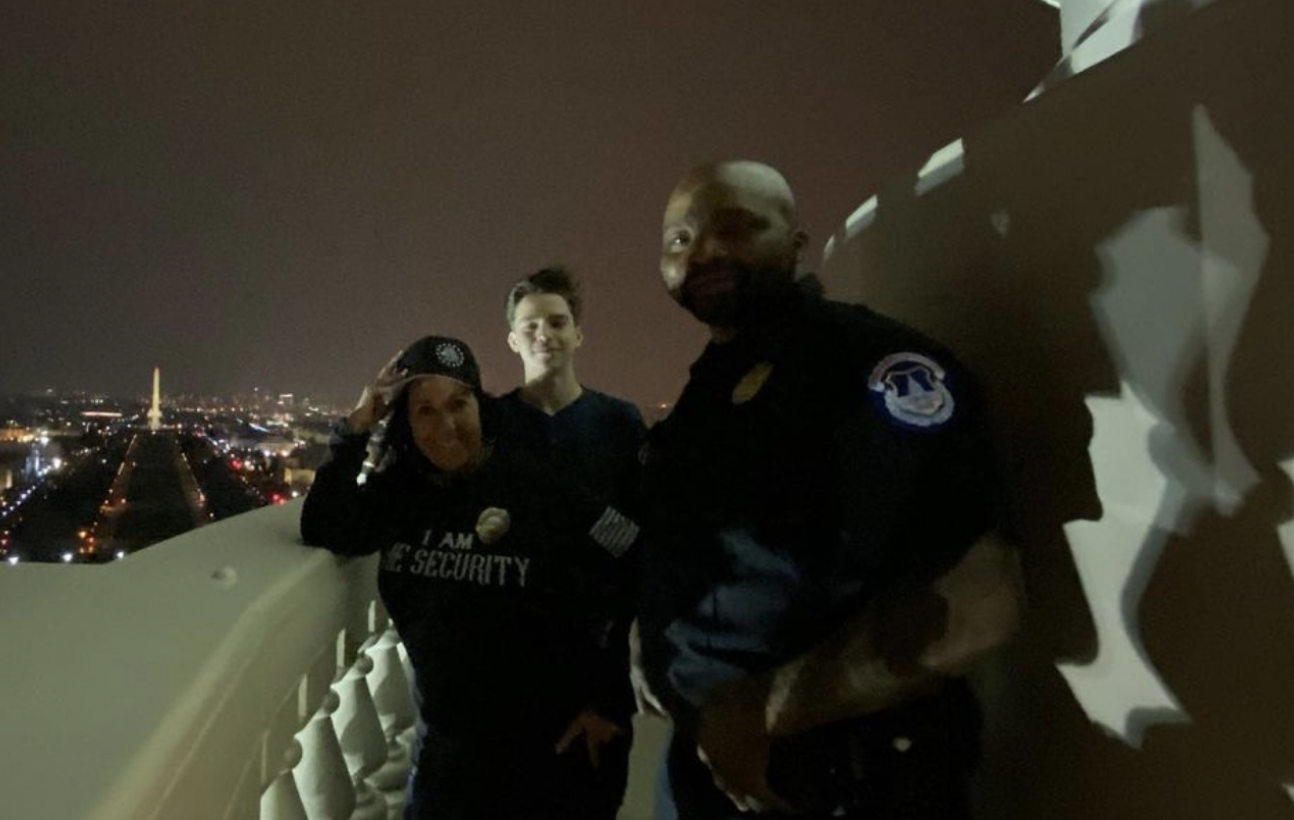
On the night of Dec. 12, 2020, the day of the first Stop the Steal rally in Washington and three weeks ahead of the Jan. 6 Capitol insurrection, several guests of then-Rep.-elect Lauren Boebert, R-Colo., received an exclusive after-hours tour of the Capitol building from the far-right firebrand.

There are several unanswered questions about this visit, which appears to have violated normal Capitol protocol in various ways. It’s not clear who authorized it, since Boebert was not yet a member of Congress and had no official standing in D.C. It’s perhaps even stranger that it occurred on a Saturday night, when the Capitol complex is closed. Later, in the aftermath of the Jan. 6 attack, Boebert repeatedly denied rumors that she had offered “reconnaissance tours” to would-be rioters shortly before that event. But her ambiguous comments appeared to avoid any specific discussion of this unexplained December tour.

According to materials reviewed by Salon, the Dec. 12 tour led by Boebert involved various parts of the Capitol complex, including the staircase in the Senate’s empty Brumidi Corridors, Senate room S-127 and the Senate briefing room, as well as the then-vacant Capitol Rotunda. 

A maskless Capitol Police officer accompanied Boebert’s mother and teenage son to the observation deck at the top of the Capitol Dome for a photo taken by a fourth person, presumably Boebert herself. This is the culmination of any Capitol tour, only available to visitors hosted by a member of Congress, and involves an arduous climb up roughly 300 steep and winding stairs to reach the high perch overlooking the city. 

Boebert’s guests were clearly enjoying themselves, as can be seen in the photos. But everything about their presence on the observation deck alongside a Capitol Police officer remains unexplained. As mentioned above, the rules for observation deck tours stipulate that a member of Congress and an official guide must accompany each group that climbs the Capitol Dome. There’s no indication that either a member or a guide was present on this occasion.

Furthermore, spots for such tours are not readily available, with only eight reservations available on any given day. It’s true that Boebert was a member-elect at the time, but that’s an important distinction: She certainly was not a sworn member of Congress and had no office, no staff and no official status in the Capitol complex. It’s even more puzzling that this tour took place on Saturday night. The guidelines for member-led Capitol tours state they are only available on weekdays from 9 a.m. to 3 p.m., and also that all visitors must sign liability waivers and all tours must be led by official Capitol guides, not Capitol Police officers. 

U.S. Capitol Police didn’t immediately return Salon’s request for comment on this story. 

After Rep. Pramila Jayapal, D-Wash., and other lawmakers accused Boebert of “involvement in instigating and aiding the violent riot at the Capitol Building” after Jan. 6, Boebert responded by saying that she hadn’t given tours to anyone but her family during the 117th Congress, which began on Jan. 3, the day she was sworn in as a member.

Her choice of words was notably specific, and potentially significant: “I haven’t given a tour of the U.S. Capitol in the 117th Congress to anyone but family,” she said, specifically not addressing the unauthorized tour she seems to have given during the 116th Congress. 

In a January interview with Salon, Boebert denied giving “reconnaissance tours” on Jan. 5, the day before the Capitol assault, saying, “I did not. No.” She has issued similar denials to numerous other publications.

This video makes clear that Boebert was in Washington on the day of the first “Stop the Steal” rally on Dec. 12, and also that on Jan. 6 Boebert and her mother visited the Save America rally at around 8:15 a.m., posing for photos with VIPs at the front of the stage. 

Jan. 6 rally organizer Ali Alexander can be seen directly behind Boebert in the clip. She is visible in the video for about 10 minutes. Around that time, at 8:30 a.m., Boebert tweeted, “Today is 1776.” 

The House met at 12 noon that day, and Boebert said on the floor during that session, “Madam Speaker, I have constituents outside of this building right now. I promised my voters to be their voice.”

Boebert later told the Daily Sentinel of Grand Junction, Colorado, that her mother took no part in the Capitol insurrection on Jan. 6, declaring, “During the riot, my mother was barricaded inside of my office alongside my staff until the all-clear was given by Capitol Police.”

In another report published by the Colorado site News9 after the Jan. 6 attack, Boebert said, “Unfortunately, due to COVID-19, I haven’t given any Capitol tours except to show my children around where I’ll be working while I’m away from home.”

It is unclear whether Boebert or her family members attended the Dec. 12  “Stop the Steal” rally, and exactly how they managed to tour the Capitol Dome that evening without a member of Congress and an official guide. Boebert’s office did not respond to Salon’s request for comment.

Read Salon’s Saturday exposé about Boebert’s strange childhood saga, her single mom, a pro wrestler, and the corrupt phlebotomist.

With more delta variant outbreaks at outdoor events, many wonder if outside is no longer safe

The delta variant of the novel coronavirus has changed the social calculus for the pandemic, as evidence mounts that many behaviors formerly considered relatively safe are not enough to keep delta from spreading. Case in point: in April, 92 people attended an outdoor wedding in Texas, in which wedding attendees were required to be vaccinated in order to attend. Despite this precaution, six fully vaccinated individuals got sick from COVID-19, according to a research paper that used the wedding as a case study. The celebration, which was held under a large, open-air tent, resulted in a coronavirus outbreak that led to one guest dying a month later.

The study’s authors suspect that two vaccinated guests who traveled from India likely transmitted the delta variant to other guests, despite both of them testing negative for SARS-CoV-2, the virus which causes COVID-19, prior to their departure. “Viral sequencing revealed 6 vaccinated patients were infected with the Delta SARS-CoV-2 variant,” the authors wrote in the paper, which is awaiting peer review. “With no histories of vaccine breakthrough, this suggests Delta variant may possess immune evasion in patients that received the Pfizer [vaccine], Moderna mRNA [vaccine], and [the] Covaxin [vaccine].”

Ever since the beginning of the pandemic, we have lived in a world in which the outdoors were purportedly the safest place to be — particularly among the vaccinated — according to public health experts. Studies of previous strains of SARS-CoV-2 found that outdoor transmission was around 20 times less likely than indoor transmission. That meant that the coronavirus was something you were more likely to get in a crowded indoor environment. Indeed, most outbreak events were traced to such conditions, including choir practices and restaurant sit-downs.  

Now, news of outbreaks tied to outdoor socializing suggest that neither outdoor environments nor vaccination are enough to stop the delta variants’ spread. 

The Texas wedding is not the only instance in which an outdoor gathering has led to a COVID-19 outbreak. The state of Oregon announced that it is investigating an outbreak stemming from the Pendleton Whisky Music Fest, which was held in an outdoor venue on July 10, 2021, in Pendleton, Oregon. So far, 64 COVID-19 cases have been connected to the event.

“This outbreak is the first one of its size and scope to be traced to an outdoor entertainment event since the lifting of statewide COVID-19 prevention measures at the end of June,” state authorities said in a media release.

While it’s unclear how many attendees were and weren’t vaccinated, the highly contagious delta variant accounts for 80% of Oregon’s new cases.

Then there’s the case of Provincetown, Massachusetts, over July 4th weekend in which three-fourths of those infected with the delta strain were already fully vaccinated. An analysis of this outbreak led to the U.S. Centers for Disease Control and Prevention (CDC) to update its mask guidelines, urging people to wear masks when indoors in areas where the virus transmission is high or prolonged, regardless of their vaccination status.

The delta variant of the coronavirus is 50 percent more transmissible than the alpha strain, which was 50 percent more transmissible than the original strain. Dr. John Volckens, a professor at the Colorado School of Public Health at Colorado State University, explained the math with an example.

“If the virus is 50 or 100% more transmissible, the one person infects four, the four people infect 16, and the 16 infect 64,” Volckens said. “So after four or five rounds of infections, with the original coronavirus you might have had 20 cases, but with the delta variant you have like 200 cases.”


Want more health and science stories in your inbox? Subscribe to Salon’s weekly newsletter The Vulgar Scientist.


This is partially why delta variant cases are rising so quickly across the country — especially in places with a high percentage of people unvaccinated. It is also why the delta variant is now the dominant SARS-CoV-2 strain in the United States.

Despite the delta variants’ seeming ability to spread more readily outdoors, this does not mean that the outdoors is just as unsafe as inside, Volckens said. Rather, the type of outdoor event matter. In the case of the Texas wedding, Volckens suspects the presence of the tent affected air flow and created an indoor-like “microenvironment.”

“Anytime you impede air exchange, the risk goes up,” Volckens said. “The only way that risk can be taken down is when you sweep that air away . . . but when we are indoors in a tent, in a car, and a bus, we are breathing other people’s air.”

Volckens likened the spread of coronavirus particles to second-hand cigarette smoke: Inside, one is more likely to inhale it than outside, when there is more space for it to be carried by the wind.

In any case, Volckens said he does not think vaccinated people need to be wearing masks outside. But what about what happened at the Oregon music festival — or the photos of packed crowds at the Lollapalooza music festival in Chicago, which many see as a harbinger of a future outbreak?

“If you are in a super crowded space where you’re surrounded by thousands of people and you’re shoulder to shoulder, I would put a mask on,” Volckens said, noting that shouting, screaming, and singing increase the risk of breathing another person’s air. “With the alpha variant, I was never worried about being outside on the street in public, or sitting outdoors at a restaurant once I was vaccinated, and I’m still not worried about that with the delta variant.”

While vaccinations are mostly effective in preventing the spread of delta, and do offer protection, there is still the possibility of vaccinated people getting a mild infection and spreading it to others. Evidence of this happening has prompted some regions to take immediate public health action. For example, in the San Francisco Bay Area, mask mandates are returning for those in indoor public settings. On the East Coast, New York City now requires proof of vaccination for many indoor activities, like dining, museums, and going to the gym. Places like Philadelphia, Washington D.C., and Kentucky have reinstated indoor masks mandates, too.

Volckens said while he feels safe outside in places where he isn’t jam-packed with thousands of people, transmission outside can happen.

“It’s always less transmissible outdoors because air gets blown away, but that doesn’t mean you can’t get the virus outside,” Volckens said. Social proximity, of course, matters. “If you were 10 centimeters from another person’s face and you guys are shouting at each other for an hour, you’re going to breathe each other’s air, no matter if you’re indoors or outdoors,” he added.

“Ironic”: Kayleigh McEnany calls out Cuomo on Fox News for “touching women in inappropriate places”

Fox News on Tuesday turned to Kayleigh McEnany, a former spokesperson for Donald Trump, to analyze a recent report by the New York attorney general finding that Gov. Andrew Cuomo, D-N.Y., sexually harassed multiple women.

“He is accused of serial sexual harassment,” McEnany explained. “And the same man [is] accused of galling things like touching women in inappropriate places, using someone’s sexual assault experience and essentially weaponizing it. These are serious allegations.”

“The thought that he would be designing a new sexual harassment policy, his office under his tenure, he would make New York government the hallmark of addressing sexual harassment, it’s just too rich and ironic and hypocritical,” she added.

McEnany, Trump’s former White House press secretary, suggested that there is “pressure mounting” on current Press Secretary Jen Psaki to condemn the governor.

“We certainly hope that these claims are aired out in a court of law,” McEnany said. “Our justice system is designed to do just that.”

The Fox News host interviewing McEnany did not ask about her experience handling accusations that Trump sexually harassed or attacked over a dozen women. In one instance, Trump’s Justice Department fought to keep one accuser’s lawsuit out of court.

Both Cuomo and Trump have denied allegations of misconduct.

You can watch the video below via YouTube:

The fight for America’s future won’t be won or lost in Washington — it runs through the states

Voting rights have not had a good summer. First, a Senate filibuster frustrated congressional efforts to pass the “For the People” bill. Then, the U.S. Supreme Court, in Brnovich v. Democratic National Committee, further eviscerated the Voting Rights Act, not only upholding certain provisions of an Arizona law making it more difficult to vote, but interpreting Section 2 of the Act to make future federal challenges more problematic

These setbacks raise key questions for those concerned about voting rights, and what strategies to employ to defend and expand them. 

Many Americans thought that the defeat of Donald Trump would lead to the expansion of voting rights. Good ideas in this arena would prevail and the courts might recognize that change is in order. This was not to be, and the federal landscape is not likely to improve without a watershed election in 2022 that few now see as likely. Even if the filibuster were to fall, it is not clear that progressive voting rights legislation could pass. And the Supreme Court has clearly become the conservative vessel that Trump and the Federalist Society have coveted for years.

So what is to be done? It would be a mistake to abandon Washington politics and folly to give up on the federal courts. But if we want to expand voting and change America in the process, the best places to fight are where most rules on elections are written — in the states.

The American public has placed so much emphasis on decisions made in Washington that it has lost track of what is happening in state capitals. Leaders from both political parties, however, have recognized that major victories can be won and lost in the states, and that is why we have recently seen so much activity on voting rights in these arenas. 

It is commonly understood that following the 2008 election of President Barack Obama, national Republicans were so concerned about their future ability to capture the popular vote in a presidential race — Republicans have lost the popular vote in seven of the last eight presidential elections — much less win the Electoral College, that they invested substantial resources in trying to win control of state legislatures. They were tremendously successful in 2010 and took control the redistricting process in key states, a crucial element in solidifying a congressional majority until 2018.  

Now, state legislatures and governors across the nation are locked in historic struggles about the future of our right to vote. In the first half of 2021, more than 2,200 elections-related bills were introduced. As of June 21, some 17 states had enacted 28 new laws restricting access to the vote. 

Not unexpectedly, Republican-controlled bodies have been the most aggressive in their actions, embracing a wide variety of limitations that will make it harder to vote, and eliminating provisions created during the pandemic that enjoy widespread support.  

After record numbers of voters cast absentee ballots in Georgia’s November election — about one-quarter of the state’s 5 million turnout — the Republican-controlled legislature passed new voter ID requirements for absentee voters, thereby increasing the burden on more than 272,000 registered voters who don’t have a driver’s license or state ID on file with election officials. The legislation also targeted “mobile voting units” that proved effective in increasing turnout in Fulton County (Atlanta), a locality where Biden garnered 73 percent of the vote. Lawmakers passed a measure to prohibit localities from using these buses in the future, except “in emergencies declared by the Governor.” Finally, new Georgia law now prohibits election officials from mailing absentee ballot applications to all voters, as Republican Secretary of State Brad Raffensperger did during the pandemic, and reduces the time prior to an election when a voter can request such a ballot. The Georgia measures are now under attack by the U.S. Department of Justice, which claims they are illegal under Section 2 of the 1965 Voting Rights Act.

Florida passed similar provisions to those adopted in Georgia, most targeting the ease of mail-in voting. 

After similar efforts were foiled in Texas by a last minute Democratic quorum-breaking walkout in May, the governor conveyed a special session to ram through the proposals. These states share a common characteristic — both houses of the legislature and the governor are controlled by the same party. 

In recent years, we have grown accustomed to measures like these. Some even can appear relatively benign — until one assesses the practical impact of their implementation. Requiring a person to produce an ID in order to vote, for example, while it enjoys substantial popular support, disproportionately impacts minorities and the disadvantaged who find that they do not have the ID required by the law, until it is too late.  

In many states, new measures appear even more brazen. The Arizona legislature recently declared war against elected Secretary of State Katie Hobbs, a Democrat, passing measures to take away her powers and transfer them to the Republican attorney general. Georgia Republicans took aim at Secretary of State Brad Raffensperger for failing to adhere to the Big Lie, replacing his oversight of elections by creating a new chair of the State Election Board appointed by the legislature. At least five states are now pursuing a new type of partisan election audits, conducted not by election officials but by private entities. Taken together, the proposals are so significant that it has prompted one recent study to declare the measures to be a “democracy crisis in the making.

In many instances, the only barrier to these draconian measures have been Democratic governors. Both Wisconsin and Michigan have passed restrictions on voting which have been or will be vetoed by Gov. Tony Evers and Gov. Gretchen Whitmer, respectively. Pennsylvania Gov. Tom Wolf not only vetoed a Republican-backed bill that would have established new voter ID requirements, created new barriers to absentee balloting and eliminated ballot drop boxes in the state, but also struck a budget measure to enable so-called voting audits modeled after the controversial and widely criticized operation being conducted by private entities in Arizona.

Voting expansion has occurred in several states. Maine recently added student IDs from authorized colleges to the list of acceptable forms that voters can use when registering to vote. Louisiana, after a surge of early voting in 2020, now provides additional time for voters to exercise this option. In Kentucky, following record-high voter turnout in 2020, no-excuse absentee in-person voting was extended to three weeks prior to elections. But the most dramatic change comes from Virginia. Known as a ruby-red state for almost two decades, the Commonwealth has now become decidedly blue. Not only has the state chosen Democratic candidates for president each year since Obama in 2008 and elected Democratic governors in four of the last five elections, 2019 brought Democratic control over both the House of Delegates and the State Senate, something not witnessed since the dawn of the century. And the state has now adopted some of the strongest voting provisions in the country. Lawmakers proceeded to repeal draconian voter ID requirements, expanded early voting to 45 days and enacted automatic registration. In addition, Virginia became the first Southern state to enact a “pre-clearance” requirement similar to one that existed under the federal Voting Rights Act before it was stricken in 2013 by the U.S. Supreme Court in Shelby v. Holder.

Most of the push for voting rights targets state legislatures. But other options are also available. Advocates should look to state constitutions, almost all of which explicitly recognize the right to vote. Such provisions exist even in states that are not typically viewed as havens of liberalism. Some 12 states, including Missouri, Tennessee, Wyoming and Arkansas, declare that elections shall be “free and equal.” Indiana, Kentucky, South Dakota, Pennsylvania and Oklahoma are among 30 that include a provision that “no power, civil or military, shall at any time interfere to prevent the free exercise of the right of suffrage.” 

By contrast, the U.S. Constitution does not include such provisions, and federal court decisions have concluded that our founding document only protects against governmental actions that violate provisions such as the Equal Protection Clause of the 14th Amendment. Consequently, federal jurisprudence has generally permitted states to impose burdens so long as they are not overly severe or overtly discriminatory. In addition, more than 25% of federal appellate judges have been appointed by Trump, and a recent study shows these appointees evidence a pattern of ruling against voting rights plaintiffs. By contrast, swing states like Colorado, North Carolina and Pennsylvania currently have Democratic majorities on their state supreme courts. Some legal scholars argue that it is time to marshal these provisions in service of the most foundational right in our democracy.

A recent case from New Hampshire illustrates how strong language in a state constitution can protect voting rights.

In early July, the state’s Supreme Court unanimously invalidated 2017 legislative measures that required newly-registering voters to provide proof of residency before they could cast a ballot, finding them to be “unreasonable burdens on the right to vote.” The decision was based on the state’s constitution, which includes language that “All elections are to be free, and every inhabitant of the state of 18 years of age and upwards shall have an equal right to vote in any election….” State courts in North Carolina are now considering whether its constitution will serve as the basis for overturning a restrictive voter ID provision of the law. Pennsylvania, which has included the “free and equal” provision in its constitution since 1789, has extensive jurisprudence protecting the right to vote under state law. Some states have constitutional clauses that are easier to use than others, but chances of judicial victories at the federal level are increasingly problematic. 

Beyond the courts, many states give citizens the ability to place proposals directly before the voters through what is called “initiative petition.” Twenty-four states have the initiative process. Of those, 18 allow initiatives to propose constitutional amendments and 21 states allow initiatives to propose statutes. For those who support the expansion of rights, citizen initiative is another avenue worth exploring. We have seen the power of citizen initiatives most recently in the number of ballot initiatives that have made recreational marijuana legal in several states, even in the face of legislative resistance. In 2020, constitutional amendments were passed in California and Florida through direct ballot initiatives that allow felons the right to vote upon completion of their sentences. 

In the final analysis, the best way to protect and enhance voter rights is at the ballot box. But other means — particularly in the states — also exist, and advocates should not be shy about using them. Only our democracy is at stake. 

Harry Reid urges Congress to press for more public disclosure of UFO sightings after landmark report

Former Sen. Harry Reid, D-N.V., was behind funding for extensive research by government and military experts examining Unidentified Aerial Phenomena filmed over the years by the pilots. The full report published in June detailed 144 encounters that they still can’t explain. All of the interviews with pilots, military specialists, scientists and officials ultimately lead to the conclusion that they have no idea what any of the sightings are.

Speaking to KPBS Midday Edition Tuesday, Reid said that he was disappointed in the report, though an admission that the government is just as clueless as Americans, is different.

“Harry Reid said he applauds the Pentagon for making it easier for military personnel to report sightings of unidentified aircraft and is urging Congress to press for more public disclosure of future sightings,” said the report.

He implied in the interview that it’s possible they wanted to bury the report since they released it on a Friday night.

“They obviously in reading the report, it was so cursory so thin,” he said. “So marginalized. I am very disappointed. I would hope that people in Congress understand that that is not the way to satisfy the American people. The one thing we need to do is be transparent and this shows no transparency. We need to get to the bottom of this, continue working on. It seems to me, the more we study it, the more we don’t know. And I think that’s important that people understand that this is not some conspiratorial theory. This is real facts we need to get to the bottom line.”

“I found very little of this new cut, but I have said, and I believe this, this can’t be a one I don’t we’re through with it,” he continued. “This has to be an ongoing program for the federal government is involved in studying these unidentified flying objects. They can no longer say they don’t exist because they exist and we need to find out what they are. And the more we try to hide it, the more parent becomes at work trying to hide something from the American people. That’s a long way to go.”

During a “60 Minutes” special, a former Navy pilot expressed his concern that the Pentagon and military, in general, are so dismissive of pilots who report UFOs. His concern, he explained, is that there are foreign actors creating technologies unknown to the United States and that they continue to be ignored because the idea it is an unidentified flying object makes people look nuts. Reid said that the one good thing to come out of this is that the military is taking it more seriously now.

However, he explained, there are decades of reports and investigations about UFOs to uncover what they are. None of those were included in the report and Reid wants to know why sightings between 2004 and 2021 were the only things considered. Some of the videos have been examined and released to the public with little information. Reid believes that there should be ongoing study as we learn more and technology gets better.

“We’ve been talking about these UFO’s for 70 years and we have not gotten any place other than to understand that the more we learn, the more we need to learn,” he explained. “And so I am satisfied that the medical Pentagon is doing the right thing.”

He said that he’s “ready” to find out specifics about what these UFOs actually are.

Listen to the full interview here.

Mike Lindell trolled by heckler, addressed as “marginally brain-addled corrupt goofball”

MyPillow CEO Mike Lindell, while on vacation with his family this past weekend, was trolled by a random passerby, who hurled a series of insults that did not seem to ruffle the tireless Donald Trump fan who has brought restful sleep to millions. 

An account with the username @BillRobens posted the series of clips to Twitter, where he pretended to be a fervent supporter of Lindell and his 2020 election conspiracy theories. 

“Love you, man, you’re a true patriot,” the heckler initially stated while Lindell was doing an online interview with frequent co-host Brannon Howse on his FrankSpeech website.  

Lindell quickly responded, “I’m live on TV right now,” while attempting to hush the troll.  

Then the heckler offered Lindell a plateful of advice, not necessarily sincere in nature: 

Don’t let the libtards call you names. Don’t let them call you an ethically dubious pillow pusher. Don’t let them call you a marginally brain-addled corrupt goofball. You’re doing great. Don’t let them call you names, is what I’m saying. Be strong. Don’t let them push you around or call you names like completely clueless crazy old man who believes everything he sees on the internet. Don’t let them call you names. Stay strong, you’re doing great, Love you, man.

Lindell declined to comment on the incident when asked by Salon. 

This encounter came shortly after Lindell pulled all his MyPillow ads from Fox News after the conservative network declined to air a promotional ad for his upcoming “cyber symposium” event scheduled for next week in South Dakota. “I am pulling everything,” Lindell told Salon last week. “Fox [News] denied the ad, and they based it on ‘pending litigation.'”

You can watch the clips of Lindell’s exchange with the heckler above. 

“Jeopardy!” has to clarify its own rules after backlash over how a contestant asks questions

Yes, it’s possible to be annoying and not break any rules. Beloved game show “Jeopardy!” confirmed this on Monday, following backlash over how one of the show’s contestants has answered questions thus far.

Matt Amodio, the show’s current champion, has been answering questions thus far by universally starting his question-answers with “what is,” rather than varying his language based on whether the qurestion is referring to a person, animal, object or event. Some fans have since questioned if this is against the rules, or if Amodio should face some sort of penalty for this. 

Per the official “Jeopardy” Twitter account, which shared a link to its official rules in the wake of this internet backlash, Amodio may annoy some fans but is technically in the clear.

“What’s up with Matt Amodio? A lot of ‘what’s’ in his responses — and that’s totally acceptable!” the Jeopardy account tweeted.

An explanation of the show’s rules posted on its website reads, “Streaking champ Matt Amodio has received a lot of attention lately for his unorthodox use of ‘What’s . . .?’ as a template for all responses — be they animal, vegetable or mineral. Viewers and grammar police alike have a lot of questions about what’s acceptable. We’ve got some answers.”

According to the show’s rules, “all contestant responses to an answer must be phrased in the form of a question,” and beyond that, “Jeopardy!” doesn’t require these questions to be grammatically correct, for the response to be deemed correct. In other words, Amodio isn’t really doing anything wrong, despite how “Jeopard!y” audiences have been up in arms about the champion of late.

For his own part, Amodio is taking things in stride, retweeting and meme-ing the “Jeopardy!” Twitter account’s posts about him, and telling Entertainment Weekly that despite how some people say his approach to answering questions on the show has been “disrespectful to the game,” he sees himself as the “No. 1 ‘Jeopardy’ fan.”

“I live and breathe the show, I love every aspect of it, and so I’m definitely not doing it out of any disrespect or undermining of the show,” he told the outlet.

A contestant’s style of answering questions may seem like a trivial and inane aspect of the game show to be upset by, but longtime fans of the show take it seriously, and are often vocal about reactions to contestants. This is especially the case when the use of incorrect grammar appears to be counterintuitive to the show’s promotion of knowledge and intellect. For his own part, Amodio clearly takes the show seriously as well, whatever other fans may say about him.

Over the course of just seven games, during guest host LeVar Burton’s hosting debut on the show, Amodio picked up a total of $268,000, solidifying his place among the top 10 highest-winning ‘”Jeopardy!” champs in the show’s history.

When I wanted to find my people, I found them in the “food women” living all across the globe

Finding my people has always felt crucial. Maybe it’s because I’m an only child. Or because I was the only Jewish girl in my class at school. I’ve always had the sense of being a bit weird, a bit of an outsider—a feeling that slowly lessens, of course, the further I get from middle school.

In high school, my family moved from Baltimore to New Jersey. Everything was different—we traded a row house in the city, a place incessantly loud with traffic and shouting teenagers and mean old-lady neighbors, for an eerily quiet suburban house in Princeton, complete with a fenced-in yard. On the weekends, my parents would let me take NJ Transit, the commuter train, into Manhattan with my friends Jose, Rinku, and Cindy, a little band of misfits. When the conductor wasn’t looking, we’d put our feet up on the blue vinyl of the seats in front of us, watching the bucolic green out the window morph into trash-strewn marshes and container-truck parking lots, and finally the black of the tunnel that meant we were entering the city. Emerging from Penn Station, hit by the smell of stale piss and those teeth-achingly sweet candied nuts for sale on every Midtown corner, the hard shine of skyscrapers bouncing sunlight above us, we felt miraculously grown up. In NYC, we weren’t even a little bit weird.

One Sunday, we found ourselves paying the five-dollar entrance fee to an off-off-Broadway matinee. The show involved audience participation. “Raise your hand if you were cool in high school,” one actor asked the crowd, his hair in the tallest Mohawk I had seen in real life. He was painted in glitter, and his chest sparkled in the spotlight. Nobody raised their hand. My friends and I exchanged conspiratorial glances. I took it as a sign from the universe: maybe I was going to be okay.

***

I’ve worked in food and hospitality since my first summer job, scooping gelato in Hoboken. When it was slow, I read Anthony Bourdain’s Kitchen Confidential under the gelato cart’s awning. I loved food entirely. But I also fell hard for that Bourdainian swagger—that machismo, the wild intensity that seemed intrinsic to the restaurant experience. Part of me saw the aggressive culture as a challenge. I was tough, too.

In real life, the adrenaline rush of a busy night of restaurant service was even better than I had read about; I started hostessing for a Michelin-starred French restaurant on the Upper West Side, and then took a job as a server in a cheese and wine bar. My new world was rough around the edges but sophisticated, the work hard in a physical and mental way I hadn’t yet experienced. People talked a big game and expected a lot—no slouching over the host stand even eight hours into a shift, knowing which tables to joke with and which to leave in peace, understanding the difference between the Aligoté and the Albariño. The restaurants were run according to a strict hierarchy, a tradition dating back to Auguste Escoffier’s military-inspired brigade system and stubbornly integrated into the restaurant world’s psyche to this day. Through college, I felt as if I was living two lives: student and restaurant person.

I loved that second identity. I loved the people; they were brilliant, challenging, and totally different from me. I loved the physicality of a shift on my feet and how tired I felt by the end of it, how sore and how satisfied. How the work took me out of my own insufferable thoughts. I loved leaving a shift with a fat wad of cash in my pocket. I loved the cute bartenders who made me esoteric drinks after closing and told me outrageous stories. I loved being a part of something.

It’s been seven years since I left my last restaurant manager job. I didn’t leave the world of food entirely, just the working-in-a-restaurant-every-day-and-every-night life, which I found ultimately too exhausting and too brutal to sustain. What I had hoped would be creatively juicy instead felt like a grind, the same thing night after night after night. I’ve chosen to write about food instead. I draft press releases when an olive oil wins a prestigious award. I compose descriptions for wheels of Gouda that will be printed out and laminated, then hung on tiny hooks behind the cheese counter in various grocery stores. And I wrote a book about working my way through restaurants, falling in love with food and (the wrong) men, and recovering from a brutal eating disorder.

Plenty is about food people. Not just about any food people but my food people. And not just my food people but my food women.

Foodland is notoriously male-dominated, in contrast with the domestic realm of cooking, which so often falls in the hands of women. Men run the restaurant world for many reasons: boys’ club networks, male-centric kitchens where women are made to feel totally out of place, and male investors’ preference for spending their money on other men who remind them of themselves—or who they want to be. But at the core of all the reasons men dominate our professional food landscape is the stubborn idea that important cooking and culinary innovation is the dominion of men.

It’s not true, of course.

It’s profoundly not true.

My own wonderful, complicated food mentors were men. There was Max McCalman, the first maître fromager in the US. I worked with Max at the now defunct Picholine on the Upper West Side, where he taught me all about Alpine cheeses made from the milk of cows that grazed in high mountain pastures. Max helped me land an internship at the Artisanal Premium Cheese Center, where I sprayed wheels of stinky Époisses de Bourgogne with brandy in the cheese caves until my fingers numbed from the cold and smelled of fermenting socks.

Max was followed by Steven Jenkins, who hired me to work with him at Fairway Market and rescued me from a sort of quarter-life crisis after I had quit my restaurant management job. He took me under his wing. We spent afternoons swigging extra-virgin olive oil straight from the bottle and reading from Madeleine Kamman’s When French Women Cook. I busied myself writing endless descriptions for slightly different kinds of smoked salmon while Steve screamed at customs agents for detaining shipments of balsamic. When I had a question about our new jars of briny Basque boquerones that made me pucker in delight, he’d pull some book from his shelf for me to read. “If you lose it, I’ll murder you,” he’d say. “I’m not joking.”

Where were my women mentors? I’ve worked side by side with some truly badass women, but they have been vastly outnumbered by men. These women have had biting senses of humor and serious talent; they have inspired, amazed, and surprised me. Some have gone on to become my friends. Why not my mentors? This is something I’ve thought about a lot. Most were my peers rather than authority figures, and the few who have risen to positions of power seemed to be more focused on safeguarding their own careers in a misogynistic system than in taking a young and (over)eager woman under their wing.

When I first started thinking about writing this book and identifying my women food heroes, I conjured up a list of chefs and entrepreneurs who’d hosted TV shows, appeared on magazine covers, and given keynotes at flashy events. I started researching and interviewing, but something left me cold.

I kept coming back to my friends—and to the people I wanted as friends. When it came to what I admired, it wasn’t fame or money or any of the outward markers of success. Not that there is anything wrong with fame, money, and success. (I’ve spent a good portion of my life chasing these things!) But I realized that really delving into the story of women in the industry was a much more personal story for me. Food is so many things beyond awards and notoriety; it is a point of passion and connection, a way that we show our love and commitment to one another. It’s a powerful way to cultivate community and family. The many people who make me believe in what we—all of us food women—are creating and preserving are so often in the trenches, working their asses off, living the food life, succeeding and failing and continuing to show up. They are peeling parsnips, driving tractors, fighting with spreadsheets, kneading dough, teaching other women how to chiffonade, and dreaming up change as I write these words. They are out there living full, complicated, and delicious lives of plenty that aren’t being documented.

Plenty is about them. And for them. For you.

If you like this book excerpt as much as we do, consider checking out “Plenty: A Memoir of Food and Family” by Hannah Howard. 

How does a show called “FBoy Island” get made? The show’s creator spills the tea

HBO Max’s new series “FBoy Island” debuted as the most-watched reality series for the streaming service in its first weekend, and it’s not hard to see why it’s so compelling. The twist on the dating series sets up three single ladies and host/comedic spirit guide Nikki Glaser, to parse through 24 men and distinguish the self-identified fboys from nice guys as they try to charm their way to a relationship  — and possibly win $100,000 in the process. But how did such a provocatively named show come to be?

The concept, not to mention the outlandish title itself, is titillating in how it pushes against established shows like “The Bachelor” that perform all the puritanical pageantry of seeking marriage and true love. Series creator Elan Gale, a producing alum on “The Bachelor,” conceived of “FBoy Island” as the natural direction for dating shows in the age of Tinder and an accurate onscreen encapsulation of the minefield that is modern dating.

“One thing I kept noticing in my day-to-day life – and I don’t know if it’s just the people I hang out with – is people kept referring to people they went on dates with as f**kboys,” Gale told Salon in an interview. “It’s been a thing where you hear it, and you wonder if there’s a dating show that’s reflective of that part of dating culture, swipe culture, ghosting culture. Yet I felt there wasn’t a place where people were opening up that door, and talking like how they talk behind closed doors about the fboys that ghost them.”

Gale wanted to bring that underexamined experience to the screen. “On dating shows, what the leads are presented with is, there’s a number of people and they’re all really great. But for those of us who have dated, we know the dating pool is usually like, Here’s a number of people, some are great and some are not,'” Gale explained. “That’s a reality we all know, we’ve all experienced that one way or another.

“So we thought, let’s just make that show — what people actually experience as young people dating right now. People that aren’t with you because of who you are, but want something from you. You meet people, everyone puts their best foot forward, and they think, ‘Is this person really into me, or is this person just a f**kboy?'”

Gale and his team knew the show was a risk, given its candor, its subversion of the greater dating show genre, and, of course, its title. They went for it, anyway.

“We decided to swing for the fences,” Gale said. “Let’s just go with it, let’s do a big swing and see if someone wants to play in the sandbox. And luckily, we live at this moment in this amazing age of streamers. HBO Max stepped up and said let’s do something crazy, and they let us do it.”

Today, relationship exclusivity isn’t a given while dating, and often requires an explicit conversation to establish, but not before a period of time spent guessing what the other person wants. Dating apps have become a breeding ground for the “f**kboy,” who has no intention of being in a relationship and usually isn’t particularly honest about this. 

Some apps like Hinge have options for users to answer a question on their profile about what they’re looking for, though many users treat the prompt as a joke with answers like “my keys.” But most apps don’t pose this question at all, and set up plenty of users either for one-night stands that they may not realize will be one-night stands, or long-winded, painful guessing games. 

“FBoy Island” is a dating show that’s meant to capture this reality on camera — and hopefully reform a few fboys in the process.

What’s in a name?

The bold concept of the show was one hurdle — its raunchy name was another, in itself. Gale says the team initially tried to brainstorm other titles for the show, but nothing stuck.

“Over time, we were thinking, ‘Can we call it something like Nice Guys vs. Bad Boys?’ But nothing sounds good in there,” he recalled. “Every time we started trying to think up a new title, it just felt like this is a worse version of ‘FBoy Island.”

Today, we know the bold name choice paid off, but Gale still believes “right off the bat, most places you can make a TV show are simply not going to make a show called ‘FBoy Island,’ and I totally understand that.”

With the name of the show squared away, what followed was philosophical discussion about the labels the male contestants would select for themselves, as “nice guys” and “fboys.” According to Gale, these labels of “nice guy” and “fboy” aren’t meant to be moral indictments of the contestants. 

“Just because you’re nice doesn’t mean you’re necessarily good,” Gale explained. “And frankly, I’m not sure having fboy tendencies necessarily makes you objectively bad.”

Specific to the goals of this show, a “nice guy” is just a man who partakes in dating to find a relationship and meaningful connection, and is honest about his intentions — whether he’s a good person or not isn’t relevant to this categorization. Likewise, “fboy” describes someone’s approach to dating, not their morality. If an fboy is honest about his intentions and that he isn’t looking for a relationship, he could very well be a better person than some racist, homophobic “nice guy” who is looking for a relationship. Of course, often in real life and certainly on “FBoy Island,” honesty is antithetical to the fboy lifestyle, as fboys on the show attempt to camouflage among “nice guys” in the hopes of cashing in.

Already on “FBoy Island,” there are quite a few signs of “nice guys” who may have “nice guy” intentions by the parameters of the show, but as Gale notes, aren’t necessarily good people. In the first episode, so-called nice guy Garratt Powers is eliminated for pretty creepy, overbearing behaviors and coming on too strong to Nakia. As she calls him out on this, he deems this the perfect time to inflict on her a reading of a romantic poem he wrote himself. Sure, the man may be looking for a relationship, but his simultaneous self-identification as a “nice guy” and glaring lack of respect for women’s boundaries speaks volumes.

Leading ladies who also support

Once the concept was greenlit, Gale says he and HBO Max were confident that the key to the show’s success would be finding the right host. “It has to be someone who’s smart and quirky, interesting, and opinionated, and a fan of these kinds of shows, because we want them to act as a surrogate for the audience, to ask the questions hopefully audiences will be asking at home,” he said.

Comedian Nikki Glaser came to mind immediately, then. She’s known for her frank and sex-positive standup, and she’s clearly having a blast calling out the ridiculousness on the show.

“I called her, I said I’m doing something really crazy, making a show called ‘FBoy Island,’ and she just said yes,” Gale recounted. Of course, he says at the time Glaser thought the invite was to be a contestant on the show, but she seamlessly assumed the role of host and executive producer despite the initial mix-up. Glaser reportedly played an indispensable role in the making of the show, writing her own hilarious lines, and setting the show’s distinct comedic tone. 

According to Gale, casting the show’s three female leads – Nakia Renee, CJ Franco and Sarah Emig – was all about finding women who were willing and able to be expressive and totally honest about their feelings, both positive and negative. It was also key that they’d had experience dealing with fboys, knew what to look for, and knew what they wanted. 

Most of all, it was essential that the women “got along.”

“We didn’t want a show where the women were fighting each other over these men. The women here are the catches,” Gale explained. And so far, at least three episodes in, Nakia, CJ and Sarah seem to not just get along, but work well as a team, looking out for each other, reading the signs, and helping each other sniff out the signs of an fboy. CJ even established the laughable code word “pterodactyl” as a cry for immediate help from her two dating colleagues.

“Two separate shows”

For the roles of host and leading ladies, the choice was simple. Choosing the 24 contestants? Not so much. Casting men who identified as nice guys and fboys required some tricky maneuvering.

“We cast the show, the group of men, as two separate shows,” Gale said. “So, the casting calls were different, the entire interview process was different. In the casting of nice guys, we treated it as a very traditional dating show, where we were really looking for the people you would put on any dating show where you wanted to present guys with their best foot forward.”

As for casting the self-identified fboys, Gale says they “cast as if we’re looking for guys who want to be on a fun summer show, meet women, bro out, have fun on an island.”

How the two groups are eliminated further delineates their separate experiences. When fboys are eliminated, they’re forced to cool their heels at a bus stop, where they eventually get drivent to “Limbro.” The outdoor enclosure that looks like a tropical junkyard is basically an unglamorous reform school of sorts that involves the occasional therapy sesh with Glaser. In contrast, expelled nice guys get to live it up at the “Nice Guy Grotto” seaside resort complete with pina coladas and fruit they don’t need to forage themselves.

Between psychological investigations of the so-called hottest guy from Ohio (not exactly the most generous compliment), and other equally tempting prospects, and even at times thought-provoking “therapy” sessions for castaway fboys, “FBoy Island” is a dating show with plenty of tricks up its sleeve. Those who judge and underestimate it for its name are doomed to miss out on its bold and insightful charms.

The first three episodes of “FBoy Island” are currently streaming HBO Max, with new episodes arriving on Thursdays.

Nevada GOP gripped by civil war after far right Proud Boys attempt “takeover”

alternet-logo

There is a civil war brewing within the Republican Party in Nevada. According to The Las Vegas Sun, tensions began to rise when members of the Clark County Republican Party (CCRP) expressed concern about the state party’s director Michael McDonald who is accused of recruiting members of the far-right group The Proud Boys to run for public office.

The move was reportedly an effort to increase the extremist presence in the state’s political party. On July 20, CCRP members held a meeting to select officers. However, that meeting was interrupted when individuals affiliated with The Proud Boys crashed it. The publication offered a clear depiction of how the scene erupted.

“It was an ugly scene with echoes of the Jan. 6 riot, except instead of Big Lie insurrectionists trying to take over the Capitol, they were trying to bully their way into a takeover of the county party’s moderate leadership,” the publication noted.

It added, “Egged on by the Proud Boy members, the crowd broke into angry chants of ‘Stop the steal’ and ‘Let us in.’ Security officers had to face down crowd members rushing the meeting room entrance before a small army of Metro officers arrived to quell the situation and break up the crowd.”

The latest news follows the CCRP’s previous cancellation of a meeting due to fears of a Proud Boys insurgency. Back in May, The Daily Beast reported about the far-right extremist group’s targeting of the CCRP. At the time, Stephen Sliberkraus, the CCRP vice chair, spoke during a press conference where he highlighted concerns about neo-Nazi content from the far-right group.

“Members of this group have launched online attacks against some of our female elected officials including a district court judge, a school board trustee, a state senator, and our secretary of state,” Sliberkraus said. “The Proud Boys call themselves ‘proud chauvinists’ and by their actions, demonstrate an intent to target women and minorities in positions of authority.”

“Pray Away” director on conversion therapy: “It’s a movement of hurt people, hurting other people”

For a documentary about a practice that has brought incalculable suffering to LGBTQ youth — conversion therapy — Netflix’s “Pray Away” is a profoundly complex, compassionate story.

“I saw the deep fear that comes when you feel like you don’t belong,” says director Kristine Stolakis. In the intimate stories she shares from veterans of organizations like the notorious Exodus, that fear often turned inward before it became weaponized toward others. And as Stolakis learned in the years she spent working on the project, her initial ideas about “homophobic, transphobic, white, straight men, teaching people to hate themselves” soon gave way to something else. The film became instead a sincere testimony from once vulnerable individuals, who sincerely believed they could make God and everybody else happy if they could just “pray away” their own identities.

In recent years, much of the “ex-gay” movement has crumbled, thanks in large part to former leaders who didn’t just turn their backs on it, but came out and began working to create a safer, more honest environment for LGBTQ youth. Yet as the film shows, the  industry still has a powerful hold in Christian communities, and countless young people are still seeking the approval of a God they believe cannot accept them as they are. But while “Pray Away” serves as a warning of an ongoing crisis, it is more than anything a testament to survival, and a celebration of sincere, unconditional love. Salon spoke recently to Stolakis about why she made the film, and its surprising message of forgiveness and hope.

This is a personal project for you. Tell me about the inspiration for this story and for this film.

I got into this topic because my uncle went through conversion therapy himself when he came out as trans as a child. What followed that experience was a lifetime of serious mental health issues that included depression, anxiety, obsessive compulsive disorder, addiction, suicidality. He suffered greatly.

I knew him during a really special 10 years of really solid mental health and sobriety. He was my babysitter, and he was one of my favorite people on earth, who liked to tell me stories on his couch, who liked to play with me and who loved me. After I became older, his mental health became a big issue. It was only years later that it was explained to me that he had come out as trans when he was quite young, and that his experience of conversion therapy, and more broadly, just being bullied and ridiculed for being for who he was, had caused these issues. When he passed away unexpectedly about six weeks before I went to film school, I decided at that moment that I would make my first feature film about this movement.

When I discovered that the people who had claimed that they themselves had changed from gay to straight or from trans to cis, and that they had the tools for others to do the same were the people running the vast majority of conversion therapy organizations, it was like a light bulb went off in my head in terms of why my uncle had believed for his entire life that change was possible. Before that, I had viewed the movement as confusing. Why did he commit his whole life to thinking that this thing that is such a part of him is a sickness, is a sin? Finding those people made me understand why.

This is not us a small, selective population. This has affected a large number of individuals, spanning over decades. Can you talk about the impact of this movement?

I was also surprised to learn that not only does the movement continue into today, but that it has affected hundreds of thousands of people in the U.S. alone. We know that nearly 700,000 people have gone through some form some form of conversion therapy in the U.S. I can also say that even if a church doesn’t view themselves as an organization that practices conversion therapy, unless they explicitly affirm their LGBTQ parishioners, they will send a message — either directly or indirectly — that something is wrong with the people in their congregation who identify as LGBTQ. They will send those people to organizations like Exodus that continue into this day, that practice some form of conversion therapy. Or even if they don’t directly send their parishioners to this kind of organization, their community members who are LGBTQ will seek it out in some way. A lot of people view this as something that is niche. My experience is that it’s actually really wrapped up in mainstream religious culture in the U.S. and abroad in a way that I did not understand before I did before I made this film.

You also put conversion therapy in the context of the the junk psychiatry that went along with it. It was not exclusive to the evangelical movement. This was a thing that people were talking about on talk shows, that was on the covers of magazines.

There is this very problematic, traumatic relationship between the pseudo psychology that has been debunked that says, “Change is possible,” that says, “There is some reason in your past that you are LGBTQ” and the larger “ex- LGBTQ” and change movement in general. The movement that says that one can change exists in religious communities, and draws on the remaining psychologists and psychiatrists who say that change is possible. These religious organizations get credibility by citing the small few that continue to practice what one might call like traditional conversion therapy — one-on-one conversion therapy in a doctor’s office.

That is not the only way people experience conversion therapy. What I have seen is in religious communities, they actually think, “We’re not doing conversion therapy. That happens in a  therapist’s office.” But their pastors, their youth pastors, are talking to the kids of their Sunday school. They’re drawing on that pseudo psychology and saying, “Look, it’s not just a religious belief. This therapist over here is saying that this is a sickness.” It lends credibility to the bigotry. I don’t think people view it that way. They often think they’re doing the right thing, that they’re helping kids, that they’re helping the people in their church.

My experience in making this film — and the research does this back up — is that conversion therapy does largely happen within religious communities in our country. If you look at the Williams Institute study, around two-thirds of all conversion therapies seem to happen within religious organizations, be that a one-on-one conversation with a pastor acting as a pseudo counselor, be it within a peer-based group. It’s an important part to understand of the movement, because even if we outlaw psychologists and psychiatrists from doing this, which is what the bans do, that’s where conversion therapy happens most, it still will happen. Yes, it is not only a religious movement, but it is a very powerful part of religious culture in the U.S., and I see therapists’ relationship to that as only fueling the movement more.

You do a very effective job of also bringing in the way in which the mainstream media has given credence to this pseudo psychiatry.

I think that we do a disservice to covering the movement when we create an “us versus them” narrative, or “There are two sides to this issue” one. So what happens in mainstream media is we see, “Here’s a happy trans person. Here’s someone that comes from the de-transition or community,” and then they give them equal weight. We know from research, anecdotally, that even if one individual feels as though they have found their own gender identity from no longer being trans, that that is not evidence that being trans is a sickness, that being trans will cause mental health problems. It’s quite the opposite. It’s not being trans causing you pain, it’s the world that doesn’t accept you that causes you pain.

You start this film with Jeffrey, a young “formerly trans” Christian man. How did you find him, and why was he so important to the story?

We have seen the conversion therapy movement and the “ex-LGBTQ” movement be driven towards and become married with the anti-trans sentiment that we see across our culture more generally right now. Policing gender identity has always been a part of this movement. If you look at the treatments that people go through, it’s often about essentializing gender into, “Women act this way, and men act this way. So women, wear more makeup, and then that’s going to somehow, through this domino effect, affect your sexual orientation.” What is in that belief system is there’s one way to be a man, and there’s one way to be a woman; God made you this way and that way, and biology says, you’re this or that way.

We know that’s not true, but that’s part of the belief system. That is a hand in the glove of anti-trans legislation and sentiment that we see happening today. Jeffrey is someone who considers themselves “ex-trans.” I’m not sure if he himself uses the phrase de-transitioner, but that is now becoming a phrase that’s much more common in our culture to refer to this person that says that it is a sickness and a sin to be trans. “Look at me, I’ve changed, therefore, I’m proof that being trans is bad.” That that story gets weaponized by religious right organizations to support anti-trans legislation.

We really wanted to show that a current leader in the movement, who’s really been lifted up by their religious right, considers himself “ex-trans.” It’s a modern incarnation of the movement today, to have these stories of people who consider themselves to have quote, unquote, “left the trans lifestyle” become a part of the “ex-LGBTQ” movement, the conversion therapy movement more generally. It was very important to myself and my team to capture that.

Jeffrey’s story is woven throughout the film. One thing about Jeffrey — I really do believe he has very good intentions. I think he is really acting from a place where he thinks he’s doing the right thing. That is something I do think our film captures. Overall, the people in this movement have good intentions, especially in the beginning. This is not a movement of bad apples, of evil people. These are people who have internalized these messages of hate, of transphobia, of homophobia, and they’re wielding it outwards. Because they think they’re helping people, they often don’t seem to see the pain that they’re causing. And that’s something we also hope the film captures.

This film is about identity in so in so many ways — not just about sexual orientation. The ways in which these these people arrive at their sense of self is really interesting, because there’s still for many of them a real sense of identification with their Christian upbringing. There’s so much longing for community.

That is at the heart of this, absolutely, that feeling of longing for community. I cannot tell you how much I felt that throughout the making of this film. I don’t think I realized until I made this film, the danger of feeling like you don’t belong, and what people do when they feel like they don’t belong. That might sound trite or overly simplified, but I saw the deep fear that comes when you feel like you don’t belong.

And to be fair to people, it’s because there are real consequences. That fear exists within a very real culture of LGBTQ youth being kicked out of their homes, of people not being able to be part of their religious communities where they’ve learned to have a relationship to something greater. If you’re told, “You can’t belong to your family, you can’t belong to your community,” over and over and over and over again, the deep fear that soaks in you — beyond the physical consequences and the lack of safety — that you aren’t worthy of love, drives people to very, very dark places. I think that’s a part of the reason that self-harm and suicide are extraordinarily common in this world. We know that youth who go through this [conversion therapy] are more than twice as likely to have attempted suicide.

In the film, there’s also a story of self-harm. It’s common. I saw this in my own uncle, that belief system that you don’t belong, which is such a basic human need. When you believe that, that sticks with you, so far beyond an individual moment of a conversation with a pastor acting as a counselor. It just lives with you, in your most intimate of moments. It’s devastating.

This is not an embittered film. These figures are coming from a place of self-forgiveness, self-compassion and love. And that’s really important, to be able to see people who can look at things that have been done to them, things that they have done themselves, and are able to to say, “I have to live in forgiveness. I believe in self-forgiveness, I believe in forgiveness of others.” I wonder if that revealed itself to you along the way, or changed as you were telling the story?

When my uncle passed away, my mom and I went to the home where he’d been living to clean it out. I found in his closet a stack of brochures from NARTH, which is the organization that a very famous conversion therapist named Joseph Nicolosi ran. This was the leading organization that promoted the idea of conversion therapy from the point of view of of licensed therapists. This has now been rebranded as organization called the Alliance for Therapeutic Choice, so it continues today.

I was livid at reading all of this. I thought, I am going to make my first feature film about this. I had an exposé in mind, like, I’m going to find my way into these groups and record the crap that people are teaching others that makes them hate themselves. In my mind, I had these homophobic, transphobic, white, straight men teaching people to hate themselves. But when I found out and really understood that the vast majority of conversion therapy organizations are run by LGBTQ folks, that madness for me transformed into a deep sadness.

I think it’s the job of a director to do their best to translate their own lived experience of being essentially their film’s first audience member to the film people then experience. That’s what I tried to do in the film. That also was not done alone. I did it with a team, and my team is filled with gay and trans conversion therapy survivors and was produced by a company called Multitude Films, which is one of the only — if not the only — LGBTQ led production companies. We had a really special impact producer on our film that started as a consulting producer, who is a survivor of conversion therapy, who’s done a lot of organizing work around bringing LGBTQ rights and dignity to evangelical and religious communities.

I say all that because I have a core creative team that I’ve worked with for years to make this film, who shared a sense of wanting to do our best to show the movement for what it is without sensationalizing it, of giving audiences members space to feel how they are going to feel and giving them space to react how they want to react, and to acknowledge that this really is a movement where internalized hatred, internalized homophobia and transphobia is wielded outwards. It’s a movement of hurt people, hurting other people. And it’s not so simple as, “Here’s five maniacal bad apples, bad actors. Get rid of them, and the whole movement topples.” That’s not that film. That’s not this movement. The reality is that as long as the world continues to be homophobic and transphobic, you’re essentially going to be training new potential leadership to fill defectors’ places. It was so important for us to capture that. This is not a finger-wagging film. We said this a lot in the edit room, we’re not putting religion on trial. We are just trying to show the harm of the movement.

I’m very moved by what you took from that in terms of the idea of forgiveness. I know that’s not how everyone reacts to the film. Having talked to a lot of people, there are survivors who feel very angry, and I understand that. I do not think it is my place to tell people how to feel after watching this film, but I hope we gave people space to feel something authentically and something that feels like theirs, versus it feeling as though we shoved one feeling down your throat. And that was not our goal. That wasn’t our intention. I think when you speak the truth plainly, there is power to that.  

Was there anything that happened while you were making the film that you really felt moved and inspired by?

The part I felt felt most moved by during the filming was the wedding that’s featured in the film. It’s because it was one of the only times our team was present in a space where the overwhelming feeling was love and acceptance for people exactly as they were. For me, it’s not about the happy ending of a wedding. It’s about capturing a moment where people just love each other, for exactly where they are.

“Pray Away” is now streaming on Netflix.

Progressives celebrate after Biden administration extends eviction moratorium

The CDC released a revised eviction moratorium on Tuesday, triggering a round of celebratory praise from progressive House Democrats who spent recent days trying to extend federal protections for renters devasted by the coronavirus pandemic.

“This order will expire on October 3, 2021 and applies in United States counties experiencing substantial and high levels of community transmission levels of SARS-CoV-2,” the CDC said of its new guidance. According to CNN, the order accounts for 80% of counties throughout the nation. Announcing the planned extension on Tuesday, President Biden said the targeted eviction moratorium is needed in light of the recent surge in new coronavirus cases.

A prior ban on eviction expired last weekend after a major push from progressive House Democrats like Reps. Cori Bush, D-MO., Nancy Pelosi, D-Calif., and Alexandria Ocasio-Cortez, D-N.Y. 

organized a campout on the Capitol steps, where she slept overnight to bring the issue to light. 

“The House is at recess. People are on vacations. How are we on vacation when we have millions of people who could start to be evicted tonight?” Bush said in a CNN interview. “There are people already receiving and have received pay or vacate notices that will have them out on tomorrow. People are already in a position where they need help, our most vulnerable, our most marginalized, those who are in need.” 

The eviction freeze was originally put in place last September by the CDC, which enacted it as a precautionary measure against the spread of COVID. This June, the Supreme Court upheld that freeze, though it ruled that the agency could not renew it ahead of its deadline. Democrats claimed up until this point that the Biden administration could not unilaterally reinstate the moratorium, an argument that critics demurred as specious. Last Thursday, White House Press Secretary Jen Psaki said Biden would have preferred to renew the ban, but “unfortunately the Supreme Court has made clear that this option is no longer available.”

Gene Sperling, Biden’s COVID economic advisor, echoed Psaki on Monday, claiming that the White House could not put together even a slimmed-down version of another eviction moratorium.  

“To date,” he said, “the CDC director and her team have been unable to find legal authority, even for a more targeted eviction moratorium that would focus just on counties with higher rates of COVID spread.”

On Tuesday, Psaki said in a presser that the White House was examining various legal pathways to pull together a “partial, limited short-term extension” on the eviction freeze, but Biden himself that is unlikely. “The bulk of the constitutional scholars say it’s not likely to pass constitutional muster,” the president said on Tuesday while announcing the plan. 

Still, Bush’s efforts appear to have been largely successful in light of today’s announcement, earning her praise from a number of fellow progressives and mainstream Democrats. 

https://twitter.com/CoriBush/status/1422655455558516752

“You get what you organize for,” fellow Squad member Rep. Ilhan Omar, D-Minn., tweeted.  “Thank you @CoriBush for leading on this.”

twitter.com/IlhanMN/status/1422658249212448772

Senate Majority Leader Chuck Schumer, D-N.Y., joined the chorus on Tuesday, congratulating both Bush and Rep. Alexandria Ocasio-Cortez, D-N.Y., for successfully moving the Biden administration on the issue. 

House Speaker Nancy Pelosi, D-Calif., also shared a Bush’s victory lap statement. 

Matt Damon tries to walk back homophobic slur anecdote, but the damage is done

There are some social graces one should know by the time they turn 50, and you’d think one of those would be to not use the homophobic slur “f*g.” In the case of actor and occasional, unintended provocateur Matt Damon, you would be wrong. 

In an interview with the Sunday Times published this weekend, Damon seemed to reveal it was only a few months ago that he’d stopped using the slur, after his daughter sat him down and explained to him why he shouldn’t. But as of Monday afternoon, Damon has walked back the admission, with a lengthy statement to Variety that revisits and clarifies the anecdote in question:

I explained that that word was used constantly and casually and was even a line of dialogue in a movie of mine as recently as 2003; she in turn expressed incredulity that there could ever have been a time where that word was used unthinkingly. To my admiration and pride, she was extremely articulate about the extent to which that word would have been painful to someone in the LGBTQ+ community regardless of how culturally normalized it was. I not only agreed with her but thrilled at her passion, values and desire for social justice. . . .

I have learned that eradicating prejudice requires active movement toward justice rather than finding passive comfort in imagining myself ‘one of the good guys.’ And given that open hostility against the LGBTQ+ community is still not uncommon, I understand why my statement led many to assume the worst.

This differs a bit from Damon’s interview with the Sunday Times, in which he says, “I made a joke, months ago, and got a treatise from my daughter. She left the table. I said, ‘Come on, that’s a joke! I say it in the movie ‘Stuck on You’!’ She went to her room and wrote a very long, beautiful treatise on how that word is dangerous. I said, ‘I retire the f-slur!’ I understood.”

The Sunday Times notes in its profile that Damon shared this story “as part of a wider conversation about changes in modern masculinity.” But if Damon thought just recently learning the f-slur is wrong as a middle-aged man was something to brag about, he had another thing coming.

An onslaught of social media backlash and incredulity almost immediately followed the publication of the interview, and despite Damon’s latest statement, many have continued to question the actor’s treatment of LGBTQ identity and media representation in the past as an extension of the interview. Damon’s own reference to his film “Stuck on You” using the f-slur as a “joke” seems particularly telling.

Adrienne Lawrence, a legal analyst and educator, tweeted about Damon’s comments, “If Matt Damon’s using homophobic slurs at the dinner table in 2021, you can’t tell me he’s not using racist slurs too. Bet.” Damon has previously faced backlash for criticizing casting practices to promote diversity in 2015.

“I have ranch dressing that has been in my fridge longer than Matt Damon has NOT been using a homophobic slur and he somehow thinks he deserves praise for this Herculean effort,” Michigan House Rep. Laurie Pohutsky wrote in a tweet.

LGBTQ activist Charlotte Clymer wrote in a tweet that Damon’s great revelation is “10+ years ago kinda stuff.”

“I want to know what word Matt Damon has replaced f****t with,” comedian Billy Eichner tweeted.

Some are speculating that in telling the anecdote of his journey to giving up homophobic slurs, Damon may not have realized how offensive the f-slur is, or how much controversy his story would stir up. So far, his attempt at damage control by back-tracking has done little to calm the backlash.

Damon’s interview with the Sunday Times was part of a series of press appearances promoting his latest movie, “Stillwater,” which draws from the real-life story of Amanda Knox, an American woman who was wrongfully charged with and imprisoned for the murder of her roommate while studying abroad in Italy. Knox has since slammed the movie for profiting off of her trauma, villainizing her and sensationalizing her story.

One way or another, Damon’s promotional tour of “Stillwater” is working, because if we weren’t paying attention to him before the past week, we certainly are now.

Why Emily Oster’s parenting wisdom is wildly popular with some and lambasted by others

What business does an economist have telling people how to raise their children? Why does Emily Oster refuse to stay in her lane? Does she have a blind spot when it comes to equity?

Many parents around the country are familiar with Oster precisely because her writing seems to strike such a nerve. Some parents I know swear by her advice; others loathe it. She’s carved out a very unique niche among those who write on parenting: the “data parent” approach, which means essentially taking an aggregate view of parenting strategies to see what is most effective and good for kids.

We spoke last week about her new book, titled “The Family Firm.” In this book, the third in the “ParentData” series, Oster tackles “the post-toddler, preteen stage — that is, the ages of five to twelve.”

As a mom, and as a parenting and education writer, I largely enjoyed “Expecting Better” (pregnancy) and “Cribsheet” (birth to preschool), released in 2013 and 2019, respectively. Since then, I’ve read every issue of Oster’s Substack newsletter, most of her popular press articles, and many, many tweets—as well as the controversy surrounding it all. So I was happy to get my hands on an advance copy of “The Family Firm.”

In it, Oster’s prose flows well (as usual) lightly sprinkled with the dry wit that suffuses her other books (e.g., “For older kids … exposure helps with non-bitter vegetables, but for bitter vegetables, researchers show better effects with what they call ‘associative conditioning,’ or what I call ‘dip'”).

After reading, I found myself sitting with some hard questions. The perpetually-intrepid Oster was game to field them. 

As always, our exchange has been edited for clarity and relative brevity.

I want to start with what you’re known for, which is analyzing academic research and questioning rules and norms that don’t find support in it. Tell us about the Mozart effect.

So, the idea with the Mozart effect is that if your kids listen to classical music or learn to play an instrument, they’ll be smarter and do better on tests and have all kinds of good outcomes. And the reason that people think this is an initial study that played music for some college students and then gave them IQ tests. The kids who’d listened to Mozart did better on the tests. What’s interesting about a result like that, is it gets blown up into some kind of secret parenting hack. But then when you dig into the data a little more, it turns out that it’s not really applicable. People came back and tried to replicate this, and they couldn’t. To the extent that there is an effect, it’s much, much smaller than initial studies, and it doesn’t really seem to be about Mozart per se. It’s a good example of how we take a little thing and it becomes a big thing.

And it sounds like the media is partially to blame if you look at all the headlines that come out of a study like that. And then consumerism … 

Yeah, there’s a lot of anxiety in our current parenting environment and a lot of desire to do the right thing for your kid. And if somebody tells you the key to that is this Baby Einstein CD or pumping Mozart into the womb, there’s a lot of people who are paying money to do that. And of course, that’s something companies like to take advantage of.

You often point to the difference between identifying a correlation between two things and proving that one caused the other. With the Mozart effect, you wrote that only some families can afford music lessons and concerts. Those same families give their kids lots of other advantages that could show up in test scores, and if researchers don’t control for things like that, it looks like Mozart causes the increase in scores when it doesn’t. 

Yeah. This is a pervasive problem in more or less every analysis of outcomes for kids and parenting practices. And often, our attempts to control for family differences are still really insufficient. I think in practice, in many cases, it’s simply not possible to really adjust for those completely. I think that’s the core of a lot of our problems with how we interpret these studies. 

In “The Family Firm,” you’re really upfront that during the early school years there aren’t as many questions like the Mozart effect where you can parse the data and say, “Actually, this accepted wisdom is kind of bunk.” Decisions are more amorphous, and they’re more individualized. Tell us how you pivoted in this book. 

There’s so much heterogeneity across kids and across families, both in what questions they have and in how to think about the answers to those. I have two kids and the questions—”what’s the right kind of afterschool activity” or “what’s the right kind of school for them,” even—need to be addressed differently just within my family, let alone between families. It didn’t mean that there wasn’t data, but at some point I realized that there was a need to figure out how to use the data. And so the first part of the book is the decision-making structure for how you can optimally organize your life. 

When it comes to your “Four Fs” decision-making framework, one of the points you make a lot is that we should aim not necessarily to make a correct decision, but to make it well. You tell readers not to be impulsive, to think through how these questions are related. Family dinner and ice skating are one choice, not two. If you sign your kids up for competitive ice skating, your family won’t be eating together. What do you say to someone who picks up the book and says, “Okay, but ‘be thoughtful’ doesn’t give me much.” Why is this a book and not a newsletter post or an article?

I think the reason it’s not is because much of what I try to do in the book is give you some practical tools. It’s great to have a mission, to say what my family’s goal is in this very broad sense. But also, you need to say what the details should look like. And if I picked out one thing that you should do, it’s to fill out the worksheets at the end of the book. Okay, now write down 4:00 to 5:00 p.m. on Tuesday. Where do you want to be? What’s going to make you happy?

After laying out this framework, you turn to specific areas of research, like screen time and displacement.

Yeah, the main message there was that the screen time is both what you’re watching but also that when you’re watching TV you’re not doing something else. I think we often combine those, but we should really separate them. In many ways, the most important thing about understanding the effect of screens is if you’re watching TV there’s something else you’re not doing. And the question is, what is that thing and is there a reason that thing would be a better thing to do or a worse thing to do?

I totally cheered when I read that analysis. And then I got to the section on homework. You looked at the same data I’ve looked at showing a small positive impact of homework, which is much smaller in the elementary years than in the older ones. You essentially say, “Well, there’s a small positive effect. Okay, homework.” And I go, “Holy crap, we’re assigning homework to millions of little kids, when all we can show is this very small positive effect that seems to disappear at their age. Why?”

That’s interesting. It sounds like your frame on this is there’s something bad about assigning homework, and I see why you’re connecting it to the screen time debate, because if we think the view is “this is displacing something that we like, that we think is better,” then the fact that it’s a small effect would suggest that should be weighed against something else. I think that what I have is a more neutral frame, and then maybe the decision is in the space of “homework is okay.”

So I’ll push you just a touch, because—

Yeah, do it. 

Because I think if this were “Expecting Better,” and we were talking about pregnant women being told to do something every evening throughout pregnancy, and we could only show this very small positive effect that really only makes a difference in the last trimester, I feel like you might’ve come out a different way.

That’s interesting. But to push back in the other direction, let’s say what they tell people is every evening before bed you should do three push-ups. There’s some relatively small thing which is not like it’s unpleasant, it’s a small thing. And maybe instead we should think about homework for kids as something that should really be more of a choice because some people will find it really awful. 

Right, and sometimes they assign 25 push-ups and if you have some women who have trainers spotting them and others with shaking arms and tears and no support … Anyway, I’m reading, and I get to the education section. You conclude—correctly, in my opinion—that there’s not a lot of evidence showing a reliable and overarching quality difference between instruction in public schools and private schools or charter schools.

Yeah. 

And then, I guess I was hoping for more of a myth-busting frame here too, because I think it’s widely assumed that most public schools are definitely not as good as most private schools. 

Yeah. The biggest issue in the private school data space is that it is not that good. And so, I don’t think I would look at that and be like, “It’s a waste of money to send your kid to Fieldston rather than the local public school.” If money were free, if Fieldston was free, is it better? Maybe it’s not. But so much of the data we have on private schools is based on basically comparing public schools to a set of private school options that are, say, undersubscribed, that are accessible with vouchers. So, I think that using that data to make a broad-based statement like private schools are not as good, or are better, or are similar—that doesn’t feel like something we can say.

So then, it seems like the conclusion from the school section might be, “We don’t have enough data to say.” 

I think that’s right. I mean, I think that basically there are a few things that come out a little bit stronger, which is I think in places where the district public schools are very underperforming, on average the charter school outcomes are a bit better. But for the most part, we don’t know. 

Right, which would still surprise most people. And what I’m getting at is … you do a good job of saying something like, “Other people have written entire books on just this one topic.” But you still give your take. It’s similar to the homework discussion. You have two people looking at the same data and arriving at these differing frames. What does that mean for your book? Is that the point, that reasonable minds can differ? 

Yeah, I think that is very true, and I think it’s true differently in some ways than it was in “Cribsheet.” Because I feel like in “Cribsheet” we can all agree what the data says. And then just because of preferences, choices would be different. We can all see the circumcision data, but some of us will circumcise our kids and some of us won’t, because there are small pluses and small minuses and preferences are important. I think what you’re getting at here, which I actually totally agree with, is now we’re in a space where it’s very hard even for very informed people who have read all of the data to come to some agreement about what the evidence says, which really opens up the importance of the recognition that you’re going to be making these choices in an evidence-poor environment in a lot of situations. 

That makes complete sense. But then—and I know you’re expecting this because you’ve gotten so much flack when it comes to your arguments around reopening schools—what do you make of the “stay in your lane” argument? People have said, “You’re an economist. You’re not an epidemiologist.” If there’s no clear answer, why not leave it to the education researchers?

I am an economist who does applied research; I’m not a person whose primary research is on education. But in terms of reading this literature and understanding it, I think that I have a reasonable claim to understand what’s in the data. I think that it is right that there are many more things that one could say in this space. And I think it’s also true that for people who are making these decisions, if that is a really key component of your decision, my guess is people will look elsewhere, go and read another three books about schools and different schools and school choice. There might’ve been a different way to do this, which is to say I’m just going to give you the decision frame, and then I’m going to point you to the other places where you get evidence. But I also think what I’m providing here is this little sampling.

Let’s talk about your readers going off to read more books. There’s been pushback on the audience you write for. Essentially, the criticism is that you’re this relatively well-off white lady writing for other relatively well-off white ladies. Is that valid? Unfair?

It would be wrong to say that is not valid, in the sense that that is a reasonable description of my demographic. And I think that, at least to some extent, it is a description of the demographic who is most reading the books that I write. The piece I would push back on, is the idea that these kinds of tools for good decision making should somehow be the purview only of people with resources. In fact, making decisions under constraints is kind of the whole thing. I’m not exactly sure beyond that what there is to say, other than that I have tried hard to make the book widely accessible for various reasons.

When you refer to “constraints,” what you mean is working two jobs and not having the time to take your kid to an extracurricular activity, and you’re saying that’s actually anticipated and built into your formula?

Exactly. People have financial constraints. They have time constraints. And when you sit down to think about what is the right way to make this decision—should I send my kid to private school or should I not—one of the first things that’s going to be in there is the question, “What are my constraints?” 

One thing I’ve noticed over the past year is that drilling down on the details of what you say often vindicates your specific argument. But headlines stir up a lot of s**t. Do you worry that readers will gloss over the subtleties of your analysis in “The Family Firm?” Do you worry they’ll confuse your personal spin with research-backed gospel?

Sort of. I’ve thought a lot about that in my other writing also. But I’m not sure what there is to do other than to write precisely and say the things that I mean. I will say: I talk about my family, I talk about the choices that we make, but I try to be pretty explicit about the circumstances in the particular case that led to those conclusions. Somebody wrote to me the other day an email in reference to a post I had about sleep training, where they said, “It would be great if at the beginning of your posts you would just have a TLDR where you told us what to do. Like, TLDR: ‘Sleep training’s good.'” That’s something I’m not interested in doing. In some ways, I’m trying a little bit to force people to read the details by not saying, “Here’s the way you should actually just do this.” I think that’s part of why people come to my books.

Right, you try to not moralize, just saying, “Hey, here’s what you’re dealing with. The choice is up to you.” But you could say, “One of the constraints you should think about is what’s just. Is it fair that your kids go to Fieldston and get more resources than other kids?”

One of the things I start with in that chapter is like, look, when you think about this choice, there are some things we can sync to with data, most of which are test scores, but there are a lot of other things that go into people’s choices, like do I want my kid to be in a diverse environment? Is my kid going to be in the minority? “Is it fair?” is also a piece of that, but it isn’t something we can speak to with data. It’s not summarized in the American Economic Review when looking at the relationship between charter school lotteries and test scores.

Right, not that data. But we do have research about all children benefiting from good integration programs. We have data on what’s good for society.

Yeah, absolutely. But ultimately these are books about personal decision making. I guess it’s true if everyone was using that frame that those sets of data would be relevant. But at the individual level, if my kid goes to this school, how is that going to speak to these broader issues of integration? Your delta on that is small.

Many say social responsibility should be part of personal decision making. 

Yeah. 

With all the critiquing of your work, do you ever feel like quitting, just pulling back from schools and kids and parenting? These areas are so controversial and so loaded for people. Does it wear on you to keep wading into these discussions?

Yeah, about three times a week, I’d say. I frequently do think maybe this is not worth it for me. I have a job and kids and other things. Despite those reservations, why do I do these things? I think there are ways that I parse data that are helpful. The thing that I am able, I hope, to do well is to take academic stuff and translate it in a way that people are able to understand. When I do that, it often helps people think about their own decisions. And that is why I keep doing it, even though sometimes people yell at me.