Spring Sale: Get 1 Year, Save 58%

Pfizer court fight could legalize Medicare copays and unleash “gold rush” in sales

Three years ago, pharma giant Pfizer paid $24 million to settle federal allegations that it was paying kickbacks and inflating sales by reimbursing Medicare patients for out-of-pocket medication costs.

By making prohibitively expensive medicine essentially free for patients, the company induced them to use Pfizer drugs even as the price of one of those medicines, covered by Medicare and Medicaid, soared 44% to $225,000 a year, the Justice Department alleged.

Now Pfizer is suing Uncle Sam to legalize essentially the same practice it was accused of three years ago — a fighting response to a federal crackdown that has resulted in a dozen drug companies being accused of similar practices.

A Pfizer win could cost taxpayers billions of dollars and erase an important control on pharma marketing after decades of regulatory erosion and soaring drug prices, say health policy analysts. A federal judge’s ruling is expected any day.

“If this is legal for Pfizer, Pfizer will not be the only pharmaceutical company to use this, and there will effectively be a gold rush,” government lawyer Jacob Lillywhite said in oral arguments last month.

Pfizer’s legal argument “is aggressive,” said Chris Robertson, a professor of health law at Boston University. “But I think they’ve got such a political tailwind behind them” because of pocketbook pain over prescription medicine — even though it’s caused by pharma manufacturers. Pfizer’s message, “‘We’re just trying to help people afford their drugs,’ is pretty attractive,” he said.

That’s not all that’s working in Pfizer’s favor. Courts and regulations have been moving pharma’s way since the Food and Drug Administration allowed limited TV drug ads in the 1980s. Other companies of all kinds also have gained free speech rights allowing aggressive marketing and political influence that would have been unthinkable decades ago, legal scholars say.

Among other court arguments, Pfizer initially claimed that current regulation violates its speech protections under the First Amendment, essentially saying it should be allowed to communicate freely with third-party charities to direct patient assistance.

“It’s infuriating to realize that, as outlandish as they seem, these types of claims are finding a good deal of traction before many courts,” said Michelle Mello, a professor of law and medicine at Stanford University. “Drug companies are surely aware that the judicial trend has been toward more expansive recognition of commercial speech rights.”

Pfizer’s lawsuit, in the Southern District of New York, seeks a judge’s permission to directly reimburse patient expenses for two of its heart-failure drugs each costing $225,000 a year. An outside administrator would use Pfizer contributions to cover Medicare copays, deductibles and coinsurance for those drugs, which otherwise would cost patients about $13,000 a year.

Letting pharma companies put money directly into patients’ pockets to pay for their own expensive medicines “does induce people to get a specific product” instead of shopping for a cheaper or more effective alternative, said Stacie Dusetzina, an associate professor of health policy at Vanderbilt University. “It’s kind of the definition of a kickback.”

Government rule-makers have warned against such payments since the launch of Medicare’s Part D drug benefit in 2006. Drug companies routinely help privately insured patients with cost sharing through coupons and other means, but private carriers can negotiate the overall price.

Because Congress gave Medicare no control over prescription drug prices, having patients share at least part of the cost is the only economic force guarding against unlimited price hikes and industry profits at taxpayer expense.

At the same time, however, regulators have allowed the industry to help patients with copays by routing money through outside charities — but only as long as the charities are “bona fide, independent” organizations that don’t match drugmaker money with specific drugs.

Several charities have blatantly violated that rule in recent years by colluding with pharma companies to subsidize particular drugs, the Justice Department has alleged. A dozen companies have paid more than $1 billion to settle allegations of kickback violations.

Pfizer set up an internal fund at one of the charities, the Patient Access Network Foundation, to cover patient costs for a heart arrhythmia drug at exactly the same time it was raising the wholesale cost from $220 to $317 for a package of 40 capsules, the Justice Department said. Pfizer referred Medicare patients who needed the drug to the PAN Foundation, the government said.

Under such arrangements, every $1 million channeled through a charity “has the potential to generate up to $21 m[illion] for the sponsor company, funded by the U.S. government,” Andrew Baum, a Citi pharma stock analyst, wrote in 2017.

Pfizer settled the case, saying it was not an admission of wrongdoing but resulted from its “desire to put this legal matter behind us.”

The PAN Foundation and three other charities also made deals to resolve allegations that they functioned as disallowed conduits for patient assistance for multiple pharma companies. One organization, the Virginia-based Caring Voice Coalition, shut down after government scrutiny.

PAN’s settlement did not mention the alleged Pfizer transactions. Those were described in the separate government deal with Pfizer.

The 2019 PAN agreement related to “legacy matters” and “did not involve any of PAN’s current operations or disease funds,” organization CEO Dan Klein said via a spokesperson. “Nonprofit patient assistance programs like PAN are necessary to help people access the critical medications they need to stay healthy.”

But legal troubles have hardly slowed the pharma-funded patient assistance business.

Four penalized nonprofits agreed to stop directing money to specific drugs, but they continue to accept hundreds of millions of dollars in pharma donations to indirectly cover copays and other patient drug costs, organization reports and IRS filings show. HHS regulators allow the practice because the drug companies are not involved in deciding which patients and which drugs are subsidized.

Donations to six pharma-funded patient assistance charities reached $1.8 billion in 2019, only slightly less than the year before, a KHN analysis of their IRS filings shows. That was nearly 50% higher than the amount from five years previously, before the Justice Department started cracking down.

Last year Pfizer donated $39.7 million to PAN and five other charities helping patients with out-of-pocket drug costs, company disclosures show.

If Pfizer’s lawsuit seeking to earmark such donations for its tafamidis heart-failure drugs opens the way for similar practices industrywide, it would drive up Medicare costs through rising prices and numbers of prescriptions, said Gerard Anderson, an economist and health policy professor at Johns Hopkins University’s Bloomberg School of Public Health. Such a program for tafamidis alone would increase Medicare costs by $30 billion, the Health and Human Services Department’s inspector general estimated.

Pharma companies can “learn which patients are using the drug, and they can market [and offer financial assistance] directly to that patient,” Anderson said. “You get a huge return.”

Pfizer argues that its proposal, which the HHS inspector general called “highly suspect” in an advisory opinion before the company filed its lawsuit, is legal and sensible.

“Providing copay assistance to middle-income patients who have been prescribed tafamidis is an efficient and equitable way to lower their out-of-pocket costs,” company spokesperson Steven Danehy said.

But the real affordability problem for patients is that tafamidis is too expensive, federal attorney Lillywhite said in court arguments last month. (HHS’ Office of Inspector General declined to comment.)

Pfizer has “priced itself out of the market,” he said. The company is seeking to “do something that’s unprecedented, to upend decades of settled law and agency guidance” to boost sales of “what is the most expensive cardiovascular drug ever launched in the United States.”

After the oral arguments, Pfizer dropped claims that HHS rules violate its free speech rights. Judge Mary Kay Vyskocil is considering only the company’s contention that a dedicated fund for tafamidis would not violate kickback prohibitions because, among other arguments, it is the doctor who decides to prescribe the drug and create revenue for Pfizer, not the patient getting the financial assistance.

But legal analysts still see the case as part of a broad movement toward deregulation and corporate rights.

A 1970s Supreme Court case, viewed as paving the way for an explosion of drug, lawyer and liquor ads as well as corporate campaign donations, was about speech rights for prescription drug sellers in Virginia. In 2011 the court found that the First Amendment allows data miners to buy and sell prescription records from pharmacies, provided the patients aren’t identified.

A year later, a federal appeals court cited speech protections when it overturned the conviction of a pharma sales rep who had been promoting a drug for uses not approved by the FDA.

Even if Pfizer loses its case, the climate may be ripe for similar challenges by other drugmakers, especially after the appointment of more than 200 federal judges by business-friendly President Donald Trump, legal scholars said.

The federal kickback law doesn’t mention copay assistance charities “and wasn’t designed with these programs in mind,” said Mello, of Stanford. Pfizer’s lawsuit “should be a loud, clanging call to Congress” to explicitly define drug assistance subsidies as illegal kickbacks, she said.

Susan Sarandon on life, career and politics: “It is getting pretty biblical out there”

We should all listen to Susan Sarandon. Not just because the actress, who won an Oscar playing Sister Helen Prejean in “Dead Man Walking,” is an outspoken activist, or an icon who starred in films ranging from cult classics “The Rocky Horror Picture Show” and “The Hunger” to modern-day classics “Atlantic City,” “Bull Durham,” and “Thelma & Louise.” We should listen because she engenders trust. Her signature voice can project confidence or hesitation — sometimes in the same sentence, and that quality only makes one listen more closely: Is she going to inspire us, warn us, or break our hearts?

In her genial new film, “Ride the Eagle,” Sarandon plays Honey, a woman who abandoned her son Leif (an affable Jake Johnson, who cowrote) when he was 12. Now dead, Honey leaves her Yosemite cabin to Leif on the condition that he completes a handful of tasks she assigns him. As Leif begrudgingly goes canoeing and fishing and scatters her ashes, Honey encourages him from a videocassette recording she made to do what he loves and for himself. 

“Ride the Eagle” is one of many “mom” roles Sarandon has played over the years. One of her best was her Oscar-nominated turn in “Lorenzo’s Oil,” as the mother of a diseased son, but Sarandon has given luminous performances as a striving, irresponsible mom in “Anywhere but Here;” a controlling mom in “Igby Goes Down;” a dying mother in “Stepmom;” an anxious mother in “Safe Passage;” the matriarch in the 1994 version of “Little Women;” a comic, meddling mom in “The Meddler;” and the widow in “Jeff Who Lives at Home,” among others. She even appeared as Mom in “Speed Racer” and in the Lonely Island video, “Motherlover.” Whatever the genre, Sarandon always etches distinct matriarchs who feel lived in. 

The actress spoke with Salon about the lessons of “Ride the Eagle” and motherhood and her decades in the business.

Honey wants to pass on important lessons to her son Leif, whom she is estranged from. She talks about regret and holding grudges, tells him about expressing emotions, rekindling love, and fighting for what one cares about. What lessons guide you in your life? 

You’re going to make me think first thing in the morning?! I will try to rise to the occasion. What guides me? Well, I can only think of what I tell my kids — be authentic and kind. I’m lucky the business I’m in is just forced empathy, because you are constantly putting yourself in the shoes of somebody else. It’s a collaborate art, storytelling. I’m incredibly lucky to still be doing this and earning a living at my age after 50 years in the business. I’m not on drugs or alcohol, or bitter. I still love what I do. Striving for that has worked for me. And that’s the guiding [force]. I do feel I have an additional sense of responsibility because I am adjacent to information and sources and am able to spread information that people aren’t getting. I can be a voice for people who need a voice. I accept that responsibility. 

You have played strong and caring mothers, controlling mothers, irresponsible mothers, anxious mothers, and a meddling mom, among other mothers. What observations do you have about motherhood? 

I just am in awe of women and women that choose to mother — whether it’s having their own children, or being a teacher, or a nurse, or someone who advocates for kids. The more I work grassroots and the longer I live, my respect and awe for women and what they can do grows and grows. I tried to have fun as a mom. It came to me very late in life. I am the oldest of nine, so I mothered as soon as I could stand, pretty much [laughs]. I always had a kid on my hip. It grounded me, and triggered all my nurturing talents, which, as the years went on, I had to learn to not apply to every guy I was with! I enjoy being a mother. I really got into it. My kids constantly blew my mind.

My parenting style was a little bit loose in terms of systems to keep the house impeccable and defrost the refrigerator. I didn’t have an enormous amount of help. I dragged my kids with me when I worked until they were old enough to give a substantial argument against going — which was around high school — and at that time, they were happy to see me leave to go on location. [Laughs] I’m blessed with amusing, smart, difficult kids, and to this day they are educating me. It’s been so much fun to learn about new books, and movements, and music, and see the world anew through them. It finally pays off when they are older and you’re older. That’s why you have them — to get that playlist!

What are your thoughts on playing mother roles, which is something almost every actress faces in their career?

I loved this tiny part in “Ride the Eagle” because a lot of what she says is pretty wise. As a mom, you have to keep apologizing when you screw up, and admit that you’re human, and give them boundaries and at the same time listen. Sometimes, as a parent, you go into a whole other personality that is about restricting freedom, and we have to give as much energy to listening and encouraging them to be whatever and however they see themselves.

Where you get into trouble is where your kids do things that don’t seem to lead to the most stable life. It used to be that if your kid was gay, that was something that scared you because how would they survive in a world that was so hostile? Now that’s getting somewhat better. But what if your family is full of doctors, and you want to be a musician? That’s equally threatening.

It’s turning out now that the kids who survive are the ones who are flexible, resilient, adaptable, and think outside the box. The world is changing so quickly. The systems that were in place that guaranteed you a place to make money are no longer true. A college education gives you a huge amount of debt, but not necessarily a guarantee of a job. Trying to reimagine what success means in terms of a fulfilled life, a joyful life, the ability to be intimate with people, a sense of empathy — that’s what we need to tell our kids: to lead a life of curiosity and satisfaction, and not necessarily that makes a huge amount of money. The definition of what success is has been so tied into productivity and capitalism

Honey tells Leif, “there is no success without struggle.” You’ve had a very successful career, but surely not without some effort. You have been an iconic actress. But I especially love your work in “Atlantic City,” which I just saw last month on Criterion, and “Joe Gould’s Secret” — which I recalled when I went up to see the Alice Neel show at the Met in New York. 

Neel’s so great, right? There is someone who just painted for the love of painting and didn’t become commercial at all for years and years and years. She brought her neighbors into her kitchen and started painting!

Can you talk about your struggles and successes?

I’ve certainly had disappointments. I’m so grateful to have been able to make a living and work with so many fun people and be so many different people. It’s really enlarged my world. I can’t lie — I have to admit: Would I like to get top-tier directors all the time, and projects that have big budgets? The problem when you do small films, they use your quote for the next film, so it’s hard to keep your price up. At the same time, I’m very fortunate to have lasted as long as I have in this business. It is different to start at 20 than to come in at 26 and as a leading lady. When you start out as an ingenue, a lot get left behind.

It’s true that a lot of my characters now are dying or helping someone else die. That seems to be my niche at the moment. [Laughs] But I love telling stories. Even though I’ve had disappointments, and I haven’t been able, at times, to get considered for things I would have loved. At the same time, I’ve got to say I’m very grateful. I feel I’ve contributed a lot to the films I’ve been in. It’s like throwing a pot: You have an idea of what it’s going to be, and it changes size and the color isn’t quite what you thought. In film, there are so many more ways for things to go wrong than right.

A long time ago, I learned to I let go of expectations —  whether the studio will stand behind it, or whether the music will ruin it, or whether it will open in the middle of Hurricane Sandy — there are so many different ways for a film not to be appreciated. So, I just focus on the process, really, and the connection with other people. It is a group effort. I really, really love that. Theater is horrifying and terrifying for me, but you are more in charge of final product, for better or worse, so that has a certain allure to it, but it’s scary for me to be on stage. Occasionally I find something I want to do on stage. 

Your character Honey is described as “unpredictable.” In what ways do you think you defy expectations?

I guess I do it all the time because I don’t know what expectations are. Being able to change gears when something presents itself is my strong suit. I don’t have any idea how I’m perceived. I’ve never thought of myself as an iconic movie star. I’m boringly grounded that way. My lifestyle and focus, my career, is a means to an end, but not an end in itself. People are constantly telling me that I’m surprising. I guess I’m just not conscious of — that doesn’t sound very evolved — but I’m not very conscious of how I am perceived. It’s always a surprise to me when I show up and there are tons of people, or when I’m far away from the United States and people recognize me. 

I think it’s that quality that I never know what you’re going to play next. 

I think I survived because I see myself and approach this business as a character actor. I think that’s true. There are women who are more beautiful, and people who have charismatic, strong personalities tend to get paid more, because they have a more identifiable persona. I see myself as more flexible. That’s the fun of it. I try not to repeat myself and find way to stretch. I’m not good at something if it doesn’t scare me. I chose things that will frighten me. Then I know I’ll be awake! Otherwise I get lazy. I am burdened with inertia that way. [Laughs] 

I think you have the inertia where you always keep moving. I respect that about you!

As I’ve gotten older, it has been more difficult for me to find older men and women who are still curious. I find myself in the midst of people who are much younger. Because a lot of people who get to be 50 or 60 just want to maintain — either politically, and not look around at what’s going on that’s new — or maintain in terms of ideology. I want to be around people that are still asking questions and are open. 

In my introduction to this interview, I emphasize that we must all listen to Susan Sarandon. What pearls of wisdom can you share to guide us in these uncertain times? 

What we have to do now is take it a day at a time because I don’t think there is going to be anything stable for the rest of our lives. 

Yes, I’m still worried . . . 

Cautious. The environment from now on is going to be completely unpredictable and whatever ramifications that has, for the long term or short term. People are so shocked, but they have been telling us this forever! How about the flooding? We are so lucky if you are housed and fed and someplace where you are not on a breadline. I had a friend in Santa Fe and there was hail the other day, which is very unusual. We’re going into biblical — I don’t want to say end times, because I’m not on that side — but it is getting pretty biblical out there.

“Ride the Eagle” is in theaters and on digital as of July 30.

Untwist your knickers, Trump fans: History says the 2020 election was nothing special

In his cascade of lies about the 2020 election, Donald Trump preys on the desire of his snowflake supporters to believe that they’re special. The thing is, they’re not.

I live in Northampton County, Pennsylvania, a swing region in a swing state. Like the rest of the commonwealth, it backed Barack Obama twice before supporting Trump in 2016 — one of 206 counties out of America’s 3,141 to make the Obama-Trump pivot — and then switched back to Joe Biden in 2020.

You might think that a county that supported Biden would never even consider electing someone who openly calls for overturning the will of its own voters. Talk to Trump supporters around here, however, and you’ll hear a disturbingly blasé attitude toward that idea. Our Republican candidate for county executive, Steve Lynch, actually attended the Jan. 6 rally that preceded the Capitol assault. At one point Lynch can be seen on camera, around 1 p.m., crowing, “It’s going down” as the attack began. When approached by Salon about his controversial campaign, Lynch insisted that the protest he attended had been peaceful, that Nancy Pelosi was (somehow) to blame for the violence and that antifa had caused or provoked the unrest. He complained about “the pathetic narrative put out there by this corrupt media,” but offered no evidence to back up his assertions. I twice asked him a question he refused to answer:

American history is full of examples of political injustice, yet there was only one other presidential election before 2020 in which a large part of the country refused to accept the official outcome. How do people who claim this election was stolen justify the way Donald Trump and his movement have responded to their loss?

I think that oddly specific question — even if Trump supporters’ claims about the 2020 election were true (which they’re not), would they justify violence? — is important. Here’s why: Whatever Trump fans may believe, the 2020 contest wasn’t especially close or controversial in historical terms. Indeed, there have been many other elections when the loser had far more plausible grounds to claim fraud or contest the result.

We can start with Trump’s supposed hero, Andrew Jackson, who won the popular vote by a substantial margin in the 1824 election but was not elected because no candidate had won enough electoral votes. Under the terms of the 12th Amendment, the election was decided in the House of Representatives, where Speaker Henry Clay threw his influence behind Secretary of State John Quincy Adams. As president, Adams in turn appointed Clay as his secretary of state, and Jackson, not without plausibility, accused the two of making a “corrupt bargain.” This was never proved, and since Clay had followed the Constitution, Jackson had no legal claim that he’d been cheated. There’s no doubt that the Adams-Clay deal was ethically questionable, and Jackson used his sense of outrage to help form a new political organization — the Democratic Party.

Jackson was an unappealing historical figure on many levels, but here’s something he didn’t do: He didn’t incite an insurrection against the government over losing that heated election.

The same is true for almost every other controversial presidential election. Both Democrats and Republicans actively suppressed votes and tampered with results during the 1876 election. Arguably, Rutherford B. Hayes and the Republicans were just a little better at it than Samuel Tilden and the Democrats. A second civil war nearly broke out after that contest, averted because both parties agreed to a racist compromise that allowed Hayes to take the White House while Southern Democrats brought an end to Reconstruction and reduced Black people to second-class citizenship.

After Grover Cleveland lost the 1888 election — despite winning the popular vote, like Jackson and Tilden before him  — many of his Democratic supporters accused Republicans of fraud, although Cleveland himself dismissed those claims as not legally supportable. 

Much closer to our own time, Richard Nixon actually had a plausible case that John F. Kennedy and the Democrtats rigged the 1960 election through chicanery in Illinois and Texas, but concluded he could not get the election overturned in court. He later wrote, presciently, that “the mark of the good loser is that he takes his anger out on himself and not on his victorious opponents or on his teammates.”

After the 2000 election, Al Gore urged his supporters to peacefully accept the results even though he had won the popular vote and only lost in the Electoral College because he trailed George W. Bush by 537 votes in Florida — and only then because a recount was halted before that margin could disappear. Unlike Cleveland or Nixon, Gore took his case all the way to the Supreme Court, but after it ruled against him in an infamous and overtly partisan decision, Gore accepted the results and urged his supporters to do likewise. 

Even the legendary election of 1800, which threatened to tear the young country apart and revealed the flaws in the Constitution’s original method for electing a president, did not lead to violence at the time. It’s fair to say, however, that one loser (Aaron Burr) has been depicted as a historical villain ever since.

The 1968 election was very close and highly divisive — and may have witnessed one of the sleaziest political dirty tricks in American history. According to reliable accounts, Nixon tried to undermine the ongoing negotiations to end the Vietnam War in order to torpedo the campaign of Vice President Hubert Humphrey, his Democratic opponent. President Lyndon Johnson supposedly knew this was happening but did not go public with it. One of Nixon’s advisers at the time was a young man named Roger Stone, more recently a confidant and consultant to Donald Trump. (Nixon was later forced to resign over the Watergate scandal, after trying to spy on Democratic campaign headquarters and then covering it up.) 

Not surprisingly, Trump and the Republicans don’t bring up 1968 or any of those other elections. For that matter, they also don’t mention the one election that did result in violent public rejection — the 1860 election won by Abraham Lincoln. No one seriously suggested that Lincoln had stolen the election, but the leaders of Southern slave states found him unacceptable as president, and plunged the nation into four years of bloody carnage for what can reasonably be described as the worst possible reasons. 

There are more reasons why Trumpist claims that the 2020 election was special don’t hold up to historical scrutiny. For most of American history, Black people and women could not vote. The above-mentioned 1876 election, in fact, was resolved precisely by stripping away Black men’s right to vote in most of the South. Throughout American history, people have been disenfranchised based on race, ethnicity, class, gender or simply the perception that they were likely to vote the “wrong” way. There have been elections decided through backroom deals, voter suppression, tampering with the results and other dubious or illegal tactics. Our democracy is almost always messy, and on many occasions deeply flawed.

If Trump were correct in his assertions about the 2020 election (which, once again, he absolutely is not), that would of course be an injustice. But it probably wouldn’t make the list of the top 10 injustices in American political history. To state the obvious, Trump fans don’t care about political injustice and absolutely don’t care about history. Those are just excuses for a blatant attempt to overthrow democracy. If Trump’s supporters want to believe they are special, in one sense they are. They remain loyal to the only president in American history to openly flout George Washington’s most important precedent — the peaceful transfer of power. 

Trump’s Arizona election audit ending with finger-pointing and lawsuit threats: report

According to a report from the Associated Press, the ballots involved in the “audit” of presidential votes in Arizona’s Maricopa County have been counted and things haven’t gotten “any better’ as the Donald Trump-inspired attempt to overturn the election results in the state draws to a close.

In the past week, one pro-audit Republican has changed their tune and pronounced the effort “botched” and organizers have seen their Twitter accounts providing blow-by-blow information on the proceedings shut down.

As AP’s Jonathan Cooper explained, “In the last week alone, the only audit leader with substantial election experience was locked out of the building, went on the radio to say he was quitting, then reversed course hours later. The review’s Twitter accounts were suspended for breaking the rules. A conservative Republican senator withdrew her support, calling the process “botched.” And the lead auditor confirmed what was long suspected: that his work was almost entirely paid for by supporters of Donald Trump who were active in the former president’s movement to spread false narratives of fraud.”

“Not even a shred of being salvaged at this point,” proclaimed Sen. Paul Boyer, the first GOP lawmaker to oppose the audit. “They’ve botched it at so many points along the way that it’s irrecoverable.”

Along with finger-pointing after spending months and millions of dollars looking for evidence of voter fraud, the report notes that the Justice Department has served warning to the promoters that they are still being watched.

“The U.S. Justice Department has weighed in, warning any state that is looking to conduct an Arizona-style review that they will need to follow federal law that requires officials to retain and preserve election records, including ballot and ballot materials, for 22 months,” the report states. “Earlier, Justice Department officials had alerted Arizona officials of the federal requirement. At this point, the Justice Department has not taken any public action beyond the letter. A Justice Department spokesperson this week declined to comment further.”

The report goes on to add, “On Wednesday night, [Cyber Ninjas head Doug ] Logan ended months of silence about who was paying him when he said a whopping $5.7 million had been contributed by political groups run by prominent Trump supporters including Michael Flynn, Sidney Powell, Patrick Byrne and correspondents from One America News Network.”

You can read more here.

The Trump phone call that may have led to Jan. 6 Capitol coup attempt

Former President Donald Trump was relentless in his efforts to overturn the presidential election. Although he has adamantly insisted that his actions were not an attempt at a coup, there is reportedly evidence to support that it was. According to The Daily Beast, details have been revealed about Trump’s phone call that may have led to the attempted coup at the U.S. Capitol.

The U.S. Department of Justice has provided Congress with documentation of the call Trump placed to outline his grievances of presumed voter fraud. At the time, the call had been taken by former U.S. Attorney General Jeffrey Rosen.

Per the publication:

“According to documents that the Justice Department has now turned over to Congress, and that were made public for the first time on Friday, Trump called to discuss his phony voter fraud claims, as if the very political William Barr hadn’t conceded, on his way out the door, that despite looking, he’d found none.”

With no real evidence of voter fraud, the author Margaret Carlson notes how Trump turned to what she describes as his “people tell me” tactic.

At the time, Trump reportedly claimed:

“‘Thousands of people’ called, complaining to him about the election, the inaction of DOJ, and how none of them ‘trust the FBI.” Other “people” say how great Jeff Clark is, as in the acting chief of the civil division who supported all things Trump. People wanted Trump to “replace DOJ leadership” with him.”

The publicly released details about the phone call “are a roadmap to Trump’s twisted thinking,” the writer explains. Trump claimed he could get a number of so-called “allies” on board to back his claims of voter fraud if he could just get the Department of Justice to sign off in support of his mission. Disturbingly, the majority of House Republican lawmakers had no problem blindly following the embattled former president which only caused more chaos.

Despite his denial of an attempted coup, the details of the call indicate that Trump’s actions were not just an example of an impulsive decision, but could rather be described as a twisted concoction of thinking he dwelled on before attempting to execute.

Tales of scientists gone rogue (or worse)

Walter Freeman was itching for a shortcut. Since the 1930s, the Washington, D.C. neurologist had been drilling through the skulls of psychiatric patients to scoop out brain chunks in the hopes of calming their mental torment. But Freeman decided he wanted something simpler than a bone drill — he wanted a rod-like implement that could pass directly through the eye socket to penetrate the brain. He’d then swirl the rod around to scramble the patient’s frontal lobes, the brain regions that control higher-level thinking and judgment.

Rummaging in his kitchen drawer, Freeman found the perfect tool: a sharp pick of the sort used to shear ice from large blocks. He knew his close colleague, surgeon James Watts, wouldn’t sanction his new approach, so he closed the office door and did his “ice-pick lobotomies” — more formally, transorbital lobotomies — without Watts’ knowledge.

Though the amoral scientist has been a familiar trope since Victor Frankenstein, we seldom consider what sets these technicians on the path to iniquity. Journalist Sam Kean’s “The Icepick Surgeon: Murder, Fraud, Sabotage, Piracy, and Other Dastardly Deeds Perpetrated in the Name of Science,” helps fill that void, describing how dozens of promising scientists broke bad throughout history — and arguing that the better we understand their moral decay, the more prepared we’ll be to quash the next Freeman. “Understanding what good and evil look like in science — and the path from one to the other — is more vital than ever,” Kean writes. “Science has its own sins to answer for.”

Expert at spinning historical science yarns — his last book, “The Bastard Brigade,” was about the failed Nazi atom bomb — Kean presents a scientific rogues’ gallery that’s both entertaining and chilling. Naturalist William Dampier, who influenced Charles Darwin’s work, resorted to piracy to fund his fieldwork in the 17th century. He joined a band of buccaneers that seized gems, scads of valuable silk, and stocks of perfume in raids throughout Central and South America.

A century later, celebrated Scottish surgeon John Hunter worked with grave robbers to obtain bodies so he could study human anatomy. His colleagues emulated his approach, and the pipeline from corpse-snatchers to anatomists continued for decades. The practice was tacitly accepted because it could yield valuable insights — Hunter discovered the tear ducts and the olfactory nerve, among other things — but the human toll was horrifying nonetheless. At public hangings, so-called sack-’em-up men “sometimes even yanked people off the gibbet who weren’t quite dead yet,” Kean writes. “They’d merely passed out from lack of air — only to pop awake later on the dissection table.”

In a way, though, the gruesome endpoints Kean describes — the scrambled brains, the ransacked ships, the deathbeds — are the least interesting part of his story. They mostly confirm philosopher Simone Weil’s impression that real-world evil is “gloomy, monotonous, barren, boring.”

What’s more compelling is Kean’s take on how the scientists justified their actions. They pushed aside thoughts of collateral damage — the lives they disrespected and damaged — by rationalizing that their contributions outweighed any harm they were doing. Freeman’s work at an early 20th-century psychiatric asylum convinced him of the unalloyed good of calming agitated patients via lobotomy. “The ward could be brightened when curtains and flowerpots were no longer in danger of being used as weapons,” Freeman observed.

But it wasn’t long before the downsides of Freeman’s blinkered strategy showed up. Botched lobotomies killed some patients, while others, like John F. Kennedy’s sister Rosemary Kennedy, emerged unable to speak normally or care for themselves.

Kean excels at conveying each scientist’s slide into corruption — one so gradual that, like the fabled boiling frog, they scarcely noticed they were in hot water. Freeman was once a wunderkind neurology professor, beloved by his students. At some point, he opened a book by Portuguese neurologist Egas Moniz and got religion. Moniz claimed excising brain tissue helped end-stage patients recover enough to leave asylums, and Freeman felt inspired to help his own severely ill patients in the same way. At first, it seemed like a reasonable approach of last resort. In Moniz’s midcentury heyday, lobotomies became an accepted part of medical practice at asylums, and Moniz even won the Nobel Prize in 1949 for his advances in psychosurgery.

But then Freeman started performing more and more lobotomies, with fewer ethical misgivings. He increasingly used the crude ice pick to probe patients’ brains, rather than Moniz’s more traditional surgical tools. And he started offering the surgery to adult patients with less severe mental illness and, finally, to young children with mood disturbances. Why not operate as early as possible, he argued, before things had a chance to get out of control?

English naturalist Henry Smeathman likewise began with the highest intentions — he was an ardent opponent of the slave trade. But years later, on a lonely posting to Sierra Leone, he yukked it up with slave ship captains in his free time, then signed on as a slave-trading agent himself. His rationale? By putting his oar in, he could ensure his field specimens got fast passage on slave ships from Africa to England. “Preserving dead bugs and plants meant more to him than preserving his morals,” Kean notes.

Kean’s catalogue of scientific ne’er-do-wells does have some notable gaps. While he briefly mentions Nazi doctors and their horrifying experiments on concentration-camp prisoners, he skips entirely over early 20th-century U.S. eugenics, a branch of pseudoscience concerned with preserving “fit” human bloodlines and discarding the “unfit.” Founders of this movement, including researcher Francis Galton, in many ways prepared the ground for the genocidal crimes of Adolf Hitler and his henchmen.

Yet Kean makes up for his omissions, at least in part, with the complexity of the portraits he does include. We learn about Smeathman’s respect for his Sierra Leonean guides’ natural history knowledge, and about how carefully Freeman followed up with each of his patients to document their progress. Many unscrupulous scientists, Kean reveals, are far more like us than not. Though it’s comforting to view them as alien, we have many of the same human tendencies they do — and, like them, we have a hard time detecting when the drip-drip-drip of moral compromise turns into a flood.

“Any one of us might have fallen into similar traps,” Kean writes. “Honestly admitting this is the best vigilance we have.”

To avoid such traps, Kean advises scientists to adopt clear ethical guidelines before launching any project, based on research showing that people behave more ethically when they assert their honesty at the start of a task. He also advocates for a technique developed by psychologist Gary Klein and championed by Nobel Prize-winner Daniel Kahneman called the premortem — thorough assessments of all the ways a planned research venture could go awry. But the book stops short of specific policy implications on this score; there’s no analysis of how well scientific premortems might work to forestall future dastardly deeds.

What’s more, some scientists are already so far into the morass that premortems are out of the question. It’s fitting that Freeman’s final surgery, an early 1967 lobotomy, ended in disaster. He failed to aim his pick just right, and the patient sustained a brain bleed and died. No doctor in the U.S. has performed a transorbital lobotomy since — at least, so far as the medical record shows — but lobotomies in general continued into the 1970s. It may be true that, thanks to Freeman’s surgeries, some patients left asylums and returned to their families. But decades later, what is remembered most are the lives the ice pick destroyed.

* * *

This article was originally published on Undark. Read the original article.

Why I won’t stop writing about “trauma” to focus on joy

“I want to use your work, D,” a good friend who teaches high school English — I’ll call her Vee — told me at a mixer, in front of a couple of artists we hang out with. “But it is triggering. It’s so violent that I can’t stand to read it.” 

To be a Black artist in an era of trauma, to write honestly about a traumatized world, from inside Trauma Land. The conflicting expectations, needs, and complexities dance slowly inside my skull, up and down, grinding against the walls.

I took a beat before responding to Vee –– a long beat, where I looked at myself, the things I endured, the many clichés that many Black men of my generation have also endured, like shootings, police violence, poor schools, no health insurance, and a string of bad relationships that include ex-lovers who enjoyed hurling aerosol cans and TV remote controls at our heads on the nights we stayed out drinking too late. I think about how I mention these brutal stories in a lot of my work, while making a serious effort to weave them in and around a thoroughly researched historical context to provide a bigger picture of why our people were shooting, why our schools were poor and why those young ladies tested their arm strength against us. And I responded with something light, like, “I feel you. You know I don’t want to ruffle feathers. I just want to tell my story.” 

But what I really wanted to say was this: “You are in Baltimore. Many of the kids in this city are living these stories. How does it help them if we act like the pain doesn’t exist? Using art as a tool to process and explain trauma is the only therapy many of us will be able to access.”

I’d tell her that the conversation about promoting joy over pain is cute on the Internet, but it’s not a complete story. A lot of us are in constant pain. However, I can’t respond like that. It’s not in my nature. After all, I don’t want to ruffle any feathers.

But then I had my own feathers ruffled during a friendly debate with a colleague I’ll call the Doctor. The Doctor is a highly respected, award-winning, bestselling author. We were having a sandwich in D.C. and he was telling me how much he admired my work, both my writing skills and the connection I have with nontraditional readers, especially in the Baltimore region. However, like Vee, he said he often gets lost in the overwhelming amount of darkness in my work. 

Overwhelming, I thought? Because he said it in a laughing manner, I decided to step out of character and push back a little. I pointed out that our backgrounds are significantly different. 

“I didn’t have scholarly parents like you. I’m from the bottom — my neighborhood was literally called Down Bottom,” I said. “I didn’t grow up on acres of land with a big house, full of countless books to thumb through when bored. As a matter of fact, I didn’t have any concept of a quality structural education at all. As far as the men in my family go, I’m a first generation high school graduate. All we really had was the block, Doc, and we had to survive that. I guess part of that survival is sharing the stories.”

The Doctor raised an eyebrow while pulling at the thin strands of hair on his chin, then challenged me back.

“You are such a funny guy, though,” he said. “Why not highlight the good, the funny? I know it wasn’t all bad. The ‘hood can’t be sooooo awful, I mean, come on!”

I explained to him that resiliency is currency where I’m from, so celebrating the triumphs and promoting that is good in a way. But in the end I simply agreed to disagree with him. 

 “You know that ‘sooooo awful’ is perspective, right?” I laughed. “Your awful isn’t necessarily my awful.” 

“Go to hell, D. Watkins!” he laughed back. 

Vee is one of my favorite educators and the Doctor is one of my favorite scholars — a very important contemporary voice on race, in my opinion — and I respect both of them enough to take their feelings on literature into consideration.

So I lounged in my office on a recent lazy Saturday and re-examined my body of work, created across different phases of my life. Not just my books — I looked at old essays, interviews, the embarrassing grad school stories I crafted before I found my voice, op-eds for major newspapers like the New York Times and The Guardian. So much freelance work. 

The Doctor and Vee were both right, in a way. I’m a pretty dark guy. Or at least I have a history of publishing some dark nonfiction material: kill, kill, kill, and murder, more killing and more murder. A lot of my writing, especially my older work, feels extra dark right now, and rightfully so. I’ve been in the streets for most of my life. I wrote three books and most of my articles while living in one of the worse neighborhoods in America. I’ve since relocated to a different part of Baltimore and have already seen slight changes in my writing after the move. My life also includes marriage and fatherhood now. But all of this is a part of my story. So that leaves me with a question: Should I downplay my background and my formative experiences when I write to make other people feel comfortable? To further our current cultures new obsession with joy? What I even be able to appreciate that joy or explain its relevance if I didn’t have those dark experiences to compare it to? 

I thought about those question for days, even asking myself if I had the right to tell the stories of the people who struggled with me but never escaped our turbulent origins as I did. Some are dead, some incarcerated. My incarcerated friends love when I write about our street days; they print them out and tack them to the tattered walls of their cells. I assume that guys like the Doctor don’t know about the connections many incarcerated people have and feel with my work, or he would have considered their feelings before making his case. Obviously I can’t ask my friends who have passed how they fell about the way I write about us, but I have a collection of notes and personal letters from their surviving family members: Thank you so much, D, for keeping my brother alive. I write for them. Without them, there would be no me. 

The elephant that must be acknowledged is that Baltimore is overflowing with pain. It’s hard to write here and not engage with that pain unless you are completely disconnected from reality. I still do my community work; however, a lot of it is becoming more and more remote, and not all by choice. I get invited to speak in different states, and I travel to different countries. And when I’m home, I’m spending time with my wife and daughter, my mentees, my close-knit artist community and my family, not at large functions, or on the basketball courts Down Bottom, or by the projects where I was raised. My perspective has changed over the past few years, along with my value system. But I still feel the weight of the pain I survived and I believe that journey is important. So even as I moved away from it, I decided to keep telling my story, doubling down on exposing the ills of the system and how they affected me and others like me. 

Keep in mind the audience I built was mostly high school students, college freshman, youth offenders, and incarcerated men and women who love Baltimore and the way I write the city. I used to pull up to the events wearing a hoodie or T-shirt and whatever type of Nikes, and always had a great time. I did receive invites to the more stuffy, literary types of events, and those talks went well, but I was lucky enough to have my people as my core audience. The events kept coming in, and my work kept building on itself, and my profile grew, without me making any significant changes in how I wrote.  I found myself on bigger and bigger stages, presenting the same types of work. But it wasn’t until I was asked to be a guest on a popular radio show that I started wondering how the people who run those bigger stages see me through my writing.  

The producers loved my book and were happy to have me on for a prerecorded segment. Even though it wasn’t live, they asked me to be at the station early, around 7 a.m. So I pulled up around 6:30, extra tired and even more hungry. When they let me in a studio, I was met with an enthusiastic, “Yo, D, what’s up, bro! Let’s get it!” from one of the hosts. I felt their energy and instantly woke up, ready to start the show. Then bottle girls came out.

Remember, this was 7 o’clock in the morning­­. I hadn’t even had a cup of coffee yet. Two women with buckets of Grey Goose and Belvedere on ice sashayed into the room. One of the young ladies said, “We did our homework and we know all of your favorites!” Another producer joined the party: “Hell yeah, dawg! Turn up!” 

I tried my best not to look confused. “I appreciate y’all so much and thank you for thinking of me,” I said. “But it’s too early for alcohol. I’m not on vacation, I’m trying to sell books. Do you have any coffee or tea?” 

Everyone in the room was laughing except for me. Yes, I have written about the phase in my life when my friends and I loved top shelf vodka early in the morning. But I was in my early twenties then. Nowadays I’m perfectly fine with the mid-tier stuff, if I’m drinking at all. And I normally don’t even drink with strangers. I don’t like the way hard liquor makes me feel anymore. And — once more — it was early in the morning. What had I written or said that would make them think that was a reception I would welcome? Maybe they figured the amount of trauma I have written about has earned me extended drinking hours? Maybe my books depress them so much that they needed a drink. 

I completed an awkward interview — no one took a drink — and left the studio thinking about Vee and the Doctor, imagining them telling me that was my fault, that my stories gave those people the license to approach me with shots for breakfast. But is it really my fault? I’ve written about liquor, but also about how much time I spend writing in coffee shops, and they didn’t approach me with a fancy latte. I’ve written a lot about my love for food, especially West African cuisine, but I wasn’t greeted with egusi stew and pounded yam fufu. So is the problem me and my writing, or what people choose to take away from it? I can’t control that.

I have enjoyed books like Richard Price’s “Clockers,” “Random Family” by Adrian LeBlanc and “Ghettoside” by Jill Leovy — all white authors who wrote deeply about a Black experience. The problem is that white authors are celebrated when they project the horrors that exist inside of Black communities, but if I do it I am triggering someone, making the joy-mongers feel bad — I’m the Golden Globe- and Oscar-winning director of all trauma porn. On the success of their work, writers like Price, LeBlanc and Leovy get bigger book deals, major awards, TV and film deals. I get a bunch of lip from my peers for not dwelling in the fantasy world of limitless joy? I’ve lived the stories I write. I walk with the limp and have the scars and nightmares to prove it. Do I have to die to own the right to tell the stories of the times people tried to kill me?

Justifying why I write what I write has not been difficult for me. But I struggled again about how I am perceived as an artist after being approached by a white woman — I’ll call her Beverly — who wanted to co-write a television show with me loosely based on my life in Baltimore. It should have been a red flag that she is not from a Black community and didn’t seem to be deeply connected to one, outside of the Internet, and yet she wrote a lot about Black characters, experiences and issues. Blinded by her wit, industry knowledge, organization skills and my desire to break into the TV industry, I ignored my instinct to run as fast as I could in the other direction, and we started working on the project. After a few years of her telling me that I wasn’t ready — I wasn’t polished enough, I didn’t have the skills to pitch to a major network — she told me that if I sent her some pictures of me worn down and shot up in the hospital, pictures that I don’t even own, pictures that I know Larry David or Ted Danson wouldn’t be required to submit as part of a pitch, then maybe we would have a shot at selling my story. This request came years after I met her, became a New York Times bestselling author, signed a deal to work on two HBO projects as a writer and consultant, and won multiple awards from my writing and teaching. I wasn’t a total dud. But in her eyes, I was not enough. I had to be sensationalized, even in my own story.

Maybe this was my fault. Maybe me allowing her to have full access to my ideas, my stories, my triumphs and my downfalls gave her a license to see me as a commodity. Maybe when you put yourself out there as an artist you give everyone who consumes your art the same license. And people can do what they want with that license: reward it, celebrate it, trash it, and yes, call it trauma porn. The only thing that balances me after analyzing the cocktail of all these events is realizing that there is no balance. To be a Black artist in an era of trauma, in a world of trauma, I have to make the art that I want to make. I have to ignore what’s going to be appropriate to social media audiences this week, because it probably won’t be appropriate for social media next week either. I have to ignore the constantly evolving rhetoric that’s sometimes so woke it’s woking itself in circles, allowing nothing to be done. 

I don’t want to be a part of a movement of fake, forced positivity. But I also don’t want to write for people who only want to consume and glorify a poor, downtrodden Black experience. The only solution for me, and the advice I would give to other artists who struggle with this, is this: Tell your truth. Accept your truth, and do not let other people twist, bend or mold it into the version of your truth they want to see.

The ability to call someones life “Trauma Porn” or lust after someone’s pain to enhance you art career is a luxury that many of us never had. My colleagues who feel my work is too dark don’t truly get me and my struggles or my work, as i I do not fully understand them. And that is OK. Let’s normalize agreeing to disagree. There’s a whole spectrum of human experience between joy and trauma, too. And we need to be free to tell all of our stories. 

From computerized carts to “Chef Bots,” how AI is becoming a bigger part of grocery shopping

In 1937, two decades after founding his first Piggly Wiggly, supermarket entrepreneur Clarence Saunders opened Keedoozle, a “fully-automated grocery store.” Groceries were offered at a steep discount and sample items were displayed in glass cabinets. 

“To purchase, the customer will insert a key in a hole in the showcase beside the sample article, press a button,” TIME Magazine reported at the time. “In the stockroom the proper article will drop on a conveyor belt leading to the cashier’s desk. Simultaneously the purchase price is recorded on an adding machine. After all purchases are made, the customer sticks his key into the adding machine, gets his bill. Using another key, the cashier releases the purchases all wrapped for the customer.” 

The idea was an ambitious one, but the three Keedoozle locations failed to last even a year. The mechanical technology was not capable of handling the high traffic loads and customers began to flock back to groceries staffed by a team of humans. Since then, supermarkets have flirted on and off with new technology to further automate the grocery shopping experience; for instance, by 2025, it is predicted that 1.2 million units will be installed worldwide. 

But over the last year — as more and more Americans looked for alternatives to traditional grocery shopping amid the novel coronavirus pandemic — there’s been an uptick in the development and popularity of supermarket services that utilize artificial intelligence.

Lindon Gao is the chief executive officer of Caper, a technology company that created the Caper Cart, the “world’s first AI-powered shopping cart.” Originally launched in 2019 at the New York-based supermarket Foodcellar & Co., the Caper Cart looks like a typical shopping cart. However as customers place items in the basket, they are weighed, measured and priced; additionally, a screen affixed to the cart offers shoppers basket-based recommendations and nearby deals. 

For instance, if I’ve placed tortillas, queso fresco and salsa in my cart, the screen may recommend that I venture over to the produce aisle to snag some avocados, which are on sale. 

“I’ve always shopped for groceries once a week with my family,” Gao said. “And if you look at how grocery stores were 100 years ago versus today, it’s virtually the same act. Given the emergence of automation across every single industry, I think grocery retail is long overdue for a positive injection of automation.” 

Gao explained that the design of the Caper Cart is actually pretty simple. There are four high-powered cameras on each corner of the cart and pad in the base of the basket to weigh items. The items are then logged on the on-camera computer, which customers can also use to pay. 


Want more great food writing and recipes? Subscribe to Salon Food’s newsletter.


“Caper brings at least two major benefits for the shopper as well,” Gao said. “Number one, you get to bypass the lines and it’s just more convenient. The second part is that Caper has the ability to interface with customers at the shop, so based on what you have put inside the basket and where you are in the store, it will give you tailored recommendations to make your shopping journey a lot smarter.” 

Caper provides an obvious benefit for supermarket owners and managers, as well. Retailers have an opportunity to observe shopper behavior in more detail, especially as Caper is able to extract data from the carts and provide them to stores so that they can optimize their inventory holdings. 

When asked if Gao — or Caper, as a whole — had received any pushback from consumers or retailers who were concerned about the concept of artificial intelligence becoming a part of their supermarket experience (despite the fact that AI is an ever-growing part of both the online shopping experience and our lives), he said that it’s not been an issue. 

“The consumers are receptive if we build a good product, and I think that’s the most important thing,” he said. “Maybe five years ago, when people were less familiar [with AI] they would have been a lot less receptive, but now it’s more common.” 

He continued: “One of our mottos is ‘Make shopping magic’ and with technology and AI, that’s what we have been able to build.” 

The intersection between grocery shopping and artificial intelligence technology is also picking up outside the supermarket aisles, especially as the pandemic inspired home cooks to look for alternatives to in-person shopping. For instance, in late 2020, Kroger launched Chef Bot, an AI-powered Twitter recipe tool “that helps users’ pair the groceries in their fridge and reduce food waste by providing mealtime inspiration and personalized recommendations.” 

Users simply snap a photo of three ingredients from their refrigerator or pantry. Users then tweet their photo to @KrogerChefbot. Through artificial intelligence, Chefbot identifies ingredients and then provides users with a list of personalized recipe recommendations based on the selected ingredients. 

“Chefbot illustrates how marketers can tap into augmented intelligence to deliver true service and value,” said Menno Kluin, the chief creative officer of 360i, in a press release. “Innovation often happens during times of seismic change. By leveraging visual AI in a bold new way, Kroger is bringing their promise of ‘Fresh for Everyone’ to life while addressing pain points and helping shoppers maximize their purchases.”

Another company that saw an increase in interest during the pandemic was Hungryroot, a personalized virtual grocery service that uses machine learning and predictive modeling to build grocery lists based on user preferences. The service gets to know users by having them complete a quiz about their typical buying patterns and their eating preferences, like whether they are vegetarian, vegan or gluten-free. 

Hungryroot then compiles a personalized shopping list and, from there, users can add or subtract items. The order is then shipped directly to their doorsteps. 

According to Dave Kong, Hungryroot’s chief technology officer, most of their customers don’t change the list recommended by the service. 

“In fact, 72%, they don’t change it,” Kong said. “Now, for the few who do have some kind of special preference for other items, as they change it, our technology notes that. It learns from your habits and how you’re editing, and that’s then taken into account for your next box and the next box.” 

According to Michael Ruhlman, the author of “Grocery: The Buying and Selling of Food in America,” while it may seem like the grocery shopping experience has remained stagnant for decades — and in many ways it has — we as a country moved relatively rapidly from the days of the neighborhood grocer to those of the big-box supermarket. 

“One of the big things was the creation of Piggly Wiggly in 1916, which did something that no other store had done before,” Ruhlman said. “Which was to have customers pick out their own food. That was one thing. The second was the introduction of the first real supermarket, King Kullen, which brought all the different categories — greengrocer, dairy, meat — all into one store and that was in 1930.” 

According to Ruhlman, many of the changes in the business of grocery selling are sparked by innovations in the world of technology — like the invention of the cardboard boxes, tin cans, wire-woven grocery baskets and, more recently, the temperature-controlled Amazon lockers at Whole Foods. 

“Interestingly, Piggly Wiggly, because they were letting shoppers do their own picking, they had to create a shopping cart that people could roll around and about 20 years after they started, a nesting shopping cart changed the way we shop for food,” he said. “So, I like the way that non-food products alter the way that we buy our food. AI is just the latest iteration.” 


Zoodles getting a little boring? Amp them up with garam masala and an herby yogurt sauce

For a fast and flavorful salad, we paired quick-cooking zucchini noodles and chicken. Garam masala (a north Indian spice blend that contains cumin, coriander, cinnamon, bay leaf, and black pepper); garlic; and ginger, traditionally used in north Indian meat dishes, give our chicken deep flavor. A cilantro-mint yogurt sauce evoked a cooling raita and diced mango added a touch of sweetness to the dish. 

Cooking zucchini noodles in two batches ensured that they didn’t overcook and turn mushy. If possible, use smaller, in-season zucchini, which have thinner skins and fewer seeds. We prefer to spiralize our zucchini at home, but you can use store-bought zucchini noodles here. You will need two pounds of zucchini to get 1 ½ pounds of zucchini noodles. Cook the zucchini to your desired level of doneness but be careful not to overcook. 

***

Recipe: Zucchini noodle-chicken salad with ginger and garam masala
Serves 4 

Salad 

  • 1 mango, peeled and cut into ¼ -inch pieces
  • 2 tablespoons chopped fresh cilantro or mint
  • 2 teaspoons lemon juice
  • 8 teaspoons vegetable oil, divided
  • 4 garlic cloves, minced
  • 4 teaspoons garam masala, divided
  • 2 teaspoons grated fresh ginger
  • ½ teaspoon table salt, divided
  • ½ teaspoon pepper, divided
  • 1 pound boneless, skinless chicken breasts, trimmed and cut into ½-inch pieces
  • 1 ½ pounds zucchini noodles, cut into 6-inch lengths, divided
  • 1 recipe Herb-Yogurt Sauce (recipe follows)


Herb-yogurt sauce 
Makes 1 cup 

  • 1 cup plain whole-milk yogurt
  • 1 teaspoon grated lemon zest, plus 2 tablespoons juice
  • 2 tablespoons minced fresh mint or parsley 
  • 1 garlic clove minced

Directions

1. For the sauce, whisk all ingredients together in bowl. Cover and refrigerate until flavors meld, at least 30 minutes. Season with salt and pepper to taste. (Sauce can be  refrigerated for up to 4 days.) 

2. For the salad, combien mango, cilantro, and lemon juice in bowl; season with salt and pepper to taste and set aside until ready to serve. Whisk 2 teaspoons oil, garlic, 2 teaspoons garam masala, ginger, ¼ teaspoon salt and ¼ teaspoon pepper together in medium bowl, then add chicken and toss to coat. 

3. Heat 2 teaspoons oil in a 12-inch nonstick skillet over medium-high heat until shimmering. Add chicken and cook until browned on all sides, 4 to 6 minutes. Transfer to clean bowl, cover with aluminum foil to keep warm and set aside until ready to serve. 

4. Heat 2 teaspoons in now-empty skillet over medium-high heat until shimmering. Add 1 teaspoon garam masala, ½ teaspoon salt, ⅛ teaspoon teaspoon salt, ⅛ teaspoon pepper, and half of zucchini noodles and cooking, tossing frequently until crisp-tender, about 1 minute. Transfer to individual plates and repeat with remaining 2 teaspoons of oil, remaining 1 teaspoon of garam masala, remaining ⅛ teaspoon salt, remaining ⅛ teaspoon of pepper, and remaining zucchini noodles. Top zucchini noodles with chicken, mango mixture, and sauce. Serve.

If you like this recipe as much as we do, check out “The Complete Salad Cookbook” by America’s Test Kitchen.

Hey you! Freeze those summer green beans

There are, of course, many welcome newcomers to the produce aisle this time of year. The tomato is the obvious star of the show (we get it, you’re juicy and sweet and delicious and pretty much perfect), but there’s also eggplantszucchini, all sorts of stone fruitbell peppers, and corn. One summer growth, however, doesn’t always get the recognition it deserves at the farmers market, and that’s the humble green bean.

They’re sturdy and reliable, endlessly versatile, and thus deserve a spot in summer’s pantheon. I like them cooked low and slow until effortlessly tender and velvety in a good dousing of olive oil. Though green beans can be found year-round (thanks, modern supermarkets), there’s something special about all the varieties of pole and bush beans, like romano, wax, and long, that start to emerge come summertime. So whether you grew your own, picked them fresh, or bought them at a farmers market or grocery store, here’s how to enjoy those summer beans well into cooler months.

It’s quite traditional, especially in the Southern U.S., to can green beans. Here, the steps are simple: you fill jars with fresh beans, then top with water and canning salt before removing any air bubbles and properly sealing the cans. Others prefer to pickle them. But freezing beans, so that you can store them through the winter and thaw them when you need them, is a different beast entirely.

The essential question remains: Can you freeze green beans? The answer is yes. It is possible to freeze green beans and, if done properly, they can live in your freezer all year long without becoming worse for wear. So, how do you freeze green beans? It’s quite simple, actually.

How to freeze green beans

The process for freezing beans is actually not so different than the process of preparing them to eat. To start, it’s best to trim the ends of each stalk. That could mean snapping off the end where the bean naturally gives or lining up the beans and trimming the ends with a knife in one go. The objective here is to remove any brown or flimsy edges and get rid of the fibrous bits where the bean was once attached to its stalk.

Next, prepare a pot of boiling water — it’s time to blanch. We blanch to preserve the beans while they’re at their peak, soft and green. Plus, blanching helps get rid of an enzyme that aids deterioration. Plop the beans in the boiling water (salt is not necessary as it can oversoften blanched vegetables) for about three minutes. We’re looking for them to turn bright green and slightly tender. Once they’ve achieved their brighter color, remove the beans and toss them into an ice bath. If you, like me, don’t have an ice machine and can’t be bothered to waste precious ice on a soak for your beans, putting them in a bowl and letting cold sink water run over them will do the trick.

Once all the beans are cooled, lay them on a towel and pat dry. It’s best to remove as much excess moisture as possible before they enter their new home, the freezer, for the unforeseen future. After they’re dry, you have two options. You can either toss all the beans in a zip-top bag and toss them in the freezer — yet you run the risk of having them all freeze together in one giant mass. This is fine if you plan on defrosting them all at the same time. Your other option is to freeze them in two batches. First, lay the beans out on a sheet pan in a single layer. Put the whole sheet in the freezer. Once they’re each individually firm, you can then store all the beans together in a bag. If we’re talking shell beans, like favas, it’s it’s best to shell them before freezing, but even those beans will benefit from an initial freeze on a sheet tray before freezing together.

The beans should be good in your freezer for six months to a year, but it’s likely they’ll call your name before then anyway. To bring the beans back to life, simply remove them from the freezer and toss them into whatever you’re cooking.

Mark Meadows’ strange threat: Trump meeting with “cabinet,” ready to “move forward in a real way”

Former White House Chief of Staff Mark Meadows still believes there is hope for TrumpWorld to progress. On Friday, July 29, Meadows appeared on Newsmax where he offered some details about Trump’s political future. He revealed the former president has conducted a number of meetings with “some of our cabinet members.”

Although Meadows admitted he had no authority to speak on Trump’s behalf, he did insist no meetings would be held at all if Trump had no real plans to “move forward in a real way.”

Speaking to Newsmax host Steve Cortes, Meadows said, “We met with several of our cabinet members tonight. We actually had a follow-up … meeting with some of our cabinet members. And as we were looking at that, we were looking at what does come next,” Meadows said.

He continued, “I’m not authorized to speak on behalf of the president, but I can tell you this, Steve; we wouldn’t be meeting tonight if we weren’t making plans to move forward in a real way, with President Trump at the head of that ticket.”

While it remains unclear what Meadows specifically meant, it appears he was suggesting that Trump is serious about another presidential run in 2024.

The latest comes shortly after Trump, himself, also hinted at the possibility of a third run for president. During a recent interview with Fox News’ Sean Hannity, Trump said, “It’s not that I want to. The country needs it. We have to take care of this country. I don’t want to, is this fun? Fighting constantly? Fighting always? I mean, the country, what we have done is so important.”

Since Trump is still considered one of the strongest Republican influences, it would not come as a surprise if his base were to support another presidential run. In fact, the latest straw poll findings have revealed Trump still holds a 70 percent lead over all of his possible Republican contenders within the Conservative Political Action Conference (CPAC).

The worst thing about “Ted Lasso” is Ted Lasso himself

If magazine profiles, TV best-of lists, Twitter and my personal text chains are to be believed, Apple TV+’s uber-optimistic “Ted Lasso” was the beacon of light that helped just about every human being – especially those who are the most dead inside – survive the pandemic. 

A testament to the idea that “nice” TV still has a place in a landscape overrun with edgy antiheroes, true crime and superheroes, people are drawn to this story about an American football coach who comes to London to fix a ragtag team of football (i.e. soccer) players at an English Premier League called AFC Richmond.

A 2021 Emmy nominee success story, the first season recently received so many nominations from the TV Academy that it broke the record previously held by Fox’s “Glee” to become the most-nominated freshman comedy series in the award’s history (“Ted Lasso” got 20; “Glee” had 19). There’s a Twitter account that cues a GIFs of star Jason Sudeikis’ titular mustachioed lead dancing with snippets of popular music or soundtracks (“Better Call Saul” makes an appearance). Apple TV+, clearly knowing its audience, promoted the recently premiered second season via a partnership with Los Angeles coffee shop Go Get ‘Em Tiger. For a few days, “Lasso”-loving Angelenos could score versions of the infamous pink box of biscuits that Ted mastered baking during the first season to warm over his initially icy boss, Rebecca (Hannah Waddingham).

All of these are stunts that Ted Lasso, if he were real, would probably appreciate. Salon’s own TV critic, Melanie McFarland, upon reviewing the second season, noted that the fish-out-of-water Kansan is a “man with a pathological need to be liked, which he feeds by persuading people to genuinely love him only after they figure out how to love themselves and those around them.” 

The character is an overly optimistic Mr. Rogers on steroids crossed with a dash of Forrest Gump but who thinks he’s “Friday Night Lights'” Coach Taylor. Last season, after he took a job coaching a sport he knew nothing about and moved halfway around the world with next to no questions asked, he put up a sign in the locker room that read “Believe” and (slowly, but surely) enveloped every person he met into his warm, folksy world. He makes malapropisms and awful puns (from this season: “I believe in communism . . . rom-communism!”), and his passion unites a team of salty, foul-mouthed jocks and their (lovable) hooligan fans from the neighborhood pub. (Romantic comedies “Jerry Maguire” and “When Harry Met Sally” are both referenced this season).

Fans of the show want you to know that Ted’s true genius is that this is all so clearly an act. Ted, of course, is going through a divorce and is using this witticism and upbeat tempo to mask his grief over the end of that relationship as well as the fact that doing this job means leaving his young son behind in the United States. They’ll point to an episode from last season, “Make Rebecca Great Again,” where the team celebrates after an away match in Liverpool with some karaoke revelry. Rebecca sings “Let It Go” from the movie “Frozen,” and Ted, who is avoiding finalizing his divorce papers, gets drunk and collapses in a heap outside the bar. The smack-you-over-the-head symbolism with that song choice aside, it’s all very sad and we do feel for Ted. 

 . . . But also? Ted is the type of guy who both believes himself to be the face of chivalry and who doesn’t appear to respect women who seem immune to his charms.  

Ted wasn’t the only one going through a messy divorce last season. The whole reason why he was actually in London was because of a feud between Rebecca and her ex-husband Rupert (Anthony Head). At one point, in a stupendous act of machismo, Ted defends Rebecca’s pride as he and Rupert square off over a game of darts. It’s a modern-day version of Inigo Montoya versus the Dread Pirate Roberts, and Ted wins. Rupert is emasculated. Rebecca, who has spent a career being the only woman in a room full of men and who definitely knows how to manage herself – and who this season learns the term “boss ass bitch” – is perplexingly delighted that someone stood up for her instead of letting her handle the situation herself.

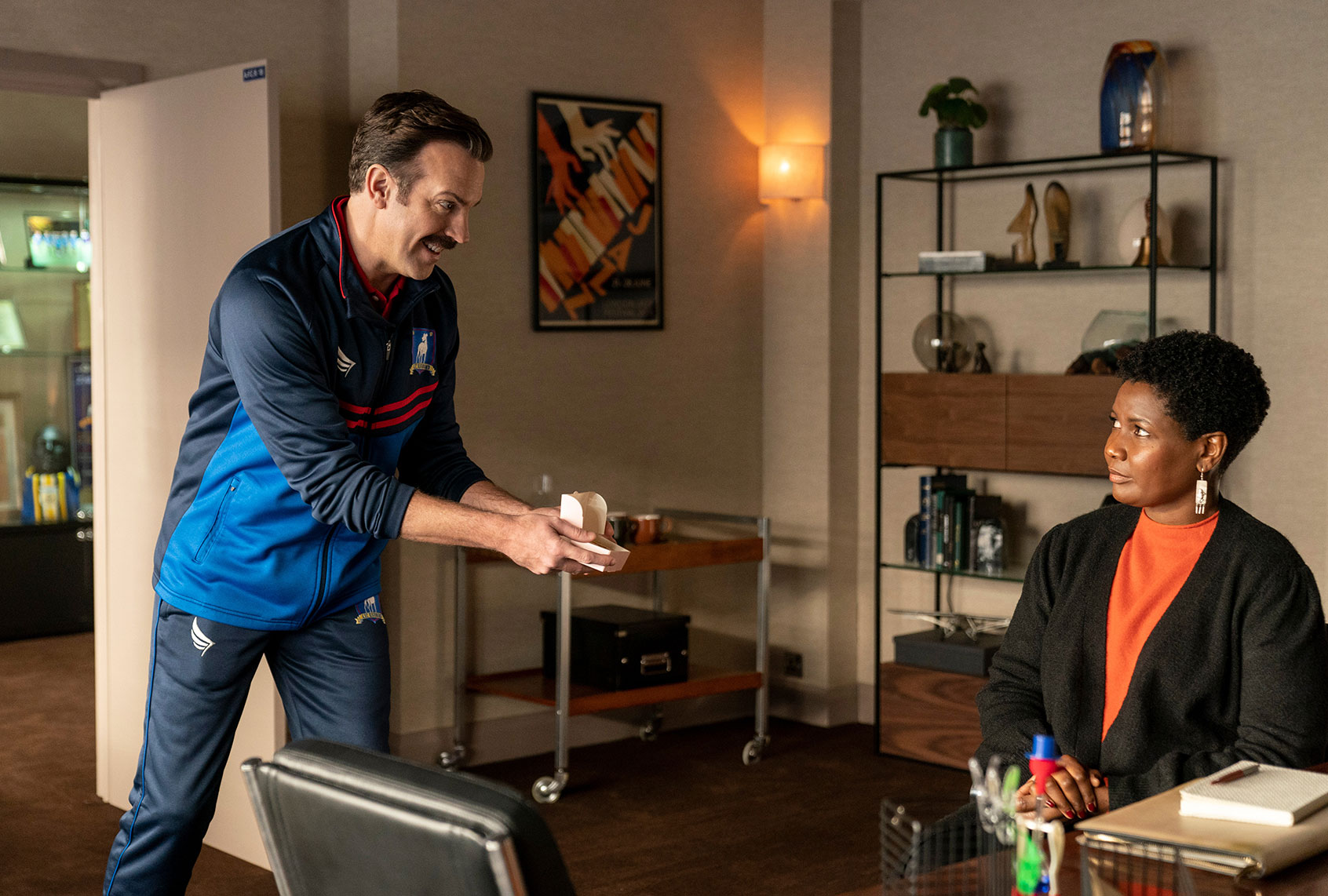
Ted LassoJason Sudeikis and Sarah Niles in “Ted Lasso” (Apple TV+)

Furthermore, this season introduces Dr. Sharon Fieldstone (Sarah Niles), a sports psychologist who comes to work with Ted’s team . . . and the personification of everything he’s been avoiding about his own troubles. She can’t be bought with his baked goods. She is immune to his charms, giant smile and hopeful eyes. She watches practices, and he becomes convinced that she’s judging his rapport with his athletes. (Is she moving down the bleachers during practice to judge him? Or is he being paranoid and she’s just doing her job and watching the players?) Frustrated that he can’t crack Dr. Fieldstone, Ted resorts to giving her the belittling nickname “Doc” and is shocked that his players not only willing schedule meetings with her – but that they get results from her sessions.

Thinking about these motives too long becomes frustrating and makes Ted really not all that likeable. It’s also perhaps something the writers of the show have zeroed in on and why the new season gives depth to non-Ted relationships on the show. 

We learned last season that Higgins, Jeremy Swift’s long put-upon Director of Football Operations, has a charming home life full of the love and respect he didn’t always get at work. We’ll now learn how he met his wife and how much more happy and confident he seems on the job.

Also, during a famous scene in the first season, Juno Temple’s influencer-turned team branding consultant Keeley Jones uses the tactics of a press conference to teach new paramour Roy Kent (Brett Goldstein) why he has no say over what this “independent woman” does with her own time. This season, her convincing him that their relationship isn’t going to work unless he expresses himself – and really just the fact that Goldstein and his nostril flaring get more screen time in general – are the reasons I stick with the series. Plus, an upcoming Christmas episode, which will debut in the dog days of summer, makes me wish for a cup of cocoa and fuzzy sweat pants.

I write all this as a dedicated fan of co-creator Bill Lawrence’s work. I spent part of quarantine re-watching “Scrubs” and began following actress Busy Philipps on Instagram more because of her work on his “Cougar Town” than because of her work on the cult hit “Freaks and Geeks.”

I just don’t “believe” in Ted’s optimism.

“Ted Lasso” streams new episodes on Fridays on Apple TV+.

Apple’s Siri is no longer a woman by default, but is this really a win for feminism?

As of March 31, 2021, when Apple released the iOs 14.5 beta update to its operating system, Siri no longer defaults to a female voice when using American English. Users must now choose between two male and two female voices when enabling the voice assistant. This move could be interpreted as a response to the backlash against the gender bias embodied by Siri

But how meaningful is this change really?

Siri has been criticized as embodying several facets of gender bias in artificial intelligence. Digital sociologists Yolande Strengers and Jenny Kennedy argue that Siri, along with other voice assistants such as Amazon Alexa and Google Home, have been developed in order to “carry out ‘wifework’ — domestic duties that have traditionally fallen on (human) wives.”

Siri was originally only voiced as female and programmed to not only perform “wifely” duties such as checking the weather or setting a morning alarm, but also to respond flirtatiously. The use of sexualized phrases by Siri has been extensively documented by hundreds of YouTube videos with titles such as “Things You Should NEVER Ask SIRI” (which has more than 18 million views).

AppleInsider reviews Siri’s new voices.

Dated gender references

Apple has been criticized as promoting a sexualized and stereotypical image of women that negatively harms gender norms. A 2019 investigation by The Guardian reveals that Apple wrote internal guidelines in 2018 asking developers to have Siri deflect mentions of feminism and other “sensitive topics.” It’s not clear what the guidelines were for hard-coding flirty comebacks.

The language used by Siri was (and still is) a combination of an already stereotypical language model, including jokes hard coded by developers. A 2016 analysis of popular language models used by software companies noted that word associations were highly stereotypical. In the study, terms such as philosopher and captain were gendered male, while the opposite was true for terms such as homemaker.

Legal scholar Céline Castets-Renard and I have been studying language models used by Google Translate and Microsoft Bing that have revealed similar issues. We input gender-neutral phrases in romanized Mandarin into the translation platforms, forcing the translation algorithms to select the gender in English and French. Without exception, the Google algorithm selected male and female pronouns along stereotypical gender lines. The Microsoft algorithm, conversely, exclusively selected male pronouns.

The use of models such as these in Siri’s algorithm might explain why, when you type in any corporate title (chief executive officer, chief financial officer, etc.), a male emoji would be proposed. While this has since been addressed — likely due to criticism — in the latest iOS, if Siri is asked to retrieve a photo of a captain or a programmer, the images served up are still a series of men.

Friendly and flirty

The idea of the perfectly flirtatious virtual assistant inspired Spike Jonze’s 2013 movie “Her,” in which the male protagonist falls in love with his virtual assistant. But it’s hard to imagine how biased language models could cause a virtual assistant to flirt with users. This seems likely to have been intentional.

In the 2013 movie “Her,” a divorced couple confront intimacy and virtuality.

In response to these criticisms, Apple progressively removed some of the more flagrant traits, and apparently hard coded away some of the more offensive responses to user questions. This was done without making too many waves. However, the record of YouTube videos shows Siri becoming progressively less gendered.

One of the last remaining criticisms was that Siri had a female voice, which remained the default even though a male voice was also provided as an option since its 2011 launch. Now, users must decide for themselves if they want a female or a male voice.

Users don’t know, however, the language model that the virtual assistant is trained on, or whether there are still legacies of flirty Siri left in the code.

Bias is more than voice-deep

Companies like Apple have a huge responsibility in shaping societal norms. A 2020 National Public Media report revealed that during the pandemic, the number of Americans using virtual assistants increased from 46 to 52%, and this trend will only continue.

What’s more, many people interact with virtual assistants openly in their home, which means that biased AIs frequently interact with children and can skew their own perception of human gender relations.

Removing the default female voice in Siri is important for feminism in that it reduces the immediate association of Siri with women. On the other hand, there is also the possibility of using a gender-neutral voice, such as the one released in 2019 by a group led by Copenhagen Pride.

Changing Siri’s voice doesn’t address issues related to biased language models, which don’t need a female voice to be used. It also doesn’t address hiring bias in the company, where women only make up 26% of leadership roles in research and development.

If Apple is going to continue quietly removing gender bias from Siri, there is still quite a bit of work to do. Rather than making small and gradual changes, Apple should take the issue of gender discrimination head on and distinguish itself as a leader.

Allowing large portions of the population to interact with biased AI threatens to reverse recent advances in gender norms. Making Siri and other virtual assistants completely bias-free should therefore be an immediate priority for Apple and the other software giants.

Curtis Hendricks, Data Science Consultant, contributed to the authorship of this article.

Eleonore Fournier-Tombs, Adjunct Professor, Accountable AI, L’Université d’Ottawa/University of Ottawa

This article is republished from The Conversation under a Creative Commons license.

How does the pandemic end now?

On Thursday night, news surfaced of an internal Centers for Disease Control and Prevention (CDC) memo revealing just how contagious, and threatening, the delta variant is. The rapid, fearful spread of the delta variant, and its ability to infect the vaccinated at a higher rate, has quelled hope that the pandemic is truly, finally waning. As journalist Maura Judkis wrote for the Washington Post, “instead of flattening the curve, we’ve hit the delta swerve.”

Specifically, the slide presentation first obtained by The Washington Post, estimated that among the 162 million vaccinated Americans there are 35,000 symptomatic infections each week. Vaccinated people are much less likely than unvaccinated people to be hospitalized or die from the mutant strain, according to the memo; but, if infected, they are able to spread it to vaccinated and unvaccinated people.

The news has led to swift public policy changes across the country, such as reinstating mask mandates, and even pushing back in-person office openings. The ominous shift in the pandemic precipitated by delta’s spread raises the question: Will we ever be out of the woods? In other words, when — and how — does this pandemic end?

* * *

While the delta variant is alarming, both for its rapid spread and its ability to occasionally infect the vaccinated, it is not invincible against the existing COVID-19 vaccines. Those who are vaccinated are less likely to get hospitalized or die from the delta variant than those who are unvaccinated. 

Still, that doesn’t mean such things cannot happen. And it turns the delta variant may foreshadow the future of the novel coronavirus — a future in which the virus continues to mutate and spread throughout the human population, year after year, again and again. 

Dr. Amesh Adalja, a senior scholar at the Johns Hopkins Center, told Salon that he believes it has “always been the case” that “the pandemic ends with SARS-CoV-2 becoming an endemic seasonal respiratory virus like the other 4 coronaviruses that we deal with year in and year out.”

“The delta variant doesn’t change that trajectory but confirms it as the virus has become more efficiently transmissible, increasing its reach into the population,” Adalja said. “There will not be a single point where the pandemic ends; it will just transition, and has partially transitioned in states in which cases have been decoupled from hospitalizations.”

In previous interviews, Adalja has emphasized that the public health goal will never be to eradicate the coronavirus, but instead to not overwhelm hospitals with severe infections. The current available COVID-19 vaccines are still a means to do that. When asked if the number of symptomatic breakthrough COVID-19 infections estimated in the memo was alarming, Adalja said “no.”

“Because they almost never land people in the hospital,” Adalja said.

As Kathleen Neuzil, a vaccine expert at the University of Maryland School of Medicine, told the Washington Post, there needs to be a shift in preventing infections to preventing severe disease.

“We really need to shift toward a goal of preventing serious disease and disability and medical consequences, and not worry about every virus detected in somebody’s nose,” Neuzil said. “It’s hard to do, but I think we have to become comfortable with coronavirus not going away.”

When asked where we go from here, Dean Blumberg, chief of pediatric infectious diseases and associate professor in the Department of Pediatrics at the University of California, Davis, said he sees COVID-19 becoming more like a “cold” and “flu” — for the vaccinated.

“Essentially we’re going to have COVID be similar to colds or flu — it will be endemic, there will be continued risk and there will be a small percentage of people that have severe disease, but the vast majority of vaccinated people will have mild illness and it will be an outpatient illness,” Blumberg said. “Those who are unvaccinated will still be at risk for severe disease, but what this suggests is that people who are vaccinated may have breakthrough infections, they may have replication of the virus at a high level in their upper respiratory tract, and therefore they may transmit to others also.”


Want more health and science stories in your inbox? Subscribe to Salon’s weekly newsletter The Vulgar Scientist.


Blumberg said that this news doesn’t mean we will never return to a sense of “normalcy,” mirroring pre-pandemic days, but that it might take more population immunity to get there.

“I think we can eventually return to near normal,” Blumberg said. “The challenge is that the virus is much more extraordinarily infectious.” He explained that the novel coronavirus’ “R-naught” number — a number that describes on average how many new people are infected from each case, considered a measure of a virus’ infectivity — has increased precipitously throughout the pandemic. 

“The number of infected people that result from every infected case has gone up from 2.4 at the beginning of the pandemic to around 8,” he noted. “Now it’s in the realm of some of the most infectious agents known to mankind.”

Similar to the measles or chickenpox, a higher percentage of people immune to the virus is needed to stop transmission completely.

“So for measles, for example, we need 95% of the population immune to result in limited transmission of cases introduced to a community, so that’s what we’re looking for,” Blumberg said. “Earlier in the pandemic we were looking at maybe 75% or 80% immunity to limit transmission, but the bars were set higher.”

* * * 

The new reality of the “forever” coronavirus pandemic means that the pharmaceutical industry will have to shift its strategy, too. Beyond merely distributing existing vaccines, there is a need now for boosters, new vaccines that immunize against variants, or both. 

Pharma’s strategy moving forward is still unclear. Could it be that booster shots that specifically target the delta variant could help us get to a 95% level of herd immunity sooner? A third dose of the Pfizer/BioNTech COVID-19 vaccine can “strongly” boost protection against the Delta variant, according to Pfizer data. but that doesn’t mean more people will get vaccinated.

But vaccines take time — months or years — and lots of testing before they can be deemed safe. In the meantime, life will continue apace for millions of Americans — as will gatherings, events and human interactions. 

And what of those? As for how one should approach gatherings in the delta variant phase of the pandemic, Blumberg recommends doubling-down on masking and social distancing, especially in areas where delta transmission is high, and if they’re unvaccinated or vaccinated with weakened immune systems.

“The vast majority of people who have breakthrough infections, who are vaccinated, are going to have mild infections; they’re going to maybe have a fever, cough, runny nose and be sick for a couple days and then they’re going to get better and that’s not that big of a deal,” Blumberg said. “If you’re unvaccinated, then you’re rolling the dice about whether you’re going to end up in the hospital.”

“For vaccinated people with weakened immune systems, who might have a suboptimal response to vaccination, it becomes even more important to take the extra layers of protection to avoid breakthrough infection,” Blumberg added.

Millions face eviction as Congress’ last-minute effort to extend moratorium falls short

A federal eviction moratorium expired Saturday at midnight after a full day of scrambling in Congress on Friday to extend the deadline — with the policy sunset, along with a failure to provide desperately needed emergency rental aid, putting millions of Americans at risk of losing their homes.

The news also comes just as the delta COVID-19 variant continues to vex public health efforts across the country.

Congressional Democrats blasted the White House — which waited until Thursday to announce that it would not attempt to extend the program due to potential legal challenges — for providing insufficient notice ahead of the deadline. 

Speaker Nancy Pelosi released statement Friday, saying her caucus had really “only learned about this yesterday.” Others were more pointed.

“The fact that this statement came out just yesterday is unacceptable,” Rep. Alexandria Ocasio-Cortez, D-N.Y., told reporters Friday. “I want to make that very clear. Because the excuses that we’ve been hearing about it, I do not accept them.”

The eviction moratorium had been bogged down for months in court, which ultimately resulted in a Supreme Court ruling last month that said the current eviction ban would expire July 31 unless an extension was approved by Congress.

In a joint statement with House Majority Leader Steny Hoyer, Pelosi also blamed Republicans for being unwilling to consider an extension to the program on short notice.

“It is extremely disappointing that House and Senate Republicans have refused to work with us on this issue,” they wrote. “We strongly urge them to reconsider their opposition to helping millions of Americans and instead join with us to help renters and landlords hit hardest by the pandemic and prevent a nationwide eviction crisis.”

The freeze was originally enacted by the Centers for Disease Control last September as a precautionary COVID-19 measure. President Joe Biden decided to extend the program in March — sparking a protracted court battle. 

White House Press Secretary Jen Psaki said Thursday that the administration would have liked to take action, but “unfortunately the Supreme Court has made clear that this option is no longer available.”

Members of the House’s left-leaning “Squad” staged a protest at the Capitol Friday, and Rep. Cori Bush of Missouri — who was once homeless herself — spent the night on the Capitol steps.

“I know what it’s like to wonder if I’m going to get that eviction notice,” she said. “Your whole life turns upside down, and that’s what’s going to happen to seven million people over the course of the next few weeks.”

Industry groups, like the powerful National Association of Realtors, have objected to any extension of the national eviction freeze. A group of organizations told lawmakers Friday that the policy hit small-time landlords especially hard, those who “continue to pay mortgages, taxes, insurance and maintain the safety of their properties for tenants with less or, in many cases, no rental income,” according to a letter obtained by POLITICO.

The most recent Census pulse survey, administered during the final week of June and first week of July, found that 7.4 million Americans were behind on rent, while another Census survey released earlier this month found that 3.6 million people say they’re facing eviction in the next 60 days.

10 types of tomatoes we aspire to eat every day this summer

Every month, Melina Hammer, Food52’s very own Hudson Valley correspondent, is serving up all the bounty that upstate New York has to offer.

* * *

We have entered my favorite season: the season of gorging on tomatoes. I grow both hybrid and heirloom tomatoes at Catbird Cottage, and once the first fruits have ripened, after a gleeful harvest, there are BLT sandwiches and numerous batches of sauce and confit that follow. I clear the calendar to bottle my surplus, preserving the season so I can enjoy their exceptional flavor year-round.

Heirloom tomatoes have become quite popular in recent years. These tomatoes are open-pollinated, which makes them more genetically diverse and allows them to adapt to local growing conditions and changing climates. True to their name, these tomato seeds have been passed down through generations, enduring the test of time. They are known for walloping deep — or bright, depending on the cultivar — tomatoey-ness.

Hybrid tomatoes have their benefits, too, especially if you want to grow disease- or pest-resistant tomatoes. But their seeds cannot be saved and reused as easily, so if you want to grow tomatoes, choosing open-pollinated varieties conserves the genetic diversity in the garden and prevents the loss of unique varieties in the face of dwindling agricultural biodiversity.

Here are 10 tried-and-true types of tomatoes — plus two new recipes at the end.

* * *

10 types of tomatoes to love

1. Roma

This plum tomato variety is long and densely meaty. Also known as the paste tomato, it is the perfect pick for making tomato paste or sauce. Most commercial plum tomatoes sold in the U.S. are a version of the Roma. Use the flavorful sauce for shakshuka, clams, or ragu.

https://www.instagram.com/p/CKt7hP5Mp2r/

2. Sungold

This cherry-style tomato is the current darling of the tomato world. Like little jewels, Sungolds make a perfect sweet snack, adored by kids and adults alike. Here at Catbird, they grow abundantly late into the season — we eat just as many straight from the vine as we put toward confit or colorful panzanella.

https://www.instagram.com/p/BnyyZg8FGgN/

3. Green Zebra

This green and yellow striped tomato is known for its bright acidity. Though green tomatoes are commonly thought of as unripe, the man who cultivated this variety, Tom Wagner, was fascinated by the idea of producing a green tomato that was meant to be just that. Add this tomato to a rainbow caprese with burrata or a crunchy cucumber, corn, and green bean salad.

https://www.instagram.com/p/B1txPRGA1oC/

4. Cherokee Purple

This heirloom tomato is one of my all-time favorites. Large, heavy, and irregularly shaped, with a concentrated tomato flavor. When ripe, they have purplish skin, green-tinged shoulders, and deep crimson flesh. This tomato is great slow-roasted into jammy perfection — or thickly sliced, piled on toast, and sprinkled with flaky salt.

https://www.instagram.com/p/CO_Gj_CsAow/

5. Brandywine

Brandywine is one of the largest cultivated tomato types. Belonging to the beefsteak family, it’s also an heirloom, grown as far back as 1886. Its pink flesh delivers a meaty slice and is one of the most popular home garden cultivars. Sprinkle wedges with salt and pepper, then drag through mayo for a simple pleasure. Or roast them in a savory galette, anointed with good olive oil.

https://www.instagram.com/p/B2E2O0VAnwo/

6. Mortgage Lifter

This tomato is legendary for its enormous size — it was bred in the 1930s to weigh up to 2 pounds! Not skimping on flavor either, the Mortgage Lifter is a great everyday tomato. Its mild, sweet flavor makes a great sauce.

https://www.instagram.com/p/CFW8LadsLCs/

7. Campari

Larger than cherry tomatoes but smaller than plum tomatoes, Camparis are commonly seen as the on-the-vine variety at grocery stores. Known for low acidity and sweet, juicy interiors, they are ideal cut into hearty wedges and added to salads. Or put toward that refreshing summer favorite, gazpacho.

https://www.instagram.com/p/CMC4OdRsGmK/

8. Currant

As it ripens on the vine, this diminutive tomato resembles dangling earrings. They grow to only 1/2 inch across, are brilliantly red, and make a fantastic addition to salads, with torn herbs and burrata or feta. They’re also a great pickling tomato due to their firmness and snackable size.

https://www.instagram.com/p/CPyVLAMs5cU/

9. Santorini

This ribbed, smallish tomato originally hails from Greece and, true to its origins, thrives in dry climates. Plants produce abundant, bright, and acidic fruit. It’s delicious served raw in salads, or roasted and served with brothy beans.

https://www.instagram.com/p/CH5obK4MMei/

10. Blush

This elongated, oval-shaped cherry tomato variety is orange-pink with reddish stripes when ripe. It’s sweet and fruity, and best eaten raw. Adding a few of these is an easy way to make any plate of food beautiful.

https://www.instagram.com/p/BmlalZllo1_/

* * *

2 Shiny New Tomato Recipes

Dark Academia and debt: University thrillers are the literary subgenre of the student loan crisis

Dark academia looms large in our current cultural imagination, evidenced not only by the aesthetic’s trendiness — the dark, moody libraries, the skulls and melting candles, the Gothic campuses flooding social media — but by a recent wave of books labeled “dark academic thrillers.” These thrillers share the visual world of the aesthetic, and, as Amy Gentry points out, also trace their lineage back to Donna Tartt’s 1992 hit “The Secret History,” the dark academic ur-text. According to Gentry, the novels often have the following in common: “a fish-out-of-water protagonist from a hardscrabble background; a charismatic professor who inspires cultish devotion in her students; a gothic campus with lots of gargoyles; and, of course, as much sex and drinking as studying.”

The concept of dark academia isn’t exactly new, but its popularity and proliferation are. The New York Times speculates we’re drawn to it now because we’ve been out of school for the past year, giving academia an added allure. I think there’s something bigger going on. The dark academic aesthetic celebrates the world of elite colleges in particular, imbuing them with an almost glamorous sense of danger, but its literary counterpart leans much harder on the danger, with plots that dismantle the very fantasies about prestigious education the aesthetic thrives on, creating a tension between colleges as ennobling institutions vs. sites of tragedy, literal and ideological violence. As much as dark academia can glorify academia, it also depicts it as haunted by an invisible threat. I don’t think it’s a coincidence that either the aesthetic or the subgenre is popular at a time when America’s relationship to higher education is more fraught than ever, our collective dream of education haunted by the specter of debt.

With the election of President Biden in November, we seemed to be taking a step toward federal student loan forgiveness, a policy that would own up to the ways America’s higher education system is broken and even predatory, and make amends to those who were forced to mortgage their futures for an education by erasing the past debts that still burden them. But the policy has sparked intense debate, even among those who seemed to support it during the election. Questions have been raised: Has college tuition spun out of control, or are tuition numbers reasonable, despite the fact that millions must go into debt to attend? Don’t colleges give students a good return on their investment? Isn’t education the most important thing a person can strive for, so valuable you can’t really put a price tag on it? And if someone takes out a loan, aren’t the consequences theirs to bear?

The answers are complicated, and it doesn’t seem like we can make up our mind: In 2021, the same year the country’s collective student loan debt reached an all-time high and borrowers urged the Biden administration to treat their debt as a crisis, the ultra-expensive Ivy League saw a record boom in applications. (To be fair, while Ivy league schools are not among the highest-ROI colleges, they’re also not among the lowest). Like moths to a flame, we seem endlessly drawn to the bright, beautiful fantasy of college, even when the price is steep enough to crush us.

Even when debt is absent in explicit ways from dark academic subculture and thrillers (though it often pops up in the novels), they represent and work through fantasies, tensions, and ideas about higher ed that are intrinsic to this moment. The books in particular seize on the romanticized vision of college rampant in the aesthetic, turning it on its head to depict characters in tortured and tragic relationships to higher education — to professors, fellow students, fellowship programs, grades, social clubs — characters who love and chase the people and things that continuously harm them. They ask critical questions about colleges as sites that perpetuate classism, places that not only reify hierarchies of value but rely on it as part of their mythology. I’m inclined to call dark academic thrillers the subgenre of the student debt era because of the way they open space to critique not only higher ed but the myth of meritocracy that pervades it, acting as a shield to obscure how much of academic success has nothing at all to do with merit.

The dark academic aesthetic often presents university life at its most elite, arcane, and privileged, divorced from the working world: the images you’ll find on Instagram are of Princeton’s Gothic splendor, not your local community college. To enter the gorgeous, spired libraries of dark academia (in your tweed jacket, of course) is to be let into a secret world, a society composed of the best of the best: like-minded people, dedicated to the life of the mind. It’s a subculture appealing to bookish outsiders, offering a liberating dream, school imagined as a place to belong and shine. But the idea of a noble mind has long been bound up with noble classes. Despite its obsession with a very upper-crust British version of school, at the heart of the dark academic aesthetic is an idea as American as apple pie: that education is sacred and ennobling; that prestigious schools offer students not only an invitation to a wealth of knowledge, but to upward mobility, to literal wealth. And while the student debt crisis disproves this, the idea is still so powerful that it animates much of the discourse around college and tuition.

To its credit, the aesthetic doesn’t only revere: also imbues its college fantasies with a sense of danger. The “dark” in dark academia is represented by literal shadows and artfully-arranged skulls and daggers, evoking a sense of memento mori, an undercurrent of loss and threat. As if a question haunts each beautiful, eerie image: all of this, at what cost?

This question drives dark academic thrillers, which take the tensions hinted at in the aesthetic—elite colleges as sites of beauty, belonging, and inclusivity, versus classist institutions, breeding hierarchy, full of threat—and dial them up to eleven. The main characters in these thrillers, as Gentry wrote, are nearly always economic and social outsiders who have won entrance to elite colleges or programs, usually brainy overachievers hungry to succeed. Suffice to say they do not find the intellectual paradises they imagined. Instead, over the course of the novels, they are forced to continue competing, to compensate for newly-discovered intellectual, social, and financial inferiority, to impress often predatory professors and mercenary classmates, and to perpetuate the rigid class hierarchies elite colleges run on. In essence, they are forced to become ruthless or are driven mad, driven to violence. At college, their dreams unravel.

This is true of working-class PhD student Mac Woods in Gentry’s novel “Bad Habits,” who wants desperately to be considered brilliant by her professors and win a coveted fellowship, driven by a literal need for money and a psychological need to feel equal to her wealthy peer Gwen Whitney. In “The Girls Are All So Nice Here,” middle-class freshman Ambrosia Wellington is desperate to shed her déclassé habits, convinced she’ll belong if she can only perform the same kind of cruelty her popular friend Sully does; in my novel “In My Dreams I Hold a Knife,” undergrad Jessica Miller will do anything — take out debt she can’t afford, betray her friends, compromise herself in every way — for the academic success she thinks will turn her into somebody.

Characters like these dramatize the lengths people will go to in order to succeed, to be thought of as valuable by others. And while debt and class issues are explicit in these three novels, even dark academic thrillers that don’t explicitly mention financial debt frequently dramatize indebted relationships, consistently depicting characters’ relationships to prestigious institutions and people as abusive ones, giving and giving without reciprocation. Like a Sallie Mae contract, the seeds of these tragedies are buried in the terms themselves: from the moment they swallow the idea that success and acceptance from these institutions is the measure of their worth, each character is doomed to dig themselves into deeper and deeper holes.

If in real life and fiction we are starting to see that the cost of an education can outweigh its rewards, why do we continue to apply to colleges we can’t afford and sign the dotted line on (often predatory) loans?

I’ve asked this of myself. I was the first in my family to go to college. My senior year, as we struggled with maze-like FAFSA forms, my father was also struggling to find work and my mother received a little above minimum wage for her retail job; right before the holidays, as I was wrapping up college applications, we had a family meeting to prepare for the possibility of losing our home. Like many, I’d grown up dreaming of going to a good college, but as we looked at tuition costs, I had to ask myself: What am I willing to do for this dream?

The answer was easy, because my parents had drilled into me that education was everything, the key to success. So I would do anything, including going into debt for decades. After all, I’d eventually be able to pay back the debt I took out for college thanks to the opportunities college would give me — right? In my case, yes. For friends and other family members who took a similar gamble, no. They’re still paying with no end in sight.

But I won’t pretend my decision was strictly utilitarian, a matter of coldly determining the juice was worth the squeeze. I also believed in the idea that the value of college can’t be measured in strictly financial terms. And while I still do, I also see the ways this claim helps keep colleges unaccountable. Unsurprisingly, dark academic thrillers both empathize with and poke holes in this claim, and they do it by playing with the idea of collegiate prestige as a fetish. Characters are so powerfully attracted to the idea of success that its markers—attendance at elite colleges and programs, Gothic architecture, high grades, fellowships, positions in campus social hierarchies — are fetishized, both in the Marxist sense of a commodity fetish — a thing so coveted that its market value exceeds its actual material worth—and a sexual fetish, an attraction that can’t be fully explained by logic. In these books, prestige academia is irrationally desirable, valuable for reasons that have nothing to do with ROI and everything to do with deep-seated human needs and feelings.

Take a short but pivotal scene in “Bad Habits,” in which Mac, who’s been waitressing to support herself through grad school, sticks a thick stack of bills in her drawer after a shift. The next moment, without knowing why, she takes the stack back out and puts the money in her mouth. The scene is sensual: Mac smells the bills, rests her teeth on them, feeling the texture, indulging the strange attraction. A similar thing happens with the heady literary theories she at first can’t grasp, then, over time, luxuriates in. In the novel’s opening scene, a much-older Mac picks up a grad student at a conference who’s “all elbow-patched corduroy and absurd woolen scarf and lips pouting suggestively around the word Lukács.”

Dollar bills and Marxist theorists are just two of the things Mac fetishizes: The same way it’s both understandable and yet not wholly rational to worship a slip of paper or a literary critic, Mac’s compulsion to attend grad school, then be recognized as her professors’ favorite, then win the fellowship, then get a tenure-track position — her willingness to go to any lengths to attain the accomplishments that were always supposed to go to her peer Gwen, never her — is both understandable and unreasonable. We see how Mac is driven to vicious lengths by a deep-rooted feeling that attaining these things will bring her a better life, power and comfort, all the things she believes she deserves. And we can recognize that her choices are bad even as we cannot fault her for wanting what she wants, and making what she thinks are the best decisions given limited options. If we can understand that a prestigious, expensive college education is a fetish many of us share, representing things we can fault no one for wanting, can’t we extend the same empathy to student borrowers?

While the dark academic subculture can at times glorify college, from “The Secret History” forward, critique has also been endemic to the genre, part of its DNA. It’s no wonder we’re drawn to it as we wrestle with historic higher education policy decisions. Though dark academic thrillers are by no means meant to be morality tales, their tragic narratives of students driven to shocking ends point again and again to systems and ideologies as the true antagonists, flipping the script on questions of individual responsibility that pervade the student debt conversation. Maybe, unlike the novels’ characters, we’ll actually learn something.

“Both sides” journalism isn’t even journalism — at this point, it’s Republican propaganda

The first witnesses in the House select committee’s investigation of the Jan. 6 Capitol attack last week were clear about what its goals ought to be. Officer Harry Dunn put it most bluntly: “Get to the bottom of what happened. “If a hit man is hired and he kills somebody, [the] hitman goes to jail. But not only does the hitman go to jail, but the person who hired him does. There was an attack carried out on Jan. 6, and a hitman sent them. I want you to get to the bottom of that.”

The others agreed. “We do need to get to the bottom of it,” Sgt. Aquilino Gonell echoed. “Who incited, who brought those people here.”  

“That is what I am looking for, is an investigation into those actions and activities which may have resulted in the events of Jan. 6,” said Officer Michael Fanone. “And also whether there was collaboration between those members, their staff and these terrorists.” 

“Fanone hit the nail on the head there,” Officer Daniel Hodges followed up. “I need you guys to address if anyone in power had a role in this. If anyone in power coordinated or aided or abetted or tried to downplay, tried to prevent the investigation of this terrorist attack.”

These were not partisan witnesses with a partisan agenda. They were law enforcement officers with a patriotic agenda. What they asked for was precisely analogous to what was asked for from the 9/11 Commission, whose example Democrats had originally hoped and tried to follow, only to be thwarted by Republican opposition, organized by House Leader Kevin McCarthy and Senate Leader Mitch McConnell. What they asked for was a full accounting, to ensure that it would never happen again. 

This ought to be utterly uncontroversial, especially for journalists, whose job it is to get to the bottom of things. But not anymore, it seems. Instead, the very existence of the hearings was treated as a partisan exercise of power, utterly contradicting the fact that Republicans had scuttled the balanced 9/11-style model Democrats had initially tried to advance. And much of this came from journalists who obviously knew better. 

CNN’s Chris Cillizza first excoriated McCarthy for his committee picks, correctly observing, “He has zero interest in getting to the bottom of what really happened (and why) when the US Capitol was stormed by rioters,” and noting that Rep. Jim Jordan’s proposed “presence on the committee ensures then is that it will be a circus.” But the next day Cillizza turned amnesiac, with a piece headlined, “Nancy Pelosi just doomed the already tiny chances of the 1/6 committee actually mattering.” Not only would the committee would be seen as partisan, Cillizza argued, but “you should give up on” any hope that it “might produce a report that would help us understand what happened in the lead-up to that day,” without noting that this new claim directly contradicted what he’d written just the day before, about Jordan in particular.

With reactions like this, journalists violate something even more fundamental than getting to the truth — that is, getting the truth to the people. Seeking the truth just to know it for oneself isn’t journalism. Journalism is a public profession, a civic profession. Its purpose is to make the world legible, so that citizens can make democracy work. It’s about the making of common sense. That’s why autocrats the world around throw journalists in jail. Or shut down news outlets altogether, like Apple Daily in Hong Kong. When it happens abroad, we have little trouble seeing it. In contrast, the purpose of propaganda is to make the world illegible, making it impossible for people to be effective citizens. We have little trouble seeing this when it happens abroad, particularly in such perceived global adversaries as Russia and China. 

Yet this is what much of mainstream “journalism” is doing right now here at home: making the world illegible so citizens throw their hands up in despair. It couldn’t come at a worse time. The GOP is trying to normalize Jan. 6, normalize Donald Trump’s pathological destruction of democratic norms and institutions, and move toward the establishment of a competitive authoritarian system in place of electoral democracy. And the press, for its own muddled reasons, is helping them do this. Prominent media figures and institutions are normalizing the attempted slow-rolling overthrow of American democracy, and de facto allying themselves with Republicans by misreporting their fundamental hostility to democracy as just another bout of partisan warfare, in which both sides make equally serious, facially valid claims.

It’s not easy to see this as propaganda, because we assume that propaganda comes from one side or another, whereas this “journalism” goes out of its way to “balance” both sides. But when both sides have been so profoundly different for so long, pretending otherwise can only make the world illegible, whether the issue is infrastructure, voting rights or the future of democracy itself. Critics have complained about such practices for decades, offering alternatives as well — see James Fallows’ 1997 “Breaking the News” or Jay Rosen’s 1999 “What Are Journalists For?” as classic examples. 

But the widespread misreporting of McCarthy’s attempted sabotage of the 1/6 investigation starkly casts things in a harsher light. This isn’t simply “flawed” journalism. It isn’t journalism at all. It’s the opposite: It’s propaganda. It actively undermines the capacity for understanding, and thus, for self-governance. It was aptly described as “The absurd coverage of the January 6 committee” in a particularly perceptive piece by Jon Allsop for the Columbia Journalism Review.   

“Both sides” metastasized 

“This is, indeed, bothsidesism as we’ve come to understand the term, insofar as it bent over backward to find Democratic culpability in a problem that Republicans created,” Allsop writes, saying it represented “a slippage from a clear-cut understanding of the term” as previously understood, “the idea of false equivalence.”  

There was that, of course — coverage “casting it as part of a ‘partisan brawl,’ or juxtaposing soundbites from Pelosi and McCarthy without adding much context” — but there was also coverage that “committed far graver sins; arguably, the worst of it was so bothsidesy that it approached onesideism, scolding Democrats while letting Republicans off the hook.”  

Allsop goes on to note three particular problems, starting with Brian Beutler’s observation of a perverse inequivalence: “the commonplace journalistic assumption that ‘Republican bad faith … is just a feature of the landscape,’ whereas a given Democrat is ‘an actor with agency, and subject to scrutiny.'” Along the same lines, Beutler earlier wrote, “Baking the presumption of GOP bad faith into everything, rather than treating it as a series of choices by human agents, creates a kind of impunity (through exhaustion or savviness or whatever else) where it isn’t even worth pressing them on their conduct.”

Second, Mehdi Hasan’s observation on “Pod Save America” that “in the eyes of many pundits, a given political development is often framed as being Bad News for Democrats, but not for Republicans.” Third, there’s the particular kind of what I’d call brain-dead analysis that, “taken on its own terms, [gets] lost down a series of empirical and logical dead ends.” 

Allsop cites a couple of examples: One was the claim that Pelosi set a dangerous precedent, when in reality, Republicans have repeatedly been willing to break precedent whenever it suited them, so the idea that “they need the cover of Democrats doing it first is absurd.” The other was the discussion of “credibility,” linked either to accepting insurrectionists onto the committee, or to criticizing Pelosi for destroying its bipartisan nature. This either ignores renegade Republicans like Liz Cheney and Adam Kinzinger or discounts them based on “Alice in Wonderland” logic:  “Such an analysis implies that, to satisfy the demands of bipartisanship, Republicans aren’t Republican enough if they take seriously the thing the committee was created to take seriously. This, clearly, is circular, and self-defeating.”

Allsop doesn’t tie these different problems together, but that part is easy. It starts with “both sides” journalism treating both parties symmetrically, when they’re fundamentally different in important ways. One way they differ is in terms of bad-faith politicking, which has grown especially pronounced since Newt Gingrich’s speakership. Once the press accepted and normalized Gingrich’s tactics, Democrats were at a perpetual disadvantage, so much so that framing anything “as being Bad News for Democrats, but not for Republicans” was simply a way of reflecting how much the game had been rigged in advance. Finally, the brain-dead analysis reflects the media’s tendency to record and accept Republican descriptions of their fantasy world, and then to pretend it reflects reality. 

Another feature or bug of the “both sides” approach is what NYU journalism professor Jay Rosen calls “the savvy style,” which he has described this way:

When journalists define politics as a game played by the insiders, their job description becomes: find out what the insiders are doing to “win.” Reveal those tactics to the public because then the public can … well, this is where it gets dodgy. As my friend Todd Gitlin once wrote, news coverage that treats politics as an insiders’ game invites the public to become “cognoscenti of their own bamboozlement,” which is strange. Or it lavishes attention on media performances, because the insiders are supposed to be good at that: manipulating the media. 

This was always a bad idea, including when Rosen wrote that in 2011. But consider the last few decades, when the celebrated media performances go from Richard Nixon to Ronald Reagan to Gingrich to George W. Bush — and then to Trump and his eager sycophants.  

By trying to be “balanced” and savvy — and maintaining the relationships on which insider-sourced journalism depends — the dominant media response has obscured what’s obviously going on: Republicans are deeply complicit with Trump (even more so after Jan. 6) and adamantly opposed to a truth-seeking investigation. 

All this happens, mind you, while the majority of journalists are Democrats. But it’s not their party affiliation that most intimately impacts how they do their jobs. That comes predominantly from their professional ethics, which are misunderstood and under-scrutinized, as described in Jeremy Iggers’ 1999 book, “Good News, Bad News: Journalism Ethics and the Public Good,” and from peer group pressures and expectations. Generations of right-wing attacks have taken their toll, resulting in deep-seated tendencies to bend over backward in order not to seem biased. Conservatives get to rail against the liberal media whenever they want, and the media responds by normalizing it — well, that’s just what conservatives do! — while bristling at any criticism from the left. 

“Both sides” rooted in asymmetric politics

The ethos of “both sides” “journalism” requires treating both parties symmetrically, but the two parties have never been symmetrical, as Matt Grossmann and David Hopkins showed in their 2016 book, “Asymmetric Politics: Ideological Republicans and Group Interest Democrats” (Salon review here). 

“The Democratic Party is focused on producing concrete solutions for citizens whereas the Republican Party is obsessed with conservative ideological purity,” I wrote at the time. “This is useful for understanding how the nation got to a point of contemplating a possible Donald Trump presidency. (In the authors’ view, Trump is the unintended product of a Republican Party purification process.)” 

One key factor underlying this asymmetry was first fully documented in  Lloyd Free and Hadley Cantril’s 1967 book, “The Political Beliefs of Americans.” As I summarized in 2018, “At the level of individual opinion, more people identify as conservatives than liberals, and conservative ideology (‘free markets,’ ‘limited government,’ etc.) is more popular. But on the other side of the ledger, support for specific liberal policies like Medicare, Social Security and so on is even more lopsided.” It was a disconnect the authors called “almost schizoid.” 

This fundamental difference explains a great deal, including the contrast between the Trump infrastructure train wreck and Biden’s (so far) low-key success. Trump saw infrastructure as a symbolic signature issue, and reveled in staging a series of “infrastructure weeks,” but couldn’t marshal the technical know-how to get a functional deal done, and never even really tried. Biden and the Democrats, on the other hand, have been working on so-called “human infrastructure” issues for decades. The term itself is new for most, but the thinking behind it isn’t. (Rosa DeLauro’s almost 20-year campaign to advance the expanded child tax credit is a particularly striking example.) So they’re better prepared for this legislative task than Republicans ever could be.

This basic reality is not just ignored, but actively obscured by “both sides” coverage. Take, for example, this short, telling passage from CNBC:

Republicans have so far refused to raise any corporate or individual taxes to offset the new funding, which will be added to an existing transportation bill for a total of $1.2 trillion. The White House, in turn, has refused to impose user fees on the improved highways and rails.

Nice, neat, symmetrical and factual, at least on the surface. But beneath the surface it’s profoundly deceptive. User fees are regressive taxes, falling disproportionately on the poor and the working class, whose incomes have stagnated for decades now, with only brief periods of respite. Corporate and high-income individual taxes are progressive taxes, which were cut sharply under Trump, and are far below historical averages.

So that symmetrical formulation fails to describe an asymmetrical reality, which is reflected in public opinion as well. A mid-June survey conducted by Invest in America and Data for Progress (memo here) found that huge majorities of likely voters support “paying for new investments in infrastructure by making corporate taxes fairer” and “increasing taxes on individuals who earn more than $1 million a year on income from stocks and bonds and on individuals who earn more than $400,000 a year.” by margins of 45-points and 38-points, respectively.” That was no fluke; a mid-July AP/NORC poll had similar results.

Furthermore, “likely voters overwhelmingly oppose increasing user fees (like highway tolls) or the gas tax in order to fund infrastructure investments.” So on both alternatives, the public overwhelmingly supports the Democratic position. But how many members of the public understand that, and what impact does that widespread consensus have, when the practitioners of “both sides” journalism do their utmost to obscure it, making it seem that the public must be evenly divided, aligned with whichever party they voted for in the last election?

The AP/NORC poll mentioned above also revealed remarkably strong support for all kinds of specific infrastructure spending, which is significantly at odds with the picture painted by media coverage of supposedly deadlocked Senate negotiations. Results range from 83% support for “roads, bridges and ports” to a low of 45% support (but only 29% opposition) for electric vehicle charging stations. Notably, funding for local public transit — which Republicans generally oppose — is supported by 61% to 14%, and funding for caregivers for the elderly — which Republicans also want to drop — is overwhelmingly popular, with 75% support. How different would American politics be if journalists made the will of the American people clear, rather than obscuring their substantial agreement on matters of fundamental public policy?

The asymmetry of bad faith

That’s only the beginning. Let’s return to “The Political Beliefs of Americans,” whose authors called for an end to the “almost schizoid” disconnect they observed between broad ideology and specific policies: 

There is little doubt that the time has come for a restatement of American ideology to bring it in line with what the great majority of people want and approve. Such a statement, with the right symbols incorporated, would focus people’s wants, hopes, and beliefs, and provide a guide and platform to enable the American people to implement their political desires in a more intelligent, direct, and consistent manner.

That restatement never happened. Instead, the racist backlash to advancing civil rights provided a framework for sharply increased attacks on “big government,” which liberals became increasingly reluctant to defend. At the same time, as explained in “The Long Southern Strategy” (Salon interview here), the GOP focused on fragile, threatened identities — first around race, but then about gender and religion as well. Bad faith was central to this strategy—not just because these three identities were deeply rooted in the bad-faith mythology of the Lost Cause, but also because it depended on constantly raising the level of perceived threat.

Asymmetric bad faith took a quantum leap under Reagan, who slashed taxes dramatically while railing against deficits, a core GOP bad-faith dynamic ever since. It took another quantum leap under Gingrich, culminating in the impeachment of Bill Clinton for lying about an affair at the same time that Gingrich himself was covertly cheating on his second wife.

Bad faith has long since become pervasive throughout the GOP, and completely normalized by the press. Commenting on a recent Punchbowl News article about McConnell “taking a very hard line on the debt ceiling,” Brian Beutler noted, “The bad-faith GOP strategy of threatening to tank the economy while Dems are in charge, based on pretexts Republicans plainly don’t believe, and even though the Dems don’t engage in the same kind of nihilism, is just presumed and unexamined (and, of course a problem for Dems).” 

Bad faith can be found in Republican claims to be “the party of life” as they cheerfully spread COVID disinformation. Bad faith can be found in their claims to be “the party of law and order,” while they heap contempt on the officers who defended the Capitol and want them to get to the bottom of that attack Bad faith can be found in their claims to be the party of patriotism, as they defend Confederate monuments and defending the Jan. 6 insurrectionists from scrutiny or consequences, paving the way for the next attempted overthrow of government. 

When journalists cannot honestly report what is happening, when they normalize the ongoing destruction of democracy, they become complicit in it. When their posture of balance makes the world more illegible, so that democratic self-governance becomes all but impossible, they’re no longer journalists. They have become propagandists, and cannot be allowed to define the standards of a profession they no longer practice.


Madison Cawthorn facing ethics complaint after screaming match with fellow GOP Congressman

Freshman Rep. Madison Cawthorn, R-N.C., is facing an ethics complaint following a Friday altercation on the House floor that colleagues reportedly feared would boil over into an actual fistfight, reports said. 

The spat between Cawthorn and Rep. David McKinley, R-W.Va., began with a disagreement over cosponsorship of a particular bill, according to POLITICO. Cawthorn visited McKinley’s office to request his name be taken off the bill, which he said he had mistakenly been added to, but the first-year legislator quickly became embroiled in a heated exchange with one of McKinley’s staffers.

At one point, he reportedly told the woman to lower her voice when speaking to “a member of Congress,” and condescendingly asked if her boss “was that guy with the mustache that nobody f—ing knows,” POLITICO reported, citing staffers who had witnessed the conflict.

The beef continued later with a full-on screaming match on the House floor between the two Congressmen, after Cawthorn approached McKinley and asked: “What is your name?”

“You know damn well who I am,” McKinley replied.

As the brouhaha progressed, McKinley repeatedly referred to Cawthorn as “junior,” which clearly got under his skin. 

“I said, ‘Your district will remember that,” Cawthorn told POLITICO after the incident. “And if you want to run for re-election and you’re going to sit here and attack me all over this stuff, I will make sure they remember. And then he started getting all kinds of angry.”

The staffer Cawthorn reportedly berated later filed an ethics complaint relating to the incident, though the exact details of the document are unclear.

Cawthorn tried to cool tensions Friday night by writing letters to both McKinley and the staffer in question, saying he wishes “no ill will between our offices” and that he hopes they can “focus on our true adversaries.”

He even signed the letter to McKinley’s staffer, “Your ally.”

Elon Musk once demanded Tim Cook install him as CEO of Apple, new book claims

A wild tech story took over the airwaves Friday, with a new book claiming that Tesla head Elon Musk at one point demanded Tim Cook install him as CEO of Apple.

According to a review published by the LA Times of the recently published Power Play: Tesla, Elon Musk, and the Bet of the Century by Wall Street Journal reporter Tim Higgins, Musk made the request during a phone call to discuss Apple acquiring Tesla — a deal the eccentric billionaire and one of the world’s richest men said he would only agree to on one condition: “I’m CEO.”

Cook agreed, until Musk clarified: CEO of Apple.

“F— you,” Cook reportedly countered, hanging up soon after.

The juicy anecdote went viral, sparking a full-throated denial from Musk, who tweeted: “Cook & I have never spoken or written to each other ever.”

“Higgins managed to make his book both false *and* boring,” he added.

Nonplussed by the story, Musk later decided to go on the offensive against his rival by tweeting, “Apple app store fees are a de facto global tax on the Internet. Epic is right,” a reference to a high-profile antitrust lawsuit filed by Fortnite creator Epic Games. The video game company argues that Apple’s heavy-handed control over software developers, via fees on developers that can reach up to 30% of user spending through its app store, constitutes a monopoly.

It was just the latest shot in a running battle between the two tech giants since Apple decided to enter the electric vehicle market by developing an autonomous car division in 2014. Musk has mocked the initiative for years, with remarks like “cars are very complex compared to phones or smartwatches” and that time he referred to Apple’s hiring practices as a “Tesla graveyard,” where employees who couldn’t hack it went after being let go.

In a statement to The Verge, Apple also denied the interaction ever occurred, referencing a New York Times interview from April in which Cook said, “You know, I’ve never spoken to Elon, although I have great admiration and respect for the company he’s built.”

Suni Lee’s signature move is her ability to perform under pressure

When Simone Biles withdrew from the team finals in women’s gymnastics during the Tokyo Olympics earlier this week, it shocked the world. Considered by many to be the greatest gymnast of all time — and one of the greatest athletes of all time — Biles had become the de facto face of the Summer Games, a high-pressure role she inherited from five-time Olympian Michael Phelps once he retired from competition after the Rio Games. Biles would eventually also withdraw from Thursday’s individual all-around competition as well, sparking yet another 24 hours of media frenzy. But what got lost in the initial discussions of prioritizing mental health, the explanations of the twisties and the uninformed hot takes from armchair critics were the fearless women who charged ahead in Biles’ absence. In particular, superstar Sunisa “Suni” Lee, who helped lead the team to silver and the took home the gold in the individual all-around, narrowly beating out Brazil’s Rebeca Andrade.

Lee, who is 18 years old and the first Hmong American to compete in the Olympics, has been a fierce competitor in gymnastics for a while now. In June, she finished in second place behind Biles in the all-around competition during the Olympic Trials to earn her trip to Tokyo. The fact she is a specialist at uneven bars — one of the hardest events in gymnastics and the one event in which Biles could even be considered to be less than great — also worked in her favor. And she put those talents on display after Biles suddenly withdrew on Tuesday, fearlessly nailing her routine in the team finals and making a connection during a transition from the high bar to the low bar that she had missed during qualifications. She earned a 15.4, a full two-tenths higher than her score during qualification and the highest mark anyone has received on bars thus far.

She then filled in for Biles on the floor and completed a solid routine having not warmed up any of her tumbling passes before the 30 seconds the gymnasts were allotted immediately before the rotation. With similarly stellar performances from teammates Grace McCallum and Jordan Chiles, the team won the silver medal.

For those who only tune into gymnastics once every four years (or five this time around), Lee is probably not a familiar face or a household name. She was just 13 when Biles took home five medals in Rio. But Lee, who is a star in the Hmong community, has battled through foot and ankle injuries and deeply personal struggles — her father, John Lee, was partially paralyzed in 2019 after falling from a ladder, and she lost an aunt and uncle to COVID-19 in 2020 — to become one of the top gymnasts in the world. And now she’s finally getting her time in the global spotlight, though we can argue she probably should have been there all along.

Just two days after her father’s accident, Lee displayed both strength and composure when she competed in the U.S. nationals championships — her first as a senior — and took home the silver medal in the all-around competition. Later that year she competed at the world championships in Stuttgart, Germany, winning three medals: a silver on the floor exercise, a bronze on the uneven bars and a gold as part of the U.S. team. While the pandemic made things like training much more difficult, Lee earned the second guaranteed team spot for Tokyo this past June, actually outscoring Biles during the second day of the two-day competition. And then, of course, she qualified in third place behind Biles and Andrade to secure the U.S.’s second spot in the all-around competition (the Olympics has a strict two-per-country rule; Jade Carey, competing as an individual, eventually replaced Biles after she pulled out). 

Although Andrade led the field after the first two rotations of the all-around on Thursday, Lee overtook her heading into the final rotation. And when Andrade went out of bounds twice during her otherwise flawless floor routine, it put her 0.135 behind Lee, who finished with a total score of 57.433 to clinch the gold. In doing so she became the fifth American in a row to stand atop the all-around podium after Carly Patterson (2004), Nastia Liukin (2008), Gabby Douglas (2012) and Biles (2016). And she did it with yet another consistent performance under pressure, which more and more seems to be her signature move.

Lee began the day on vault, arguably her weakest event, by scoring a 14.6 on her double-twisting Yurchenko. It was her best performance since arriving in Tokyo and put her in fourth place to start. She then followed that up by snagging a 13.833 on balance beam after a miraculous save kept her from falling during a triple wolf turn. It would end up being the second highest score after a trying day of competition in which falls — a full point of deduction — were seemingly everywhere. Meanwhile, Lee’s floor exercise routine, during which she stuck all of her tumbling passes (she removed the fourth that she had done during qualifications because of lingering pain in her ankle that can cause trouble on landings), earned her a 13.7, her best of the Olympics. But as expected, what really helped to push Lee over the top and secure her title was her spectacular uneven bars routine during the third rotation. With a difficulty score of 6.8 — the hardest in the world — she earned an 8.5 in execution to give her 15.3. Just like during the team finals, Lee received the highest score of the day. Nina Derwael of Belgium was the only other athlete to top 15, earning a 15.266 (Derwael finished in sixth place).

While Lee might not have as much innate power as Biles, who even at 24 (practically ancient by gymnastics standards) seems to have a limitless supply that allows her to soar to unthinkable heights and complete daring skills that no one else would even attempt to try, she does appear to have ice water running in her veins. She’s been thrown into multiple high-pressure situations, from her father’s injury to Biles’ abrupt withdrawal, and she’s performed beautifully at every turn. She’s elegant on uneven bars, where she combines difficult combinations with a graceful fluidity, and we’ll get the chance to witness this one more time in Tokyo when she competes during the uneven bars event final this weekend. She is also strong and consistent on beam (she’ll compete in the beam finals next week as well), can tumble well on the floor and, as witnessed on Thursday, has the ability to nail her vault even if others in the competition have higher levels of difficulty. 

While gymnastics fans around the world already knew it to be true, Lee has again proven herself to be a well-rounded athlete with an advantage on an event that can trouble even the best of the best. If Biles had retired after Rio, the stories leading up to the Tokyo Olympics no doubt would have been championing Lee’s name and her impressive list of skills. Instead, she has become a global superstar known for stepping up and delivering during a pivotal time. So while Lee, who will compete for Auburn University in the fall, might have come to Tokyo as the No. 2 woman on Team USA and an undeniable uneven bars specialist, she’ll be leaving it as the reigning Olympic all-around champion and the best gymnast in the world. If you didn’t know her name before, you definitely do now.

“Never Have I Ever” star identifies with having to dress up in a “cringe-worthy” costume for a job

On Netflix’s “Never Have I Ever,” the latest and arguably greatest Mindy Kaling project that follows the equal-parts hilarious and devastating story of a South Asian-American family, Devi Vishwakumar (Maitreyi Ramakrishnan) is as charismatic a protagonist as we’ve ever seen on a teen comedy. But while Devi’s high school love triangle hijinks take center stage, the show’s second season also delves deeper into the lives of three other South Asian characters as they go on journeys of their own.

Devi’s mother Nalini (Poorna Jagannathan) is finding herself identifying more as Indian American than just Indian and also starts to see a romantic life for herself after the loss of her husband. Meanwhile, Devi’s cousin Kamala (Richa Moorjani) is navigating the sexist politics of her new research position while maintaining her relationship with her overseas boyfriend. Even new student Aneesa (Megan Suri) is revealed to have her own issues and isn’t just the cool interloper who’s better at being Indian than Devi.

“We all have such different experiences and ways of growing up,” Moorjani tells Salon. “This show shows four perspectives of the South Asian female experience with Devi, Nalini, Kamala, Aneesa. There’s so many different experiences, different ways of growing up and just growing here.”

Despite shared aspects of their heritage, the series shows that no two South Asian women’s stories are the same, contrary to what the long history of stories featuring tokenized characters of color might have led us to believe. Salon spoke to Moorjani and the series writers about building out the more nuanced experiences of these characters in Season 2.

“Everyone thinks Asian women will take all kinds of crap”

This season, we get a deeper understanding of Kamala’s character, a PhD student at Caltech, as she’s forced to navigate workplace sexism in her lab. As a woman she’s subject to grunt work, awful overtime hours unlike her male peers and also denied credit for her invaluable work. All of this is infuriating to watch, but Moorjani says it was “so exciting” to depict these everyday realities and Kamala’s journey to stand up for herself.

“Discrimination and sexism are still such a strong problem in the STEM field, especially for women and especially for women of color,” she said. “A name being taken off a paper is unfortunately a very common thing, and this goes back all the way to Marie Curie, when her husband had to take credit for her Nobel Prize because she was a woman. It’s not something we see very often represented in TV or film.”

Perhaps the most memorable way that Kamala is forced to conform is being pressured to wear a sexualized flight attendant costume inspired by “The Fifth Element” to join male cosplaying peers at a sci-fi convention. Moorjani laughs recalling that scene and notes that it’s “both funny and cringe,” and is personally familiar to her.

“I’ve never had to dress up like a sexualized video game character before, but I’ve had to do similar things even in my own industry when I was a ‘struggling artist,’ like go to events where I had to dress up like an ‘atmospheric Bollywood dancer,’ and had to dress in very sexualized, exoticized Bollywood costumes, and stand around like a piece of furniture,” she recounted. “I know what it feels like to do something that’s so cringe-worthy, but you feel like you have to do it to fit in, or impress, or get a job.”

Throughout “Never Have I Ever,” Devi is often criticized for and forced to confront her anger issues that causes her to act out in brash and dramatic fashion. This is in contrast to Kamala, who was introduced as the stereotypical perfect cousin, who not only is even-tempered and hardworking but even started dating a nice Indian man, Prashant (Rushi Kota), who was chosen for her.

Yet it’s Devi’s anger and fire that Kamala turns to when she tells her cousin about the sexism she’s faced in her lab. This manifest in crucial advice.

“Everyone thinks Asian women will take all kinds of crap, like, bow, or hand them a cup of tea or some s**t. You can’t let them,” Devi says, offering a rare pearl of wisdom. 

Kamala follows her cousin’s advice by taking down her chief antagonist and even getting her name added to the research. While it’s a joy to see, it’s bittersweet, as we witness how the advice of Prashant – who told her to fit in with the sexist treatment versus figthing it – has sowed doubt about their relationship for Kamala.

“That little advice Devi gives to Kamala is actually extremely profound, because these are messages South Asian and all women of color have received throughout our lives, to just keep our heads down, like Prashant literally says to Kamala, ‘Just keep your head down and keep your chin up and don’t let them think you’re difficult,’ he says,” Moorjani said. 

“It’s because of these messages we’ve all received that a lot of us tend to not stand up for ourselves and put up with discrimination and sexism and taken no for an answer,” she added. “It’s something I’ve struggled with personally in my life, so this was something that was really cathartic for me.”

It’s an awakening for Kamala, whose previously assumed perfection made Devi’s struggles as a child of immigrants look messy and ungrateful. But those paying attention will realize that Kamala was capable of rebellion and passion all along, especialy when it comes to taking risks in her romantic life, inspired by the bold overtures of “Riverdale.” By the end of the season, Kamala abandons a special dinner in which it’s assumed that Prashant will propose to her and instead hangs out with Devi’s cool teacher Mr. Kulkarni (Utkarsh Ambudkar).

“Never Have I Ever” writer Amina Munir, said of Kamala’s arc this season that we get a glimpse of “her growth and evolution with what she was willing to fight for, what compatibility means for her,” as “someone who is a bit in between more traditional Eastern cultural values.”

The internal and external conflicts Kamala faces this season are an honest depiction of those of many young people from immigrant families.

“It’s something so many of us children of immigrants have had to deal with throughout our lives — wanting to explore and express our identity, but also being confused about our identities,” Moorjani said. “We want to balance our modern, western way of life with our family and our culture and background. That can lead to a lot of cognitive dissonance, and be confusing and stressful. I know exactly how that feels, wanting to be your own person and pursue your dreams but at the same time make everyone around you happy.”

There’s no wrong way to be a South Asian woman

Meanwhile, Devi’s mother Nalini is going through her own personal and professional journey. Dr. Chris Jackson, played by beloved rapper Common, begins as a rival of sorts to the recently widowed Nalini — only for the two to find solace in shared loss, and Nalini to discover an unexpected spark of romance with him.

“With Nalini, we’ve seen one side of her as a very protective, cautious, quite intense mother who has a lot of conflicting feelings around raising her child, and dealing with her grief, where I think this is just a really interesting color on Poorna,” said Munir of Nalini’s new romance. “I think we rarely see romantic plotlines for women of color who are over 30, in a way where it was really exciting and cool to write it, and see Poorna just handle it so gracefully.”

Series co-creator Lang Fisher and an alum from previous Kaling-led projects says this tapestry of diverse experiences of South Asian female characters is particularly exciting as a departure from previous shows’ tokenization of women of color. Gone are the days of one character of color, or one character from a marginalized community, representing everyone from their community in one singular, usually stereotyped storyline.

“Historically we’re used to seeing a person of color be a sidekick, and at least on our show, we’re trying to show that should never be the case,” Fisher said. “We want all of our characters to be totally fleshed out, real human beings, with dreams and needs and desires, real stories behind them.”

Nalini, Devi, and Kamala may be family, but they couldn’t be more different in how their heritage shapes their lives. In Season 2, while Devi faces consequences for some of her more impulsive behaviors, we start to see change in the decision-making of her mother and cousin as they start to become less cautious and guarded in their own personal lives.

In their own ways, the women of the Vishwakumar family stand at crossroads by the end of the season. Devi appears to be at the brink of everything she thought she ever wanted – she’s doing well in school and is dating her dream guy. Nalini may be open to love again. And Kamala stands up to workplace sexism, and leaves the future of her relationship with presumptive-fiancé Prashant on a cliffhanger. 

Moorjani herself says she has no idea what the future holds for Kamala, but she’s confident it “will be fun to explore, and to see Kamala make romantic and non-romantic decisions for herself without being pressured into anything.” And she’s confident the show will continue its flair for crafting comedy through the honest, everyday experiences and frustrations of women of color and young people.

“I’ve been amazed by how many things were written into the show that as I was like, ‘That literally happened to me, or someone I know,’ and just completely related to it,” Moorjani said.

Both seasons of “Never Have I Ever” are streaming on Netflix.

The medical-industrial complex: When patient-doctor interactions are tainted by the profit motive

Though Richard Wolff is professor emeritus of economics at the University of Massachusetts–Amherst and a highly regarded public intellectual, he is not immune to the frustrations that beset many of those who seek medical care. Back in the 1970s, he had one particularly aggravating stay at the Yale New Haven Hospital. His wife had given birth to their daughter and the happy couple was ready to leave. But an administrator told them that they were not allowed to go.

“I looked at her and said, ‘Excuse me?'” Wolff recalled. And she repeats, ‘You can’t leave. You have to stay here a couple of days when you have a baby.’ I said, ‘What are you talking about? She said, ‘Well, that’s the policy of this hospital.’ And for the next two or three minutes, we go around and around, repeating ourselves to one another, and then I say, ‘I’m leaving.’ I look at her because by now I’m angry. I said, ‘If you want you please call the police and we will have a scene right here, and let me remind you’ — cause I could see where this was going ‘that I’ve lived in this town a long time. I’m a professor over at Yale. You might want to think about this.'”

That, apparently, cleared everything up. “She said, ‘You can go.'”

Wolff’s story echoes that of countless ordinary Americans who seek medical treatment and find themselves pressured into treatments, visits, or stays at the hospital that, generally, make the medical-industrial complex more money. This can happen even when the patients believe that the medical institution’s recommendation is not in their own best interest.

It is important to emphasize that the problem is not with either doctors (generally speaking, at least) or the validity of the scientific conclusions reached by the American medical establishment. As the COVID-19 pandemic has brought junk science to the political mainstream, one must parse the difference between being skeptical of the business side of American medicine and being skeptical of the scientific side. When it comes to their overall medical knowledge or their handling of specific issues (public health guidelines about the coronavirus pandemic, advocacy of vaccines, etc.), American medical professionals are among the best in the world. When it comes to offering humane health care, however, the United States is marred by the character of its partially for-profit system.

The United States is not the only system in the developed world in which insurance companies and others can turn a profit off of medicine. It is true that countries like Canada, the United Kingdom, Norway and Sweden have single payer health care systems (in which governments are the main subsidizers of health care), but even developed nations which cover people through private insurers are usually more progressive than the United States. The Netherlands, for instance, requires companies to accept and renew anyone who applies as well as provide all customers with a minimum number of services. Insurers in Switzerland must use the profits they earn on basic services to reduce premiums for the people.

The problems inherent in American health care have prompted long overdue conversations about the need for Medicare for All or other single payer health plans. Yet the struggles with American health care are not always confined to questions of inequities and premium rates. Sometimes they affect ostensibly mundane medical interactions, forcing patients to endure inappropriate pressure or emotional abuse in ways that don’t always inspire news items or think pieces.

While doctors generally have a patient’s best interest at heart, hospitals — many of which are for-profit — are also bound to turn a profit. That creates an odd gray area, where it can be hard to tell whether a doctor or administrator’s advice is coming from a place of caution or concern or a desire to milk a patient’s healthcare plan for more money. Indeed, as defying a doctor’s advice or orders are frowned upon, many hospitals benefit from these subtle feelings of coercion that make patients (or their health insurance) pay for supplementary visits or even procedures. 


Want more health and science stories in your inbox? Subscribe to Salon’s weekly newsletter The Vulgar Scientist.


This is what happened to Dan Morris, who works in online marketing, when he saw a gastroenterologist roughly three years ago. He has Crohn’s disease and was taking Azathioprine, an immune system suppressant medication which he was concerned might impact his fertility. This may not be the consensus view of the medical establishment, but another doctor had already told them that Azathioprine was a bad idea if they wanted to conceive. Morris and his wife wanted to see if medications existed which could help his condition and be better suited for his future plans.

“The gastro doc literally became enraged at my wife and me in his office, telling us that if I ‘wanted to get holes in my gut then go ahead,'” Morris told Salon by email. “The IBD nurse who was there at the time was mortified by the situation and apologized profusely afterward. This doctor simply wanted things to be done his way and didn’t like being questioned.”

Fortunately for Morris, he found another doctor who prescribed a drug called Mercaptopurine, which alleviated his concerns. Morris now has two healthy children, but still remembers that it was “difficult to know what to do or say when the specialist doctor was yelling at us telling us we were wrong. In his defense, we later found out that he had done an in-depth study into this drug and its relationship with male fertility, so he was an expert.”

Even so, Morris knows that other doctors feel differently, and insists that his tone was inappropriate.

While defiance of a medical institution’s advice may be legal, it is certainly frowned upon. Yet what if there is a situation where a patient genuinely disagrees with a medical institution’s assessment or simply wants to raise valid questions about it?

As Wolff opined, the US has what might be called a “medical-industrial complex.” Wolff was playing on a famous term coined by President Dwight D. Eisenhower, who denounced the “military-industrial complex” in his 1961 Farewell Address.

“He warned us against being entrapped by the cozy relationship between the government, a military who buys and the ability of companies who sell all the equipment,” Wolff explained. “We have what I have called a medical-industrial complex. It’s a collection of entities — basically five of them, four of them private and one of them public. The public is the federal government: Medicare, Medicaid, and all of that. And the four private are hospitals, number one; doctors, number two; drug and device makers, number three; and medical insurance companies, number four.”

The end result of this monopoly is a system in which individual companies may fiercely compete with each other, but they align when it comes to their mutual economic self-interest. That, in turn, means that they will often make decisions about patients based on business rather than humane considerations… and the system is so opaque that the patients themselves may not ever know why.

“This has nothing remotely to do with the quality of the care or the quantity of the care,” Wolff told Salon. Even the government has become beholden to the medical-industrial complex, so that it now often works for big business instead of patients.

“They have their regulators who don’t interfere in the monopoly,” Wolff explained.

Gail Trauco, R.N., a Patient Advocate and healthcare professional, said that there is another factor which contributes to this problem: ego.

“Ego does enter clinical medicine and occasionally one encounters an ego-driven physician,” Trauco wrote to Salon. “From my experience most of these physicians are in private practices which are not managed or governed by any major medical institution.”

That seems to have been the case with Jenny Pritchett, better known as Jenny True, the pregnancy and parenting columnist for Romper who wrote the book, “You Look Tired: An Excruciatingly Honest Guide to New Parenthood.” She told about a time when she took her young son to a doctor because he had a blocked tear duct. While it wasn’t life threatening, her child was in pain, and Pritchett wanted him to feel better.

At the hospital, Pritchett “saw a random pediatrician (ours wasn’t available), and he immediately suggested antibiotics.” Pritchett says she was “stunned, as I thought the research was out there about how too many antibiotics, especially for non-emergency situations, can lead to suppressed immunity over time.”

While the situation was not life-threatening, Pritchett was still surprised at the advice and respectfully asked if he had other suggestions. The doctor leaned back in his chair and became condescending, insisting that if the problem was serious enough for Pritchett to go to the hospital, it required antibiotics.

“There was no room for me to ask questions, and I got that feeling of anger, defensiveness, and embarrassment that makes it hard to ask questions,” Pritchett told Salon. “I felt incredible pressure to assure him (a white male, if that makes any difference, which our original pediatrician was not) that I appreciated his suggestion, and said thank you for the prescription, and I just didn’t pick it up.”  

Pritchett later found a remedy that worked for her child, but the memory of the uncomfortable encounter still lingers. The key is that she understood, and unequivocally advocated for, both her rights as a patient and those of her child.

That, as Wolff explains, is the key thing that patients must understand: You do not lose your basic rights just because you put yourself in a doctor’s care.

“The fact that I’m in a hospital and my wife had a baby does not relieve me of my freedom to leave a building,” Wolff told Salon. He wonders how many people make bad medical choices because they simply don’t realize that they have the right to say no.

“My guess is that a lot of these circumstances are like that, because all of this is a kind of monopolistic situation,” Wolff said. “The real story is, ‘Do people accept it or do they tend to intimidate people enough so that they simply shake their heads?’ They kind of know something is going on here that isn’t appropriate, or isn’t good for them, but they don’t believe there’s anything they can do. And so they go along, even though there is plenty that they can do.”

Will things ever return to normal? It doesn’t look that way right now

The message of the Centers for Disease Control’s documents obtained by the Washington Post and the New York Times on Friday isn’t specified in those documents themselves, but in one epidemiologist’s reaction to them. “Herd immunity is not relevant as we are seeing plenty of evidence of repeat and breakthrough infections,” Dr. Jeffrey Shaman, a Columbia University epidemiologist, told the Post. 

If you’re like me, you will probably need a moment to let that sink in. Until Friday morning, July 30, 2021, herd immunity was the goal we were all working towards. Remember when President Biden set his goal of vaccinating 70 percent of the population by July 4? What followed was an extended discussion among experts and politicians about whether that goal would amount to the country reaching “herd immunity.” The hope was that COVID would turn out to be similar to chicken pox or measles or polio, diseases for which herd immunity was long ago reached with vaccines. When enough people had been vaccinated, those diseases simply went away, with only occasional outbreaks of measles in communities which lost their herd immunity, due largely to anti-vaccine movements.  

 Most experts believed that it would take vaccinating somewhere between 70 and 90 percent of Americans for the country to reach something resembling herd immunity. The fact that COVID is a global pandemic, with many countries in the developing world lacking widespread vaccine distribution, argued against the kind of herd immunity eventually reached against diseases like polio. Still, the goal seemed within reach if enough of us could be convinced to get vaccinated. At that point, it was hoped, normal life in this country could resume, with people eating in restaurants, going to the movies, attending concerts, singing in church choirs, playing sports and attending school uninhibited by requirements to social distance or keep wearing masks.

On Friday, that hope went out the door. The CDC internal health document obtained by the Post and the Times urges federal health officials to “acknowledge the war has changed.” What changed the CDC’s approach to COVID was “unpublished data from outbreak investigations and outside studies showing that vaccinated individuals infected with delta may be able to transmit the virus as easily as those who are unvaccinated,” according to the Post.

Herd immunity has to do with transmissibility. A disease goes away when enough people become immune to the infectious agent such that it can no longer be transmitted among a population. The CDC on Friday essentially admitted that being vaccinated against COVID doesn’t make you immune. You can still contract the disease, especially the delta variant, and having become infected, you can still transmit the disease to others whether you have symptoms or not.

If you get down in the weeds of the CDC findings, you find that the lack of immunity provided by the current vaccines has to do with the way the antibodies produced by the vaccines act within the body. When the COVID vaccines are injected, the antibodies produced by the human immune system appear mostly in the blood. “Some antibodies may make their way into the nose, the main port of entry for the virus, but not enough to block it,” the Times reported Friday. “The Delta variant seems to flourish in the nose, and its abundance may explain why more people than scientists expected are experiencing break-through infections and cold-like symptoms.” 

Vaccinated people can spread the virus almost as easily as unvaccinated people because the so-called “viral loads” in their noses and upper respiratory tracts can be nearly as strong as in unvaccinated people. When vaccinated people become infected, the virus attempts to travel from the nose and throat into the lungs. This is where the antibodies built up by the vaccines go to work, preventing a severe enough infection to need hospitalization. 

“The vaccines — they’re beautiful, they work, they’re amazing,” Dr. Frances Lund, a viral immunologist at the University of Alabama at Birmingham, told the Times. “But they’re not going to give you that local immunity.” Vaccinated people will be contagious for a much shorter time, Dr. Lund told the Times. “But that doesn’t mean that in those first couple of days, when they’re infected, they can’t transmit it to somebody else.”

There’s the rub about COVID. Since vaccinated people can still “catch” the delta variant of COVID and transmit it to other people almost as easily as unvaccinated people, “in some sense, vaccination is now about personal protection — protecting oneself against severe disease,” Dr. Shaman, the Columbia University epidemiologist told the Post. So it’s not about the “herd,” it’s just about you.

This is why the CDC’s findings this week are a game-changer. It’s also why the CDC has released new guidelines suggesting a return to mask-wearing, even among vaccinated people, in areas of the country that are experiencing an uptick in breakouts of the disease. Getting the vaccine doesn’t keep you from getting the disease, and it doesn’t keep you from spreading it. 

Of course, this might raise the question among the unvaccinated of why they should get the vaccine at all. If everybody can still get the disease and spread it to the extent that the CDC is going back to saying we’ve got to wear masks again – all of us, vaccinated and unvaccinated alike – what’s the use? 

For one thing, all the available vaccines provide protection against coming down with a bad enough case of the disease that you’ll need to be hospitalized and run the risk of dying. And vaccines at least lower the possibility that you’ll contract the disease and be likely to spread it. So we’ve gone from expecting that the vaccines will make us immune to the knowledge that the vaccines will protect us from severe infection and the symptoms of “long COVID” and the possibility of dying from the disease. 

The message is, COVID is as contagious as chicken pox, Ebola or the common cold, and getting vaccinated isn’t going to prevent you from catching it. But it will save your life. 

That is a more nuanced argument for the vaccines, and it will have to be the argument that health care professionals and politicians take to the population that isn’t yet vaccinated. Telling them that getting vaccinated is some kind of cure-all would be a lie, so tell them the truth. 

I think the other thing the CDC findings published on Friday tell us is that the unvaccinated population is no longer “the problem.” They are part of the problem, because they can of course catch the disease and spread it, but, as we just learned, so can those of us who are vaccinated. We may be returning to the point where “the problem,” if there is one, is more about people who refuse to adhere to mask mandates, or those politicians who, faced with outbreaks of the disease, refuse to impose them. 

If there is an enemy in the war against COVID it’s the virus itself, which is far more virulent than we knew. It is mutating, and mutations like the delta variant are making the disease much worse than it was in the beginning. I think we will have to assume that there will be new mutations, new variants, meaning this disease is going to be with us in one form or another for years – maybe forever, like the seasonal flu and the common cold. We’re going to have to learn to live with the disease even if more and more Americans come around to getting vaccinated, because while the vaccine may protect us as individuals, it will never protect us as the “herd” we hoped to become by getting vaccinated. We’re never going to reach herd immunity, but it behooves us as a nation to reach a herd understanding that for better or worse, we’re all in this together.