Spring Sale: Get 1 Year, Save 58%

Kevin McCarthy appears confused by questions about his talk with Trump on Jan. 6

House Minority Leader Kevin McCarthy seethed with outrage at Speaker Nancy Pelosi on Wednesday during a press conference, denouncing her decision to block two of his appointees from serving on the select committee to study the Jan. 6 Capitol attack. But he seemed caught off guard when a reporter asked him if he stands by his previous commitment to testify about his phone conversation with former President Donald Trump in the middle of the insurrection.

“On May 20th, in this room, I think you told us that you were prepared to testify about your conversation with President Trump on the afternoon of Jan. 6. Do you still stand by that? Are you prepared to testify about that conversation?” the reporter asked.

In May, McCarthy had offered a short, “Sure. Next question,” when asked about testifying. He has tried to downplay the significance of the conversation, but Democrats argued it was highly relevant during Trump’s second impeachment. According to multiple reports, Trump told McCarthy of the people who were storming the Capitol, assaulting police, and stalling the work of Congress: “Well, Kevin, I guess these people are more upset about the election than you are.” It indicated Trump’s alignment with the rioters, who he had gathered to D.C. in the first place and inflamed with his false claims about the 2020 election.

On Wednesday, McCarthy appeared to regret his previous assent to testifying about the call.

“My phone call is out there,” McCarthy said, shrugging, seeming to suggest there was nothing to be learned from his testimony.

In fact, the phone call is not “out there.” There are multiple secondhand reports of the call, from sources on and off the record, but there’s no definitive account from either of the two participants. In fact, McCarthy’s claim that the record of the call is “out there” is highly deceptive since he has tried to deflect from and cast doubt on the reports about what was said. Here was his reaction when asked about the reports by Fox News’s Chris Wallace in April, as transcribed by PolitiFact:

Wallace: “During the Trump impeachment in February … a Republican congresswoman said this. I want to put it up on the screen. She said that while the Jan. 6th riot was in full force, you phoned President Trump and asked him to call off his supporters. And according to you, she said, the president responded, ‘Well, Kevin, I guess these people are more upset about the election then you are.’ Is she right? Is that what President Trump said to you?”

McCarthy: “What I talked to President Trump about, I was the first person to contact him when the riot was going on. He didn’t see it. What he ended the call was saying — telling me, he’ll put something out to make sure to stop this. And that’s what he did, he put a video out later.”

Wallace: “Quite a lot later. And it was a pretty weak video. But I’m asking you specifically, did he say to you, ‘I guess some people are more concerned about the election than you are?'”

McCarthy: “No, listen, my conversations with the president are my conversations with the president. I engaged in the idea of making sure we could stop what was going on inside the Capitol at that moment in time. The president said he would help.”

Clearly, he was not forthcoming about the details of the call. It was after those remarks that he agreed to testify about the conversation. That he’s now backtracking on that plan suggests he’s afraid of what he’ll have to say.

Echoing GOP Rep. Jim Jordan of Ohio, McCarthy continued on to try and push the blame on to Democrats, suggesting that the only relevant questions are about the security planning for the day.

“The question is, you make a phone call after people are in the Capitol to advise the president of what’s going on — [it] doesn’t get to the answer of: why were we ill-prepared?” McCarthy said. “That’s really playing politics. And it really shows that that’s the issue of where they want to go to. Of where they want to drive. We want to get all the answers.”

This explanation makes little sense. The reason the phone call is relevant is that it is revealing about what Trump’s intentions were in riling up the crowd and sending it to the Capitol. That is, of course, a fundamental part of any investigation into the causes of the attack. And it’s contradictory for McCarthy to say it’s he who wants to get “all the answers” while also declaring one topic of the investigation to be off-limits.

What McCarthy is trying to do is pin the blame on Pelosi for the Capitol’s weak security, thus muddying the waters on responsibility for the attack and deflecting criticism of Trump and the GOP. As the New York Times explained, though, the attack on Pelosi is baseless:

Capitol security is overseen by the Capitol Police Board, which has three voting members: the sergeants-at-arms of the House and Senate and the Architect of the Capitol. Paul D. Irving, the House sergeant-at-arms at the time of the attack, was hired in 2012 under Speaker John Boehner, a Republican. The Senate sergeant-at-arms at the time, Michael C. Stenger, was hired in 2018 when Senator Mitch McConnell, Republican of Kentucky, led the chamber.

Even if Pelosi had been responsible for Capitol security, however, McCarthy’s argument would be unlikely to be effective. The Capitol shouldn’t need to be protected from a violent mob inspired by the sitting president’s lies. And even McCarthy himself knows this. On Jan. 13, he said:

The president bears responsibility for Wednesday’s attack on Congress by mob rioters. He should have immediately denounced the mob when he saw what was unfolding. These facts require immediate action by President Trump.

In that speech, he opposed Trump’s impeachment, but he was advocating for an independent commission to investigate the attack. Now, he is doing everything he can to thwart such an investigation.

Madison Cawthorn goes on the warpath against “punk” Dr. Fauci

North Carolina Republican Rep. Madison Cawthorn, a freshman born in 1995, appears to have gone on the warpath against Dr. Anthony Fauci, the director of the U.S. National Institute of Allergy and Infectious Diseases and the chief medical advisor to the president during the coronavirus pandemic. 

Cawthorn took to Newsmax on Tuesday to call Dr. Anthony Fauci “a punk who is trying to further his own career.”

In an earlier Senate committee hearing on Tuesday, Fauci had a tense exchange with Sen. Rand Paul R-KY over the National Institutes of Health-funded gain-of-function research in the Wuhan Institute of Virology.When Paul asked Fauci to retract his statement denying that there was such funding, Fauci refused to do so.

“You are implying that what we did resulted in the deaths of individuals,” Fauci said to Paul. “I totally resent that, and if anyone is lying here, senator, it is you.”

Cawthorn gave his reaction to the heated exchange saying: “It really makes me angry to say that he does not want to retract his statements because he did lie to the American people. He did lie to Congress, which is a crime.”

“I normally have a great amount of respect for the people who work here on Capitol Hill, knowing that although we have different ideas on how to accomplish it, we are all trying to work for the betterment of the American people,” Cawthorn said. “I will tell you right now, that is not the case with Anthony Fauci.”

“He is a punk who is trying to further his own career and make himself wealthy and famous,” he continued.

Previously, Cawthorn tweeted that Fauci was an “unelected and overpaid bureaucrat.”

“I thank Rand Paul for bringing it up and I will tell you right now Anthony Fauci does not have the best interests of the American people at his heart,” he said. “I believe he is a pawn for the Chinese government by giving them funding to do militaristic funding to try and figure out how they can make an animal virus more transmissible to humans. It’s disgusting, it’s wrong, and 4 million people are dead all around the world because of it.”

Biden praises Fox News for finding the “courage” to pivot on vaccines: “They’ve had an altar call”

President Biden took a jab at Fox News on Thursday over the network’s sudden change in the rhetoric surrounding the COVID-19 vaccine, suggesting that the channel had an “altar call” by ramping up its push to get viewers vaccinated. 

“One of those other networks is not a big fan of mine, uh, one you talk about a lot, but if you notice, as they say in the southern part of my state, they’ve had an altar call, some of those guys,” Biden without mentioning Fox News by name during a town hall televised on CNN Wednesday night. “All of a sudden they’re out there saying, ‘Let’s get vaccinated. Let’s get vaccinated.'”

He added: “The very people who before this were saying — so that, but that — I shouldn’t make fun of it. That’s good. It’s good. It’s good. We just have to keep telling the truth.”

The president repeated his comments to reporters after the town hall.

Biden’s comments come after Fox News host Sean Hannity – who has been somewhat less anti-vaccine than his colleagues like Tucker Carlson and Laura Ingraham – told viewers that he “believe[s] in the science of vaccination,” adding that they should “take COVID seriously.” 

Earlier on Monday, “Fox & Friends” co-host Steve Doocy likewise implored to viewers: “If you have the chance, get the shot, it will save your life.”

Up until now, Fox News has been largely extremely critical of its safety and efficacy, often to a farcical degree. In fact, a Media Matters report last week found that Fox News has “undermined vaccination efforts in nearly 60% of all vaccination segments” from Jun 28 to July 11. Carlson and Ingraham have largely been at the helm of the channel’s effort to fuel the flames of vaccine hesitancy, often downplaying the vaccine’s efficacy or disparaging President Biden’s rollout.

On Tuesday, White House Press Secretary Jen Psaki revealed that the Biden administration had directly reached out to Fox News, as well as other networks, regarding their programming around the Covid crisis in an effort to improve the rate of vaccination.

“We’ve been in touch with every network and many, many media outlets about coverage of COVID-19 to make sure people have accurate information, to voice concerns when we have them, and I think you all know we’re never shy when we have an issue with a story,” Psaki told reporters. 

Fox, however, disputed the notion that any major discussions took place with White House officials and Fox top brass. 

On Wednesday night, Fox News debuted a public service announcement formally encouraging its viewers to get the jab. In the ad, Doocy says: “America, we’re in this together, and if you can, get the vaccine.” The PSA then points Fox viewers to a link with information on how to register for vaccination.

This week, CNN reported that Fox Corporation – the parent company of Fox News – had quietly begun implementing its own “vaccine passport” system despite Fox News’ blatant pattern of anti-vaccine rhetoric.

Media’s “both sides” obsession has gone too far: Jan. 6 commission fight is fault of the GOP only

The most important thing to remember about the formation of the select committee to investigate the January 6 Capitol riot is this: Speaker of the House Nancy Pelosi gave Republicans multiple opportunities to act as good faith investigators who want to help reveal the truth, instead of as insurrection co-conspirators who are running interference for Donald Trump.

Democrats tried to create a bipartisan committee through official congressional legislation, but Republicans stopped them. Democrats then went at it by themselves, creating a select committee with the House leadership powers, yet still decided to invite Republicans onto the commission as an act of good faith. All Republicans needed to do was act like adults who believe fascist coups are bad business, instead of a bunch of clowns whose only goal is to disrupt the proceedings. House Minority Leader Kevin McCarthy, however, could not pass this basic “adults or clowns?” test. He picked clowns, including Rep. Jim Jordan of Ohio, who has a pair of the biggest shoes and some of the thickest greasepaint in the highly competitive field of authoritarian buffoons of the GOP. Picking the QAnon shaman would have been a more subtle effort at sabotage, but “subtle” isn’t exactly a popular aesthetic in Republican circles today. And so Pelosi did what any sensible person who wants a real investigation instead of a conspiracy theory circus would have done: She said no thank you to Jordan and Jim Banks, R-Ind., who honks his nose less loudly than Jordan but is no less a far-right saboteur. 

In turn, McCarthy, proving once more he is not adult enough to handle the responsibilities Pelosi entrusted to him, threw a tantrum and declared that he and the Republicans are going to have their own investigation, where they can unpack the clown car full of all the “antifa did it!” and “beating cops is peaceful protest” lies that they want. 


Want more Amanda Marcotte on politics? Subscribe to her newsletter Standing Room Only.


“There are people who want to derail and thwart an investigation and there are people who want to conduct an investigation,” Rep. Jamie Raskin, D-Md., made clear to the New York Times. “That’s the fault line here.”

Here’s the thing: Everyone knows Raskin is telling the truth. Democrats know it. Republicans know it. The journalists covering this know it. And yet, because the slow decline of our democracy is like a horror movie where the scantily clad young woman is ignoring audience pleas not to go down that dark hallway, the mainstream media is framing this as a “both sides” problem — or worse, as somehow the fault of Democrats for wanting adults to act like adults when investigating such a serious matter as an attempted coup. 

Pelosi Bars Trump Loyalists From Jan. 6 Inquiry, Prompting a G.O.P. Boycott,” reads the New York Times headline. The text describes the dispute as a “partisan brawl” that illustrates “how poisonous relations have become between the two parties,” sidestepping how this is singularly the fault of Republicans for choosing Trump over democracy itself. 

Bipartisan House probe of Jan. 6 insurrection falls apart after Pelosi blocks two GOP members,” declared the Washington Post headline. “Both parties have attacked the other as insincere and uninterested in conducting a fair-minded examination of the attack,” without noting that only one side, the Republicans, are lying about this. 

The media’s coverage of McCarthy’s stunt so far has been an extreme example of what the bloggers at Lawyers, Guns, and Money deemed “Murc’s law”: “the widespread assumption that only Democrats have any agency or causal influence over American politics.” In this case, the assumption is that it’s somehow Pelosi’s fault that McCarthy and his fellow Republicans are singularly focused on covering up for Trump and his crimes. These men are adults who think they’re entitled to run the government, and yet they apparently can’t be held responsible for their rejection of truth, the law, or the integrity of the electoral system they’ve sworn to uphold. Nah, it’s somehow Pelosi’s fault for not somehow massaging these fascist cover-up artists into better people. 

A corollary assumption, though one that does not yet have a cute nickname, is that “bipartisanship” should be a goal above all others, one that all other values should be sacrificed to, including values like integrity, decency, and a belief that public servants should serve the public. Again, only Democrats are expected to sacrifice core values for “bipartisanship.” Republicans can do what they want, burn any bridge, even continue to back the man who attempted a coup, but any failure of “bipartisanship” is laid at the feet of Democrats.

CNN’s Chris Cillizza coughed up a particularly gross example: 

The attitude, common in the Beltway press, is obnoxious enough when Democrats are being chastised for putting their campaign promises on infrastructure spending ahead of letting the GOP sabotage them in the name of “bipartisanship.” But now the media fetish for bipartisanship is being weaponized by Republicans to justify, and this cannot be stated firmly enough, covering up for an attempted fascist overthrow of the U.S. government. And because they want the man who instigated it to have another bite at the apple, no less. 

As Crooked Media editor-in-chief Brian Beutler pointed out on Twitter, the problem is that the media treats Republican “dirty dealing as a constant,” as if it’s the weather and not the actions of autonomous actors. They, therefore, end up acting like the only people whose actions deserve scrutiny are Democrats. The result is Democrats get blamed for things completely out of their control, such as McCarthy’s choice to favor Trump over democracy. 

The result, he added, is that the media is ignoring “one of the most incredible stories in U.S. history,” which is that “an organized mob of the president’s supporters attacked the Capitol and his party is trying to cover up the connections between the two.” It’s certainly a more interesting story than “Democratic leader fails to make Republicans act better,” and yet, here we are. 


Want more Amanda Marcotte on politics? Subscribe to her newsletter Standing Room Only.


Adam Serwer of the Atlantic diagnosed the problem by tweeting, “‘The committee on the insurrection needs both pro and anti insurrection members, for balance is an expression of how uncomfortable mainstream objective journalists are in the current environment and how badly they want to get back to the pre-Trump equilibrium.”

The irony of this is that the most effective thing the press could do to get that pre-Trump equilibrium back is to hold Republicans accountable for covering up for Trump. Pretending the fascists aren’t fascist — or that they would somehow be less fascist if the Democrats were nicer to them — only helps the Trumpists get more power and helps keep Trump at the center of GOP politics. If there’s any hope of the Republicans leaving Trump in the past, it goes through making it hard for them to keep hanging on. That starts with reporting the news honestly, instead of putting this Republican-coddling spin on events. 

The reality is that Pelosi, by drawing the “no clowns” line in the sand for committee appointments, made the committee better. As Greg Sargent and Paul Waldman at the Washington Post wrote, “The less involved McCarthy is with this committee, the more likely it will be to undertake a genuine and comprehensive accounting.”

Odds are that, for all the caterwauling about “bipartisanship,” the press will end up giving more favorable coverage to the findings of the official Democratic-run committee than whatever joke of a committee the Republicans throw together. Not, of course, because mainstream journalists want to take Democrats more seriously. Clearly, they are so desperate to take Republicans seriously they’re always throwing them a handicap. It’s just that the Democrats will produce something that can be reported on seriously. McCarthy’s nose-honkers, on the other hand, are likely to churn out some Breitbart newsletter-style conspiracy theories about “antifa” that the press will gently decline to cover widely, ironically to protect the illusion that Republicans are serious people. 

Not that Republicans care. Whatever they produce is going straight into the Fox News propaganda machine. It was what Republicans intended to hijack the real committee to do: Produce selectively edited clips of Jordan raving at witnesses to distribute in their propaganda channels. Now they just won’t waste Democrats’ time in doing it. 

By blocking the sabotage trolls, Pelosi gave the committee a fighting chance at producing something genuinely interesting, newsworthy, and focused on the real causes that led to the insurrection. She gets abused by the press for acting as the only adult in the room, but someone has to do it. And the same press that’s bagging her for not doing more to accommodate insurrection cover-up artists will benefit from her choice. They’re now going to get to cover committee findings that are both stronger and more interesting than the kneecapped version a more “bipartisan” committee would have produced. They may actually get people to click and read their stories, instead of ignoring the weak sauce headlines a report that caters to snowflake-sensitive pro-insurrectionists would have produced. No good deed goes unpunished, I guess. 

Orange coffee soda is your mysteriously delicious summer drink

One of life’s great, rare pleasures is the kind that comes from changing your mind for the better. That feeling when you hear a song you were too cool for in high school, and suddenly realize it’s a banger. That recognition when you see that the present you’d never have picked out for yourself has grown on you. That epiphany that if you just roast that vegetable instead of boiling it, it’s delicious. That experience when you try something just to be polite and wind up loving it.

I hate fizzy drinks 98% of the time (Passover Coke tho) and I loathe the flavor of oranges. So when, a few years back, I was in Nashville and found myself in the company a beverage that was both fizzy and orange, I was not pleased.

I was at Steadfast Coffee in Germantown, hanging out with a friend who worked in the neighborhood. She told me they had a coffee drink that would blow my mind, and then proceeded to order their famous coffee soda. As we sat together at the bar, I watched in gastronomic horror as the man behind the counter whipped up something that was both carbonated and involved a giant orange peel.

Then I tasted it. I don’t what kind of sorcery was going on here, but DAMN, it was phenomenal. I had to stop myself from ordering a second one so I wouldn’t be fighting heart palpitations at the Ryman later on. I’ve seen the flavor combination described as “Tootsie Roll-like,” which is somehow weirdly right and weirdly good. There is something about the sweetness, the bitterness, the bubbliness, that all comes together here.

Because I have no travel plans, I can’t experience Steadfast’s magical coffee soda in person any time soon. You can, if you are curious, order cans of Matchless Coffee directly and even get a Matchless subscription. But if you want to test the flavor waters here, try a low effort knockoff.

You could make a simple syrup here. You could cold brew your own coffee. Or you could be like me and just open up a few cans. Coffee soda makes an insanely refreshing summer drink, one that slides easily from morning pick-me-up to happy hour mocktail. And if you imbibe, who’s to stop you from adding a shot of Cointreau here? Don’t knock it till you’ve tried it. You might just open your mind.

###

Recipe: Orange Coffee Soda 
Inspired by Steadfast Coffee

Serves 2

Ingredients:

  • 1 bottle of cold brew coffee
  • 1 can of Orangina, orange San Pellegrino or similar effervescent citrus beverage
  • 1 orange
  • Mint sprigs, for garnish

Instructions:

  1. With a good vegetable peeler, peel off long strips of the orange skin, taking care not to get too much of the white pith.
  2. Pour ice cubes into two tall glasses, about halfway up each.
  3. Pour equal portions of your orange drink, followed by the coffee, into each glass, leaving room at the top. (About 1 cup each)
  4. Twist your orange peels to release their oils, then add to the glass. Stir well.
  5. If you like, add a few mint sprigs. Enjoy immediately.

More Quick & Dirty: 

Salon Food writes about stuff we think you’ll like. Salon has affiliate partnerships, so we may get a share of the revenue from your purchase.

Tucker Carlson slammed after attacking Capitol Police officer: He “has not served a day in uniform”

The attorneys for U.S. Capitol Police officer Harry Dunn issued a blistering statement slamming Tucker Carlson and Fox News after the host accused their client of being a political pawn. The Fox News host called the officer attacked during the Jan. 6 riot at the U.S. Capitol “an angry left-winged political activist” on Wednesday.

“Tonight Fox News allowed its host Tucker Carlson, who has not served a day in uniform, whether military or law enforcement, to criticize the heroism and service of African-American U.S. Capitol Police Officer Harry Dunn,” the statement said. “Our client has served 13 years in law enforcement and on January 6, 2021, fought against an insurrectionist violent crowd ― no doubt many of them Carlson’s supporters ― to protect the lives of our elected officials, including Vice President Pence.”

On his Wednesday night program, the Fox News personality blasted the investigation into the Jan. 6 insurrection after House Speaker Nancy Pelosi refused to allow Representatives Jim Banks, R-IN, and Jim Jordan, R-OH, both of whom voted against the certification of Joe Biden’s electoral college victory and one of whom may be a material witness to the events leading up to Jan. 6, to be appointed to the commission. House Minority Leader Kevin McCarthy, R-Calif, retaliated by yanking all the other congressmen he chose to serve on the committee.

Carlson went on to say “On Tuesday, Pelosi will call a Capitol police officer called Harry Dunn. Dunn will pretend to speak for the country’s law enforcement community. But it turns out Dunn has very little in common with your average cop.”

Dunn was among hundreds of police officers who battled rioters to protect lawmakers during the Jan. 6 attack. Since that day, he has spent time on Capitol Hill telling his story to convince Republicans to join a bipartisan investigation.

Dunn’s legal team confirmed he is expected to testify next week on Tuesday before the House Select Committee.

“Frankly, the last thing Carlson wants is for the truth to emerge of what happened that day and why,” Dunn’s attorneys stated.

New COVID-19 vaccine warnings don’t mean it’s unsafe

While the COVID-19 vaccines currently available in the U.S. have been proved to be safe and effective, recent reports of rare adverse events, or side effects, have raised concerns. On July 12, 2021, the Food and Drug Administration approved an update to the Johnson & Johnson COVID-19 vaccine fact sheet to include an increased risk of the rare nerve condition Guillain-Barré syndrome. This follows previous reports linking the J&J vaccine with a rare blood clot.

While reports like these can be scary, they’re a sign that the vaccine safety reporting system is working. They also highlight how the relative risks of rare side effects like these need to be put into context.

As a pharmacist who has been managing operations for the University of Virginia Health System’s COVID-19 vaccine program for the past seven months, I’ve seen how uncertainty and fear over potential side effects can drive vaccine hesitancy. Understanding how information about adverse events is collected and what it means for vaccine safety may help people make informed decisions about their health.

Tracking safety before, during and after approval

The FDA enforces rigorous testing and approval processes that manufacturers must follow before a new vaccine can be made available to the public. Regardless of whether a vaccine is approved through the typical FDA approval process or an Emergency Use Authorization (EUA), the steps required to test a new drug for safety and effectiveness are the same. An EUA can get a vaccine to the public more quickly by streamlining the regulatory process, but no shortcuts are taken. Every step is taken to ensure the vaccine is both safe and effective.

Vaccine clinical trials occur in four sequential phases. In the first three phases, study investigators are the ones who identify, quantify and document safety issues. Phase 1 typically introduces the vaccine to fewer than 100 people over several months under controlled conditions. Typically, the majority of potential adverse events are identified in this stage.

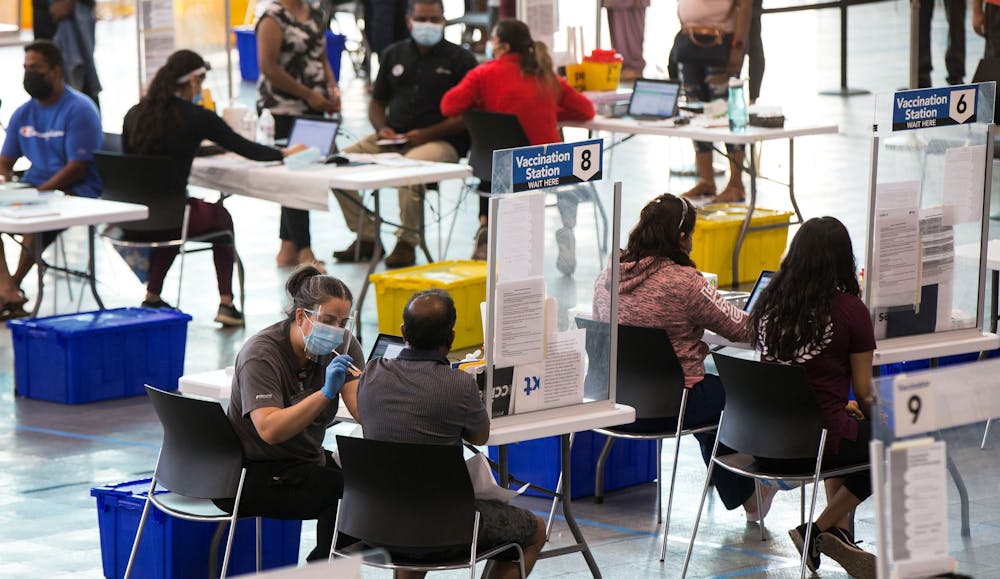
People getting vaccinated at various vaccine stations in a clinic.

Everyday people can contribute to vaccine safety monitoring even after it is approved by the FDA. Xinhua News Agency via Getty Images

After the FDA reviews phase 1 data and deems the vaccine safe enough to be studied further, the vaccine moves on to phases 2 and 3, where it will be given to larger numbers of people over longer periods of time. Here, investigators determine optimal dosage and screen for rare side effects.

If phase 2 and 3 data meets FDA approval standards, the vaccine will then move on to phase 4 and become available to the public. The vaccine is observed over much larger populations and extended periods of time, and manufacturers are required to regularly check and report potential safety concerns to the FDA.

What’s different about this final phase is that the public can also contribute to safety reporting. The Vaccine Adverse Event Reporting System (VAERS) is a national safety monitoring system run by the FDA and Centers for Disease Control and Prevention. While certain types of adverse events, such as injuries during vaccine administration and serious complications, are mandatory for health care providers to report, anyone can submit a report. Recent adverse events associated with the COVID-19 vaccine, including Guillain-Barré and thrombosis for Johnson & Johnson and myocarditis for Pfizer, were identified through VAERS.

Serious adverse event risk from vaccines is small

A rare adverse event may take months or years to identify for a simple reason: It’s rare. For some drugs that are less commonly used, new safety data takes longer to discover because a relatively small number of patients use the drug. For example, though the shingles vaccine Shingrix was approved 2017, it wasn’t until March 2021 after over 3.7 million patients had gotten the shot that the FDA announced a potential increased risk of Guillain-Barré. And it still hasn’t been confirmed that the Shringrix vaccine causes the nerve condition.

For cases like the COVID-19 vaccine, however, millions of people will receive the drug shortly after it’s released to the public, and new issues or patterns often emerge more quickly.

Adverse events that occur closely following vaccination may not be caused by or even related to the vaccine.

This can lead to two problems.

First, not every reported adverse event is directly related to the vaccine. For example, many of the tens of millions of people who have received the Pfizer vaccine have likely experienced a sunburn. People might report that they experienced a sunburn to VAERS, but the vaccine has no effect on your skin’s ability to protect against the sun. VAERS is very clear that it “is not designed to determine if a vaccine caused a health problem, but is especially useful for detecting unusual or unexpected patterns of adverse event reporting.” Correlation does not imply causation.

Second, a plausibly identified adverse event does not necessarily make the vaccine unsafe. According to CDC, there have been 100 preliminary reports of Guillain–Barré out of 12.5 million J&J doses, or 0.008% of people who received the vaccine. Administering one vaccine to a huge sample of people can make it easier to identify a possible connection between the shot and a side effect. But that doesn’t mean the risk of getting that side effect is very likely, or that it outweighs the benefit of getting vaccinated.

These risks, while real and potentially life-threatening, must be viewed in context with the much larger risk of negative outcomes from the diseases vaccines protect people from. For example, 1%-7% of patients who take cholesterol drugs called statins are likely to experience potentially harmful muscle injury. However, these drugs are still taken by millions of people because they are highly effective at preventing heart disease and stroke. And in the case of Guillain–Barré, about one in 100,000 people, or 0.001%, develop this condition yearly in the U.S. from any cause. By comparison, the U.S. has had more than 33 million cases of COVID-19, and over 600,000 deaths caused by this disease.

Close-up of three Johnson & Johnson vaccine vials.

While the Johnson & Johnson vaccine has been linked to a possible increased risk of certain rare adverse events, the vaccine is still safe to use. Ramon Van Flymen/AFP via Getty Images

COVID-19 is a bigger risk than vaccine side effects

In such extraordinary times as during a pandemic, it’s understandable that people may be hesitant to take on any more risk than they have to. But there are safety nets in place to monitor the COVID-19 vaccines, and they are still working as they should.

The COVID-19 vaccines are proven to be overwhelmingly safe for most people. More than 40,000 patients participated in J&J’s clinical trials before the company applied for emergency use authorization, mirroring Pfizer’s and Moderna’s study sample sizes. Some 0.4% of participants in the J&J trial experienced serious adverse events unrelated to COVID-19 infection. In contrast, the trial demonstrated that people who get the vaccine are 85% less likely to get severe COVID-19 than those who remain unvaccinated.

The extremely rare side effects associated with the COVID-19 vaccines were discovered because safety reporting tools were used appropriately. Being aware of the risks of a treatment, however rare, can help people make health decisions that work best for them. However, these risks must be viewed in context. And in the case of the COVID-19 vaccines, they must be weighed against the consequences of remaining unvaccinated and letting the pandemic rage on.

Justin Vesser, Manager of Ambulatory Pharmacy Services, University of Virginia

This article is republished from The Conversation under a Creative Commons license. Read the original article.

The debate over umbilical cord screenings and stillbirths

In 2018, Kristen Miller, a high school social studies teacher from Cleveland, had an uneventful pregnancy for the first two trimesters — “textbook perfect,” she said. But then at her 32-week prenatal visit, she was told she had excess amniotic fluid, a condition that can slightly increase the risk of complications.

The following morning she went to work but noticed the fetus wasn’t moving much. Feeling something was wrong, she eventually went to the hospital. The attending physician couldn’t find a heartbeat. Miller was told her daughter, whom Miller had named Leighton, would be stillborn.

After the delivery, the doctors discovered that Leighton had suffered from two knots in her umbilical cord. The team told Miller the knots were the cause of the stillbirth — the term used to define a fetus that dies in the womb at or after 20 weeks — and that it was unavoidable. “Everyone said, ‘this is it, look no further,'” said Miller. “But I became obsessed with finding out the why.”

Roughly half of the 26,000 stillbirths per year in the United States have an unknown cause, according to the Stillbirth Collaborative Research Network, an organization funded by the National Institute of Child Health and Human Development. Umbilical cord abnormalities — of which there are roughly seven categories, ranging from cord cysts to entanglements to knots — may account for anywhere from 10 percent to more than 25 percent of stillbirths, according to studies in the medical literature. But which types of cord abnormalities can be directly associated with stillbirth, and whether or not those abnormalities can be detected and the stillbirths prevented, is an ongoing matter of contention among medical experts. Without a stronger consensus, the standard of care — how a patient should be treated in accordance with professional guidelines — for people like Miller is unlikely to change.

Miller’s search for answers led her to a support group, where one researcher’s name came up a lot: Jason Collins, a now-retired obstetrician-gynecologist and independent medical researcher. Collins, who practiced for three decades in Louisiana, attests that these kinds of accidents are responsible for a greater number of stillbirths than the literature suggests, and that many can be prevented through extra screening that isn’t included in the current standard of care. “This issue is really not discussed,” said Collins. “There’s no awareness. It’s falling through the cracks.” Some researchers and medical practitioners agree and say the medical community should offer broader education on the topic. But far more aren’t so sure, pointing to the lack of substantial and uniform studies and cautioning against the over-screening of pregnant people.

Determining the relationship between umbilical cord abnormalities and stillbirth is difficult, said Christopher Zahn, vice president of practice activities at the American College of Obstetricians and Gynecologists (ACOG), as many are common in live births as well. “It’s not an all-or-none situation,” he added, “so establishing a true cause and effect is a challenge that we don’t have the evidence for.”

* * *

The umbilical cord is the fetus’ lifeline — it’s a source of oxygen and nutrients, and it eliminates waste. All pregnant animals that give birth to live young have one; the oldest known example is a 380 million-year-old primitive fish fossil with a mineralized umbilical cord discovered by Australian researchers in 2008. In many cultures the cord is seen as a good luck charm and is sometimes eaten as a cure for infertility. A failure of the umbilical cord means a failure of life.

Despite how vital the umbilical cord is for proper fetal development, many of its complexities remain understudied. This is especially true for its pathologies. “There is no question that cord accidents have not gotten the attention they deserve as a potential contributor to poor pregnancy outcomes,” said Alfred Abuhamad, a professor of obstetrics and gynecology at Eastern Virginia Medical School. Twenty years ago, Abuhamad said he cared for a patient who came to him after a stillbirth linked to a knot in the umbilical cord. He was then able to diagnose the same type of knot in the patient’s second and third pregnancies using an ultrasound and delivered the babies early to avoid complications. It was a rare occurrence, he said, that emphasizes the many unknowns surrounding the risks of umbilical cord abnormalities.

According to Abuhamad, cord accidents are likely overlooked because they exist on a spectrum, making them difficult to diagnose prenatally. Even when a diagnosis is made, there are no standardized guidelines for treatment, he said, because the relevant research and education are lacking.

The largest and most comprehensive study of stillbirths to date was published in 2011 by the Stillbirth Collaborative Research Network, according to Uma Reddy, a professor of obstetrics, gynecology, and reproductive sciences at Yale University. The study enrolled 663 women with stillbirths and 1,932 women with live births, and ultimately reported that umbilical cord abnormalities accounted for 10 percent of the stillbirths. That’s as far as the organization could go, stating: “As a potentially preventable cause of stillbirth, cord abnormalities deserve further investigation.”

In 2020, Reddy and colleagues from the University of Utah reexamined the data from the 2011 study and found that half of the stillbirths associated with umbilical cord abnormalities were due to compromise of blood flow through the cord. “So there is interest in understanding this,” she said. “It is a potential risk factor of stillbirth.”

Compounding the issue is the fact that researchers can’t even agree on how to define umbilical cord abnormalities. The 2020 edition of the Oxford Textbook of Obstetrics and Gynaecology, considered a leading comprehensive resource for physicians, has less than one page on umbilical cord accidents, and mentions only two possible abnormalities: cases where the cord inserts in the wrong spot, and cords with two umbilical vessels instead of the normal three.

But according to a 2019 study in the journal Medical Science Monitor, umbilical cord defects can be divided into several categories and subcategories. In addition to abnormal insertions and the wrong number of vessels, the study lists abnormal cord length, cysts, and blood clots along the cord. Among the most serious abnormalities, according to the study, are cord knots. In many cases, loose knots, also called false knots, are normal and pose no cause for concern. But diagnosis of a true knot — the cause of Miller’s stillbirth — occurs in up to roughly 2 percent of births and puts the fetus at risk of stillbirth.


The most contentious category in the Medical Science Monitor study is when the cord encircles the fetus’ body. Sometimes the cord wraps around a limb, but it more commonly winds around the neck, called a nuchal cord. Nuchal cords affect up to 37 percent of births. In most cases, a cord looping around the neck or other part of the body is no cause for concern, which is why it’s often excluded from stillbirth studies as the sole cause of a death. But according to the Medical Science Monitor study, multiple loops can pose serious complications, including stillbirth.

Although the evidence is limited, Collins believes all of these abnormalities, plus several more variations within the categories, can cause stillbirth if undetected. That the medical community can’t even agree on which cord defects contribute to stillbirth, Collins said, is due to an “educational void” in obstetric medicine.

* * *

Despite the lack of consensus, Collins said the answer to preventing stillbirths related to umbilical cord accidents is simply to perform more screening. In 2012, he laid out his recommended protocol in an article published in the journal BMC Pregnancy and Childbirth.

Routine prenatal care already typically involves one or two ultrasounds using a two-dimensional Doppler — which shows a flat, two-dimensional image on a screen — to check on fetal growth and health between weeks 18 and 22 of pregnancy. During these screens, most technicians do examine the umbilical cord, although they only look for blood flow and the proper number of cord vessels. Collins’ protocol calls for additional imaging with a 3D or 4D Doppler, which allows a physician to evaluate the nooks and crannies of the fetus and the cord.

Collins also advocates for the expanded use of at-home heartbeat monitoring to detect fetal stress. People who are pregnant typically go to a doctor’s office or hospital for fetal heartbeat monitoring during the day if their pregnancy is at-risk — this is the same test that Miller’s doctors used to confirm her stillbirth. The more optimal time to do it, Collins contends, would be at night when the parent’s blood pressure is lower and the foremost sign of fetal distress — brief drops in the fetal heart rate — are more likely to occur.

Collins’ protocol suggests that if the additional screening indicates an umbilical cord issue, the pregnant parent should be hospitalized and the baby monitored for 24 hours. If the fetal behavior or heart rate is abnormal, that observation time should be extended, according to the protocol, and if there are still indications of fetal distress, the medical team should consider an early delivery — whether by Caesarean section or induction.

According to Collins, many pregnant people tell him that they don’t feel like they are getting the medical attention they need after a stillbirth. For instance, when Miller became pregnant again in 2019 with Lincoln, her “rainbow baby,” — what parents often call a pregnancy after a loss — she sought help from Collins in her third trimester. But she said that her doctors seemed offended that she’d done her own research.

“They treated me like I was being hysterical,” she said, and ordered her to stay off of Google and to stop talking to Collins. When she presented the team with her research and communications with Collins, and requested additional cord screenings, she said they would tell her that it just wasn’t the standard practice of care. “Which made me feel bad because after losing Leighton, I didn’t want the standard practice of care,” she said. “I wanted the absolute best of the best to bring Lincoln home.”

Although Collins is recently retired, he responds to daily emails and phone calls from worried parents, and coaches them in how to approach their doctors with their research. Like Miller, a lot of these parents tell him that they are made to feel unhinged by their medical teams, he added, or that they are acting out of grief, for demanding care that is considered outside the standard.

* * *

The standard of care is a legal term, not a medical one. Jill Wieber Lens, a law professor at the University of Arkansas who specializes in stillbirth and medical malpractice, explained that the standard of care is tricky, because in many cases, especially those involving stillbirth prevention, the best option for the patient may not always be clear. In some cases, for instance, a doctor may follow the basic standard of care; in others, they may choose to include some additional screenings or other care. If doctors comply with the standard of care, they don’t “need to worry about malpractice too much,” she said. But if doctors do something “inconsistent with the standard of care and something bad happens, that’s dangerous malpractice-wise.”

Unless professional organizations recommend Collins’ protocol, it’s not going to be considered part of the standard of care. Typically, if ACOG doesn’t say to do it, most doctors will refuse to implement a new or experimental test, according to Lens. In a case of medical malpractice, she added, juries don’t have a lot of wiggle room. With some exceptions, they have to consider whether the doctor followed the professional standard of care.

Changing the standard of care would require support from the obstetrics community more broadly. “It would mean changing entire protocols, and admitting we can do a better job,” said Karen Finkelstein, an ACOG member and leader of the medical team at Southwest Women’s Oncology in Albuquerque, New Mexico, where she specializes in gynecologic cancers.

Finkelstein lost her son to an umbilical cord accident at 32 weeks, on the same day she received a reassuring non-stress test at her obstetrician’s office. He was born with two nuchal cords and his head was buried deep in her pelvis, pulling tightly on the cords. Since her stillbirth, she has delved deep into the world of fetal monitoring and pregnancy, and said she feels very “underwhelmed” with the current guidelines.

For her two subsequent — and successful — pregnancies, Finkelstein followed Collins’ protocol. “We can change the outcome of the majority of stillbirths, and it isn’t high cost,” she said. “But we’re not doing it. It makes no sense to me.”

In 2020, Finkelstein wrote a letter to ACOG expressing her disappointment in the lack of attention to umbilical cord abnormalities in their most recent bulletin on stillbirth management, noting that the article excludes nuchal cords as a contributor to stillbirth. In her letter, Finkelstein implored the organization for an increase in screening and access to at-home fetal monitoring. She described the response from ACOG as “passive.”

Updating a standard of care at the ACOG level requires substantial research in order to determine and understand potential links between cord accidents and stillbirth, said Radek Bukowski, a professor and associate chair of discovery and investigation in the department of women’s health at Dell Medical School at the University of Texas at Austin. “The change in the standard of care has to be very well substantiated,” he said. For the research to be done there has to be interest, funding, and participation. All are currently insufficient, according to Bukowski, who said there is not even enough research to even conclude how frequently any umbilical cord accidents — let alone the more controversial ones — contribute to stillbirth.

Until there is enough evidence to establish a direct relationship between cord accidents and stillbirth and determine the strength of that relationship, he added, talking about the next steps — detection and prevention — is fruitless and could be dangerous, as it may spur unnecessary medical interventions.

Collins maintains that enough research exists, in both humans and other mammals, to support routine screening for umbilical cord abnormalities. He pointed to a 2015 study published in the journal of the German Society of Gynecology and Obstetrics that shows the ability to detect cord abnormalities prenatally with a Doppler, which he said could prevent about half of all stillbirths attributed to umbilical cord abnormalities — thousands of stillbirths worldwide.

For other experts, though, the issue remains murky. “There is evidence to support the association between Collins’ findings and poor pregnancy outcomes,” said Abuhamad, who also acknowledged Collins’ dedication to this research. “He’s contributing to the debate, which will be ongoing.”

* * *

ACOG maintains that additional screening for umbilical cord problems might not help. Screening is a population-based tool, not an individual one, said Zahn. This means the reduction of adverse outcomes has to outweigh the potential harms. While the field needs more information, “it’s important to recognize that there is ongoing research in these areas,” he added. “If we can reduce the risk, we will.”

There are downsides to increasing fetal screening. Extra tests can make pregnant people anxious, for instance, and misdiagnoses can lead to unnecessary labor inductions and C-sections, said Cathrine Ebbing, an obstetrician at Haukeland University Hospital and an assistant professor at the University of Bergen in Norway. Many of those inductions and C-sections would be premature births. Premature infants — defined as those born before 37 weeks of pregnancy — often face serious risks to survival, as well as challenges with feeding and breathing. These babies are also at a greater risk of developmental delays, cerebral palsy, and hearing and vision loss than full-term infants, according to the American Academy of Pediatrics. So increased fetal screening may “do more harm than good,” Ebbing wrote in an email. “Finding the balance is very difficult.”

Ebbing’s interest in umbilical cord problems began as a young obstetrician, when one of her patients lost her child during delivery because of a cord abnormality even though it had been diagnosed before birth. The experience, Ebbing said, marked her for life. She is now conducting ongoing research to determine the viability of routine screening for certain cord issues using ultrasound.

In the beginning of her career, Ebbing said education about umbilical cord issues was limited, but that this is now changing. “When I was a trainee I was told that a cord knot could not be the cause of death,” Ebbing wrote. “Now, I and many with me think it obviously represents a cause of death in some cases.”

In a 2018 study of certain cord abnormalities, Ebbing and her colleagues found that having them in one pregnancy more than doubled the risk of recurrence in a subsequent one. Routine cord screening, she said, is fast, relatively easy, and could be done in all pregnancies or only in those at higher risk. There are ongoing studies in Norway evaluating the feasibility of this, but it is not currently standard practice. Whether the findings will translate to other countries is uncertain, though. Health care is universal and free of cost to the public in Norway, and cost effectiveness is a major factor in increased screening and education. Norway’s population is also highly homogenous, which makes the data difficult to compare to the U.S.

And not all screens are created equal. Ultrasounds — whether the more common 2D version or the 3D and 4D models that Collins recommends — are “the most operator-dependent of all scans,” said Eran Bornstein, a maternal-fetal medicine specialist and director of the department of obstetrics and gynecology at Lenox Hill Hospital in New York City. “It’s only as good as the person using the machine.”

The minimum expectation of cord screening on a typical ultrasound is to look at the vessels, cord insertion, and blood flow. Bornstein’s unit uses a tool called a color Doppler to see if the cord is anywhere near the cervix, which could indicate a cord insertion anomaly or a risk of cord prolapse, where the cord precedes the baby into the cervix, and which can lead to compression of the cord during labor. But that’s not necessarily standard protocol, he said, and could cause “more anxiety than value” if the wrong person is doing it.

“A closer look could be great,” said Bornstein, referring to increased cord screening. “If it’s in the right hands.”

* * *

When Kristen Miller became pregnant again in 2019, she sought care from a different medical team within the same clinic.

Lincoln was hiccupping a lot in the third trimester. Daily hiccups occurring after 28 weeks and greater than four times a day necessitate fetal evaluation, Collins had told her, as fetal jerking movements and pervasive fetal hiccups may also be related to fetal blood flow disturbances, especially cord compression. (This recommendation is based on animal studies; for ethical reasons there has not been a study in humans.)

“I brought it to the care team’s attention every week,” she said. They didn’t know it was a problem, she said, but armed with Collins’ research and guidance, she explained that it could indicate a cord issue. The baby was also hyperactive. “He was going bonkers, and it scared me,” she said.

In March of last year, following Collins’ recommendation of weekly non-stress tests and ultrasounds, Lincoln was born by early induction at 37 weeks. Her obstetrician had proposed the plan early on in Miller’s pregnancy because she thought it would give her the best chance of preventing a cord-related stillbirth, while avoiding the health risks of a premature birth.

Miller pointed out that there is no word in the English language to describe a mother who has had a stillbirth or lost a child, though there is a noun to describe others who have had a loss — someone who’s divorced, or widowed, or orphaned. She chooses to refer to herself as a “loss mom.”

She thinks this linguistic hole correlates to a lack of awareness. Which is why she’s found herself advocating for “loss moms” and in the summer of 2019 joined the nation’s leading stillbirth advocacy group, the Star Legacy Foundation, as secretary. She stresses the importance of Collins’ research and puts other loss moms in touch with him if they have a history of umbilical cord issues. “You can carry it silently and alone,” she said, “or you can get out there.”

* * *

Claire Marie Porter is a Pennsylvania-based health and science journalist whose work has been published in Scientific American, The Washington Post, NextCity, WIRED, and Elle, among other publications. Find her on Twitter @_okclaire.

This article was originally published on Undark. Read the original article.

Will the battle over “critical race theory” be a winning issue for the right? It already is

For today’s Republicans, Trumpists and other members of the white right, “critical race theory” is a form of political ectoplasm: It’s both a liquid and a solid, something slimy and sticky which can be shaped into whatever frightening or dangerous thing suits their mood and needs in a given moment.

In this political context, “critical race theory” means both everything and nothing; it is a fetish object used to summon up centuries-old racist nightmares and fears about “scary” Black and brown people who are plotting a rebellion or uprising to undermine the (white) family, indoctrinate (white) children and attack (white) America.

By implication, if “critical race theory” and other Black and brown bogeymen are threats to (white) America, then preemptive violence is both necessary and reasonable. Moreover, multiracial democracy is seen, by definition, as incompatible with white people’s safety, security and material interests.

Debates about language are a battlefield for questions of power. Critical race theory has an actual meaning: it is a rigorous academic framework for understanding how racism, white supremacy and other unequal outcomes across the color line in America are overdetermined by the country’s legal system and other social and political institutions.

Of course, “critical race theory” as weaponized by conservatives and the white right doesn’t mean that at all. In the right-wing political imagination, facts are unimportant. In that closed episteme, dogma is a substitute for truth, evidence, intellectual honesty and rigorous thinking.

Many liberals and “moderates” refuse to understand that core feature of today’s right-wing movement. Instead, they want to argue “issues” and “facts” against believers of a political religion who care more almost exclusively about obtaining and keeping power, and have long since abandoned all abstract principles about “democracy” and “truth.”

At In These Times, Hamilton Nolan elaborates, critiquing the premise “that misinformation and conspiracy theories and omnipresent propaganda have created a situation in which Americans don’t seem to have a single set of mutually agreed upon facts”:

That is true. But it does not capture an even more elementary flaw in what we are doing. We allow entire “issues” to be created and to be talked about endlessly in the national political media without ever determining what those issues mean.

The absurd effect of this failure is twofold. First, it allows bad faith political actors to purposely exploit this rhetorical vulnerability in order to smear the other side by inflating the definition of bad things to include whatever the other side is doing. This is standard issue political scumbag behavior, and is to be expected. Worse, though, it creates a self-reinforcing cycle in which widespread use of some vague, ill-defined term convinces the public that this term is something important, driving media coverage and creating impenetrable towers of meaninglessness that come to dominate our partisan political landscape.

This same dynamic applies to terms that may have once had a legitimate definition, but which become definition-less by the time they have been elevated into the popular mind, laden with propaganda. Do any of the politicians or commentators decrying “critical race theory” have a precise working definition for this academic term? Of course not. It now means “Anything that talks about white people’s racism.”

In a recent essay for the Atlantic, historian Ibram X. Kendi argues that there is no real “culture war” over race and racism, only a deliberate politics of division being practiced by the right

Republican operatives have buried the actual definition of critical race theory: “a way of looking at law’s role platforming, facilitating, producing, and even insulating racial inequality in our country,” as the law professor Kimberlé Crenshaw, who helped coin the term, recently defined it. Instead, the attacks on critical race theory are based on made-up definitions and descriptors. “Critical race theory says every white person is a racist,” Senator Ted Cruz has said. “It basically teaches that certain children are inherently bad people because of the color of their skin,” said the Alabama state legislator Chris Pringle.

There are differing points of view about race and racism. But what we are seeing and hearing on news shows, in school-district meetings, in op-ed pages, in legislative halls, and in social-media feeds aren’t multiple sides with differing points of view. There’s only one side in our so-called culture war right now.

The Republican operatives, who dismiss the expositions of critical race theorists and anti-racists in order to define critical race theory and anti-racism, and then attack those definitions, are effectively debating themselves. They have conjured an imagined monster to scare the American people and project themselves as the nation’s defenders from that fictional monster….

It’s entirely true that the white right’s attacks on “critical race theory” are based on fantasies and lies. But that does nothing to diminish the force and impact and belief in the righteousness of those attacks.

On this, new research by the polling firm Morning Consult reveals ominous prospects for the Democrats:

Amid a spike in attention from conservative media outlets and leaders on the right regarding critical race theory, a new Morning Consult/Politico survey finds discussion of the topic resonating more deeply with Republican voters than their Democratic counterparts.

In turn, Republicans in the electorate have sharper views about the concept – as revealed by an analysis of open-ended responses among those who reported the highest level of awareness.

According to the June 18-20 survey, 3 in 10 Republicans said they’d seen, read or heard “a lot” about critical race theory, compared with 21 percent of Democrats. The skew toward Republican consumption ranked among the largest of roughly 200 other news events and topics tested so far this year, placing it alongside other issues of interest to conservatives such as immigration, increasing gas prices and the Dr. Seuss controversy….

The poll asked those who said they’d seen, read or heard “a lot” about critical race theory to describe it in their own words. Among informed Republican respondents, nearly 4 in 5 expressed negative sentiment, with one calling the theory a means to make white “people feel guilty about being white” and another saying it is a “way to villainize one race over another with twisted history.”

The largest share of informed independent voters (46 percent) described critical race theory using negative terms, such as “BS” or “anti-white racism,” compared with just 7 percent of Democrats, one of whom characterized the idea as trying “to combat racism by being racist against whites.”

Public opinion and other research has repeatedly shown that a commitment to white (and male) supremacy is the primary driver of support for the Trump movement and its agenda.

“Critical race theory” is a way for right-wing politicians and other opinion leaders to channel and leverage such energy to advance their goals.

While some in the mainstream news media continue to carry water for the disproven claim that support for Trump is driven primarily by white working-class  “economic anxiety,” new research further exposes that fiction. In an article at Alternet, Alex Henderson offers these details, reporting on an NPR interview with Johns Hopkins political scientist Lilliana Mason:

Mason told [Danielle] Kurtzleben, “So, the colloquial stories we hear about Trump suggest that he somehow created a whole bunch of hatred in American politics. And instead, what this data shows is that what he did was serve as a place where people who already held a lot of animus towards marginalized groups — they all sort of gathered around him. So, this was a latent faction of Americans that had just — that had already been sitting there and had already existed.”

In other words, that hostility towards “marginalized groups” existed before Trump’s 2016 presidential campaign, but he encouraged it. That “animus,” according to Mason’s research, “uniquely draws” those “Trump voters” to him.

Mason told Kurtzleben, “When we control for partisanship, what we found is that people in 2011 who have negative views of these particular groups are much more likely to approve of Trump in 2018. They’re not any more likely to approve of the Republican Party, to approve of Mitch McConnell or to approve of Paul Ryan.”

The battle over “critical race theory” — and over the teaching of America’s real history, as opposed to literally whitewashed “patriotic education” — is simultaneously simple and complex, old and new.

This is a struggle over the American narrative and the role of the color line in American society. It is also a struggle over democracy and freedom, and the role of nonwhite people in the American story.

Will America be a society organized around white fictions, white fantasies and white lies, both large and small? Or will America be a society that learns from its complicated, painful, contradictory and sometimes beautiful past to make a better future for all its citizens? In the long term, lies undermine a society, while truths can uplift a society and make it stronger. Which will we choose?

How Republicans unleashed a new crime wave in America — through worsening inequality

Yesterday morning, a burglar tried to break into my home. Thankfully the doors were all locked, but a few houses down wasn’t so lucky; our neighbor was home and is now pretty traumatized to have experienced a home-invasion burglary. By the time the police arrived, the burglar was long gone in a stolen car.

A friend is trying to sell his condo in downtown Portland but large parts of downtown have been turned into a giant homeless camp so there are few buyers even in this hot real estate market. The nearby streets are pockmarked with tents and the curbs frequently sport human waste. 

Homelessness and its attendant crime are getting so bad that police in many cities don’t bother to investigate many property crimes unless they’re against wealthy people and involve things of great value. Just among my own friends and acquaintances in the past year I’ve seen three cars stolen (one I watched happen!), one car damaged in a smash-and-grab and two home-invasion break-ins. 

And I know of dozens of smaller crimes, including assault against a family member by a mentally ill homeless person, that were simply never reported to police and therefore don’t show up in official statistics.

And this isn’t a story unique to Portland; petty and property crime are exploding along with gun crimes and homelessness in cities across the nation. New York City is nearly certain to elect a new Democratic mayor whose main credential was that he was a cop; people are freaking out. 

But there’s more to this than homelessness or “bad people” doing crime for fun and profit; there are deep causes to this problem (beyond the pandemic) that require deep solutions.

Most people think crime (particularly property crime) is caused by poverty, like the poor people portrayed in “Les Misérables” stealing food for their children. But Louis XVI’s policies had both increased poverty in France while massively increasing his own wealth and that of his friends. There was poverty, and even periodic famine but (outside of stealing food) that wasn’t what was driving crime and ultimately revolution in 18th-century France: It was inequality. 

Hold that thought. 

I’ve worked among very, very poor people and even in the midst of famines. In late November 1980 I went into Uganda at the tail end of the Tanzanian invasion that overthrew Idi Amin. As Amin fled to Saudi Arabia, where he was feted with a palace for himself and his wives by the Saudi government, his soldiers went on a killing and looting rampage, particularly in the northern region against the Karamojong people. They killed most all the men and boys older than toddlers and raped the women; by the time we got there the region was filled with thousands of starving women and small children (my contemporaneous diary of that trip is here). 

Thursday of that week the special on NPR’s “All Things Considered” show was an 18-minute conversation between Sanford Ungar and me (on a satellite phone from Uganda) as I was describing the famine we were trying to address, with hundreds of people dying every day, live on the radio as Americans were sitting down to Thanksgiving dinner. 

I worked in Bogota, Colombia, a year or so later in one of that city’s massive barrios built on a hillside out of cardboard and scrap wood with streams of raw sewage running to an open sewer in the valley below. I worked in the Klong Toey slum of Bangkok where the Duang Prateep Foundation was putting in non-flammable sidewalks and organizing regular trash removal because the giant Japanese corporation that owned the swamp the slum was built over kept trying to burn out the slum-dwellers. 

When I was in the Philippines in 1985, the Rev. Ben Carreon, an activist priest and the author of a popular column for the Manila Times, took me to one of that city’s massive garbage dumps. The smell was awful, the air thick with insects, as mountains of rotted garbage stretched off into the distance. We stood in the hot afternoon sun, and Father Ben said, “Look carefully at the piles of garbage.” I squinted in the bright light, looking at the distant piles, and noticed something. “They’re moving!” I said. “No, it’s children on them that are moving,” he said. “Thousands of them. Their families live all around here, and the children spend their days scavenging for garbage that their families can eat.”

People in Uganda were dying of famine in Mbale and across the Karamoja region, and hunger stalked the “big city” of Kampala, but there was little crime because the rich people had all left the country. Instead, there was a shared sense of solidarity; while poor people did prey on each other, it was more the exception than the rule and entire communities would rise up against thieves. 

I experienced the same thing working in the slums of Thailand, Peru and Colombia; the biggest crime I personally experienced was having my wallet and pocket computer stolen on a flight to Kenya while I was asleep. Truly poor people don’t buy airplane tickets.

Poverty doesn’t cause most crime, it turns out: Inequality does. And America is now, far and away, the most unequal developed country in the entire world. 

While billionaires who pay less in federal income taxes than you do blast themselves into space on giant penis-shaped rockets, the majority of Americans are struggling to get by. I say “the majority” because a decade ago the number of Americans who could call themselves “middle class” slipped below 50% for the first time since the Eisenhower era. 

My neighborhood’s burglar wasn’t hungry; she was young, healthy and well-fed, as was the small dog she walked to blend into the community. America is not experiencing a surge of crimes related to survival. 

So how does inequality provoke criminality? The research on the topic is pretty exhaustive, albeit poorly publicized, and the simplest explanation is among the most easily understood: Humans are wired to rebel against unfairness. 

Walk into a preschool class and give one child a pile of cookies while giving everybody else only one each and see what happens. In fact, it’s not just humans; this holds true across all mammalian species, from rats to dogs to apes.  

As research across 33 nations published in Oxford’s European Journal of Public Health found, inequality devastates social trust among people, opening the door to antisocial crime, including violent crime (although you could argue that stealing is also a form of interpersonal violence). 

We’re social animals and evolution has fine-tuned that socialization instinct — necessary for survival in a hostile world — so well that in virtually every preliterate and/or pre-agricultural society in the world (and there are still many left), the No. 1 way to gain status in such societies is to give things away. In North America, that’s the origin of the Native American Potlatch, a feast where everybody brings food and shares as much as they can. (The first Thanksgiving of lore was probably an East Coast variation on the Potlatch.)

In fact, as I learned in Uganda working through that famine, the more people have their backs to the wall, the more cooperative and concerned with others they become. Shared hardship fosters community. 

This isn’t to romanticize poverty; it’s tough, and crime is a problem in barrios and slums around the world. But crime isn’t sweeping the cities of Europe, Japan, South Korea or Taiwan the way it is American cities, because in those countries the very wealthy are appropriately taxed and therefore average people are still well within the parameters of the middle class. 

Research published in the Oxford Economic Papers in 2014 found that not only does inequality cause increases in crime (including violent crime), but the main variable is people’s perception of inequality: When the morbidly rich are conspicuous in their consumption, crime explodes faster than when they’re discreet. 

“Using variation within US states over time, we document a robust association between the distribution of conspicuous consumption and violent crime,” authors Daniel and Joan Hicks noted

A 2000 study published in The Review of Economics and Statistics (Harvard/MIT) came to the same conclusion: Inequality causes crime, not just poverty. 

The World Economic Forum published a paper in 2014 looking at the relationship between inequality and crime in Mexico. “Our key finding is that, in fact, municipalities with lower inequality saw lower rates of crime,” the authors write. “In other words, while the overall national data reveals an apparent paradox; broken down by smaller geographical regions, the paradox does not hold — less economic disparity does lead to less crime.” 

A study of 148,000 people across 142 countries found a similar association all over the world. The Economist magazine titled their review of it: “The stark relationship between income inequality and crime.” 

Research published by the Equality Trust in the U.K., which exclusively studies the impacts of economic and social inequality, found: “Small permanent decreases in inequality — such as reducing inequality from the level found in Spain to that in Canada — would reduce homicides by 20% and lead to a 23% long-term reduction in robberies.”

Inequality causes crime because it destroys social trust, the core fabric of any society. Without social trust, empathy and shared values disintegrate and culture begins to disintegrate. 

We see examples of this across the Third World in countries that have been essentially raped by their morbidly rich ruling class for decades. Beyond a certain point, inequality becomes an actual poison to society itself. We passed that point in the last decade, and it’s tearing our nation apart.

Which brings us to the GOP. The Republican Party is so committed to making morbidly rich people even richer (and keeping them that way) that just this weekend Republican Sen. Rob Portman announced on TV that they wouldn’t go along with funding a bipartisan infrastructure bill by letting the IRS hire more auditors to catch rich tax cheats. Seriously. That’s their position. 

Republican Sen. John Barrasso of Wyoming told Axios last week that “spending $40 billion to super-size the IRS is very concerning. … Law-abiding Americans deserve better from their government than an army of bureaucrats snooping through their bank statements.”

Republican Sen. Ted Cruz said, “Throwing billions more taxpayer dollars at the IRS will only hurt Americans struggling to recover after waves of devastating lockdowns. … Instead of increasing funding for the IRS, we should abolish the damn place.”

Republican tax policies, starting with Reaganomics in the 1980s (and continuing to this very day) have both gutted the American working class and exploded inequality in this nation, all while making 100,000 or so Americans obscenely rich.  

We’ve even exceeded the worse inequality gap we’d ever seen, in 1929 at the tail end of the “Roaring ’20s” and the beginning of the Republican Great Depression (yes, they called it that until the early 1950s). 

If we want to get crime under control and restore social cohesion to our society, we must also tackle inequality. And that means taxing the morbidly rich who today pay less than 3% of their income in taxes

Community policing and a variety of other solutions are important, but if we don’t address the core problem of inequality in our society, they’re merely Band-aids on the cancer of this social crisis.

Many schools will reopen without vaccine or masking mandates. Here’s what’s at stake

Schools across the country are planning on reopening in the fall for in-person instruction, but not all are requiring COVID-19 vaccinations for kids who are eligible to get inoculated. In fact, a handful of states — Alabama, Arkansas, Florida, Indiana, Montana, Oklahoma and Utah — have passed laws that would prohibit public schools from requiring COVID-19 vaccinations or proof of vaccination, according to CNN.

The vaccine-related laws are clearly targeting COVID-19 vaccines specifically, the administering of which has become a victim of the culture war. For example, Alabama Governor Kay Ivey (R.) signed a bill into law that states that “institutions of education may continue to require a student to prove vaccination status as a condition of attendance only for the specific vaccines that were already required by the institution as of January 1, 2021.” In Arkansas, the law states that a coronavirus vaccine “shall not be a condition of education.” (Currently, children over the age of 12 are eligible for the COVID-19 vaccine.)

While it may be another few months before elementary school-aged children can get inoculated, requiring vaccinations to attend school is nothing new; immunization exemptions — religious, medical or philosophical — vary from state to state. But as Dr. William Moss, executive director of the International Vaccine Access Center at the Johns Hopkins Bloomberg School of Public Health, told CNN on Monday, singling out of the COVID-19 vaccine is “obviously occurring in a broader social and political context around COVID-19 and the extreme politicization of the disease and vaccines.”

So, what’s at risk when children return to school in an environment where COVID-19 vaccines aren’t required?

Doctors tell Salon they are relatively okay with it — provided proper mitigation strategies are still in place.

“I’m comfortable right now with schools not requiring vaccination,” Dean Blumberg, chief of pediatric infectious diseases and associate professor in the Department of Pediatrics at the University of California, Davis, told Salon. “We knew even before vaccines were available that we were able to have safe in-person schooling,” he continued. Blumberg noted that school can be a safe place provided that they have masking policies, exclude ill students from in-person instruction, test for COVID-19, have contact tracing protocols, and distance children when not masking. 

As the Centers for Disease Control and Prevention (CDC) explains, previous outbreaks in schools happened mostly when prevention strategies weren’t implemented or followed. A cautionary tale comes from a school in Israel, which, prior to vaccine availability, shut down less than two weeks after re-opening when two symptomatic students went to school and infected 153 students and 25 staff members. An analysis of the school’s coronavirus outbreak found that the children weren’t wearing masks because of a heatwave at the time. The school’s outbreak shows that when mitigation strategies are lacking, transmission is very possible.

Jeanne Noble, MD, associate professor of emergency medicine at the University of California – San Francisco, told Salon she believes requiring vaccinations for schools would help reach the end goal of getting kids back in school and returning to some sense of normalcy.


Want more health and science stories in your inbox? Subscribe to Salon’s weekly newsletter The Vulgar Scientist.


“The most important thing in my mind is getting kids back to school — and mandatory vaccinations, I think, would make that happen more quickly,” Noble said. “Requiring all kids to get vaccinated would certainly decrease the chances of outbreaks in school and keep kids in school for longer and help ensure that their schools are open.”

Noble added that this would be done to primarily protect adults in the school and the community at large.

“Kids transmit COVID at about half the rate or efficacy of adults,” Noble said. “It’s not a threat, in terms of serious illness and death to kids, numerically, that would typically justify a mandatory vaccine . . . it’s really for the greater societal good of protecting adults and other more vulnerable people.”

As for masking and social distancing in schools, Noble said she thinks if a county or city has more than five hospitalizations per 100,000 people in the population, it makes sense to mask unvaccinated kids. Noble did not see as much of a necessity for vaccinated children to mask up.

“I think the only argument for having vaccinated kids continue to mask are for social concerns, that some kids are masked and some kids aren’t,” Noble said. “People can make an argument that that’s a fair way to do things.” On the other hand, Noble noted that “kids, especially young kids, are having trouble reading the emotions of others when their faces are partially covered up, and kids with speech impediments really suffer.”

Noble’s opinion is at odds with The American Academy of Pediatrics’ (AAP) latest updated guidance for schools, which recommends that all students over 2 years old, along with staff, wear masks, regardless of their vaccination status. The reasoning is twofold: first, because large portions of the student population are not eligible for vaccination, it is difficult to enforce mask policies for those who are unvaccinated; and second, there is a concern about emerging variants that could be more transmissible among children.

“Given what we know about low rates of in-school transmission when proper prevention measures are used, together with the availability of effective vaccines for those ages 12 years and up,” the AAP states. “The benefits of in-person school outweigh the risks in almost all circumstances.”

The AAP also recommends all children should get vaccinated as soon as they are eligible.

Despite some schools prohibiting vaccine mandates, not all states will require masks or mitigation strategies either.

In South Carolina, school districts are prohibited from mandating masks for students and staff. In Texas, an executive order prohibits schools from mandating face coverings. In other states like Washington, schools must mandate masks or face coverings indoors regardless of vaccination status.

While severe disease and death from COVID-19 is rare in children, Centers for Disease Control and Prevention Director Dr. Rochelle Walensky pushed back on that narrative this week emphasizing that proper mitigation strategies are in place for children.

“I think we fall into this flawed thinking of saying that only 400 of these 600,000 deaths from COVID-19 have been in children,” Walensky said. “Children are not supposed to die. And so 400 is a huge amount for respiratory season.”

The cost of the GOP’s war against abortion is adding up — and taxpayers are footing the bill

For the first time in decades, the House Appropriations Committee passed a spending bill last week without a ban on federal funds being used on abortions for patients on Medicaid. On the state level, however, Republican-dominated legislatures across the country are ramming through a raft of anti-abortion legislation that is not only harmful but incredibly costly. 

On Thursday, the attorney general of Mississippi is expected to file briefs with the Supreme Court as it prepares to rule on yet another abortion case, Jackson Women’s Health v. Dobbs, later this year. Experts predict the case could continue a long pattern of supposedly fiscally conservative, anti-abortion state governments spending significant taxpayer dollars on abortion laws that don’t hold legal water, if the court strikes down Mississippi’s 15-week abortion ban. 

After all, just two years ago, a judge ruled Mississippi owed Jackson Women’s Health Organization more than $750,000 in attorneys’ fees, after blocking the state from enforcing its unconstitutional clinic shutdown law. Jackson Women’s Health runs Mississippi’s last remaining abortion clinics. Compared with around 90% of US counties, 99% of Mississippi counties lack an abortion provider.

Mississippi’s clinic shutdown law had required abortion clinics to have hospital admitting privileges at nearby hospitals, despite the safety of abortion care, and the extreme rarity of abortion patients needing to go to the hospital. Medically unnecessary requirements like this, which were at the heart of the Whole Woman’s Health v. Hellerstedt Supreme Court case of 2016, are specifically designed to force clinics to shut down. Following the Whole Woman’s Health case which overturned a Texas law, a federal judge ruled the state of Texas owed the reproductive health organization $2.3 million in legal fees later that year. In Arkansas, a federal judge on Tuesday blocked a law banning nearly all abortions in the state while its constitutionality is reviewed in court. 

Among the most common — and justified — criticisms of the anti-abortion movement is its single-minded focus on forcing pregnancy and birth, rather than investing in life, children, families, and pregnant people. 

“It goes without saying that the [Mississippi] state government wastes huge sums of money on writing, passing, and defending abortion restrictions,” Shannon Brewer, director of Jackson Women’s Health, told Salon. According to Brewer, this “essentially deprives people of health care services,” and “disproves the notion legislators refuse to fund abortion care and Medicaid expansion because of their fiscally conservative core values.”

Texas and Mississippi aren’t the only states where exorbitant amounts of state funding are dedicated to defending abortion bans in court.

The Washington Post reported in 2019 that between 2016 and that year, several states defending anti-abortion laws in court had spent nearly $10 million in legal fees. Some of the most notable offenders include North Carolina, which was ordered by a federal judge to pay more than $1 million in legal fees to attorneys who challenged and successfully overturned a state law requiring people seeking abortion care to first have an ultrasound, in 2016. That same year, another judge ordered Alabama to pay ACLU lawyers $1.7 million in legal fees, after federal courts struck down a 2013 hospital admitting privileges law in the state.

Also in 2016, Wisconsin was ordered to pay $1.6 million in legal fees to Planned Parenthood, Alaska was required to pay $995,000 to the Center for Reproductive RIghts, and North Dakota was required to pay nearly $500,000, also to the Center for Reproductive Rights — all in defense of these states’ unconstitutional abortion laws. There are numerous other states, including Ohio, Arizona, Missouri, and others, that have been ordered to pay legal fees in a similar cost range while trying to defend the indefensible in the last three years. 

Reproductive rights advocates in Missouri recently celebrated a crucial victory when their state legislature defeated an attempt to block a bill that funds the state’s Medicaid health care program for the poor, due to its coverage of abortion and contraception. But states’ approach to funding reproductive health care like abortion has long been a point of contention — especially as many states that severely restrict funding for abortion care are the same states that spend hundreds of thousands, even millions, on defending abortion bans in court.

Notably, many of these states, which also have the most restrictions on abortion, have some of the worst child and maternal health outcomes in the country. This is no coincidence, Elisabeth Smith, chief counsel of state policy at the Center for Reproductive Rights, tells Salon. 

“When we think about the money that is being spent litigating unconstitutional abortion restrictions, that money could absolutely be better spent supporting people in these states through Medicaid expansion, child care support, family leave, extended post-partum Medicaid coverage, Title X funding,” Smith said. “States with the most abortion restrictions have implemented the fewest social policies that have been proven to help pregnant people, children, families.”

As recent as last summer, the Supreme Court ruled to strike down a clinic shutdown law in Louisiana, in the case of June Medical Services v. Russo. As a result, Louisiana could be forced to pay $9 million in legal fees to the Center for Reproductive Rights, which represented June Medical Services in the case. According to Smith, litigation around the case has continued even after the Supreme Court ruling, because the state has continued to “challenge protective orders and other orders that require information about the doctors’ identities to be destroyed” to this day, nearly one year later.

Despite the jarring costs of defending laws that will likely be struck down by even some conservative judges, many states have continued to introduce, pass and sign abortion bans at an alarming rate. One week in April saw more states introduce abortion restrictions than any other single week in recent history. Hundreds of restrictions have been passed in the last decade alone. Smith says states are well-aware of the legal costs of their crusade — they also know they’ll always have the taxpayer dollars to pay for it.

Who’s really paying the price?

“State legislators know these bills will be challenged, and they know the state will pay for representation,” Smith said. In fact, she cites how this session, legislators in North Dakota even said in a committee hearing for two total abortion bans that they had the budget to pay for the litigation to defend them.

Jennifer Driver, senior director of reproductive rights at the State Innovation Exchange (SiX), which is a network of state legislators who support reproductive health, rights, and justice, recalls a similar conversation in a South Carolina committee meeting on a six-week abortion ban. “We heard anti-abortion legislators say you can’t put a dollar on the amount of life,” Driver recalled to Salon. “Yet, these same legislators don’t have the same philosophy when it comes to expanding social protections and programs for women and children.”

According to Driver, some will pay the price of costly legal battles for abortion bans, more than others. During the Great Recession, after states slashed funding for education and health care budgets, the lasting impact of this, Driver says, fell hardest on “low-income, Black and brown communities,” and “years of public divestment” has left these communities less prepared to weather public health and economic crises like COVID, today.

“Just this past winter folks in Jackson went without running water for a month and were still told to boil our water for an entire month after,” Brewer said. “Our water delivery system had been openly crumbling and contaminated for years before the system finally broke.” 

But instead of offering Jackson residents any support or funding for clean running water, the state is continuing its costly war on legal abortion, all on the taxpayer dime.

A glaring double standard

Since 1976, Congress has repeatedly maintained the Hyde Amendment as a budget provision to restrict public coverage and funding of abortion care. Hyde, which is widely understood as an abortion ban for low-income people, is often portrayed by anti-abortion politicians as a fair compromise that upholds religious freedom and saves taxpayer dollars.

“Prohibiting coverage is never about saving a state money, but is completely about ideological opposition to standard reproductive health care,” Smith said.

Aside from the obvious problems with Hyde, namely that it separates abortion care from all other health care, and can force one in four women on Medicaid seeking an abortion to carry an unwanted pregnancy to term, its existence — and the existence of dozens of state-level abortion coverage bans — highlights a glaring double standard in restrictions on how taxpayer dollars can be spent. On top of the millions of dollars in legal fees defending abortion bans, dozens of states have also directed funding to anti-abortion “crisis pregnancy centers,” which target and deceive pregnant people with anti-abortion propaganda. At least 10 states have recently diverted federal welfare funding to anti-abortion clinics.

Citing the famous Turnaway Study, which found people who aren’t able to afford abortion care become singificantly more likely to fall into poverty or remain in abusive relationships, among other detrimental impacts, Driver says it’s important to consider who’s most affected by Hyde and coverage bans. “Not only are we talking about continuing to keep folks in poverty, we’re continuing to consistently keep folks of color in poverty,” she said.

The Hyde Amendment, of course, exists all while people who are more likely to be targeted by police must pay for police departments they may morally oppose, or the inflated military budget. Residents of states that pass abortion ban after abortion ban must watch their tax dollars fund state governments’ costly legal defenses of these bans in court. 

“It would take hours to detail all the weak and hypocritical arguments used by governments to deny people their rights,” Brewer said.

A glimpse at a broken court system

As the Supreme Court’s ruling on Jackson Women’s Health v. Dobbs looms ahead, advocates and health providers are holding their breath.

“Everyone at the Center is very concerned that the court decided to hear this case, but if precedent means anything, we will absolutely win,” Smith said. “The ban at issue in the case flies in the face of nearly 50 years of precedent.”

While Brewer notes that if Mississippi loses the case, the state “could be on the hook for over a million dollars in legal fees,” she’s concerned about how the court, which includes three Trump-appointed Justices, could rule.

“The state may finally be victorious in their long-fought crusade to end abortion access in the state of Mississippi,” Brewer said. “The description of these laws being ‘blatantly unconstitutional’ is true today, but may not be true in 2022.” She notes that what’s deemed “constitutional” has continuously “fluctuated with the agendas of those currently in power.”

According to Driver, while state legislatures have often been ground zero for dangerous abortion laws, the Republican US Senate’s shaping of the judicial landscape has posed a threat to state abortion laws for years. “We saw Mitch McConnell change the Senate rules not once but twice in the last four years, in order to really pack the courts with conservative judges,” Driver said. “States have the ability to then rush and pass additional restrictions, and if upheld, these would overturn Roe.”

There’s also been plenty of political interference with the court system to attack abortion on the state level.

In 2019, when a court in Alaska found the state’s Medicaid program must cover abortion care, Gov. Mike Dunleavy line-item vetoed $334,700 from the judiciary system’s budget — the same amount the state had spent on abortion care the year before. This move prompted legal action from the ACLU of Alaska, and an Alaskan judge ruled Dunleavy’s veto had been unconstitutional last fall. (Notably, the court’s 2019 decision in favor of Medicaid coverage of abortion cost the state $98,625 in legal fees to Planned Parenthood; it’s not clear how much the state owes the ACLU of Alaska as of October.)

Just as states funnel millions of taxpayer dollars toward defending abortion bans in the legal system, many have also weaponized the legal system to prosecute people for their pregnancy outcomes. Several states have applied feticide laws meant to protect pregnant people from domestic violence to instead criminally charge them for harming their fetus, if they miscarry, self-induce an abortion, or struggle with substance abuse problems.

There have been several recent, high-profile cases in which women have been prosecuted and even jailed for pregnancy loss, including Marshae Jones, a Black woman who was jailed for losing her pregnancy after being shot in the stomach in 2019; Amber Abreu, who faced felony charges for “procuring a miscarriage” for using abortion pills in 2007; and Purvi Patel who was sent to prison for inducing an abortion, contradictorily charged with feticide and child abuse for using medication abortion in 2013. Just as states spend in the millions on defending abortion bans and restrictions, they’re also leading efforts to prosecute and criminalize people for the outcomes of their pregnancies. 

This is, again, one of the many hypocrisies of the state-level anti-abortion crusade that Brewer says are too expansive to be tracked at this point. “We are so used to injustices being imposed on us without just rationale that we don’t even bother to point out the inconsistencies anymore,” she said. 

Ultimately, Driver sees the forthcoming Supreme Court case and ongoing legal battles as indication that “we can’t solely rely on the courts.”

“The courts are extremely important,” Driver said, “but no matter what the outcome of the case is, we must continue to push, to resist policies that are denying people their basic human right to bodily autonomy and reproductive freedom.”

Mike Lindell offers $5 million to cyber experts, reporters who can disprove his semi-mythical data

Ardent Trump supporter and MyPillow CEO Mike Lindell claims he will offer a $5 million reward to any cyber expert, politician or reporter who can disprove his alleged 2020 election data — specifically, the mysterious “packet captures” (PCAPs) that he claims will show beyond a reasonable doubt that Donald Trump overwhelmingly won the 2020 election.

To claim the prize, one must not only attend Lindell’s August “cyber symposium” in South Dakota but also, according to a notice on his website, prove that his “cyber data is not valid data from the November 2020 election.”

The big jackpot was first announced on Steve Bannon’s “War Room: Pandemic” podcast on Monday. “All the cyber guys, I don’t care if it’s media; they can dig into all this data. If they can prove [that] it’s not all valid data from the 2020 election, the November election, we have it all,” Lindell said. “We have 37 terabytes of information.” 

Lindell’s latest announcement follows the MyPillow CEO’s recent statement that his admittedly ambitious goal is to have more than a billion people tune into his upcoming three-day “cyber symposium,” event so that his “absolute proof” of widespread voter fraud can have a global reach.

Two weeks ago, Salon caught up with Lindell at the Conservative Political Action Conference (CPAC) gathering in Dallas, Texas, and asked him why he has not released the so-called PCAPs and raw data he claims will prove that Trump was cheated. 

Lindell avoided the question, saying, “Sorry, Zachary,” and going on to inquire why this Salon reporter was singlehandedly “destroying this country.”

The code words anti-vaxxers use to evade Facebook bans

Under mounting pressure to stop the spread of medical disinformation, Facebook has announced that it is banning the use of the #VaccinesKill hashtag — fully two years after it banned the same hashtag on Instagram.

But sensing a crackdown, anti-vaccine groups are adapting to evade detection — and according to NBC News’ Ben Collins and Brandy Zadrozny, they are developing their own coded language to discuss anti-vaccine propaganda that moderation cannot detect.

“Some anti-vaccination groups on Facebook are changing their names to euphemisms like ‘Dance Party’ or ‘Dinner Party,’ and using code words to fit those themes in order to skirt bans from Facebook, as the company attempts to crack down on misinformation about Covid-19 vaccines,” said the report. “The groups, which are largely private and unsearchable but retain large user bases accrued during the years Facebook permitted anti-vaccination content, also swap out language to fit the new themes and provide code legends, according to screenshots provided to NBC News by multiple members of the groups.”

According to the report, the sites even post their list of code words — which include “Pizza” for Pfizer, “Moana” for Moderna. Their members openly boast about how they’ve been able to evade Facebook’s content restrictions.

The report comes as President Joe Biden has suggested Facebook’s lack of moderation for anti-vaccine propaganda is “killing people,” and just after Rep. Marjorie Taylor Greene (R-GA) received a temporary Twitter suspension for repeatedly posting misinformation.

Michael Cohen thinks Jared Kushner already flipped on Trump

Former Trump “fixer” Michael Cohen made a bold declaration on Wednesday when he tweeted that he thinks that Jared Kushner has already flipped on his father-in-law in conversations with prosecutors.

Cohen referenced a 2017 CNN report about Jared Kushner being the so-called “secretary of everything,” because Trump handed everything off to him to accomplish.

“Interesting how Jared Kushner (#SecretaryOfEverything) name appears to be absent from all the controversy, indictments and arrests. Is he next to fall or a cooperating witness? Knowing what a snake he is, I bet the latter!” tweeted Cohen.

Tom Barrack’s indictment will potentially lead to other indictments, as former federal prosecutor Barbara McQuade explained on MSNBC earlier this week.

Meanwhile, rumors have been swirling that both Kushner and Ivanka are distancing themselves from the former president. Kushher, according to reports, wants to focus on his book and continue to pat himself for his diplomatic efforts in the Middle East — including some initiatives that benefited the government of the United Arab Emirates, which Barrack is accused of illegally lobbying for.

See Cohen’s tweet below:

Sandra Oh is ready to shake up academia in new trailer for Netflix’s dark comedy “The Chair”

On Wednesday, Netflix released the first look at the original dark comedy series, “The Chair,” starring Sandra Oh in her latest TV starring role after her Emmy-winning turn in “Killing Eve.” She also serves as an executive producer on the project.

In “The Chair,” Oh stars as Dr. Ji-yoon Kim, who is tasked with chairing Pembroke University’s prestigious English Department following a series of scandals. Per Netflix, Kim will face a “unique set of challenges” as the first woman to chair the department and one of just a handful of staff members of color at the entire university. 

Pembroke and its English Department are helmed mostly by old white men resistant to change — the very change Kim seeks to fight for. Throughout “The Chair,” Kim struggles to balance her new administrative responsibilities with parenting and her vision for her department. This struggle is exacerbated by ongoing controversy surrounding Kim’s department, for which she begins to realize she may wind up a tokenized scapegoat.

“I feel like someone handed me a ticking time bomb because they want a woman to be holding it when it explodes,” Kim says in the trailer.

Jay Duplass, Holland Taylor, Bob Balaban, Nana Mensah, David Morse, and Everly Carganilla will star as Oh’s colleagues, confidants and adversaries, with Duplass, who played Josh Pfefferman on “Transparent,” as a controversial professor for whom Dr. Kim appears to have feelings.

As “The Chair” seems to confront the ongoing issue of racism, sexism, and either tokenizing or exploiting women of color, it’s a highly fitting role for Oh, who has spoken openly about her experiences with industry racism and misogyny as an Asian American woman. Oh has been nominated for 12 Emmys and became the first Asian American woman to win the coveted prize.

Amanda Peet serves as the series’ writer, showrunner and executive producer. Her husband, “Game of Thrones” co-creator David Benioff, and his creative partner D.B. Weiss are also executive producers. This is their first project for Netflix after signing a deal with the streamer. “The Chair” is also executive produced by Bernie Caulfield (“The X Files”) and Daniel Gray Longino (“Portlandia”), who directs all six episodes.

“The Chair” will be released Aug. 20 on Netflix.

Candace Owens wants Tomi Lahren canceled for endorsing Caitlyn Jenner

Pro-Trump pundit Candace Owens has suggested that Fox Nation host Tomi Lahren should be barred from speaking at Turning Point USA’s youth gathering in the future after Lahren’s positive comments about Caitlyn Jenner. 

Owens’ remarks, which seem reminiscent of the “cancel culture” she has often attacked, were made Wednesday morning on TPUSA founder Charlie Kirk’s podcast. 

Owens expressed dismay that the conservative movement’s “big-tent philosophy says that we need to be more like the left.” She continued, “In fact, I think Turning Point should kick out more people from their conferences.”

Owens mentioned the “conservative porn star” who was booted from TPUSA’s weekend event in Tampa, before moving on to Caitlyn Jenner.

“I’ve been like kinda hitting — when I found out Tomi Lahren endorsed Bruce Jenner, I mean Caitlyn Jenner, I mean, I don’t know how to do this,” Owens said, “dead-naming” Jenner. (That is, using the name she was known by before her transition.) Owens suggested that the big-tent analogy did not apply “when you’re talking about positions of power.” She went on, “And you’re saying you’re endorsing trangenderism, which is one of the biggest threats to the pillar of faith. Let’s not forget, faith came before the Constitution.”

“And these people are now antithetical in calling themselves conservatives,” Owens continued. “If you do anything that is against the family unit, you are not a conservative.”

Owens, who founded the BLEXIT Foundation —dedicated to urging young Black people to leave the Democratic Party — went on to say that Lahren shouldn’t have been allowed to speak at the TPUSA event. 

“You shouldn’t have let Tomi Lahren speak after she endorsed Bruce Jenner,” Owens said, before Kirk raised his hand and responded, “Well …” Owens then appeared to backtrack somewhat, adding, “Or maybe to debate her ideas, I think we should allow a forum to debate.” 

In response to the Owens remark, the editor-at-large of the conservative blog RedState tweeted, “So stupid. Tomi Lahren can endorse whomever she wishes, as can Candace Owens. Neither one of them can vote here anyway, so this is all for clicks and giggles. Candace needs to calm down. You doin too much, boo.” 

“Trying to cancel other female conservatives has to get boring, no?” added far-right former GOP candidate Kimberly Klacik, who has a history of feuding with Owens. 

You can watch the segment below via, YouTube

On “Sexy Beasts,” love isn’t quite blind – but it’s an entertainingly shallow heavy petting zoo

Fifteen months of pandemic lockdown isolation left all of us a little bit weirder. Now, as we start to venture beyond our homes, our desperation to return to so-called normalcy is counterbalanced by our realization that many of us have forgotten how to be around strangers. Our driving skills have rusted. Casual interactions with people we don’t know may turn in to regrettable cases of oversharing.

Dating must be a special ordeal, but people had problems forging lasting relationships with each other long before COVID-19 mutated into the world. The timeless popularity of the romance reality genre speaks to this by selling the illusion of finding true love by gamifying the process.  

It’s a lucrative racket even when none of the contestants are in it “for the right reasons,” but none of it is particularly original. Netflix’s “Sexy Beasts” cannot overcome that. But at least it adds a level of artistry to its mockery of modern courtship and has “Catastrophe” star Rob Delaney narrating the goofy proceedings.

Maybe that’s a cynical way of summing up this six-episode speed dating binge dressed up with latex and body paint. Since this love connection game tries to emphasize personality over looks, its heart is in the right place. Since many of the players’ terminal cluelessness or chronic cases of superficiality bleed through their masks, it is still dressing up unreasonable expectations in impressive special effects makeup.

“Sexy Beasts” is the natural answer to what happens when reality TV runs out of new ways to dress up old balls. Get your mind out of the gutter, I’m talking about pageants like “The Bachelor” and its progeny. That franchise’s already-discriminatory image took an additional beating over our year of racial and social reckoning, but even without it we’re long past believing in the legitimacy of its “happily ever after” proposal. Not even “Love Is Blind” and its love matches made from conversation are presumed to be durable and real. 

Still, we yearn for true connection with other people. We also love ridiculous, batsh*t TV premises, hence this modern version of “The Dating Game,” except for furries.

Each episode features either three women competing to win one guy’s affections, or three dudes campaigning to ensnare the heart of a single lady. The catch is that everyone’s features are completely obscured under layers of prosthetics and cosmetics that make them look like a forest creature, a farm animal or a fantasy figure.

A model looking for a guy who loves her for who she is on the inside dons a (decidedly unsexy) demon face and goes on dates with a baboon, a mouse and a guy glued up to look like a statue.

A lab technician and self-described “ass man” hides behind beaver teeth and a head covered in fur as he peruses a trio of women transformed into a pixie, a zombie and a leopard.

A lady done up as a somewhat anatomically correct dolphin caresses the dorsal fin on the back of her skull and deals with jokes about the blowhole on her forehead.

Another man seeking women meets his potential dates disguised as a wolf.  Out of the three men positioned as the main catch, he fares the best in the masking department; the remaining lad is hidden underneath a rooster’s beak, feathers and flaming red wattles. Between the wolf, the beaver and the cock, one wonders what the “Sexy Beasts” makeup team are saying about men in the dating scene through their work. Not for long, but it may cross your mind.

But the main appeal of “Sexy Beasts” nests in the challenge of making a love match through personalities as opposed to looks, although on a show like this you can rest assured that nobody’s a complete uggo under all that paint. As for what the show reveals about inner beauty, we have questions.

Obviously the casting producers selected these contenders for their gigantic personas. In doing so, they’ve paired the truism concerning love being blind with the notion that losing one sense heightens the others. So rather than focusing on how attractive a couple looks together, we’re made to listen to how each person speaks to one another, or over one another, which is enlightening. For the audience, not necessarily the people on the dates.

Our beaver, for example, forgoes the intent of the series by announcing to the contestant pool that he likes one woman’s body more than the others. On their date, when she asks him whether he’d still be with her if she gained significant weight, the beaver stammers awkwardly and looks to the only other guy in the room, the venue’s host, for guidance.  That man offers none, leaving our industrious semiaquatic rodent to slowly drown.

But for the most part, everyone navigates each other’s strange appearance with a good sense of humor while the audience delights in the absolute stupidity of it all. We all say regrettably dumb things on first dates, but when those blurts are made by a bipedal rhino who holds forth on his proficiency in “sex kung fu” a person may wonder why and how the human race manages to continue.

Despite this, “Sexy Beasts” may be the most harmless, commitment-free dating reality show out there. All shows like this attempt to play out some version of a Cinderella fairy tale. This one presents itself as nothing more than algorithmically calculated entertainment. It may be built upon the notion of “it’s what inside that counts,” but it comes off as the well-mannered issue of a drunken hookup between the makeup reality competition show “Face Off” and MTV’s “Singled Out.”

The real stars of this show are the makeup effects specialists, who conceal each person’s looks completely enough to make the reveals actually exciting.

Silver medals go to the casting directors, who defied the imaginary difficulties claimed by the producers of “The Bachelor” and managed to find several Black men to feature along with other participants of color. That provides its own subtle commentary on the whiteness of dating and romance reality shows, actually, in presenting an inclusive contestant pool in a dating show where looks are removed from the equation. (Then again, and at the risk of spoiling a few details, there are a lot of blondes underneath those animal and monster masks, proving that producers weren’t trying to spark a revolution here.)

That’s definitely overthinking this. None of the contenders spend enough time together for a reasonable person to expect any couple to make it, regardless of panda woman’s breathless expectation that she would find her husband among one of the three masked strangers before her, one of whom sports a buffalo’s head.

But you may find yourself wondering how each can drink cocktails, let alone share kisses through their false snouts and beaks. Everyone manages the former, and a few lip synch their way through the latter, adjusting to overcome layers of obstacles otherwise preventing a physical connection. Maybe such interludes invite us to ponder the concept of animal attraction or even animal companionship in these times.

Mostly they underline what a long, strange and lonely pandemic it’s been.

“Sexy Beasts” is currently streaming on Netflix.

How to brew a better French press coffee, according to an expert

I’ve used a French press to brew my morning coffee for years, mostly because it’s inexpensive and easy, but also because I like a rich, viscous brew. When a friend bought me a pourover kit for my birthday a few years ago, I quickly embraced the meditative ritual of repeatedly saturating coffee grounds with hot water from that elegant, gooseneck kettle; plus, I liked the cleaner, brighter cup it yielded. Alas, life got in the way again, as it so often does, and I went back to setting and forgetting it with the ole French press. 

Over time, I’ve unriddled a few secrets to a better French press brew. I always start with whole-bean coffee, which I coarsely grind. I like using filtered water, and I always steep the grounds for exactly five minutes. 

Seeking some more professional tips, I called on Bailey Manson, innovation manager at Chicago-based Intelligentsia. I did so sheepishly, knowing that Manson is a pourover-coffee lifer who’s dedicated his career to unearthing impeccably extracted brews. I also knew for those very reasons that there might be no one better to ask. 

“Three reasons,” Manson replied, when I asked why he’s not big on using a French press. “One is sediment, but you can work around that. Second is that making it well requires way more work than pourover, so it’s not user-friendly. Third, it is inefficient in that it’s an immersion method.”

At its most basic, pourover brewing involves pouring water over and through coffee grounds to extract their flavors. Continuously replenishing the liquid surrounding the grounds with fresh water promotes a faster, more efficient brew. French press, on the other hand, is an immersion method in which hot water sits with coffee grounds in a cylindrical beaker before the grounds are filtered out by pressing down on a mesh plunger. 


Want more great food writing and recipes? Subscribe to Salon Food’s newsletter.


“With the French press, you’re relying on the kinetic energy of the hot water to do all of the work of extraction,” Manson said. “As the little molecules move around and bump into the coffee, the minerals in the water grab solubles from the beans’ cells.” 

In order to get the percentage of coffee dissolved that you get with the manual pourover method, you’d have to let the grounds and water sit in the French press for 30 or 40 minutes, “by which time the flavors would have totally degraded,” Manson said.  

Instead, his optimized French press method calls for stirring the coffee grounds almost constantly throughout immersion for better flavor extraction. (It’s worth noting that he recommends this method for lighter-bodied, high-density coffees as opposed to dark roasts.)  

RELATED: Competitive caffeine: Inside the wild world of professional coffee tasting

Manson begins with a ratio of 1 gram of coffee per 15 grams of water, or 51.5 grams (roughly 9 Tbsp) of coffee grounds for a quart-size French press. Whereas a French press typically calls for coarsely ground beans to slow down extraction and minimize fines (tiny particles), Manson suggests grinding the beans fine like you would for pourover to increase the surface area exposed to the hot water. 

“Imagine the surface area of 100 grams of bowling ball versus 100 grams of golf ball,” he said. “Most of the coffee is trapped inside, and you’re relying on water trying to come in and get to the core.”

He preheats the beaker and plunger with some of the boiling water before adding the grounds and water. After the grounds settle at the top and start off-gassing (aka releasing gas, which helps the water extract flavor), he presses the grounds into the water, then he stirs constantly for four to six minutes. A minute into stirring, he skims off the foam, which creates a thinner mouthfeel and prevents CO2 from dissipating back into the brew, which can add bitterness. 


(Photo courtesy of Maggie Hennessy)

You know it’s done when it smells how you want it to taste. “If it still just smells citrusy, it probably needs more time,” he said, “but once you’re finally getting those red fruit and berry notes, it’s likely ready.”

When I tried Manson’s method the next morning, I was delighted by the thinner, silkier texture and more nuanced coffee flavors in the final brew. It was, without question, the best French press coffee I’d ever made, even if it wasn’t really French press brew. I was gobsmacked by the quantity of coffee the method requires, which drove home Manson’s point about its inefficiency.

I’m also fairly certain most French press coffee drinkers won’t love the idea of hovering over their brew with one eye on a stopwatch as they stir continuously. As Manson pointed out, with a deeply subjective ritual like coffee, you have to meet people where they’re at.  

RELATED: What does the term “ethical coffee” actually mean?

“Most people don’t want to try something new when it comes to coffee,” he said. “Or if they do try it, they might get the intended outcome, but it’s different and does not meet their expectations.” 

Indeed, most days, I stick to my set it-and-forget-it immersion method. But about once a week, I’ll head into the kitchen with a determined air. I arrange my fancified French press mise en place — a small bowl, wooden spoon and tablespoon — on a single piece of paper towel next to my digital scale and clean French press. I preheat the beaker with some of the boiling water, then replace it with a heap of fresh, fine grounds. As the news radio gabs on and the dog snuffles around underfoot, I stir and stir, watching CO2 rise to the top of the beaker in a tawny foam while I breathe in aromas of cherry and milk chocolate. 

I press and pour it into my pre-warmed mug. That first luscious sip tastes like the best coffee I’ve ever had, and I’m reminded that taking time for small gestures of self-kindness — like brewing a perfect if totally inefficient cup of coffee — is sometimes enough to make one’s whole day. 

How to Brew Intelligentsia’s Optimized French Press Coffee

What you’ll need:

  • Coffee grinder
  • Digital scale (optional)
  • Quart-sized French press
  • Stopwatch (or, you know, the one on your phone)
  • Wooden spoon
  • Tablespoon
  • Small bowl for catching excess foam

Directions:

1. Using a digital scale, measure 51.5 grams of whole-bean coffee for a quart-size French press. (For those measuring in tablespoons, aim for about 1 Tbsp ground coffee per 3 oz. of water, which equals roughly 9 Tbsp here.) Finely grind the beans as you would for pourover coffee.

2. Bring a kettle of water to a boil. Preheat the French press and plunger by adding about 8 oz. of the boiling water to the french press and pressing in the plunger. (Note: You can also pour some of the hot water in your mugs to preheat them at this point.)

3. Dump out the preheated water, and add the coffee grounds to the French press. Fill it with the hot water while starting a stopwatch counting up. A crust of coffee will form at the top of the French press; let that sit for one minute. As Manson pointed out, “This is good as it promotes off-gassing, which helps the brewing water extract the roasted coffee’s flavors.” 


(Photo courtesy of Maggie Hennessy)

4. Use the back of a wooden spoon to push the crust down into the brew. Spend the next four to six minutes constantly but gently stirring the slurry back and forth to keep the grounds settling at the bottom. Some people like to think of drawing a “#” pattern for the stirring motion. 

5. After about a minute of stirring, scoop off the remaining foam on the top of the brew and discard it. “This really just contributes bitterness and carbonic acid to the brew that you don’t need.”


(
Photo courtesy of Maggie Hennessy)

6. Once you’re finally tired of stirring your brew, let it sit for about 30 seconds so the grounds can settle to the bottom.

7. Add the plunger, and gently press it down.


(Photo courtesy of Maggie Hennessy)

8. Pour out your brew. Enjoy!

More by this author:

Bill O’Reilly has stopped his accuser from appearing on “The View”

A woman who accused former Fox News host and right-wing political commentator Bill O’Reilly of sexually harassing her while she worked as his producer was barred from appearing on “The View” Wednesday morning, after O’Reilly filed a request for a temporary restraining order against her, according to The Hollywood Reporter.

Andrea Mackris, who came forward about her allegations against O’Reilly to The Daily Beast earlier this month, has been ordered by a judge to show cause by Monday next week for why a temporary restraining order shouldn’t be put in place against her. She’s also been directed to “not engage in any conduct in breach of the agreement” until then.

O’Reilly is reportedly trying to enforce a confidentiality agreement in his 2004 settlement with Mackris, which included a $9 million deal that Mackris says she did not want to take. O’Reilly’s lawyer is currently working to get his client a gag order from Mackris, claiming that Mackris’ public statements have resulted in “significant harm” to O’Reilly, and that they expect Mackris intends to continue to harm O’Reilly “to the greatest degree possible.”

In her interview with The Daily Beast, Mackris alleges that while she worked as a producer for O’Reilly in the early 2000s, he had pressured her to give him phone sex, engage in mutual masturbation, and described to her his ​​fantasy of “soaping her down in the shower with either a ‘loofah’ or a ‘falafel thing.'”

O’Reilly was originally forced out of Fox News in spring 2017, months before the advent of the mainstream #MeToo movement later that year, following a series of sexual harassment allegations against him and an internal investigation of him at Fox. Mackris is one of at least six women who the New York TImes reports received settlement payments following alleged harassment and misconduct from O’Reilly, from 2002 to 2017. The controversy surrounding O’Reilly’s treatment of women in 2017 followed the ousting of the late Roger Ailes, once the CEO of Fox News, the year before, after several women alleged Ailes had not just harassed but assaulted them.

Despite how these allegations and investigation from Fox led to O’Reilly’s removal from the network, he’s remained widely popular in conservative media and among conservative political circles, going on tour with former President Trump later this year to promote his right-wing history books. And while #MeToo has ushered seismic culture shifts to protect women from sexual misconduct, and expose the prevalence of sexual harassment and assault, legal maneuvering like what we’re seeing from O’Reilly remains a common and powerful approach to silencing women.

While Mackris’ scheduled Wednesday appearance on “The View” is tabled as a result of O’Reilly’s legal actions, The Hollywood Reporter reports that it’s “postponed,” and Mackris could potentially appear in a future episode, pending the outcome of her legal fight with O’Reilly. 

A steep drop in American life expectancy is only partly because of the pandemic

Between 1942 and 1943, the average life expectancy of an American fell by 2.9 years. The United States was fighting a fascist menace overseas, while a terrible economic calamity had not yet fully receded into the country’s rearview mirror.

Such drops in life expectancy are rare, and usually easily attributable to a cause — World War II, in this case. In general, American life expectancy has risen or remained stagnant every year for the past fifty years, until around 2014 when it tapered off and dipped very slightly. Yet in 2020, the United States is facing a far more dramatic drop in life expectancy, attributable to the pandemic. For some demographics, the drop was as dramatic as the one in 1942. 

The U.S. Centers for Disease Control and Prevention (CDC) announced on Wednesday that the average life expectancy fell by one-and-a-half years in 2020, settling at 77.3 years. It breaks down to a three year decline for Hispanics (81.8 years in 2019 to 78.8 years in 2020), a 2.9-year decline for African Americans (74.7 years to 71.8 years) and 1.2 years for white people (78.8 years to 77.6 years).

The overall 1.5-year drop is the largest one-year decline since World War II (when the 1942-1943 drop occurred) and puts life expectancy at the lowest level since 2003. The main contributing factor here is, not surprisingly, the COVID-19 pandemic, which hit the United States unusually hard. Almost three-fourths of the growth (74%) was due to the deadly disease, with drug overdoses also playing a big role. (This is based on provisional data covering the entirety of 2020.)

“Life expectancy has been increasing gradually every year for the past several decades,” CDC researcher Elizabeth Arias told Reuters. “The decline between 2019 and 2020 was so large that it took us back to the levels we were in 2003. Sort of like we lost a decade.”

While COVID-19 caused a historic drop in American life expectancy, the country’s collective mortality rate had been faltering for quite some time. This was not always the case: Between 1959 and 2010, the average American’s life span increased by almost a decade, from roughly 69.9 years to roughly 78.9 years. Starting in 2010, however, factors like obesity, drug addiction, alcoholism and suicidality caused the average life expectancy to plateau. (The United States is the only developed country whose life expectancy stopped increasing after 2010.) By 2014, life expectancy began to actually go down, a trend that would continue for three consecutive years.

This was the most prolonged decline that the United States had seen since the period from 1915 to 1918. During the latter half of that span, the United States was mired in World War I and the influenza pandemic, the two of which combined killed 675,000 people in that country. Of course, the United States did not have any combination of crises like that in the 2010s. It also differs from the COVID-19 pandemic because, while the current plague is likely to significantly change American history, the influenza epidemic did not have that effect.


Want more health and science stories in your inbox? Subscribe to Salon’s weekly newsletter The Vulgar Scientist.


“For as many people that it killed (50-100 million), the 1918 flu had relatively few long-term impacts on public policy or culture,” Dr. Joshua S. Loomis, an assistant professor of biology at East Stroudsburg University, previously told Salon in an interview. “People generally considered the 1918 flu as a horrific extension of [World War I]. When the war and pandemic ended, most people simply wanted to move on and enjoy the economic boom of the 1920s.”

Prior to COVID-19, American life expectancy was struggling due to a series of small cuts rather than any giant wound. The COVID-19 pandemic, it now appears, may have been just such an injury. Especially in light of news that the delta variant of the SARS-CoV-2 virus (which causes COVID-19) is spreading rapidly, this news is all the more reason to fight the pandemic and address other ongoing health crises in the United States.

Kyrsten Sinema is in big trouble

Centrist Sen. Kyrsten Sinema of Arizona has recently drawn a great deal of criticism from more progressive Democrats for her opposition to ending the filibuster, and a new poll from the progressive think tank Data for Progress finds that two-thirds of Democratic primary voters in her state would favor a primary challenge to Sinema in 2024 if she maintains that position. But the poll raises some questions: how do centrists, conservatives and independents feel about Sinema in Arizona? And how would a more progressive Democrat fare against a Republican candidate in Arizona’s 2024 U.S. Senate race?

Sinema, along with Sen. Joe Manchin of West Virginia, has been adamant in her opposition to ending the filibuster, which requires at least 60 votes for most bills to pass — including voting rights bills such as the For the People Act and the John Lewis Voting Rights Advancement Act. Democrats have a narrow majority in the U.S. Senate, but they don’t have 60 votes. Sinema, who was elected to the U.S. Senate when she defeated Republican Martha McSally in 2018, has argued that Democrats will be glad to have the filibuster if Republicans regain the Senate and the White House in the future. And some Democrats have responded that if Sinema and Manchin are opposed to ending the filibuster altogether, they should at least support creating an exception to the filibuster when it comes to voting rights — which Republicans in state legislatures have been attacking with voter suppression bills all over the United States. 

On July 20, Brian Burton and Gustavo Sánchez of Data for Progressive cited Sinema’s support of the filibuster as the reason why she is, according to Data’s poll, vulnerable to a possible Democratic primary challenge in 2024. The poll was conducted from June 28 to July 6.

According to Burton and Sánchez, “These potential primary voters are already revealing the policy priorities and deal-breakers that may decide their vote. Particularly salient among them is the voters’ desire to eliminate the filibuster. Among likely Democratic primary voters, 66% have said that they would vote for another candidate who will champion filibuster reform compared to only 22% who would reelect Sen. Sinema should she continue to preserve it. As previously noted, her voting record up to this point would already place her in a relatively weakened position in a hypothetical primary challenge. If she remains steadfast in her resolve to protect the filibuster, regardless of reason, it seems quite likely that she will further push her base towards another candidate entirely.”

But if a staunch progressive — someone along the lines of Rep. Alexandria Ocasio-Cortez of New York City, Rep. Pramila Jayapal of Washington State or Rep. Ilhan Omar of Minnesota — were to defeat Sinema in a Democratic primary in 2024, could that person defeat an Arizona Republican in the general election? Other polling has indicated that while progressive Democrats are critical of Sinema, she fares better among centrists, independents and conservatives.

In 2024, Sinema will not be running a House race in a liberal, overwhelmingly Democratic district in New York City, Seattle or Philadelphia — she will be running a statewide race in Arizona, which was deeply Republican for many years but has evolved into a swing state.

For decades, Arizona was synonymous with the right-wing conservatism of Sen. Barry Goldwater and his successor, Sen. John McCain — a self-described “Goldwater conservative.” But Democrats have enjoyed three major statewide victories in Arizona in recent years — first Sinema’s victory over McSally in 2018, followed by Sen. Mark Kelly’s victory over McSally in 2020 and President Joe Biden’s Arizona victory over former President Donald Trump in 2020. Arizona now has two Democratic U.S. senators, which is downright shocking to older Arizona residents who remember how Republican the state was for so long. And when Sinema praises McCain as her political idol, that goes over well with centrists, independents and Never Trump conservatives in her state.

Although the Data for Progress poll indicates that Sinema is vulnerable to a primary challenge in 2024, she fares better in polls that are less progressive. A recent Bendixen/Amandi International poll found that among registered voters in Arizona, those who have a “favorable” view of her include 52% of Democrats and 51% of Republicans.

That poll asked, “Do you approve or disapprove of the manner in which Kyrsten Sinema is handling her job as United States senator?” Those who “approve” included 54% of Republicans, 47% of Democrats and 46% of independents. But when the subject of the filibuster comes up, one finds quite a disparity. Bendixen/Amandi asked, “Do you support or oppose Sen. Sinema’s decision to maintain the filibuster in the U.S. Senate?” Only 21% of Democrats supported Sinema on the filibuster compared to 75% of Republicans and 51% of independents.”

These are the challenges that Sinema faces in 2024, when she may have to worry about a possible primary challenge from the left as well as how to defeat a Republican if she makes it to the general election.

Meghan McCain tries to defend Fox News on “The View,” gets schooled by co-host

During Wednesday’s episode of “The View,” outgoing co-host Meghan McCain tried to further the same stance she’s aired on the show all week: that Republicans aren’t the sole scapegoat for low vaccination numbers across the country.

At the beginning of the week, McCain, whose husband is a regular contributor and host at Fox News, said that while she maybe be “misinformed,” she believes Fox personalities, like Tucker Carlson, have not told their discouraged viewers from getting the vaccine. 

Co-host Sonny Hostin quickly retorted by reading from a study by Media Matters for America which found that nearly 60 percent of recent Fox News segments on vaccines have undermined or downplayed vaccination efforts. 

“When you look at the stats, Fox News has played a key role in disseminating anti-vaccine propaganda,” Hostin said, adding, “It’s just very sad when you think about it because I would bet my bottom dollar that every single one of those Fox News hosts like Laura Ingraham, like Tucker Carlson, Sean Hannity, I bet you they’re vaccinated, yet they are still pushing this propaganda.”


On Tuesday, McCain continued by saying it’s “factually inaccurate” that Republicans are the main reasons for low vaccination rates. She went on to cite CDC statistics when referring to Hispanic and Black communities getting the vaccination at slow rate.

This is the same narrative she continued on Wednesday’s episode. She spoke after playing a clip of Mitch McConnell saying to “ignore the other voices” in the party or in the media and get vaccinated. McCain first backtracked on her original narrative from a couple days ago, recognizing that Tucker Carlson is manipulating his audience, before standing by the claim that people of color are taking to the vaccine slower than Republicans. 

McCarthy says Republicans will conduct their own Jan. 6 probe after Pelosi rejects GOP picks

House Minority Leader Kevin McCarthy, R-Calif., pulled all of his Republican picks from the House Capitol riot committee after House Speaker Nancy Pelosi, D-Calif., vetoed two of his controversial selections.

“We will run our own investigation,” McCarthy said at a news conference, calling Pelosi a “lame duck speaker” and accusing her of an “egregious abuse of power” and of “destroying the institution.”  

The House voted mostly down party lines to create a special committee to investigate the Jan. 6 Capitol attack after Republicans refused to support the creation of an evenly split independent nonpartisan commission. The speaker, who appointed Republican Rep. Liz Cheney of Wyoming among her picks for the committee, said that McCarthy could choose up to five Republicans “in consultation” with her office. The Republican leader on Monday selected Reps. Jim Jordan, R-Ohio, Jim Banks, R-Ind., Rodney Davis, R-Ill., Kelly Armstrong, R-N.D., and Troy Nehls, R-Texas.

But Pelosi said in a statement on Wednesday that she would not allow Jordan and Banks, both of whom objected to certifying election results after the riot, to sit on the committee. She did allow, however, McCarthy to appoint Nehls, a freshman congressman who also objected to the results, and the other two Republicans.

“With respect for the integrity of the investigation, with an insistence on the truth and with concern about statements made and actions taken by these Members, I must reject the recommendations of Representatives Banks and Jordan to the Select Committee,” Pelosi said, adding that she requested that McCarthy appointed two other members.

“The unprecedented nature of January 6th demands this unprecedented decision,” the speaker said.

Pelosi previously said that how Republicans voted on the election certification would not factor into her decision but said in the statement that unspecified “objections” have been raised about Banks and Jordan.

Jordan, a fierce ally of former President Donald Trump who pushed false claims of election fraud, has long sought to derail Democratic-led investigations into Trump era scandals. Jordan has raised concerns among Democrats after alleging that the committee was all “about going after President Trump.” Banks, the chairman of the conservative Republican Study Committee, has similarly raised alarm among House Democrats after issuing a statement on Monday decrying the committee he was appointed to as an attempt by Pelosi “solely to malign conservatives and to justify the Left’s authoritarian agenda.”

“I will not allow this committee to be turned into a forum for condemning millions of Americans because of their political beliefs,” Banks vowed.

A senior Democratic aide told CNN that “members were outraged with Banks’ statement on Monday night and his border trip that included [Republican] member photos with someone who was a participant in the insurrection,” referring to Banks’ recent border visit with Trump.

McCarthy first issued a statement threatening to pull all of the Republicans from the committee “unless Speaker Pelosi reverses course and seats all five Republican nominees.”

“Denying the voices of members who have served in the military and law enforcement, as well as leaders of standing committees, has made it undeniable that this panel has lost all legitimacy and credibility and shows the Speaker is more interested in playing politics than seeking the truth,” McCarthy said, adding that Republicans will not be party to their sham process and will instead pursue our own investigation of the facts.” The Republican leader ultimately decided to have his party boycott the committee, according to the Associated Press.

“It is unprecedented. It has never happened before,” Jordan told Politico after Pelosi’s announcement. “We already know what this is: It is a partisan attack against President Trump.”

Democratic leaders did not seem overly concerned about the lack of Republican participation.

“That’s all right with me,” House Majority Whip Jim Clyburn, D-S.C., told the outlet.

Rep. Bennie Thompson, D-Miss., who will chair the committee, has said that the committee will have a quorum to conduct business regardless of whether Republicans participate in the process.

“We have a bipartisan quorum,” Pelosi said after McCarthy’s decision on Wednesday. “We can proceed.”

The committee is scheduled to hold its first hearing next week with at least four police officers involved in the response to the riot.

Thompson, who also chairs the Homeland Security Committee, told The Guardian on Wednesday that the committee will “absolutely” investigate Trump’s role in the riot. “Nothing is off limits,” he said, adding that he is ready to issue subpoenas to numerous Trump administration officials if they refuse to voluntarily appear, including Trump’s daughter Ivanka and former chief of staff Mark Meadows.

Thompson said the committee may also seek McCarthy’s testimony after he reportedly pleaded with Trump to call off his supporters during the riot.

“There will not be a reluctance on the part of the committee to pursue it. The committee will want to know if there is a record of what was said,” Thompson said, adding that “if somebody spoke to the president on January 6, I think it would be important for our committee to know what was said. I can’t imagine you talk about anything else to the president on January 6.”