Spring Sale: Get 1 Year, Save 58%

Competitive caffeine: Inside the wild world of professional coffee tasting

“Three, two, one, go! Taste, taste, taste!!” I am watching a coffee tasting competition unfold on screen, but as competitors spring into action not a single mouth touches a cup. Rounded spoons frantically plunge into what looks like small soup bowls. A hand juts forward, placing a single bowl beyond a line marked on the table, then returns to the task of spooning coffee from bowl to nose to mouth. 

As the scene plays out, techno music pulses in the background and a crowd cheers the tasters on from just a few feet away. 

This is the World Cup Tasters Competition where competitors sniff, examine, and slurp eight sets of three cups in order to identify the “odd cup out” in each set as quickly and accurately as possible. It’s a challenge known to those with sensory training as a “triangle test.”

“It’s about accuracy first, then speed,” says Jen Apodaca, who represented the United States at the 2019 Worlds competition in Berlin. “If one competitor finishes in under two minutes, but they only get seven cups correct, they would place behind someone that took five minutes but got all eight cups.”

The 2019 World Champion, Daniel Horbat of Ireland won with seven correct cups in just two minutes 33 seconds. 

“It was very intense,” Apodaca says of the atmosphere at the competition.”There were competitors that ate essentially chicken and rice for 6 months to prepare for it.” This was done to protect their taste buds and, a full year before wearing a mask in public became the norm, competitors were wearing them to protect their highly calibrated sniffers from offending smells. 

Ken Selby, who represented the US in the 2018 World Coffee Tasters competition says there is good reason for that rigorous preparation. “At Worlds you’re in the position to instantly advance your career, if you do well,” he says. 

Selby thinks taste is essential to success in the coffee industry. “I firmly believe that palate development is the heart and soul of your career in coffee,” he says. “Whether you’re a producer, a barista, a director of coffee, a buyer, or a sourcer or a roaster — all of those roles, they’re contingent on knowing what is happening with the coffee and how that impacts taste.” 


Want more great food writing and recipes? Subscribe to Salon Food’s newsletter.


The focused enhancement of sensory skills begins with a ritualistic method of tasting coffee called “cupping.” It’s an intricate multi-step process which is made somewhat ceremonial by the exacting execution of each step. 

Coffee is weighed and ground (but only after the grinder has been pointedly purged). Notes are recorded on the dry fragrance of each sample before they are covered in chemically-balanced water heated to exactly 200°F. A timer is then set as the tasters wait exactly four minutes to “break” the layer of grounds and oils on the cup with a spoon held at a specific angle. This releases “wet aroma” and more notes are scribbled. This breaking must be done in the same order in which the cups were filled. Steps continue on like this with precisely timed pauses and methods all in complete silence. 

“There is no talking,” says Shannon Cheney, Lab Director at Coffee Lab International. Watching professional cuppers at work is like watching a silent ballet with tasters swirling around the table in choreographed moves.

Several steps in, each person will slurp coffee from the spoon rather than drink it. “We’re trying to suck it in,” says Cheney. This helps release more volatile aromas into the nasal passageway to help the taster get the best impression of the coffee’s characteristics. 

“It’s all about the smell,” she says. “Once you get to tasting, you’re basically just double-checking everything you already think about the coffee.” 

Once that aroma and taste is assessed, the taster spits out the coffee to avoid massive caffeine intake — an action that is so practiced and methodical, it could be described as elegant. 

Take that ceremonious method, speed it up, add a jubilant audience, an enthusiastic emcee and a timer clock and that’s roughly what is happening on the stage at Cup Tasting competitions.

At the final table of the US Championships, Apodaca remembers music roaring through the speakers. “It starts to play [Toto’s] ‘Africa’ and the audience is getting all excited and I can see them dancing,” she says. She was trying to focus, to identify the correct cup. After going around all the cups once, then twice, she still couldn’t even hear her own thoughts, “I totally old lady screamed, ‘Can you turn that music down?’ and he did.” 

And she won that competition.

Of course, Apodaca was accustomed to cupping in silence, a skill she had to master to earn a title even more difficult to achieve than US Cup Tasting Champion: Q Grader. 

To achieve Q Grader designation, coffee professionals must pass a total of 22 tests to prove that they have the sensory prowess and coffee knowledge to definitively grade coffee on the most impartial scale possible. 

Candidates have to be top tasters at perceiving everything, not just coffee. For example, one small part of the test consists of nine identical glasses of what looks like water. Candidates have to identify which three are sweet, which three are sour, and which three are salty. And then, within those three sets, they have to determine which is the “most” sweet, sour, or salty, and which is the least. 

Even though Apodaca was already a decorated taster, “I wanted to prove to myself that I could pass the test,” she says. 

Cheney says becoming a Q Grader is all about calibrating yourself to other coffee professionals and adding objectivity to tasting: “You learn to take out the subjectivity, even though it’s sensory, so there’s always a little bit of subjectivity.”

Once certified, Q Graders evaluate the quality of a coffee in order to assign it a grade. These evaluations allow farmers to earn more money for their crops, or to learn where there are flaws and how they can improve to eventually achieve a higher rating and a higher price point. 

There is a completely different kind of cupping competition in which Q Graders can flex their tasting skills, though this time as judges. Cheney once participated in the Cup of Excellence competition, where she was one of the judges to help crown the best coffees in the world. 

“For the farmer to potentially get a better premium for their crop. I think that kind of cupping competition is very rewarding to everyone involved,” she says. 

Cheney has spent her career honing her palate in order to be able to effectively judge coffees and therefore improve the quality of coffee in the overall market. After years of cupping and teaching other professionals to prepare them for the Q Grader exam, she sees ‘Speed Cupping’ as a novelty. 

“It’s more like, ‘I’m going to test my ability on how fast I can come up with an outlier,’ but they aren’t meant for quality purposes or to support a particular producer or coffee quality in general,” says Shannon. “That kind of competition is just fun for people. The purpose of cupping is it is silent work, there is no sound.”

Apodaca also says her competitive cup tasting days are over, especially after founding her own coffee company, Mother Tongue Coffee. “I learned so much at Worlds so I definitely have advice for people who want to go for it,” she says. 

People like Selby, who has qualified to take the Cup Tasters stage at the U.S. Championships in New Orleans this fall. 

He says that making it back to Worlds would already be a great opportunity to meet people from all over the industry, but to take that top spot on the global stage would take intense preparation. 

“I talked to someone who did really well there [at Worlds] that cut out all sugar and excess salt for four months so there were no flavor distractions,” he says, “I’m not sure if I would do that, it would be a big decision.”

But sacrificing flavor to train your palate is just the kind of decision a world champion coffee taster might have to make.

Read More from Salon’s Coffee Week


Texas Republicans are ramming through legislation to remove teaching about MLK Jr. in public schools

The Texas Senate approved a GOP-backed education bill backed on the moral panic against the so-called critical race theory that eliminates any requirements for public schools to teach students about Martin Luther King Jr., the Ku Klux Klan, women’s suffrage, and a number of topics related to the Civil Rights movement. 

Presently, Texas law requires that public school teachers adequately instruct their students on “the history of white supremacy, including but not limited to the institution of slavery, the eugenics movement, and the Ku Klux Klan, and the ways in which it is morally wrong.”

However, the bill, advanced on Friday along an 18-4 vote in the Republican-led Texas Senate, will effectively give school districts the choice to shape their own history curriculums. S.B. 3 falls in line with the broader conservative push to abolish educational mandates on what history teachers can and cannot teach in the classroom. 

Last month, Texas Gov. Greg Abbot, a Republican, signed a law instructing schools on how to teach students about particular issues of justice while eschewing the notion that present-day individuals bear responsibility for the unjust actions of their ancestors. Contained within the bill was a specific section mandating that students are taught about “historical documents related to the civic accomplishments of marginalized populations.”

Examples of such accomplishments included “women’s suffrage and equal rights”, “the history of white supremacy, including but not limited to the institution of slavery, the eugenics movement, and the Ku Klux Klan, and the ways in which it is morally wrong”, “Chicano movement,” and Martin Luther King Jr.’s “I Have a Dream” speech. 

In S.B. 3, however, the mandatory instruction of these accomplishes was scrapped.

Proponents of the bill have largely framed the measure as pushback against big government “indoctrination” by the left, arguing that use of critical race theory is in fact racist in itself for telling minorities that they are oppressed. 

As Republican Texas Lt. Gov. Dan Patrick recently said, the bill rejects “philosophies that espouse that one race or sex is better than another.” Patrick added the bill stems from parents who “want their students to learn how to think critically, not be indoctrinated by the ridiculous leftist narrative that America and our Constitution are rooted in racism.”

Democrats have meanwhile railed against the bill, framing it as a way for the Texas school system to whitewash American history. 

As CNN’s Julian Zelizer put in an op-ed: The “kinds of bills that we are seeing pass in states like Texas amount to the imposition of a very particular version of patriotic education that seeks to downplay the failures and injustices of the United States. This quickly becomes propaganda rather than history.”

The bill has yet to be officially made into law as it is awaiting a House vote. Though, with 51 House Democrats currently absent from the legislature following a walkout over a nearly passed GOP-backed restrictive voting bill, the House will not have a quorum to vote on S.B. 3.

Fox News treats its viewers as fools with latest vaccine disinformation campaign

On air, the Fox News attitude about COVID-19 vaccines is one of pure loathing. Popular prime time hosts Tucker Carlson and Laura Ingraham routinely suggest that the vaccines don’t work, which is flatly false. In almost 60% of their segments about the vaccine, a recent analysis found, the network has pushed an anti-vaccination message, falsely implying the shots are dangerous or unnecessary.

Fox News has framed the vaccine in highly emotional culture war terms, with the shot presented to viewers like other made-up panics, such as “cancel culture” or “critical race theory.” They are all a direct threat to the precious but poorly defined “freedom” that liberals supposedly want to snatch away. Viewers are made to feel that, by rejecting the vaccine, they are proving their conservative bona fides, sticking it to the liberals, and being the best MAGAs helping to make America great again. 

But when the cameras are off at Fox News, suddenly everything changes. The vaccine is no longer regarded as a dangerous threat to Mom and apple pie, but a common-sense health intervention backed up by medical science. As CNN reported on Monday, Fox News — while decrying “vaccine passports” on-air — has been using a vaccine passport among their own staff since early June. Vaccinated employees who get what is called the FOX Clear Pass “are allowed to bypass the otherwise required daily health screening” and basically return to normal life inside the Fox offices. 

This reporting caused rounds of completely justified outrage among liberals online, with “hypocrites” being the preferred term thrown around. But really, what the folks at Fox News are up to is much worse than garden variety hypocrisy. The whole thing is a dark reminder that the well-heeled pundits and corporate executives at Fox News have almost bottomless contempt for their own viewers, who they see as a bunch of gullible rubes to be exploited and discarded as needed for profit and political gain. Indeed, they hold their viewers in such low regard that they will happily talk their viewers into contracting a highly contagious, extremely dangerous, and easily prevented disease — for no other purpose than creating headaches for a Democratic president and, quite likely, the cheap thrill of having so much power over other people. 


Want more Amanda Marcotte on politics? Subscribe to her newsletter Standing Room Only.


The worst part is that the numbers are only giving the Fox News elites more justification for the derision they have for their viewers. Polling shows over 86% of Democrats have gotten at least one vaccine, while only 45% of Republicans have. To make it worse, only 6% of Democrats reject the vaccine outright, whereas 47% of Republicans say they are unlikely to get vaccinated. 

We all have heard over and over about the grave dangers of “liberal condescension,” which is commonly blamed for Republican misbehavior as if Republicans weren’t full adults responsible for their own decisions. In a recent piece for National Review Online, Michael Brendan Dougherty laid the blame for vaccine rejection at the feet of those promoting vaccines, writing that “attempts to answer skepticism or understand it end up poisoned by condescension” and that outreach to anti-vaxxers “feels like lowering themselves to answer people they believe to be less intelligent.”

Dougherty, in a feat of truly spectacular bad faith, failed to acknowledge the two-ton elephant in the room, even as its manure is filling up the joint and getting people killed: That the main reason Republicans aren’t getting vaccinated is that both Republican politicians and right-wing media are basically telling them not to. Oh, sure, they rarely come right out and say, “Don’t get the shot.” But Fox News is very good at getting that message across all the same, with segments that frame the shots as ineffective, dangerous, and a threat to “freedom”. 

“These segments amount to permission slips for unvaccinated viewers, telling them that they have good reasons not to get their shots and that the people trying to convince them otherwise are just trying to control them,” Matt Gertz at Media Matters writes, citing recent segments on Fox News in which talking heads lied and told viewers the shots don’t work very well and COVID-19 isn’t that dangerous anyway. 

Liberal condescension may be a factor, but the ugly truth is that it’s utterly dwarfed by the condescension — indeed, outright contempt — that conservative elites have for consumers of right-wing media. On Monday, morning host Brian Kilmeade came right out and said that if unvaccinated people are dying of COVID-19, then that’s “their choice.” Laura Ingraham gleefully distorts statistics to argue that there are doubts about “the efficacy of the vaccine itself among adults.” There are not — over 99% of people hospitalized or dying are unvaccinated — but Ingraham, full of contempt for her audience’s intelligence, assumes they can’t or won’t engage the actual statistical evidence. 


Want more Amanda Marcotte on politics? Subscribe to her newsletter Standing Room Only.


And Tucker Carlson, the biggest anti-vaccine voice on Fox News, clearly thinks this is all a fun game he’s playing with people’s lives.

To be certain, the viewers of Fox News are not blameless ciphers, innocently doing what they’re told out of an abundance of trust for their beloved TV personalities. Like all good con artists, the pundits at Fox News know to target the worst instincts in their marks — venality, egotism, and sadism. The anti-vaccine propaganda on Fox News works so well because it lures their viewers into believing they’re in on the con. Viewers are led to believe that, by refusing to get the shot, they’re getting one over on those namby-pamby Democrats. They’re so caught up in the liberal-triggering that they fail to notice that the people being fed to the virus are themselves. 

That’s why this dynamic is so toxic.

It’s hard to feel sorry for the rubes that make up the Fox News audience, because their mean-spirited nature is what makes them such easy marks. No doubt that’s also how the Fox News elites sleep at night, by convincing themselves that the people they’re bamboozling have it coming. Hard to argue against the contempt they have for their audience, when their audience is driven by such contemptible impulses. 

Liberals often talk down to conservatives like they’re stupid, no doubt. But liberal condescension towards conservatives cannot hold a candle to the contempt that conservatives have for each other, especially when we’re talking about the contempt that Republican elites have for their everyday voters. They see each other as soulless assholes driven by pettiness and greed — and they often have a point. But the problem here is that it’s causing a rat’s nest of bad people talking other bad people into making bad choices, all feeding on each other’s ugliest instincts. And now it’s spiraled so out of control it’s turned into a death cult. 

Marjorie Taylor Greene gets suspended from Twitter, blames “communist California”

Twitter temporarily suspended freshman Rep. Marjorie Taylor Greene, R-Ga., on Monday for sharing misinformation downplaying the severity of the coronavirus as well as the benefits of getting vaccinated. 

Her remarks, which earned her a 12-hour suspension, came in response to a Sunday tweet by embattled surgeon Dr. David Samadi, a regular expert on Fox News. 

“In the United Kingdom,” Samadi wrote, “47% of new COVID-19 cases are vaccinated people.” 

Greene responded to Samadi later that day: “This is why no entity should force NON-FDA approved vaccines or masks. Instead help people protect their health by defeating obesity, which will protect them from covid [sic] complications & death, and many other health problems. We should invest in health, not human experimentation.”

https://twitter.com/mtgreenee/status/1416945786273681409

Greene fired off another round of what Twitter flagged as “misleading” on Monday following a tweet by Rep. Thomas Massie, R-Ky., who claimed he’d received a tip from a military source warning that a substantial number of officers would resign if a vaccine mandate was applied to service members.

“The controversial #COVID19 vaccines should not be forced on our military for a virus that is not dangerous for non-obese people and those under 65,” Greene said in response. “With 6,000 vax related deaths and many concerning side effects reported, the vax should be a choice not a mandate for everyone.”

https://twitter.com/mtgreenee/status/1417096540074565636

Twelve-hour suspensions are typically doled out in cases where the offender has violated Twitter’s policies at least once or twice. Additional violations could earn Greene a permanent suspension. The Republican blamed “communist California” for getting her “canceled.”

“As if I haven’t been canceled enough this past week, now Twitter has banned me for 12 hours,” she said on Newsmax following her suspension on Monday. “We are being canceled and our speech is being canceled,” she continued, according to Mediate. “And we’re being blamed for it. So you can see what’s going on. This is communism. This is communism when you have American cities canceling two members of Congress’s events at private venues,” she said, referring to recently canceled rallies for her and Rep. Matt Gaetz, R-Fla., who is currently under federal investigation.

“Twitter, who is playing a big part and a role with Big Tech and Facebook and the White House – apparently the Joe and the Biden administration – in censoring Americans, along with the communist cities in communist California who doesn’t [sic] believe that America first represents their values, in Anaheim or Riverside.”

Greene – a far-right spreader of myriad conspiracy theories – has over the last year built up a reputation for herself as perhaps the foremost congressional Covid denialists, often disputing the danger of the virus or downplaying the need for public health precautions, including getting vaccinated. 

Back in May, Greene’s comments prompted a downpour of backlash when she compared Nazi Germany to a Tennessee grocery store program of having employees wear “vaccination logos.”

“Vaccinated employees get a vaccination logo just like the Nazi’s [sic] forced Jewish people to wear a gold star,” tweeted Greene. “Vaccine passports & mask mandates create discrimination against unvaxxed people who trust their immune systems to a virus that is 99% survivable.”

Greene drew a more recent Nazi analogy in July when describing Biden administration health officials as “medical brownshirts,” suggesting that the vaccine rollout likens Nazi totalitarianism. 

“Biden pushing a vaccine that is NOT FDA approved shows covid is a political tool used to control people,” the lawmaker tweeted. “People have a choice, they don’t need your medical brown shirts showing up at their door ordering vaccinations. You can’t force people to be part of the human experiment.”

Greene’s latest comments come amid substantial pushback from the White House against Covid-related misinformation. On Friday, President Biden said that social media sites like Facebook were “killing people” as a result of their failure to moderate misinformation about the virus and vaccine. 

After criticism from Facebook, Biden watered down his rhetoric, suggesting that only certain social media users – rather than Facebook itself – is responsible for the promulgation of misinformation.

Why the revelations about Trump and the Kremlin are true (even if the documents are fake)

Joe Biden may be president, but in too many ways the Age of Trump marches on. American political and civic life continues to resemble a spy thriller, a horror movie or a science fiction dystopia that keeps spawning sequels. Most Americans want to escape the theater, but the doors are locked. Those who remain in their seats love these movies and can’t get enough of their charismatic star.

The ending of this saga has been obvious since the beginning: Donald Trump is a malevolent force, with no loyalty to the United States and its people; yet his followers worship him as a god and nothing can tear them away from the cult.   

Almost every day there are new plot twists. As reported last week, the highest-ranking officers and civilian leaders of the U.S. military were concerned that Trump might try to stage a military coup after his defeat in the 2020 presidential election. Gen. Mark Milley, chairman of the Joint Chiefs of Staff, considered a plan to resist such a move through mass resignations, a last-ditch effort to save democracy.

As detailed in Carol Leonnig and Philip Rucker’s new book “I Alone Can Fix It,” Trump became so enraged after losing to Joe Biden that some feared he would stage a “Reichstag fire” incident, in the mode of Adolf Hitler, that might allow him to seize absolute power. House Speaker Nancy Pelosi even asked Milley to ensure that Trump would not launch a nuclear attack and use the ensuing crisis as an excuse to suspend the Constitution and remain in power.

More “revelations” have followed: Last Thursday the Guardian reported that it had obtained classified documents from a 2016 meeting where the Russian government launched its secret campaign in support of Trump:

Vladimir Putin personally authorised a secret spy agency operation to support a “mentally unstable” Donald Trump in the 2016 US presidential election during a closed session of Russia’s national security council, according to what are assessed to be leaked Kremlin documents.

The key meeting took place on 22 January 2016, the papers suggest, with the Russian president, his spy chiefs and senior ministers all present.

They agreed a Trump White House would help secure Moscow’s strategic objectives, among them “social turmoil” in the US and a weakening of the American president’s negotiating position.

Russia’s three spy agencies were ordered to find practical ways to support Trump, in a decree appearing to bear Putin’s signature.

Western intelligence agencies are understood to have been aware of the documents for some months and to have carefully examined them. The papers, seen by the Guardian, seem to represent a serious and highly unusual leak from within the Kremlin.

The Guardian has shown the documents to independent experts who say they appear to be genuine. Incidental details come across as accurate. The overall tone and thrust is said to be consistent with Kremlin security thinking.

At this purported Kremlin meeting, Putin and the Russian intelligence services concluded that Trump could be easily manipulated to serve Russia’s strategic goals because he is an “impulsive, mentally unstable and unbalanced individual who suffers from an inferiority complex.” This document concludes, “It is acutely necessary to use all possible force to facilitate [Trump’s] election to the post of US president.”

The Guardian further concludes that the Kremlin’s internal report was likely the work of Vladimir Symonenko, a senior Kremlin official who “provides Putin with analytical material and reports, some of them based on foreign intelligence.” He discussed various “American weaknesses” Russian agents could exploit, including “a ‘deepening political gulf between left and right,” the U.S. ‘media-information’ space, and an anti-establishment mood under President Barack Obama.”

The Guardian report has been met with considerable skepticism, some of it from the usual suspects who continue to claim — despite an abundance of known and proven facts — that the scandal sometimes dubbed “Russiagate” was all a hoax, or at least grossly exaggerated. But it’s also fair to say that some respected national security experts are suspicious about the timing of the Guardian story, and the authenticity and provenance of the documents in question.

But other national security and intelligence experts believe the Guardian story is true and the Kremlin documents are authentic. Robert Baer, a former CIA case officer and author of several bestselling books who serves as an intelligence and security analyst for CNN, believes the Kremlin document is legitimate and was likely leaked to the Guardian by British intelligence. 

In a recent conversation with journalist Ian Masters, Baer said that Donald Trump may indeed have served as a “useful idiot” on behalf of Russian interests, sent into the heart of American democracy as a “Trojan horse to cause problems.” He suggests that Russian intelligence used the technique of “framing a guilty man” to muddy the waters around Trump and make him a more effective chaos agent.

Writing at Esquire, Charles Pierce explains how he reconciles concerns about the veracity of the Kremlin papers: 

Are experts within the Western intelligence agencies divided about the authenticity of the documents, and did someone who believes them to be the smoking gun leak them in order to force the action? I’d certainly want to know more about their provenance than I do now.

Frankly, my impulse is to believe what The Guardian reported. The revelations certainly seem believable given some of the otherwise inexplicable actions of the previous president* and his administration*, and they also conform to the methods of ratfcking Russia has used in other democracies in Europe. (What up, Estonia?) And they also track with what we’ve learned recently about the former president*’s rabid-badger attempts to stay in power after he’d clearly lost the election — and, for that matter, his continued attempts to undermine confidence in this country’s electoral system.

But my innate caution against leaping to conclusions based on leaks from intelligence services of any kind makes me cautious about this being a conclusive Eureka moment. Too many shadowy people have too many shadowy agendas for me to accept anything emerging from those shadows too readily. But there is one conclusion I will stand by, based on the Guardian story and its conformity to what a lot of us suspected was true about the previous president*: We simply have got to get rid of the Electoral College. Now.

Whatever one concludes about the authenticity of these Kremlin papers, one conclusion is obvious: Their observations about Donald Trump, and about the vulnerability of American society to disinformation and subversion, are correct.

Both Robert Mueller’s report and the Senate Intelligence Committee’s report on the 2016 election (the latter completed under Republican leadership) have conclusively shown that Russia interfered to help Donald Trump win as a way of advancing its strategic goals. Moreover, it is a matter of public record that Trump’s inner circle included at least one Russian agent.  

At almost every key juncture in his presidency, Trump made decisions that advanced Russia’s interests to the disadvantage of the United States. In both public and private, he was strikingly submissive and deferential to Putin. Whether that reflects blackmail and control, or simply hero worship and admiration, is an unsettled question.

Even members of Trump’s administration and Republican elected officials questioned his loyalty to the country, especially after the astonishing Helsinki summit of 2018.

In the end, Russia’s strategy would prove to be brilliant: Trump left the White House with the U.S. a weakened world power, gripped by a plague that has killed at least 600,000 people, along with a neofascist insurgency that shows no signs of dying out. Right-wing terrorism and other violence is escalating, and the nation has become irreparably polarized by the increasing radicalism of Republicans and the right.

In recent weeks I have reflected a great deal on my 2019 conversation with the late Dr. Jerrold Post, the founding director of the CIA’s Center for the Analysis of Personality and Political Behavior. In Post’s long and distinguished career, he served as the CIA’s head psychological profiler under five presidents of both political parties. He described Donald Trump this way:

If one were to subtract from the ranks of political leaders all those with significant narcissistic personality features, the ranks would be perilously impoverished. I see Donald Trump as representing the quintessential narcissist. Using that phrase, though, is not to make a diagnosis, but to say he has a preponderance of these traits. Someone such as Donald Trump with that trait has no capacity to empathize with others, no constraints of conscience. Donald Trump also demonstrates a paranoid orientation. Whenever anything goes wrong, there is someone to blame.

There is also unconstrained aggression. This is very important. Never apologize, never admit you’re wrong. That is part of Donald Trump’s political style. But negotiating foreign policy is different from negotiating how to buy a skyscraper. Donald Trump also shows through his behavior a deep underlying insecurity. His grandiosity aside, Donald Trump is extremely fragile, and that trait is associated with extreme sensitivity.

Post also warned, nearly two years before it happened, that Donald Trump was unlikely to leave office peacefully:

In the last chapter of my new book I quote one of my favorite poems, which is, “Do not go gentle into that good night, but rage, rage at the dying of the light.” I do not believe that Donald Trump will go gentle into that good night. In a close election, there is a very real hazard in terms of both potential outcomes. Should Trump win, as he did in 2016, he will make it a much bigger win and talking about the fraudulent election support on the Democratic side. But should Trump lose narrowly, I think we can be assured that he will not concede early. Trump may not even recognize the legitimacy of the election.

How will the American people deal with these continuous “revelations” about Trump and his regime? To this point, the response seems to be impotent rage. Because Trump and his inner circle are almost entirely rich white men, they will face no serious punishment for their crimes and other wrongdoing. Many Americans feel justifiable rage about a system which has one set of rules and laws for the rich and powerful (who are white) and another set for everyone else.

America is not just experiencing a democracy crisis caused by the Trump movement and the Jim Crow Republicans. The problem goes much deeper: America’s political and social institutions are experiencing a legitimacy crisis, in which Trumpism is one symptom of a much larger disease.

The American people must decide whether their rage can be turned into productive or regenerative possibilities, or whether they will continue to live in a state of learned helplessness, shrugging their shoulders as even more of the Trump regime’s crimes are revealed. On that decision rests the future of American democracy.

Flood me once, shame on me. Flood me twice, shame on FEMA?

Over the last 20 years, the Federal Emergency Management Agency, or FEMA, has failed to enforce a law that would have made U.S. cities and towns more resilient to the impacts of climate change, according to a recent federal investigation by the Office of Inspector General in the Department of Homeland Security. 

The law, the Disaster Mitigation Act of 2000, required that FEMA write regulations and create policies to encourage communities to prepare for natural disasters and rebuild their infrastructure after emergency events so it is more resilient, taking measures such as improving stormwater management or strengthening buildings against earthquakes. As part of this mandate, FEMA was supposed to restrict the amount of federal funds available to communities to repair repetitively damaged infrastructure from 75 percent to 25 percent of project cost. But instead, the new report shows the same bridges and roads were repaired over and over again using FEMA aid — and in one case, seven times — costing taxpayers almost $2 billion from 2009 to 2018. 

“Mitigating these vulnerabilities is way cheaper than putting it off and rebuilding,” said Rob Moore, a climate policy expert at the Natural Resources Defense Council, or NRDC. 

For disasters, every federal dollar spent on mitigating risks today saves $6 in the future, according to a report from the National Institute of Building Sciences. Adopting recommended building codes saves $11 for every dollar spent. Private-sector building retrofits save $4 for every $1 spent. And, it all reduces the risk of injuries, fatalities, and property loss. 

The report from the Office of Inspector General only looked at one FEMA public assistance disaster category, Category C: Roads and Bridges, out of seven, so the real impact of the agency’s noncompliance with the law is likely much greater. 

Categories that weren’t analyzed in the investigation include water control facilities, public utilities, and parks and recreation. 

In response to the findings, FEMA agreed with the Office of Inspector General that it hadn’t complied with the law, but said it was because the agency had been focusing on immediate disaster needs. The agency said it would now work to create the necessary regulations. 

Moore says this investigation revealed just one area that FEMA desperately needs to make updates in. 

“They have a number of programs and authorities that don’t reflect the frequency and severity of disasters we are currently experiencing,” he said, “most of which are attributable in some form to climate change.” 

One example — the National Flood Insurance Program — established local building and zoning codes in 1968 in 22,000 communities across the country. But the zones haven’t been updated in decades. The NRDC and the Association of State Floodplain Managers filed a legal petition this year to get them revised, calling for stronger construction standards and updated flood maps. 

According to an independent flood map calculation that takes into account sea-level rise, rainfall, and flooding along small creeks, the number of homes at risk of flooding are far more than current official maps show. And, it’s communities of color that are most affected by the miscalculations. In over 60 percent of states, areas with more residents of color had a greater share of unmapped flood risk than the state average. 

The Inspector General report calls attention to the fact that the cost of repairing infrastructure will continue to rise unless FEMA starts enforcing the law, due to increasing severe weather events related to climate change that threaten weak or aging infrastructure. 

In the 1970s and 1980s, FEMA spent an average of $1 billion annually on the federal disaster relief fund. As of 2019, it was up to $8 billion a year. 

Don’t hike so close to me: How the presence of humans can disturb wildlife up to half a mile away

Millions of Americans are traveling this summer as pandemic restrictions wind down. Rental bookings and crowds in national parks show that many people are headed for the great outdoors.

Seeing animals and birds is one of the main draws of spending time in nature. But as researchers who study conservation, wildlife and human impacts on wild places, we believe it’s important to know that you can have major effects on wildlife just by being nearby.

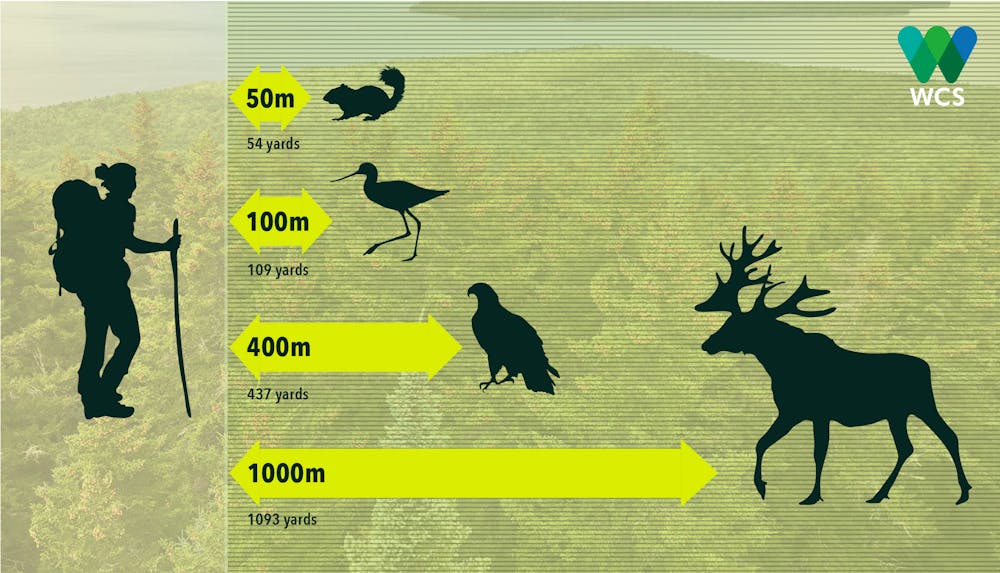
In a recent review of hundreds of studies covering many species, we found that the presence of humans can alter wild animal and bird behavior patterns at much greater distances than most people may think. Small mammals and birds may change their behavior when hikers or birders come within 300 feet (100 meters) – the length of a football field. Large birds like eagles and hawks can be affected when humans are over 1,300 feet (400 meters) away – roughly a quarter of a mile. And large mammals like elk and moose can be affected by humans up to 3,300 feet (1,000 meters) away – more than half a mile.

Many recent studies and reports have shown that the world is facing a biodiversity crisis. Over the past 50 years, Earth has lost so many species that many scientists believe the planet is experiencing its sixth mass extinction – due mainly to human activities.

Protected areas, from local open spaces to national parks, are vital for conserving plants and animals. They also are places where people like to spend time in nature. We believe that everyone who uses the outdoors should understand and respect this balance between outdoor recreation, sustainable use and conservation.

How human presence affects wildlife

Pandemic lockdowns in 2020 confined many people indoors – and wildlife responded. In Istanbul, dolphins ventured much closer to shore than usual. Penguins explored quiet South African Streets. Nubian ibex grazed on Israeli playgrounds. The fact that animals moved so freely without people present shows how wild species change their behavior in response to human activities.

Decades of research have shown that outdoor recreation, whether it’s hiking, cross-country skiing or riding all-terrain vehicles, has negative effects on wildlife. The most obvious signs are behavioral changes: Animals may flee from nearby people, decrease the time they feed and abandon nests or dens.

Other effects are harder to see, but can have serious consequences for animals’ health and survival. Wild animals that detect humans can experience physiological changes, such as increased heart rates and elevated levels of stress hormones.

And humans’ outdoor activities can degrade habitat that wild species depend on for food, shelter and reproduction. Human voices, off-leash dogs and campsite overuse all have harmful effects that make habitat unusable for many wild species.


Disturbing shorebirds can cause them to stop eating, stop feeding their young or flee their nests, leaving chicks vulnerable.

Effects of human presence vary for different species

For our study we examined 330 peer-reviewed articles spanning 38 years to locate thresholds at which recreation activities negatively affected wild animals and birds. The main thresholds we found were related to distances between wildlife and people or trails. But we also found other important factors, including the number of daily park visitors and the decibel levels of people’s conversations.

The studies that we reviewed covered over a dozen different types of motorized and nonmotorized recreation. While it might seem that motorized activities would have a bigger impact, some studies have found that dispersed “quiet” activities, such as day hiking, biking and wildlife viewing, can also affect which wild species will use a protected area.

Put another way, many species may be disturbed by humans nearby, even if those people are not using motorboats or all-terrain vehicles. It’s harder for animals to detect quiet humans, so there’s a better chance that they’ll be surprised by a cross-country skier than a snowmobile, for instance. In addition, some species that have been historically hunted are more likely to recognize – and flee from – a person walking than a person in a motorized vehicle.

Generally, larger animals need more distance, though the relationship is clearer for birds than mammals. We found that for birds, as bird size increased, so did the threshold distance. The smallest birds could tolerate humans within 65 feet (20 meters), while the largest birds had thresholds of roughly 2,000 feet (600 meters). Previous research has found a similar relationship. We did not find that this relationship existed as clearly for mammals.

We found little research on impact thresholds for amphibians and reptiles, such as lizards, frogs, turtles and snakes. A growing body of evidence shows that amphibians and reptiles are disturbed and negatively affected by recreation. So far, however, it’s unclear whether those effects reflect mainly the distance to people, the number of visitors or other factors.

Graphic showing distances at which human presence affects animals' behavior.
Human recreation starts to affect wild creatures’ behavior and physical state at different distances. Small mammals and birds tolerate closer recreation than do larger birds of prey and large mammals. Sarah Markes, CC BY-ND

How to reduce your impact on wildlife

While there’s much still to learn, we know enough to identify some simple actions people can take to minimize their impacts on wildlife. First, keep your distance. Although some species or individual animals will become used to human presence at close range, many others won’t. And it can be hard to tell when you are stressing an animal and potentially endangering both it and yourself.

Second, respect closed areas and stay on trails. For example, in Jackson Hole, Wyoming, wildlife managers seasonally close some backcountry ski areas to protect critical habitat for bighorn sheep and reduce stress on other species like moose, elk and mule deer. And rangers in Maine’s Acadia National Park close several trails annually near peregrine falcon nests. This reduces stress to nesting birds and has helped this formerly endangered species recover.

https://www.instagram.com/p/B89vyKwFlsZ/

Getting involved with educational or volunteer programs is a great way to learn about wildlife and help maintain undisturbed areas. As our research shows, balancing recreation with conservation means opening some areas to human use and keeping others entirely or mostly undisturbed.

As development fragments wild habitat and climate change forces many species to shift their ranges, movement corridors between protected areas become even more important. Our research suggests that creating recreation-free wildlife corridors of at least 3,300 feet (1,000 meters) wide can enable most species to move between protected areas without disturbance. Seeing wildlife can be part of a fun outdoor experience – but for the animals’ sake, you may need binoculars or a zoom lens for your camera.

Jeremy Dertien, PhD Candidate in Forestry and Environmental Conservation, Clemson University ; Courtney Larson, Adjunct Assistant Professor, University of Wyoming, and Sarah Reed, Affiliate Faculty in Fish, Wildlife and Conservation Biology, Colorado State University

This article is republished from The Conversation under a Creative Commons license. Read the original article.

Trump Organization money man who once blabbed to investigators testifies before grand jury: report

A high-ranking Trump Organization executive has testified before a special grand jury that returned an indictment against the former president’s company.

Jeff McConney, a longtime accountant for the family-owned business, previously testified during a 2017 civil lawsuit and showed a willingness to admit errors that might help prosecutors build a case, according to a transcript from a confidential interview obtained by The Daily Beast through a public records request.

“I probably didn’t know at that time that we probably shouldn’t be using foundation funds for this type of thing,” McConney told a New York attorney general investigator. “We made a mistake.”

That error was related to Donald Trump using a donor-funded charity to settle a lawsuit with Palm Beach, Fla., where his Mar-a-Lago resort is located, and McConney also admitted mistakes related to the then-president’s $25,000 gift to Florida attorney general Pam Bondi’s re-election campaign after she dropped an investigation into his fraudulent Trump University.

“We found out we made the contribution to . . . a political organization as opposed to a charitable organization,” McConney said. “Anything and everything that could go wrong did go wrong with this one request.”

McConney also told investigator about the time Trump skipped a Republican debate in January 2016 to host a televised fundraiser for veterans in Iowa, but he later got caught holding back donations.

“At that time, we thought there was a possibility of handing out checks to veterans,” McConney said under oath. “I had a checkbook and a pen, piece of paper to write down the contributions, if that was Mr. Trump’s desire.”

McConney gave detailed descriptions of his role in the Trump Organization, saying that Trump only signs the most important checks flowing out of the company, and the twice-impeached one-term president is confident his longtime lieutenant will remain loyal as he’s questioned by investigators.

“The former president thinks that Jeff worships the ground that he walks on,” said a source who’s spoken to Trump about McConney in the past few weeks. “Trump has said that after all he’s done for Jeff and his family, there is no reason for [McConney] to turn on him like some other people have.”

Shades of Big Tobacco: How (and why) Juul bought an entire issue of a scientific journal

Facing the imminent threat of corporate death, the embattled e-cigarette maker Juul is pulling out all the stops in its fight to convince the Food and Drug Administration that its vaping products are more beneficial than harmful. 

If that sounds like a stretch, it probably is. Last month, Juul settled a $40 million lawsuit that accused the company of luring in teens to use its flavored vape products, allowing Juul to avoid the potential PR nightmare of a widely covered jury trial. Juul has also spent tens of millions in federal lobbying efforts over the past several years, presumably in an effort to block comprehensive regulations on the sale of e-cigarettes. 

But the most bizarre Juul news came two weeks ago, when the New York Times reported that the company had funded an entire issue of a scientific journal, in which every article presented evidence that vaping is a beneficial harm-reduction practice that can wean smokers off tobacco cigarettes. 

Last month, the American Journal of Health and Behavior (AJHB), a 44-year-old academic journal that has published many nationally recognized scholars, released a special edition specifically devoted to the question of whether e-cigarettes are harmful or helpful. The 219-page issue is unusual not just by virtue of its niche subject matter — e-cigarettes are a relatively new phenomenon in the field of health behavior — but also because its publication was bankrolled entirely by one source: Juul Labs. 

This fraught episode comes at an exceptionally tumultuous time for the vape maker. In early 2019, Juul, a company founded just four years earlier, was riding a wave of explosive success, boasting $1 billion in revenue. Sales had grown by 641% from 2016 to 2017 alone. A national survey in 2019 found that nearly 30% of U.S. high school students reported using e-cigarettes in the last month, with 60% of them naming Juul as their preferred brand. 

In 2018, the tobacco giant Altria — previously known as Philip Morris — took a 35% stake in Juul, believing the acquisition might help recover some of the company’s losses from an overall decline in U.S. cigarette sales over the past several decades. Only a few months later, however, disaster struck. A mysterious respiratory ailment, clearly linked to vaping, sickened more than 1,000 people in the U.S., and by the fall of 2019, 34 vape users had died from lung injuries. Facing an array of potentially devastating lawsuits and pressure from the Food and Drug Administration (FDA), Juul voluntarily pulled its products from many store shelves and canceled its youth advertising campaigns, rapidly losing more than 30% of its market share. 

Now Juul remains in something like corporate limbo, awaiting FDA approval to continue selling its vape products in the U.S. The agency will likely decide this year whether the alleged health benefits of Juul products outweigh their potentially addictive qualities. It’s not entirely surprising, then, that Juul wanted to subsidize an entire edition of a medical journal: Its survival as a corporation is on the line. 

But is the Juul-sponsored journal ethical? That’s a murkier question than it might appear. The special issue of AJHB makes no attempt to conceal the fact that essentially all the studies it contains were funded and facilitated by Juul. As The American Prospect notes, a cursory glance at the journal’s “Conflict of Interest” statements reveals that 18 co-authors of articles in the special issue are Juul employees. 

Five other co-authors work at PinneyAssociates, a firm that “provides consulting on harm reduction exclusively to JUUL Labs,” as its senior scientific adviser, Dr. Saul Shiffman, told Salon by e-mail. “We participate in JUUL’s work to publish their scientific research to inform the public dialogue about tobacco harm reduction,” he added. An additional three co-authors are involved in the Centre for Substance Use Research, another consulting firm that has a contract with Juul. Nearly every study in the issue features the brand name in its title, and all of them effectively conclude that Juul’s products are a safe form of harm reduction.

As one paper in the journal, a study based on population modeling, puts it, “after considering both potentially beneficial and potentially harmful transitions and based on the available evidence to date — the (continued) availability of ENDS [i.e., vape products such as Juul’s] in the US is likely to have a positive impact on population mortality.”

The edition’s closing perspective, written by Dr. Karl O. Fagerström, a Swedish psychologist who specializes in smoking cessation and “tobacco harm reduction,” waxes a bit more philosophical. “Because it is unlikely that humankind will give up drugs, nicotine included,” he writes, “the findings from the studies presented in this issue suggest that ENDS, and JUUL in particular, can be an acceptable substitute for more harmful cigarette alternatives.” (It is duly noted that Fagerström has served as a paid consultant to Philip Morris International and British American Tobacco.)

Outside the world of corporate-sponsored research, the existing scientific literature is mixed, at best, on the question of whether products like Juul offer effective means of smoking cessation. One study from the University of California, San Francisco, found last year that Juul’s products deliver “more nicotine to the blood per puff than cigarettes or previous-generation e-cigarettes (e-cigs) and [impair] blood vessel function comparable to cigarette smoke.”

Another study published this year in Pediatrics, the official journal of the American Academy of Pediatrics, found that e-cigarette smokers are three times more likely to switch to tobacco cigarettes later on. Other studies have found that e-cigarettes elevate the risk of heart disease, high cholesterol and depression.

To get a better sense of how this strange edition of a previously respected journal came into being, Salon contacted dozens of people listed as associate editors or senior associate editors at AJHB — none of whom are paid for their work there. Virtually none of them knew about the Juul-sponsored edition prior to its release.

“There was certainly no email sent out to any of the editors that this was going to happen,” Dr. Richard Olmstead, a research psychologist at UCLA’s Semel Institute for Neuroscience and Human Behavior, and an associate editor of AJHB, told Salon. “I think there would have been quite a bit of pushback had there been some forewarning about it.”

Dr. Carl Fertman, a professor emeritus at the University of Pittsburgh’s School of Education and an associate editor at the journal, described the special issue as a “complete surprise.”

“There was no transparency,” he said in an interview with Salon. “I don’t want to be associated with this journal. It’s upsetting.”

“I think it’s fairly unusual that a single company would sponsor a special issue,” another associate editor told Salon, asking not to be identified by name. “I was surprised to see they called out a specific company in every article.” This person added that was “different” from anything they’d seen before in “any scientific behavioral journal.”

A number of editors, however, acknowledged that there’s nothing new about seeing corporations sponsor scientific research they believe will be favorable to their bottom line. 

For decades, the tobacco industry worked diligently to steer the scientific consensus away from the conclusion — now universally accepted — that cigarette smoking causes lung cancer, emphysema and other serious or life-threatening health problems. Central to that strategy was ginning up fake controversy by pushing junk science that appeared to contradict the overwhelming weight of scientific and medical evidence. Tobacco companies poured money into shadowy front groups that supported dubious science, paid consultants to prepare “expert” testimony to Congress and regulatory bodies and suppressed internal research findings that made clear that the companies themselves understood their products were killing people.

In 1998, a torrent of secret internal documents from a number of tobacco giants was released to the public as part of the Tobacco Master Settlement Agreement. By the early 2000s, the veil was just about lifted. Ruling on a landmark Justice Department suit back in 2006, U.S. District Judge Gladys E. Kessler found that several big-name tobacco companies, including Philip Morris, had systematically defrauded the American public with a decades-long effort to launder pro-tobacco “science” through academic and government channels. 

To be clear, Juul is not a tobacco company. It makes and sells e-cigarettes, aka “vapes,” which contain no tobacco and are meant to simulate the experience of smoking cigarettes. They deliver high doses of nicotine to the brain through water vapor, often flavored in various ways. Whether vaping is “safe” remains an unsettled question, but it’s not the same thing as smoking.

Still, the fact Altria holds a significant interest in Juul creates an uncomfortable parallel, even if the two companies’ products would seem to be in competition. Juul’s decision to bankroll an entire edition of a medical journal struck many people as reminiscent of the Big Tobacco playbook. 

Following AJHB’s publication of the special edition, a number of editors resigned from the journal, according to New York Times reporting later confirmed by Salon. Most editors declined to comment on the scientific merit of the papers published in the special edition. But there are reasons to be dubious about how the journal’s peer-review process worked in this case.

Before studies are published in any scientific journal, they are typically subject to peer review, in which experts in the relevant field read the papers and offer comments. As AHJB states in its ethical guidelines: “To decrease bias during the editorial process, we employ the classic double-blind peer review process. … The Editor-in-Chief transmits reviewer evaluations and comments to the corresponding author, usually within 4 weeks.” 

AJHB editor-in-chief Dr. Elbert Glover, however, apparently told reviewers that the issue was about e-cigarettes in general — and then offered them cash rewards to complete their reviews within a week, according the the Philadelphia Inquirer. Many editors told Salon that in itself was unusual. Only after reviewers reportedly began to ask questions about “fishy” aspects of the studies did Glover reveal that the entire issue was funded by Juul. One reviewer told the Inquirer that the design of one particular study seemed so biased that she recommended it be rejected outright. “I thought, ‘No way it wasn’t funded by Juul,'” she said. 

In an email exchange with Salon, Glover acknowledged that he had been privately approached by Juul, who personally paid him $57,500 to publish the edition. (Glover is the sole owner of the publication.) He maintained, however, that the peer review process was conducted in good faith.

“Reviewers were not initially notified regarding the funder of the special issue as it has been journal policy to not identify the funder of special issues during the review process,” Glover wrote to Salon. “However, during the review process, one reviewer requested the identity of the funder. As a result of the reviewer’s response, I decided to share the identity of the funder with all the reviewers of the special issue.”

Asked whether he believed it was appropriate to publish a corporate-sponsored special issue without consulting the other listed editors, Glover responded that it had not occurred to him, saying he “was more concerned about the science and did not consider who funded this issue.”

“I should have been more perceptive to their issue,” he said. “In retrospect, it was probably an error but I still do not understand the ability to ignore science and allow negative bias to enter into the decision.

“My philosophy is to allow the scientific merit to determine publication, not personal bias. Just because the tobacco industry lied, manipulated data and currently promote a product that causes death, does not mean that I have to compromise my values.”

But it’s precisely because of the tobacco industry’s dark history of lies and manipulative spin that Glover should have come clean about Juul’s sponsorship from the beginning, say experts on the other side of the issue.

“The problem is that the tobacco industry has a decades long history of spinning science to meet its regulatory, legal and PR needs,” wrote Dr. Stanton Glantz, former director of the Center for Tobacco Control Research and Education, in a blog post responding to AJHB’s special issue.

As one meta-analysis of research data found in 1998, “the only factor associated with concluding that passive smoking is not harmful was whether an author was affiliated with the tobacco industry.” 

A number of AJHB editors told Salon that any study funded by an interested party, especially a large corporation, should be met with heightened scrutiny. One said it was “a red flag when the authors are part of the organization that sponsored the research,” adding: “It doesn’t mean that one can dismiss all of the findings, but it needs to be carefully scrutinized.”

It remains unclear which way the wind is blowing for Juul. In September 2019, the FDA issued a formal warning to the company, making clear that “before marketing tobacco products for reduced risk, companies must demonstrate with scientific evidence that their specific product does in fact pose less risk or is less harmful.” 

“JUUL has ignored the law,” the department added, “and very concerningly, has made some of these statements in school to our nation’s youth.”

Months later, it was reported that Juul had begun beefing up its scientific staff, hiring a number of former FDA officials and recruiting researchers in hopes of clearing potential regulatory hurdles. Last July, Juul submitted a Premarket Tobacco Product Application (PMTA) to the FDA, providing “detailed scientific data from over 110 studies totaling over 125,000 pages evaluating the product’s impact on both current users of tobacco products and nonusers, including those who are underage.”

The Juul-sponsored special issue of AJHB is one aspect one part of the company’s PMTA, a Juul spokesperson told Salon in a statement. 

“The research in the special issue derives from an extensive research program designed to provide the US Food and Drug Administration’s Center for Tobacco Products with information, scientific data, and analysis to determine whether JUUL products are appropriate for the protection of public health,” the statement read. “This determination, through the submission of Premarket Tobacco Product Applications (PMTAs), is based on a rigorous, science-based process. Indeed, FDA has received not only the findings and reports reflected in the published papers, but also the subject-level data and other supporting information required through the PMTA process.”

In April of this year, six major health organizations — including the American Academy of Pediatrics, the American Cancer Society, the American Heart Association and the American Lung Association — wrote a letter to the FDA urging the agency to reject Juul’s Premarket Tobacco Product Application.

“The devastating combination of appealing flavors that appeal to youth, targeted marketing strategies, and technological innovations that deliver a powerful hit of nicotine, has caused enormous damage to public health, primarily through youth uptake,” they wrote. “Because of this, no JUUL products currently on the market can meet the public health standard, and therefore, none should be authorized by CTP or be allowed to stay on the market.”

The FDA is expected to rule on Juul’s application by Sept. 9.

Corey Lewandowski admits actors were hired for Trump campaign launch — then he blames Michael Cohen

Former campaign manager to Donald Trump, Corey Lewandowski, is admitting that the campaign launch at Trump Tower was fueled by paid actors.

According to BusinessInsider, Lewandowski confessed that he lied in 2016 when he said, “You know Donald Trump. There is nobody who believes that when Donald Trump goes somewhere he does not generate the biggest, largest and most rambunctious crowds on the planet. It’s just not true, unequivocally. The Donald Trump campaign and Donald Trump did not pay anybody to attend his announcement.”

Now, Lewandowski is saying that he lied, but really it was all Michael Cohen’s fault, claiming that the former Trump lawyer hired the actors who were on hand to cheer Trump.

“That’s a Michael Cohen special,” Lewandowski claimed. “Michael Cohen decided that he was going to go hire one of his buddies and pay his buddy without getting any campaign approval. You know, $50 for every person to come in, to stand in Trump Tower.”

Cohen calls that completely false, noting that Trump hired the partner of a public relations firm to organize the launch event “professionally.” David Schwartz, a partner at the Gotham Relations & Communications was the one who was behind organizing the day.

“Any allegation of payments to actors is an absolute lie that was promoted by Corey Lewandowski,” said Cohen.

Schwartz confirmed Cohen’s account.

“The reality is we hired 50 people, some of whom were part-time actors I found out later on. But we hired 50 people to help coordinate an event that brought in thousands of people,” Schwartz explained.

Lewandowski was recruited to be the campaign manager in Jan. 2015, The Lowell Sun reported in July 2015. It’s unclear why Lewandowski wouldn’t be aware of firms being hired or why he would lie about Cohen recruiting actors. But Lewandowski has been lying about the paid actors for five years, so it’s unclear what is true.

Read the full report at BusinessInsider.

Harrowing report on plastic pollution says we have 29 years to save the ocean

Speaking to Salon in April, John Hocevar — the Oceans Campaign Director for Greenpeace USA — brought the horrors of plastic pollution to vivid life by describing one of its more heartbreaking consequences: the suffering it inflicts on innocent sea creatures.

“We’ve seen pictures of whales washed up on beaches with their stomachs full of plastic bags or sea turtles with straws up their noses or albatrosses dead with stomachs full of bottle caps and lighters and other bits of plastic,” Hocevar explained. “Sharks and turtles will take a bite out of a plastic bottle at sea or sea turtles often might be entangled in plastic bags or choke on them because plastic bags can resemble a jellyfish, a major source of food.”

Now, a report on plastic pollution, written by Pew Charitable Trusts and endorsed by the U.N. undersecretary-general, says the world needs to implement drastic measures to make sure no new plastic enters the ocean as of 2050, which is a major goal of 19 countries and the European Union. The report was released in tandem with a peer-reviewed analysis of an “evidence-based, comprehensive, integrated, and economically attractive pathway to greatly reduce plastic pollution entering our ocean” which was published in Science. The report describes itself as a “roadmap” to reduce plastic pollution on a global scale to the extent that the oceans suffer no more of it. 

Sadly, humanity is nowhere near achieving that objective, the report claims, and offers eight steps to turn things around. Those steps include “reduce growth in plastic consumption,” “substitute plastics with suitable alternative materials,” “design products and packaging for recycling,” “expand waste collection rates in the Global South,” “increase mechanical recycling capacity globally,” “scale up global capacity of chemical conversion,” “build safe waste disposal facilities” and “reduce plastic waste exports.”

Sen. Jeff Merkley of Oregon, who chairs the Environment and Public Works subcommittee that oversees environmental justice, waste management and chemical safety, introduced the Break Free From Plastic Pollution Act earlier this year in order to put America on the road to a sustainable future. He later explained to Salon that he is pushing for this legislation because “if we keep proceeding with business as usual, the air we breathe, the soil we use to grow our food, and the waters that countless communities rely on will only become more and more polluted —putting Americans’ health, particularly in communities of color and low-income communities, at serious risk.”


Want more health and science stories in your inbox? Subscribe to Salon’s weekly newsletter The Vulgar Scientist.


Beyond the effect of plastic pollution on large marine animals, plastic pollution has myriad other consequences for human health and wildlife. The prevalence of synthetic polymers, both on land and in the ocean, has been linked to dropping sperm counts as well as incidences of cancer and immune diseases. Studies have found that there are more microplastics than zooplankton (a vital part of the ocean food chain) in the ocean. A 2016 report from the World Economic Forum even projected that there would be more plastic waste than fish in our oceans by 2050.

Indeed, perhaps the greatest threat presented by plastic pollution to humans is dropping sperm counts. Synthetic polymers include a number of chemicals that serve as so-called “endocrine disruptors,” meaning they interfere with the healthy functioning of the glands that produce hormones. These endocrine disruptors are linked to dropping sperm counts that have continued since the 1970s and which, if they continue unabated, could cause human males to become infertile.

Trump aides kept Rudy Giuliani away from debate preparation by giving him wrong meeting time: book

Aides to former President Donald Trump were reportedly so desperate to keep Rudy Giuliani out of debate preparation sessions that they resorted to using crude deception and subterfuge.

Business Insider has obtained a copy of the new book “I Alone Can Fix It” by Washington Post reporters Philip Rucker and Carol Leonig, which details the Trump presidency’s disastrous final year that saw him lose the 2020 election to President Joe Biden.

According to Business Insider, Trump allies Chris Christie and Kellyanne Conway were deeply wary of Giuliani’s approach to debating with then-candidate Biden and did not want him influencing Trump ahead of the all-important first debate.

After Giuliani blundered his way through one debate prep session that aides described to the authors as “supremely unhelpful,” a decision was made to keep Giuliani out of the next session no matter how much he begged to help.

“Aides told Giuliani they would be gathering at 2:00 p.m., though they were scheduled to start at noon,” the authors report. “They had tricked Giuliani by giving him the wrong time.”

The reporting tracks with reporting from reporter Michael Wolff, who claimed that no campaign officials wanted Giuliani at the debate prep sessions in part because he “passed gas constantly.”

In “Black Widow,” here’s why a simple vest with pockets means so much

One scene in Marvel’s “Black Widow” prequel, which revists the titular superhero’s dark, humble beginnings, is particularly resonant. And in a movie full of deadly assassins, a dramatic prison break and an exploding covert facility, the scene in question is a simple conversation between two sisters about the marvel that is a vest.

Estranged surrogate sisters Natasha (Scarlett Johansson) and Yelena (Florence Pugh) have reunited to take down the Black Widow special ops program that has kidnapped, trained and brainwashed innumerable women to become lethal killing machines against their will. Having gone through and escaped the program themselves, they’re intent on liberating their sisters in arms. But before that, they share a surprising heart to heart as they drive off in a stolen getaway vehicle.

“You know, this is the first piece of clothing I’ve ever bought for myself,” Yelena says offhandedly of the vest she’s wearing. It isn’t exactly glamorous nor overtly feminine, so Natasha jokingly responds, “Is that like an army surplus or . . .?”

Feeling the need to justify her purchase — and her fashion sense — Yelena says, “OK, it has a lot of pockets, but I use them all the time and I made some of my own modifications. The point is, I’ve never had control over my own life before and now I do. I want to do things.”

Natasha realizes that to Yelena, the vest is about more than a vest, and she finally smiles and voices her support with a simple, “I like your vest.” Yelena, of course, isn’t quite done singing the garment’s praises, closing the poignant dialogue by driving home the point that “you can put so much stuff in there, you wouldn’t even know.”

“Black Widow” is rife with punchy feminist storylines, not the least of which include holding up a mirror to the real-life war on reproductive rights and validating non-biological womanhood and family. But this dialogue about Yelena’s vest is one that’s the most relatable. 

Few clothing garments for women are more universally beloved than those with pockets — the more and the deeper the better. Any woman who is complimented on a dress that happens to have pockets will be the first to point out this convenience with a certain conspiratorial glee. The simple pocket should be a given, but its lack is unfortunately the norm in women’s clothing.

As Vox reported back in 2016, the pocket has always been political, offering not-so-subtle insight into who is expected to go out into public spaces and carry belongings with them. It may not seem like much, since women are expected to carry purses anyway, but the necessity of carrying a purse in itself is an added, gendered burden — and cost — that men don’t have to deal with. In recent years, especially throughout the skinny jeans and jeggings craze of the 2010s, the discourse around lack of pockets in women’s clothing reached a fever pitch, as women went from accepting this wardrobe deficiency as an annoyance, to calling it out for its sexism.

Yelena’s whole vest situation is especially political, given the context of how she has been denied control over her body and life from the moment she was born and enrolled in the Black Widows program against her will. Over the course of her time in captivity, Yelena is forced to undergo an unwanted hysterectomy, kill untold numbers of people she didn’t want to kill, and is denied the ability to have meaningful friendships and relationships with anyone, or have a life of her own in any way. Her first free act was to purchase a handy utility vest, covered in pockets which she can use to not just carry whatever she wants, but also do whatever she wants. And what she wants is to liberate the other Widows and be by her sister Natasha’s side.

The iconic and decisively feminist vest is also a symbol of sisterhood — most notably, sisterhood between Yelena and Natasha. By the end of the film, Natasha accepts Yelena’s gift and wears it almost right away, from the closing scene of “Black Widow” to her return after years on the run in “Infinity War.” The vest becomes an intimate part of her — like her sisterhood with Yelena, even when they’re apart.

It’s unclear what happens to Yelena in the years between “Black Widow” and “Endgame.” Our only hint at this is a mid-credits scene when Yelena visits Natasha’s grave, some time after Natasha sacrifices her life in “Endgame.” It’s in this scene that Yelena is given her “next assignment,” supposedly as an assassin under the employ of Julia Louis-Dreyfus’ mysterious Contessa Valentina Allegra de la Fontaine: to kill Hawkeye (Jeremy Renner) whose life Natasha had deemed more important than her own. Naturally, being the pocket-advocating, flaming feminist hero she is, Yelena’s response is to ask Valentina for a raise.

There’s clearly a bright future for Yelena — who might just become the snarkiest, most delightfully sarcastic person in the Marvel Cinematic Universe, carrying on the legacy of her sister, the first female Avenger. Hopefully, wherever her journey takes her, she’ll have recovered the iconic vest: a manifestation of her freedom, and her loving sisterhood with Natasha, the Avenger who paved the way for new heroes like Yelena.

Charlie Kirk wants student followers to harass TSA employees with no-mask “game”

Conservative firebrand and youth right-wing organizer Charlie Kirk has encouraged his young followers to play a “game” based on deliberately making life difficult for TSA employees at airports around the country. 

Kirk’s remarks came at Turning Point USA’s annual summer gathering in Tampa, where conservative college and high school students congregated to hear from a star lineup of TrumpWorld speakers.

“A ‘micro-tyrant’ is a term that we came up [with] on our podcast,” Kirk said, elaborating that he means “the type of person at Starbucks who has way too much power, that no one voted for, that never ran for office, that will start screaming at you because you have your mask one millimeter below your nose.”

Kirk then commenced a lengthy narrative, beginning with a tale about a recent Starbucks encounter. 

“I’ll tell you a story about a micro-tyrant where I went into a Starbucks in California, and there was like this ridiculous, arbitrary line, and I reached over to go get a straw, and she just comes up to me said, ‘Sir, you are contributing to the spread of the killer coronavirus.’ … Because I went three inches. I said, ‘No one voted for you, OK? … You have way too much power.'” 

The frequent Fox News guest, known for his bewildering remarks at previous TPUSA gatherings, continued by sharing a different story about how he and his team harass TSA agents as they try to do their jobs.

“I have a TSA story I could go through as well,” Kirk began. “There’s this woman without a mask, looking at her phone. I try to — by the way, you guys should all play this game alongside of me; it’s a lot of fun. It’s how far can you get through the airport without them telling you to put on a mask? All of you guys, it’s really fun.” Kirk then asked his audience if any of them had successfully boarded planes without wearing masks. Some students in the crowd raised their hands, and Kirk responded, “That’s awesome!” 

Kirk went on to declare that a member of his team had been successful at the “game” and “broke through” at the airport while defying the current federal mandate to wear a mask. 

Kirk also claimed that a member of his TPUSA team had been threatened with arrest by a TSA agent, before mocking the agent’s authority. “First of all, you have way too much power,” he said. “Like, that might be a real badge, but you’re not deputized in the name of the law. Like, you don’t have handcuffs, you know?” 

Kirk concluded by describing the entire “game” as a way to “fight against the little things,” adding, “I’m not a big rule person. I like tightly written rules that everyone can understand, maybe 10 or 12.”

On Monday, Kirk doubled down on advocating his mask “game,” stating that it involved taking a “risk in pursuit of a good thing.”

In other circumstances, encouraging right-wing teens to defy travel regulations for no discernible reason might have generated headlines. But Kirk has faced other challenges during the four-day TPUSA conference in Tampa, including banning a “conservative porn star” and evicting white nationalist “groypers” who have tried to invade the event.

Watch Kirk’s speech below, via YouTube

The bill Jeff Bezos doesn’t want you to know about

Amazon is emblematic of the long-term decline of America’s middle class and historical levels of economic inequality. Lousy pay and unsafe working conditions across the American economy have fueled anger and frustration, drug overdoses and deaths of despair, and tempted some working-class people to embrace messages of fear, hate, and division.

Amazon and other architects of inequality don’t just wield enormous economic power. They now wield immense political power, allowing them to get away with egregious labor law violations.  Even though public support for unions is as high as it’s been in 50 years, when nearly 6,000 predominantly Black workers dared to try to unionize their Bessemer, Alabama warehouse, they were thwarted by Amazon’s “shock and awe” union-busting campaign against them.  The National Labor Relations Act makes it illegal for employers to fire workers for trying to organize a union. But the penalties for violating the Act are so laughably small that employers like Amazon routinely do it anyway.

Amazon may be the future of the American economy, but if that future is to have room for the kind of prosperous working families we saw fifty years ago, we need strong unions. Research shows high union membership boosts middle class incomes and reduces inequality. Rebuilding worker power is critical to restoring broad-based prosperity.

In March, the House of Representatives passed legislation designed to level the playing field, the Protecting the Right to Organize Act. The PRO Act would end many of the practices Amazon used to defeat the union effort in Bessemer, and impose real penalties on companies who violate the National Labor Relations Act.  Crucially, it would send a clear signal that ours is truly a government “of the people.”  Passing the PRO Act is a crucial. Let’s make it happen.

After Robert E. Lee comparison, first Capitol rioter convicted of a felony gets 8 months in prison

A Florida man who waved a “Trump 2020” flag on the Senate floor was convicted on Monday for participating in the Capitol riot, with a district judge assigning him an 8-month prison sentence. 

Last month, Paul Hodgkins, a 38-year-old crane operator, pled guilty to obstructing an official proceeding, admitting that he breached the Senate chamber with the explicit intent of blocking President Joe Biden’s election certification. Hodgkins, the first person to be charged in connection with the riot, spent a total of fifteen uninterrupted minutes inside the chamber, donning Trump paraphernalia and taking a selfie with his fellow rioters. 

His sentence is less severe than the 1.5 years originally requested by the Department of Justice, an amount that the agency felt would adequately deter potential insurrectionists down the road, CNN noted. Though Special Assistant U.S. Attorney Mona Sedky appreciated that Hodgkins made “significant steps” toward rehabilitation, she maintained that “the need to deter others is especially strong in cases involving domestic terrorism, which the breach of the Capitol certainly was.”

Prosecutors did not convict Hodgkins with the “crime of terrorism,” instead likening his behavior to that of a domestic terrorist by pointing out exhibits of his “intimidation or coercion” during the insurrection.

Hodgkins’ lawyer, Patrick LeDuc, who requested that the court sentence Hodgkins to home detention, disputed the notion that the Capitol riot amounted to anything resembling domestic terrorism. “That was a bridge too far for me,” LeDuc said. 

The lawyer specifically contrasted the prosecution’s apparently severe treatment of his client to the leniency Union general Ulysses S. Grant practiced in his punishment of Confederate general Robert E. Lee at the end of the Civil War. At the Appomattox Court House in 1865, Grant and Lee brokered a deal in which Lee would surrender his troops in exchange for pardons, Union rations, and assurance that Confederate men would be able to keep their private property.

“Today, the country is as divided as it was in the 1850s. But today, this Court has a chance to make a difference,” LeDuc wrote in court documents. “We have the chance to be as Lincoln had hoped, to exercise grace and charity, and to restore healing for those who seek forgiveness.”

Ludoc also delivered a relatively garrulous floor speech lasting 30-minutes, wherein the lawyer invoked the words of Abraham Lincoln and railed against “cancel culture.”  

He argued that, in the U.S., “we don’t sentence people collectively. We sentence people individually,” adding that America “left that behind” during Japanese-American internment.

During a break, Hodgkins’ mother reportedly told Leduc: “You talk too much.”

So far, twenty rioters have entered into guilty pleas and two have already been sentenced for misdemeanors, according to CBS News. Of those convicted, one was assigned 6 months probation with no jail time, while the other was given six months in prison. Prosecutors have said Leduc’s sentence will serve as a benchmark for convictions to come.

“The Daily Show” launched 25 years ago to tackle the news: “We didn’t lampoon it, we became it”

Twenty-five years ago, the best news show on television debuted — on Comedy Central.

From its beginning, “The Daily Show” distinguished itself with its combination of brutally funny cynicism and furious hope, a balance refined when Jon Stewart became host in early 1999, and maintained today with Trevor Noah behind the desk. And from its beginning, it’s been a show much about the news media as the news itself. 

The endurance of “The Daily Show” remains a testament to its creators, Madeline Smithberg and Lizz Winstead, who helped set the show’s meticulously crafted tone. Salon spoke to Winstead recently via phone about the show’s genesis, the grueling, pre-Google days of newsgathering and the “Daily Show” reunion benefit livestreaming this week.

This conversation has been lightly edited for length and clarity.

It’s not like there’d never been satire. It’s not like there’d never been parody of the news. What made “The Daily Show” unique?

I think what made this different is that we didn’t lampoon it; we became it. We really gave the audience credit. We didn’t want to be cartoons. We wanted to, by being as realistic as possible, by looking like and having their same tone, by using the same bullsh*t that the media focused on, really shine a light on what it was that wrong with the media.

A lot of times, in previous iterations where there was a news desk, it was snarky commentary about the news. For us, we felt like the media itself needed to be a character. Back in 1996 when we launched, there was only CNN. We launched in mid-July. MSNBC launched a couple weeks later. [Note: MSNBC launched July 15, 1996]. Fox News launched in October. All of that happened in 1996.

When we started, we were really satirizing the whole if “If bleeds, it leads” local news stories, and also the fear-based news magazines. There were 17 news magazines on network television when we launched. They would all do,”Will your pasta kill you?” You know, everything was about terrifying the viewer and then finding obscure ways to tie it into a think piece and then put it out there in this supposition language. That was happening all over. You would look at the cover of a magazine and it would say, “Do you have AIDS?” Then there would be an article and it was just, “Of course you don’t have AIDS.” But they would just try to scare you. We really followed that trajectory. The show, when we launched it, was actually more like Colbert in the sense that every single person on the show was in character. We just took the audience on this newscast full of people who were utterly reprehensible on some level. You could see the essence of what you knew and what you saw every night in real news.

One of the reasons “The Daily Show” is 25 years old and has been going strong is because Brian Unger came from news, and trained every correspondent. He was the first correspondent we hired. He was a producer and he was an on-camera person. He trained everybody on how to light a shot, how to shoot to create a mood, how to deliver your lines. He really helped all of us learn how to go straight with the ridiculousness, so it sounded like you were delivering the news.

Was the show a hard sell to the public, as female creators?

To create a news show back in the day, and to do good satire, you had to satirize the existing thing. And the existing thing was full of white men. So as two women, the one thing we did know was that if we wanted to blow the lid off the news, it had to look like the news. That meant that the spaces that needed to get occupied needed to be white dudes, right? To this day — and this part is frustrating —I don’t think a lot of people know that two women created that show.

I think that they also don’t know that our two co-creators, executive producer, head writer, executive in charge of production, senior producer, all of field producers except for one, were all women. It was a bummer because we got over 150 writing submissions, and only two from women, when we launched.

It was a lot of fun, but it was also really challenging. Madeleine and I had to fight a lot of battles with the network because they didn’t want this to be a news show. I think they wanted it to be wackier, and more pop culturey. I’m not sure that “The Daily Show” would have lasted 25 years if Madeleine and I would have acquiesced to turn it into some kind of “Entertainment Tonight” kind of comedy show.

When did you know that this was something? That this was a thing that people were paying attention to and that it was having an impact?

The second the show went on the air, I had a feeling. Then we got flooded with fan mail. Then there were so many requests that it was almost a year in advance to get tickets. That happened within like the first week. And that audience wanting to be part of it thing was really cool.

There was nothing else really quite like that out there to pin your conversations around, that was reflecting the way that we were talking about the news.

What gave us a great boost was broadcast news had just really done a disservice around real news. CNN was like “the trial of the century of the week.” A lot of people were really wondering what the hell was going on in the world and not seeing it, and then watching the news. They knew the conventions.They knew the local news guy. They knew that scary story. They knew Stone Phillips. They had a working knowledge of the conventions. Within the subtleties of how we did our characters, we still made sure that the audience was with us on how we satirized the people and the genres and the type of stories that we did. So we didn’t try to be too inside baseball. And you know, print journalists were so excited that we were sh*tting all over television journalism. They were writing glowing, glowing stories.

Was there a moment early on in it, where you had a story where you thought, “We’re doing this story in a way that nobody else has looked at it?”

I think everything we did was sort of that. I mean, even “Weekend Update” never used footage. There was never a lot of designing over-the-shoulder graphics that looked like how they did on the news. We were the first to do that. Taking the trends of news genres, like, “When animals attack,” then we did “When the elderly attack.”

We really just satirized how they did the coverage, the terms, and how many times they’re just throwing to somebody to say, “Over to you,” when there was nothing going on there. Car chases. Storm watch. We were the first people to really take it to the next level and out into the field, and bring it back into the studio. Instead of it being skits, it was actually a fully formed show that had to operate like a newsroom, because we were making a news show, but we were satirizing it.

And remember, without Google. I think we stole a LexisNexis login. We had like 45 newspapers delivered to the office. People split up the country in regions, and they would just find stories. I think we had the AP wire. But it was digging around, and then just watching, and observing what the trends were, and then satirizing it.

The show came at a moment in the midst of the Clinton administration and post O.J., all these media circuses. Do you think that that was part of what made us ripe for the show, or was the show ripe for America?

I think it’s what made the show ripe for America. The media had set the agenda for the circus. We didn’t have to point out there was a circus; the circus was self-evident. The circus started after the first Gulf War. People forget that right when it was winding down, and everybody was panicking about how they were going to keep ratings going, Rodney King happened. So they were able to keep their media jones going, and then that just keeps perpetuating itself.They didn’t even really learn good lessons in that. They just amplified the furious nature of the rage, instead of examining the rage. That should have been our reckoning.

Instead of what it’s become, which is the model.

Then you had the baby-shaking nanny, and then the Menendez brothers, and then Anna Nicole Smith. It just became this furious churn factory. We just followed it. It was like, that’s how you’re going to help people? That’s insanity to me. Part of what was fun was by holding a light up and becoming them, without having to hit somebody over the head to say, “Careful who you trust when you get information.”  

You’ve got a reunion event with Madeline Smithberg, Brian Unger and other “The Daily Show” originals. Tell me about the show.

The good news is, I really want to promote this special, because it’s also benefiting Abortion Access Front, which is really cool. All these people are getting together to support us.

I really would love to make sure that people know that they can watch all these cool people get back together and tell the original story with stories they’ve never heard before. I’m really excited that this fall, we are launching a YouTube talk show — a 30-minute weekly hilarious feminist comedy talk show that’s going to talk about all the issues that don’t get talked about, and that is really doing deep dives into all these laws that are happening around reproductive access, and just patriarchy, and white supremacy, and with comedy and fun. That’s called Feminist Buzzkills Live, and that’s launching in October. That’s one of the projects that we’re working on with Abortion Access Front as well. I’m also going back out on the road to do a bunch of touring. People really need a catharsis and to gather. We need a 12-step program to get off Nextdoor. Just stop going online and getting weird information from your vaguely racist neighbors. Like, we need to regroup.

So, all eyes on the prize and in Washington, D.C. in the fall, on the Supreme Court, when they’re going to decide the fate of abortion access as we know it in the United States. And that is pretty intense.

“The Daily Show Turns 25!” livestreams July 19 at 9 p.m. ET/6 p.m. PT. Tickets are available on RushTix, and proceeds benefit Abortion Access Front.

Texas Democrats who fled state in protest of GOP anti-voting bill test positive for COVID

More than 10% of the Texas Democrats who left the state earlier this summer to stymie the passage of a GOP-backed voter restriction bill have contracted COVID. 

A sixth member of the Texas House tested positive on Monday. State Rep. Rhetta Bowers told the Dallas Morning News that the elected officials are quarantining in their hotel rooms in D.C. where several lawmakers went to lobby Democrats in Congress to pass federal legislation protecting access to the ballot box.

“When my Texas House Democratic colleagues and I broke quorum to stop anti-voter legislation, we knew that tactic would come with real personal sacrifice,” State Rep. Trey Martinez Fischer of San Antonio said in a statement announcing that he had tested positive.

He also said that he is fortunate to be experiencing only “extremely mild symptoms.”

One caucus official said all of the more than 50 passengers and crew on the trip were  vaccinated. The CDC says, while rare, “breakthrough” infections among groups of vaccinated people can still occur. 

When a photo surfaced showing the Democrats maskless on the plane, Republicans and others criticized the lawmakers for being maskless, but federal guidelines don’t require masks to be worn on private aircrafts.

After meeting with the Texas officials last week, Vice President Kamala Harris went to Walter Reed Hospital on Sunday for a routine visit, according to a White House official. Once lawmakers started testing positive, Harris’ spokesperson said her and her staff were not at risk due to not being in close contact with any of the infected officials and all being vaccinated. 

State Rep. Gene Wu said the outbreak speaks to the efficacy of the vaccine. 

“That is the beauty of being vaccinated,” said Wu. “Every single person who has tested positive so far have little to no symptoms, which is the point of the vaccine. If nothing else, we want this to be a reminder to all Americans: get your stupid shot now.”


The Hubble Space Telescope’s weird computer glitch, explained

After more than a month of being offline, the Hubble Space Telescope is operating again.

Over the weekend, engineers at the National Aeronautics and Space Administration (NASA) announced they had successfully switched the telescope to its backup hardware after completing a high-stakes procedure that was initiated on Thursday.

“Hubble is an icon, giving us incredible insight into the cosmos over the past three decades,” said NASA Administrator Bill Nelson in a press release. “I’m proud of the Hubble team, from current members to Hubble alumni who stepped in to lend their support and expertise; thanks to their dedication and thoughtful work, Hubble will continue to build on its 31-year legacy, broadening our horizons with its view of the universe.”

As Nelson alluded to, the Hubble Space Telescope — which launched in 1990 and has taken over 1.5 million observations of the universe contributing to some of the most significant discoveries made over the past 30 years — had a close call as it experienced an outage on its payload computer.

Indeed, on June 13, the telescope’s payload computer, which is used to control and coordinate Hubble’s scientific instruments, stopped working. NASA engineers found this out when the Hubble Space Telescope stopped receiving a specific “keep-alive” signal that’s a “standard handshake between the payload and main spacecraft computers to indicate all is well,” according to a separate NASA news release.

At first, engineers thought a memory module was to blame, and tried to switch to a backup module — but they received the same error message. Eventually, they decided they had to switch to a backup operating system, a nail-biting move. As Science magazine reported, many astronomers were very nervous about the switch while it was happening. Fortuitously, the switch-over went smoothly.

When they first received the error message, NASA engineers did not know what caused the outage. While an investigation is still ongoing, they have some theories.


Want more health and science stories in your inbox? Subscribe to Salon’s weekly newsletter The Vulgar Scientist.


The malfunctioning computer resides in the Science Instrument Command and Data Handling unit; thus, NASA believes one possible cause is that either the voltage level exceeded acceptable levels from the regulator or the secondary protection circuit simply degraded over time. The issue was likely related to the Power Control Unit, NASA stated.

The outage was not entirely a surprise, considering Hubble’s age: it was launched in 1990. A similar repair happened in 2008, when another part of the Science Instrument Command and Data Handling unit failed.

However, NASA is optimistic that the Hubble Space Telescope will continue to contribute to science for years to come. Indeed, upon restoration, the Hubble Space Telescope is already back at work collecting data. Any observations that were missed during the outage will be rescheduled for a later date.

“NASA anticipates that Hubble will last for many more years and will continue making groundbreaking observations, working in tandem with other space observatories including the James Webb Space Telescope to further our knowledge of the cosmos,” NASA said in a statement.

The James Webb Space Telescope is the successor to the Hubble Telescope, and will launch from a port near Kourou, French Guiana, in November 2021. Its mission is to observe the first galaxies that formed in the early universe, in addition to seeing stars forming planetary systems. According to NASA, it will be the leading observatory of the 2020s and help thousands of astronomers worldwide, along with the Hubble.

The absolute easiest trick to cleaning your grill

Why is it important to clean a grill? And how come leaving charred bits and leftover cooking oil doesn’t season the grates similar to a cast iron skillet? Well, first and foremost, it’s better for your health. Grilling meats at high temperatures can actually produce carcinogens, then left behind on the grill, so it’s important to keep the grates maintained. Beyond the health factor, regularly cleaning your grill will lengthen its life, prevent dangerous flare-ups, and simply make your food taste better.

We know that summer is officially in full swing, but here’s a tip that will carry you well beyond the Fourth of July: how to clean your grill, using things you already have lying around. All you’ll need for this quick hack is a piece of aluminum foil and a pair of tongs. Oh, plus your dirty grill grate and a little bit of elbow grease. 

1. First, cut a length of aluminum foil about the size pictured here — or, the width of your grill is a good rule of thumb.

2. Once you have your aluminum foil, crumple it into a ball. This will be your main tool, and the bearer of all grill-cleaning magic.

3. Position your magical aluminum foil ball snugly in your tongs, and then, with determination and your Olympic strength, use it to scrub the surface of the grill rack. (Hint: this method works even better when the grill is still warm.) The foil will remove all of your stickiest grilling bits in a matter of seconds.

And there you have it! Now your grill is good as new, with enough time leftover for kicking back at your barbeque.

Other hacks we’ve seen (but can’t confirm)  

• First, brush the grill gates with a neutral oil, like canola. Sprinkle kosher salt all across the grates. Then, scrub them down with a halved potato. 

• Get the grill piping hot, then scrub it down with half an onion. While this sounds like a lovely method for cleaning the grill pre-steaks, this will likely impart flavor, so best not to do this before grilling peaches. 

A deeper clean:  

If you’re looking to give your grill some TLC beyond just the grates, here’s how you can give it a full, knock down, drag out scrubbing. 

1. Start by turning the grill onto the highest heat, close the lid, and wait at least 30 minutes. This will operate like a self-cleaning oven, singing everything that exists in there and readying itself to be scraped down.

2. Let the grill fully cool down, then scrub the grates with a brush (avoid metal brushes that can shed dangerous splinters into your food) or sponge, dish soap, and hot water.

3. For some extra cleaning power — and if you have the space to do it — soak all the grates in a soap and hot water solution for 30 minutes. Once they’ve soaked, you can scrub them again — using a baking soda and vinegar paste on most stubborn parts.

4. Use a putty knife or any kind of flat scraper to remove bits from the fire box.

5. Finally, clean the exterior of the grill with white vinegar and a cloth or a specialized stainless steel cleaner. 

Making crème fraîche at home has never been easier

A few months into my first year in college, I realized that I hadn’t prepared for such brokeness. In an attempt to pull myself out of college poverty, I applied for a waitressing job at a local brewpub. Aside from some insignificant retail jobs that lasted maybe a few weeks, I had no relevant work experience. So when it came time for my interview, I did what I seem to do best: I winged it. I spoke about everything that wasn’t relevant — how pretty the detailing on the general manager’s shirt was, how nicely designed the restaurant was (it had a hideous interior), how challenging school was, etc.

Eventually I had to face the music and come clean, admitting to having no experience, but really, really needing money. The general manager was visibly bummed; she genuinely wanted to hire me, but how could she at this point? She looked down at my application and said, “Well, okay, so you have no experience. I can teach you how to juggle tables. I care more about people who know and like food. Can you answer this: What is crème fraîche?” My eyes lit up immediately.

My first dollop of crème fraîche had come into my life a few summers prior, in a cozy basement in the Netherlands. I was there on a road trip with my parents, and we stopped in the middle of the night in a small town called Emmen. The next morning, the bed-and-breakfast offered a quaint meal in the basement. This breakfast is one that I recall often. It was the first time I ever had eggs that had been laid that very morning. The butter’s hue was so bright and beautiful — I had never seen anything like it. And its flavor! It may have been the best I’ve ever had. Next to the variety of fresh jams was a bowl of crème fraîche. I placed a spoonful atop some softly scrambled eggs, expecting it to mimic the flavor of sour cream; while it did have similarities, I found it far better. It was nutty, tangy, and delightfully creamy.

After my movie-like flashback was done, I looked up and told the manager that I did know what crème fraîche was. She hired me on the spot. I soon found out that the restaurant had no crème fraîche on the menu and instead prided itself on serving frozen chicken wings tossed in store-bought bottled wing sauce. I wasn’t too mad. I was just glad that I no longer had to eat cereal for dinner.

Even in big cities, like my current town of Los Angeles, good-quality crème fraîche can be tricky to find. Not all grocery stores stock it, and if they do, it’s often at the steep price of $8 a cup. To my delight, I discovered that it’s ridiculously easy to make crème fraîche at home. And while some will argue that it isn’t true French crème fraîche, it comes in a very close second.


How to make homemade crème fraîche

All you need to make crème fraîche at home is 1 cup of pasteurized heavy cream and 2 tablespoons of cultured buttermilk. It’s important to use pasteurized heavy cream (but not ultra-pasteurized) because it will thicken more quickly. To make crème fraîche, start by pouring 1 cup of the heavy cream into a nonreactive container such as a glass mason jar with an airtight lid. As far as containers go, you can use nearly anything, as long as it isn’t made from iron or aluminum.

Next, add 2 tablespoons of buttermilk to the pasteurized heavy cream. Cover the container tightly and shake until both of the ingredients are thoroughly combined. If you don’t have buttermilk, you can add a splash of fresh lemon juice to 2 tablespoons of whole milk and let it stand at room temperature for 10 minutes. The acidity from the lemon juice will create bacterial cultures, which will give the milk its tanginess and allow it to act the same way as buttermilk.

From here, all you need to do is loosely cover the container with parchment or a slightly damp paper towel and allow it to sit on your kitchen counter for 12 to 24 hours. For the best results, the temperature in your kitchen should be between 72°F and 78℉. (My apartment tends to be on the cooler side, so it always takes mine a full 24 hours to thicken.) Once it has reached your desired consistency (I prefer my homemade crème fraîche to be thick and creamy, but not stiff), transfer the jar to your fridge. Homemade crème fraîche will last up to 2 weeks in the refrigerator if stored properly. 

How to use homemade crème fraîche

I love a dollop of crème fraîche on everything from a bowl of soup to fresh fruit such as mixed berries. Recently, I’ve been obsessed with mixing the seeds from a quarter of a vanilla pod into about 1/2 cup of crème fraîche. It’s delightful. You can also use crème fraîche by stirring it into soup or mashed potatoes for an extra-creamy texture and tangy flavor. It’s kind of like a super luxurious, ultra-chic version of sour cream.

The poignant resistance of “Great Freedom” found in a German prison where gay men are criminalized

“Great Freedom,” which won the Jury Prize in the Un Certain Regard section of this year’s Cannes Film Festival, is a poignant, potent drama — and a love story, actually — featuring an all-male cast and taking place almost entirely within the confines of a German prison

Hans Hoffman (Franz Rogowski of “Undine“) is arrested in 1968 for “deviant sexual practices” under Paragraph 175. Sentenced to two years in jail without probation, he enters the prison system where he recognizes both Leo (Anton von Lucke), a teacher, who was also arrested in the same sting operation — a hidden camera in a public toilet where men met for sex — and Viktor (Georg Friedrich), whose connection to Hans is slowly revealed. 

Hans seems resigned to his life behind bars, and he is observant, picking up cues as he surveys the men on the yard. When he protects Leo from some abusers, Hans ends up in solitary. Director Sebastian Meise, who cowrote the film with Thomas Reider, plunges viewers into the darkness of Hans’ experience in the hole, illuminating some scenes with just a match or a through a peephole. The filmmaker’s commitment to the world — he filmed in an abandoned prison — adds to the picture’s heightened realism.

And it is at this moment in “Great Freedom” that the story shifts back to 1945 and reveals that Hans has been in this same cell before. He was then finishing four months of an 18-month sentence after being held prisoner in a concentration camp. Hans’ scrawny, naked frame (Rogowski reportedly lost more than 25 pounds for the role) illustrates the horrors of that experience. So does the serial number on his arm, which catches the attention of his cellmate, Viktor. Viktor is initially wary of Hans — he does not want to share a cell or associate with a gay man — but Viktor, who is imprisoned for another crime, helps Hans alter his tattoo, a scene that has a real intimacy.

Meise introduces a third narrative thread in the film, which also features Hans and Viktor. In 1957, Hans is jailed again under Paragraph 175, this time along with his lover, Oskar (Thomas Prenn). Hans performs a sexual favor for Viktor in order to get his former cellmate to pass communications along to Oskar. How Hans and Oskar navigate their relationship behind bars provides one of the film’s most dramatic and affecting moments.  

“Great Freedom” uses these three distinct episodes from Hans’ life to show how he sacrifices himself for others and finds a way to control his world in the process. It’s a clever narrative approach and allows Rogowski to create a complex, multi-layered portrait of a man who is subversively operating within the rules of a restrictive systems to achieve his desires. When Hans tells Leo in 1968 to defy night watch (a headcount), it allows them to have a “first date” as they are both taken to another cell in the prison for the evening. Of course, he knows to do this because he did the same thing with Oskar a decade earlier. 

Likewise, When Hans tells Viktor, in 1968, that he can help him kick his drug habit, Viktor conspires to make Hans his cellmate as they were back in 1945. The two men soon establish a caring, tender, and loving relationship. It is as pleasing to Hans as his romantic affair with Oskar, as seen in a film clip of the lovers by a lake that provides one of the few scenes that break outside the confines of the drab prison walls. 

What makes “Great Freedom” so gratifying is that Hans never questions his sexuality. He adapts to each of his lover’s needs and desires, even if they don’t dovetail with his own. More importantly, he does not feel shame from or allow the authorities to upset him. In fact, his repeated arrests are an act of protest and defiance that indicate how unreasonable a law such as Paragraph 175 is. 

Rogowski’s performance communicates Hans’ unapologetic character through his body language. The actor conveys awareness and resistance when he is coiled up tight, responding to the guards’ efforts to control him, and he can be affectionate and sensuous, cuddling with a lover. Scenes of Hans and Leo eyeing each other at a concert, or conversing in a shower, brim with seduction. Rogowski exudes sex appeal and generates sympathy in equal measure.

Miese lets Hans’ story unfold at an unhurried pace, allowing viewers to absorb all the gestures and codes the characters use to communicate. There are a few dramatic bits that are telegraphed, but those elements — and the time shifts — do not sap the film of its narrative tension. That said, anyone who saw the 2004 gay German prison film, “Locked Up,” can guess how “Great Freedom” will end. That is neither a drawback nor a spoiler. Miese’s film features a very impressive sequence before the penultimate scene. 

“Great Freedom” is a perceptive character study about resistance and resilience, buoyed by Rogowski’s impeccable performance.

What does the term “ethical coffee” actually mean?

For many people, coffee is the ultimate escape — a comforting cup to sink into, a few minutes’ break from work, the date before you decide whether you want to date. More recently, however, it’s been at the center of a percolating problem about “conscious consumerism,” which the New York Times has described as “an umbrella term that simply means engaging in the economy with more awareness of how your consumption impacts society at large.” That could mean avoiding single-use plastics, buying second-hand clothes, joining a food co-op or trying to discern which companies have ethical sourcing, manufacturing, labor and marketing practices.

The notion of a “socially conscious consumer” is not a social-media or “Goop” invention. It’s a concept that’s at least half a century old, when it appeared that companies began taking notice of the gaining momentum for this social shift and realizing that “with further demands for social and environmental responsibility, the cost to the firm of ignoring the social and environmental context in which it operates may not be profit; the cost may well be survival.” 

A 2021 “Meaningful Brands Report” compiled and published by the Havas Group found that today, the momentum of this kind of demand, contrasted with capitalism’s unwillingness to make impactful progress, has spurred an “age of cynicism” in which 73% of 395,000 surveyed consumers believe brands “must act now for the good of society and the planet,” while 71% of those same respondents lack faith in brands’ willingness to follow through. 


Want more great food writing and recipes? Subscribe to Salon Food’s newsletter.


There are so many (like, so many) consumer products out there, many of which have been recognized as extractive and exploitable for a long time — diamonds, fast fashion, pretty much anything disposable — and generally, when faced with information about questionable practices and dubious business dealings, consumers are inclined to look elsewhere. 

So, where does coffee fit in?

***

Since it’s not technically necessary for survival (though many of us may disagree), coffee is classified as a luxury product — especially the higher-end specialty coffees that have captured a growing percentage of consumer attention. However, unroasted (“green”) coffee is still traded as a commodity worldwide and as such is subjected to the volatility of the market, due in part to supply and demand but also to the participation of speculators who aren’t invested in the physical product but have real impact over the lives of the farmers who grow it. 

While coffee prices on the retail end have risen exponentially, green coffee prices have remained disastrously low. In 2018, the price for commodity futures of coffee dropped below $1 per pound — far short of the average cost of production — and stayed there for long enough to mobilize global concern. The Specialty Coffee Association established its Coffee Price Crisis Response Initiative as a way to raise awareness and rally efforts around creating better price stability for smallholder farmers; coffee importers and roasters explored sourcing models that could create more equity in the supply chain; and the language used in marketing coffee to consumers shifted to include terms like “transparency,” with an emphasis on sharing the prices being paid along coffee’s chain of custody. 

Meanwhile, climate change is gaining pace across the coffeelands, causing dramatic shifts in weather patterns that disrupt usual harvest cycles and increase the threat of agricultural disease (like the coffee-leaf rust outbreak of the 2010s). Political and economic unrest in some coffee-growing countries has caused many farmers to leave their crops in search of a better life, all of which adds up to consumers feeling overstimulated and confused — and not because of too much caffeine. Because these issues make it exceptionally difficult to make a living as a coffee farmer, the average age for smallholders is 50-plus, as young people seek more stable and lucrative employment in urban centers.

In other words, the deck has been stacked against coffee growers for a while, and more consumers are demanding to know who’s holding all the best cards. 

Of course, concerns about farmer equity aren’t exactly new. They gave rise to the fair trade movement, which came to the coffee sector in the 1990s, and the direct-trade movement, popular through the late 2000s and 2010s. Additional certifications like Rainforest Alliance/UTZ and Smithsonian Bird Friendly have left their mark on packages worldwide over the past 20-plus years, encouraging consumers to look for the official seals that indicate “good” coffee, vetted by third parties along stringent social, economic and environmental standards.

Naturally, the push for feel-good coffee inspired marketers to capitalize on consumer conscience. Today, language like “fair,” “ethically sourced,” “partnership,” “relationship coffee,” “transparency,” “traceable” and “sustainable” can be found on almost every bag of beans on the shelf — often without much to qualify or quantify it. 

This raises an important question for coffee drinkers today, “How the heck are we supposed to know what’s trustworthy and what’s hokum?” Unfortunately, it’s not easy. 

“How many sellers of roasted coffee will ever say, ‘This coffee was not purchased on ethical terms?'” says Peter Roberts, a business professor at Emory University and the founder of a pricing-equity initiative called the Specialty Coffee Transaction Guide. “If sellers want to brag, they will showcase a label indicating that others (e.g., certifiers) approve. But, how often do we hear, for instance, that fair trade prices are ‘not fair?'” 

The argument about whether or not fair trade sourcing is truly fair is as old as the certification itself. There’s skepticism about the cost of the certification, which can range from several hundred to several thousands of dollars, plus the cost of any necessary adaptations to farming practices. There’s also the fact that the fair trade floor price doesn’t include any stipulation or reward for quality; it’s merely a protection for smallholders in the event that the commodity price for coffee drops below a certain level, guaranteeing them a minimum that should, ideally, keep them in business. 

Challenges like these can be raised against any existing certification for coffee, as well as alternative sourcing models.

Direct trade is one such example. The term has no single overseeing body to enforce it, and it lacks a universal set of standards and behaviors, instead following a rather loosey-goosey business ethos that ideally includes long-term relationships with coffee farmers, higher-quality coffee and premium prices that reflect that quality and offer an incentive for the producer to keep up the good work. 

The lack of standardization, however, has made direct trade something of the Wild West all over again. Self-regulation means that a company can tell its customers whatever it wants about how “direct trade” is defined (i.e. it might not be very “direct” at all), and there’s no outside accountability between the coffee buyer and the coffee farmer if the buyer wants to back out of future contracts for any reason. 

Unaware consumers may see the words “relationship coffee” but not know what that means. After all, we all know every “relationship” isn’t a great or equal one. 

***

You may be thinking, “Wow, thanks, Debbie Decaf. Am I supposed to take a crash-course in the coffee supply chain so I can buy beans that won’t leave such a bitter taste in my mouth?” Not necessarily. Even experts agree that there’s got to be a better way.

For starters, it’s important for consumers to both want to make the best and most conscious purchases they can while also realizing that they’re not solely responsible for changing the face of the global coffee industry.  

“I think the main thing that people get wrong about ‘ethical’ anything is that they get overwhelmed by creating a binary of good and bad,” Jamie Isetts, green-coffee buyer for Merit Coffee Roasters, says. “It would be amazing if there were a clean-cut, objective truth we could all trust and just follow that path into heaven. At the same time, expecting ourselves to verify every detail along a complex supply chain is not possible, realistic or fun — even for someone like me, who has made a whole career out of coffee sourcing.”

Isetts raises a significant point: There is no one-way road to coffee perfection, just as there’s no universal code of ethics or behavior. 

Even the most conscious consumers create a kind of hierarchy for themselves about the issues and products they focus on, it would be nearly impossible (if saintly) to be able to do in-depth research and critical-thinking analysis to every single thing we consume. Who has the time or energy to investigate toilet paper and toothpicks, dog toys, bathroom tiles, ballpoint pens, socks, tomatoes? The list starts to feel endless pretty quickly.

Roberts has an interesting perspective on the consumer consciousness conundrum, acknowledging that it’s impossible to be fully present to every product in the store. He suggests making an ethical “plan,” writing a list of the most important consumables in your household — things like coffee, dairy products, clothing, pet food — and doing some research on what you consider the ethical shopping guidelines for each one. 

List your requirements for things like corporate social responsibility, environmentally sound practices, BIPOC support, community give-backs, living wage guarantees and other labor protection — anything that speaks to a value you hold that would make a purchase meaningful. Then, when confronted with a purchasing decision, you’ll already have an idea of what to look for, as well as what you will and won’t accept, including what’s feasible for your income.

Price has long been used as a marketing indicator for do-good coffee, but it’s not always a water-tight metric on its own. Coffee production around the world is so vastly different from one place to another that without keen knowledge about the chain of custody country to country, it can be virtually impossible to identify whether the prices listed are truly “fair” and to whom. While some coffee companies are making their supply chains more transparent all the way to the farmer level, for most consumers it’s still pretty baffling how a $3 pound of green coffee reasonably becomes a $20 pound of roasted stuff.

“Honestly, I’d say the price of coffee is only a bellwether of its ethics to a certain point,” Isetts says, acknowledging the complex chain of actors responsible for harvesting, processing, shipping, roasting and packaging green coffee — all of whom need to get paid. 

“I think beyond the $15 per-pound-mark, it takes a deep well of knowledge and a lot of questions to understand how much of that extra money is going toward making that coffee more ethical,” Isetts says. 

“If you’re on a budget, go for organic,” she adds. “In my experience, this is the certification that has the most potential to affect change.”

“The majority of people have good intentions, and when presented with the option, they’ll make the most ethical choice that fits their budget,” says Kyle Freund, a communications and sustainability expert who has worked in the coffee sector for many years.

That’s why it’s important to have those boxes to check before you start comparing prices. It will help you decide what’s worth the extra couple bucks and when you’re willing to (or need to) make a compromise.

Freund has worked for equity-focused NGOs and seen the world of certifications up close and personal. He also believes that there’s value behind the seal that a certification like organic, Fair Trade or Rainforest Alliance holds. “When people learn what all goes into a certification, they tend to become more committed,” he says. 

Isetts agrees that commitment is a key element of making ethical choices. “Look for companies that buy the same coffee year after year,” she says. “Pick a shop or roaster that advertises where their coffee comes from, whose service and values you like, and whose coffee you can afford to drink every day.” 

There it is — there’s one major responsibility you have on your path to be a conscious coffee consumer. Drink coffee every day. (Not too bad, huh?) “Become a regular. When coffee shops, roasters and growers have a reliable audience for what they’re doing, they can breathe a little easier and focus on raising the bar,” Isetts says.

By asking questions and learning more about your favorite coffee company’s sourcing methodology, you will show them that you (and hopefully others like you) care. “Especially if you’re interacting with people regularly, you’ll shape the supply chain toward the values that matter to you,” she adds.

Being committed doesn’t have to take all the joy out of coffee drinking, though. Isetts recommends an 80/20 approach to consciously caffeinating: “Try new things 20% of the time. Coffee is cool and tasty and interesting and you can have fun in the process.”

It’s important to remember that while consumers do have some impact over product trends and can work to move the needle toward more ethical sourcing and selling of things like coffee, changing an entire marketplace is collective action — and consumers are not the only ones who need to take care. 

“While I think everyone needs to do their part, in this case, I think the responsibility leans more toward roasters and retailers,” Freund says. “They have direct access to the product and the ability to bring their customers along on the journey.” 

If there were a bottom line, most experts agree, it would be to simply keep drinking coffee and doing the best you can at it. Leave room for yourself to learn, make mistakes and change your mind. New research is constantly coming out about coffee, and our caffeinated planet is constantly changing. 

“If there was some objective and permanent line or standard separating ethical and not ethical, my guess is that we might have found it and we might be able to hold to it,” Roberts says. 

Republicans renege on deal with Democrats, strip funding for IRS in gift to rich tax cheats

Under pressure from well-heeled conservative advocacy organizations and donors, Republican senators have removed funding for IRS enforcement from an emerging bipartisan infrastructure plan, threatening to tank a proposed crackdown on rich tax cheats.

“Fully funding the IRS = $1.2 trillion in revenue over 10 years. No wonder Republicans want to protect their rich friends.”
—Rep. Ro Khanna

Sen. Rob Portman (R-Ohio), part of the 22-member bipartisan group that’s rushing to hash out the details of the infrastructure bill ahead of a key procedural vote this week, confirmed Sunday that the IRS provision has been removed due to right-wing “pushback.” Portman also complained that Democratic lawmakers are working to provide the IRS with more funding in their forthcoming reconciliation package, which can pass without Republican support.

The scrapped provision would have increased the IRS budget—a frequent target of GOP cuts in recent years—by $40 billion over the next decade to help the agency combat tax dodging, which is depriving the federal government of trillions of dollars in revenue. An analysis released earlier this year by academics and IRS researchers estimated that 36% of unpaid federal income taxes are owed by the top 1%.

Due to persistent funding shortages and inadequate staffing, the IRS now audits poor Americans at roughly the same rate as the wealthy, who often use complex strategies to avoid paying taxes. Big businesses are also taking advantage of the depleted IRS; the agency now audits just half of all large company tax returns, allowing corporations to claim unwarranted tax breaks.

“The decision to exclude the IRS provision means lawmakers will have to scramble to replace it to complete the infrastructure package before a midweek deadline, and it casts new uncertainty over the talks,” the Wall Street Journal reported Sunday.

It’s unsurprising that Republicans are not enthusiastic about boosting IRS funding, given that their party is responsible for the 20% decline in the agency’s budget between 2010 and 2018.

“Fully funding the IRS = $1.2 trillion in revenue over 10 years,” Rep. Ro Khanna (D-Calif.) tweeted last week. “No wonder Republicans want to protect their rich friends.”

The decision to strip the proposed IRS funding from the list of pay-fors in the bipartisan infrastructure package came after conservative advocacy organizations pressured Republicans to oppose the provision. As the Washington Post reported earlier this month, a coalition of right-wing groups including the Committee to Unleash Prosperity, FreedomWorks, the Conservative Action Project, and the Leadership Institute warned Republican lawmakers not to “negotiate with the White House unless they agree to ‘no additional funding for the Internal Revenue Service.'”

“The groups leading the opposition to the IRS budget increase include those that have received funds from major conservative donors, including the Mercer Family Foundation, the Sarah Scaife Foundation, and Donors Trust, a donor-advised fund that gives to conservative and libertarian causes,” the Post noted. “One signatory of the letter, Phil Kerpen of American Commitment, worked for five years at Americans for Prosperity, the main political arm of the influential Koch network.”

Democratic lawmakers are expected to pursue IRS funding in their multitrillion-dollar reconciliation package, but it’s not yet clear how much—and their effort could run up against arcane budget reconciliation rules.

As part of his original safety net expansion plan, President Joe Biden called for $80 billion in additional IRS funding, a proposal that the White House said would bring in roughly $700 billion in revenue over a decade.

Some Democrats, including Khanna, have demanded more. As part of his Stop Corporations and Higher Earners From Avoiding Taxes and Enforce Rules Strictly (CHEATERS) Act, the California Democrat has proposed investing $100 billion in the IRS over ten years.

“We know our tax system is broken, and it’s long past time we start fixing it,” Khanna said earlier this year.


Our work is licensed under Creative Commons (CC BY-NC-ND 3.0). Feel free to republish and share widely.