Spring Sale: Get 1 Year, Save 58%

“Knucklehead”: Trump continued to lash out at “stupid person” Mitch McConnell months after election

Donald Trump tarred Sen. Majority Leader Mitch Majority, R-Ky., as a “stupid person” in an interview back in March, claiming that the Republican lawmaker was a “knucklehead” for not going through with Trump’s wishes to the nuke the filibuster when he was in office. 

“I tried to convince Mitch McConnell to get rid of the filibuster, to terminate it, so that we would get everything,” Trump said, “and he was a knucklehead and he didn’t do it.”

Trump’s comments stem from an interview conducted earlier in the year by Washington Post journalists Carol Leonnig and Philip Rucker, who back in late March jetted down to Mar-a-Lago to personally speak with Trump about his post-presidential operations as well as his retrospective views on his time in office. 

From the outset, the journalists – at one point handed a bound volume entitled “1,000 Accomplishments of President Donald J. Trump” – were immediately subjected to Trump’s now months-old election conspiracies, in which the former president rattled out a series of equally grandiose and baseless claims about ballot “irregularities” in certain states. 

But instead of targeting Democrats, Trump directed much of his ire toward former Vice President Mike Pence and former Attorney General Bill Bar, who the former president erroneously claimed could have blocked the certification of President Joe Biden’s election win. 

Pence, he said, could have “sent” the 2020 electoral votes “back to the legislatures” – a move he called “very acceptable.” 

“And I could show you letters from legislators,” the president continued, “big-scale letters from different states, the states we’re talking about. Had he done that, I think it would have been a great thing for our country. I think he had bad advice.”

Trump spoke not only of the election certification process but of the fatal riot that occurred that very same day, undoubtedly fueled by his own baseless rhetoric about fraud. 

Asked about January 6, Trump disavowed the riot, instead putting the blame on the Capitol police, who he said were “ushering people in,” despite footage of the crowd violently attacking a number of police officers attempting to guard the building. 

“The Capitol Police were very friendly,” he said. “They were hugging and kissing. You don’t see that. There’s plenty of tape on that.”

The former president also rattled off a number of his apparently errant political debtors, such as Barr, Justice Brett Kavanaugh, and Arizona Gov. Doug Ducey – all of whom, he said, have shown him “disloyalty” for not backing his election conspiracies. 

“I needed better judges,” Trump said, adding that the election “should have been reversed by the Supreme Court. I’m very disappointed in the Supreme Court because they did a very bad thing for the country.”

Trump’s frustration with Kavanaugh largely stems from the fact that Trump had defended Kavanaugh during his confirmation process when the justice was facing a number of sexual assault allegations from professor Christine Blasey Ford as well as others.

Asked whether he had any regrets about how he handled certain issues during his term, Trump, ever-hesitant to admit fault, did acknowledge one: that he didn’t deploy the military during the George Floyd protests last year. 

“I think if I had it to do again,” he said. “I would have brought in the military immediately.”

As for the COVID-19 crisis, Trump felt that his administration handled the pandemic perfectly.

“I think we did a great job on COVID and it hasn’t been recognized,” Trump said. “The cupboards were bare. We didn’t have gowns. We didn’t have masks. We didn’t have ventilators. We didn’t have anything…We brought in plane loads. We did a great job.”

When challenged on his advocacy of misinformation and junk science, he responded: “First of all, I’m a big person. Do you know this? My uncle, Dr. John Trump, I think he was at [the Massachusetts Institute of Technology] longer than any other professor. Totally brilliant man. He had numerous degrees. So that’s in the genes. I always go with that stuff.”

He added: “But it’s a little bit in the genes and Dr. John Trump, he was a great guy. My father’s brother. No, I’m a big believer in science. If I wasn’t, you wouldn’t have a vaccine. It depends. Are you talking about disinformation or are you talking about lies? There is a more beautiful word called disinformation.”

Trump also praised himself for giving certain government officials, like Dr. Anthony Fauci, celebrity status during the COVID crisis.

“You have people that have never been stars before and all of a sudden the Washington Post is calling. New York Times is calling. CNN would love to have lunch with you. ‘Come up and meet our editorial staff!'” Trump said. 

He added: “All of these people are calling. You are a regular person in government. If you were [in the] Jimmy Carter [administration], you’re not calling these people. If you were [in the] Bush [administration], you’re not calling these people. With Trump, everybody becomes a star. I’m the greatest star-maker in history.”

Trump’s remarks are just a fragment of what will likely be revealed in Leonnig and Rucker’s forthcoming book “I Alone Can Fix It,” which recount a series of chaotic – and previously unknown – mishaps from within the Trump administration. 

The fake Arizona “audit” is confusing, idiotic, and endless — which means it’s working as intended

The first thing to know about the fake Arizona vote “audit” that was the subject of an equally fake state senate “hearing” last Thursday: It’s nearly impossible to follow what the hell is happening.

A lot of wild claims about voting “irregularities” are being flung about, and so are the fact checks, in a dizzying array of information that will cause even the most avid QAnoner’s eyes to glaze over. Over the weekend, Donald Trump put out three separate statements full of so many false claims about the “audit,” that it’s nearly impossible to keep track of and debunk every lie. Associated Press reporters must surely be commended for their efforts in doing so. 

The second thing to know about the fake audit is that everything about it is pure theater. It is agitprop meant to create the illusion of information-gathering while the people involved are doing everything in their power to distort reality.

Take for instance Doug Logan, a conspiracy theorist masquerading as a security “expert,” whose firm, Cyber Ninjas, is running the fake audit. He pretended to testify last week about the so-called audit in an environment done up to look like a senate hearing. In reality, as the Arizona Republic reported, “it was not a hearing of any committee,” and no one was allowed to ask questions but Arizona Senate President Karen Fann and Sen. Warren Peterson, two Republicans who have been involved in propping up this fake audit from day one

The third thing to know is that, even though the “audit” was supposed to be wrapped two months ago, it’s quite clear now that it will be dragged out for a long time, and may never really be concluded.

Logan has a pre-existing conclusion — that the election was “stolen” from Trump — and so Logan wants to keep digging even though he is yet have turned up any real evidence, because it didn’t happen. He is now asking if his “auditors” can go door to door, using “canvassing” as cover for what is obviously going to be a racialized harassment campaign against Arizona voters. 


Want more Amanda Marcotte on politics? Subscribe to her newsletter Standing Room Only.


This Arizona fake audit is incoherent, fact-free, and apparently endless, which has led to some amount of liberal gloating about what a disaster the whole thing has turned out to be. Indeed, some Republicans in the state are starting to get a little anxious about the whole thing, worried that it’s such a clown show that it will backfire on them. The fake audit and the false claims that the election was “stolen” from Trump are dominating the GOP primary for a Senate nominee to challenge incumbent Democrat Sen. Mark Kelly. One Republican operative even complained to CNN that the “audit is an albatross around the neck for every Republican running in the state of Arizona.” 

But the sad truth of the matter is that every aspect of the fake audit that is so frustrating — the confusion, the B.S., and its interminable nature — is very much by design. While Trump and his more sane allies likely understand that there is no pathway to getting Joe Biden removed from office and Trump installed any time in the next three and a half years, their eyes are on the 2024 election. Trump likely can’t win that one honestly, either, but he doesn’t really intend to. Instead, this fake audit is all about laying the foundation for what Trump hopes will be a more successful coup effort than his failed one in 2020. 

Trump apologist and disgraced lawyer Alan Dershowitz gave the game away on Fox News Thursday night, admitting that it’s “fact that Joe Biden is the president of the United States,” but insisting “we have to move forward to make sure that future elections have transparency.”

“Transparency” is, of course, Trumpist code for sowing doubt and confusion about the election results, creating a pretext for Republican election officials and judges to simply vacate any election results they dislike. And that is what the Arizona fake audit is all about, generating an endless stream of confusing B.S. that can be leveraged for future claims that the elections are too “corrupt” to actually be counted. As Charles Pierce at Esquire notes, this fake audit is “a political perpetual-motion machine that is designed never to finish its purported ‘job.'” 

All part of the scheme: Logan’s future plans to sue the state repeatedly with false accusations and the hopes for a door-to-door voter “canvassing.” It’s all about generating more press releases, more confusion, and, if they actually get to start harassing individual voters, more racist scare tactics implying that U.S. citizens are “illegal” voters. 

Information overload is part of the strategy. Logan, Trump, and other fake audit proponents are pouring out lies and false allegations of irregularities so fast that fact-checkers can barely keep up. It’s very much a variation of the GOP’s “Benghazi” playbook: Flood the zone with so much confusing information that most people don’t bother trying to understand it. Instead, many will assume that where there’s so much smoke, there must be a fire. 


Want more Amanda Marcotte on politics? Subscribe to her newsletter Standing Room Only.


Will it work? It’s hard to say this early on.

Trump spraying a shotgun’s worth of false claims about the Arizona election certainly is bolstering his supporters and appears, so far, to be making his allies even more confident lying about the results of the 2020 election. But the larger question is whether it’s enough for the longer-term goal of setting up Republican-controlled state legislatures or even a Republican-controlled Congress in 2024 to simply throw out a Democratic win in 2024. Or to get the Supreme Court to do it for them

Trump’s election lawyer, Jenna Ellis, certainly hinted in that direction on Newsmax Thursday night, saying that the nonsense that Logan was spewing — which was immediately debunked live, on Twitter, by the Maricopa County Board of Supervisors — was enough to justify her claim that Congress should not have certified Biden’s win on January 6. Of course, Congress was then controlled by Democrats, so these lies were never going to matter. But Republicans may very well control Congress in 2024.  By then, there will four years of lies being generated by this false audit. Worse, there may be false audits in other states, if Republicans get their way. The crush of lies that get repeated over and over until they are GOP canon could very well give Republican-controlled states and a Republican-controlled Congress the pretext they need to evacuate the results of an election that didn’t go their way. 

The good news is some Democrats in Congress seem to finally be taking this threat seriously. As Zachary Petrizzo in Salon reports, “the House Oversight and Reform Committee have launched a probe into the Arizona ‘audit firm ‘Cyber Ninjas.'” They explained in a letter requesting documents that they are worried this whole fake audit “could undermine the integrity of federal elections and interfere with Americans’ constitutional right to cast their ballot freely and to have their votes counted without partisan interference.”

Of course, undermining the integrity of federal elections is the entire point of the “audit.” It’s not clear how much House Democrats can do, and there’s always a risk that adding more fact checks to Trump’s lies just increases the amount of chaos Trump is trying to cause. But it’s certainly better than standing by and letting this farce just go on without an answer. Unless there’s a way to shut the whole thing down, the fake “audit” will likely be dragged out for months or even years, generating more lies and confusion that Trump is counting on to fuel a transparent bid to steal the 2024 election. Ignoring the situation is no longer feasible for Democrats on a national level. The Arizona “audit” may look like a big joke, but it’s a very serious threat to democracy. 

Lindsey Graham wants to emulate Texas Democrats, suggests Republicans leave D.C. to block Biden

Sen. Lindsey Graham, R-S.C., said on Sunday that he’d happily “leave town” in a bid to prevent Senate Democrats from approving President Biden’s $3.5 trillion infrastructure bill. 

“I would leave before I would let that happen,” the senator said in a Fox News interview with host Maria Bartiromo. 

“So, to my Republican colleagues, we may learn something from our Democratic friends in Texas when it comes to avoiding a $3.5 trillion tax-and-spend package,” he added, citing the Texas Democrats who left the state last week to deny Republicans attempting to pass a bill restricting voting access a quorum.

“Leave town.”

Last week, a bipartisan coalition of senators struck an unofficial deal on a $1 trillion infrastructure and spending plan mostly aimed at rebuilding roads and bridges. 

However, Democrats are also hoping to advance a number of other provisions through Congress by passing a standalone bill via budget reconciliation – a plan which would allow Senate Democrats to effectively circumvent a filibuster and pass the bill with a simple majority. These provisions would cover policy areas such as childcare, education, and clean energy. 

Last week, Senate Democrats decided on a $3.5 trillion price tag for the reconciliation package, immediately sparking Republican ire. 

“As for the $3.5 trillion reconciliation package, designed to pass without a single Republican vote, [Sen.] Joe Manchin [of West Virginia] says that has to be paid for,” Graham said on Fox News. “The only way you can do that is through a massive tax increase. The reconciliation package is not infrastructure. It’s big government. All kinds of new social programs unrelated to infrastructure. We’ll see if they can get Democratic support.”

He added: “I will use everything lawfully in my toolbox to prevent rampant inflation. If it takes me not showing up to stop that, I will do it because if we pass that bill, you’re going to have inflation through the roof.”

If all Senate Republicans were to flee Congress in advance of the bill’s floor vote, they would consequently deny their Democratic colleagues the necessary quorum to advance the infrastructure package, stopping the budget reconciliation effort in its tracks. 

However, as The Washington Post noted, Graham’s plan is likely to fail because Senate rules require only 51 members to be present for a quorum, meaning that the presence of just one Republican would throw a wrench in GOP-backed mass exodus from the Capitol.

Graham’s comments stem directly from a successful exodus last week in Texas, where at least 56 Texas Democrats fled the state capitol, jetting D.C. in a bid to impede the legislature from passing a sweeping GOP-backed restrictive voting bill. The move, which saw widespread plaudits from Democrats and voting rights advocates, prompted a torrent of rage from Republican politicians and pundits who felt that the Democrats wrongly absconded. 

“By leaving the state,” Fox host Tucker Carlson stated on his show last week, “they violated their sworn duty to represent voters and committed what amounted to an act of, yes, insurrection.”

Gov. Greg Abbott shortly threatened to have the Texas caucus arrested upon their arrival back into Lone Star State. In fact, Texas Republicans have already signed a bill allowing them to dispatch law enforcement against their colleagues. 

Republicans’ vaccine refusal is about more than just sabotaging Joe Biden

One of the Republican Party’s go-to strategies to counter a Democratic president’s campaign promise to bring the country together is to obstruct everything the president attempts to do, working night and day to keep their people as angry and unhappy as possible so they can call the Democrats a failure for being unable to fulfill their promise. Such a promise is a bit of a sucker’s play by the Democrats, to begin with, but it’s a natural impulse since Republican administrations so often leave office having put the country through an overwhelming trauma with the nation yearning for healing. It takes a lot of chutzpah for the Republicans to pull this over and over again, yet they have no shortage of that particular characteristic. In fact, one might even call them shameless. And, after all, it works, so why should they stop?

You can go back quite a way in history to find this cycle, but I think the recent example of Barack Obama’s presidency is the most vivid.

Obama ran as a guy who signaled a new day in America, one in which a gifted, young, Black politician with a compelling vision of a diverse, multi-cultural society and a smart, technocratic style could usher the country into the new century and put an end to all of the overwrought political turmoil of the post 9/11 era. Obama had big ambitions, not the least of which was an idea that he could take many of the thorniest political arguments off the table with a Grand Bargain that included some offers the GOP supposedly couldn’t refuse. The thinking was that if they could just get past some of these big disagreements, the temperature would be lowered and the Democrats would have running room to fulfill their agenda.

There was more than a little bit of hubris in that idea. The economy was in freefall which meant that it was going to take a whole lot of political capital to stop its descent into chaos. And Democrats also made the big mistake of telegraphing their intentions by holding dinners with members of the press and letting them know the contours of the big Grand Bargain plan even before the inauguration. The GOP took notice. 

Under the circumstances, the new administration assumed the Republicans would eschew crude partisan politics and work with the Democrats for the good of the country. So it came as quite a shock when the most popular right-wing personality in the country, Rush Limbaugh, came right out and said that he wanted Obama to fail. On his show, Limbaugh said he’d been approached by a major publication and asked to write a 400-word essay on his hopes for the Obama administration. His response?

My hope, and please understand me when I say this. I disagree fervently with the people on our side of the aisle who have caved and who say, ‘Well, I hope he succeeds. We’ve got to give him a chance.’ … So I’m thinking of replying to the guy, ‘Okay, I’ll send you a response, but I don’t need 400 words, I need four: I hope he fails.’

It did cause quite a stir at the time but Limbaugh was just saying what the Republican establishment was thinking.

Then Majority Leader Mitch McConnell, R-KY, (who also has a habit of saying the quiet part out loud) famously said the next year, in the heat of very intense negotiations, “the single most important thing we want to achieve is for President Obama to be a one-term president.” Columnist George Will said on Fox News Sunday, “of course I want Obamacare to fail, because if it doesn’t fail, it will just further entangle American society with a government that is not up to this.” Florida Republican Senator Marco Rubio even personally sabotaged a bipartisan immigration reform bill that he’d worked on for years rather than give Obama (and the country) a win. But perhaps the best example of the phenomenon I described above came from the Donald Trump prototype, former VP candidate Sarah Palin, speaking at a Tea Party Convention who said very sarcastically, “I gotta ask his supporters, ‘how’s that hopey, changey stuff working out?’ “

Obama promised hope and change and the Republicans thwarted him at every turn. They then taunted him for failing to deliver. It’s a very cynical ploy in the best of times but seeing them use that tactic in the midst of a global pandemic in order to ensure Biden fails in his ambition to vaccinate the country and save lives is beyond even my most pessimistic view of Republicans.

I had been wondering about the basic logic of these Republican governors and other officials’ stubborn hostility to the vaccines. Obviously, the vast majority of them are not fooled by the massive disinformation campaign that’s keeping so many of their constituents from protecting themselves and others. They can see that cases are surging and that the unvaccinated are getting very sick with the Delta strain that’s much more virulent than the COVID of last year. Yet they are still passing laws banning mask and vaccine mandates for schools and, in some cases, even workplaces. In the state of Florida, where 20% of all the current new cases are, Republican Gov. Ron DeSantis is running for re-election selling beer koozies that say “Don’t Fauci My Florida.” In Tennessee last week Republicans banned state public health outreach to teenagers for vaccines of any kind, not just COVID.

It is now clear that Republicans are going out of their way to ensure that COVID spreads and kills more people. In any normal society, you’d have to wonder how it could possibly serve these people to let their own voters get sick and die. But obviously, they’re just relying on their old playbook and have decided it’s politically profitable to make Biden’s vaccine distribution program fail. Their constituents are basically human sacrifices for the cause.

Trump made this explicit on Sunday with this statement:

Joe Biden kept talking about how good of a job he’s doing on the distribution of the Vaccine that was developed by Operation Warp Speed or, quite simply, the Trump Administration. He’s not doing well at all. He’s way behind schedule, and people are refusing to take the Vaccine because they don’t trust his Administration, they don’t trust the Election results and they certainly don’t trust the Fake News, which is refusing to tell the Truth

The line is that Biden is failing because some people don’t trust him. And why don’t they trust him? Because Republicans, starting with Donald Trump, are lying to them about what Biden is doing. It’s a neat trick and one they’ve used quite successfully before. This time they’re actually killing people to own the libs. 

Lifting the curtain on a long-neglected disease

In the 1940s, a promising Armenian-American researcher in Texas wanted to understand more about a parasite called Trypanosoma cruzi, which lives in a species of insects colloquially called kissing bugs. He knew that local kissing bugs transmitted the parasite to other mammals, but he wanted to know if humans could contract it, too. So, he stuffed a crushed kissing bug into the eye of a young Black man, who, according to the researcher’s personal correspondence, may have been a psychiatric patient at Austin State Hospital. Sure enough, a few weeks later, the parasite, which can destroy the heart of its host, appeared in the man’s blood.

T. cruzi and kissing bugs appear in human history far earlier than the horrifically racist medical experiments of the mid-20th century. T. cruzi has been found in mummies from 9,000 years ago. Charles Darwin may have had T. cruzi. Gilded Age-era American reporters christened the insects “kissing bugs” after an outbreak spurred dozens of news reports; a decade later, a Brazilian doctor isolated the parasite in a local toddler and gave the zoonotic disease its common name, Chagas. Since the 1980s, many of the millions of people living with Chagas in Latin America have immigrated to the United States. In “The Kissing Bug: The True Story of a Family, an Insect, and a Nation’s Neglect of a Deadly Disease,” reporter, memoirist, and professor Daisy Hernández chronicles the story of these people, and the racially fraught history of this disease, which is incurable unless it’s caught early and treated with a rare drug.

This story is a personal one for Hernández. When she was a little girl growing up in New Jersey, one of her Colombian aunts, Tía Dora, traveled to the tri-state area to seek medical care for a mysterious disease that had swelled her stomach. In New York, Dora was diagnosed with Chagas, which is cousin to the sleeping sickness caused by the African tsetse fly. She spent the next decades fluctuating between health and sickness, in and out of the hospital, her esophagus collapsing. (Although the parasite usually targets the heart, it occasionally destroys other organs.) The disease eventually killed her.

There was plenty that Hernández’s family didn’t talk about when she was a girl: Another aunt claimed that Dora had fallen ill from eating an apple, and no one ever acknowledged the poverty and medical racism that exacerbated Dora’s plight. As an adult, in the wake of her aunt’s death, Hernández grappled with her grief by learning more about the disease. Her family was not alone in avoiding discussion of it: She writes that “even among the neglected, [Chagas] has long been ignored.”

As part of her quest, Hernández travels to Bogotá to meet with a professor who’s battling the insect and meets kissing bugs in jars in the university’s insectario. She battles her fear of six-legged creatures and hunts for the bugs at dusk with researchers at Texas A&M University. In Iowa, she views T. cruzi through a microscope with a researcher who has samples of the parasite isolated from a person who lived in Chile in the 1940s.

Hernández also tracks down other Chagas sufferers, 300,000 of whom are thought to live in the United States. She meets Janet, a Hispanic woman in Maryland who had to have an emergency C-section during her second pregnancy and whose son nearly died from mysterious complications. Nobody knew what was wrong with him until they called family members in Latin America. Hernández meets a man who receives a heart transplant after the ravages of the parasite; an infected Los Angeles woman who has to have regular scans to monitor her heart wall; a Texas woman who contracted the disease from a local kissing bug.

Kissing bugs do live in the U.S., in a swath across the southern half of the country, but overall, cases of so-called homegrown Chagas are rare. The people who make up the bulk of Chagas cases in the United States are either immigrants from Latin America, who contract it there as children, or children of immigrants from Latin America, who inherit the parasite from their mothers.

This demographic truth contributes to Hernández’s dawning realization that she was lied to as a girl when teachers told her that disease knows no racial or class boundaries. Disease itself is innocent of racism, of course, but our systems are guilty (as has been made abundantly clear since Covid-19 arrived on American shores) and these engrained prejudices shape which diseases and sick people receive attention and which do not. Chagas is confined to what Hernández calls “a second America,” one whose maladies aren’t taught in medical schools: 84 percent of OB-GYNs said “I don’t know” when asked if expectant mothers could pass on the disease to babies. It is true that only 20 to 30 percent of people with Chagas become sick, and a much smaller percentage die, but, Hernández argues, even “one lost baby is impossible to bear.”

Chagas patients also have to navigate the byzantine American health care system. Janet, the Maryland woman whose newborn fell ill with Chagas, had no health insurance and knew she would have to pay out of pocket for her own treatment for the disease. When Dora first arrived in New York, she relied on the kindness of a first-generation Jewish doctor who didn’t report her for overstaying her visa. Then there’s the cost of prescription drugs. In 2015, notorious “Pharma Bro” Martin Shkreli tried to hike the price of benznidazole, a drug used to fight Chagas, sparking a brief Twitter spat between him and Hernández.

The power of this book lies not just in Hernández’s unflinching journalistic examination of the racism and classism embedded in the U.S. and international health care systems, but also in the blend of this examination with her complicated grief over Dora. This is no book about an angelic aunt snatched too soon: Dora stopped speaking to Hernández when Hernández came out as queer, and when Dora died, Hernández wondered why she was drowning in grief for someone who was so horrid to her. Her search for the kissing bugs is partly an extirpation and examination of that grief; she eventually concludes that she is mourning not her relationship with Dora, but how that relationship might have healed had Dora lived.

Hernández also brings a literary flair to her subject. Her mother is a “rag doll of a woman” and her dad a “jack-in-the-box,” while a refrigerator is a “giant potato.” This style unifies the journalistic and memoiristic aspects of the book while also serving to ground and enliven the scientific descriptions: For example, she writes that T. cruzi can shapeshift from “an eel with a Mohawk” to a “lavender coin” during its deadly hunt for cells.

Ultimately, the book is propulsive, fascinating, and tragic in equal parts, and in both style and substance it reminds us that the cold hard facts of medical science are never separate from humanity, or from our prejudices, or from our most intimate stories. “Pathogens don’t care about bank accounts, national boundaries, or tax returns,” writes Hernández, “and yet government policies about race, class, and citizenship determine who gets to see a doctor and who gets treatment — in the simplest and scariest terms, who gets to live or die.” Put more simply and personally, “migration and poverty swallowed parts of the story.”

* * *

Emily Cataneo is a writer and journalist from New England whose work has appeared in Slate, NPR, the Baffler, and Atlas Obscura, among other publications.

This article was originally published on Undark. Read the original article.

Dr. John Gartner on America after Trump: “Dystopian science fiction … is actually happening”

Donald Trump’s regime continues to reveal its “secrets.” But these are largely confirmations of what was both publicly and privately known for years about Trump and his allies’ perfidious and despicable conduct, disregard for human life, and scheming against American democracy.  

New reporting has confirmed what was long predicted: Trump was willing to do anything to stay in power after being defeated in the 2020 election, up to and including ordering the U.S. military to turn against the American people.

As detailed in the new book “I Alone Can Fix It” by Carol Leonnig and Philip Rucker, Gen. Mark Milley, chairman of the Joint Chiefs of Staff, along other high-ranking military leaders, feared Trump as a potential Hitler and saw the potential for a “Reichstag fire” incident. Milley reportedly expressed concern in private that Trump would command his neofascist followers, both within and outside the government, to support a coup attempt and otherwise create chaos and violence.

Perhaps most worrisome, House Speaker Nancy Pelosi and others at the highest levels of government were concerned that Donald Trump would use nuclear weapons in an act of spite, perhaps to create a global disaster that would permit him to remain in power indefinitely.

If Trump had successfully ordered the United States military to keep him in power by usurping the will of the American people, the result could well have been a second American Civil War. The nation was saved from such an outcome, at least for the moment, through good fortune and the choices of a few real patriots such as Gen. Milley and his allies.

Unfortunately, Trumpism was not routed or finally defeated, and the Trump coup is ongoing. Trump remains in firm control of the Republican Party. At least 30 percent of the American people have been seduced by the Big Lie that the 2020 election was “stolen” from Trump and that Joe Biden is an illegitimate president.

The Jim Crow Republicans are escalating their war on multiracial democracy by proposing laws in numerous states designed to stop Black and brown people and others who support the Democratic Party from voting. The end goal of this anti-democratic campaign is to turn the United States into a plutocratic theocratic fascist state where dissent is not allowed and the Trump-Republican Party rules uncontested.

In a recent interview on MSNBC, historian Timothy Snyder, author of the bestselling book “On Tyranny,” described this state of peril: “A failed coup is practice for a successful coup. … We’re now working within the framework of a Big Lie … so long as we’re in that framework of a Big Lie, we can expect one of the parties to try to rig the system.”

Like other fascist and fake populist movements, Trumpism draws its power and a type of life force from the slavish loyalty of Trump’s followers. Normal politics is fundamentally ill-equipped to grapple with fascism and its commands to ignore reality in deference to the Great Leader, the elevation of that leader into a type of God and extension of the self, and its collective celebration of narcissism and other anti-social behavior including violence and hatred. Ultimately, Trumpism is a cult movement: If Trump and other leaders are the brain and the arms, Trump’s followers serve as a hammer meant to smash multiracial democracy.

At the Washington Post, Michael Bender, author of the new book “Frankly, We Did Win This Election: The Inside Story of How Trump Lost,” writes about his interactions with Trump’s followers.

They were mostly older White men and women who lived paycheck to paycheck with plenty of time on their hands — retired or close to it, estranged from their families or otherwise without children — and Trump had, in a surprising way, made their lives richer. …

In Trump, they’d found someone whose endless thirst for a fight encouraged them to speak up for themselves, not just in politics but also in relationships and at work. His rallies turned arenas into modern-day tent revivals, where the preacher and the parishioners engaged in an adrenaline-fueled psychic cleansing brought on by chanting and cheering with 15,000 other like-minded loyalists. Saundra Kiczenski, a 56-year-old from Michigan, compared the energy at a Trump rally to the feelings she had as a teenager in 1980 watching the “Miracle on Ice” — when the U.S. Olympic hockey team unexpectedly beat the Soviet Union. …

Kiczenski was in Washington with friends for the Jan. 6 rally. She was convinced beyond a doubt that Trump had been reelected on Nov. 3, only to have his victory stolen in what she described as “a takeover by the communist devils.” She said she believed that, in part, because she had crossed paths with Corey Lewandowski, a well-known and ubiquitous Trump adviser, in the Trump International Hotel the previous summer. Lewandowski told her, she said, that the only way Trump could lose was if there was massive election fraud.

“If someone put a gun to my head and said: ‘Did Donald Trump win, yes or no? And if you’re wrong, we’re going to shoot your head off!’ I would say yes,” Kiczenski told me. “I’m that confident that this stuff is not made up.”

Since at least 2015, many of the country’s leading mental health experts warned that Donald Trump was psychologically unstable if not sociopathic or psychopathic, that his movement constituted a cult, and if elected he would bring mass death and human suffering to the United States. These mental health professionals (and others who shared similar concerns) were demeaned as “hysterical” or accused of “Trump derangement syndrome.” Many were cautioned to be silent for violating the obsolete and misunderstood “Goldwater rule,” which held that mental health professionals are not to warn the public about obviously dangerous people if they have not examined them in person.

Dr. John Gartner is one such voice. He is a psychologist, psychoanalyst and former professor at the Johns Hopkins University Medical School and also the founder of Duty to Warn. He was a contributor to the 2017 bestseller “The Dangerous Case of Donald Trump: 27 Psychiatrists and Mental Health Experts Assess a President,” and was featured in the recent documentary “Unfit: The Psychology of Donald Trump.”

In our most recent conversation, Gartner reflects on the uncanny accuracy of his predictions that Donald Trump would unleash death, destruction and mayhem on the United States if elected president. He also explains how the pathological knot of control between Trump and his followers continues to hold because of the deposed president’s unique “gift” of being able to stimulate the most primitive and violent parts of the human mind. Gartner reflects on the events of Jan. 6, and discusses why Trump’s attack force was so excited and aroused by the violence of that day. 

How does it feel to have been right about Donald Trump and all the destruction he has caused? Few people heeded your warnings.

The first word that comes to mind is “exhausting.” This has been a long war. We keep thinking that we’re going to wake up from this nightmare and we never do.

Why are Trump’s followers and other neofascists still energized so right now? On the other hand, it appears the so-called resistance has had its will broken.

Some people’s minds are organized in a more primitive way. Such people are more action-oriented, as opposed to being thought-oriented. The primitive-minded do not reflect, they don’t consider, they don’t create. They live in a world which is black and white. In such a mindset they are threatened by “bad people” and therefore must respond aggressively to protect “the homeland.” People whose minds are organized in a more primitive way are essentially on a permanent war footing. Compared to other people, that is actually a type of advantage in terms of raw aggression.

Trumpists and other neofascists are engaged in an existential battle. They are fighting a life-and-death struggle, and will not stop until they win. A person who is committed to “normal” politics and the old ways of “consensus” and “bipartisanship,” and who believes that somehow things will always turn out fine because of “the institutions” is not able to understand the peril the country is facing.

For these people it is not situational: it is a type of fundamental orientation. People who are organized at this more primitive level are fundamentally angry people. They are also fundamentally paranoid people, and ethnocentric. People who are organized at this more primitive level, who are closer to their evolutionary roots, have a program that a demagogue can activate.

Reviewing all the predictions that you made regarding the Age of Trump, what is the one you wish people had taken more seriously?

Even the people who believed us about the nature of Trump’s psychopathology did not believe our warnings about how far he would go. Trump was so deviant from everything that we have ever experienced in America from a president. I remember saying, “He’s going to form concentration camps. He will do that.” When I was comparing Trump to Hitler, one of the things that people said was, “Oh, come on, you’re going too far.”

I was wrong about Trump starting a war. I am grateful to be wrong on that prediction. But what I did not realize then was that Trump would engage in germ warfare. I did believe that Donald Trump was going to kill hundreds of thousands of people, and he has. With COVID-19, Trump has killed more than 600,000 people.

Why are so many Americans still surprised by these “revelations” about Trump’s wrongdoing as president? Based on his public behavior and what we already knew about him, none of this is a surprise at all. 

In a way, we as a society have been so protected and privileged, and lived such a life of peace and sanity, that we don’t believe that the dystopian science fiction that we are living today in America is actually happening. There’s a certain default option of normality. Nobody wants to give up that default assumption that we are still living in a world of facts and sanity.

How do you assess the events of Jan. 6, with the attack on the Capitol and Trump’s attempted coup?

The four traits of malignant narcissism that I’ve emphasized in my discussions and warnings about Trump and this era are narcissism, paranoia, antisocial personality disorder and sadism. The one trait that is the most important, and the least recognized, is sadism. On Jan. 6, during that attack on the Capitol, there was a sense of carnival for Trump’s mob. These people were having fun. There was a weird manic joy, a kind of euphoria, pleasure and excitement at harming other people.

Trump is a sadist, but he’s also arousing and tapping into the sadism in his right-wing authoritarian followers. He liberates a level of aggressive energy because one of the beliefs of the right-wing extremist is that aggression should be used for dominance and to enforce conformity and submission. And so aggression is sexualized and celebrated. Freud said there were two kinds of energy, sexual and aggressive. So when you liberate aggressive energy, it’s euphoric, elating, you feel alive. So these people felt more alive on Jan. 6 than any other day of their lives.

How does Trump transmit this violence to his followers?

They are already primed for it. Trump just encourages it. The interaction between Trump and the followers creates a whole new state of being. It is almost as if Trump’s followers are sleeper cells waiting to be activated by him or some other similarly inclined leader.

How do you explain the connections between the Big Lie, Q-Anon and conspiracy theories more generally?

Noted psychiatrist Robert Jay Lifton developed the concept of “malignant normality.” This explains how a malignantly narcissistic leader can change the reality of the society so that people actually believe the Big Lie or other propaganda. It becomes the new conventional wisdom.

Right-wing authoritarians are fundamentally paranoid. Their paranoia functions such that everything that is “bad” is projected outward. It is like a mirror reality for them. Using the Republican Party as an example, they use projection to gaslight: “Whatever I am doing, I will accuse you of doing.” Joseph Goebbels said much the same thing: “Accuse them of whatever you’re doing.”

For the psychopaths at the top who are perpetrating these things, it is not an unconscious psychological process. Instead, it is an intentional strategy. The people who are vulnerable to such a tactic exist in a social context where they live in a bubble of information. They also have personalities ready to believe any paranoid conspiracy theory. It’s fundamental to their personality to believe that other bad people are doing crazy things that need to be defended against, and there’s really no limit to what those bad people could be doing or what theories you could have about them — especially if you and your group are doing some of those bad things.

I receive many emails and other messages from people who are upset when I issue warnings about Trumpists, Republicans and the white right and their collective commitment to using terrorism and other forms of violence to achieve their goals. Trump’s followers are willing to kill and die for him and his movement. What would you tell such people who, even now, are still in deep denial about the reality of the crisis facing the United States?

They are very serious about hurting people. They are very serious about criminalizing resistance to their fascistic one-party rule over the country.

The new book by Washington Post reporters Carol Leonnig and Philip Rucker reveals that during the final days of the Trump regime the highest levels of the military were preparing to disobey Trump’s orders in order to save the country’s democracy from a coup. They were worried that Trump was behaving like Hitler and could be capable of starting a nuclear war. The Guardian also obtained a document, supposedly from a secret meeting held at the Kremlin, suggesting that Trump was the chosen candidate of Russian leaders because they concluded he was mentally unstable and would be easy to manipulate. I’m wondering how you feel about these apparent confirmations of your warnings?

It’s ironic that we were so severely criticized for diagnosing Trump as a malignant narcissist, when it was precisely this diagnosis that proved to the best predictor of his most dangerous behavior. Diagnosis was destiny. If we really allowed ourselves to consider the implications of a leader being this ill, we could have done more to protect ourselves. This would have included invoking the 25th Amendment, which we later learned was widely discussed within his administration.

For example, malignant narcissists don’t peacefully transfer power. Period. That’s why we warned back in 2017 that there was a high risk that he would initiate a coup or start a war, maybe even a nuclear war, to stay in power. Recent revelations from “Only I Can Fix It” show that both warnings should have been taken more seriously. Gen. Milley felt compelled to take steps to block a coup, and Nancy Pelosi called him to demand a promise that he would not allow “an unstable president” to use the nation’s nuclear arsenal.

This [alleged Kremlin document] also validates our contention that Trump is the real-life “Manchurian Candidate,” which many have known for a long time. What’s new is that his mental instability was a feature, not a bug, for Vladimir Putin, who assessed Trump as an “impulsive, mentally unstable and unbalanced individual who suffers from an inferiority complex” and whose election would lead “lead to the destabilization of the U.S. sociopolitical system.” This gives new meaning to psychological warfare. A Russian stooge as president is unthinkable enough, but a a mentally unstable one could bring the whole country down. The result has been to cripple us. We are almost incapable of shared reality-based thinking and collective action in our national interest on almost anything, including areas that always rallied the nation, like public health and national defense.

If Donald Trump somehow returns to office, either by election or through a successful coup, what will happen?

I believe it will make “The Handmaid’s Tale” look like a vacation.

Alfie the New Jersey mute swan avoids the death penalty — but there’s a better way

Alfie the mute swan may be the world’s first jet-ski refugee. Alfie has been forcibly expelled from his home in Seawood Harbor, New Jersey, to a relocation center in nearby Popcorn Park. His offense? Protecting himself from harassment by jet skiers invading his home waters. It’s not clear exactly what his crime was: Most likely he hissed at them. The New York Times reported that his fate came “after some users of Jet Skis and other personal watercraft complained to federal wildlife officials that he had been dangerously aggressive in their interactions with him.” (Other neighbors said that all that was required to keep Alfie calm was to “leave him alone.”)

Originally Alfie faced the death penalty, as a non-native swan species standing up to — well, another non-native species, the human users of Seawood Harbor. The state agency responsible for this decision, the New Jersey Division of Fish and Wildlife, said that it “does not authorize relocation for mute swan since they are an exotic species…. Because relocation isn’t allowed by New Jersey, the only option is to humanely euthanize an aggressive bird.” (This translates to: If we want to take your home as our playground, we aren’t allowed to give you a new one. Instead, we’ll shoot you!) 

But capital punishment was commuted to enforced exile when Alfie became entangled in abandoned fishing line and was taken to a rescue facility — at that point, under the letter of the law, he no longer had to be relocated. But he had lost his home in Seawood Harbor.

There is nothing particularly unique about Alfie’s near-death experience. Birds and other animals — whether native or immigrant — that try to defend their territory against humans are exposed to execution as “vermin” almost everywhere in the United States, unless they belong to certain privileged classes of endangered or particularly cuddly species. 

There’s an obvious and ironic comparison between the government’s action here — exiling Alfie from Seawood Harbor to make the area safe for jet-skiers— and the standard American “anything goes” response to a homeowner’s perceived right to repel intruders.

What rights do Alfie and his brethren — of whatever species — have to be left alone on public waterways, which are their only possible home? None at all, in the view of wildlife officials at the U.S. Department of Agriculture. “Most conflicts between mute swans and people affect people’s enjoyment of recreational sites or activities,” the USDA reports. “People often cannot use and enjoy their own property, public parks and other areas because of aggressive swans or the accumulation of swan feces.” Note that ambiguous phrase “other areas.” In USDA’s vision, there is no place where a swan can raise its family in peace if a human wants to invade that place, even with the specific goal of harassing the birds. Notice USDA’s ironic depiction of the conflict as involving “people’s enjoyment of recreational activities,” without even acknowledging that it also involved people intruding on the swan’s enjoyment of its nesting area, mating grounds or food security.

But I’m here to point out that there is a whole different way of thinking about the risk wildlife poses to human intruders in the wild. This different way assumes a relationship of coexistence, not dominance. It is most spectacularly demonstrated in Mumbai, India, where Sanjay Gandhi National Park, located within the city limits, hosts a dense population of leopards, currently estimated at more than 50. These leopards interact on a frequent basis with dogs and other domestic animals, which actually make up 43% of their diet. On rare occasions, people sleeping in the park at night have become victims.

But the response of the Indian government to managing this potential conflict — which would appear to overshadow the menace of a hissing swan — could not be more different than that of New Jersey wildlife authorities or the USDA. Indian authorities, even with far more limited resources, have invested in educating neighborhoods around the Sanjay Gandhi Park on how to live peacefully with leopards. They modify traffic patterns to avoid killing leopards crossing streets. They put radio collars on those leopards living closest to the park boundaries so they can more effectively identify ways to reduce conflict between humans and the big cats. India has even celebrated this approach by turning the story into a popular movie, “Ajoba. The American notion of unfettered human dominance simply doesn’t make moral sense to Indians: They are willing to invest time and energy, and even accept the loss of livestock and domestic animals, to allow wildlife to coexist with people in a city.

Alfie, it would appear, simply picked the wrong big democracy to be born in.

“People think you’re a pedophile!” Matt Gaetz accidentally poses with prankster for beach photo

Rep. Matt Gaetz (R-FL) was tricked into posing with a man who pointed out that he has been accused of being a pedophile.

The incident was said to have occurred on a California beach, while Gaetz was in the state with Rep. Marjorie Taylor Greene (R-GA) over the weekend. Video of the confrontation was shared on Twitter by MeidasTouch.com.

“Oh, my God! I’m so excited,” the man exclaims. “Everybody thinks you’re crazy. I don’t think you’re crazy.”

“People think you’re a pedophile!” the man tells Gaetz. “I don’t think you’re a pedophile. I don’t think you’re a pedophile at all. The charges against him are totally false.”

At that point, a man who appeared to be a security guard forced the man to move away from Gaetz and Greene.

Watch the video below.

White House wanted Hannity to stop telling Trump “crazy stuff” during campaign: book

Appearing on MSNBC with “The Sunday Show” host Jonathan Capehart, author Michael Wolff was asked about a revelation in his book “Landslide,” that Donald Trump believed that Michelle Obama would be on the Democratic ticket in the 2020 presidential election.

According to an excerpt from the book, read on-air by Capehart, “The agitated president said, lowering his voice, ‘This is all being coordinated by the Obamas,’ and, Trump added more darkly, ‘There is a very good chance that Michelle will go on the [Andrew] Cuomo ticket as VP. This is where Karl Rove says to [Brad] Parscale, ‘My God, where did he get this from?’ ‘Sean Hannity.’ ‘Sean Hannity?’ Rove repeated. And Parscale says, ‘POTUS believes it. If you could call Hannity and tell him to let up, that might be good.'”

“Seriously?” an incredulous Capehart asked.

“I mean, on one level you’ve got to say it’s hilarious,” Wolff replied. “And Karl Rove was — you know, one of the funny aspects of this is that they called Karl Rove because they were — you know, they had to convince Trump to attack Biden, which he refused to do because he thought he would weaken them, and then the ticket would have Cuomo and Michelle Obama.”

“They got Rove up into Washington into the Oval Office to try to, to try to convince the president that this was crazy stuff, and this was a super-secret meeting,” he recalled. “And then Rove walked in and there were 15 people in the Oval Office because there are always — the Oval Office under Trump was always filled with this kind of, well, there are people in the Trump administration who always called the Oval Office the Star Wars bar scene.”

Watch below via MSNBC:

15 summer “blockbusters” that completely tanked at the box office

Summer, according to a normal calendar, begins in late June and ends in late September. Summer, according to Hollywood studios, lasts quite a bit longer, because they’re trying to squeeze every last dollar out of that blockbuster-filled “summer movie season” we all love (or love to hate) so much.

Ever since films like “Jaws” and “Star Wars” established a model for ambitious, FX-filled features that could make a lot of money, studios have been tinkering with blockbusters in the summer. Sometimes the real money-making potential is in the stars, sometimes it’s in the intellectual property, sometimes it’s in the massive visual effects, and sometimes it’s all of the above. Whatever the case, it’s a business model that isn’t going anywhere, and as with any continuous Hollywood trend, it’s bound to produce a few flops.

While the 2021 summer movie season is just beginning to spring back to life following a tough year due to the pandemic, here are 15 past films — all filled with blockbuster potential — that failed, often spectacularly, upon arriving in front of audiences. Notice: We said summer, referring to the summer movie season that begins roughly in May these days and continues until the fall, so if a movie tanked in December, it’s not included here. Also notice: We said “blockbusters” in the headline, which means that through budget or casting or both, these were films with big intentions that produced not-so-big results, even if they’re often beloved years later.

1. “Ishtar” (1987)

A film released in mid-May would not have been considered a “summer movie” in 1987, but it very well would be now, and the history of “Ishtar” as one of cinema’s most infamous flops is too fascinating to pass up. “Ishtar” was the brainchild of Elaine May, a legendary improvisational comedy performer who’d made a name for herself as a screenwriter, director, and script doctor throughout the 1970s and ’80s. When May did uncredited rewrite work on “Reds,” one of the great triumphs of Warren Beatty’s career, the actor was determined to pay her back somehow, and decided to offer his talents as star and producer for a project that would afford her top Hollywood talent and the freedom to make a film she wanted.

May, a fan of the classic Bing Crosby/Bob Hope road movies like Road to Morocco, offered a new comedic riff on that concept, with a twist. Beatty would play against his ladies man type and be the comedic klutz à la Bob Hope, while Dustin Hoffman (who credited May with saving his film “Tootsie” and was coaxed into the production by Beatty despite being unsure of the script) would play the ladies man, à la Bing Crosby. With the key talents in place, the production began . . . and then things started to go wrong. May’s blend of indecision and perfectionism meant that hours were wasted arguing about things like camera placement, while shooting on location in Morocco (as opposed to California) meant dealing with everything from a lack of local cooperation to guerilla fighters and land mines in the region, and May spent much of the on-location work completely wrapped up in shawls or under tents.

When it came time to edit the film, May had produced more than 100 hours of footage, at least three times what a typical comedy of the time would be. Post-production stretched on, with its own various arguments and issues, and the film completely blew past its Christmas 1986 release date. To make matters worse, much of this production drama was being documented in the Hollywood press, which dubbed “Ishtar” and its ballooning budget “Warrensgate.” It’s a very, very long story, but “Ishtar” finally rolled into theaters in 1987 with a massive budget, a whole lot of bad blood between various people involved, and journalists eager to document a notorious flop. That’s exactly what happened. Though “Ishtar” is not as bad as its reputation, it was a bomb, earning $14.37 million domestically from a $55 million budget.

2. “Super Mario Bros.” (1993)

If you happened to be alive in 1993, and you weren’t an infant, there’s a good chance you remember how big “Super Mario Bros.” was. It might not have been the first hit video game, but in the age of Nintendo, Mario and his brother Luigi had become the hit video game. A movie seemed inevitable, even in a time before video game movies were common. So, a movie arrived . . . and then quickly plummeted.

A host of tonal clashes and other production troubles led to the film going through multiple directors and writers, including one who was asked to write a new script just a week before principal photography was set to begin. The initial idea was to make a Mario film that had an edge, because the video game was played by adult consumers almost as much as children. It never worked, the production never quite came together, and the finished film is something that barely resembles its internationally famous source material. The film arrived to negative reviews and ultimately earned just shy of $21 million at the box office, less than half of its reported budget. Bob Hoskins, who played Mario in the film, later called it “the worst thing I ever did.”

3. “The 13th Warrior” (1999)

The 1990s were a great time to have a Michael Crichton project on your hands. After the bestselling author landed one of the most influential blockbusters of all time with “Jurassic Park,” studios were eager to adapt his other work. That led to “Disclosure,” “Rising Sun,” “The Lost World,” “Congo,” “Sphere,” and “The 13th Warrior.”

Adapted from Crichton’s 1976 novel “Eaters of the Dead, “itself loosely based on “Beowulf,” the film had all the makings of a medieval epic, and blockbuster director John McTiernan (Die Hard) was hired to give it blockbuster appeal. McTiernan shot the film in 1997 for a release the following spring, but then the release was pushed to later in 1998 in the hopes of creating a summer event. Those hopes were dashed when audiences didn’t respond well to test screenings. With McTiernan out as director, Crichton reshot much of the film, and “The 13th Warrior” (as it was then called) hit theaters in the summer of 1999. While the critical reaction wasn’t completely dismal, the box office was lackluster. Low ticket sales combined with the cost of reshoots meant the studio may have lost as much as $130 million on the film in the end.

4. “Battlefield Earth” (2000)

It’s possible that no film has ever been as synonymous with a total flop as “Battlefield Earth,” the big-screen adaptation of science fiction author and Scientology founder L. Ron Hubbard’s epic novel of the same name. The film was almost universally panned for bad acting, weird Dutch angles, and goofy costumes, among other things, and its reputation endured so much that by the end of the 2000s the Golden Raspberry Awards declared it their pick for “Worst Picture of the Decade.” The film went far beyond a mere critical failure, though, only earning back about $29.7 million of a reported $73 million budget (and keep in mind that those budgets often don’t factor in marketing costs).

What went wrong? According to writer J.D. Shapiro, who came up with the initial pitch and script for the film after meeting star and prominent Scientologist John Travolta, he was fired from the production after receiving a series of new directives on how to rewrite the film. Shapiro claimed his original draft bears little resemblance to what ended up onscreen, and that he heard that Travolta requested the changes because “Battlefield Earth” was Hubbard’s pick for the book he must wanted to see a film version of, and had left numerous notes on his ideas. Shapiro owned the failure, though, penning an infamous New York Post editorial on the film and accepting the Worst Picture Golden Razzie in person.

5. “Final Fantasy: The Spirits Within” (2001)

“Final Fantasy” might not be a video game franchise quite on par with “Super Mario Bros.,” but it’s still a massive and enduring success that’s been running for more than 30 years, so a big-screen adaptation of it would make sense. For “The Spirits Within,” video game developer Square (now Square Enix) turned to its own newly formed studio — Square Pictures — to create an extremely photorealistic animated film. The groundbreaking animation techniques worked. The visuals are indeed stunning, and realistic enough that one of the film’s characters appeared alongside real women in Maxim magazine, but nothing else about the film worked.

Critics praised the animation but didn’t like the story; “Final Fantasy” fans didn’t like the story’s departure from the games they loved; and everyone else just didn’t show up. “The Spirits Within” ended up costing nearly $170 million to produce, and lost Square Pictures $81.8 million. The failure was drastic enough that Square Pictures folded in 2002.

6. “The Adventures of Pluto Nash” (2002)

“The Adventures of Pluto Nash,” Eddie Murphy‘s sci-fi comedy about a smuggler turned lunar nightclub owner, might not have the same reputation as other films on this list do — but that’s only because almost no one saw it. The film was supposed to come out far sooner than its August 2002 release, but was delayed because of re-shoots and poor test screenings, to the point that Warner Bros. eventually just decided to roll out the film without any real promotion or screenings for press. The critics who finally did see the film largely hated it, but the real proof of “Pluto Nash”‘s bomb status is in the box office. From a reported budget of about $100 million, it made just $7.1 million worldwide. Not every Eddie Murphy movie can be “The Nutty Professor,” but this particular failure was downright astronomical.

7. “Stealth” (2005)

At one point, Sony Pictures was very high on Stealth, director Rob Cohen’s action film about a group of pilots dealing with new sci-fi stealth technology. The studio put it on the fast track to a prime summer 2005 release and poured a lot of money into marketing it, particularly after co-star Jamie Foxx earned an Oscar earlier that same year. Sadly, Stealth went the same route as other big films released on the heels of major awards seasons for their stars.

Even with early box office tracking looking poor, the film performed worse than imagined on its opening weekend, finishing in fourth place and earning less than $14 million. The total box office take ultimately came in just shy of $77 million against a $135 million budget, while critics panned it as a ripoff of “Top Gun.”

8. “Evan Almighty” (2007)

“Evan Almighty” had a reported budget, before marketing, of $175 million, in 2007. That might not sound unusual now if you’re talking about a huge action movie with a handful of major stars to its name, but this was a sequel to a comedy about a man who was temporarily granted God’s powers. “Bruce Almighty,” the original film, made more than $480 million worldwide when it was released in 2003, but it starred Jim Carrey and Jennifer Aniston — two of the biggest stars in the world at the time — and cost just $81 million to produce. Bruce plays God, but the film isn’t exactly packed full of extravagant setpieces. For “Evan Almighty,” the studio decided to go bigger, much bigger, to the point that the film had the distinction of being the most expensive comedy ever produced at the time.

Steve Carell, who played Evan, was already an acclaimed comedy star, but he didn’t have Carrey’s proven box office draw. All of that, plus the massive costs of visual effects and live animals on the set, led to the film earning just under its reported budget at the box office. When you factor in promotional costs and the cut theatrical distributors take from a film’s earnings, that means the studio had to take a loss.

9. “Cowboys & Aliens” (2011)

“Cowboys & Aliens” is another one of those big genre projects that seems to have all the right ingredients for success, and then just fizzles. It was director Jon Favreau’s next project following dual hits “Iron Man” and “Iron Man 2,” and starred Daniel Craig and Harrison Ford: James Bond and Indiana Jones, sharing the screen while they battle aliens in the Wild West. Who wouldn’t want to see that?

Sadly, “Cowboys & Aliens” just never connected with audiences. Despite a critical reception that was at least mixed, the film’s box office returns were barely enough to earn back its $163 million budget. That’s not a massive flop on the scale of “The Adventures of Pluto Nash,” but this was a post-“Iron Man” Jon Favreau action movie being released in 2011 with Harrison Ford and Daniel Craig as the leading men. To say everyone involved expected better when they set out to make this movie would be an understatement.

10. “The Lone Ranger” (2013)

On paper, “The Lone Ranger” had many key ingredients that could have made it a hit: an attractive young star (Armie Hammer, before all the bad publicity hit) looking for his big action movie break, a seasoned fan favorite actor (Johnny Depp) in a quirky supporting role, and the director (Gore Verbinski), producer (Jerry Bruckheimer), and screenwriters (Ted Elliott and Terry Rossio) who helped build the Pirates of the Caribbean franchise into a Disney behemoth.

The first public sign of trouble came in 2011, when Disney halted production on the project over reported budget concerns. The filmmakers eventually returned to work, but Disney was reportedly still concerned about the return on its investment. The concerns were warranted. “The Lone Ranger” failed critically and commercially, despite its creators insisting the film would one day be appreciated. In the end, Disney reported during an earnings call that the film would lose them somewhere between $160 and $190 million.

11. “R.I.P.D.” (2013)

“Ryan Reynolds in a comic book movie” sounds like a great idea now in the era of “Deadpool,” but five years ago things were a bit different. Though “Green Lantern” might receive the most mockery now, “R.I.P.D.” is perhaps the best example of this. Based on a Dark Horse comic book about a pair of deceased cops who have to hunt paranormal fugitives in our world, it basically looked like “Men In Black” meets “Ghostbusters” without the same appeal of either. As the film’s box office projections dropped, Universal scaled back some of its marketing and didn’t screen it for critics. Basically, they knew “R.I.P.D.” wasn’t going to work. The film was received poorly by both critics and the audiences that did see it, and made back only $78 million of its reported $130 million budget.

12. “Fantastic Four” (2015)

With so many of the films on this list, it’s not hard to understand why a studio would have wanted to pursue a “Fantastic Four” movie in 2015. Fox, which also owns the film rights to Marvel’s X-Men characters, wanted to take another shot at the franchise after two previous “Fantastic Four” films did moderately well (even with middling reviews) in 2005 and 2007. It’s also not hard to understand why they’d want to pursue the movie with this team: Director Josh Trank was riding high from his breakout indie hit (which also deals with superpowers) Chronicle, and his chosen stars to play the titular team — Miles Teller, Michael B. Jordan, Jamie Bell, and Kate Mara — were all rising stars at the time, full of acclaim and potential. What happened next was a combination of many things, some of which matter more than others, depending on who you ask.

There was the racist backlash against Michael B. Jordan playing the Human Torch, the whispers of Marvel sabotaging its own comic book property from afar by canceling the “Fantastic Four”‘s monthly series, the worries over Trank’s decision to make the film about younger superhumans and how they deal with getting their powers, and more. Then there were the rumored reshoots. You can see at least some evidence of this in the finished film (Mara’s hair seems to rather abruptly change color at times), and much of the final act does morph from emotional journey for young and confused heroes to a big CGI battle, but the best confirmation of this came from Trank himself.

On the eve of the film’s release, he tweeted a cryptic message about a version of the film audiences will “probably never see,” which he then deleted. It was widely viewed as confirmation that the film he wanted to make had indeed been heavily reworked by the studio. At any rate, “Fantastic Four” suffered poor reviews and grossed $168 million worldwide, much of that overseas, against a $120 million budget.

13. “Ben-Hur” (2016)

Sometimes you hear about a remake, think “who was asking for this?,” and it turns out a lot of people were ready to show up to the theater for an updated take on a classic. Other times you get “Ben-Hur,” the 2016 reboot starring “Boardwalk Empire”‘s Jack Huston in the title role. Though the film’s marketing leaned heavily on the lavish action sequences (including a new version of the famous chariot race sequence) and sword-and-sandal sets, and the final box office wasn’t as dismal as other entries on this list (the film actually came within $10 million of earning back its budget), “Ben-Hur” was still a flop for a number of reasons.

Critics, though they were kinder to it than other films, mostly weren’t ever enthused about a reboot of William Wyler’s Oscar-winning classic, and audiences weren’t much more excited. The film’s marketing efforts specifically tried out a “Passion of the Christ”-esque strategy, using its Biblical setting to get faith leaders on their side. While that did work in some cases, the other demographics who were supposed to turn out to watch the action sequences just weren’t there, in part because of the sheer number of FX-driven blockbusters already on the market.

14. “The Mummy” (2017)

In the age of Marvel Studios, every major distributor in America is trying to bring in “Avengers”-style money on whatever shared universe concept they can get across to audiences. That’s why spinoff films from both the “Transformers” and “Fast and the Furious” universes are on the way right now, and that’s why last year Universal Pictures decided to launch something they dubbed “Dark Universe” with new reboots of their classic monster films. The idea was that eventually characters like Frankenstein’s Monster (Javier Bardem) and The Invisible Man (Johnny Depp) would all get films that would allow various crossovers and team-ups in a big budget, FX-driven style. “The Mummy,” starring Tom Cruise, was supposed to be the film that kicked it all off.

While there are whispers that the Dark Universe isn’t dead, it certainly wasn’t jumpstarted by its opening gambit. The film was critically panned, and while it did manage to earn $400 million on a $125 million budget (which some estimates place closer to $300 million if marketing is factored in), it did less than $81 million domestically. As for what went wrong, insider reports have laid blame on Cruise stepping in and taking a very direct role on the production, hiring his own writers to place the focus more on his character than Sofia Boutella’s title monster, and other such changes. Those reports went unconfirmed, and the Dark Universe might not be dead, but “The Mummy” certainly didn’t bring it out of the grave on the right foot.

15. “King Arthur: Legend of the Sword” (2017)

Speaking of studios trying to capitalize on classic characters to jumpstart new shared universe: There’s Guy Ritchie’s most recent take on the saga of King Arthur. The idea here seemed to be to tell a gritty, action-driven origin story focused on the title character’s rise to be the wielder of Excalibur, followed by subsequent films that would bring us new takes on Merlin, Lancelot, and so on. The film took a critical beating, saw its budget driven up by reshoots, and earned just $148.67 million worldwide. As for why, you can blame anyone from Ritchie to the lack of recognition of star Charlie Hunnam to the idea that moviegoers just weren’t interested in yet another King Arthur movie.

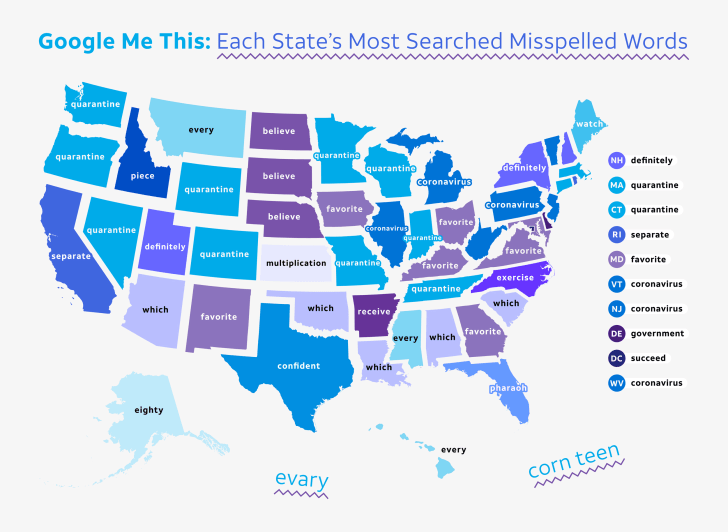
Quarantine or corn teen? The most misspelled word in each state

If there’s something we can all agree on, it’s that spelling is often not intuitive — and it’s difficult to spell words or phrases that you’ve only ever heard aloud. Sure, this can be frustrating, but seeing someone write bone apple tea (or bone app the teeth) instead of bon appétit will give you a better belly laugh than some feature-length comedies.

As USA TODAY reports, we now have a new phrase to add to the list of most iconic misspellings of all time: corn teen, a valiant attempt to produce the word quarantine. It wasn’t exactly an isolated incident, either. AT&T Experts analyzed Google Trends data from March 2020 to March 2021 and found that in 12 states, more people looked up how to spell quarantine than any other word. Corn teen was the most common misspelling. The word coronavirus was another pandemic-themed puzzler, though people’s approximations weren’t quite so wide of the mark. The most common one was just one letter off: caronavirus.

Other top entries included which (people often tried wich and witch), and favorite — residents of seven states struggled to remember whether the U.S. uses the British spelling, favourite. (We do, but only when referencing 2018’s Olivia Colman-starring film “The Favourite.”) “I before e, except after c” apparently didn’t help many people: believereceive, and piece all appear on the map, too.

Corn teen aside, states generally made classic spelling errors. California and Rhode Island had trouble with the vowels in separate; the consonants in exercise confused North Carolina; and Delaware habitually forgot the n in government. In one state, however, residents were mostly busy Googling how to spell pharaoh. And that state is Florida.

Orthographic kryptonite. AT&T EXPERTS

[h/t USA TODAY]

Wet bulb temperature: The crucial weather concept that actually tells us when heat becomes lethal

The most insidious threat posed by climate change may lie in how it exacerbates existing hazards — making all our problems, conflicts, and vulnerabilities harder to deal with. (Three recent examples, for instance: forest fires intensified by previous heat waves, aggravated immigration pressures, and increased risks from infectious diseases, including future pandemics.)  These multiple layers of cause and effect are complex, and make it harder to recognize the damage we are causing.

But sometimes the effects of human-caused global warming is not so subtle and indirect. Indeed, it is quickly becoming dreadfully clear that we can expect more frequent and intense heat waves. Heat waves are already among the deadliest “natural” disasters, and if one could invest in the growth of their destructive power, now would be a good time to do so. 

What is less well recognized is that when it comes to heat stress, and where and when things will get bad, not all heat is created equal. Record high temperatures make headlines because we are intimately familiar with these numbers. Yet record temperatures do not tell the full story. When it comes to the brave new climate world we are creating, we need to get familiar with something called “wet bulb temperature” — a much more meaningful concept to ascertaining when hot weather conditions become dangerous. Wet bulb temperature even tells us where and when our cities will become uninhabitable.

What is wet bulb temperature anyway?

The normal temperature of a healthy human is about 98 °F (37 °C). So why don’t we feel most comfortable when that’s the temperature of the air around us? Because our bodies are engines, burning food to do work, and engines need to lose heat to their surroundings, or they overheat and stop working. As in, die. 

Fortunately, even if our surroundings are warmer than our bodies, we still lose heat if our sweat evaporates, by the miracle of the energy required to convert water from liquid to vapor. In dry air, this evaporative cooling system works great, even at air temperatures that sound really hot, because evaporation makes our skin feel cooler. But as moisture in the air increases, evaporation and heat removal slows, as anyone who has worked outside on a hot humid day knows.

But when do things go from uncomfortable to dangerous — and when will climate change take us there? 

Scientists have come up with more than 120 ways to quantify heat stress. One of the most useful is wet bulb temperature — the temperature that a wet thermometer in the shade measures as water evaporates freely off it. This temperature will be lower than the temperature on a dry thermometer in the same place (which is known as dry bulb temperature), and the difference between the two is a measure of humidity. So to get wet bulb temperature we can either measure it directly with a wet thermometer, or calculate it from dry bulb temperature and humidity. 

The usefulness of wet bulb temperature is it makes it clear how close conditions are to lethal. The closer wet bulb temperature gets to our body temperature, the less heat is lost and the closer we are to heat death.

It has been known for more than a century that wet bulb temperatures higher than 88 °F (31 °C) make it impossible to do physical labor, and a wet bulb temperature of 95 °F (35 °C) kills healthy humans within a few hours. Interestingly, reconstructions of wet bulb temperatures in hothouse periods of Earth’s past have also been used to interpret possible geographic limits and body temperatures of ancient mammals. 

Wet bulb temperature also explains why sky-high temperatures in places like Arizona are typically not lethal. Even a warm 100 °F (38 °C) May day in Tucson with relative humidity of 20% is a relatively comfortable wet-bulb temperature of 70 °F (22 °C). But the same dry bulb temperature with the average relative humidity in Jacksonville (75%) leads to a wet bulb temperature of 94 °F (34 °C), close enough to human body temperature to cause severe and potentially fatal heat stress. And while extreme temperatures usually get the headlines, globally, humidity dominates wet bulb temperature. 


Want more science and health stories in your inbox? Subscribe to Salon’s weekly newsletter The Vulgar Scientist.


Today, wet bulb temperatures do not often exceed 88 °F (31 °C). But even recent heat waves with wet bulb temperatures of 85-88 °F (29-31 °C) have killed tens of thousands of people, and they have reached 95 °F (35 °C) for short periods in some places. And what about the future? Extremely high temperature will certainly occur more frequently over large parts of the planet. Trends in humidity are more complex, but are generally predicted to increase as well.

It is unfortunate that wet bulb temperature is not an everyday concept, as it is much more meaningful for understanding human heat stress both from climate change as well as everyday dangers on hot summer days. Indeed, while it’s often assumed that regions most vulnerable to climate change are those with the highest (dry bulb) temperatures, like the desert southwest, models project future lethal wet bulb temperature events in areas that are already humid. In North America, this is most of the midwest and eastern United States. 

Likewise, in as little as 60 years many parts of the world with some of the densest populations may experience frequent wet bulb temperature events approaching or exceeding 95 °F (35 °C), causing mass mortality of humans and livestock, enormous strain on power grids, and socioeconomic instability.  

It is important to understand that wet bulb temperatures of 95 °F (35 °C) are not conditions we can just get used to. Human bodies have fundamental physiological limits; our planet’s perturbed, angry climate doesn’t care about them. Air conditioning may save some, but increased demand and likelihood of outages in already strained power grids makes this a risky bet at best.  

Responsible action can minimize chances of worst-case scenarios. But like it or not, dangerous moist heat waves with lethal wet bulb temperatures are coming, and will raise dreadful new awareness of global warming, and cause devastating heat stress. As is common with climate change, the effects will be felt disproportionately by the most vulnerable.

Condiments with some chill: CBD enters the world of sauces

Over the last decade, CBD has steadily infiltrated supermarket shelves. If you haven’t noticed, next time you’re at the grocery, take a little trip up and down the aisles. 

You’ll find CBD-infused sodas, seltzers, candy bars, gummies, smoothie kits, cereals and even (if you’re lucky) “Flamin’ Hot Weetos,”a crunchy snack coated with neon-red chili powder that contains 100 milligrams of hemp CBD.

Increasingly, the condiment aisle, as well as my personal condiment stash, is reflecting that trend as cannabis companies continue to permeate other markets, and existing food brands hitch their wagons to the brightly burning star that is CBD. 

From infused honeys to hits of spice, here are some sauces that can add a little chill to your day-to-day dining. 

But first, what is CBD and why is it so popular? 

As I wrote in Salon’s beginner’s guide to cooking with CBD — which you can read here — the cannabis plant contains at least 80 chemical compounds called cannabinoids. The one that most people are probably familiar with is THC, the primary psychoactive compound that leads to the effects of people most closely associate with smoking or ingesting marijuana: a slowed perception of time, mood elevation, and you know, the munchies. 

CBD is one of the other cannabinoid compounds found in marijuana. It’s non-psychoactive, so you won’t get “high”; however it can provide benefits like relaxation, decreased inflammation and reduced anxiety. 

What CBD condiments should I think about adding to my stash? 

Here are some Saucy-approved CBD-infused condiments: 

  • Loud Grandma CBD Chili Crisp Oil. Created by Calvin Eng, a Cantonese chef born and raised in Brooklyn, Loud Grandma CBD Chili Crisp oil is a little fruity and funky — thanks to the delicious pairing of Szechuan peppercorn and fermented black soybeans — with that signature spicy crunch of fried chili flakes. It’s not crazy hot, but it packs a flavorful punch when used on leftover rice or spooned over scrambled eggs. Each teaspoon is a 10-milligram dose of CBD. 
  • Potli’s CBD Feel Good Honey. This product is crafted with raw, wildflower honey harvested in California and infused with 10 milligrams of CBD per teaspoon. While you won’t feel much of a buzz (sorry) after consuming the honey, it is a solid addition to cups of tea, iced coffees and cocktails. Maybe try it in a Gold Rush
  • Hot Sloth CBD Hot Sauce. This bright magenta hot sauce has a super complex flavor profile. There’s white miso paste, fermented plum, dragonfruit, habanero and 15 milligrams of CBD per teaspoon. Hot Sloth is the brain-child of former Alinea executive chef Mike Bagale and his partner food writer Kat Odell. It has a slow-growing, smoky and sweet heat that is killer on fish tacos and incorporated into barbecue. 


Read More Saucy:

The citrus care mistakes we make (and what to do instead)

If your love of plants and indoor gardening has allowed you to graduate from the much-loved ZZ or a mini plot of herbs, you might just be ready to take on a citrus tree. Flowering, fruit-bearing, and lusciously green, they contribute more than just a pop of color to a space. But whether you’re a beginner or a pro plant parent, keeping a citrus tree alive and thriving takes a little effort.

To help you get started off on the right foot, we turned to experts for their insight on everything to do with caring for a citrus tree. Turns out, there’s a bit more to it than meets the eye. Here’s what we learned.

It’s going to need a lot of sunlight

Before you purchase that lemon plant you’ve been eyeing, it’s worth gauging whether or not you have the right space for it. “Citrus trees are warm-weather plants, which means that they thrive with a minimum of 6 to 8 hours of sun a day and love high, humid temperatures,” says plant collector and expert Ciara Benko of The Jungle Upstairs.

You’ll want to carve out a nook for the tree, preferably near a southwest-facing window. But remember to steer clear of vents or air conditioners, as constant fluctuations in temperature and drafts can harm the tree.

If your citrus tree is in direct sunlight for more than 8 hours a day, and its leaves start to wilt, it may be a sign of sunburn, which can affect some of the newer, more vulnerable parts of the plant, says Benko. Keep an eye out for leaves with a sandy-colored scorch to them, and if that’s the case, relocate your plant to a less sunny spot.

If you don’t have room for a tree near a window, grow lights can be a great alternative. Via Citrus co-founder Charley Todd suggests placing one at least 2 to 3 feet above the tree and having it on for 8 to 12 hours a day.

Acclimation is key

Any sort of greenery that is mailed to you will typically experience an element of “shock” during travel. Upon arrival, place the citrus tree in a sunny spot and let it rest for at least a week and up to 10 days. Resist the urge to relocate it from its original grower’s pot until it’s had a chance to adjust to its new surroundings.

A spacious container is best

Once that period of adjustment has passed, you’ll want to find a more permanent home for it. Keep the soil the tree came with and just add citrus- or cactus-friendly soil on top. When choosing planters, go for one that’s roughly 3 inches greater in diameter than the original pot or one that is approximately 2 to 3 gallons in volume. Think of it this way: The more spacious the container, the bigger and happier the citrus tree will be. If you prefer to keep the tree on the small side, just prune it regularly to maintain your preferred size.

Keep an eye out for darker discoloration around the edges of leaves, along with very heavy drooping, which can be a sign of root rot or obstructed drainage. Remove the tree to inspect it more closely and if needed, break up clogged soil and relocate it to a new (and bigger!) container.

Watering can vary by size and pot type

How often you should water a citrus tree depends on several factors, says Benko, including the size and type of pot, as well as how much sun it’s getting. A smaller pot will drain faster than a larger one, requiring smaller but more frequent watering. And if your citrus tree is in a terra-cotta planter, it’ll need more, as water evaporates quickly through the material.

The leaves of a plant are great indicators of how it’s doing. For example, yellow, brown, and droopy leaves are a sign of overwatering, while brittle leaves with curled edges signify underwatering. That said, it’s better to overwater the tree as long as it has proper drainage, says Todd. Citrus trees are used to summer storms in Florida, he notes, “so you can go ahead and douse it with water as long as it’s effectively draining.” This means that the bottom of the planter should be free and clear of anything that can potentially block it — be it hardened clumps of soil or even its roots.

For a gut check, stick your finger in the top 2 or 3 inches of soil, says Benko. “If it’s bone dry, pour a gallon of water in a steady stream into the soil until it starts to trickle out the hole at the bottom.” This could be anywhere from once a week to every other week — and will largely depend on the season. You might find that in the winter, you’ll be watering your citrus trees much more sparingly.

It may take a while to fruit

Citrus trees take a while to grow, and sometimes, it may be years before one bears fruit. “The first bloom that comes through is sometimes just for the bees,” says Todd, meaning that you might have to wait for them to be pollinated before they flower again and eventually fruit. Once the time has come, the petals of its blooms will fall off to reveal the fruit bud underneath.

If your tree arrives fully in bloom, don’t be surprised if it ends up losing a majority of its flowers. The plant is aware of how much weight it can sustain and will drop buds if it’s not strong enough to bear them all. A young tree that’s only 2 years old will probably be able to hold a maximum of nine fruits, says Todd, adding that realistically, it may only be three or four.

Pests love them

Garden pests and common insects are highly attracted to citrus trees so if you plan on keeping yours outside during the warmer months, be vigilant about what’s buzzing in and around it. “Aphids (sap-sucking insects) and spider mites are pretty common but only when the plants are outside,” says Todd. Should you run into that problem, he recommends Neem Oil as an insecticide, since it’s all-natural and super effective. And on that note, be sure to bring it in during inclement weather when wind and heavy rain can damage the tree.

All in all, abundant sunlight and a consistent watering schedule will do wonders for your citrus tree. Give it the TLC it deserves and you’ll be eating fresh, ripe fruit from your very own tree in no time.

This post contains products independently chosen (and loved) by Food52 editors and writers. As an Amazon Associate and Skimlinks affiliate, Food52 earns an affiliate commission on qualifying purchases of the products we link to.

Your new favorite salad pairs grilled vegetables with briny, creamy halloumi cheese

This warm, hearty salad is a flavorful melange of perfectly charred vegetables and chunks of briny halloumi cheese. Halloumi has a solid consistency and high melting point, making it perfect for grilling. After just 10 minutes on the grill, the radicchio, eggplant, zucchini, and cheese were perfectly browned, tender, and redolent with smoky flavor. We chopped the vegetables and cheese before tossing everything with a honey and thyme vinaigrette and topping the salad with Crispy Chickpeas. 

***
Recipe: Grilled Vegetable and Halloumi Salad

Serves 4 to 6

Ingredients

  • 3 tablespoons honey
  • 1 tablespoon minced fresh thyme or rosemary
  • 1 garlic clove, minced
  • 3/4 tablespoon table salt, divided
  • 1/2 teaspoon grate lemon zest plus 3 tablespoons juice
  • 1/8 teaspoon, plus 1/2 teaspoon pepper, divided
  • 1 pound eggplant, sliced into 1/2-inch-thick-rounds
  • 1 head radicchio (10 ounces), quartered
  • ​​​​​​​1 zucchini or summer squash, halved lengthwise
  • 1 (8-ounce) block halloumi cheese, sliced into 1/2-inch-thick slabs
  • 1/4 cup extra-virgin olive oil, divided
  • 1/2 cup Crispy Chickpeas

Directions

  1. Which honey, thyme, garlic, 1/4 teaspoon salt, lemon zest and juice, and 1/8 teaspoon pepper together in large bowl; set aside. Brush eggplant, radicchio, zucchini, and halloumi with 2 tablespoons oil and sprinkle with remaining 1/2 teaspoon slat and remaining 1/2 teaspoon pepper. 
  2. For a charcoal grill: Open bottom vent completely. Light large chimney starter half filled with charcoal briquettes (3 quarts.). When top coals are partially covered with ash, pour evenly over grill. Set cooking grate in place, cover, and open lid vent completely. Heat grill until hot, about 5 minutes. For a gas grill: Turn all burners to high; cover; and heat grill until hot, about 15 minutes. Turn all burners to medium. 
  3. Clean and oil cooking grate. Place vegetables and cheese on grill. Cook (covered if using gas), flipping as needed, until radicchio is softened and slightly charred, 3 to 5 minutes, and remaining vegetables and cheese are softened and lightly charred, about 10 minutes. Transfer vegetables and cheese to baking sheet as they finish cooking, let cool slightly, then cut into 1-inch pieces. 
  4. Whisking constantly, slowly drizzle remaining 2 tablespoons oil into honey mixture until  emulsified. Add vegetables and cheese and toss gently to coat. Season with salt and pepper to taste. Sprinkle with chickpeas and serve. 

If you like this recipe as much as we do, check out “The Complete Salad Cookbook” by America’s Test Kitchen.

How “Kevin Can F**k Himself” subverts our TV expectations of female friendship

Once it sinks in that “Kevin Can F**k Himself” is a moving showcase of trope subversion, Allison McRoberts’ (Annie Murphy) odd relationship with Patty O’Connor (Mary Hollis Inboden) makes sense.  Patty is Allison’s next-door neighbor, and per the unwritten law of sitcoms, one might assume that the two would automatically be friends, if not best pals.  That has been the way of things since the days of Lucy and Ethel.

But Patty considers herself to be the buddy of Kevin McRoberts (Eric Petersen) Allison’s worthless husband, not Allison. In fact, Patty barely hides how much she despises Allison, taking swipes at her optimism, ridiculing the other woman’s fashion choices despite her own “phoning it in” sense of style.

Allison has no true-blue girlfriends in her neighborhood, or anywhere in Worchester, Massachusetts. Her former co-worker at the liquor store undermines her self-esteem at every turn. Even the clerks at the fancy cosmetics boutique she likes to visit view her with utter disdain. The only woman who is genuinely nice to her is the wife of her high school friend Sam (Raymond Lee), who currently has no idea that Allison recently had sex with her husband.

If Allison’s lack of female support rubs you the wrong way, that speaks to the effectiveness of TV’s messaging about women’s relationships. “Kevin Can F**k Himself” is swimming against a strong current made up of archetypes that stand the test of time: Mary and Rhoda, Laverne and Shirley, Carrie and Samantha and Miranda and Charlotte, Dorothy and Rose and Blanche and Sophia.

All of these true-blue teams live in comedies, which is not to say that dramas don’t have their own sets of bonded women. The strongest of those relationships survive conflict at some point in their stories. Cristina Yang may be Meredith Grey’s person on “Grey’s Anatomy,” but they have plenty of history, which includes falling out as severely as Issa and Molly on “Insecure.”

The TV comedy by its nature implies a level of assurance and low stakes, which is why so many of the simpler examples neglect to solidify or concentrate the strength of any relationships beyond those that directly impact the title character.

The cruel joke on Allison is written into the DNA of the sitcom side of “Kevin Can F**k Himself,” dictating that the only people Kevin (and the audience by proxy) needs to care about are his family and his bros. How much he considers his wife to be family is also part of the joke since sitcom men are constantly failing their wives or treating them like surrogate mothers, the punchline that launches the show.

Within this ecosystem Patty is an unusual player: one of the guys, never on Allison’s team. She’s not entirely gender-neutral, which is what the comedy side implies. In the drab, sickly colored drama Patty has a romantic life, demonstrated via glimpses of her beta-male fiancé; she’s also a stylist when she isn’t using her business as a front for her drug-dealing side hustle.

Only after Allison ropes Patty into a road trip does she tighten the screws on their partnership. During their drive Allison reveals her cockeyed scheme to murder Kevin, and Patty’s initial shock isn’t at the confession itself but the fact that adorable widdle Allison believes she’s capable of cold-blooded homicide.

Events lead to Kevin exiling Patty from the gang once he figures out that the two went to his favorite out-of-town burger spot and didn’t bring anything home for him, which happens at the exact time that Patty needs a distraction from her problems, which is all Kevin, Neil and the rest of the gang are to her.

The cops are circling in on Patty’s opioid dealing business, especially a particularly inquisitive female detective. Surely she doesn’t want to be Patty’s friend, right? But this gives Patty an idea that might also solve Allison’s problems – they can pin the drug dealing racket on Kevin and off him at the same time.

Dramas have their own double-standard when it comes to women, which we saw in the hatred that erupted toward Skyler White when she dared object to Walter’s meth-dealing business on “Breaking Bad.” Men can be difficult in prestige dramas; women have a tougher time of it. That’s why we remember Edie Falco more as the long-suffering Carmela Soprano than the drug-addicted, tart-tongued title character in “Nurse Jackie.”

Then again, “Sex & the City” writer Carrie Bradshaw was no angel to other women either, betraying lovers’ wives and judging her friends.  But that doesn’t make her terrible, merely flawed – a spiritual role model, of sorts, for characters like “Never Have I Ever” protagonist Devi who, among other mistakes in this new season, obliterates the reputation of another young woman out of envy.

Devi is lovable for a lot of other reasons, of course, and some of them she has in common with Murphy’s self-serving but adorable Alexis Rose from “Schitt’s Creek.” I’m not entirely sure she or “Kevin” creator Valerie Armstrong or showrunner Craig DiGregorio intend for us to like Allison, the traditional expectation of the sitcom audience. Very few other people do aside from the character’s high school crush.

That makes her an interesting experiment, doesn’t it? The sitcom wife who not only lacks female companionship but in her current state is impossible to befriend. You almost can’t blame Patty for keeping Allison close in the way we’re supposed to with enemies.

The show’s bifurcated nature could make it impossible to fully connect to Allison. Her personality remains constant between the comedy side of the show and the drama, and in both worlds she’s a little unstable, the type of person one gleefully watches from a distance without empathy, drinking in the schadenfreude.

She’s a creature of catharsis ready to blow with nobody to hold her hair while she vomits up her pain. Maybe that’s not an entirely new persona on TV. But if Murphy and the show’s creators wanted to build a story around a character that challenges the storied, expectations of how women behave to each other and in the larger TV world, they’ve hit on something.

“Kevin Can F**k Himself” airs Sundays at 9 p.m. on AMC and streams a week early on AMC+.

The fires this time: a climate view from California

In San Francisco, we’re finally starting to put away our masks. With 74% of the city’s residents over 12 fully vaccinated, for the first time in more than a year we’re enjoying walking, shopping, and eating out, our faces naked. So I was startled when my partner reminded me that we need to buy masks again very soon — N95 masks, that is. The California wildfire season has already begun, earlier than ever, and we’ll need to protect our lungs during the months to come from the fine particulates carried in the wildfire smoke that’s been engulfing this city in recent years.

I was in Reno last September, so I missed the morning when San Franciscans awoke to apocalyptic orange skies, the air freighted with smoke from burning forests elsewhere in the state. The air then was bad enough even in the high mountain valley of Reno. At that point, we’d already experienced “very unhealthy” purple-zone air quality for days. Still, it was nothing like the photos that could have been from Mars then emerging from the Bay Area. I have a bad feeling that I may get my chance to experience the same phenomenon in 2021 — and, as the fires across California have started so much earlier, probably sooner than September.

The situation is pretty dire: this state — along with our neighbors to the north and southeast — is now living through an epic drought. After a dry winter and spring, the fuel-moisture content in our forests (the amount of water in vegetation, living and dead) is way below average. This April, the month when it is usually at its highest, San Jose State University scientists recorded levels a staggering 40% below average in the Santa Cruz Mountains, well below the lowest level ever before observed. In other words, we have never been this dry.

Under the Heat Dome

When it’s hot in most of California, its often cold and foggy in San Francisco. Today is no exception. Despite the raging news about heat records, it’s not likely to reach 65 degrees here. So it’s a little surreal to consider what friends and family are going through in the Pacific Northwest under the once-in-thousands-of-years heat dome that’s settled over the region. A heat dome is an area of high pressure surrounded by upper-atmosphere winds that essentially pin it in place. If you remember your high-school physics, you’ll recall that when a gas (for example, the air over the Pacific Northwest) is contained, the ratio between pressure and temperature remains constant. If the temperature goes up, the pressure goes up.

The converse is also true; as the pressure rises, so does the temperature. And that’s what’s been happening over Oregon, Washington, and British Columbia in normally chilly Canada. Mix in the fact that climate change has driven average temperatures in those areas up by three to four degrees since the industrial revolution, and you have a recipe for the disaster that struck the region recently.

And it has indeed been a disaster. The temperature in the tiny town of Lytton, British Columbia, for instance, hit 121 degrees on June 29th, breaking the Canadian heat record for the third time in as many days. (The previous record had stood since 1937.) That was Tuesday. On Wednesday night, the whole town was engulfed in the flames of multiple fires. The fires, in turn, generated huge pyrocumulus clouds that penetrated as high as the stratosphere (a rare event in itself), producing lightning strikes that ignited new fires in a vicious cycle that, in the end, simply destroyed the kilometer-long town.

Heat records have been broken all over the Pacific Northwest. Portland topped records for three days running, culminating with a 116-degree day on June 28th; Seattle hit a high of 108, which the Washington Post reported “was 34 degrees above the normal high of 74 and higher than the all-time heat record in Washington, D.C., among many other cities much farther to its south.”

With the heat comes a rise in “sudden and unexpected” deaths. Hundreds have died in Oregon and Washington and, according to the British Columbia coroner, at least 300 in her state — almost double the average number for that time period.

Class, Race, and Hot Air

It’s hardly a new observation that the people who have benefited least from the causes of climate change — the residents of less industrialized countries and poor people of all nations — are already suffering most from its results. Island nations like the Republic of Palau in the western Pacific are a prime example. Palau faces a number of climate-change challenges, according to the United Nations Development Program, including rising sea levels that threaten to inundate some of its lowest-lying islands, which are just 10 meters above sea level. In addition, encroaching seawater is salinating some of its agricultural land, creating seaside strips that can now grow only salt-tolerant root crops. Meanwhile, despite substantial annual rainfall, saltwater inundation threatens the drinking water supply. And worse yet, Palau is vulnerable to ocean storms that, on our heating planet, are growing ever more frequent and severe.

There are also subtle ways the rising temperatures that go with climate change have differential effects, even on people living in the same city. Take air conditioning. One of the reasons people in the Pacific Northwest suffered so horrendously under the heat dome is that few homes in that region are air conditioned. Until recently, people there had been able to weather the minimal number of very hot days each year without installing expensive cooling machinery.

Obviously, people with more discretionary income will have an easier time investing in air conditioning now that temperatures are rising. What’s less obvious, perhaps, is that its widespread use makes a city hotter — a burden that falls disproportionately on people who can’t afford to install it in the first place. Air conditioning works on a simple principle; it shifts heat from air inside an enclosed space to the outside world, which, in turn, makes that outside air hotter.

A 2014 study of this effect in Phoenix, Arizona, showed that air conditioning raised ambient temperatures by one to two degrees at night — an important finding, because one of the most dangerous aspects of the present heat waves is their lack of night-time cooling. As a result, each day’s heat builds on a higher base, while presenting a greater direct-health threat, since the bodies of those not in air conditioning can’t recover from the exhaustion of the day’s heat at night. In effect, air conditioning not only heats the atmosphere further but shifts the burden of unhealthy heat from those who can afford it to those who can’t.

Just as the coronavirus has disproportionately ravaged black and brown communities (as well as poor nations around the world), climate-change-driven heat waves, according to a recent University of North Carolina study reported by the BBC, mean that “black people living in most U.S. cities are subject to double the level of heat stress as their white counterparts.” This is the result not just of poverty, but of residential segregation, which leaves urban BIPOC (black, indigenous, and other people of color) communities in a city’s worst “heat islands” — the areas containing the most concrete, the most asphalt, and the least vegetation — and which therefore attract and retain the most heat.

“Using satellite temperature data combined with demographic information from the U.S. Census,” the researchers “found that the average person of color lives in an area with far higher summer daytime temperatures than non-Hispanic white people.” They also discovered that, in all but six of the 175 urban areas they studied in the continental U.S., “people of color endure much greater heat impacts in summer.” Furthermore, “for black people this was particularly stark. The researchers say they are exposed to an extra 3.12C  [5.6F] of heating, on average, in urban neighborhoods, compared to an extra 1.47C [2.6F] for white people.”

That’s a big difference.

Food, Drink, and Fires — the View from California

Now, let me return to my own home state, California, where conditions remain all too dry and, apart from the coast right now, all too hot. Northern California gets most of its drinking water from the snowpack that builds each year in the Sierra Nevada mountains. In spring, those snows gradually melt, filling the rivers that fill our reservoirs. In May 2021, however, the Sierra snowpack was a devastating six percent of normal!

Stop a moment and take that in, while you try to imagine the future of much of the state — and the crucial crops it grows.

For my own hometown, San Francisco, things aren’t quite that dire. Water levels in Hetch Hetchy, our main reservoir, located in Yosemite National Park, are down from previous years, but not disastrously so. With voluntary water-use reduction, we’re likely to have enough to drink this year at least. Things are a lot less promising, however, in rural California where towns tend to rely on groundwater for domestic use.

Shrinking water supplies don’t just affect individual consumers here in this state, they affect everyone in the United States who eats, because 13.5% of all our agricultural products, including meat and dairy, as well as fruits and vegetables, come from California. Growing food requires prodigious amounts of water. In fact, farmland irrigation accounts for roughly 80% of all water used by businesses and homes in the state.

So how are California’s agricultural water supplies doing this year? The answer, sadly, is not very well. State regulators have already cut distribution to about a quarter of California’s irrigated acreage (about two million acres) by a drastic 95%. That’s right. A full quarter of the state’s farmlands have access to just 5% of what they would ordinarily receive from rivers and aqueducts. As a result, some farmers are turning to groundwater, a more easily exhausted source, which also replenishes itself far more slowly than rivers and streams. Some are even choosing to sell their water to other farmers, rather than use it to grow crops at all, because that makes more economic sense for them. As smaller farms are likely to be the first to fold, the water crisis will only enhance the dominance of major corporations in food production.

Meanwhile, we’ll probably be breaking out our N95 masks soon. Wildfire season has already begun — earlier than ever. On July 1st, the then-still-uncontained Salt firebriefly closed a section of Interstate 5 near Redding in northern California. (I-5 is the main north-south interstate along the West coast.) And that’s only one of the more than 4,500 fire incidents already recorded in the state this year. 

Last year, almost 10,000 fires burned more than four million acres here, and everything points to a similar or worse season in 2021. Unlike Donald Trump, who famously blamed California’s fires on a failure to properly rake our forests, President Biden is taking the threat seriously. On June 30th, he convened western state leaders to discuss the problem, acknowledging that “we have to act and act fast. We’re late in the game here.” The president promised a number of measures: guaranteeing sufficient, and sufficiently trained, firefighters; raising their minimum pay to $15 per hour; and making grants to California counties under the Federal Emergency Management Agency’s BRIC (Building Resilient Infrastructure and Communities) program.

Such measures will help a little in the short term, but none of it will make a damn bit of difference in the longer run if the Biden administration and a politically divisive Congress don’t begin to truly treat climate change as the immediate and desperately long-term emergency it is.

Justice and Generations

In his famous A Theory of Justicethe great liberal philosopher of the twentieth century John Rawls proposed a procedural method for designing reasonable and fair principles and policies in a given society. His idea: that the people determining such basic policies should act as if they had stepped behind a “veil of ignorance” and had lost specific knowledge of their own place in society. They’d be ignorant of their own class status, ethnicity, or even how lucky they’d been when nature was handing out gifts like intelligence, health, and physical strength.  

Once behind such a veil of personal ignorance, Rawls argued, people might make rules that would be as fair as possible, because they wouldn’t know whether they themselves were rich or poor, black or white, old or young — or even which generation they belonged to. This last category was almost an afterthought, included, he wrote, “in part because questions of social justice arise between generations as well as within them.”

His point about justice between generations not only still seems valid to me, but in light of present-day circumstances radically understated. I don’t think Rawls ever envisioned a trans-generational injustice as great as the climate-change one we’re allowing to happen, not to say actively inducing, at this very moment.

Human beings have a hard time recognizing looming but invisible dangers. In 1990, I spent a few months in South Africa providing some technical assistance to an anti-apartheid newspaper. When local health workers found out that I had worked (as a bookkeeper) for an agency in the U.S. trying to prevent the transmission of AIDS, they desperately wanted to talk to me. How, they hoped to learn, could they get people living in their townships to act now to prevent a highly transmissible illness that would only produce symptoms years after infection? How, in the face of the all-too-present emergencies of everyday apartheid life, could they get people to focus on a vague but potentially horrendous danger barreling down from the future? I had few good answers and, almost 30 years later, South Africa has the largest HIV-positive population in the world.

Of course, there are human beings who’ve known about the climate crisis for decades — and not just the scientists who wrote about it as early as the 1950s or the ones who gave an American president an all-too-accurate report on it in 1965. The fossil-fuel companies have, of course, known all along — and have focused their scientific efforts not on finding alternative energy sources, but on creating doubt about the reality of human-caused climate change (just as, once upon a time, tobacco companies sowed doubt about the relationship between smoking and cancer). As early as 1979, the Guardian reports, an internal Exxon study concluded that the use of fossil fuels would certainly “cause dramatic environmental effects” in the decades ahead. “The potential problem is great and urgent,” the study concluded.

A problem that was “great and urgent” in 1979 is now a full-blown existential crisis for human survival.

Some friends and I were recently talking about how ominous the future must look to the younger people we know. “They are really the first generation to confront an end to humanity in their own, or perhaps their children’s lifetimes,” I said.

“But we had The Bomb,” a friend reminded me. “We grew up in the shadow of nuclear war.” And she was right of course. We children of the 1950s and 1960s grew up knowing that someone could “press the button” at any time, but there was a difference. Horrifying as is the present retooling of our nuclear arsenal (going on right now, under President Biden), nuclear war nonetheless remains a question of “if.” Climate change is a matter of “when” and that when, as anyone living in the Northwest of the United States and Canada should know after these last weeks, is all too obviously now.

It’s impossible to overstate the urgency of the moment. And yet, as a species, we’re acting like the children of indulgent parents who provide multiple “last chances” to behave. Now, nature has run out of patience and we’re running out of chances. So much must be done globally, especially to control the giant fossil-fuel companies. We can only hope that real action will emerge from November’s international climate conference. And here in the U.S., unless congressional Democrats succeed in ramming through major action to stop climate change before the 2022 midterms, we’ll have lost one more last, best chance for survival.

Copyright 2021 Rebecca Gordon

Author Sarah Everts on why sweating is our “evolutionary superpower”

How much did you perspire today? How much did you think about it, attend to it? Did you, as I did, swipe on some antiperspirant before your workout and then sweat through your gym clothes? Did you notice droplets forming on your neck throughout the day, as you walked outside, cooked a meal, kissed a lover, flubbed a work presentation? Did you fret that your sweat was telling on you?

Sarah Everts was curious too. Despite our obsessive and often counterproductive cultural “war on sweat,” the science journalist knew that our perspiration is a big part of what makes us human. Our sweat regulates our bodies, and it helps understand each other, even if we’re not aware of any of its power. Salon spoke recently via phone to Everts about her entertaining new book, “The Joy of Sweat,” about our surprise superpower, why our odor aligns with our bestie’s and the “bacterial poop” that makes us stink.

Why write a whole book about sweat?

Like a lot of people, I have always slightly mortified by my sweat, and slightly worried that I sweat too much. During workouts, I am the first to grab a towel, even during the warmup.

As a science journalist and a recovering chemist, I decided, I have the tools dig into this, to learn more about this thing that’s causing me some anxiety and maybe find some serenity, instead of shame from all of this.

Around the same time that I was thinking about sweat, I also moved to Berlin, Germany, and everybody there goes to the sauna for fun. I was like, “Why would you sweat for fun?”

I realized there’s this amazing catharsis that you have going to the sauna. It’s a place where everyone is sweating profusely. You’re supposed to sweat profusely. It’s just this delightful thing that turned me on to the joyous part of sweating.

There isn’t actually a whole lot of literature about this thing that, as you say, we are doing constantly.

Not only are we doing it constantly, but it’s humans’ evolutionary superpower. Along with big brains and near nakedness, sweating is one of the ways that we are amazing in the animal kingdom. We’re super efficient at temperature control. It means we can run marathons. Over our evolutionary history, it allowed us to hunt prey that ran much faster than us.

Most of our prey sprint faster than we do, but humans can trudge along, run after it, and once we catch up, force them to sprint again, because they have to stop to cool down. Meanwhile, we can cool down while on the run, and, in effect, outrun our prey, forcing them to die of heatstroke. Heatstroke’s a terrible way to die, and we have this embedded biological system, millions of little tiny machines in our skin, pumping out sweat to keep us cool.

Yet we are also super wasteful sweaters.

Some other animals do sweat to cool down, like cows and horses, but humans are so much more sweaty. We produce so much more fluid than other animals. We’re also that much more efficient with it. It’s partly because of our nakedness.

Our closest primate cousins, chimpanzees, have body-wide sweat glands like humans do, but they don’t use it really to cool down. They pant like dogs. You need to evaporate water away from your skin to get that cooling effect. Their tongues are the nakedest part of their bodies, whereas we have our whole surface area, our whole bodies, as a surface to cool down.

The ideas of sweat and smell are obviously so deeply intertwined. What can our sweat tell us about ourselves?

We learn so much information about one another through body odor. It starts at birth. Just hours after a baby is born, parents can identify their newborn based on its body odor. Siblings can identify each other even after spending two years away. We all have our unique smell print, but there are other interesting bits of information that emerge in our body odor.

We can sniff out anxiety among each other. This is really interesting research that stemmed from an observation from law enforcement. People who do interrogations observed that when you bring in somebody for questioning, they smell like themselves, but after an hour of stressful questioning, they all leave smelling the same of this potent stink of anxiety.

Researchers who followed up on got people to watch a video, one a nature documentary and then another one a scary film. They collected their body odor on t-shirts, then gave those samples to a panel of sniffers who distinguished who was stressed out and scared versus who was just a normal human.

There’s also just interesting ways in which researchers have found out that we can probably also smell our immune systems at work. You can imagine that for most of human history, this has helped us figure out if somebody is infected and maybe avoid that person. We maybe do it unconsciously, just by thinking, “That person doesn’t smell as appealing to me, I think I should take a step away.”

To that end, I was surprised reading about how people shake hands — and then will smell their hands. It’s such a beautifully primal, animal thing that we do.

Scientists based out of the Weizmann Institute in Israel took videos of people meeting for the first time. What they found was that they’d have two people meet and shake hands, and then afterwards they caught people on camera sniffing their hands. It was so unconscious that many of the subject participants. when shown the videos afterwards. accused the researchers of having done some clever editing or somehow faking the videos.

The idea is that when you meet a new person and you shake their hand, you get a body odor sample of them on your hand. We are sniffing out these new individuals. That same researcher just found that people who become fast friends, when their body odors are assessed by a body odor panel, have more similar body odor profiles than any two random people sampled. If you think about most human greetings, it brings us in close proximity to one another. Whether it’s a bow or a cheek kiss, we get this opportunity to take a sniff.


Want more health and science stories in your inbox? Subscribe to Salon’s weekly newsletter The Vulgar Scientist.


I was also intrigued about how just sharing a bed with someone can change our microbes. Can you talk a little bit about that can change the way you smell?

This is really fascinating work from a guy named Chris Callewaert who’s got the best Twitter handle ever, Dr. Armpit. He had a tryst with a woman, and he said through most of his life prior to the tryst, he had not really had much of a strong body odor. Afterwards he noticed that his armpit odor changed dramatically. He found it to be a lot stronger and a lot more stinky, and he was perplexed by this. But he also was interested in doing a PhD, and he decided to investigate this as part of his doctorate. He started analyzing the microbial makeup of his armpit because, as we know, the reason our armpits stink is thanks to a sweat gland that becomes active at puberty.

This is not the sweat gland that produces all the salty stuff that helps us cool down. This is one that becomes active anywhere where you grow hair at puberty. We have bacteria all over and in our body, but the ones that we get in our armpits, we metabolize it and turn it into the stink that emerges out of our armpits. It’s actually not your sweat that stinks in your armpits — it’s the bacterial poop.

Callewaert began to study the populations of bacteria living in our armpits and became interested in the possibilities of doing a transplant of the populations of bacteria living on our skin. Ultimately, he managed to re-transplant his original microbial population, in kind of a freak accident. He had this old t-shirt that he has used years before that was covered in paint and that he hadn’t actually washed. He put it back on and painted for a day. His old armpit microbiome was on the armpits of that shirt, and he kind of repopulated himself with his old bacteria. He went back to smelling like himself.

It does make you question then what happens when we spend a lot of time sleeping in the same bed with someone and the implications then for our own microbial portrait.

Callewaert actually found that it’s really hard to transplant other people’s armpit microbiomes. It’s very rare that this is actually successful, so he had a really strange occurrence with that tryst.

The most success he’s has is with identical twins who clearly have some of the same genetics. They probably have grown up in the same environment, have probably recruited the same bacteria into their armpits as each other, and therefore, can hold a new ecosystem that maybe produces less stink.

I want to ask you about the stink aspect, and “the war on sweat.”

We have been worried about our body odor for thousands of years. Here’s some advice from the Roman poet, Catullus, who says to his nemesis:

You are being hurt by an ugly rumor which asserts

that beneath your armpits dwells a ferocious goat.

This they fear, and no wonder; for it’s a right rank

beast that no pretty girl will go to bed with.

So either get rid of this painful affront to the nostrils

or cease to wonder why the ladies flee.

For most of our history we have worried about our body odor, but we’ve mostly dealt with it with perfumes or by washing with soap and water, and then adding perfume to overwhelm or compliment our body odor. But around the turn of the 20th century is when deodorants and antiperspirants get invented. They were invented, in part, by doctors who have discovered antiseptics. Because body odor is mostly caused by bacteria, deodorants are just antiseptics you put in your armpit and kill the bacteria that gives you stink.

Whereas, antiperspirants end up being a product that clogs your pores and so, they cut off the sweaty buffet the bacteria that would eat it and then turn into stink. That’s the strategy for stopping stink and wetness that develops around the turn of the 20th century. And nobody wants to buy them. Everyone thinks that water is frankly good enough and nobody want to talk about stink or sweat. Certainly drugstores are not going to put these products on their shelves.

All these early entrepreneurs just don’t know what to do, they can’t get a hold on the market. This high school girl named Edna Murphey figures out a way around it. Her dad had actually invented an antiperspirant for his hands, because he was a surgeon and was worried about dropping surgical tools into his patients during surgery in the hot summer months in Cincinnati. She starts a small company and starts promoting this product called, “Odorono.”

But like everybody else who’s an early anti-sweat entrepreneur, she’s getting no buy in, until she hires a marketing team from J. Walter Thompson. In particular, they give her this copywriter, who with one advertisement in Ladies Home Journal puts the fear of stink in America. The advertisement starts off about how “the curve of a woman’s arm” should be this beautiful place. But it’s actually not, it’s a stinky horrible hellhole. He effectively alludes to the fact that women’s armpits are a stink zone. He says to women that not only are people talking about you behind your back, but this is going to interfere with you getting a husband. It is 1919. People were so offended by this ad that they canceled subscriptions to Ladies Home Journal, but so many people were struck by the ad that sales of Odorono skyrocketed. Soon everybody in the anti-sweat industry was using this strategy, which even has its own name, “whisper copy.”

By the time the thirties roll around they’ve managed to get buy-in from most of the women in America and they want to expand their market. They’re like, “How do we make more money? Oh, men smell, too.” Instead of working on fears of not finding a romantic partner, they prey on another social fear, stinking in the workplace, or in particular losing your job. Because it’s the Depression era, a lot of the ads that first target men focus on the idea that you’re going to stink in the boardroom and it’s going to cost you a job or a promotion or your career. You can still see that today. It’s no longer just women and romance and men and the career, but now you see similar strategies aimed at everybody in the population. It’s all preying on our fears of being socially excluded or socially isolated.

Often in popular culture, whether it is fiction or news media, the sight of someone perspiring is just an instant shorthand for desperate, scared, losing. Did you, when you were writing this book, did you become more sweat aware?

Sweat is often used with this derogatory framing. That if you’re sweating, you’ve got something to hide. Or, it speaks poorly about your fitness level — both of which are entirely wrong. Excellent athletes actually sweat more than the average person, because their bodies have been trained to know that they’re going to have to cool down, because when they get going it’s probably going to be some hard exercise for a long time. I do find that mainstream media, sweat is not presented as this amazing evolutionary superpower, but as this mortifying thing that reveals your secrets.

Humans love to be in control, particularly of our image. Of all our bodily fluids or bodily functions that cause us embarrassment — I’m thinking farts, burps, pee, poop, all of those other things — we can hold back for at least a microsecond, so that you can step away from your party or the person you’re talking to and do whatever you need to do. With sweat, there is nothing we can do to stop the floods when they get going. When our body gets that temperature directive, we just start sweating.

This conversation has been edited and condensed for clarity.

Cheesecake is the best summer dessert. Here’s why

The way to my heart is through all things doughy: bread, pie, and biscuits. But I’ve baked a lot more cheesecakes since meeting my husband, because they are his favorite dessert. The way to his heart is through creamy custards, preferably with a tart hint of tang — add a cookie crust, and he’s done for. I’ve been experimenting more with cheesecakes ever since learning this, and along the way I fell in love by proxy. (And since cheesecakes are really custard in a crust — they sound a bit like a pie to me! #teamcheesepie.) In the most recent episode of Bake It Up a Notch, I dived deep into cheesecakes and shared a ton of recipes, as we head into my favorite season to make them. While I bake cheesecakes of all flavors year-round, they truly are a perfect summer dessert. Here are three delicious reasons that may convince you I’m right.

1. Cheesecake is served chilled.

One of my favorite things about cheesecakes is that they are usually served cold. This alone makes them ideal for summer — what’s better than something chilled and sweet when it’s hot outside? (I’ve also heard of folks who enjoy eating frozen cheesecakes without letting them thaw, for an extra-cold twist.) This also speaks to me as a lover of make-ahead options. It’s a dessert that can be made whenever you have time to bake, then enjoyed for many days to follow (assuming it lasts that long). Since it can be made ahead, it’s also perfect to take with you — maybe pack some slices for a summer picnic or try some easy-to-serve cheesecake bars or mini cheesecakes to bring to a barbecue. It’s refreshing, it’s a crowd-pleaser, it’s the definition of creamy and delicious.

2. Fruit + cheesecake = A match made in heaven.

As a serious lover of fruit desserts, this is the real reason I’ve fallen for cheesecake. My husband’s favorite fruit flavor is lemon — and it’s an easy one to add to cheesecake. You can add zest, juice, or even incorporate lemon curd; any of these adds that beautiful hint of sourness that helps to cut the richness of the custard. Of course, other citrus is just as dreamy: Limes, grapefruits, and tangerines are a few of my faves.

But don’t stop there! I also reach for other fruity ingredients to spike my cheesecake batters with. The rhubarb cheesecake from my first book, “The Fearless Baker,” is a super-special one for me. Rhubarb is cooked down with vanilla sugar until soft, then blended right in to the cheesecake batter. The result will be a lovely, pale shade of pink, with a perfect hit of tartness in the mix.

But even beyond overtly tart options, the flavor of so many fruits is beautifully highlighted in the form of a creamy custard. The blackberry cheesecake from this month’s episode of Bake It Up a Notch is another lovely example — the ripe blackberries (sans seeds) are blended and baked into a smooth, creamy custard. I’ve also loved cheesecakes made with blueberries, raspberries, and strawberries, and I am dying to try it with some stone fruit options like peaches, plums, and cherries this summer. Of course, fully blending the fruit into the batter isn’t the only option; it’s wonderful to add a fruity swirl or topping to cheesecake with the help of jam or fruit purée. In short, when you’ve got really good fruit on hand this summer, consider making a cheesecake to show it off!

3. No-bake cheesecakes are NOT a gimmick.

As a bit of a cheesecake late bloomer, I was initially slow to join the no-bake-cheesecake club. But now I am a proud member, and I’m actively recruiting any other nonbelievers to join me. I guess I assumed that no-bake cheesecakes were largely a summer “hack” — something to make when you’re desperate for dessert but can’t bear to stand any heat. But with some practice, I’ve found that this method is actually incredibly versatile and produces reliably delicious results with very little effort, to boot.

So yes, this is for those of you reading who are unwilling to turn on your oven this summer for what can be the admittedly long bake times for classic cheesecakes. And sure, also for those of you never willing to fuss with a water bath, or the slow cooling process that’s most likely to yield a smooth, uncracked cheesecake. But it’s also for those of you who truly love cheesecake and are looking for a high-payout summer dessert.

No-bake cheesecakes have got it going on: all the flavor, creaminess, and make-ahead friendliness of the baked version, without all the worries that come with properly baking a cheesecake. No-bake cheesecakes can be made a variety of ways — most utilizing whipped cream. When you combine the room temperature (softened) cream cheese with whipped cream, the mixture becomes light and aerated. When you chill it, the fat firms back up, and the mixture becomes firmer and more sliceable. The texture is smooth and creamy like a well-baked cheesecake, but in an even lighter way. It’s lovely, so simple, and endlessly adaptable: This method is perfect for full cheesecakes, bars, or mini cheesecakes. Some no-bake cheesecakes utilize gelatin to help them set a bit firmer (this can be helpful if you desire a firmer structure), but I typically skip it to keep things easy and because I happen to favor that extra bit of creaminess over structure. I’ve offered two versions in this month’s episode of Bake It Up a Notch because I love them so—a triple-chocolate stunner and super-cute pistachio mini cheesecakes.

Cheesecake recipes:

Trump’s Big Lie gets an intellectual defense at last — as a Twitter thread, of course

It’s probably going too far to suggest that we are entering a new version of the Dark Ages — although anyone who has studied the early medieval period knows it was a lot more complicated than that term suggests. But we are definitely in a new golden age of darkness, or at least of ignorance, superstition and magical thinking, which ought to remind us that the Enlightenment never had as much of a grip on human consciousness as we sometimes pretend. 

Anyone who reads contemporary political commentary — or, worse yet, tries to write it — becomes aware of the moral and intellectual hazard involved in constantly announcing that you are right and everyone else is wrong. The more you ridicule others for their blatantly delusional or childish views, the more you feel the gnawing certainty that others are mocking you with the same superior confidence. That isn’t exactly what Nietzsche meant about staring too long into the abyss, but as a metaphor it will do pretty well.

Donald Trump’s presidency didn’t cause any of this. Trump is a symptom and a catalyst — to use more academic language, a signifier and a simulacrum — but too much of an empty container for the fears, fantasies and desires of others to directly cause much of anything. In a sense, Trump has done humanity a service, if we are willing to see what he has revealed: We live in a world long prophesied by philosophers and long dreaded by priests, in which nothing is true and everything is permitted — or, to slice it more finely, where truth has been revealed as a relativistic moral construct, which is what it was all along. (Nietzsche would be pleased about that.) 

Like all generalizations, that’s not quite right either: Of course we all still believe that certain things are flat-out true and others false. But the universe of agreement about which things are which is rapidly contracting. I’m not here to solve that problem (since it has no solution), but one of its most galling consequences is that it opens the door for the most banal, most cynical and most hypocritical people in the public sphere to say things they know to be false, and then throw up their hands and protest innocence: Who can say! Nobody knows anything! 

This week we had New York Times columnist David Brooks, lifetime holder of the Dumbass Who Actually Knows Better trophy, pretending to be mystified that “the left” — whatever he thinks that means — does not support continuing the endless and ruinous war in Afghanistan, by almost any measure one of the worst foreign policy decisions in American history. It’s tempting to get sidetracked by this insulting horseshit, which essentially amounts to nostalgia for the early George W. Bush era, when neocons and a few spineless liberals tried to convince themselves that going to war in the Middle East — against unclear adversaries, for unclear reasons and with unclear objectives — was a grand and noble cause that could unite Americans around a renewed sense of mission and purpose. 

But Brooks didn’t even come close to taking the prize in the Let’s Pretend This Is Real category last week, which also saw the arrival of a long-awaited landmark in intellectual history: an articulate defense of the Trump movement’s false and delusional claims about the 2020 election, artfully constructed around the admission that many or most of those claims are false and delusional. 

I’m honestly surprised it took this long. As Laura K. Field recently explored in a lengthy must-read for the Bulwark, the Claremont Institute, a formerly-somewhat-respectable conservative think tank, has been churning out pseudo-intellectual defenses of Trumpism and the Trumpian Big Lie for the past few years, and stepped up its game around the 2020 election. But Claremont’s MAGApologists are a posse of doddering paleoconservatives with expensive educations and no popular audience, desperately trying to reverse-engineer an attachment to the Trump movement. Even when they go all-in, as with Michael Anton, author of the infamous “Flight 93 manifesto,” it’s rooted in obscure and pretentious right-wing ideology that has nothing to do with why millions of people love Donald Trump. (Anton lasted 14 months in a minor Trump administration post before cycling back to the bush leagues of conservative academia.)

But until last week, Darryl Cooper was a relatively obscure podcaster, clearly on the right but not overtly partisan, who offered mildly heterodox takes on semi-recent history: the civil rights movement, Jim Jones and People’s Temple, Communism and the Cold War. He launched a Twitter thread on July 8 by announcing: “I think I’ve had discussions w/enough Boomer-tier Trump supporters who believe the 2020 election was fraudulent to extract a general theory about their perspective.”

That thread went viral to the point that Tucker Carlson read most of it aloud on his Fox News prime-time show, which took up about seven minutes of airtime. It certainly makes for fascinating reading, and at least partly does what it purports to do in illuminating how Trump supporters have come to understand the world. But Cooper’s initial tone of detached or disinterested analysis — he’s offering “a general theory” of why other people (not him, we infer) think the way they do — totally collapses by the end of his thread, tumbling into the Nietzschean abyss I mentioned above. 

As Philip Bump of the Washington Post has noted, Carlson omitted Cooper’s concluding tweet, in which he suggests, out of nowhere, that if Trump had won the 2020 election (which Cooper, by the way, never exactly says he didn’t), the Deep State might have had him killed: “Trump fans should be happy he lost; it might’ve kept him alive.”

Cooper’s argument, if you want to call it that, rests on a number of interlinked claims that are either false or grossly overstated: Conservatives used to have implicit trust in the government and the media (when? In 1958?), but after the entire Russiagate scandal of 2016 turned out to be a Hillary/Demoncrat scam designed to torpedo Trump (maybe 8% true, mixed with massive evidentiary cherry-picking), they lost their innocence and began to see the sinister forces at work in the shadows. No, really, that’s exactly what he says: “This is where people whose political identity was largely defined by a naive belief in what they learned in Civics class began to see the outline of a Regime that crossed all institutional boundaries. Because it had stepped out of the shadows to unite against an interloper.”

But a great deal of his thread is completely unrelated to either the Russia scandal or the 2020 election, and is just a list of extraneous right-wing grievances that he pretends are unique or distinctive to the Trump era: Liberal media elites, obeying the orders of their reality-shaping overlords, framed Brett Kavanaugh as a gang rapist (“based on nothing,” Cooper says), ignored the allegedly devastating revelations on Hunter Biden’s laptop and “cheered on a summer of riots,” meaning the Black Lives Matter protests of 2020. It’s pretty much an old-school Rush Limbaugh or Bill O’Reilly monologue about media bias and all the shocking scandals Democrats are sweeping under the rug, artfully framed so as to appear especially urgent and of the moment.

In fact, the question of whether Cooper has his facts straight — according to you or me or Philip Bump, who seems not to have read the memo about the arrival of the new Dark Ages — is completely beside the point. Bump’s Post column offers a good-faith but profoundly clueless attempt to rebut Cooper point by point, almost immediately getting lost in the weeds around the Carter Page FISA warrant and the Steele dossier and exactly what James Comey said when. It’s boring! No one cares! Even Rachel Maddow, who really was responsible for muddying the waters with a bunch of far-fetched Russiagate conspiracy theories, has moved on to other material.

Give Cooper credit for doing what the pointy-headed Claremont Institute MAGA-wannabes could never possibly do: He addressed Trump fans (and Trump haters) in their native environment and their native language — on Twitter, that is — and rebranded standard-issue conservative victimology and whining as something brand new as well as noble and courageous, a great rupture with the past justified by a shocking betrayal. His thread succeeds on rhetorical and emotional grounds, not at all on its incoherent and internally inconsistent factual claims (if that’s even what they are).

Indeed, Cooper acknowledges late in his thread that after the November election Trump supporters “got shuffled around by grifters and media scam artists selling them conspiracy theories” that were “increasingly absurd,” an obvious reference to the likes of Rudy Giuliani, Sidney Powell and Mike Lindell, although he never mentions them by name. True believers of the MAGAverse will have to close their eyes during that part, I guess, to get to Cooper’s half-hearted claim that just maybe the entire election should have been thrown out as unconstitutional, based on the pandemic-related changes in voting rules. He admits that no court would ever have done that, but suggests that lack of judicial courage was essentially a function of racist terror: “What judge will stick his neck out for Trump knowing he’ll be destroyed in the media as a violent mob burns down his house?”

One could perhaps respond by inquiring how many houses were burned down by violent left-wing mobs in the past year, versus how many times a right-wing mob literally overran the U.S. Capitol, threatening to hang the vice president and the speaker of the House for performing their duties as outlined in the Constitution. Cooper is notably silent on the events of Jan. 6, mentioning them in his first tweet and then never again. It’s almost as if he can’t bring himself to endorse them, but fears the “violent mob” might burn down his house, metaphorically or otherwise, if he condemns them. But I digress.

That question, however, carries within it the assumption that there is still a zone of agreed-upon truth, and that I — along with reasonable, like-minded readers who still believe in such things — have an enlightened perspective that other people sadly lack. That’s precisely the assumption that, as Darryl Cooper eloquently illustrates, we can’t take for granted.

College Republicans in disarray after ‘stolen’ election — Texas chapter may even secede

College Republicans are facing disharmony in their ranks after Courtney Britt was elected chair of the College Republican National Committee, the National Review reports.

The election’s legitimacy has been challenged after “only about 60 percent of CRNC affiliates were allowed to cast ballots.

Britt reportedly “spent much of the day, however, voting not to allow numerous states — which had been sidelined over disputed credentialing issues — representation in the chairman’s race. It is widely believed that [Judah] Waxelbaum would have had a sizable majority had all 52 eligible federations cast ballots. Just over 30 were actually allowed to.”

Allegations of voter fraud were rampant.

“At one point, a debate broke out over Arkansas being stripped of its votes last Sunday under allegations of voter fraud in its state chairman election; the state’s actual party chairman has weighed in on the matter, assuring the CRNC that everything was on the up and up. Nevertheless, Britt — a graduate of Richmond Law School — argued that the state should remain disenfranchised since it hadn’t presented evidence that fraud had not occurred,” the National Review explained.

The feud is expect to continue.

“Now, the theater of battle shifts. Britt will take over in 72 hours, but her organization may be significantly smaller by then. Within minutes of her election, both the New York and Texas federations announced that they would be meeting to discuss secession,” the publication reported.

The National Review quoted Brandon Kiser, chairman of the Texas federation, who argued the election had been stolen.

“I don’t want to get into the details of this stolen election. My focus now is on TXFCR, our chapters, our members, and our future. Texas doesn’t tolerate corruption and fraud. We are going to vote on leaving the CRNC to ensure moral leadership of our organization, and a focus on winning in 2022,” Kiser said.

The backlash against the national organization may continue to grow.

“Students from multiple other federations have also told National Review that they are considering leaving. One person connected with the Waxelbaum campaign implied that Florida and California are likely to withdraw from the CRNC. That would mean the organization would lack representation in the four largest states,” the National Review reported.

“Conservative pornstar” derails Turning Point USA’s right-wing youth gathering

Turning Point USA, the right-wing youth student organization led by Charlie Kirk, found itself in an unusual controversy Saturday night after “conservative pornstar” Brandi Love was allowed into a Florida conference and welcomed as an “Adult VIP,” sparking backlash.

The drama began early in the night when the adult entertainer’s presence in Tampa was first discovered by a follower of white nationalist Nicholas Fuentes and former Kansas State student Jaden McNeil, who wrote on Telegram, “Turning Point USA has a pornstar as a VIP at their Student Action Summit.”

“Imagine sending your kids to this conference think they’re gonna learn about Christian Conservative values, and they come home with photos with pornstars,” he added, attaching a photo of Love snapping a picture with a TPUSA attendee.

Quickly thereafter, white nationalist “groypers” began to approach Love both in person at the event and feverishly online, hurling insults again and again at the adult star. 

After a while, more mainstream conservative figures and student activists began to join in as well, calling out Turning Point USA for the alleged misstep. “A new low for TPUSA. Zero class left in that organization,” Liberty University student Carley Dehnisch said. Right-wing writer Alec Sears penned, “Absolutely fucking speechless that ‘conservative’ org TPUSA has invited an actual porn star to a conference that minors attend.” Young America’s Foundation (YAF) intern Jacob Porwisz wrote, “Great job TPUSA, for inviting a porn star to their conference that features kids under 17; very conservative of them!”

Reached for comment by Salon, TPUSA spokesperson Andrew Kolvet declined to comment on the drama. Shortly thereafter, Love was banned from the gathering.

“We regret to inform you that your SAS 2021 invitation has been revoked,” an email from TPUSA stated, posted to Twitter by the adult entertainer. “This decision is final. This revocation does not impact application to future events, and we hope that you will consider applying again in the future.” 

However, Love wasn’t buying it and said the Republican Party is “broken” due to TPUSA officials giving her the boot. “Can’t make this shit up lol!! I just watched Charlie Kirk, Dan Bongino, Rick Scott, Kat Timpf, speak about freedom, censorship, how inclusive the ‘movement’ is,” she stated. “And then they had me thrown out of the Turning Point USA conference. The Republican Party is broken.” 

While many right-wingers cheered the ban on Love, an unlikely opposition force led by Federalist co-founder and frequent Fox News guest Ben Domenech also emerged: “I’m disappointed that TPUSA kicked out Brandi Love for no reason whatsoever. She’s a Florida conservative businesswoman who loves America,” he tweeted. “The right has an opportunity to be the big tent party. Don’t be a bunch of prudes.”

As of Sunday morning, the ban remained.

Turning Point USA is no stranger to such type of controversy, as back in December of 2020, the organization came under fire during their Student Action Conference in Palm Beach, Florida, over Bang Energy’s “Bang Girls” blasting free cash into the crowd of college and high school students.

Following publication, factions on the right emerged over TPUSA’s decision to ban Love. Notably, New York Post opinion editor and event speaker Sohrab Ahmari agreed with the move, tweeting, “Here at the TPUSA Student Action Summit, and I’m proud of Charlie Kirk and his team for revoking the pass of a pornstar who’d signed up as an adult attendee. There are kids as young as 15 here.”

This post has been updated. 

“Tuca & Bertie” creator discusses codependent friendships and teases a “disaster” of a finale

Therapy and getting any sort of help for mental health was once stigmatized and mocked, and luckily, we’ve come a long way since. But arguably just as problematic are social media quips that regard therapy as an easy, one-stop fix for all of life’s problems, when that’s just not what it is. In fact, anyone who’s ever sought therapy probably relates to a storyline in the first episode of the new season of “Tuca & Bertie” – which Adult Swim snapped up after Netflix canceled it after one season –  in which the anxious song thrush Bertie (Ali Wong) faces a convoluted, anxiety-inducing maze trying to find the right therapist. 

Lisa Hanawalt, creator of “Tuca & Bertie” and production designer for Netflix’s acclaimed “BoJack Horseman,” says the storyline was based on some of her own lived experiences. “Therapy has been really important to me in my life,” Hanawalt told Salon. “But when I was first trying to find one, I went through some duds who just made me feel alienated, and made me feel worse, honestly.”

In fact, much of “Tuca & Bertie,” a show about two 30-something bird women, best friends weathering life’s hilarious ups and downs together, is based on experiences and stories from Hanawalt’s life, and her friends’ lives. This season, as the show wades deeper and deeper into the layered stories of Tuca (Tiffany Hadish) and Bertie, and their loving but imperfect friendship, it only builds on the refreshing realness that characterized the first groundbreaking season. Codependency, mental illness, and the natural peaks and valleys of adult friendship are explored amid a delightful backdrop of talking trees, dancing tomatoes, and all of Hanawalt’s signature whimsy. 

Continue reading for the full interview with Hanawalt in which she teases a season=ending twist, the agonizing realness of “canceled” men returning to our lives and more.

The following interview has been lightly edited for length and clarity.

How did you get your start as an artist and creator? What brought you to “Tuca & Bertie”?

I was just looking at some of my drawings I made when I was like seven years old earlier today, and they’re cat people and horse people and very similar in some ways to what I do now. It didn’t change that much. I feel like I was just an artist, it was like a coping mechanism from when I was a little kid so I just kept doing it. It became what I was best at, so I just continued. 

It was never my plan to work in TV or work in animation, but Raphael [Bob-Waksberg] was a good friend from high school, and when he pitched “Bojack” he included my drawings in it, so it kind of came from there. After several years of working on “Bojack,” he asked me if I had ideas for my own TV show, and “Tuca & Bertie” kind of came out of that!

“Tuca & Bertie” brings to life such fundamentally human and particularly human women issues, like the trauma of sexual assault, codependency, mental illness. Why did you choose to tell these stories through birds? 

I like telling stories through animals — I think part of it is, a lot of these stories are really personal to me, and even though I changed all the details, it still feels pretty raw sometimes. I also think you see humans onscreen with all these preconceived notions based on what the humans look like, since we’re so attuned to human faces. If we see a person, we’re like, “Oh, that reminds me of my best friend,” or “That reminds me of my teacher from second grade,” so when they’re animal-people, you kind of come into it not knowing who they are. 

So, it makes it a little more universal in some ways — the characters are very well-defined, but in some ways, because they don’t look like people, it’s easier for audiences to project themselves onto them, like, “I’m a Tuca,” or “I’m a Bertie,” or “I’m a Speckle.” I just like telling stories with animals — it makes them seem sort of allegorical. And the kinds of stories I’m telling are really just what I’m interested in, things I’ve experienced or my friends have experienced, and a lot are things I haven’t seen much of in adult animated comedies before. So, I’m trying to do stuff I haven’t really seen before, pave new ground if I can. 

The first episode of Season 2 shows how therapy isn’t one-size-fits-all. What message if any were you trying to convey with Bertie’s struggle to find the right therapist?

Even when I found the right therapist for myself, I wasn’t sure at first. It was a process of growing and figuring out what I needed from them, like Bertie is trying to repair some of her trauma and deal with her panic attacks, and she has all these problems and is finding the process really frustrating, because it’s not as easy as she thought it would be. It’s not going to be a quick fix, or be smooth in any way. A lot of the things she’s struggling with are going to come back over again in her life. I wanted to write some storylines that speak to that. 

Tuca and Bertie’s struggle to live balanced lives without each other this season has sparked important conversation about codependency. Was it difficult to portray this dynamic at the same time that you show their friendship is also fun and powerful?

I didn’t want it to seem like, “Oh these two definitely shouldn’t be friends.” They do a lot for each other, they really help each other, they depend on each other. This season, they’re going through really different life changes, and I think Tuca is worried her friendship with Bertie is holding her back a little bit, but maybe she also needs her. So, I want that constant push-pull — is this healthy, is this helping both of us? That happens as you get older, naturally. You go like, is the best friend I had when I was 28 who I need to depend on when I’m 35 or 38? Things change a lot, especially in our 30s. That’s something I wanted to explore.

There’s a lot of honesty in the casual misogyny we see in the workplace for Bertie, and in the streets with street harassment. How important was it for you to create characters and experiences that audiences can relate to in their own way?

I think that’s just how I make art. I’m either making stuff to make myself laugh, or I’m trying to connect with other people and I think making art is my way of doing that. I want people to connect with it, but don’t want it to just be simple. I think there’s a lot of gray area and complexity in what I’m trying to do, like the fact that Pastry Pete — his storyline seems to come to a satisfying conclusion in Season 1, but then it’s Season 2 and he’s back and he’s thriving. That, to me, is interesting — how people don’t go away after they are cruel to us, or they’ve been “canceled.” They stick around, and that’s interesting to me.

The show’s approach to Bertie’s sexual assault last season has been widely praised for being survivor-centric. What went into that episode behind-the-scenes, from how you decided on the visuals of the episode, to your discussions with the actors? How did you bring to life this story to center Bertie and all survivors?

It was really collaborative. A lot of people have been through something like this, a couple of my writers came to me after we were pitching that and said, “Something similar happened to me, I’m so glad you’re telling this story,” which really meant a lot to me. The director, Amy Winfrey, really worked a lot on those visuals, and she nailed it. It was really important to me that we not focus on the bad guy, the guy that does that to Bertie, and not focus on the details of it. I don’t want to see exactly what he does, because I don’t want anyone to judge Bertie’s reaction to it and whether it’s appropriate or not, because it just is what it is, that’s her response. 

I didn’t want to show that — and in fact, I don’t think we showed any men in the episode at all. A lot of rape and assault scenes have been shown in TV shows, and I’m not a big fan of how a lot of them have been treated. So I felt like there was room to do a new perspective on it, that felt more empathetic toward the audience, who may or may not have experienced a similar thing.

I don’t want to be like, “This show is going to take care of you, the audience, and you’re never going to be hurt or feel uncomfortable watching the show.” I think that gets really dangerous — I don’t think my show is always going to feel safe to every person, because it just can’t, I just don’t know. But I do my best to be considerate.

What can we expect Tuca and Bertie’s futures to hold? Are we going to see more growth around Bertie’s experiences with therapy and mental health, or any particularly zany adventures for Tuca?

Yes, I think more wild adventures, more mental health issues, definitely! The characters grow in some ways and then regress in other ways, so there’s always going to be conflict and there’s always going to be stuff for them to work on. I’m really excited for people to see the rest of Season 2, because I think it goes to some really interesting places. We’re slowly picking up on a lot of the threads we started in Season 1, so that’s fun!

What has the transition been like from working on Netflix to Adult Swim?

We had quite a big hiatus between the seasons, while we were figuring out how to move it over to Adult Swim. It took some time. It’s been really smooth since working with Adult Swim, it’s been great. What’s nice is they loved the first season so much, they really understood what the show was, so I didn’t really feel the need to explain it. Like, “OK, there’s gonna be snake trains!” 

It’s just such a weird show, that it felt nice to have that be accepted and encouraged. It was bizarre trying to make it during the pandemic and wildfires, and the whole thing made remotely, which is nuts. And my state of mind wasn’t always very joyful during that period. It was really difficult. So I wonder if that affected the tone of the show at all, I couldn’t say. But yeah, it’s been great working with Adult Swim, and it’s fun to have it come out every week. 

Was this entire season made remotely during the pandemic? Did the pandemic and its effects on mental health shape the stories of the second season in any way?

Yes, the whole thing was made remotely. I’m really excited for people to see all of it. I’m really proud of it, the crew worked so hard on it. And the fact we had to make it during such a weird year, I’m really proud of what we were able to accomplish.

It’s hard for me to say what shaped it and what didn’t, because everything that happens to me and everything I read or look at shapes what I make in some way or another. I’m kind of just a sponge! A lot of the story was stuff I already had in mind that I wanted to do before the pandemic hit. So, maybe it just helped intensify or focus some of those storylines. It’s not like a pandemic happens in Season 2, I never want to make that direct of a reference to real life. But there are some connections people could make to what happens — I’m not going to spoil the end of the season, but some stuff goes down, and I think it could be seen as an analogy for worldwide disaster of some sort.

“Tuca & Bertie” airs news episodes on Sundays at 11:30 p.m. on Adult Swim.

Climate change and the Moon are teaming up to create record floods on Earth

At the time of this writing, at least 120 people have been confirmed dead because of severe flooding in Western Europe. It is tragically likely that, when this story is over, the number will be significantly higher. A German weather service (DWD) spokesman told CNN that in some areas there has not been this much rainfall in 100 years.

These extreme weather events are inextricably linked to climate change, politicians and experts have noted. But there is another culprit, one above, that is also affecting the weather: a “wobble” in the orbit of the Moon.

Indeed, only days before the flooding, a study in the journal Nature Climate Change by scientists from NASA and the University of Hawaii warned that the Earth may experience record flooding in the mid-2030s because of changes in the Moon’s orbit.

“Climate change causes a rise in sea levels which in turn increases the rate of high-tide floods,” Harvard professor and astronomer Avi Loeb told Salon by email. “The gravitational force of the Moon pulls water in the oceans in its direction. The strength of the Moon’s pull changes from year to year, as the moon ‘wobbles’ in its orbit, slightly altering its position relative to Earth on a rhythmic 18.6-year cycle.” In one half of the cycle, Loeb explained, the moon’s force on the Earth causes low tides to grow and high tides to shrink; during the other half, high tides get bigger and low tides get lower.

“We are currently witnessing the tide-amplifying part of the cycle and the next tide-amplifying cycle begins in the mid-2030s,” Loeb pointed out. “By then, global sea levels will have risen enough to make those higher-than-normal high tides particularly troublesome.”

But while the Moon’s orbit is not something that humans can readily control, man-made climate change is the other half of the equation. 

“Only if we take up the fight against climate change decisively, we will be able to prevent extreme weather conditions such as those we are experiencing,” German President Frank-Walter Steinmeier proclaimed. Environment Minister Svenja Schulze publicly stated that “Climate Change has arrived in Germany.”


Want more health and science stories in your inbox? Subscribe to Salon’s weekly newsletter The Vulgar Scientist.


“We will be faced with such events over and over,” Armin Laschet, the premier of North Rhine-Westphalia and a candidate to replace Merkel as German Chancellor, declared in a statement. “And that means we need to speed up climate protection measures, on European, federal and global levels, because climate change isn’t confined to one state.”

While the extent to which climate change contributed to the historic flooding remains unclear, Laschet’s warning in particular is indisputable.

Indeed, climate scientists say perfect storm of variables is falling into place to imperil coastal cities.

“Climate change increases sea level relentlessly  and that is what increases nuisance flooding as well as all storm surges and coastal erosion,” Kevin Trenberth, a climate scientist at the University Corporation for Atmospheric Research, wrote to Salon. “But the biggest effects are when things are aligned: high tide, a major storm with storm onshore wind component that piles up water along the coast and then adds big waves on top. The process is highly nonlinear, and the biggest effects are with big waves on a very high tide.”

Ken Caldeira of the Carnegie Department of Global Ecology told Salon by email that the planet has natural variability when it comes to hot or cold spells, wet or dry periods. “It is the extremes that get us, not the change in average conditions. Coral bleachings happen when an ocean heat wave is exacerbated by global warming — turning an event that corals were adapted to into one that they are not prepared to confront,” said Caldeira. 

What the new study reminds us, he added, is the presence of a 18.6 year lunar cycle of waxing and waning tidal amplitudes. “This 18.6 year cycle, mapped on top of the daily monthly and other cycles, allow us to predict when the sea level rise caused by melting glaciers and thermally expanding seas will be most likely to impact human and natural systems,” he noted.

Caldeira expressed hope that our knowledge about the impending coastal city disaster will compel policymakers to take the necessary steps to offset climate change. Unfortunately, he noted, “seas go up and down with the natural cycles, but human interference in the climate system causes the seas to move in one direction only — and that direction is up.”

He added, “It is likely to be tens of thousands of years, at least, before nature can fully reverse human influence on sea level.”