Spring Sale: Get 1 Year, Save 58%

High-tide flood risk is accelerating, putting coastal economies at risk

As sea level rises, it can be easy to miss the subtlety of higher water. It’s much harder to overlook saltwater more frequently flooding streets, impeding daily life and making existing problems worse.

The frequency of high-tide flooding along the U.S. coasts has doubled since 2000, and it’s expected to increase five to 15 times more in the next 30 years, the National Oceanic and Atmospheric Administration warns in a new report released July 14, 2021.

I work with coastal communities in the northern Gulf of Mexico that are facing the risks of rising seas as they try to avoid preventable damages and costs, such as infrastructure failures and falling property values. Information like the NOAA report is critical to helping these communities succeed.

Last year, the U.S. averaged four days of high-tide flooding, but that number doesn’t tell the whole story – regionally, several areas saw far more. There were record-breaking numbers of high-tide flooding days in 2020 along the Gulf of Mexico and southeast Atlantic coasts. The city of Bay St. Louis, Mississippi, jumped from three days of high-tide flooding in 2000 to 22 days in 2020.

Chart of sea level rise and flooding days

High-tide flooding days have been rising. Renee Collini; NOAA High Tide Flooding Outlook, CC BY-ND

NOAA’s annual high-tide flooding report projects a national median of three to seven days of high-tide flooding this year, again with differences expected regionally. The western Gulf Coast, including Texas and Louisiana, is expected to see the most tidal flooding days, ranging between seven and 15 days. The northeast Atlantic is projected to have six to 11 days of high-tide flooding. The Pacific Coast is projected to be lower than the other regions.

Calling it ‘nuisance’ flooding overlooks damage

High-tide flooding impedes the use of roads and increases wear and tear on stormwater and wastewater systems. The impact can seem minor, but as the frequency increases, these seemingly inconvenient flood days can have long-lasting impacts.

Already, areas at risk from sea level rise have seen decreases in property values, particularly where cities and homeowners haven’t taken steps to increase flood resilience. Insurance premiums are beginning to increase to reflect actual risk, and bond ratings are increasingly being tied to the resilience efforts of communities.

Flooded roadways can create dangerous situations where first responders struggle to safely reach those in need. Businesses get fewer visitors and feel the loss in depressed revenues. The more often this happens, the more it ripples through coastal economies. It can affect tax revenues and erode community ties.

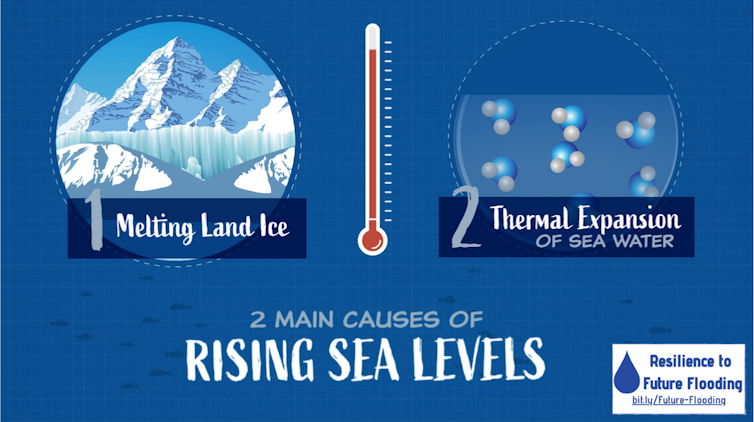
Illustration of two sources of sea level rise

Globally, sea level has been rising by about one-eighth of an inch every year, and that rate is accelerating. It’s caused by both land ice melting as global temperatures rise and by thermal expansion in the oceans; the volume of water increases as it warms. Mississippi-Alabama Sea Grant Consortium, CC BY-ND

Sea level rise disproportionately impacts poorer, marginalized communities, and the impact of high-tide flooding has been no exception. People living in some of the most underserved coastal communities are facing increases in their insurance premiums because of the flood and storm risks, sometimes with more than 90% of the insurance policies in a single ZIP code projected to increase.

Ways to reduce the threat of high-tide flooding

NOAA’s projections provide valuable foresight that can help local governments, property owners and other coastal stakeholders to act before the water rises.

Communities can upgrade their infrastructure, such as raising roadways and installing backflow preventers in stormwater systems, and modify building standards such as increasing freeboard, the distance required between the first floor and base flood level, or designating base flood elevations outside of current FEMA flood zones to help prepare communities to withstand higher seas. Communities can also work with nature to preserve and restore coastal habitats that provide natural flood protection such as marshes and barrier islands.

Pensacola, Florida, is one example of a city being proactive. It recently completed a sea level rise vulnerability analysis to determine where high-tide flooding will begin to strain infrastructure, low-income neighborhoods, economic hot spots and critical facilities. The city was able to recommend where to prioritize action and what kind of action will be necessary to keep high-tide flooding from being costly or as damaging.

The message from the new report is clear: High-tide flooding and other more severe types of flooding have already increased with sea level rise and are expected to accelerate in the coming years. Communities have an opportunity to act now to reduce the impacts.

Residents in any coastal community can reach out to their local governments to encourage forward thinking. For more information on how to get involved in coastal resilience, almost all coastal and Great Lakes states have a coastal resilience specialist within their Sea Grant programs. Each regional NOAA Office for Coastal Management can offer guidance on how to get involved, as well.

Renee Collini, Coastal Climate Resilience Specialist, Mississippi State University

This article is republished from The Conversation under a Creative Commons license. Read the original article.

The most compelling “Never Have I Ever” storyline this season isn’t a romance but a rivalry

The second season of Mindy Kaling’s beloved teen comedy series “Never Have I Ever” starts off with a bang, opening with a classic teenage love triangle that immediately steals the show. But a subtler, even more captivating storyline soon ensues, when a new girl named Aneesa (Megan Suri) transfers to Sherman Oaks High School. Aneesa is smart, athletic, fun, cool, and pretty much all the things that 15-year-old protagonist Devi (Maitreyi Ramakrishnan) aspires to be — and she also shares Devi’s Indian heritage, becoming the only other Indian girl in their class.

It’s basically Devi’s worst nightmare.

As narrator-slash-retired-tennis-legend John McEnroe puts it, “Devi was in awe of this cool Indian teen. She had always assumed her unpopularity was because of racism, but this new kid was proving that Devi might just be objectively lame.”

“Aneesa’s character was a very fertile area for us to tap into talking about identity politics in a way that doesn’t feel too forced or pushed, and discussing something I honestly haven’t seen on TV too much before,” said Amina Munir, a writer on the show and a South Asian woman herself.  “That is, like the internal battle when you see someone who you’re envious of, and they also happen to be your same race.”

Devi is immediately threatened by Aneesa’s presence, which may surprise audiences who would have expected them to bond over their shared racial identity, in a school where few other people can relate to them. After all, this is exactly what Devi’s mom expects when she hears about Aneesa and promptly forces Devi to invite her over for a sleepover.

The tension Devi feels actually makes sense, however, as she watches Aneesa befriend Devi’s favorite (and the only Indian) teacher who once played favorites with Devi, effortlessly infiltrate the cool kids inner circle and excel in their shared orchestra class. At one point when a white history teacher accidentally calls Aneesa by Devi’s name, one of their classmates says, “Aneesa’s like Devi 2.0. . . . No offense, Devi 1.0.” 

There’s always been an unspoken paradox of sorts for women, people of color and all marginalized identities, who are often the one, token member of their community in a number of settings. Being the only person who represents your community in any given space can be exhausting and lonely — yet, when other members of your community do join you in the space, their presence can feel like a threat, or competition, mostly because traditionally white, male spaces offer so few spots to anyone who’s different from them. 

We’ve seen echoes of this on “The Simpsons” when overachiever Lisa Simpson feels theatened by a new girl who is better at everything – school, the saxophone and even dioramas – that Lisa feels makes her unique. And in Kaling’s other sitcom, “The Mindy Project,” her gynecologist character attempts to distance herself from another Asian female candidate going up for the same job.

In the case of “Never Have I Ever,” Devi immediately tries to downgrade Aneesa’s social clout with insults and gossip, beginning with her humorously hypocritical comment, “I get sort of a self-hating Indian vibe from [Aneesa]. I bet she doesn’t have any Indian friends.” Devi, of course, has none herself. 

Munir was able to relate to the storyline involving tension between Devi and Aneesa on a personal level. “For all the racial diversity we’re seeing in highly coveted spaces, we’re still very tokenized,” she said. “Really, are you seeing multiple women of color occupying power in the same office? So many people in charge of hiring think to themselves, ‘We’ve got one, great.’ You’re making it appear to people of different minority groups that there is only room for one.”

That’s exactly what Devi thinks — that there’s only room for her. She’s long had conflicting feelings about her Indian-ness, and in Season 1 we see her feeling embarrassed by it during a Ganesh Puja celebtation, while also being defensive when others perceive her as not Indian enough. That’s because whatever she may personally feel about her Indian heritage, it’s always been a defining and, in her school, unique part of her identity. It’s also a part of her identity she felt she could comfortably blame for her lacking popularity — what’s her excuse when Aneesa shows up and almost immediately charms everyone in their class, including Devi’s love interest Ben (Jaren Lewison)?

It’s not until the aforementioned sleepover, during which they sneak out and Devi gets her nose pierced, that she begin to feel trust and kinship with Aneesa. The next morning when Devi’s mother lectures her daughter about the piercing that was decidedly not parent-approved, Aneesa covers for her and claims Devi got her nose pierced to feel closer to her Indian heritage. It’s only because they share this cultural background that she’s able to effectively defuse the situation.

But that goodwill evaporates quickly once Devi catches wind of romance brewing between Aneesa and Ben, and “pulls a Devi” by selfishly sabotaging the romance. Despite a rough start, Devi and Aneesa eventually find their footing, but the tension — mostly instigated by Devi early in their relationship — between them is one of the most compelling arcs of the season.

“It’s a storyline that was very interesting to Mindy in particular, that feeling that there can only be one, which I think many women and marginalized people feel a lot of times, in school settings but also in work settings,” Lang Fisher, showrunner and a writer for “Never Have I Ever,” told Salon. “It’s like, ‘Oh no, if there’s only one of us then someone else shows up, what does it mean for me?'”

According to Fisher, the added element of Aneesa’s presence on the first comedy centering an Indian American teenager, is meant to “send the message, almost in a meta way, that there shouldn’t only be one.” 

“Aneesa and Devi are both Indian but they couldn’t be more different. Aneesa is Muslim, she’s a jock, she’s struggling with a pretty hard eating disorder. Her insecurities and her troubles are very different than Devi’s,” she said. “We wanted to show you can’t have one person represent everything from a culture or ethnicity, and it’s good to have multiple people of color particularly in a show showing different types of people.” 

The second season of “Never Have I Ever” is rife with thoughtful storylines like this one approaching the complexities of youth, immigrant, South Asian and queer identities, as well as grief and trauma. It’s one of many shows that reflect the diversity and values of high schoolers today.

“Gen-Z couldn’t be more progressive, they are just the ones on the forefront fighting for everything good. You can’t have a teen show without making it pretty progressive, because that is what that generation is all about,” Fisher said. “It’s important to have queer storylines, it’s important to have storylines that center around young people of color.”

Gen-Z may indeed be more progressive than its predecessors — but that doesn’t mean its members can’t be just as messy and problematic, and wonderfully cheesy and romantic. Fisher says she grew up watching all the classic John Hughes movies, stories of uncomplicated fun and youth. “Those were incredibly white and have zero gay characters,” she said, “but the feeling you got when you watched them, the angst of the teens and the romance and all that stuff — we hope [in ‘Never Have I Ever’] we modernize that for a new audience.” 

On “Never Have I Ever,” Lee Rodriguez plays Fabiola, one of Devi’s two best friends whose specialty is robotics and is also a queer girl of color. As with Hulu’s “Love, Victor” her narrative encompasses more than the clichéd angst-ridden coming out story and instead is an ongoing exploration of her identity in all its facets. The show’s serious regard for its young subjects and audience is apparent in how thoroughly these stories are told with empathy, depth and nuance.

“No one on the staff is in high school,” said Munir. “But what I appreciate most in stories about younger people is treating those characters with respect, because so often I find when I watch high school shows or media that features high schoolers, there is such an adult judgment toward some of the kids, that ignores how young people have such strong emotions and such high stakes at that age. So, why wouldn’t you treat those stakes as seriously as they feel? 

“When you’re that young, everything feels life and death, and it’s a very fun kind of genre to write, because there’s so much there, all these raw emotions people are dealing with, and it translates so beautifully to screen.”

It would have been easy for the show to write off the rivalry Devi imagines between herself and Aneesa as more of the same, petty teen drama. “Never Have I Ever” doesn’t shy from the fact that Devi is, in fact, a petty teen — but it also makes it clear there are serious, interesting and relatable dynamics that compel her to feel this way toward the new girl.

At the end of the day, the foremost goal of the writers and creators of “Never Have I Ever” is to give audiences a fun experience, which is fun not despite but because it shows the fullness of the lives of a diverse group of young people. “What we’re trying to achieve is a show that isn’t preaching at you or trying to tell you how to feel about anything,” Fisher said. “We’re just trying to show an Indian American teen who still has fun, juicy storylines about boys, has best friends, and we want it to also just be really fun.”

“Never Have I Ever” Season 2 is now streaming on Netflix.

Why it’s (almost) impossible to argue with the right

Not long after the attacks of September 11, 2001, my mom accused me of hating my country. By then she had fully fallen into the Fox News world, having married a far-right man late in life. But her position still surprised me. I was, after all, her own daughter. Didn’t she have a basic idea of what I thought?

I explained that being against the war in Iraq, opposed to invading Afghanistan and all-out critical of just about everything the Bush administration did was not akin to hating my country. We went around in circles. But there was no convincing her that she held the wrong premise and that critique was not hatred.

That wasn’t the only time in those years that I dealt with being told that I hated my country, but it certainly was the most frustrating. Again and again, then as now, those of us who make critical arguments about the United States, those of us who question conservative policies, those of us who point out examples of right-wing hypocrisies, aggressions, abuses and lies find ourselves in the strange position of having to argue against a warped understanding of what we advocate.

My mom and I never discussed what I actually thought about the United States, because the entire conversation was framed by her assertion that I hated it and my efforts to explain that I didn’t.

I don’t think I fully captured the core of the problem until I recently read an essay in The Atlantic by Ibram X. Kendi on how there is no debate over critical race theory. As Kendi puts it:

The Republican operatives, who dismiss the expositions of critical race theorists and anti-racists in order to define critical race theory and anti-racism, and then attack those definitions, are effectively debating themselves. They have conjured an imagined monster to scare the American people and project themselves as the nation’s defenders from that fictional monster.

Kendi brilliantly lays bare that which many of us have been ensnared in for ages — that pundits and politicians create their own version of many progressive, liberal and leftist views, and then they fight with their version. There is no real debate and certainly no dialogue, because the entire game is to offer up a distorted version of a position, then freak out about it.

Once the pattern is recognized it can be seen everywhere. Kendi refers to the way it has been used with Black Lives Matter, the New York Times’ 1619 Project, cancel culture, and critical race theory, but we can see the same play made with almost all progressive political positions. Professors are trying to brainwash students to become socialists, feminists think all men are rapists, abortion rights defenders don’t care about life, the gay community doesn’t respect marriage, and so on. We can even see it in claims that young people are snowflake whiners.

They distort from the start and then take up all of your bandwidth in fighting their distortion. They don’t just set the terms; they singlehandedly define them — for both sides.

It isn’t just that the right argues with itself. It is also that they do it really loudly.

There is little question that the vituperative, bullying nature of the right’s so-called debating is also a core part of the problem. First, they misrepresent you, then they spin up into an incoherent meltdown. Think for a moment of how we now have such a high-profile chorus of right-wing gasbags, all of whom make their illogical points really loudly. Sometimes, as in the case of Alex Jones, they do so while shouting so intensely that they seem to spit into the microphone.

Take, for example, the recent scare over President Joe Biden’s door-to-door vaccine strategy. The White House has noted that there is a growing disparity in communities receiving the vaccine. So, Biden proposes the notion that in some communities it might be beneficial to go door-to-door to spread information about vaccine safety and efficacy in order to encourage more people to get vaccinated.

Yet, that’s not what the GOP hears. Instead they turn this plan into a sinister strategy, which according to GOP Rep. Madison Cawthorn (N.C.), could be used to take all manner of items away from citizens: “They could then go door to door and take your guns. They could go door to door and take your Bibles.”

So, what should the White House do? Refute these loony claims? Doing so only allows the right an ongoing platform to repeat them and forces the White House to engage in an exhausting repeat loop of trying to explain themselves. Yet leaving these unfounded accusations out there unchallenged has the real risk of costing lives. It’s an impossible situation because it shuts down any form of reasonable exchange.

You can’t debate with someone who isn’t even listening to your point.

The rub, as Kendi makes clear, is that one simply can’t argue with someone who won’t even listen. “How should thinkers respond to monstrous lies?” he asks. “[T]alking with people who have created a monologue with two points of view, theirs and what they impute to you, gets old.”

But what doesn’t get old is finding a way to expose the rhetorical games played by the right. You might not want to bother trying to debate them, but there is much to be said for finding ways to reveal the faulty logic, hubris and bluster that so often characterizes their manufactured outrage.

This, of course, is why irony and satire do a better job of diving into the fray than reasoned critical discourse. Satire can take the absurdity of these right-wing faux debates and expose their spectacle. Think, for example, of how Desi Lydic Foxsplains for “The Daily Show.” Even better, check out her takedown of the fake debates staged on cable news. Or consider how Samantha Bee drives home Kendi’s point in her bit, ” What Are Conservatives Screaming About today?” where she dissects the irrationality of the critical race theory backlash. Trevor Noah underscores the point the right has manufactured their version of CRT with a segment called, “Do Any Republicans Know What Critical Race Theory Actually Is?”

What this critical satire does is both refuse to debate with someone incoherent and irrational, while also refusing to let their claims remain unchallenged. Using irony is often the only way to fight the illogically absurd.

The War of 1812 vs. Jan. 6: Which was the worst attack on the U.S. Capitol?

Former Maryland governor Martin O’Malley calls himself a history “aficionado,” and we’ve had several conversations about the relationship between history and current events. Recently we found ourselves discussing the War of 1812 because of a major similarity with the coup attempt of Jan. 6, 2021 — namely, a direct attack on the U.S. Capitol.

As O’Malley reflected on the events of Jan. 6, he became emotional. He was thinking about his mother, who worked for former Sen. Barbara Mikulski, a Maryland Democrat who was the longest-serving woman in congressional history, and knew, he said, “every nook and cranny” of the Capitol. She had instilled in her son a deep love of American history and America’s democratic institutions.

“As I was hearing reports about members of Congress barricading doors, huddling under desks and trying to be quiet — so the people outside in the mob wouldn’t know they were there and attack them or take their lives — I was reminded of the story of the Virginia militia who found themselves inside the Capitol building in 1814,” O’Malley said.

He was referring to Aug. 22, 1814, the infamous day during the War of 1812 when British troops tried to break America’s will to fight by capturing Washington and burning the White House, the Capitol and other key buildings. O’Malley described how Americans in his home state of Maryland could see the orange glow from their homes.

Some, like the Virginia militia he mentioned, had a closer view. Barricaded inside a stairwell, they waited while British troops tried to break down an intervening door. After that failed, the troops set the Capitol on fire and left the frightened Virginians to burn to death. Believing they were about to die, the militiamen carved their names and other details about themselves into the stones. O’Malley contrasted it with the desecration committed by Trump supporters in the Capitol on Jan. 6 and said of his mother: “I’m glad she didn’t have to witness that.”

One person who did witness it up close was Rep. Eric Swalwell of California, coincidentally one of O’Malley’s few congressional supporters when the then-governor briefly ran for president in 2016. Like O’Malley, Swalwell is a history buff who knows a lot about the War of 1812. In an earlier interview, Swalwell told me about the “uncertainty and terror” that he and his colleagues felt on Jan. 6. He had sent a text message to his wife asking her to kiss their young children, fearing he might never see them again. More recently, Swalwell shared another memory from that day, one brought on when he saw pro-Trump rioters brandishing the Confederate flag.

At the time, Swalwell said, his chief of staff was a Black man he identified to me as Michael. A woman on his staff kept checking in with Michael because she was worried about him. “She was watching everybody descend upon the Capitol with their Confederate flags,” Swalwell said. “The person she was most worried about was not me, but our Black chief of staff because she saw all these racists with their flags, their insignia and then with their weapons.” The staff member was concerned that if Michael encountered the rioters he might be in danger. “When she said that, it really elevated my concern for him and his safety as well.”

Swalwell also had some choice words about Donald Trump’s leadership, contrasting him to James Madison, who was president during the War of 1812. Swalwell observed that Madison made numerous errors leading into that conflict, but was a great scholar and patriot, who helped draft the Constitution and wrote many of the Federalist Papers. “Madison loved his country, he was just woefully unprepared for what the British were willing to do,” Swalwell said.

In a similar situation, Swalwell speculated, Donald Trump “would have been been beholden at the time to God knows what foreign power. If you read the Federalist Papers, because we had aligned with the French during the Revolutionary War, [the founders] were worried that future leaders would entangle themselves with foreign governments. That’s why the emoluments clause was put in the Constitution. … Whoever would have had the biggest emolument, essentially, would have been in Donald Trump’s ear.”

There are of course many other differences between the events of August 1814 and January 2021. The former occurred during a war in which the U.S. faced a conflict with British Empire over economic and trade disputes that essentially revolved around the question of whether America was truly independent. The burning of Washington was, in that sense, the last British middle finger stuck in the young nation’s face.

Also, most obviously, it was foreign troops who burned the Capitol in 1814, not American citizens. On Jan. 6, we saw a defeated political faction lashing out because their leader was being a historic sore loser, quite literally. An angry mob, egged on by the first president in American history to lose an election and reject the results, stormed the Capitol in the false belief they could somehow overturn the 2020 election. It doesn’t matter whether they sincerely thought Trump had been robbed or, as Salon’s Amanda Marcotte has suggested, felt they were in on Trump’s con

Here’s another difference: While politicians and the public learned important lessons from the War of 1812 about protecting America’s democratic institutions, Republicans have gone out of their way not to face the truth about Jan. 6, or learn anything from it. Swalwell remembered seeing the faces of his Republican colleagues’ faces as they fled for their lives.

“As I bumped into people who were at the [Trump] rally or who had also propagated the Big Lie, I thought, ‘How strange is it that we both are running for our lives?'” he said. “It made me think, maybe this is an opening. Maybe this will be what it takes for us to come together, that we find ourselves running for our lives, and we’re going to the same secure location. Maybe this will bring us together and maybe this will be an inflection point for them to break away from Trump.” Trump hadn’t just targeted Democrats, after all, but “squishy” Republicans who weren’t helping him win no matter what. 

But now, Swalwell thinks his initial thoughts were “naive and Pollyanna-ish.” When he “saw the fear” on the faces of Republican colleagues, he said, “I thought this would bring us all together to condemn Donald Trump … we’d finally recognize that unity would be the antidote to make sure it never happened again.”

The problem, Swalwell thinks, is political courage. “I serve with people who don’t have the imagination to see themselves doing any other job besides Congress,” he said. “They don’t have the confidence to believe that they could get a job other than Congress, so they do anything they can to stay in their jobs, which right now means you have to support Donald Trump and anything he says.”

Arizona GOP worries Trump’s audit is destroying their chance at a Senate seat: report

According to a report from CNN, high-ranking officials in the Arizona Republican Party fear any chance they might have had of reclaiming a U.S. Senate seat has been irreparably crippled by the highly-criticized audit of the 2020 presidential ballots in Maricopa country at the behest of former president Donald Trump.

With reports trickling out that the months-long controversial audit uncovered no evidence of widescale fraud that denied Trump the state’s 11 electoral votes, Republican campaign consultants worry that a campaign against Sen. Mark Kelly (D-AZ) will fall flat because the eventual nominee will undoubtedly have to spend precious time explaining away the failed venture.

According to CNN’s Alex Rogers and Michael Warren, “Former President Donald Trump’s false claims of widespread voter fraud, including his promotion of a controversial, partisan audit of the vote in Maricopa County, has dominated the debate within the Arizona GOP for months, as it recovers from Trump’s and Republican Sen. Martha McSally’s close losses to Joe Biden and Kelly last year,” with the journalists adding that focus on Trump’s 2020 audit will hover like a dark cloud over 2022.

“But some Republicans are worried that embracing Trump’s falsehoods could hurt their eventual nominee in the party’s effort to take back the Senate in 2022 ,” the report continues with Republican lawyer Chris DeRose summing up the GOP’s dilemma by candidly admitting, “The audit is an albatross around the neck for every Republican running in the state of Arizona.”

According to one campaign consultant, every candidate will also be scrutinized over their connection to the former president.

“The party apparatus is deeply entrenched in MAGA and it’s the only litmus test that seems to matter at the moment,” they explained.

You can read more here.

It sure looks like this GOP Congressional candidate plagiarized her Democratic opponent

A top-ranking Republican candidate in an upcoming Virginia Congressional primary election is facing stark criticism after ripping off her Democratic opponent’s words.

According to The Daily Beast, Jen Kiggans’ recent fundraising email has become a topic of scrutiny due to a number of the quotes included in it. The publication reports that the words were gravely similar to what was written in her Democratic opponent, Rep. Elaine Luria’s (D-Va.) latest op-ed.

An example of one of the controversial phrases in the op-ed and email was based on the following:

In reference to the Chinese military and the U.S. Navy’s naval ships, the two-time incumbent op-ed’s noted: “Meanwhile, China is building warships at an astonishing rate. In 2010 the U.S. Navy had 68 more ships than the Chinese navy. Today, it has 63 fewer, a swing of 131 ships in 10 years.”

Kiggans also included an argument with gravely similar wording in her email that read, “Meanwhile, China has been steadily growing militarily… they have more ships in their fleet than the US (by more than 60).”

English experts have offered different perspectives on the email. While some have defended Kiggans’ writing, others have admitted that there is a slim chance the email was written coincidentally. Mark Algee-Hewitt, director of the Literary Lab at Stanford University a statistical linguistic analysis expert, described the email as “really bizarre.”

The publication also noted that Algee-Hewitt’s software “analysis pegged the probability that one of the phrases in question was accidental at one in 10,000,000,000,000,000,000.” Speaking to The Daily Beast, he also noted: “For comparison’s sake, that is less likely than you being elected president of the USA and winning the Powerball lottery in the same year.”

He later added, “The longer a string of words is, the rarer it is,” he said. “The distribution follows a power curve—so the odds of finding a repeating two-word combination (what we call a bigram) are exponentially less than finding a repeating single word; the odds of finding three words is exponentially less again, etc, etc.”

Marty Steffen, chair of the Society of American Business Editors and Writers (SABEW) at the University of Missouri School of Journalism, weighed in with a critical assessment of Kiggans’ email. While Steffan admitted that Kiggan did lift some words, he insists there may be “cause and effect” for her doing so as he noted that the email appears to be a response to the op-ed.

“She lifted some words, and I’m absolutely sure there’s a cause and effect here. The email is clearly a response to the op-ed, and tries to use those talking points against her.”

Far more adults don’t want children than previously thought

Fertility rates in the United States have plunged to record lows, and this could be related to the fact that more people are choosing not to have children.

But just how many “child-free” adults there are has been tricky for researchers to pin down.

National fertility data provided by the U.S. Census and Centers for Disease Control and Prevention lump together all adults who aren’t parents, making it difficult to understand how many people identify as child-free.

As social scientists, we think it’s important to distinguish child-free individuals from those who are childless or not yet parents. People who are child-free make the conscious decision not to have kids. They’re distinct from childless individuals – adults who want children but can’t have them – and from people who plan to have children in the future.

In a recent study of 1,000 people, we found that over 1 in 4 Michigan adults did not want biological or adopted children and were, therefore, child-free. This number was much higher than those reported in the few past national studies that have attempted to identify child-free people, which placed the percentage between 2% and 9%.

Child-free by choice

Although we can’t be sure why we identified more child-free people in our study, we suspect it may have something to do with how we determined who was child-free.

Past studies that attempted to estimate the prevalence of child-free individuals often focused only on women and have used criteria based on fertility. These studies left out men, older adults and biologically infertile people who nonetheless didn’t want children.

In our study, we used a more inclusive approach. We looked at both women and men, asking three yes-no questions that allowed us to determine who was child-free based on the desire to have children, rather than fertility:

  • Do you have, or have you ever had, any biological or adopted children?

  • Do you plan to have any biological or adopted children in the future?

  • Do you wish you had or could have biological or adopted children?

Those who answered “no” to all three questions we classified as child-free.

Just like everyone else?

In addition to examining how many child-free people there are, we also examined whether child-free people differed from parents, not-yet-parents and childless individuals in life satisfaction, personality or political views.

We found that child-free people were just as satisfied with their lives as others, and there were few personality differences. However, child-free people were more liberal than parents.

Although child-free people were pretty similar to everyone else, we did find that parents were less warm toward child-free people. This finding suggests that child-free individuals may be stigmatized in the United States.

Looking ahead

Our study suggests that the number of people who choose not to have children may be larger than previously thought. Although our study focused on Michigan residents, the state’s population is similar to the overall U.S. population in terms of age, race, income and education. So we’d expect to see similar numbers of child-free people in other states.

We hope to continue our research by collecting data over time across the country to determine whether it’s becoming more common to be child-free – and to understand how and why people make the choice not to have children.

Jennifer Watling Neal, Associate Professor of Psychology, Michigan State University and Zachary Neal, Associate Professor of Psychology, Michigan State University

This article is republished from The Conversation under a Creative Commons license. Read the original article.

On being the madwoman in the attic: What “Jane Eyre” taught me about women’s anger

I have spent years of my life reading and loving Charlotte Brontë’s novel “Jane Eyre.” But in the last few years I have realized something: The main character of this novel isn’t Jane, but Bertha; the woman who we call “The Madwoman in the Attic.” As I have looked closer and closer at Bertha over the years, I have realized something important. I don’t think she’s a madwoman. I think she’s an angry woman. I think she wields her anger like a scalpel, and I want to learn from her precision.

I think women are made to straddle this line of mad and angry all of the time. When I was a college advisor a student of mine was on a club soccer team. She was playing, for fun, like usual, when a male student on her team said to her, “Anne, you need to work on your hustle.” When she politely ignored him, he “teased” her, saying, “we need to work on your issues with authority.” They were in the same year in school; he was not the team captain. Throughout practices and games alike, this young man would harass Anne under the guise of teasing. He would tell her to “lighten up” and say that she didn’t have a sense of humor because she did not find him belittling her funny. I gave her the advice I was given throughout my life: ignore him. It was not Bertha-informed advice.

Anne felt that by enduring his teasing, she was not standing up for herself. She was being made to swallow her anger, which is crazy-making. But if she had answered him, she would have been seen as confrontational, or even dramatic or “psycho.” She kept going and kept saying nothing. Her silence infuriated him, and the harassment got worse. She quit the team. And those are the only options we so often feel we have: Endure a form of harassment and say nothing, which will make you so angry it will get you to do something like quit, or say something, break the mold of what society deems as appropriate femme behavior, and be seen as crazy.

It is convenient for patriarchy to diminish women’s mental capacity when we’re pissed. But also, patriarchal behavior can make us seem “mad” when really, we’re angry. My student stopped responding to that guy, per my (probably bad) advice. She started pretending like she couldn’t hear him. This is literally behavior that appears to be unhinged from reality.

I have found myself in these situations too many times in my life and yet as a white, cisgender woman, fewer than others. I get to go to the bathroom in peace and am seen as acting “mad” much less quickly than women of color, who by and large have to endure more frequent and egregious forms of this form of toxicity. I’m speaking for myself when I say that these are situations when I feel as though my only two options are to let myself be steamrolled or to call someone out. 

My grandfather left me a little money when he died and my uncle could not stand it. I agreed to give him half of the money but we had to go back and forth ad nauseum about the details. During this seemingly endless sending back and forth of documents, he would send me the changes that he wanted made and I would do the editing in the document. I was working two jobs at the time and this added part time job of doing his legal work (on top of my own) got to be too much for me.  When he sent me yet another round of edits that he wanted me to insert into the document I finally told him no, he could make his own requested changes to the document. Also, I didn’t say this, but I was finding it humiliating to help him essentially sue me.  The wrath that ensued when I said I wouldn’t continue as his legal secretary was one of the most striking about-faces I have ever seen. I was an “entitled bitch” and got emails and phone calls telling me so for days. I transferred the money into his account as he continued to call me names.

There have been dozens of smaller incidents like this one: when my college boyfriend would have me hold his beer in front of other men, even though surfaces that appeared structurally sound abounded. I could either hold the beer or not, but all eyes were on me. Or the years and years that one of my brother’s friends called me a clever nickname for Vanessa — Vannoying — because I “always had an opinion about everything.” I couldn’t say anything, because I would be proving his point.

Then there have been the bigger indignities. The ones that still bleed when I pick at the scabs. My C-suite level boss shook my assistant-level self and screamed at me as my feet dangled in the air. When he put me down, tears were in my eyes, so he patted me on the head and said, “Oh look at you, acting offended by this.” A man I went out with acted offended when I asked if he was married because of his strange behavior two or three weeks into our dating. “You’re being crazy. I can’t believe you don’t trust me.” When I reminded him of that moment after I had the proof that he was indeed married, he sighed in anger and said, “I wasn’t married when you asked.”  He had only been engaged and had gotten married a few days after that conversation. Then there is the other boss, the one I can’t tell you about because of the document I had to sign to keep my health insurance for a few months after he fired me for being the victim of harassment. 

I have been on the wrong end of this dynamic too. My mom would sometimes get so tired and angry at my dad and us kids that she would “take a long walk.” She’d leave the door open as a symbol that she couldn’t do one more thing for us and that she would be back. We would always be scared that mom had gone a little bit crazy.

I am trained as a chaplain. I am supposed to live a life of kindness, compassion and empathy. But there are so many moments in my life when I feel like my two options are to swallow my anger or to be seen as “psycho.”  To be made mad or to be seen as a madwoman.

I am called confrontational, a pain in the ass and worse. I am called these things often enough that I wonder if I, on some level, enjoy confrontation and being thought of in such terms. Upon much thought, I have come to the self-satisfied conclusion that I actually find confrontation scary and uncomfortable. I just really don’t want to make another person’s suggested changes to a document when they could do it themselves.

Bertha Mason Rochester in Jane Eyre is called the “madwoman” because she lights beds on fire, stabs people, sneaks into rooms and rips veils, lights the house on fire. But when you look more closely at her actions, they make perfect sense. She sneaks out one night after ten years of being locked in the attic by her husband. Her caretaker has fallen too deeply asleep and Bertha has stolen the key. She does not injure her caretaker who is being paid to do a job. Bertha lights the bed of the man who is locking her up on fire. She never lunges for the maids who come to help tend her. But she stabs her brother who knowingly leaves her locked in an attic. When she is in a room with the woman who her husband is going to marry, she does not hurt the young, unknowing fiancée (Jane Eyre herself). Bertha rips up the veil that Jane will put on in the morning to marry Bertha’s husband. Bertha doesn’t hurt Jane: she warns her.

Bertha is not a madwoman, she is an angry woman who we, her readers, have been calling psycho for years.

One of the odd things to me is that when I am called angry or crazy, I am not feeling any of those things. What I am actually feeling, like Bertha, is trapped. I sobbed, unable to catch my breath, after my boss shook me. I felt stuck. I had just been assaulted and publicly humiliated and there was nothing I could do about it. I responded in a way that was described as “unprofessional and hysterical.” My body responded without my permission. If I could have gone about my day, that is what I would have chosen to do. But instead, I was so loud… so unwieldy. My sobs echoed in the bathroom and so I was sent home so I would stop “causing a scene.”

Bertha’s anger is magical because it seems to me that she is in complete control of it. My anger comes when I lose control. Bertha plays her anger like an orchestra.  She doesn’t take out her anger on Jane. She chooses sisterhood; warning another potential victim of Rochester. She takes out her silence, which has festered into rage, on the man who has gagged her and locked her up. 

I do not believe in violence. I think that it is sometimes necessary but much more infrequently than it is used. So I do not suggest that we use Bertha’s strategy in its particulars for addressing our anger. (In her situation — essentially kidnapped and imprisoned — her behavior is completely reasonable, though.) Even though those of us reading this are likely never to be locked in attics by our husbands for ten years, I still think that there is much that we can learn from the way that Bertha expresses her rage. She looks herself in the mirror; she rips the products of the patriarchy; she is loud and she is persistent.

Our anger has been made quiet for too long. “Madness” is the diagnosis of a single person, not of a movement of intersectional solidarity. Anger is what drives us to stand up for each other and for ourselves in a persistent way that cannot be ignored. We are choking on the flames of our rage and being made mad by our sewn lips. It’s time to breathe fire and leave behind scorched earth. 

Following the chain’s “not tuna” debacle, Subway is attempting a comeback. Will it work?

In the wake of the tuna/not-tuna sandwich debacle, Subway is attempting to mount a comeback, and the international chain is taking a multi-pronged approach. Subway is airing new star-studded commercials as it makes its largest menu update in history, and it even launched a website to defend its name. But the question remains: Will it work, and what does a return to success look like for the beleaguered brand? 

What is going on with Subway’s tuna? 

In late January, Subway was the target of a lawsuit alleging that its tuna salad didn’t actually contain tuna and was instead “made from a mixture of various concoctions.” As San Francisco Chronicle reporter Soleil Ho wrote, the lawsuit itself was kind of a non-story. The plaintiffs, Karen Dhanowa and Nilima Amin, and their attorney repeatedly declined to specify what was found in an analysis of the tuna salad. 

Subway attempted to brush the accusations aside. “Keep fishing folks,” a caption read on a January Twitter photo of its tuna salad sub. “We’ll keep serving 100% wild-caught tuna.” 

RELATED: Inside “Taco Bell Quarterly,” the seriously delicious literary magazine honoring the fast-food chain

However, the story captivated viewers and readers across multiple news cycles. Eventually, The New York Times released an investigation in June — titled “The Big Tuna Salad Mystery” — in which reporter Julia Carmel procured “60 inches worth of Subway tuna sandwiches” and sent their contents to a commercial food testing lab. 

“No amplifiable tuna DNA was present in the sample, and so we obtained no amplification products from the DNA,” the final email from the lab read. “Therefore, we cannot identify the species.”

Subway didn’t offer comment for the article and instead waited a few days before issuing a formal response. In a statement, it said DNA testing was an unreliable methodology for identifying processed tuna. 


Want more great food writing and recipes? Subscribe to Salon Food’s newsletter.


“This report supports and reflects the position that Subway has taken in relation to a meritless lawsuit filed in California and with respect to DNA testing as a means to identify cooked proteins,” the statement said. “DNA testing is simply not a reliable way to identify denatured proteins like Subway’s tuna, which was cooked before it was tested.”

However, the damage had been done, and it only contributed to America’s growing disinterest in — or flat-out distrust of — Subway as “health food.”

How did this impact the brand? 

As Salon reported in February, Subway has been suffering from an identity crisis for years. Some of this is a result of prior ingredient-centered scandals, such as when the blogger known as Food Babe asserted that Subway’s bread contained a “yoga mat chemical” or when a viral story ran stating that Subway’s bread contained too much sugar to be classified as bread in Ireland. 

Another big part of Subway’s waning health halo has been a cultural shift in what wellness looks like: footlong sub sandwiches are out, made-to-order grain and salad bowls are in. The chain has tried to follow along, but its efforts often don’t quite hit the mark. For instance, its protein bowls — which launched right after the initial tuna lawsuit — simply looked like a pile of lunch meat. 

There was even a “Saturday Night Live” sketch in which the protein bowl was the punchline. “So, is this like a fetish I don’t know about?” a character says in the sketch. “You get off on watching people eat a bowl of ham?” 

Oh, and the Jared Fogle situation didn’t help the brand’s identity, either. 

What is Subway doing now to try to manage its identity crisis? (And will it work?)

On July 6, Subway announced a new menu that had been in the works for more than a year. According to a report by Today, “the chain’s culinary team, along with external consultants like James Beard Award-winning chef Nancy Silverton, started working on creating two new kinds of sandwich bread: white and multigrain.”

“Then the chain worked to upgrade its protein offerings, bringing back its rotisserie chicken, roast beef and slicing its ham and turkey as thin as a deli would,” the report said. “It’s also adding smashed avocado, BelGioioso’s fresh mozzarella and a Parmesan vinaigrette to its ingredient lineup.” 

On July 13, Subway launched its “Eat Fresh Refresh” campaign, which features advertisements starring Super Bowl champion Tom Brady, NBA All-Star Stephen Curry, soccer champion Megan Rapinoe and tennis legend Serena Williams. The campaign also includes the remodeling of one-third of U.S. restaurants by the end of 2021, as well as an upgrade of packing and marketing materials, according to Ad Week.

Then, in a move that veers more offense than defense, the chain launched a new website: subwaytunafacts.com.

It leads with this paragraph, “The New York Times test results only show that the type of DNA test done by the unnamed lab wasn’t a reliable way of determining whether the sample was tuna or not. If the test had confirmed the existence of a protein other than tuna, questions could have been raised. However, their ‘non-detect’ conclusion really just means that the test was inadequate in determining what the protein was. In other words, it was a problem with the test, not the tuna.” 

Obviously, Subway is firing on all cylinders as it attempts to both deal with the tuna debacle and re-establish its reputation as a purveyor of healthy options. 

But will it work? According to Subway CEO John Chidsey, this rebrand is the largest in the chain’s history.

“People were really crying out for food innovation,” Chidsey told Today. “There hadn’t really been a whole lot of food innovation, and where there had, it had kind of been chasing the shiny object, like Popeyes’ chicken sandwich is going to save the brand.”

The new menu will feature nearly a dozen new or improved ingredients, as well as 10 revamped or original sandwiches. Paired with assurance from some of the biggest athletic stars — whose mere presence denotes wellness to many — there’s a chance that Subway could take a bite out of its current bad reputation. 

Why Nadiya Hussain’s kiwi and feta salad is genius

Every week in Genius Recipes—  often with your help! — Food52 Founding Editor and lifelong Genius-hunter Kristen Miglore is unearthing recipes that will change the way you cook.

* * *

This salad has everything going for it: You can make it in one bowl. You can prep it ahead — for picnics, for barbecues, for dinner tonight. You can swirl it into a bright, herby, creamy, juicy, crisp thrillfest, in very little time.

“The Great British Bake Off” winner and Netflix star Nadiya Hussain designs all her salads to be “the best salad you’ve ever eaten in your life.” Here, as always, she nails it. (1)

But in all of this greatness, there’s one unlikely but irrefutable star: fuzzy, downright standoffish kiwis. Specifically, their peels.

Even if you’ve heard evangelists tell you to eat kiwis, skin and all; even if you’ve already tried it and aren’t completely convinced, it is my solemn vow that this salad will convert you — in one of two ways.

Nadiya herself is a testament to the first. In her cookbook “Time to Eat,” she doesn’t shy away from the common visceral reactions. In the recipe’s introduction, she likens the not-dissimilar sensation of eating peach skins to “that of licking a Russian Blue cat.” In our conversation for The Genius Recipes Tapes podcast, she compares the idea of eating kiwi skin to chewing on a teddy bear’s leg, the outside of a coconut, and something that you’d use to scour your pans.

This was Nadiya’s own reaction, too, when she first saw a recommendation to eat the peels on Greg Rutherford’s Instagram feed. But she’s someone who likes a challenge.

And when she tried it, “It was the weirdest, most wonderful thing I’ve ever tried because, you know, your mind expects you to hate it, your mind already decided that this is the way it’s going to feel, and this is the way it’s going to taste,” she told me. “It ticked all of those boxes, and I was like, ‘Oh my goodness, this is as weird as I imagined it would be, but it is still really delicious.'”

In overcoming a food aversion, it’s not just that you may be wrong about everything you assumed — it’s that you may be right, only to discover you like it anyway. (2)

And the second way this recipe may convert you? Even if you’re not immediately won over by biting straight into the little Brillo pads, like Nadiya was, a salad is the answer. Because bathing kiwis in a dressing tames their fuzz, just like pomade smooths frizzed hair on a humid day. This dressing in particular — which leans on Middle Eastern powerhouse ingredients — woodsy za’atar and creamy tahini — is good enough to drink from the bowl when all the kiwi is gone.

On one last point, let me be clear: Not only can you and should you eat kiwi skin — for ease, economy, nourishment, badassery — this salad would not be as good without it. The kiwi is a wonder of textures: crunchy seeds, juicy-tart flesh, and the taut snap of skin that acts like a chip to a dip. Or a teddy bear leg to a teddy bear. In a good way.

Recipe: Kiwi and Feta Salad from Nadiya Hussain

(1) She’s also a cookbook authornovelist, and one of my (and my daughter’s) favorite writers for kids.

(2) In addition to eating peel-on kiwis in this salad and out of hand, Nadiya and her family like to freeze them, either in slices or whole with a stick poked through, as ice pops. Frozen, the kiwi flesh turns sorbet-like inside. (Peep the end of the video above to see one local two-year-old’s review.)

How to buy and use broccoli rabe, everyone’s favorite bitter green

Broccoli rabe (pronounced “rahb”) seems like it should be a type of broccoli. Its flowers look like tiny broccoli florets, and if you stripped its stalk of leaves, you might swear it’s broccolini. You’d be wrong, but not so far off — broccoli rabe is a member of the brassica family, although it’s more closely related to turnips than broccoli. And don’t be fooled at the market: broccoli rabe masquerades under a variety of names, including broccoli raab, rapini, bitter broccoli, turnip broccoli, and broccoli di rape.

What to look for 
Choose firm, small-stemmed specimens with compact, tightly closed, dark green florets and leaves that aren’t wilted, and make sure to avoid yellow leaves and flowers. As with broccoli, the florets turn yellow as it ages, so yellow flowers are a sign that your bunch of broccoli rabe is past its prime. For extra insurance, give your stems the sniff test, and pass on any with an unpleasant smell (think off-putting cabbage aroma).

How to store and prep 
Similar to most greens, broccoli rabe stores well in a plastic bag in your crisper drawer for 3 to 5 days. The stalks, leaves, and blossoms of the plant are all edible — you’ll just want to trim off the base of the stem, as it can be woody. If you end up with thick-stemmed broccoli rabe despite your best efforts otherwise, simply shave or peel a bit of the stem like you would with beefy asparagus stalks.

How to use broccoli rabe
Broccoli rabe is really at its best when cooked, though nothing should stop you from tossing a few very young leaves into a salad. Its flavor is nutty, similar to mustard or turnip greens, and bitter in varying degrees — it can change depending on your taste buds, how it’s prepared, and its age. Bitterness is part of broccoli rabe’s charm, but if you’d like, you can cut some of it by blanching before proceeding with your recipe. Check out our spirited discussions for other suggestions on how to quell the bite, and try recipes that balance the bitterness with sweetness or acidity. And if you still find broccoli rabe too bitter, well, all the more for us.

Our favorite broccoli rabe recipes 

A Pot of Beans and Greens 

For this uber-comforting beans and broccoli rabe recipe that can be made vegan (just leave out the Parmesan rind!), start with an entire pound of dried beans, such as cannellini, pinto, or chickpeas. Cook them with a whole head of garlic, an entire lemon, and a big head of sturdy greens, such as broccoli rabe. As they simmer together, the mixture will be super creamy, a little brothy, and totally delicious.

Beef and Broccoli 

Instead of using Chinese broccoli for this stir-fry, use broccoli rabe! Sauté it with garlic, ginger, soy sauce, Shaoxing wine, and a spoonful of sugar to help soften the bitter flavor of cooked broccoli rabe. Serve it over rice with thin strips of marbleized steak for a takeout meal at home.

Sausage and Broccoli Rabe Stuffing

Change up your usual Thanksgiving stuffing with this super-flavorful version that boasts two classic Italian ingredients — hot Italian sausage and some slightly bitter broccoli rabe. To prepare the broccoli rabe, bring salted water to a boil and blanch it for just a couple of minutes, until tender. Stop the cooking by immediately transferring it to a bowl of ice cold water, which will preserve its crisp texture and bright color.

Pot of Pasta with Broccoli Rabe and Chorizo Bread Crumbs

An entire pound of spicy sausage and a large bunch of sautéed broccoli rabe is tossed with a chunky pasta noodle like rigatoni for this 30-minute weeknight dinner recipe. Cook the broccoli rabe over medium-heat with olive oil and tomato paste in a large pot; after a few minutes, the vegetable will start to wilt and turn bright green. 

Far right rushes to find new cup of joe after MAGA-friendly Black Rifle Coffee denounces extremists

Right-wingers are souring on a coffee company that had marketed itself as MAGA in a mug, following an interview several of the company’s founders did with the New York Times Wednesday.

Black Rifle Coffee, a veteran-founded firm that became a darling of the conservative right with self-conscious pro-firearm, pro-military and pro-police branding — as well as an “anti-hipster” message — produces blends like “Silencer Smooth roast” and “AK-47 espresso,” earning plaudits over the years from all manner of far-right characters.

But during the past year, their logo has been pictured on insurrectionists who invaded the U.S. Capitol building, worn by Kyle Rittenhouse, the Illinois teenager who killed two Black Lives Matter protesters in Wisconsin last summer, and as a recurring theme at nearly every anti-lockdown, anti-mask and anti-vaccine protest during the pandemic.

In the New York Times piece, titled “Can the Black Rifle Coffee Company Become the Starbucks of the Right?” the founders of the company attempted to distance themselves from the extremists who have in recent years co-opted the company’s logo and message, and worn it in all manner of situations that they found concerning.

“How do you build a cool, kind of irreverent, pro-Second Amendment, pro-America brand in the MAGA era without doubling down on the MAGA movement and also not being called a [expletive] RINO by the MAGA guys?” Evan Hafer, one of Black Rifle’s founders, asked the Times.

“I would never want my brand to be represented in that way, shape or form,” Hafer added, “because that’s not me.”

In particular, Hafer used the interview to denounce the Proud Boys and other violent white nationalist groups that he says “hijacked” the brand’s imagery.

“The racism [expletive] really pisses me off,” Hafer said. “I hate racist, Proud Boy-ish people. Like, I’ll pay them to leave my customer base. I would gladly chop all of those people out of my [expletive] customer database and pay them to get the [expletive] out.”

This did not earn many fans among the far-right pundits who had reliably hawked the company’s products over the years.

“How to destroy your company in one easy step: give an interview to the New York Times trashing your customers,” Raheem Kassam, editor in chief at the right-wing outlet, The National Pulse, wrote on Twitter.

“It looks like Black Rifle Coffee, a company which became famous because of conservatives, is now trying to distance themselves from conservatives,” Brigitte Gabriel, founder of the influential conservative group ACT for America, tweeted. “I never tried their products before and it looks like I never will.”

Mike Cernovich, the conspiracist who championed the widely debunked pizzagate theory, said the company was “taking a knee” by agreeing to the interview. Specifically, he highlighted a passage about how the company passed over a new logo that featured St. Michael the archangel— a patron saint of military personnel that the Pentagon also considers a white supremacist symbol. 

This was a theme among conservatives denouncing the company, many of whom think that Black Rifle’s spurning of the Christian iconography amounted to “wokeness” or “political correctness.”

“Black Rifle Coffee prefers St. Milley the Wokeangel,” conservative TV host John Cardillo wrote on Twitter.

The searching New York Times piece also introduced a new dilemma for right-wingers who found themselves at a crossroads: what coffee company would promote their worldview unflinchingly, implications be damned? Many took to the comments thread on these widely shared posts to promote coffee brands they saw as more sympathetic to their cause. 

Carl Higbie, the former Navy Seal and Newsmax host, promoted a company called “Right Wing Brew.” Michigan-based Brushtail Coffee wrote “Brushtail Coffee knows Rittenhouse was a victim of a vile mob-mentality,” adding a winking emoji to boot. 

And Stocking Mill Coffee, which forces you to select “no” to the question “Are you for common sense gun laws?” to enter its website, spent much of Saturday hyping its brews to conservatives with statements like, “We’re not just pro-2A, we’re pro-Saint Michael.” The company also added the coupon code “repugnant” to their website, an apparent dig at Black Rifle.

Goat cheese takes this spinach salad from plain-Jane to gourmet

We recommend slightly sweet Ruby Red grapefruit for this salad.

***
Recipe: Strawberry, Goat Cheese, and Almond Spinach Salad
Ingredients

  • 1½ ounces goat cheese, crumbled (⅓ cup)
  • ¼ cup extra-virgin olive oil
  • 1 (3-inch) strip grapefruit zest plus 1½ tablespoons juice
  • 1 shallot, minced
  • 2 teaspoons sugar
  • 1 (10-ounce) bag curly-leaf spinach, stemmed and torn into bite-size pieces
  • 6 strawberries, hulled and sliced ¼ inch thick
  • ¼ cup sliced almonds, toasted
  • Salt and pepper

Directions

1. Place goat cheese on plate and freeze until slightly firm, about 15 minutes.

2. Heat oil, zest, shallot, and sugar in Dutch oven over medium-low heat until shallot is softened, about 5 minutes. Remove pot from heat, discard zest, stir in grapefruit juice, and add spinach; cover, allowing spinach to steam until just beginning to wilt, about 30 seconds.

3. Transfer steamed spinach and hot dressing to large bowl. Add strawberries, almonds, and goat cheese and toss to combine. Season with salt and pepper. Serve.


If you like this recipe as much as we do, check out “The Complete Salad Cookbook” by America’s Test Kitchen.

Understanding the relatively unsexy allure of Netflix’s “Virgin River” comes down to one thing

It didn’t happen with the type of overwhelming word-of-mouth social media push that has propelled some of Netflix’s most popular series to the top of the streaming mountain, but the heartwarming, small town drama “Virgin River,” which just released its third season on July 9, has emerged as one of the streaming service’s most beloved and reliable performers since debuting in December 2019. 

Based on a long-running series of romance novels by author Robyn Carr and developed for TV by showrunner and executive producer Sue Tenney, the drama stars Alexandra Breckenridge as Melinda “Mel” Monroe, a nurse practitioner and midwife from Los Angeles who moves to the remote Northern California town after a series of traumatic heartbreaks has left her lost and seeking a chance to start over. While the small cabin she was promised by the town mayor (Annette O’Toole) is in great need of repair and the aging town doctor (Tim Matheson) she was hired to assist would rather she disappear, Mel ultimately decides to stay in town a while after a newborn is left on the clinic’s doorstep. Well, that and there’s an obvious spark with Jack Sheridan (Martin Henderson), a former Marine living with PTSD and the owner of the only bar and restaurant in town.

With the right amount of romance, soap and small town charm, “Virgin River” is the type of show that screams comfort viewing and is thus appealing to lots of viewers. It has been especially helpful in quelling real-world anxieties during the COVID-19 pandemic. But the perception of the show, which is rarely talked about with any depth in the media, is that it’s not very exciting. After all, it’s not a prestige drama like “The Crown.” It’s not an awards contender like “Ozark” or “The Queen’s Gambit.” It doesn’t even have the overt sexiness of a series like “Bridgerton.” So why, then, are viewers flocking to it en masse

It might not be obvious to the casual subscriber, but Netflix has made a concentrated push into the romance genre over the last few years, with licensed K-dramas and adaptations of popular romance book series like “Virgin River,” “Sweet Magnolias” and the aforementioned “Bridgerton,” which just received 12 Emmy nominations, leading the way. With few television options for romance fans, this seemingly small effort has allowed Netflix to tap into a previously underserved audience and see maximum gains as a result. It’s also part of a larger endeavor by the streaming service to produce programming that is created by and for women (see also: “Firefly Lane” and romantic comedies like “Set It Up”). 

Women, but especially women over 30, are an important demographic and one whose interests have regularly been overlooked or considered inferior despite the fact women overall make up more than half of the U.S. population. A general lack of programming made specifically for women could be the result of the fact that men continue to hold the majority of senior positions in the media and entertainment industries, with women filling just 27% of the top roles. Netflix reported in January that women make up nearly half of its workforce (47.1%), including 47.6% of its senior leadership team. Whether or not there is a direct correlation between these employment statistics and the number of programs made for women in recent years requires deeper investigation than this story allows, but it does seem obvious that Netflix has, at the very least, figured out that entertainment made for women is financially wise in addition to filling a cultural void.

Also working in its favor is the fact that “Virgin River” primarily stars women over 35, with many of the show’s supporting cast members being women who are at or over the age of 60. It’s one of the few programs that refuses to play by the ancient, misguided rules of Hollywood, which tend to claim that a woman is washed up by the age of 30 but men in the 60s can still be leading men. Geena Davis has been working for nearly two decades to bring equality to the industry for this reason, and seeing so many roles for “women of a certain age” is a breath of fresh air for many viewers. Their stories are easily the biggest draw of the show, and if you need further proof that Mel and the older women are the stars, the single storyline involving teenagers is the show’s weakest and often feels like nothing more than a half-hearted attempt to also attract younger audiences. 

But simply being content for women and offering better representation aren’t the only reasons “Virgin River” and series like it have found success. There is an obvious Netflix factor at play as well. After all, basic cable networks like Hallmark and Lifetime have been producing content for women for years and haven’t seen the same mainstream level of success. While the former had the No. 2 scripted series on cable in 2019 and both managed to break through to the masses in terms of holiday programming — Hallmark was actually cable’s most-watched entertainment network in primetime and total day ratings during its Christmas programming block last year — a stigma still persists. It is not unlike how romance novels continues to be mocked as being the guilty pleasure of horny housewives rather than a booming and profitable industry (and in many cases, a form of resistance). 

But even if Hallmark has managed to escape the worst of the ratings woes that have befallen much of basic cable by offering heartfelt programming with low stakes that audiences of all ages can watch and enjoy, TV shows and movies airing on niche cable networks still suffer in comparison to those being readily available on a streaming service like Netflix that has 208 million global subscribers. This is because it’s easy to push these cable programs aside and ignore them — especially now that more people are cutting the cord — which only further alienates them. So while romances and soapy dramas have been and still are available elsewhere, it’s possible — and even likely — that being made for and being available on Netflix has helped to not only put more eyes on these types of series and strengthen the foundation of these genres but potentially even legitimize them more in the eyes of viewers after years of being maligned. (The fact that Shonda Rhimes is an executive producer on “Bridgerton” also certainly helps.)

If these were the only things “Virgin River” had going for it, they would be more than enough to draw viewers. But there is one more reason the show continues to appeal to so many, and it’s because it puts issues that women face in the spotlight. During the show’s first season it was revealed that Mel had lost a child prior to her husband’s (Daniel Gillies) tragic death in a car accident. The baby was stillborn, and Mel and her husband struggled with infertility in the years that followed, going through multiple rounds of in vitro fertilization but never again becoming pregnant. Mel’s grief, especially with regards to motherhood, was a major throughline of the first two seasons. The series again returned to the topic in Season 3 when Mel chose to undergo another round of IVF on her own after she and Jack broke up because he was hesitant to have another child when he already had twins on the way with someone else (Lauren Hammersley’s Charmaine). 

According to the CDC, approximately 12 % of women in the U.S. ages 15 to 44 have difficulty becoming pregnant or carrying a pregnancy to term. Within the last few years many women have taken their struggles with infertility public in order to increase awareness of these issues. High-profile celebrities like Meghan Markle and Chrissy Teigen have both shared their personal miscarriage experiences recently in the hopes that women everywhere will feel less alone and be more comfortable talking about something that affects millions of people. The fact that “Virgin River” tackles this little-talked about but relevant topic and the way it has affected its heroine is a powerful step in bringing even more awareness to it.

Mel’s struggle with infertility is not the only important topic that the show has tackled since its debut though. “Virgin River” has also covered domestic violence in a storyline involving Paige (Lexa Doig) fleeing her abusive husband, geriatric pregnancies and postpartum depression after Lilly (Lynda Boyd) gave birth in Season 1 and sexual assault after Jack’s sister, Brie (Zibby Allen), suffered a miscarriage in Season 3 after being raped by her then-boyfriend. These are all topics that unfortunately affect women, and while “Virgin River” is far from the only show to tackle these types of stories, they’re most often relegated to the sidelines or added for melodrama.

Even if “Virgin River” deals heavily in soap at times — there are drug dealers outside of town and the main narrative thread of Season 3 rests on who shot Jack at the end of Season 2 — it always returns to the very real, very honest issues affecting women today. And while women are hungry for comforting slice-of-life dramas full of romance, they also just want to see programming that is made for them by women like them. They want to see their stories depicted on TV. And “Virgin River” is doing all of those things with no signs of slowing down. You might scoff, but “Virgin River” is a bona fide success, and Netflix is sitting on a goldmine.

“Virgin River” Season 3 is now streaming on Netflix.

8 bizarre places where bodies have been found

In May 2021, a father and son detected a strange stench coming from a massive papier-mâché sculpture of a stegosaurus in a suburb of Barcelona. They called the police, who, with the help of firefighters, discovered a body wedged inside the dinosaur’s leg. Authorities believe the victim had dropped his cell phone into the structure and gotten stuck while trying to fish it out.

The hollow leg of a papier-mâché stegosaurus might be the weirdest place a body has ever been found, but it’s not the only bizarre location from the annals of crime and misadventure. From Murphy beds to haunted Disneyland rides, here are eight other strange locations where people came across corpses.

1. Near the set of “CSI: New York”

In September 2006, a mummified body was located on the fifth floor of a Los Angeles building where “CSI: New York” was shooting a Season 3 episode (though they were filming on the seventh floor). The plot didn’t involve a mummified body, but there was one in an earlier episode that hadn’t yet aired. While some people suspected the grisly discovery was a publicity stunt —nicknamed “Corpsegate” — at least two people claiming to be building residents told Gawker Media’s Defamer that they believed the story was true, citing pungent odors on the fifth floor. Apparently the man had failed to pay rent, and his body was found when a building employee went to investigate.

2. In a Murphy bed

When British sexagenarian sisters Mildred Bowman and Alice Wardle failed to return from their vacation to Benidorm, Spain, in 2005, a friend alerted the authorities. Resort employees discovered both bodies trapped between their Murphy bed and its frame, which had detached from the wall and fallen on the bed, suffocating its occupants.

3. At DisneyLand Paris’s Phantom Manor

Disneyland Paris’s Phantom Manor, filled with fake cobwebs and campy specters, turned seriously macabre in 2016, when employees discovered the body of their co-worker, a 45-year-old technician believed to have been electrocuted while fixing a broken light. It wasn’t the only recent death at Disneyland Paris — five years earlier, another employee had died after getting stuck under a boat on the “It’s a Small World” ride. It had suddenly started operating while he was tinkering with it.

4. Behind a grocery store cooler

In 2019, when workers moved some coolers away from the wall of a defunct No Frills Supermarket location in Council Bluffs, Iowa, they found the body of Larry Ely Murillo-Moncada. The 25-year-old, who had worked at the supermarket, had gone missing nearly 10 years earlier. It was suspected that he had climbed atop the coolers — a concealed storage space frequented by workers during unsanctioned breaks — and fallen into the 18-inch space between the coolers and the wall. Murillo-Moncada hadn’t been scheduled for a shift at the time, so the other employees may not have known that he entered the store at all; and authorities believed the loud thrum of the coolers blocked out any shouts for help.

5. In a rabbit hole

In January 2015, a person was on a walk at the Squirrel Wood Scout Campsite in Doncaster, UK, when he came upon legs and a torso sticking out of a rabbit hole. They belonged to 50-year-old Stephen Whinfrey, a lifelong rabbit hunter who had suffocated to death after getting stuck in the hole the previous day. His dog, tied to a tree near the hole, was still alive.

6. In a cryotherapy chamber

It’s believed that, after locking up Las Vegas spa Rejuvenice one night in October 2015, 24-year-old employee Chelsea Ake-Salvacion decided to use the cryotherapy chamber. When her body was found the next day, it was frozen — but the coroner later ruled that her cause of death had actually been “asphyxia due to an oxygen-poor environment.” The nitrogen pumped into cryotherapy chambers to keep them well below freezing also diminishes the oxygen level, which can render you unconscious and eventually dead. Neither of Rejuvenice’s two locations had documentation for workers’ compensation insurance, and the one where Ake-Salvacion worked wasn’t actually licensed to provide aesthetician services, so authorities forced both to shut down.

7. In a fish tank

In the early summer of 2018, Devon Egg called his brother Brian and got his answering machine — the message said Brian was on vacation. Not only did Brian never use his answering machine, but Devon believed the voice on the message was someone else’s. Neighbors had begun to report Brian as missing by late July, and the police visited his San Francisco home three times, but left when nobody answered their knocks. Other people were seen coming and going from the house, and in mid-August, a crime scene clean-up van appeared. Again neighbors called the police, who eventually discovered a room whose door was hidden behind a picture. In the room was a fish tank, where they found Brian’s body, minus head and hands. Though two suspects living in the house at the time were arrested, they were later released pending further investigation.

8. In a hospital ceiling

In May 2019, while laid up at South Africa’s Mahatma Gandhi Memorial Hospital with a broken femur, Sandile Sibiya went missing. An internal search turned up nothing, so the staff reported his disappearance to the police. But soon, “an unbearable stench intensified at the hospital,” a health official explained. “Eventually, it led to the storeroom, where fluid dripping from the ceiling provided the tell-tale signs that something was amiss.” Sibiya’s body was found in the ceiling, but how he got there is still a mystery.

MTG, Matt Gaetz scrambling after third venue pulls plug on duo’s event: report

According to a report from Forbes, Reps. Marjorie Taylor Greene (R-GA) and Matt Gaetz (R-FL) are once again seeking another venue to host their “America First” rally in California after a third location pulled the plug.

Last week a hotel in Laguna Beach canceled their far-right rally after the management learned who the main speakers would be.

On Friday, Forbes reports, “Raincross Hospitality, a private company that operates the Riverside Convention Center under contract with the city of Riverside, Calif., canceled on Gaetz and Greene.”

On Saturday, their fall-back location in Anaheim also was canceled with Forbes reporting, “…the operators of the private Anaheim Event Center canceled the event on Saturday over ‘public safety concerns’ after ‘conversation and consultation’ with the city.”

As for the Riverside cancellation, Gaby Plascencia, a nonpartisan member of the Riverside City Council issued a statement that explained, “Riverside is a diverse and inclusive community, so it is heartening to hear that this event will not move forward. I am disappointed we even got to this point, because these speakers are the antithesis of everything Riverside stands for.”

You can read more here.

What the UK knows about violent crime that the US can’t figure out

Is it possible that Republicans are unaware of the intrinsic link between alleviating child poverty and crime reduction, despite a wealth of evidence from around the world?  This week, the Internal Revenue Service (IRS) began rolling out President Biden’s new child tax credit as part of his $1.9 trillion American Rescue Plan. The expanded benefits aim to lift half of the country’s smallest citizens out of poverty. As a British forensic psychiatrist and psychotherapist, this caught my attention.  Although an outsider looking in, I was surprised the legislation passed without a single Republican vote in support, especially in light of their ‘tough’ stance on crime.

Poverty is a form of “Adverse Childhood Experience” (ACE) which affects future life outcomes. This is not a new idea: American researchers first highlighted the importance of ACEs in a major study in the 1990s. Their construct has since been universally adopted and supported by the global community; the WHO has even developed an ‘ACE international questionnaire‘ to guide social investments and interventions. It is easy to grasp that poverty may cause problems such as malnourishment and chronic illness. But physical deprivation is only half the story. Having socially and materially deprived parents can also be a form of ACE, as can conditions in your community. Your ACE “score” is based on one point for every kind of negative influence: including the obvious, such as direct abuse and material neglect. Along with parental mental illness and parental substance misuse, parental incarceration is another ACE of particular concern in the US, given the high incarceration rate. 45% of the American population have had a family member incarcerated, which rises among minorities to reach 63% in the Black community.

Over the last 30 years, I have worked within the UK’s National Health Service, which includes the provision of mental health care to offenders in our prisons and secure psychiatric hospitals. I provide expert testimony about the roots of violence in criminal and family courts and have studied the research evidence about the link between poverty, social inequities, mental health issues and different types of crime. I have seen firsthand in our prison population that the majority of convicted offenders are from poor backgrounds, including a disproportionate number of economically disadvantaged minorities.

The same is true in the US, albeit on a larger scale. Recent data from the CDC and others demonstrate how a child exposed to 4 or more kinds of ACE is at increased risk of criminal violence. A study of 20,000 offenders in a Florida prison found that the higher the ACE score, the more likely the offenders carried out repeated violence from an early age. The authors termed this “downstream wreckage,” demonstrating how someone’s chance of becoming a serious, chronic, and violent offender increased with each additional ACE point. Half of all prisoners they studied had been exposed to four or more ACEs.  Their report concludes with this warning: “the prevention of ACEs in future generations is critical and a key factor in the prevention of crime.”

In my work, I have found that ACEs regularly interact with other known risk factors for violence to make cruel states of mind more likely. We are all capable of cruelty to others, just as we all have the capacity for compassion; thankfully, most of us never get to the point where we act on our darkest emotions. For someone to reach that tipping point, several elements must combine, which I compare to the way numbers align in a combination bike lock. When it comes to serious violence, the first two variables tend to be actuarial, such as being young and male. The next two include familiar ACEs, like parental substance misuse and neglect. But the final number that causes the lock to spring open, releasing sometimes fatal violence, is idiosyncratic. I’ve found it to be an individual experience of an intense and painful feeling with deep roots in someone’s early life, very often related to early childhood trauma and unresolved feelings of horror and shame. Shame, defined by Carl Jung as a “soul-eating emotion”, is central to the experience of poverty because of the impact on social status and the sense of social exclusion that attends it.

Some will protest that a simplistic correlation between poverty and violence is unfair to the majority of people who, despite being poor, are honest and pro-social; I wholeheartedly agree. The original ACE researchers knew this too, citing a range of positive influences which could neutralize a person’s harmful childhood experiences, including having nurturing people to care for them, access to a good education, and social programs that support their family.  The casualties tend to be those people who lack such nurturance and access. It’s also important to understand that risk identification through ACEs is not the same as prediction; there will be people who have been exposed to several ACEs who don’t become criminally violent. They may be more resilient in ways we don’t fully understand, or they may just be lucky. But overall, the association between high exposure to childhood adversity and later criminal violence cannot be ignored.

I understand that economic conservatives will always oppose increasing public expenditure and will likely not be interested in the observations of a British doctor coming from a “socialist” health system. Rather than debate ideologies, I would point to data, such as the UK’s proportionally far lower violent crime rate relative to the US, including for homicide. I suggest the British government’s introduction, in 1977, of a similar and permanent child benefit measure to Bidens’ has had some impact on violence rates (alongside other factors, including our very different laws on gun possession). I also recognize that the UK has its own severe problems with incarceration and socio-economic inequity, both of which have risen sharply in the last few decades. Nor is the UK the highest social spender in GDP percentage terms; in 2019, the World Economic Forum report ranked the UK 8th, well below countries like Belgium, Spain, and Japan, and closer to the US, ranked 10th. There is much more to be done.


Want more health and science stories in your inbox? Subscribe to Salon’s weekly newsletter The Vulgar Scientist.


The next legislative proposals from the Biden administration advocate for an even deeper investment in social programs, including making their child tax credit permanent. I wonder if resistance to this from the right can be challenged using the argument of crime reduction, which has been such a vaunted plank of Republican policy. Such a tactic could be especially potent at a moment when the right is doubling down on portraying Democrats as ‘soft on crime’ and deliberately warping some constructive ideas about reforming law enforcement in the wake of the George Floyd murder. How can they condemn ‘defunding police’ while rejecting funds for a permanent social program that could be so transformative in the fight against crime? There is also a useful analogy to the Covid pandemic. Right now,  governments around the world are racing to vaccinate their citizens against this deadly virus that has overturned all our lives. I believe the Biden Administration’s rollout of the child tax benefit today can be framed as comparable and equally urgent: a kind of ‘vaccination’ against increased violent crime now and in the next generation.

Suppose this enhanced “Social security for children” is made permanent. Americans could see a profound impact on ACEs in the near and long term, as greater economic security plays its part in reducing anxiety, abuse and criminal behaviour in parents. Their enhanced well-being contributes to a more secure future for their children and the whole of society. The fractured global response to the pandemic has demonstrated our frailty when we are divided in the face of a threat that knows no party. We should not have to ask if we can convince each other that a society’s safety and well-being depend on protecting and nourishing children as they grow. The real question may be whether, in the US, the UK, or the broader global community, we can afford not to act. 

Biden’s secret weapon in fight against right-wing COVID-19 misinformation? Olivia Rodrigo

President Joe Biden’s statement Friday that social media giants were “killing people” by propagating anti-vaccine content sent conservative media into a meltdown, but in railing on its recent hobby horse, the White House certainly has one fact right: far-right content, especially anti-vax messages, performs very well on these platforms. Especially Facebook.

But one savvy move in particular by the Biden team this week appears to have significantly cut into that lead: a White House appearance Wednesday by the pop star Olivia Rodrigo to promote COVID-19 vaccination.

“We need to reach people, meet people where they are and speaking to young people — people who are under the age of 18,” White House press secretary Jen Psaki said during a briefing. 

Even taking just the past week alone, anti-vaccine posts by right-wing personalities like Candace Owens, Ben Shapiro and Dan Bongino dominated Facebook’s news feed, garnering hundreds of thousands of interactions, according to data from Crowdtangle, a publicly available analytics tool run by Facebook. 

In fact, a Crowdtangle analysis by the politics and advertising newsletter FWIW shows 12 of the top 15 vaccine-related posts on the platform earlier this week were negative. One video in particular dominated Facebook’s algorithm for much of the week: a selfie-style live talkback with right-wing pundit Candace Owens, in which she encourages people to leave or get fired from their jobs for flouting vaccine rules because “no job is worth your health.” The post was shared more than 130,000 times and currently has more than 4 million views.

Enter Olivia Rodrigo.

The “good 4 u” singer’s White House appearance sent political Twitter into a tizzy, but it appears the real impact of the strategy was felt on Facebook — where at least three posts from the event catapulted into the platform’s top 15 over the next three days, according to a Salon analysis, while the misinformation-filled Candace Owens video that had previously been everywhere on Facebook fell out of the leaderboard entirely.

The top post on the platform is now a picture of Biden and Rodrigo donning the president’s signature aviator sunglasses.

The other two include a video that Rodrigo recorded with Dr. Anthony Fauci, the White House COVID-19 advisor, in which the pair read vaccine tweets, and a selfie of the pop star and Biden, in which she gushes about how excited she is to be at the White House.

The trend carried over on Instagram as well, with the top five most-interacted with posts all related to Rodrigo’s White House visit. Though Instagram generally promotes less vaccine misinformation than Facebook, FWIW reported, the Rodrigo-related content garnered significantly more interactions than the platform’s previous top posts, with millions of likes and shares. 

In fact, the top four Biden-Rodrigo posts hold hold the top spots over the past month, despite being live for just under three days. 

The social media blitz is part of a larger strategy on behalf of the White House digital team, which has decided in recent weeks, alongside its Democratic allies, to be more proactive in combating right-wing misinformation that the president increasingly views as a threat to the country’s post-COVID recovery process. 

Jen Psaki even went so far as to say this week that the administration is in “regular touch” with social media platforms and actively flags “problematic posts” for Facebook higher-ups.

“This is troubling, but a persistent narrative that we are seeing,” she said. “We want to know that social media platforms are taking steps to address it.”

As of Thursday, The CDC reports 55.8% of Americans have gotten at least one dose of vaccine — while 48.3% of the country is fully vaccinated — a 0.6% increase from the previous week.

Why vacations feel like they’re over before they even start

For many people, summer vacation can’t come soon enough – especially for the half of Americans who canceled their summer plans last year due to the pandemic. 

But when a vacation approaches, do you ever get the feeling that it’s almost over before it starts?

If so, you’re not alone. 

In some recent studies Gabriela ToniettoSam MaglioEric VanEpps and I conducted, we found that about half of the people we surveyed indicated that their upcoming weekend trip felt like it would end as soon as it started. 

This feeling can have a ripple effect. It can change the way trips are planned – you might, for example, be less likely to schedule extra activities. At the same time, you might be more likely to splurge on an expensive dinner because you want to make the best of the little time you think you have. 

Where does this tendency come from? And can it be avoided?

Not all events are created equal

When people look forward to something, they usually want it to happen as soon as possible and last as long as possible.

We first explored the effect of this attitude in the context of Thanksgiving. 

We chose Thanksgiving because almost everyone in the U.S. celebrates it, but not everyone looks forward to it. Some people love the annual family get-together. Others – whether it’s the stress of cookingthe tedium of cleaning or the anxiety of dealing with family drama – dread it.

So on the Monday before Thanksgiving in 2019, we surveyed 510 people online and asked them to tell us whether they were looking forward to the holiday. Then we asked them how far away it seemed, and how long they felt it would last. We had them move a 100-point slider – 0 meaning very short and 100 meaning very long – to a location that reflected their feelings.

As we suspected, the more participants looked forward to their Thanksgiving festivities, the farther away it seemed and shorter it felt. Ironically, longing for something seems to shrink its duration in the mind’s eye.

Winding the mind’s clock

Most people believe the idiom “time flies when you’re having fun,” and research has, indeed, shown that when time seems to pass by quickly, people assume the task must have been engaging and enjoyable. 

We reasoned that people might be over-applying their assumption about the relationship between time and fun when judging the duration of events yet to happen. 

As a result, people tend to reflexively assume that fun events – like vacations – will go by really quickly. Meanwhile, pining for something can make the time leading up to the event seem to drag. The combination of its beginning pushed farther away in their minds – with its end pulled closer – resulted in our participants’ anticipating that something they looked forward would feel as if it had almost no duration at all.

In another study, we asked participants to imagine going on a weekend trip that they either expected to be fun or terrible. We then asked them how far away the start and end of this trip felt like using a similar 0 to 100 scale. 46% of participants evaluated the positive weekend as feeling like it had no duration at all: They marked the beginning and the end of the vacation virtually at the same location when using the slider scale.

Thinking in hours and days

Our goal was to show how these two judgments of an event – the fact that it simultaneously seems farther away and is assumed to last for less time – can nearly eliminate the event’s duration in the mind’s eye.

We reasoned that if we didn’t explicitly highlight these two separate pieces – and instead directly asked them about the duration of the event – a smaller portion of people would indicate virtually no duration for something they looked forward to.

We tested this theory in another study, in which we told participants that they would watch two five-minute-long videos back-to-back. We described the second video as either humorous or boring, and then asked them how long they thought each video would feel like it lasted. 

We found that the participants predicted that the funny video would still feel shorter and was farther away than the boring one. But we also found that participants believed it would last a bit longer than the responses we received in the earlier studies. 

This finding gives us a way to overcome this biased perception: focus on the actual duration. Because in this study, participants directly reported how long the funny video would last – and not the perceived distance of its beginning and its end – they were far less likely to assume it would be over just as it started.

While it sounds trivial and obvious, we often rely on our subjective feelings – not objective measures of time – when deciding how long a period of time will feel and how to best use it.

So when looking forward to much-anticipated events like vacations, it’s important to remind yourself just how many days it will last. 

You’ll get more out of the experience – and, hopefully, put yourself in a better position to take advantage of the time you do have.

Selin Malkoc, Associate Professor of Marketing, The Ohio State University

This article is republished from The Conversation under a Creative Commons license.

How evangelicals abandoned Christianity — and became “conservatives” instead

As a pastor I was always uncomfortable using God’s word to pressure people to give money to the church. It seemed like a dirty trick: Play on the fear of disappointing God by convincing people on fixed incomes to provide for my livelihood. So I never did, much to the chagrin of my board of trustees. For the past 70 years, however, evangelical leadership has used this fear of God to raise billions of dollars to fight those the evangelicals have deemed to be the enemies of God. This naturally requires a private jet, a television network, a super PAC and a con artist pastor and politician to lead the way.  

The first set of enemies were of course the feminists, the pro-choice advocates and the LGBTQ community. Jerry Falwell Sr. said in 1980, “We must stand against the Equal Rights Amendment, the feminist revolution and the homosexual revolution.” From that point forward, the blueprint to effect political change for God — and to raise money for that cherished cause — was created. God’s call was clear, or so the congregations were told, and the enemies were equally clear. The evangelical movement was born and money started flowing to numerous evangelical organizations. Politicians used evangelical language to win elections, and the God vote became more and more aligned with the Republican Party.  

My problem is that the Christian faith was lost — as I have argued previously in Salon — during these massive fundraising campaigns. Donald Trump and the evangelical political machine raised millions of dollars, while completely removing anything that even remotely looked like the Christian faith. I believe a Christian reformation in American evangelical politics is desperately needed — not only to save my beloved faith, but to save the country.

True reform of the evangelical political machine will never happen, however, as long as the current evangelical leadership holds the reins. Understand that the leaders who have recently been fighting for control of the Southern Baptist Convention are no different than Jerry Falwell Sr. or Pat Robertson in the past, or Robert Jeffress and Franklin Graham today. These new evangelicals feel the need to be more discreet about their homophobia and anti-equality agenda. Perhaps they will even reject Trump now that he’s no longer president, but do not expect them to show up at the next Pride rally or Black Lives Matter march. The problem here is that this relationship between the evangelical leadership and the Republican Party has become what Christians call a covenant.  

Over the last 70 years, Christian theology has been steadily replaced, within the evangelical world, by Republican or “conservative” ideology. I noticed this in my time at an evangelical seminary and during my years in ministry, whenever political discussion would go beyond abortion and gay rights. When the conversation turned towards gun rights, immigration, taxing the wealthy, education or health care, the tenets of Christian theology disappeared behind Republican talking points. 

The evangelical political message was that the Bible should be used in politics to attack certain people, but never to question oneself. That’s how you get people to donate: Make the enemy clearly visible and easily definable. That’s why the Bible is almost never used in politics as a justification for serving the poor, welcoming the foreigner, healing the sick or promoting equality. That agenda is not likely to motivate donations from wealthy white heterosexual men.  Therefore, over time the evangelical message became that “American” and “Republican” were more important labels than “Christian” — or that they were effectively the same thing.  

This shift is most obvious around the issues of gun rights and immigration. If you want to reject the foreigner, build a wall and own a private artillery, go right ahead. That is your right. But it is not your right if you sincerely want to follow the teachings of Jesus. We are not gun owners; we are pacifists. We are not provided with the gift of freedom and independence by God just to make sure no one else can have it.  

The ugliest part of this agenda is that evangelicals have come to believe in rejecting the foreigner and keeping their guns because they are protecting what is “rightfully theirs.” A true Christian should understand that nothing except condemnation is rightfully theirs. This country, their home, their freedom and their very lives belong to God. So how in God’s name can a Christian support an agenda based on violence and racism?

I have never understood the appeal of gun culture, but I understand that Jesus was a man of peace. He certainly had a large enough following to fight back with force against the false sedition charges brought against him. With one speech, Jesus could have caused great political and religious difficulty in Jerusalem by doing what Trump did on Jan. 6. But that is not the Christian way.  

When one of Christ’s disciples did use a weapon to defend Jesus, his words were clear: “Put your sword back in its place, for all who draw the sword will die by the sword.” That should be enough for any follower of Jesus. We are not commanded to be violent people. If there is an enemy, we are to love that enemy and pray for that enemy, not murder that enemy.

This issue around immigration is quite clear in the Bible. Leviticus 19 tells us, “The foreigner residing among you must be treated as your native-born. Love them as yourself, for you were foreigners in Egypt.” There is no greater call on a Christian than to embrace the foreigner. In fact, there is a theory that if a Christian does not accept the foreigner, then God may reject that Christian at those pearly gates of heaven.   

Evangelical leaders have focused their agenda on protecting things they feel entitled to, while focusing the attention of their followers on what they define as the enemies of God. That fear of God’s enemies has allowed billions of dollars of donations to flow into the hands of religious hypocrites. They have convinced millions of Christians that the enemies of God are people who live south of the border, who are coming for their guns, their jobs, their property, their health insurance, their taxes and even their families. Trump tapped masterfully into the fear planted by evangelical leaders in the hearts of their followers. In the end, millions of Christians have abandoned their faith for a narrow-minded political ideology.   

True Christian theology commands quite the opposite. A person of faith is not driven by fear, but by love. Grace is extended to the foreigner, forgiveness is offered to the prisoner, health care is offered to the sick, food is offered to the hungry and equality is offered to all.  

Trump, Giuliani may face criminal investigation in AZ for effort to overturn election

Donald Trump and Rudy Giuliani are potentially facing a criminal investigation in Arizona over their efforts to pressure election officials into overturning the 2020 election.

Arizona Attorney General Mark Brnovich’s office on Friday sent an email to Secretary of State Katie Hobbs asking for documents related to allegations of violations of election fraud, The Arizona Republic reports.

Earlier in July, Hobbs asked Brnovich to investigate the pressure campaign.

“The correspondence marks the first public sign that Brnovich, a Republican running for the U.S. Senate, intends to examine public records in the aftermath of The Republic‘s reporting, which first detailed the pressure campaignThe Republic found Trump’s personal lawyer, Rudy Giuliani, and Kelli Ward, the chairwoman of the Arizona Republican Party, repeatedly reached out to Maricopa County officials to try to influence the election outcome,” the newspaper reported.

The newspaper obtained a copy of the email sent by the AG’s office.

“Additionally, please provide any and all records your office possesses related to potential violations of Arizona’s election laws,” Assistant Attorney General Jennifer Wright wrote in the email to Hobbs.

A spokesperson for the secretary of state’s office said they were providing the records to the attorney general on Friday.

The request for documents comes after Giuliani had his law license suspended in New York and Washington, DC over his delusions about election fraud.

Treated as a “criminal mastermind”: Black women athletes punished for mental & reproductive health

Brianna McNeal had been recovering from an abortion she had in January last year, when she missed a mandatory drug test from World Athletics two days after the procedure. McNeal, a 2016 Olympic track and field champion, had been in bed, and didn’t hear the anti-doping officials at her front door who had come to carry out the test.

Physically and emotionally recovering from her abortion, among other intense personal struggles, marked one of the most difficult times in McNeal’s life. Yet, where she needed compassion and support, she was met with suspicion, interrogation, and devastating punishment. Following two hearings of her case before World Athletics, which McNeal described to Salon as “insensitive,” “invasive” and “gaslighting,” last month, she was suspended from competing in her sport for five years for allegedly tampering within the results management process.

“In both of my hearings, they didn’t acknowledge my mental health, they tried to discredit it — especially the second time, when they brought in some clinical psychologist to try to tell me what I should have been experiencing,” McNeal said, of a disciplinary hearing in which she tried to explain to World Athletics how recovery from her abortion and her subsequent mental health struggles had affected her. Instead, she was told she hadn’t actually experienced depression, and all the ways she supposedly would have acted if she had. 

“They were wrapping me up into this person, this criminal mastermind, that I am not. It was heartbreaking to have to deal with this whole case and the insensitivity, to be told I should have been doing this instead of that, when they could never know [what it’s like] being inside my shoes,” she said.

McNeal believes “without a doubt” that the outcome of her case was shaped by her identity as a Black woman, and the broader, systemic issue of mistreatment of Black women athletes, as well as prevalent abortion stigma. Certainly, she’s one of several Black women athletes this Olympic cycle alone who were pushed out of the games by discriminatory, race-gendered policies. And she’s also one of many female athletes whose careers have been impacted by discrimination and punishment based on a pregnancy outcome. 

Earlier this month, Sha’Carri Richardson, another Black, female track and field star, was suspended and barred from the Tokyo Olympics after testing positive for marijuana — a ruling that is inseparable from the racist War on Drugs, and long history of policing Black communities for marijuana use. She later shared in an interview that she had smoked weed as a means to cope with grief after the death of her mother.

Just weeks earlier, tennis superstar Naomi Osaka was fined $15,000 for refusing to do interviews with media to preserve her mental health. Osaka, struggling with anxiety and met with no support from the French Open, was forced to bow out of the competition, while also facing immense pressure to share her struggles with anxiety with the world. The story of Osaka balancing her wildly successful career with her mental health is now the subject of a Netflix docuseries that released this week. Osaka has inspired many, paving the way for change — but, of course, no matter how famous, no athletes should feel forced to divulge difficult personal stories to the public to be treated with compassion.

Among many similarities these women’s stories share, there is the excruciating, highly public nature of it all. McNeal didn’t intend to share her abortion story with anyone at first, save trusted loved ones and her coach, because the procedure had impacted her ability to participate in a race that same weekend. But as her case dragged on, and World Athletics continued to ignore her explanations about her mental and physical health, McNeal felt forced to provide full details about a deeply private and personal experience — one that’s become extremely visible in the past few weeks alone.

“In the beginning, I was trying to be vague as possible, but still letting them know I had something medical going on that weekend when I missed my tests,” she said. “But I guess the information wasn’t enough for them. I was getting frustrated, because I felt like they didn’t believe me, and I had to disclose that information to them, which I really did not.” 

Even after she disclosed these details, McNeal says World Athletics officials “did not have compassion or understanding as to what [she] had going on that weekend.” She says she was “met with a lot of interrogation and stigmatized because they couldn’t understand why [she] was making certain decisions due to the trauma [she] was under.”

According to McNeal, most people just don’t understand the extent of the policing, punishment and cruelty athletes — and especially Black women athletes — face. “They don’t listen to our perspective, our experience with mental health, and nitpick it just because it doesn’t make sense to them, but that doesn’t mean that situation isn’t true for us,” she said. “I felt like I was being gaslighted the entire time, especially seeing things on social media.”

Black women athletes are being punished for mental health struggles

Among the one in four women who have abortions, everyone has a different experience, and no experience is more valid than another. For McNeal, even months after the procedure, she continued to struggle both physically and emotionally, falling into a deep depression she believes was partially inflicted by abortion stigma, which affected her ability to train, care for herself, and meet the different dates and demands imposed by World Athletics. As a result of McNeal’s struggles at this time, during which she also struggled with mourning the loss of a family member, her highly decorated athletic career has been derailed by her five-year ban.

“This whole case is insensitive, and their purpose is to catch dopers, but this has nothing to do with doping,” McNeal said. “It’s just an abuse of authority, and entrapment as well.”

Leeja Carter, an assistant professor at Long Island University-Brooklyn, whose work focuses on wellness for women of color, sports, and contemporary representation of Black women as “strong,” sees the stories about McNeal, Richardson and Osaka as connected by a greater culture of Black women being disproportionately punished and policed for mental health struggles. Or, in other words, they’re punished and policed for being human, failing to be the archetype of the “strong Black woman.”

“That archetype celebrates this strength and resilience of Black women, how they’re able to navigate a society that is violent toward them, and still show up in a brilliant, excellent, joyful way,” Carter said. “But it puts us in a box. It doesn’t allow us to understand our own diverse experience around physical, mental, emotional, spiritual health. And it allows society to not see our humanity — when we act outside that box, we’re characterized as angry, weak, or just misunderstood, punished.”

The supposedly race and gender-neutral policies and requirements of athletes carry specific harm for Black women and their mental health. “These policies are not gender and body-inclusive,” Carter said. “[In McNeal’s case], they dismiss and fail to acknowledge the very real experience of abortion on the body, mind and spirit. Black women are disproportionately impacted by inequitable and exclusive policies, and as a result will bear more of the negative impact of these policies.”

At the heart of widespread mistreatment of especially Black women athletes, McNeal also sees stereotyping of athletes like her as “strong” as actually harmful. “They put athletes on this high pedestal as if we’re supposed to be superhuman, and we’re supposed to be able to do things so perfectly, when we’re just as human as everyone else,” she said. “We’re told, ‘You’re strong it’s supposed to roll off your back,’ but we are weak too — we’re not all strong, we are also weak.”

Carter believes Black women athletes deserve more than just to not be punished for struggling — they deserve actual resources and support from the institutions that take so much from them. That starts with acknowledging there’s a problem, in the first place.

“First, let’s acknowledge that sport rulemaking and governing bodies have a long way to go before establishing and systemizing gender and body-inclusive policies and messages,” Carter said. “If we don’t acknowledge there is an issue, we will never seek to address and transform it.”

“They undermined abortion stigma”: Black pregnant athletes face unique barriers

McNeal says that even after she reluctantly shared her experience having an abortion and how it had affected her, World Athletics ignored this, and refuted her claim that she had been struggling with mental and physical health issues when she missed her drug test. 

“They totally just forgot about the procedure and focused more so on the error I made,” she said. “I felt like they just did not have any compassion or understanding as to what I went through.”

Victoria Jackson, a sports historian and clinical assistant professor at Arizona State University whose research focuses on pregnancy and sports, says stories like McNeal’s aren’t rare, despite the erasure of women athletes’ experiences with pregnancy, contraception, and even abortion. “Women athletes have been getting abortions, experimenting with forms of birth control, and having to navigate both underground networks of information and overground systems that do not consider the realities of their bodies, since the birth of modern sport,” Jackson told Salon.

According to Jackson, women and pregnant-capable athletes have long had to consider potential impacts of birth control on their athletic performance, or faced pressure to have abortions, knowing sports governing bodies, professional leagues, and athletic brands often punish pregnant athletes or mothers. In 2019, Allyson Felix, an Olympic track and field champion, left her deal with Nike after she says the company tried to pay her 70% less after her pregnancy. Today, Felix is notably helping to fund child care for Olympic athletes competing in Tokyo.

“Sports governing bodies, professional leagues, athletic shoe and apparel companies — basically every industry related to sport — are still playing catch-up when it comes to working with, accommodating, and supporting women athletes and everything to do with reproductive health, birth control, maternal health, postpartum health, and childcare,” Jackson said.

For Jackson, McNeal’s story immediately brings to mind Olympic sprinter Sanya Richards-Ross’ public statements about her abortion in 2017, in which the athlete suggested so many elite track and field athletes had had abortions that she didn’t know one who hadn’t. Despite the prevalence of this experience, McNeal’s case shows it remains stigmatized and punished.

There is a greater culture of distrust toward Black women and Black women athletes about their bodies, Jackson says, especially where pregnancy is concerned. She cites how Felix and tennis legend Serena Williams “both nearly died in childbirth.”

“Their experiences reflected broader systemic issues in reproductive health that affect Black women — doctors do not listen to their Black patients,” Jackson said. “Elite athletes are sharply tuned to know their bodies and have hypersensitivity to identify when things are wrong. If a doctor doesn’t listen to Serena freaking Williams’ concerns, what does that tell us about the experiences of most Black women? What toll does that take on Black women’s mental and physical health?”

Experiences with pregnancy, reproductive health, and mental health should be as private as individuals want and need for them to be. But athletes, and especially Black women athletes like McNeal, are held to an entirely different standard.

“Elite athletes must give up a lot of privacy when they decide to compete in national and international competition,” Jackson said. “While all athletes must agree to give up this privacy in order to compete, this disproportionately affects women because international sports also carry a history of surveilling and policing women athletes’ bodies. National and international systems of anti-doping and sports governance have access to — and often make public—athletes’ private medical information.”

Since McNeal had her abortion last year, through the scrutiny and shaming she’s faced today, McNeal has relied on her faith to take care of herself. She says she’d always seen “track and field in [her] future,” and is now focused on “trying to heal from this whole experience.”

“I’m just taking it day by day and letting God guide me to whatever he sees fit for my future,” McNeal said. But for all the hardship and obstacles she’s faced, don’t sleep on McNeal — or the many Black women athletes who have faced discrimination and mistreatment. McNeal says, “What I can say is, I do want to have purpose and serve people in some way. I’m not yet sure what that will be, but that’s where my heart is and what I want to do in the world.”

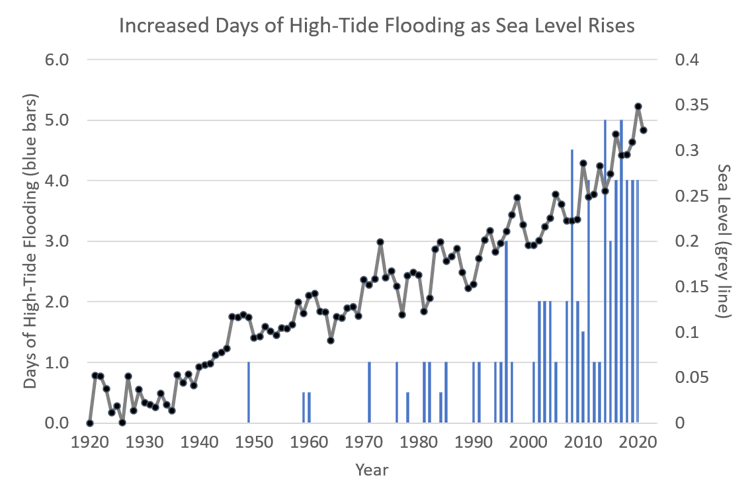
Before Shark Week and “Jaws,” World War II spawned America’s shark obsession

Every summer on the Discovery Channel, “Shark Week” inundates its eager audiences with spectacular documentary footage of sharks hunting, feeding and leaping.

Debuting in 1988, the television event was an instant hit. Its financial success wildly exceeded the expectations of its creators, who had been inspired by the profitability of the 1975 blockbuster film “Jaws,” the first movie to earn US$100 million at the box office.

Thirty-three years later, the enduring popularity of the longest-running programming event in cable TV history is a testament to a nation terrified and fascinated by sharks.

Journalists and scholars often credit “Jaws” as the source of America’s obsession with sharks.

Yet as a historian analyzing human and shark entanglements across the centuries, I argue that the temporal depths of “sharkmania” run much deeper.

World War II played a pivotal role in fomenting the nation’s obsession with sharks. The monumental wartime mobilization of millions of people placed more Americans into contact with sharks than at any prior time in history, spreading seeds of intrigue and fear toward the marine predators.

America on the move

Before World War II, travel across state and county lines was uncommon. But during the war, the nation was on the move.

Out of a population of 132.2 million people, per the 1940 U.S. Census, 16 million Americans served in the armed forces, many of whom fought in the Pacific. Meanwhile, 15 million civilians crossed county lines to work in the defense industries, many of which were in coastal cities, such as Mobile, Alabama; Galveston, Texas; Los Angeles; and Honolulu.

Local newspapers across the country transfixed civilians and servicemen alike with frequent stories of bombed ships and aircraft in the open ocean. Journalists consistently described imperiled servicemen who were rescued or dying in “shark-infested waters.”

Whether sharks were visibly present or not, these news articles magnified a growing cultural anxiety of ubiquitous monsters lurking and poised to kill.

The naval officer and marine scientist H. David Baldridge reported that fear of sharks was a leading cause of poor morale among servicemen in the Pacific theater. General George Kenney enthusiastically supported the adoption of the P-38 fighter plane in the Pacific because its twin engines and long range diminished the chances of a single-engine aircraft failure or an empty fuel tank: “You look down from the cockpit and you can see schools of sharks swimming around. They never look healthy to a man flying over them.”

“Hold tight and hang on”

American servicemen became so squeamish about the specter of being eaten during long oceanic campaigns that U.S. Army and Navy intelligence operations engaged in a publicity campaign to combat fear of sharks.

Published in 1942, “Castaway’s Baedeker to the South Seas” was a “travel” survival guide, of sorts, for servicemen stranded on Pacific islands. The book emphasized the critical importance of conquering such “bogies of the imagination” as “If you are forced down at sea, a shark is sure to amputate your leg.”

Similarly, the Navy’s 1944 pamphlet titled “Shark Sense” advised wounded servicemen stranded at sea to “staunch the flow of blood as soon as you disengage the parachute” to thwart hungry sharks. The pamphlet helpfully noted that hitting an aggressive shark on the nose might stop an attack, as would grabbing a ride on the pectoral fin: “Hold tight and hang on as long as you can without drowning yourself.”

The Department of the Navy also worked with the Office of Strategic Services, the wartime precursor to the Central Intelligence Agency, to develop a shark repellent.

Office of Strategic Services executive assistant and future chef Julia Child worked on the project, which tested various recipes of clove oil, horse urine, nicotine, rotting shark muscle and asparagus in hopes of preventing shark attacks. The project culminated in 1945, when the Navy introduced “Shark Chaser,” a pink pill of copper acetate that produced a black inky dye when released in the water – the idea being that it would obscure a serviceman from sharks.

Nonetheless, the U.S. military’s morale-boosting campaign was unable to vanquish the glaring reality of wartime carnage at sea. Military media correctly observed that sharks rarely attack healthy swimmers. Indeed, malaria and other infectious diseases took a far greater toll on U.S. servicemen than sharks.

But the same publications also acknowledged that an injured person was vulnerable in the water. With the frequent bombing of airplanes and ships during World War II, thousands of injured and dying servicemen bobbed helplessly in the ocean.

One of the worst wartime disasters at sea occurred on July 30, 1945, when pelagic sharks swarmed the site of the shipwrecked USS Indianapolis. The heavy cruiser, which had just successfully delivered the components of the Hiroshima atomic bomb to Tinian Island in a top-secret mission, was torpedoed by a Japanese submarine. Out of a crew of 1,196 men, 300 died immediately in the blast, and the rest landed in the water. As they struggled to stay afloat, men watched in terror as sharks feasted on their dead and wounded shipmates.

Only 316 men survived the five days in the open ocean.

“Jaws” has an eager audience

World War II veterans possessed searing lifelong memories of sharks – either from direct experience or from the shark stories of others. This made them an especially receptive audience for Peter Benchley’s taut shark-centered thriller “Jaws,” which he published in 1974.

Don Plotz, a Navy sailor, immediately wrote to Benchley: “I couldn’t put it down until I had finished it. For I have rather a personal interest in sharks.”

In vivid detail, Plotz recounted his experiences on a search and rescue mission in the Bahamas, where a hurricane had sunk the USS Warrington on Sept. 13, 1944. Of the original crew of 321, only 73 survived.

“We picked up two survivors who had been in the water twenty-four hours, and fighting off sharks,” Plotz wrote. “Then we spent all day picking up the carcasses of those we could find, identifying them and burying. Sometime only rib cages … an arm or leg or a hip. Sharks were all around the ship.”

Benchley’s novel paid little attention to World War II, but the war anchored one of the movie’s most memorable moments. In the haunting, penultimate scene, one of the shark hunters, Quint, quietly reveals that he is a survivor of the USS Indianapolis disaster.

“Sometimes the sharks look right into your eyes,” he says. “You know the thing about a shark, he’s got lifeless eyes, black eyes, like a doll’s eyes. He comes at you, he doesn’t seem to be living until he bites you.”

The power of Quint’s soliloquy drew upon the collective memory of the most massive wartime mobilization in American history. The oceanic reach of World War II placed greater numbers of people into contact with sharks under the dire circumstances of war. Veterans bore intimate witness to the inevitable violence of battle, compounded by the trauma of seeing sharks circle and feed opportunistically on their dead and dying comrades.

Their horrifying experiences played a pivotal role in creating an enduring cultural figure: the shark as a mindless, spectral terror that can strike at any moment, a haunting artifact of World War II that primed Americans for the era of “Jaws” and “Shark Week.”

Janet M. Davis, University Distinguished Teaching Professor of American Studies, The University of Texas at Austin College of Liberal Arts

This article is republished from The Conversation under a Creative Commons license. Read the original article.

What is microplastic anyway? Inside the insidious pollution that is absolutely everywhere

A 2020 study found that there may be more microplastics in some waters than zooplankton, a group of plankton that include tiny animals and some immature larger animals. That may not seem like a big deal, but countless aquatic species rely on zooplankton as a food source; their experience is tantamount to accidentally eating a credit card half the time you try to eat what’s on your plate.

Indeed, plastic pollution is one of the biggest ongoing threats to the planet, easily on par with climate change and the loss of biodiversity. Plastics are responsible for poisoning our bodies, reducing our fertility rates and destroying wildlife both on the land and in the sea.

Yet plastics pollution doesn’t mean floating bottles and utensils, medical equipment and random consumer junk. Plastic pollution from these and other goods are broken down in the ocean into tinier and tinier pieces. Much plastic pollution is so tiny that they appear as grains, or perhaps are invisible to the naked eye. These are known as microplastics; and while they are tiny compared to the vast belching smoke stacks and mushroom clouds we associate with the most ominous symbols of pollution, microplastics are no less ominous.

What are microplastics?

“A microplastic most typically is defined as a particle that is five millimeters or less across or in length,” Rolf Halden, Director of the Biodesign Center for Environmental Health Engineering at Arizona State University, told Salon. “Even there people disagree, but let’s say it’s just a diameter of five millimeters or less that makes for a microplastic.” Halden says that they are “plastic shavings or debris,” which floats in the ocean and created by continually being ground down by the surf. Some microplastics are also remnants of rubber tire shavings that blow off of highways as cars travel — these are rubber polymers. 

Jacqueline Doremus, an Assistant Professor of Economics at Cal Poly who, among other things, is an expert in evaluating environmental policy effectiveness, explained that the plastic industry itself is connected to the petrochemical manufacturing industry, which plays a big role in pollution. This economic angle explains how plastics have become so pervasive and, as a result, microplastic pollution has become such a major environmental problem.

“Plastic is a byproduct of petrochemical manufacturers,” Doremus told Salon by email. “Decreases in demand for oil and gas mean producers betting on plastic. At the same time, more than three-quarters of plastic additives are not disclosed to researchers, the public, or regulators because they are protected as intellectual property or are improperly documented. So we have two forces at work: strong incentives for a powerful industry to increase plastic production and a poor understanding of the sometimes toxic additives they use.”

Where are microplastics?

There is no easy way to answer this question: They are literally everywhere. You cannot escape them.

“Microplastics are insidious and now cover large areas of our planet,” Mary Crowley, Founder and President of Ocean Voyages Institute, wrote to Salon. “Besides being found in the deepest part of our ocean, the Mariana Trench, microplastics are also found atop the Rocky Mountains, the Pyrenees Mountains, the Arctic, the Antarctic and throughout the world’s oceans and deserts — everywhere!” Even worse, because plastic is not biodegradable (that is, able to decompose because bacteria or other organisms consume it), it is going to stick around for centuries.

“Microplastics end up being ingested by small organisms which are in turn ingested by larger organisms such as fish and birds and via this route, plastic enters into our planet’s food web making its way up the food chain,” Crowley explained. “Microplastics and larger pieces of plastic are now commonly found filling the stomachs of fish, birds, whales, dolphins, seals and turtles, causing illness and mortality.”

Why are microplastics dangerous?

Crowley also elaborated on the ways that microplastics endanger human health.

“Microplastics contain toxic chemicals and hormone altering compounds, which can affect human health in areas ranging from reproduction to immune function,” Crowley told Salon. “More studies need to be done for us to begin to gain a full understanding of all the effects microplastics have on human health and the health of our oceans, but from what we can observe, we know plastics are made with substances that are not meant to be ingested. On a macro level, microplastics tamper with the ocean’s ability to sequester carbon through plankton, affecting the very air we breathe.”

Halden said that laypeople may wonder why we make so many products out of plastic if it is toxic or hazardous to human health.

“The answer to that is that, historically, we have made choices to enough of the ingredients to make plastics that in hindsight turned out to be very poor ones,” Halden explained. One example is vinyl chloride, which scientists later learned is a potent carcinogen. Obviously all we have to do is keep it out of products that could contaminate our food and we should be fine, right?

“If you look to food, we don’t use PVC [polyvinyl chloride, a polymer of vinyl chloride] to package food,” Halden said. “We use a polyethylene and other polymers, right? And they are initially safe for the purpose they’re intended for. However, since we make so much of it and it gets out into the environment, then it grinds down. They are changing their chemical makeup and their physical appearance and they become a health hazard.”

To illustrate the processes at work here, Halden suggested that people imagine a disposable plastic yogurt cup. Once they eat the yogurt, they throw away the cup. What happens to it? The chances are pretty good that, eventually, it will find its way into a body of water like the ocean or a river.

“It floats there for a long period of time and can absorb a lot of air and water pollutants,” Halden explained. “It becomes like a toxic float and its surface characteristics can change so it almost looks like a piece of asbestos. And we know that foreign particles that get into our lungs or other organs can cause inflammation and cancer. So the material changes over time and with it the risk, and that is something that is not intuitively understandable by a lay person when they evaluate plastics and wonder, ‘Should I buy more plastics? Am I doing the right thing here? Or should I change my, my behavior?'”

How can we protect ourselves from microplastics?

Lisa Erdle is the Manager of Science & Innovation at 5 Gyres, a nonprofit devoted to fighting plastic pollution.

“Once microplastics are in the environment, they are nearly impossible to clean up,” Erdle wrote to Salon. “There have been some technologies designed to ‘clean up’ the ocean, for example, but these are expensive, have other negative impacts on the environment, and are exceedingly difficult to implement at scale. However, other technologies, like those that capture microplastics closer to the source, are effective at capturing microplastics before they enter the environment.” One example of this are washing machine filters that capture microfibers before they can infiltrate aquatic environments; another are storm drain traps that capture plastics on our roads before they enter bodies of water.

“Since there are many different sources of microplastics to the environment, it is likely we will need a range of different solutions to prevent their emissions to the environment,” Erdle observed.


Want more health and science stories in your inbox? Subscribe to Salon’s weekly newsletter The Vulgar Scientist.


Doremus framed the question as being one of protecting our basic freedoms and argued that manufacturers themselves need to be held accountable.

“The problem boils down to rights,” Doremus wrote. “Who has the right – companies to produce plastic without consequences? Or people to have a threshold of plastic they can expect in the air we breathe and the water we drink?”

From this vantage point, Doremus urged a number of approaches including taxing plastic, reclassifying it as a pollutant so it can be regulated and force companies to “take back” their plastics. On an individual level, people can change their lifestyle to reduce their plastic output.

“Wash your clothes less and line dry, this avoids microfiber pollution and carbon emissions – win-win,” Doremus argued. “Same with carpooling and reducing driving, which reduces tire fibers, carbon emissions, and local pollutants that increase asthma.If you smoke cigarettes, be careful to dispose of the butts in the trash, as they contain highly toxic microfibers. Avoid plastic bottled beverages, as the manufacturing process likely introduces microplastic. Reduce your use of plastic where you can.”

She added, “Start small and be kind to yourself if you can’t avoid it. It’s not you – it’s us.”