Spring Sale: Get 1 Year, Save 58%

Abortion rights advocacy groups file lawsuit against controversial Texas law

Abortion rights advocacy groups have filed a federal lawsuit pushing back against Texas’ new controversial law. According to The Washington Post, multiple abortion rights groups, including the Center for Reproductive Rights, Planned Parenthood and the American Civil Liberties Union (ACLU), filed the lawsuit in Austin on behalf of a number of other abortion rights groups.

The lawsuit seeks to block a new state law that grants individuals the right to file a lawsuit against anyone assisting a woman with an abortion procedure. The publication reports that the law also extends to “those who provide financial help or drive a pregnant patient to a clinic.”

While several states have passed laws prohibiting abortion after six weeks of pregnancy, the Texas law, set to go into effect in September, takes legal recourse a step further by “incentivizing private citizens to help enforce the ban — awarding them at least $10,000 if their court challenges are successful,” the publication reports.

Abortion providers are now arguing that the controversial bill is “unconstitutional” and will “subject them to endless lawsuits, shut down clinics and reduce services — and they say it will isolate abortion patients by undermining support networks for pregnant women.” Nancy Northup, president of the Center for Reproductive Rights, released a statement expressing her concerns about the possible impacts the law could have on abortion providers.

“The state has put a bounty on the head of any person or entity who so much as gives a patient money for an abortion after six weeks of pregnancy, before most people know they are pregnant,” Northup said in a statement. “Worse, it will intimidate loved ones from providing support for fear of being sued.”

Other advocates and heads of abortion rights groups have also sounded off. Marva Sadler, the clinical services director for Whole Woman’s Health, expressed concerns about the possible attacks many women may be subjected to as a result of the bill.

“It’s really, really scary for me to imagine the people we pass through to go to work on a daily basis, who yell at us . . . now have the authority and ability to sue me at will,” Sadler said. “Not only is it an attack on the access, but it absolutely feels like a personal threat, as well.”

The lawsuit comes nearly two months after Gov. Greg Abbott, R-Texas, signed the bill into law. At the time, he lauded the bill describing it as a victory for Texans.

Biden blasts GOP’s attack on voting rights — Fox News doesn’t air it

Fox News, the conservative cable heavyweight, elected not to dedicate air time to President Joe Biden’s Tuesday address in Philadelphia, which blasted Republicans for their efforts to restrict voting rights across the country. That didn’t stop Fox News, along with many other conservative pundits, finding ample time in the day to counterattack the president’s speech. 

During his speech at the National Constitution Center Tuesday afternoon, Biden described Republican efforts to limit access to the ballot box as a “21st century Jim Crow assault.”

“They want to make it so hard and inconvenient that they hope people don’t vote at all,” Biden said of GOP efforts to roll back voting rights. “That’s what this is about. This year alone, 17 states have enacted, not just proposed but enacted, 28 new laws to make it harder for Americans to vote, not to mention nearly 400 additional bills Republican members of the state legislature are trying to pass,” he added. 

“The 21st-century Jim Crow assault is real. It’s unrelenting,” Biden stated. “And we’re going to challenge it vigorously.”

Biden went on to characterize the GOP-led push for stricter voting rights laws as “pernicious.” The president said, “Some state legislators want to make it harder for you to vote. And if you vote, they want to be able to tell you your vote doesn’t count for any reason they make up. They want the ability to reject the final count and ignore the will of the people if their preferred candidate loses.”

Fox News did not respond to Salon’s request for comment on the network’s decision not to air the presidential address live.

Right-wing Twitter pundits didn’t mince words following Biden’s address, blasting his speech as a complete “lie.” 

“It’s demagoguery, designed to make the left think Biden’s doing something about HR 1, and guaranteeing that nothing will ever be done about it — or that, if it passes, it will mark the end of democracy, as Republicans will see it as a Lockean change of government, and resist it,” right-wing Breitbart editor Joel Pollak wrote on Twitter. 

“Almost every word of this Biden speech is a lie,” National Review senior writer David Harsanyi added.

Daily Wire pundit Matt Walsh also got in on the action, writing: “The right to vote is not universal or inherent, nor is it meant to be enjoyed by all people or even most people. It should be a responsibility entrusted only to those most qualified to fulfill it.”

Before the president’s address, Fox News even got in a few swipes at Biden’s push to expand voting in America. “Are you concerned that President Biden is weaponizing the DOJ to enforce his moral views about voting?” Fox News anchor John Roberts asked former Rep. Jason Chaffetz, a network contributor.

“I am. I’m concerned about how Biden is using the Department of Justice,” Chaffetz responded. “Look, they’ve lost at the Supreme Court. I don’t think this bill at the federal level has any chance of passing. And if Joe Biden is going to give a speech today, tell me specifically, President Biden, what you are opposed to in Texas and Georgia — because they talk in platitudes, but they won’t offer specifics.”

“Authenticate the vote. That is a winning proposition. That’s where the president should be, but he hasn’t been in the past,” Chaffetz concluded.  

Over the past nine months following Biden’s election in November, Republicans have used the cover of former President Donald Trump’s false election fraud claims to push for legislation in numerous states that sharply limits or restricts access to voting in the name of “election integrity.” 

In parenting or politics, appeasement is often a losing psychological strategy, experts say

It is one of the most infamous stories of failed diplomacy in modern history: British Prime Minister Neville Chamberlain, determined to keep his country out of another world war, gave part of Czechoslovakia to Nazi Germany in the Munich Agreement of 1938. His hope was that appeasing Adolf Hitler — that is, placating his demands — by allowing him his desired conquest would sate his appetite for empire. Instead it emboldened him to continue with his imperialistic and genocidal ambitions. Appeasement, contemporaries and eventually students of history would learn, made World War Two more likely, not less so.

This story is not just relevant to geopolitics; nearly everyone has had to debate the strategy of appeasing someone in their life — whether a bully, boss, narcissist, partner, or otherwise. Parents, particularly, might relate to Chamberlain: moms and dads who bear witness to their toddler throwing a tantrum in public, demanding something generally verboten like a toy or candy, must weigh whether appeasement sets a bad parenting precedent

Whether you’re dealing with a toddler, a boss or a dictator, how does one know whether appeasement is the right strategy? And how does it affect the appeased, psychologically? 

Psychologists describe appeasement as a tactic with deep roots in human psychology. It is not always bad to appease people — but it can be just as unhealthy in your personal life (or your child’s life), as it was dangerous for the free world when Chamberlain did it more than 80 years ago.

“In psychology, appeasement behavior is something that can be observed in both the human and animal world,” Dr. Holly Schiff, a licensed clinical psychologist, told Salon by email. “In the animal world, it is the action that one takes to reduce the likelihood of attack or threatening behavior from another. They will take a submissive posture, reduce their apparent body size, crouch and use vocal signals that are associated with young animals.”

When it comes to human beings, this approach can be useful when we are faced with serious imminent threats, Schiff explained. “If the threat is another person, then giving them what they want and placating them can reduce the danger, even if what you do and say you later regret,” she explained. “Your mind focuses on options that might reduce the immediate threat, and you may not be able to see other options that seem obvious later.”

At the same time, appeasement can be a problem in other scenarios, such as parents who regularly appease misbehaving children.

“In the short-term, this may defuse an escalating situation; however, you are not getting the root of the problem,” Schiff observed. “And if you continue to appease, you will be giving up on what you want and believe in and need, and how does this make the individual feel after a while?” It also sends the people observing the appeaser the message that they are weak and can be manipulated or taken advantage of.

“When you give an inch, people tend to take a mile,” Schiff pointed out. “Each individual has the discretion to decide when it makes sense to take a stand and when it makes sense to appease in order to avoid further conflict.”

Dr. Paul Greene, a psychologist who currently serves as the director of the Manhattan Center for Cognitive-Behavioral Therapy in New York, offered further insight as to when appeasement is or is not a sound strategy.

“There is no one recipe for knowing when to appease someone and when to ‘stick to your guns,'” Greene explained. Yet in parenting, that recipe is often different than it might be for an adult.

“If you don’t punish an undesirable behavior, that makes it more likely to recur,” Greene pointed out. “This can be harmless in some situations but unwise in others. For example, if a passerby bumps into you and doesn’t apologize, what is the real impact for you? Not much. However, if your 8-year-old cries until she gets more and more candy, there may be consequences for her health.”


Want more health and science stories in your inbox? Subscribe to Salon’s weekly newsletter The Vulgar Scientist.


His other advice is that people should “try to be skillful in responding to undesirable behavior from others. Just because you might reject ‘appeasement’ in a given situation doesn’t mean you need to start yelling, cursing, or screaming. The better you get at calmly and effectively asserting your opinion, the more results you might see.”

Kimberly Perlin, LCSW-C, a licensed clinical social worker providing psychotherapy in Towson, Maryland who specializes in providing services to women “raised in emotionally chaotic homes,” spoke with Salon by email about the importance of recognizing the specific power dynamics in a particular situation before deciding whether to appease.

“This question depends on what one is willing to risk and the power dynamics involved,” Perlin told Salon. “If you are unhappy at a job and know you want to leave anyway, you might feel more free to appease or not appease as you know your time is limited. If you enjoy your position you have to consider the power dynamics (who can limit your growth or show you the door).”

She also urged those who consider appeasing to consider what they might be asked to do after the accede to this “one thing” and whether the behavior itself is sustainable.

“What is your tolerance for confrontation — does this coworker hold grudges or behave in ways you would find intolerable? What would be your plan if that would happen to you?” Perlin explained.

“Some will have a learning curve if you say no, stand your ground,” Perlin added. “Some will not, they will push your boundaries and question your motives at least initially. You have to have a tolerance for both possible responses. People can claim they are appeasing a boss to help the boss but often it is about their own intolerance for conflict. They can’t see past the conflict. One has to practice responses and often practice saying no to smaller issues in order to develop a tolerance for bigger nos.”

Yet there is no reason to be ashamed if you struggle to avoid appeasing strategies with others. Indeed, very often those who practice appeasement do so because they are victims. Appeasement is often a vital survival strategy for those who face oppression in a dynamic wherein they are powerless. One example is sexual harassment.

“In the case of sexual harassment, somebody often tries to laugh off or ignore the behaviour,” Olivia James, a London-based therapist who specializes in trauma, wrote to Salon. “This can look like tacit agreement, the recipient tries to look like it hasn’t bothered her. So it can perpetuate the bad behavior because there were no consequences for those who perpetrate this behavior. We do not directly confront it and say: ‘That’s an inappropriate thing to say, I’m reporting you to HR.'” James added that victims often beat themselves up afterward, noting that “where there is a big power difference, we know direct confrontation is going to come back on us, so we freeze or appease.” She added that appeasement “can also ensure our survival in the system as a woman in the workplace.”

Dr. Jessica January Behr, a licensed psychologist who practices in New York City, noted that there are psychological “dangers” to appeasement — in both personal and political contexts.

“The psychological danger of appeasement is twofold,” Behr explained. First, “it can lead to the delusion or denial of appeaser, who can convince themselves that the opposition will be softened, changed or that they will respond with a sense of reciprocal fairness. However appeasement does nothing to change the long-term behavior of the opposition. In addition, appeasement “can lead to further grandiosity, strength and omnipotence in the opposition as they gain power through being appeased and through the delusion or denial of the appeaser.”

Followers of national politics are likely aware that the psychology of appeasement is particularly relevant in this political moment. America is currently mired in gridlock because two Democratic senators, Joe Manchin of West Virginia and Kyrsten Sinema of Arizona, refuse to eliminate an ancient obstructionist tool known as the filibuster. By their own admission, they hope to appease the Republicans’ Senate Leader, Mitch McConnell, by forcing Democrats to work with them despite their obstructionism. (McConnell has apparently ordered Republicans to go out of their way to praise Manchin and Sinema for appeasing them.)

It also remains relevant in terms of personal relationships. More and more people are drawing attention to toxicity in their romantic lives, with their families or at their jobs. Our culture is increasingly averse to appeasing those who wrong us, which is a healthy development. The question now is how to best help people who in the past may have felt compelled to appease. The goal should never be appeasing a party who hurts or wrongs you, but to make sure that you confront them in an effective and healthy way.

Texas legislator calls out Fox News host over election lies: Tell your viewers that “Trump lost”

The youngest legislator in Texas just took down a Fox News host in real time.

Speaking to Fox News host Pete Hegseth, Rep. James Talarico, D, called out both the host and the network for making money off of lying to the American people.

“You have made a lot of money personally, and you have enriched a lot of corporations with advertising by getting on here and spewing lies and conspiracy theories,” said Talarico, as Hegseth protested. “So, what I’m asking you to do is to tell your viewers that Donald Trump lost the election.”

Hegseth has been one of many Fox hosts to downplay the Jan. 6 attack on the U.S. Capitol, as well.

“They weren’t going in there to target individuals. They were going in there symbolically,” he told the audience.

Just one day before his comments, a video surfaced of the Capitol attackers chanting, “Hang Mike Pence!”

Check out the exchange between Hegseth and Talarico below.

You can watch the video below via Twitter

America’s war in Afghanistan is finally over — so what about Iraq and Iran?

At Bagram Air Base, Afghan scrap merchants are already picking through the graveyard of U.S. military equipment that was until recently the headquarters of America’s 20-year occupation of their country. Afghan officials say the last U.S. forces slipped away from Bagram in the dead of night, without notice or coordination. 

Taliban fighters are rapidly expanding their control over hundreds of districts, usually through negotiations between local elders, but also by force when troops loyal to the Kabul government refuse to give up their outposts and weapons. 

A few weeks ago, the Taliban controlled a quarter of the country. Now, it’s a third. They are taking control of border posts and large swaths of territory in the north of the country. These include areas that were once strongholds of the Northern Alliance, a militia that prevented the Taliban from unifying the country under their rule in the late 1990s. 

People of good will all over the world hope for a peaceful future for the people of Afghanistan, but the only legitimate role the U.S. can play there now is to pay reparations, in whatever form, for the damage it has done and the pain and death it has caused. Speculation in the U.S. political class and corporate media about how the U.S. can keep bombing and killing Afghans from “over the horizon” should cease. The U.S. and its corrupt puppet government lost this war. Now it’s up to the Afghans to forge their future. 

So what about America’s other endless crime scene, Iraq? The U.S. corporate media only mentions Iraq when our leaders suddenly decide that the 150,000-plus bombs and missiles they have dropped on Iraq and Syria since 2001 were not enough, and dropping a few more on Iranian allies there will appease some hawks in Washington without starting a full-scale war with Iran.

But for 40 million Iraqis, as for 40 million Afghans, America’s most stupidly chosen battlefield is their country, not just an occasional news story. They are living their entire lives under the enduring impacts of the neocons’ war of mass destruction.

Young Iraqis took to the streets in 2019 to protest 16 years of corrupt government by the former exiles to whom the United States handed over their country and its oil revenues. The 2019 protests were directed at the Iraqi government’s corruption and failure to provide jobs and basic services to its people, but also at the underlying, self-serving foreign influences of the U.S. and Iran over every Iraqi government since the 2003 invasion.

A new government was formed in May 2020, headed by Prime Minister Mustafa al-Kadhimi, previously the head of Iraq’s Intelligence Service and, before that, a journalist and editor for the U.S.-based Al-Monitor Arab news website. Despite his Western background, al-Kadhimi has initiated investigations into the embezzlement of $150 billion in Iraqi oil revenues by officials of previous governments, who were mostly former Western-based exiles like himself. And he’s walking a fine line to try to save his country, after all it has been through, from becoming the front line in a new U.S. war on Iran.

Recent U.S. airstrikes have targeted Iraqi security forces called Popular Mobilization Forces (PMF), which were formed in 2014 to fight the Islamic State (IS), the twisted religious force spawned by the U.S. decision, only 10 years after 9/11, to unleash and arm al-Qaida in a Western proxy war against Syria. 

The PMFs now comprise about 130,000 troops in 40 or more different units. Most were recruited by pro-Iranian Iraqi political parties and groups, but they are an integral part of Iraq’s armed forces and are credited with playing a critical role in the war against IS.

Western media represent the PMFs as militias that Iran can turn on and off as a weapon against the United States, but these units have their own interests and decision-making structures. When Iran has tried to calm tensions with the United States, it has not always been able to control the PMFs. General Haider al-Afghani, the Iranian Revolutionary Guard officer in charge of coordinating with the PMF, recently requested a transfer out of Iraq, complaining that the PMFs are paying no attention to him.

Ever since the U.S. assassination of Iran’s Gen. Qassem Soleimani and PMF commander Abu Mahdi al-Muhandis in January 2020, the PMFs have been determined to force the last remaining U.S. occupation forces out of Iraq. After the assassination, the Iraqi National Assembly passed a resolution calling for U.S. forces to leave Iraq. Following U.S. airstrikes against PMF units in February, Iraq and the United States agreed in early April that U.S. combat troops would leave soon

But no date has been set, no detailed agreement has been signed and many Iraqis do not believe U.S. forces will leave, nor do they trust the Kadhimi government to ensure their departure. As time has gone by without a formal agreement, some PMF forces have resisted calls for calm from their own government and Iran, and stepped up their attacks against U.S. forces. 

At the same time, the Vienna talks over the JCPOA nuclear agreement have raised fears among PMF commanders that Iran may sacrifice them as a bargaining chip in order to negotiate a nuclear agreement with the United States.

In the interest of survival, PMF commanders have become more independent of Iran, and have cultivated a closer relationship with Prime Minister Kadhimi. This was evidenced in Kadhimi’s attendance at a huge military parade in June 2021 to celebrate the seventh anniversary of the PMF’s founding. 

The very next day, the U.S. bombed PMF forces in Iraq and Syria, drawing public condemnation from Kadhimi and his cabinet as a violation of Iraqi sovereignty. After conducting retaliatory strikes, the PMF declared a new ceasefire on June 29, apparently to give Kadhimi more time to finalize a withdrawal agreement. But six days later, some of them resumed rocket and drone attacks on U.S. targets.

Whereas Donald Trump only ordered retaliatory strikes when rocket attacks in Iraq killed Americans, a senior U.S. official has revealed that President Biden has lowered the bar, threatening to respond with airstrikes even when Iraqi militia attacks don’t cause U.S. casualties. 

But U.S. airstrikes have only led to rising tensions and further escalations by Iraqi militia forces. If U.S. forces respond with more or heavier airstrikes, the PMF and Iran’s allies throughout the region are likely to respond with more widespread attacks on U.S. bases. The further this escalates and the longer it takes to negotiate a genuine withdrawal agreement, the more pressure Kadhimi will get from the PMF, and other sectors of Iraqi society, to show U.S. forces the door.

The official rationale for the U.S. presence, as well as that of NATO training forces in Iraqi Kurdistan, is that the Islamic State is still active. A suicide bomber killed 32 people in Baghdad in January, and IS still has a strong appeal to oppressed young people across the region and the Muslim world. The failure, corruption and repression of successive post-2003 governments in Iraq have provided fertile soil.

But the U.S. clearly has another reason for keeping forces in Iraq — as a forward base in its simmering war on Iran. That is exactly what Kadhimi is trying to avoid by replacing U.S. forces with the Danish-led NATO training mission in Iraqi Kurdistan. This mission is being expanded from 500 to at least 4,000 troops, made up of Danish, British and Turkish personnel. 

If Biden had quickly rejoined the JCPOA nuclear agreement with Iran on taking office, tensions would be lower by now, and the U.S. troops still in Iraq might well be home already. Instead, Biden obliviously swallowed the poison pill of Trump’s Iran policy by using “maximum pressure” as a form of “leverage,” escalating an endless game of chicken the United States cannot win — a tactic that Barack Obama began to wind down six years ago by signing the JCPOA.

The U.S. withdrawal from Iraq and the JCPOA are interconnected, in that both are essential parts of a policy to improve U.S.-Iranian relations and end America’s antagonistic and destabilizing interventionist role in the Middle East. The third element for a more stable and peaceful region is the diplomatic engagement between Iran and Saudi Arabia, in which Kadhimi’s Iraq is playing a critical role as the principal mediator.    

The fate of the Iran nuclear deal is still uncertain. The sixth round of shuttle diplomacy in Vienna ended on June 20, and no date has yet been set for a seventh round. Biden’s commitment to rejoining the agreement seems shakier than ever, and President-elect Ebrahim Raisi of Iran has declared he will not let the Americans keep drawing out the negotiations. 

In an interview on June 25, Secretary of State Tony Blinken upped the ante by threatening to pull out of the talks altogether. He said that if Iran continues to spin more sophisticated centrifuges at higher and higher levels, it will become very difficult for the U.S. to return to the original deal. Asked whether or when the United States might walk away from negotiations, he said, “I can’t put a date on it, [but] it’s getting closer.”

What should really be “getting closer” is the U.S. withdrawal of troops from Iraq. While Afghanistan is portrayed as the “longest war” the United States has fought, the U.S. military has been bombing Iraq for 26 of the last 30 years. The fact that the U.S. military is still conducting “defensive airstrikes” 18 years after the 2003 invasion and nearly 10 years since the official end of the war proves just how ineffective and disastrous this U.S. military intervention has been.

Biden certainly seems to have learned the lesson in Afghanistan that the U.S. can neither bomb its way to peace nor install U.S. puppet governments at will. When pilloried by the press about the Taliban gaining control as U.S. troops withdraw, the president answered:

For those who have argued that we should stay just six more months or just one more year, I ask them to consider the lessons of recent history. … Nearly 20 years of experience has shown us, and the current security situation only confirms, that “just one more year” of fighting in Afghanistan is not a solution but a recipe for being there indefinitely. It’s the right and the responsibility of the Afghan people alone to decide their future and how they want to run their country.

The same lessons of history apply to Iraq. The U.S. has already inflicted so much death and misery on the Iraqi people, destroyed so many of its beautiful cities and unleashed so much sectarian violence and Islamist fanaticism. As with the shuttering of the massive Bagram base in Afghanistan, Biden should dismantle the remaining imperial bases in Iraq and bring the troops home. 

The Iraqi people have the same right to decide their own future as the people of Afghanistan, and all the countries of the Middle East have the right and the responsibility to live in peace, without the threat of American bombs and missiles always hanging over their heads, and their children’s

Let’s hope Biden has learned another history lesson: that the United States should stop invading and attacking other countries.


Kayleigh McEnany calls out Joe Biden for “using the tactic of whispering” to connect with voters

Fox News contributor Kayleigh McEnany hosted a segment on Tuesday that slammed President Joe Biden for “using the tactic of whispering” to connect with voters.

During the Fox News Outnumbered program, McEnany accused the media of defending Biden’s habit of “whispering” to emphasize his remarks.

“Yikes!” McEnany said to kick off the segment. “That’s President Biden using the tactic of whispering during his speeches and press conferences. The White House communications experts say it’s a way for him to connect with voters.”

“It’s yet another example of the media seemingly treating Democrats and Biden differently than Republicans,” she continued. “Going back to the whispering, the press defends Biden a lot. But for the [Associated Press] to cite an expert saying this is an intimate form of communication — I think it’s a creepy one.”

One Fox News guest agreed: “A whispering president with a history of sniffing women’s hair makes a lot of Americans uncomfortable.”

“Yes,” McEnany replied.

Co-host Emily Compagno weighed in to criticize Biden.

“On the whispering, you guys, I’m sorry but when someone whispers in that candyman, Shelter Island, freakshow way, I do not feel connected,” she said. “I feel frightened.”

“Yeah, that’s right,” McEnany remarked. “It’s very odd.”

Watch the video below via YouTube:

Anatomy of a shutout: Why the Emmys snub Beyoncé despite her continuing to innovate on TV

Emmy voters are a fickle bunch. Every nominations day reminds us of that, regardless of how diverse the nominees are in a given year, despite the boldness of the choices. Television Academy members hit a few bullseyes, even in rounds that make us question whether they actually watch TV. Whether the year’s preliminary choices are good, bad or ugly, they will always show tendency to reward the familiar while leaving indisputably deserving contenders on the curb.

Anyone who is at all emotionally or professionally invested in these awards knows this, but on Tuesday, fans of Beyoncé Knowles-Carter may have felt more acutely aware of this fact than others when her 2020 Disney+ special “Black Is King” was completely shut out  of contention.

This same voting body granted four nominations to her 2016 opus “Lemonade” and six to 2019’s “Homecoming: A Film By Beyoncé.” Neither netted a statue at their respective awards ceremonies, but given the track record it was reasonable to expect the pop performer’s third major TV feature to get at least a nomination for something. Yet not even a costume nod came its way, which is incredible considering the strength of that artistic element alone.

“Black Is King” is an interesting project to consider as an example of what Emmy voters gravitate toward and what they snub. There are multiple elements to consider in every category, many of which change every year. But what it frequently comes down to is the simple fact of how popular a work is, or the familiarly of a work’s star, and whether the TV academy members understand a project enough to gravitate towards it.

Beyoncé has been deconstructing her narratives concerning who she is and her place in the world since 2013’s “Life Is But a Dream,” a biographical documentary that follows all the standard beats of the form while still frustratingly keeping the audience at arm’s length. “Lemonade” is neither a reaction to that perception or the result of it, but the artist’s acknowledgement that her storytelling mastery rests in her songs and by extension her videos.

Visually speaking, TV is her medium because of the opportunities it now affords for experimentation with structure and short form narratives. “Lemonade” dropped on HBO because it is premium TV. “Homecoming” hybridizes the concert film with a backstage exploration of intellectual consciousness.

Out of Beyoncé’s three features for the small screen, “Black Is King” is at once her highest concept work and her most narrowly targeted, in that Beyoncé, who voiced Nala in the 2019 photo-realistic remake of “The Lion King,” transforms the Disney fable into a metaphor for the Black experience rendered in a collage of rich natural imagery, luxurious set pieces and vibrant dance.

Emmy voters are not big on metaphors, so they probably didn’t know what to do with it.

That doesn’t mean it wasn’t a creative success. The same year that Emmy is denying Beyoncé her TV propers, she set a new all-time record for most Grammy wins by a female artist, racking up a career total of 28 so far. The piece that put her over the top is her best R&B performance win for “Black Parade,” the first single released from “The Lion King: The Gift,” the musical inspiration for “Black Is King.”

What thrills Grammy voters doesn’t necessarily charm those winnowing down dozens of Emmy contenders to a handful of nominees in each category. It’s much simpler to reward broadly appealing projects and TV stars, or telecast versions of cultural giants.

Hence, in the categories in which “Black Is King” were expected to gain some type of foothold, such as for best variety special (pre-recorded) or best variety special directing, nominations went to Dave Chappelle’s “8:46,” Bo Burnham’s “Inside” and – of course! – “Friends: The Reunion” and “A West Wing Special to Benefit When We All Vote.”

Beyoncé deemed “Black Is King” (and herself by extension) a whole mood, but Emmy voters don’t tend to reward abstract notions like moods, or archetypes as opposed to characters, or visualized odes that don’t adhere to a plot in any standard fashion.

“Hamilton,” another pre-recorded variety special contender along with fellow Broadway production “David Byrne’s American Utopia,” is a mood too. Lin-Manuel Miranda encapsulated said mood in a linear narrative told to a catchy hip-hop beat that people quote even if they haven’t seen it.

“Black Is King” was a balm to the walking wounded when it landed last July in the midst of uprisings in protest of racial inequality. Regardless of how well it spoke to what people, and specifically Black people, were feeling in that moment, Emmy’s mostly white voting body has probably seen “Hamilton” on Broadway. Even those who haven’t can easily get behind a story of the Founding Fathers told by Black and brown people. And it has a script!

Something else happened with this year’s nominees, too. Music categories that otherwise would have been firmly in Beyoncé’s wheelhouse shut out every major name performer who submitted for entries in music categories, including Cher, H.E.R., Sara Bareilles and Bruce Springsteen. Queen Bey wasn’t the only superstar that didn’t get an invite to the party, in other words. Instead, favor fell upon working composers . . . and Mumford & Son’s singer Marcus Mumford, who wrote the “Ted Lasso” theme.

Artists denied well-earned spots in an award nominations round may not take much comfort in knowing they’re in good company. But that is truly the case here. Hell, even Dolly Parton came up with bubkes on the music side of the Emmy nods, although her soul-killing holiday film “Dolly Parton’s Christmas On The Square” received a TV movie nomination. She’ll probably be there on Emmy night with rhinestones on, and we love that for her and for us.

But back to Beyoncé and the cold comfort zone. The larger takeaway is that all her visual albums and projects fall outside of what the Television Academy typically rewards. The fact that “Lemonade” lost out to the directors of “Grease: Live” in the 2016 outstanding directing for a variety special horse race speaks to this.

“Lemonade” was that spring’s version of a pop culture wildfire, inspiring reading lists and academic syllabi, but the “Grease: Live” actors pulled off a performance broadcast live onstage with few flaws, and in the middle of a rainstorm.  Any TV production nerd would give the edge to that level of performance moxie, and what are Emmy voters if not TV nerds? 

In 2019, “Homecoming” received even more nominations . . . but to Emmy voters it probably coded as a Coachella concert film and nothing more.

When I originally wrote about “Black Is King” I suspected that people may penalize it in part because of its source material. “The Lion King” is as much of a Broadway hit as “Hamilton,” but it started out as an animated Disney theatrical for kids. It’s possible that lineage played some role in its snubbing.

But it’s more likely that voters simply didn’t know what to do with it, in the same way they might not have been sure of how to categorize Steve McQueen’s “Small Axe” anthology, another triumph left out in the cold. Easier to explain is why shows like critical favorites  “WandaVision” and “The Good Lord Bird” didn’t make the cut for outstanding limited series. This year was blessed with a surfeit of suitable contenders in that race.

In the larger scheme of things, all parties are having a good year. This round of Emmy nods is relatively diverse and generally satisfying, save for the odd “Emily in Paris” blip. Beyonce is now the winningest woman in Grammy history, and her creative ambition expands with each new visual work she introduces. Someday Emmy voters may reward that, but whether they eventually get her doesn’t matter. Her fandom’s numbers are far greater than the award show’s average audience, and they’ll keep on showing up regardless of what she does.

Ex-bank executive guilty of bribing Paul Manafort in bid to land Trump administration job

A former Chicago bank executive was convicted Tuesday on charges that he bribed former Trump campaign chairman Paul Manafort in an effort to land a top job with the Trump administration.

Stephen Calk, the founder and former chairman of Federal Savings Bank, was found guilty of financial institution bribery and conspiracy to commit financial institution bribery after a three-week trial. He now faces up to 30 years in prison.

Prosecutors said Calk was “hungry for power” and helped approve $16 million in loans for Manafort despite numerous red flags “in an effort to secure a personal benefit, namely to an appointment as Secretary of the Army, or another similar high-level position in the incoming presidential administration.” Prosecutors said Calk provided a list to Manafort with positions he wanted, starting with Treasury secretary, deputy Treasury secretary, commerce secretary, defense Secretary and 19 high-level ambassadorships.

“Calk was the one with the money,” prosecutor Paul Monteleoni told the jury on Monday. “What Manafort offered to Calk was the chance to use some of that money to buy power.”

Calk was ultimately never offered a job of any kind in the Trump administration. Furthermore, his bank lost millions when Manafort defaulted on the loans, which he needed to avoid foreclosure, according to CNN.

Calk’s attorney argued that he believed the loans would be profitable and alleged that it was Manafort and a loan officer at the bank who defrauded the company by lying about Manafort’s wealth, according to the Wall Street Journal. Prosecutors told the jury that Calk pushed to approve the loans even though Manafort was already in debt and had properties in foreclosure.

“No matter how many problems [emerged] the loans just would not die. Why not? Because Calk wanted them to close,” Monteleoni told the jury. “Calk had corrupt intent because he gave Manafort such special treatment. And he did it with both eyes open. So the idea that everyone else was moving alone forward and keeping things from Calk is 100% backwards. Calk was deep in the weeds on this loan.”

Manafort appointed Calk to the Trump campaign’s Economic Advisory Council days after his first loan was approved in 2016, where he served as a surrogate for the campaign. Calk told Manafort on election night that the bank could approve a second loan despite multiple “red flags,” according to text messages presented at the trial.

Former Trump adviser Anthony Scaramucci testified that Manafort asked him to get Calk an interview for the secretary of the Army position after Trump was elected. Calk was ultimately interviewed at Trump Tower for the undersecretary of the Army position but did not land the job.

Scaramucci, who along with Trump’s son-in-law Jared Kushner was part of a team overseeing sub-Cabinet level appointments, said he did not know Calk but “wanted to be helpful” to Manafort.

Paul Schoeman, Calk’s attorney, did not dispute that Manafort pushed for an interview but insisted his client was innocent.

“Yes, Steve Calk was personally involved in making loans to Paul Manafort, and yes, Steve Calk, got some help and advice from Paul Manafort applying for a government job that he did not get,” he told the jury. “But what the government didn’t prove is that Mr. Calk thought at the time that he was doing these things that he was doing something wrong, something corrupt, something evil. They haven’t shown you that he wasn’t acting in good faith trying to make loans that he thought were great for his bank.”

Schoeman argued that many administration officials lacked experience and that Trump liked to hire people he saw defend him on television, which Calk did as an unpaid surrogate.

“What really matters to Donald Trump is how you do on TV and Mr. Calk did well on TV and maybe that would put him in a position, just like Mr. Scaramucci was good on TV and he got a White House position,” he said. “And it’s not like the Trump cabinet was full of all these you know, government, you know, longtime government people.”

Despite Schoeman’s claims that his client acted in good faith, the dealings quickly drew concern inside the bank. Retired Army Lt. Gen. Randall Rigby, then a director at Federal Savings, said in grand jury testimony released last month that he quit after learning about the arrangement.

“After he told me he was a candidate to be secretary of the Army, I said to myself, ‘Looky here, here’s what’s going on, perhaps he made this loan because Manafort could help him get a position,'” Rigby said in March. “And it didn’t look good to me. I just didn’t want to be a part of that.”

The dealings between Calk and Manafort became public during Manafort’s federal trial in Virginia. Manafort was convicted of numerous fraud charges but jurors in that case deadlocked on four counts of bank fraud and conspiracy related to the loans from Calk.

Manafort later pleaded guilty in a separate trial in Washington. D.C., where he admitted to conspiring with Calk to commit bank fraud. Trump ultimately pardoned Manafort in December.

Calk, who is free on bail, is scheduled to be sentenced in January, though Schoeman suggested he may appeal the verdict, according to Bloomberg News.

“Calk used the federally-insured bank he ran as his personal piggybank to try and buy himself prestige and power,” Manhattan U.S. Attorney Audrey Strauss said in a statement after the verdict. ” Today’s verdict sends the message that corruption at the highest levels of federally regulated financial institutions will be prosecuted by this Office.”

8 surprising facts about Tom Hiddleston

British actor Tom Hiddleston is best known for his tenured portrayal of Loki, Thor’s morally compromised brother in the Marvel Cinematic Universe. Hiddleston’s God of Mischief is so popular that a spin-off series, “Loki,” just arrived on Disney+.

As enjoyable as Hiddleston’s performance is, there’s more to him than his interpretations of Greek-Marvel mythology. Take a look at some facts on the actor’s life and career. (Mild spoilers for “Loki” below!)

1. Tom Hiddleston’s college nickname was “Piddle.”

Hiddleston was born in Westminster, London, England, on February 9, 1981, to physicist James Hiddleston and casting director Diana Hiddleston. It was arts, not science, that Hiddleston gravitated toward, observing his mother’s work in live theater. While attending Eton College and learning about performing, Hiddleston said that his last name encouraged classmates to refer to him by an unflattering nickname.

“Very soon after I arrived I got the nickname ‘Piddle,'” he told Graham Norton in 2020. “The boys made up the rhyme, ‘Hiddle Piddle did a widdle in the middle of the night.'” Among those who may have accused Hiddleston of doing a widdle was Eddie Redmayne, a classmate who went on to have his own successful acting career (including a Best Actor Oscar in 2015 for his portrayal of Stephen Hawking in “The Theory of Everything”).

2. Tom Hiddleston’s stage work led to Thor.

Hiddleston appeared in plays at both Eton College and the University of Cambridge and then spent several years in theater. He graduated from the Royal Academy of Dramatic Art in 2005. Theatergoers saw him in “Cymbeline” and “Othello,” among other plays.

It was on stage that Hiddleston first met Kenneth Branagh, an acclaimed actor and director who was preparing to helm 2011’s “Thor.” Despite scant screen credits, Branagh selected Hiddleston to be the villain—a role that’s lasted for a decade and counting.

3. Tom Hiddleston wanted to be Thor.

While “Thor” was a huge break for Hiddleston, the actor actually had his sights set on playing the God of Thunder. Hiddleston even did a screen test with a long, flowing wig and a buffed-up physique. In fact, Thor was the only audition he did for the movie before being cast as Loki, which Branagh felt would fit his mischievous sense of humor better. You can watch the somewhat surreal footage above.

4. Tom Hiddleston didn’t know Loki would be a longtime gig.

When he was cast in “Thor,” Hiddleston wasn’t totally aware of Marvel’s plan of interconnected, serialized storytelling. “I was like, ‘Excuse me?'” he told Entertainment Weekly in 2021. “Because [Marvel Studios president Kevin Feige] was already three, four steps ahead. That took me a few minutes to process, because I didn’t quite realize how it just suddenly had a scope. And being cast as Loki, I realized, was a very significant moment for me in my life, and was going to remain. The creative journey was going to be so exciting.”

It was also intended to be brief. Loki’s run was supposed to end in death in 2013’s “Thor: The Dark World,” but test audiences vetoed the character’s demise, believing he was too much of a slippery villain to be done in so easily. And while Loki technically died in 2018’s “Avengers: Infinity War,” some time travel has him alive and well in the “Loki” series.

5. Tom Hiddleston operated a “Loki School” for cast and crew.

When it was time to shoot “Loki,” director Kate Herron decided to pick the brain of the man who knows him best — Hiddleston. The actor prepared a presentation that went over the character’s onscreen history, his traits, and even screened clips from the films he thought would be helpful. “I suddenly found myself feeling extremely nervous, as if I was some amateur academic giving a thesis on Loki,” he told The Verge in 2021. “You’ll have to ask the others if it was useful at all. But at least we synchronized watches and we were starting from the same place.”

6. Tom Hiddleston’s father didn’t think his son had a real job.

Ever a pragmatic thinker, Hiddleston’s father, James, had trouble understanding his son’s acting ambitions. “He was genuinely worried that I would be bored and unfulfilled,” Hiddleston told The Telegraph in 2014. “Acting was completely other from anything he knew and he just couldn’t see that it was a real job.” Hiddleston eventually explained that on “Thor,” his schedule was grueling. “He’s seen that it takes six months to make a ‘Thor’ film. I’ve described my working process to him; the fact that, some days, I get up at four in the morning and don’t get home until nine at night, and he has absolutely acknowledged that that’s real work.”

7. Tom Hiddleston can do a fantastic horse impression.

Like a number of actors, Hiddleston can slip into other personas with uncanny accuracy. Among the impressions he’s done in public: Owen Wilson, Chris Evans, Alan Rickman, the horse from the 2011 film “War Horse,” and a Velociraptor. You can see Hiddleston’s many faces above.

8. Tom Hiddleston is a UNICEF ambassador.

For years, Hiddleston has represented UNICEF UK as an ambassador, raising awareness of the humanitarian crisis in Guinea and South Sudan. He traveled to Guinea in 2013 and South Sudan in 2016 and 2017. “Everywhere there is inequality, everywhere there is division, and I worry about it,” the actor told Interview magazine in 2016. “I think everybody does. I wish we could be decent to each other. And I’ve thought a lot about whether I have a responsibility to stand up for what I believe in because I have a platform, because I have a voice. There is a red line where you do have to stand up for these children. They haven’t asked for this. And, by the way, I am so profoundly aware of my lack of skill to make any material difference. I am not a doctor. I can’t influence foreign policy. I can’t build schools. I can’t chemically engineer the protein paste that helps people with acute malnutrition. But I can talk about it, and so can you.”

Emmys nominations: Bowen Yang and Mj Rodriguez make history for LGBTQ & actors of color

Emmy nominations were announced Tuesday morning with shows like “WandaVision” and “Ted Lasso” leading the pack with record-breaking numbers of nods. However, this year’s selections are also rife with a number of history-making picks — not to mention, as The Advocate points out, a significant amount of LGBTQ representation

Among these history-making nominations is Mj Rodriguez on “Pose,” the groundbreaking FX drama focusing on the ’80s and ’90s ballroom scene in New York, as the first transgender lead actress nominated for an Emmy in this category. The nomination comes at a time of increased political attacks targeting trans folks, and especially trans youth. 

Since receiving the nomination, Rodriguez has told Variety she sees this as “a pivotal moment.”

“There’s never been a trans woman who has been nominated as a leading outstanding actress and I feel like that pushes the needle forward so much for now the door to be knocked down for so many people — whether they be male or trans female, gender nonconforming, LGBTQIA+, it does not matter,” Rodriguez told Variety. “A moment like this extends and opens and elongates the possibilities of what’s going to happen, and I believe the Academy is definitely making it possible and their eyes are more than open.”

Meanwhile, Bowen Yang, an openly gay, Asian-American cast member on “Saturday Night Live,” also makes history as the first Chinese American to be nominated for an acting Emmy. Yang, who had started as a writer on the comedy sketch show, became a full-time cast member in 2019, and has since often used his platform to speak on his dual identities as an Asian American and a gay man, and spoke out about anti-Asian violence in a March “SNL” episode. 

This year’s Emmy nominations have also made history in a number of other ways. Actors Jonathan Majors and Jurnee Smollett are now the first two Black leads to be nominated from the same drama series for the since-canceled “Lovecraft County.” They are, of course, joined by Rodriguez and Billy Porter from “Pose,” repeating this feat.

Other crucial representational victories include Rosie Perez of “The Flight Attendant,” who now becomes just the third Latina to be nominated in the supporting comedy actress race, following Liz Torres and Sofia Vergara. As for additional Emmys victories for Asian American actors, Bowen Yang is joined by Philippa Soo of “Hamilton,” who is also of Asian-American descent, and the first to receive an Emmy nomination for best supporting actress in a limited series. 

In another crucial milestone, people of color comprised the majority of nominees for lead drama actor for the first time in history. These nominees include Sterling K. Brown of “This Is Us,” Majors for “Lovecraft County,” Regé-Jean Page of “Bridgerton” and Porter for “Pose.”

Despite these representational wins, there were also a number of letdowns. Amazon’s critically acclaimed “The Underground Railroad” nabbed five nods – two in major categories – and yet none of its stellar cast was recognized. Furthermore, while Perez’s nomination for best supporting actress in a comedy is exciting, she’s also the only woman of color nominated in the category. Tracee Ellis Ross is also the only woman of color nominated in her category for lead comedy actress.

Milestones like these are always important to celebrate, but they can also feel bittersweet, forcing audiences to consider the historical and ongoing institutional barriers and systems of oppression that made it take this long for these victories to happen. The Academy Awards voters are and have long been overwhelmingly white, and the entertainment industry itself remains highly inaccessible to people of color trying to break in, or looking for characters and actors they can see themselves in.

The Emmys, hosted by Cedric the Entertainer, will take place on Sept. 19 at Microsoft Theater in Los Angeles.

I grew callaloo to spite my mom: How cooking a Jamaican dish healed old wounds, plus how to make it

Growing up, my mom had dinner cooked and my lunch packed by the time I woke up every morning. She made sure I never had to fend for myself when I returned from school and she was at work for several more hours. She didn’t encourage me to learn how to cook because she was always happy to prepare our meals. Still, I managed to inherit her sense of seasoning food just right (most of the time) without measurements. 

There’s an unbreakable bond in providing, in feeding. When my newborn refused to latch onto my breast, the expectations I’d placed upon myself were shattered. I refused to give up, and professionals throughout the Capital Region were stumped about how to help him, how to help me. “He won’t starve himself,” my midwife said. One night, my son cried for almost an hour as I attempted every position and latching technique to help relieve the over-supply of milk from my painfully engorged breasts. I, too, broke down crying, accepting defeat. I hooked myself up to the pump, then handed my husband a bottle of milk, which he finger-fed to my son as I took a shower in tears.  

A few days later, my mom came to visit toting a Macy’s shopping bag packed with cornmeal to make porridge and beef kidney with green bananas and dumplings, as if none of those things were available in Albany. In Jamaican families, intergenerational living arrangements are normal, so our plan was always to have her come live with us permanently once she was ready. We closed on our house when my son was 17 days old. We made sure it had enough room for all of us. But instead of making Albany her full-time residence, my mom traveled from Brooklyn every week to help with childcare. When she was around, she was happy to rock my son, sing him nursery rhymes and bathe him. Then, she would cook, telling me “you need to eat to keep up your milk supply.” I pumped, and my husband fed. My mom cooked, and I healed emotionally.

My mom didn’t get to enjoy raising her children on her own because she worked a lot when my sister and brother were growing up in Kingston, Jamaica. My sister was nine years old and my brother was only seven when my mom obtained a visa to come to the U.S., where she found work as a live-in nanny. She became determined to pull her family from the threat of the violence back home that stemmed from the political conflict between the Jamaican Labour Party and People’s National Party. After two years apart, my mom secured her green card and arranged for her children and then-husband to join her in America. 

Eight years later, my mom had been a room attendant at the Waldorf-Astoria Hotel for some time when she met a charming Nigerian diplomat with the classiest snakeskin shoes she had ever seen and a dashing dimpled smile to go with it. He told her that he never used the Waldorf’s entrance on Lexington Avenue — only the grand Park Avenue entrance. When he kissed her hand, she thought she had met a prince. He took her to a fancy little restaurant on 53rd Street and Lexington Avenue, and after a short courtship, I was conceived at the Roger Smith Hotel. My father lost his lucrative position when Nigeria was in political chaos following the overturn of MKO Abiola’s election win. He couldn’t live up to the promises he’d made to my mom, also in part, because he was already married with children. So, she raised me with her village of friends and family in Brooklyn and taught me that I was African royalty because that’s what she believed.

Even in retirement, NYC still invigorated my mother. After taking care of us all during the week in Albany, she was happy to return to the city on weekends to shop at Macy’s Herald Square, where she chatted with her favorite sales associates. She showed them photos on her phone of my son who looks so much like her and then bought him designer outfits on sale — but not before directing some tourists to the McDonald’s on the 7th floor so they could eat and let their children rest their feet for a while. On Sundays, my mom would go to church and tell my godmother and aunt all about the new house and the baby. Then she’d return to her apartment and cook more food than one person living alone needed for Sunday dinner, which would inevitably be brought to Albany on Monday morning.

Freshly washed calalloo
Freshly washed Callaloo. (Photo provided by Antoinette Deitcher)

The first spring my mother stayed with us, she suggested we grow callaloo in the backyard along with tomatoes and cucumbers. Callaloo is the leaf of the amaranth plant, and it’s often prepared in the same way as spinach. Back in Jamaica, it was a staple on my grandmother’s farm, and my mom ate it often as a child. Cooked up, callaloo is one of those dishes that is filling and doesn’t need to be paired with meat. Just some boiled or fried dumplings, green bananas and yam would be tasty with it, which was good for my mom because my grandmother couldn’t afford to keep much meat when she slaughtered one of her animals to sell. 

As much as we tried, the callaloo in my backyard just wouldn’t grow enough to provide more than a couple of meals that first summer. By the winter, things weren’t working out with my mom living with us, either. She became the third parent in our household, and tensions rose because our parenting styles differed.

Once I got pregnant with my second child, a disagreement over nighttime feedings resulted in her leaving. I felt that my nearly two-year-old son would eat food during the daytime if we stopped giving him the 20 ounces of milk he demanded throughout the night. He cried for an hour, and my mom stomped through the house calling me wicked. “Don’t you have a heart?” she asked me. 

I snapped back, “I’m his mom, and I don’t need your opinion.” She decided that our living arrangement could no longer work, rushing back to Brooklyn with no plans to ever return. Her parting words to my son were, “Granny loves you. Take care of yourself.”

Right on cue, the pandemic turned our lives upside down. My mom suddenly had no Macy’s to go to and no one to talk to in person. She grew lonely and started calling my husband to talk to my son more and more, eventually learning how to video chat on Facebook Messenger.

Bowl of cooked calalloo with fried dumplings
Cooked Jamaican Callaloo and Dumplings. (Photo provided by Antoinette Deitcher)

As the weeks and my pregnancy progressed, I began craving Jamaican food. Whenever I had a pelvic floor physical therapy appointment, I’d return with a large container of ackee and saltfish from the local spot that really was not on the way home. After the few in-person appointments with my midwife, I’d silently eat curry goat with rice and peas and plantains in the car outside another Jamaican restaurant. The tastes transported me back to my childhood, when my mom would relish in cooking favorite foods from the island.

I became adamant that I would grow callaloo. It was to spite my mom, to show her I could do it, that we wouldn’t suffer without her taking care of us. I wasn’t so sheltered that I needed her help to mother my children the way that is right for me. I bought all kinds of plant food, added eggshells, moved the plants to different parts of the yard, anything I thought would trick the callaloo seeds to produce the greens I was so desperate to cook. Every day, I checked to see if there was growth, but it began to feel futile.

I rarely cooked throughout my pregnancy as a result of nausea and fatigue from standing up for long periods, so my husband took on the role of family chef. But he feared to attempt Jamaican food. He left his part-time job and took on much of the childcare, but working from home while pregnant and being there for my son was wearing on me, and my mom deeply missed her days with him.

Time — and desperation — heal some wounds, so my husband brokered talks to get my mom back to us. After she returned towards the end of my pregnancy, she didn’t cook anything for us for two weeks. She made it a point not to step on any toes. She would just cook her own separate meal every evening while the rest of us ate whatever my husband prepared. Outside, the callaloo leaves finally sprouted, almost ready for a first harvest. I yearned for her to cook some Jamaican food for me, and then one day, without warning, my mom said, “The callaloo is growing well. Want me to make some for lunch?”

While it would be a stretch to say that enjoying a meal of those leafy greens with fried dumplings was the best peace offering, it was what I needed to begin to heal from the pain I’d been carrying for months. My mom stayed for six weeks after I gave birth to my daughter, but then she returned to Brooklyn. I miss her, especially her tales of life back home. We haven’t come up with a plan for her move to Albany yet. I now know that there really is such a thing as too many cooks in the kitchen, so while I don’t think it would be a good idea for us to live under the same roof, maybe we can find her an apartment nearby. My husband and I are even considering selling our current house in favor of a two-family property. Something with a garden.

***

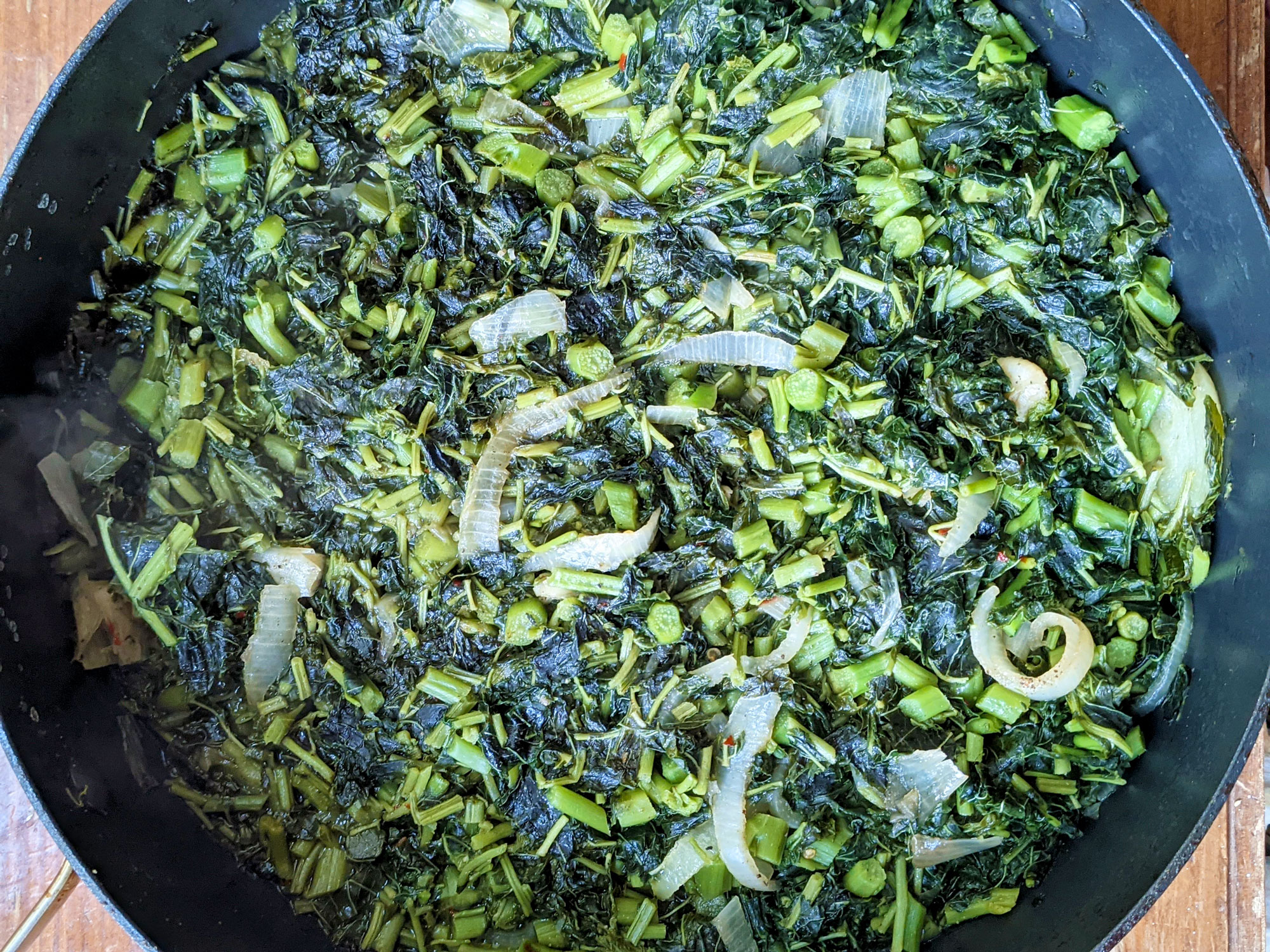
Cooked calalloo in pot
Jamaican Callaloo in a pot. (Photo provided by Antoinette Deitcher)

Recipe: Antoinette’s Mom’s Jamaican Callaloo

Prep time: 15 minutes
Cook time: 15 minutes
Serves: 5

Ingredients:

  • 1 lb. callaloo leaves and stems, washed in salt water
  • 1 tbsp. margarine (or your choice of fat)
  • 1 small onion, chopped
  • 2 garlic cloves, chopped
  • 2 tsp. seasoned salt
  • 1 tsp. black pepper
  • 1 deseeded scotch bonnet pepper (optional)

Directions:

1. Working from the bottom, peel callaloo stalks just up to where the leaves begin. Discard peelings. Roll callaloo into a bunch, and cut into small pieces.

2. Mix all ingredients together in a pot with 3 tbsp. water. Cover with lid on very low heat. Let steam for 10-15 mins, stirring occasionally.

***

Fried Dumplings in Pan
Jamaican Fried Dumplings in a pan. (Photo provided by Antoinette Deitcher)

Recipe: Jamaican Fried Dumplings

Prep time: 5 minutes
Cook time: 8 minutes
Yield: 10 fried dumplings

Ingredients:

  • 2 cups flour
  • 2 tsp. baking powder
  • 1 1/2 tsp. salt
  • 1/2 cup water
  • Oil for frying

Directions:

1. Combine dry ingredients in a medium-sized bowl.

2. Slowly add water, and knead until dough is firm. (You may need to add a bit more water.)

3. Heat enough oil to cover the bottom of a frying pan.

4. Break off 2-inch pieces, and form into the shape of biscuits.

5. Fry for 4 minutes on each side, until golden brown. Cover the pan with a lid while the second side is frying to ensure the inside cooks.

6. Remove from the pan, and place on a paper towel-lined plate to drain oil.

Read more: 

“Animal” author Lisa Taddeo: “‘Bad women’ are not allowed to tell their stories”

It’s the year of the female antihero. From “Promising Young Woman” to “Kevin Can F**k Himself” to “Physical,” the pissed off woman is everywhere, wreaking havoc, getting revenge and maybe blowing up her own life in the process. Now, Joan has entered the chat.

“Animal,” Lisa Taddeo’s follow-up to her sensational nonfiction bestseller “Three Women” is the tale of a self-described “depraved” New Yorker, forging a tragedy and violence-strewn path toward a younger woman whose life seems a GOOP fever dream of perfection. One recent review has described the novel as an “American Psycho” for the #metoo era — a comparison that’s simplistic but also should really make you want to read it.

Taddeo appeared on “Salon Talks” recently about what inspired her to write one of 2021’s most talked about books, about female anger and about what makes a “summer read.”

The following interview has been lightly edited for length and clarity.

This is a book that women are going to be quoting for years. One that really stands out is, “We are all monsters. We’re all capable of monstrosity.” That is also a foundational bedrock of this story. Tell me about Joan, the monster she is, the monster she has become.

Joan is a woman who we meet in a restaurant in New York City. She is having dinner with a man who is married, and another married man comes in and shoots himself in the face in front of her. What follows is basically why and how she got to that spot where a man would do that. What are the things that she did to, quote-unquote, “deserve” that, and moreso why do we think somebody “deserves” something? Why we do root for the people we root for, and don’t root for the ones that we don’t? I do believe as humans, and it’s something I wanted to look at in “Animal,” that we are all capable of doing terrible things. The reasons we do those things are most often not because we’re born with some bad seed, but because something has driven us to this sort of point of no return.

Things have been happening collectively to so many oppressed people. I focused on women, but for me it’s really the whole idea. “Animal” is for anyone who has been oppressed and knocked down, and then upon trying to rise back up, was looked upon as a monster for doing so. I’m really happy you brought up that quote in particular, because it really does mean so much for me. It is so much of why I wrote the book.

Joan is telling her story to a reader. She’s using direct address as she calls herself “depraved.” At first you’re wondering why she’s doing it, and then you can see how it’s defensive. She is very, very sophisticated in the way that she reveals herself.

That’s exactly it. It’s defensive. We see so often in society when certain people have been beleaguered for a long period of time, they get really good at calling out what their opponents are going to say to them or call them, thereby owning the insult themselves. This is something that Joan is very proficient in. After years of being called names by men and her fellow women, she has come to this point where she’s like, “I’m going to say it before you do.” When she calls herself depraved and mad and all of the things she calls herself, she’s saying, “Look, I fit this definition because of X, Y and Z.” But she’s also mocking the very nature of name-calling by saying, “This is what happened to me. Do you still want to call me those things? Or do you want to talk about where it actually began?”

We hear all of Joan’s story from when she was a child and from all the biggest experiences that render her the monster that she claims to be and become. What we’re really not getting is the full story of all the people who did that stuff to her, and where their history of trauma comes from and why they’re doing the things that they do. That’s really the point, that we’re just looking at Joan. That is so interesting to me. I did a lot of research for “Three Women” on pedophilia. Most of them have had things happen to them sexually when they were children themselves. I think it gets to this cyclical nature of just trying to deal with the symptoms and not the actual heart of the disease. Joan, in a sense, beyond being our sometimes unreliable narrator, is also someone who very much understands all of that, because of the way she’s been treated and the things that have happened to her.

Whether we’re looking at it from a macro level of post-pandemic, or one person’s grief, it’s there in that phrase “back to normal.” That you go “back to normal” as if you can return in time to that person you were before this incredibly traumatic, upsetting, devastating, life-changing thing happened to you.

It’s like, how is your life interrupting someone else’s? It’s always this idea, that everybody just wants to be part of the same mouse wheel, and if anyone gets kicked off, we’re just like, “Oh God.” We thrive on that routine, and that sense of order, because we’re all very afraid. I’m the most afraid person in the world, I feel sometimes. It’s that danger of looking at others and feeling like others’ paths are somehow dictating our own, to an extent that we feel like we need to dictate theirs. 

You wrote this book in that space between finishing “Three Women” and “Three Women” being published. I know there were stories in “Three Women” that you didn’t use or couldn’t use, and you also obviously draw on your own life. I’m wondering how that first book informs this one.

It informs it. A lot of the things that I was writing about in “Three Women” and talking to women about, I was like, “Oh, that’s going to be too dark for this,” and not because I was trying to have people read it and be happy. It wasn’t that. I just was under this correct notion that people wouldn’t listen to the stories at all if there was one thing that smacked of something that was not sympathetic enough. My biggest goal was to make all of the women feel, just to make everyone feel, not empathy for them, but see themselves in them. I knew that it could both be additive and reductive to the goal to tell the parts that I knew were a little bit too dark because on the one hand, there’d be people who would identify even more with the woman, and then there’d be another half of the people who would take whatever they had felt up until then and would be gone.

In “Animal,” I was like, “I’m not going to be worried about this,” because it’s a fiction. It’s a novel. There’s a lot of truth in here, but it’s also not like “Three Women.” I really made a conscious decision to say whatever all the truths were that I had heard, that I myself had experienced. I knew that there was going to be that “American Psycho” feeling about things. I knew it because I’d seen it with “Three Women,” so I was prepared and I’m not surprised. It was important to me nonetheless, to continue doing it.

I think that part of what we do to each other is we really do try to censor one another’s stories. We do it so much. It’s like we have all these trigger warnings. I have my own trigger warnings, things that will wreck my entire day if I see or read about. We have this way of making our own trigger warnings be someone else’s responsibility to the point of the person for whom talking about their trigger warning is a catharsis, becomes unable to do it because they might upset somebody else. There’s a lot of selfishness involved in telling stories, and in not telling stories, and deciding who can tell them and who can’t. Quote-unquote “bad women” are not allowed to tell their stories still. We — I’m saying “we” because I’ve been bad in the way that sometimes my mothering is bad. I’m often a bad wife. I’m saying it in that same way that Joan does, not really believing that bad is bad, but that it’s human, and that I’m being honest about it. I prefer to be super honest about emotions than talk about stuff that is not interesting to me.

Then there’s this one character who seems to have it all together. I read something you wrote about how people will always believe that a woman could be that perfect. People don’t question that she’s perfect and sexually available and she’s beautiful. And that is so much more credible in a fictional story than the woman who is just falling apart, and is the madwoman in the attic. 

We just don’t want that woman to exist because I think she’s in all of us. We’ve been told that if we show that, that we are going to be ejected from society. We have to be cool. There are things that it’s okay to talk about now. It’s okay now to talk about mental health. It’s getting okay to talk about miscarriages. I’m saying that very expansively. I don’t know exactly what is okay and what is not okay. What I do know though is because I’ve just published a book about a woman who is falling apart, I know that it’s not okay to do that because I’ve been told that it’s not okay. A woman has to be a victim in the right kind of way, and she has to fight back in the right kind of way, and the fact that we don’t see that, that we don’t allow for women to be more complex characters, is part of the sort of hysterical blindness that we have. 

It really pissed me off about “Three Women,” with Lina in specific — the woman in Indiana who has this affair with her high school lover because her husband didn’t want to kiss her on the mouth anymore — people were like, “Oh, she’s pathetic. Why are you talking about this pathetic woman? Why did you decide to tell her story?” I find that so mind-boggling. Who’s arbiting that? Who’s the judge of whose stories are good? You can say you don’t like a story. That’s fine. But, “Why are you telling that story?” is a really dangerous question to ask.

Someone asked me this morning, “Is this a summer read?” I said, “I mean, maybe. It depends on what kind of beach reader you are.” If I were to tell a friend, “This is your beach read. Take this one on vacation,” what would you say?

I would examine who the person is, which beach reader we’re looking at. For me, it is a beach read. It was a beach write. It’s a beach read. This is the level at which I operate. I don’t like reading books that I will forget about within a couple of weeks. I don’t like consuming any art that is forgettable. I don’t want to create any that is either. And that’s not to say that beach reads are forgettable at all. For me, I guess this is the closest I could come to writing a beach read. So hopefully it is, for some people, a beach read.

“Zero F**ks Given” embodies the willful tedium of a depressed flight attendant

The probing character study, “Zero F**ks Given” (the French title is “Rien à foutre”), premiered Sunday in the Critics’ Week Competition at this year’s Cannes Film Festival. The film, written and directed by Julie Lecoustre and Emmanuel Marre, follows Cassandra (Adèle Exarchopoulos from “Blue Is the Warmest Color“), an unambitious flight attendant for a low-rent airline based in Lanzarote. She works long hours, parties or lazes in her down time, and tries not to think about her mother’s recent death.

That’s pretty much it for 115 minutes. “Zero F**ks Given,” is about depression, and does not provide much in the way of drama, save a few encounters Cassandra has with managers at the airline who question her alcohol use or her breaking the company’s rules. 

The filmmakers immerse viewers in the world of flight attendants and overperform in showing the monotony of the profession. That is a compliment and a criticism. Cassandra has a few exchanges with needy passengers that show the thankless and taxing nature of her work. There are a few scenes that provide insight — such as a training session for cabin manager that requires folks to smile for 30 seconds (and most can’t). But so much of the film is tedious. 

“Zero F**ks Given” even raises a topical issue about unfair working conditions when Cassandra and her fellow flight attendants are approached by employees on strike. While Cassandra is sympathetic to their cause, she really just wants to get to work. This scene may indicate something about Cassandra’s personality — that she has more apathy than attitude — but the overarching point of her masking her depression through work (and alcohol) isn’t quite compelling enough. Even fans of the actress, who might be content just watching her for two hours, (and there are very few moments Exarchopoulos is not on screen) will get restless.

Cassandra s-l-o-w-l-y reveals herself over the course of this film. The actress, who is also featured in the police thriller, “Bac Norde,” playing at Cannes this year, is a magnet for the camera. She can be fascinating to watch her perform her duties with minimal interest. But the most interesting scene has her talking to a cell phone representative and fighting back tears as she considers upgrading her calling plan. Cassandra is obviously hurting inside (she easily fails the 30-second smile test) and when she is not working, she tries to soothe her pain with alcohol and/or hookups. In what may be her most emotional moment she begs a guy not to take a shower so they can cuddle for five more minutes. 

Lecoustre and Marre are savvy in wanting to profile an aimless character who is stuck in a rut. Significantly, Cassandra’s mental health is never discussed, but it hangs like a dark cloud in the background. Exarchopoulos’ committed performance conveys this silently, which is to the film’s credit, but it also feels like there is a missed opportunity for something deeper here. 

“Zero F**ks Given” downshifts after its mid-point when Cassandra returns home to her father Jean, (Alexandre Perrier) and sister, Michelle (Mara Taquin). Alas, the narrative does not become any more interesting. Considering that an earlier scene showed Cassandra telling her sister that she couldn’t take time off for the holidays — a lie; she volunteered for extra shifts — one might expect that there would be more tension at home. But the atmosphere is more one of melancholy. The sisters hang out and drink, and occasionally discuss their dead mother. Jean hopes to resolve a legal situation involving his wife. It is very quotidian.

The filmmakers’ approach is rooted in “fly on the wall” documentary, which is certainly appropriate for their closeup examination, which is, for better or worse, reminiscent of mumblecore. There are some nice, naturalistic images during a scene where only the lit ends of the cigarettes are seen as two characters talk one night, but extended shots of Cassandra’s environment on the ground feels like unnecessary padding. 

Near the end of the film, the narrative pulls at giving Cassandra a possible path forward. Tolerant viewers may feel invested in her character, and it is hard not to root for her. However, the biggest problem with “Zero F**ks Given” is that, truth in titling, it never quite engenders the emotions it should.

Mike Lindell pushes election fantasies at CPAC, accuses Salon reporter of “destroying the country”

DALLAS — MyPillow CEO turned 2020 election truther Mike Lindell, whom I have interviewed many times by phone, got his first chance to meet me in person on Sunday at the Conservative Political Action Conference (CPAC) gathering here. He did not waste the opportunity, accusing me of being “evil” and “destroying the country”

While taking in the carnivalesque sights and of CPAC early on Sunday afternoon, I noticed Lindell by his booth on the conference floor. I approached and introduced myself, beginning to ask some of the questions he has avoided answering during our multiple phone conversations.

Much of the following exchange was captured on video and later posted by Raw Story. “I’m going to tell you something, and I’m going to tell everybody,” Lindell began. “In our country’s history, every single election official, if there’s fraud involved, there’s not a statute of limitations. They take the guy that won, and they put him back in office, and it’s just never happened at the presidential level.” (In fact, cases of courts overturning certified elections at any level are vanishingly rare. At the federal level, it is likely a legal and constitutional impossibility.)

“The Supreme Court will vote 9-0 to pull this [the election] down,” Lindell continued. “And you can sit here and go, ‘Come on, Mike.’ You know what? I’m just telling you what’s going to happen, and if it doesn’t happen — if they don’t watch it, that’s when the whole public is going to go, ‘You have to protect our country.'” 

Lindell continued explaining his proposed path to reinstate former President Donald Trump, which he has been discussing for months. His original deadline of an Aug. 13 deadline for Trump to return to power is now barely a month away.

Nearing the end of the interview, I asked Lindell about the raw data he claims to possess relating to the 2020 election, specifically the “packet-captures” (PCAPS) he has mentioned on several occasions. If the information is so explosive, I wondered, why doesn’t he share it with the media?

“Sorry, Zachary. Sorry, Zachary,” he responded, dodging the question by repeatedly asking whether I enjoy “destroying this country.”

Later on Sunday afternoon, Salon learned from sources close to Lindell that he participated in a behind-the-scenes roundtable event with Trump ahead of the former president’s keynote address. 

You can watch portions of my exchange with Lindell above, via YouTube

How the Christian right took advantage of COVID to win rampant religious exemptions

On a Friday evening in April, the Supreme Court quietly issued a short decision that opened the floodgates for religious entities to claim an exemption from just about any law. Tandon v. Newsom didn’t center on a traditionally hot-button issue like abortion or LGBTQ rights; it focused on COVID-19. While the case received little attention outside of the legal world, it marked the culmination of more than 30 years of legal strategy by Christian conservatives who have sought ever-broader leeway to flout the law. The decision could affect everything from traffic laws to racial discrimination.

During the pandemic, religious entities, often supported by influential right-wing firms like the Alliance Defending Freedom, Thomas More Society and Liberty Counsel, filed a barrage of religious objections to rules aimed at protecting people from COVID, culminating in more than 100 decisions, according to a preliminary tally by the Law, Rights, and Religion Project at Columbia Law School. In Tandon, a Bible study group in California said it should be exempt from a rule barring in-home gatherings of more than three households.

The case made its way to the Supreme Court, where the justices sided with the Bible study group 5 to 4, writing that “government regulations are not neutral and generally applicable, and therefore trigger strict scrutiny under the Free Exercise Clause, whenever they treat anycomparable secular activity more favorably than religious exercise.”

Lost in the weeds was a legal bomb. The Court had, in effect, ruled that if a government made any exception to a rule — like allowing people to grocery shop in a pandemic — it had to make an exception for religious activities. In other words, the justices had elevated religion above just about every other right, including free speech and racial equality, according to a report out today by Columbia Law School’s Law, Rights and Religion Project.

“The failure of the government to grant religious objectors an exemption from nearly any law or policy now amounts to religion-based discrimination, no matter the importance of the public interest being protected by the law — even the public’s interest in staying healthy during a global pandemic,” concludes the report, titled, “We The People (of Faith): The Supremacy of Religious Rights in the Shadow of a Pandemic.” “Under this broad conception of religious liberty, policymakers could be constitutionally required to exempt religious adherents from regulations enacted to protect labor and workers’ rights, public health, civil rights, and other critical policy goals.”

The report outlines chilling examples that could result from this broad new religious power. A religious nonprofit could claim it doesn’t have to pay its workers a minimum wage, because the state’s minimum-wage law has an exemption for contract work. A religious owner of a massive corporation could refuse to hire women to positions of authority over men because a workplace anti-discrimination law has an exemption for small businesses. Religious entities have, the report concludes, won the right to exercise “discrimination on steroids.”

“Freed from the baggage of the ‘culture war,’ conservative Christian groups managed to achieve unprecedented legal wins in the COVID cases without triggering a dramatic backlash,” the authors of the report write. “One could therefore see this litigation campaign as a form of ‘COVID opportunism,’ using the pandemic as an opening to secure long-sought changes to religious liberty doctrine that will remain in effect even after the virus has subsided.”

This shift toward religious exceptionalism is, in significant ways, a departure from precedent. In 1990, the Supreme Court issued a decision called Employment Division v. Smith that essentially concluded that religious entities have to follow laws that apply generally to the rest of the population, even if those laws happen to burden their religious beliefs. (That the Court sided against religious objectors in this case may have to do with the fact that it concerned members of the Native American Church who had been denied unemployment benefits after they were fired for consuming peyote in a religious ritual.) Since then, the Christian right has been trying to do away with Smith in order to win ever-broader exemptions from laws that apply to everyone else.

The Supreme Court’s ruling in the Tandon case could, at least in theory, open the door to religious exemptions from a whole host of regulations — from gun laws, which make exemptions for security guards, to traffic laws, which make exemptions for emergency vehicles, the report notes. If it seems far-fetched to think a religious entity would claim an exemption from a law that has nothing to do with religious beliefs, remember that religious corporations and institutions have, in recent years, won broad new powers to do everything from underfund their employee pension plans, to refuse to recognize adjunct faculty unions.

“I think it’s really important to remember that the Christian right is part of a larger conservative movement,” Elizabeth Reiner Platt, one of the report’s authors, told Truthout. “So we all know that the focus among Christian right law firms has been on ‘culture war’ issues — making sure that marriage equality, LGBTQ anti-discrimination laws, reproductive health laws, don’t apply to conservative Christians. But we’ve also seen Christian right firms advocating for a broader range of conservative policies.”

Platt said that the report, co-authored with Katherine Franke and Lilia Hadjiivanova, is intended to help activists, policymakers and the public prepare for the implications of the new legal regime ushered in by the Tandon case. Perhaps most chillingly, at a time when Roe v. Wade and a host of other important rights are on the chopping block, the case shows how the Supreme Court can upend decades of precedent with relatively little outcry.

Copyright © Truthout. Reprinted with permission.

Want to bring bipartisanship back? End the filibuster now

Monday night, Democrats in the Texas state legislature were forced to flee. Again. Republicans who control the state legislature and the governor’s mansion have called a special session for the purpose of passing laws meant to make it difficult for residents in racially diverse cities to vote. The only way to slow them down is for Democrats to leave the state and deny Republicans the quorum necessary to have a vote. As they did over Memorial Day weekend, when they fled the first attempt by Republicans to crack down on voting, Texas Democrats held a press conference to shame Sen. Joe Manchin of West Virginia and Sen. Kyrsten Sinema of Arizona, the two Democratic holdouts who refuse to let a democracy reform bill be put up for a vote in the Senate, into changing their minds. 

“We need Congress to act now to pass the For the People Act and the John Lewis Voting Rights Act to protect Texans — and all Americans — from the Trump Republicans’ nationwide war on democracy,” the Texas Democrats said in a statement. 

Both Manchin and Sinema claim to support voting rights, but so far, they refuse to take the votes necessary to end the Senate filibuster, an arcane Senate procedure that is more the result of an accident than a legitimate tool, that Republicans are using to block democracy reform bills. Both Senate Democrats claim the filibuster is important for the vague purposes of “bipartisanship,” even though its main use is for Republicans to unilaterally shut down all debate and refuse to come to the bargaining table with the slim Democratic majority in the Senate. 

The situation in Texas, however, underscores how backward the Sinema/Manchin theory of bipartisanship is. 


Want more Amanda Marcotte on politics? Subscribe to her newsletter Standing Room Only.


Giving Republicans more power does not, in fact, cause Republicans to be more open to compromise. On the contrary, the only thing that can cause Republicans to moderate and make deals is for Democrats to play hardball, and force Republicans to come to the negotiation table. 

Right now, Republicans on Capitol Hill have absolutely no reason whatsoever to haggle in good faith with Democrats on anything. That’s because a combination of gerrymandering, voter suppression and pre-existing anti-majoritarian provisions in the constitution have made it so that the votes of white conservatives, who are a minority of Americans, count for more than the votes of the more racially diverse and cosmopolitan majority. Indeed, the growing disproportionality is eye-popping. The Senate is split 50-50 between Democrats and Republicans, but those Democrats represent 41 million more Americans than the Republicans do. Republicans have controlled the Senate for most of the past two decades, even though Democrats have represented more people since 1996. Republicans lost the popular vote in all but one of the presidential elections since 2000 but managed to win half the time anyway. Even though Democrats likely get more votes, the math suggests that Republicans can gerrymander their way to controlling the House in 2022

Because the vote of a white conservative counts more, on average, than the vote of any other American, Republicans believe they have no real need to appeal to or work with anyone else. That means they have no incentive to moderate, cooperate, compromise, or do anything but obstruct Democrats in power and work, as they’re doing in Texas, to make sure that Democratic majorities are permanently blocked from choosing their own leaders. The filibuster, therefore, doesn’t work to smooth the way towards bipartisan compromise — it prevents it. Republicans, with the filibuster, have unilateral power to stop all real negotiation and debate as they amass so much illegitimate power that they never have to answer a Democrat’s phone call again. 

Republicans don’t even bother to hide that their strategies are all geared towards obstruction and refusal to compromise on anything.

Senate Minority Leader Mitch McConnell calmly declared in May that “100% of my focus” is on obstruction and that he has “total unity” from the GOP caucus on that goal. Texas Republican Rep. Chip Roy was recently caught on tape explaining to donors that “for the next 18 months, our job is to do everything we can to slow all of that down to get to December of 2022,” and that all Republicans offer to Democrats is “chaos and the inability to get stuff done.” In another recently leaked video, House Republicans can be seen laughing at what fools Manchin and Sinema are to think the filibuster serves any purpose but giving Republicans the ability to turn their noses up to the negotiating table. 

If Manchin and Sinema want to return to the supposed glory days of bipartisanship and cross-party negotiation, they have the power to make that happen. They must vote to nuke the filibuster. Then they must start passing bills like the For the People Act and the John Lewis Voting Rights Act, legislation meant to protect the right to vote and stabilize election systems so that Republicans cannot cheat their way towards more illegitimate power, with a simple majority vote. 

This will work for two reasons. First, if Republicans are forced to compete in fair elections, instead of coasting to victory on the backs of an authoritarian minority, it will have a moderating influence on the party. They’ll have to appeal to voters who want more moderate candidates, instead of merely blocking such people from voting at all. If they can’t gerrymander districts to render the Democratic majority permanently disempowered, they will have to do more to work with Democrats to get things done. 

Second, and just as importantly, ending the filibuster forces Republicans who are currently in Congress back to the negotiating table. 


Want more Amanda Marcotte on politics? Subscribe to her newsletter Standing Room Only.


Right now, Republicans have near-absolute power to block not just bills but even debate on bills. So it’s not just that almost no bills pass, but that bills have no chance of even being debated. There’s no opportunity for bipartisan compromise and discussion because bills die long before that’s even an option. But if bills were moving to floor debate and a vote, Republicans could actually weigh in and negotiate with Democrats, through the processes that they are currently halting with the absolutist use of the filibuster. 

Texas Democrats have shown how to get Republicans to negotiate: You have to do more than ask nicely.

When Texas Democrats fled to deny Republicans quorum in May, that not only slowed down the assault on voting rights, but it forced Republicans, reluctantly, to strip out two unpopular provisions from the original bill: One to block “get out the vote” events at churches and one to give right-wing judges the ability to overturn election results they don’t like. 

But ultimately, the plight of the Texas Democrats are what national Democrats will be facing, if they don’t take measures now to protect voting rights and fair elections. Democrats in that state represent nearly half the voting population — Donald Trump only got 52% of the vote in 2020 — and there’s long been hope that Texas could be turned blue. But Republicans have an iron grip on power, not because they have strong majorities, but because they shamelessly gerrymander and vote suppress their way to dominance. And the legislature answers not to moderates, but only to far-right radicals, because Republicans who control the state have no incentive to compromise or negotiate. The only time they pay attention to what anyone else wants is when they are forced, such as by Democrats fleeing the state. 

Manchin and Sinema have, so far, been unmoved to end the filibuster by appeals to decency or common sense. But they do love bipartisanship, far more than they care about voting rights or democracy. Unfortunately, the same thing standing in the way of democratic reform, or even a sensible infrastructure bill, is the same thing standing in the way of true bipartisanship: The filibuster. If they want to return to the world of drinks and deal-making with Republicans, Sinema and Manchin have to make it worthwhile for Republicans. And that requires ending the filibuster and making democracy competitive again. 

How the Trump Organization’s alleged scheme may have also helped Ivanka dodge taxes

The same tax evasion scheme allegedly used by the Trump Organization to secretly funnel money to CFO Allen Weisselberg may have also been used to enrich Donald Trump’s children, Rachel Maddow recently suggested.

During a segment of MSNBC’s “The Rachel Maddow Show,” the host found similarities between the illegal compensation described in the Manhattan District Attorney’s indictment of Weisselberg and evidence uncovered by the New York Times’ Pulitizer Prize winning investigation into Donald Trump’s tax records that shows his daughter Ivanka Trump was paid as both an officer of and as a consultant to the Trump Organization.

“The Times described in detail financial records they discovered that showed Ivanka Trump being paid both as an employee of the Trump Organization and as a consultant to the Trump Organization in a way that seemed custom designed to try and evade taxes, both for the company and for her,” Maddow said. “That is the executive scheme described at the end of the indictment. Prosecutors say that Weisselberg benefited from such a scheme and that other executives did too. They are not named in this indictment. But that is the Ivanka scheme described last fall in the New York Times.”

New York Times reporter Susanne Craig echoed Maddow’s observations, saying that the schemes described in the indictment felt “of a piece” with evidence she, Russ Buettner, and Mike McIntire uncovered while investigating Trump’s tax records last fall. She said that the New York Times tracked a consulting fee that was paid out to a company called TTT (short for Trump, Trump, Trump) and then transferred to Ivanka Trump, who is listed as an officer of both the Trump Organization and TTT.

“What we in our reporting suspected is that this was an attempt by Donald Trump to reduce his taxable income and to transfer money to his kids,” Craig said. “We didn’t have access to other people’s tax information to see if potentially Eric Trump was getting some of these payments, if Donald Trump Jr. was getting some of these payments, but they are also part of that company that was getting the money that went to Ivanka.”

Craig went on to say that the New York Attorney General has previously investigated TTT, and that prosecutors are likely “looking at” the connection between the shell company and the Trump Organization’s tax evasion efforts.

Mary Trump, the former president’s niece and author of Trump family expose “Too Much and Never Enough,” said that the Trump children should be “anxious” at the prospect of being charged by the Manhattan DA, and that such charges could sow division within the family.

“As far as Donald’s concerned, they have what they have because of him, and they should be willing to take whatever hit they’re going to take,” Trump said. “I think he would be surprised to learn that I don’t believe that my cousins would exercise that kind of loyalty towards him because his relationship with them and their relationship with him is entirely transactional and conditional. So they’re not going to risk anything for him, just as he won’t risk anything for them.”

You can watch the segment below via Youtube:


GOP Rep. Madison Cawthorn tweets swastika to attack Black Lives Matter, deletes after criticism

Freshman Rep. Madison Cawthorn, R-N.C., tweeted a picture of neo-Nazis last week, only to delete it days later following criticism on Twitter. 

The controversy, first reported by The Asheville Citizen-Times, centers on a tweet Cawthorn posted on July 9 in an attack on Black Lives Matter members who claimed that flying the American flag is an expression of racism. 

“The American flag symbolizes unity, patriotism, independence, pride, and love for our country. BLM continues to expose their radical hatred of this country,” Cawthorn wrote in response. Contained within his tweet, however, was a link to a New York Post article whose thumbnail featured neo-Nazis from the National Socialist Movement – a far-right white supremacist organization – marching on the ground of the Capitol building in 2008. 

According to the Citizen-Times, one of the pictured men donned a shirt emblazoned with the word “skinhead.” The man was shown holding the hand of a boy wearing a shirt with a swastika, an ancient Indian rune appropriated by the Nazi Party during the Third Reich. 

Following a firestorm of criticism on Twitter, Cawthorn spokesman Micah Bock told the Citizen-Times that the tweet had been removed, though Bock did not address why the picture had been included in the first place. 

“Rep. Cawthorn has denounced fascism in all its forms,” Bock said in a statement. “The American flag has stood for freedom since the founding of our nation, and the BLM movement would do well to remember that during World War II, the flag waved proudly as American soldiers destroyed Nazism in Europe.”

“To equate the American flag to a symbol for fascism is historically suspect, and factually inaccurate,” Bock continued.

Cawthorn, 25, was elected as the youngest member of Congress last year. Despite his political nascence, the right-wing freshman has already distinguished himself as a rising star in the Republican Party, particularly for his ability to make headlines.

Back in August of last year, Cawthorn sparked outrage when old Instagram posts from 2017 surfaced of the congressman posing for a photo in the Eagle’s Nest, Adolf Hitler’s vacation residence in Germany. At the time, Cawthorn said the site was on “bucket list for awhile” and “did not disappoint.” Cawthorn later denied ever visiting despite evidence pointing otherwise. In the past, Cawthorn has also posed with a Betsy Ross flag (a banner associated with white nationalism) and a Spartan-style helmet (a symbol used by members of the far-right Oath Keepers), as the Observer noted.

The Charlotte Observer noted that the name Cawthorn’s real estate business, SPQR Holdings, harkens back to “an abbreviation of a Latin phrase meaning the Senate and the Roman People, a phrase from the Roman Republic, is often used by white nationalists.”

Cawthorn has also been accused of sexual misconduct dating back to his college years, in addition to lying about how he became paralyzed.

The most popular ice cream flavor in every state

National Ice Cream Day is just around the corner (June 18th to be exact), and just in time for a celebratory scoop, grocery delivery service Instacart has revealed the most popular ice cream flavors in every state across the country. The results are based on Instacart’s own data, accounting for thousands of different ice cream products from all across the country and uncovering which ice cream flavor each state buys the most, compared to national averages. So which flavor came out on top as the most-loved scoop? Moose tracks. Twelve states — Alabama, Illinois, Indiana, Iowa, Michigan, Minnesota, Nebraska, North Dakota, South Carolina, Tennessee, West Virginia, and Wisconsin — consistently ask for a double or triple scoop of moose tracks, which is a rich and fudgy ice cream that has a vanilla ice cream basechocolate fudge swirls, and peanut butter cups (plus toppings, of course).

There was a tie for the second-most-popular ice cream flavors: rocky road, which was most popular in Arizona, California, Nevada, Utah, and Wyoming; coffee, which was popular among the caffeinated residents of New England, including Maine, Massachusetts, New Hampshire, Rhode Island, and Vermont; birthday cake, a favorite among party-goers in Louisiana, Mississippi, North Carolina, South Dakota, and Virginia; and green tea, which was the favorite in Alaska, Colorado, Oregon, and Washington.

The tri-state area including Connecticut, New Jersey, and New York went nutty for pistachio ice cream. And there were some one-state wonders, too. Delaware was the only state to choose cherry-flavored ice cream, Pennsylvanians love mint chocolate chip, and New Mexico is filled with chocolate lovers, who especially love a pint of chocolate chocolate chip. Kentucky, Louisiana, and Ohio keep things simple; their shoppers tend to stock up on regular vanilla chocolate chip ice cream more so than any other flavor. Surprisingly, only three states chose cookie dough as their favorite flavor of ice cream: Maryland, Missouri, and Oklahoma.

Rum raisin, the beloved boozy ice cream flavor, is the most popular flavor in sunny Florida and Georgia. For something even cooler and creamier, rainbow sherbet reigns supreme in Arkansas, Kansas, Montana, and Texas. Similarly, fruity mango ice cream is the most consumed ice cream flavor in both Hawaii and Washington, D.C.

We’d be hard-pressed to choose just one flavor that’s our favorite, so on National Ice Cream Day, we think we’ll have one of each — with a cherry on top!

Tourists are desperate to return to national forests . . . just in time for wildfire season

Back in 2016, Michael Dahling did something crazy: He left a steady job and maxed out his credit cards to open Old County Inn, a restaurant in the tiny town of Pine, Arizona. Restaurants are always risky no matter where they’re located, but Pine is surrounded by the Tonto National Forest. In a good year, that means a steady stream of mountain hikers stopping in for a pizza, and cyclists telling jokes over rounds of beers. But last month, officials temporarily closed the national forest entirely due to drought and the threat of fire.

“Obviously Arizona gets dry, and you can definitely tell it’s getting drier. It seems like now every year they shut down the forest around Memorial Day,” Dahling said.

As the Southwestern corner of the country baked to a crisp and fires began to flare in late June, officials also closed the Prescott, Kaibab, Apache-Sitgreaves, and Coconino national forests — all in Arizona. It is likely the largest number of simultaneous closures in Forest Service history. Forests have shut down in response to fire risk before, of course, but not all at once like this, Punky Moore, a fire communications specialist for the Forest Service’s southwestern region, told Grist. 

These closures come just as businesses are trying to recover from COVID-19 losses, and when many people are desperate to get out to public lands for pandemic-safe activities and Instagrammable travel. 

“The pent up demand is huge. I’ve never seen it like this before,” said Kevin Nissen, co-director of Friendly Pines Camp, which sits on private land in the middle of the Prescott National Forest “What you’ve got is parents who are really ready to get their kids outside and out from behind their screens, and campers who really want to get out of the house.”

The more people pour out of quarantine and into public lands, the more likely one of them is to accidentally spark a fire. And this year, the risk is perhaps higher than ever before.

All across the West, national forests and other public lands are dangerously dry. At the Forest Service’s Rocky Mountain Research Station, ecologist Matt Reeves runs the FuelCast model, which predicts the amounts of dry grass and brush on the non-wooded parts of the national forests. A few months ago, that model started spitting out numbers that made Reeves ask a programmer to check the model’s computer code for errors. “I called him up and said, ‘We’ve got a problem here,'” Reeves said. “‘Either there’s a hiccup in the data, or the algorithm blew up, or we are headed for uncharted territory.'”

There was nothing wrong with the model. The predictions were right. It is the extent of this dryness that makes it so unusual. Just about every prairie, desert, and shrubland in the western half of the United States is parched. There have been more intense droughts in the recent past, but they’ve been smaller, Reeves said. The fact that a model based on machine learning confidently predicted something that to human eyes looked like a mistake is evidence that the predictable order of things no longer applies. “The baselines are changing,” Reeves said. “That makes the systems too complicated for human beings, so we need to allow the computer to read the patterns.”

This year, heat waves have hit the Southwest particularly hard — 2021 had the hottest June on record in Arizona and seven other states. The heat turned vegetation to tinder leading to more extensive fires than the same time last year — which was one of the most severe in Arizona’s recent history

It was this intense dryness and fire risk that led Forest Service officials to make the difficult decision to close most of Arizona’s national forests completely — leaving many tourism and outdoors-based businesses wondering how they would cope. But in the end, the closures didn’t stop many tourists from rushing to these businesses. Soul Ride, a mountain bike shop and outfitting company in Prescott, lost business it would have done providing tours and shuttles on the area’s well-known trails. But money from sales, repairs, and beer — the business has craft brews on tap — made up for that lost revenue, said Cina Mcconaughy, co-owner of Soul Ride. “In the end, it didn’t really affect our business. People were so eager to get out and ride that they found a way,” she said.

Friendly Pines Camp had to shift the routes of their hiking and horseback riding excursions, but said the closures didn’t hit their bottom line, thankfully.

As for Dahling, he said that even without the hikers and bikers, there are enough people willing to make the two-hour drive from Phoenix to the Old County Inn for the views and the wood-fired pizza. The stream of day-trippers was strong enough that he even did brisk business through the pandemic. But while the restaurant can survive the forest closures, fires are a different story. 

On June 18th, Dahlin was on the restaurant’s deck going over the menu with an employee when he saw a pillar of smoke looming over the town. “I don’t know about you,” he remembers saying, “but I’m going to get out of here.” A few hours later the sheriff came in to confirm that evacuation was mandatory. It was a disaster: A wedding party had just arrived for their rehearsal dinner. “You can imagine — Friday night, there were 30 to 40 people here already, the bride and groom were crying,” Dahling said. They dropped everything and left. The fire spared Pine, but it was eight days before officials gave the all-clear for the evacuees to return.

The first rains of the summer monsoon season finally came to Arizona over the July 4th weekend, allowing the Tonto, Prescott, Kaibab, Apache-Sitgreaves, and Coconino national forests to partially reopen. But that doesn’t mean the threat has gone away. Many areas remain closed or restricted, and fires are still burning. More than 90 percent of the West is in a state of drought.

This may be a high-water mark for the appreciation of public lands. It also could be the summer that the public loves those lands to death.

Engine No. 1’s big win over Exxon shows activist hedge funds joining fight against climate change

One of the most expensive Wall Street shareholder battles on record could signal a big shift in how hedge funds and other investors view sustainability.

Exxon Mobil Corp. has been fending off a so-called proxy fight from a hedge fund known as Engine No. 1, which blames the energy giant’s poor performance in recent years on its failure to transition to a “decarbonizing world.” In a May 26, 2021 vote, Exxon shareholders approved at least two of the four board members Engine No. 1 nominated, dealing a major blow to the oil company. The vote is ongoing, and more of the hedge fund’s nominees may also soon be appointed.

While its focus has been on shareholder value, Engine No. 1 says it was also doing this to save the planet from the ravages of climate change. It has been pushing for a commitment from Exxon to carbon neutrality by 2050.

As business sustainability scholars, we can’t recall another time that an energy company’s shareholder – particularly a hedge fund – has been so effective and forceful in showing how a company’s failure to take on climate change has eroded shareholder value. That’s why we believe this vote marks a turning point for investors, who are well placed to nudge companies toward more sustainable business practices.

Hedge funds to the rescue?

Climate strategies aimed at saving the planet are an odd play for a hedge fund. Such investment firms are better known for getting companies to stop investing in this type of thing so they can collect quick profits.

Recent research undertaken by one of us found that activist hedge funds tend to target companies that spend more of their resources on these types of sustainability initiatives. That is, they buy shares of a company to gain influence and then convince other investors to join them in demanding efficiency enhancements and cost-cutting protocols to return more cash to shareholders. A follow-up study found that companies cut spending on sustainability initiatives within five years of a hedge fund getting involved.

In other words, hedge funds focus on short-term returns – not long-term concerns such as climate change or even a company’s own future profitability. And this is because of how hedge funds fundamentally operate.

Hedge funds usually charge their investors – often wealthy individuals and institutional investors – a 1% to 2% management fee in addition to a 20% cut of any gain in their investments. In return, these clients expect quick and substantial returns that substantially outperform the market.

Engine No. 1, a new type of hedge fund?

This is what makes Engine No. 1’s fight so interesting.

It began in early December 2020, shortly after tech investor Chris James launched Engine No. 1 with two other hedge fund industry veterans. The firm said it was “purpose-built to create long-term value by harnessing the power of capitalism.”

Engine No. 1’s first order of business was to pick a fight with one of the world’s largest energy companies, Exxon Mobil. It sent a letter to the company’s board on Dec. 7, 2020, urging it to focus on clean energy and shake up its board of directors – a bold move for an upstart investment firm with just a 0.02% stake in the nearly US$250 billion company.

But Exxon was an obvious target for this strategy. It has been a laggard on developing low-carbon fuels for years and has promoted misinformation about the human impact on climate change for decades.

After Exxon refused to commit to a transition to carbon neutrality, Engine No. 1 formally launched its proxy battle in March to force a change of strategy at the company, which traces its history back to 1870, when John D. Rockefeller founded the Standard Oil Company.

A proxy battle is when a group of shareholders tries to garner enough support from other investors – in the form of votes – to force a company to do what it wants, whether it’s to cut costs or change strategy.

Exxon said it expected to spend $35 million more than its usual costs to deal with the proxy battle; unfortunately, by increasing Exxon’s expenses, these are costs that are actually footed by investors. Engine No. 1 put its expenses at $30 million. The total cost, by some estimates, has exceeded $100 million.

Engine No. 1 was hoping to replace a third of the oil giant’s board of directors with four individuals who have more clean energy experience. The hedge fund was also seeking corporate governance reforms, a review of Exxon’s climate action plan – and its impact on the company’s finances – and greater public disclosure of its environmental and lobbying activities.

Even before the vote, the campaign was already changing the way Exxon does business. In the past few months, Exxon has proposed a $100 billion carbon capture project in Houston and committed $3 billion to low-emission technologies through a new venture.

Though Exxon denies any of these investments were due to pressure from Engine No. 1, it’s hard to believe the hedge fund wasn’t a catalyst. These are some of the biggest investments Exxon has proposed in sustainability in recent years, and they came right after pressure from the hedge fund – as well as the election of a new U.S. president who has made fighting climate change a priority.

Another likely reason for the new initiatives is that Engine No. 1’s campaign was enlisting significant support from other major Exxon investors, such as the California Public Employees’ Retirement System and the New York State Common Retirement Fund, which laid additional pressure on Exxon to do something about its lagging sustainability strategy.

So despite its pushback against Engine No. 1 and its proposed climate plan, clearly Exxon Mobil’s attention to its sustainability plans has been piqued.

What it all means

So why is Engine No. 1 really doing this – and do its motives matter?

While the firm is pushing hard for more investment in sustainability and clean energy, the focus in its statements on what’s driving this fight is mostly about shareholder value. And many of its demands, such as better long-term capital allocation strategy, a plan to enhance shareholder value and a “misaligned” management compensation, are straight out of a typical hedge fund’s playbook.

What we see as fundamentally different here is the emphasis the hedge fund is putting on the connection between sustainability and long-term profits. It makes a strong case that the reason Exxon’s financial position has been deteriorating is because of its failure to invest in low-carbon technologies.

Or, like a hedge fund, Exxon has been focusing on the short-term gains from fossil fuels at the expense of its long-term future in a global economy that puts a premium on sustainability and a penalty on carbon-intensive activities.

Moreover, the readiness of so many major investors – including the three largest U.S. pension funds and BlackRock, the world’s biggest investment manager with $7.4 trillion in assets under management – in joining Engine No. 1 shows which way the winds are blowing, which Exxon seems to now also realize.

So the vote itself isn’t the story here. It’s that the weight of activist hedge funds – the most potent form of shareholder activism – seems to be shifting in favor of sustainability. As we see it, this means companies and executives that don’t invest in the transition low-carbon energy will increasingly risk incurring their wrath.

Mark DesJardine, Assistant Professor of Strategy and Sustainability, Penn State and Tima Bansal, Canada Research Chair in Business Sustainability, Western University

This article is republished from The Conversation under a Creative Commons license.

The vital gardening practice you might be forgetting

A manicured yard with a picture-perfect lawn, mulched flower beds, and precision-trimmed shrubs and trees is a question of taste. For wildlife and native insects in search of food and shelter, however, it is anything but beneficial. Not removing fallen leaves below trees, especially oaks, supports numerous beneficial arthropods, fungi, and bacteria that are essential for decomposition. Dried dead flower stalks provide nesting space for insects, and not removing the seed heads of flowers, such as the coneflower Echinacea, provides birds with food.

When it comes to edibles, on the other hand — your vegetable garden, berries, melons, and other small fruit, as well as fruit trees — keeping everything neat and tidy is not merely just for looks, it’s outright essential.

The most frequent gardening practice you read about is a thorough cleanup in the fall, but there are several other housekeeping tasks you can do all throughout the summer to increase your chances of a successful harvest.

* * *

Pruning — not just for ornamentals

If you’ve ever grown tomatoes, they were most likely indeterminate, which means they keep growing and growing. By mid-summer, even if you’ve staked, trellised, or used a tomato cage, they can get out of control. The denser the foliage, the less air circulation, which can precipitate the spread of disease when the plant gets wet, or in humid weather.

Pruning your tomatoes by snipping off the suckers (the side shoots between the main stem and a branch) helps you get a handle on the abundant growth, at least in the early summer. If you cannot keep up, which happens easily, and the tomato plant turns into an unruly mess, cut out entire vines to let more air in. You might sacrifice a few tomatoes but it’s worth it because when a deadly disease like late blight makes the rounds in your area, good air movement can help prevent its spread.

Tomatoes are not the only vegetables that you should prune to prevent your garden from turning into a jungle. The vines of cucumbers, summer and especially winter squash can be kept under control by pruning, with the added benefit that the plant will put all its energy into growing a few healthy fruits instead of more vines. Wait until the plant has developed three to five tiny squashes. No worries if the first flush of flowers on the plant drops off, those are male flowers; only the female flowers produce fruit. If the vine has not fruited, snip off the fuzzy end. If the vine has fruit, snip it off about a foot or two past the fruit. Winter squash vines will continue to grow until the first frost, so you need prune regularly, about once a week.

* * *

Lift things up

Beans are not the only vegetables that you can grow vertically. Let your cucumber plants trail on a netted trellis or a fence instead of having the cucumbers sit directly on the wet soil, which can precipitate rotting, especially during a wet rainy summer. Protect heavy fruit such as melons or winter squash from soil moisture by placing them on a flat rock, brick, or an old, chipped dinner plate or bowl turned upside down.

Small melons such as French breakfast melons can be grown on a trellis. To prevent the weight from tearing on the vine, place each melon in a piece of pantyhose when it is about the size of a tennis ball size. Tie the pantyhose at the bottom to create a bag and attach the pantyhose to the trellis.

* * *

Get rid of the bad stuff

Approach garden waste the same way as household trash: to be disposed of promptly and regularly. Remove any pruned plant parts as well as inedible, rotten fruits and vegetables from your garden right away and compost them, as they attract noxious insects and rodents. Also pick up any fallen fruit around fruit trees.

One exception, though: If the plant or fruit is diseased, and after researching it you cannot figure out what it is, it is safer not to compost it and dispose of it in the trash. Many plant diseases such as the cucumber mosaic virus survive composting.

Don’t skip any rotten or molded fruits or vegetable but pick every single one to prevent it from infecting intact ones. If you are squeamish about touching those, wear gloves.

* * *

Keep your tools clean and sharp

Just like in the kitchen, always keep your tools and pots clean to remove bacteria, fungi, and plant viruses. Disinfect pruners and planting pots and containers with a solution of one-part household bleach and ten-parts water. Also sharpen your pruners and keep them rust-free with a regular squirt of oil.

The recommendation to wipe your blades after each pruning cut may seem cumbersome but there’s a compelling reason for it: when you prune out diseased plant parts, you can easily spread a disease to the next healthy plant.

* * *

Labeling is key

Plant labels are indispensable, especially when starting plants from seed because unless you are a highly experienced gardener or a botanist, it is quite difficult to identify young plants. I have learned this the hard way when I did not properly label seed pots and wasted precious space on the melon trellis when a cucumber was growing in the center.

Neatness is like record-keeping in gardening — it makes your life as a gardener much easier. Come harvest time, you’ll see the results.

Melania Trump once said if Kristi Noem “wants to get COVID that bad, that’s up to her”: new book

Former first lady Melania Trump really didn’t want any kind of Election Night party, fearing that it would turn into another super-spreader event like the Rose Garden ceremony nominating Supreme Court Justice Amy Coney Barrett.

Wall Street Journal reporter Michael Bender, whose new book “Frankly, We Did Win This Election: The Inside Story of How Trump Lost,” comes out Tuesday, told the story about Melania’s resistance to the party in an exclusive excerpt given to The Daily Mail.

Melania felt that it was dangerous to have an election extravaganza with packed parties where COVID-19 could continue to spread. She and her husband both overcame the disease after suffering from it less than a month before the 2020 election.

As the first lady, Mrs. Trump ruled over social events in the White House, saying, “if it was up to her, there would be no White House parties during the pandemic,” the book recalled. Mrs. Trump also didn’t like being so overtly political in the White House, a government building known as “The People’s House.”

“The constant use of the White House for blatantly political purposes also made her uncomfortable,” Bender wrote. She reportedly told the chief of staff Mark Meadows “no” to the event three times. They decided to use the Trump Hotel five blocks from the White House, but the Washington, D.C. COVID restrictions prevented it.

“We’ll be talking to our licensee, which is the hotel,” Mayor Muriel Bowser said at the time.

Mrs. Trump was still against it, telling Meadows “no.” So, Donald Trump called her from Air Force One begging for the event to be in the taxpayer-funded building.

“This is your night — do what you’re going to do,” Mrs. Trump told him. “You’re going to do it, anyway.”

Even after Trump lost the election, Mrs. Trump was forced to deal with holiday parties, which boast thousands of people throughout weeks of celebrations. She was ultimately able to cut the list down to just 200 people, but it meant people were desperate to get in, including South Dakota’s governor. She “wanted to attend multiple Christmas parties and wouldn’t take no for an answer,” said the report.

“Fine,” acquiesced Mrs. Trump. “You know what? If she wants to get COVID that bad, that’s up to her.”

Noem supervised one of the worst COVID-19 outbreaks in the country through her leadership. As of last month, her state was still in the top three worst states for COVID, reported South Dakota’s KELO News.

Noem is now quickly rising in popularity among the GOP, The New York Times described in May. Her popularity among the right-wing is in part due to her decision to keep her state open regardless of how many people died. While at CPAC in Dallas, Texas over the weekend, Noem trashed other Republicans, like Ron DeSantis, R-Fla., for closing the state but now pretending they didn’t. She didn’t get more than 1% of the CPAC Straw Poll, however.

Read the full report at the Daily Mail.

After the monster’s ball: CPAC celebrates the coup, and offers hints of the turmoil ahead

Last weekend’s Conservative Political Action Conference (CPAC) event in Dallas was a virtual monster’s ball of fascists, con artists, coup plotters, political street thugs, white supremacists and QAnon cult members, along with a deposed and twice-impeached president, various theocrats, professional liars and other disreputable elements who are the “mainstream” of the Trumpified conservative movement. 

In keeping with its macabre origins, the CPAC monster’s ball both celebrated and encouraged right-wing political violence in its various forms. Donald Trump’s presidency gave full permission for such violence. His coup attempt and the attack by his followers on the U.S. Capitol was but one more step in the normalization of right-wing political violence in service to the neofascist cause. As seen at CPAC and across the right-wing echo chamber, stochastic terrorism — in which violence is encouraged and implied but not directly endorsed — is increasingly being replaced by overt and direct threats.

The Big Lie that Donald Trump had the 2020 election stolen from him, is still the “real” president and will somehow be returned to office next month (or at least soon) is accepted as truth by the CPAC faithful and large numbers of Republicans.

Likewise, the coup attempt and right-wing terrorism of Jan. 6 are also understood to be the acts of “patriots” who are now understood as “political prisoners” and “heroes.” Alleged participants in the Jan. 6 attack were also present and feted at CPAC. They were not shamed or condemned for their treasonous behavior and overall support of sedition.

Rep. Lauren Boebert of Colorado, a featured speaker, mocked the hundreds of thousands of people who have died during the COVID pandemic by encouraging people not to be vaccinated, calling the lifesaving coronavirus vaccine “Fauci’s ouchie.”

Donald Trump and his regime’s response to the coronavirus pandemic was a combination of sabotage, indifference and self-interest, acts which in total constitute democide against the American people. That crime against humanity is now being celebrated by Trump’s Republican Party and his followers.

During her speech at CPAC, South Dakota Gov. Kristi Noem stuck to the right-wing moral panic script over “critical race theory,” understood as a danger to white children, who are being indoctrinated into Marxism and taught to hate themselves.

On Sunday, Noem would tell her audience that “Critical race theory is hate, division, and it’s not American. It’s offensive. We do not have racism in our DNA in this country.” And what does one do, of course, when told that the the well-being of one’s children is being threatened by such evil and devious forces? Understandably, one resorts to violence.

In one of the most direct commands to commit acts of right-wing violence and terrorism, Rep. Mo Brooks of Alabama said that conservatives must act in the spirit of George Washington during the Revolutionary War and be prepared to “fight for America.” The message was clear enough: Right-wing “patriots” must be prepared to kill and die for their beliefs. This summary is from the Independent:

Representative Mo Brooks asked the crowd at the 2021 Conservative Political Action Conference whether they are willing to “sacrifice” themselves as their “ancestors” did during the American Revolutionary War encampment at Valley Forge, where hundreds of soldiers died of disease.

The Alabama congressman — running for a Senate seat in the state with the endorsement of former President Donald Trump — is facing a censure effort and a lawsuit from Democrats in the House of Representatives after he joined a months-long campaign to undermine the results of the 2020 presidential election, culminating in a speech telling the former president’s supporters to “start taking down names and kicking a**” before the riot at the US Capitol.

“Our choice is simple: We can surrender and submit, or we can fight back, as our ancestors have done,” he told the CPAC attendees on 9 July.

Continental soldiers at Valley Forge “didn’t fight the British — they fought for survival”, he said at the political conference. “Twelve thousand Continental soldiers arrived. Five, six months later, 2,000 died. Think about what they went through. Burying your brothers, your fathers, your sons, 10 to 15 a day, every day for six months.”

He added: “That’s the kind of sacrifice we have to think about, and I ask you – are you willing to fight for America?”

These are not empty threats: Brooks is one of alleged ringleaders in Trump’s coup attempt, which aimed to nullify the results of the 2020 presidential election.

Of course Trump himself was the featured guest and keynote speaker. He would tell the CPAC faithful that:  

Democrats are ruthless, but they are united. They don’t have these Romney types. They don’t have them. It must be wonderful to live like that, but they have bad policy and they have policy that’s going to destroy our country. Like socialists and communists movements throughout history, today’s leftists do not believe in freedom, they do not believe in fairness, and they do not believe in democracy. They believe in Marxist morality. Anything is justified as long as it hurts their political opponents and advances the radical agenda of their party. It’s a radical agenda like nobody has seen before. Before our very eyes, the radical left Democrats are turning the law itself into a weapon for partisan persecution. …

Our glorious American inheritance was passed down to us by generations of American patriots who gave everything they had. Their sweat, their blood and even their way of lives to build America into the greatest nation in the history of the world, and we are not going to let it be taken away from us by a small group of radical left Marxist maniacs. We’re not going to let it happen.

Perhaps the most dangerous escalation of Trump’s appeals to fascist violence is his attempt to canonize followers who die in service to him and the movement. As seen in the wake of Jan. 6, such people are now “martyrs” to the cause. This kind of myth-making is a common propaganda strategy among political death cults, from the Nazis to ISIS. Joseph Goebbels would be very proud of the Trump movement’s elevation of terrorists into heroes.

Ultimately, the implicit and explicit calls to violence at CPAC are symptomatic of a larger problem in America. With neofascism in the ascendant, the Republican Party and right-wing echo chamber are amplifying violence as a means of keeping and holding political power. It’s an understatement to say that such values and behavior are dangerous to democracy.

By email, I asked Dr. Bandy Lee, one of the world’s foremost experts on violence and public health, how she perceives Trumpism’s increasing public embrace of violence and physical threats against its enemies. She began her response by noting that violence, whether directed at others or the self, “is best considered a contagious disease”: 

In science and in medicine, the distinction between physical and psychological diseases has all but dissolved. People debate whether Donald Trump is a symptom or a cause, but he is both. If he were removed as soon as specialists identified him and made their public health prognosis, he would have remained a symptom. Unfortunately, he was not, and his violence-proneness has spread as never before from a president. 

This is why I try to emphasize the concept of “shared psychosis,” whereby a severely symptomatic person in a position of power transmits his symptoms through exposure and emotional bonds. Symptom transmission differs from ordinary persuasion, or the convincing of ideas, in that it “catches” through compulsion, or irresistible emotional drives that are not amenable to logic or evidence. The results are quite dramatic in family settings or in street gangs, but we now see this at national scale because of the influential position he held.

Given the events of Jan. 6 (and the Age of Trump more generally), law enforcement and national security experts are warning that the United States may experience a sustained right-wing violent insurgency. Such experts also warn that, once it becomes clear that Trump will not miraculously be returned to power, we are likely to see acts of domestic terrorism directed at Democratic elected officials, Black and brown people, and others targeted as “the enemy.”

On this pattern of escalating violence, Lee warns:

Fascism is more of a mental pathology at societal scale than a political ideology.  Since we failed to intervene at the seeding phase, the spread has become exponential, just like any pandemic, but it is still not impossible to reverse the tide.

Donald Trump’s being “gone” has not been much of a remedy because he was allowed to stay in power for so long, and even now we are far from containing him.

Over four years, he had “infected” and hence created many more mini-Trumps who act individually or at local levels to transmit symptoms.

Indeed, there was rapid escalation of suicides following his election, and we are now seeing homicide levels that reflect his presidency in 2019.  We can mitigate the violence more directly through local means, but a truly preventive intervention needs to happen at the presidential or national level.

As illustrated at the CPAC gathering, Joe Biden may be president, but America remains in the grip of a national nightmare fueled by Trumpism, the Republican Party and the larger white right. What can or will the Democrats do to break this cycle? What are they doing right now to save American democracy from the ferocious energy of fascism and political violence, seen in miniature this past weekend?