Spring Sale: Get 1 Year, Save 58%

Carlson “furious” at Fox News brass for “not vigorously defending” his evidence-free claims: report

According to a report from CNN’s Brian Stelter and Oliver Darcy, Tucker Carlson is waging a behind-the-scenes war with his bosses at Fox News because he is under fire for his often inflammatory comments on his prime time show and they are remaining silent and not supporting him publicly.

Carlson, whose show is one of the networks most popular as viewership has declined in the post-Trump era, is already problematic for the conservative network as advertisers have fled over his increasingly extremist rhetoric.

In 2020, the network won a defamation lawsuit based on comments Carlson made about one of Donald Trump’s mistresses because lawyers for Fox “persuasively” argued ‘any reasonable viewer arrive[s] with an appropriate amount of skepticism about the statements’ Carlson makes,” reported CBS.

These days Carlson has taken to attacking efforts to get the US fully vaccinated which has led to some of his Fox News colleagues to attack him. Then last week he accused the NSA of spying on him without presenting any evidence.

Those controversies, along with condemnation by others outside of Fox News, has Carlson looking for a public vote of confidence from his superiors — but he is only hearing crickets.

According to CNN, “Tucker Carlson is furious with Fox News executives for not vigorously defending him amid his evidence-free claims that the National Security Agency spied on him in a conspiracy to destroy his TV show, according to people familiar with the matter.”

One Fox insider stated the Fox late-night personality is “furious” and that “Tensions are sky high.”

A second source told CNN that Carlson is “extra-pissed” while admitting there has always been tension between Carlson and his bosses.

“Ordinarily a TV network would be quick to denounce such a thing, if it actually happened. But Fox News executives have been noticeably silent during the back and forth,” CNN reports before adding that the network did offer a “vague and terse statement” that asserted, “We support any of our hosts pursuing interviews and stories free of government interference,” which Carlson reportedly found “wholly insufficient.”

The CNN report goes on to note that other Fox News shows have also kept their distance from Carlson’s show.

“Carlson’s show operates almost like its own planet, removed from the vetting and oversight that applies to normal cable news shows. That may be why other Fox programs have largely avoided covering Carlson’s allegations on air — a sign that management doesn’t know if the claims are legitimate,” the report states.

But Carlson described CNN’s reporting as “absurd” in a text on Sunday night.

“I’m not mad at anyone at Fox,” he told a CNN reporter. “If I was, I’d say so. I’m mad at you for lying relentlessly. What a loathsome person you are. Please print that.”

You can read more here.

A “traitor” to the American death machine faces years in prison — while the killing goes on

Daniel Hale, an active-duty Air Force intelligence analyst, stood in the Occupy encampment in Zuccotti Park in October 2011 in his military uniform. He held up a sign that read “Free Bradley Manning,” who had not yet announced her transition. It was a singular act of conscience few in uniform had the strength to replicate. He had taken a week off from his job to join the protesters in the park. He was present at 6 a.m. on Oct. 14 when Mayor Michael Bloomberg made his first attempt to clear the park. He stood in solidarity with thousands of protesters, including many unionized transit workers, teachers, Teamsters and communications workers, who formed a ring around the park. He watched the police back down as the crowd erupted into cheers. But this act of defiance and moral courage was only the beginning. 

At the time, Hale was stationed at Fort Bragg. A few months later he deployed to Afghanistan’s Bagram Air Force Base. He would later learn that that while he was in Zuccotti Park, Barack Obama ordered a drone strike some 12,000 miles away in Yemen that killed Abdulrahman Anwar al-Awlaki, the 16-year-old son of the radical cleric and U.S. citizen Anwar al-Awlaki, who had been killed by a drone strike two weeks earlier. The Obama administration claimed it was targeting the leader of al-Qaida in the Arabian Peninsula, Ibrahim al-Banna, who it believed, incorrectly, was with the boy and his cousins, all of whom were also killed in the attack. That massacre of innocents became public, but there were thousands more such attacks that wantonly killed noncombatants that only Hale and those with top-security clearances knew about.

Starting in 2013, Hale, while working as a private contractor, leaked some 17 classified documents about the drone program to investigative reporter Jeremy Scahill, although the reporter is not named in court documents. The leaked documents, published by The Intercept on Oct. 15, 2015, exposed that between January 2012 and February 2013, U.S. special operations airstrikes killed more than 200 people. Of those, only 35 were the intended targets. For one five-month period of the operation, according to the documents, nearly 90 percent of the people killed in airstrikes were not the intended targets. The civilian dead, usually innocent bystanders, were routinely classified as “enemies killed in action.”

Hale was coerced by President Biden’s Justice Department on March 31 to plead guilty to one count of violating the Espionage Act, a law passed in 1917 designed to prosecute those who passed on state secrets to a hostile power, not those who expose to the public government lies and crimes. Hale admitted as part of the plea deal to “retention and transmission of national security information” and leaking 11 classified documents to a journalist. He is being held in the Alexandria Adult Detention Center in Virginia, awaiting sentencing on July 27. If he had refused the plea deal, he could have spent 50 years in prison. He now faces up to a decade in prison.

Tragically, his case has not garnered the attention it should. When Nick Mottern, of the Ban Killer Drones campaign, accompanied artists projecting Hale’s image on downtown walls in Washington, he found that everyone he spoke to was unaware of Hale’s plight. Prominent human rights organizations, such as the ACLU and PEN, have largely remained silent and uninvolved. The group Stand with Daniel Hale has called on Biden to pardon Hale and end the use of the Espionage Act to punish whistleblowers, mounted a letter-writing campaign to the judge to request leniency and is collecting donations for Hale’s legal fund. 

“Daniel Hale is one of the most consequential whistleblowers,” Edward Snowden said on a May Day panel held at the University of Massachusetts-Amherst on the 50th anniversary of the release of the Pentagon Papers.  “He sacrificed everything — an incredibly courageous person — to tell us that the drone war, that, you know, is so obviously occurring to everyone else, but the government was still officially denying in so many ways, is here, it is happening, and 90 percent of the casualties in one five-month period were innocents or bystanders or not the target of the drone strike. We could not establish that, we could not prove that, without Daniel Hale’s voice.”

Speaking on Democracy Now! with host Amy Goodman a few weeks later, Daniel Ellsberg agreed that Hale “acted very admirably, in a way that very, very few officials have ever done in showing the moral courage to separate themselves from criminal activities and wrongful activities of their own administration, and resist them, as well as exposing them.”

Because Hale was charged under the Espionage Act, he, like other whistleblowers, including Chelsea Manning, Jeffrey Sterling, Thomas Drake and John Kiriakou, who spent two and a half years in prison for exposing the routine torture of suspects held in black sites, was not permitted to explain his motivations and intent to the court. Nor could he provide evidence to the court that the drone assassination program killed and wounded large numbers of noncombatants, including children. He faced trial in the Eastern District of Virginia, much of whose population has links to the military or intelligence community, and whose courts have become notorious for their harsh sentences on behalf of the government. 

The 2012 “Living Under Drones” report by the Stanford International Human Rights and Conflict Resolution Clinic provides a detailed documentation of the human impact of U.S. drone strikes in Pakistan. Drones often fire Hellfire missiles that are equipped with an explosive warhead of about 20 pounds. A Hellfire variant, known as the R9X, carries “an inert warhead,” The New York Times reported. Instead of exploding, it hurls about 100 pounds of metal through a vehicle. The missile’s other feature includes “six long blades tucked inside,” which deploy “seconds before impact to slice up anything in its path” — including, of course, people.

The numbers of civilian dead from U.S. drone strikes run into the thousands, if not tens of thousands. The Bureau of Investigative Journalism (TBIJ), an independent journalist organization, for example, reported that from June 2004 through mid-September 2012, drone strikes killed between 2,562 and 3,325 people in Pakistan, of whom an estimated 474 to 881 were civilians, including 176 children.

Drones hover 24 hours a day in the skies over Iraq, Somalia, Yemen, Afghanistan, Pakistan and Syria. Without warning, the drones, operated remotely from Air Force bases as far away as Nevada, fire ordinance that obliterates homes and vehicles or kills whole groups of people in fields or attending community gatherings, funerals and weddings. The leaked banter of the young drone operators, who often treat the killings as if they are an enhanced video game, exposes the callousness of the indiscriminate killings. Drone operators refer to child victims of drone attacks as “fun-sized terrorists.”

“Ever step on ants and never give it another thought?” Michael Hass, a former drone operator for the Air Force, told The Guardian.  “That’s what you are made to think of the targets — as just black blobs on a screen. You start to do these psychological gymnastics to make it easier to do what you have to do — they deserved it, they chose their side. You had to kill part of your conscience to keep doing your job every day — and ignore those voices telling you this wasn’t right.”

The ubiquitous presence of drones in the skies, and the awareness that at any moment these drones can kill you and your family, induces feelings of helplessness, anxiety and constant fear.

“Their presence terrorizes men, women, and children, giving rise to anxiety and psychological trauma among civilian communities,” the 2012 report reads of the drone war in Pakistan. “Those living under drones have to face the constant worry that a deadly strike may be fired at any moment and the knowledge that they are powerless to protect themselves. These fears have affected behavior. The U.S. practice of striking one area multiple times, and evidence that it has killed rescuers, makes both community members and humanitarian workers afraid or unwilling to assist injured victims. Some community members shy away from gathering in groups, including important tribal dispute-resolution bodies, out of fear that they may attract the attention of drone operators. Some parents choose to keep their children home, and children injured or traumatized by strikes have dropped out of school.”

Drones have become killing machines that mete out random death and usually permanently cripple those victims who survive.

“The missiles fired from drones kill or injure in several ways, including through incineration, shrapnel, and the release of powerful blast waves capable of crushing internal organs,” the report reads.  “Those who do survive drone strikes often suffer disfiguring burns and shrapnel wounds, limb amputations, as well as vision and hearing loss.”

Hale, now 33, always had doubts about the war, but he enlisted in 2009 when Obama assumed office. He hoped that Obama would undo the excesses and lawlessness of the Bush administration. Instead, Obama, a few weeks after he took office, approved the deployment of an additional 17,000 troops to Afghanistan, where 36,000 U.S. troops and 32,000 NATO troops were already deployed. By the end of the year, Obama increased troop levels in Afghanistan again by 30,000, doubling U.S. casualties. He also massively expanded the drone program, raising the number of drone strikes from several dozen the year before he took office to 117 by his second year in office.  By the time he left office Obama had presided over the killing of at least 3,000 suspected militants and hundreds of civilians. He authorized what are known as “signature strikes” allowing the CIA to carry out drone attacks against groups of suspected militants without getting positive identification. He spread the footprint of the drone war, establishing drone bases in Saudi Arabia, Turkey and other overseas locations to expand attacks to Syria and Yemen. The Obama administration also indicted eight whistleblowers under the Espionage Act, more than all previous administrations combined. The Biden administration, like the Trump and Obama administrations, continues to launch widespread global drone strikes.

“Before I joined the military, I was well aware that what I was about to enter was something I was against, that I disagreed with,” Hale says in the 2016 documentary film “National Bird.” “I joined anyway out of desperation. I was homeless. I was desperate. I had nowhere else to go. I was on my last leg. The Air Force was ready to accept me.”

In the film, Hale alludes to a difficult and chaotic childhood.

“It’s kind of funny, a little ironic too, because so far I’m the only adult male in my entire family, immediate and external, who had not been to prison so far,” he says. “I come from a long lineage of prisoners, actually, a very proud tradition of fuck-ups who get drunk and go driving, or sell pot, or carry a gun when they shouldn’t be carrying a gun, in the wrong place at the wrong time, a lot of that where I’m from.”

He was assigned to the Joint Special Operations Command at Fort Bragg and underwent language and intelligence training. He worked for the National Security Agency (NSA) in Afghanistan as an intelligence analyst identifying targets for the drone program. His Top Secret/Sensitive Compartmented Information (TS/SCI) security clearance gave him access to the vast global drone war hidden from public view and Obama’s huge secret “kill lists.”

“There are several such lists, used to target individuals for different reasons,” he wrote in an essay titled “Why I Leaked the Watchlist Documents,” originally published anonymously in the book “The Assassination Complex: Inside the Government’s Secret Drone Warfare Program” by Jeremy Scahill and the staff of The Intercept. The book is based on the leaked documents provided by Hale that first appeared as an eight-part series called “The Drone Papers” published by The Intercept.

“Some lists are closely kept; others span multiple intelligence and local law enforcement agencies,” Hale writes in the essay. “There are lists used to kill or capture supposed ‘high-value targets,’ and others intended to threaten, coerce, or simply monitor a person’s activity. However, all the lists, whether to kill or silence, originate from the Terrorist Identities Datamart Environment, and they are maintained by the Terrorist Screening Center at the National Counterterrorism Center. The existence of TIDE is unclassified, yet details about how it functions in our government are completely unknown to the public. In August 2013 the database reached a milestone of one million entries. Today it is thousands of entries larger and is growing faster than it has since its inception in 2003.” 

The Terrorist Screening Center, he writes, not only stores names, dates of birth and other identifying information of potential targets, but also stores “medical records, transcripts, and passport data; license plate numbers, email, and cell-phone numbers (along with the phone’s International Mobile Subscriber Identity and International Mobile Station Equipment Identity numbers); your bank account numbers and purchases; and other sensitive information, including DNA and photographs capable of identifying you using facial recognition software.”

Data on suspects is collected and pooled by the intelligence agencies known as the Five Eyes, the intelligence alliance formed by Australia, Canada, New Zealand, the United Kingdom and the United States. Each person on the list is assigned a TIDE personal number, or TPN.

“From Osama bin Laden (TPN 1063599) to Abdulrahman Awlaki (TPN 26350617), the American son of Anwar al Awlaki, anyone who has ever been the target of a covert operation was first assigned a TPN and closely monitored by all agencies who follow that TPN long before they were eventually put on a separate list and extrajudicially sentenced to death,” Hale wrote.

He also exposed that the more than one million entries in the TIDE database include about 21,000 U.S. citizens.

After leaving the Air Force in July 2013, Hale was employed by the private defense contractor National Geospatial-Intelligence Agency as a political geography analyst between December 2013 and August 2014. He said he took the job, which paid $80,000 a year, because he was in desperate need of money and hoped to go to college. But by then he was disgusted with the drone program and determined to make the public aware of its abuses and lawlessness. Inspired by the peace activist David Dellinger, he, like Dellinger, had decided to become a traitor to “the American way of death.” He would make amends for his complicity in the killings, even at the cost of his own security and freedom. 

“When the president gets up in front of the nation and says they are doing everything they can to ensure there is near certainty there will be no civilians killed, he is saying that because he can’t say otherwise, because anytime an action is taken to finish a target there is a certain amount of guesswork in that action,” Hale says in the film. “It’s only in the aftermath of any kind of ordinance being dropped that you know how much actual damage was done. Oftentimes, the intelligence community is reliant, the Joint Special Operations Command, the CIA included, is reliant on intelligence coming afterwards that confirms that who they were targeting was killed in the strike, or that they weren’t killed in that strike.”

“The people who defend drones and the way they are used say they protect American lives by not putting them in harm’s way,” he says. “What they really do is embolden decision makers, because there is no threat, there is no immediate consequence. They can do this strike. They can potentially kill this person they are so desperate to eliminate because of how potentially dangerous they could be to the U.S. But if it just so happens that they don’t kill that person, or some other people involved in the strike get killed as well, there are no consequences for it. When it comes to high-value targets, every mission you go after one person at a time, but anybody else killed in that strike is assumed to be an associate of the targeted individual. So as long as they can reasonably identify that all of the people in the field view of the camera are military-aged males, meaning anybody who is believed to be age 16 or older, they are a legitimate target under the rules of engagement. If that strike occurs and kills all of them, they just say they got them all.”

Drones, he warns, make remote killing “too easy, too convenient.”

On Aug. 8, 2014, the FBI raided Hale’s home. It was his last day of work for the private contractor. A male and female FBI agent shoved their badges in his face when he opened the door.

“Immediately behind them came about 20 agents, basically all of them with pistols drawn, some wearing body armor,” he says in the film. “At this point I was extremely scared. I did not understand what was going on. Altogether, there might have been at least 30 to 50 agents in and out of the house at different points throughout the evening taking photos of every room and everything, searching for different things.”

By the time they finished his house was stripped of all electronics, including his cell phone.

For the next five years he lived with the uncertainty of his fate. He struggled to find work, fought off depression and contemplated suicide. He was barred by law from speaking about his plight, even with a therapist. In 2019, the Trump administration indicted Hale on four counts of violating the Espionage Act and one count of theft of government property. 

The thousands of targeted assassinations carried out by drones, often in countries that are not at war with the United States, are an egregious violation of international law. They are turning huge swaths of the planet against us. The secret kill lists, which include U.S. citizens, have transformed the executive branch into judge, jury and executioner, obliterating the right to due process. Those that commit these killings are unaccountable. Hale sacrificed his career and his freedom to warn us. He is not a danger to the country. The danger we face comes from the secret drone program, which is spiraling out of control and ominously being adopted by domestic law enforcement agencies. If left unchecked, the terror we impose on others we will soon impose on ourselves.

Allen Weisselberg removed as officer of some Trump Organization subsidiaries: report

Former President Donald Trump has removed chief financial officer Allen Weisselberg from serving as an officer on some of his other companies.

According to a Wall Street Journal report Monday, documents show that Weisselberg’s name was removed from Trump Organization subsidiaries, such as the Trump Payroll Corp. The same company is named in the prosecution of Weisselberg for subverting taxes to the local, state and federal governments.

Weisselberg was named as the treasurer, director, vice president and secretary in Florida Department of State records, but Donald Trump Jr. is now the executive vice president, director, secretary, treasurer and vice president. Eric Trump is the new president, director and chairman of the company.

“Trump Payroll is run by Trump Organization employees and processes payroll for company staff, according to the indictment,” The Journal explained. “Mr. Weisselberg was also terminated last week as a director at Trump International Golf Club Scotland Limited, a company tied to Mr. Trump’s Scotland golf course, according to a filing in Companies House, the U.K.’s registrar of companies.”

Former federal prosecutor Daniel Zelenko explained to the Journal that once a CFO is indicted, they generally don’t remain in the position.

“How are insurers and lenders going to rely on what the CFO tells them?” said Zelenko. “It creates a lot of challenges for a company continuing to do business.”

Read the full report at The Wall Street Journal.

9 fascinating facts about fireworks

Every 4th of July, many Americans celebrate their nation’s independence with barbecues, family, and a fireworks display. Whether it’s a few small poppers ignited in the backyard or an elaborate show at a local park, lighting up the night sky with color and sound has become a tradition — not only for Independence Day, but sporting events and other public gatherings as well.

If you’re curious about where fireworks come from, how they became associated with holidays, and when consumers go a little too big, we’ve got your primer here.

1. Fireworks originated in Ancient China.

You need to turn back quite a few pages in the history books to find the origin of fireworks. As best as anyone can tell, the explosive amusement was developed in the 2nd century BCE in Liuyang, China. Bamboo sticks thrown into bonfires would make a “pop” noise when the air inside the bamboo’s cavities heated up. (Baozhu, the Mandarin word for firecracker, means “exploding bamboo.”)

Sometime between 600 and 900 CE, a mix of potassium nitrate, sulfur, and charcoal — saltpeter, or rudimentary gunpowder — was poured into bamboo or paper tubes. When ignited with burning tissue paper, they caused an even bigger bang. The addition of steel or cast-iron shavings to the saltpeter made them sparkle. Old iron pots would also be crushed into sand and mixed with gunpowder. The Chinese used these to commemorate births, deaths, and other occasions. By the 15th century, Europeans were using the mixtures to celebrate both religious and secular events.

2. Fireworks were part of the very first 4th of July celebration.

Fireworks weren’t an afterthought of the 4th of July holiday — they were there all along. During the country’s first Independence Day celebration in Philadelphia in 1777, revelers set off a number of explosions from cannons and firearms, honoring John Adams’s belief that the day should be marked by cannons, bonfires, and illuminations. When the displays of ammunition eventually declined — they were not exactly safe for the public — fireworks took over, forever marking the day as the premier reason to strike a fuse.

3. Metallic compounds give fireworks their different colors.

Whether they’re Roman candles or falling leaves, fireworks share the same underlying science. Rocket fireworks consist of a mortar, a fuse, propellant powder, a shell, a bursting charge, and pellets known as “stars.” When the fuse is lit, a lifting charge fires the shell out of the mortar and into the air. Once in the air, a time-delay fuse triggers a second explosion and bursting charges release the stars, which contain metallic compounds that give fireworks their color. Each compound has a different shade when ignited: Magnesium is white, copper is blue, sodium is gold, and so on. The style or design of the fireworks display depends on how the stars are arranged inside the shell.

4. Not all fireworks shoot skyward.

Fountain-style fireworks remain on the ground and shoot sparks out of a paper mortar. Catherine wheels are fountains arranged in a ring attached to a pole; when they’re lit, the thrust of the fountains causes the ring to spin. Sparklers are simply wires coated in metallic fuel (aluminum or magnesium), oxidizer, and binding material that will burn and then fizzle.

5. There’s a trick to how fireworks can change colors in mid-air.

How can fireworks actually shift their shade in mid-air? It’s pretty simple. The stars, or pellets, are coated in multiple metal salts. After burning through the outer layer — like magnesium, giving off white sparkles — the second layer is ignited, emitting a different hue.

6. One state has totally banned consumer fireworks.

Because fireworks can be dangerous, disruptive, or both, some states have laws on the books limiting their use. Illinois, Ohio, and Vermont permit only wood or wire stick sparklers. And if you live in Massachusetts, you’re completely out of luck — no fireworks of any kind are allowed to be used by consumers. Professional displays are still OK, however. On the other hand, Missouri, Pennsylvania, South Carolina, and Texas have relatively lenient regulations for consumer-grade fireworks.

Some states, like Indiana, mandate that fireworks can be used only between 9 a.m. and 11 p.m. on non-holidays. For the 4th of July, Memorial Day, or New Year’s Eve, you can go wild and set them off until midnight.

7. Legal fireworks give you enough time to get out of their way.

What makes fireworks legal or illegal? The Consumer Product Safety Commission (CPSC) instigated a “fuse burn time” standard that legal fireworks need to meet. Typically, consumer-grade fireworks must have a fuse burn time of between three and nine seconds so users can get away from the fireworks before they go off. Legal fireworks are also limited to containing 50 milligrams of pyrotechnic material.

8. San Diego accidentally set off all its fireworks at once.

In one of the more memorable public fireworks displays, the city of San Diego, California, had a mishap during their 4th of July celebration in 2012. The annual Big Bay Boom fireworks show was supposed to take place over 18 minutes, with a carefully orchestrated series of detonations. Instead, thanks to a computer error, it went off in just 15 seconds.

9. The worlds’s largest firework weighed over 2 tons.

In February 2020, the world’s largest aerial firework went off. Weighing in at 2797 pounds, or roughly the weight of a four-door sedan, it detonated over Steamboat Springs, Colorado, for the city’s Winter Carnival after being ejected by a tube at 300 miles per hour. It set a Guinness World Record in the process. You can view the apocalyptic footage above.

New York City or Los Angeles? Where you live says a lot about what and when you tweet

The Big Apple versus The Big Orange. The City of Dreams versus The City of Angels. I’m referring, of course, to the ongoing rivalry between New York City and Los Angeles. Hilarious “survey” videos and talk shows will give you one picture of the cities. My colleagues and I decided to take a more serious look at the differences between the cities, so we studied what everyone else was talking about – on Twitter.

We set out to answer a simple research question: Are people who are located near each other likely to tweet about similar things? To do so, we analyzed millions of GPS-enabled tweets across New York City and LA. This type of study – looking at huge amounts of social media traffic by location – is useful for more than tracking pop culture memes in different cities. It could be valuable for understanding many aspects of urban life, including the effects of the COVID-19 pandemic.

If we were considering the case of a single, small community that takes pride in local events, celebrities and culture, the answer to our research question would be a resounding “yes.” One challenge in comparing two large, international cities is the reality that globalization has led to unprecedented interaction among multiple cultures and peoples, along with Starbucks and McDonald’s seemingly in every city on the planet.

For cities that are international but also take pride in their uniqueness, the key is teasing out the extent to which local qualities or global culture dominate tweeting behavior. We designed our methods to be precise enough to account for the fact that, contrary to the fun videos, New York City and LA are quite similar. Both have high housing costs, famous educational institutions, hospitals, museums and other cultural establishments, and residents who tend to vote Democratic.

Define “close” and “same”

Our study tackled two problems: There’s no simple definition of “close together,” and it’s difficult to say whether two tweets are about the same topic. We combined several definitions of “close together,” ranging from people located in the same city to the distance in miles between their coordinates, using a common formula from spatial sciences.

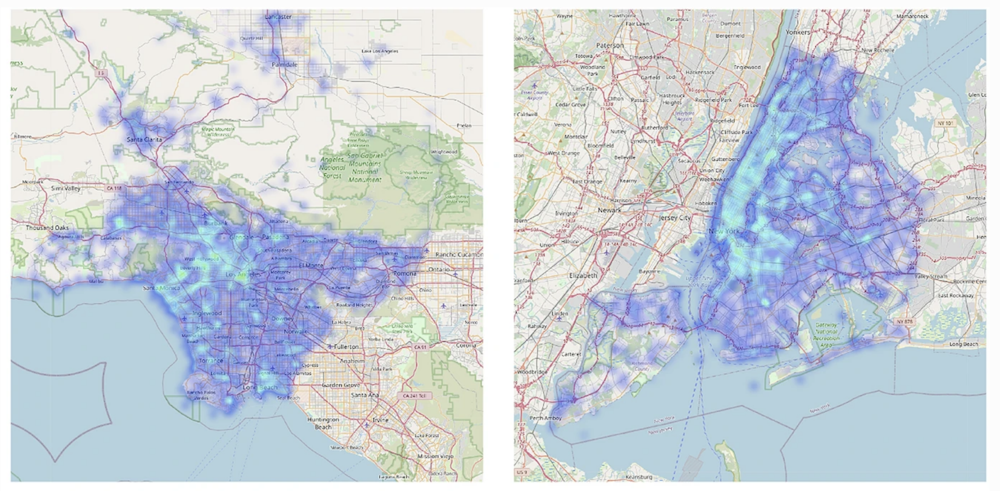
Side-by-side maps of Los Angeles and New York City covered with bright blue blobs
Tweeting in Los Angeles (left) and New York City (right). Blue indicates density of tweets; the brighter the blue the greater the number of tweets. Minda Hu, CC BY-ND

It’s more difficult to determine whether two tweets are talking about similar things. Looking for common hashtags might suffice, but unfortunately many people do not use hashtags or use different hashtags when talking about the same thing. To overcome this problem, we used state-of-the-art natural language processing technology. Algorithms developed in this field read and interpret sentences in a manner similar to the way humans do, and they are able to deal with nuance.

We used this technology to group tweets into clusters of topics. We then studied whether tweets falling inside the same cluster were also from people who were close together based on their GPS-enabled tweets. This allowed us to determine, for example, that clusters containing art-related words and phrases tended to arise more often in New York than LA.

Health and wealth versus art and representing

Even before we looked at who tweets about what, we found tweeting across New York City to be more evenly spread, while in LA, more tweeting happens in wealthier areas, including Calabasas – home to Kim Kardashian – Palos Verdes, West Hollywood and the coastal areas.

We also found that New Yorkers referred to themselves and their city far more often than Angelenos did. On a per capita basis, New Yorkers like to talk about art, while Angelenos like to talk about health care and hospitality.

LA generates more tweets than New York throughout the day, despite having a smaller population, but from 8 p.m. to 5 a.m. local time, the two have comparable numbers of tweets. Tweeting in New York City rises sharply from 8 p.m. to a peak at 9 p.m., whereas tweeting in LA rises steadily from 2 p.m. to a peak at 7 p.m.

Computational social science

Our methods are a case study in the growing field of computational social science, which aims to find insights in unique, often large, data sets using artificial intelligence models and algorithms. In contrast, traditional social science tends to rely on surveys and polls to quantify public perception about an issue. Though surveys have some distinct statistical advantages, they can be expensive and time-consuming to use for collecting quality data with good response rates.

For example, Gallup releases new survey data every few months and currently charges US$30,000 for academic licenses. Decades ago, researchers found that monetary incentives increase response rates significantly. Even today, online surveys are often accompanied by lottery-based promises of receiving an Amazon gift card. Researchers are working on combining the benefits of traditional and computational social science.

Zooming into our data, we uncovered some fascinating trends that we hope future research will explore. We found, for example, that on a per capita basis, as crime increases, so do tweets, at least at the level of ZIP codes. Why do high-crime areas tweet more? We don’t know yet, but the trend is consistent across both New York City and LA.

Tweeting, place and COVID-19

Studying tweeting behavior by location could also be useful for understanding disparate outcomes of large-scale events. For example, our twitter analysis could help shed light on how the COVID-19 pandemic has affected people in different places.

New York City was hit hard by COVID-19 early on, showing that even major cities were affected in different ways by this terrible pandemic. New reporting is now showing that even within cities, socioeconomically disadvantaged communities were disproportionately burdened.

Recently, we released a Twitter data set covering 10 of the largest metropolitan areas in the United States to further study such disparities using computational social science. We are already using our methods across all of these cities to better understand how COVID-19 has affected certain groups, and the levels of expressed vaccine hesitancy among these groups.

Eventually, we hope to use our methods with a large set of international metropolises to study urban behavior.

Mayank Kejriwal, Research Assistant Professor of Industrial & Systems Engineering, University of Southern California

This article is republished from The Conversation under a Creative Commons license. Read the original article.

Zaila Avant-garde stands where Black children were once kept out

When Zaila Avant-garde, 14, won the 2021 Scripps National Spelling Bee on July 8, 2021, she became the first Black American to win in the competition’s history. Shalini Shankar, a scholar of spelling bees, breaks down the importance of this historical moment.

Why is it news that an African American won this championship?

It’s significant because not so long ago, Black children would have faced a lot of obstacles just to compete in this spelling bee.

In fact, Black children were routinely sidelined from participating on the national stage until well after the passage of the 1964 Civil Rights Act. Even after schools were ordered to racially integrate in the late 1950s, spelling bees were largely all-white affairs, thanks to regional organizers who routinely found ways to keep interested Black children from advancing in the contest.

Avant-garde’s victory is also significant because, like with any sport, people love to celebrate new records. This one is especially welcome because with the exception of Jamaican Jody-Anne Maxwell’s win in 1998, the Scripps National Spelling Bee has never had a Black winner.

This can be attributed to decades of disadvantage in which Black schools had far fewer resources to help support and train students for activities like spelling bees. It may seem surprising, but specialized brain sports like the bee – and so many other kid contests today – require a great deal of expertise, such as spelling coaches.

What does it take to be a spelling bee champ?

Becoming a spelling bee champion requires several stars to align. First and foremost, one needs a love of the English language, especially philology – that’s the historical development of language – and etymology – the study of word origins and roots. Winners need an ability to build vast knowledge in these areas and summon it on demand in a competitive setting. Without this interest, the task of studying thousands of words per day, as elite spellers do, would be onerous at best.

Equally important, as I learned when researching my book “Beeline: What Spelling Bees Reveal about Generation Z’s New Path to Success,” is the parental support an aspirational speller receives in terms of day-to-day studying, expert coaching and access to commercial word lists and resources, such as those designed by coaching companies. The Scripps National Spelling Bee also distributes word lists. However, champions have told me that these are not extensive enough to address the increasing difficulty of the bee. 

Zaila Avant-garde’s father realized her aptitude for spelling when she was around 10, which is relatively late for a contest in which eligibility ends after eighth grade, when most spellers are 14. Spellers I studied started competing as early as 6 or 7, making them far more comfortable with the format of the contest by age 10. Still, Zaila made astounding progress from her third-round elimination in 2019 which I witnessed in National Harbor, Maryland, when she misspelled the word “vagaries,” to winning it all in 2021. That kind of transformation suggests a tremendous work ethic, extraordinary aptitude and a whole lot of parental investment and support. 

What will it take to see more bee champs from diverse backgrounds in the future?

The against-all-odds success story featured in the 2006 fictional film “Akeelah and the Bee” underscores how vital the role of adult support and resources are to success. Now we have Zaila and the bee, which will hopefully attract a new generation of Black talent.

An actual win – versus fictionalized win – should serve as real inspiration to younger people, because until now aspiring Black children had no trailblazer. I believe Zaila will be very inspirational, like Venus and Serena Williams have been to a new generation of Black women tennis champions. 

What’s especially interesting about Zaila’s path to the bee was that her father observed how fantastic her skills were when they watched the 2017 Scripps National Spelling Bee together. This raw talent got her to the national contest but kept her far from the final rounds – until she and her father learned about commercial word lists.

In her post-win interview, she noted using commercial word lists from a company called “Spell-Pundit,” created by former elite spellers, which according to them allowed her to study 13,000 words per day. This is the kind of edge that one needs to win a bee today, and it is fantastic that she was able to acquire these products to aid in her successful preparation. Ensuring that others with raw talent like hers have access to paid coaching resources is vital to continued diversity in this field.

Shalini Shankar, Professor of Anthropology and Asian American Studies, Northwestern University

This article is republished from The Conversation under a Creative Commons license. Read the original article.

“NRA shot itself in the foot”: Schumer calls for DOJ probe of possible bankruptcy fraud

Senate Majority Leader Chuck Schumer, D-N.Y., called on Sunday for the Justice Department to investigate the National Rifle Association for fraud over the group’s ad expenditures amid its failed bankruptcy case.

The NRA filed for bankruptcy in January in a bid to relaunch the organization in Texas under “the protection of the bankruptcy court” despite boasting that the group was “in its strongest financial condition in years.” The bankruptcy filing came after New York Attorney General Letitia James filed a lawsuit seeking to dissolve the NRA over allegations that executive vice president Wayne LaPierre and other top executives had “funneled millions” in donor funds “into their own pockets.” A Texas judge in May dismissed the bankruptcy case, ruling that it was not “filed in good faith” and was instead an attempt to “gain an unfair litigation advantage and … was filed to avoid a state regulatory scheme.”

Schumer this week said that the DOJ should investigate millions in advertising expenditures the NRA made while claiming to be bankrupt.

“NRA claimed they were ‘bankrupt’ to escape the NY Attorney General’s jurisdiction,” Schumer said on Twitter. “But they’ve been spending millions on ads, mailers, texts, TV, & more to stop common sense gun reforms. The U.S. Department of Justice must investigate if NRA committed fraud or other offenses.”

In April, the NRA announced a $2 million ad campaign to oppose President Joe Biden’s gun control proposals.

“At the same time they’re saying they’re bankrupt, they’re spending millions of dollars on ads to stop universal background checks,” Schumer told the Associated Press. “That demands an investigation by the Justice Department.”

Schumer noted that the group spent $500,000 on ads pressuring Sen. Joe Manchin, D-W.Va., and Sen. Pat Toomey, R-Pa., to oppose Biden’s nomination of David Chipman, a former adviser to the Giffords Law Center to Prevent Gun Violence, to head the Bureau of Alcohol, Tobacco, Firearms and Explosives.

“How can you say you’re bankrupt at the same time you have millions of dollars to spend on ads throughout the country trying to prevent universal background checks fundraising and other things that will stop the killings on the streets?” the majority leader told the AP. “The bottom line is the NRA shot itself in the foot when they declared bankruptcy and still have millions of dollars.”

The comments drew an angry reaction from the NRA, which described his call for a probe as a “tyrannical threat.” NRA lawyer William Brewer accused Schumer of “promoting a false narrative.”

“The NRA pursued a financial reorganization for one reason: to streamline its financial and legal affairs. The truth is, the proceedings in question confirmed what the Association disclosed from the outset — the NRA is financially solvent, and the filing in Texas was part of its long-term plans to effectively serve its members,” Brewer said in a statement to the AP. “Although the bankruptcy court did not believe the filing was for a proper bankruptcy purpose, it specifically did not find the NRA acted in bad faith.”

The NRA’s bankruptcy bid was highly unusual from the start. LaPierre admitted during the proceedings that he kept the bankruptcy filing secret from nearly all the group’s top officials and its board of directors. NRA board member Phil Journey called the ploy a “fraud perpetrated on the court” in May.

Federal bankruptcy Judge Harlin Hale ruled that the bankruptcy petition was “not filed in good faith” and cited “lingering issues of secrecy and a lack of transparency” at the group, noting that he was particularly troubled by “the surreptitious manner in which Mr. LaPierre obtained and exercised authority to file bankruptcy for the NRA.”

The ruling allowed James to renew her bid to dissolve the group and the months-long trial forced officials to confirm some of the allegations brought by her office.

LaPierre admitted to taking annual trips to the Bahamas on a luxury yacht owned by an NRA vendor, which he failed to disclose to the group. LaPierre’s private travel consultant, who was paid $26,000 per month, testified that LaPierre instructed her to doctor invoices for private jets to hide their real destinations.

James’ lawsuit accuses the NRA of reimbursing $1.2 million in personal expenses for LaPierre and claims he spent another $3.6 million of the group’s money in just two years for private travel and executive car service, and millions more for private security for him and his family. The lawsuit also accuses NRA executives of failing to report income by funneling personal expenses through a public relations firm and awarding big contracts to friends and associates.

The NRA in response filed a federal lawsuit accusing James of a ” blatant and malicious retaliation campaign against the NRA and its constituents based on her disagreement with the content of their speech” but ultimately dropped the suit last month.

James said that the group’s decision to drop the lawsuit was “an implicit admission that their strategy would never prevail.”

“The truth is that Wayne LaPierre and his lieutenants used the NRA as a breeding ground for personal gain and a lavish lifestyle,” she said in a statement. “We were victorious against the organization’s attempt to declare bankruptcy, and our fight for transparency and accountability will continue because no one is above the law.”

HBO’s “Catch and Kill” series shows how Weinstein is “a villain of the most extraordinary degree”

Almost four years ago, investigative journalist Ronan Farrow helped spark the movement for survivor justice known as #MeToo, with his reporting that exposed decades of sexual abuse allegations against Hollywood titan Harvey Weinstein. Yet, the story behind the story of how Farrow and others brought the allegations to light is a thriller on its own, adapted into Farrow’s 2019 book, “Catch and Kill,” and later, “The Catch and Kill Podcast with Ronan Farrow.”

Now, the epic story of power, truth-telling, and a sea change to protect and empower women, has been adapted into an HBO documentary series, “Catch and Kill: The Podcast Tapes.” Directed by Emmy winners Fenton Bailey and Randy Barbato, the series is an accumulation of years of intimate interviews and chilling research, presenting the harrowing, captivating tale of how Weinstein was finally brought to justice — and the corporations, lawyers, notorious non-disclosure agreements, police departments, and media ecosystem that protected him for years.

“There has been change, but it’s important to understand just how difficult it can be for certain stories like this to see the light of day,” Barbato told Salon. “It is the persistence and hard work of so many people, clearly Ronan at the forefront, being relentless to tell this story against so many odds, against a corporation saying, ‘no, we’re not going to move this story forward.’ Thankfully for all of us, he, with the help of others, kept persisting.”

A unique cast of characters brings “Catch and Kill: The Podcast Tapes” to life – from the courage and craftiness of Italian-Filipina model Ambra Guttierez, who first caught Weinstein’s confessions of sexual abuse on a wire in 2015 to a surprising ally in Igor Ostrovsky, initially hired to spy on Farrow for Weinstein. The result is a thorough and addictive triumph of investigative reporting that presents the cautious dismantling of systemic, patriarchal abuse of power. Bailey and Barbato spoke to Salon about adapting the story for television, the continued impact of the story in 2021 and beyond and the humanity and compassion that lie at the heart of this project.

Between the police investigations, the original interviews from when Ronan Farrow was first reporting, and the new interviews on the podcast, there was a lot of material for the show. What was your process of sorting through all of this material and creating a cohesive product? What were the new pieces of information or materials that you knew you absolutely needed to use? 

Fenton Bailey: We came on board when the idea of this series was born, and by that point, the book existed, the audiobook existed and the podcast existed. And they’d had the foresight to tape a lot of those interviews for the podcast. It was in the middle of a pandemic, so the opportunity to go out and film new interviews wasn’t really possible, so they came to us and said, “Can you make something of this?” We were wildly passionate and excited about it, because even though the story has been told in the articles Ronan wrote, the book and his podcast, seeing it makes all the difference. When you see the people Ronan interviewed, and can put a face to the voice, it creates another dimension. We were so honored to be able to present and show the victims of Harvey Weinstein over many years.

Then, I feel this series shows you the story of the story. It pulls back the veil and shows you it actually is really hard to bring someone to account, and investigative reporting is hard, difficult, even at times dangerous work. As storytellers, Randy and I thought this is a really gripping story, in that we were familiar with a lot of the points about Weinstein, but we hadn’t seen this in quite this way, from this perspective. It really feels like a real-life thriller, really.

Weinstein is in jail and still due to stand trial in Los Angeles. While “Catch and Kill” takes place in the past, what sort of consideration were current-day events given to how you created the series?

Randy Barbato: For us, from a creative perspective, I think the most important thing was to make a series that respected the voices in the series, whether it was the whistleblowers, or the other journalists who Ronan spoke with, private investigators. The series isn’t necessarily about the current events in the story, now, because I think the story is evergreen, it’s timeless. Like Fenton said, Ronan’s book and the podcast and series are about the story of the story itself, speaking truth to power, the courageousness it takes. Look how long it’s taken Weinstein to be brought to justice, it took the voices of all these different people to come together. It wasn’t our job necessarily to make a series about the story today, our job was to help people understand how we got to where we are today, what it took, for Weinstein to be brought to justice. 

In the first episode, Catch & Kill will explore how even with the confession from Weinstein that Ambra Gutierrez caught while wearing a wire, police still didn’t act. What has retelling her story on the show been like, at this time of increased criticism of how police departments have harmed or ignored survivors?

Bailey: I think there is tremendous institutionalized disbelief when it comes to victims. It’s not just the police department, you know, it’s corporations, sometimes even the press, the Justice Department. You see that in Ambra’s story, because you would think doing what the police asked her to, wearing a wire, getting the confession caught on tape — you’d think it would be a short few steps to Weinstein being arrested and put on trial, but that is not what happened. Instead, Ambra found herself put on trial in the media, when stories started emerging about her past in Italy. 

We see this time and time again, the fundamental disposition to disbelieve the victim. It’s a story that plays out not just over a few weeks and a few months, this is over years. Just the end of last month, Weinstein was extradited to L.A. — it’s still going on. This is a process that’s been going on in Weinstein’s case for decades. If it takes that long to bring one person, one high-profile person like Weinstein to account, think how many more are out there who have been getting away with it and continue to, to this day. It’s profoundly disturbing, really, and also why we found it so important to tell this story because you see over the six episodes how it wasn’t enough to have one person, you had to have multiple people. And even then, multiple people weren’t enough, NBC didn’t believe Ronan had the goods. He had to go to the New Yorker. It’s an epic quest to bring those stories to light.

[UPDATE: By NBC’s request, here is Noah Oppenheim’s note to staff on October 14, 2019: “Farrow’s effort to defame NBC News is clearly motivated not by a pursuit of truth, but an axe to grind.  It is built on a series of distortions, confused timelines, and outright inaccuracies.”]

TV adds a visual element to this story. What were some of the visuals you wanted to employ or avoid when it came to the typical way documentaries show past events?

Barbato: For us, as filmmakers, the subject always dictates the style and approach. While this is an epic story and thriller of sorts, we did want to have some of those elements and visual elements to amplify the storytelling. We also never wanted to overpower the subjects and the intimacy. The fact that HBO and Ronan had the foresight to record these conversations was at the core of the show. Our job was never to show our fingerprints, never to overwhelm those voices, because it’s those voices and the combination of those voices — that’s the story. We were lucky enough to have an incredible team we worked with, our composer, our DP [director of photography], for a very long time who all felt a personal connection to the subject matter and a commitment to bringing this story to light without overwhelming the very essence of what it is, which is these voices, the voices of the whistleblowers, the journalists, the investigators.

In addition to the voices of people who were directly harmed by Weinstein, this show will build upon the podcast and pull back the curtain on the people in media who made this reporting possible — and also tried to stop it. What insights does “Catch & Kill” offer on how media coverage of sexual violence has or hasn’t changed since some of the shock reporting of fall 2017?

Bailey: I think we’ve seen a huge change with #MeToo, the whole movement that’s come out of this sparked by this case. I do think there’s a tremendous impact this story has had. I suppose in trying to understand how that is, perhaps it was just the straw that broke the camel’s back. The tide rises, finally, you get a case that is a moment of precipitation. You’ve reached a critical mass. There’s been tremendous change, certainly, at the top in Hollywood; Weinstein isn’t the only predator or male behind sexual harassment to have lost his job. There is that change. I think a lot of the underlying factors persist, of a reluctance to believe people. There has been tremendous change and there is a lot further to go.

Barbato: I do think the series also reminds us — particularly if you look at Episode 2, which features some other award-winning investigative journalists Kim Masters, Ken Auletta, who were on the case of this story — how formidable the forces are against truth. How money and power can prevent truth from seeing light. 

One of the most shocking pieces of “Catch & Kill” — the book and podcast — is the revelation about how Ronan Farrow was being spied on, and Igor Ostrovsky even gives his account in the sixth episode. There are so many layers and twists in this saga, what was most shocking to you as creators? What was the most challenging to convey for TV?

Bailey: Without doubt one of the most shocking things was to see those interviews Ronan conducted of people who subsequently come forward and have been identified, but at the time who gave interviews in silhouettes. 

It was profoundly shocking to see how many there were, and it’s gut-wrenching to hear their stories. In spite of knowing what a complicated story this is, and how many layers there are in terms of corporate layers, legal layers, always different factors at play, it’s still pretty hard to recognize or accept that people can be victimized and abused, and nothing gets done about it. That a whole system can exist not intentionally necessarily, but a whole system can exist and allow and encourage this kind of behavior, and doesn’t stop it. That’s the hard thing, the most shocking thing, I think. 

And on a personal note, the depths of depravity of Harvey Weinstein are hard to fathom — even before all this, the stories of him being a bully and abusive person were legion, but I don’t think anyone ever suspected he was also a serial rapist. He’s just a villain of the most extraordinary degree, and deserves no compassion, and I hope finds no legal recourse to escape the consequences of his action, the lives he’s destroyed. It completely erases his cultural contributions.

Barbato: On the flip side of what was the most shocking, what was the most surprising and satisfying, was connecting with and experiencing the humanity from so many of the participants in this series. It gave me a sense of hope. Whether it was Rowena Chiu, or Rich McHugh, these people who came and spoke out and took the steps necessary to move this story forward, and did that out of this sense of duty to tell the truth, discover or find the truth. When Rich McHugh, a producer who worked with Ronan at NBC when they were pursuing the story there, in the end he left his job. He did it for the future of his daughters. There’s something about that and so many other stories that are shared during the course of this series that, my hope is some of those stories will overshadow the darkness of Weinstein’s story, that they will renew our hope moving forward, that less of this will happen, that there will be change. And these nefarious, powerful individuals who think they can just ignore the norms will think twice and be more respectful.

There would be no “Catch and Kill” without Ronan Farrow – but what was his level of participation for this? Did he have any general thoughts on how this should be approached?

Bailey: Ronan? Oh, yeah. Ronan is formidable. He doesn’t do anything in half-measures. He doesn’t do anything at a distance of arm’s length. He was very involved, he agonizes over every word and every detail. He’s insanely hard-working, conscientious, and scrupulous, to a degree that is quite jaw-dropping really. Working with him was such a pleasure. It’s just an honor to be in the presence of that formidable an intelligence, and not only formidably intelligent, but also compassionate and funny. It’s just been a sheer pleasure working with him.

“Catch and Kill: The Podcast Tapes” premieres Monday, July 12 at 9 p.m. on HBO and will stream on HBO Max.

“Submitted in bad faith”: Judge smacks down Sidney Powell’s “fantastical” election lawsuit

A federal judge indicated on Monday that far-right Trump attorneys Sidney Powell, Lin Wood, and others may be sanctioned for bringing a “fantastical” election fraud lawsuit to court, suggesting their affidavits “were submitted in bad faith.”

“Plaintiffs ask this court to ignore the orderly statutory scheme established to challenge elections and to ignore the will of millions of voters,” U.S. District Judge Linda Parker wrote. “This, the Court cannot, and will not, do.”

The case, self-described as the “Kraken” lawsuit, was brought last year by Powell, Wood, and former Department of Housing and Urban Development adviser Julia Haller on behalf of Donald Trump, who has since his 2020 election loss baselessly alleged that President Biden won on account of systematic election fraud. The suit centers on four battleground states: Michigan, Wisconsin, Georgia, and Arizona. Each state lawsuit was shot down in court along with their respective appeals. 

On Monday, Parker convened a meeting to discuss whether the Kraken team should be sanctioned or even permanently disbarred over their Michigan suit, for which they introduced a particularly “speculative” affidavit. 

Both Wood and lawyer Emily Newman attempted to disavow themselves from the suit, alleging that they did not play a specific part in the lawsuit. Wood claimed that he was unaware his name would be attached to the case and had only promised to “help [Powell] from a trial lawyer standpoint.”

Detroit attorney David Fink argued that Wood’s claims were “blatantly false,” citing evidence that Wood had boasted about his work on the case over social media. 

The hearing, which was held via video conference, featured a number of bizarre exchanges that went beyond typical legal decorum.

In one back-and-forth described by Politico, pro-Trump lawyer Donald Campbell took issue with Parker’s objection to an affidavit in which a witness described being “perplexed” at the way ballots were being handled out in at the TCF Center in Detroit.

“The word ‘perplexed’ is what you think is worth the time and effort of all the staff and lawyers … in this proceeding?” Campbell asked, surprised. 

“I would caution you to — do not question my procedure,” Parker responded. 

“I am not a potted plant,” Campbell clapped back. “I will represent my client.”

In another, Parker concluded that she’d “never seen an affidavit that makes so many leaps,” adding: “This is really fantastical. So my question to counsel here is: How could any of you as officers of the court present this affidavit?”

At one point, Powell in fact met Parker with a similar level of shock. “I have practiced law for 43 years and have never witnessed a proceeding like this,” she said. “I take full responsibility [sic] myself for the pleadings in this case […] We have practiced law with the highest standards. We would file these same complaints again.”

The proceeding comes as part of broader pushback against Trump’s baseless election conspiracies. Back in February, the Georgia State Bar sent Wood a 1,600-plus-page complaint proposing that he be disciplined, as Politico reported. Last month, New York state similarly suspended the legal license of ex-Trump attorney Rudy Giuliani. 

Detroit lawyers argued in the hearing that licensed attorneys who have supported Trump’s election conspiracy should face professional penalties.

Texas AG Ken Paxton agrees to stop blocking people on Twitter

Texas Attorney General Ken Paxton will no longer block ​users from his personal account for expressing “First Amendment-protected viewpoints” as part of an agreement to end a lawsuit where plaintiffs say they were unconstitutionally blocked for criticizing him or his policies on the platform, according to a filing late Friday in a federal court in Austin.

Paxton had already unblocked the named plaintiffs of the lawsuit in May, a month after the lawsuit was filed, but the latest filing confirmed he has now unblocked any other accounts. The ACLU of Texas, a freedom of speech organization that represented the plaintiffs in the lawsuit along with the Knight First Amendment Institute at Columbia University called the agreement “an important victory for Texans’ First Amendment rights.” 

“We’re pleased that Attorney General Paxton has agreed to stop blocking people from his Twitter account simply because he doesn’t like what they have to say,” Katie Fallow, a senior staff attorney at the Knight First Amendment Institute, said in a prepared statement. “Multiple courts have recognized that government officials who use their social media accounts for official purposes violate the First Amendment if they block people from those accounts on the basis of viewpoint. What Paxton was doing was unconstitutional.”

Paxton’s office did not immediately respond to a request for comment.

Though Paxton blocked the plaintiffs on his personal account — not the official attorney general account — attorneys for the plaintiffs said he used the account to make official announcements, comment on local issues and defend his policies. The plaintiffs argued that being blocked from viewing Paxton’s tweets from his @KenPaxtonTX account limited the rights of people to participate in a public forum and access statements made by the public official, therefore violating the First Amendment.

The Texas Tribune is a member-supported, nonpartisan newsroom informing and engaging Texans on state politics and policy. Learn more at texastribune.org.

What is post-Trump patriotism?

As America prepares to celebrate the nation’s founding on Independence Day, nearly six months to the day after self-proclaimed patriots inspired by then-President Donald Trump led a siege on Congress, it is worth considering a very different and far more inclusive vision: In the year 2021, what should patriotism look like?

In search of answers, Capital & Main interviewed Dorian Warren, the president of Community Change, a Washington, D.C.-based social justice organization. Warren spends his time thinking about the past, present and future of our country — something that has taken on new resonance for him with the birth of his baby daughter. As he discusses a modern and more progressive vision of patriotism, he does so through the lens of a parent contemplating the version of this country that he wants his daughter to grow up in.

Warren spoke about the meaning of patriotism for the American left, especially in the aftermath of Donald Trump’s presidency that stoked divisions and racial tensions. Warren, who is a Capital & Main advisory board member, highlighted an 1852 speech delivered by Frederick Douglass entitled “What, to the Slave, is the Fourth of July

Douglas told his audience, at an Independence Day celebration in Rochester, New York — 11 years before legal slavery finally came to an end in the United States with the Emancipation Proclamation — that while they “may rejoice” on the occasion, he “must mourn.”

Warren, like Douglas, points out that we cannot overlook the scandalous inequality that still disgraces our nation, and at the same time fight to redeem the more noble principles outlined in the Declaration of Independence.

Capital & Main spoke to Warren from his home in Washington, D.C. The following interview was edited for length and clarity.

* * *

Capital & Main: Donald Trump weaponized the idea of patriotism during his four years in office through the demonization of immigrants, liberals, Black Lives Matter protesters and the media. What are your views on the damage Trump might have done to the idea of patriotism?

Dorian Warren: I’m not sure if there’s much we could classify as patriotism that Trump did. He pursued a very exclusionary white nationalism which, taken to its fullest conclusion, led us to the January insurrection. If you add the policy of mass death that led to 600,000 Americans dying from COVID-19, I have a hard time squaring how anything he did was patriotism. It feels like treason and insurrection with a little plunder thrown in.

You previously spoke to Capital & Main the day after the Jan. 6 crowd, waving Confederate flags, breached the Capitol. These people, of course, defined themselves as patriots too. How do you explain what seems to be a rather perverse use of that word?

In some ways they’re patriots to the lost cause. And the tell was flying the Confederate battle flag in the Capitol. They’re patriots of a treasonous government from the 1860s. It makes me think of the patriots who built that Capitol building stone by stone, brick by brick. [There were] many enslaved black adults, but especially black children who built the Capitol — who built that symbol of our democracy — with their hands and their labor.

Over this past year we’ve had to look at some hard truths about the American present and past, the legacy of Jim Crow and mass incarceration. Can you make a case that “true” patriots would acknowledge the difficulties of that past and present without some people seeing it as a threat to the country?

I thought of Frederick Douglass’ 1852 speech “What, to the Slave, is the Fourth of July?” It is a searing indictment of the hard truths of our history, of plunder, of enslavement, of a range of exploitative and unjust actions at the highest levels. At the same time, I’m a black person in America so I have no choice but to fight for the promise of America.

Thinking of Douglass’ speech also takes me to Dr. King’s speech [in 1963] at the March on Washington. People often forget the first half of that speech, which is, very much like the Douglas speech, a searing indictment of the injustices of American democracy. So we have to embrace all the contradictions in American democracy if we want to imagine a vision of a future that’s about freedom and inclusivity and opportunity and justice.

You’ve spoken about being a new father. What lessons about our history do you want your child to learn?

I think a lot about “what are the lessons I want to teach my child,” and it’s irresponsible to not teach our kids about hard truths. It doesn’t mean we can’t envision a better future, but we have to look back at our past and all the ugliness there, and at the promise and the possibility of people who fought for a better life who lived in even harsher conditions than we do today.

Let’s talk about the pandemic. Do you think that this crisis has changed the way that people view our country, our fellow citizens and the role of government in society?

I think most Americans probably would agree that part of the role of government is to create safety and security from threats, including threats of a deadly virus. I think we all saw the failure of the Trump administration to act in the early days of the pandemic. We saw the fundamental lack of support for families, for small businesses that people felt early on. That initiated a reassessment of what the government can and should deliver. It’s definitely spurred calls for a more inclusive economy, a more caring economy.

I think this current administration gets good marks on how they handled the pandemic, not to mention all the efforts to get people back to work and respond to the economic crisis. So I do think we’re going to be in an extended conversation about the role of government and our obligations to each other as fellow citizens. It’s one thing to have an abstract debate about this, but we’ve just lived through unnecessary debt and pain and hardship.

There has been a lot written in the past several years about the need for a common national narrative that people can more or less agree on. Do you think we need that sort of overarching narrative?

I think we have multiple narratives and multiple traditions in this country. If I think about how I explain the story of America to my daughter, I have to offer at least two big stories. I have to offer the contradictory story of how America was founded — of genocide, of the stealing of land, of claiming other people’s land, of slavery. I have to tell that story, and I have to tell a story of hope and promise and struggle and change and transformation.

I have to tell my daughter the story of the Civil Rights Movement and the Great Society, and the moments when we rose to the occasion as a country to solve intractable problems. There has to be some commonness — something has to bind us all together in terms of building a collective identity.

We’re getting ready to celebrate Independence Day. And there is a debate going on right now, generated by Republicans, about critical race theory, and what should be taught in schools and what shouldn’t. Proposed laws in a number of states will attempt to avoid acknowledging things about the nation’s past.

I think this is a form of what I would call strategic racism because it is a deliberate play by the right-wing for cultural power — in this case, the power of storytelling and who is the arbiter of our national story and whether we include the hard truths or not. But I’m curious about what’s underneath it? This goes to what Tucker Carlson talks about often; his Great Replacement theory. This notion that whites who have been a majority in this country will somehow be replaced by nonwhites and the fear of that transition. There is a fear of retribution and punishment. That’s an implicit acknowledgement that there’s been some wrongdoing in the past.

Political pundits and commentators often say we need more conversation. With the New Deal one vision of society won and a different vision lost. One side also won in the Civil War, and the other side lost. Doesn’t one side need to be politically victorious because conversations only get you so far?

I don’t think we need political theater to masquerade as meaningful debate. We need accountability for the anti-patriotic behavior of Jan. 6. I don’t want to have any more conversation. I’m not interested in a debate about the alternatives between authoritarianism and fascism, systems that take away people’s freedoms. They have to be defeated.

And we had a system of Jim Crow authoritarianism in Southern states for over a hundred years after the Civil War, [and] it had to be defeated. Race has always been used as a zero sum frame that for black people to win, white people have to lose, which I just reject. Actually, white people have benefited a lot from the struggles of black people to make our country more just.

Most people want to feel patriotic, from standing for the National Anthem at baseball games to some of our other collective rituals. Most people want to embrace their country and feel positively enough about the United States to want to fix its flaws. So what does progressive patriotism look like to you?

It’s work. It’s not going to come as a result of one magic flowery speech. It’s work. It’s the commitment of figuring out our joint future with people different from you or me. I think a progressive patriotism has a very broad sense of belonging and inclusivity, which is one of the best aspects of the American tradition. An important part of our history is being welcoming to outsiders. What is the common goal that we can all collectively agree we are striving toward? And maybe it’s not going to be 100% of folks. I’ll be happy with 60%. Then you keep talking to the other 40%. Democracy is work. Then we will pass the baton to the next generation.

Copyright 2021 Capital & Main

Most inmates have had their COVID shots — but their guards likely haven’t

When the number of covid-19 cases among inmates in Pennsylvania state prisons last fall topped 1,000 and staff cases hovered in the hundreds, the union representing 11,000 corrections officers began lobbying to get prison staffers to the front of the line for vaccinations.

John Eckenrode, president of the Pennsylvania State Corrections Officers Association, pressed state officials for months to give prison workers the same status as hospital staff members, first responders and teachers.

“This is a health and public safety crisis,” Eckenrode said in a January statement. “It’s time to prioritize vaccinating staff, so they can do their jobs and also not worry about bringing the virus home to their loved ones.”

Yet, after the lifesaving shots became widely available, Pennsylvania prison guards have not rushed out to get them — even though the corrections department has had more than 4,700 staff members test positive over the course of the pandemic and eight die.

By mid-June, 22% of Department of Corrections employees were inoculated, according to voluntary reports collected by the department. At one prison, just 7% of staffers had received shots.

Meanwhile, more than 75% of the 39,000 men and women incarcerated in Pennsylvania’s 24 state prisons have had the shots, according to the department.

That disparity is evident across the country. While a majority of inmates in most states are fully vaccinated, prison staffers are not, according to data on 36 states and the federal Bureau of Prisons compiled by the Prison Policy Initiative using information from several prison advocacy and journalism groups.

That report — released in April, when the vaccine was becoming more easily accessible — found 48% of prison staff members nationwide had received at least one dose, although in some states rates were in the teens or lower.

Eckenrode declined to comment to KHN. But he recently told WHYY, the NPR member station in Philadelphia, that he believes many more officers are vaccinated and not reporting their status to prison officials.

He acknowledged reluctance among his members. “I think that no matter what kind of demographic you look at, there’s vaccine hesitancy,” he said. The vaccines were “approved under experimental conditions, and I believe that it should be an individual choice.”

One officer with the New York Department of Corrections and Community Supervision, which reported last month that it had vaccinated 43% of inmates, compared with 30% of staffers, said he waited until late June because he and his wife had survived a bout of covid and felt they had natural protection from the virus.

Some colleagues have been spooked by internet videos from anti-vaccination groups showing doctors talking about vaccine-related deaths or stoking concerns that the Food and Drug Administration’s emergency use authorization for the vaccines — rather than formal approval — means they are less dependable, said the officer, who asked to remain anonymous because corrections staffers are not authorized to speak to reporters. He added that a sense of “I don’t want people to think I’m weak” machismo and right-wing politics play into the decision-making.

“There are a lot of conspiracy theorists,” the New York guard said.

Covid has taken a high toll inside prisons. Two news organizations, the Marshall Project and The Associated Press, have found nearly 400,000 covid cases in U.S. prisons and more than 2,700 inmate deaths. Among staff members, more than 114,000 cases and more than 200 deaths have been reported nationwide.

Staff vaccination statistics often do not give the full picture, since states generally don’t require corrections staffers to report their status.

In California, which has the nation’s second-largest prison system, a reform group is suing over low staff vaccination rates, arguing that unprotected prison workers put vulnerable inmates at risk.

State tallies show that in late June 52% of prison staffers had been fully vaccinated versus 71% of inmates. In its court filing, the Prison Law Office said that, despite efforts by California officials encouraging vaccinations, “infected and unvaccinated staff members continue to pose a significant threat to incarcerated communities.”

Health experts say prison staff members also endanger surrounding communities.

Unvaccinated officers are a common cause of infection, because they go back and forth between the prison and the community, said Dr. Anne Spaulding, an associate professor in epidemiology at Emory University and former medical director at the Rhode Island Department of Corrections.

Spaulding also pointed to the “downstream effects” of unvaccinated staffers — especially corrections officers (known as COs), who are in daily close contact with inmates — on the inmates’ mental health.

“If it passes from CO to CO, what does that mean with staff shortages? More lockdowns, less programming,” she said. “It’s going to affect the mental health of those incarcerated, who already have restricted lives.”

Kirstin Cornnell, social services director with the Pennsylvania Prison Society, which advocates for reforms, said lockdowns resulting from sick staff members could lead to suspension of family visitation, disrupting connections critical to inmates’ mental health.

“We have really serious concerns about how low the rate of staff vaccination is,” said Cornnell. “This increases tension in an already stressful situation.”

Pennsylvania Corrections Secretary John Wetzel and officials in other states say that, while they are not considering making the shots mandatory, they are pressing employees to get vaccinated.

“We continue to educate our staff and encourage them to get vaccinated for their own protection, but also for those around them,” said Wetzel. “Everyone knows that prisons are breeding grounds for infectious diseases like covid-19, largely because inmates live so close together.”

While union officials in several states did not respond to queries, prison officials said their employees have the same concerns as the general public: religious or other objections, false conspiracy theories about the vaccines, worries about a new shot that was developed quickly.

“They want to see how it plays out with others who are vaccinated,” said John Bull, a spokesperson for the Department of Public Safety in North Carolina — where 6,607 department employees, or roughly half the staff at 55 facilities, have been vaccinated through prison clinics. “They didn’t want to be guinea pigs.”

Incentives, such as gift cards, cash lotteries and paid time off, have boosted staff rates in some states, officials said. But Chris Gautz, a spokesperson for the Michigan corrections department, said his state will not provide incentives, despite having only about 15% of staffers vaccinated. He said his agency decided disease prevention was a better motivator.

“The benefit of not dying is not dying,” he said. “A $5 gift card to Frosty Boy is not going to put someone over the edge.”

The Prison Law Office and other groups are advocating for mandatory prison staff vaccinations, but the potential face-off with powerful prison worker unions has thwarted that idea in some states.

California Gov. Gavin Newsom said at a May news conference that he had no plans to make vaccinations mandatory and would instead urge the corrections officers union to persuade its members to get the shots.

Health experts point to other public institutions, such as schools and colleges, that require vaccination.

“States have the ability to mandate vaccination when it puts someone at risk,” said Joseph Amon, an epidemiologist and director of the Office of Global Health at Drexel University in Philadelphia. “This is a case that makes sense. There could be limited exemption, but there should be an expectation that all staff be vaccinated.”

Mink farms, breeding grounds for COVID-19 outbreaks, face a global backlash

The happy-go-luck mink had no idea how lucky it was.

As a child, Scott Beckstead watched the foreman at his grandfather’s mink farm keep the unnamed pet mink as his constant companion. Though the function of the farm was to skin and breed mink, this particular mink had become an unofficial mascot: picked by the foreman when it was a newborn, it spent much of its subsequent life swinging from his shoulder. Minks are widely regarded as cute; they look a bit like weasels and ferrets (all are part of a family known as Mustelidae) with their long bodies, wiry whiskers, tiny limbs, nimble digits and skin covered in rich, glossy fur. This particular mink, a male, was large and black, Beckstead recalled.

“There was this act of kindness shown this one random individual,” Beckstead reflected. “I always thought that was very curious. I always thought, ‘This is the mink that won the lottery.'”

Yet thousands of its peers on the farm were not so lucky. 

Beckstead, who is now the director of campaigns for Animal Wellness Action at the Center for a Humane Economy, recalls seeing minks that had their ears or scalps removed by other minks who had grown aggressive in their cramped living conditions. He knew that if one mink was injured and another smelled blood, the wounded one was “doomed.” Growing up, he was told that during the time of year when mink mothers gave birth to their kits, he had to be as quiet as possible and avoid certain areas of the farm so that they wouldn’t eat their own offspring from stress. Once he saw a mink literally die from terror as she was taken to be killed and skinned; she may have intuited her grisly fate. All of the minks spend their days “constantly pacing and bobbing and weaving in their cages,” behavior almost certainly caused by extreme boredom and frustration.

And all of this occurred on a farm run by a man who adored the animals entrusted to him.

“I truly believe that if you were a mink on a captive mink farm, that was the one you’d want to be on just because there was so much concern for their welfare,” Beckstead said of his grandfather’s mink farm. “Yet even under those best of conditions, I saw terrible, terrible things.”

Mink farms, and the industry at large, is at something of a crossroads. The genetics of mink, and the close quarters they share on such farms, meant that they became a hotbed for the SARS-CoV-2 virus that caused the COVID-19 pandemic. Largely out of the public eye prior to the pandemic, mink farming became front-page news this year following stories of outbreaks and mass cullings. Yet for decades prior, animal rights activists opposed mink farming — both because of the inhumane way that the animals are treated and because of the seeming immorality of slaughtering animals merely to use their fur for luxury clothing.

Now, with renewed public scrutiny over mink farming, advocates of banning them believe they may actually have a fighting chance.

A new House bill, H. R. 4310, is a bipartisan proposal that would ban mink farming throughout the country. The bill is official known as the Minks in Narrowly Kept Spaces Are Superspreaders Act (or MINKS Act) — because of the minks’ tendencies to be, well, superspreaders. Up to a quarter of mink farms in the United States saw outbreaks of SARS-CoV-2, the virus which causes COVID-19, and there have been at least 431 outbreaks in both American and European mink farms so far. (There are two extant species of minks, one American and one European.)

“If SARS-CoV-2 could design its perfect habitat, it might closely resemble a mink ranch: a stressed, immuno-suppressed inbred host with thousands of other minks kept in very small cages,” Dr. James Keen, who formerly studied zoonotic disease outbreaks as a senior scientist at the U.S. Department of Agriculture, said in a press statement. “This environment maximizes chances for infections and mutations.”


Want more health and science stories in your inbox? Subscribe to Salon’s weekly newsletter The Vulgar Scientist.


Now the director of veterinary science for the Center for a Humane Economy and author of a recent report sent to legislators about mink farming, Keen tells Salon that minks are particularly prone to contracting diseases that cross over to humans. As he explained, the reasons relate to evolutionary history and behavior. 

“They’re solitary creatures,” said Keen. “Their territory tends to be hundreds-to-thousands of acres along water edges. Their whole immune system has evolved to have infrequent contact with other mink. When you take that sort of immune system, that’s not used to living with others from their own species, and put them all crowded together — an average US mink farm has about 17,000 mink, for example, but they vary in size from smaller to over 50,000 — they do not like it.”

He added that sometimes, “they escape,” carrying their diseases with them. The situation is exacerbated by the fact that they aren’t allowed to roam, explore and utilize the other freedoms that their wild instincts take for granted. This causes mink tremendous stress, which also compromises their immune system, Keen explained. This stress is why they will mutilate themselves and other mink, or engage in behaviors as unnatural as cannibalism.

“It is probably mostly out of frustration from being unable to manifest their normal behaviors,” Keen suggested. He says there are four behaviors that characterize minks’ instincts in the wild: They like to be alone, to roam, to stay active through activities like swimming and to hunt.

“Do they sound playful and intelligent? Yes, I think they are,” he added.

Not surprisingly, some mink farmers are pushing back against the new movement to ban their industry. Speaking to both AP Wire Reports and Farm and Ranch, a mink farm owner in Idaho named Ryan Moyle characterized the anti-mink farming campaign as effectively being an effort to wipe out a culture that is ingrained in those who make their living as mink farmers.

“When they want to come out and ban and wipe out an entire culture, that’s not what America is all about,” Moyle said. He later added that mink farmers would lose everything if the bill passes and many could commit suicide. (Salon reached out to Moyle’s farm for comment and has not heard back at the time of this writing.)

Beckstead, for his part, was skeptical of Moyle’s rosy view of mink farming as a beloved culture. He pointed out that as anti-fur campaigns have changed fashion tastes since the 1980s, fur farmers have developed a sense of solidarity with each other.

“I don’t know if I would call it a culture, but I do know that these are people who are very insular and they stay cohesive with each other,” Beckstead explained. “I think a lot of that is because they have been under siege for decades now — ever since I remember talking with my grandfather when the anti-fur movement was starting to gain traction in the 1980s.”

Beckstead recalled asking his grandfather how he would react if people demanded the outright banning of mink farms.

“He shrugged and he said, ‘Times change. If that happens, then there won’t be any more mink farms,'” Beckstead recalled. “He had this matter-of-fact attitude.” When his grandfather later died, his grandmother basically shut the farm down and “pelted out” — which means to remove the pelts from all their remaining minks. 

It seems like an anti-mink farming movement may be happening on a global scale. Austria and the Netherlands are leading a coalition of European Union (EU) countries demanding a ban on fur farming in Europe. States like Oregon and Wisconsin are at least acknowledging the COVID-19 threat posed by mink farms by demanding that mink be vaccinated against the coronavirus. In the near future, it is possible the world will pelt out of mink farming for reasons both practical and moral.

30 thirst-quenching, crowd-pleasing punch recipes

When the punch bowl comes out, it’s time for a party. Every celebration — from a summer cookout to a winter holiday party — requires a boozy big-batch beverage. So grab a ladle, raise a glass, and drink up! Ahead, we’re sharing 30 of our best punch recipes. Some are extremely seasonal, like Apple Rye Punch and a Mulled Wine Punch, whereas others are drinkable 365 days a year. And when you’re craving a tropical getaway, we have a drink that will mentally transport you to a cabana somewhere far, far away (looking at you, Pineapple Daiquiri Punch).

* * *

Our Best Punch Recipes

1. Apple Rye Punch

When the leaves start to change but you’re not quite ready to drink hot chocolate or straight whiskey by a crackling fire, sip on what we like to call a transitional beverage. For this autumnal punch, mix together regular apple cider with rye whiskey, maple bitters, and hard cider.

2. Spring Sangria With Strawberries And Mint

As soon as the weather warms up outside, this is the only sangria we want to drink. Why? Because it’s so dang refreshing! Use your favorite light, dry white wine and mix it with berry-flavored vodka, lemon juice, simple syrup (for sweetness), and sliced berries.

3. Negroni Sbagliato Punch

A twist on the fizzy, festive negroni, this crowd-friendly punch is just as easy to make. Like the original cocktail, this big-batch beverage (try saying that three times fast) is made with equal parts prosecco, Campari, and sweet vermouth.

4. Southern Belle Punch

“Based off of a raspberry-ginger-bourbon drink I had once, this punch balances summer fruitiness with the heft and moodiness of bourbon and Campari,” says recipe developer fiveandspice. Grab a seat on a porch swing and sip glass after glass until there’s not a drop left in the pitcher.

5. Rosemary Grapefruit Milk Punch

Make-ahead, crowd-friendly, and packed with a beautiful balance of earthy, citrusy flavors, this punch is exactly the drink to serve at your next holiday party. Bring it to the company gathering and you’re guaranteed to be named employee of the year.

6. Bowery Punch

This bitter, bubbly punch recipe brings together an Italian aperitivo, grapefruit juice, lemon juice, bitters, and gin. It comes together in a matter of seconds, so that you can start partying.

7. Red Sangria

In our book, the ultimate punch recipe is sangria. Red and white both have their place during happy hour, but right now we’re celebrating the robust red. Accent a medium-bodied wine with a few generous splashes of liquor (anything goes, but think triple sec and vodka or brandy), plus a trio of sliced fresh fruit.

8. Limoncello Punch

Take a trip to Italy anywhere in the world with this lemony punch recipe that’s one of our best of all time. The base begins not with limoncello (that comes later) but with big scoops of lemon gelato. Top it off with fresh lime juice, pineapple juice, ginger ale, and, yes, limoncello.

9. Glögg (Mulled Wine Punch)

The trick to a flavorful mulled wine has less to do with the type of wine you use (though that is certainly important) and more to do with the variety of herbs, spices, and fruits that you include.

10. Ginger Sangria

This punch recipe is no ordinary punch recipe. It was voted Food52’s best summer cocktail by our thirsty readers, who apparently can’t get enough of the peach-ginger combination in this white wine sangria. And frankly, neither can we.

11. Mother’s Ruin Punch

Inspired by Death & Co., a speakeasy-style cocktail bar in New York City, this gin-based punch also features Champagne, homemade cinnamon-infused vermouth, two kinds of citrus juice, and club soda.

12. Pineapple Daiquiri Punch

All you need is a cheeseburger in paradise as you sip on this pineapple and rum cocktail. Our recipe serves 10 to 15, so we highly recommend sipping on a pontoon boat.

13. Louisa Shafia’s Watermelon, Mint and Cider Vinegar Tonic

This mocktail recipe dresses up cider vinegar with honey, watermelon juice, and fresh mint.

14. Pomelder Prosecco Punch

This delightful floral punch pairs prosecco with sparkling pear juice, elderflower liqueur, pomegranate juice, and whole spices.

15. Crimson Bulleit Punch

The mesmerizing, pomegranate-studded ice ring will stop you in your tracks. Pour cranberry pomegranate juice, Champagne, bourbon, and ginger liqueur into a punch bowl with the ice for a festive, self-serve punch.

16. Red Wine Sangria

Hosting the ultimate summer party? Then you need the recipe for the ultimate summer punch: sangria! This basic red wine sangria recipe is plenty fruity, plenty boozy (thanks to cognac and Grand Marnier), and perfect for a crowd.

17. Big Batch Matador

You need only three ingredients to make this punch recipe — white tequila, fresh pineapple juice, and fresh lime juice. The only other things you need are SPF 50 and a big straw hat, because you’ll be on island time as soon as you take a sip.

18. “Adult” Shirley Temple Pitcher Cocktail

This punch recipe has the berry flavor and vibrant red color that you love minus the supersweet flavor. You need just three ingredients—berry-flavored vodka, grenadine, and club soda — plus a few thin slices of lemon for a garnish.

19. Rum Punch

Want to go to Aruba? Craving the Caymans? Can’t get enough of Curaçao? No matter which island you want to visit, this five-ingredient rum punch recipe will bring you there.

20. Watermelon-Habanero Lemonade

If you think that lemonade is just a little tooooo sweet for your palate, then you’ve probably never tried adding chile peppers to your drink.

21. Homemade Alcoholic Ginger Beer

One of the most refreshing summer cocktails is the Moscow mule. If you’re hosting happy hour and really want to impress your friends, make a batch using homemade alcoholic ginger beer, which you can certainly enjoy on its own, too.

22. Lemonade

Skip the powdery mix or large cartons of supersweet lemonade and make your own homemade lemonade using basic ingredients: lemons (duh), granulated sugar, water, and a pinch of salt. When life gives you lemons…

23. Golden Plum Kir Royale “Bowle,” A Fruity Summer Wine Drink

In this variation on a kir royale (the super-classy Champagne cocktail made with crème de cassis), this make-ahead punch recipe starts by soaking plums in sugar and white wine overnight. The next day, ladle the wine into a glass over ice and finish with the black-currant liqueur.

24. Switchel

Switchel equals simple. Trust us! You need only three ingredients (okay, four if you count water) including apple cider vinegar, pure maple syrup, and fresh ginger to make this revitalizing punch.

25. Papelón Con Limón-Menta

For a make-ahead, crowd-friendly drink, make this limey panela punch. We can’t say enough good things about it.

26. Kristin Donnelly’s Watermelon Agua Fresca

Sweet juicy watermelon and tart lime juice are a genius, totally timeless pairing. Add a dozen or two drops of bitters into the mixer, which brings out their flavor even more.

27. Whiskey Punch

Consider this your best-ever whiskey lemonade with a little extra sweetness from a honey simple syrup.

28. Limoncello E Pepe

It’s not cacio e pepe . . . it’s something even more magical! A punch recipe that marries limoncello, a bright and slightly syrupy Italian liqueur, with vodka, sugar, and crushed black peppercorns hits just right on a hot day.

29. Ponche (Mexican Punch)

A stunning assortment of fruit (think: pears, apples, prunes, and raisins) poaches in cinnamon syrup for our version of this modified Mexican ponche recipe.

30. Velour Parkour Punch

“This holiday punch uses flavorful low-proof ingredients — kind of inspired by a spritz — in order to make a punch that is sophisticated, but that you can also drink with impunity,” says recipe developer fiveandspice.

The 5 pantry essentials in my Senegalese kitchen

Welcome to Monifa Dayo‘s pantry! In each installment of this series, a recipe developer will share with us the pantry items essential to their cooking. This month, we’re exploring five staples in Monifa’s Senegalese kitchen.

* * *

When it comes to Senegalese cooking, the techniques are pretty straightforward. Release whatever romantic idea you have in your mind about what it means to live here and cook authentic cuisine. For example, sauce piment (sometimes known as purée de piment), a staple hot sauce, may sound complex, yet literally calls for all of the ingredients to be ground up and fried with seasonings added — that’s it. Yet what is rendered in the balance is one of the most pungent and tasty hot sauces. Another example: A morning staple, the beignet (different from the ones you’d find in New Orleans), calls for mixing together a quick batter, letting it rest, then frying it in small morsels. This simple recipe rivals any fried dough found in top-notch restaurants, in my opinion. Yassa is another example of simple yet classic Senegalese fare: Find every allium you can get your hands on, chop, fry, season appropriately, and simmer. Traditionally, you’ll see yassa with marinated-then-fried fish or chicken served over piping-hot broken rice. Young Senegalese cooks in training start with this dish before learning the more technique-driven dishes.

https://www.instagram.com/monifadayo/

Each morning at my home in Somone, Senegal, the scenario is as follows: clear skies, sun bursting through the window, welcoming yet another gorgeous day of existence. I live on what I call a “poor woman’s beachfront,” as my home is technically across the street from the beach. (The properties that sit directly on the beach are exorbitantly expensive, yet when you cross the street the prices decrease significantly.) The gardener is watering succulents, mango trees, and my tiny fruit garden of watermelon and bell pepper. The one-eyed feral cat creeps onto the property from the rear, looking for food and an opportunity to terrorize me. We have a stare down; I wonder if today is the day I finally run this creature off my property. As I look at the cat, I ponder, Am I posing as the dominant colonizer, arriving at a land I claimed for myself following a monetary exchange, seeking to banish anything unwanted while I carry out my personal vision? Maybe colonizer is too strong of a word. After all, I am committed to understanding the nature of this community, as opposed to complete denial of their existence. The feral cats, babies and all, roam the streets and chill at the market. They yearn for food. I try to get over my disdain, but I just don’t like cats, and they’re everywhere. I’m constantly reckoning with my privilege here, and my acceptance of the culture of Senegal — but the cats, they have to go. For now, the feline acquiesces; I head toward the kitchen.

Each morning, I drink some water, have a cup of coffee, and check my refrigerator. Upon an informal inventory, I assess which ingredients I need for the day. Sometimes, I need ingredients I wouldn’t necessarily call “staples,” since I don’t always buy them, like okra, lamb, or peanut flour; always on the list, however, are the ingredients for nokoss, a spicy paste made of alliums, peppers, and tomato paste that becomes the base of myriad dishes (more on that soon). I may not even need any of the items, but their presence on the list keeps their importance top of mind. Furthermore, I never want to get caught without, as I like to call them, the supreme five: palm oil, tomato paste, Liquid Aminos, habaneros (green and orange), and black peppercorns. This presents a relatively seamless task, as all of the markets in Senegal, and even most neighborhood boutiques — in the U.S., we’d call them corner stores — carry these items (with the exception of one, which I’ll explain!) year-round.

I take the short half-mile walk to the market every morning instead of buying groceries in bulk. My “stroll” there is in fact anything but as I navigate what is common terrain for a Sénégalais. I’ve already mentioned the daily staring contest with feral felines. That first left turn outside, I’m often met with a flock of larger-than-life horned cows sifting through the garbage in search of breakfast. I chat with a bashful nomad named Muhammad, dressed in traditional Muslim garb with a North African–style headdress. I pass women who have just left the market, carrying a bounty of produce atop their heads in beautiful woven baskets.

I finally make it to the market. I love the market. It can be a scary place if you don’t know the rules — or if you come off as insecure. Densely populated, it smells of fermented fish, onions, and butchered beef. Freshly caught fish is sold here, too — I pass by the section of women whose sole job is to clean, gut, and scale fish for a fee of 150 CFA (25 cents in the U.S.). There’s a chaotic order to it all: I find myself living for this thrill.

I make my way to each stall. The green onion lady and the habanero guy have what feels like mountains of each item. The yellow onion ladies offer onions whole or chopped, if you prefer. Everything here seems to be a miniature version of what is typically found in the U.S. A green pepper can fit snugly in the palm of my hand; a yellow onion can be the size of a lime. Once I have procured all the items on my list, I take one last look around and try to prevent myself from turning back to buy a few of the super-affordable eggplants or delicate heritage beans that practically call out my name when I pass by. I have to walk away, head back home, and know that I will live to see another market day in the very near future — tomorrow.

* * *

My 5 Senegalese Pantry Essentials

1. Palm Oil (Huile De Palme)

My late stepmother Mama Kaddy used palm oil generously in her cooking. This deeply red-hued oil was a staple in her kitchen as a child, and remained so throughout her adult life (though it wasn’t my father’s favorite!). Most commonly referred to as huile de palme in Senegal, this robust oil is super-saturated in fat, similar to butter or lard, and can be used as a substitute for animal fats. In my opinion, it lends much more flavor than other tropical oils, such as coconut oil or its fraternal sister palm kernel oil.

Huile de palme provides a silky texture, with deeply nutty and earthy flavor notes. I use it liberally as an ingredient for plasas (a dish of greens like cassava leaf and peanut flour) and as a garnish for c’est bon (also known as thiebou djiola, a dish of grilled whole fish, bissap purée, and caramelized onions). Albeit a controversial ingredient (due to its link to deforestation), huile de palme is a quintessential West African flavor. Use it as a secret ingredient when steaming rice by adding a few tablespoons in before cooking. Guests will marvel over the color and aroma of your grains.

2. Tomato Paste (Pâte De Tomate)

Of the five basic tastes (the others being sweet, sour, salty, and bitter), umami triggers a reaction within your palette that makes your mouth water. Tomato is a great source of umami, therefore the concentrated version of the fruit in the form of pâte de tomate makes your taste buds fanatically excited. Found at every market in Senegal, whenever I want a soup or stew to have a deeper, more complex flavor, I add pâte de tomate—or any other tomato product, like crushed or whole tomatoes.

The most common Senegalese dish featuring pâte de tomate is called thiou: imagine a velvety tomato sauce built upon fresh alliums and crispy fried fish, stewed and adorned with poached vegetables, served over the fluffiest steamed broken rice. Here in Senegal, you’ll also see all kinds of beautiful art created out of the thousands of cans of pâte de tomate used here.

3. Black Peppercorns (Poivre Noir)

There are no Senegalese meals without freshly pounded black peppercorn, hard stop. Crucial to the authenticity of the meal, this underrated spice is the backbone of the culinary process in Senegal. Here, you won’t see it in a shaker on the table at your favorite restaurant. Black peppercorn is bought whole and pounded using a standing mortar and pestle, called a guna, every time it’s used.

I was blessed with a stage, a chef’s tryout, in a kitchen in Dakar some years back when I was doing research for a book. The chef refused my assistance in the kitchen until I cooked a traditional Senegalese meal for her. It was only after she tried my mafé, a nutty, aromatic stew, that she allowed me to pound peppercorns in the kitchen. That’s how seriously some Senegalese people take their poivre noir.

Black pepper doesn’t pack a lot of heat, but when used properly, such as fried with the garlic and onions for a sauce, you open up its warm and woody essence. Yassa, the dish composed of marinated poultry or fish with caramelized alliums, heavily relies on poivre noir. Without this modest ingredient, Senegalese dishes simply won’t have the same appeal and splendor.

4. Bragg Liquid Aminos

There is no French equivalent to Bragg Liquid Aminos, a seasoning sauce similar to soy sauce, yet it’s a staple in my pantry nonetheless. The closest Senegalese comparable is the Maggi brand bouillon cube. While you would be pretty hard-pressed to convince a Senegalese woman to break up with Maggi, I prefer the flavor and nutritional properties of Liquid Aminos. (And that’s what makes this collection my pantry!) Just like pâte de tomate, Liquid Aminos pack an enormous amount of umami into dishes. However, it is impossible to source here, so I’m typically that person smuggling it into luggage, having to choose between hair products and my liquid (amino) gold!

5. Habanero Peppers (Piments Habanero)

I saved this ingredient for last, but it is definitely not least. Of all of the ingredients listed above, habanero is of the utmost importance. Simply put, Senegalese food just doesn’t taste right without its floral, sweet heat. There is no modifying a dish’s spice level for children or people who don’t like the pepper. At its peak maturity, this orange and at times red pepper isn’t just about heat; it’s about the unique flavor it lends to hot sauces, warm beverages, and savory repasts alike.

I add a whole pepper to pots of beans, then crush the cooked pepper into the legumes once they are cooked. When making mulled cider or a hot toddy when I’m under the weather, I add a whole habanero — the pepper’s strength will burn through any cold or flu. Senegalese culture is spicy and full of character, which is reflected in the beautiful cuisine through habanero.

Texas Democrats flee the state to shut down GOP’s vote-suppression bill

After hundreds of Texans lined at their state capitol on Saturday to testify against a GOP-backed restrictive voting bill, only to face a 17-hour wait until they were actually heard by the state’s legislature, Democratic lawmakers fled the state on Monday. The move is meant to prevent Texas Republicans, who hold majority control in both chambers of the statehouse, from holding the quorum necessary to vote on the restrictive crackdown on voting. 

The development, first reported by The Texas Tribune, centers on two recent measures designed to crack down the alleged risk of widespread voter fraud in the Lone Star State. The measures, Senate Bill 1 and House Bill 3, contain provisions that would effectively ban 24-hour voting, end drive-thru voting, and limit the potential reach of mail-in-ballots – all of which helped Texans cast a vote in the 2020 election. 

S.B. 1 was moved out of committee on Sunday along a 6-3 vote. H.B. 3, meanwhile, was advanced out of committee with a 9-5 vote along party lines following a Saturday hearing. 

Hundreds of voters flocked to the Capitol to voice both opposition and support for bills over the weekend. MOVE Texas, a nonpartisan grassroots group that advocates for underrepresented youth, trained 50 attendees on how to testify against the bills. The legislature also heard from Delta Sigma Theta Sorority, a historically Black sorority that expressed staunch opposition to the measures, according to the Tribune. 

Omitted from the bills over the weekend were two of their most extreme provisions: a ban on early Sunday voting before 1 p.m. and an expansion of the state’s judicial power to reverse an election. 

Still, according to multiple reports, 58 Democrats are leaving the state, mostly bound for Washington D.C. on private planes. The Texas state constitution says that a two-thirds quorum is required for legislation to pass. 

“We are now taking the fight to our nation’s Capitol. We are living on borrowed time in Texas. We need Congress to act now to pass the For the People Act and the John Lewis Voting Rights Act to protect Texans — and all Americans — from the Trump Republicans’ nationwide war on democracy.”

Republican state Rep. Andrew Murr, who drafted the house bill, defended the restrictions as measures meant to buttress election integrity.

“This is a serious attempt to make sure that Texas has good policy in place,” Murr claimed. “I’m confident that we’re here because of the electoral process and our constituents trust us, but at the same time, I want them to always continue to believe in that.”

Texas Gov. Greg Abbott, a Republican, has steadfastly supported both measures with the same reasoning, arguing that 24-hour voting and drive-thru voting threaten “the sanctity of the ballot box.”

“With regard to the drive-through voting,” Abbott explained in a “Fox News Sunday” interview. “This violates the fundamentals of the way voting and voter integrity has always been achieved and that is the sanctity of the ballot box. Are you going to have people in the car with you … who may have some coercive effect on the way that you would cast your ballot?”

Local officials have noted that many of the provisions included in the bills will disproportionately target voters of color. 

Under questioning by a number of Democrats in the chamber, Murr admitted that he had not conducted a disparate impact study on how the bills might affect different communities. 

Democratic state Sen. Royce West specifically took issue with Republicans scrapping certain voting options altogether without making an attempt to discuss how to improve them. 

“Surely, we should be able to find ways to resolve those issues, especially if it’s a convenient model for people to be able to vote,” West argued. “When we stand up and say, ‘We can’t fix it but we don’t even want to look at trying to fix it,’ I think it’s inconsistent with the intent of the bill.”

The bills also saw Democratic opposition from former presidential candidate Beto O’Rourke. “It is the big lie that is the source and inspiration for so many of these voter suppression bills,” O’Rourke said in his testimony. “Some of you are akin to the arsonist who wants to light the fire, and then get credit for trying to put it out, because you say, look, there may not be a statistically meaningful level of voter fraud, but my constituents are worried about it. Well, why are they worried about it? Because you keep talking about a problem that doesn’t exist and then trying to apply a solution that’s in search of a real problem.”

Last June, the Texas legislature saw another voting showdown when Texas Democrats coordinated a full-fledged walkout, denying House Republicans the quorum vote on Senate Bill 7, another restrictive voting bill. The move was a last-ditch attempt to block the GOP’s circumvention of a state requirement that any bill be public for 24 hours before it is voted on.

Adviser to Turning Point USA sends newsletter “so racist” it could “make a Ku Klux Klansman blush”

Pro-Trump Republicans often engage in subliminal racism or “dog whistle” attacks — that is, code words that they will insist aren’t racist. But when Florida resident Rip McIntosh, an adviser to far-right Trumpista Charlie Kirk’s Turning Point USA, sent out a fundraising newsletter on April 29, there was nothing subtle or subliminal about the racism in the newsletter. 

In the newsletter, Talking Points Memo’s Nick R. Martin reports, someone going by the pen name E.P. Unum wrote that Blacks have “become socially incompatible with other races” and that “American Black culture has evolved into an unfixable and crime-ridden mess.” Martin described Unum’s rant as being “so racist it might make a ku klux klansman blush.”

According to Martin, the newsletter that McIntosh e-mailed, “also said White people aren’t racist but ‘just exhausted’ with Black people. It portrayed post-Civil War America as a 150-year-long ‘experiment’ to see whether Black people could be ‘taken from the jungles of Africa,’ enslaved, and then integrated into a majority-White society. It said that experiment had failed.”

McIntosh is on Turning Point USA’s advisory council. Although McIntosh is 85, Turning Point is a youth outreach organization; its mission is to convert Millennials and members of Generation Z into far-right Republicans.

Martin explains, “The newsletter, which McIntosh says has more than 25,000 subscribers and which he sometimes publishes as often as five times a day, is frequently filled with culture war rants, conspiracy theories, racism, and other types of bigotry, but this e-mail stood out even among that toxic stew. In an interview, McIntosh said neither Turning Point nor its co-founder Charlie Kirk, whom he considers to be a personal friend, has any role in the publication of his newsletter. McIntosh also denied writing the essay, which was published under the fictitious byline ‘E.P. Unum.'”

McIntosh told Talking Points Memo and The Informant that E.P. Unum is “a nom de plume of a friend” who “doesn’t want his name out there because he’s a teacher” and “doesn’t want to be canceled.”

Unum’s racist rant in the newsletter was headlined, “On the Question of Systemic Racism in the United States.”

Martin writes, “McIntosh acknowledged that the essay, which it turns out borrowed heavily from an article first published years ago on a prominent racist website, was ‘a bit extreme,’ but said he had no regrets about publishing it. He also said he believed both Turning Point and Kirk would stand by him.

Unum’s rant wasn’t the first time someone associated with Turning Point USA has been overtly racist. Martin recalls, “One of the most prominent examples of racism within the organization came in 2017 when Turning Point parted ways with Crystal Clanton, a white woman who was Kirk’s second-in-command. The New Yorker’s Jane Mayer, as part of a larger article looking at allegations of racial bias and financial issues within the organization, reported that Clanton sent a text message to a colleague that said: “I HATE BLACK PEOPLE. Like fuck them all … I hate blacks. End of story.”

Martin adds, “In 2018, HuffPost reported that Shialee Grooman, a White woman who replaced Clanton, had previously used the N-word on social media and bragged, ‘I love making racist jokes.’ The news site also uncovered other examples of Turning Point employees and volunteers using racist and anti-gay slurs in text messages and on social media.”

“Outnumbered”: White evangelicals find themselves on the decline

Some non-evangelical Christians — from Mainline Protestants to moderate Catholics to the African Methodist Episcopal Church — absolutely cringe whenever the Christian Right says or does something racist, misogynist, anti-Semitic or homophobic, as they realize that it turns young Americans off to religion. Countless Millennials and members of Generation Z have said that if far-right White evangelicals are the face of Christianity, please count them out. Liberal New York Times opinion writer Michelle Goldberg, in a column published on July 9, emphasizes that the Christian Right has lost a lot of ground since George W. Bush’s presidency during the 2000s.

Goldberg explains, “The presidency of George W. Bush may have been the high point of the modern Christian right’s influence in America. White evangelicals were the largest religious faction in the country…. But the evangelicals who thought they were about to take over America were destined for disappointment.”

The Times columnist illustrates her point by citing a Public Religion Research Institute poll released on July 8. PRRI’s 2020 Census of American Religion found that Mainline Protestants now outnumber White evangelicals in the United States.

Mainline Protestants are non-fundamentalist, non-evangelicals Protestants such as Lutherans, Episcopalians, Presbyterians and Methodists or members of the AME Church — a Black denomination that, in contrast to the far-right politics of the White evangelical movement, has a long history of supporting liberal and progressive causes.

“PRRI’s 2020 Census of American Religion, based on a survey of nearly half a million people, shows a precipitous decline in the share of the population identifying as White evangelical, from 23% in 2006 to 14.5% last year,” Goldberg observes. “As a category, ‘White evangelicals’ isn’t a perfect proxy for the Religious Right, but the overlap is substantial. In 2020, as in every year since 2013, the largest religious group in the United States was the religiously unaffiliated.”

Goldberg continues, “One of PRRI’s most surprising findings was that in 2020, there were more White Mainline Protestants than White evangelicals. This doesn’t necessarily mean Christians are joining mainline congregations — the survey measures self-identification, not church affiliation. It is, nevertheless, a striking turnabout after years when Mainline Protestantism was considered moribund and evangelical Christianity full of dynamism. In addition to shrinking as a share of the population, White evangelicals were also the oldest religious group in the United States, with a median age of 56.”

One person who did a lot to turn people off to the Christian Right and the White evangelical movement is former President Donald Trump. Although Trump was raised Presbyterian in Queens, he was never known for being a devoutly practicing Christian or for being especially religious. Trump is really an agnostic even if he claims otherwise, and his relationship was the Christian Right was one of convenience. Many Americans looked at the Trump/Christian Right relationship and either became agnostics or embraced non-evangelical forms of Christianity.

Goldberg points out that during the George W. Bush years, Generation Joshua — a far-right evangelical group that pushed for home schooling — was optimistic about the future of the evangelical movement. But the PRRI survey, according to Goldberg, doesn’t give that movement any reason for optimism. And she concludes her column on an ominous note, fearing that the more the Christian Right feels they are losing the Culture War, the more dangerous they could become.

The columnist writes, “White evangelicals probably aren’t wrong to fear that their children are getting away from them…. I was frightened by the Religious Right in its triumphant phase. But it turns out that the movement is just as dangerous in decline. Maybe more so. It didn’t take long for the cocky optimism of Generation Joshua to give way to the nihilism of the January 6 insurrectionists. If they can’t own the country, they’re ready to defile it.”

Trump supporters think they’re players — but they’re still just pawns

Do Donald Trump supporters actually believe the Big Lie?

We know they certainly like telling pollsters they do. The latest polling from Monmouth University shows that 63% of Republican voters continue to insist that Joe Biden only won the 2020 election because of voter fraud. But is this something they really believe, or something they simply say out of tribalist loyalties because they believe that repeating the lie is useful justification for the GOP war on voting

On Sunday night, we got strong evidence that, for the most part, Republican voters understand that the Big Lie is indeed a lie. They just repeat it because they view themselves as co-conspirators in perpetuating it.

In his speech at the second “annual” Conservative Political Action Conference of the year, Trump bragged about how he lies about polls and elections when he doesn’t win them. “You know, they do that straw poll, right?” Trump asked, referring to the 2024 GOP nominee straw poll CPAC conducted of attendees. “If it’s bad, I say it’s fake. If it’s good, I say, that’s the most accurate poll perhaps ever.”

The “humor” of this not-actually-a-joke is due to being a sly reference to the Big Lie — an admission on Trump’s part that he didn’t win in 2020 and is merely saying otherwise for political gain. And it’s no surprise that Trump went there. He loves to brag about how much corruption and crime he gets away with.

What is perhaps more important is the audience’s reaction to this not-a-joke. 


Want more Amanda Marcotte on politics? Subscribe to her newsletter Standing Room Only.


Trump got a huge laugh from the CPAC crowd, despite the death and destruction the Big Lie has already caused. As the clip went viral, there was no outraged reaction from GOP voters, no anger that he lies to them in order to enlist their support for an authoritarian coup. Trump supporters aren’t mad about Trump admitting he lied for one simple reason: They don’t think they’re the ones being lied to. They think they’re in on it. They know why the Big Lie has been propped up, first to justify Trump’s failed coup and now for the ongoing efforts by the GOP to steal the next election. They see themselves as co-conspirators, and thus knowingly laugh at this in-joke about the conspiracy. 

But just because the typical GOP supporter thinks he’s in on the con doesn’t mean he’s not a dupe. On the contrary, Trump and other right-wing leaders deeply understand the adage that you can’t cheat an honest man. Letting GOP voters believe they’re in on the authoritarian schemes is the way that Trump and other leaders trick these folks into being their pawns. 

This was clearly illustrated by another disgusting moment at CPAC over the weekend, when Alex Berenson, an anti-vaccination conspiracy theorist, celebrated his success at persuading so many right-wing Americans to reject the shots that have otherwise proven successful at safely preventing COVID-19. 

“The government was hoping that they could sort of sucker 90% of the population into getting vaccinated,” Berenson said, “and it isn’t happening.” 

I’m just one of a handful of commentators who have been saying, for monthsas Brian Beutler of Crooked Media noted in his latest newsletter, “that the right would try to sabotage recovery from the plague under a Democratic president.” In this view, every transmission, every hospitalization, and every death is a victory, because it keeps COVID-19 in the news and denies Biden his ability to say he beat it. And if they have to use their own bodies to make that happen, well, so be it. 

That may sound paranoid, but as Beutler points out, these are the same conservative leaders who “sought to destabilize the [Affordable Care Act’s] marketplaces by encouraging young people to forego health insurance altogether, to accept enormous personal risks for the good of the larger goal of damaging the Obama presidency and discrediting government for the common good.” Killing people, even their own people, is seen as an acceptable price to pay for partisan warfare. 

Again, what is telling is the crowd’s reaction at CPAC — cheers and applause. They’re thrilled at their success at undermining Biden’s goals and delighted that case counts are rising in red areas in the country. This reaction shows that, for conservatives, refusing the vaccine is really more about being part of a larger war to undermine Biden’s presidency, and not so much the result of sincere concerns about the vaccine’s safety. 

Of course, refusing the vaccine means offering your body up to a virus that can be extremely brutal and is often deadly. But conservatives are too tickled by getting one over on Biden to pay attention to the fact that they’re the ones taking the serious physical risks. Once again, the best grift works by convincing the mark that they’re part of the con. 


Want more Amanda Marcotte on politics? Subscribe to her newsletter Standing Room Only.


The martyrization of Ashli Babbitt is the grossest, most obvious version of this. Babbitt’s history of online delusions suggests she may have been one of the rare right-wingers who really was duped by the Big Lie. Either way, she’s dead now and it’s all Trump’s fault because he’s the one who incited the insurrection that led to Babbitt dying. But Trump, sociopath to the core, has no remorse. Instead, he’s cynically exploiting her death — a death he caused — by propping her up as a martyr to convince others to follow in her footsteps and die for the Big Lie. 

Most of the Trumpists who have started to venerate Babbitt as their own Horst Wessel know full well that they are gaslighting when they claim that she was an innocent victim shot in cold blood. Her death was taped from multiple angles, making it quite clear that she was shot because she was attempting to lead a charge to run down the clearly visible fleeing congressional members. But they repeat the lie about her innocence, again and again, because most of them view themselves as part of the propaganda effort.

But, of course, all these self-appointed mini-Goebbels are actually the patsies.

Trump clearly doesn’t care how many of his own followers get arrested, shot, or injured on his behalf. As his phony exaltations of Babbitt show, he would just see their losses as his gain. And they will go down for him, time and again, mistakenly thinking they’re Trump’s fellow travelers, never admitting to themselves that he’s using and discarding them like he does to everyone. 

Dr. Fauci reacts to CPAC crowd celebrating low vaccination rates: “It’s horrifying”

Dr. Anthony Fauci, the nation’s top infectious disease expert, expressed horror on Sunday over a crowd at a conservative gathering this past week celebrating the federal government’s inability to meet its vaccination goals. 

“It’s horrifying,” Fauci told host CNN’s Jake Tapper in an interview. “I mean, they are cheering about someone saying that it’s a good thing for people not to try and save their lives.”

Fauci’s comments come in response to a speech made by Alex Berenson, a former New York Times reporter who acquired a reputation last year for scaremongering over the safety of the vaccine and disputing the value of taking basic public health precautions.

“The government was hoping that they could sort of sucker 90 percent of the population into getting vaccinated,” Berenson said cheerily at the Conservative Political Action Conference on Saturday. “And it isn’t happening.”

Fauci also expressed grave concern over the differences in vaccination rates between voters of different political leanings.

“We’ve got to put aside this ideological difference or differences thinking that somebody is forcing you to do something,” he said. “The public health officials, like myself and my colleagues, are asking you to do something that will ultimately save your life, and that of your family and that of the community.”

“I mean, it’s ideological rigidity, I think,” he added. “There’s no reason not to get vaccinated.”

Tapper later pressed the doctor on concerns over a federal vaccine mandate – a policy floated last week by former Health and Human Services Secretary Kathleen Sebelius for schools and businesses. Fauci acknowledged that he would support the policy, saying: “I have been of this opinion, and I remain of that opinion, that I do believe at the local level, Jake, there should be more mandates. There really should be.”

Just under half of all Americans are vaccinated according to the Centers for Disease Control. Of all COVID-related deaths in June, 99% were among people who were unvaccinated.

“If you’re not vaccinated, you should be concerned,” Fauci said on Sunday in another interview on ABC’s “This Week.” 

He added: “We know from extensive experience, not only in our own country, here in the United States, but in other countries, that the vaccines that we are using work extremely well against the Delta variant, particularly in preventing advanced disease that would lead to hospitalization and likely death in some circumstances.”

A number of studies and analyses have found that vaccine hesitancy is disproportionately present amongst conservatives. Back in March, a PBS NewsHour/NPR/Marist poll found that the plurality of those who intend to refuse the COVID-19 vaccine are Republican men. A New York Times analysis similarly found that the “willingness to receive a vaccine and actual vaccination rates to date were lower, on average, in counties where a majority of residents voted to re-elect former President Donald J. Trump in 2020.”

Over the past several months, vaccine hesitancy has no doubt been buttressed by the reckless rhetoric of high-profile right-wing pundits who’ve cast doubt on the efficacy of the vaccine and argued that President Biden’s vaccine rollout portends a slide toward authoritarianism. As Salon reported last week, a whole host of Republican politicians and far-right pundits spread the erroneous notion that Biden health officials were gearing up to go “door-to-door” to compel Americans to be vaccinated against their will. A number of these conservatives compared Biden’s vaccine rollout to Nazi Germany, suggesting that the administration is trying to enact a kind of authoritarian regime under the auspices of public health. 

Trump cranks it up at CPAC: Why raising the spectacle of right-wing madness right now is so scary

Every revolutionary movement needs a martyr and it appears that the MAGA revolution has finally found one for itself.

Ashli Babbit, the Jan. 6th insurrectionist who was shot by a security guard as she climbed through a broken window just a few feet away from members of Congress, is Donald Trump’s Horst Wessel, the German brownshirt who was murdered in 1930 and turned into a martyr by the Nazi propaganda chief Joseph Goebbels. Trump himself is making the case for Babbit, having mentioned her in every appearance he’s made in the last week.

At his recent Florida rally, Trump wondered: “Who shot Ashli Babbit? We all saw the hand… Now they don’t want to give the name.” At his press conference on Wednesday in which he announced his laughable “class action” lawsuit against the Big Tech companies, he went a little bit farther saying, “there were no guns in the Capitol except for the gun that shot Ashli Babbitt. And nobody knows who that man were…the person that shot Ashli Babbitt right through the head, just boom. There was no reason for that.” Then this past weekend he went all the way, describing the insurrection as a love fest and Babbit as an innocent victim in an interview with Fox Business host Maria Bartiromo:

Bartiromo took the ball and ran with it, saying that Babbitt climbed out of a broken window (as if she was trying to escape the vicious gunman) after which both she and Trump speculated that the officer who shot Babbitt was part of a Democratic official’s security detail, casually mentioning Chuck Schumer in the process. The implication was obvious: the Democrats shot Ashli Babbitt for no good reason. The fact that we have all seen the footage of the shooting is irrelevant: We can believe them or we can believe our lying eyes.

Over the weekend, Trump appeared at his second CPAC conference in five months — this time in Texas. (Salon’s Zachary Petrizzo delivered these dispatches from the event.) Trump gave his usual speech, to a notably more excited crowd than the last one in February in Florida. He’s barely able to keep from announcing to his adoring fans that he’s running again and they are all clamoring for him to do it. And it’s clear that he will be running to avenge his bogus claims that he actually won the election. The Big Lie will never die.

It all sounds bizarre but when you talk about this stuff in the context of CPAC, it is really not all that crazy. Sure the violent insurrection gives their standard reckless rhetoric a feeling of urgency that wasn’t there before, but if you look back you can see that’s been there for decades.

Back in 1973 when the American Conservative Union (founded in 1964) first started holding these get-togethers, the GOP was in terrible disarray in the wake of Watergate and far-right organizers saw an opportunity to reshape the party in their conservative image. They invited Ronald Reagan to give the first keynote and the “New Right” never looked back.

CPAC has always been used as a way to take the temperature of the party activists and in that way, it’s very instructive. The straw poll that’s taken every year (or now, every few months, apparently) has not always been predictive of the party’s nominee, but it shows what ideas and issues most excite the base. It’s almost certain that the feedback loop between this group and the right-wing media guides the party as much as party officials and pollsters do. For the first quarter-century, the conference was an ideological gathering designed to promote the conservative movement agenda of anti-communism, small government, strong military, Christian Right values, low taxes, etc. But with the rise of the right-wing media — first talk radio, then Fox News — by the turn of the century, it became much more of a right-wing celebrity spectacle that sought to shock the political media, which loved to cover it since it was always held in DC. (This is the first year they’ve ever held the event outside of DC.) In fact, for the past 20 years, CPAC was basically the same circus that Trump took on the road for his beloved rallies. During the Bush years, politicians showed up and there were panel discussions of issues but the stars of the show were people like Ann Coulter, who pretty much made her name at these events. And they said things which, looking back, make January 6th seem inevitable.

At the 2002 meeting, Coulter said, “we need to execute people like John Walker in order to physically intimidate liberals, by making them realize that they can be killed, too, otherwise, they will turn out to be outright traitors.” A few years later she made news again with another notorious speech:

On Democrats: “Someday they will find a way to abort all future Boy Scouts.”

College professors: “sissified, pussified.” Harvard: “the Soviet Union.” John Kerry: the other “dominant woman in Democratic politics.”

Her post-9/11 motto: “Rag head talks tough, rag head faces consequences.” For good measure, she threw in a joke about having Muslims burn down the Supreme Court — with the liberal justices inside.

Then came questions. A young woman asked Coulter to describe the most difficult ethical decision she ever made. “There was one time I had a shot at Bill Clinton,” Coulter said.

She meant that literally. Meanwhile, down in the bowels of the hotel hosting CPAC, they sold merchandise with adorable sayings such as “Happiness is Hillary Clinton’s face on a milk carton” and “Rope. Tree. Journalist. Some Assembly Required.” At the next year’s event, Coulter said, “I was going to have a few comments on the other Democratic presidential candidate, John Edwards, but it turns out you have to go into rehab if you use the word ‘fa**ot,'” and when she was rebuked for saying it, she called it “speech totalitarianism.”

There is nothing new under the right-wing sun.

In recent years, some of the acts were scrapped. Coulter was not invited in 2015, and in 2017 the right-wing provocateur Milo Yianopoulos was canceled when it was revealed that he had made positive statements about pedophilia. They were no longer needed anyway. The show was by then dominated by Donald Trump who had made his first big political splash there in 2013 spreading the “birther” lie, which the attendees ate up with a spoon. And while Coulter climbed her way back to CPAC this weekend, participating on an obscure panel going on about immigration and making grotesque racist statements, as usual, her act doesn’t shock anymore and nobody cares. Who needs Coulter anyway when you have Trump?

Historian Annette Gordon-Reed: Jan. 6 was a “turning point” in American history

In the past six months, since the events of Jan. 6, I have been meditating a great deal on William Faulkner’s wisdom and warning: “The past is never dead. It’s not even past.”

American history is a puzzle, full of contradictions and complexity. But some people, instead of studying this history so as to make better decisions in the present and future, choose to take a hammer to the puzzle. They smash it and then hammer the pieces back together so as to fit their self-serving lies and distortions.

Consider the moral panic created by the white right against “critical race theory.” Of course, as deployed by right-wing propagandists, “critical race theory” possesses little if any resemblance to the epistemological framework of the same name. For the white right it’s a term that means everything and nothing, a convenient vessel into which they can pour white rage, white fear, white victimology and white supremacy in an ongoing attack on multiracial American democracy.  

Writing at the Atlantic, historian Ibram X. Kendi summarizes this:

The United States is not in the midst of a “culture war” over race and racism. The animating force of our current conflict is not our differing values, beliefs, moral codes, or practices. The American people aren’t divided. The American people are being divided.

Republican operatives have buried the actual definition of critical race theory: “a way of looking at law’s role platforming, facilitating, producing, and even insulating racial inequality in our country,” as the law professor Kimberlé Crenshaw, who helped coin the term, recently defined it. Instead, the attacks on critical race theory are based on made-up definitions and descriptors. …

Right-wing hysteria about “critical race theory” is not happening in a vacuum. It is part of a much larger project by the Jim Crow Republicans, neofascists and the broader white right to legitimize a new type of American apartheid in which nonwhites — especially Black people — do not have equal rights with white “conservatives” and others loyal to their cause.

This crisis of democracy has forced questions of history and public memory to the forefront of America’s struggle against neofascism and authoritarianism.

In an essay for the New York Times, historian Timothy Snyder warns of the threat to democracy posed by Republican attempts to whitewash American history — quite literally — through Orwellian laws that ban the teaching of “critical race theory”:

This spring, memory laws arrived in America. Republican state legislators proposed dozens of bills designed to guide and control American understanding of the past. As of this writing, five states (Idaho, Iowa, Tennessee, Texas and Oklahoma) have passed laws that direct and restrict discussions of history in classrooms. The Department of Education of a sixth (Florida) has passed guidelines with the same effect. Another 12 state legislatures are still considering memory laws. …

Democracy requires individual responsibility, which is impossible without critical history. It thrives in a spirit of self-awareness and self-correction. Authoritarianism, on the other hand, is infantilizing: We should not have to feel any negative emotions; difficult subjects should be kept from us. Our memory laws amount to therapy, a talking cure. In the laws’ portrayal of the world, the words of white people have the magic power to dissolve the historical consequences of slavery, lynchings and voter suppression. Racism is over when white people say so.

We start by saying we are not racists. Yes, that felt nice. And now we should make sure that no one says anything that might upset us. The fight against racism becomes the search for a language that makes white people feel good. The laws themselves model the desired rhetoric. We are just trying to be fair. We behave neutrally. We are innocent.

Ultimately, these fights about the past are fronts in a larger war about the present and future of American society. In an effort to better understand these struggles over history, power, memory and the color line in the Age of Trump and beyond, I recently spoke with historian Annette Gordon-Reed.

She is the Carl M. Loeb University Professor at Harvard University and the author of several books, including “Thomas Jefferson And Sally Hemings: An American Controversy” (which was awarded the National Book Award) and the Pulitzer Prize–winning “The Hemingses of Monticello: An American Family.” Gordon-Reed was also awarded the Pulitzer Prize in history in 2009. Her new book is “On Juneteenth.”

In this conversation, Gordon-Reed explains how Donald Trump’s coup attempt and his followers’ attack on the Capitol represent a much older struggle in America over multiracial democracy and “white freedom.” She warns that the events of Jan. 6 pose a fundamental threat to the future of the American republic and democratic experiment.

Gordon-Reed also discusses how African Americans, from slavery to freedom and beyond, have been stalwart defenders of the best principles of American democracy, yet find themselves still fighting against white people who want to deny them their civil rights. She locates the attacks on “critical race theory” relative to deeper societal questions about white guilt, evasions of reality and responsibility, historical memory and white supremacy.

How do we begin to understand the events of Jan. 6 within the larger history of America’s multiracial democracy?  

It shows the predicament that we are in as a country. African Americans have from the very beginning been the people who tried to make the promise of America real. They believed in the words of the Declaration of Independence. African Americans have tried to uphold those words, in the face of other people who did not seem to take those words and the values as seriously as they did.

African Americans have long tried to uphold the values of the Declaration and the notion of equality in the 13th, 14th and 15th amendments, which brought Black people into citizenship and represent the idea that people should be treated as equal citizens. Yet there are people right now here in the United States who do not take those parts of the Constitution seriously. They are imagined as “true” Americans, and are given the benefit of the doubt when, for example, they attack the Capitol building.

It is an obvious juxtaposition, but if Trump’s attack force had been Muslim or Black the narrative would be totally different.

They would have been mowed down. They would not have gotten inside the Capitol building. Historians cannot predict the future, but Jan. 6 is going to be looked at as potentially a turning point in the country’s history. If there is no proper reckoning, then the United States is facing serious problems. The whole concept of democracy and the republic are at stake.

Why are so many (white) people upset by basic facts about the color line and its centrality to American history?

Guilt. That is why there are people who don’t want to talk about race or slavery or related topics in schools because white children will supposedly feel upset. That is the heart of white identity politics. The idea that a child is going to look back at something that happened in the 1730s and say, “Oh, those are white people. Those are my people, and I must defend those people.” That same child will then supposedly feel bad because challenging things are being said about them.

In practice it means that Black people’s feelings do not matter. We want to tell the story of our ancestors. We have to keep quiet so that white people do not feel bad.

There is a choice being made there. They could easily repudiate what happened in the past and say, “We’re going to do something different and move forward.” But instead, the response is to be defensive. It puts white people and whiteness at the center of the universe, and everybody else is just peripheral to that. Only their feelings count. There are some white people who truly feel that way.

There is the common deflection that teaching the real history of the country and the color line is “divisive.” Mitch McConnell recently used that language.

It is only divisive if Mitch McConnell and others who feel that way choose to stand with the people in the past. He could easily say, “Yes, that happened. It was wrong. We’ll do better. And we want to chart a different course.” But some of them are still very much wedded to that past. History is not just the study and discussion of things that make you feel good. That is not real history.

What is at stake in these current debates over history and public memory?

In the case of the Confederacy, it means the “Lost Cause,” and how those who sympathize with it have never given up on the idea of white supremacy, or that Blacks should be second-class citizens. It also means that the interests of Black people should be subordinate to those of white people. With the Confederate statues and what they represent, including the “honor” of Confederate soldiers and so on, that is a way of publicly stating that the Confederacy will never be defeated, that its defenders have not repudiated the past and that they have not changed. Ultimately, that is what is at stake for them.

That past was a country built on chattel slavery. For Black people, these debates are about citizenship. The people who tried to preserve a system of slavery lose the Civil War and then get statues. That is an act of white supremacy. It is sending a message to Black Americans that you are not supposed to be comfortable here because this is “our” space.

Given the Republican Party and white right’s assault on Black and brown people’s voting rights and civil rights, didn’t the Confederacy actually win the Civil War in the long run?

They seem to have won the cultural battle. Many neo-Confederates and those aligned with them or who otherwise share those values have never given up on the idea of white supremacy and a racial hierarchy with Black subordination. That seems to be what’s happening now in America.

Growing up in Texas, I remember seeing a Confederate flag only occasionally. We would see the Texas flag and American flag together all the time. I was in Texas three or four years ago and I saw more Confederate flags on that trip than I’d seen in my entire childhood in the South. There’s been a resurgence of militant whiteness. The Confederate flag represents that for many people. They are bold about it. To see a resurgence of the Confederacy is a worrisome thing.

How do you explain this moment of white rage? Is it as simple as a backlash against the Barack Obama?

That is certainly part of it. It is reminiscent of Reconstruction. Such a reaction tends to happen when people think that the culture is changing, and Obama’s presidency represented clear evidence of that fact. What many people see as a dream other people see as a nightmare. In all, it is a reaction against a more inclusive society. The election of Barack Obama seems to have stunned many people, and these Confederate monuments symbolize a past that such people feel nostalgic for — a past where Blacks were second-class citizens.

Who owns the past? I am thinking specifically of these monuments but also, for example how some white people hold weddings and other festive gatherings at Southern plantations, places that were literally sites of torture, death, rape and other forms of misery for Black human property.

It is a constant battle about power. Whose memories are going to be ascendant? That is what is being fought over. These plantation weddings are an example of people who are tuning out the real meaning of what these plantations actually were in American history, in terms of chattel slavery. They want to control the past, but a past that is not a real past at all. It’s just amazing to me that there are so many people who believe that we can talk about American history without talking about race.

Juneteenth is now a federal holiday. How do we balance symbolic and substantive politics? Through that lens, what does Juneteenth mean — and what does it not mean?

Juneteenth is important. But people either make things out of symbols or they do not. Juneteenth has the potential of starting a conversation, or continuing a conversation, about the issue of slavery and freedom, the nature of emancipation and voting. This directly connects to the present and the question of whether we are going to tolerate these measures that are designed to stop Black people and people of color more generally from voting.

Republicans and the white right have launched an all-out attack on “critical race theory” and the teaching of the truth about American history and society and the color line more generally. If this Orwellian crusade is victorious, what would the average person not know about Juneteenth and Texas history for example?

Many people probably would not know that Stephen F. Austin was explicitly a booster for the institution of slavery and thought that slavery was vital to the development of Texas. You might not know that people at the Alamo, including Travis and Bowie, had slaves and were slave traders. You cannot talk about the Republic of Texas without talking about slavery. The Texas constitution explicitly said that Black people could not be citizens.

And also that the war with Mexico was in many ways directly over slavery.

Texans were afraid that Mexico, which had outlawed slavery but gave them an exemption, would change its mind. Texas wanted to be part of the Cotton Empire that the South was hoping to build, which included Cuba and other parts of the Caribbean and elsewhere. To do that, they had to have slavery. You cannot understand Texas without knowing this history.

Americans just celebrated the first Fourth of July since the events of Jan. 6, as the Republicans and their allies are escalating their war on Black and brown people’s right to vote. What does that holiday mean in this moment?

Everything old is new again. We are a young country and we’re an even younger full democracy. The right to vote was not extended to Black people until the 1960s. That is only a few decades ago. The notion of multiracial American democracy is very new and very fragile, and people are still fighting about it. “We don’t want Negro rule.” That was being said by whites in the 19th century after the Civil War, when Black men got the vote — and that is where we are now.

Scholar Carol Anderson on the “anti-Blackness” coded into the Second Amendment

Carol Anderson is likely to trigger a lot of people on the right with her book about the anti-Black history of the Second Amendment, “The Second: Race and Guns in a Fatally Unequal America.” But if anyone understands what white backlash looks and feels like it’s Anderson, who also wrote the 2016 bestseller “White Rage.”

In her new book, Anderson, the chair of African American studies at Emory University, shares a history of the Second Amendment that few of us ever heard, arguing that it was included in the U.S. Constitution after demands by slave states for a constitutional right to form militias to put down slave revolts. Anderson details how Virginia’s Patrick Henry and George Mason expressed fears that the federal government would not help them defeat slave uprisings, and demanded that the Second Amendment be included so they could deal with such revolts themselves — an acute concern in the slave-owning oligarchy of that time.

From there, Anderson traces how for decades the Second Amendment only protected the right of white Americans to own guns. In fact, states like Virginia enacted laws in the early 1800’s making it a crime for free Black people to carry guns. In the infamous 1857 Dred Scott decision, where the Supreme Court ruled that Black people were not citizens, Chief Justice Roger Taney — who wrote the opinion — expressed the concern that if Blacks were to become citizens, they would have the constitutional right to firearms

Anderson draws a straight line from the racist history of the Second Amendment and its application to our society today where armed (and unarmed) Black Americans are treated vastly different by the police than armed and dangerous white people. She points to the contrast between the case of 12-year-old Tamir Rice, who in 2014 was killed by police while playing with a toy pellet gun, andwhite supremacist  Dylann Roof, who in 2015 murdered nine Black worshipers at a historic church in South Carolina, but was captured alive by police.

My recent conversation with Anderson for Salon Talks will challenge the preconceptions of most readers or viewers — and anger others. She wouldn’t have it any other way. The transcript that follows has been edited for length and clarity.

I want to start out with something you talk about in your book that I’ve never heard — and I’m a lawyer — the history behind the Second Amendment, how and why it was really written. So tell us a little bit about that, because no one really knows about this, except for you and a few other really well-informed people.

So the key here is anti-Blackness. The key for the Second Amendment is the ability to have a militia to control Black people, to stop slave revolts and to keep Black people subjugated. It was part of the deal that was cut that allowed the South to be able to sign on to the Constitution. They needed to be protected. And I talk about these deals a lot, with the three-fifths clause, the extension of 20 years for the Atlantic slave trade, the fugitive slave clause, which were put in the Constitution because the South demanded that kind of protection in order to sign on.

But it was at the ratification convention in Virginia, where Patrick Henry and George Mason go toe to toe with James Madison. Because Madison had put control of the militia under the federal government because the militias had been basically unreliable during the war, and it was seen as a need to provide some standardization. Patrick Henry was like, “No. No. In that federal government, you’ve got people from Pennsylvania, people from Massachusetts. You know the North detests slavery. We can’t trust that when there’s a slave revolt, they will send the militia down to protect us.” George Mason said, “We will be left defenseless.” And so they put enormous pressure on James Madison, that if he wanted to have this Constitution and this government that he had crafted, they were going to need a Bill of Rights, and that Bill of Rights was going to have to include protection for slavery. That’s the Second Amendment.

What was going on that would make them so keenly concerned about slave revolts?

So we had a series of revolts starting in the 1600. And there was a huge revolt in 1739 in Stono, South Carolina. It was the Stono Rebellion. Sixty people were killed, including 20 whites. And in this rebellion, you had Black men who had been on a road labor gang, who were spotting, surveilling the rotating of the guards, how deep and where the arms were. On a Sunday, when there weren’t a lot of white folk around, they struck. They killed the two people who were at the depot where the arms were, they took the weapons and they set off for Florida to freedom. The law said that every white man had to carry a gun. And so the white men who were in church, the alarms go off, they pick up their guns and they go running after the folks at Stono, hunting them down and catching them, and then using torture and all kinds of brutality to send the signal, do not revolt. It was the largest revolt in colonial North America. That scared the bejeebers out of them.

In your view from studying this, the primary reason for the Second Amendment was anti-Blackness. Iit was the fear of these white plantation owners not having an armed group to protect them from slave revolts?

Yeah. That is the primary concern. It’s not to say there aren’t tangential ones. But that’s the primary concern. One of the other major concerns they had were the use of the militia to remove indigenous people off their lands. And so you’ve got racism just coursing through the Second Amendment. So when you get this heroic language about the militia as the defender of democracy, remember that this was the militia that was driving George Washington crazy during the war because sometimes they’d show up and sometimes they wouldn’t. Sometimes they’d fight, sometimes they’d run. And this was also during Shay’s Rebellion, which was right before the Constitutional Convention, where you had white men attacking the Massachusetts government over taxation policy and land foreclosure and the militia refused to hop in there and fight. Instead, some of the militia were joining them in this battle.

In Boston, merchants had to hire a mercenary army, basically, to put down Shay’s Rebellion. So this thing about protection of government, none of that was resonating with the folks who were drafting this at the time. Protection of government, a well-regulated militia to defend against foreign invasion? No. What it could do was put down slave revolts.

Anti-Blackness was so strong that during the Revolutionary War in South Carolina, they didn’t even want to arm Black people to fight for their freedom. It seemed like the white slaveowners would prefer living under British rule than having their own nation if it meant giving arms to Black people. 

Yes. So, after the war had stiffened in the North, the British decided to hit what they called the “soft underbelly” in the South. So, they took Savannah like that and were headed up to Charleston. John Lawrence, who was an emissary of George Washington, runs down to South Carolina and  he’s pleading with that South Carolina government: “You only have 750 white men that can fight. Everybody else has been used for the militia to keep that large Black population down. The British are bringing 8,000 troops. You’ve got 750. This is David and Goliath. This is a slaughter. You’ve got to arm the enslaved.” 

They said, “We are horrified that you would even ask us that. And we’re wondering whether this is a nation even worth fighting for.” They were willing to take their chances with the British, with the king, than arm the enslaved. I mean, that is how entrenched this was. Nathanael Greene, who was one of George Washington’s generals, came down there, pleading with them, and he finally said to Washington, “They have a dreaded fear of armed Blacks.”

Anti-Blackness resulted in laws in state after state that prohibited Black people from owning guns. Including free Black people, who were presumably citizens and the Second Amendment said they could.

You see these laws throughout the United States. As the U.S. is growing, these laws continue to come through. In Maryland, free Blacks were called a dangerous population. And so they could not have access to guns. In Virginia, free Blacks had to get a license renewed all the time, something that white men did not have to do. That was part and parcel of an array of laws to constrict the movement of Black people. They couldn’t be mail carriers. You had laws where they couldn’t cross state lines, or they had to pay a fee in order to be in a state for more than three days. You had all these kinds of restrictions on free Blacks because, again, this in-depth anti-Blackness is just coursing through the laws.

In 1857, there was the infamous Dred Scott decision. Guns come up here too, but remind people what Dred Scott stood for, and then how guns were actually part of Chief Justice Taney’s opinion?

So what happened was, Dred Scott was an enslaved man whose owners had taken him to free soil, in Wisconsin and Illinois. And then they took him to Missouri, a slave state. He argued that because he had been on free soil, he was actually free. Well, Justice Taney was like, “No son. No son. No son.” He’s like, Black people weren’t citizens at the founding of this nation. They weren’t citizens. They could never get a passport because they weren’t citizens. They couldn’t carry the mail because they weren’t citizens. And if they were citizens, they’d be able to go across state lines easily and carry weapons whenever and wherever they wanted. Remember that a Black man has no rights that a white man is bound to respect.

In your book, there are numerous examples of free Black people who were protecting their communities, being gunned down by whites. It’s not just Tulsa, which everyone now knows about. They didn’t know about. But there’s also Colfax, Wilmington, Brownsville — the list goes on and on. Share a little so people understand, because we can’t go through them all. But what was happening here? Was it that if Blacks did get guns when they were legally allowed to have them, white people were triggered right to the point of actually slaughtering them?

Black people with guns became the ultimate threat. I’m going to go a little bit before the Civil War, to Cincinnati in 1841. Here you had whites storming into the Black community seeking to do a full-boar slaughter because, ostensibly, a Black man had molested a white woman. Black folks were armed and they shot back, repelled the mob. The mob came back again. Black folks shot back. The white mob got so angry they got a cannon. They brought a cannon to a gunfight. And when they brought the cannon, then the police swooped in. And what the police did was not to arrest the white people who brought the cannon and were trying to kill all of these Black people. Instead, they arrested the Black folks in the city, and disarmed the Black community, thinking that if they took the weapons away from Black people, that would calm white folks down. Instead, it was like an invitation to the kill. And that’s what happened in Cincinnati in 1841.

We have Elaine, Arkansas, in 1919. You had Black sharecroppers whose wages had been stolen from them. Imagine you work for a year expecting to get paid, and you get nothing. So they began to organize a union. Well, when the wealthy whites found out that they were organizing a union, they sent a surveillance party up there to bust up and shoot up the meeting. But the Black folks had guards outside that meeting, and there was an exchange of gunfire. A white man was killed and a white man was wounded. When the white townfolk found out about this, the mob came into that Black community. They were even coming in from Mississippi because this was written up as a Black insurgency, that Black people were just trying to kill all of the white folks in Elaine.

When Black folks are running away from this mob, and they’re shooting wildly, two more white men are killed. That was enough to send the message to the governor. He brought in the U.S. Army with machine guns that had been used in the war in France, and they began gunning down Black people. Up to 800 were killed in this slaughter. There was this joy about this killing. You can see it in the documents. And no white person was ever indicted for the slaughter. Instead, Black people were put on trial for killing whites. And they were tortured. It took the NAACP coming in there to get these folks off of death row and out of prison.

This is history that most people are not going to know about. The idea of the Second Amendment is, at its essence, for whites. And then you go through time, and get to the civil rights movement. You have the Civil Rights Act, the Voting Rights Act. But the Black Panthers in California, as you discuss, still wanted to defend their community, specifically from the police. Share a little bit about when the Black Panthers in California legally owned guns, and how the California legislature and the police responded?

So you had massive police brutality raining down on the Black community, and absolutely no accountability in that system. And so the Black Panther Party for Self-Defense is formed by Huey P. Newton and Bobby Seale, and they decide to police the police. They knew the law. They knew the California code. They knew that they could open-carry, and they also knew the distance that they had to maintain from the police while the police were arresting Black folk. And the police did not like that. They did not like having these leathered up, armed up, braid-wearing, ‘fro-wearing Black folks monitoring what they were doing.

And so the cops ran to Don Mulford, who was a state assemblyman, and said, “We need help. Every time we pull them over, the weapons they’re carrying are legal. They are licensed weapons. We can’t get them on anything. How do we make them illegal?” And Mulford is like, “I got this.” With the help of the NRA, they wrote a law that banned the open carrying of weapons. And Ronald Reagan was like, “I’m eager to sign this legislation the moment it hits my desk.” So you get what you often consider as the guardians of the Second Amendment eagerly writing gun control legislation to ban the Black Panthers from openly carrying arms.

Mulford said, “Oh, this isn’t targeted at any group. I mean, this isn’t racially targeted. Not at all.” But when you look at the letters, it’s like the Black Panthers are a problem. We’ve got to bring the Black Panthers under control. Not, how do we ensure that the police are not brutalizing the Black community? So the way that you frame an issue has a lot to do with what you see as the solution.

You take the book to the present day to the disparity in the treatment of armed white people, like Kyle Rittenhouse and Dylann Roof, who have literally killed people, versus unarmed Black people and how they’re treated by police. What does that double standard say about America today? 

I looked at how these so-called testaments to the Second Amendment — “stand your ground” laws, open carry and basically the right to self-defense — how those actually play out for the Black community. And the disparities were just stunning. “Stand your ground” expands the castle doctrine by saying anywhere where you have a right to be — it’s not like you just have to be in your home and somebody invades your home — then you have the right to self-defense. You’ve got the right to stand your ground. What makes it so lethal is that it’s like, if you perceive a threat, when Black is the default threat in American society. If I’m in the grocery store, if I’m in a parking lot, if I’m in the park, and I perceive a threat, then I have the right to use lethal force. We see that in terms of the data that shows that when somebody white kills somebody Black using “stand your ground,” they are 10 times more likely than somebody Black killing somebody white to walk away with justifiable homicide. 

I use the example of Trayvon Martin, where you have an unarmed Black teenager who’s being stopped in a neighborhood by an armed guy who’s like, there’s something suspicious about him. So you got the armed guy with the gun killing an unarmed teenager who has Skittles and iced tea. He is found not guilty because he had a right to be fearful. If he was so afraid, why didn’t he just stay in the car? As the 911 operator said, “Sir, you need not to be doing that.” When she said, “Are you following him?” So the disparity is there.

The disparity in open carry, where I look at Tamir Rice, who’s the 12-year-old child in Cleveland who was playing alone in a park. There’s nobody in the park and Ohio is an open carry state. Granted, his toy gun doesn’t have the orange tip on it, but again, it’s an open carry state. As long as you’re not pointing the weapon at anybody, threatening anybody, you can open carry. The police rolled up, and within two seconds they shot Tamir Rice. They said, “He was a threat. We were afraid. He was dangerous.”

Then you take Kyle Rittenhouse, the 17-year-old white kid who crosses state lines with an illegally obtained AR-15, and the police in Kenosha, Wisconsin, welcome him. “Oh, we really appreciate that you guys are here.” They offer him water on a hot night. He then goes and guns down three men, killing two of them, seriously wounding a third. He walks towards the police with his hands up as if to surrender. They don’t even notice him because Kyle Rittenhouse, who has just gunned down three people, is not a threat. He goes all the way back home before they go, “Oh, this guy killed somebody. I guess we got to arrest him.” And that disparity in what is a threat and not a threat is what is at the base of the Second Amendment.

Are there any prescriptions available to change this?

This is the work that this nation must do, and is consistently resistant to. That is to dismantle anti-Blackness as part of the operating code of this nation. And when I say “resistant to,” think about the pushback we’re getting right now, in terms of the teaching of history in our schools, where you can’t talk about “divisive” things such as slavery, such as Jim Crow, such as the genocide of indigenous people, such as redlining. What? The refusal to engage with the role of anti-Blackness and racism in this society means we keep having these circular arguments, and keep having these same events happen over and over. And so one of the things that you can see from this book, although I go back to the 17th century, the access that African Americans have to their rights does not change fundamentally when it comes to the Second Amendment, from being enslaved to being free Black to being a denizen — which is that halfway land between enslaved and citizen — to being emancipated to Jim Crow Black to post-civil rights African American. The precarity of Black life is always there.

Trump openly admits during CPAC speech to lying about poll numbers he doesn’t like

President Donald Trump talked about the CPAC Straw Poll during his speech on Sunday. He claimed that CPAC chief Matt Schlapp didn’t tell him the results of the poll, but he said that he knew anyway.

“By the way, you have a poll coming up,” said Trump. “Unfortunately I want to know what it is. You know, they do that straw poll, right? Now, if it’s bad ideas, I say it’s fake. If it’s good, I say that’s the most accurate poll perhaps ever. And I know they have it. I guess it gets announced after — I want to find out. Are you gonna — aww he won’t? I know Matt. He won’t tell me. I know Matt, he won’t tell me well, whenever the hell they get it released, I’ll tell you.”

See the video below via Twitter: